• Skip to primary navigation
  • Skip to main content
  • Skip to primary sidebar
  • Home
  • About Us
    • Privacy Policy
    • Comment Policy
    • Disclosures & Disclaimers
  • Resources
    • Links, Essays & Articles
    • Fandomology!
    • CLAMP Directory
    • BlogRoll
  • Features & Columns
    • 3 Things Thursday
    • Adventures in the Key of Shoujo
    • Bit & Blips (game reviews)
    • BL BOOKRACK
    • Bookshelf Briefs
    • Bringing the Drama
    • Comic Conversion
    • Fanservice Friday
    • Going Digital
    • It Came From the Sinosphere
    • License This!
    • Magazine no Mori
    • My Week in Manga
    • OFF THE SHELF
    • Not By Manga Alone
    • PICK OF THE WEEK
    • Subtitles & Sensibility
    • Weekly Shonen Jump Recaps
  • Manga Moveable Feast
    • MMF Full Archive
    • Yun Kouga
    • CLAMP
    • Shojo Beat
    • Osamu Tezuka
    • Sailor Moon
    • Fruits Basket
    • Takehiko Inoue
    • Wild Adapter
    • One Piece
    • After School Nightmare
    • Karakuri Odette
    • Paradise Kiss
    • The Color Trilogy
    • To Terra…
    • Sexy Voice & Robo
  • Browse by Author
    • Sean Gaffney
    • Anna Neatrour
    • Michelle Smith
    • Katherine Dacey
    • MJ
    • Brigid Alverson
    • Travis Anderson
    • Phillip Anthony
    • Derek Bown
    • Jaci Dahlvang
    • Angela Eastman
    • Erica Friedman
    • Sara K.
    • Megan Purdy
    • Emily Snodgrass
    • Nancy Thistlethwaite
    • Eva Volin
    • David Welsh
  • MB Blogs
    • A Case Suitable For Treatment
    • Experiments in Manga
    • MangaBlog
    • The Manga Critic
    • Manga Report
    • Soliloquy in Blue
    • Manga Curmudgeon (archive)

Manga Bookshelf

Discussion, Resources, Roundtables, & Reviews

Reviews

From the stack: Maoh: Juvenile Remix vols. 4 and 5

May 12, 2011 by David Welsh

The good news: there’s nothing wrong with Maoh: Juvenile Remix (Viz) that Kazuya Minekura couldn’t fix. The bad news: Maoh: Juvenile Remix was created by Megumi Osuga.

Maoh, based on a story by Kotaro Isaka, has an interesting plot. A corporation is undertaking a neighborhood revitalization plan that basically involves razing the place and displacing the residents to make room for luxury high-rises. The corporation is opposed by a group of vigilantes led by an enigmatic and ostensibly charismatic figure named Inukai. Caught in the middle of these two forces is a high-school student named Ando who has the minor psychic power of being able to put his words into the mouths of others.

The story is packed with corrupt officials, hired killers, angry mobs, and generally seedy types. There are attempts at moral complexity and the angst of personal choice in a crumbling world. There’s a reasonable sprinkling of homoeroticism.

In other words, it reminds me of Minekura’s Wild Adapter (Tokyopop). Unfortunately, it also makes me wish I was reading Wild Adapter instead.

The main problem with Maoh is its leaden sincerity. Ando makes Hamlet look like a type-A personality, and his use of his “ventriloquism” is generally awkward and hard to follow. (How does forcing people to quote Kamen Rider protect you from mob violence?) The dialogue is almost always overblown, and Ando’s droning internal monologues may make you wish someone else was putting words in his mouth.

The promising plot is generally sacrificed to spectacle. The people of Nekota City seem even more prone to mob mentality than the denizens of Springfield, and it’s supposed to be chilling here instead of goofy and ironic. Inukai and his vigilantes seem to have no credible moral position, and their opponents in the Anderson Group are just greedy, which equates to “bad.” There are interesting arguments to be made in a story like this, but it’s just a frame for bombast in this case.

The quality of the art varies quite a bit. Some chapters have a sleek competence that resembles a combination of Takeshi Obata and Naoki Urasawa. A lot of the time, the pages seem like they’ve been finished in a hurry. I would describe the character design as patchy; I’ve seen many a manga assassin look ridiculous and still be terrifying, but Osuga doesn’t strike that balance. Some of the crowd scenes display too-strenuous attempts to achieve visual variety and end up looking like a community theatre musical chorus that was asked to provide its own costumes. Even the homoeroticism doesn’t help, as it frequently seems inadvertent, unless Osuga is trying to suggest what a cute couple Ando and his younger brother might be.

Maoh badly needs some of Minekura’s polish and slyness, but it has neither. It’s just lumpy and overly serious, with a waffling protagonist who lacks urgency. Hard as it tries to simulate it, Maoh lacks the sex appeal it needs to really be something.

(Based on review copies provided by the publisher.)


Filed Under: REVIEWS Tagged With: Shogakukan, Shonen, shonen sunday

Lychee Light Club

May 9, 2011 by David Welsh

David: Kate and I were both planning on writing about Usamaru Furuya’s Lychee Light Club, which arrives courtesy of Vertical this week, and we decided to pool our critical resources. It’s… quite a reading experience, and I think Kate and I have different overall responses to the book. First, though, Kate, would you like to take a stab at summarizing the plot?

Kate: If I were at a cocktail party, and someone I didn’t know very well asked me to describe Lychee Light Club, I might say that it’s about a group of teenage boys who are just beginning to go through puberty. They’ve formed their own secret organization with elaborate rules and rituals, and go to extreme lengths to conceal their activities from outsiders. Among those activities: building Lychee, a robot who’s programmed to find beautiful girls and bring them back to the clubhouse. Not long after his activation, however, Lychee develops a conscience, forming a bond with one of his kidnapping victims and turning against his creators.

Of course, that summary makes Lychee Light Cub sound more coherent and less violent than it is; the boys deal with threatening figures by raping, torturing, and dismembering them, acts that Usamaru Furuya draws in exquisite detail. There’s also a great deal of internal conflict within the Lychee Light Club, as several charismatic boys vie for control of the group. And in true Lord of the Flies fashion, the boys begin turning on each other with a savagery that’s genuinely disturbing.

How’d I do?

David: I think you did very well. It’s a fever dream of adolescent power fantasies manifesting themselves as abominable realities. I think there’s always an element of that in Furuya’s storytelling, and I don’t always have a lot of patience for it. I tend to find that his work is characterized more by flashes of brilliance than sustained craftsmanship.

In this case, though, and in spite of the really strenuous efforts to be shocking, I found this to be the most coherent work of Furuya’s that I read. It’s packed with undeniably revolting moments, but it holds together in ways that something like Genkaku Picasso didn’t. Whether that coherence compensates for the unsavory content is an entirely different question, obviously.

Kate: I wonder if the story’s coherence can be attributed to the fact that Furuya adapted Lychee Light Club from a pre-existing work. (For folks who haven’t read the English edition, Furuya based the story on an experimental play called Tokyo Grand Guignol.) Perhaps working from someone else’s storyline helped Furuya concentrate more on plot mechanics, something he definitely had difficulty doing in Genkaku Picasso. It certainly makes me curious to see what he’ll do with Osamu Dazai’s No Longer Human.

As for the unsavory content… I don’t even know where to start. I understand that the story is intended to be dark satire, to reveal just how hysterical and silly young adolescent boys can be, especially before they know how to approach and interact with girls. But I have a hard time getting on board with that kind of satire when it requires the characters to grossly abuse girls and women. And I have an even harder time embracing that kind of plot device when the author eroticizes the violence against female characters. I’m thinking, in particular, of an early scene in which the boys capture one of their teachers. Though we’re meant to see that the boys’ behavior is a symptom of their depravity, the scene in which they kill her is charged with a thoroughly unpleasant, sexual energy: they fondle her, they strip her, and then they vivisect her, inspecting her internal organs with prurient interest. As a female reader, my own revulsion was so strong that it was hard to push past that scene.

David: That scene definitely constructs a high barrier to the work. I almost wonder if it got so gruesome so early to inform the audience that this was what they were likely to get, and that they might choose to flip past those chapters as they appeared in Manga Erotics F. An issue that may compound the problem of the frankly repulsive acts these kids perpetrate is that, while Lychee Light Club is more structurally coherent than some of Furuya’s other works, that doesn’t mean that it has a sound and consistent philosophy. On one hand, I’m not a fan of entertainments that try and paint aberrant depravity as generational malaise, and this book certainly doesn’t attempt that. But it doesn’t really present any other explanation aside from the malignant influence of a charismatic psychopath. And that’s a problematic starting point for other reasons.

But I’m glad you mentioned the work’s theatrical origins side by side with its offensive content, because the theatricality was key to my appreciation of what I feel like Furuya is doing here. One of the striking things about the book was the very specific theatricality that I took away from it.

By that, I don’t mean that it was melodramatic or extravagant, but that it seemed wedded to certain theatrical conventions. Furuya kept using compositions that suggested proscenium staging to me, a sort of one-set gore opera not unlike Sondheim and Prince’s Sweeney Todd or the sewer scenes in Phantom of the Opera. Even the strange flatness of character and event, no matter how horrible, seemed like a conscious aesthetic choice that a theatrical troupe might assume as their distinguishing shtick. I’m not saying it justifies the gratuitous violence, particularly when it was sexualized, but it did add a layer of distance for me, and it added a certain degree of fascination.

Kate: I agree; the characters’ interactions with one another — especially the boys’ group dynamic — feel like pure stage business, which makes it easier to interpret their behavior as ritual or schtick. I also agree with you that there’s something aesthetically appealing about the way Furuya emphasizes the story’s theatrical roots, both in the way he frames the action and in the way he moves his characters around the “stage”; the boys’ ceremonies reminded me of something out of Young Sherlock Holmes — well, if that movie had been made by Leni Riefenstahl, and not Steven Spielberg.

And yet…

I’m still struggling with my reaction to the way the female characters are treated. Kanon endures less sexual and physical humiliation than the other female characters, yet she’s so saintly that it’s hard to see her as anything more than an adolescent fantasy figure. Maybe that’s the point, but Furuya’s treatment of the other female characters is so despicable that it’s hard to know whether he’s condemning the boys’ behavior or just shrugging his shoulders and saying, “Gosh, that’s just how young teenagers are.”

David: I’m glad you mentioned that shrug, because I view it as a consistent problem in this sub-genre of fiction. When I was in college, it seemed like there was a minor flood of independent films about how awful and amoral teen-agers are, and my consistent reaction to them was always, “Yes? And?” I’ve never thought that merely identifying the depths to which any group of people can sink isn’t sufficient purpose for fiction, no matter how well it’s crafted. When it resorts to a vérité approach to that material, whether it’s a movie like River’s Edge or a graphic novel like Ayako, I feel like there’s nothing to respond to but the bleak appraisal, and that’s always unsatisfying. Lychee at least has the absurd theatricality to elevate it.

But, as you say, that’s not going to be enough to mitigate the effect of violence, particularly the violence against women. And Kanon is a problematic female lead in the sense that she’s very much in that gray area between ambiguous and under-developed. I kept hoping that there was more to her behavior, as I would occasionally detect some suggestion of a larger pattern to her actions, but that never really cohered into anything meaningful. She influenced the outcome of the story, but that was less through agency than it was a result of an incongruous female presence, which is hardly the same thing as an active female character. Does that make sense?

Kate: Absolutely — I think you’ve put your finger on why I struggled so much with the story, even though Kanon is intended to be a sympathetic figure.

Switching gears, I wanted to ask you what you thought of the artwork.

David: I’ve always been taken with Furuya’s art, even when it’s in service of this kind of material. He strikes a really impressive balance between realism and stylization, I think, and that was definitely my impression here.

One thing I have to mention, which is minor but struck me repeatedly in this book: the odd blush that he applies to boys’ lips. It’s such a strange little detail, but I always notice it, and I always find it unsettling in a productive way, at least in this book. I can’t quite put my finger on why, but it landed in this place where it suggested both innocence and horror.

Kate: That small detail with the boys’ lips harkens back to what you said about Lychee Light Club‘s theatricality; it’s as if the characters are wearing stage make-up to make them look even younger and more androgynous.

And speaking of the boys’ appearance, one of the things I found most interesting about Lychee Light Club is the way in which Furuya channels the spirit of Suehiro Maruo. When I first flipped through the book, I was struck by how many of the characters reminded me of an image that appears in Frederick Schodt’s Dreamland Japan. It’s a picture of three schoolboys — one holding a sword, one playing a flute, and one cocking a baseball bat — from Maruo’s Itoshi no Showa (My Beloved Showa Era). Each of the boys represents a different period in modern Japanese history (the Meiji, Taisho, and Showa eras, respectively), and at the end of the story, when a new “sibling” is born into their family, “they take off their masks and reveal themselves as monsters.” Schodt goes on to quote critic Inuhiko Yomota, who characterizes Maruo’s style as “a museum of 20th-century kitsch art” for the way in which Maruo synthesizes Nazi symbolism, traditional Japanese woodblock prints, and Taisho and Showa-era graphic design into a coherent visual language.

I think that “museum” metaphor is an apt way to describe Furuya’s style as well. In Short Cuts, for example, he proved that he could mimic just about any manga-ka’s style in service of a good joke; he pokes fun at Leiji Matsumoto and Osamu Tezuka with beautifully drawn panels that not only reproduce the characters from Galaxy 999 and Astro Boy, but also the sensibility of those comics — the linework, the density of images, the application of screentone. In Lychee Light Club, Furuya does something similar with Maruo’s work, though the prevailing spirit is different: the character designs, extreme violence, and “unmasking” of the boys in the final act of the story seem like explicit homage to Maruo, rather than a playful jab at established masters.

David: That’s so interesting, and it helps some things click for me. I think I noticed a similar kind of curatorial bent in Furuya’s Palepoli strips in Secret Comics Japan. I always find creators more interesting when they have a wider frame of reference, so to see Furuya fusing theatrical conventions and Maruo homage with his own sensibility is very satisfying, in a way. I just feel like artists are almost always automatically better when they have interests beyond their specific creative spheres and when they can drawn on these interests to inform their work while still maintaining their specific point of view. The ability to synthesize a range of elements from all over high and low culture while still creating something unique is quite impressive to me.

Of course, if it’s in service of fairly repulsive material, that may not be enough to salvage the reading experience. It did for me, but I certainly understand that it probably won’t for many, many people. Which brings me to a tricky question: to whom would you recommend this book, if you would recommend it at all? It’s interesting to me that Vertical would publish a book like this. There’s certainly been no shortage of aggressively shocking material in their other releases (Felipe Smith’s Peepo Choo and Tezuka’s MW and Ayako come to mind), but Lychee Light Club seems to be on a different taste plane altogether.

Kate: Good question — and one I feel unqualified to answer, since a formulation as glib as “fans of Suehiro Maruo’s work!” only addresses a tiny fraction of Lychee Light Club‘s potential audience. But if I had to take a stab at recommending it, I’d say it would be of interest to anyone who was intrigued by the darker stories in AX: An Alternative Manga Anthology (e.g. Kaizuichi Hanawa’s “Six Paths of Wealth”).

David: I think that’s an excellent answer. I like it even better because I don’t have an answer of my own.

On the subject of marketing, I noticed an intriguing tag line in Vertical’s house ad for Jiro Matsumoto’s Velveteen and Mandala, which asserted that “the manga renaissance continues.” I quite liked that sentiment, particularly as it relates to Vertical’s catalog. It’s ambitious, and not every book is right for every reader, but Vertical does make very ambitious choices, and their selection does have something for many different demographics, from kids who like funny cats to hardcore otaku.


Filed Under: REVIEWS Tagged With: Manga Erotics F, Ohta Shuppan, Seinen, Usumaru Furua

Hikaru no Go 21-23 by Yumi Hotta and Takeshi Obata

May 5, 2011 by Michelle Smith

Nearly seven years after it began, the English edition of Hikaru no Go has finally reached the final volume. I was originally both curious and skeptical about the final arc of the series, in which Hikaru and long-time rival Akira Toya represent Japan in the first Hokuto Cup (against China and Korea), but this was mostly because I’d liked where the anime chose to bring the story to a close. Having now finished the manga, though, I find it comes to quite a satisfying conclusion, after all.

Volume 21 wraps up the qualifying rounds, with a few final moments of character insight for Ochi—who, even though he wins his game, can’t stand the thought that he’d be the weak link on the team—and Waya, who realizes he hasn’t got Ochi’s pride, and was relieved not to have to play against tougher opponents. Once the Japanese team is set, consisting of Hikaru and Akira plus Yashiro, a player from the Kansai go Association, they spend the days leading up to the tournament crashing at Akira’s house, staying up all night studying game records and devouring the bento boxes Hikaru’s sweet mother prepared for them. (Hikaru treats his mother somewhat dismissively here, but after learning that Yashiro receives no support from his parents regarding his career, he has a change of heart and sort of, kind of invites her to watch him play.)

Right before the tournament begins, Hikaru learns that one of the Korean players, the handsome Ko Yong Ha, has made disparaging remarks about Shusaku, who was actually, of course, Sai. While Akira wonders why Hikaru takes the insult so personally (he will never actually learn the answer), Hikaru gets all fired up and ends up getting in a tough spot in his first game against China. There’s a nice moment where he realizes he’s going to have to stage his own comeback—“There’s nobody else here to do it”—and though he fails, his performance is impressive enough to convince Kurata, the Japanese team leader, to agree to Hikaru’s request to play in first position against Korea, so he can challenge Ko Yong Ha head-on.

For Hikaru, of course, this isn’t about personal glory. It’s about honoring Sai’s legacy. “The whole reason I play Go is…” he starts to say, but he doesn’t complete this thought until later. While he and Ko Yong Ha play a riveting game—and how awesome is it to see a packed crowd raptly following the analysis of the game, including familiar faces like Tsutsui (looking rather foxy, I must add)?—Toya Meijin and Yang Hai, the leader of the Chinese team, talk about Sai, the mysterious player who appeared on the Internet a few years ago, and indulge in some fanciful speculation that he might’ve been the spirit of Shusaku.

It’s kind of neat that they got it right, but will never know it, and it’s wonderful that Sai was responsible for reinvigorating a genius player like the Meijin, and inspiring who knows how many others. Indeed, though Hikaru ends up losing the game by a close margin (I actually love that the Japanese team didn’t cruise to an unlikely victory), his performance is shown to inspire a pair of insei and in this way, Sai’s legacy continues.

As Hikaru explains, he began playing go “so I could link the distant past to the far future.” The conclusion of the series, though open-ended, shows that he is succeeding in this goal, even though his current match ended in defeat. As Akira wisely points out, “It doesn’t end here, y’know. In fact, it’s barely started.” This idea is echoed by the lovely cover to the final volume, on which Hikaru and Akira gaze with clear eyes at the path that lies ahead.

For more discussion of Hikaru no Go, please check out the commemorative roundtable at Manga Bookshelf!

Filed Under: REVIEWS Tagged With: Shonen Jump, Takeshi Obata, VIZ

Spice and Wolf, Vol. 4

May 4, 2011 by Katherine Dacey

At some point in your childhood, a well-meaning adult — a parent, a teacher, Mr. Rodgers — exhorted you “not to judge a book by its cover.” I’m not as diligent about following that advice as I should be, though I have enough experience as a consumer to correctly guess a book’s contents and intended audience from the packaging. Every now and then, however, I completely misjudge a title, as I did with volume four of Spice and Wolf. The cover suggested a fantasy-adventure in a medieval setting — perhaps something along the lines of Claymore — but the story read more like an economics textbook with sexy illustrations.

Ostensibly, Spice and Wolf focuses on the relationship between Holo, a six-hundred-year-old wolf god, and Lawrence, a twenty-five-year-old human. The two meet cute when Holo stows away in Lawrence’s wagon, looking for a ride to her homeland of Yoitsu. Though they’re temperamental opposites — Holo is crafty and impulsive, Lawrence is deliberate and careful — the two discover that they make good business partners; Holo’s ability to manipulate trading partners complements Lawrence’s financial acumen and risk assessment skills.

That’s not a bad premise for a manga; in the right hands, Holo and Lawrence’s travels could be the basis for a smart social satire or an engaging comedy. Unfortunately, the script frequently requires Lawrence to explain the finer points of loans, currency, and inventory control to Holo, expositions that are about as much fun to read as a chapter from Modern Management: Concepts and Skills. Holo’s responses are equally stultifying; in one scene, she cheerfully tells Lawrence, “It’s my intention to pay you back with interest. That means the more I borrow, the more you profit.” Ace student, that Holo.

These tedious exchanges about interest rates and guild politics are occasionally interrupted by comic interludes, usually prompted by Holo’s discovery of a stash of booze or Holo’s decision to groom her tail, an elaborate procedure that requires her to assume a number of fetching poses as she preens. If there was any chemistry between Holo and Lawrence, these scenes might not feel so completely perfunctory, but they serve little purpose beyond catering to the male reader’s gaze. Worse still, the story lacks any sense of urgency or purpose; the dramatic climax of volume four involves Lawrence discovering that he bought a wagon’s worth of worthless armor. There’s more at stake in a typical episode of The Apprentice, and they’re hawking salad dressing and mattresses.

Yet for all my criticisms of Spice and Wolf, I can see why the series has a devoted following. The artwork is immaculate, with clean lines, appealing character designs, and meticulously rendered landscapes, buildings, and urban markets; Keito Koume’s crowd scenes bustle with activity, as characters negotiate deals and flirt with each other, bringing the walled medieval towns to vivid life. The supporting cast, too, boasts some memorable characters. In volume four, for example, Lawrence and Holo cross paths with Norah, a shepherdess whose pleasant demeanor masks a complicated personal history. The volume closes with a bonus story showing us Norah’s visit to a local town, followed by a difficult night when she and her dog Ennek hide from Church authorities. It’s a simple mood piece, but it’s tense and effectively staged, hinting at the broad — even overreaching — power invested in religious authorities.

That the Church’s power and history remain mysterious four volumes into the manga points to the series’ biggest problem: most of the interesting conflicts in Spice and Wolf are so deeply buried beneath the commercial shop-talk that they barely register at all. As a result, Spice and Wolf reads more like Project X: Cup Medieval Noodle than a proper drama; what it desperately needs is a high-speed wagon chase, sword fight, or — dare I say it? — a love scene to goose the proceedings.

Review copy provided by Yen Press. Volume four of Spice & Wolf arrives in stores on May 31, 2011.

SPICE AND WOLF, VOL. 4 • STORY BY ISUNA HASEKURA, ART BY KEITO KOUME • YEN PRESS • 192 pp. • RATING: MATURE

Filed Under: Manga, Manga Critic, REVIEWS Tagged With: Seinen, Spice and Wolf, yen press

From the stack: Ai Ore! vol. 1

May 2, 2011 by David Welsh

Who could have predicted that the comic I read this week that really made my skin crawl wasn’t Usumaru Furuya’s Lychee Light Club (Vertical)? No, that dubious honor goes to Mayu Shinja’s Ai Ore! (Viz). It manifests the kind of dreadful sexual politics I secretly hoped for from The Beautiful Skies of Hou Ou High, providing a handy reminder that one should always be careful about the wishes one makes.

It begins with an all-girl rock band losing its lead singer and the subsequent application of a boy for the vacant spot in the line-up. The band members are all sexy and androgynous, and they’re idols at their all-girl high school. The would-be singer is delicate and feminine, and his classmates have declared him the princess of their all-boy academy. Mizuki, the de facto leader of Blaue Rosen, is reluctant to admit Akira to the band. She doesn’t think she’s particularly fond of guys, but Akira is persistent. In fact, he’s creepily persistent. One might even say he doesn’t take no for an answer.

His desire to join the band is driven mostly by his obsession with Mizuki, and her repeatedly expressed disinterest doesn’t really penetrate Akira’s disconcerting determination. He’s one of those “just a matter of time” love interests who keeps acting like the girl’s already fallen for him (or that she doesn’t have a say in the matter). In spite of her formidable demeanor, Mizuki can’t seem to effectively fend off Mizuki’s persistent advances. Worse still, and obviously, she doesn’t really want to.

This is the part where I start ranting like an old prude, but dynamics like this really bother me. I hate the whole “I know what you want better than you do” précis, and I think it sends a horrible message. I really hate unwanted physical affection being presented as romantic or, even worse, cute. I hate when female characters are repeatedly put in peril so their stalker love interests can save them and look marginally better by comparison. And I hate Akira.

I find him repulsive. Part of this is due to the way that Shinja draws him. She’ll give Akira close-ups, narrated by Mizuki talking about how cute or ardent he looks. I think he looks demented in these panels, but maybe I’m just projecting my interpretation of his behavior on his appearance. It’s certainly partly because of the horrible lines he uses on Mizuki. (“Instead of singing about love, drown yourself in me.” “I came to take advantage of… your sadness, Mizuki-Chan.” “Don’t  you like me licking you?”) But mostly it’s just his obnoxious, menacing behavior. His final acts of the volume go so far beyond the pale that the second should begin with him being sent to jail.

Listen, I’m not naive enough to think that this kind of thing doesn’t have its audience, and I certainly don’t think that I’m going to make any difference by bitching about it. But when my primary response to a romantic narrative is “Nobody who actually loves you would treat you that way,” then it seems worth noting, at least for the record.

(Based on a review copy provided by the publisher.)


Filed Under: REVIEWS

5 Reasons to Read InuYasha

April 29, 2011 by Katherine Dacey

InuYasha was the first comic that I actively collected, the manga that introduced me to the Wednesday comic-buying ritual and the very notion of self-identifying as a fan. Though I followed it religiously for years, trading in my older editions for new ones, watching the anime, and speculating about the finale, my interest in the series gradually waned as I was exposed to new artists and new genres. Still, InuYasha held a special place in my heart; reading it was one of my seminal experiences as a comic fan, making me reluctant to re-visit InuYasha for fear of sullying those precious first-manga memories. VIZ’s recent decision to re-issue InuYasha in an omnibus edition, however, inspired me to pick it up again. I made a shocking discovery in the process of re-reading the first chapters: InuYasha is good. Really good, in fact, and deserving of more respect than it gets from many critics.

What makes InuYasha work? I can think of five reasons:

1. The story arcs are long enough to be complex and engaging, but not so long as to test the patience.

There’s a Zen quality to Rumiko Takahashi’s storytelling that might not be obvious at first glance; after all, she loves a pratfall or a sword fight as much as the next shonen manga-ka. Don’t let that surface activity fool you, however: Takahashi has a terrific sense of balance, staging a romantic interlude between a demon-of-the-week episode and a longer storyline involving Naraku’s minions, thus preventing the series from devolving into a punishing string of battle arcs. The other great advantage of this approach is that Takashi carves out more space for her characters to interact as people, not just combatants; as a result, InuYasha is one of the few shonen manga in which the characters’ relationships evolve over time.

2. Takahashi knows how to stage a fight scene that’s dramatic, tense, and mercifully short.

‘Nuff said.

3. InuYasha‘s villains are powerful and strange, not strawmen.

Though we know our heroes will prevail — it’s shonen, for Pete’s sake — Takahashi throws creative obstacles in their way that makes their eventual triumph more satisfying. Consider Naraku. In many respects, he’s a standard-issue bad guy: he’s omnipotent, charismatic, and manipulative, capable of finding the darkness and vulnerability in the purest soul. (He also has fabulous hair, another reliable indication of his villainy.) Yet the way in which Naraku wields power is genuinely unsettling, as he fashions warriors from pieces of himself, then reabsorbs them into his body when they outlive their usefulness. Naraku’s manifestations are peculiar, too. Some are female, some are children, some have monstrous bodies, and some have the power to create their own demonic offspring, but few look like the sort of golem I’d create if I wanted to wreak havoc. And therein lies Naraku’s true power: his opponents never know what form he’ll take next, or whether he’s already among them.

Sesshomaru, too, is another villain who proves more interesting than he first appears. In the very earliest chapters of the manga, he’s a bored sociopath who has no qualms about using InuYasha’s mama trauma to trick his younger brother into revealing the Tetsusaiga’s location. As the story progresses, however, Sesshomaru begins tolerating the company of a cheerful eight-year-old girl who, in a neat inversion of the usual human-canine relationship, is dependent on her dog-demon master for protection, food, and companionship. Takahashi resists the urge to fully “humanize” Sesshomaru, however; he remains InuYasha’s scornful adversary for most of the series, largely unchanged by his peculiar fixation with Rin.

And did I mention that Sesshomaru has awesome hair? Oh, to be a villain in a Takahashi manga!

4. InuYasha‘s female characters kick ass.

Back in 2008, Shaenon Garrity wrote a devastatingly funny article about the seven types of female characters in shonen manga, from The Tomboy to The Little Girl to The Experienced Older Woman. I’m pleased to report that none of these types appear in InuYasha; in fact, InuYasha boasts one of the smartest, toughest, and most appealing set of female characters in shonen manga. And by “tough,” I don’t mean that Kagome, Kikyo, and Sango brandish weapons while wearing provocative outfits; I mean they persist in the face of adversity, even if their own lives are at stake. They’re strong enough to hold their own against demons, ghosts, and heavily armed bandits, and wise enough to know when words are more effective than weapons. They’re not adverse to the idea of romance, but recovering the Shikon Jewel takes precedence over dating. And they’re woman enough to cry if something awful happens, though they’d rather shed their tears in private than show their pain to others.

5. The horror! The horror!

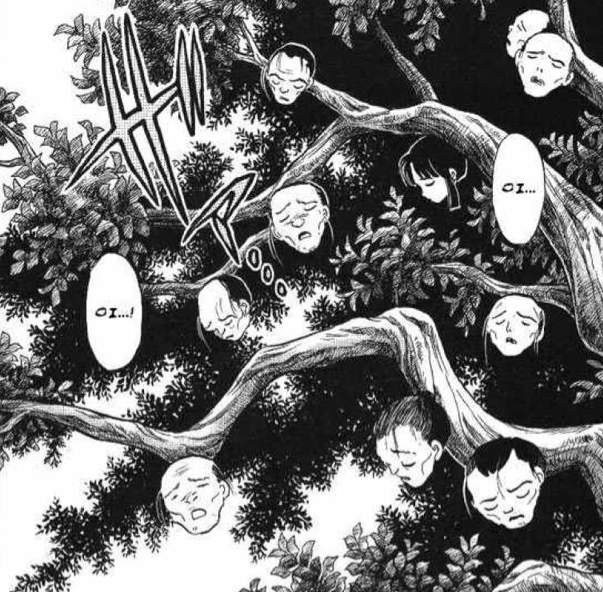
Takahashi may have the coolest resume of anyone working in manga today; not only did she study script writing with Kazuo Koike, she also worked as an assistant to Kazuo Umezu — an apprenticeship that’s evident in the early chapters of InuYasha. In between Kagome and InuYasha’s first encounters with Naraku are a handful of short but spooky stories in which seemingly benign objects — a noh mask, a peach tree — are transformed by Shikon Jewel shards into instruments of torture and killing. Takahashi’s horror stories are less florid than Umezu’s, with fewer detours into WTF? territory, but like Umezu, Takahashi has a vivid imagination that yields some decidedly scary images. Here, for example, is the demonic peach tree from chapter 79, “The Fruits of Evil”:

Takahashi doesn’t just use these images to shock; she uses them to illustrate the consequences of ugly emotions, impulsive actions, and violent behavior, to show us how these choices slowly corrode the soul and transform us into the most monstrous version of ourselves. (Also to show us the consequences of substituting human bones and blood for Miracle Gro. Kids, don’t try this at home.)

What Takahashi does better than almost anyone is walk the fine line between terror and horror. Gothic novelist Ann Radcliffe, author of The Mysteries of Udolpho (1794) and The Italian (1797), was one of the first writers to argue that terror and horror were different states of arousal. “Terror and Horror are so far opposite, that the first expands the soul and awakens the faculties to a high degree of life; the other contracts, freezes and nearly annihilates them,” she wrote in an 1826 essay, “On the Supernatural in Poetry.” Critiquing Radcliffe’s work in 1966, Devendra P. Varma explained that difference more concretely: “The difference between Terror and Horror is the difference between awful apprehension and sickening realization: between the smell of death and stumbling against a corpse.” And that’s exactly where Takahashi operates: she gives us tantalizing, suggestive glimpses of scary things, then keeps them obscured until the denouement of the story, allowing our imaginations to supply most of the grisly details. We read her work in a heightened state of awareness, which only intensifies our pleasure — and revulsion — when the true nature of Kagome and InuYasha’s foes are revealed.

* * * * *

If you haven’t looked at InuYasha in a while, or missed it during the height of its popularity, now is a great time to give it a try. Each volume of the VIZBIG edition collects three issues, allowing readers to more fully immerse themselves in the story. And if you’re a purist about packaging, you’ll be happy to know that VIZ is finally issuing InuYasha in an unflipped format — a first in the series’ US history.

Filed Under: Manga, Manga Critic, Recommended Reading, REVIEWS Tagged With: Horror/Supernatural, inuyasha, Rumiko Takahashi, Shonen, shonen sunday, VIZ, Yokai

The dreary skies of Hou Ou High

April 28, 2011 by David Welsh

When I do my “pick a dubious manga” polls, I have two preferred outcomes in mind. The first is that I’ll be pleasantly surprised by a manga that sounds questionable, finding a nugget of gold in an unexpected place. The second is that the book will be even worse than it sounds and that I’ll be able to unleash a bitter diatribe on something that’s offended one of my core values. The worst potential outcome is that I’ll merely be bored.

Unfortunately, the first choice in this series of reader-generated selections achieves that last result. Arata Aki’s The Beautiful Skies of Hou Ou High (Digital Manga) is garden-variety bad. Oh, it’s very bad, I assure you, but it’s not memorably bad.

It’s about a young lesbian whose mother contrives admission to an elite, all-boys’ school in the hopes that the complete immersion in a sea of wealthy dreamboats will burn the gay out of her daughter. (“The students are all fat-cats!” Mom crows. “If she gets pregnant, then we win!”) Aki doesn’t stage a train-wreck of skin-crawling sexual politics like Jun Yuzuki did with Gakuen Prince, mostly because I suspect Aki isn’t writer enough to conceive of a plot outlandish (or consistent) enough to be that awful.

Instead, we get a lot of quirky classmates out of central casting who harbor an inexplicable fascination with our heroine, Kei, whose defining characteristic is her stupidity. (“She really is an idiot,” Kei’s younger sister notes. In a moment of what’s later revealed to be understatement, her mother calls her “dimwitted.” “Man, everything about you is weak,” her first friend at school concludes.) Manga has a rich history of endearingly dumb protagonists. Kei Saeba is not among their number. She’s frantic and grating and dull, and her stupidity is so generic that it’s hard to invest any interest in it.

What passes for an ongoing subplot isn’t especially promising. The school’s administration has been blackmailed into admitting Kei, and they basically want her gone. (Sympathies, gentlemen!) The director is terrified of potential scandal involving a girl secretly attending the prestigious school, but he’s equally concerned with concealing his own secrets. I could go on, but I don’t care. Even a little.

I don’t care about stupid Kei. I don’t care about the blurry boy harem that Aki is assembling for her. I don’t care if the headmaster arranges for her to be tossed into a deep, icy well.

I do care about the fact that Digital Manga couldn’t be bothered to include translation notes for the volume, as at least knowing what some references were would have given me something to think about besides the manga I was trying to read. But no, all I had to work with were dull characters, inane plot developments, and a tone that couldn’t even work up the energy to offend me.

Blue Exorcist, I’m sorry I ever doubted you.


Filed Under: REVIEWS

Manga Artifacts: Rumiko Takahashi’s Rumic Theater

April 26, 2011 by Katherine Dacey

Most American readers know Rumiko Takahashi through her work in Shonen Sunday, but Takahashi has a foot in the seinen world as well. Maison Ikkoku ran in Big Comic Spirits from 1980-87, alongside Area 88 and Wounded Man, while short stories such as “To Grandmother’s House We Go” and “One Hundred Years of Love” appeared in Big Comic Spirits‘ sister publication Big Comic Original. In Japan, Takahashi’s seinen shorts have been collected into four volumes: 1 or W, The Tragedy of P, The Executive’s Dog, and Red Bouquet. Here in the US, however, only two have been translated into English: The Tragedy of P, which was re-titled Rumic Theater (1996), and 1 or W, which was published as Rumic Theater: One or Double (1998). (N.B. One or Double includes a handful of shonen and josei stories that appeared in Shonen Sunday and Petit Flower, respectively.)

These two translated volumes showcase Takahashi’s ability to work in almost genre. There are sports comedies (“The Grandfather of All Baseball Games”), domestic dramas (“Hidden in the Pottery,” “House of Garbage,” “The Tragedy of P”), rom-coms (“The Merchant of Romance,” “The Diet Goddess”), pop-culture spoofs (“Shake Your Buddha”), and ghost stories (“To Grandmother’s House We Go,” “One or Double”). As with Takahashi’s work in Shonen Sunday, many of these stories fold supernatural elements into everyday situations. In “Extra-Large Size Happiness,” for example, a woman’s relationship with her mother-in-law is strained by the sudden and frequent appearance of a household spirit that only she can see, while in “Reserved Seat,” a ghostly grandma takes possession of her grandson’s body so that she can honor her season tickets at the Takarazuka Revue.

Takahashi is a master at establishing her premise in just a few pages, allowing plenty of room for character development and broad comedy without compromising narrative momentum. One of the reasons Takahashi can be so economical is that she invests even the smallest moments with telling detail, making sure that every aspect of a character’s behavior is consistent with the story’s premise. In “Excuse Me for Being a Dog,” for example, the hero — who turns into a shiba inu whenever he suffers a nosebleed — acts like a canine even in his human form: he investigates an abandoned book bag with his nose, curls his lip at strangers, and recoils in the presence of pungent odors. Takahashi doesn’t make a big deal of these behavioral tics, but their inclusion in the story elevates Shiro’s condition from a wacky plot contrivance to a fundamental aspect of his existence. (OK, it’s also a wacky plot contrivance.)

Takahashi’s deep affection for her characters also contributes to the stories’ success. Though they bicker and tease and goad one another, the characters’ good will and mutual affection is seldom in question, even when their judgment is. Takahashi is as generous with her least sympathetic characters as she is with her leads, allowing them moments of wisdom and decency that often challenge the other characters’ perception of them. In “The Story of P,” for example, a man agrees to care for his eccentric client’s pet penguin, despite the fact the Hagas’ apartment complex doesn’t allow pets. For most of the story, Mrs. Haga plays cat-and-mouse with her neighbor Mrs. Kakei, the head of tenants’ association and a reputed animal hater. (Mrs. Kakei keeps tabs on the other tenants, notifying the management of any pet violations.) Yet in the last pages of the story, we learn that Mrs. Kakei has complicated, emotional reasons for ratting out her neighbors that stem, in part, from a genuine concern for animal welfare and not a humorless love of rules.

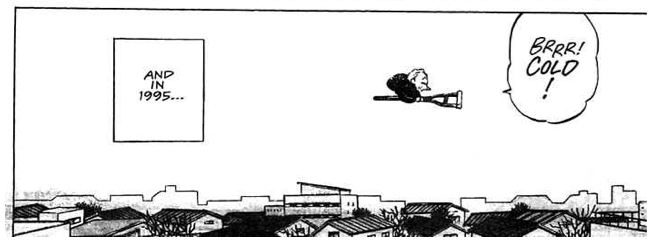
Art-wise, Takahashi produces some of the cleanest, most accessible layouts in manga. Her characters’ faces are easy to read, and her scenes are staged for maximum clarity and emotional impact; no one times a scare or a punch line better than Takahashi. Even more striking is the sense of mischief and play that informs her artwork. The elderly heroine of “One Hundred Years of Love,” for example, gains the ability to fly after surviving a near-death experience. Takahashi draws the old woman astride an enormous crutch, soaring over an urban landscape. At first, Mrs. Hoshino mutters about the weather, but soon she embraces the possibilities of flight, buzzing an unsuspecting eight-year-old apartment dweller:


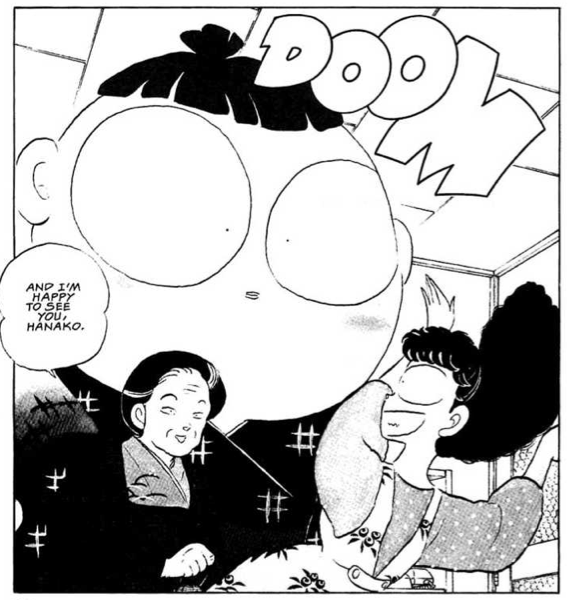
That same sense of mischief is evident in “Extra-Large Size Happiness,” in which a giant yokai pops into the frame — directly behind the frazzled heroine’s mother-in-law. Readers familiar with InuYasha‘s Shippo and Myogi will immediately recognize this round, genial figure:

The similarities between this nameless yokai and Myoga could be construed as a flaw or weakness of Takahashi’s style, but there’s an argument to be made that Takahashi employs a “star system” of her own. Granted, Takahashi never constructed a neat theoretical framework to explain the recurrence of certain characters in her stories, as Osamu Tezuka famously did for his. Flipping through the pages of Rumic Theater, however, it’s easy to imagine these characters as actors who specialize in certain types of roles, retaining something of their own “off-screen” personality and appearance in every story; as David Welsh observed in his recent essay on Ranma 1/2, “The fun is in seeing the specialists find variations on their distinctive themes.” And here, in Rumic Theater, the fun comes from seeing Takahashi’s regulars tackle more grown-up themes — marital discord, neighborhood politics, growing old — than might otherwise be permissible in the context of a long-form adventure such as InuYasha or Ranma 1/2 .

Filed Under: Manga, Manga Critic, Recommended Reading, REVIEWS Tagged With: Manga Movable Feast, Rumic Theater, Rumiko Takahashi, Seinen, VIZ

Blue Exorcist, Vol. 1

April 22, 2011 by Katherine Dacey

Have you ever seen the pilot episode of Law & Order? Most of the regular characters are present, and the script follows the three-act structure familiar to anyone who’s watched an episode of any Law & Order series, but the pacing is slack; the dialogue fizzles where it should crackle; and the actors struggle to create believable relationships between the characters, even as the script demands that they explain things to one another that, presumably, they’d already know from working together. Small wonder that “Everybody’s Favorite Bagman” languished for nearly a year before NBC rescued the show from limbo and ordered a full season of episodes.

So it is with Blue Exorcist, which has a first chapter that might charitably be described as a “pilot episode.” In these opening thirty pages, Kato introduces orphan Rin Okimura, a hot-tempered young man; Yukio, Rin’s snot-nosed fraternal twin; and Father Fujimoto, their guardian. Rin, we learn, is a direct descendant of Satan, and is in imminent danger of going over to the dark side. Father Fujimoto, however, has kept this information from his young charge, seeing fit only to explain the complexities of Rin’s lineage when Satan’s minions try to spirit Rin back to Gehenna, the demon realm. (Like all manga priests, Father Fujimoto spends more time fighting demons than preparing Sunday sermons or ministering to the sick, hungry, and bereaved.) An epic confrontation between Satan and Father Fujimoto leaves Rin’s mentor dead, forcing the boy to decide whether to cast his lot with Satan or with humanity.

There’s no reason why this opening prelude has to be such a bumpy, predictable ride, but Kato seems so intent on relating Rin’s entire Tragic Past in one installment that she trades naturalism for economy. (Sample: “I see you’ve returned. An overnight trip to the job center? How diligent of you.” And how helpful of Father Fujimoto to ask Rin a question to which he already knows the answer!) In the second chapter, however, Kato finds her stride with the material: the dialogue is looser and funnier; the characters’ relationships are more firmly and plausibly established; and she introduces her first genuinely memorable character, Mephisto Pheles. The plot is stock, with Rin vowing to avenge Father Fujimoto by enrolling in an exorcism “cram school,” but Kato enlivens the proceedings with humorous twists and nifty artwork.

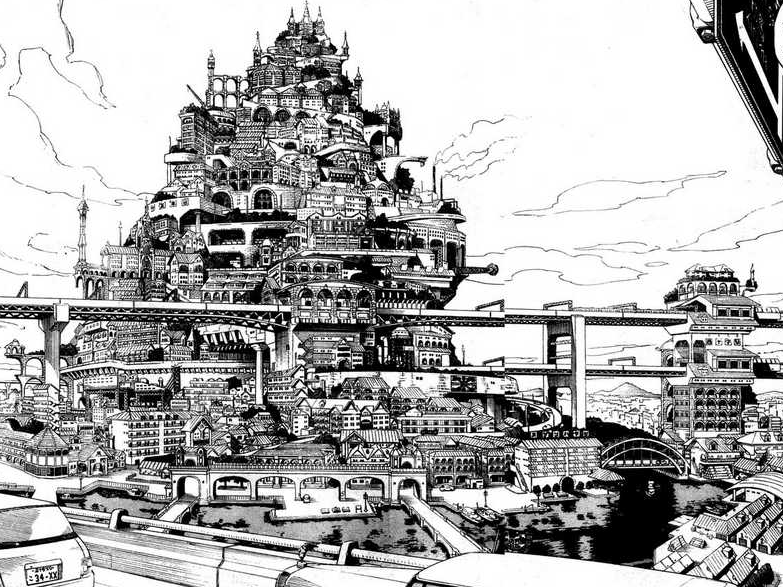
And oh, the artwork! It’s crisp and expressive, filled with small but suggestive details. Mephisto, for example, carries a patched umbrella and wears a polka-dot cravat — two minor flourishes that help establish him as a slightly decadent figure, elegant but down at the heels. The not-very-imaginatively named True Cross Town provides another instructive example of Kato’s meticulous and thoughtful draftsmanship: she lavishes considerable attention on architectural details and infrastructure, stacking layers of houses and buildings on top of one another to form a giant urban ziggeraut:

In short, Kato has created an imaginary urban landscape that seems to have evolved naturally over time, with old and new buildings side-by-side and modern modes of transport straddling canals and rivers. That kind of thoroughness may not serve much purpose in the context of a manga about demon fighters, but it lends Blue Exorcist a temporal and geographic specificity that’s sometimes missing in other areas of the story — like the religious bits.

Whatever my reservations about the first chapter, I freely admit that I’d fallen head-over-heels for Blue Exorcist by the end of the second. The brisk pacing, sharp artwork, and cheeky tone of these later chapters convinced me that Kazue Kato is in firm control of her story, and has successfully laid the foundation for the series’ first major story arc. Bring it on, I say!

BLUE EXORCIST, VOL. 1 • BY KAZUE KATO • VIZ MEDIA • 198 pp. • RATING: OLDER TEEN (16+)

Filed Under: Manga, Manga Critic, REVIEWS Tagged With: blue exorcist, Kazue Kato, Shonen, Shonen Jump, VIZ

From the stack: Chew: Taster’s Choice

April 21, 2011 by David Welsh

It’s time again to look at a title from the top 10 list of the 2011 Great Graphic Novels for Teens list assembled by the Young Adult Library Services Association of the American Library Association. The exercise is providing a nice variety of reading experiences, from a gracefully rendered adventure on the high seas to a slice of adolescent life in Guadeloupe. This month’s entry is Chew: Taster’s Choice (Image), the first collection a novel and occasionally nauseating detective series written and lettered by John Layman and drawn and colored by Rob Guillory.

This volume introduces us to Tony Chu, a police detective who also happens to be “cibopathic,” which means he experiences the full history of everything he eats. You may worry about food miles, but at least you don’t have to travel every one of them with your salad. As a result, Chu isn’t a very enthusiastic eater. The gift-curse does have its uses in the course of investigations, and Chu ends up drawing the interest of a strangely sinister Food and Drug Administration. The agency hires him to help solve food-related crimes.

Chu is assigned to work with fellow cibopath Mason Savoy, who is as stout and hearty as Chu is scrawny and drawn. They investigate the death of a food inspector, and Chu becomes smitten with a writer whose unique ability is to write about food so expressively that her readers react viscerally to her prose. Before Chu can pursue this fetching raconteur, he starts to sense that there may be more to the FDA and Savoy than he suspected, and the volume ends with Chu’s life changing drastically yet again.

Layman has a great sense of pacing. The chapters generally charge along at a nice clip, but there’s plenty of space for quirky details and funny set pieces. Guillory seems ideally suited for the material, straddling the line between amusingly absurd and full-on gross. Together, they’ve assembled an interesting cast, conducted some smart world building, and established an underlying plot that seems like it could sustain the series for some time. (Why did the FDA drive the poultry industry underground?) They also create enough of a level of internal logic to make the weirder elements fit quite nicely.

The only thing they haven’t seemed to do by the end of this volume is to figure out ways for Chu to solve crimes without eating human flesh. Given the volume of evidence available at the average crime scene, it seems like cannibalism would be a last resort for someone of Chu’s abilities. There are lots of marginally edible things lying around that are bound to be at least somewhat usefully resonant before starting in on the (not chicken) fingers. Aside from being revolting, the device feels limiting. Much as I enjoyed this volume, I want to see the hero vary his diet.


Filed Under: REVIEWS

From the stack: Onward Towards Our Noble Deaths

April 18, 2011 by David Welsh

There are several very welcome text pieces in Drawn & Quarterly’s handsome production of Shigeru Mizuki’s Onward Towards Our Noble Deaths – a foreword by Frederik L. Schodt, extensive translation notes, and an afterword by the creator. My favorite extra has to be an interview with Mizuki in which the legendary mangaka is simply not having it.

He’s not being difficult or unpleasant, but he’s not really game for the standard questions that legendary cartoonists generally get asked. His answers tend to be much shorter than the inquiries that triggered them. He won’t play into the “trailblazing artiste” narrative, nor will he won’t deprecate himself. He won’t list his influences, trash commercial comics, or paint the creation of Onward… as an artistic or personal struggle.

Of course, my favorite bit of the interview is when Mizuki is asked which of his works he’s most proud of and would like to see made available in English:

SM: I would have to say GeGeGe no Kitaro.

I would have to agree with him. Grateful as I am to have any of his work licensed and in translation, it feels kind of odd to start with one of his darker works. It would be like if Osamu Tezuka’s Ayako had been licensed before anyone had a chance to read Astro Boy. Of course, GeGeGe no Kitaro is a Kodansha property, some of which was published ages ago in the publisher’s bilingual comics initiative, so that complicates things. It’s also beloved and probably very expensive, so one can’t precisely fault other publishers for not waiting. Of course, Onward… was a Kodansha property as well, originally serialized in Gekiga Gendai, so it’s nice to see the publisher continue to work with other houses rather than keep everything for themselves.

And Onward Towards Our Noble Deaths has numerous merits in its own right beyond being part of Mizuki’s body of work. It’s based on Mizuki’s experiences as a soldier serving in Papua New Guinea during World War II and portrays the hardships and ill use average soldiers endured at the hands of their superiors. These abuses range from routine, almost desultory physical punishment – “New recruits are like tatami mats: the more you beat them, the better they are.” – to the overall military culture that paints surrender as the worst kind of shame and promotes dying in battle, no matter how senseless and futile the effort, as every soldier’s highest calling (aside from victory, obviously).

Mizuki doesn’t need to do much beyond merely portraying this mindset in order to condemn it. His cast of everyman grunts doesn’t pontificate about its fate. They gripe about the shortage of food, the isolation, the grueling routine, the danger and disease. The overarching injustices they face and the ways that these will doom them always loom, and the soldiers are keenly aware of them, but they’re rarely addressed directly in the text. This is welcome, because it keeps subtler, more effective condemnation from becoming an obvious screed, and it’s also natural in a way. It makes sense to me that these powerless people are reluctant to address the fact that their day-to-day suffering is almost certainly for nothing, and that the people responsible for their fate know that and don’t care. As a result, it’s a very straightforward, chronological narrative. The soldiers arrive, conditions deteriorate, they face unthinkable danger and impossible choices, and things end badly. The approach serves Mizuki’s aims well.

The visual style can be jarring at times. Mizuki paints lushly realistic backdrops and peoples them with cartoonish figures. That isn’t problematic by itself, as I’m more than happy to embrace the combination of cartoonish and gruesome in works like Tezuka’s MW and Ode to Kirihito. There are moments when Mizuki’s particular stylization is not just dissonant with his subject matter but directly at odds with it. This is particularly evident in more violent scenes when body parts are flying, and Mizuki’s strict adherence to his character aesthetic sometimes results in panels that look more ridiculous than horrific. He’s also dealing with a large cast, and individuality tends to get lost in terms of design and simple space to develop characters thoroughly. Ironically, it’s the higher-ups who make the strongest impression. Again, that fits, since they’re the ones with the most agency, and it reinforces the brutal expendable status of the rank and file.

It’s an effective piece on the whole, and I’m glad I had the opportunity to read it. The overall level of restrained sincerity is welcome and makes the piece stand out in the field of autobiographic comics. I’m also pleased that Drawn & Quarterly chose to mark the occasion of Mizuki’s proper English-language debut with proper introductory pieces providing an overview of his career and impact. If it doesn’t seem like the ideal piece to use for Mizuki’s reintroduction, it certainly does him credit.


Filed Under: REVIEWS

From the stack: Cross Game vol. 3

April 14, 2011 by David Welsh

Hello, and welcome to the latest installment of “David Gushes over Mitsuru Adachi’s Cross Game!” Listen, I know I’ve crossed over from any kind of clear-eyed critical examination into full-on, sweaty, tent-in-a-parking-lot evangelism with this title, but I also know that I’m beyond caring. This series delivers joy on a regular basis.

The third omnibus, which collects the sixth and seventh volumes of the series, can be reduced to the simplest of sports manga narratives. The team of plucky upstarts prepares for a big game, then plays the big game, then reacts to the outcome of the big game. It doesn’t get much purer than that, and the arc here is certainly exciting in terms of that basic outline.

But it’s so much more than that. Ultimately, the events portrayed here are about justice, about heart and determination winning out against elitism and presumption. Of course, that’s also one of the least novel conflicts ever to grace the pages of manga as a category, but still…

The thing is, while Adachi is working with one of the oldest road maps in the form, he doesn’t take a straight line anywhere. Our scruffy heroes don’t gaze off into the middle distance and make vows about their future. They’re too realistic for that. They don’t lapse into paragraphs of internal monologue about what’s happening, because Adachi draws too well and frames sequences too clearly for that to be necessary. Characters can behave entirely believably and still surprise you, because Adachi doesn’t feel the need to underline their every thought or feeling. He trusts your ability to comprehend subtext, to remember past moments, and to connect what you already know or suspect with what you see unfolding on the page in front of you.

As goofy as Adachi’s sense of humor can sometimes be, he can also tug at your heartstrings or thrill you with moments big and small. You can be both elated and tickled when justice is visited upon the smug. You can snicker at and feel sympathy for the team dork during his mishaps, and you can feel touched but not manipulated as characters inch towards a better understanding of each other.

It’s just an awesome comic, you guys. It does everything you expect a comic of this sort to do, but it does them with such distinctive style and heartfelt sincerity that you’ll never notice you’ve visited this territory before. Awesome.


Filed Under: REVIEWS

Butterfly, Vol. 1

April 11, 2011 by Katherine Dacey

Reading Butterfly won’t change your life, make you a better person, or cause subtle but significant changes to South American weather patterns, but it may just restore your faith in Tokyopop’s ability to suss out smart, entertaining series that quietly subvert genre conventions.

The genre in question is what I call “seeing dead people,” in which a teenager struggles to cope with the unwanted ability to interact with ghosts. Normally, these long-suffering teens see spirits everywhere, but Genji Ishikawa, Butterfly‘s protagonist, sees only one ghost: his older brother, who committed suicide after pushing a girl into the path of an oncoming train. Though Genji would like nothing better than to have a girlfriend, his tragic past and rumored ability to speak to the dead proves irresistible to classmates with an interest in the paranormal.

Genji has another problem: he’s ¥600,000 in debt, more than he could hope to earn through an after-school job. When a peculiar girl approaches him with a money-making proposition, he reluctantly accepts, only to renege on their agreement when he realizes what he’s being asked to do: tangle with ghosts. Or, more accurately, tangle with what Ageha’s clients believe are ghosts; she has the ability to make people’s fears take corporeal form, and expects Genji to “kill” these projections for her clients’ benefit.

Though Ageha is a type we’ve seen before — manipulative, preternaturally calm, faintly androgynous — her abilities put an interesting twist on the “seeing dead people” premise. She clearly profits from her deceptions, but her fraud is, at bottom, a useful public service, one that allows shopkeepers, frightened swimmers, and hotel chambermaids to resume their normal routines after a catastrophic event, even if these “exorcisms” don’t actually help the dead cross over to the afterlife. As mercenary as Genji finds Ageha, her success forces him to to consider the possibility that his own spiritual powers are less a bane than a blessing, that he has an obligation to develop and use them, rather than deny their value.

The only downside to such an ambitious premise is that Yu Aikawa needs almost every page of volume one to establish the basic parameters of her story. Some of the exposition is handled gracefully; the details of the brother’s death, for example, are revealed slowly and casually, forcing the reader to piece together what happened to him with little authorial guidance. Some of the exposition is handled clumsily, however; Ageha and Genji’s first few encounters seem more like job interviews than spontaneous exchanges of information, an impression that isn’t thoroughly dispelled until one of their ghostbusting gigs goes awry.

Narrative hiccups aside, the story that’s beginning to emerge in the later chapters of volume one is compelling, a supernatural mystery that explores its characters troubled emotional lives with the same thoroughness as it dispenses with pesky spooks. Recommended.

BUTTERFLY, VOL. 1 • BY YU AIKAWA • TOKYOPOP • 208 pp. • RATING: TEEN (13+)

Filed Under: Manga, Manga Critic, REVIEWS Tagged With: butterfly, Seinen, Tokyopop, Yu Aikawa

Tidbits: Shonen Jumpin’ Jehosaphat

April 11, 2011 by Michelle Smith

Sometimes I just crave some shounen manga! Here, then, are a few short reviews of some shounen I have lately read: the third volume of Bakuman。, the 31st through 34th of Bleach, the second of Genkaku Picasso, and the thirteenth through fifteenth of Slam Dunk. All are fairly recent releases and all published under VIZ’s Shonen Jump imprint; Bakuman。 and Genkaku Picasso also have new volumes due out in May.

Bakuman。3 by Tsugumi Ohba and Takeshi Obata
This was my favorite volume of Bakuman。 so far!

It begins with Mashiro and Takagi struggling to create a mainstream battle manga, over the objections of their editor, because they believe this is the ticket to popularity in Shonen Jump. They improve a lot between attempts, but in the end, Takagi requests some time alone over summer break to think of a new story, leaving Mashiro free to work as an assistant for Eiji Nizuma, their rival.

MJ adores Eiji, and when he first appeared in this volume I was wondering how that could be, since he comes across as bratty and weird. Once you get to know him, though, it turns out he’s actually kind of endearing. He simply says what he thinks, and is incapable of being malicious or devious. After watching him happily and genuinely soak up feedback from his assistants—apparently his editor at Jump is too in awe of his genius to offer any useful guidance—I kind of love him, too!

To top it off, we see some growth from the female characters. Miho makes some progress in her dream of becoming a voice actress, although right now she seems to be succeeding mostly on account of her good looks. Miyoshi comes up with the goal of being a novelist, though her primary function in this volume is to captivate Takagi with her general awesomeness and make Mashiro doubt that his partner is working on the promised story at all.

In the end, the future of the partnership appears to be in jeopardy, even though both guys have independently hit upon the idea of a detective manga as the way to go. I’ve always found this series interesting for its inside glimpse into the publication process, but now I’m starting to find it interesting for the characters, as well. I eagerly await volume four!

Bleach 31-34 by Tite Kubo
You might not think that battles against creepy supernatural foes with bizarre powers could be boring, but it turns out that Bleach somehow manages it.

Volumes 31 through 33 are chiefly comprised of fights against weird-looking dudes during which nearby structures often go “boom” and crumble. It’s pretty much impossible to tell what’s going on, so I just sort of coast along until there’s a panel that shows someone actually being hurt by something. There are but two bright spots in these volumes. One is the predictable but still gratifying revelation that Nel, the toddler who’s been accompanying Ichigo in his journey across Hueco Mundo, is actually a badass (and buxom) former Espada. The second is an honestly riveting scene in which a hollowfied Ichigo appears before Orihime for the first time and terrifies her.

Things improve a bit in volume 34 with the timely arrival of some Soul Reaper captains. Okay, yes, their explanation for their arrival is pretty flimsy, but I will accept any excuse if it means Byakuya will be around. This also leads to a crazy battle of one-upsmanship between one of the stranger Soul Reapers, Kurotsuchi, and his Arrancar opponent. It goes something like this:

Arrancar: Fear my leet skills! I will turn your innards into dust!

Kurotsuchi: Oh, actually, I infected [Uryuu] with surveillance bacteria the last time we were fighting, so I’ve been watching your battle and, aware of your abilities, have replaced all my insides with fakes. Too bad. Now my gloopy pet will eat you.

Arrancar: Lo, I have been et. But before that happened I implanted [Nemu] with my egg, which will hatch and grow a new me! Plus, there are bits of me still in your pet, which will allow me to use it to attack you.

Gloopy pet: *splat*

Kurotsuchi: Oh, but before you did that I programmed my pet to self-destruct if anyone ever tried to use it against me. Also, I filled Nemu’s body full of drugs for the same reason, so now you’re going to see everything in extreme slow mo while I kill you.

Arrancar: Crap.

Honestly, it’s so outrageous one kind of can’t help admiring it!

Genkaku Picasso 2 by Usamaru Furuya
I really wish I could like Genkaku Picasso more. Mostly this is because Usamaru Furuya’s art is really impressive—true, in their normal states the characters don’t look all that exciting (and the lip-glossy sheen on the boys’ lips is somewhat distracting) but the illustrations created by artistic protagonist Hikari Hamura are detailed and gorgeous, and I like that Furuya continues drawing in that style when Hikari and his ghostly advisor, former classmate Chiaki, enter into the drawings in order to help solve the problems plaguing their classmates.

The problem is that I just don’t like any of the characters! Hikari is creepy, anti-social, and perverted, and is always reluctant to help out his classmates, putting Chiaki in the role of always being the one who reminds him that he has to help them, otherwise he’s going to rot away. (He cheated death in volume one and this is the manner in which he must pay for that.) I could possibly like Chiaki if she were given something to do besides pester Hikari all the time, but that’s not the case.

The manner in which the classmates are helped by Hikari and Chiaki is also odd. The pair enters a drawing based on the “heart” of said classmate and attempts to figure out what is worrying them. One boy has created a fictional girlfriend, for example, while another girl sees herself as a mecha rather than an actual girl. While inside the drawing, Hikari and Chiaki attempt to reason with the classmate, while in the real world, the classmate answers them aloud, making them look totally freaking crazy to the people who happen to be around. If I was hanging out with my friend and he began to break up with his imaginary girlfriend right in front of me, I think I would be quite alarmed.

That said, there is one bright spot in this volume—the tale of Yosuke, a girl born in a body of the wrong gender. Perhaps it’s a little too optimistic, but I liked it anyway, especially the fact that the “heart” of the transgender kid is the calmest and healthiest place we’ve seen yet.

If Genkaku Picasso were any longer, I might not continue it, but since there’s only one volume left, I shall persevere.

Slam Dunk 13-15 by Takehiko Inoue
Ordinarily, if a series took two-and-a-half volumes to cover less than an hour of action, I might be annoyed. Not so with Slam Dunk, which takes that long to finish Shohoku High’s exciting prefectural tournament match against Kainan, a team that has made it to Nationals every year in recent memory.

There’s an interesting phenomenon that occurs when one reads Slam Dunk. Hanamichi Sakuragi, the hot-headed protagonist, has matured somewhat since the beginning of the series, though he’s still inclined to proclaim himself a genius at every opportunity. Hence, it’s pretty satisfying to see him humbled, and to watch him realize that he hasn’t yet got the skills to carry the team or hog the spotlight. And yet, there comes a point where the humbling has been sufficient, and one wants to see him triumph.

When Captain Akagi sprains his ankle during the game, Sakuragi, realizing how immensely important this game is to Akagi, does his best to fill the captain’s shoes. How can you not root for someone trying so hard to make someone else‘s dream come true? Yes, it’s the talented Rukawa who is single-handedly responsible for tying up the game by halftime, but Sakuragi is just trying so damned hard that his bluster actually becomes a source of strength for his teammates. When he finally makes an impressive slam dunk in front of a cheering crowd, I convince that I got a little sniffly.

Shohoku ends up losing the game, though this doesn’t put them out of the running for Nationals just yet. The disappointing experience makes Sakuragi more serious than ever before and he returns to school with a shaved head (as penance for an unfortunate mistake during the final seconds of the game) and a fierce desire to improve.

Why do I love sports manga so much? I’m honestly not sure I can articulate it, but with Slam Dunk part of it is the fact that the hero, who previously had no goals in life, has found a place to belong and something to care about. That kind of story pushes my personal buttons in a big way.

Review copies for Bakuman。, Genkaku Picasso, and volume fourteen of Slam Dunk provided by the publisher.

Filed Under: REVIEWS Tagged With: Shonen Jump, Takehiko Inoue, Takeshi Obata, VIZ

From the stack: Korea as Viewed by 12 Creators

April 11, 2011 by David Welsh

I don’t know if it was editorially composed to be this way, but Korea as Viewed by 12 Creators (Fanfare/Ponent Mon) puts its least successful pieces first, allowing the stories to build in ambition and interest as the anthology progresses. The order leaves the reader with the strongest possible impression of the collection and only a scant memory of the introductory blandness. It’s a smart choice.

Choi Kyu-Sok opens the collection with “The Fake Dove,” a reminder that pretense is an international language. In it, a manhwa artist tries to live among the homeless for an assignment. It’s exactly what you’d expect – halfhearted, privileged guilt tempered by winking cynicism. “Feel bad about their plight, but you can still complain about the way they smell.”

Catel’s “Dul Lucie” has a promising idea – the creator’s attempts to show South Korea through her trademark character’s eyes. Unfortunately, it ends up being a shapeless blend of travelogue and authorial excuse-making. It’s not without charm, though, and I’d like to read some of Catel’s other work. (This chapter is among those that suffer from sometimes awkward, seemingly rushed translation; happily, none of the really good pieces fall victim to that fate.)

Things start to perk up with “Solego’s Tree,” by Lee Doo-hoo. A gifted artist finds that masterworks can have unintended consequences in a simply structured, beautifully drawn little parable.

Alas, it’s back to the bland with Vanyda’s “Oh Pilsung Korea!” A French brother and sister (whose father is Korean) bemoan the fact that they aren’t seeing “the real Korea” during their visit. Putting aside the fact that they haven’t made any specific efforts in that direction, I always find the notion of finding the “real” anywhere kind of presumptive. If the story had been about the impracticality of expectations or the travelers’ accountability, there might have been something here.

I liked “Cinderella” by Park Heong-yong, a tale of boyhood mischief that morphs into something stranger but still welcoming. I found Mathieu Sapin’s “Beondegi” twee in the way I generally react to “normal person gets dragged into wacky misadventures by a free spirit” fiction. Byun Ki-hyun makes a conscientious effort to illustrate the ways women are underestimated and overlooked in “The Rabbit,” blending elements of fantasy into a realistic urban landscape. The results aren’t especially memorable or persuasive, though.

The anthology really takes off with Igort’s “Letters from Korea.” It displays the sharpest point of view of any of the stories up to this point, and the creator clearly filtered his experiences into a coherent, thematically resonant narrative. He recounts his experiences with artisans of various levels and types, from someone who crafts handmade notebooks to a legendary animator to the people who merely leave notes to loved ones on the border with North Korea. It’s a story with interesting things on its mind, representing a meaty kind of travel experience that’s well worth sharing.

Utterly different and even more glorious is “The Pine Tree,” by Lee Hee-jae. A large family gathers in their rural hometown for the funeral of their patriarch. It speaks clearly and eloquently of the power of tradition and the enduring bonds of home as it articulates, moment by moment, the experience of the wake, the funeral, and the landscape where they’re set. I’d love for someone to publish more of Lee’s comics if they’re even remotely close to the quality of this piece.

We’re back to travelogue with Hervé Tanquerelle’s “A Rat in the Country of Yong,” but what a travelogue it is. Tanquerelle forgoes conventional detail for wordless, anthropomorphous charm. It’s such a treat to see Tanquerelle visually frame the experience of going someplace utterly new in classic, children’s-book fashion. The experiences aren’t exactly novel, but their rendering has such endearing freshness and such a warm point of view that I doubt most readers will care.

Chaemin snaps us back into the real world with “The Rain that Goes Away Comes Back,” a glimpse at what the Korean equivalent of josei must look like. As with “The Rabbit,” Chaemin shows the challenges and choices working women face. Unlike “The Rabbit,” Chaemin doesn’t need to rely on obvious metaphor. Her protagonist, an unmarried woman working at a social service agency, makes eloquent points about the pros and cons of solitude and makes anxiety about the future palpable, while keeping it at a recognizable, human scale.

Things close out on a totally whimsical note with Guillame Bouzard’s “Operation Captain Zidane.” Bouzard, in a hilariously self-parodying frame of mind, paints his trip to Korea as a ridiculous bit of subterfuge tied to the World Cup. Bouzard neatly and winningly satirizes politics, nationalism, and manic sports fandom in this smart and frisky closer to the book.

While Korea isn’t as consistently successful as its predecessor, Japan as Viewed by 17 Creators, there’s more than enough excellent material here to make it worth your time. Its high points are extremely high, and they’re varied in tone and approach. It’s about two-thirds of a good-to-great anthology, which is a totally acceptable rate of return.


Filed Under: REVIEWS

  • « Go to Previous Page
  • Page 1
  • Interim pages omitted …
  • Page 299
  • Page 300
  • Page 301
  • Page 302
  • Page 303
  • Interim pages omitted …
  • Page 346
  • Go to Next Page »
 | Log in
Copyright © 2010 Manga Bookshelf | Powered by WordPress & the Genesis Framework