• Skip to primary navigation
  • Skip to main content
  • Skip to primary sidebar
  • Home
  • About Us
    • Privacy Policy
    • Comment Policy
    • Disclosures & Disclaimers
  • Resources
    • Links, Essays & Articles
    • Fandomology!
    • CLAMP Directory
    • BlogRoll
  • Features & Columns
    • 3 Things Thursday
    • Adventures in the Key of Shoujo
    • Bit & Blips (game reviews)
    • BL BOOKRACK
    • Bookshelf Briefs
    • Bringing the Drama
    • Comic Conversion
    • Fanservice Friday
    • Going Digital
    • It Came From the Sinosphere
    • License This!
    • Magazine no Mori
    • My Week in Manga
    • OFF THE SHELF
    • Not By Manga Alone
    • PICK OF THE WEEK
    • Subtitles & Sensibility
    • Weekly Shonen Jump Recaps
  • Manga Moveable Feast
    • MMF Full Archive
    • Yun Kouga
    • CLAMP
    • Shojo Beat
    • Osamu Tezuka
    • Sailor Moon
    • Fruits Basket
    • Takehiko Inoue
    • Wild Adapter
    • One Piece
    • After School Nightmare
    • Karakuri Odette
    • Paradise Kiss
    • The Color Trilogy
    • To Terra…
    • Sexy Voice & Robo
  • Browse by Author
    • Sean Gaffney
    • Anna Neatrour
    • Michelle Smith
    • Katherine Dacey
    • MJ
    • Brigid Alverson
    • Travis Anderson
    • Phillip Anthony
    • Derek Bown
    • Jaci Dahlvang
    • Angela Eastman
    • Erica Friedman
    • Sara K.
    • Megan Purdy
    • Emily Snodgrass
    • Nancy Thistlethwaite
    • Eva Volin
    • David Welsh
  • MB Blogs
    • A Case Suitable For Treatment
    • Experiments in Manga
    • MangaBlog
    • The Manga Critic
    • Manga Report
    • Soliloquy in Blue
    • Manga Curmudgeon (archive)

Manga Bookshelf

Discussion, Resources, Roundtables, & Reviews

Reviews

A Certain Scientific Railgun, Vol. 4

May 30, 2012 by Sean Gaffney

By Kazuma Kamachi and Motoi Fuyukawa. Released in Japan as “Toaru Kagaku no Railgun” by ASCII Media Works, serialization ongoing in the magazine Dengeki Daioh. Released in North America by Seven Seas.

This volume, as the back cover tells you, marks the start of the ‘Sisters’ story arc for Railgun. Which, if you’re only following the manga, means very little to you. But this is not a manga for those who merely read the manga (though it can be read on its own fairly easily, as I have shown). Franchise manga tend to lack the surprising plot twists that original titles may have, simply as they rely on an already existing base. So if you’re buying this 4th volume of the Railgun manga, it’s already expected that you’ll have bought the Index light novels, and the Index manga and anime, and indeed Railgun’s own anime, which is namechecked here. Higurashi does this too – I’ve been coyly pretending not to know who the villain is in my reviews, but of course I do – as did all the readers of the manga when it came out. Expectations are set differently.

That said, this volume has a lot to offer. It’s rather upfront about the way that it manipulates its cast – particularly its heroine, Misaki. We start right off with her being shown a boy with muscular dystrophy, and asked to donate some of her DNA to help fight such things. Which would be fine, if she had parents who were also giving consent, or if the scientist askin g didn’t have an evil leer on his face after she agrees. No, we know we’re going to be getting into evil clones right off the bat. (Well, the cover might have clued us in as well.)

Of course, the evil is debatable – the clone on the cover actually looks rather sad and vulnerable (and mysteriously missing genitalia, in the best time-honored tradition). And indeed, when we first meet Misaka 9982, she is immediately filled with likeable traits. She’s snarky, and intelligent, and deadpan, and talks in the third person (something I wasn’t sure Seven Seas would carry over – it sounds more awkward in English, but does help to set the clones apart from the original). This is contrasted with Misaka herself, who spends the entire volume frustrated and not sure how she should feel. She’s heard the rumors before, but being faced with the actual reality is a bit much.

As we see Misaka meet her clone, and have amusing arguments with her clone, and come to see her clone as a little sister sort of figure – complete with giving her a frog badge she got from a crane machine – we know, instinctively that we’re heading for tragedy, and that this clone is going to die. Of course, the number ‘9982’ after her name might also clue us in – these clones are being created as experimental subjects, and their purpose is to die for the greater good. I suspect Misaka is not going to see it that way, however, and the volume ends with her losing it and attacking the mysterious boy who is responsible.

All of this is handled quite well. The manga flies by, and we get just enough characterization from Misaka 9982 to feel horrible about what happens. And certainly we immediately loathe Accelerator, the young man who seems to be our heroine’s new villain. Ah well, I’m sure he will simply be a minor villain… you see? There I go again, pretending that this isn’t a franchise. :) Definitely recommended.

Filed Under: REVIEWS

Puella Magi Madoka Magica, Vol. 1

May 29, 2012 by Katherine Dacey

The opening pages of Puella Magi Madoka Magica suggest a dreary retread of Sailor Moon: Kyubey, a talking cat, appears before Madoka Kaname, a perky yet otherwise unremarkable school girl, and asks her, “Would you like to change destiny?” Our first clue that Puella has something nastier up its be-ribboned sleeve occurs midway through the first chapter, when transfer student Homura Akemi confronts Madoka with a dire, if cryptic, warning: “You should never consider ‘changing yourself’ in any way,” she tells Madoka. “If you choose not to heed my words, those things that you hold dear will all be lost.” Homura then attacks Kyubey, accusing him of using “dirty tactics” to persuade Madoka to make a contract with him.

Though all the trappings of a traditional magical girl manga are in place — the costume changes, the cute familiars, the teamwork — Puella charts a darker, more violent course than other translated examples of the genre. Homura and Madoka operate in a world where magical girls routinely die; though their powers are formidable, magical girls are worked to the point of emotional and physical exhaustion. Moreover, their contracts are signed under duress; Kyubey frequently appeals to girls in desperate circumstances, using their vulnerability as leverage. (In exchange for battling witches, he explains to Madoka, “I fulfill one wish. Any wish you want!”)

In short, Puella manages to have its cake and eat it, too, faithfully adhering to the genre’s conventions while offering an explicit critique of its underlying message of courage and selflessness. The story is the antithesis of a wish-fulfillment fantasy: the powers that Kyubey bestows come with responsibilities that are too difficult for a young, inexperienced person to bear. Throughout the manga, we see examples of magical girls who have become competitive or embittered by their experiences, at risk of becoming witches themselves. We also meet girls who regret the haste with which they made their contracts, as their wishes were fulfilled at the expense of friends and family members.

As sharp as Puella‘s genre critique may be, the artwork is a disappointment. The character designs are faithful to the original anime, but the magical elements look smudgy on the page, the product of too much dark grey screentone. The anime’s surreal fight sequences have lost their visual punch as well. Creatures that looked strange and menacing in color have been defanged, reduced to cute video game monsters floating above the picture plane.

Most of the fight scenes have been compressed into a few pages, further curtailing their impact; we barely have time to register who the opponents are before one of the magical girls has eliminated the threat. As a result, the volume’s climatic scene lacks emotional resonance. Though the characters have repeatedly discussed how dangerous their vocation is, the fight is so fleeting and impressionistic that the stakes seem too low to yield such a devastating outcome.

If the artwork lacks the personality of a Magic Knight Rayearth or Cardcaptor Sakura, however, the actual story is on par with the best translated examples of the magical girl manga. Like the aforementioned CLAMP titles, Puella Magi Madoka Magica treats the magical girl as a character worthy of complexity and genuine interiority; the Puella girls may engage in magical combat, but they’re painfully aware that saving the world can be an ugly business — even if they’re wearing smart costumes.

Review copy provided by Yen Press.

PUELLA MAGI MADOKA MAGICA, VOL. 1 • STORY BY MAGICA QUARTET, ART BY HANOKAGE • YEN PRESS • 144 pp. • RATING: OLDER TEEN (16+)

Filed Under: Manga, Manga Critic, REVIEWS Tagged With: Magical Girl, Magical Girl Manga, Puella Magi Madoka Magica, shojo, yen press

Oishinbo A La Carte, Vol. 2 (Sake)

May 22, 2012 by Sean Gaffney

By Tetsu Kariya and Akira Hanasaki. Released in Japan by Shogakukan, serialization ongoing in the magazine Big Comic Spirits. Released in North America by Viz.

It’s time for the Oishinbo Manga Moveable Feast, and though I had already reviewed the final volume a long time ago (see sidebar), I thought that I would take this time to revisit another volume, one which got a lot of buzz when it first came out over here. That would be the one devoted to sake, Japan’s national alcoholic beverage. And so we get several chapters, including one long multipart epic, devoted to what makes good sake – and why so much of it these days is bad.

Given that Oishinbo is about singing the praises of Japanese food, it’s not particularly surprising that much of it involves praise for Japan in general. One chapter here involves a businessman who has been ‘Westernized’ and has to be reminded of the joys of good old Japanese cooking and liquor. That said, it’s rather startling how much of this volume is just ripping into Japan’s sake trade over and over again. I’ve no idea if things are the same these days (these chapters were written 15-25 years ago), but much is made over the fact that popular sake in Japan tends to be watered down in order to increase profit, and have additives such as charcoal and MSG. It can get fairly depressing.

That said, of course, you knock them down in order to build them up. We also get much praise of the good old-fashioned small-time sake brewer, still using pure ingredients with no additives and storing it properly to bring out the best flavor. There’s actually a lot of comparison with French wine, in a way that reminded me of The Drops of God – it’s noted that France would never treat its wine the way Japan does its sake.

In these Viz compilations, characterization usually falls by the wayside – the danger of working with a 108+ volume series – but we still get a good sense of the main players, which is important for a series like this. You have to sympathize with Yamaoka and Yuka, and care about their lives, as otherwise you’re left with nothing but a manga that lectures you. (Which, admittedly, it can sometimes be anyway.) Yamaoka shows off his cleverness in the final chapter, which reminds us that sake is still an alcohol, and that there are some people who abuse that. And Yuka really shines in the multi-part story, managing to sweet-talk Yamaoka’s father, Yuzan (this is actually a running thing in the series, and Yuka is very, very good at it – note Yuzan’s retainers giggling). There’s no romance here, but if you want that go lean Japanese and then buy the original Vol. 47, which has the wedding.

At the end of the day, though, the way to judge Oishinbo is by its ability to make you want to search out more. After this volume, I wanted some sake – just as I wanted to visit an Izakaya after the final Viz volume. Oishinbo may be about a battle between father and son, or a growing romance between colleagues, but that’s just the spice. The real meat of the manga is its love of food and its burning passion for it being cooked and served properly. And it’s something yoou can’t really get in North American Comics, either, though I’d love Batman’s recipe for crumble apple pie.

Filed Under: REVIEWS

Until Death Do Us Part, Vol. 1

May 19, 2012 by Katherine Dacey

Until Death Do Us Part is a slickly packaged compendium of action movie tropes that reads like a story. That’s not to say it’s bad — it isn’t — but to warn you that you may experience a powerful sense of deja-vu as you thumb through its numerous shoot-outs, explosions, and speeches about terrorism.

The opening pages plunge us directly into the action: a solemn pre-teen girl leaps from a speeding car, accosts a blind man, and begs him to help her, promising him jewels and money in return for his assistance. That man, Mamorou, proves surprisingly adept at dispatching bad guys; he’s a modern-day Zaitoichi, using a pair of special goggles and a fine-edged sword to disarm Haruka’s captors, a group of thugs in the employ of the Ex Solid Corporation. (Which begs the question: how does such an ill-named company stay in business? But I digress.) Haruka’s ability to pick Mamorou from a crowd of thousands is no accident; like the pre-cogs in Minority Report, she has an uncanny ability to predict the future. For several years, she used that power to enrich her family — mostly by playing scratch tickets — but now she finds herself running from several powerful organizations, each of whom sees her precognition as a tool for advancing their own interests.

Whether Until Death‘s similarities to The Professional, Mission: Impossible, Minority Report, and the entire oeuvre of Jason Statham are intentional is difficult to say; some of the plots skirt the line between theft and homage. Mamorou’s fellow crime fighters, in particular, seem like IMF recruits, as they’re armed to the teeth with the latest spy technology and weaponry — an incredible feat for an off-the-the-grid vigilante organization with no ties to the government or the mob. (Just in case we don’t fully appreciate how awesome this weaponry is, there are several scientists on hand to explain in excruciating detail how they work.) The sheer abundance of borrowed characters and story lines, however, work in Death‘s favor, with no single borrowing overpowering the resulting fusion of sensibilities.

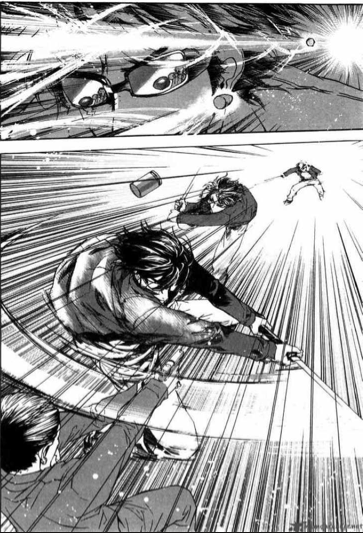
Like many action manga, the artwork tacks between static scenes of talking heads — usually imparting some key points of information about a bad guy’s history, or describing a hypothetical technology — and kinetic scenes of bone-crunching violence. Though the fights aren’t as inventively staged as a John Woo shoot-out, DOUBLE-S wins points for carefully delineating the space in which the gun battles unfold; the reader is conscious of how walls, objects, and sight lines influence the outcome of those battles. DOUBLE-S is overly enamored of slo-mo bullets — a visual gimmick so overused in the last fifteen years it’s become a parodic gesture — but he uses it to good effect, demonstrating how swiftly Mamorou moves, and how precisely his blade slices through solid objects:

Mamorou slices bullets with his scientifically modified katana.

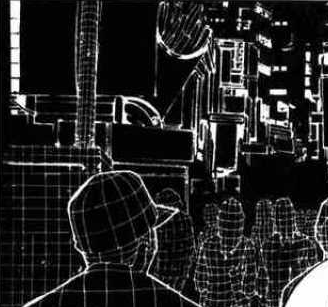
DOUBLE-S has several other nifty tricks up his sleeve as well. In one of the manga’s recurring visual gambits, DOUBLE-S shows us how Mamorou perceives his environment through his special goggles:

A Tokyo street as viewed through Mamorou’s goggles.

Though the characters are recognizable in their computer-enhanced form, they have a spectral quality to them; if anything, they resemble echoes or after-images, rather than corporeal entities. The artist’s quick cuts between Mamorou’s perspective and ours neatly underscores how much Mamorou must rely on his other senses to give these incomplete forms flesh and blood: how else could he be so devastating, given the limitations of his goggles?

Perhaps the best compliment I could give Death‘s creators is to note the skill with which it recycles familiar action-movie conventions. We’ve seen Death‘s characters and plots and scientifically implausible weapons in other stories, but Hiroshi Takashige and DOUBLE-S stitch them together in such a fashion that the seamwork is almost invisible. The resulting manga isn’t original, exactly, but it has enough style and integrity to engage the reader’s interest, making it an agreeable beach or airplane companion.

Review copy provided by Yen Press.

UNTIL DEATH DO US PART, VOL. 1 • STORY BY HIROSHI TAKASHIGE, ART BY DOUBLE-S • YEN PRESS • 448 pp. • RATING: OLDER TEEN (16+)

Filed Under: Manga, Manga Critic, REVIEWS Tagged With: yen press

One Piece, Vol. 62

May 18, 2012 by Sean Gaffney

By Eiichiro Oda. Released in Japan by Shueisha, serialization ongoing in the magazine Weekly Shonen Jump. Released in North America by Viz.

Now that the gang is back together, we are off to Fishman Island. No, really! Really and truly, they do finally arrive at Fishman Island this time. Which sort of ends up being a mixed blessing, I will admit. I’m afraid that Fishman Island’s arc is similar to Skypeia and Thriller Bark – you like it more on a re-read, but at the time, it just annoyed you. Still, being annoyed by One Piece is still superior to being entertained by other, lesser shonen series.

Of course, first we have to get to the island, which is not as easy as it sounds. This is the better half of this volume, with each of the crew showing off why they’re awesome – everyone gets to fight (except Nami, whose navigation skills are what’s awesome here), we get another dumb goofy villain who actually seems to have more staying power than we expect, and Luffy tames a kraken. Of course he does.

Unfortunately, it turns out that Fishman Island is not quite as welcoming as you would have expected given our adventures with Cammie and Hachi. It turns out that the island was under protection by Whitebeard, and with him gone, power balances are quickly shifting. Another of the Four Emperors – Big Mom – is supposedly protecting them now, but this seems more like mafia protection than anything else. What’s more, the issues of prejudice – on both sides – that we’ve seen before in the Arlong and Sabaody arcs are still around, and there’s some particular nastiness when it becomes very hard to find a blood donor for Sanji, who is dying due to idiocy.

No, I won’t ever stop complaining about this. I will give Oda credit – when he decided to overuse a dumb idea, he really goes all out – but I still hate Sanji’s complete incompetence around women, even if you do acknowledge that he was on the okama island for two years. We see everyone else’s flaws here as well – including Nami’s lust for money, which hadn’t come up in a while – but it’s just harder to take with Sanji nosebleeding all over the place. Even if he is surrounded by gorgeous mermaids.

Having arrived at Fishman Island, our heroes are escorted to King Neptune and his beautiful daughter, but there’s already a conspiracy against them, as the local fortune teller has said Luffy will bring ruin to Fishman Island. Sounds like one of those self-fulfilling prophecies to me, honestly. A bigger problem is that we’re simply introduced to too many characters too fast here – there’s at least 20 new characters, each with boxes giving names and what time of Fishman they are – and there’s simply no way to know at this point who we have to be paying attention to. Well, except for Hody Jones, who appears to be the villain of the arc so far.

On a side note, the last cover page shows Makino with a baby?!?! Oh Oda, why you gotta destroy the Shanks/Makino shipper dreams? :)

There’s lots of cool action here, and some fun goofy humor. I also like that Oda is not forgetting about Nami’s past – there’s a great shot of her shuddering when she sees one pirate has an Arlong tattoo. But the arc is a bit too new to see where the plot is going, and thus this whole volume ends up being a bit more confusing than I think it really deserved to be. Hopefully next time we’ll see Jimbei and things will begin to get knit together.

Filed Under: REVIEWS

FLCL Omnibus

May 15, 2012 by Sean Gaffney

By GAINAX and Hajime Ueda. Released in Japan in two separate volumes by Kodansha, serialized in the magazine Magazine Z. Released in North America by Dark Horse Comics.

I recall when Tokyopop first released this manga, a number of years ago, my general reaction to it was sort of a flat ‘what’. Of course, I was a much younger reader then, and have since read many experimental manga with weird art, weird plotting and a certain gonzo style to them. So I picked up Dark Horse’s new omnibus, which has a spruced-up translation, color pages, and some extras by the author, wondering if I could now appreciate the deep and beautiful meaning in the series. But as it turned out, most of FLCL still ends up making me say the same thing: what?

To be fair to its authors, this is probably the reaction they were going for anyway. It’s OK to write something that’s surreal, and if FLCL is anything else, it’s that. The plot, for those who may not know, involves a young boy named Naota and his metaphors for puberty, which in this series emerge from his head and turn into giant robots. He has a crush on a girl named Mamimi, a ditzy older girl who’s in love with Naota’s older brother (who is in the US) and using Naota as an emotional crutch. She’s also an arsonist. He also goes to school, where he has the usual two male friends, plus the class president, who is the mayor’s daughter and is tsundere for him. All of this is turned upside down when a woman named Haruko arrives, bringing chaos in her wake and fighting the robots… or using the robots to fight one another… in an intergalactic battle that is never really explained properly.

This manga ran in Magazine Z, which no longer exists but was basically Kodansha’s media tie-in magazine. And it should come as no surprise to you that this was based on an anime by GAINAX, who were trying to deconstruct everything so they could reconstruct themselves after putting out Evangelion. The anime was 6 episodes long, and the manga is sort of a truncated adaptation. However, unlike the manga version of Evaangelion, which sticks to the same plot/events but makes the characters more likeable, FLCL’s author is allowed to shake things up a bit. Certainly I don’t remember Naota killing his father in the original.

Sometimes the author does actually remember that this is supposed to be about Naota growing up. At one point, all three female protagonists are living in his house, and Haruko and Mamami decide to tease him by pretending to be lesbians, something that does actually play off of male teenage sexuality. The ending is also rather interesting, changed slightly from the original – Haruko actually gives Naota her broken Vespa, and challenges him to fly to outer space after her. Of course, now our last shot is of his bruised and bloody fingers trying to fix/fly the thing. One might argue it’s more downbeat than the original.

The art is very stylized, and may possibly be worth a look-see. And I still like Mamimi despite myself. But for the most part, what read as an incoherent mess 8 years ago is *still* an incoherent mess, even if the author would like us to think otherwise. If you’re looking for teenage metaphors for sexuality, there are better manga than this.

Filed Under: REVIEWS

Pretty Guardian Sailor Moon, Vol. 5

May 14, 2012 by Sean Gaffney

By Naoko Takeuchi. Released in Japan as “Bishoujo Senshi Sailor Moon” by Kodansha, serialized in the magazine Nakayoshi. Released in North America by Kodansha Comics.

Sailor Moon is at Vol. 5, and the R arc is nearing its end. Things are getting bad. Mercury, Mars and Jupiter are still abducted, Moon’s been kidnapped, and now Wiseman seems to have spirited off Chibi-Usa. Will our heroes be able to stop the rising tide of pervasive evil? Well, there’s 7 more volumes of the main storyline, so the answer to that is obvious. The question is how dramatic and interesting can the author make it before Usagi fires her beam of super-concentrated pureness at the villain?

Quite a bit, as it happens. The villains below Wiseman seem to get a bit more depth to them than their first arc counterparts. In particular, Saphir seems like he might actually betray the villains for the sake of his family. Unfortunately, we’re not at the point yet where the manga starts redeeming minor villains, and the power of Death Phantom within him proves too much. Demande fighting his conditioning was also interesting, though I find Demande so loathsome that the impact was lessened for me. Unfortunately for the Black Moon Family, they find themselves replaced by a more useful villain, who has closer ties to our heroes.

That’s right, it’s time for Black Lady. Take all of the frustrations, desires and fears of a typical eight-year-old girl (again, ignore that she’s supposedly 902, that makes no sense). Then infuse her body with evil, and age her up so that she looks like an adult. This plotline can get a little creepy, be warned – Chibi-Usa’s jealousy of Usagi gets played out here with incestual subtext, and seeing Black Lady kissing her mind-controlled dad is meant to be as unpleasant as it sounds. Still, Black Lady does an excellent job of making the villain’s plan come to fruition – so much so that if they’re going to stop her, it’s going to require the big guns. They’re just going to have to – STOP TIME.

I have to admit, re-reading this volume, I hadn’t realized how emotional Sailor Pluto gets in it. I’d gotten used to the concept of her as the cool, stoic warrior of time – which she clearly isn’t here. Lamenting her fate (she can’t leave the time gate, she can’t let people through the time gate, and she can’t stop time, all rules she breaks in this arc), we realize that her true desire has simply been to be able to fight with the rest of the senshi. This is why she has such a close bond with Chibi-Usa, who has similar feelings of loneliness. Of course, you don’t break the only three rules of your position without consequences, and Pluto’s are particularly heartbreaking, even if you do know how things end up in the S arc and beyond. That said, her sacrifice was definitely worth it, as they were able to get Chibi-Usa back, as well as give Sailor Moon the final bit of determination she needs to beat the bad guys (even if the “name of the moon” speech seems a little jarring after such a serious scene.

The rest of the volume is basically getting Usagi in place to defeat Death Phantom, then getting her back. (Which reminds me, there’s a very amusing scene towards the start of the book where Tuxedo Mask runs off to rescue Chibi-Usa, and a stressed Sailor Moon collapses. They decide to take her back to the 20th Century to recuperate… for about 10 minutes, then the Black Moon Family messes things up so they have to return again. Pacing can sometimes be a problem with Takeuchi.) Luckily, everything works out, and Sailor Moon is even able to briefly meet her future self (hey, they’ve already broken all the other laws of time). We also see the three abducted senshi reuniting with the human side characters who their chapters focused on, which was nice and sweet. (I can’t remember if we ever see them again, but that’s par for the course with minor Sailor Moon characters.)

This volume really doesn’t let up at all, being a breathless race to the climax from beginning to end. And while that may disappoint some fans of the anime (certainly the other four senshi really have very little to do here), it helps to convey the tension needed to support such scenes. And Chibi-Usa goes home to the future! … no, wait, she’s back immediately, as Neo-Queen Seremity apparently regards her past self as free babysitting. Oh well, it’s always nice to end an arc on a cute note. On to the third, and some might say best, arc.

Filed Under: REVIEWS

Rohan at the Louvre

May 11, 2012 by Katherine Dacey

In 2007, NBM Comics-Lit published Nicolas de Crecy’s Glacial Period, the first in a series of graphic novels commissioned by the Louvre Museum. The goal of Glacial Period — and the four books that followed it — was to introduce readers to the richness and complexity of the Louvre’s vast collections through a familiar medium: comics.

The artists’ strategies for bridging the divide between fine and sequential art have varied. In Glacial Period, for example, a team of anthropologists unearth the Louvre’s collections, which have been buried under ice for a millennium. The scientists try to make sense of the objects they discover, not unlike a group of aliens speculating about the purpose of a Coke bottle or an Etch-A-Sketch. Other novels are more fanciful: Eric Liberge’s On the Odd Hours reads like a classy version of Night at the Museum, in which the museum’s iconic pieces come to life, roaming the empty galleries until the night watchman can subdue them. Still others are explicitly historical: Bernar Yslaire and Jean-Claude Carriere’s Sky Over the Louvre, for example, stars two of the French Revolution’s best-known bad boys: Maximilien Robiespierre and David.

Hirohiko Araki’s Rohan at the Louvre, by contrast, takes its cues from the world of J-horror, using the Louvre as the setting for a nifty ghost story. In the book’s opening pages, we’re introduced to Rohan, an aspiring manga artist who lives with his grandmother in a nearly deserted rooming house. (N.B. Fans of JoJo’s Bizarre Adventure may recognize Rohan as a minor character from one of the later volumes of the series, though prior knowledge of JoJo is not necessary for appreciating Louvre.) The unexpected arrival of a beautiful divorcee turns the normally placid household upside down with tearful drama. Within a week of her arrival, however, Nanase disappears into the night, never to be seen again.

We then jump forward ten years: Rohan, now 27, is a successful manga artist who decides to visit the Louvre to view what Nanase once described to him as “the darkest painting in the world.” The painting, he learns, has never been publicly displayed; it sits in a long-forgotten basement vault. What transpires in the bowels of the Louvre is a mixture of old-fashioned Japanese ghost story and contemporary slasher flick; if one were to update Masaki Kobayashi’s Kwaidan for today’s audiences, the denouement of “The Black-Haired Woman” or “Hoichi the Earless” might look like the climatic scene of Rohan.

For all the gory zest with which that scene is staged, Rohan‘s artwork is uneven. Araki’s command of color is impeccable: the prelude is bathed in a golden light, while the scenes at the Louvre are rendered in a cooler palette of grey, blue, and pure black, a contrast that nicely underscores Rohan’s journey from youthful inexperience to maturity. Araki’s sexy character designs are another plus; even the most muscle-bound figures have a sensual quality to them, with full lips and eyes that that moistly beckon to the reader.

When those figures are in motion, however, Araki’s artwork is less persuasive. Rohan and Nanase’s bodies, for example, rotate along several heretofore undiscovered axes; only Power Girl and Wonder Woman twist their bodies into more anatomy-defying poses. Araki’s fondness for extreme camera angles similarly distorts his characters’ bodies, as he draws them from below, behind, or a forty-five degree angle, eschewing simple frontal views whenever possible. Such bodily distortions are meant to give depth to the picture plane, I think, but the result is curiously flat; the characters often look like paper dolls that have been bent into unnatural shapes, rather than convincing representations of walking, talking people.

What Araki’s artwork does best is convey a sense of place. The opening pages are lovely, offering us a peek into a world that is largely — though not completely — untouched by modernity. Araki takes great pains to render the boarding house’s environs — its rock garden and gnarled pine trees — as well as its interior of spartan rooms and sliding doors. We feel the stillness and seclusion of the inn, and bristle when Nanase’s cell phone pierces that tranquility.

Likewise, Araki captures the Louvre in vivid detail. He guides the reader through its galleries, marching us past the Nike of Samothrace and several rooms of seventeenth- and eighteenth-century paintings. We follow Rohan’s gaze upwards towards vaulted ceilings encrusted in sculptural detail and elaborate frescoes, pausing to meet the gaze of the Dutch burghers and Roman gods whose images are mounted on the gallery walls. We then descend into the museum’s extensive network of tunnels and storage vaults, a veritable catacombs of neglected and obscure objects spread out over hundreds of acres. Although these dark, claustrophobic spaces make an ideal setting for a horror story, they’re also a powerful reminder of the Louvre’s history; the tunnels are remnants of a twelfth-century fortress that once occupied the site of the present-day museum.

If the artwork is, at times, overly stylized, Rohan at the Louvre is still an imaginative celebration of the Louvre Museum, conveying its scale, age, and majesty. Araki’s book is not as sophisticated or ambitious as some of the other titles in this series, but is one of the most dramatically satisfying, achieving a near-perfect balance between telling a ghost story and telling the Louvre’s own story. Recommended.

ROHAN AT THE LOUVRE • BY HIROHIKO ARAKI • NBM/COMICS-LIT • 128 pp. • NO RATING

Filed Under: Manga Critic, REVIEWS Tagged With: Hirohiko Araki, Louvre Museum, NBM/Comics Lit, Rohan at the Louvre

The Flowers of Evil, Vol. 1

May 11, 2012 by Sean Gaffney

By Shuzo Oshimi. Released in Japan as “Aku no Hana” by Kodansha, serialized in the magazine Bessatsu Shonen Magazine. Released in North America by Vertical.

Sometimes you get one of those series coming down the pike where you know, based on your own personal tastes, you’re going to both love it *and* hate it. I sort of felt that way when I heard about Flowers of Evil. It’s somewhat twisted, which appeals to me, and also has a very distinctive cover, which Vertical has adapted well from the original Japanese. On the other hand, it features that classic beloved-in-Japan but not-so-much-here “weak male lead”, which tends to frustrate me quite a bit more than it probably should. If I’m going to be identifying with characters in stories I read, I’d like them to be less aggravating, thanks. In addition, I’d read the author’s Drifting Net Cafe on JManga, and found it riveting yet thoroughly unpleasant.

(Note that the typeface for the cover title has changed between releasing the above picture to retailers and actually coming out – Vertical has a lot of last-minute changes to spruce up their covers, mostly for the better.)

After reading Flowers of Evil 1, I’m prepared to hang in there for the long haul. As with Drifting Net Cafe, riveting is the adjective I find myself using to describe it. The plot itself is not the most original – outcast girl blackmails weak male guy, who’s interested in pretty-yet-unapproachable other girl – but as ever, it’s not the plot that matters so much as what the author does with it. Takao is an *interesting* weak male lead. His obsession with Baudelaire – particularly Flowers of Evil, his collection of poetry from which this manga gets its title – is interesting, but mostly as he almost uses it as a psychological crutch. I read important books, he thinks, so I am better than the people around me. It’s the teen intellectual approach, and god knows I did it myself a bit when I was in high school.

Most of the characterization in this volume goes to Takao. The object of his affection, Nanako, gets a little bit of oblique development towards the end – I liked her discomfort as the other classmates were accusing Nakamura, and she and Takao do actually look like a nice couple. We’re still mostly seeing her through his eyes, though. As for Nakamura, the girl on the front cover… I still don’t quite know what to make of her. She seems to enjoy manipulating Takao for her own amusement, but is that all there is? In this case, the fact that we can’t see what she’s thinking is what drives us on. Is she simply bored with life? Does she have feelings for Takao (something he accuses her of towards the end, and which she very quickly rips apart)? Is she simply enjoying having power over someone, in the way that many teenagers find they love? Or is she trying to get Takao to mature, to develop into a stronger man?

I notice how much I wrote above about how teenagers think. This first volume deals with that subject a lot. What is considered to be perverse, what can you say or not say around your friends… how much you’re allowed to show how puberty is changing you. Takao is actually, compared to some of the freaks we’ve seen in other shonen manga, a rather mild case, but because this is a fairly realistic plotline, it hits closer to home. Likewise, Nakamura seems to have a few perversions of her own. (I like the flush she gets as she’s stripping him in the school library. That and the ending where she screams at him shows that she’s not controlling her emotions as well as we think.) The combination of nostalgia and discomfort drives Flowers of Evil, and it’s done well enough that I absolutely want to see what happens next. Even if I may squirm a bit.

Filed Under: REVIEWS

The Flowers of Evil, Vol. 1

May 9, 2012 by Katherine Dacey

If you grew up in a small town, you probably knew someone like Takao Kasuga, the nebbish-hero of The Flowers of Evil. Kasuga is a precocious middle-schooler who copes with provincial life by burying his nose in a book. His peers tolerate him, but find him a little too smug and strange to be one of the guys. Kasuga, for his part, takes pride in his sophisticated reading habits, stashing poems in his desk and telling his classmates that they’re too stupid to appreciate his favorite writer, Charles Baudelaire.

In a moment of impulse, Kasuga steals the gym outfit of beautiful classmate Nanako Saeki — an act witnessed by Sawa Nakamura, the class outcast. Nakamura confronts Kasuga after school, threatening to expose him as the thief unless he complies with her requests. Her motives for blackmailing Kasuga are complex, a mixture of prurient interest in Kasuga’s sexual fantasies and sadistic delight in wielding power over a boy. At times Nakamura  physically dominates him — she punches and tackles him — and at times she manipulates him with humiliating tasks and questions.

I’d be the first to admit that the similarities between Flowers of Evil and Sundome — however superficial — predisposed me to dislike the book. I didn’t think I had the stomach for another story in which a ball-busting girl sexually and psychologically tortured a sad-sack boy. Yet Flowers of Evil proved a far more compelling and honest look at adolescent sexuality than Sundome, thanks, in large part, to Shuzo Oshimi’s sympathetic portrayal of Kasuga.

Throughout the book, author Shuzo Oshimi hints that Kasuga’s character was inspired by his own experiences as a book-toting misfit. “I read Baudelaire’s Flowers of Evil for the first time in middle school,” he explains at the end of chapter one. “I didn’t understand much of it, but the book’s feel — suspicious, indecent, yet nastily noble — made me think, I’m so cool for reading it.” Kasuga, too, clearly feels a sense of superiority for having discovered Baudelaire at a young age; in a fit of self-pity, he muses, “How many people in this town understand Baudelaire?” At the same time, however, he’s keenly aware that his peers think he’s weird. Kasuga may be mature enough to appreciate Baudelaire — or perhaps, more accurately, to think he understands Baudelaire — but he isn’t quite old enough to shake off his classmates’ teasing.

Oshimi also does an exceptional job of dramatizing Kasuga’s inner sexual turmoil. Early in the book, for example, Kasuga catches sight of Saeki. In a flash, he pictures her clad in gym clothes, blushing and telling him, “I love you.” His acute embarrassment at being discovered mid-reverie is all the more palpable for the way in which he’s drawn: Kasuga sinks into his chair, his shoulders slumped, brows furrowed, and body foreshortened, making him look like a moist ragdoll. In later chapters, Oshimi uses surreal imagery — a wall of eyes, a fun-house mirror, a giant sink hole — to suggest that Kasuga’s normal teenage discomfort with sexual feelings has become something more powerful and destructive: shame.

If Kasuga is a sympathetic character, Nakamura poses greater difficulties for the reader. She claims her true agenda is to expose him as a pervert, but nothing about Kasuga’s behavior indicates that he is; if anything, Kasuga is naive, torn between romantic and sexual ideas about love. (That he calls Saeki “my muse, my femme fatale, my Venus” suggests the extent of his confusion.) Nakamura, too, appears to wrestling with complicated sexual feelings; in several scenes, she hints at her own predilections, only to accuse Kasuga of harboring even nastier ones. In short, Nakamura seems intent on finding someone more self-loathing and sexually confused than she is, yet her behavior is so violent and manipulative it sometimes feels as if Oshimi is trying too hard to suggest her disaffection; Nakamura’s character veers dangerously close to being a symbol of castration anxiety, rather than an emotionally damaged teenage girl.

That said, The Flowers of Evil is a shockingly readable story that vividly — one might even say queasily — evokes the fear and confusion of discovering one’s own sexuality. Recommended.

THE FLOWERS OF EVIL, VOL. 1 • BY SHUZO OSHIMI • VERTICAL, INC. • 202 pp. • NO RATING (BEST FOR OLDER TEENS)

Filed Under: Manga, Manga Critic, REVIEWS Tagged With: Flowers of Evil, Shonen, Shuzo Oshimi, vertical

Fallen Words

May 4, 2012 by Sean Gaffney

By Yoshihiro Tatsumi. Released in North America by Drawn and Quarterly.

Sometimes you don’t need deep, significant plots. You don’t need characters that go on an incredibly journey that lets them grow up and learn about life. And you may not need 65 volumes to tell your story. Sometimes all you need to do is be interesting, to have an anecdote to tell and to enthrall the listener with that anecdote. And if it ends on a funny note, well, so much the better. The art of rakugo is beloved in Japan. It’s basically storytelling, but has an element of stand up comedy to it (while, of course, being nothing like stand up at all). The stories usually involve dialogues, all conveyed through changes in tone and pitch. And now we have legendary mangaka Yoshihiro Tatsumi giving us some rakugo in manga form.

There are eight stories here, all about 30-50 pages in length, and almost all being fairly comedic and lighthearted. Even the darkest of the bunch, which involves a down-on-his-luck man who befriends The Grim Reaper (seen on the cover here) is still fairly humorous until its dark conclusion. Since Tatsumi cannot aurally convey what the world of the Rakugo is like, he simply has to do it by drawing us into the stories. And it works beautifully, as I found it very hard to pull myself away, even when I was reading about yet another get-rich-quick scheme (a common theme of these stories is the lack of money).

While I said the stories weren’t stand-up, they are of course devoted to telling a funny story. I was reminded a bit of the longer and less humor-oriented parts of Henry Rollins’ old spoken word albums, where he described photo shoots in Australia and crappy jobs euthanizing animals. The other thing these stories reminded me of, especially since some of them *do* end with a punchline that makes you groan rather than laugh, is the shaggy dog story. Not in as much as you feel that you just wasted 15-20 minutes of your life (which is what the best shaggy dog stories offer to the listener), but that feeling that the journey was more important than the destination. In a story about a courtesan and her clients, all of whom sit alone and rail at the poor beleaguered assistant, the final joke is sort of a quick “the end’ gag. What’s fun is the entire story itself, watching these puffed-up and self-deluded middle-aged men ranting and raving because they aren’t getting any.

My favorite story, in terms of combining all the elements I mentioned above, was the third in the book, Escape of the Sparrows. Featuring a prologue that is seemingly irrelevant to the rest of the tale, this them spins off into another ‘deadbeat guest’ story, but becomes far more fantastical. As the pace quickens and the stakes increase, the story also takes on a fantasy element, and even manages to have some beauty. And then… there’s the last page, which features a horrible, horrible joke that wraps up everything the entire story did in a neat bow. You will groan, but feel like applauding.

Such is the nature of the craft of rakugo. Tatsumi says in his afterword that the performers would retire if they didn’t feel they could convey the different moods anymore. I don’t think Tatsumi has anything to worry about here, though. This is not only a great collection of humorous short stories, but a storybook, the kind that you feel like reading aloud to people after you’ve finished it. Perhaps someone will read these and become a rakugo (or its Western equivalent) of his own!

Filed Under: REVIEWS

GTO: The Early Years, Vol. 12

May 1, 2012 by Sean Gaffney

By Toru Fujisawa. Released in Japan as “Shonan Jun’ai Gumi” by Kodansha, serialized in the magazine Weekly Shonen Magazine. Released in North America by Vertical.

Volume 11 of this manga was fortuitously focused on Onizuka. I say fortuitously because when you’re reintroducing a series via a different publisher that didn’t sell well in the first place, it’s always best to drum up sales by featuring the one character people absolutely love. This next volume, however, reminds you that GTO: The Early Years didn’t just star Onizuka, but his best friend Ryuji Danma, and he gets most of the focus here.

This is not to say there isn’t also plenty of Onizuka. He gets most of the first half, actually, as we resolve the Joey storyline from the previous volume. As you might guess form a delinquent story set in Shonen Magazine, this is not done through graphic violence and killings, but via a motorcycle race. Joey is on one of the best bikes around, Onizuka is on a legendary old bike whose best days are behind it. Guess who wins. It’s notable that, while we all know Onizuka as a cool character who is constantly allowed to be a giant comedic goof, he also works well in the opposite direction: Onizuka is a goofy, horndog teen who can nevertheless back up his boasts with feats of utter badassery. And of course teaching valuable lessons, which he does with Joey here.

Meanwhile, Onizuka gets to cool moments, but Ryuji gets the emotional turmoil. (Not a surprise: Ryuji has always been vaguely more mature than his best friend. Note I said vaguely.) First of all, he’s dealing with his former teacher and first love appearing back in his life again, right when he’s trying to settle down with Nagisa. Secondly, there’s the ongoing issues with Joey, and his girlfriend being used as “bait” to draw out the two leaders. But both of these pale next to the end of his “castle” and idyllic trailer park life, as the cops arrive to destroy everything, and Nagisa’s parents arrive to take their runaway daughter back home. Ryuji, of course, is forbidden to see her.

There’s a lot of teen angst here, which I can’t help but see from a slightly older perspective. For all that Ryuji and Nagisa were living in their happy fantasy, a bus in the middle of a field, with no real prospects for the future is not something to cling to. I think Nagisa gets that more than the others. While Onizuka and Shinomi are wondering why they can’t be left alone, Nagisa’s the one noting that no matter where they run, adults (and by extension reality) will still exist. They can’t face life as a loving couple on teenage terms. Growing up has to be done. And for the moment, that means dealing with her being under house arrest and having to communicate via written messages.

There is still, lest this all sound like a bummer, plenty of humor – this is an Onizuka manga, after all. The catfight between Shinomi and Saya over Onizuka is ridiculous and hilarious, as is the chapter where Nagisa reveals she might be pregnant, and everyone goes completely out of control. (Spoiler: she isn’t.) Best of all, though, is Onizuka accidentally ending up in the middle of a yakuza job, and finding the horrifying things you would expect – all played for comedy, of course. All in all, the series continues to give us what Fujiwara does best: lots of fighting, lots of goofy faces, a few heartwarming/heartbreaking moments, and lots of a future Great Teacher.

Filed Under: REVIEWS

Negima! Magister Negi Magi, Vol. 34

April 30, 2012 by Sean Gaffney

By Ken Akamatsu. Released in Japan as “Mahou Sensei Negima!” by Kodansha, serialized in the magazine Weekly Shonen Magazine. Released in North America by Kodansha Comics.

Since I wrote my last Negima review, the series has ended in Japan, and I’d love to talk about the fan reaction to it, but will have to wait till the ending comes out here a year from now. Till then, I will be content with talking about Vol. 34, which is pure balls-to-the-wall action, and gives lots of the ‘second-tier’ girls a chance to show off and be the hero. Perhaps that’s why this cover art is notable for not having Negi in it.

Let me start with Natsumi. Negima has featured a lot of shy, “normal” girls in its cast, but along the way any pretense of normality has totally vanished, with Nodoka and Yue commonly pulling off amazing feats. Natsumi, though, is the genuine article – even her artifact is a tribute to how she doesn’t stand out. Now that artifact is the one thing that might allow the cast to pull off Asuna’s rescue, which means it’s all depending on her. And she’s TERRIFIED. The way Akamatsu draws her emotions in this volume is really amazing – it’s taking every bit of willpower she has not to run away screaming. Then of course she gets to watch the cast, including the boy she’s fallen in love with, get taken down one by one. It’s no wonder she’s petrified by the cliffhanger. Keep going, Natsumi!

Where, you ask, is Negi in all this? Well, Negi is busy finding that while it’s all very well to embrace dark magic and say he’ll rely on his friends to break him out of any evil he might do, that in practice he’s still a 10-year-old boy easily controlled by his emotions. So, when he almost kills Shiori, he goes into an emotional coma. Even Chisame slapping him (which she does, AGAIN, to get him to calm down, even after he wounds her) doesn’t help. Luckily, Negi gets the traditional ‘visited by your dead family and friends’ coma flashback towards the end, and even though most of them aren’t actually dead, it’s enough to revive his spirits. Come on, he’s the hero.

The battle to rescue Asuna is pretty damn awesome, all the more so as they’re doing it without Negi. There’s several noble sacrifices, including Yuna and Sayo (petrified) and Kaede and Kotaro (beaten down), but they manage to grab the key *and* Asuna. (By the way, Natsumi, you fail as plucky girl compared to Makie. Makie just needed a pep talk, Natsumi had to be slapped and dragged away. Another reason she’s still the ‘normal’ one.) And then… oh dear. You’d think Fate’s real name, Tertium, might have clued us in, but the arrival of FOUR OTHER Fates really is absolutely no fair. The ease with which they dispatch everyone is actually rather unnerving – in particular, seeing Chachamaru blown in half is really horrible – and everything they gained since the start is seemingly lost.

Except, of course, Fate is not just one of many generic villains anymore, and he does not take too kindly to these last minute bosses stepping in and ruining his fun. Yes, in the end, Fate is much like Kotaro was 20-odd volumes ago, another young boy who simply wants to fight Negi to see who is more powerful. And if that means getting rid of the other clones who will stop that? So be it. The cliffhanger to this volume is well-paced, and it really makes you want to get to Vol. 35 as soon as possible. When, rest assured, we should begin the final Negi vs. Fate showdown.

Filed Under: REVIEWS

The Best Manga You’re Not Reading: I’ll Give It My All… Tomorrow

April 25, 2012 by Katherine Dacey

I’m not a big fan of squirm-inducing comedies like The Office; it’s hard to root for a loser who makes everyone uncomfortable with his general lack of self-awareness and humility. Yet The Office was undeniably compelling, even if it was sometimes hard to watch. The genius was in Ricky Gervais’ performance: he embodied a type that we’ve all encountered in our working lives, someone who felt small but used his job to make himself seem bigger or more important than he really was. Gervais never tried to make his character appealing in his vulnerability, and in so doing, forced the audience to confront the fundamental falseness of the lovable loser stereotype; we may feel better about ourselves for identifying with a decent underdog, but we probably have more in common with David Brent than we’d care to admit.

I’ll Give It My All… Tomorrow, an unsparing farce about a forty-year-old father who quits his job to become a manga artist, inspires a similar mixture of love and squick. Shunjo Aono makes no effort to endear his protagonist to readers; Shizuo is a loser with big dreams but terrible follow-through. Like many daydreamers, Shizuo failed to realize that his fantasy job would be just as grueling as the one he quit, a revelation that sends him into a tailspin of binge drinking, prostitution, and video gaming. The first volume’s blunt, unsparing tone yields some squirm-inducing moments that are just a little too truthful to be funny, such as when Shizuo bumps into his eighteen-year-old daughter at a love hotel or parties with younger colleagues.

As the story progress, however, Shizuo spends less time pretending to be twenty and more time writing stories. Volume two opens with a scene of Shizuo pitching an ill-advised story Murakami, the one editor at EKKE magazine who can tolerate Shizuo. Following the dictum of “write what you know,” Shizuo has penned “The History of Me,” an autobiographical comic depicting Shizuo’s ongoing struggle to find his true gift, the thing that, in his own words, makes him “different from other people.” It’s an exquisitely uncomfortable scene, as Murakami must endure Shizuo’s pompous editorializing, making it almost inevitable that Shizuo’s work will be rejected swiftly. Worse still, Shizuo’s journey of self-discovery is anything but; he’s failed at everything he’s tried — street tough, folk singer, salary man — yet hasn’t abandoned the delusion that he’s “too big” for the “little” opportunities he’s been given thus far.

In subsequent volumes, Shizuo’s progress remains fitful, impeded by his ego and his inexperience. When he does have an epiphany, it’s usually because he’s failed spectacularly and must rationalize the choices he’s made. In volume four, for example, Shizuo is assigned to a new editor, Aya Unami. After reading his latest excruciatingly autobiographical manuscript, “Live to 300,” she promptly tells him, “I think you need to know when to give up.” Oguro is initially stunned, but soon realizes that Aya might be the only person with the vision and honesty to help him improve. Whether she’s willing to coach him, and whether he can accept her guidance, however, are a different story; it’s hard to imagine Aono treating this moment as a major breakthrough in Shizuo’s journey from amateur to professional, the first meeting between a gifted natural and the coach who will lead him to stardom.

The artwork mirrors Shizuo’s skill level and emotional maturity: the lines are thick and imperfect, the shapes are basic, and the characters’ bodies are awkwardly proportioned. Shizuo has an enormous, round head that seems ill-suited for his body, and tiny eyes that remind us just how myopic he is in every aspect of his life. (See “bumping into teenage daughter at a love motel,” above.) In a particularly skillful touch, Shizuo’s own drawing mirrors that of Aono’s, only executed with less command of line and form — a subtle reminder that the prevailing aesthetic of both stories is meant to reflect how Shizuo sees the world, not an artistic failing on Aono’s part.

I’m probably making I’ll Give It My All… Tomorrow sound like a colossal downer; after all, it’s hard to laugh at a character who seems so pitiful. Yet for all Shizuo’s self-aggrandizement, there’s something honest about his efforts, and that’s what makes this squirm-inducing comedy readable. We may do our best to be responsible — to hold good-paying jobs, pay our mortgages, and raise our children to be good students and citizens — but for many of us, a soft, nagging voice asks, “Is that all there is?” Shizuo’s decision to act on that doubt isn’t wise or noble, but it’s testament to a deeply human need: to create meaning out of our experiences, and to find proof that our lives are intrinsically interesting to other people. Recommended, though you may want a stiff drink afterwards.

This is an expanded version of reviews that previously appeared at The Manga Critic on 8/20/09, 11/08/10, and 11/28/11.

Filed Under: Manga, Manga Critic, Recommended Reading, REVIEWS Tagged With: Manga Movable Feast, Shunju Aono, SigIKKI, VIZ, VIZ Signature

Dorohedoro, Vol. 6

April 25, 2012 by Sean Gaffney

By Q Hayashida. Released in Japan by Shogakukan, serialization ongoing in the magazine Ikki. Released in North America by Viz.

No thrilling escapes for Nikaido after last volume’s cliffhanger ending – she’s captured, and En is determined to make her his new partner. That said, the most fascinating thing about this volume, and indeed Dorohedoro as a whole, is the motivations of the so-called ‘villainous’ characters. In a world where everyone’s a bit of a sadistic murderer, how do you judge who’s really a good person or not? Well, one way might be that they don’t chain you in a dungeon and mind-control you into being a zombie. But on the other hand…

En is on this volume’s cover, and En gets the most attention, as we get a flashback to his own origins. Of course, this particular flashback is a movie directed by En, so there’s a slight question of veracity. But even if it is propaganda, it *sounds* right – we even see him without his mask! (He has thins tiny pencil mustache – I bet he thinks it makes him look cooler, but I was thinking more cute.) The big thing about this flashback, though, is it continues to show that En’s past is tied with the past that Caimahn is trying to discover – and that the current happy-go-lucky lizard head Caiman was probably a very different person when he was a Cross-Eyed.

However, as sympathetic as En seems in the final chapters, it’s balanced by his treatment of Nikaido, which I already alluded to. Forced to sign a partner contract – which in this universe involves literally opening up your chest and sticking it inside your body – Nikaido is then imprisoned for the majority of this volume, and it’s very much the chains and bread and water type of prison. When she’s finally freed, it’s only because the contract – which is shown to be magical in nature, as if opening people’s chests like doors wasn’t a clue enough – is making her passive and accepting. Indeed, at one point she has a bowling ball dropped on her head by a jealous Chota, her reaction is basically “oh”. It’s sad to see, and does not endear En to you, no matter what grand plans he has. (The ‘extra chapter’ is a side story showing us how Nikaido got her restaurant, in case we missed the old chirpy version.

And as always, there’s the world building. This month the Manga Moveable Feast is discussing Viz’s Signature titles, and this is certainly one of them. Indeed, I have trouble imagining this series anywhere but in Ikki, Shogakukan’s experimental seinen line. Hayashida clearly has an ongoing plot, but the series works because she’s given so much time to play everything out – even the action scenes don’t feel rushed. Dorohedoro’s been running since 2000, and Japan is up to Volume 16. While this means it must be selling something, I think it also shows the trust the editors place in her to deliver these sorts of goods. Of course there is *some* pandering to the reader – each volume is filled with gory violence, and one scene showing Noi and Ebisu bathing a struggling Nikaido has our standard gratuitous nudity – but it’s not done in the usual “look, boobs!” way we see in, say, Cage of Eden.

Lastly, what struck me about this volume was the unashamed sentiment it still has in its crapsack world filled with morally ambiguous characters. The ongoing funny-yet-heartwarming relationship between Fujita and Ebisu. The way that Caiman has quickly won Tanba over and is now prepared to reveal things that he really only told Nikaido before. And Johnson and his compatriots escaping En’s prison, not because of a clever and daring escape, but because Johnson saved Shin’s life back in the day and Shin owes him. In a world where hell is literal (and not always filled with the dead, as En can attest) but we’re not so sure about heaven, these little moments are precious. It’s the difference between having a world of villains and having a world full of unlikeable villains. All of Dorohedoro’s cast makes you want to read more of them. Even En. Though I wish he didn’t have to resort to brainwashing.

Filed Under: REVIEWS

  • « Go to Previous Page
  • Page 1
  • Interim pages omitted …
  • Page 282
  • Page 283
  • Page 284
  • Page 285
  • Page 286
  • Interim pages omitted …
  • Page 346
  • Go to Next Page »
 | Log in
Copyright © 2010 Manga Bookshelf | Powered by WordPress & the Genesis Framework