• Skip to primary navigation
  • Skip to main content
  • Skip to primary sidebar
  • Home
  • About Us
    • Privacy Policy
    • Comment Policy
    • Disclosures & Disclaimers
  • Resources
    • Links, Essays & Articles
    • Fandomology!
    • CLAMP Directory
    • BlogRoll
  • Features & Columns
    • 3 Things Thursday
    • Adventures in the Key of Shoujo
    • Bit & Blips (game reviews)
    • BL BOOKRACK
    • Bookshelf Briefs
    • Bringing the Drama
    • Comic Conversion
    • Fanservice Friday
    • Going Digital
    • It Came From the Sinosphere
    • License This!
    • Magazine no Mori
    • My Week in Manga
    • OFF THE SHELF
    • Not By Manga Alone
    • PICK OF THE WEEK
    • Subtitles & Sensibility
    • Weekly Shonen Jump Recaps
  • Manga Moveable Feast
    • MMF Full Archive
    • Yun Kouga
    • CLAMP
    • Shojo Beat
    • Osamu Tezuka
    • Sailor Moon
    • Fruits Basket
    • Takehiko Inoue
    • Wild Adapter
    • One Piece
    • After School Nightmare
    • Karakuri Odette
    • Paradise Kiss
    • The Color Trilogy
    • To Terra…
    • Sexy Voice & Robo
  • Browse by Author
    • Sean Gaffney
    • Anna Neatrour
    • Michelle Smith
    • Katherine Dacey
    • MJ
    • Brigid Alverson
    • Travis Anderson
    • Phillip Anthony
    • Derek Bown
    • Jaci Dahlvang
    • Angela Eastman
    • Erica Friedman
    • Sara K.
    • Megan Purdy
    • Emily Snodgrass
    • Nancy Thistlethwaite
    • Eva Volin
    • David Welsh
  • MB Blogs
    • A Case Suitable For Treatment
    • Experiments in Manga
    • MangaBlog
    • The Manga Critic
    • Manga Report
    • Soliloquy in Blue
    • Manga Curmudgeon (archive)

Manga Bookshelf

Discussion, Resources, Roundtables, & Reviews

Reviews

Loveless, Vols. 1-2

October 24, 2012 by Sean Gaffney

By Yun Kouga. Released in Japan by Ichijinsha, serialized in the magazine Comic Zero-Sum. Released in North America by Viz.

Another license rescue, this time of a very popular josei-ish series that’s still running, albeit at a crawl, in Japan. So I picked up the first omnibus thinking, why not? Generally I don’t read much BL, if any, but the author herself has said she doesn’t think it’s BL. Actually, if I’m honest, there’s not only a huge genre of ‘BL only not quite’, but several magazines devoted entirely to it, of which one is Comic Zero-Sum. (The most famous is probably Shinshokan’s Wings, whose manga I always classified as ‘whatever Wings is’ back in the day.) Given the cover, however, which features what seems to be an abused catboy being aggressively fondled by an unseen party, I’m going to guess that Loveless falls into ‘it may not be BL, but its fans sure are’. You know, like Naruto.

That aside, Loveless is basically a fantasy thriller with psychological overtones. Our hero, Ritsuka, is trying to start his life over after his older brother was apparently brutally murdered. He also has amnesia, and so is trying hard to figure out what he used to be like – something not helped by his mentally unstable mother, who keeps assuring him over and over again that he’s wrong and horrible and she wants her son back. To make matters worse, he ends up being stalked by another guy, who was close to his brother. Now he has to fight various members of an evil organization, figure out why his brother was killed, and deal with these strange feelings he gets whenever he’s around Soubi, the aforementioned stalker.

There’s very little setup here, with the author deciding it would be easier to simply drop you into the middle of her world and let you figure out how it works. So far it’s crossing between high school drama and fantasy. In this world, virgins have cat ears and a tail, which fall off after they lose their virginity. This mostly seems to be an easy way to mark off who’s meant to be innocent and naive and who isn’t so far, including Ritsuka’s ‘Christmas Cake’ teacher, Hitomi. Notably, she’s the only one actively mocked for said virginity, if only by the villains. Aside from this, there’s a lot of battle sequences where Ritsuka and Sougi must pair up to defeat whoever’s attacking them. This was easily the poorest part of the manga, with generic combat and spells/power words/whatever. The idea of your partner taking whatever damage you get could lead somewhere in the future, but at the moment it just seems to be there to make Ritsuka suffer more nobly.

When the manga isn’t focused on combat, it’s a lot better. Ritsuka is a messed-up young kid, and his hot-and-cold running emotions, even for a teenager, are jarring. He’s not quite sure about this whole ‘love’ thing, or why he’s so attracted to Sougi, but then again he’s not all that good at friendships either – it’s cute seeing him have to deal with someone as bright and talkative as Yuiko, the tall girl in his class who slowly befriends him. In case anyone’s curious, I absolutely loved Yuiko. I knew going in she was a heavily bashed character, so those who know me probably guessed this, but even more than that, she helps to lighten up the book and prevent the psychological drama from getting too depressing. I hope (but am not optimistic) she sticks around as events ramp up.

Loveless is a very odd duck, and I kept alternating between being fascinated and creeped out by its storyline. Soubi, who I barely mentioned at all, is likely the main reason for this – I just don’t like him yet, and thus it’s hard to see his disturbing devotion to Ritsuka, who is meant to be 12. The shotacon aspects are partly intentional, of course, but I’m pretty sure it’s only meant to be partly – which disturbs me. I keep waiting for the other shoe to drop. Still, there’s no denying that the author has skills and power to draw you in. It’s easy to see why this series is popular. And I do wonder what happens next. (Will Ritsuka abandon his shotacon stalker for cute tall-girl love? Mmmmmmm, probably not…)
Filed Under: REVIEWS

GTO: The Early Years, Vol. 15

October 22, 2012 by Sean Gaffney

By Toru Fujisawa. Released in Japan as “Shonan Jun’ai Gumi” by Kodansha, serialized in the magazine Weekly Shonen Magazine. Released in North America by Vertical.

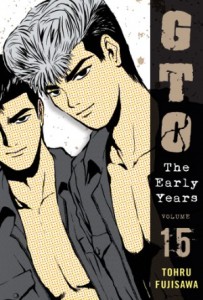
And so, after much delay and a rescue by our friends at Vertical, the GTO Early Years series is now complete.It’s been a ling ride, and you can visibly see how much Fujisawa has improved and refined his art – Shinomi, for one, is almost unrecognizable compared to how she looked when we first saw her, and most of the characters have that ‘GTO’ look that we’re more familiar with from the sequel. What’s more, knowing he has to wrap things up, Fujisawa devotes much of this volume to our heroes’ two love-interests, showing how each of them compares and contrasts with their man. In particular, Shinomi demonstrates that, in her own way, she can screw everything up just as much as Eikichi.

When I reviewed Vol. 14, I noted that I wasn’t sure if the cliffhanger reveal would be played for comedy or drama. Very cleverly, this is actually used in-story – Shinomi, in a fit or misplaced jealousy, is ready to mock Eikichi mercilessly, only to suddenly find that he’s far more affected by everything than she had anticipated. In fact, things get so bad so fast that she desperately confesses to him – which he seems to pretend not to hear, something that he’s very good at indeed. (Note that in GTO 14 Years he’s *still* pretending not to hear Shinomi at times…) After a heart to heart and a good cry with an old mentor, Shinomi decides to go all out and give herself body and soul to Eikichi. This ends up going horribly wrong in the best GTO tradition, and in the funniest scene of the entire book. I had always been a fan of Onizuka getting together with Azusa, given I read GTO first, but Shinomi is making me waver a bit. She’s a perfect complement to his idiocy.

Nagisa, meanwhile, is having troubles of her own. Mostly that Ryuji is using their dates to have sex with her and not much else. And the sex isn’t bad, but Nagisa is a romantic. So when a guy at a nearby high school confesses to her, she’s depressed enough to actually go out with him. Again, Ryuji has always been slightly (but only slightly) more mature than Eikichi, so it would make sense that his own complement is the same. As we see later in the book, she’s trying to study and get into college so she can become a therapist and deal with… well, people like herself. (It’s likely been long forgotten, but Nagisa has disassociative identity disorder). Getting Ryuji to realize that she’s not just there for him to stick it in is tough. Luckily, she’s still completely devoted to him, and it all works out.

And so we get to the final battles. There’s a group of new freshman entering high school, all of whom have heard about the famous exploits of the Oni-Baku Duo, and all of whom are now ready to pledge their lives to them and take over all of Shonan. This is somewhat disquieting to our heroes, who while they always unquestioningly defend their friends, and certainly enjoy being in a gang, fighting, and driving around on bikes, have never really had the ambition to take over the city. Or indeed do much at all. Ryuji sees his girlfriend’s fierce study and is blown away – he’s starting to wonder what to do with his life once he graduates. Onizuka is not quite at that stage (indeed, it will take until the start of GTO to push him there), but the two definitely realize they don’t want to be gang leaders the rest of their days, and something needs to be done.

As ever in the GTO series, events spiral out of control into complete madness, and talking everyone down is no longer an option. So the two of them decide to pull off an elaborate final fight (between each other, of course), and leave this world once and for all. Now clearly we’re not buying what they’re doing – we’ve seen GTO, after all, which shows them both as adults – but I think even readers seeing this back in 1996 knew this was all an elaborate put-on. And sure enough, it’s not even 15 pages before the reveal. Those 15 pages, though, are styled like a documentary/remembrance, with reactions ranging from anger to disbelief to genuine grief (Shinomi and Nagisa).

GTO and its prequels/sequels ran in Weekly Magazine rather than Weekly Jump, and the audiences are fundamentally different. But in the end, you can’t deny that GTO: The Early Years brings you some of the best in shonen ideals. Kids having fun, getting into goofy antics, and trying to get laid are contrasted with holding on to your dreams, always being there for your friends, and enjoying your youth while trying not to destroy it. Eikichi and Ryuji have walked a fine line between those ideals at times, but in the end have shown the main way to accomplish these ideals: a good heart. (And also possibly being a badass biker with ungodly stamina.)

Filed Under: REVIEWS

The Best Manga You’re Not Reading: Mail

October 20, 2012 by Katherine Dacey

Have spirit gun, will travel — that’s the basic plot of Mail, a three-volume collection of ghost stories penned by Kurosagi Corpse Delivery Service illustrator Housui Yamazaki. Like Kurosagi, Mail follows a spook-of-the-week formula, pausing occasionally to fill us in on the personal life of its chief exorcist, Detective Reiji Akiba. Akiba initially presents as a Columbo-esque figure, disarming clients with his rumpled coat and penchant for napping on the job, but his true nature is soon revealed in the first story: he’s handy with Kagutsuchi, his trusty pistol, and unflappable in the presence of the undead.

As we learn over the course of the series, Akiba was born blind. Medicine restored his sight, but with a side effect: he began seeing dead people. After years of living in fear of ghosts, Akiba learned to perform exorcisms with Kagutsuchi, a skill he parlayed into a career as a modern-day onmyoji.

If Akiba’s strategies for assisting his clients are decidedly hi-tech — websites, cellphones, GPS devices, bullets — the stories have a pleasantly old-fashioned quality to them. Some are morality plays; in “The Doll,” for example, a toy becomes the vessel for a hit-and-run victim to bring her killer to justice. Others read more like good campfire tales; in “Suppressed,” for example, a young woman begins receiving mysterious calls from a “friend” who’s en route to her home, the last of which appear to be originating from inside her apartment. Still others draw on urban legend for inspiration; “Ka-tsu-mi,” the fifth chapter in the series, focuses on a girl who dies after accidentally photographing a ghost.

I’d be the first to admit that Yamazaki is not a master of suspense. Though Mail is filled with suitably gruesome imagery and creative variations on oft-told ghost stories, the reader is never in doubt about Akiba’s ability to save his clients. The endings have a sameness that becomes more apparent when reading them back-to-back, as Akiba’s only method for banishing the undead is to fire Kagutsuchi. And while Akiba demonstrates remarkable sangfroid when confronting murdered babies, vengeful lovers, and drowning victims, his undeniable coolness doesn’t quite compensate for the predictability of the denounements.

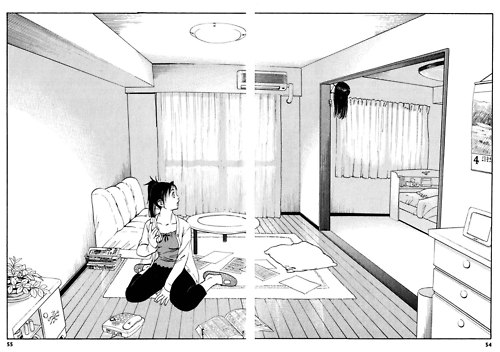
What Mail lacks in suspense it makes up in atmosphere. Yamazaki shows considerable flair for turning ordinary urban environments into unbearably scary places, whether he’s depicting an empty public bathroom or a high-rise building. In one of Mail‘s best stories, for example, a woman receives a letter urging her to move out of her apartment right away. Shortly after reading the letter, she catches glimpse of something moving along the ceiling of the adjacent room:

Though we’re outside the picture plane, viewing the action from a different angle than the hapless apartment dweller, we don’t have any more information about what’s lurking in the other room than she does; Yamazaki is relying on the reader to guess what might be crawling along the ceiling by planting one suggestive detail.

The other thing that makes this image so unsettling is the very mundaneness of the setting. With its square rooms and bland furnishings, this scene could be unfolding in almost any Tokyo neighborhood, in almost any modern apartment complex. (Add a parquet floor, and it could just as easily be taking place in any postwar building in Manhattan.) More unsettling still is that this scene is taking place in broad daylight, not at night; whatever is haunting the apartment isn’t relying on the camouflage of darkness, but is sallying forth at a time of day when spirits are supposed to be hidden and, more importantly, impotent.

Not all of the stories take place in Tokyo; several unfold in the countryside. Mail is at its best in urban settings, however, as the very nature of city living gives Yamazaki ample material to work with, whether he’s spinning a cautionary tale about the anonymity of modern life or simply reflecting on the myriad layers of history buried underneath new roadways and buildings. As a life-long city-dweller, I found stories such as “The Drive” — which takes place on an urban freeway — “The Elevator” — which takes place in a stalled elevator car — and “Hide-and-Seek” — which takes place in a haunted apartment — among the spookiest in the collection, as they tapped into a deep well of fear that all urban folk share: that cities harbor something even bigger and scarier than crime, high property taxes, or gridlock.

MAIL, VOLS. 1-3 • BY HOUSUI YAMAZAKI • DARK HORSE • RATING: OLDER TEEN/MATURE

Filed Under: Manga, Manga Critic, Recommended Reading, REVIEWS Tagged With: Dark Horse, Horror/Supernatural, Housui Yamazaki

Girl Friends The Complete Collection, Vol. 1

October 20, 2012 by Sean Gaffney

By Milk Morinaga. Released in Japan by Futabasha, serialized in the magazine Comic High!. Released in North America by Seven Seas.

I had reviewed the first digital volume of this series when JManga released it a while back, but it’s always worth revisiting things, especially in print. This omnibus contains the first half of the series, i.e. 2 1/2 volumes. It’s a chunky read, but I think that works to the book’s favor as it helps us really get to know the two heroines before we get to plunge into their new friendship and growing romance.

You’ll note the title is split into two words, and I think that’s for the best, as the author makes it a point to show us Mari and Akko bonding as friends for an entire volume before it really starts getting into the potential yuri romance. Given Mari’s shyness and insecurities, this helps keep things realistic. It also ups the stakes: Akko is Mari’s best friend, and while the romance may take all five volumes to really break out the friendship is close and endearing immediately. Mari is a sweet and sympathetic protagonist. and Akko is outgoing, impulsive and oblivious without it becoming too irritating, as many who read one-sided crushes know can happen easily.

But of course this is a yuri manga, and so Mari’s admiration of Akko soon turns into attraction to Akko. This can be tricky, as there’s a vague line between the sort of close ‘skinship’ friendships that aren’t necessarily sexual, and those what do turn into blooming relationships. Indeed, Akko’s reaction on hearing that Mari kissed her while she was sleeping is ‘oh, girls do that *all the time*’. Of course, when Mari is a little more drunk and a lot more forceful, even Akko manages to notice what’s going on.

These are teenagers, so there’s a lot of puzzlement and ‘is this what love is really like?’ on both sides, as well as yuri’s addition of ‘it will never work out because we are both girls’. Akko has a presumed sexual past with a guy (though we quickly learn that nothing happened, of course – this did run in a seinen magazine) which adds to Mari’s dread that all she’s doing is making herself miserable for something that can’t happen. So she turns to a guy from middle school who happens to like her – and manages to get Akko jealous, though she’s not quite sure why…

This is meant to feel like a fluffy shoujo soap opera, just with two girls as the lead, and that’s mostly what it does. There are also two best friends who are also very touchy-feely with each other but clearly aren’t going to be a couple, which is a relief in a genre that sometimes has everyone pairing off with everyone else. Seven Seas’ omnibus obscures the well-times endings of the first two books (Mari thinking she kissed Akko for Vol. 1, Akko boggling at Kiss #2 in Vol. 2), but that works out fine as it gives the omnibus volume a better cliffhanger, as Mari reveals she went all the way with her new boyfriend. (Does anyone really believe her? Well, except for Akko…)

This isn’t a lights out of compulsively addictive series. But it’s fun, wtih likeable characters and as realistic a yuri romance as you’re going to get in something that’s basically “Story A”, written with little consequence besides ALL THESE FEELINGS… IN MY HEART. I hope the second volume resolves said tortured feelings.

Filed Under: REVIEWS

A First Look at Cross Manage

October 13, 2012 by Katherine Dacey

For a series whose plot hinges on a mammary collision, Cross Manage is better than it has any right to be: it’s interesting, funny, and populated with appealing characters who rise above type. The collider and the collidee are, respectively, Sakurai, an aimless second-year student, and Misora, captain of the girls’ lacrosse team. Though Sakurai has joined and quit twelve clubs, he has yet to discover an activity at which he excels; he scoffs at the idea that anyone would play a sport or pursue a hobby simply for enjoyment. Misora is his diametric opposite, an enthusiast who can describe the history of lacrosse in voluminous detail, but can’t make a shot to save her life. When Sakurai accidentally grabs Misora’s chest during an impromptu coaching session, she offers him a choice: become the manager of the girls’ lacrosse team, or risk public humiliation.

Yikes! The “whoops-I-touched-your-boob!” gag is one of the most overused and least amusing “comic” bits in shonen manga, not least because it portrays boys as the victims of mammary collisions, rather than the other way around. I admit that my heart sank a little when I read that scene: surely Kaito could have found a more creative way to set the plot in motion, perhaps one that didn’t scream Love Hina: The Lacrosse Years. But I soldiered on for another chapter, and was pleasantly surprised to discover that Cross Manage wasn’t evolving into a panty-fest or a string of lecherous, Benny Hill-style gags, but an amusing character study of two charmingly screwed-up teens.

Anyone who’s read more than two shonen rom-coms will recognize Sakurai and Misora as familiar types, but artist/author Kaito has invested them with more personality than is called for by the genre. Misora, for example, is a classic Shonen Spaz Dream Girl, but she’s an interesting variation on the type; though she’s utterly incompetent at everything, she’s clearly knowledgeable about lacrosse. She freely admits that she’s terrible, but she doesn’t care because playing the game gives her a sense of accomplishment and purpose.

Sakurai embodies another classic type, the Cool Reader Surrogate. As portrayed in the first two chapters of Cross Manage, Sakurai is a natural at everything — photography, shogi, sports — even though he never practices. Sakurai is a sympathetic character nonetheless, one who’s both moved and puzzled by Misora’s dedication to a sport at which she… well, sucks. And while Misora has a lot to learn from Sakurai about how to handle the stick and pass the ball, Sakurai clearly has a lot to learn from Misora as well — not the least of which is how to enjoy doing things at which he’s not an expert. (Also how to comport himself around girls, of whom he has a deep, unnatural phobia that’s sure to be explained in a future chapter.)

As with many Shonen Jump titles, the artwork is crisp if not terribly distinctive; I’d have a hard time picking Sakurai and Misora out of a line-up of recent Jump characters, though both are memorable enough within the context of the story. Kaito has the artistic chops to populate Cross Manage with a diverse supporting cast — a key skill in a series that promises to have a bumper crop of comic relief characters. Though he hasn’t had many opportunities to showcase this skill just yet, a throwaway scene involving the “prince” of the shogi club hints at Kaito’s ability to establish personality through a few well-chosen details.

If Kaito can steer clear of excessive fanservice, and provide both Sakurai and Misora room for personal growth, I could see myself following Cross Manage; if not, it will join the large pile of shonen romantic comedies that I’ve abandoned after the fifth — or fifteenth — “misunderstanding” involving groping, nudity, or panties. Stay tuned.

CROSS MANAGE, CHAPTERS 1-2 • BY KAITO • VIZ MEDIA • CURRENTLY RUNNING IN WEEKLY SHONEN JUMP ALPHA

Filed Under: Manga, Manga Critic, REVIEWS Tagged With: Lacrosse, Shonen, Shonen Jump, Sports Manga, VIZ

Crazy For You, Vol. 1

October 10, 2012 by Sean Gaffney

By Karuho Shiina. Released in Japan by Shueisha, serialized in the magazine Bessatsu Margaret (“Betsuma”). Released in North America by JManga.

I will admit, JManga is very good at planning their surprises. I had thought the big news for NYCC would be the Kodansha rescues, where they picked up several old Del Rey series that sold poorly enough that Kodansha Comics didn’t want to continue them, and are going to finish them off on the JManga site. And that is indeed very awesome news. But they followed it up with new, unreleased in North America titles from another of the ‘untouchable’ publishers that everyone assumed was supporting JManga quietly without actually giving them anything. Shueisha has added two older shoujo titles that Viz presumably doesn’t have an interest in, and I couldn’t be happier. Especially as one of them is an earlier series from the author of Kimi ni Todoke.

The first 3/4 of this volume is, quite simply, warm fuzzy fluffy shoujo romance. The heroine is Sachi, who is bright, bubbly, and eager to experience life, whatever it may be. She’s naive to a fault, but otherwise is quite different from Sawako, Shiina’s other heroine. Her more down-to-earth friend Akemi is arranging a get together so Sachi and her other friends can meet some guys Akemi’s boyfriend knows (the curse of all-girl schools). While there, she sees Yuki, a somewhat passive yet handsome guy, and falls almost instantly in love. The problem is that Yuki has issues. Will she be able to get through to his true self and show him her feelings? And is she really ready for love herself?

Sachi is an interesting heroine, at once incredibly naive and yet aware of her own naivete. At times in this volume she sets herself up to be hurt, knowing that even if she does it will be a good life experience and make her a stronger person. She’s also able to see that Yuki is a deeply wounded young man, though she’s unable to see exactly what those wounds are. After he initially rejects her (we suspect as she’s not the sort of girl he can casually date and drop), they become friends, but Sachi is still trying to show how much she cares for him. There’s a very awkward yet warm tone to their conversations that KnT fans will find familiar.

So, we get a cute bubbly girl and a quiet guy whose mask hides his loneliness and true feelings. We also have the cute beta couple of Akemi and her boyfriend, and another guy, Akahoshi, who is another shoujo cliche, the guy who initially is annoyed by the girl’s ditziness, but starts to fall for her as he realizes she has a truly good heart. It’s all very cute but slight. But this is six volumes long, not one, and we realize that something has to go wrong. The last 15 pages or so are a total mood swing, turning violent and dramatic, and end with a brutal cliffhanger. I suspect Volume 2 will be a lot less happy and fluffy.

(I actually liked the way all the players came together. Kimi ni Todoke’s main romantic pairings all tend to happen in parallel to each other, with no intersections (except maybe Kent). This is a giant messy pile of friendships and relationships.)

I’ve said this before about other titles, but again, this is what I want to see JManga doing. A nice, solid shoujo title that other publishers aren’t going to bother with. It doesn’t quite hit the heights of Kimi ni Todoke (the art, in particular, is less elegant and more typical shoujo), but it has a likeable heroine and an addictive plot. I want to know what happens next. Good thing Vol. 2 is also out now.

Filed Under: REVIEWS

Skip Beat!, Vol. 29

October 8, 2012 by Sean Gaffney

By Yoshiki Nakamura. Released in Japan by Hakusensha, serialization ongoing in the magazine Hana to Yume. Released in North America by Viz.

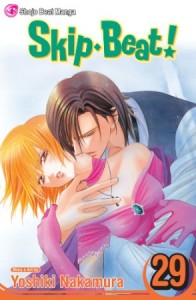
I hope you enjoyed the Black Bird-esque cover art, as that’s really the closest thing Skip Beat gets to romance. Oh yes, there’s Kyoko and Ren teasing each other briefly, but the point of that scene is the same as it’s been before – when pressed, Kyoko freaks out completely and shows, as Lory lampshades in this volume, that she’s not remotely ready for love or romance. Which is one reason why Skip Beat is at Vol. 29 and things are still up in the air. Not that we’ve any doubt that the final pairing will be Ren and Kyoko – if Sho somehow manages to win her heart I’ll be mind-boggled (and I think angry fans would storm Hakusensha’s offices). But there’s simply demons in Kyoko’s past that really haven’t resolved yet.

Honestly, I wish we’d see more of Kyoko’s mother. Yes, she’s horrible, and I certainly don’t want to see more of her interactions with Kyoko. Except I totally do, because her emotional abuse at her mother’s hands is what continues to drive her story. Every single time she twitches or reacts poorly to someone getting angry with her – even when it’s obviously meant to be comedic – it reminds me that she’s hypersensitive to everyone’s reactions. And one reason she may be so good at method acting is that she grew up trying to be the good child – or, as she increasingly got pawned off on Sho’s family, the dutiful wife/sister figure. Kyoko’s ability to immediately sense when Ren is upset with her, and her over the top reactions, are incredibly funny, but they’re also built on a foundation that screams ‘trigger warning’.

In a way, Kyoko’s emotional maturity when it comes to love and romance (and even simple things such as friendship) is trying to catch up to the personas that she’s put on her entire life. Which is why she’s still so incredibly naive about love. Her discussion with her Bo costume about Ren’s ‘playboy’ ways show that Lory isn’t kidding about her being completely unable to love. He may glibly tell Ren to avoid taking ‘that final step’ with her, but there’s a reason behind it – if Kyoko is freaking out to the point of bolting across the room when Ren even suggests seducing her, she’s not ready for anything else.

As for the rest of the manga, despite the fact that we’re twenty-nine volumes in, not much time has passed within the manga itself, as we can see given that Dark Moon is only just wrapping up. Meanwhile, Cain Heel’s drama finally starts filming, and we meet one of his fellow actors, Murasame, who seems to be a combination of rival and tsukkomi, as he points out to himself all the weird things Cain and Setsu are doing, but is also clearly attracted to Setsu. Of course, he shows this attraction via his own emotional immaturity – after pondering the best way to introduce himself to her, he starts by insulting her brother. Kyoko’s not the only one with issues.

I love the fact that this cute, funny shoujo manga can make me write about serious things. It doesn’t look to be ending anytime soon, so here’s to more volumes (and perhaps Kyoko conquering her love and affection demons).

Filed Under: REVIEWS

Give My Regards to Black Jack, Vols. 1-2

October 5, 2012 by Katherine Dacey

Give My Regards to Black Jack tells a familiar story: a newly-minted professional enters his field, convinced that he has chosen the True Path. He soon discovers, however, that many of his colleagues have chosen profit over passion, forcing him to decide whether to follow their example or fight the system.

Eijiro Saito, the hero, is a graduate of a top medical school, brimming with energy and enthusiasm. Though Saito lands a plum internship at Eiroku University’s teaching hospital, his pay is meager; he supplements his income by moonlighting at a woefully understaffed emergency room. At both institutions, Saito encounters crooked doctors who demand bribes from patients; arrogant doctors who belittle poor patients; and money-minded doctors who care only about the hospital’s bottom line. For all the challenges to Saito’s idealism, however, he clings tenaciously to the belief that candor and sincerity are a doctor’s greatest assets.

As agit-prop, Give My Regards to Black Jack succeeds. Author Shuho Sato makes a convincing case that billing practices encourage Japanese hospitals to treat patients as cash cows, rather than people in need of medical care. Sato also offers a blistering critique of doctor training, showing us the toll that long hours, poor pay, and workplace bullying exact on residents.

As drama, however, Give My Regards to Black Jack is too tidy to be moving. True, Saito’s despair at his own futility seems genuine. Early in volume one, for example, Saito finds himself alone in the operating room with a motorcycle accident victim. Fearful of killing the patient, Saito does nothing; only the last-minute intervention of a more experienced surgeon prevents the victim from dying on the table. In a moment of self-hatred, Saito dissolves into tears, castigating himself for his paralysis — a scene that intuitively and emotionally feels right, given where he is in his residency.

Where the story falters is in its portrayal of the senior doctors at Eiroku Hospital: they’re haughty and deceitful, primarily concerned with asserting their authority over patients and junior staff members. Even when their words ring with truth, their advice is framed as a cynical and self-serving pose. Not all of the doctors fit this mold: the repulsively drawn Ushida, who toils in the Seido emergency room, is a wiser and more compassionate soul than his wolfish face or feral demeanor might suggest. So is Saburo Kita, a maverick heart surgeon who loves karaoke and paisley shirts; Kita cuts a flamboyant figure, but is humble when discussing his work. These characters are few and far between, however, with many more doctors acting like graduates of the Snidely Whiplash School of Medical Malpractice.

The series’ other shortcoming is the artwork. Though Sato shows a Tezukian flair for close-ups of mangled flesh and pulsating organs, his character designs lack Tezuka’s finesse. Tezuka’s Black Jack might be a cartoonish figure with his cloak and Frankensutures, but those design elements are fundamental to establishing Black Jack’s personality; a reader could dive into any Black Jack story and immediately understand who he is. Moreover, all of the characters in Black Jack are crafted with similar care, each assigned a few simple but telling details that communicate their role in the drama.

By contrast, Ushida looks like he stepped out of Toriko, with his bug eyes, lantern-jaw, and perma-sneer. Since none of the other characters are rendered in such a grotesque fashion, one could make the argument that Ushida’s ugliness must serve a dramatic purpose, symbolizing the corrosive effect of his working conditions. We never spend enough time with Ushida, however, to know how much he sacrificed his ideals for a steady career, nor do we see enough of his behavior with patients to rationalize his appearance. It seems perverse to draw only one character in such a distorted fashion; say what you will about Tezuka’s caricatures, but there was always a unifying aesthetic in Black Jack that made it possible for the reader to view Dr. Kiriko, Pinoko, and Biwamaru as inhabitants of the same universe.

What Sato’s work has in common with Tezuka’s is a fierce conviction that the Japanese medical establishment is bloated, ineffective, and indifferent to real human suffering. Sato addresses these shortcomings in a more explicit fashion than Tezuka did in Black Jack — or Ode to Kirihito, for that matter — using real medical procedures and real administrative dilemmas as plot fodder. Yet Sato’s stories are often unmoving, as his hero’s idealism compels him to take simplistic stands on complex issues. Tezuka, on the other hand, focused more on entertaining audiences than on educating them about Japanese health care, building his stories around a character whose subversive, self-interested behavior never prevented him from treating the genuinely deserving. Tezuka’s stories might be more formulaic and absurd than Sato’s, but they’re never so earnestly dull that they read like anti-JMA propaganda. Call me crazy, but I’ll take killer whale surgery and teratoid cystomas over a hectoring medical procedural any day.

GIVE MY REGARDS TO BLACK JACK, VOLS. 1-2 • BY SHUHO SATO • SELF-PUBLISHED (AVAILABLE THROUGH AMAZON’S KINDLE STORE)

Filed Under: Manga, Manga Critic, REVIEWS Tagged With: black jack, Medical, Say Hello to Black Jack, Shuho Sato

Paradise Kiss, Vol. 1

October 3, 2012 by Sean Gaffney

By Ai Yazawa. Released in Japan by Shodensha, serialized in the magazine Zipper. Released in North America by Vertical, Inc.

I had already done a review/overview of this series for a Manga Movable Feast a while back, but now we have Vertical’s new re-release with larger trim and a new translation, so it’s time to give it another look. Which I honestly don’t mind, as this is such a terrific series. I won’t be talking too much about the technical details – the larger size makes the asides much easier to read, I do note. As for the translation, it’s definitely different, and there are pluses and minuses to both. I do prefer Arashi not sounding like Johnny Rotten, though.

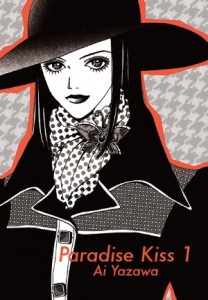
The cover and chapter pictures, by the way, might give away a bit of the plot: Yukari becomes a model. But then, most of you probably guessed that as it’s the premise. Yazawa has an eye for fashion and posing, and it all comes to the fore here, with many long, lingering shots of outfits and fabric, and even the rudimentary drudgery of sewing beads is made to look glamorous. Paradise Kiss is a colorful, vibrant place. By contrast, Yukari’s life is as stark and black and white as the manga itself – we barely get to know anyone besides Hiroyuki at her school, and her attention is so quickly distracted by George and company that her diligence to study is in doubt. (Notably, the entire PK group urge her to keep studying, and constantly ask if she has to hit the books. They’re all good students, and don’t want to be seen as the reason she isn’t. It’s Yukari’s own fault that she winds up blowing everything off all the time.)

I’ve said this before, and I’ll say it again – I really like Hiroyuki, and I’m glad to see how he interacts with Yukari and the others. The sequence where Yukari drags him to meet Miwako is painful but very well done – and Yukari, as many ‘well-intentioned’ folks seem to do, immediately realizes she’s made a mistake. That said, it worked out well in the end, even if what we mostly get from the story of Miwako. Arashi and Hiroyuki is of things left unfinished – by forcing a choice onto Miwako, Arashi has unwittingly left everything more open-ended than it should be. This will come back to haunt him in future volumes…

A word of warning to those who hate it – this manga is rife with metatextuality. The non-Yukari cast constantly talk about chapters, page placement, etc., reinforcing the fact that Yukari is not only entering the fashionista world of Paradise Kiss, but the manga ‘world’ as well. There are also several references to Yazawa’s shoujo manga Gokinjo Monogatari, which starred Miwako’s older sister, Mikako. Mikako makes a cameo, and a few other characters also show up. Don’t worry if you’ve never read the (unlicensed) prequel; the references actually serve to better flesh out the characters, and show that this isn’t just a story that began once Yukari entered the scene.

Did I forget to mention George? I did. Hi, George. I’ll have more to say about him in my next review. In the meantime, Paradise Kiss has attractive, vibrant characters, gorgeous and striking art, and a wonderfully wicked sense of humor. I’m incr3edibly happy that it’s back in print.

Filed Under: REVIEWS

Barbara

October 1, 2012 by Sean Gaffney

By Osamu Tezuka. Released in Japan by Shogakukan, serialized in the magazine Big Comic. Released in North America by Digital Manga Publishing.

This is one of those mature Tezuka titles that a lot of fans had been waiting to hear about. So much so that when DMP decided to start a Kickstarter project to get enough money to license it, it was an obvious choice. And I must admit, it does seem like the sort of manga you’d like to verify you have enough money to cover costs before you publish. Unpleasant, flighty, and just plain annoying at times, Barbara is fittingly very much like its main character, a muse who is various things to various people, and ends up being an alcoholic hipster when she’s inspiring our “hero”, the writer Yosuke Mikura.

You’ll note I put the word hero in quotes. Even using the term protagonist seems wrong for Mikura, who does not really inspire much sympathy throughout this book. Right off the bat we get two chapters which show him not only abusing Barbara (he beats the crap out of her the entire book) but also has serious psychological problems, leading to hallucinations. It requires a certain amount of sang-froid to trust that Tezuka will lead you through this and tell a satisfactory story, especially as the first half of Barbara seems to be composed of mostly disconnected life scenes with Mikura and his drunken companion.

Things pick up considerably when we are introduced to Russalka, an African writer and political activist who comes to Japan for a conference. It turns out he has a past with Barbara, and was not particularly happy to see her go. This is when Mikura gets the full explanation of what Barbara is, which he stubbornly doesn’t really understand at all – at least not consciously. But they don’t really have a relationship, just occasional inspiration – as muses are to writers most of the time. When he decides to marry Barbara at one point, most readers will be groaning and going “You idiot!”. If they weren’t already.

Mikura continues to spiral downward, committing murder multiple times (even if it’s sometimes only implied) and his marriage to another woman who is genuinely real seems to only make things worse for both of then. The last third of Barbara reads like an elegiac car crash, as you watch a man who was already deeply disturbed when the book began go off the deep end. In fact, that may be a fault with the book – Mikura was *so* creepy and deluded right from the start, there’s very little surprise or sympathy in seeing him get run off the rails like that. It’s less of a tragedy and more of a “well, that’s just life.” Which, given this is the early 1970s, may have been what Tezuka was going for anyway.

The artwork is excellent, with many striking scenes. He’s especially good at depicting Mikura’s hallucinations. At one point Mikura meets a woman who looks like Barbara but insists she’s a real woman named Dolmen, and Tezuka actually manages to have her look slightly different. Sometimes the art is a bit sexualized (there is much focus on Barbara’s rear end), but that’s what you’d expect from a book about a seductive muse. And the scenes in the end in the sewers and field are fantastic action sequences.

I wouldn’t say I enjoyed Barbara the way, say, I enjoy Ranma or Sailor Moon. It can be an unpleasant experience, and its lead is loathsome much of the time. If you can get past that, however, this is a striking tale well-told, and made me curious to find out more about the Japanese literary scene of the early 1970s. And hoping that if I ever get a muse like Barbara, I don’t end up the same way. But, that’s writing for you. So fickle…

Filed Under: REVIEWS

Angelic Layer, Vol. 1

September 30, 2012 by Sean Gaffney

By CLAMP. Released in Japan by Kadokawa Shoten, serialized in the magazine Shonen Ace. Released in North America by Dark Horse Comics.

Angelic Layer comes at a turning point for CLAMP, one where they had already shown how well they could succeed in the shoujo market and were trying to branch out and expand. And while they were still drawing X at the time they started this (and just wrapping up Card Captor Sakura), they clearly wanted a new challenge. Unfortunately, I’m not sure how well they succeeded – certainly this work is a decent enough diversion, and there’s never any desire to put it down or move on. But it doesn’t really grip you the way their best series do – and indeed, the way that their more successful series for a male audience, Tsubasa and xxxHOLIC, would later on. Angelic Layer is shonen, but it’s fluffy shonen.

If I want to be honest, there’s not even a whole lot about Angelic Layer that HAS to be shonen. Yes, the plot involves what basically amounts to a fighting tournament, but the fighters are mostly female, and they’re fighting using cute dolls, albeit technologically advanced fighter dolls controlled through willpower. But Magic Knight Rayearth was basically a series of ever-increasing battles as well. (Speaking of which, Rayearth apparently exists as an anime in this universe – Misaki’s Angel is clearly meant to be based off Hikaru from the series.) But the cute female lead who’s plucky but always optimistic, the vague romantic possibilities, the jealous rivals who want to take her out as soon as possible? This could easily have run in Asuka, except X already was taking its place.

The series has its heart in the right place, and clearly wants to be liked. Perhaps that’s why I’m not enjoying it as much as other CLAMP offerings – at times you feel it’s trying too hard. There are two wacky, comedy characters – Icchan, the mad scientist inventor of the Angels, and Misaki’s new female friend Tamayo – who are wacky! And funny! Oh so funny! Let us show you how wacky and funny and loud and funny they are! And it can be exhausting. The quieter, more sedate supporters of Misaki work much better.

That said, it also feels like I’m finding faults where I shouldn’t bother. As a light, fun comedy with lots of cool fights and amusing scenes, this fills its function perfectly. CLAMP are at the point in their careers here where they couldn’t really ruin a story if they tried. (That will change later – indeed, Angelic Layer gets made far more depressing retroactively if you read Chobits – but for now, it’s all smiles.) Misaki has enough things going wrong for her that we feel a need to see her win and be happy, but not so much that it verges into Pollyanna territory. And honestly, sometimes the wacky characters *are* funny, particularly Icchan and his sublime awareness that he gives the appearance of a creepy pedophile.

But there’s no depth to Angelic Layer at all, and depth is something that we’ve increasingly come to rely on CLAMP for (and get frustrated when it goes wrong). It’s a step forward into a new genre, but it’s still keeping too much of itself held back. If only it had an anime adaptation that took its good points and expanded on them? Hrm, that would be awesome…

Filed Under: REVIEWS

Limit, Vol. 1

September 28, 2012 by Katherine Dacey

“The world doesn’t suffer fools or fugly people” — so says Sakura, the most popular student in class 2-4. Sakura is a classic Alpha Girl: pretty, manipulative, and confident that at fifteen, she’s discovered the secret to being successful. (“Both studies and make-up. They’re real important for enjoying life, you know?” she informs her pal Konno.) Though Sakura’s friends may not like her, they recognize her power and follow her example; when Sakura declares that the awkward, quiet Arisa Morishige should “die,” Sakura’s friends are all too quick to agree.

The dynamic between Sakura’s clique and Morishige is dramatically reversed, however, on an annual school trip to “exchange camp,” where second-year students spend a week roughing it in a rural setting. En route to camp, a bus accident kills most of the class, leaving a handful of survivors stranded in the wilderness. The remaining members of Sakura’s clique soon discover that their nasty antics have demoted them from the A-list to the D — a demotion that, in their new, desperate circumstances, has potentially deadly consequences.

In a more cynical frame of mind, I might describe Limit as “Lord of the Flies with chicks,” but that cheeky brush-off doesn’t quite do justice to Keiko Suenobo’s story. Her principal characters are just as concerned with survival as William Golding’s private-school boys were, but the girls’ internal power struggles are less a exploration of Hobbesian philosophy than an extreme dramatization of the cliquish behavior found in Japanese high schools. In other words, it’s Mean Girls… with weapons.

Entertaining as that sounds, Limit suffers from a crucial flaw: Konno, the narrator, isn’t very interesting, as her primary role is to be an inoffensive reader surrogate. Konno is pretty and smart enough to be a member of Sakura’s clique, but passive enough that her behavior won’t elicit criticism from most readers; Konno is never portrayed as a ringleader or enthusiastic participant in Morishige’s degradation, though she clearly joined Sakura in harassing Morishige. That’s a mistake, I think, because it permits the reader to side too readily with Konno when the tables are turned, ignoring the fact that Morishige’s rage stems from being bullied on a daily basis by Sakura and Konno.

The other survivors are a more compelling lot, even if each neatly slots into a well-established role: The Principled Outsider, The Timid Girl, The Frenemy. That Suenobo endows each of these girls with more humanity than those roles require is testament to her skill as a writer. Volume one’s most moving scene, for example, belongs to Ichinose, Sakura’s best friend. Though she and Konno have moved in the same social circles, the bus accident reveals that Ichinose views Konno as a rival for Sakura’s friendship. Ichinose’s desperation at being “traded in” for the smarter, prettier Konno is palpable, and the rawness of her angry confession is one of the few moments in the script that doesn’t feel like a rote portrayal of mean-girl politics.

Perhaps the strongest element of Limit is the artwork. Suenobo’s meticulous efforts to dramatize her characters’ inner turmoil reminds the reader that Limit ran in Bessatsu Friend, not Weekly Shonen Magazine. Konno and Ichinose scream and cry as lustily as any character in Cage of Eden, but Limit‘s characters register a much fuller range of emotions than just fear of being lost or eaten; Konno and her fellow survivors are by turns angry, jealous, gleeful, miserable, spiteful, bitter, remorseful, and fearful — of one another. By far the most dramatic example is Morishige, who morphs from cringing, sweaty scapegoat to demonic avenger; her once dull, shark-like eyes are suddenly animated with a fierce, nasty sense of purpose, and she moves with a speed and deliberation that surprise her classmates.

Suenobo also demonstrates a flair for staging action scenes. The bus accident is depicted in a brief but effective sequence that makes creative use of camera angles to suggest the severity of the crash. Likewise, Suenobo firmly establishes how desperate the girls’ situation really is; in a few carefully drawn panels, the reader readily grasps the geographic obstacles to rescue, from sheer cliff walls to impenetrable woods. That no one’s cell phone works feels like an unnecessary touch, given the care with which Suenobo sketches out the crash site and its environs.

If the story is, at times, a little uneven, or ungenerous to Morishige, Limit still shows considerable promise. Suenobo makes good use of her teen-survivor premise to explore the politics of bullying without being too mawkish. At the same time, however, Suenobo manages to write a scary thriller that’s sophisticated and suspenseful enough to sustain an adult’s interest; the story’s occasional Grand Guignol touches add a welcome dash of camp, preventing the story from sinking under the weight of its Very Important Message. I can’t imagine what will happen in volume two, but I’m looking forward to reading it… with the lights on. Recommended.

Review copy provided by Vertical, Inc. Volume one will be released on October 9, 2012.

LIMIT, VOL. 1 • BY KEIKO SUENOBO • VERTICAL, INC. • 176 pp.

Filed Under: Manga, Manga Critic, REVIEWS Tagged With: Keiko Suenobo, Limit, shojo, vertical

Higurashi: When They Cry, Vol. 19

September 26, 2012 by Sean Gaffney

Story by Ryukishi07; Art by Hinase Momoyama. Released in Japan as “Higurashi no Naku Koro ni: Minagoroshi-hen” by Square Enix, serialized in the magazine GFantasy. Released in North America by Yen Press.

This review has spoilers!

Ladies and gentlemen, after 18 volumes, meet our heroine.

The author talks in the notes for this volume about how he tried to keep Rika’s main character-ness a secret at first, with Keiichi, Rena and Shion getting all the attention. The Time Killing Arc was probably the one exception, and even that was 5 years before the main action. We’ve known Rika is much deeper than she seems, and that she can see/understand the constant resets in this world. But this is where the manga outright has her as the star. And while no one is going to pick up a new manga 19 volumes in, the first chapter does a decent job at setting up the ‘mysteries’ and ‘rules’ of the resetting worlds… even if it turns out to be wrong a lot.

By the way, the twin girl that Rika meets is Frederica Bernkastel, whose poetry we have been enjoying at the start of each arc. She is somewhat unimportant to the Higurashi series (we’ll only see her again at the very, very end), but is a far larger player in Umineko, which begins over here in two months… Also, Frederica, not Furude Rika. I don’t know how anyone could mix them up. :)

We do also meet another major character here – Hanyu, aka ‘Oyashiro-sama’. For a series that has combined moe and gore to such a large degree, it’s not as much of a surprise as one would think to find that their torture god is an adorable little girl who hates all the killing. Seeing her stomping her feet in rage at Takano’s insane ravings is quite funny. Possibly the only funny thing she gets to do in this arc – Hanyu is a drag, and ends up bringing Rika down with her. Downtrodden and depressed, she’s the one resetting the worlds, but it’s clear she has no confidence this one will be any different.

But oh, how wrong she is. This is what the previous 18 volumes have led to. Remember Higurashi is actually an adaptation of a game, where the player saw everyone make really, really horrible mistakes. And in this world, through the constant replays and reboots, they subconsciously learn from those mistakes, and make the right decisions. This is one of the more heartwarming parts of the volume. Seeing Keiichi give Mion the doll, seeing Shion treating Satoko like a little sister, Rena confessing that she got her dad help and a job… it’s great to see. And it has a wonderful capper, as who should show up in Hinamizawa but Akasasa. With his wife. Who is not dead. It’s pure happiness on a manga page.

And this is where hubris starts to hit Rika. After being so depressed for so long, seeing this is a world where everything is ‘perfect’ makes her a little too cocky. She goes to tell Tomitake and Takanao that they’re going to be killed… and they seem to believe her. She deliberately incites a gang to hit her… and it turns out she now has hidden bodyguards. So she gets the tiniest bit smug… and oh, does she ever pay for it. Because this is the Answer Arc for the MOST DEPRESSING ARC EVER, the Curse Killing Arc.

See, when Rena turned to Mion and confessed the difficulties she and her dad were having, Mion told her family. Who are yakuza. Who responded by simply quietly killing off Mamiya, the woman blackmailing Rena’s dad. And with Mamiya now dead… Satoko’s uncle has come back home. This leads to the most chilling image of the volume, Satoko with a huge bruise on her cheek and empty eyes. We only have one problem to solve in this world, but oh, it’s a doozy.

But remember, people are learning from their mistakes, mostly. So even though Shion backslides a little, murder for once ISN’T an option. Instead, they go to child services. Who suck. Horribly. So they go back, with their teacher and principal. And fail again. It’s like beating your head against a brick wall, mostly as Satoko refuses to admit that she is being abused. (Well, maybe murder isn’t an option as it’s being taken off the table… the first thing Rika does is go to Takano and ask that her hired goons take out Satoko’s uncle. She should know better.) And Ooishi, despite getting a nicer introduction than usual, is not helping at all with his usual elliptical warnings.

By the way, there’s still the matter of who is killing Rika. When this first started in GFantasy in 2009, the games were finished. As was the anime. 95% of the people reading this knew who the main villain was. So you see the author cheating a bit, with perhaps a few more creepy villainous smiles than might be warranted. More on this later. It isn’t called the Massacre Arc for nothing, after all.

As you can see, there’s a lot going on in these first two volumes. I am pleased that Yen omnibused them. The next two aren’t out till December, but luckily we have Umineko in November. We switch from cicadas to seagulls… and also switch from a series searching for its happy ending to one where that may not even be an option.

Filed Under: REVIEWS

GA: Geijutsuka Art Design Class, Vol. 4

September 24, 2012 by Sean Gaffney

By Satoko Kiyuduki. Released in Japan by Houbunsha, serialization ongoing in the magazine Manga Time Kirara Carat. Released in North America by Yen Press.

It may seem like forever, but in reality we’re getting two new volumes by Kiyuduki-san this fall, with this and the 3rd Shoulder-A-Coffin Kuro. This series ended up being far more popular in Japan (much to the consternation of Western fans, who I think prefer the darker Kuro), probably due to its dynamic – let’s face it, if every series you do with cute high school girls living their ordinary lives sells well, you’re going to want more of that. The artist does use this fourth volume to provide a bit more depth and characterization than we’d seen previously, though.

This series has always been compared with Sunshine Sketch (and not just over here – Japanese fanartists cross the two series over a lot), but GA is far more serious about its art. Previous volumes have dealt with color choice, textures, and lettering. This one has the color pages dealing with fashion from early to modern, and the chapters cover topics like the best way to convey water, how to get your model to not pose stiffly, and (in the best sequence) Kisaragi losing her glasses and seeing the rest of the cast as indistinct, vegetable-like shapes. For a 4-koma cutie series, the artist is not afraid to experiment within its boundaries.

Speaking of which, one series starring Noda, the flakey and eccentric girl, shatters the fourth wall in what turns out to be a long dreams sequence (which surprised me, as usually it’s Kisaragi who gets those sorts of stories). Noda, by the way, enjoys teasing Namiko, the straight woman of the group, about her weight and her larger chest. It was entertaining seeing that Namiko is starting to fight back in a deadpan way, and seeing Noda getting all upset is quite amusing, given she’s normally so hyperactive and cheery. Speaking of Namiko, she may be the perfect oneesama character to keep everyone else in check, but apparently her home ec skills show she’s not ready to be a perfect Japanese housewife just yet.

As for the third-year group that’s our secondary cast of GA characters, they get some nice spotlight time as well. Awara ends up wandering into said home ec class, and gets corralled into helping Kisaragi and Namiko make pasta. We also learn her eyesight is exceptional, almost preternaturally so. This is a contrast to the bespectacled Uozumi, who not only needs glasses but turns out to be color-blind (which, this being GA, leads to a discussion of how color-blind people see art and what Van Gogh painted). And in the final chapter of the volume, we see the sickly Tomokane brother, having passes out in the sun (his being sickly has been a plot point throughout) musing on the relationship between him and his sister (also Tomokane – the artist has deliberately avoided giving them first names) and how they contrast perfectly with each other. Not to mention how his sister apparently has psychic powers to know when he needs her help…

As I noted above, there are a ton of cute girl 4-koma series out there, even in North America. Most need something beyond the initial gimmick to keep you reading. And besides the bond between the cast members, humor, and occasional bits of character development, this series simply makes you more interested in art, and how artists see things. It’s great fun, and I’m pleased that we finally have the 4th volume. It’s coming out very slowly in Japan, though, so it may be a while before we see it again.

Filed Under: REVIEWS

GTO: The Early Years, Vol. 14

September 23, 2012 by Sean Gaffney

By Toru Fujisawa. Released in Japan as “Shonan Jun’ai Gumi” by Kodansha, serialized in the magazine Weekly Shonen Magazine. Released in North America by Vertical.

One of the things I’ve always liked about the GTO franchise, be it Shonan Jun’ai Gumi or GTO or Shonan 14 Days, is its insistence on taking responsibility for your own actions while at the same time not letting that destroy your dreams. Onizuka choosing to become a teacher may have had a lecherous motivation at the start, but it’s been proven time and time again that his ability to motivate jaded young minds and make them see there are other ways is second to none. And it’s also seen here in the earlier title, as we meet Nao Kadena, a former young punk who drove around in fast cars and on fast bikes (because there was nothing else to do, of course) who is now returning as a teacher in order to motivate these kids to get better grades… by any means necessary.

Onizuka here is fairly admirable throughout. Even if he’s attracted to Nao and thinking with his genitals as usual, he still notes that there’s something off about her, and resolves to dig a bit deeper and find out (and if he happens to see her naked, well, bonus). It’s this desire to understand and help others that makes him such an attractive shonen hero, and helps us to understand why girls actually do fall for him.

Then we have the second half of the book, which opens with a scene which reminds you why, even if he has a lot of girls falling for him, he’s still a virgin. After being mocked by Ryuuji, who is off for a secret date with Nagisa (still locked up by her parents, I believe), Onizuka decides to lose his virginity once and for all. So he climbs 12 stories up to Shinomi’s apartment, breaks into her bedroom, removes her panties and prepares to rape her in her sleep. Now, I know this was meant to be played for comedy. I also get that Shinomi woke up, beat the shit out of him, and that everyone regards him as a complete idiot for these actions. But holy crap, Shonen Magazine! What kind of heroes are you rolling out here?

Of course, we can also guess he probably wouldn’t have been able to go through with it. When he meets up with a genuinely cute girl later at a karaoke bar, who seems to be almost too good to be true. Taking her to a love hotel, he confesses his desire, and she’s willing to sleep with him… but is clearly doing it because he wants to, not due to any feeling on her part. This stops Onizuka cold, and he walks out, noting that he wants his first time to have some sort of love behind it. (That sound you heard was my neck breaking from the whiplash from three chapters ago to this point.) This touches her, and so over the course of the next few days the two begin a genuine romance – much to Shinomi’s annoyance (yes, she still has a crush on him despite everything).

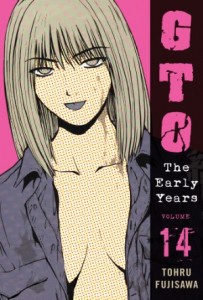
Of course, the final pages seem to indicate that this romance won’t last. I’m not actually sure if this will end in a comedic way or will be another ‘Onizuka saves a lost soul and teaches them to dream again’ sort of climax. We will see in Vol. 15, the final volume in the series. Till then, enjoy Onizuka, seen here at his best and worst.

Filed Under: REVIEWS

  • « Go to Previous Page
  • Page 1
  • Interim pages omitted …
  • Page 278
  • Page 279
  • Page 280
  • Page 281
  • Page 282
  • Interim pages omitted …
  • Page 346
  • Go to Next Page »
 | Log in
Copyright © 2010 Manga Bookshelf | Powered by WordPress & the Genesis Framework