• Skip to primary navigation
  • Skip to main content
  • Skip to primary sidebar
  • Home
  • About Us
    • Privacy Policy
    • Comment Policy
    • Disclosures & Disclaimers
  • Resources
    • Links, Essays & Articles
    • Fandomology!
    • CLAMP Directory
    • BlogRoll
  • Features & Columns
    • 3 Things Thursday
    • Adventures in the Key of Shoujo
    • Bit & Blips (game reviews)
    • BL BOOKRACK
    • Bookshelf Briefs
    • Bringing the Drama
    • Comic Conversion
    • Fanservice Friday
    • Going Digital
    • It Came From the Sinosphere
    • License This!
    • Magazine no Mori
    • My Week in Manga
    • OFF THE SHELF
    • Not By Manga Alone
    • PICK OF THE WEEK
    • Subtitles & Sensibility
    • Weekly Shonen Jump Recaps
  • Manga Moveable Feast
    • MMF Full Archive
    • Yun Kouga
    • CLAMP
    • Shojo Beat
    • Osamu Tezuka
    • Sailor Moon
    • Fruits Basket
    • Takehiko Inoue
    • Wild Adapter
    • One Piece
    • After School Nightmare
    • Karakuri Odette
    • Paradise Kiss
    • The Color Trilogy
    • To Terra…
    • Sexy Voice & Robo
  • Browse by Author
    • Sean Gaffney
    • Anna Neatrour
    • Michelle Smith
    • Katherine Dacey
    • MJ
    • Brigid Alverson
    • Travis Anderson
    • Phillip Anthony
    • Derek Bown
    • Jaci Dahlvang
    • Angela Eastman
    • Erica Friedman
    • Sara K.
    • Megan Purdy
    • Emily Snodgrass
    • Nancy Thistlethwaite
    • Eva Volin
    • David Welsh
  • MB Blogs
    • A Case Suitable For Treatment
    • Experiments in Manga
    • MangaBlog
    • The Manga Critic
    • Manga Report
    • Soliloquy in Blue
    • Manga Curmudgeon (archive)

Manga Bookshelf

Discussion, Resources, Roundtables, & Reviews

Reviews

Alice in the Country of Joker: Circus and Liar’s Game, Vol. 1

February 26, 2013 by Anna N

I enjoyed the first series in this franchise, Alice in the Country of Hearts, but didn’t care for Alice in the Country of Clover at all. Fortunately this variation seems much closer to the original series in tone and execution. It is the unstable April season in the Country of Hearts and a circus headed by a new character named Joker has just arrived.

Alice seems to be having issues with both her memory and perception, aided by some mental meddling from Nightmare. Her occasional fugue states and general confusion serve to give this manga a hint of the sinister and mysterious atmosphere that I enjoyed so much in Alice in the Country of Hearts. Plotwise, there isn’t much going on as Alice goes around during April season saying hello to all the handsome male residents of Wonderland. We do get some world building bits when we see that Alice’s desires are creating a situation where there are more people with “roles” for her to interact with and there’s some nice back story filled in where we see glimpses of Alice’s life before Wonderland. There’s even a glimpse of the man from Alice’s past who is strikingly similar to the Mad Hatter but in some ways the flashback to Alice’s real life seems just as surreal as her dream world. Even though this volume is mostly exposition and getting reacquainted with most of the characters, I was curious to see how this version of the story would play out. After reading the first volume of Alice in the Country of Clover, I was wondering if any of the sequel series would appeal to me at all, but I am now wavering. Recommended for people who enjoyed the first series in this franchise.

Filed Under: REVIEWS Tagged With: alice in the country of joker, Seven Seas

Emerald and Other Stories

February 26, 2013 by Sean Gaffney

By Hiroaki Samura. Released in Japan as “Sister Generator” by Kodansha, serialized in various magazines. Released in North America by Dark Horse Comics.

Well, first off, there’s not a samurai in this thing. It’s an anthology similar to the one we saw recently from Kaoru Mori, aka “I need to do something different occasionally and show off my chops”. As with most anthologies, the quality is highly variable, but the author is good enough that even the stories I didn’t really get into here had something to offer. It’s a good short story collection, all told.

emerald

The collection itself was published by Kodansha, and it’s likely no coincidence that the three strongest stories in it ran in that company’s seinen magazine Monthly Afternoon, also home to Blade of the Immortal, the work that Samura is most famous for. This North American version uses Emerald as the title story (Sister Generator is an amusing title, but I think would convey the wrong image over here), and it’s a straight-up Western, with gunslingers, saloons, and an orphan playing a tortured game in order to save her family’s good name (and her chastity). As with the best Westerns, the morality is incredibly ambiguous, but there’s a heartwarming center to it despite it all.

The stories are interspersed with some short gag comics that ran in Ohta Shuppan’s QuickJapan for a while, all based around Japanese schoolgirls snarking around whatever fashionable trend they’re dealing with at the moment. It reminded me quite a bit of Furuya’s Short Cuts series, and while these aren’t quite ko-gals, there’s the same surreal quality to a lot of their conversations (probably my favorite is where two of the girls compare their fan fiction, and we find that one of them basically writes straight-up bad porn). I like these sorts of stories, but I can see how they might be a weak link for any other readers. Another weak link might be Shizuru Cinema, a short story from Media Factory’s Comic Flapper, which I think ended up being a little TOO weird and diffuse for me. (The same could be said about Brigitte’s Dinner, but that won me over with its stark imagery.)

The real winner, though, is “The Kusein Family’s Grandest Show”, a dark and twisted story about a family where all is not as it seems. I don’t want to give away too much about the plot – the way you can tell I really love a story is I either spend 5000 words or 6 describing it – but it shows a very dark take on daughters taking after their mothers, what we leave behind, and exactly what it means to fulfill a man’s dying wishes. The mood, dialogue, and sinister plot all combine to create something almost poetic – although it’s a subdued, erotic poetry. The whole volume is worth it for this story.

As with a lot of short story collections, you want to come out of them saying “I’ve got to get more of this author’s work!” As such, I’m really interested in both Blade of the Immortal and his other NA short story collection, Ohikkoshi. The man can certainly spin a tale. And if all else fails, you can take pride in his amazing mahjong hand, as seen in perhaps the most obscure manga in this collection.

Filed Under: REVIEWS Tagged With: emerald and other stories

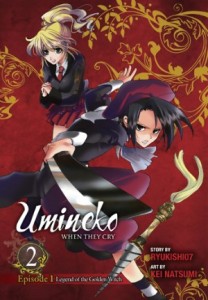
Umineko: When They Cry, Vol. 2

February 24, 2013 by Sean Gaffney

Story by Ryukishi07; Art by Kei Natsumi. Released in Japan in two separate volumes as “Umineko no Naku Koro ni: Legend of the Golden Witch” by Square Enix, serialized in the magazine Gangan Powered. Released in North America by Yen Press.

And so the first arc of Umineko: When They Cry is finished, and even more than the first Higurashi arc, it shows us that what we’ve been reading for the last 1100 pages is simply a prologue for everything that is to come. It shows us the main players, allows us to see the family drama at the heart of everything, and of course has a number of gloriously gruesome murders, but you keep expecting the last page to be, with apologies to The Goon Show, Wallace Greenslade announcing “And this is where the story REALLY starts.”

umineko2

There’s a lot more emphasis on the mystery itself than there was in the Abducted by Demons arc, with each new killing propelling the remaining cast to desperately try to figure out how in God’s name they’re happening. This is made possible by the deliberate closed-in locked-room style of the series, which does not allow much in the way of escaping or trying to forget about everything. Thus Umineko is a more oppressive series than Higurashi, but it’s also more focused. Character allegiances shift rapidly, as Eva, one of the more sensible character in the first volume, proves to be incredibly nasty at trying to pin the crime on Natsuhi; Maria’s split personality is genuinely looked into as possibly being a product of her mother’s resentment; and Natsuhi herself finally takes control of the family at the expense of… well, a whole lot.

Jessica and Kanon are on the cover, but they really don’t get much of a look in beyond the fact that Jessica clearly has a crush on Kanon. (I understand the second arc focuses more on Jessica and George’s relationships.) But the inside cover tells the real story of this book, showing a frustrated and enraged Battler and a smug, grinning Beatrice wielding chess pieces at each other.

Then there’s the tea party. I’ve been reading through a couple of the Higurashi Visual Novels (available legally from Mangagamer, by the way – one of the few non-porn things they’ve done), and each of them ends with a short ‘tea party’ set in the cafe where the cast, out of character, go over what happened in the book and whether it was due to demon or human elements. That said, it’s totally independent of the VNs themselves, and was dropped from the manga adaptation as being irrelevant. Is was therefore a big surprise to me to see the tea party actually adapted for the manga… and it proved to be the biggest plot twist as well. It’s all very well and good to deny the existence of a witch who appears as shafts of light or butterflies, but her physical presence really throws Battler for a loop. And when he continues to deny her involvement… let’s just say things don’t end well for our heroes.

And so we seem to have a plot and a meta-plot, as Battler and Beatrice are now in competition to find the best explanation for the events at Rokkenjima (note that actually trying to stop the murders doesn’t seem to be an option anyone brings up this time). And then at the very end there’s a meta-meta plot, as Beatrice has her own tea party with another witch named Bernkastel… who we’ve seen in the Massacre arc breaking down the Higurashi plot with Rika. Indeed, Bernkastel looks exactly like Rika… and while Ryukishi07 has apparently said that the two are not the same, there’s clearly enough similarities that they’re connected in some way.

The balance between mystery and horror is what drives this series, as the author himself notes at the end. And while events may be more dramatic, gestures more declamatory, and events far more hopeless than Higurashi, the key is whether a reader wants to read on and find out more. I certainly do, especially since I want to find out more about Beatrice, who insists she’s behind everything, but hasn’t really given a reason why beyond “cause I’m evil like that”. I’m going to guess that’s not the real reason.

Filed Under: REVIEWS Tagged With: umineko

Hayate the Combat Butler, Vol. 21

February 24, 2013 by Sean Gaffney

By Kenjiro Hata. Released in Japan as “Hayate no Gotoku!” by Shogakukan, serialization ongoing in the magazine Shonen Sunday. Released in North America by Viz.

I’ve given every volume of Hayate since I began this blog a full review, so want to keep up the tradition. Of course, that tends to mean I have to keep finding new things to say. Should I talk about how the North American audience views harems… no, wait, did that already. What about the relation between gags and serious… no, did that too. It doesn’t help that Hata is very slowly putting all his pieces into play for what promises to be an epic storyline… but it isn’t yet. As a result, we get a lot interruptions here, including some characters who haven’t appeared in so long that Hayate and Nagi have to direct readers to the appropriate volume.

hayate21

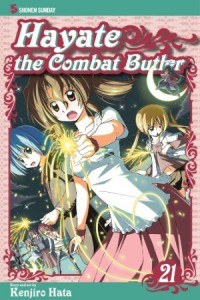
For those who like Maria, enjoy that cover, she’s barely in this volume. (To be honest, aside from one-shot chapters, she’s never really going to be relevant again, unless Hata comes back to her if/when he wraps this up.) The two major events in this book are a beach volleyball game challenge given by Gilbert, the aforementioned character who no one remembers anymore; and Sonia, the nun with a crush on Wataru, trying to steal the Ougyoku Stone. This Stone has come up once or twice since the series began, but here is where it starts to really play a major role, in that Nagi’s Machiavellian grandfather states if Hayate allows anyone to steal or destroy the stone for more than an hour, Nagi loses her inheritance. And there’s a lot of people who want that to happen, including Athena, now 10 years older and living in Greece. The stone is the gimmick that will drive the next few volumes.

The beach volleyball game is the funniest part of this volume. Gilbert immediately shoots himself in the foot by demanding Hayate partner with Hinagiku, as she’s so “weak and frail”. Unfortunately, Hina is dealing with her usual self-image and tsundere love for Hayate, so she decides to pretend to be as weak as Gilbert says she is. Complete with monotone “Eek” noises. Thankfully, Gilbert is *such* an ass that this only lasts for a couple of pages before she decides to kick his ass. (By the way, I note that now that Hata has revealed that Miki is in love with Hina, he’s allowing her to be a lot more open about it, demanding Hina wear a bikini and essentially lusting after her.)

The most romantic part of the volume is the one with Sonia, though she isn’t the reason why. She’s stealing the stone so that she can help Wataru get his *own* family fortune back, and therefore return Sonia’s love. Hayate is absolutely not the best person to figure this out, given that he has all the sensitivity of a hammer. Luckily, Ayumu is there with him, and once again makes you wonder why she isn’t the heroine of some other manga. She calms Sonia down, points out Wataru wouldn’t like her just for money, gets the stone back, comforts Hayate, *and* gets to kiss him (on the cheek) to boot. She would be the clear winner of any other harem manga, but is only a long-shot in this one. Which is a sign of how balanced Hata keeps his harem… and his readers.

Due to the typical low sales of almost all harem manga these days, the next volume will not be out till August. But Hata, for the most part, delivers what readers want – some fanservice, some laughs, some romantic tease, and a few sweet moments. If you read Hayate scanlated, get over the fact that your pairing may not win and buy the manga. As for new readers… why are you buying Vol. 21?

Filed Under: REVIEWS Tagged With: hayate the combat butler

Knights of Sidonia, Vol. 1

February 20, 2013 by Sean Gaffney

By Tsutomo Nihei. Released in Japan by Kodansha, serialization ongoing in the magazine Afternoon. Released in the United States by Vertical, Inc.

I will admit to being one of the few people reviewing this title who has not read either Biomega or Blame, the author’s previous series released here. As a result, I wasn’t quite sure what I was getting into, except that the series looked vaguely Gundam-ey. And I have to admit, after finishing the first volume, I’m still not quite sure what’s going on. That said, it’s the sort of manga that rewards trying to find out, and there’s lots of little things here and there that make this well worth a read.

sidonia1

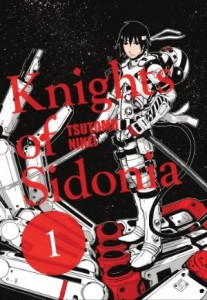
This takes place somewhere in the future on a World Spaceship, a la Heinlein’s Orphans of the Sky. Much of the plot is not told to us via exposition or narrative, but simply by immersing us in our hero’s day-to-day life and expecting us to figure it out as we go along. Our hero, Nagate, has been living secretly underground for years with his grandfather (I think), practicing blowing things up in a flight simulator. When he runs out of food (is his grandfather dead? And for how long?), Nagate goes to find some, and accidentally falls into the processing machine (one of the more morbidly funny scenes in the entire volume). After being discovered, he’s quickly indoctrinated into the military and added to a team whose mission is to battle the Gaunas, alien life forces intent on destruction.

Our hero is not much for words (or indeed facial expressions), so getting some battle scenes almost feels like a relief. My favorite part of the entire manga is probably the cruelest: we meet a new girl, Eiko, who is standoffish and avoiding all the superstition that the other pilots perform. Given she’s in the chapter title, we naturally assume she’ll be like Izana and come to befriend our hero, though given how prickly she seems it may require him to show initiative. But no! They go out to battle Gaunas, and she’s not only killed off immediately but her form is used to become a hideous monstrosity that almost kills off Nagate too. This fakeout was well-played, and I applaud the author for it.

Towards the end of the volume we get a few more new characters, who are a bit too new to really grasp on to, as well as an indication that Izana seems to have fallen hard for our hero. Clearly this is meant to be a series with a few volumes to it, and I imagine all will become clearer as I go along. I’m left, however, with a sense of distance about the whole thing. Nagate has difficulty emoting due to his upbringing (at least, that’s what I imagine), Izana seems naturally repressed, and through most of the volume I kept wishing that I could get closer to our heroes’ mindset while being unable to. I did enjoy Nagate defending Izana against a hotshot egotistical jerk pilot (who then breaks Nagate’s arm), and hope that we’ll see more elements like this. Knights of Sidonia as a series is cool rather than warm, but it’s still fascinating, and I look forward to working out what’s going on in future volumes.

Filed Under: REVIEWS Tagged With: knights of sidonia

Fushigi Yugi Genbu Kaiden, Vol. 11

February 19, 2013 by Anna N

I am looking forward to the end of this series in an odd sort of way. The next volume will be the last and I’m looking forward to being able to reread the entire series in a couple sittings. There was quite the gap in publication between volumes, so I’m curious to see how the story plays out when I’m not waiting around for four years or so between volumes 9 and 10. Yuu Watase says in her author notes that her series tend to pick up towards the conclusion, and this is definitely true for this volume as Uruki confronts his family legacy, Teg and Urumiya deal with their celestial warrior destiny and the heroine Takiko continues to cough up blood while working bravely to save the country of Bei-Ja. There’s a good balance in the story as it presents plenty of emotional character arcs and action with a general feeling of impending tragedy.

Overall after reading this volume I was struck by how much self-sacrifice is a theme and how this contrasts with the somewhat lighter tone of the original series. Takiko’s devotion to her role as Priestess of Genbu is absolute, but her romance with Uruki does get a bittersweet type of resolution at the close of this volume. One of the things I’m going to miss about this series is the art. Watase’s distinct character designs never leave me confused about what’s going on, even with an extended cast and many subplots happening towards the end of the series. The action scenes are dynamic, and the costumes and setting are detailed enough to make me invested in the World of the Four Gods. I’m looking forward to the last volume, but I’m going to have a box of kleenex ready when I read it!

Filed Under: REVIEWS

Harelequin Manga Quick Takes

February 18, 2013 by Anna N

I went on a .99 cent shopping spree in the Harlequin manga section of the Kindle store recently, so here are some quick takes on bargain romance manga.

Maddie’s Love Child

The Maddie in question in this title is an Australian headstrong leather-garbed interior designer, who enjoys making rich and remote men fall in love with her and then stomps on their hearts. She’s also longing for a baby but not a husband, so she is determined to track down the perfect sperm donor. Miles McMillan, remote and rich British businessman comes back into her life. Maddie and Miles met previously but he rejected her advances because he was engaged. Now that he’s broken things off with his fiancee, he decides to return to Australia for business…and something else. Maddie and Miles start to date, but will her baby making schemes and romantic foibles, combined with his emotional reticence and uptight British ways result in a romance or just a whole bunch of emotional trauma? Maddie’s internal dialogues sizing up Miles’ fatherhood prospects (“My child would never learn his arrogance or cold pride. And I could give it all of my love!”) were pretty hilarious. The art in this title was a little stilted, but generally attractive. Maddie’s personality and forthright nature was refreshing compared to other Harlequin heroines, so if reading about emotionally distant British businessmen falling in love is one of the romance novel tropes that you enjoy, this title was worth the .99 cents.


Expecting the Boss’ Baby

In Harlequin world billionaire bachelors with attractive secretaries end up accidentally impregnating them FAR TOO OFTEN! Michael is a rich emotionally distant man who accidentally celebrates a business deal with his capable secretary Kate a bit too much. She’s now secretly pregnant and harbors feelings of affection towards Michael the millionaire robot, but he is oblivious and doesn’t want any sort of emotional connection with Kate. When he makes his feelings known to her, she promptly quits. Michael is emotional remote because he grew up in an orphanage, his only friends are a couple of other millionaires who dispense warped advice about women and relationships. When Michael realizes that Kate is pregnant, he’s determined to ensure that his child won’t grow up without a father. This was very much a middle of the road title for me. Both the story and art were about average in terms of what one would expect from a Harlequin manga adaptation. This is part of a trilogy, as I’m sure Michael’s millionaire bachelor friends also find themselves promptly married off in later installments.

The Royal Marriage

This title had the vaguely retro art that I tend to enjoy most when reading Harlequin manga. There are plenty of big eyes and flowing hair abounds as Gabriella, the Brazilian heiress finds herself trapped in a marriage with Prince Ricardo. Ricardo has the reputation of a playboy, but when Gabriella’s father dies, leaving her with no family and a will with some very odd provisions, she decides to go through with the marriage. Gabriella settles into her new rule as princess, while trying to figure out her feelings towards her new husband. There’s a bit of palace intrigue, and Gabriella is a bit sassier than the usual Harlequin heroine. Along with Maddie’s Love Child, this was the title I enjoyed the most out of this batch of four manga.

Word of a Gentleman

I tend to take notice when I find a Harlequin title with decent art, because mostly I tend to expect somewhat lackluster art. Of the batch, this had the worst artistic adaptation, with stilted, out of proportion characters. The sub-par quality of the lettering was also distracting. This was a bit of a shame, because aspects of the story were a bit interesting. Clarissa decides that she’s going to hire herself a poor husband in order to get away from the machinations of her evil guardian Uncle and the loutish pawing of her cousin. She fixates on Hugh Richfield, who actually decides to take her up on her offer to pay him to elope with her. Hugh and Clarissa take off for Gretna Green and have some adventures along the way. Unfortunately the happy ending where everybody suddenly becomes rich strains even my willing suspension of disbelief.

Filed Under: REVIEWS Tagged With: harlequin manga

Kamisama Kiss, Vol. 12

February 14, 2013 by Anna N

It seems like most volumes of Kamisama Kiss involve human kami Nanami traveling to a new land or meeting some strange yokai. Fortunately this is a plotline that Julietta Suzuki executes so well with both art and story, I don’t mind a bit. I would happily look at a Suzuki art book because I find her character designs so entertaining. I’ve noticed that her underwater characters are often particularly inspired, so there is a lot to like about this volume, which features some major romantic happenings not for Nanami but for her yokai acquaintance Himemiko of the Tatara swamp and her human boyfriend Kotaro.

Himemiko has only appeared to Kotaro in human form, but her secret is going to be tested when her childhood fiance arrives to cause problems. Nishiki is a prince of a neighboring swamp who has grown up arrogant and cut off from contact from most creatures. His solution to his upcoming wedding is to kidnap both Nanami and her shrine, leaving her cut off from Tomoe. Nishiki has a formal way of dressing, accessorized by a scaly headband and fins at the side of his head. When he finds Himemiko in human form she pretends to not know what he’s talking about because she still doesn’t want to reveal her non-human nature to Kotaro. Kotaro gets injured during a confrontation and the god of the sea Ryu-Oh appears again, with his toothy grin, eye patch, and attitude problem.

Nanami struggles with her shrine being trapped at the bottom of a swamp and attempts to get through to Nishiki. Her utter disregard for high court yokai etiquette starts to wear the arrogant Nishiki down towards the end of the volume. His royal mannerism have even cut himself off from his own people, who boggle when they are shown the slightest amount of regard from their ruler. Himemiko and Kotaro start dealing with the true nature of their relationship, even as Nishiki starts to thaw a little bit and begin to understand that he doesn’t know much about the nature of love. Nishiki’s character evolves throughout the volume, and it is always good to see Nanami cause change just simply by being herself.

Even if Nanami and Tomoe’s relationship isn’t resolved yet, it is nice to see things moving forward for the other human/yokai couple in the book. I’m going to look forward to see what happens next at the conclusion of this arc, and if there’s a happy ending for the swamp Princess and her human it will be very interesting to see how Tomoe and Nanami react to that development.

Filed Under: REVIEWS Tagged With: kamisama kiss, shojo beat, viz media

Slam Dunk, Vol. 26

February 11, 2013 by Anna N

With each new volume of Slam Dunk I’m simultaneously happy and a bit disappointed – happy because I can read another volume of a great sports manga, and disappointed because we are slowly inching towards the final 31st volume. I continue to find Slam Dunk fascinating even when a basketball game gets spread out over several volumes. Shohoku is still playing tournament favorite Sannoh, but things finally start to click for the loveable underdogs. My favorite aspect of this volume was that the breakout star of the game wasn’t the cool Rukawa or the sometimes doltish basketball savant Sakuragi, but their sometimes overlooked and quiet teammate Mitsui who starts out the volume by hitting three 3-pointers in a row. He’s able to take advantage of the fact that Sannoh’s focus is on Shohoku’s star players and score with simple precision. Everybody is mystified by Mitsui’s sudden confidence, including his own teammates. The Shohoku fans remember that Mitsui used to be a junior high MVP, but his play has suffered because he felt like he had to live up to some past glories. Shohoku’s enigmatic coach concludes that Mitsui is starting to believe in himself again at just the right time, and there’s a great wordless interchange between coach and player as they make eye contact and pump their fists. Simple moments like this where Inoue just uses a few simple panels to underscore a moment do so much more to drive the story forward than pages filled with expository dialogue.

Once the opposing team realizes that Mitsui needs more coverage, Shohoku needs to change up their strategy yet again. Rukawa and Sakuragi both have some moments, but Sakuragi is tested when the opposing team puts a huge substitute player in and his coach tells him that the monster is his assignment. It is a measure of just how far Sakuragi has come that while he does give in to his first impulse of trying to fight strength with strength, he eventually hits on a way to deal with the new player using strategy and observation. Each volume of Slam Dunk always feels very satisfying. To describe the plot, it might seam as if the story is moving forward at a glacial pace, with three volumes or so spent on one basketball game. But the evolution of characters and personalities brought on by the conflict of basketball is layered and dense, and that makes this title such a special sports manga.

Review copy provided by the publisher.

Filed Under: REVIEWS Tagged With: slam dunk, viz media

Wonder!, Vol. 3

February 11, 2013 by Sean Gaffney

By Akira Kawa. Released in Japan by Futabasha, serialized in the magazine Women’s Comic Jour. Released in the United States by Futabasha on the JManga website.

When I left off with Vol. 2 of Wonder!, I was wondering whether the extremely uncomfortable plot twist that ended it would be brought up again in the third volume or just glossed over. In a way, it’s both. But I’m OK with how it resolved, as having it any other way would just give me the creeps (as indeed it does to Kaori at the start of the book). That said, it feels a bit of a cop-out, and makes Kaori’s mother even less sympathetic than she already was. But then, that’s one of the main things about this series: family are always there, even if you try desperately to avoid them, and they always bring their own issues to the table. And not all families are perfect.

wonder3

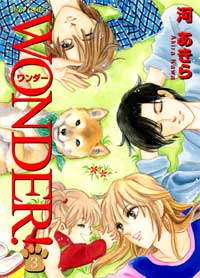
That said, the main family – Kaori, Taiyou, Kota and Miya – still tend to be a bit better than you’d expect. Problems that affect them mostly come from outside sources, and even the one time there’s a big screw-up – Taiyou trusts a mother that he bonds with at the zoo to take his girl to the ladies’ room, only for the mother to run off with her – it’s something that resolves in a rather pat way. As for Kota, when your worst flaw is that you’re sometimes too direct and a bit reserved, you’re clearly a great kid. He gets to show off how he deals with both kids and creeps in this volume, and his awesomeness is (so far) rewarded. Only Kaori really seems to have major issues here, and that’s mostly from the fallout from last volume. Everyone’s just a bit too perfect.

However, the author does seem to be trying to shake things up. Kota’s cousin Kaito, who looks very similar to Kota except for his height, arrives, and proves to be a giant pain in the neck. He’s under pressure from his mother to live up to his siblings’ success in school, and it’s driving him to acting up. He’s clearly meant to contrast with Kota, as the cast lampshades, and almost causes Kota to show an actual emotion. His mother, though, once revealed, explains much of his behavior – she’s even worse than Kaori’s mom (and in fact allows Kaori’s mom to have the upper hand for a bit), and makes your nerves grate. Kaori notes to Taiyo that part of the reason they agre4ed to their ‘open marriage’ at first was simply to avoid dealing with each other’s family, and we’ve come to see why.

And throughout all this there is the dog Wonder, who still has odd traces of the supernatural to him, being able to instantly show up whenever there is trouble, even if he’s also still at home playing with the kid. The family seems to have quietly accepted it as ‘awesome dog powers’, but given that said dog has saved their lives multiple times, I can see why they’d want to gloss over and explanations in case they ruin the fantasy. It does add an odd touch to this off-kilter soap-opera of a manga, which never quite allows me to find my footing. While the lack of stability can be annoying, it’s also probably why I find it so fascinating. I want to read more about these people to see how they tick. Yes, even if it means dealing with their families. Here’s hoping for Vol. 4 soon.

Filed Under: REVIEWS Tagged With: wonder!

Alice in the Country of Joker: Circus and Liar’s Game, Vol. 1

February 8, 2013 by Sean Gaffney

By Quin Rose and Mamenosuke Fujimaru, based on the game by Quin Rose. Released in Japan as “Joker no Kuni no Alice – Circus to Usotsuki Game” by Ichijinsha, serialization ongoing in the magazine Comic Zero-Sum. Released in North America by Seven Seas.

As I’ve noted before, I’m enjoying the Alice series a lot more than I’d expected to. I think one reason may be its similarity to the Higurashi series, another favorite of mine. Both franchises based on ‘visual novel’-type games, and made into manga series where the continuity reboots with each new incarnation. The Alice books, however, haven’t really tied into each other the way Higurashi does – you don’t really need to read them in order, and you can simply pick the series with your favorite guy and only read that one without missing much. Now, though, we have Alice dealing with a new antagonist, Joker, and this very much ties into the previous series, and rewards readers/players who are well-versed in it.

alicejoker1

It may come as a surprise, then, to see the volume begin with what amounts to a giant 80-90 page recap of Alice’s adventures in Wonderland to date, from her abduction by Peter to her present life working in the Heart Palace (yes, she’s there in this iteration, not the Clocktower, the Amusement Park, or the Hatter Mansion). We meet the entire main cast, get a brief precis as to who they are and what their damage is, and see how they interact with Alice (who hasn’t fallen for anyone here – romance is, so far, not in the cards in this setup). It’s given a wraparound of Alice reading her diary and reminiscing about the past, which works all right. However, this doesn’t seem like filler but more a way of putting the basic concepts of Wonderland in the reader’s mind before the creators start fiddling with them.

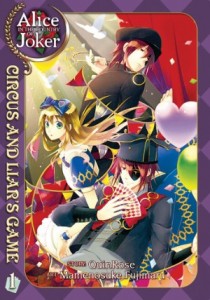
Because it’s April, the Circus is coming to town, and Alice’s memories are starting to go a bit wonky. She’s currently in the country of Clover, yet runs into Julius and Gowland, neither of whom should technically be there. It would appear that this is merely a function of the season, but the arrival of the circus to town might also be a reason – a circus with two creepy children and their master, the titular Joker. We met Joker in a small cameo in the original Alice series, but this is the first time dealing with him in the flesh. He’s a smug trickster-type character, and no doubt will be driving Alice nuts as the series goes on. More to the point, Joker and his two assistants ask Alice why she’s staying in Wonderland and not returning to her world. We get a bit more detail about her life pre-Wonderland here, including a touchingly sad side-story detailing her crush on her tutor, and her sister’s role in it. Again, we see that all of the main male cast seem dedicated to her NOT thinking of her sister, and I have a feeling Joker might try to sabotage that. (Of course, the fate of her sister is about as much of a spoiler by this point as Higurashi’s main villain – if you haven’t figured it out yet, read the main series again.)

This is a more serious and mystery-oriented incarnation of the Alice series, with only one sexual innuendo from the Hatter (a new low!). This isn’t to say it’s without humor, however. Alice’s reaction to Peter’s assault at the start is amusing enough to take the taste of creepy away a bit, and the Hatter’s way of showing her she’s being appalling by comparing him with her tutor is fantastic. There’s also an amusing side-story showing what the series would be like if Alice was a tiny cute little girl instead – let’s just say less romance and more adorable. But the main reason to read Alice, as always, is for the mind games the world brings with it, and this series promises to be the best one yet in delivering them.

Filed Under: REVIEWS Tagged With: alice in the country of hearts

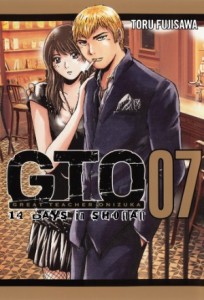
GTO: 14 Days in Shonan, Vol. 7

February 6, 2013 by Sean Gaffney

By Toru Fujisawa. Released in Japan by Kodansha, serialized in the magazine Weekly Shonen Magazine. Released in North America by Vertical.

Another volume of 14 Days, and the lessons remain the same. Don’t let your past define you, don’t become a bad person just because society thinks you are, there are other people who really do care about you, etc. The telling of this can be somewhat melodramatic, but that works in the story’s favor, to be honest. Onizuka and his story is larger than life. Moreover, to every teenager who thinks their problems are the ABSOLUTE WORST EVER, every decision they make and conflict they have is this dramatic. Indeed, it’s telling that Kikuchi and Urumi’s solution on how to break Miko is simply to ramp *up* the drama.

gto14days7

That said, my favorite part of the volume came in between crises, as Shinomi gets back to the White Swan and runs into Urumi, who’s hanging out after assisting Onizuka with Miko. Seeing the most popular girl in Shonan Jun’ai Gumi meet the most popular girl in GTO is sort of a fan dream, and at the start it goes exactly as we’d expect: Urumi instantly identifies Shinomi as a threat and starts to systematically make her feel small and cornered, with the help of money and a typically oblivious Onizuka.

The best comes in the bath, however, when Urumi learns that Shinomi hasn’t actually gotten anywhere with Onizuka, and realizes that they’re not rivals but the same – doomed to be the ‘little sister’ who can’t be seen romantically. And the tension in Urumi *instantly* dissolves, as she suddenly regards Shinomi as someone to confide in (I don’t think she ever did that in GTO, so it’s impressive). They’re both probably correct, by the way – I suspect if Onizuka ever does end up with anyone in the future of GTO, it’ll be Fuyutsuki, simply as he actually sees her as a possible romance. In any case, Urumi’s juvenile solution to their frustration, and Shinomi going along with it, is a pitch-perfect ending to the scene.

Unfortunately, the real world is due to come crashing into the series. Despite a chapter that pushes the bounds of ridiculousness by having Onizuka literally fly for over a mile. The mayor of Shonan proves to be the sort who wants anything that might be a problem to simply go away till he’s re-elected, and his slimeball assistant appears to want to take advantage of that by having some of the ‘White Swan’ kids returned to the loving arms of their parents – even if those parents are abusive scum. Which means that, with only two volumes of the series to go after this, we may end up right back where we started, with Sakurako being in danger.

For all that Miko and Riko were a credible threat to Onizuka in the past couple of volumes, there was no doubt that they wouldn’t be won over (kicking their deadbeat dad into the harbor likely helped out a lot there). These guys, though, are far less likely to simply be misunderstood or uncaring. Yes, GTO may tell you that you need to stop feeling sorry for yourself and move forward, but it never diminishes what you’ve been through. Which makes this new threat all the more scary. That said, this is Onizuka, and I look forward to seeing how he takes it out.

Filed Under: REVIEWS Tagged With: GTO

Negima! Magister Negi Magi, Vol. 37

February 4, 2013 by Sean Gaffney

By Ken Akamatsu. Released in Japan as “Mahou Sensei Negima!” by Kodansha, serialized in the magazine Weekly Shonen Magazine. Released in North America by Kodansha Comics.

First off, I will admit that this reads a lot better in collected format than it did in weekly chapters. The parts of the story that really aggravated me are confined to the latter third of the book, and there is some honest attempt at character building and attempting to wrap things up. But overall, this is still Ken Akamatsu, after an exciting 18-volume arc of fighting and apocalypse, going back to Mahora Academy and simply coasting on fanservice for a while. And, at least in the West, he found himself up against a fandom that was now reading Negima almost entirely for the action and drama, and hated the fanservice. This is a big problem if you’re Ken Akamatsu.

negima37

Where the story works well is when it’s capturing the fallout from the Magic World arc. Setsuna, as Eva points out, can’t deal with being a soldier in peacetime, and is still (still!) upset with her base desires for Konoka, not to mention finding out that Asuna is a princess. Her heroic self-loathing can be quite amusing, but it’s also a very annoying side to her, and so I was somewhat torn between laughing and wanting to smack her. Of course, all that class distinction goes right out the window when she finds out what Negi and Asuna’s plan for saving the magic world is. It’s a big but workable sacrifice for Negi, but a huge and appalling sacrifice for Asuna, and Setsuna is justifiably appalled that she’s avoiding telling anyone what she has to do. More on this in the final volume…

There are some other good chapters. Chisame spent most of the Magic World arc filling in for Asuna as Negi’s tsukkomi and adviser, and now that they’ve returned suddenly finds that she hates being out of the loop. Yue gets shorter shrift, but finally manages to recover the memories from the past year, ironically triggering them by confessing to Negi. Unfortunately, this then leads to the rest of the book, where Haruna and Misa (a truly disastrous combination who should never be allowed to plan anything together ever) decide that Negi ‘leading on’ all these girls by his natural-born charisma, and not responding to any of their love confessions (despite his age – I wonder if he’s turned 11 by now) makes him an enemy of women.

Earlier in the volume we had a chapter or so devoted to a giant fight between Negi and Eva, fanservice for those who like that sort of thing. And at the end of the manga we get a giant wacky chase, which Akamatsu loves to do (see my recent review of the 4th Love Hina omnibus) and which never fails to annoy me, as it always has people acting out of character for the sake of comedy schtick. Combined with far more nudity than usual (let’s just say Negi sneezes quite a bit this volume) and you have Akamatsu specializing in many of my least favorite scenarios.

There’s also the fact that Negima ends in the next volume, and there seem to be an insane amount of loose ends that still haven’t been tied up. Negi’s parents, the whole plan with Asuna – it won’t end the way it’s suggested, unless this series goes really dark – and of course which girl wins. And behind the scenes, Akamatsu and his editors at Weekly Shonen Magazine are (allegedly) having a bit of a tiff. How will this all shake out? Well… see you next time.

Filed Under: REVIEWS

Pretty Guardian Sailor Moon, Vol. 9

February 2, 2013 by Sean Gaffney

By Naoko Takeuchi. Released in Japan as “Bishoujo Senshi Sailor Moon” by Kodansha, serialized in the magazine Nakayoshi. Released in North America by Kodansha Comics.

I have so many things to say about this volume of Sailor Moon that I’m not even sure where to begin, so please forgive me if I start to ramble. For those of you wondering what’s going on, the Senshi are dealing with the Dead Moon Circus and Chibi-Usa’s getting visions of a pegasus who’s looking for the Legendary GOLDEN Crystal. Meanwhile, all the senshi have found themselves unable to transform and are wondering if this means their duties are over… and whether they can start to follow their dreams.

sailormoon9

The volume opens with each of the four Inner Senshi discussing their dreams of the future. Ami wants to follow in her mother’s footsteps and become a doctor, Rei likewise wants to succeed her grandfather (who I’d forgotten looks nothing like his anime counterpart) at the shrine. Makoto wants to be a wife and baker; and Minako of course dreams of being an idol singer. As we move on, it’s not limited to just them. Not only do the Outer Senshi find themselves living in a small bubble of ‘perfect happy family’ that seems like a dream, but even the Amazoness Quartet, this arc’s minor villains, use the same language – getting their freedom to move in the real world is referred to as their dream.

The first three chapters also remind us that many of the senshi have family issues. Ami’s mother is really too busy to give her the care she needs (though notably she seems to show remorse about it, unlike a lot of ‘education mama’ portrayals of Ami’s mother I’ve seen), and her father essentially ran away and divorced them a few years prior. Rei’s mother died soon after she was born, and her dad is a government minister who has no time for his daughter and has sent her off to live at the shrine. (As we’ll find in a later short story, he *is* as unpleasant as he sounds.) And Makoto’s parents are both dead, and she’s living on her own with the traditional manga “where the hell does she get the money to afford that place” apartment.

The Amazon Trio (who, this being the manga, are barely characterized and killed off right away) thus have no trouble finding ways to get into the girls’ heads and try to tempt them away from their true calling. Preying on Ami’s loneliness and abandonment issues, Rei’s sense of duty and how oppressive that can feel, and Makoto’s indecision and feelings of being weak. Naturally, in the end, each finds the inner strength to go on (in Jupiter’s case, MONSTER STRENGTH, a line that had me laughing hard) and are able to transform, power up, gain new attacks, and wipe out the enemy. (Though not, notably, the Quartet, who always get away. Maybe it’s because they always work in a group, rather than on their own like the previous minor villains. You’d almost think they were friends…)

And then there’s Minako, who has issues of her own. She’s supposed to be the leader of the Inner Senshi, after all (something the anime quietly dropped), and is rather upset that they can all now transform and she still cannot. What’s more, the other three are all mentioning the Outers more and more – how inspirational they find them, the good advice they received from them, and how it would be great if they could show up to help everyone out. This makes Minako even more annoyed, as she never really bonded with them the way the others did, and is unable to offer advice as she’s still powerless. We see in the previous chapters each Inner thinking of advice from their Outer mentor – Ami with Setsuna, Rei with Michiru and Makoto with Haruka. Clearly that would leave Hotaru for Minako, but as she’s a baby right now that doesn’t really happen.

(Speaking of which, when did all these chats and bonding with the Outers actually happen? Between S and SuperS, or in the bits we didn’t see between S? Also, I know that Minako and Hotaru is quite a popular fanfic crack pairing, and I wonder if this might be a reason why.)

In many ways, this parallels an episode of the S anime, where Minako is frustrated that she’s the only one who hasn’t been attacked by the enemy. Here she charges forward into the enemy’s trap (and yes, she’s quite aware it’s a trap) in an attempt to make herself power up through sheer force of will. Unfortunately, what this leads to is her being dropped off of a tall platform, and the only thing holding her up is Artemis. Ignoring the physics of that for a moment, this resonates the best of the four Inner Senshi stories. Ami and Makoto had tiny little versions of themselves gibing them pep talks, and although Rei and Phobos and Deimos turn human briefly, we’d never seen her interact with her crows in quite the same way. But Minako and Artemis are partners (in a way that Usagi and Luna will never be), and when Minako thinks he’s been killed she’s heartbroken.

Artemis’s transformation into a white-haired handsome bishie would likely be less startling to those who read the manga when it first came out (they’d already seen a side-story where Luna did the same, which was adapted into the S movie), and it’s presented as sort of a powerup, much as the senshi go from Planet Power or Star Power to Crystal Power, Artemis is now strong enough to turn human in times of need. This is turn allows Minako to find the strength to make her own transformation.

In the meantime, as I noted, the Outers are living an idyllic life in a mansion somewhere. Haruka’s racing idiots on the highway, Michiru’s recording CDs (and getting hit on), Setsuna is doing important research, and Hotaru… now seems to be about 5 years old. And is quoting Yeats. The Senshi of Destruction quoting The Second Coming is never a good sign. She has her memories as Hotaru, her memories as Saturn, and these new memories of growing up with the Outers all in her head, and it’s turned her into quite the little prodigy. Of course, she also has her deep bond with Chibi-Usa, and knowing that she’s in trouble leads to her age up, again (this time to about 12, it seems), and unite the other Outers to do the same. It’s the sort of scene you want to see set to music, and is beautiful, inspiring, and a bit scary all at once.

In the meantime, what of our leads? Well, poor Mamoru is once again suffering by being the one who is always targeted. This time it’s shadows on the lung, which then becomes coughing up black blood – and even worse, it seems to be contagious, something we find at the very end of this volume when Usagi starts to cough as well. The ‘swapped bodies’ cliffhanger from last time is resolved fairly quickly (though not before Usagi tries to cuddle up with Mamoru in her chibi body, and finds that though he likes ’em young, that’s a little *too* young). Most of the book has Chibi-Usa trying to figure out what’s going on with Pegasus, which is a combination of ‘I want to save him from the bad guys’ and ‘he transformed into a hot guy what are these feelings in my heart?’. This, by the way, leads to the other big funny moment in the volume, where Chibi-Usa imagines talking about her unicorn wannabe-boyfriend with the other Inners, and quickly realizes Makoto is the only conversation that wouldn’t be a disaster.

I seem to have gone on a bit. Suffice to say this book was basically everything I wanted it to be, gave me tons of character stuff to analyze (giving lie to the anime fans saying the manga characters are too dull), and had huge roles for Minako and Hotaru, my two favorite senshi. And, if I recall, the next volume is just as good, and will wrap up the SuperS arc. Get it!

Filed Under: REVIEWS Tagged With: sailor moon

Game Review: Yedo

February 1, 2013 by Paul Beasi 3 Comments

Curry favor with the Shōgun–or maybe assassinate him!
Bits & Blips: Manga Bookshelf Edition

Every October from several thousand kilometers away I try to live vicariously through others’ accounts of Internationale Spieltage SPIEL, the largest board gaming convention in the world, also known simply as Essen after the German city in which it is held. Hundreds of games are unveiled publicly for the first time here, some of which will eventually be released worldwide within weeks or months. But some of the games released might never make their way to United States except through importers, and since getting heavy games across the ocean is an expensive endeavor, the cost to obtain these games can be significant. That means limiting myself to one or two of them and that means research. There were a lot of new games with significant buzz coming out of Essen ‘12, but most of them were slowly getting released here. One that particularly caught my eye was a game from a pair of designers from Belgium called Yedo published by eggertspiele / Pegasus Spiele. It didn’t have a lot of buzz, had no US release planned, and it was the designers’ first effort, but the people who played it really seemed to like it and it looked stunning. I decided to take a chance on it.

Best. Decision. Ever.

In Yedo, a worker placement/auction style game, each player is a Clan Elder trying to curry favor with the new Shōgun who rules Japan from the city of Yedo (also known Edo–see this designer diary for information on the name–which is modern day Tokyo). This is primarily accomplished by completing missions to earn money and prestige points (PP). The player with the most prestige points at the end of the game is the winner.

Gameplay:

Yedo lasts for 11 rounds (unless someone assassinates the Shōgun). There are two versions of the game: Geisha and Samurai. For this review, I will cover the more challenging Samurai version. I’ll discuss the differences at the end.

cardsAt the beginning of the game, players will each receive some money, two disciples, an action card, four missions, and a favor. Players will use the disciples to gather the various items needed to complete missions and can acquire more disciples during the course of the game in order to accomplish more in a single turn. The action cards grant the owners special, usually powerful single-use abilities that can be used at various points throughout the game. The favor grants the owner a special starting bonus which could include money, cards, or even a blessing. Each favor’s bonus is unique, however after collecting the bonus players flip the card over and may use it once during the game as a blackmail card or keep it for 2 PP at the end of the game.

The missions are the crux of the game. They come in four colors which are indicative of their difficulty to complete. Green missions are the easiest, followed by yellow, red, and the high scoring but extremely hard black missions. Early on players will need to complete some of the easier missions in order to be able to collect the items needed for the harder missions. There are also five mission types: Warfare, Kidnapping, Theft, Espionage, and Assassination.

greenmission redmission

Once the game begins, players may bid in an auction on various assets: Action cards, Bonus Cards, Weapons, Annexes, Geisha, Disciples, and Mission cards. The assets are divided up into three color groups; in two and three player games, players bid on one of these color groups and in a four or five player game players bid on a specific asset. The starting bidder will make an opening bid on one group or asset equal to the minimum bid printed on the board. In player order, everyone participating in the auction will have a chance to increase the bid or pass. Finally, the person who started the auction has one more chance to increase the bid or pass and then the auction ends. The winning bidder places her bid token there, collects her asset (and in some instances 2 PP), and that color group or asset is now blocked for the remainder of the bidding round. This continues until everyone has had an opportunity to acquire an asset or drop out.

Next comes the event phase which starts with upkeep of the weapons market and ends with an event. The events can be good, relatively benign, inconvenient, or downright disastrous. The most devastating ones can really wreck players’ plans, possibly causing them to lose an entire annex, a disciple, a geisha, money, or a weapon–or more than one of these! Sometimes the really bad events can be somewhat mitigated by returning your blessing. There is a full deck of 27 events and since only one is used per round, not all events will be encountered offering variety from game to game.

After the event phase, the assigning phase begins. I’m not going to go over everything here as there is a lot that can be done, but this is where players will send their disciples to the various districts or their personal annexes. The districts include the Gates, Tavern, Harbor, Red Light District, Market, Temple, and Castle. Each district has a number of available spaces (depending on the number of players) where players may place their disciples to perform actions or to complete missions. Each district has multiple actions which can be performed ranging from acquiring new annexes, geishas, weapons, blessings, or missions to buying or selling PP, changing the turn order, or performing foresight (looking at the top three cards of one of the decks and with the exception of events replacing them in any order), among other things.

board

Completing missions will require players to have one or more disciples in specified districts and may include other requirements such as specific weapons, geishas, annexes, blessings, or even a competing clan member to assassinate. The green cards are easier with fewer requirements, but the black cards will require a lot of planning to have everything needed and disciples in the right places. This phase is only for placement of disciples; performing the actions occurs later.

After all disciples have been placed, the watch patrol will move. Players know ahead of time where the watch is going to be based on the color and current location of the watch patrol marker on the board. Action cards can be used to influence the movement of the guard. If there are any disciples in the district where the watch patrol ends its movement, those disciples are arrested! Any disciples there are returned either to the reserve if the player owns more than two with the remaining going back to the player Clan House. This can be devastating! Luckily, Actions cards can be used to influence whether or not a player’s disciples are arrested. Also, the Blackmail card can be turned in to save one disciple one time, giving up the 2 PP the card would be worth at the end of the game.

After the watch patrol has been resolved, players in the Market District may freely trade weapons and/or money. Then, players in the Tavern District may freely trade weapons, money, bonus cards, action cards, geishas and/or uncompleted missions. Disciples, annexes, blessings, and completed missions may not be traded. Also, players cannot reveal what is on any card that they trade; they may only state that they believe the card would be useful to the other person. Honesty is not a requirement!

In the final phase, players will begin activating their disciples to perform the actions available in the district or to complete missions. Mission cards have two halves; the top half is the Standard reward which must be completed and the bottom half is a Bonus reward which is optional. For the Standard reward, a disciple in one of the required districts will be returned to the Clan House in order to complete the mission. Any other disciples required for the Standard reward or Bonus reward may remain on their locations meaning they will be able to complete other missions or perform actions. Thus, the order in which actions are resolved can be very important.

blackmissionAt the end of this phase, the next round will begin until 11 rounds have been played. That is, unless one player has completed the Kill the Shōgun black mission! If this happens, the game ends immediately at the end of the round.

At the end of the game, players will score any accumulated bonus cards (which I didn’t mention in the review but they score PP based on a variety of end game conditions) and their Blackmail card if they didn’t use it. The Clan with the most Prestige Points wins!

Theme and Artwork:

This game is dripping with theme and I love it! The mission cards all have wonderful flavor text and the requirements generally make thematic sense. Combined with with the absolutely stunning, colorful artwork this game really puts you in 16th century Japan.

The only extremely minor issue with the artwork is that the annexes are all similar looking and when trying to figure out which is which on the mission cards, you have to pay extra attention. But this is only barely a quibble worth mentioning. All of the art is lovely. It’s one of the most striking games I have in my collection and it always gets complimented when I introduce it to people.

Rulebook and English Translation:

I have a lot of board games and therefore a lot of rulebooks. The number of problematic rulebooks far outweighs the number of good ones. This is true whether or not the game was translated from English or was written by a native English speaker, but adding translation certainly can introduce more problems. I am happy to say that both the quality of the instructions and the quality of the translation are best in class. In fact, if I didn’t know that this wasn’t a game designed by native English speakers I would never have guessed it.

The rulebook is laid out in a very well organized manner. After reading through the rules, I had almost no questions about how to play. On the back page, there is a table that summarizes what things are, where to get them, what to do with them, and important notes. The player board lists all of the phases, all of the annex functions, and all card and weapon limits. The action cards clearly indicate in which phase they can be used.

That said, there were two misprints in the English edition of the game: The Tavern and Market districts on the back page were labeled incorrectly and a couple of the yellow Assassination mission cards were misprinted as Kidnapping. Mistakes like these are common in first printings of any game and neither causes a major problem, although some of the bonus cards do rely on the types of missions completed and players will have to make sure that if a mission is labeled Kidnapping but the flavor text says to Assassinate someone that they remember that it is an Assassination mission.

Still, those mistakes aside I consider the manual the gold standard of what game manuals should be like. The translation was perfect and the rules were complete, clear, and concise.

Conclusion:

If you haven’t figured it out already, I absolutely love Yedo. It scales very well for two to five players and is a solid tactical game. This game is what Lords of Waterdeep wishes it could be. While I found that game enjoyable enough, it was an extremely dry extrapolation of Dungeons and Dragons. This is the opposite of that. The theme shines in this game. It’s really hard to explain without just experiencing it, but everything looks beautiful and the missions are highly thematic.

I mentioned earlier that there are two versions that you can play. The Samurai version includes all of the action cards and all of the events. The action cards can be very confrontational and the events can be extremely cruel. I will admit that this game has flared tempers between players and if you don’t like confrontation or having your plans utterly wrecked by the turn of a card, you will NOT want to play this version of the game. However to accommodate this there is the Geisha version of the game. In this version, the most evil event and action cards are removed from the game. Also, the watch patrol is removed completely for the 11th round of the game. These changes will not make Yedo that much easier but may make it more palatable for some, especially younger players.

I really hope that this game finds a US distributor because it deserves to be played by everyone. Yedo is easily the best game I acquired in 2012 and definitely one that will find its way to the table often. There may be a few retailers who still have leftover import copies such as Funagain Games, but otherwise you’ll have to order this directly from Germany.

If you get the chance to play, take it! You won’t regret it.

Age: 14+
Length: 120-180 mins
# of players: 2 to 5

Designers: Thomas Vande Ginste and Wolf Plancke
Pubisher: eggertspiele / Pegasus Spiele.
Artist: Franz Vohwinkel

Filed Under: Bits & Blips Tagged With: board games, Yedo

  • « Go to Previous Page
  • Page 1
  • Interim pages omitted …
  • Page 273
  • Page 274
  • Page 275
  • Page 276
  • Page 277
  • Interim pages omitted …
  • Page 346
  • Go to Next Page »
 | Log in
Copyright © 2010 Manga Bookshelf | Powered by WordPress & the Genesis Framework