• Skip to primary navigation
  • Skip to main content
  • Skip to primary sidebar
  • Home
  • About Us
    • Privacy Policy
    • Comment Policy
    • Disclosures & Disclaimers
  • Resources
    • Links, Essays & Articles
    • Fandomology!
    • CLAMP Directory
    • BlogRoll
  • Features & Columns
    • 3 Things Thursday
    • Adventures in the Key of Shoujo
    • Bit & Blips (game reviews)
    • BL BOOKRACK
    • Bookshelf Briefs
    • Bringing the Drama
    • Comic Conversion
    • Fanservice Friday
    • Going Digital
    • It Came From the Sinosphere
    • License This!
    • Magazine no Mori
    • My Week in Manga
    • OFF THE SHELF
    • Not By Manga Alone
    • PICK OF THE WEEK
    • Subtitles & Sensibility
    • Weekly Shonen Jump Recaps
  • Manga Moveable Feast
    • MMF Full Archive
    • Yun Kouga
    • CLAMP
    • Shojo Beat
    • Osamu Tezuka
    • Sailor Moon
    • Fruits Basket
    • Takehiko Inoue
    • Wild Adapter
    • One Piece
    • After School Nightmare
    • Karakuri Odette
    • Paradise Kiss
    • The Color Trilogy
    • To Terra…
    • Sexy Voice & Robo
  • Browse by Author
    • Sean Gaffney
    • Anna Neatrour
    • Michelle Smith
    • Katherine Dacey
    • MJ
    • Brigid Alverson
    • Travis Anderson
    • Phillip Anthony
    • Derek Bown
    • Jaci Dahlvang
    • Angela Eastman
    • Erica Friedman
    • Sara K.
    • Megan Purdy
    • Emily Snodgrass
    • Nancy Thistlethwaite
    • Eva Volin
    • David Welsh
  • MB Blogs
    • A Case Suitable For Treatment
    • Experiments in Manga
    • MangaBlog
    • The Manga Critic
    • Manga Report
    • Soliloquy in Blue
    • Manga Curmudgeon (archive)

Manga Bookshelf

Discussion, Resources, Roundtables, & Reviews

Reviews

That Blue Sky Feeling, Vol. 1

August 24, 2018 by Sean Gaffney

By Okura and Coma Hashii. Released in Japan as “Sorairo Flutter” by Square Enix, serialization ongoing in the magazine Gangan Joker. Released in North America by Viz Media. Translated by Jocelyne Allen.

When I first saw the cover for this manga on preordering it, my thought was “Boy, that guy sure is excited”. And that’s a pretty good description of the first volume. Noshiro, the guy punching the air on the cover, is just a big bundle of energetic, outgoing “HI THERE”, and you can’t help but be carried along in his wake. Even when he’s being introspective, angry, or doubting himself, it’s filled with big, energetic emotions and movements. This is, of course, to contrast him with the series’ other lead, Sanada, who is introverted, quiet, doesn’t smile much – at least at first – and is the very definition of standoffish. Most of the book is devoted to Noshiro’s arrival in Sanada’s life, and his reaction and actions on hearing the rumor going around the school, which is that Sanada is actually gay. A rumor that Sanada later confirms to Noshiro.

Most of the rest of the volume focuses on Noshiro’s developing reaction to this news, although honestly the book is as much about Sanada as an introvert as it is about Sanada as a young gay man. Sanada’s childhood friend Yamamoto has always come to eat with him (and might have a crush on him), but seems delighted that he’s finally making another friend, and tries to support Noshiro’s attempts to batter his way into Sanada’s life. But Sanada’s introversion and his sexuality aren’t easily separated either, and even being introverted isn’t always black and white. We see Sanada meet some old friends from junior high, and he’s smiling and laughing with them in a way he doesn’t seem to with Noshiro. This leads both Noshiro and Yamamoto to wonder if Sanada is “faking it” in front of them – something which Sanada rebuts, saying that both aspects of him are “real”.

We also meet Hidemitsu in this story, an older man who Sanada describes as “sort of an ex-boyfriend”. The fact that Sanada is still a high school boy is briefly brought up and then shunted aside, but I will hold off on objections till I see how close they actually were. For the moment Hidemitsu functions as an advisor and mentor to both Sanada and Noshiro, having a mature wisdom that both of them lack at this point. It also is fairly obvious that Hidemitsu and Noshiro look a whole lot alike, and that a lot of Sanada’s standoffishness may simply be attraction. Noshiro’s sexuality hasn’t come up much – he finds it difficult to name a specific girl he’s attracted to in a “guy conversation”, and has no romantic experience – but I suspect we may delve further into that in future volumes.

Honestly, the best thing about this ongoing coming-of-age story is simply how well-written it is. The characters are likeable, they have good depth, and you care about them. It feels very real. I absolutely recommend it.

Filed Under: REVIEWS, that blue sky feeling

Baccano!: 1934 Alice in Jails: Prison

August 23, 2018 by Sean Gaffney

By Ryohgo Narita and Katsumi Enami. Released in Japan by ASCII Mediaworks. Released in North America by Yen On. Translated by Taylor Engel.

Having just finished a two-volume arc, we immediately jump into a THREE-volume arc, which consists of the two Alice in Jails book and a third called Peter Pan in Chains. As the names might indicate, Alice in Chains is the title quote, so to speak, but the book itself also revolves around jail, specifically Alcatrax, which in 1934 was still fairly new as a prison for hardcore felons (as opposed to a military prison). The description of the prison itself is quite good, showing it as an unpleasant place that can break a man, as well as being well-nigh impossible to escape from. After being blackmailed with Ennis’ safety, Firo is sent to infiltrate the prison to try to talk to its most infamous resident: Huey Laforet, who is kept in solitary confinement in the lowest of basements. But he’s not alone. Isaac has been sent there for some odd reason, and one of the prisoners already there is well known to us: Ladd Russo. Has he gotten any less violent and manic? No.

This book was, I believe, being written at the same time as the anime was being planned, and discusses certain events that the reader is unaware of but the characters aren’t, such as Graham Specter, who is introduced in this book but unseen, or the mention of a Mr. St. Germain at the Daily Days, who is also as yet unseen. The book also flits back and forth between Firo’s adventures in prison and the rest of the cast back in New York, who are dealing with Huey Laforet, despite being in prison, apparently planning a large scale terrorist attack. Narita enjoys setting up mystifying things only to have them pay off one or two books down the road, so we need to settle in here. There’s also some events from previous books intruding – the coverup of the Flying Pussyfoot murders is mentioned a few times, and we meet Gustavo, the pathetic villain from Drugs and the Dominoes, who is essentially here to be Ladd’s ticket to Alcatraz, and boy does he deserve it.

I want to talk about Isaac and Miria, though, as this is in some ways my favorite book with them, despite their not being major players in it. They’ve been wonderfully funny comic relief most of the time, but in the last arc we got some hints of deeper things – Miria’s monologue in the color pages. Now here we see that neither of them are as “stupid” as they may outwardly seem. Isaac’s ability to identify he’s talking to a cop and get Miria out of danger is masterful, and the rest of the Martillos rightly boggle at it. We also get into his head a little bit at the end, as it’s made clear he grew up in San Francisco right near Alcatraz… though he doesn’t want to see his family. As for Miria (whose head we don’t really get into), not only does she go to Ronny first to help her try to save Isaac, but she actually seems to know he’s a demon. But the best scene for Miria, in my opinion, is the one with Chane, where the two of them comfort each other over their most important person being in Alcatraz, and Miria shows off her empathy – I liked how she immediately knew how Chane communicated and wasn’t uncomfortable with it. Terrific character work here.

This is one of the better Baccano! books, including a great twist at the end I’ve tried not to spoil, and fans will absolutely want to get it. Next time we should actually meet Gustav St. Germain, as well as the much mentioned but unseen Graham, who I suspect may have been written with Norio Wakamoto and Tomokazu Sugita in mind.

Filed Under: baccano!, REVIEWS

An Archdemon’s Dilemma: How to Love Your Elf Bride, Vol. 1

August 22, 2018 by Sean Gaffney

By Fuminori Teshima and COMTA. Released in Japan by Hobby Japan. Released in North America digitally by J-Novel Club. Translated by Hikoki.

This is a series that, when I first heard about the license, I was told was really sweet and adorable. And there’s no doubt: it is. The relationship between Zagan and Nephy is very reminiscent of young teenage love, and despite the obvious power imbalance going on throughout the story, by the end of this first book the two seem to have worked things out, although I suspect those looking for sex may be in for a long wait. That said, I tell a lie, because the FIRST thing I heard about this license was its original title with one extra word, and I was… not impressed. In fact, I may have actually avoided it. As such, I definitely approve of J-Novel Club removing ‘Slave’ from the title. But I can see why it was originally there: Nephy isn’t a bride in this at all, but she is definitely a slave, purchased by Zagan, with a collar that will blow up and all the works. What makes this different from, say, Lazy Dungeon Master is how the narrative and the characters handle this sort of thing.

Zagan is a teenage demon lord, who has his own castle (which he essentially inherited from its previous owner due to backstory that is carefully revealed throughout the book) and his excellent magical powers. He spends his day doing things like saving young knights from evil sorcerers while justifying in his head that he’s not doing it because he’s a nice guy or anything. He then hears that one of the archdemons (even higher than his position) has died and their legacy is being auctioned off. He arrives in time to see the last part of this, which is the elf Nephelia, who has giant stockpiles of mana and is also young and gorgeous. The young and gorgeous part attracts Zagan more than the mana part, and he falls in love instantly, spending his entire fortune to buy her. There’s just one problem: he’s an incredibly awkward speaker who can’t say what’s on his mind and doesn’t know how to deal with a girl. Which is fine, because as it turns out Nephy is very similar.

This is not a book I would recommend to someone looking only for sweet, cute romance. It still has all the trappings of the fantasy light novel, with slavery being a major plot point. There are no rapes, but there are several rape threats and mentions, and lots of demonic skulduggery. Indeed, Zagan gets in trouble throughout the book as the rule of thumb is that archdemons = evil, and given he won’t admit that he’s being a nice guy, he never gets the benefit of the doubt. But it’s what the book does with this that is interesting, as it shows the local village is far more accepting than you’d expect, and Zagan’s inner monologue aside, he uses power to defend himself and (later) those he loves, and has to emphasize time and time again that he did not buy Nephy to use her powers, but because he was smitten. Not that he can admit that either.

In the end, the reason I enjoyed this so much despite its settings and overall premise is that the characters were sympathetic and enjoyable, and the actual narrative pushes against the premise. If you don’t mind fantasy LN settings, and like sweet romance that’s probably a slow burner, you should absolutely pick this up.

Filed Under: archdemon's dilemma, REVIEWS

The Magic in This Other World Is Too Far Behind!, Vol. 5

August 21, 2018 by Sean Gaffney

By Gamei Hitsuji and himesuz. Released in Japan by Overlap. Released in North America digitally by J-Novel Club. Translated by Hikoki.

It stands to reason that, given this fantasy world is looking for strong heroes, and they’ve gathered three of them from Suimei’s “home” universe (albeit two of them by accident), that there would be other heroes here who hail from Japan. That said, having the hero be Suimei’s childhood friend is asking a bit much of the reader’s suspension of disbelief, methinks. She also has amnesia, which ends up helping the book to pad out its length, because a great deal of time is spent with Suimei trying to get her to trust him and also fending off attacks from her allies, who think that he’s some sort of villain. She is… an OK character, I suppose, but I have to be honest, an overly earnest swordswoman is not really something we need to add to Suimei’s party given that we already have Lefille. Given Hatsumi has her own party, much like Reiji, I’m hoping that when this arc ends she will head off on her own.

We also get a bit more information on our villains, if not their purpose just yet, and honestly I’m wondering if they’re more antagonists than villains. There is a sense that the religion in this world may be what’s actually holding it back, and while Suimei doesn’t dwell on it too much, given that he has some highly religious people in his party, I suspect it’s not something that will go away. This is also not too surprising for a Japanese fantasy light novel, where the Church has a tendency to be evil by default, but given this author’s habit of going deeply into magical theory, I’ll be interested to see if he also goes deeply into this in a way that’s not just “God bad. Grr!”. We also get a whole cadre of demons introduced, and they seem far more villainous – the one behind the battle at the end is a typical smug jerk who needs to get what’s coming to him. (Speaking of which, once again Suimei saves the girl multiple times but the author allows Hatsumi to get in the final blow. I’ll take what I can get, I suppose.)

I mentioned last time that Liliana’s depth suffered as she was essentially the victim in her introductory books. She does much better here, adding to Suimei’s party of white mage and swordswoman by being a top class spy. The scene where everyone comes up with no information whatsoever and she mentions she found “a little bit” and then rattles off every secret in the town is almost hilarious, and as Suimei notes speaks very well of her. Admittedly, you still get the sense that the girls are all doing this to get him to like them more, but given the nature of the genre I can’t really avoid that. This book ends with a cliffhanger, so it looks like another two-parter is in the works. I do wonder if Hatsumi will get her memory back in the next book or not – there’s good plot reasons why it may be best for her to stay amnesiac. Also, will Reiji and company (who have an unwanted addition now in the form of Evil Olivier Armstrong) find the ultimate weapon they’re seeking? Too Far Behind continues to stay just on the good side of “overpowered guy with harem” titles.

Filed Under: magic in this other world is too far behind!, REVIEWS

Wake Up, Sleeping Beauty, Vol. 5

August 20, 2018 by Sean Gaffney

By Megumi Morino. Released in Japan as “Ohayou, Ibarahime” by Kodansha, serialized in the magazine Dessert. Released in North America by Kodansha Comics. Translated by Alethea and Athena Nibley.

I reviewed the first volume of this shoujo series, and then the next three were reviewed as Bookshelf Briefs. This is common for the majority of the series I follow – there just aren’t enough hours in the day, and usually I don’t have 500+ words to say about a title even if I am enjoying it. But sometimes a volume comes along that I just can’t stop thinking about, and this penultimate volume of Wake Up, Sleeping Beauty is certainly that. I actually put it off for quite some time because I had a sneaking suspicion that it was going to be too depressing and also driven by Shizu’s antagonistic father. I was wrong on both counts – Tetsu fleeing with Shizu actually turns out to work out for a while, and Daddy Dearest doesn’t get to do much until near the end, because first we have to repair Shizu’s relationship with her mother.

Speaking of mothers, Tatsu’s mom manages to be the star of the show this volume, which is all the more impressive given that she spends the entire book in a coma. This is actually a major plot point, as it’s been eight years, and the family has been sacrificing everything they have to keep her going. Is it time to give up and pull the plug? The family has a difficult decision to make. The reader is not helped in making this easier when we find out who one of the spirits possessing Shizu really is. I’m not entirely sure if the final volume will have Aki waking up or dying, but I did appreciate the backstory given to both her and Sanae, Shizu’s mother – honestly it feels very much like a shoujo manga of its own, and one I’d want to read. It also helps Sanae repair her relationship with Shizu, and come to accept her despite the spirits.

That still leaves her father, who is seemingly a tougher nut to crack. In reality, I suspect this is when the author was told “you need to wrap this up by the next volume”, as this is perhaps a very rushed resolution. That said, it is quite dramatic, and we get to see the past of Shizu’s father as well, showing why he’s such a seemingly emotionless hardass. When you are starving for love, it can be wonderful to find the right person in your life. But if you then have children, you have to accept that this love is not going to be entirely the same anymore, and that can be difficult for many people. Fortunately, despite a dramatic fall, this is not resolved via convenient plot death, and hopefully the family can work things out. This is especially true given that clearly the spirits in Shizu are all, one by one, getting ready to move on. The cliffhanger suggests this will be the thrust of the final volume.

I wasn’t expecting much of this series, but it’s rapidly become one of my favorite shoujo manga this year. Fans of the genre should absolutely be buying it.

Filed Under: REVIEWS, wake up sleeping beauty

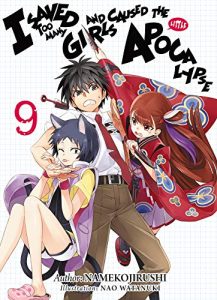
I Saved Too Many Girls and Caused the Apocalypse, Vol. 9

August 19, 2018 by Sean Gaffney

By Namekojirushi and Nao Watanuki. Released in Japan as “Ore ga Heroine o Tasukesugite Sekai ga Little Mokushiroku!?” by Hobby Japan. Released in North America digitally by J-Novel Club. Translated by Mana Z.

Eventually this series is simply going to have to run out of stereotypical heroines to stack on to Rekka’s pile. We’re down to two – well, one, really, but I have my suspicions about the other – in this book, and the cracks are starting to show – I’m OK with beloved childhood friend, but beloved childhood PET? Yes, turns out the cat was a cat yokai of some sort, and now She Is All Grown Up and everything. Of course, she still acts like a cat. Her story is probably the weakest in the book, actually, as this is essentially a book of four short stories with a wraparound, and so it gets resolved quickly and easily. Possibly realizing that, the author gives us a little more depth to both heroines from the 6th book, who R wasn’t quite sure were heroines or not last time. They may not have crises to resolve, but they do both seem to like Rekka. And then there’s R.

I have been crying out for more character depth and insight into R and her future, and it looks like I’m finally starting to get it. The other “girl” in this volume is an assassin from the future, and the moment we hear she’s named L we know she’s connected to R in some way. As it turns out, she’s the prototype for what R is, and it was originally her mission to save the world… but things took too long, and R had better specs, so she was used instead, and L was sent to live her own life and, well, get corrupted by the forces of evil. As frequently happens in this sort of story. I’m not entirely certain if we’re going to add L to the harem list, but the door is open for her return. That said, I found R more fascinating here. For the most part she remains her dry, emotionless snarky self, but dealing with L finally forces some actual anger and rage out of her, mostly because she can’t be like Rekka.

Much as this series tries to have Rekka be a parody of the clueless harem guy, and he absolutely is, when it comes to saving the girl he’s really, really good at it. R has watched him save the day time and again against all odds, and it’s very frustrating to R that she is ultimately unable to talk any sense into L or save her. Unfortunately, the drawback of my enjoying her plotline is that the rest of the book feels off-balance, as if the other three stories aren’t up to the task of the final one. There’s nothing wrong with them – everyone goes to the pool and tries to flirt with Rekka, to no avail; they hold a “summer camp” at the school in an effort to give Midori a bit more depth, which… works a bit, but she still suffers from not really having had much impact in her debut. So in the end this volume of Little Apocalypse is just OK, but the best part is at the end, so it will leave you happy when you finish it.

Filed Under: i saved too many girls and caused the apocalypse, REVIEWS

Shortcake Cake, Vol. 1

August 18, 2018 by Anna N

Shortcake Cake, Volume 1 by suu Morishita

I’m always up for more shoujo series, and Shortcake Cake starts off with a very promising first volume. The story begins with Ten Serizawa dealing with her daily 2 hour commute to school. She gets up early and naps on the bus. But as she hangs out with her school friends, she begins to realize that her commitment to the commute means that she can’t take part in after school gatherings with her new classmates, as she has to keep checking the time to be sure she’s able to catch the last bus back to her more rural home. Ten’s friend Ageha points out how much easier it would be if Ten moved in to her boardinghouse. Ageha sneaks Ten in one day after school (the residents aren’t supposed to have outside guests), and Ten experiences the hazards of boardinghouse crashing, like avoiding the house mom, tiptoeing past the boys’ floor. In the process she has a brief encounter with the handsome bookworm Chiaki, who dazzles her with his good looks and quotes Turgenev at her.

Ten sees that the boardinghouse is much more spacious and nice than she was imagining and decides to move in. She meets another resident, the overly flirtatious Riku. As Ten gets settled in, she starts getting entwined in the lives of the residents. She sees Riku gently turning a girl down who asks him out and points out to him that if he would stop flirting with everyone, random girls wouldn’t get the wrong idea. Riku’s ingratiating manners are looked on as odd by most of the boardinghouse. Riku starts falling for Ten, and can’t act like his normal self around her anymore. The new friends go out on an outing, and Ten learns more about Chiaki’s bookish ways and his reactions to his looks-driven popularity. Finally, a third boy is introduced, Rei, who wears traditional clothing and is drawn to resemble a blond L from Death Note. He’s given to odd insulting outbursts.

So a romance being set up where many people slowly fall in love with a relatively ordinary girl is familiar shoujo manga territory, but the situation in Shortcake Cake doesn’t feel artificial or unearned, because Ten is objectively pretty adorable with her Sailor Moon style pigtails and her quirky hobby of following along with radio exercise programs. Morishita does a great job with character development in this volume, leaving just enough mystery for the reader to become invested in finding out why Chiaki is so withdrawn and wonder why Riku is overcompensating by acting superficially pleasant to most of the girls he meets. The volume ends on a cliffhanger which shows Ten forcing a confrontation about something that most shoujo heroines would leave unsaid for 5-6 volumes, which instantly got me onboard for the rest of the series!

Morishita’s art features a liberal amount of screen tone, and her characters quickly switch back and forth between regular and exaggerated facial expressions. Ten frequently shifts into cat face mode whenever she’s being mischievous or startled. The production for Shortcake Cake sets it apart from other Shojo Beat volumes, with matte covers and a cute strawberry on the spine. There are some additional black and white illustrations for chapter covers included as a bonus in the back of the book. I can see why this shoujo series was so highly anticipated, and I’m looking forward to reading more.

Filed Under: Manga Reviews, REVIEWS Tagged With: shojo beat, shortcake cake, shoujo, viz media

Accomplishments of the Duke’s Daughter, Vol. 1

August 18, 2018 by Sean Gaffney

By Suki Umemiya and Reia. Released in Japan as “Koushaku Reijou no Tashinami” by Kadokawa Shoten, serialization ongoing in the magazine Young Ace Up. Released in North America by Seven Seas. Translated by Angela Liu. Adapted by Tracy Barnett.

There has been a bit of a backlash online about the constant flow of “isekai” stories into North America in the past few years. Of course, that’s because they’re incredibly popular in Japan. Indeed, they seem to be so popular in Japan that we’re starting to see authors who have an idea of a story that need not involve an isekai try to shoehorn it in anyway to get readers. This is a good example of it. Now, I may be wrong – it’s taken from a light novel that is itself taken from a webnovel, and future volumes may take more advantage of the fact that its heroine has been killed and reincarnated in another world. But honestly, if you removed the isekai aspect from this manga series, very little would change at all. Fortunately, the story is strong – which is probably why I’m complaining that an isekai wasn’t needed. I’m perfectly happy to watch Iris save the world.

As I mentioned earlier, it begins, as many series like this do, with a death by car accident. A young woman who works overtime at some company or other and spends her spare time playing otome games is killed, and suddenly finds herself in the climactic scene of the game she just cleared. Sadly… she’s the rival who’s just being taken to the cleaners. She knows what happens next – her character leaves the school and gets exiled to a nunnery for the rest of her life. Yeah, that’s not happening. Oh, she’ll leave the school, but she decides instead to confront her father with all the political machinations that have been going on in the game, pointing out that he had plans and backup plans. He’s impressed enough by this that he decides instead of exiling her to a nunnery to exile her to one of his fiefdoms, and basically tells her she’s in charge. So, with the help of a seeming army of orphans she’s picked up over the years, she sets out to make her country a better place.

I enjoyed this, but there are, let’s face it, a few moments that made me raise an eyebrow in disbelief. For a “villain” character who is seemingly an expert at verbal abuse in the game itself, Iris actually turns out to be a sweet girl who constantly wants to save everyone. Iris claims it’s “first love sickness”, and I guess we’ll go with that, but I’d have liked better use of the actual gimmick. Likewise, Iris immediately having a large force of bodyguards, maids, accountants and such that she can immediately marshal to the cause is a bit… easy? That said, honestly, if it’s going to lead to “let’s see how we’ve neglected the poor people and try to make it so they have a better life”, I’m fine with it. And the supporting cast seem fun, even though, as I noted, none of them seem to regard Iris as the villain type. Honestly, given this runs in a seinen magazine, the best audience for it may be those who enjoy the light novel How a Realist Hero Rebuilt the Kingdom. It has a similar vibe. In any case, I look forward to future volumes of this flawed but fun book, even if it did not have to be an isekai.

Filed Under: accomplishments of the duke's daughter, REVIEWS

Arifureta: From Commonplace to World’s Strongest, Vol. 7

August 17, 2018 by Sean Gaffney

By Ryo Shirakome and Takayaki. Released in Japan as “Arifureta Shokugyou de Sekai Saikyou” by Overlap. Released in North America digitally by J-Novel Club. Translated by Ningen.

I’ve talked before about Hajime as Christ figure, and Hajime as simply another example of the overpowered hero going after the kids that bullied the author in middle school, but in this book it’s also worth taking a look at something that has remained a core part of Hajime’s character despite every possible attempt to extract it: Hajime the nerd. (Yes, yes, I know, chuuni. I never saw that anime, so feel uncomfortable using the expression.) Hajime’s inner monologue has had the occasional taste of otaku culture throughout the series, but this volume really sees it in full flower. When he’s in the bar gathering information, and has to impress the bartender, you can almost hear him squeeing. And while the core purpose of his “arranging a distraction” was to humiliate and get a bit of revenge on Shizuku for laughing at him, the fact that he dresses them all as a sentai team also shows this off. Hajime is badass, but still a nerd.

We seem to have run out of cover girls, as we’re back to Yue. (Technically it should be Liliana, but honestly ignoring her in favor of Yue is perfectly in character.) That said, in terms of content, Shea should really be the one on the cover, as she and her rabbit tribe own this book. Considering that turning the rabbits into savage killers was a passing joke in the 2nd book, it’s become quite a large thing, and the best running gag of the volume was everyone giving Hajime the stink-eye as they realize how much he brainwashed everyone into being Rambo. (They also inherited his nerd tendencies, coming up with hilariously bad “names” for themselves.) Since the Empire is doubling down on Beastmen being enslaved, the rabbits take matters into their own hands – with a little help from Hajime, admittedly, but mostly entirely on their own – to convince the Emperor to change his mind. Again, those who like over the top battles will be very happy.

The demons also get their asses handed to them by the rabbits, but they have a much stronger response, coming up with 400 or so of the Angels that Hajime had a little trouble with in Book 6. I suspect the eighth volume will deal with the fallout from that. One last thing that impressed me, though, was the final extra story. Usually in light novels these extra stories are pure fanservice, but this one not only advances the plot but makes a nice refreshing change from the “all religion is evil” trope we’ve seen in Arifureta and other light novels. A new pope is appointed to fill the void caused by the events of Book 6, and he proves to be an excellent choice, coming across both Yuka (the girl Hajime saved in Book 1) and Aiko and helping them get over their dithering and try to move forward. It comes across as a confessional, and this is exactly the sort of thing that confessions should be about. I really liked it.

A very strong Arifureta book. Except for Tio. God, I hate Tio. More accurately, I hate the way the author writes Tio.

Filed Under: arifureta, REVIEWS

Yona of the Dawn, Vol. 13

August 16, 2018 by Sean Gaffney

By Mizuho Kusanagi. Released in Japan as “Akatsuki no Yona” by Hakusensha, serialization ongoing in the magazine Hana to Yume. Released in North America by Viz. Translated by JN Productions, Adapted by Ysabet Reinhardt MacFarlane.

As we watch Yona and her bunch wandering through the nations doing good and saving people, it would be all too easy to cut back to the usurpers back at the palace and make them simple, cookie-cutter antagonists. But one reason that Yona of the Dawn is so strong is that Su-Won is not a cookie-cutter antagonist. In fact, the reader might occasionally be thinking to themselves, “You know, Su-Won being king may actually be a very good thing?” Yona is dealing with the world at the lowest level, going from small village to small village for the most part, while Su-Won takes on major threats to his kingdom and also tries to get the leaders of the various tribes to think better and learn more. It’s micro vs. macro, and neither choice is bad. And it also means that when Su-Won and Yona see each other towards the start of this volume, the tension involved is absolute dynamite – and it can only last a few seconds before being taken away.

If you do want a more typical evil antagonist, there’s always General Su-Jin, who cannot conceive of a situation where he loses to this upstart new king. But lose he does, as right from the very start we see horses dressed up as tigers (some nice historical research from Kusanagi-san there) and it just goes downhill from there. Su-Jin is the classic example of the obsessive who cannot let something go, and I felt sad that he did not have a moment where he threw up his hands and screamed “THIS CANNOT BEEEEE!”. The best part of his attack on Su-Won was actually when Yona confronted him, as her concern is not only t stop the violence but also to tell him how far Tae-Jun has come. Sadly, it’s all for nought, but it does lead to that beautiful shot of her and Su-Won seeing each other (there is some absolutely gorgeous art in general in this volume. I may not mention it all the time, but Yona of the Dawn is extremely pretty).

There’s also a bit of reverse harem here, but honestly, every single time that one of the other guys (usually Jaeha) shows that they’re in love with Yona, it’s there to underscore how obvious Yona/Hak is as the OTP. Here we see Yona getting a bit jealous when Hak uses his natural charm to get customers at a bazaar, and also tamping it down because she knows one day he’s going to leave her and go with someone else. That will never, ever happen, but hey, this is why you don’t hook up the main couple in the first book. Hak and Yona are perfect for each other. That said, the other guys all have their charms, and I am certainly content for things to simmer a bit as they are now. This is a bit of a transitional book, as we see that Tae-Jun, much as being a nurse is something he’s awesome at, having to return to the Fire Tribe to be temporary leader while his brother studies. As for Yona and friends, I’m sure we’ll be starting a new arc next time. I can’t wait.

Filed Under: REVIEWS, yona of the dawn

Me, a Genius? I Was Reborn into Another World and I Think They’ve Got the Wrong Idea!, Vol. 3

August 15, 2018 by Sean Gaffney

By Nyun and Sakana. Released in Japan as “Isekai ni Tensei Shitandakedo Ore, Tensai tte Kanchigai Saretenai?” by Overlap, Inc. Released in North America digitally by J-Novel Club. Translated by Shaun Cook.

Of all the places for Me, a Genius? to go in its third volume, I was not expecting it to go here. Note that I’m not talking about it suddenly becoming a tense techno-thriller a la Tom Clancy – given the fact that we spent much of the second volume in a cod-fantasy world, I barely raised an eyebrow to see that we’re suddenly back in Kouki’s home world and taking on Russians and international terrorist organizations. No, the main thing I wasn’t expecting was that Me, a Genius has gotten rid of the humor. You might argue that it’s trying to be funny and the jokes just aren’t landing, but I’m not sure that’s quite it. We do see one or two “lol!” situations in the book that aren’t funny (Baldy is a lolicon! Hilarity ensues!), but for the most part this seriously looks like it still has its bonkers premise, but is trying to deal with it realistically. Which is… weird.

Yes, that’s Alice on the cover again, despite appearing in the book even less than she does in the 2nd volume. This is especially frustrating given how much of the reason for all this is supposed to be The Alice Project and her illegal genetic creation. But given that’s just an excuse to have cool action and espionage sequences, I shouldn’t really be surprised. Honestly, everyone in this series aside from Kouki and his mother are superfluous to requirements. We do get a very interesting development, though, in that the head of the terrorist organization (who is basically an evil version of Kouki’s mother) has been researching reincarnation, and Kouki is forced to admit that yes, he was reincarnated with his memories. This being Me, a Genius, everyone misunderstands the nature of the reincarnation and things he’s trapped in a Higurashi loop, but I was still surprised, and it gave a brief shade of depth to people (which went away about a page later).

The book should be filled with taut action sequences, this being a pastiche of a techno-thriller, but they’re actually pretty absent – we just see people talking around them or the immediate aftermath. The book also ends with a lot unfinished, which is a shame as there’s no sign of a fourth book coming anytime soon – apparently the writer has hit a block, and so this is all we’re going to get. And to be fair, there may be only so far that you can take this premise. Trying to do a serious version of Me, a Genius? was intriguing for one volume, but let’s face it, if I’m going to be reading a serious light novel about someone reincarnated into another world who’s caught in a worldwide power game and has people constantly misunderstand what they’re thinking, I’m going to be reading The Saga of Tanya the Evil, not this. This is an interesting third volume, but it wasn’t all that funny, and I’m starting to ask how many tricks this pony has.

Filed Under: me a genius?, REVIEWS

Laid-Back Camp, Vol. 1

August 14, 2018 by Katherine Dacey

Laid-Back Camp may be the most quintessentially Japanese thing I’ve read this year: it features cute girls doing cute things while imparting information about camping gear. There’s no real plot to speak of, just a meet-cute in the first chapter that introduces seasoned camper Rin to enthusiastic newbie Nadeshiko. Through one of those only-in-manga coincidences, Rin and Nadeshiko attend the same school, where two other girls — Aoi and Chiaki — are struggling to recruit members for their Outdoor Exploration Club. You can guess what happens next: Nadeshiko joins the club and, by dint of her Golden Retriever personality, brings the skeptical Rin into the fold.

Each chapter is built around a skill, a piece of equipment, or a location. In “Mount Fuji and Cup Ramen,” for example, Rin explains how to build the perfect campfire, calling dried pine cones “nature’s premier fire starter,” while in “You Can Only Go Camping If You Have the Gear,” the Outdoor Exploration Club pores over catalogs, debating the merits of down and synthetic sleeping bags. These passages are deftly woven into the fabric of each story, playing a natural part of the girls’ conversations as they plan camping trips. Dashes of humor and breath-taking scenery add welcome nuance to the storytelling, preventing it from tipping into edu-manga dullness or yon-koma hijinks. Best of all, Rin is a genuinely interesting character, a small, self-sufficient kid who likes solo camping trips. Though volume one doesn’t explain how she caught the camping bug, author Afro has done such a good job of fleshing out Rin it doesn’t matter; we can see how someone so introspective and independent would welcome the opportunity to be alone in nature. Recommended, even for those who prefer the Great Indoors.

Laid-Back Camp, Vol. 1
Story and Art by Afro
Translation by Amber Tamosaitis
Yen Press, 178 pp.
Rated T, for Teen

Filed Under: Manga, Manga Critic, REVIEWS Tagged With: Afro, Comedy, Laid-Back Camp, Seinen, yen press

Hakumei & Mikochi: Tiny Little Life in the Woods, Vol. 1

August 14, 2018 by Sean Gaffney

By Takuto Kashiki. Released in Japan by Enterbrain, serialization ongoing in the magazine Harta. Released in North America by Yen Press Translated by Taylor Engel.

This was really cute and fun. I mean, I knew going in that it was going to be – that’s the premise. It’s one of those slice-of-life series starring two girls, only in this case the life is fantasy life and they’re four inches tall. But all of the things I was expecting the series to do were done well, and I enjoyed all the characters. The premise is that Hakumei (the extroverted redhead) and Mikochi (the introverted black-haired one) live together in a tree in the middle of the forest, and we follow then as they do things like go shopping, do their jobs, hang out at a bar, and hitch rides on giant birds who also happen to be old forgotten childhood pets. This isn’t aa laugh riot, and not much of anything happens. And despite the fact that the two of them live together, there’s no real yuri subtext either. It just puts a smile on your face.

I think one of the big reasons I liked this so much is that it feels like a slice-of-life with grownups, as opposed to impulsive teenage girls. Hakumei and Mikochi are like Ritsu and Mio when they both grow up, sort of. Hakumei is impulsive and loud, but not obnoxiously so, and she’s likeable and endearing. Mikochi can be fretting and stressing as well, but it too never gets to the point where it’s too much. Despite being tiny creatures, they’re both functional adults. Hakumei works for a weasel as a repair person, and we see she takes her job quite seriously, which is not somethng you’d expect given her stereotype. Mikochi makes preserves and household stuff, and she ends up having more issues with the local tsundere songstress than with Hakumei. The cast is minimal – besides said tsundere songstress and Hakumei’s boss, the only other fellow we meet is a mad scientist sort who means well, but comes off as… well, a mad scientist.

You’re never quite sure if you’re going to be getting fantasy or regular old slice-of-life. Scenes like Hakumei and Mokochi on the sunset kite (which is the first chapter, and has some gorgeous art to show off) or dealing with the lake’s skeletal denizens are definitely fantasy, but other plotlines like Mikochi losing their wallet while out shopping or hanging out at a pub playing games in a blizzard barely need fantasy context at all. And throughout the entire volume there’s a warm feeling of peace while reading it. It’s like a nice hot soup. We do meet our two heroines when they’re already in their house, and I’d like to see how they met, but that’s why this series is six-plus volumes. There are lots of places you can go from here. I’m definitely content to follow the author, as long as I keep seeing these two tiny women going about their tiny lives with aplomb.

Filed Under: hakumei & mikochi, REVIEWS

Didn’t I Say to Make My Abilities Average in the Next Life?!, Vol. 3

August 13, 2018 by Sean Gaffney

By FUNA and Itsuki Akata. Released in Japan as “Watashi, Nouryoku wa Heikinchi de tte Itta yo ne!” by Earth Star Entertainment. Released in North America by Seven Seas. Translated by Diana Taylor. Adapted by Maggie Cooper.

I don’t think I’ve read a series that’s as consistently funny as Make My Abilities Average. The author simply knows how to write humor and write it well (she also apparently makes a lot of tortured puns and wordplay jokes, which the translators make a valiant effort at adapting). The book starts off relatively sedately, but the entire battle with the Wyvern in the final third is comedy cold from beginning to end. You would think that “Mile suggests something incredibly off the wall” would get old fast, but she’s simply a walking font of ridiculous, and it helps greatly that she has three types of tsukkomis traveling with her. There is the occasional moment of seriousness, mostly involving the background for Pauline’s family, but for the most part Make My Abilities Average knows what the audience wants: laughs.

Mavis and Pauline share the third cover, which is appropriate as their backstories come back to haunt them at the same time. Pauline’s is more serious, involving the murder of her father and loss of her family business. Mavis’ family is still intact, but she is the only daughter of a Count, and as such they would rather she not be training to be the best knight she can be and get back to being a marriage prospect. And so the Crimson Vow heads off (unofficially this time) to deal with the problems and ensure that they can carry on as before. There’s some lampshading of obvious tropes here, which is where the humor is really mined. Mile shows up as Mavis’ teacher, Evening Gown Mask (yes, really) in order to take on the Count in swordfighting. Her disguise is… an eye mask. That’s it. Despite this, and without the use of magic, Mavis’ entire family fails to recognize that it’s Mile.

Then there’s the Wyvern fight, which ends up being a series of toppers. I had assumed that the high point would be the scene that is illustrated (quite well, I might add), but no, it gets better. And then gets better again. The absolute highlight may be the mastermind explaining his plans to (and for) Mile, which involves plans so deeply silly that Mile is forced to play the tsukkomi herself. I’m trying not to spoil because it was simply that funny to me. This isn’t a perfect book – as with a lot of light novels that need to pad out the word count, one of the short stories falls amazingly short, as we see Adele (yes, it’s a flashback to school #1) going on a date with a classmate, where the humor involves a) said classmate being a “nice guy” with extra quote marks, and b) the class rep being a wacky comedy lesbian. I hate wacky comedy lesbians. On the bright side, this does suggest that the series is determined not to have romance invade its fun. which is fine by me.

Last time I mentioned that the lack of a “main plot” was also a flaw, and you can say the same thing about this book – it still feels more like a short story collection that happens to be sequential. That said, the author seems to realize this, and is implying she will add more plot in the next book. In the meantime, if you want a laugh, or want to see a great all-girl fighting team, I highly recommend this series.

Filed Under: Didn't I Say to Make My Abilities Average in the Next Life?!, REVIEWS

Amigurumi: San-X Crochet Patterns

August 12, 2018 by Anna N

Amigurumi: San-X Crochet Patterns

I was excited when I saw that Viz was getting into the crafting book business, since there are so many great Japanese pattern books out there. Amigurumi: San-X Crochet Patterns is an English translation of a super cute guide to San-X Crochet. The first half of the book has over 30 color pages showing multiple poses of the amigurumi you can make with the book, including extensive accessories and costumes. I enjoyed the amigurumi sitting in tiny eggshells or lounging around the most.

Japanese knitting and crochet books almost universally rely on charts for pattern information, and this book has charts and construction schematics, followed by a basic stitch guide so someone new to charted knitting can figure out the directions. So, this book might seem a bit unfamiliar to people who are mostly used to written directions, but it shouldn’t be a problem. There are plenty of beginner books out there and I think that there space in the crafting marketplace for a book like this, which is a straight translation of a Japanese book, without any extras added in for an English language audience. There are so many youtube tutorials and other crafting guides like this on the web, I feel like most people can figure out what they need to know in order to follow a chart. I’d be excited to see more Japanese craft books translated like this! I tend to buy single patterns on ravelry instead of books, but this book is the type of thing I’d like to collect in print form for all the great photo illustrations.

I have a gazillion knitting projects going on right now that I want to finish up, but I’ll update this review later with a crochet creation. I think I’m going to start with either the teeny tiny toast and eggs, or Sumikkogurashi.

Filed Under: REVIEWS Tagged With: amigurumi, viz media

  • « Go to Previous Page
  • Page 1
  • Interim pages omitted …
  • Page 164
  • Page 165
  • Page 166
  • Page 167
  • Page 168
  • Interim pages omitted …
  • Page 346
  • Go to Next Page »
 | Log in
Copyright © 2010 Manga Bookshelf | Powered by WordPress & the Genesis Framework