• Skip to primary navigation
  • Skip to main content
  • Skip to primary sidebar
  • Home
  • About Us
    • Privacy Policy
    • Comment Policy
    • Disclosures & Disclaimers
  • Resources
    • Links, Essays & Articles
    • Fandomology!
    • CLAMP Directory
    • BlogRoll
  • Features & Columns
    • 3 Things Thursday
    • Adventures in the Key of Shoujo
    • Bit & Blips (game reviews)
    • BL BOOKRACK
    • Bookshelf Briefs
    • Bringing the Drama
    • Comic Conversion
    • Fanservice Friday
    • Going Digital
    • It Came From the Sinosphere
    • License This!
    • Magazine no Mori
    • My Week in Manga
    • OFF THE SHELF
    • Not By Manga Alone
    • PICK OF THE WEEK
    • Subtitles & Sensibility
    • Weekly Shonen Jump Recaps
  • Manga Moveable Feast
    • MMF Full Archive
    • Yun Kouga
    • CLAMP
    • Shojo Beat
    • Osamu Tezuka
    • Sailor Moon
    • Fruits Basket
    • Takehiko Inoue
    • Wild Adapter
    • One Piece
    • After School Nightmare
    • Karakuri Odette
    • Paradise Kiss
    • The Color Trilogy
    • To Terra…
    • Sexy Voice & Robo
  • Browse by Author
    • Sean Gaffney
    • Anna Neatrour
    • Michelle Smith
    • Katherine Dacey
    • MJ
    • Brigid Alverson
    • Travis Anderson
    • Phillip Anthony
    • Derek Bown
    • Jaci Dahlvang
    • Angela Eastman
    • Erica Friedman
    • Sara K.
    • Megan Purdy
    • Emily Snodgrass
    • Nancy Thistlethwaite
    • Eva Volin
    • David Welsh
  • MB Blogs
    • A Case Suitable For Treatment
    • Experiments in Manga
    • MangaBlog
    • The Manga Critic
    • Manga Report
    • Soliloquy in Blue
    • Manga Curmudgeon (archive)

Manga Bookshelf

Discussion, Resources, Roundtables, & Reviews

Reviews

Konosuba: God’s Blessing on This Wonderful World!: The Lich’s Proposal

March 3, 2021 by Sean Gaffney

By Natsume Akatsuki and Kurone Mishima. Released in Japan as “Kono Subarashii Sekai ni Shukufuku o!” by Kadokawa Sneaker Bunko. Released in North America by Yen On. Translated by Kevin Steinbach.

It is the nature of a long-running series that it tends to accrue supporting cast members. The longer the series, the more cast members it has to support. Now, KonoSuba has never made it a secret that it is, at heart, a story of four people: Kazuma, Aqua, Megumin and Darkness. Now, this series has a bit of an advantage over many others in that it is popular enough to have scored a slew of spinoff books. We’ve seen one of them, which focuses on Megumin and Yunyun before and during the events of the series. There’s another, unlicensed series (by a different author) that follows KonoSuba through the eyes of Dust and his party (which also has a large helping of Yunyun, who is pathetic enough to get entangled in Dust’s life). But really, though we’ve learned a bit about her past, there has not been a huge focus on adorably pathetic shop owner Wiz. That changes now!… though this does not really mean Wiz will come off looking good.

As with a large number of KonoSuba books, the actual main plot does not really start up till about halfway through the book. There’s also a fake plot – Yunyun has to take the test to be the next chief of the Crimson Magic Clan, and wants Kazuma’s help. Megumin refuses to let this happen, of course, and instead helps Yunyun herself – with offscreen results, but results you can probably guess. There’s a treasure hunt to clean encrusted jewels off a turtle’s shell, and Darkness once again tries to seduce Kazuma, who makes it clear that he’s only willing to go through with it if he’s forced, so he can blame her. (They’re both caught, of course.) That said, the main plot is what folks are here for – a mysterious stalker… erm, stranger arrives and seemingly proposes marriage to Wiz! Or at least that’s what Kazuma and Wiz herself believe. Only Vanir knows the truth, and he finds it absolutely hilarious.

As you might gather, fans of Kazuma being a complete scumbag will be well-served here by his behavior here, though again this is the slightly less appalling version we’ve seen from Vol. 9 and later. I was highly amused where Megumin offers to sneak into his room and he, having just gotten laid via succubus sex workers, indicates he’s not in the mood – the joke being Megumin was unaware men could EVER be not in the mood. The main plot itself is amusing, but if you aren’t a fan of the series kicking Yunyun when she’s down, you may not enjoy it as much, as Wiz is absolutely an airhead here, getting completely into the idea that someone has proposed to her and acting like a lovestruck maiden. Vanir heaps abuse on her, probably because all her love-love feelings are making him cranky. That said, spoilers, but Wiz does not get married. Sorry to ruin that for you hopeful readers.

Speaking of Yunyun, the cliffhanger involves that she will finally drag the main cast back to her chieftain trial, which is at its third (and presumably final) attempt. We’ve got four more books to go after this one, so you can see the series starting to dot its I’s and cross its T’s. This is not really as deep or heartwarming as some prior volumes, but it’s a lot of mean, kick-them-when-they’re-down fun.
Filed Under: konosuba, REVIEWS

Zom 100: Bucket List of the Dead, Vol. 1

March 2, 2021 by Katherine Dacey

If your chief criticism of King of Eden was “not enough boobs,” have I got the manga for you: Zom 100: Bucket List of the Dead, a comedy about a corporate drone whose life is transformed by the onset of a zombie plague. Its hero, Akira Tendo, sees opportunity where others see only chaos, and decides to make a bucket list of 100 things he wants to do before he, too, becomes one of the walking dead. His top priorities? Telling his voluptuous co-worker Ohtori how much he likes her—even if she is the “boss’ side piece”—and tracking down a mysterious hottie he encounters in a convenience store.

While Akira’s quest doesn’t sound particularly memorable, his new-found optimism makes him an agreeable guide through a Tokyo overrun by zombies. His palpable joy in quitting a soul-crushing job is infectious—if you’ll pardon the expression—as he finds pleasure in small things: riding a motorcycle for the first time, scavenging for his favorite beer, playing video games during normal business hours. No matter how much carnage he encounters, or how many of his bucket-list errands don’t go according to plan, Akira’s can-do spirit remains undiminished. So, too, is his loyalty to others, as evidenced by his willingness to rescue his childhood friend Tencho from a hotel overrun by zombies.

The hotel scene is indicative of what’s good and not so good about Zom 100. On the one hand, the friends’ shared ordeal leads to a heartfelt exchange in which they discuss why they drifted apart after college. Their dialogue is a little on-the-nose—“I got jealous of how successful you were and took my anger out on you,” Akira confesses in a torrent of tears and snot—but the characters’ sincerity makes Akira and Tencho’s reconciliation feel like a genuine moment of maturity.

On the other hand, the main reason this scene begins in a hotel—specifically, a love hotel—is to offer some good old-fashioned fan service, as Kencho is trapped in a bondage chamber with an irate, naked zombie who’s been chained to the wall. The zombie is drawn in loving detail, right down to her perky breasts, but serves no real dramatic purpose; she exists mainly to make young male readers gawp at Kencho’s predicament. The same goes for several other gratuitous moments of nudity and pin-up posturing, none of which feel necessary or demonstrate artist Kotaro Takata’s skill at drawing attractive, anatomically correct women. (All of his figures seem to have a few extra vertebrae.)

The fan service is indicative of a deeper problem as well: the zombies—or the boobs, for that matter—don’t feel essential to Akira’s story. Almost any catastrophe or life-altering event could have set the plot in motion, whether it was a devastating medical diagnosis or Earth’s impending collision with a meteor. Equally disappointing is that Akira’s quest feels more like a to-do list than a real emotional journey; even he seems disappointed in his inability to come up with a sufficiently long or imaginative bucket list. As a result, Akira seems like just another standard-issue shonen lead, blessed with an optimism that sometimes makes him seem a little dim, a superhuman ability to escape life-threatening situations, and an uncanny knack for stumbling into situations with hot women. I don’t know about you, but I would have enjoyed this series 100% more if the gender roles had been reversed, if only for the sight of a former office lady cheerfully riding a Harley through a zombie horde on her way to score a few brews.

To read a brief excerpt of Zom 100: Bucket List of the Dead, click here.

ZOM 100: BUCKET LIST OF THE DEAD, VOL. 1 • STORY BY HARO ASO • ART BY KOTARO TAKATA • TRANSLATION BY NOVA SKIPPER • TOUCH-UP ART & LETTERING BY VANESSA SATONE • EDITED BY KARLA CLARK • VIZ MEDIA • RATED: OLDER TEEN (PARTIAL NUDITY, GORE, VIOLENCE) • 159 pp.

Filed Under: Manga, Manga Critic, REVIEWS Tagged With: Comedy, Horror/Supernatural, VIZ, VIZ Signature, Zombies

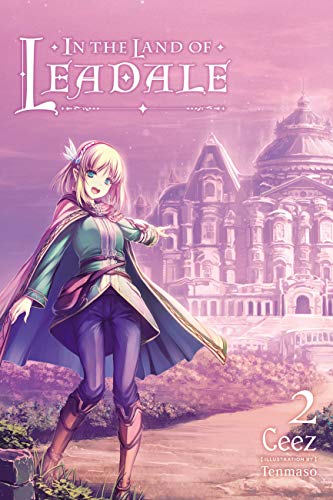
In the Land of Leadale, Vol. 2

March 1, 2021 by Sean Gaffney

By Ceez and Tenmaso. Released in Japan by Famitsu Bunko. Released in North America by Yen On. Translated by Jessica Lange.

Last time I jokingly said that the series was “Overlord meets Kuma Kuma Kuma Bear”, and I was not expecting that to be doubly true in the second volume, which features Cayna serving as a guard/guide to students going out in the woods for the first time (Kuma Bear), but also searching for other “players” and starting to discover that she is not the only one who ended up in this supposed game world far into its future (Overlord). Surrounding this are scenes of Cayna getting pissed off when getting called “grandmother”, Cayna having absolutely no knowledge of current currency at all, and Cayna one-shotting various terrifying monsters that would normally take 15 high-level people to take out. In other words, it’s a slow life series without the actual slow life. It FEELS like a slow life series in both the meandering pacing and Cayna’s somewhat blase personality, but there’s far, far too much going on here, and too many mysteries still to be solved. It is a lot of fun, though, and very quotable.

We pick up where we left off, with Cayna arriving at the capital of Helshper to deliver a message for Mai-Mai. The message turns out to have been a ruse, as it was going to the leader of the largest merchant house in the world… who is also Mai-Mai’s son, and thus Cayna’s grandson. Oh yes, and her granddaughter is a member of the city knight brigade. Cayna doesn’t like surprises like this (she’s also not fond of being called grandma given she still feels like a 17-year-old), but hey. The city is having a bit of a bandit problem, and as Cayna helps with it, she finds out that yes, there ARE other players trapped in this “post-game” world, though whether they think it’s a game or real depends on the mindset. Elsewhere, she gains a small fairy helper, continues to go to the other top player bases, and, to the disappointment of her children, decides to settle and build a house somewhere AWAY from the big city.

So yes, Cayna is not alone in being in Leadale as a gamer, though she does seem to be late – the other players have been there for years, and it’s suggested this might have something to do with the fact that she died in the real world before the game shut down. That said, she’s still far and away the most overpowered person in the entire world, and we see examples of that throughout this book – anyone who dislikes overpowered characters… well, should stop reading Japanese novels, really. Cayna’s delivery continues to be a treat, be it when she’s angry, happy, or otherwise, and I like how her priorities are simply nothing like what anyone else expects them to be. She finds out that another of the top players she knew had an NPC daughter who wants to meet her , and her reaction is “sounds like a pain, so no”. Keina spent half her life in bed on life support. As Cayna, she has absolutely no fucks to give.

So yes, another enjoyable volume in the series, and I definitely recommend it more to those on the Kuma Bear end of the spectrum rather than the Overlord end, though there is a suggestion of malevolent things going on in the epilogue. Cayna’s a treat.

Filed Under: in the land of leadale, REVIEWS

Kuma Kuma Kuma Bear, Vol. 5

February 28, 2021 by Sean Gaffney

By Kumanano and 029. Released in Japan by PASH! Books. Released in North America by Seven Seas. Translated by Jan Cash & Vincent Castaneda.

Apologies for the slang here, but as I was reading this volume of Kuma Bear, I kept thinking about recent discussion of ‘gap moe’. Sure, I’m certain there are some people who read this series for the cute girls doing cute things, or for Yuna being stupidly overpowered, or even for the food descriptions. But I think the best reason to read it is for those moments where Yuna’s deadpan, staid character is forced to actually react to things – usually embarrassment, but not always. As I’ve said before, her desire to not take credit for anything she does is starting to feel like a complex, and people are beginning to notice – even kids like Fina. That’s not to say it works all the time, as her Bear Tunnel shows us. What’s more, Yuna gets as uncomfortable with the rough, spiky parts of this world as the reader does, and would much rather try not to think about the whole thing – though she does help out in the end. She hopes by thinking of herself as dull and normal, it will rewrite reality.

Most of this book is devoted to the seaport Mileela, and the aftermath of Yuna wiping out the bandits and boiling the kraken. Returning to normal is not something that can happen as fast as the anime implied it. The town is still pretty much devastated by the last few months, the foreign ships don’t know that they can start sailing there again, and while they would like to ally themselves with Cliff’s city Crimonia, but there’s still that huge mountain in the way. Fortunately, they have Yuna, who once met common sense in passing but promptly went somewhere else. Now there’s a huge tunnel connecting the two areas. Problem solved! Well, except it needs lights. And air. And monster cleanouts. And guards. Yuna may be an overpowered bear girl, but cleaning up after her remains a very exhausting job.

Not sure this counts as ‘gap moe’, but the scene that intrigued me the most, as I implied above, is when Yuna is asking the innkeeper’s daughter Anz to run her new shop. Anz asks if she can have some help in the form of the young women Yuna rescued from the bandits last book – that is to say, the ones whose families were killed and were raped by said bandits. Unsurprisingly, they find still living in the town incredibly uncomfortable. It’s these sort of scenes that you really would not see in this cutesy bear and girls sort of book – indeed, the anime tries to gloss over this – and the fact that it comes up over and over again, ever since Book 1 (where, you’ll recall, Yuna in Japan paid her parents off to go away and leave her alone) just won’t let me go. That said… the majority of this book *is* Bear does OP things” “Bear hangs out with cute kids”, “Bear comments sarcastically on events”, etc.

We get setup for what I assume is the next book near the end, where Yuna is asked to guard a bunch of pampered royals as they journey to the forest to hunt some low-level monsters. It is implied that Yuna’s sharp tongue may be more devastating than any monsters, but we shall see. Till then, this remains a cute, if sometimes more disturbing than expected, book. (Oh yes, and LOL at Yuna accidentally walking around in the white bear outfit one day, which she compares to walking outside in her pajamas.)

Filed Under: kuma kuma kuma bear, REVIEWS

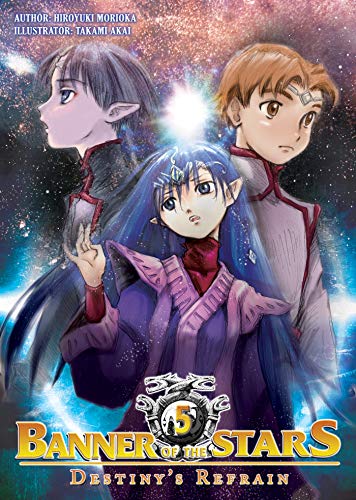
Banner of the Stars: Destiny’s Refrain

February 27, 2021 by Sean Gaffney

By Hiroyuki Morioka and Toshihiro Ono. Released in Japan by Hayakawa Bunko. Released in North America by J-Novel Club. Translated by Giuseppe di Martino.

I admit, I frequently have difficulty plowing through these books. I enjoy the plotting and characterization, but the writing is a bit on the dry side, not to mention all the bolded vocab. Usually I have a lot of banter between Jint and Lafier to hold me over, but in this book they appear less than they have in any of the others – and for good reason. If you ever looked at the massive Abh Empire and thought “wow, they seem arrogant, I wish they’d lose everything they have”, well, wish granted, my friend. We get an awful lot of dead cast members, though most of the ‘current’ younger generation, including our two leads, are fine. But it does mean that you’re reading an entire book about the downfall of an entire people, which can be… bleak. Honestly, it’s at times like this that I’m grateful for the Abh’s blase attitude towards everything, as this would be a lot worse if people were screaming and crying as they died.

Picking up right where the last book left off, it turns out that the Hania Federation has pulled a fast on the Empire (and indeed on its own negotiators), joining with the Three Nations Alliance. The Abh very quickly realize that they are screwed, and a good deal of the book is seeing them trying to evacuate to a safe haven as many people as possible while also having those in change (including the Empress, Lafier’s grandmother) nobly try to hold off the enemy as long as possible. Lafier’s brother Duhier also gets a subplot as he tries to be a soldier despite the entire world working to make sure he can never do anything productive – it would normally be funny, but we feel his frustration. As for Jint, he’s busy moving gravestones, which to the Abh are far more important than his own life or Lafier’s.

The book is not entirely a downer. Sporr makes a welcome return towards the end, as does her aide, and they’re as hilarious as ever, as she is essentially the Abh version of the princess-curled ojousama. Jint manages to talk to the old Baron who helped them escape from his son’s clutches, and there is some amusing teasing about his relationship with Lafier – literally everyone assumes that they are lovers, though if they are neither one communicates that to the reader. But for the most part this book is about last stands and picking up the pieces, and I suspect that the next book, when it comes (which is also the most recent book, having come out in 2018), will have the Abh taking on more of a freedom fighter sort of role. In the meantime, this is good space battle stuff, assuming you don’t mind the technical banter, the bolded words and, of course, the piles of death, most of which, like the Abh, is communicated to us very matter of factly.

Filed Under: banner of the stars, crest of the stars, REVIEWS

I’ll Never Set Foot in That House Again!, Vol. 2

February 26, 2021 by Sean Gaffney

By Milli-gram and Yuki Kana. Released in Japan as “Nidoto ie ni wa Kaerimasen!” by Overlap Novels f. Released in North America digitally by J-Novel Club. Translated by Emily Hemphill.

Reading this immediately after The Saint’s Magic Power Is Omnipotent was probably a mistake, as the two series share much in common. At least the Saint is in her thirties, though. Chelsea’s age and emotional innocence are still front and center in this book, and it can sometimes be discomfiting. The complains once or twice about being treated like a child, but, well, she’s twelve, and honestly acts like she’s six much of the time. What matters most to her are Glen and delicious food, possibly not in that order. And, of course, she has a heart as big as the world and wants to save everyone. In a non-fantasy world she’d be a perfect magical girl candidate – heck, she even looks a bit like Madoka – but here it’s easy for her to be coddled. She’s protected at all times by Glen, ends up getting a new head chef, and a new set of bodyguards once Glen – who is a good 8-10 years older than she is – proposes. So yeah. Anyway, about the rest of the book…

Most of the book involves a journey to a neighboring kingdom, which is definitely having a miasma problem, apparently due to the fact that their new ruler has been cutting down sacred trees and other terrible things. Glen, Chelsea and company decide to see how the former ruler is doing – he’s still around, he just has a terrible mana-draining illness – and Chelsea being essentially a walking plot device, this is soon resolved and he returns to the throne. That said, there are a few hints that there are greater things going on here – the horrible ruler turns out to have been slightly brainwashed by a mysterious fortune teller, who turns out to be working for someone who really, really hates Chelsea – no one is quite sure why. Is this going to be the end of her slow, pampered lifestyle? I mean, no, probably not.

I won’t begrudge Chelsea having a pleasant experience with one the occasional “I did too much and passed out” to worry about, she’s had a rough life and deserves happiness after so long, but it does make the book a bit dull at times. I was amused at her grandparents’ description of Chelsea’s mother – they’re polar opposites – as well as Chelsea’s poleaxed reaction to it. The book also continues to make very light usage of its big clever idea – that Glen is an isekai’d from Japan prince – and we find the former ruler of the other kingdom, a dragon man, is also a forner Japanese person now in a fantasy world body, which leads to some amusing discussion of – as always – how to get miso in a fantasy world. That said, this also means that when Glen proposes to Chelsea he’s called a lolicon… which, well, she’s twelve. At least it doesn’t appear they’ll actually get married till she comes of age.

So yeah, like the first book, this is hit or miss for me – a bit more miss this time – but it’s still warm and fluffy at heart. Also like the first book, I assumed this second volume would be the end of the series, but there’s apparently a third volume out in Japan next month. Recommended for those who love waifs – no, not waifus, waifs.

Filed Under: i'll never set foot in that house again!, REVIEWS

The Saint’s Magic Power Is Omnipotent, Vol. 3

February 25, 2021 by Sean Gaffney

By Yuka Tachibana and Yasuyuki Syuri. Released in Japan as “Seijo no Maryoku wa Bannou desu” by Kadokawa Books. Released in North America by Seven Seas. Translated by Julie Goniwich.

One of the things that is difficult to admit for your average everyday light novel reader or reviewer is that we are unlikely to every be the savior of an entire world. The Saint, as seen here, has to deal with a bunch of difficult challenges to try not to advertise too much exactly who she is (especially now that the existence of the Saint, if not her identity, has been confirmed) while also trying to help as many people as possible by making many, many powerful potions, and also find the time to try to figure out how her powers actually work and why they only appear at unusual times. That said, sometimes even an omnipotent saint can end up being very relatable, as when Sei suddenly realizes what it is that triggers her superpowers, and… yup, so embarrassing it’s the power of love. This has been pretty obvious to the reader from Book one, but the author admits that the romance is going to be slow going, so…

The majority of this volume is spent away from Sei’s beloved potion research, but it’s for a good cause: the domain where they get their best ingredients is suffering from an attack of monsters and miasma, and therefore her powers are particularly needed. Upon arrival, after dealing with pomp and ceremony, and the fact that her cooking methods have become widespread… but only if you like meat… Sei gets down to the nitty gritty of her visit: quizzing the old potion expert they have there about ways to make a superior grade potion. As it turns out, they have the long-lost documentation that might be able to help her. That said, in order to succeed she’s going to not only have to come to terms with the fact that Albert is hot and she likes that, but also deal with a new guy interested in her… one who’s a bit more down to earth.

To be fair, I’m not sure that you can call Leo a love interest per se – he’s not interested in Sei as a person but rather in her abilities. He’s probably the funniest part of the book, being a well-meaning but tactless musclehead, apparently included by the author because muscle fetishes are in these days. The most interesting part of the book, though, shows us the diaries and research books of the Great Alchemist, which was thought to have been destroyed and lost forever. To no one’s surprise, she seems to be a lot like Sei, particularly in her attention to detail in regards to research. Given that we now have Sei’s ridiculous magic power combined with actual knowledge, I suspect big things are going to be happening in the next book. That said, I doubt one of those big things will be confessing to Albert.

This is getting an anime soon, so certainly has caught the eye of folks. It’s not the most exciting or original thing in the world, but it makes me smile, and I always enjoy reading it. It’s also a very good recommendation for folks who would normally be turned off light novels due to excess fanservice – only Leo’s muscles qualify here.

Filed Under: REVIEWS, saint's magic power is omnipotent

Invaders of the Rokujouma!?, Vol. 35

February 24, 2021 by Sean Gaffney

By Takehaya and Poco. Released in Japan as “Rokujouma no Shinryakusha!?” by HJ Bunko. Released in North America digitally by J-Novel Club. Translated by Warnis.

You would think, now that we are at the 37th volume of this series (counting the two .5 books), that we would be finished with introducing new characters to add to an already overloaded cast, and yet. Coming to Earth to help our heroes with their battle against Ralgwin and his troops is another Princess, Nefilforna Canon Forthorthe. Honestly, there are so many people in this cast I’d like to pretend she doesn’t exist, but unfortunately, she’s Canon. (I’m so sorry.) She arrives and promptly proceeds to kick Koutarou’s ass in a mock battle – as he readily agrees, he only won the second time thanks to all the support he gets from everyone. She’s compared to Theia in that, while Theia has a natural talent for combat, Nefi is the sort who got really good at it through hard work and grinding. Good thing, too, as the raid against Ralgwin’s base, especially now that they’re armed with spirit guns, proves to be a giant pain in the neck.

Harumi is on the cover again, and gets a fair bit to do. The most notable thing is that the troops of Forthorthe that are allied with Koutarou’s group ar4e working with her for the first time, and are… a but weirded out that she is essentially Alaia’s reincarnation/soul carrier/whatever. Even Koutarou is not quite sure how Harumi and Alaia’s relationship is, and honestly, I don’t think it’s going to matter much in the long run. They both love Koutarou, and they both kick ass. Everyone here gets some good time in the spotlight, though as always Yurika gets made fun of, this time for being their “chemical warfare expert”, as her image of being Card Captor Sakura gets further and further away. The one who suffers the worst is probably Theia, who I suspect wanted to try her cool powered suit and so rushes ahead – she’s fine, but she put those under her in danger. She’s still too hotheaded.

Unfortunately, the raid is not a complete success. Ralgwin wants to get revenge for his uncle, but also has an actual logical brain, so is a much tougher opponent. And he has the benefit of a new villain rescuing him, whose identity we don’t quite get yet (though I can hazard a guess), but who seems to have teleportation skills of some sort. Honestly, it feels more like the author using magical writing powers to make sure that the book doesn’t end that soon. Fortunately, our gang does not seem too upset about it. Also fortunately, while she certainly admires him, Princess Nefi does not seem to fall in love with Koutarou, which is good. A harem of nine or ten girls is already quite a lot even by light novel standards, and adding more would seem to be overegging the pudding a bit.

Side stories continue to take a break, as the next book continues the main Ralgwin plot. Till then, this is a decent volume in a very long running series.

Filed Under: invaders of the rokujouma!?, REVIEWS

ROLL OVER AND DIE: I Will Fight for an Ordinary Life with My Love and Cursed Sword!, Vol. 2

February 23, 2021 by Sean Gaffney

By kiki and kinta. Released in Japan as “Omae Gotoki ga Maou ni Kateru to Omou na” to Gachizei ni Yuusha Party wo Tsuihou Sareta node, Outo de Kimama ni Kurashitai” by GC Novels. Released in North America by Seven Seas. Translated by Jason Muell. Adapted by Brock Wassman.

When I was younger I wrote stories, and a whole lot of them were what these days is referred to as “grimdark”. I killed off beloved supporting characters. I brought in cameos from other universes just to kill THEM off. I had the main couple become multiple murderers. But now I am older, and I gotta admit… I prefer happy endings, y’know? Grimdark can be exciting, and when you first create it you do feel sort of edgy and cool, but you run into the problem of how to top yourself, and before long, well, you’ve become an editor at DC Comics. (Zing!) All of this is a roundabout waty to say that, like the first volume, the second volume of Roll Over and Die has a Grimdark Problem. If you’re here for the lesbians, there’s about 10-15 pages for you. The book, however, is 299 pages.

As the second volume begins, our heroines are enjoying a relatively peaceful life while also trying to deal with the somewhat aggressive attacks from Dein, the “leader” of the section of town they’re in. Unfortunately, said peace is shattered when they come across a young girl with both eyes sewn shut, named Ink, who claims to have amnesia. She doesn’t, as they soon find out, and her origin is what drives this second volume, which ends up, once again, putting Flum through the ringer. She has more friends – both in the royal military and allies from the hero’s party who have now left it – but a lot of this book sees her suffering on her own, trying to avoid getting killed and finally being forced to go on a spree of killing just to defend herself. Can she uncover what the Church is up to while not sacrificing the lives of her friends?

Don’t get me wrong, the grimdark is compelling at times. This is a well-written book for walking up to the “too much horror” line, perhaps treading on top of it, but never quite going over it. (That said, there is a general eye and body horror warning for the whole book.) As noted above, Flum has a lot of allies this time around, but not only do they tend to get cut off from her just when she needs them most, but she is also reluctant to call for help in the first place. Having spent most of her life being treated as useless, it’s very hard for Flum to ask for any help at all, even now that she has her fantastic cursed sword and tendency to not die. The third quarter of the book reminded me very much of Sexiled, in that it’s a young woman beating the absolute crap out of a shitty man who won’t stop calling her insults, slurs and threats even up till his end. Still, it can be exhausting.

The author says in the afterword that the “slow life” part of the series is over, and honestly it didn’t last very long. I assume that we’re going to be focusing more on the Hero’s Party as we go along, which looks to be either falling apart of filled with evildoers. Till then, I will definitely be reading more, and I even enjoyed this for some factor of “enjoyed”, but man, Flum, hug a puppy or something.

Filed Under: REVIEWS, roll over and die

Holmes of Kyoto, Vol. 3

February 22, 2021 by Sean Gaffney

By Mai Mochizuki and Shizu Yamauchi. Released in Japan by Futabasha. Released in North America by J-Novel Club. Translated by Minna Lin.

One of the better things about this series is the way that it makes you look at art. And by art I don’t just mean paintings and sculptures, but also anything that is crafted with a purpose. In this book we see several times what it means to be a real artist, the sacrifices and mental anguish that sometimes need to be suffered to achieve this, and also the fact that imitations cannot, no matter how hard they try, get completely into the artist’s head. This is not to say that imitations are always invaluable – there’s a lithograph in this story that impresses everyone even though it’s merely a copy – but that it is very hard to keep the emotions of what you are doing while also thinking “hrm, he used to paint his ears like THIS”, etc. Holmes is very good at this sort of thing, and Aoi is starting to get better at it as well. Unfortunately for Holmes, Aoi – and indeed everyone else around him – have trouble seeing HIS heart.

After a brief prologue in which Holmes indirectly helps his father think of a subject to write about, we get three main stories here. In the first, Holmes and Aoi go to a Kabuki show, only to run into theatrical intrigue when the show’s star is threatened, both via letter and later on the stage itself. In the second story Holmes meets up with his ex-girlfriend, now engaged, who worries that her fiancee is lying to her about ending his relationship with his former girlfriend. And in the final story, Holmes and Aoi attend his grandfather’s birthday party, and a treasure hunt arranged by the family ends up being a lot of fun… until a surprise guest shows up. Throughout all these stories, of course, Holmes is making deductions and solving crimes, as well as showing off his well-trained eye for antiques. He’s a terrific guy. Unfortunately, Aoi suffers from a major case of low self-esteem, and so is convinced that he sees her as just a friend – clearly not true, as the reader knows.

Honestly, I am content with Aoi feeling like this, at least until she’s out of high school. The bigger question (OK, not really) is whether they become a triple rather than a couple, as every single time they have an outing they seem to run into Akihito, who ends up accompanying them. This is the funniest part of the book, and it’s amusing to see Holmes’ growing frustration, but the three really do have a great chemistry as a team. The mysteries themselves are also well-done, and the author has promised not to dip into more serious crimes like murder, so the stakes are low enough that the book is a relaxing read. Indeed, I was thrown off by the first story, where I incorrectly guessed the culprit. That said, like a lot of mystery books of this sort, I don’t think the books are written to have the audience guess before the detective, but to show off the detective’s awesomeness.

If you’re looking for a book about romance, I’d look elsewhere, but for a fun series of mysteries, Holmes of Kyoto is hard to beat.

Filed Under: holmes of kyoto, REVIEWS

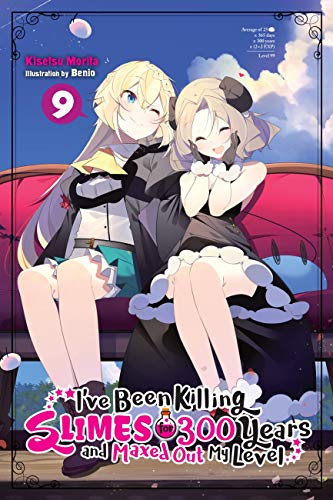
I’ve Been Killing Slimes for 300 Years and Maxed Out My Level, Vol. 9

February 20, 2021 by Sean Gaffney

By Kisetsu Morita and Benio. Released in Japan as “Slime Taoshite 300 Nen, Shiranai Uchi ni Level MAX ni Nattemashita” by GA Novels. Released in North America by Yen On. Translated by Jasmine Bernhardt.

One of the main reasons to read this series, aside from the fact that it’s a relaxing read where you can be reasonably assured that nothing terrible will be happening to anyone ever, is the push-pull characterization of the lead character, Azusa was an OL in Japan, and she’s subsequently been living for… well, over 300 years by now… in a fantasy world. And yet, of course, for the most part she does not remotely act her age, because her mental state has remained in as much of an unchanging mode as her physical one. This allows for plots where she can be a bit doofy and cute, as well as the main role that she normally fills in the series, which is being a tsukkomi to everyone else. The best parts of this book are where we got to see an Azusa who’s not constantly making comebacks. That said, for those who love that, no fear, the book is still littered with examples.

Stories we see here: Azusa and company help Nintan to help get her followers back by figuring out what’s really driving the current mood; everyone goes to another world created by Godly Goddess and finds out what it’s like to be a slime in a world of slimes; Azusa gets a haircut that ends up being too short, and takes the opportunity to be “big sis” rather than “mom” with her daughters; she and the gang go to a “meat festival” which is basically a barbecue, then watch a bullfight with minotaurs which is EXACTLY like sumo; Azusa and her daughters visit the Great Slime and learn that a 3rd slime similar to them has been born… but she’s reluctant to make Azusa her new mom; and Sandra grows a mushroom hat after a big storm and learns the value of not getting too greedy. Meanwhile, Halkara’s spinoff exists.

The weak point of the book, as you may have guessed, is the Halkara spinoff chapters, which show no signs of getting a series like Beelzebub anytime soon. I like Halkara, but these prequel chapters simply aren’t very good. I’m also a little tired of Azusa having to say that she’s not gay at least once per volume – I get the sense the author knows there’s a large yuri fandom that follows this series and is unhappy about it. (Given the series has only women in it, I’m not sure what they expected.) Other than that, though, this is a pleasant enough book. Azusa’s reaction to her new “daughter” was quite amusing, and the constant comebacks in the bullfight were quite appropriate. The book does seem to really be leaning hard into Japanese culture once more – see the sumo, but also earlier, where a kanji pun has to be explained with the actual kanji for it to work. The translation is excellent, but the original makes for headaches, I expect.

It’s hard to write reviews for series like this, because there’s never going to be anything ever happening beyond the addition of new eccentric characters. But if you want something akin to Nisekoi or Laid-Back Camp, this fits the bill very well.

Filed Under: i've been killing slimes for 300 years, REVIEWS

The Magician Who Rose from Failure: Tales of War and Magic, Vol. 1

February 19, 2021 by Sean Gaffney

By Hitsuji Gamei and Fushimi Saika. Released in Japan as “Shikkaku Kara Hajimeru Nariagari Madō Shidō! ~ Jumon Kaihatsu Tokidoki Senki ~” by GC Novels. Released in North America by J-Novel Club. Translated by Alexandra Owen-Burns.

I ended up enjoying this book quite a bit, despite the fact that it is absolutely filled to the brim with things that should annoy me. Our hero’s parents treat him like absolute dirt because his magic levels are low, and don’t change their opinion even when he proves to be a genius magician in front of multiple people. Despite “low magic aether”, our hero can basically do anything, mostly because of his isekai memories helping him envision spells better. There’s a lot of girls in peril in the book. There’s the standard smug evil bastard. And of course the plot is “I’ll show them! I’ll show them all!”. Fortunately, this last one is nipped in the bud almost immediately, and we get not one but TWO examples of why “I will dedicate my life to revenge” is a dumb thing to do. That said, the author’s other series is also filled with cliches. He gets past them by making the books entertaining anyway.

Our hero is Arcus, a six-year-old boy who one day wakes up from dreams of a different life. His Japanese life does not overwrite this one, though, and that’s fine, as Arcus has a lot to deal with. His parents hate him due to his low magic levels. And unfortunately “build up your levels by working out or using magic a lot” isn’t a thing here – levels don’t get higher. Fortunately, his sister still loves him. Also fortunately, his uncle, also shunned by the family a while ago, agrees to train him. Then we discover that Arcus has a unique way of thinking, and can achieve a lot of things that magicians can’t. He makes friends in town (who turn out to be far more mysterious than he knows), invents things that will take the magical world by storm, and gets a cool butler. Then his sister gets kidnapped…

Gonna be honest, I enjoyed the first half of the book more than the second. Which is interesting given it’s things like “Arcus invents a magical thermometer”. But seeing him tinker is a lot more satisfying than seeing him as an action hero, which is what the second half of the book entails. He has to break out of a prison tower, kill bad guys, rescue his sister and his (ex-)fiancee, and still find time to murder the real man behind all of this. Oh yes, he’s eight when he does all this, by the way. I think the book is a bit too casual with killing, to be honest. Of the other kids in the cast, Sue comes off best, being the right combination of bright young girl and mysterious manipulator. She also makes one of the few fart jokes in a light novel I’ve actually laughed at. Arcus’ sister Lecia, sadly, is very wet, but I’m hoping future books show her kicking some ass.

In the end, I can’t really think of a good reason to read this novel beyond “I read it all the way through and found it mostly enjoyable despite everything about it”. And, honestly, if authors manage to do that, we should support them. Hopefully they won’t abandon THIS series the way they did The Magic in This Other World Is Too Far Behind!!.

Filed Under: magician who rose from failure, REVIEWS

Random Reads 2/18/21

February 18, 2021 by Michelle Smith

Are You in the House Alone? by Richard Peck
Are You in the House Alone? came out in 1976 and though I totally could’ve read it when I was a teen—and thus still a member of its target audience—I never did.

Gail Osburne is a sixteen-year-old high school junior and native New Yorker who’s not at home in the quaint Connecticut village her family relocated to several years back. I knew that the plot involved Gail receiving menacing anonymous notes and phone calls, and I was expecting these events to get started quickly and the suspense to remain high throughout. But that doesn’t happen.

Instead, the story is told retroactively, so we know Gail survives. Also, obvious culprit is obvious. (I hope the reveal wasn’t intended to be a surprise, but perhaps readers were less savvy about such things in 1976.) Initially, much more of the focus is on Gail’s relationships with her parents, boyfriend, and best friend, and in particular how the latter two are in the slow process of dissolution. Eventually she receives some threatening notes and creepy phone calls, gets scared, is let down by people in positions of authority, and comes face-to-face with said obvious culprit. That happens halfway through this slim novel. The rest of the book is about Gail’s recovery from her ordeal.

I thought Are You in the House Alone? was going to be fun, suspenseful fluff, but it turned out to be fairly serious and occasionally (intentionally) infuriating. I really appreciated how Peck was able to weave in a couple of threads that seemed very random at first and make them integral to the denouement, too. Ultimately, I didn’t love the book, but I kind of… respect it, if that makes sense. It didn’t go the cheap route.

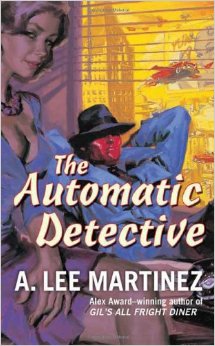
automaticThe Automatic Detective by A. Lee Martinez
Mack Megaton is a hulking robot who was created to destroy. He developed self-determination, however, and went against his programming. Now, he’s a probationary citizen of Empire City, where mutagens and pollution have created a very diverse population. While some “biologicals” are still “norms,” others have been physically transformed (like rat-like Detective Alfredo Sanchez) and others have been changed in not-so-visible ways (like Mack’s friend, Jung, a talking gorilla with refined literary taste). Mack works as a cab driver and is trying to keep a low profile, but when his neighbors are abducted, he can’t help but try to rescue them. This gets him into all sorts of trouble, of course.

Despite its name, The Automatic Detective isn’t really much of a mystery. I suppose it’s more… sci-fi noir. Mack meets various thugs, beats some of them up, gets beat up himself, etc. Slowly, he makes progress on uncovering a huge conspiracy. At times, I felt like Martinez was a little too enamored of the gimmick he created, and places in the middle dragged a bit as a result, but the ending is pretty satisfying and overall the book was enjoyable enough, even though it’s quite far from the sort of thing I usually read.

As a final note: I really liked that Martinez limited himself when it came time to invent universe-specific profanity. Instead of the text being liberally sprinkled with words like “frell” or “frak,” the phrase “Oh, flurb” appears but once (during a moment where the meaning is 100% apparent) and made me laugh out loud.

I don’t know if I’m necessarily eager to read more by Martinez, but I’m glad I read this one.

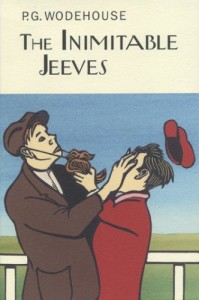
jeeves2The Inimitable Jeeves by P. G. Wodehouse
When I read My Man Jeeves back in 2010, I was somewhat disappointed because so much of it was repetitive. While there are some common elements that recur within the eleven stories that comprise The Inimitable Jeeves, it is still so very much superior that I’d now say… forget about that first book. Start here. Go back and read My Man Jeeves for completist purposes, if that’s your inclination, but start here for the best introduction to these characters and Wodehouse’s uniquely charming and amusing writing.

First published in 1923, The Inimitable Jeeves contains a linked set of stories that typically involve affable Bertie Wooster being imposed upon by either his eternally lovesick friend Bingo Little (who is “always waylaying one and decanting his anguished soul”) or his mischief-making younger cousins, Claude and Eustace. One plot thread involves convincing Bingo’s uncle (who provides him with an allowance) to agree to Bingo marrying a waitress. Jeeves comes up with the idea to ply the uncle with romance novels featuring class differences to soften his heart, and it ends up that Bertie is compelled to go visit the old fellow and claim to be the author. In addition to containing the most elegant description of sweat I’ve ever seen—“The good old persp was bedewing my forehead by this time in a pretty lavish manner.”—this situation is referenced a few times in subsequent stories until Bingo succeeds in getting married to a different waitress who really is the author of those romance novels.

So, even though you’ve got episodic happenings, it’s rather a satisfactory conclusion. Bertie is endearing, Jeeves is competent, the writing is excellent, and it made me laugh. (I especially liked when a character was described as resembling “a sheep with a secret sorrow.”) I’m so glad that I didn’t give up on the series after the first book; now I feel as though I finally see what the fuss is all about. I’d also like to give credit to the fabulous narration by Jonathan Cecil. I’m not sure if it’s deliberate, but I hear echoes of Fry and Laurie in his performance, and I heartily approve. I will certainly seek out more unabridged versions read by him.

The Murders of Richard III by Elizabeth Peters
This is the second in the Jacqueline Kirby series of mysteries. I haven’t read the first, and wouldn’t normally begin with the second, but the book promised an English country mansion plus “fanatic devotees of King Richard III” so my usual routine flew right out the window.

Even before university lecturer Thomas Carter likened himself unto Watson, I’d noticed the similarities between how this tale is told and the Sherlock Holmes stories. We are never permitted inside Jacqueline’s head. Instead, we see her how Thomas, hopeful of one day securing her romantic affections, views her. It’s fairly interesting, actually, because Thomas’ opinion of her fluctuates, sometimes peevishly. “You drive me crazy with your arrogance and your sarcasm and your know-it-all airs,” he says at one point. And though he soon after claims “I’m no male chauvinist; I don’t mind you showing off,” the fact is that earlier he was grumbling inwardly about her feigning “girlish ignorance” to reel in mansplainers and then walloping the “unwitting victim” with a cartload of knowledge. It’s true that Jacqueline isn’t especially likeable sometimes, but for remorselessly trouncing the sexist louts she encounters throughout the book, I must commend her!

The mystery itself is somewhat bland, unfortunately. The leader of a Ricardian society has received a letter purportedly written by Elizabeth of York, which would exonerate Richard of the deaths of her brothers, the “princes in the tower.” He calls a meeting of the society, with each attendee costumed as one of the historical personages involved, and summons the press, planning to unveil his find with much fanfare. But someone begins playing practical jokes on the Ricardians reminiscent of the fates of the people they are pretending to be. The book isn’t a long one, and soon the pranks start coming right on the heels of one another. Because of the swift pace—and some shallow characterization—the solution is rather anti-climactic.

Still, while I’m not sure I’ll seek out any more Jacqueline Kirby mysteries, this was overall a decent read.

A Perfect Match by Jill McGown
The series of books featuring Detective Inspector Lloyd (whose first name is a secret for now) and Detective Sergeant Judy Hill begins with a short yet enjoyable mystery in which a wealthy young widow is found dead in a small English town on property she’d just inherited from her recently deceased husband. Unlike some mysteries of which I am fond, there’s no preamble where readers get to know the victim or the circumstances of their life. Instead, immediately there’s a policeman discovering the body and then Lloyd turns up to question the victim’s next of kin. This same lack of character development hampers the romantic tension between Lloyd and Hill, leaving me with no idea what motivated Hill to finally decide to act on her feelings for him, betraying her marriage vows in the process.

The mystery itself is interesting enough, however, involving long-married Helen and Donald Mitchell who have ties to both the victim, Julia—her late husband was Donald’s older brother and Helen thinks they were having an affair—and chief suspect, Chris, originally a friend of Donald’s who has fallen in love with Helen. I can’t claim to have mustered anything more than a mild curiosity as to what the outcome would be, but neither did I guess the specifics, so that was good. I liked the interrogation scenes, too.

McGown’s writing had some fun moments. I loved the super-evocative imagery of Lloyd telling Hill that her new perm makes her look like Kevin Keegan. I also really appreciated a recurring bit where each chapter ends with the point of view of wildlife. When Chris is eventually brought in by the police, his arrest is depicted from a bird’s perspective, for example. There are also ducks, a moth, a fly, a cat… I don’t know if this device recurs in later books in the series, but I look forward to finding out.

Reconstructing Amelia by Kimberly McCreight

This is the second mystery/thriller I’ve read in which a single mom who is a lawyer with a cold and unfeeling mother of her own attempts to work out the mystery of what happened to a family member (the other being Girl in the Dark by Marion Pauw). Is that some kind of trend these days?

Kate Baron has a demanding job at a swanky firm, but she’s trying her best to be a good mom to her fifteen-year-old bookworm daughter, Amelia. She’s shocked to get a call from Grace Hall, the prestigious private school Amelia attends, saying that her daughter has been accused of cheating, and by the time she makes her way to the school, Amelia has evidently jumped to her death from the school roof. The police are only too happy to classify her death as a suicide, but when Kate gets a text that says “Amelia didn’t jump,” she starts trying to put together the pieces of what happened.

Reconstructing Amelia has quite a few problems. Despite her better judgment (and a promise to her best friend), Amelia joins a clique of bitchy girls at school who end up publicly humiliating her and trying to get her expelled when she falls in love with someone deemed off-limits. It’s hard to muster sympathy for what she ends up going through when one remembers the cruel prank she was willing to pull on someone else as part of the initiation process (largely kept off-camera to keep us from disliking her too much, I guess). We’re repeatedly told about the great relationship Amelia and her mom share, but never shown it. The subplot about Amelia’s dad is the literary equivalent of wilted lettuce. And the fact that the new detective who gets assigned to the case allows Kate to question suspects is absolutely ludicrous.

And yet, I couldn’t hate the book, largely because of Amelia’s friend, Sylvia. For much of the book she comes across as shallow and self-absorbed, but when Amelia really needs her, she’s there. She gives Amelia this tour of “great moments at Grace Hall” to cheer up her impressive pal, right before breaking down about her own legitimate pain. I never would’ve thought at the outset that I would have such immense sympathy for Sylvia, but I do. I find myself hoping that she’ll be okay.

shutterislandShutter Island by Dennis Lehane
It sure is nice going into a book unspoiled, particularly one as twisty as Shutter Island. I was quite happy with the book as it began, with U.S. Marshals Teddy Daniels and Chuck Aule taking the ferry to Shutter Island to track down a patient missing from Ashcliffe Hospital for the Criminally Insane. It’s late summer 1954, and these guys are manly but accessible, and surprisingly funny. Consider this relatiely early exchange that cracked me up:

Pretentious Doctor: *makes remarks on the lives of violence the marshals must lead*
Chuck: Wasn’t raised to run, Doc.
Pretentious Doctor: Ah, yes. Raised. And who did raise you?
Teddy: Bears.

For a while, all seems straightforward. Then Teddy confides to Chuck that he’s actually come there looking for a patient named Andrew Laediss, who was responsible for setting the fire that killed Teddy’s wife two years before. Gradually, one starts to doubt everything (and there was a point where all of the uncertainty got to be a little much for me) but the ultimate conclusion is a very satisfactory one.

Why Did You Lie? by Yrsa Sigurdardottir
Set in Iceland, Why Did You Lie? starts out with three different storylines taking place a few days apart. The first involves a photographer on a helicopter journey to take pictures of a lighthouse on a rock in the middle of the ocean, the second is about a policewoman whose journalist husband has recently attempted suicide, and the third is about a family who returns from a house swap with an American couple to find some of their stuff missing and weird footage on the security camera. Of course, as the book progresses, these storylines converge, and it’s pretty neat when the police activity the helicopter flew over in chapter one turns out to be almost the culmination of the policewoman’s plot thread.

For some reason, I can’t help wondering how Ruth Rendell might’ve written this book. I think Rendell would’ve done a lot more with characterization, for one thing. There’s certainly some here, especially for the anxious husband who struggles to make his wife admit something really has gone wrong with their houseguests, but the primary concern seems to be getting on with the suspenseful action. Quickly, each plot features some kind of creepy lurker and then ominous notes (variations on the “why did you lie?” theme) figure in to all three, as well. Nina, the policewoman, digs around and talks to people and works out that everything connects to a supposed suicide from thirty years ago.

The result is certainly an entertaining book, but not one I could really love. One major issue I had is being able to predict something very significant. The number of characters who could’ve been angry enough about the 30-year-old lies in question to terrorize people in the present is very small. And once the existence of a certain person is oh-so-casually mentioned two-thirds through the book, I thought, “Oh, well, it’s them, then.” And then a little later, I figured out which of the characters it must be and I was right. This made for an anticlimactic ending that was clearly meant to be a shocking one. Also, I would’ve liked to have cared more that one character ends the novel poised to move on with life but, in reality, still in jeopardy.

I still would read more by this author, though.

Filed Under: Books, General Fiction, Humor, Mystery, Random Reads, REVIEWS, Sci-Fi, Short Stories, Suspense, YA Tagged With: A. Lee Martinez, Barbara Michaels/Elizabeth Peters, Dennis Lehane, Jill McGown, Kimberly McCreight, P. G. Wodehouse, Richard Peck, Yrsa Sigurdardottir

The Asterisk War: Gathering Clouds and Resplendent Flames

February 17, 2021 by Sean Gaffney

By Yuu Miyazaki and okiura. Released in Japan by MF Bunko J. Released in North America by Yen On. Translated by Haydn Trowell.

I was going to spend this review of the latest Asterisk War talking about how awesome Saya Sasamiya is, the girl whose main solution to every single problem is “I guess I just need a bigger gun”, but then I looked at my review of the previous volume and realized I’d done that already. But I mean, come on, what do you expect me to talk about? The fights? That said, there is a little bit of non-tournament stuff here. The King Arthur school is back, and one of their members is now mind-controlled and evil, and has a backstory that makes me wonder if the author of Asterisk War read A Certain Scientific Railgun one day and thought “Hmmm”. And we finally get the end of the Sugary Days flashbacks with Akari and Madiath Mesa, which shows off his reasoning for being the big bad of the series, and I guess it’s all right as a motivation, but I dunno, the bad guys in this series just feel really boring. I guess I do need to talk about the fights.

Kirin’s on the cover, but, as with the previous book, isn’t actually the focus. We get instead 1) Ayato vs. Fuyuka, who essentially calls up a spiritual tag team to beat the crap out of Ayato (he still wins – hard to avoid that spoiler given he also fights later in the book); 2) Orphelia vs. Sylvia, which gives us some more of Sylvia’s backstory and thankfully does not kill her off, though it’s a close one; Saya vs. Lenaty, where even the announcers are making fun of Saya (who is, admittedly, wearing what amounts to an elementary schooler’s backpack), and again MORE DAKKA wins the day; and finally Ayato vs. Julis. The last battle you’d think would be called off, as his sister’s “you have a bomb in my body” problem is dealt with here as well, but when Ayato hears what Julis is actually planning to do…

Asterisk War is never going to be winning any “favorite series” competitions – as far as I can tell, its current fanbase is divided between those who hated the Ayato and Julis fight because he was too overpowered and those who hated it because he wasn’t overpowered enough – but it chugs along its fights never wear out their welcome, and, as I said at the start of the book, it has Saya. I was amused at the epilogue, which discusses the finals as if Saya has already lost. Saya, while admitting she thinks the same thing, is rather pissed off about this, but doesn’t want to forfeit even though she’s grievously injured and Orphelia literally tried to murder her last opponent, because she has something she “wants to try out”. Several times she thinks to herself that she’s the weakest of those in the quarterfinals, but now she’s in the semis, and I highly doubt the author will kill her off for drama, so I look forward to seeing what happens.

But that may take a bit. Yes, those dreaded words, we’ve caught up with Japan. The 16th volume is out there at the end of March, but I suspect we won’t see it till the fall at the earliest. Till then, Asterisk War is still coasting on being “okay”, but it has Saya, and that’s good enough for me.

Filed Under: asterisk war, REVIEWS

Strike the Blood, Vol. 17

February 16, 2021 by Sean Gaffney

By Gakuto Mikumo and Manyako. Released in Japan by Dengeki Bunko. Released in North America by Yen On. Translated by Jeremiah Bourque.

This is the first of two books that will be adapting stories that originally came out back around the time of the first anime, from 2014-2015. This one was also originally a 7-page short story, but, needless to say, has a lot more going on now that it’s around 250 pages. (Remember when Strike the Blood books were short?) It’s not too much of a spoiler, really, so I will note that this is a ‘daughter from the future’ sort of plot, and honestly I am a sucker for those sorts of things. That said, there’s also a lot more added here to tie in to the rest of the series and to set up events going forward. Shizuri is now officially a main cast member, getting quite a bit to do, and we also see Yuiri and Shio showing up again. As for the enemy, well, it’s fairly light as Strike the Blood enemies go – it’s a rampaging demon beast. Still enough to cause massive amounts of property damage, of course.

After beating up Kojou and Shizuri’s two allies from the previous book, the demon beast has to be taken down – and Kojou can’t do it, as the beast basically feeds on magical and demonic energy. Yukina is able to temporarily defeat it, but – as the subtitle of the book suggests – this causes her main weapon to be destroyed. This is bad news all around, as she’s now being summoned back to Lion King Agency Headquarters and Yuiri is going to take her place watching Kojou. Both Yukina and Kojou hate this, but are still both in the “what do you mean we’re not in love with each other?” stage of things, so there’s mostly a lot of moping. To Yukina’s additional consternation, there’s a fake Yukina running around as well. Looks just like her… except Reina is a vampire, knows a lot more about everything than she should, and sometimes calls Yukina “mom” by accident.

Reina is the most fun part of the book. As you can probably guess, she doesn’t seem like the sharpest knife in the drawer, but she’s certainly got powers out the wazoo, and is here to make sure that Yukina is NOT recalled from the island… which would lead to her fading out of existence. I also liked Asagi trying to be a bit more proactive and creating a school club that’s on the lookout for demonic activities – if nothing else, hopefully this will help Kojou have fewer days absent. There’s also a lot of politics behind the scenes – there are those who want Yukina gone because, since she has no family to threaten, she could easily turn against them, not to mention her status as a Blood Bride. And, of course, this being Strike the Blood, half the book is fights, which are well-written as usual, and I’m sure look very good animated. Oh yes, and there’s evil twins.

So, overall, given I’m not making fun of it, I’d say this was on the high side of Strike the Blood volumes. Next time we see Kojou going to a party of La Folia’s, and hopefully get Sayaka, who has been absent from the story for I don’t know how many books, back in the equation.

Filed Under: REVIEWS, strike the blood

  • « Go to Previous Page
  • Page 1
  • Interim pages omitted …
  • Page 104
  • Page 105
  • Page 106
  • Page 107
  • Page 108
  • Interim pages omitted …
  • Page 346
  • Go to Next Page »
 | Log in
Copyright © 2010 Manga Bookshelf | Powered by WordPress & the Genesis Framework