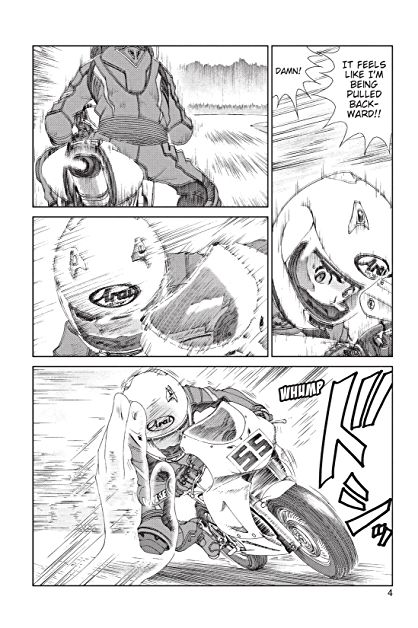
By Chihiro Ishizuka | Published by Vertical Comics
 Makoto Kowata is a novice witch who, in the tradition of witches, has left home at the age of fifteen to become independent. Her parents are concerned about her safety, though, so she’s staying with relatives in Aomori, located in the Tohoko region where it’s easier to perform magic thanks to abundant wilderness and natural resources. Accompanying her is her familiar, a black cat named Chito who is indisputably my favorite character.
Flying Witch is a calm, slice-of-life tale depicting Makoto’s attempts to fit in to her new surroundings. Makoto’s young cousin, Chinatsu, is scared of her at first, but changes her opinion to “so cool!” after a ride on a broomstick. Makoto starts high school and forgets that she’s not supposed to be talking about witchy matters with people who aren’t family. She tries to give a mandrake to an ordinary girl as a present. She starts a vegetable garden. She receives a visit from “the harbinger of spring” and another from her world-traveling sister.
It’s all very peaceful, but there are some amusing moments scattered throughout. I love that Chinatsu’s dad has a heavy regional accent (rendered as Southern in the translation) and that, after everyone else has tried and failed to capture a pheasant, he gives it a shot himself, comically muttering, “Dang it!” But what I really love is anything to do with Chito. Ishizuka-sensei does a terrific job at conveying Chito’s facial expressions, including an adorable panel of the kitty sticking out her tongue and going “pbbt.” The best, though, occur during the chapter in which Chito leads direction-challenged Makoto for a walk in the neighborhood. She assures her they’re going to a good spot, but it ends up being a location where Chito can taunt a dog on a tether, remaining disdainfully out of reach as he goes berserk.
Even though the premise is very different from Yotsuba&!, that gentle, slice-of-life feeling summons a similar response. I ended up enjoying this a lot more than I expected to, and now eagerly await volume two, albeit mostly for more Chito.
Flying Witch is ongoing in Japan, where five volumes have been released so far. Vertical will release the second volume in English later this month.
Review copy provided by the publisher.
 Fifteen-year-old Tsukushi Tsukamoto doesn’t have any friends. He’s always rushed home after school to be there for his disabled mother, who is raising him on her own after his father passed away. After an eccentric fellow named Jin Kazama saves Tsukushi from bullies, Tsukushi is more than willing to grant Kazama the favor of playing a game of futsal with him. In fact, he runs six miles through the rain in order to fulfill his promise, and though he’s spectacularly awful at the game, he’s also a gutsy idiot and something about his enthusiasm rubs off on his teammates.
 Little by little, Tsukushi manages to not completely suck, albeit only for brief moments at a time. Because of his ability to rekindle the joy of soccer in others, he is surprisingly chosen for the Interhigh team. Though he makes an error that costs them a penalty kick, he also makes a valiant save that rallies everyone’s spirits. I’m a sucker for those moments when the underdog first hears the crowd cheering for them so, predictably, this moment made me verklempt.
 Mikuri Moriyama is a 25-year-old licensed clinical psychologist who hasn’t been able to find a job after grad school. She’s been living with her parents and working for a temp agency, and when she’s laid off her father arranges for her to assume housekeeping duties for a guy he used to work with. Hiramasa Tsuzaki is 36 and single. He seems humorless and particular at first, but Mikuri finds that working for a hard-to-please guy makes it easier to know when she’s been successful. She performs her duties well, even managing to nurse Tsuzaki through an illness in such a business-like way that it’s not awkward for him. Things go well for a few months, then Mikuri’s father prepares to retire and move to the countryside. Rather than lose their mutually beneficial arrangement, Mikuri and Tsuzaki decide that she’ll move in with him and, for the sake of propriety, become his common-law wife. They proceed to perpetuate the ruse that they’re actually a real couple.
 As Tsuzaki’s coworkers learn that he’s gotten married, his social calendar suddenly fills up in a way it never did before, while Mikuri notices that her aunt Yuri, with whom she’s very close, has been hesitant to invite her out as much as she used to before Mikuri got married. Spending time with Numata and Kazami is enjoyable for the couple, but it’s also risky, because nosy Numata snoops and learns there’s only a twin bed in the bedroom, and by volume two, Kazami is convinced that they’re faking it. Kazami is perhaps as equally developed as Tsuzaki himself, as we hear a great deal about his reservations about marriage, which all leads up to the big cliffhanger ending of volume two (which I shan’t spoil). Tsuzaki, meanwhile, is attempting in vain to keep from developing feelings for Mikuri. She persists in being business-like, and he 100% believes there’s no chance she’d ever reciprocate, so he often looks emotionless in front of her, only revealing his feelings when he’s alone. I love that neither one of them is spazzy; they’re in a somewhat trope-y arrangement, but they’re handling it like adults.
 Even without knowing much about Dreamin’ Sun, I was sold by the fact that it’s an earlier series from Ichigo Takano, creator of orange, which I loved dearly. Dreamin’ Sun is more of a straightforward and comedic shoujo story in which characters do not contend with letters from their future selves or how to save a suicidal friend, but it still has a few poignant moments.
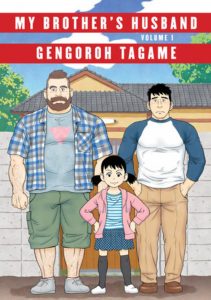 Yaichi is a single dad who works from home managing the rental property his parents left to him and his brother, Ryoji, after being killed in a car accident when the boys were teenagers. He considers his real job to be providing the best home he can to his daughter, Kana. On the day the story begins, Yaichi is expecting a guest—Mike Flanagan, the burly Canadian whom Ryoji married after leaving Japan ten years ago. Ryoji passed away the previous month and Mike has come to Japan to try to connect with Ryoji’s past and see for himself the many things he’d heard stories about from his husband.
 In elementary school, Shoya Ishida often engaged in foolhardy stunts to stave off boredom. When hearing impaired transfer student Shoko Nishimiya joins his class and causes disruption within the class, she becomes Shoya’s target. Initially, the other kids laugh at Shoya’s antics but when he goes too far and destroys several hearing aids to the tune of $14,000, they swiftly condemn him. Now he’s the one who’s ostracized and this status continues into high school, long after Shoko transferred out again. Full of self-loathing, he’s preparing to commit suicide, but a chance reunion with Shoko inspires him to try to change.
 Back and forth things go, with this group continuing to try to establish themselves as friends without seeming to genuinely like each other much. Eventually, they decide to film a movie together. For one scene, they need to acquire permission to film at their old elementary school. Shoya is the unwilling emissary, and an encounter with his odious former teacher leaves him feeling so awful about himself that he ends up lashing out at all his friends, seemingly trying to drive them away as he feels he deserves. This has the unintended side effect of causing Shoko to feel like she’s the cause of his unhappiness, prompting a desperate act.
 Less clear is what Oima was aiming for with their group of friends. Even though Naoka was far more outwardly nasty to Shoko, at least she was open about it and expressed a great deal of self-loathing because of her behavior. With the help of another friend, Miyoko, she is encouraged to have a bit more optimism, and will probably end up doing okay. Even though she could’ve been fleshed out further, I do like Naoka as a character. But man oh man, do I hate Miki. She makes everything about herself—at one point revising the bullying narrative so that she and Shoko were co-victims—and doesn’t seem to grow at all. Everything she does seems fake, because most of it is, and I was baffled when the boy she fancies declared her to be “kind” after some weepy episode. Miki should get hit by a bus.
 Bloom Into You, Vol. 1 by Nakatani Nio
 The Girl from the Other Side: Siúil, a Rún, Vol. 1 by Nagabe
 Kase-san and Morning Glories by Hiromi Takashima
 Kindred Spirits on the Roof: The Complete Collection by Hachi Ito, Aya Fumio, Toitentsu, and Liar-Soft
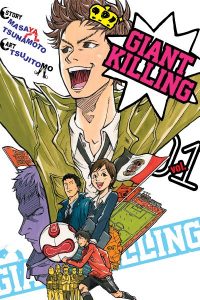 Although I genuinely, deeply love shounen sports manga, I can’t deny that most follow similar story beats. I knew going in that Giant Killing is actually seinen, but wasn’t prepared for what a breath of fresh air it would be.
 Eijun Sawamura really wanted to make some good baseball memories with his middle-school friends, but even though they practiced hard, they couldn’t win a single game. Although he shows talent as a pitcher, his unsportsmanlike behavior after a bitter defeat means most of the good baseball schools are no longer interested in him. And, because he is a hot-headed yet enthusiastic idiot, he totally forgot about the entrance exams required for other schools.
 and the second volume ends with the cliffhanger… will he and another first year succeed in scoring against overwhelming opponents?