• Skip to primary navigation
  • Skip to main content
  • Skip to primary sidebar
  • Home
  • About Us
    • Privacy Policy
    • Comment Policy
    • Disclosures & Disclaimers
  • Resources
    • Links, Essays & Articles
    • Fandomology!
    • CLAMP Directory
    • BlogRoll
  • Features & Columns
    • 3 Things Thursday
    • Adventures in the Key of Shoujo
    • Bit & Blips (game reviews)
    • BL BOOKRACK
    • Bookshelf Briefs
    • Bringing the Drama
    • Comic Conversion
    • Fanservice Friday
    • Going Digital
    • It Came From the Sinosphere
    • License This!
    • Magazine no Mori
    • My Week in Manga
    • OFF THE SHELF
    • Not By Manga Alone
    • PICK OF THE WEEK
    • Subtitles & Sensibility
    • Weekly Shonen Jump Recaps
  • Manga Moveable Feast
    • MMF Full Archive
    • Yun Kouga
    • CLAMP
    • Shojo Beat
    • Osamu Tezuka
    • Sailor Moon
    • Fruits Basket
    • Takehiko Inoue
    • Wild Adapter
    • One Piece
    • After School Nightmare
    • Karakuri Odette
    • Paradise Kiss
    • The Color Trilogy
    • To Terra…
    • Sexy Voice & Robo
  • Browse by Author
    • Sean Gaffney
    • Anna Neatrour
    • Michelle Smith
    • Katherine Dacey
    • MJ
    • Brigid Alverson
    • Travis Anderson
    • Phillip Anthony
    • Derek Bown
    • Jaci Dahlvang
    • Angela Eastman
    • Erica Friedman
    • Sara K.
    • Megan Purdy
    • Emily Snodgrass
    • Nancy Thistlethwaite
    • Eva Volin
    • David Welsh
  • MB Blogs
    • A Case Suitable For Treatment
    • Experiments in Manga
    • MangaBlog
    • The Manga Critic
    • Manga Report
    • Soliloquy in Blue
    • Manga Curmudgeon (archive)

Manga Bookshelf

Discussion, Resources, Roundtables, & Reviews

Manga

Cat Paradise, Vol. 1

July 16, 2009 by Katherine Dacey

When I was applying to college, my guidance counselor encouraged me to make a list of amenities that my dream school would have — say, a first-class orchestra or a bucolic New England setting. It never occurred to me to add “pet-friendly dormitories” to that list, but reading Yuji Iwahara’s Cat Paradise makes me wish I’d been a little more imaginative in my thinking. The students at Matabi Academy, you see, are allowed to have cats in the dorms, a nice perk that has a rather sinister rationale: cats play a vital role in defending the school against Kaen, a powerful demon who’s been sealed beneath its library for a century.

Yumi Hayakawa, the series’ plucky heroine, is blissfully unaware of Kaen’s existence when she and her beloved pet Kansuke enroll at Matabi Academy. Within hours of their arrival, however, they find themselves face-to-face with a blood-thirsty demon who describes himself as “the right knee” of Kaen. (N.B. He’s a lot more badass than “right knee” might suggest, and has a coat of human skulls to prove it.) The ensuing battle reveals that the school’s six-member student council is, in fact, comprised of magically-enhanced warriors who fight in concert with their pets. Each Guardian has a different ability; some possess super-strength, while others transform their cats into powerful weapons. Though prophecy foretold only six “fighting pairs,” Yumi and Kansuke quickly discover that they, too, have similar powers that obligate them to fight alongside the Guardians. Iwahara hasn’t explained why the prophecy proved wrong — a cloudy crystal ball, perhaps? — but it’s a safe bet that Yumi and Kansuke will have a special role to play in the impending showdown with Kaen, who has yet to materialize.

Though the plot sounds like an amalgam of manga cliches, Cat Paradise proves fun and fresh, thanks to Iwahara’s rich imagination and wicked sense of humor. The Guardians’ powers are handled in a particularly droll fashion: each student’s ability is based on his best talent, whether that be great physical speed or the ability to make a mean dumpling. The scenes in which Yumi and the other Guardians unleash their powers are both hilarious and horrifying, as Iwahara pokes fun at fighting-pair manga (e.g. Loveless) while punctuating the action with scary, visceral images (e.g. the demon’s coat). Iwahara also milks the talking animal concept for all its humorous potential, giving each Guardian’s cat a distinctive voice. The jokes are predictable but amusing; Kansuke speaks for many cats when he voices disdain for sweaters.

At first glance, Iwahara’s artwork looks a lot like other manga-ka’s. His cast is filled with familiar types, from the bishonen who’s so pretty people mistake him for a girl to the steely female fighter who looks older and more worldly than her peers. Yet a closer inspection of Iwahara’s drawing reveals a much higher level of craftsmanship that his generic character designs might suggest; he’s a consummate draftsman, favoring intricate linework over screentone to create volume and depth. (Even his character designs are more distinctive than they initially appear, as each human’s face contains a subtle echo of his cat’s.) The story’s good-vs-evil theme is neatly underscored by Iwahara’s use of white spaces and bold, black patches to create strong visual contrast and menacing shadows.

I’d be the first to admit that Cat Paradise defies easy classification. Is it a parody? A horror story? A plea for greater human-cat understanding? Or just a goof on Iwahara’s part, as his afterword suggests? No matter. Iwahara demonstrates that he can make almost any story work, no matter how ridiculous the premise may be. The proof is in the pudding: you don’t need to have a special fondness for cats, manga about cats, or manga about teen demon fighters to enjoy Cat Paradise, just a good sense of humor and a good imagination.

CAT PARADISE, VOL. 1 • BY YUJI IWAHARA • YEN PRESS • 192 pp. • RATING: OLDER TEEN
Filed Under: Manga, Manga Critic, REVIEWS Tagged With: Animals, Cats, Horror/Supernatural, yen press

Swallowing the Earth

July 9, 2009 by Katherine Dacey

Nineteen sixty-eight was a critical year in Osamu Tezuka’s artistic development. Best known as the creator of Astro Boy, Jungle Emperor Leo, and Princess Knight, the public viewed Tezuka primarily as a children’s author. That assessment of Tezuka wasn’t entirely warranted; he had, in fact, made several forays into serious literature with adaptations of Manon Lescaut (1947), Faust (1950), and Crime and Punishment (1953). None of these works had made a lasting impression, however, so in 1968, as gekiga was gaining more traction with adult readers, Tezuka adopted a different tact, writing a dark, erotic story for Big Comic magazine: Swallowing the Earth.

Like MW (1976-78), which was also serialized in Big Comic, Swallowing the Earth is an overripe, overstuffed period piece that’s both entertaining and frustrating for modern readers. The basic plot is simple: seven beautiful young women seek to avenge the untimely death of their mother by wrecking havoc on the political, social, and economic systems that robbed Zephryus of her money and her home. The only thing standing in their way is Gohonmatsu, a perpetually drunken longshoreman who’s immune to their charms.

Tezuka’s presentation of the story, however, is anything but straightforward, as he employs flashbacks, subplots, and red herrings galore to sustain the reader’s interest. Some of these gambits are so ridiculous and nervy they work. Zephyrus’ daughters, for example, team up with a female scientist to produce Dermoid Z, a synthetic skin that can completely transform a person’s appearance. From a manga-ka’s standpoint, Dermoid Z is a brilliant device, as it allows him to plausibly conceal his characters’ identities from the reader and the other actors in the drama, giving him latitude to do just about anything.

Other gambits flat fall, as they rely on outdated notions of gender and race for their dramatic impact. When Dermoid Z arrives in the United States, for example, African-Americans begin buying white “skins” in vast quantities, donning them to commit crimes, enjoy privileges that had been denied them, and exact retribution on their oppressors. White retaliation is swift and brutal, plunging American cities into a race war that destroys the very fabric of society. Lacking a deep understanding of American history, or the underlying causes of the 1968 riots that erupted after Martin Luther King, Jr. was assassinated, Tezuka’s subplot feels like a crude attempt to be topical. He’s grasped the basic injustice of segregation, yet he never humanizes his black characters; they remain a violent, faceless mob throughout this unfortunate episode.

Tezuka’s treatment of women is likewise muddled. He clearly recognizes that men have treated women as property throughout human history, a point he illustrates both through Zephryus’ story (which unfolds in Nazi-occupied France) and through an interlude in the South Seas, where a tribal chief barters with Gohonmatsu for a downed airplane, offering his two daughters in exchange for the machine. Yet Tezuka’s own notions of female sexuality frequently undermine his critique of male privilege. He depicts Gohonmatsu’s South Seas brides as sexual grotesques, with bodies as roundly deformed as the Venus of Willendorf’s and libidos that verge on nymphomania. Women from the developed world don’t fare much better, as Tezuka neatly divides them into two camps: man-hating hysterics (e.g. Zephyrus’ daughters) and tormented victims (e.g. a beautiful aphasiac who lost her ability to speak after she was raped).

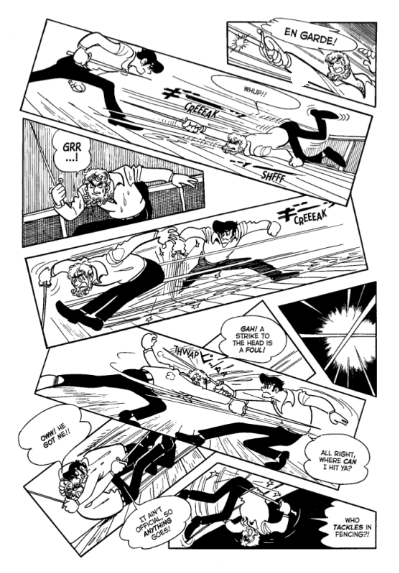
However dated Swallowing the Earth‘s racial and sexual politics may be, it’s hard to deny the sheer exuberance of Tezuka’s artwork. His imagination yields some stunning — and stunningly weird — images. Zephyrus’ palace, in particular, is a marvelous creation, an Art Deco ziggeraut filled with enormous cat statues that look like they were swiped from Cleopatra’s tomb. Tezuka frequently experiments with the layout, varying the shape of the panels to suit the pace and intensity of the action, or to suggest the simultaneity of two events. One of the best examples occurs early in the story, when Gohonmatsu duels a handsome Spanish count on the deck of a tugboat:

fightscene

Tezuka uses diagonal panels to mimic the rocking motion of a ship anchored in choppy water. The shape of the panels also demonstrate just how difficult it is for both characters to find their footing on the slippery deck — a small but tricky detail that isn’t easy to capture in a static image.

In an excellent companion essay to the English-language edition, manga scholar Frederick Schodt acknowledges Swallowing the Earth‘s myriad flaws — its surfeit of plotlines, its racial caricatures — while celebrating the almost anarchic way in which the story unfolds. He encourages readers to enjoy Earth as a “wild ride” and a window into a critical period in Tezuka’s development, showing us “how he began to make the transition from a children’s artist to someone who could push the manga medium in every genre, even for adult readers.” It’s in this spirit that I recommend Swallowing the Earth, as testament to Tezuka’s fertile imagination, and his ability to grow as an artist and a storyteller.

SWALLOWING THE EARTH • BY OSAMU TEZUKA • DMP • 516 pp. • RATING: OLDER TEEN (16+)

Filed Under: Manga, Manga Critic, REVIEWS Tagged With: Action/Adventure, Classic, DMP, Osamu Tezuka

Bamboo Blade, Vol. 1

July 6, 2009 by Katherine Dacey

Dangerous Minds, Dead Poets Society, Stand and Deliver, and To Sir, With Love all depict teachers who are heroic in their self-sacrifice, renouncing money, family ties, and even their reputations in order to inspire students. Kojiro Ishido, the anti-hero of Bamboo Blade, won’t be mistaken for any of these noble educators. He’s bankrupt, morally and financially, and so eager to dig himself out of debt that he’d exploit his students in a heartbeat.

Kojiro’s troubles begin when he enters a bet with his old friend and sparring partner Toryah, an accomplished martial artist. If Kojiro can lead his school’s kendo club to victory over Toryah’s, Toryah will provide him with a year’s worth of free sushi from a top-notch restaurant. If Kojiro fails, he must surrender a personal treasure: the trophy he won for defeating Toryah at the 26th annual Shoryuki High School Kendo Meet. Making Kojiro’s job more challenging is the fact that Toryah coaches an all-girls’ squad; Kojiro’s co-ed team has but one female member, so he must recruit at least four more girls in order to scrimmage with Toryah’s crew. The few students who aren’t scared off by Kojiro’s acute desperation include Kirino, the club’s captain; Eiga, a plump boy who’d rather play ping pong; Nakata, Eiga’s best friend; Miya-Miya, a beautiful ditz; and Tamaki, an experienced swordswoman who initially rebuffs Kojiro’s entreaties to join the club.

Whether or not they’ll come together to form a proper team remains to be seen, but readers will be forgiven for bailing out before that point in the story, as Bamboo Blade quickly sinks under the weight of stale jokes and one-note characters. Kojiro, in particular, is a repellent creation: he’s mean, loud, and dumb, utterly lacking in the self-awareness or humility that would make him a sympathetic figure. A skillful writer might have found a way to make Kojiro’s nastiness funny — say, by making him more sardonic, or by drawing a sharper contrast between his pessimism and Kirino’s relentless optimism. Instead, Kojiro comes across as a crashing bore, a bully who’s incapable of speaking at conversational decibel levels or thinking of anything but his growling stomach. (He subsists on instant noodles and student handouts.)

The swordplay isn’t much better. Artist Aguri Igarashi’s fight scenes are impressionistic at best, employing speedlines to such a degree that it’s almost impossible to tell what’s happening in many panels; if anything, these scenes look like a forgotten Giacomo Balla painting: Kendo Fighters No. 1. I wished Igarashi had been more meticulous in showing how, exactly, a fight unfolds, from where the opponents strike one another to how they move across the floor, as there’s very little information about kendo anywhere in the story or the translation notes.

Given how exciting it is to watch a real kendo match, I’m convinced there’s a great story lurking deep within Bamboo Blade; I’m just not sure that Masahiro Totsuka and Aguri Igarashi are the right folks for the job. Sports junkies and fans of the Bamboo Blade anime may find something to like here, but rookies should avoid this team of losers.

BAMBOO BLADE, VOL. 1 • STORY BY MASAHIRO TOTSUKA, ART BY AGURI IGARASHI • YEN PRESS • 228 pp. • RATING: OLDER TEEN (16+)

Filed Under: Manga, Manga Critic, REVIEWS Tagged With: Comedy, Kendo, Sports Manga, yen press

Black Cat 1-2 by Kentaro Yabuki: B+

June 17, 2009 by Michelle Smith

blackcat11 Black Cat is the story of Train Heartnet, who used to work as an assassin for a powerful organization called Chronos. After an encounter with a female bounty hunter (a.k.a. sweeper) named Saya (whom we only glimpse near the end of volume two), his outlook changed and he gave up that life. Now it’s two years later and Train has become a sweeper himself, collecting bounties on criminals with his partner, Sven. Train’s motto is “more money, more danger… more fun!” and his pursuit of the latter two usually means the duo doesn’t get much of the former.
Though the idea of the “protagonist who used to be a killer but has now become more kind” is not new to shounen manga, it’s employed a little differently in Black Cat. While many such heroes have made it their pledge never to kill again, Train has no problem with offing the criminal element, though he’s scrupulous about not harming innocents. This allows for the potential of a deadly showdown with his former partner, Creed, who was responsible for Saya’s death and upon whom Train has sworn to exact revenge.

After going after a few minor targets, Train and Sven are approached with a proposition by Rinslet, a notorious female thief. She’s been hired to steal some research data from a criminal bigwig, and wants Train and Sven to help make her job easier by capturing the bigwig first. They get the reward; she gets the loot; everybody’s happy. Of course, things don’t exactly go as planned, since the bigwig invokes Creed’s name and makes Train go rather nuts. Ultimately, Train and Creed confront each other, inflicting enough wounds to prove they are well matched as opponents but living to fight another day.

These first two volumes skillfully introduce Train’s past, his current circumstances, and the lingering threat of Creed and his band of revolutionaries (who seek to overthrow Chronos and want Train to join them) without inundating the reader with information. One of the best things about this series is the nebulous notion of “pacing,” which to me means that when I read it, it feels like I am watching a television show, with a variety of perspectives and camera angles and a natural flow to scenes and conversations. The story is also structured similarly, with the introduction of a villain who then retreats into the background for a bit while the protagonists get on with the daily grind of their occupation, calling, and/or duty.

My favorite aspect of the series, however, is the strength of the partnership between Train and Sven. It’s clear that these two trust each other professionally, but it goes deeper than that, as exemplified by Train’s reaction when Sven gets wounded during an attempt to apprehend a target. Their relationship actually reminds me some of Ban and Ginji in GetBackers, with the energetic but extremely powerful guy using the nickname –chan to refer to his more cerebral partner who possesses some sort of eye-related power (though this is only a hint so far in Sven’s case). That’s a pretty superficial comparison, but the overall affectionate feel is pretty similar.

Thankfully, the similarities between Black Cat and GetBackers do not extend to the art. Yabuki’s illustrations are clean and easy on the eyes, with a minimum of screentone and quite a lot of speed lines. Even without looking at the cover, one could probably tell that this series ran in Shonen Jump. Speaking of the cover, that’s the one area where Yabuki’s art becomes unattractive. Rinslet in particular looks much, much better in the interior art. One artistic element that does puzzle me is Train’s coat. What exactly are those brown things?! They look like miniature life boats but I have a sneaking suspicion they’re meant to be cat nipples.

Bizarre sartorial choices aside, what it all boils down to is that Black Cat is a lot of fun. The well structured story and the camaraderie between the leads elevates it beyond typical shounen fare and I’m definitely looking forward to seeing how the rest of it plays out.

This review was originally published at Comics Should Be Good.

Filed Under: Manga, Shounen Tagged With: Shonen Jump, VIZ

Detroit Metal City, Vol. 1

May 28, 2009 by Katherine Dacey

Detroit Metal City is a rude, raunchy comedy that’s both a satire of death metal culture and a loving portrait of the folks who labor in its trenches. When we first meet the series’ hero, twenty-three-year-old Soichi Negishi, he’s wearing a fright wig, kabuki makeup, fangs, and a pair of knee-high platform boots that look like they were swiped from Paul Stanley’s closet. Soichi is the lead singer and guitarist for Detroit Metal City (DMC), an “evil core death metal band with a huge following.” Onstage, Soichi adopts the persona of Krauser II, Lord of Hell, spitting lyrics about rape, torture, and mutilation; offstage, however, Soichi is a sweetly metrosexual young man who loves Swedish pop music, Audrey Tatou movies, and shopping for stylish clothing in the Daikanyama district. How, exactly, Soichi ended up singing in DMC is something of a mystery; by his own admission, he left his parents’ farm hoping to start a “hip indie pop band.” Five years later, however, Soichi is living in Tokyo and performing in DMC while doing his utmost to conceal that fact. Try as he might, however, he can’t quite limit his loud, violent persona to the stage, as Krauser has an unfortunate tendency to manifest himself whenever Soichi is depressed, angry, intoxicated, or feeling rejected by Yuri, a pretty young magazine editor who shares Soichi’s passion for perky tunes.

The tension between Soichi’s two musical personae turns out to be a brilliant framing device for the story, allowing manga-ka Kiminori Wakasugi to have his cake and eat it, too. As Krauser II, Soichi can sing the kind of crudely misogynistic lyrics that might otherwise offend because we, the readers, know that DMC epitomizes everything Soichi disdains in real life — in effect, Soichi is our surrogate, expressing indignation for us so that we might laugh freely at the risque jokes. At the same time, however, DMC gives Soichi an outlet for expressing the darker side of his personality—for de-wussifying him, if you will—and acknowledging his deep disappointment that no one appreciates his gentle, sensitive side.

Nowhere is the tension between the Swedish pop star and the Japanese metal god more evident than in chapter twelve. While hanging out in a trendy boutique with Yuri, Soichi lands an opportunity to play a small, intimate gig in the store. Soichi jumps at the chance, performing a saccharine tune called “Sweet Lover”:

When I wake up in the morning
You’re there making cheese tarts.
Sweet baby, that’s what you are.
My sweet, sweet lover
Let’s go
Let’s dress up and go to town.
With cheese tarts in one hand,
You’re romping around.
Cut through the crowds
Let’s go to that store we love.
To buy those matching rings
I promised you.
Sweet sweet sweet sweet lover…

The song’s god-awful lyrics, however, meet with indifference, prompting the boutique owner to eject Soichi from the store. Dazed and wounded, Soichi goes on a drinking binge, his embarrassment slowly curdling into rage. He then dons his DMC outfit and performs “Bad, Bad Lover,” a darkly humorous re-working of his much-reviled love song:

When I wake up in the morning
You’re there frying your parents up!
Let’s go
Kill everyone dressed up in town.
With chainsaw in one hand
You’re slashing around.
Slaughter the crowds
Let’s go to that store we love.
To get those matching weapons
I promised you.

As one might imagine, there are only so many scenarios in which Soichi can transform into Krauser (and vice versa). Mid-way through volume one, I worried that the joke was beginning to wear thin, as Soichi once again found himself trying to explain to Yuri why, exactly, he’d suddenly started acting like a loud, foul-mouthed boor. Thankfully, Wakasugi finds some odd and marvelous ways to spin the story—none of which I’ll spoil for you—including a contest between DMC and an Ozzy Osbourne-esque rocker, and a visit to Soichi’s hometown, where his cheerful, clueless parents grow mushrooms and raise livestock.

All of these scenes are rendered in a crude yet energetic style; if I had to hazard a guess, I’d say Wakusagi didn’t do very well in life drawing, as his bow-legged figures sit awkwardly in the picture plane. Yet the very clumsiness of the art works perfectly with the story’s over-the-top premise, capturing both the intensity of DMC’s performances and the sheer stupidity of their on-stage antics. Were the art any slicker, many of Detroit Metal City’s most outrageous moments just wouldn’t work, as their verisimilitude would elicit a “That couldn’t happen in real life!” response from the reader.

Fans worried that Viz would sanitize Detroit Metal City for English-speaking audiences can breathe a sigh of relief. The script abounds in f-bombs, anatomical slang, and crude sexual humor, suggesting that Viz made every effort to preserve the tone and content of the original script. Translator Anne Ichii deserves special mention, as she did a terrific job of making the song lyrics funny in English, a task akin to translating “Big Bottom” or “Stonehenge” into, say, Czech or Chinese. (Just how does one say “mud flaps” in Czech?) The production team merits praise as well, both for their snazzy cover design and for their inclusion of 2009’s coolest extra: temporary DMC tattoos.

If you find South Park offensive, it’s a safe bet that Detroit Metal City won’t be your cup of tea. But if you can look past the swear words and lewd behavior, you’ll find a surprisingly funny, touching story about a musician on a quest to discover his true voice — crank up Portrait of the Artist as a Young Man to eleven, and you have a pretty good idea how this crude, goofy story reads. Highly recommended.

Review copy provided by VIZ Media, LLC.

DETROIT METAL CITY, VOL. 1 • BY KIMINORI WAKASUGI • VIZ • 200 pp.  RATING: MATURE (18+)

Filed Under: Manga, Manga Critic, REVIEWS Tagged With: Comedy, Heavy Metal, Musical Manga, VIZ, VIZ Signature

Blood+ Adagio, Vol. 1

May 23, 2009 by Katherine Dacey

Forget what you know about the Russian Revolution. The real cause of the Romanov’s demise wasn’t growing unrest among the proletariat, or the high cost of World War I, or the famines of 1906 and 1911, but something far more sinister: vampires. At least, that’s the central thesis of Blood+ Adagio, a prequel to the popular anime/manga series about an immortal, vampire-slaying schoolgirl and her handsome, enigmatic handler. The first volume of Adagio transplants Saya and Hagi from the steamy jungles of present-day Okinawa and Vietnam — where they’ve battled US military forces and the myserious Cinq Flèches Group — to the chilly halls of Nicholas II’s Winter Palace in St. Petersburg — where they discover a nest of Chiropterans as well as a host of schemers, sycophants, and crazy folk in the tsar’s orbit.

Russophiles will balk at the liberties that artist/author Kumiko Suekane has taken with historical fact, such as transforming Rasputin from a bearded monstrosity into a clean-shaven hottie and introducing Sergei Shupukin, a fictional general who supposedly rose from peasant stock to become Nicholas II’s most trusted military advisor. As preposterous as some of these decisions may seem, however, they work surprisingly well, creating a delirious atmosphere that captures the Romanov’s desperate, semi-debauched state in 1916. One could almost — almost — believe that vampires prowled the halls of the Winter Palace under Rasputin’s protection.

What doesn’t work so well is the actual story. Few characters receive a proper introduction; we’re simply thrown into the action and left to our own devices to decide which ones are central to the drama and which ones are peripheral, a process unnecessarily complicated by some unfunny comic business in the opening pages. More frustrating is how poorly the historical elements are incorporated into the storyline, as two rooted-in-fact subplots — the tsarevich’s hemophilia and Rasputin’s cult following — receive only cursory treatment, never rising beyond the level of period window dressing.

Frustrating as the story may be, Kumiko Suekane’s artwork is clean and stylish, capturing the opulence of the Romanov lifestyle through elaborate costumes, hairstyles, and personal affects. Her character designs closely resemble Chizu Hashii’s originals, though they’re a little softer and more sensuous than the angular figures from the Blood+ anime — a good thing, in my opinion, as the characters’ faces are less mask-like and more expressive. Suekane stages the fight scenes competently, if not imaginatively, relying heavily on speedlines and close-ups of contorted faces to convey the intensity of the violence, sometimes obscuring where, exactly, her characters are standing in relation to one another.

Readers unfamiliar with the Blood+ series may find Adagio a confusing place to begin their journey, as the author presumes her audience is well-versed in the characters’ elaborate histories. Long-time fans, however, will find this an entertaining, if unevenly executed, story that should satisfy their urge to see Saya and Hagi’s slow-simmering romance continued.

BLOOD+ ADAGIO, VOL. 1 • STORY AND ART BY KUMIKO SUEKANE • DARK HORSE • 200 pp. • RATING: TEEN

Filed Under: Manga, Manga Critic, REVIEWS Tagged With: Blood+, Dark Horse, Historical Drama, Horror/Supernatural, Vampires

Otomen, Vols. 1-2

May 19, 2009 by Katherine Dacey

To a casual observer, Asuka Masamune epitomizes masculinity. Not only is he the captain of the kendo team and a star student, he’s also tall, handsome, and quick to defend weaker students from bullies — the kind of stoic, principled guy that boys and girls admire. That macho exterior belies Asuka’s true nature as a sensitive young man with girly hobbies such as making elaborate bento boxes, sewing stuffed animals (the cuter, the better), and reading Love Chick, a shojo manga serialized in his favorite magazine, Hana to Mame (literally, “Flowers and Beans,” a pun on Hana to Yume, or “Flowers and Dreams”).

Asuka’s charade is threated by classmate Juta Tachibana, a tousle-haired player who discovers Asuka’s big secret: an unrequited crush on transfer student Ryo Miyakozuka. Ryo is yin to Asuka’s yang, a pretty young woman who can deliver a mean karate chop but can’t bake a cake or sew a button onto a blouse. They may seem like a match made in shojo heaven, but there’s a catch: Ryo disdains “girly” guys. Her initial impression of Asuka is favorable, but that encounter unleashes a torrent of emotion inside Asuka that makes it increasingly difficult for him to play the cool, macho customer. Juta pledges to help Asuka win Ryo — a gesture that initially seems out of character for such a transparent opportunist and womanizer. As we begin to learn more about Juta, however, we discover that he is, in fact, the manga-ka behind Love Chick (he uses the pseudonym “Jewel Tachibana”) and that Asuka is the inspiration for the series’ graceful heroine. Whether Juta empathizes with his subject, or is hoping to manipulate Asuka’s life for literary fodder, isn’t yet clear, though Juta embraces his matchmaking role with gusto.

The set-up is ripe with possibility, but I wasn’t entirely sold on Otomen after reading the first volume. Aya Kanno earned points for her sensitive portrayal of Asuka and gentle digs at shojo cliche, yet the story lacked the necessary edge to be a true satire. Her characters expressed disdain for various shojo conventions while engaged in stereotypical shojo behaviors — meeting on rooftops, exchanging bento boxes, visiting amusement parks. Kanno enlivened these stock scenarios with a generous helping of slapstick, but they never quite rose to the delirious, gender-bending heights of Your and My Secret or My Heavenly Hockey Club.

Volume two suffers from the same have-cake-and-eat-it-too problem, as Kanno trots out more subplots from the shojo playbook: a Christmas date, a surprise fiancee. As with the amusement park trip in volume one, Kanno pokes fun at these familiar scenarios by piling on the misunderstandings and the fist-fights. When Asuka meets his fiancee, for example, he’s initially enchanted by her girly clothing and Disney-fied living quarters. He sticks to his guns, however, and declares his love for Ryo, setting off a chain of events that culminates in a daring rescue by Ryo and Asuka. Yet aside from inverting the usual rescuer/rescuee roles, this scene feels like it could have been lifted from almost any wacky shojo romance; Kanno can’t quite bring herself to skewer this very creaky plot device even as she paints a ridiculous scene.

Otomen is at its best when tackling gender identity head-on. In volume two, for example, Kanno introduces a character named Yamato Ariake, an underclassman who suffers from the opposite problem as Asuka: his petite, pretty appearance leads many folks to assume he’s a girl, even though Yamato has conventionally masculine tastes. He “apprentices” himself to Asuka to learn how to be more manly, gushing about Asuka’s height, gait, and reserved demeanor with infatuated abandon. Yet Yamato expresses disgust when he discovers Asuka’s affinity for cute bento boxes and “girly” activities: how could someone as cool as Asuka be so feminine? On one level, the Yamato-Asuka relationship is a send-up of the “sempai” crush so prevalent in shojo manga; as Yamato catalogues Asuka’s best features, for example, Yamato’s saucer eyes sparkle with the intensity of a Moto Hagio character’s. On another level, however, Yamato’s plight helps underscore just how difficult it is to find a niche when your appearance or personality deviate from established gender norms.

Kanno drives the point home by showing us the degree to which Asuka’s thoughts and feelings reflect his feminine avocations. Using shojo manga tropes — flowery backgrounds, sparkling screentones, close-ups — she demonstrates that Love Chick has profoundly influenced the way in which Asuka fantasizes about Ryo, as he imagines an ideal Christmas Eve date that involves a tender exchange of words and a chaste kiss — hardly the stuff of harem comedies. She also uses these time-honored techniques to help us understand Asuka’s ambivalent feelings about his father, who abandoned the family to have a sex change operation. As we learn in volume one, his dad harbored a similar interest in girly things; his departure inspired Asuka’s mother to purge the cute and sparkly from Asuka’s life, lest he also turn out to be a woman in a man’s body. Though the flashbacks to Asuka’s childhood border on melodrama, the way in which they’re drawn gives them a poignancy and immediacy that mitigates against camp.

I’m not sure on which side of the drama/satire divide Otomen will settle, but I certainly plan to continue reading this odd, funny, and sometimes moving tribute to a character who’s man enough to excel at kendo and like shojo and stuffed animals.

Review copies provided by VIZ Media, LLC.

OTOMEN, VOLS. 1-2 • BY AYA KANNO • VIZ • RATING: TEEN

Filed Under: Manga, Manga Critic, REVIEWS Tagged With: Comedy, shojo beat, VIZ

Gorgeous Carat, Vols. 1-4

May 11, 2009 by Katherine Dacey

Gorgeous Carat caught my eye because it looked like a frothy costume drama. I’m a total sucker for that kind of thing, especially if it involves beautiful people fighting and falling in love in fancy surroundings. Alas, what I’d hoped would be a pleasant bit of escapism turned out to be so problematic in its presentation of gender, sexuality, and race that I never got swept up in its embrace.

The premise is ridiculous, but the first volume has a certain flair that carries Carat past its credulity-straining aspects. Our hero, Florian Rochefort, belongs to a French family with a noble name and and not-so-noble debt load. Rather than fence the family jewels, Florian’s mother does what all self-respecting French aristocrats do in yaoi manga: she sells Florian into slavery, delivering him to Ray Balzac Courtland, a distant relative who also happens to be, natch, young and handsome. Florian may be too dense to recognize his growing attraction to Ray, but it doesn’t take long for Florian to realize that Ray is, in fact, “Noir,” a cat burglar who’s the talk of fin-de-siecle Paris. When Florian is kidnapped by a rival gang of thieves, Ray sails for Morocco to enlist an old friend in tracking down his prized possession relative.

Elegant men in elegant costumes hopscotching across Europe and North Africa in pursuit of treasure: sounds good, no? Alas, You Higuri’s beautiful artwork can’t disguise the fact that her vision of North Africa is steeped in the same colonialist attitudes as Salammbo — not exactly an unimpeachable source of information about the Middle East. Take, for example, Laila, one of the key supporting characters in the Carat cast. Laila is Ray’s gal Friday, helping him track down information, cooking him meals, and keeping his car’s engine running whenever he sets out on a mission that might require a quick getaway. She might be a harmless character if it weren’t for Higuri’s decision to make Laila a dark-skinned Moroccan wearing a midriff baring costume.

Though we’re meant to see Laila as plucky, she has an ugly, Pygmalion-esque backstory (Courland rescued her from the streets when she was a girl and taught her to read) and is depicted as all-too-eager to do her master’s bidding. More disturbing is the way in which she competes with the fair-skinned Florian for her master’s attention. She throws temper tantrums, rages at Florian, tries seducing Ray, and, when none of that works, concedes that Florian has the superior claim on Ray’s heart. In fairness to Higuri, I think Laila is intended to be a surrogate for Carat’s female readers—a kind of wink-wink to readers wishing that Ray or Florian harbored romantic feelings for women. Instead, Laila comes across a tempestuous child-servant—a Steppin’ Fetchit for the Britney Spears era.

Equally troubling is the kidnapped-by-a-sexy-sheik subplot in the second volume. Florian becomes a pawn in an ugly contest between Ray and Azura, a mysterious Moroccan who—naturally—is impossibly and exotically beautiful himself. I got the same queasy feeling reading these pages as I did watching the implied rape scene in Lawrence of Arabia. Much is made of Florian’s fair, virginal beauty, just as Jose Ferrer fawns over Peter O’Toole’s blue eyes, pale skin, and sexual innocence. But while David Lean shows us the terrible ramifications of this encounter, Higuri includes these scenes in Carat for pure titillation. Yes, she hints that Azura may have “ruined” Florian, but given the series’ Harlequin romance plotting, it’s a safe bet that the lasting impact of Florian’s imprisonment will be bringing him closer to Ray, not sending him into, say, an irreversible tail spin of drug addiction and prostitution. (Though, of course, Higuri does inflict amnesia and temporary insanity on Florian for most of volume three.)

In Higuri’s defense, I doubt she knew much, if anything, about the imperialist discourse that shaped European attitudes towards the “Orient.” Yet she rehearses many of the stereotypes prevalent in nineteenth-century European art, literature, and scholarship about the Middle East, portraying Laila and Azura as irrational, childlike, and dangerously sensual — just as Flaubert portrays his Carthaginian princess. About the best I can say for Higuri is that she’s so committed to her story and characters that Gorgeous Carat almost works as a parody of Delacroix, Flaubert, and Massenet. Good thing Edward Said never picked up a copy.

GORGEOUS CARAT, VOLS. 1-4 • BY YOU HIGURI • BLU MANGA • RATING: MATURE (18+)

Filed Under: Manga, Manga Critic, REVIEWS Tagged With: Action/Adventure, BLU Manga, LGBTQ, Romance/Romantic Comedy, You Higuri

Real, Vols. 1-4

May 3, 2009 by Katherine Dacey

Slam Dunk may have been the series that put Takehiko Inoue on the map and introduced legions of Japanese kids to basketball, but for me, a long-time hoops fan who grew up watching Larry Bird lead the Celtics to numerous NBA champtionships, Slam Dunk was a disappointment, a shonen sports comedy whose goofy hero desperately needed a summer at Robert Parrish Basketball Camp for schooling in the basics. Real, on the other hand, offered this armchair point guard something new: a window into the fiercely competitive world of wheelchair basketball. Watching Inoue’s characters run a man-to-man defense and shoot three-pointers from their chairs gave me a fresh appreciation for just how much strength, stamina, and smarts it takes to play the game, with or without the use of ones’ legs.

Much of the series’ appeal lies with Inoue’s superb draftsmanship. As he does in both Slam Dunk and Vagabond, he immerses us in the action, making us feel as if we’re on the court with his characters, bumping rims and talking trash. No detail is squandered; even a close-up of a character’s eyes or hands helps us picture where his teammates are on the court, and imagine how the play might unfold.

The other thing that Real does incredibly well is give us a window into its characters’ emotional lives, something that the antic, frantic Slam Dunk never pauses to do. (In Inoue’s defense, I don’t expect a shonen comedy to shed much light on its hero’s interior life, especially one as dense and single-minded as the flame-haired Hanamichi Sakuragi.) Its three principle characters—Togawa Kiyoharu, a track-and-field standout whose promising career was snuffed by bone cancer, Nomiya Tomomi, a high school dropout responsible for paralyzing a girl in a motorcycle accident, and Takahashi Hisanobu, a high school basketball star sidelined by a spinal cord injury—are complex individuals whose foul tempers and bouts of self-loathing make them seem like ordinary people coping with extraordinary circumstances, rather than cardboard saints.

Consider Takahashi. Until the day he was hit by a truck, Takahashi embodied the big-man-on-campus stereotype, leading the basketball team, dating several girls at once, acing his exams, and enforcing the school’s social pecking order by ruthlessly hazing weaker students. The accident robs him not only of his mobility, but also his identity; Takahashi predicated his entire sense of self on what others thought of him. Once confined to a bed, however, he lashes out at anyone who shows him kindness: how dare these C- and D-list folk offer him pity? (In one of the series’ only running jokes, Takahashi evaluates everyone on a five-point scale, including the tough, homely nurse assigned to his ward. She rises in his estimation after ticking off a long list of American boyfriends.) As he begins the grueling process of rehabilitation, Takahashi’s sense of self is further undermined by the realization that learning to move again will require discipline, something he lacks. (In fact, Takahashi held his more disciplined teammates in contempt, viewing their work ethic as a sign of weakness.) His fear and anger begin curdling into self-pity, leaving him physically and emotionally paralyzed.

Degraded as the character may seem, however, Inoue never invites us to pity Takahashi. We feel his sense of loss and futility, yet it’s clear from Takahashi’s repellent behavior that he still has a strong will to live, giving us hope that his journey will end in redemption. What isn’t so obvious is how Takahashi will get his groove back, as Inoue doesn’t draw neat draw parallels between his story and Kiyoharu’s. (Nomiya, the dropout, emerged from his accident unscathed, and faces a somewhat different battle than the wheelchair-bound Takahashi and Kiyoharu.) Though it’s frustrating to wait and see what will happen to Takahashi, the slow and almost haphazard way in which his story unfolds gives the narrative a true-to-life rhythm that mitigates against a pat, uplifting resolution to the drama.

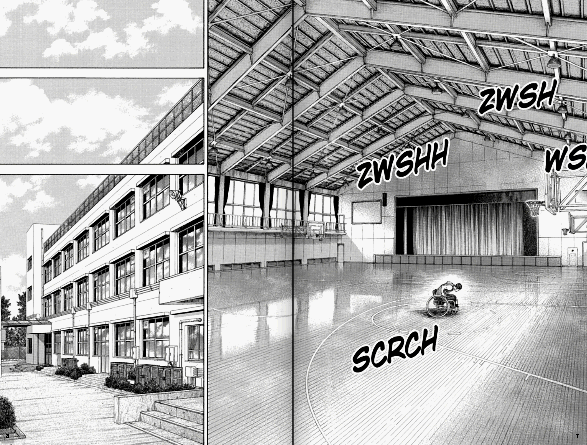
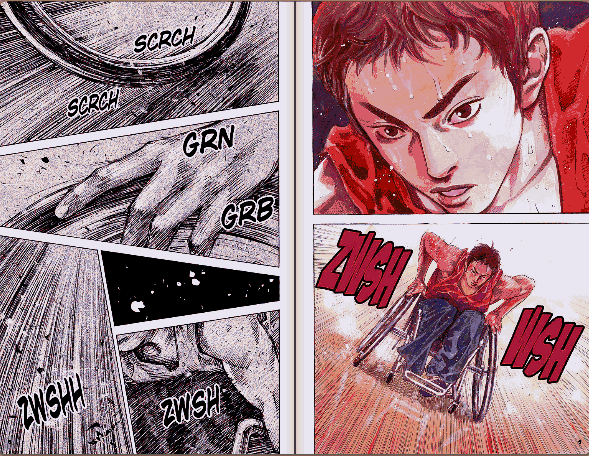
Inoue may take his time developing each character’s backstory, but he’s surprisingly efficient at establishing their personalities in just a few panels. The opening two pages of volume one, for example, speak volumes about Kiyoharu:

realpage1

realpage2

Through a combination of facial gestures and body language, those first five panels capture Kiyoharu’s fierce determination and incredible physical strength — he’s a consummate athlete pushing his body to its limits. Inoue then pulls back from Kiyoharu’s hands and face to reveal a lone figure dwarfed by an empty gymnasium. Kiyoharu’s discipline may make him a first-class basketball player, but as this image suggests, that discipline isolates him from other people — a theme that Inoue develops in volumes three and four, when Kiyoharu estranges his teammates with a grueling practice schedule and tough talk about winning.

Viz has done a terrific job of packaging Real, wrapping each issue in a beautifully designed cover and printing the artwork on creamy, high-quality paper that makes both the grayscale and full-color images pop. (I’m not really sold on the French flaps’ utility, though they certainly look cool.) John Werry’s fluid translation gives a distinct voice to each of the three principles — no mean feat, given how belligerent all three of them can be. Each volume includes a helpful set of cultural notes, as well as sidebars explaining the rules of wheelchair basketball; if anything, the American edition might have benefited from a more extensive appendix at the end of each volume.

I’m hoping that the deluxe presentation will encourage folks to give Real a try, regardless of their interest in basketball. It’s a sports story for those of us who care more about good writing and good artwork than the inner workings of a zone defense. But if you like to wax poetic about the Celtics/Lakers rivalry of yore, Real is your kind of series, too, as it will remind you just how beautiful the game can be when played with passion.

Review copies provided by VIZ Media, LLC.

REAL, VOLS. 1 – 4 • BY TAKEHIKO INOUE • VIZ • RATING: OLDER TEEN (16+)


Filed Under: Manga, Manga Critic, REVIEWS Tagged With: Basketball, Sports Manga, Takehiko Inoue, VIZ, VIZ Signature

Samurai 7, Vol. 1

April 29, 2009 by Katherine Dacey

Remake or retread? That’s the question facing critics whenever someone updates a classic novel or favorite film, be it Pride and Prejudice or The Taking of Pelham One Two Three. A remake brings new urgency or wit to the original story, new clarity to its structure, or new life to a premise that, by virtue of social or technological change, seems dated—think of Philip Kaufman’s The Invasion of the Body Snatchers, which infused a 1950s it-came-from-outer-space story with a healthy dose of seventies paranoia, or Alfred Hitchcock’s 1955 version of The Man Who Knew Too Much, which featured a leaner, meaner script than his 1934 original. Retreads, on the other hand, evoke the letter but not the spirit of the originals, embellishing their plots with fussy details, slangy dialogue, or new characters without adding anything of value—think of Ethan and Joel Coens’ deep-fried version of The Ladykillers, which was louder, cruder, and longer than the 1955 film, yet decidedly less funny.

Samurai 7, a mangafication of Akira Kurosawa’s The Seven Samurai, falls somewhere between these poles, treating the source material respectfully without adding anything particularly new or interesting to the mix. The basic plot remains the same: a poor rural village hires seven samurai to protect them from a band of thugs who steal their rice and enslave their womenfolk. Though the manga takes minor liberties with the main characters—one is a headless cyborg, one is a bishonen who always seems to be falling out of his yukata—the samurai bear a strong resemblance to Kurosawa’s original crew, both in terms of their personalities and functions within the group. The manga also preserves the war-ravaged atmosphere of the original, substituting a robot-fueled world war for the carnage caused by sixteenth-century daimyo.

Such fidelity to the source material proves Samurai 7’s undoing, however, as it underscores just how lackluster this adaptation really is. The story unfolds in fits and starts, bogging down in lame comedy and windy speeches that stall the samurai’s inevitable posse formation. Though the fight scenes are competently executed, the artwork has a sterile, perfunctory quality, as if the layouts and character designs were traced from four or five different sources. The mecha elements seem especially incongruous when juxtaposed with the story’s sixteenth-century costumes, buildings, and weaponry; there’s never any compelling rationale for their inclusion, save a desire to surpass the original film’s “wow” factor.

I offer these criticisms not because I view Kurosawa’s original as a sacred text, but because Samurai 7’s creators made such a calculated, unimaginative effort to sex up the material for a new generation of fans. Alas, no amount of bitchin’ gadgetry can compensate for poor pacing, generic artwork, or flat characterizations, even if later volumes promise more samurai-on-robot action. My suggestion: skip the manga and rent the original film. Toshiro Mifune is much fiercer than anything in this samurai-lite adaptation.

SAMURAI 7, VOL. 1• BY MIZUTAKA SUHOU • DEL REY • 224 pp. • RATING: OLDER TEEN (16+)

Filed Under: Manga, Manga Critic, REVIEWS Tagged With: Action/Adventure, Akira Kurosawa, Anime Adaptation, del rey, Samurai, Sci-Fi, Seven Samurai

Love*Com 11 by Aya Nakahara: B-

March 18, 2009 by Michelle Smith

After briefly breaking up in the previous volume, things are going okay for series protagonists Risa Koizumi and Atsushi Ôtani. It’s up to the supporting cast, therefore, to deliver the angst. Risa’s best friend, Nobu, fulfills her obligation by suddenly deciding to attend college in Hokkaido so that she can be with the ailing, much-beloved grandmother whom she’s never previously mentioned.

Well, I guess every series can have a dud now and then. I would’ve been far more interested in Nobu’s decision if she had ever actually talked about her grandmother, if any seeds at all had been planted in advance of this suddenly sprouting plotline. As it is, it feels completely random, like saying, “Oh yes, I have this best friend who I’ve never ever mentioned but I am suddenly very devastated that they have died.” Also, Nobu and her boyfriend Nakao are simply not very thoroughly developed characters in their own right, existing primarily to advise, chastise, or encourage Risa and Ôtani as situations warrant.

The art also looks a lot different to me in this volume. At first, I thought maybe the reason Nobu looks almost like a different person is because we usually see her in background and not close-up. But then I noticed that Ôtani looks rather different, too. I compared the art to volume ten and it was obviously evolving back then, too, but it wasn’t as noticeable. The new style might actually be more polished, but it’s also more generic-looking.

The final chapter is an improvement on its predecessors. For the past few volumes, Ôtani has been studying furiously for his college entrance exams. Risa went through a range of reactions to his efforts, from attempting to dissuade him from a futile endeavor to resolving to stay out of his way until his exams are over. When a family flu outbreak, snow, and cancelled trains threaten to keep Ôtani from making it to the testing facility on time, it’s Risa’s determination that gets him there in the end, which is nice to see. They may bicker far too often for my liking, but when they really come through for each other, it’s very satisfying.

Review copy provided by the publisher. Review originally published at Manga Recon.

Filed Under: Manga, Shoujo Tagged With: shojo beat, VIZ

Love*Com 10 by Aya Nakahara: B+

March 16, 2009 by Michelle Smith

From the back cover:
Risa got a job at a restaurant so she could be close to Ôtani’s cram school. But now it looks like one of her coworkers wants to get close to her! Kohori is cute and short and majorly into Umibouzu, but Risa just wants to be friends. When circumstances conspire to make it look like she’s interested in more, what will a super-stressed Ôtani do?

Review:
It seemed like I was always annoyed with one or the other of the two leads throughout this volume and, at different times, mentally advised each to dump the other. First, Ôtani, with the excuse of being stressed out about college entrance exams, says a lot of really unkind things to Risa, saying that she’s basically useless and has nothing to offer in terms of helping him out. Next, Risa, who already knows a guy at work fancies her (since he’s been caught in the act of kissing her while she slept) and that Ôtani is exhausted and jealous, stupidly agrees to basically go on the date with the guy to a concert. And, of course, Ôtani runs into the two of them together.

This act is so stupid, in fact, that it was EXTREMELY satisfying that Ôtani breaks up with her as a result. I was probably supposed to be all, “Oh noes,” but instead I felt a vicious glee. One thing I didn’t like is that, because Ôtani is always mouthing off and saying mean things he doesn’t really mean, the impact of his harsh words was lessened. The rest of the volume is Risa trying to get back into his good graces, eventually resolving to stay away from him until he finishes his exams and planning to persuade him to take her back at that time. Interesting how I kind of forgave her too by this point, making the volume’s happy ending a welcome one.

Risa’s propensity to start sentences with “Well,” continues. In one chapter, she did it ten times. Three of those were the “Well, gosh” variant. I had to snicker at one square o’ narration (squarration?) that was comprised entirely of this meaningful sentence: “Well, I mean, gosh.” I assume that she really is saying some particular Japanese phrase over and over again, but it’s starting to get on my nerves. While I’m griping, who the heck is that other kid on the cover? I recognize Kohori (the aforementioned coworker who fancies Risa) but I have no idea who the other dude is.

Filed Under: Manga, Shoujo Tagged With: shojo beat, VIZ

Love*Com 9 by Aya Nakahara: B+

March 15, 2009 by Michelle Smith

From the back cover:
Risa’s life should be perfect. After all, she’s finally dating the guy she loves. But Ôtani’s never actually said that he loves her, and they don’t even act like boyfriend and girlfriend. Wasn’t dating supposed to fix all that? To make matters worse, graduation is looming and Risa’s not sure she likes the way her future with Ôtani looks. Could this be the end of her love and their friendship?

Review:
Wow, it’s been a long time since I’ve read this series. I kind of forgot how good it is.

Risa and Ôtani are getting a little more comfortable together as a couple, but Risa still isn’t sure how Ôtani feels about her, since he keeps saying mean things to her. The tendency of both characters to speak insultingly to each other is the one thing I really don’t like about this series, so I was happy to see it actually addressed in the plot, even though it doesn’t seem like it really gets any better afterwards. Essentially, Risa just realizes that Ôtani doesn’t mean what he says and that he actually does love her.

Random observation: Risa’s friend Chiharu is the Tina Hakim Baba of the series. When Risa complains about Ôtani calling her stupid, Chiharu attests, “I think that’s just his way of saying he loves you!” Totally Tina. If you don’t catch that reference, you’re probably lucky.

Moving on, there’s a brief chapter on the school festival then it seems like we kind of branch into a new arc. Everyone except for Risa knows what they want to do after graduation. Even Ôtani has begun to study to try to get admitted into college. Risa initially tries to dissuade him, since his grades are so bad, but it turns out that when he buckles down, he can actually do pretty well. This just makes Risa feel more alone and abandoned than ever, though.

Even though I’ve seen variations on this plot before, I still think it’s interesting and well-handled and look forward to where it’s headed. I’m especially pleased that the characters are graduating now, when the series is only half over, since it seems we might be following them at least a little while into young adulthood. Risa also ends up taking a part-time job in this volume, bringing with it an injection of new characters, too.

One final random observation: Has Risa always begun 80% (approx.) of her sentences with “Well,”? I was seeing it all over the place in this volume and it was really distracting.

Filed Under: Manga, Shoujo Tagged With: shojo beat, VIZ

Two Flowers for the Dragon 1 by Nari Kusakawa: A-

February 1, 2009 by Michelle Smith

From the back cover:
Shakuya is the heir to the Dragon Clan and next in line to rule the land. Oh, and she also happens to have two fiancés! Lucien won Shakuya’s love and her hand in marriage, but he disappeared before the wedding day. So the princess did what any woman would do—replaced him. Kuwan stepped in as her new soon-to-be-husband, and everything was fine until fiancé number one came back to town—with everything but his memory. What is a girl to do?! Now, Shakuya must choose who she wants to marry, using her two magical tattoos that change to reflect her feelings for each of the suitors!

Review:
I find it simultaneously amusing and perplexing that the words “magical tattoos” are in a different color and font than the rest of the text, as if that is the most important aspect of the story. I make my own fun by imagining purchasing decisions being made solely on a basis of “Ooh, magical tattoos! That settles it, then.”

Back cover mockery aside, I really, really like this. It’s cute, it’s funny, and I like the characters. Shakuya is far more sensible and intelligent than most shoujo heroines, and is perfectly fine with the necessity of a political marriage, though she’d prefer it if she and her spouse could also be in love. Kuwan is serious and sometimes kind, though not very merciful, and while Lucien begins as cocky and teasing, he also has a more gentle and affectionate personality.

I like the way Kusakawa handles the story’s gimmicks, namely Shakuya’s ability to turn into a dragon when her “feelings needle swings into the red zone” and the magical tattos that serve as a gauge for her feelings for each fiancé. The positive and negative aspects of her transformation ability are both explored well. The growth of the tattoos is nicely integrated into the story and, as Shakuya’s feelings for Lucien bloom ever so slightly, I found my own opinion of him shifting as the story wore on and more of Kuwan’s flaws became apparent.

Too, I like how little things show how well the stories are thought out. Like, early on Shakuya mentions how she has difficulty braiding her own, very long hair. Later, when her handmaid has skipped out on her duties in order to attend a market day, Shakuya must dress herself and appears with her hair in mere pigtails. It’s a very minor thing, but somehow impressed me immensely. Also, the final chapter, with its plot about snake charmers who kidnap Shakuya, could’ve been ridiculously silly but was instead unique and quite exciting.

I’m sure some will not be fans of the art, but I like it a lot. Kusakawa has a distinctive style and I have no complaints about it. In fact, now I feel compelled to read everything by her that I own.

Filed Under: Fantasy, Manga, Shoujo Tagged With: cmx, Nari Kusakawa

Love*Com 8 by Aya Nakahara: B+

August 30, 2008 by Michelle Smith

Risa and Ôtani are finally going out, but she’s uncertain about how she’s supposed to act around him now. She’s got this preconceived notion of what a girlfriend should be, and internally beats herself up each time she fails to live up to that ideal. It helps some when Ôtani sets aside his natural reticence and introduces her to people as his girlfriend, but he still hasn’t articulated exactly why he loves her, and she’s having a hard time imagining what he could see in her.

Later, Ôtani’s neighbor, Mimi, finds out he’s got a new girlfriend and is furious. The beautiful and tall middle schooler has harbored a crush on him for years, but abandoned hope because she thought he only liked tiny girls. A lot of Mimi angst follows, and while it’s creditable that Risa sympathizes with her plight, the way this new character suddenly dominates the story is rather irksome.

Eventually, though, I realized that her purpose is to solidify the main couple’s relationship. We see that she really poses no threat to them at all, that Ôtani’s feelings never waver, and that he and Risa really are made for each other, rough edges and all. Having fulfilled this destiny, may she now go quietly away.

While this particular volume didn’t focus on the leads quite as much as I would’ve liked, it still excels at depicting the insecurities and awkwardness of this period in a relationship. That’s no surprise, since Love*Com has nailed many other aspects of first love. I’m sure it will continue to do so in the volumes to come.

Review copy provided by the publisher. Review originally published at Manga Recon.

Filed Under: Manga, Shoujo Tagged With: shojo beat, VIZ

  • « Go to Previous Page
  • Page 1
  • Interim pages omitted …
  • Page 23
  • Page 24
  • Page 25
  • Page 26
  • Go to Next Page »
 | Log in
Copyright © 2010 Manga Bookshelf | Powered by WordPress & the Genesis Framework