• Skip to primary navigation
  • Skip to main content
  • Skip to primary sidebar
  • Home
  • About Us
    • Privacy Policy
    • Comment Policy
    • Disclosures & Disclaimers
  • Resources
    • Links, Essays & Articles
    • Fandomology!
    • CLAMP Directory
    • BlogRoll
  • Features & Columns
    • 3 Things Thursday
    • Adventures in the Key of Shoujo
    • Bit & Blips (game reviews)
    • BL BOOKRACK
    • Bookshelf Briefs
    • Bringing the Drama
    • Comic Conversion
    • Fanservice Friday
    • Going Digital
    • It Came From the Sinosphere
    • License This!
    • Magazine no Mori
    • My Week in Manga
    • OFF THE SHELF
    • Not By Manga Alone
    • PICK OF THE WEEK
    • Subtitles & Sensibility
    • Weekly Shonen Jump Recaps
  • Manga Moveable Feast
    • MMF Full Archive
    • Yun Kouga
    • CLAMP
    • Shojo Beat
    • Osamu Tezuka
    • Sailor Moon
    • Fruits Basket
    • Takehiko Inoue
    • Wild Adapter
    • One Piece
    • After School Nightmare
    • Karakuri Odette
    • Paradise Kiss
    • The Color Trilogy
    • To Terra…
    • Sexy Voice & Robo
  • Browse by Author
    • Sean Gaffney
    • Anna Neatrour
    • Michelle Smith
    • Katherine Dacey
    • MJ
    • Brigid Alverson
    • Travis Anderson
    • Phillip Anthony
    • Derek Bown
    • Jaci Dahlvang
    • Angela Eastman
    • Erica Friedman
    • Sara K.
    • Megan Purdy
    • Emily Snodgrass
    • Nancy Thistlethwaite
    • Eva Volin
    • David Welsh
  • MB Blogs
    • A Case Suitable For Treatment
    • Experiments in Manga
    • MangaBlog
    • The Manga Critic
    • Manga Report
    • Soliloquy in Blue
    • Manga Curmudgeon (archive)

Manga Bookshelf

Discussion, Resources, Roundtables, & Reviews

Manga Critic

Twin Spica, Vol. 1

May 3, 2010 by Katherine Dacey

Asumi Kamogawa is a small girl with a big dream: to be an astronaut on Japan’s first manned space flight. Though she passes the entrance exam for Tokyo Space School, she faces several additional hurdles to realizing her goal, from her child-like stature — she’s thirteen going on eight — to her family’s precarious financial position. Then, too, Asumi is haunted by memories of a terrible fire that consumed her hometown and killed her mother, a fire caused by a failed rocket launch. Yet for all the pain in her young life, Asumi proves resilient, a gentle girl who perseveres in difficult situations, offers friendship in lieu of judgment, and demonstrates a preternatural awareness of life’s fragility.

If Asumi sounds like a stereotypically optimistic manga character, a can-do kid who maintains a positive attitude through every set-back, the first volume of Twin Spica reveals her to be more complex and damaged than her firm resolve might suggest. Mr. Lion, her imaginary friend, is proof of the wounds she carries: she “met” him when she was six, never quite outgrowing the need for his counsel or company. When Asumi suffers a traumatic flashback to the Yuigahama disaster, for example, she calls out Mr. Lion’s name; when her father responds angrily to the news that she passed the space academy’s placement test, she asks Mr. Lion if she should enroll or abandon her dream of becoming “a driver on a rocket.”

Though Asumi’s story ran in Comic Flapper, a seinen magazine, Twin Spica works surprisingly well for both adults and teens. The storytelling is direct and simple without being didactic, filled with the kind of characters that younger readers will recognize and embrace as true to their own experiences. At the same time, however, Twin Spica‘s subtexts are rich enough to sustain an adult’s interest, as the supplemental stories “2015: Fireworks” and “Asumi” attest. Both explore Asumi’s response to her mother’s death, acknowledging and validating Asumi’s curiosity about her mother’s appearance (Mom suffered disfiguring burns) and about dying itself. (Six-year-old Asumi scandalizes funeral-goers by leaning over her mother’s casket to see what death “smells like.”) Without a trace of mawkishness, Yaginuma shows us how Asumi makes sense of what happened to her mother, recognizing his young heroine’s keen emotional intelligence in the way she chooses to honor her mother’s memory. Tween and teen readers may well find these passages moving, as they touch on one of childhood’s most primal fears, but adult readers will find them more unsettling, as they remind us of our inability to protect children from painful experiences, and of the moment when we first grasped death’s finality.

The artwork, like the narrative, has a direct, expressive quality that keeps the focus on the characters’ interactions, rather than the gizmos and laboratories where their training takes place. Yaginuma draws his tyro astronauts in a simple, stylized fashion that treats them as collection of distinctive geometric shapes: Fuchuya, one of Asumi’s classmates, sports a ‘do evocative of Eero Saarinen’s iconic TWA terminal, while Asumi resembles a kokeshi doll with her exaggerated round head and tiny body. The characters’ slightly awkward proportions register as a deliberate artistic choice — call it studied naivete or primitivism — though at times the art seems a little clumsy and flat; readers will be forgiven for thinking Yusinuma’s storytelling skills outstrip his draftsmanship.

Whatever conclusions the reader reaches about Yusinuma’s style, it’s impossible to deny the emotional power of Twin Spica as a coming-of-age story about one girl’s journey from childhood to adulthood, and one nation’s journey from terrestrial power to space race competitor. A beautiful, thought-provoking book for star gazers of all ages.

Review copy provided by Vertical, Inc. Volume one of Twin Spica will be released on May 4, 2010.

TWIN SPICA, VOL. 1 • BY KOU YAGINUMA • VERTICAL, INC. • 192 pp. • NO RATING

Filed Under: Manga, Manga Critic, REVIEWS Tagged With: Sci-Fi, Space Exploration, Vertical Comics

Bokurano: Ours, Vol. 1

May 1, 2010 by Katherine Dacey

BokuranoOurs_1Among the most discussed scenes in the new Kick-Ass film is one that pits a tweenage assassin against a roomful of grown men. To the strains of The Banana Splits theme song, thirteen-year-old Hit Girl dispatches a dozen gangsters with a gory zest that has divided critics into two camps: those, like Richard Corliss, who found the scene shocking yet exhilarating, a purposeful, subversive commentary on superhero violence, and those, like Roger Ebert, who found it morally reprehensible, a kind of kiddie porn that exploits the character’s age for cheap thrills. What’s at issue here is not children’s capacity for violence; anyone who’s run the gauntlet of a junior high cafeteria or cranked out an essay on Lord of the Flies is painfully aware that kids can be beastly when the grown-ups aren’t looking. The real issue is that Hit Girl seems to be enjoying herself, raising the far more uncomfortable question of how children understand and wield power.

Mohiro Kitoh, creator of Shadow Star and Bokurano: Ours, likes to muck around in this uncomfortable space. In Shadow Star, for example, Kitoh pairs teens with powerful supernatural allies — in this case, “shadow dragons” — who become instruments not for fighting evil but for exacting revenge on their masters’ peers and asserting their masters’ primacy in the school pecking order. Shadow Star‘s graphic violence and sex scenes clearly made some folks uneasy, as a few of the later chapters were censored here in the US. (Dark Horse dropped the series before completing it.) Bokurano: Ours hasn’t crossed that line — at least not yet — but once again finds Kitoh subverting a familiar manga trope to suggest the darkness of the underage psyche. This time, he takes a stock shonen formula — kids piloting giant robots to save Earth from aliens — and gives it a nasty twist: the pilot of a successful sortie dies after completing his mission.

The first volume of Bokurano: Ours is neatly divided into three acts, the first explaining how Kokopelli, a mysterious computer programmer, dupes fifteen kids into “playing” this lethal game; the second profiling Waku, a brash jock who pilots the first mission; and third profiling Kodama, a ruthless loner who leads the second. In just a handful of pages, Kitoh establishes both boys’ personal histories and personalities with efficiency and nuance. Waku, for example, views his mission in the same light as a soccer match, as something to be won, while Kodama views his sortie with calculated detachment: by stomping flat an entire neighborhood, he hopes to create work for his father’s construction business. (He’s a youthful Donald Trump, minus the comb-over.)

As these first two sorties suggest, Kitoh seems intent on laying bare the unspoken truth about the giant-robot genre, that kids’ power fantasies are seldom as heroic and self-abnegating as we’d like to think; given the opportunity to control an enormous, destructive piece of machinery, many kids would just as soon turn it on others as save the day. His point is well-taken, but is driven home with such grim determination that it feels more punitive than insightful. The same could be said for his fight scenes, in which he meticulously documents the destructive effects of the children’s behavior. Kitoh’s robots look more like flesh-and-blood creatures than machines, making every body blow and puncture as viscerally real as a wound. The fights aren’t exciting; they’re exhausting, grim spectacles with terrible consequences for everyone caught in the crossfire.

Which brings me back to Kick-Ass: if a story’s tone is serious and dour, rather than cheeky and excessive, how are we to process the sight of young children committing terrible acts of violence? I wouldn’t go as far as Ebert and pronounce Bokurano: Ours morally reprehensible, as I think Kitoh recognizes that a child’s capacity for inflicting — and enjoying the sight of — pain comes from a different place than an adult’s, something that’s less self-evident in the Kick-Ass movie. At the same time, however, there’s something undeniably exploitative about Kitoh’s fondness for depicting children in peril; he seems to take pleasure in stomping all over the idea that children are more innocent and pure than adults, even though he’s devised an unfair scenario for testing that hypothesis. (As I note above, the kids are tricked into “playing” what they believe is a game, with no way to renege on their contract.) I’m not sure if his aim is to shock or simply tell unpleasant truths, but either way, his relentlessly pessimistic view of human nature wears thin fast.

BOKURANO: OURS, VOL. 1 • BY MOHIRO KITOH • VIZ • 200 pp. • RATING: OLDER TEEN

Filed Under: Manga Critic Tagged With: Mecha, Mohiro Kitoh, Seinen, SigIKKI, VIZ

Bokurano: Ours, Vol. 1

May 1, 2010 by Katherine Dacey

Among the most discussed scenes in the new Kick-Ass film is one that pits a tweenage assassin against a roomful of grown men. To the strains of The Banana Splits theme song, thirteen-year-old Hit Girl dispatches a dozen gangsters with a gory zest that has divided critics into two camps: those, like Richard Corliss, who found the scene shocking yet exhilarating, a purposeful, subversive commentary on superhero violence, and those, like Roger Ebert, who found it morally reprehensible, a kind of kiddie porn that exploits the character’s age for cheap thrills. What’s at issue here is not children’s capacity for violence; anyone who’s run the gauntlet of a junior high cafeteria or cranked out an essay on Lord of the Flies is painfully aware that kids can be beastly when the grown-ups aren’t looking. The real issue is that Hit Girl seems to be enjoying herself, raising the far more uncomfortable question of how children understand and wield power.

Mohiro Kitoh, creator of Shadow Star and Bokurano: Ours, likes to muck around in this uncomfortable space. In Shadow Star, for example, Kitoh pairs teens with powerful supernatural allies — in this case, “shadow dragons” — who become instruments not for fighting evil but for exacting revenge on their masters’ peers and asserting their masters’ primacy in the school pecking order. Shadow Star‘s graphic violence and sex scenes clearly made some folks uneasy, as a few of the later chapters were censored here in the US. (Dark Horse dropped the series before completing it.) Bokurano: Ours hasn’t crossed that line — at least not yet — but once again finds Kitoh subverting a familiar manga trope to suggest the darkness of the underage psyche. This time, he takes a stock shonen formula — kids piloting giant robots to save Earth from aliens — and gives it a nasty twist: the pilot of a successful sortie dies after completing his mission.

The first volume of Bokurano: Ours is neatly divided into three acts, the first explaining how Kokopelli, a mysterious computer programmer, dupes fifteen kids into “playing” this lethal game; the second profiling Waku, a brash jock who pilots the first mission; and third profiling Kodama, a ruthless loner who leads the second. In just a handful of pages, Kitoh establishes both boys’ personal histories and personalities with efficiency and nuance. Waku, for example, views his mission in the same light as a soccer match, as something to be won, while Kodama views his sortie with calculated detachment: by stomping flat an entire neighborhood, he hopes to create work for his father’s construction business. (He’s a youthful Donald Trump, minus the comb-over.)

As these first two sorties suggest, Kitoh seems intent on laying bare the unspoken truth about the giant-robot genre, that kids’ power fantasies are seldom as heroic and self-abnegating as we’d like to think; given the opportunity to control an enormous, destructive piece of machinery, many kids would just as soon turn it on others as save the day. His point is well-taken, but is driven home with such grim determination that it feels more punitive than insightful. The same could be said for his fight scenes, in which he meticulously documents the destructive effects of the children’s behavior. Kitoh’s robots look more like flesh-and-blood creatures than machines, making every body blow and puncture as viscerally real as a wound. The fights aren’t exciting; they’re exhausting, grim spectacles with terrible consequences for everyone caught in the crossfire.

Which brings me back to Kick-Ass: if a story’s tone is serious and dour, rather than cheeky and excessive, how are we to process the sight of young children committing terrible acts of violence? I wouldn’t go as far as Ebert and pronounce Bokurano: Ours morally reprehensible, as I think Kitoh recognizes that a child’s capacity for inflicting — and enjoying the sight of — pain comes from a different place than an adult’s, something that’s less self-evident in the Kick-Ass movie. At the same time, however, there’s something undeniably exploitative about Kitoh’s fondness for depicting children in peril; he seems to take pleasure in stomping all over the idea that children are more innocent and pure than adults, even though he’s devised an unfair scenario for testing that hypothesis. (As I note above, the kids are tricked into “playing” what they believe is a game, with no way to renege on their contract.) I’m not sure if his aim is to shock or simply tell unpleasant truths, but either way, his relentlessly pessimistic view of human nature wears thin fast.

BOKURANO: OURS, VOL. 1 • BY MOHIRO KITOH • VIZ • 200 pp. • RATING: OLDER TEEN

Filed Under: Manga, Manga Critic, REVIEWS Tagged With: Mecha, Mohiro Kitoh, Seinen, SigIKKI, VIZ

Kobato, Vol. 1

April 26, 2010 by Katherine Dacey

kobato1Kobato Hanato has a job to do: if she can fill a magic bottle with the pain and suffering of people whose lives she’s improved, she’ll have her dearest wish come true. There’s just one problem: Kobato is completely mystified by urban life, and has no idea how to identify folks in need of her help. Lucky for her, Ioryogi, a blue dog with a foul mouth and fierce temper, has been appointed her sensei and guardian angel, tasked with helping Kobato develop the the street smarts necessary for completing her mission.

It’s perfectly possible to read Kobato as a story about a sweet, clueless girl who teams up with a gruff but lovable animal to collect wounded hearts. That book is beautifully drawn, but isn’t terribly interesting; most of the stories follow the same template so, well, doggedly, that even the most committed fan of cute would find Kobato too repetitive to be much fun. A more productive way to understand Kobato is as a moe parody, a gleeful skewering of an entire genre in which the cute, underage heroine’s primary role is to endear herself to readers with her mixture of enthusiasm, naivete, and sensitivity.

…

Read More

Filed Under: Manga Critic Tagged With: clamp, Shonen, yen press

Kobato, Vol. 1

April 26, 2010 by Katherine Dacey

Kobato Hanato has a job to do: if she can fill a magic bottle with the pain and suffering of people whose lives she’s improved, she’ll have her dearest wish come true. There’s just one problem: Kobato is completely mystified by urban life, and has no idea how to identify folks in need of her help. Lucky for her, Ioryogi, a blue dog with a foul mouth and fierce temper, has been appointed her sensei and guardian angel, tasked with helping Kobato develop the the street smarts necessary for completing her mission.

It’s perfectly possible to read Kobato as a story about a sweet, clueless girl who teams up with a gruff but lovable animal to collect wounded hearts. That book is beautifully drawn, but isn’t terribly interesting; most of the stories follow the same template so, well, doggedly, that even the most committed fan of cute would find Kobato too repetitive to be much fun. A more productive way to understand Kobato is as a moe parody, a gleeful skewering of an entire genre in which the cute, underage heroine’s primary role is to endear herself to readers with her mixture of enthusiasm, naivete, and sensitivity.

Exhibit A in the case for moe parody: CLAMP has provided Kobato with a name and a mission, but no history that would explain her bizarre behavior. (Is she an amnesiac? An alien? A simpleton?) Nor does CLAMP reveal Kobato’s deeper motivation for collecting wounded souls. “There’s a place I want to go!” she cheerfully tells Ioryogi without elaborating on the why and where. Exhibit B: Kobato’s behavior seldom endears her to anyone. When Ioryogi instructs her to “do the things that are appropriate for Christmas,” for example, Kobato casually asks a stranger to spend the night with her in a hotel, to the consternation of his girlfriend, while an old man interprets her request to “heal his heart” as a solicitation for sex. Exhibit C: Ioryogi has a sadistic streak that far outstrips the basic demands of the plot. Though his comments are shockingly abrasive at first, it doesn’t take long for the reader to realize that Ioryogi’s assessment of Kobato is spot-on; in effect, he gives the audience permission to dislike Kobato, despite her sweet face and Holly Hobbie outfit.

CLAMP has performed this sleight of hand before with Chobits, another series that can be read as a straightforward genre exercise or a parody. In the case of Chobits, CLAMP starts from the basic nebbishy-guy-meets-magical-girl premise, adding some perverse ruffles and flourishes that call attention to the genre’s more unsavory aspects. (Chi, the magical girl/robot/love interest, behaves like a horny frat guy’s idea of the perfect girlfriend, eschewing underwear, hanging on her owner’s every word, and buying him porn magazines as a gift.) The complexity of the story and the size of the cast eventually overwhelm the satire, however, making it hard for the reader to know how, exactly, she’s supposed to react to Chi and Hideki’s relationship. In Kobato, on the other hand, CLAMP strips things down to the bare essentials, putting the focus squarely on the darkly comic hijinks.

Lest I make Kobato sound unbearably mean-spirited, the manga equivalent of kicking a puppy, let me assure you that it’s actually good fun. Ioryogi, the unquestionable star of the series, is a hoot; CLAMP wrings considerable laughs from the cognitive dissonance between his cute, doll-like appearance and his destructive rages, martial arts moves, and unsavory habits. (Like Mokona Modoki, Ioryogi is always jonesing after beer or sake.) Long-time CLAMP fans will enjoy the cameos sprinkled throughout the book, as characters from Chobits, Suki, and xxxHolic cross paths with Kobato in subtle, unexpected ways — think Where’s Waldo for the Card Captor Sakura crowd. (Bonus points if you can identify the characters without consulting the translation notes.) As one might expect, the artwork is clean and elegant, filled with beautiful costumes, lovely title pages, and crisply executed action sequences in the manner of Tsubasa: Reservoir Chronicles.

A quick glance at the Wikipedia entry suggests that future volumes of Kobato may cant more towards romance than satire. So long as Ioryogi is along for the ride, however, I’m confident that Kobato will remain edgy enough for readers, like me, who have a limited tolerance for insipid heroines. Recommended.

Review copy provided by Yen Press. Volumes one and two of Kobato will be released simultaneously on May 18, 2010.

KOBATO, VOL. 1  • CLAMP • YEN PRESS • 160 pp. • RATING: TEEN (13+)

Filed Under: Manga, Manga Critic, REVIEWS Tagged With: clamp, Comedy, Fantasy, yen press

Your & My Secret, Vols. 1-5

April 25, 2010 by Katherine Dacey

secret5If you ever wondered what Freaky Friday might have been like if Jodie Foster had switched bodies with Leif Garrett instead of Barbara Harris, well, Ai Morinaga’s Your & My Secret provides a pretty good idea of the gender-bending weirdness that would have ensued. The story focuses on Nanako, a swaggering tomboy who lives with her mad scientist grandfather, and Akira, an effeminate boy who adores her. Though Akira’s classmates find him “cute and delicate,” they declare him a timid bore — “a waste of a man,” one girl snipes — while Nanako’s peers call her “the beast” for her aggressive personality and uncouth behavior, even as the boys concede that Nanako is “hotter than anyone.” Akira becomes the unwitting test subject for the grandfather’s latest invention, a gizmo designed to transfer personalities from one body to another. With the flick of a switch, Akira finds himself trapped in Nanako’s body (and vice versa).

The joke, of course, is that Nanako and Akira have found the ideal vessels for their gender-atypical personalities. Nanako revels in her new-found freedom as a boy, enjoying sudden popularity among classmates, earning the respect of Akira’s contemptuous little sister, and discovering the physical strength to dunk a basketball. Akira, on the other hand, finds his situation a mixed bag: for the first time in his life, his sensitive personality endears him to both male and female peers, but many of the things his maleness had previously exempted him from — housework and cooking, menstrual cycles, unwanted advances from boys — turn out to be much worse than he’d imagined. He struggles to feel comfortable in Nanako’s skin, insulted by the grandfather’s refusal to do chores and bewildered by his old buddy Senbongi’s growing attraction to him.

…

Read More

Filed Under: Manga Critic Tagged With: Ai Morinaga, Gender-Bending, shojo, Tokyopop

Your & My Secret, Vols. 1-5

April 25, 2010 by Katherine Dacey

If you ever wondered what Freaky Friday might have been like if Jodie Foster had switched bodies with Leif Garrett instead of Barbara Harris, well, Ai Morinaga’s Your & My Secret provides a pretty good idea of the gender-bending weirdness that would have ensued. The story focuses on Nanako, a swaggering tomboy who lives with her mad scientist grandfather, and Akira, an effeminate boy who adores her. Though Akira’s classmates find him “cute and delicate,” they declare him a timid bore — “a waste of a man,” one girl snipes — while Nanako’s peers call her “the beast” for her aggressive personality and uncouth behavior, even as the boys concede that Nanako is “hotter than anyone.” Akira becomes the unwitting test subject for the grandfather’s latest invention, a gizmo designed to transfer personalities from one body to another. With the flick of a switch, Akira finds himself trapped in Nanako’s body (and vice versa).

The joke, of course, is that Nanako and Akira have found the ideal vessels for their gender-atypical personalities. Nanako revels in her new-found freedom as a boy, enjoying sudden popularity among classmates, earning the respect of Akira’s contemptuous little sister, and discovering the physical strength to dunk a basketball. Akira, on the other hand, finds his situation a mixed bag: for the first time in his life, his sensitive personality endears him to both male and female peers, but many of the things his maleness had previously exempted him from — housework and cooking, menstrual cycles, unwanted advances from boys — turn out to be much worse than he’d imagined. He struggles to feel comfortable in Nanako’s skin, insulted by the grandfather’s refusal to do chores and bewildered by his old buddy Senbongi’s growing attraction to him.

Much of the humor in Your & My Secret stems from the war between head and hormones. Akira still identifies as a boy, lusting after Nanako’s sweetly feminine friend Shiina and suffering volcanic nosebleeds in the girls’ locker room, yet his body is drawn to Senbongi; after Senbongi makes a pass at him, the flustered Akira wonders how Senbongi “got to be such a good kisser.” Nanako, who is quick to embrace her new male identity, struggles as well; though she asks Shiina out, she’s reluctant to consummate their relationship, and shows an all-too-prurient interest in Senbongi’s, um, equipment. Making things even more complicated for Akira is that he’s trapped in the body of the girl he adores. He’s both disgusted and aroused by the sight of himself, and filled with conflicting emotions about the growing relationship between Nanako and Shiina.

Perhaps the most interesting wrinkle in Your & My Secret is that Nanako’s experiences transform her into a sexist pig. She rebuffs Akira’s pleas to reverse the experiment, belittling his gentle, conciliatory personality and asserting her right to have fun in his body. At the same time, she insists that Akira refrain from dating, having sex, or exploring her body; she repeatedly describes her body as a sacred temple that must remain “unpolluted” before her wedding day, and threatens Akira with humiliation if he acts on his conflicted feelings for Senbongi — or Shiina. (Apparently, Nanako is a bit of a homophobe, too.)

While the gender-swapping hijinks provide most of the comedic fodder for Your & My Secret, Morinaga also has a ball poking fun at manga tropes from incestuous infatuation to cultural festivals. The best of these gags revolves around the school’s manga club: in a sly nod to Tezuka, the group is helmed by a beret-wearing artist who transforms Akira and Senbongi’s friendship into a steamy boys’ love comic in which Akira is the seme and Senbongi is the uke. (“It’s not that I like guys,” Akira’s avatar tells Senbongi’s. “The person I fell in love with just happened to be a guy.”) Morinaga also wrings laughs from her characters’ desperate behavior; the grandfather, for example, thinks nothing of blackmailing Akira to get closer to Shiina (he dreams of having a pretty teenage girl sit in his lap and clean his ears), while Senbongi hatches up a love-hotel scheme to drive a wedge between Akira and Nanako.

Yet for all the black comedy, Morinaga still allows her characters moments of vulnerability and decency, preventing the humor from curdling into pure meanness. She wisely avoids the trap of making her characters too dumb to notice the transformations in Akira and Nanako, allowing her to sustain the body-swapping premise without straining credulity or testing the reader’s patience. Morinaga avoids another trap as well: that of making her leads so repellent the reader wishes for their comeuppance. (Even Nanako — she of the karate chops and withering put-downs — demonstrates a capacity for kindness and selflessness when wooing Shiina.) The artwork supports Morinaga’s characterizations, showing us both their nastier and nicer sides. When Akira assumes ownership of Nanako’s body, for example, there’s a visible softening of Nanako’s features, her lips becoming moistly inviting, her chin turning ever-so-slightly upward, and her eyes shining like a proper shojo heroine’s. If provoked, however, Akira’s body language and gestures revert back to Nanako’s coarse, tomboy persona, right down to the maniacal gleam in his eye; the gap between the two personalities proves smaller than either would like the admit.

No, it isn’t Taming of the Shrew, but Your & My Secret manages to make some worthwhile points about gender roles (and gender norms) while serving up plenty of dopey slapstick and risque jokes. Frankly, I’d take a big helping of Morinaga’s un-PC humor over an earnest, socially responsible “girls’ comic” any day of the week. Highly recommended.

This is an expanded version of a review that originally appeared at PopCultureShock on 3/12/08. The original review can be read by clicking here.

Filed Under: Manga, Manga Critic, REVIEWS Tagged With: Ai Morinaga, Comedy, Tokyopop

Kingyo Used Books, Vol. 1

April 19, 2010 by Katherine Dacey

kingyo_coverKingyo Used Books starts from a simple premise: an eccentric group of people run a second-hand bookstore in an out-of-the-way location. Various customers stumble upon the shop — usually by accident — and, in the process of browsing, find a manga that helps them reconnect with a part of themselves that’s been suppressed, whether it be a youthful capacity for romantic infatuation or a desire to paint expressively.

Is there such thing as agit-manga? I ask this because Kingyo Used Books seems like the brainchild of an editor who’s desperately trying to convince adults that one never outgrows manga. In the first story, for example, a salaryman tries to unload his collection at the store, telling the owner, “I’m not a kid anymore. Besides, it’s kind of pathetic to keep reading manga forever.” He gets a gentle comeuppance at a class reunion, where his friends’ fond memories of Dr. Slump remind him what an important role manga played in their young lives. The story is pleasant and enjoyable, but suffers from a bad case of predictability; as soon as the salaryman sees his friends engaged in tearful, rhapsodic discussions of their childhood reading habits, he’s overcome with emotion and — natch — a strong desire to keep the manga he’d previously hoped to sell.

…

Read More

Filed Under: Manga Critic Tagged With: Seinen, SigIKKI, VIZ

Kingyo Used Books, Vol. 1

April 19, 2010 by Katherine Dacey

Kingyo Used Books starts from a simple premise: an eccentric group of people run a second-hand bookstore in an out-of-the-way location. Various customers stumble upon the shop — usually by accident — and, in the process of browsing, find a manga that helps them reconnect with a part of themselves that’s been suppressed, whether it be a youthful capacity for romantic infatuation or a desire to paint expressively.

Is there such thing as agit-manga? Because Kingyo Used Books seems like the brainchild of an editor who’s desperately trying to convince adults that one never outgrows manga. In the first story, for example, a salaryman tries to unload his collection at the store, telling the owner, “I’m not a kid anymore. Besides, it’s kind of pathetic to keep reading manga forever.” He gets a gentle comeuppance at a class reunion, where his friends’ fond memories of Dr. Slump remind him what an important role manga played in their young lives. The story is pleasant and enjoyable, but suffers from a bad case of predictability; as soon as the salaryman sees his friends engaged in tearful, rhapsodic discussions of their childhood reading habits, he’s overcome with emotion and — natch — a strong desire to keep the manga he’d previously hoped to sell.

<!—more—>

Other stories in volume one follow the same basic template. In “Far Away,” for example, an archery champion discovers that laughter and downtime are as essential to winning as practice, thanks to a pair of Kingyo employees whose snot-rolling-down-the-face, tears-in-eyes response to Moretsu Ataru inspires the archer to pick up a manga instead of his bow and quiver. “Fujiomi-kun,” another chapter that adheres to this formula, focuses on a frustrated housewife who makes some small but important changes in her life after rediscovering Chizumi and Fujiomi-kun, a romance about a handsome athlete who falls in love with a clumsy but kind-hearted girl.

The series’ episodic structure cuts both ways, see-sawing between a fun exercise in formula — which manga will feature prominently in this story? who will be drawn into the store? — and a frustratingly obvious collection of beats culminating in a character’s decision to make a change in her life. I’d be lying if I didn’t admit the appeal of a series that highlights some famous (and, sadly, untranslated) manga, or that validates my own experiences as an adult manga reader; like many of the characters in Kingyo Used Books, I, too, have found titles as different as Suppli, Phoenix, and Night of the Beasts an outlet for emotions that don’t always find expression in my daily life. In settling for such a tidy approach to dramatizing manga’s transformative power, however, author Seimu Yoshizaki misses an opportunity to really move readers, instead treating us to sentimental, sometimes mawkish, scenes in which adults recover childhood memories of favorite books. Yoshizaki never acknowledges the messiness or risk that her characters take when acting on their epiphanies or experiencing personal growth, choosing instead to end every story on a positive note.

The artwork is clean, conveying the characters’ interior lives with directness and simplicity. Though her style isn’t particularly distinctive, Yoshizaki does a fine job evoking other artists’ styles, recreating images from famous series and altering one of her own characters to look like the hero of his favorite manga. The most striking image in the book is just such a recreation: it’s Hokusai’s iconic wave print, drawn in the sand by two students who then watch the incoming tide erase it. In the story’s final panels, the two reflect on their emotions as they watch their work vanish. One is pensive and wishes the work was permanent; the other responds by noting that permanence can be its own trap. “I’ve seen the pictures Hokusai drew when he was our age,” he says. “They really sucked.” Here’s hoping that volume two has more of these frank, funny, and true-to-life moments and fewer scenes of tearful housewives and salarymen reliving their childhoods through manga.

KINGYO USED BOOKS, VOL. 1 • BY SEIMU YOSHIZAKI • VIZ • RATING: OLDER TEEN (16+) • 208 pp.

Filed Under: Manga, Manga Critic, REVIEWS Tagged With: Drama, SigIKKI, VIZ

Diamond Girl, Vol. 1

April 15, 2010 by Katherine Dacey

diamond_girl_coverPart Bad News Bears, part Boys of Summer, Diamond Girl follows a time-honored sports-comedy formula in which a team of losers have their pennant dreams rekindled after an unlikely but undeniable talent joins their ranks. In Diamond Girl, those hard-luck athletes are Baba, Seto, and Takagi, the heart and soul of the Ryukafuchi High School baseball club. The trio discovers, by accident, that the new transfer student has the throwing arm of a youthful Roger Clemens, capable of nailing a moving object hundreds of feet away or throwing a shotput with the ease and precision of a softball. The catch: Tsubara is a girl, making her ineligible to play.

Actually, there’s another obstacle to Tsubara joining the team: she doesn’t want to. At first, Tsubara vehemently denies her skills, feigning bewilderment at her ability to snatch a line drive from the air, bare-handed. When Tsubara’s classmates remain unpersuaded, Tsubara finally concedes her athletic prowess, but rebuffs Baba and Takagi’s suggestion that she play baseball in drag. (“We hide her chest by wrapping it up in bandages,” Takagi confidently asserts. “I see no problem.”) How Tsubara came by her skills, and why she refuses to play, are the central mysteries of volume one, and provide most of the series’ comedic — and dramatic — juice.

…

Read More

Filed Under: Manga Critic Tagged With: cmx

Diamond Girl, Vol. 1

April 15, 2010 by Katherine Dacey

Part Bad News Bears, part Boys of Summer, Diamond Girl follows a time-honored sports-comedy formula in which a team of losers have their pennant dreams rekindled after an unlikely but undeniable talent joins their ranks. In Diamond Girl, those hard-luck athletes are Baba, Seto, and Takagi, the heart and soul of the Ryukafuchi High School baseball club. The trio discovers, by accident, that the new transfer student has the throwing arm of a youthful Roger Clemens, capable of nailing a moving object hundreds of feet away or throwing a shotput with the ease and precision of a softball. The catch: Tsubara is a girl, making her ineligible to play.

Actually, there’s another obstacle to Tsubara joining the team: she doesn’t want to. At first, Tsubara vehemently denies her skills, feigning bewilderment at her ability to snatch a line drive from the air, bare-handed. When Tsubara’s classmates remain unpersuaded, Tsubara finally concedes her athletic prowess, but rebuffs Baba and Takagi’s suggestion that she play baseball in drag. (“We hide her chest by wrapping it up in bandages,” Takagi confidently asserts. “I see no problem.”) How Tsubara came by her skills, and why she refuses to play, are the central mysteries of volume one, and provide most of the series’ comedic — and dramatic — juice.

Anyone expecting a baseball version of Crimson Hero will be in for a rude shock with Diamond Girl. There’s fan service a-plenty, from a “whoops, I didn’t mean to collide with your chest!” gag to a bath scene that seems calculated to reassure readers that Tsubara is 100% girl, even if she could beat the snot out of her teammates, on or off the field. (The author annotates one panel with the cheerful admission that “Today, we bring you more fan service than usual.”) Aside from a truly distasteful scene in which the team pervert assesses Tsubara’s panty preferences — he bemoans her tendency to wear “little kid underpants” — the fan service is easy enough to overlook, even for an old feminist curmudgeon like me.

The real joy of Diamond Girl is watching Tsubara lose herself in the moment. Midway through volume one, for example, a monkey steals Tsubara’s treasured purse, ripping it open and fleeing to the safety of the school roof to examine its contents. Tsubara doesn’t hesitate; she transforms herself into a human pitching machine, lobbing balls and rocks at the culprit until one well-timed throw knocks the purse of the monkey’s hands. A similar sense of joyful abandon informs a scene in which Tsubara plays fetch with her dog Hachi, who shares his mistress’s talent for fielding extreme fly balls — as well as her ability to tune out her surroundings. (He crash-lands on top of Tsubara’s classmate, ball in mouth.) Tsubara runs their game with the intensity of a drill sargeant or big league coach, treating Hachi as if he’s a star right fielder.

Manga-ka Takanori Yamazaki demonstrates a genuine knack for caricature, neatly encapsulating each character’s personality in a few gestures: a mohawk for the slightly chubby, irreverent Takagi; a row of earrings and a maniacal gleam for the more energetic Baba; a pair of ratty pigtails and a scowl for Tsubara. Though Yamazaki makes a game effort to immerse us in the action, his fondness for dramatic camera angles and freeze-frames occasionally results in an awkwardly composed drawing; in more than one scene, he foreshortens characters to such a degree that they look a bit squashed. Yamazaki also relies on tracing just a little too often, as the monkey scene attests; all of the monkeys have a straight-off-the-lightbox quality that suggests a National Geographic spread on the hot-tubbing macaque of Honshu. Even with such obvious limitations, however, the artwork suits the story’s broad comedic tone without becoming too frantic.

If the one-note characters and suggestive situations prevent Diamond Girl from scoring a homerun, it’s certainly a solid base hit, offering an enjoyable mixture of game play and humor that should appeal to baseball enthusiasts, manga lovers, and female athletes of all stripes. Recommended.

DIAMOND GIRL, VOL. 1 • BY TAKANORI YAMAZAKI • CMX MANGA • RATING: TEEN (13+) • 160 pp.

Filed Under: Manga, Manga Critic, REVIEWS Tagged With: Baseball, cmx, Comedy, Sports Manga

10 Must-Read Manhwa

April 11, 2010 by Katherine Dacey 26 Comments

After visiting “Korean Comics: A Society Through Small Frames” last weekend, I was struck by the homogeneity of titles on the exhibit’s suggested reading list. The list isn’t bad by any means, but it places heavy emphasis on recent, teen-oriented titles such as The Antique Gift Shop, Chocolat, Click, Moon Boy, and Snow Drop while overlooking some less popular choices such as Buja’s Diary. As a supplement to my write-up of the “Korean Comics” show, therefore, I’ve compiled my own list of must-read manhwa. Though my goal is to direct readers to works in a variety of styles and genres, I freely admit that this list reflects my own tastes and biases. I’d love to hear from you about what you think belongs on a must-read manhwa list and why. And if you’d like a copy of the SFPL’s Korean Comics bibliography, let me know — I’d be happy to mail one to you.

dejavu10. DEJA-VU: SPRING, SUMMER, FALL, WINTER

YOUN IN-WAN • TOKYOPOP • 1 VOLUME

Déjà vu is a manhwa smorgasbord, pairing writer Youn In-Wan with six artists with distinctly different styles. The first four stories follow the same basic template: two lovers find themselves drawn together by mysterious forces, only to be separated by a moment of terrible violence. The settings and circumstances range from the vaguely folkloric — a warrior and a fox demon fall in love after he frees her from a hunter’s snare — to the contemporary — a blind Korean-American girl and an up-and-coming pop singer meet cute on the streets of San Francisco. The best stories, “Spring” and “Winter,” deftly interlace the fates of the warrior and the fox with the survivors of a twenty-third century apocalypse, bringing to mind Sun, the final installment of Osamu Tezuka’s Phoenix. Though the stories aren’t uniformly excellent, Deja-vu still makes a fine introduction to the contemporary Korean comics scene in general and the writing of Youn In-Wan in particular; look for his series March Story in October 2010. (Reviewed at PopCultureShock on 1/30/08.)

narration9. NARRATION OF LOVE AT 17

KYONGOK KANG • NETCOMICS • 4 VOLUMES

Seyoung, the heroine of Narration of Love at 17, is bright, but not exceptional; pretty, but not a head-turner; and talented, but not outstanding. For several years, Seyoung has been a member of the drama club, relegated to backstage roles while the beautiful Hyemi lands the plum parts. When Hyemi becomes involved with Hyunwoo, Seyoung’s friend and first crush, Seyoung faces a tough choice: will she wait for Hyunwoo to reciprocate her feelings, or will she move on? Backstage rivalries and first loves are standard manhwa fare, but Narration of Love at 17 proves deeper and more heartfelt than most coming-of-age stories in this vein, thanks to Kyongok Kang’s believable, appealing characters; their quicksilver moods, intense passions, deep insecurities, and ever-changing social allegiances make them seem like real teenagers and not an adult’s idea of what teenagers are like. Though the art is, at times, a little clumsy, Kang’s fondness for 1970s shojo is evident in her linework and character designs, and in her emotionally resilient protagonist. (Reviewed at PopCultureShock on 9/12/07. Click here to read a preview chapter at NETCOMICS.)

priest18. PRIEST

MIN-WOO HYUNG • TOKYOPOP • 16 VOLUMES

This sprawling, religio-horror epic comes saddled with enough convoluted backstory for a J.R.R. Tolkein trilogy or a George Lucas franchise, yet proves surprisingly fast-paced and fun. Skipping between the present, the Crusades, and the American West — or, more accurately, a manhwa artist’s cinematically influenced notion of the West — Priest tells the story of Ivan Isaacs, a man of the cloth who renounces his faith after evil researchers use his sister as a human sacrifice. Over the span of sixteen volumes, Ivan battles fallen angels and zombies in an effort to avenge Gena’s death, restore order, and redeem his sinner’s soul. The artwork is bold and stark, with spiky lines and attitude to spare; if you adored the over-the-top action sequences and pistol-packing clergymen of Hellsing, Min-woo Hyung’s elaborate shoot-em-up will be your cup of tea. (Click here to read the first volume at Tokyopop.)

bongsmallcov7. RUN, BONG-GU, RUN!

BYUN BYUNG-JUN • NBM/COMICS LIT • 1 VOLUME

Run, Bong-Gu, Run! tells a simple story: Bong-Gu and his mother leave their rural village to find Bong-Gu’s father, who has gone to Seoul in search of work. As they retrace his steps through the capital, a chance encounter with a beggar yields an important clue to the father’s whereabouts, offering hope that the family will be reunited. The author never explicitly states what prompted the father to leave, how long he’s been away, or why Bong-Gu’s mother waited so long to track him down. In leaving these characters’ personal histories mysterious, Byun Byung-Jun comes dangerously close to romanticizing them: Bongu-Gu’s parents and the old beggar often register as poor but dignified archetypes rather than flesh-and-blood people. But Byun’s spare, restrained artwork mitigates against the story’s sentimentality, offering readers a haunting cityscape that’s as much a character as Bong-Gu or his mother. Rendered in rough, energetic brushstrokes and muted watercolors, Byun’s street scenes are among the most beautiful images I’ve seen in any manhwa translated for English-speaking audiences. (Reviewed at PopCultureShock on 7/11/07. Click here to read a preview at NBM/Comics Lit.)

1020306. 10, 20, AND 30

MORIM KANG • NETCOMICS • 7 VOLUMES

The ten, twenty, and thirty of the title refer to Rok, a sixteen-year-old girl; Belle, her twenty-six-year old cousin; and Krumb, Rok’s mother, who at age thirty-two finds herself a widow. Through a series of interlocking vignettes, 10, 20, and 30 documents the trio’s fumbling efforts to find themselves — and Mr. Right. If the naive, cartoonish art is a take-it-or-leave-it affair, Kang’s heroines are winning, at once complex and sympathetic. They make mistakes; they overreact; they misjudge the men in their lives; they sometimes hurt loved ones with selfish behavior. To be sure, similar characters abound in Bridget Jones’ Diary and Sex and the City, but there’s a qualitative difference between Bridget and the ladies of 10, 20, and 30: Rok, Belle, and Krumb aren’t neurotic. Beneath their quirks and anxieties, all three women display genuine strength and self-determination, even if they don’t always make smart choices about the men in their lives.  (Reviewed at PopCultureShock on 5/10/07. Click here to read a preview chapter at NETCOMICS.)

goong75. GOONG: THE ROYAL PALACE

PARK SOO-HEE • ICE KUNION • 10+ VOLUMES (ongoing)

Goong: The Royal Palace focuses on commoner Chae-Kyung, a high school student who marries the next in line to the (fictional) Korean throne. Just as Diana Spence did in real life, Chae-Kyung discovers that being a princess isn’t glamorous, as her day-to-day life is filled with palace intrigue, onerous civic responsibilities, jealous classmates, and an indifferent husband who’s in love with someone else. Though the plot is an amalgam of familiar soap-opera conventions — romantic triangles! hot younger siblings! disapproving mother-in-laws! — the story has surprising depth, showing us the emotional toll that public life exacts on the young couple. Another plus is the artwork: it’s flat-out gorgeous, with considerable attention devoted to ancient ceremonial costumes and au-courant fashions. Pair those beautiful images with a compelling plot and boatloads of romantic tension, and you have a recipe for manhwa crack. (Reviewed at PopCultureShock on 8/29/08.)

forestgray24. FOREST OF GRAY CITY

JUNG-HYUN UHM • ICE KUNION/YEN PRESS • 2 VOLUMES

Struggling artist Yun-Ook and bartender Bum-Moo decide to room together after a series of drunken misunderstandings that wouldn’t be out of place in a Meg Ryan movie. Though Yun-Ook is horrified to discover their age difference — she’s in her twenties, he’s seventeen — Bum-Moo begins courting her in a confused, low-key fashion. The story would be pure Harlequin fodder if Jung-Hyun Uhm’s heroine wasn’t such a strong, appealing character. Yun-Ook is impetuous, insecure, and quick to take offense, but she’s also focused on her career, protective of Bum-Moo, and determined not to sacrifice her sense of self just to land a husband. There’s a level of emotional authenticity about her character that will resonate with female readers in their twenties and thirties, even if her story seems more firmly rooted in romance novel convention than reality. (Reviewed at The Manga Critic on 4/27/09.)

shaman33. SHAMAN WARRIOR

PARK JOONG-KI • DARK HORSE • 9 VOLUMES

Shaman Warrior serves up generous portions of pow! splat! thmp! and gyaaaa! with heaping sides of political intrigue and supernatural hoo-ha. The story is, at heart, an inter-generational revenge fantasy about a young woman who spends her childhood preparing to confront her father’s assassin and lay bare the double-crosses and unsavory alliances that led to his demise — in short, it’s a grrrl power theme-and-variation on the Epigoni. What it lacks in complexity Shaman Warrior makes up in beauty and bravado: Park Joong-Ki is a superb draftsman, populating his story with an astonishing variety of faces and body-types. His fight scenes are artfully choreographed, if a little heavy on the speedlines, immersing readers in the action in the manner of a contemporary wuxia film. (Reviewed at PopCultureShock on 1/24/07. Click here to read a preview at Dark Horse.)

dokebi22. DOKEBI BRIDE

MARLEY • NETCOMICS • 6 VOLUMES (on hiatus in Korea)

After losing her mother to mental illness and her grandmother to old age, Sunbi’s long-absent father returns to claim her. Their reunion proves an awkward and unhappy one, however: his new wife and daughter resent Sunbi’s presence, while Sunbi’s classmates shun her for her “freakish” behavior, none of them realizing that her aloof, abrasive demeanor helps protect her from demons and spirits. Familiar as Dokebi Bride‘s “I see demons!” premise may be, Marley uses Sunbi’s affliction as a jumping-off point for exploring issues such as fitting in, blending families, and answering that most basic of questions, who am I? Sunbi is an all-too-rare character in comics, a smart, resourceful girl who’s palpably — and justifiably, I might add — angry. Long after you’ve forgotten the basic storyline, the memory of Marley’s fierce, real heroine will stay with you. N.B. Dokebi Bride has been on hiatus for over a year; NETCOMICS has released the six volumes that were published in Korea. No word on when — or if — Dokebi Bride will resume. (Click here to read a preview chapter at NETCOMICS.)

bujacovsmall1. BUJA’S DIARY

SEYOUNG O • NBM/COMICS LIT • 1 VOLUME

Among the manhwa featured in “Korean Comics: A Society Through Small Frames” was “The Picture Diary of Puja,” a short, poignant story about a rural family’s efforts to make a home in Seoul. “Puja’s Diary” (translated by NBM as “Buja’s Diary”) juxtaposes wordless scenes, illustrated in a naturalistic style, with a young girl’s description of the same events: a robbery, a shakedown, a child being injured at a construction site. The effect is simple yet devastating, a Dickensian critique of industrialization and poverty in modern-day Korea. As the other stories in Buja’s Diary attest, displacement, change, and encroaching urbanization are important themes in Seyoung O’s work, though he proves equally adept at humor (“Observe,” which tracks a vain gum-chewer through the streets of Seoul) and surrealism (“Escape,” which depicts one bored man’s nightmarish daydream about his office mates). The artwork varies according to the tone of the story; some of the more somber tales are rendered in charcoal wash and ink, while others employ more exaggerated linework reminiscent of Daumier. One of the most thought-provoking and beautiful manhwa available in English. (Click here to read a preview at NBM/Comics Lit.)

Filed Under: Manga Critic Tagged With: Dark Horse, NBM/Comics Lit, netcomics, Tokyopop, yen press

Korean Comics: A Society Through Small Frames

April 9, 2010 by Katherine Dacey

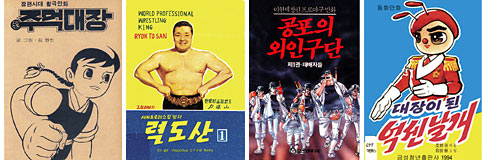
Last weekend, I had an opportunity to visit the San Francisco Public Library, which is mounting a small but meticulously curated exhibit exploring the relationship between politics, censorship, and manhwa in post-war Korea. Called “Korean Comics: A Society Through Small Frames,” the exhibit features twenty-one of Korea’s best-known cartoonists, from Kim Won Bin, creator of Fist Boss, to Hwang Mina, a sunjong (girls’) pioneer. For a Western reader whose primary knowledge of manhwa comes from titles such as Goong: The Royal Palace, the exhibit will be revelatory, as almost none of the series on display look like the Korean comics that have been licensed for the US market; if anything, the curators have gone out of their way to choose titles that challenge the commonly-held Western notion that manhwa is simply the “Korean form” of manga.[1] Styles range from the cartoonish (Baby Dinosaur Tuli, Madame Vicious) to the  naturalistic (The Picture Diary of Puja), while the story lines explore topics as varied as ancient Korean history (Kojudo: Three Kingdoms), homelessness in Seoul (We Saw a Pity Bird Who Lost Its Way), Korean involvement in the Vietnam War (Yellow Bullets), and sumo champion Rikidozan, who is credited with introducing Japanese and Korean audiences to modern professional wrestling.[2]

…

Read More

Filed Under: Manga Critic

Korean Comics: A Society Through Small Frames

April 9, 2010 by Katherine Dacey

Last weekend, I had an opportunity to visit the San Francisco Public Library, which is mounting a small but meticulously curated exhibit exploring the relationship between politics, censorship, and manhwa in post-war Korea. Called “Korean Comics: A Society Through Small Frames,” the exhibit features twenty-one of Korea’s best-known cartoonists, from Kim Won Bin, creator of Fist Boss, to Hwang Mina, a sunjong (girls’) pioneer. For a Western reader whose primary knowledge of manhwa comes from titles such as Goong: The Royal Palace, the exhibit will be revelatory, as almost none of the series on display look like the Korean comics that have been licensed for the US market; if anything, the curators have gone out of their way to choose titles that challenge the commonly-held Western notion that manhwa is simply the “Korean form” of manga.[1] Styles range from the cartoonish (Baby Dinosaur Tuli, Madame Vicious) to the  naturalistic (The Picture Diary of Puja), while the story lines explore topics as varied as ancient Korean history (Kojudo: Three Kingdoms), homelessness in Seoul (We Saw a Pity Bird Who Lost Its Way), Korean involvement in the Vietnam War (Yellow Bullets), and sumo champion Rikidozan, who is credited with introducing Japanese and Korean audiences to modern professional wrestling.[2]

Throughout the exhibit, curators have gone to great pains to illustrate the complex relationship between cartoonists and the Korean government, noting when a particular title elicited criticism from officials or earned praise for its depiction of Korean life. Visitors unfamiliar with recent Korean history may be surprised to discover the degree to which propaganda and censorship shaped the development of manhwa in South Korea. Hwang Mina’s We Saw a Pity Bird, for example, caused a stir when Seoul was preparing to host the 1986 Pan-Asian Games; the government attempted to ban the work for depicting poverty and homelessness in urban settings, fearing that Pity Bird would make South Korea look economically backwards. Other works, such as Kim Seong Hwan’s Koban, a long-running newspaper strip, ran afoul of Park Chung Hee’s censors for depicting student unrest and changing social mores in the 1960s.[3]

fistboss

Not surprisingly, the exhibit’s most dramatic illustration of the relationship between comics and politics comes from North Korea. The Great General Mighty Wing debuted in 1994, shortly after Kim Jong Il succeeded his father. Like Soviet novels of the 1920s and 1930s, and Chinese model operas of the 1960s, The Great General Mighty Wing is intended both as entertainment and education, employing a popular medium to teach Communist values, assert the importance of the collective, and reassure readers of their leader’s benign, parental authority. Using the metaphors of the garden and the hive (both Communist staples), the story depicts a conflict between honeybees and wasps for control of two vital resources: water and flowers. The full-color artwork is a synthesis of mid-1950s Korean and Japanese styles (Fist Boss is cited as one important influence), while the script is pure agit-prop, with characters speaking in Communist slogans and heroic, selfless pronouncements.

One of the subtler affects of censorship — artistic isolation and stagnation — is addressed briefly but effectively in the few examples of sunjong manhwa on display. Korea experienced a brief shojo manga boom in the 1970s, when pirates flooded the Korean market with unauthorized versions of popular Japanese titles. The Magnificent 49ers’s style, in particular, had a profound influence on artists writing for the girls’ market. After the government cracked down on Japanese imports, however, Korean artists who had drawn inspiration from the 49ers no longer had access to current shojo manga; as a result, variations on the starry-eyed heroines and long-haired princes of The Rose of Versailles flourished in Korean manhwa long after they’d fallen out of fashion in Japan.[4]

If I had one complaint about the exhibit, it’s that visitors whose entire knowledge of Korea is rooted in the present may not appreciate the degree to which the displayed comics reflect the social and political upheaval of the past eighty years. A small timeline of major events, or even a pamphlet providing a brief overview of Korean history from 1939 to the present, would have been a valuable asset to the exhibit. (A quick glance at the Wikipedia articles on Korea, North Korea, and South Korea are strongly suggested if you don’t know much about the region.) That said, “Korean Comics” is a thoughtful and thought-provoking show that will challenge readers’ notions of what manhwa is, offer them a window into Korean society during some of its most turbulent periods, and introduce them to twenty-one brilliant artists, all of whom deserve greater recognition outside their home country.

“Korean Comics: A Society Through Small Frames” runs now through June 13, 2010 at the Main Branch of the San Francisco Public Library. Admission is free. For hours and directions to the library, click here. The exhibit is a joint effort by the San Francisco Public Library and the Korea Society.

Suggested Reading

“100 Years of Korean Manhwa,” Park In-Ha. List: Books from Korea (Vol. 4, Summer 2009). (Accessed April 9, 2010.)

“Great General Mighty Wing,” Cho Pyong Kwan; translated by Heinz Insu Fenkl. Words Without Borders: The Online Magazine for International Literature (February 2, 2008). (Accessed April 8, 2010.)

Manhwa 100: The New Era for Korean Comics. NETCOMICS (2008). Available through Amazon and other retailers.

A Study of the Development of Sunjong Manhwa by Hwang Mina, Kim Hyerin, and Choi In-sun, Yeewon Yoon. Master’s thesis, University of British Columbia (2002). Available through the UBC Retrospective Theses Digitization Project [http://www.library.ubc.ca/archives/retro_theses/]. (Accessed April 9, 2010.)

Notes

1.This disparity is reflected in the library’s suggested reading list, which features a number of contemporary works such as The Antique Gift Shop, Honey Mustard, Moon Boy, and Priest but none of the works feature in the show. The SFPL’s collection does include a few Korean-language titles, which are listed in the bibliography.

2. Rikidozan is mentioned in Yoshihiro Tatsumi’s A Drifting Life (2009; Drawn & Quarterly), in which Rikidozan is presented as a Japanese hero for defeating American wrestlers in the ring. See pages 261-63.

3. Kim Seong Hwan produced 14,319 Koban strips over its 50+ year run in Korean newspapers.

4. NETCOMICS, a Korean publisher which has been translating manhwa for the American market, has released a number of sunjong titles from the 1980s and early 1990s that suggest the continued influence of 1970s shojo styles on Korean artists. The early work of Kyungok Kang provides an instructive example. See In the Starlight and Narration of Love at 17 for two such examples; her later work, such as Two Will Come, has a distinctly different look.

Filed Under: Manga Critic, Manhwa Tagged With: Exhibitions

Ode to Kirihito, Vols. 1-2

April 7, 2010 by Katherine Dacey

kirihito1“When he heard his cry for help, it wasn’t human” — so went the tagline for Ken Russell’s Altered States (1980), a bizarre fever-dream of Nietzchean philosophy, horror, and mystical hoo-ha in which a scientist’s experiments result in his spontaneous devolution. That same tagline would work equally well for Osamu Tezuka’s Ode to Kirihito (1970-71), a globe-trotting medical mystery about a doctor who takes a similar step down the evolutionary ladder from man to beast. In less capable hands, Kirihito would be pure, B-movie camp with delusions of grandeur — as Altered States is — but Tezuka synthesizes these disparate elements into a gripping story that explores meaty themes: the porous boundaries between man and animal, sanity and insanity, godliness and godlessness; the arrogance of scientists; and the corruption of the Japanese medical establishment.

At its most basic level, Ode to Kirihito is a beat-the-clock thriller in which a charismatic young doctor named Kirihito Osanai tries to discover the cause of Monmow, a mysterious condition that reduces its victims to hairy, misshapen creatures with dog-like snouts. Kirihito’s superior, the ambitious Dr. Tatsugaura, dispatches Kirihito to Doggodale, a remote mountain village where hundreds of residents have developed suggestive symptoms. Once in Doggodale, Kirihito contracts Monmow himself, thus beginning a hellish odyssey to escape the village, arrest the disease’s progress, and share his findings with the medical community.

…

Read More

Filed Under: Manga Critic Tagged With: Classic, Medical Thriller, Osamu Tezuka, vertical

  • « Go to Previous Page
  • Page 1
  • Interim pages omitted …
  • Page 30
  • Page 31
  • Page 32
  • Page 33
  • Page 34
  • Interim pages omitted …
  • Page 39
  • Go to Next Page »
 | Log in
Copyright © 2010 Manga Bookshelf | Powered by WordPress & the Genesis Framework