• Skip to primary navigation
  • Skip to main content
  • Skip to primary sidebar
  • Home
  • About Us
    • Privacy Policy
    • Comment Policy
    • Disclosures & Disclaimers
  • Resources
    • Links, Essays & Articles
    • Fandomology!
    • CLAMP Directory
    • BlogRoll
  • Features & Columns
    • 3 Things Thursday
    • Adventures in the Key of Shoujo
    • Bit & Blips (game reviews)
    • BL BOOKRACK
    • Bookshelf Briefs
    • Bringing the Drama
    • Comic Conversion
    • Fanservice Friday
    • Going Digital
    • It Came From the Sinosphere
    • License This!
    • Magazine no Mori
    • My Week in Manga
    • OFF THE SHELF
    • Not By Manga Alone
    • PICK OF THE WEEK
    • Subtitles & Sensibility
    • Weekly Shonen Jump Recaps
  • Manga Moveable Feast
    • MMF Full Archive
    • Yun Kouga
    • CLAMP
    • Shojo Beat
    • Osamu Tezuka
    • Sailor Moon
    • Fruits Basket
    • Takehiko Inoue
    • Wild Adapter
    • One Piece
    • After School Nightmare
    • Karakuri Odette
    • Paradise Kiss
    • The Color Trilogy
    • To Terra…
    • Sexy Voice & Robo
  • Browse by Author
    • Sean Gaffney
    • Anna Neatrour
    • Michelle Smith
    • Katherine Dacey
    • MJ
    • Brigid Alverson
    • Travis Anderson
    • Phillip Anthony
    • Derek Bown
    • Jaci Dahlvang
    • Angela Eastman
    • Erica Friedman
    • Sara K.
    • Megan Purdy
    • Emily Snodgrass
    • Nancy Thistlethwaite
    • Eva Volin
    • David Welsh
  • MB Blogs
    • A Case Suitable For Treatment
    • Experiments in Manga
    • MangaBlog
    • The Manga Critic
    • Manga Report
    • Soliloquy in Blue
    • Manga Curmudgeon (archive)

Manga Bookshelf

Discussion, Resources, Roundtables, & Reviews

Manga Critic

Not Love But Delicious Foods Make Me So Happy!

December 12, 2010 by Katherine Dacey

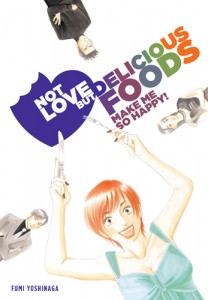
My Dinner With Fumi: that’s what I would have called the English-language edition of Not Love But Delicious Foods Make Me So Happy! The fifteen stories contained within this slim volume celebrate good food and good conversation, documenting Yoshinaga’s interactions with friends, assistants, and fellow artists at real restaurants around Tokyo. No culinary stone goes unturned, as Yoshinaga — or, as her fictional alter ego is called, Y-naga — visits a Korean restaurant, a French bistro, an Italian trattoria, a sushi joint, an all-you-can-eat dim sum buffet, and a bakery famous for its bagels. (Bagels in Tokyo? Call me a recovering New Yorker, but that sounds horribly wrong, especially since Y-naga views the absence of a hole in a the middle as a sign of quality.)

I can think of few mediums less suited to showcasing food than manga, but Yoshinaga’s drawings of steaming dumplings, seafood stews, and sashimi are convincing, despite the absence of color. She renders the food’s textures and shapes in meticulous detail, in the process suggesting the care with which each item was prepared. Her characters’ obvious enjoyment of the meals also helps sell the conceit; watching them rhapsodize over rare ingredients or extol the virtues of dessert makes the reader feel like another member of the party.

Much as I enjoyed the foodie shop-talk, what really sold me on Not Love But Delicious Foods was Yoshinaga’s willingness to poke fun at herself. Y-naga is a sartorial disaster, wearing a frumpy headband, thick glasses, and a scowl as she toils over her comics; only the prospect of a restaurant meal can persuade her to trade her sweatpants for a dress and to comb her hair. Once transformed, however, Y-naga is just as uncouth as her work attire would suggest, spilling copious amounts of food and wine on herself, talking with her mouth full, and flirting aggressively with a handsome dinner companion after drinking too much wine. Yet Y-naga’s dinner conversations reveal that she isn’t a buffoon; she’s surprisingly self-aware, rejecting one potential boyfriend because he’s indifferent to food (he doesn’t like to talk about it the way she does), farming out an incompetent assistant to other artists so that he can improve his skills, and apologizing profusely to a gay friend for “paying my rent by drawing manga with gay themes,” even though her books contain “no real gay themes.”

And that, I think, is the real strength of Not Love But Delicious Foods: the people remain central to the story, even though the Tokyo restaurant scene is the ostensible subject of the manga. As the characters chatter enthusiastically about what they’re eating, we realize that Yoshinaga’s real objective is showing us the important role that food plays in bringing people together, drawing them out, and cementing friendships. It’s a sentiment that’s expressed throughout the manga, as characters find common ground in their mutual enthusiasm for creme brulee and osso bucco. One contentious conversation even prompts the omniscient narrator to praise good food for its diplomatic value; in Yoshinaga’s world, detente is just a dish away. “But through the power of skirt steak, their hearts resumed beating as one,” the narrator observes. Couldn’t have said it better myself.

Review copy provided by Yen Press. Not Love But Delicious Foods Make Me So Happy! will be released on December 21, 2010.

NOT LOVE BUT DELICIOUS FOODS MAKE ME SO HAPPY! • BY FUMI YOSHINAGA • YEN PRESS • 160 pp. • RATING: OLDER TEEN (16+)

Filed Under: Manga Critic Tagged With: fumi yoshinaga, yen press

Not Love But Delicious Foods Make Me So Happy!

December 12, 2010 by Katherine Dacey

My Dinner With Fumi: that’s what I would have called the English-language edition of Not Love But Delicious Foods Make Me So Happy! The fifteen stories contained within this slim volume celebrate good food and good conversation, documenting Yoshinaga’s interactions with friends, assistants, and fellow artists at real restaurants around Tokyo. No culinary stone goes unturned, as Yoshinaga — or, as her fictional alter ego is called, Y-naga — visits a Korean restaurant, a French bistro, an Italian trattoria, a sushi joint, an all-you-can-eat dim sum buffet, and a bakery famous for its bagels. (Bagels in Tokyo? Call me a recovering New Yorker, but that sounds horribly wrong, especially since Y-naga views the absence of a hole in a the middle as a sign of quality.)

I can think of few mediums less suited to showcasing food than manga, but Yoshinaga’s drawings of steaming dumplings, seafood stews, and sashimi are convincing, despite the absence of color. She renders the food’s textures and shapes in meticulous detail, in the process suggesting the care with which each item was prepared. Her characters’ obvious enjoyment of the meals also helps sell the conceit; watching them rhapsodize over rare ingredients or extol the virtues of dessert makes the reader feel like another member of the party.

Much as I enjoyed the foodie shop-talk, what really sold me on Not Love But Delicious Foods was Yoshinaga’s willingness to poke fun at herself. Y-naga is a sartorial disaster, wearing a frumpy headband, thick glasses, and a scowl as she toils over her comics; only the prospect of a restaurant meal can persuade her to trade her sweatpants for a dress and to comb her hair. Once transformed, however, Y-naga is just as uncouth as her work attire would suggest, spilling copious amounts of food and wine on herself, talking with her mouth full, and flirting aggressively with a handsome dinner companion after drinking too much wine. Yet Y-naga’s dinner conversations reveal that she isn’t a buffoon; she’s surprisingly self-aware, rejecting one potential boyfriend because he’s indifferent to food (he doesn’t like to talk about it the way she does), farming out an incompetent assistant to other artists so that he can improve his skills, and apologizing profusely to a gay friend for “paying my rent by drawing manga with gay themes,” even though her books contain “no real gay themes.”

And that, I think, is the real strength of Not Love But Delicious Foods: the people remain central to the story, even though the Tokyo restaurant scene is the ostensible subject of the manga. As the characters chatter enthusiastically about what they’re eating, we realize that Yoshinaga’s real objective is showing us the important role that food plays in bringing people together, drawing them out, and cementing friendships. It’s a sentiment that’s expressed throughout the manga, as characters find common ground in their mutual enthusiasm for creme brulee and osso bucco. One contentious conversation even prompts the omniscient narrator to praise good food for its diplomatic value; in Yoshinaga’s world, detente is just a dish away. “But through the power of skirt steak, their hearts resumed beating as one,” the narrator observes. Couldn’t have said it better myself.

Review copy provided by Yen Press. Not Love But Delicious Foods Make Me So Happy! will be released on December 21, 2010.

NOT LOVE BUT DELICIOUS FOODS MAKE ME SO HAPPY! • BY FUMI YOSHINAGA • YEN PRESS • 160 pp. • RATING: OLDER TEEN (16+)

Filed Under: Manga, Manga Critic Tagged With: Cooking and Food, fumi yoshinaga, yen press

Bunny Drop, Vols. 1-2

December 8, 2010 by Katherine Dacey

Fictional bachelor dads come in two flavors. The first is easily flummoxed by diapers, sippy cups, tantrums, and stomach aches, reacting in abject horror to bodily functions and extreme emotions (see Three Men and a Baby), while the second behaves more like a stand-up comedian than an engaged parent, commenting wryly on his charges’ behavior without doing much to guide or correct them (see Yotsuba&!). Daikichi, the singleton hero of Bunny Drop, is a pleasant corrective to these familiar stereotypes: he’s a sensitive, well-meaning thirty-year-old who steps up to the plate when his grandfather dies, leaving behind an illegitimate six-year-old daughter.

What begins as an impulsive decision — Daikichi is offended by his family’s reluctance to accept responsibility for gramps’ kid — quickly evolves into a serious commitment. Daikichi is humble enough to realize his limitations as a father, enlisting help from co-workers, friends, and family members in his efforts to find day care for Rin and impose some structure on her life, even though he isn’t entirely certain what kind of boundaries and routines are appropriate for a six-year-old. Yumi Unita wrings some humor out of Daikichi’s attempt to understand Rin’s unique point of view, but steers clear of easy laughs and easy victories. The early moments of rapport between Daikichi and Rin feel earned, not contrived, while Rin’s quirks reflect the bizarre circumstances of her early upbringing, as well as her deep fear of being abandoned.

Though Unita’s character designs are highly stylized and her panels free of busy detail, the spare, unfussy quality of her artwork is deceptive; her seemingly simple faces and bodies actually speak volumes about each character’s personality and history. The few lines on Daikichi’s face, for example, not only establish his age and his homeliness, they also give readers a window into his relationship with Rin. We see his growing attachment to the girl through the softening of his brow and jawline, and note the tension in his face when trying to negotiate new office hours for himself. (His co-workers are puzzled and angered by Daikichi’s decision to take care of Rin. “Just because it’s a relative’s child,” one underling complains, “why must you be the sacrifice, Kawachi-San?”)

With Rin, Unita focuses as much on the character’s body language as on her facial expressions. In the first volume, Rin appears closed off from everyone: rounded shoulders, downcast eyes, pursed lips, and folded arms. As Rin begins to trust Daikichi, however, her face and posture change: her limbs unfurl and her eyes brighten, and her repertory of faces soon includes pouty defiance and bravado. That same attention to detail extends to supporting cast members as well. Rin’s mother, whom Daikichi meets in volume two, comes across as impossibly young, swimming in an outfit too big for her slight frame, and fidgeting throughout her conversation with Daikichi, twisting her hair and avoiding eye contact in the manner of a sullen teenager.

The introduction of Rin’s mother suggests that future installments of Bunny Drop will continue to focus complex issues — what constitutes a family? who has the right to call himself a parent? what’s in the best interest of a damaged child? — in lieu of sitcom ones. (See sippy cups, bad dreams, and the stomach flu, above.) That Unita can take such potentially overwrought material and fashion a thoughtful, funny, and honest look at child-rearing is testament to her skill as a storyteller and — one suspects — as a parent. Easily one of 2010’s best new titles.

BUNNY DROP, VOLS. 1-2 • BY YUMI UNITA • YEN PRESS • RATING: TEEN (13+)

Filed Under: Manga Critic Tagged With: Josei, yen press

Bunny Drop, Vols. 1-2

December 8, 2010 by Katherine Dacey

Fictional bachelor dads come in two flavors. The first is easily flummoxed by diapers, sippy cups, tantrums, and stomach aches, reacting in abject horror to bodily functions and extreme emotions (see Three Men and a Baby), while the second behaves more like a stand-up comedian than an engaged parent, commenting wryly on his charges’ behavior without doing much to guide or correct them (see Yotsuba&!). Daikichi, the singleton hero of Bunny Drop, is a pleasant corrective to these familiar stereotypes: he’s a sensitive, well-meaning thirty-year-old who steps up to the plate when his grandfather dies, leaving behind an illegitimate six-year-old daughter.

What begins as an impulsive decision — Daikichi is offended by his family’s reluctance to accept responsibility for gramps’ kid — quickly evolves into a serious commitment. Daikichi is humble enough to realize his limitations as a father, enlisting help from co-workers, friends, and family members in his efforts to find day care for Rin and impose some structure on her life, even though he isn’t entirely certain what kind of boundaries and routines are appropriate for a six-year-old. Yumi Unita wrings some humor out of Daikichi’s attempt to understand Rin’s unique point of view, but steers clear of easy laughs and easy victories. The early moments of rapport between Daikichi and Rin feel earned, not contrived, while Rin’s quirks reflect the bizarre circumstances of her early upbringing, as well as her deep fear of being abandoned.

Though Unita’s character designs are highly stylized and her panels free of busy detail, the spare, unfussy quality of her artwork is deceptive; her seemingly simple faces and bodies actually speak volumes about each character’s personality and history. The few lines on Daikichi’s face, for example, not only establish his age and his homeliness, they also give readers a window into his relationship with Rin. We see his growing attachment to the girl through the softening of his brow and jawline, and note the tension in his face when trying to negotiate new office hours for himself. (His co-workers are puzzled and angered by Daikichi’s decision to take care of Rin. “Just because it’s a relative’s child,” one underling complains, “why must you be the sacrifice, Kawachi-San?”)

With Rin, Unita focuses as much on the character’s body language as on her facial expressions. In the first volume, Rin appears closed off from everyone: rounded shoulders, downcast eyes, pursed lips, and folded arms. As Rin begins to trust Daikichi, however, her face and posture change: her limbs unfurl and her eyes brighten, and her repertory of faces soon includes pouty defiance and bravado. That same attention to detail extends to supporting cast members as well. Rin’s mother, whom Daikichi meets in volume two, comes across as impossibly young, swimming in an outfit too big for her slight frame, and fidgeting throughout her conversation with Daikichi, twisting her hair and avoiding eye contact in the manner of a sullen teenager.

The introduction of Rin’s mother suggests that future installments of Bunny Drop will continue to focus complex issues — what constitutes a family? who has the right to call himself a parent? what’s in the best interest of a damaged child? — in lieu of sitcom ones. (See sippy cups, bad dreams, and the stomach flu, above.) That Unita can take such potentially overwrought material and fashion a thoughtful, funny, and honest look at child-rearing is testament to her skill as a storyteller and — one suspects — as a parent. Easily one of 2010’s best new titles.

BUNNY DROP, VOLS. 1-2 • BY YUMI UNITA • YEN PRESS • RATING: TEEN (13+)

Filed Under: Manga, Manga Critic, REVIEWS Tagged With: Drama, yen press

The Best Manga of 2010: The Manga Critic’s Picks

December 6, 2010 by Katherine Dacey 16 Comments

For all the upheaval within the manga industry — the demise of CMX, Del Rey, and Go! Comi, the layoffs at VIZ — 2010 proved an exceptionally good year for storytelling. True, titles like Black Butler, Naruto, and Nabari no Ou dominated sales charts, but publishers made a concerted effort to woo grown-ups with vintage manga — Black Blizzard, A Drunken Dream and Other Stories — edgy sci-fi — Biomega, 7 Billion Needles — underground comix — AX: A Collection of Alternative Manga, The Box Man — and good old-fashioned drama — All My Darling Daughters, Bunny Drop. I had a hard time limiting myself to just ten titles this year, so I’ve borrowed a few categories from my former PCS cohort Erin Finnegan, from Best New Guilty Pleasure to Best Manga You Thought You’d Hate. Please feel free to add your own thoughts: what titles did I unjustly omit? What titles did I like but you didn’t? Inquiring minds want to know!

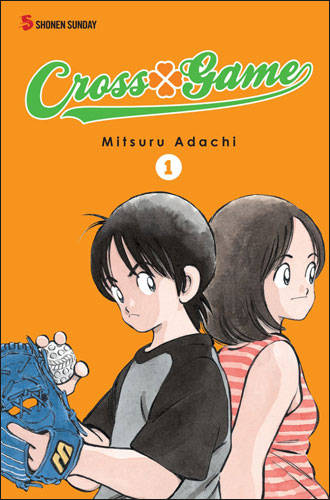
10. CROSS GAME (Mitsuri Adachi; VIZ)

In this sometimes funny, sometimes melancholy coming-of-age story, a family tragedy brings teenager Ko Kitamura closer to neighbor Aoba Tsukishima, with whom he has a fraught relationship. Though the two bicker with the antagonistic gusto of Beatrice and Benedict, their shared love of baseball helps smooth the course of their budding romance. To be sure, Cross Game can’t escape a certain amount of sports-manga cliche, but Mitsuri Adachi is more interested in showing us how the characters relate to each other than in celebrating their amazing baseball skills. (Not that he skimps on the game play; Adachi clearly knows his way around the diamond.) The result is an agreeable dramedy that has the rhythm of a good situation comedy and the emotional depth of a well-crafted YA novel, with just enough shop-talk to win over baseball enthusiasts, too.

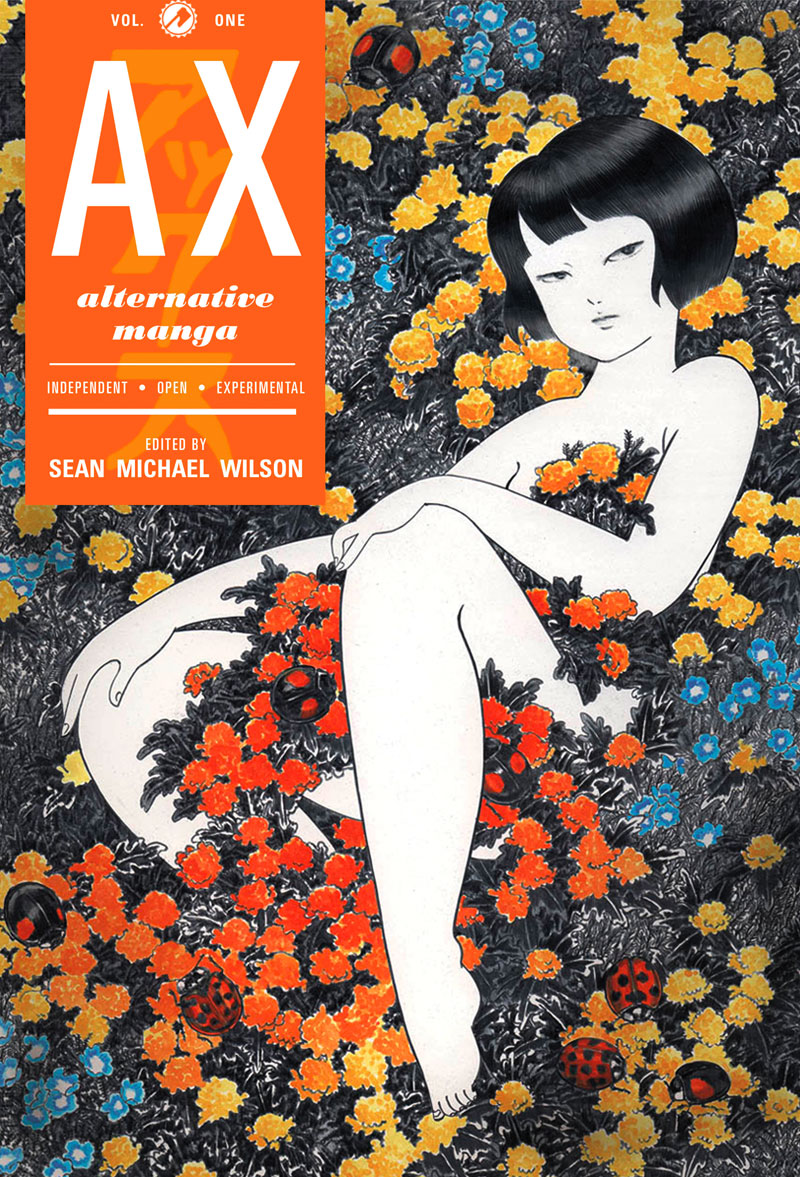
9. AX: A COLLECTION OF ALTERNATIVE MANGA (Various Artists; Top Shelf)

The next time someone dismisses manga as a “style” characterized by youthful-looking, big-eyed characters with button noses, I’m going to hand them a copy of AX, a rude, gleeful, and sometimes disturbing rebuke to the homogenized artwork and storylines found in mainstream manga publications. No one will confuse AX for Young Jump or even Big Comic Spirits; the stories in AX run the gamut from the grotesquely detailed to the playfully abstract, often flaunting their ugliness with the cheerful insistence of a ten-year-old boy waving a dead animal at squeamish classmates. Nor will anyone confuse Yoshihiro Tatsumi or Einosuke’s outlook with the humanism of Osamu Tezuka or Keiji Nakazawa; the stories in AX revel in the darker side of human nature, the part of us that’s fascinated with pain, death, sex, and bodily functions. Like all anthologies, the collection is somewhat uneven, with a few too many scatological tales for its own good, but the very best stories — “The Hare and the Tortoise,” “Push Pin Woman,” “Six Paths of Wealth,” “Puppy Love,” “Inside the Gourd” — attest to the diversity of talent contributing to this seminal manga magazine. –Reviewed at The Manga Critic on 5/21/10

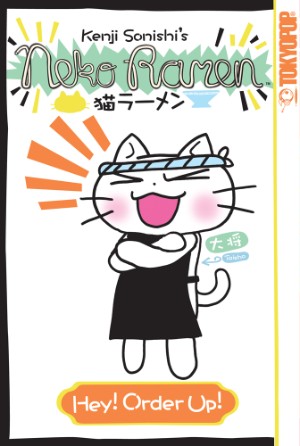
8. NEKO RAMEN (Kenji Sonishi; Tokyopop)

If you’ve ever lived with a cat or dog, you know that no meal is complete without a pet hair garnish. Now imagine that your beloved companion actually prepared your meals instead of watching you eat them: what sort of unimaginable horrors might you encounter beyond the stray hair? That’s the starting point for Neko Ramen, a 4-koma manga about a cat whose big dream is to run a noodle shop, but author Kenji Sonishi quickly moves past hair balls and litter box jokes to mine a richer vein of humor, poking fun at his cat cook’s delusions of entrepreneurial grandeur. Taisho is the Don Quixote of ramen vendors, dreaming up ludicrous giveaways and unappetizing dishes in an effort to promote his business, never realizing that he is the store’s real selling point. The loose, sketchy artwork gives the series an improvisational feel, while the script has the pleasant, absurdist zing of an Abbott and Costello routine. –Reviewed at The Manga Critic on 6/2/10

7. AYAKO (Osamu Tezuka; Vertical, Inc.)

Combining the psychological realism of Dostoevsky with the social consciousness of Tolstoy and Zola, Osamu Tezuka uses conflicts within the once-powerful Tenge clan to dramatize the social, political, and economic upheaval caused by the American occupation of post-war Japan. No subject is off-limits for Tezuka: the Tenge commit murders, spy for the Americans, join the Communist Party, imprison a family member in an underground cell, and engage in incest. It’s one of Tezuka’s most sober and damning stories, at once tremendously powerful and seriously disturbing, with none of the cartoonish excess of Ode to Kirihito or MW. The ending is perhaps too pat and loaded with symbolism for its own good, but like Tezuka’s best work, Ayako forces the reader to confront the darkest, most corruptible corners of the human soul. As with Apollo’s Song, Black Jack, and Buddha, Vertical has done a superb job of making Tezuka accessible to Western readers with flipped artwork and a fluid translation.

6. BUNNY DROP (Yumi Unita; Yen Press)

Stop me if you’ve heard this one before: a thirty-something bachelor unexpectedly becomes a parent to a cute little girl, leading to hijinks, misunderstandings, and heart-tugging moments. That’s a fair summary of what happens in Bunny Drop, but Yumi Unita wisely avoids the pitfalls of the single-dad genre — the cheap sentiment, the unfunny scenes of dad recoiling in horror at diapers, runny noses, and tears — instead focusing on the unique bond between Daikichi and Rin, the six-year-old whom he impetuously adopts after the rest of the family disavows her. (Rin is the product of a liaison between Daikichi’s grandfather and a much younger woman.) Though Daikichi struggles to find day care, buy clothes for Rin, and make sense of her standoffish behavior, he isn’t a buffoon or a straight man for Rin’s antics; Unita portrays him as a smart, sensitive person blessed with good instincts and common sense. Clean, expressive artwork and true-to-life dialogue further inoculate Bunny Drop against a terminal case of sitcom cuteness, making it one of the most thoughtful, moving, and adult manga of the year.

5. BLACK BLIZZARD (Yoshihiro Tatsumi; Drawn & Quarterly)

Written in just twenty days, this feverish pulp thriller plays like a mash-up of The Fugitive, The 39 Steps, and The Defiant Ones as two convicts — one a hardened criminal, the other a down-on-his luck musician — go on the lam during a blinding snowstorm. The heroes are more archetypes than characters, drawn in bold strokes, but the interaction between them crackles with antagonistic energy; they’re as much enemies as partners, roles that they constantly renegotiate during their escape. Evocative artwork — slashing lines, dramatic camera angles, images of speeding trains — infuses Black Blizzard with a raw, nervous energy that nicely mirrors the characters’ internal state. Only in the final, rushed pages does manga-ka Yoshihiro Tatsumi falter, tidily resolving the story through an all-too-convenient plot twist that hinges on coincidence. Still, that’s a minor criticism of a thoroughly entertaining story written during a crucial stage of Tatsumi’s artistic development. –Reviewed at The Manga Critic on 9/9/10

4. HOUSE OF FIVE LEAVES (Natsume Ono; VIZ)

Timid ronin Akitsu Masanosuke can’t hold a steady job, despite his formidable swordsmanship. When a businessman approaches him with work, Masanosuke readily accepts, not realizing that his new employer, Yaichi, runs a crime syndicate that specializes in kidnapping. Masanosuke’s unwitting participation in a blackmailing scheme prevents him from severing his ties to Yaichi; Masanosuke must then decide if he will join the House of Five Leaves or bide his time until he can escape. Though Toshiro Mifune and Hiroyuki Sanada have made entire careers out of playing characters like Masanosuke, Natsume Ono makes a persuasive case that you don’t need a flesh-and-blood actor to tell this kind of story with heartbreaking intensity; she can do the slow-burn on the printed page with the same skill as Masaki Kobayashi (Hara Kiri, Samurai Rebellion) and Yoji Yamada (The Twilight Samurai) did on the big screen. –Reviewed at The Manga Critic on 8/20/10

3. TWIN SPICA (Kou Yaginuma; Vertical, Inc.)

Asumi Kamogawa is a small girl with a big dream: to be an astronaut on Japan’s first manned space flight. Though she passes the entrance exam for Tokyo Space School, she faces several additional hurdles to realizing her goal, from her child-like stature — she’s thirteen going on eight — to a faculty member who blames her father for causing a fiery rocket crash that claimed hundreds of civilian lives. Yet for all the setbacks she’s experienced, Asumi proves resilient, a gentle girl who perseveres in difficult situations, offers friendship in lieu of judgment, and demonstrates a preternatural awareness of life’s fragility. Twin Spica follows Asumi through every stage of training, from physics lectures to zero-G simulations, showing us how she befriends her fellow cadets and gradually learns to rely on herself, rather than her imaginary friend, Mr. Lion. Though Twin Spica was serialized in a seinen magazine, it works surprisingly well for young adults, too, an all-too-rare example of a direct, heartfelt story that’s neither saccharine nor mawkish.  –Reviewed at The Manga Critic on 5/3/10

2. ALL MY DARLING DAUGHTERS (Fumi Yoshinaga; VIZ)

The five vignettes in All My Darling Daughters depict women negotiating difficult personal relationships: a daughter confronts her mother about mom’s new, much younger husband; a college student seduces her professor, only to dump him when he tries to court her properly; a beautiful young woman contemplates an arranged marriage. Like all of Yoshinaga’s work, the characters in All My Darling Daughters love to talk. That chattiness isn’t always an asset to Yoshinaga’s storytelling (see Gerard and Jacques), but here the dialogue is perfectly calibrated to reveal just how complex and ambivalent these relationships really are. Yoshinaga’s artwork is understated but effective, as she uses small details — how a character stands or carries her shoulders — to offer a more complete and nuanced portrait of each woman. Quite possibly my favorite work by Yoshinaga.

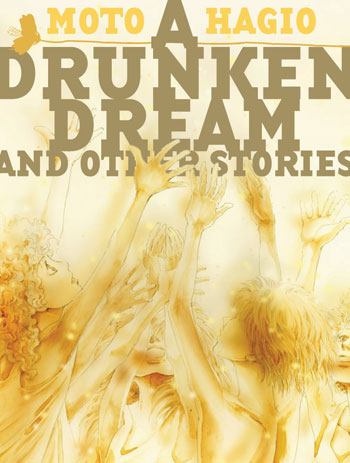
1. A DRUNKEN DREAM AND OTHER STORIES (Moto Hagio; Fantagraphics)

Not coincidentally, A Drunken Dream and Other Stories was my nomination for Best New Graphic Novel of 2010 as well. Here’s what I had to say about the title over at Flashlight Worthy Books:

Moto Hagio is to shojo manga what Will Eisner is to American comics, a seminal creator whose distinctive style and sensibility profoundly changed the medium. Though Hagio has been actively publishing stories since the late 1960s, very little of her work has been translated into English. A Drunken Dream, published by Fantagraphics, is an excellent corrective — a handsomely produced, meticulously edited collection of Hagio’s short stories that span her career from 1970 to 2007. Readers new to Hagio’s work will appreciate the inclusion of two contextual essays by manga scholar Matt Thorn, one an introduction to Hagio and her peers, the other an interview with Hagio. What emerges is a portrait of a gifted artist who draws inspiration from many sources: Osamu Tezuka and Shotaro Ishimonori, Ray Bradbury and Isaac Asimov, Frances Hodgson Burnett and L.M. Montgomery.

For the complete list — including nominations from David “Manga Curmudgeon” Welsh, Brigid “MangaBlog” Alverson, Lorena “i heart manga” Ruggero, and Matthew “Warren Peace Sings the Blues” Brady — click here. To read my full review of A Drunken Dream, click here.

HONORABLE MENTIONS

Done because there are too menny… great manga, that is, to confine myself to a traditional top ten list. With apologies to Thomas Hardy, here are some of the other titles that tickled my fancy in 2010:

  • OTHER AWESOME DEBUTS: Not Love But Delicious Foods Make Me Happy (Yen Press), Saturn Apartments (VIZ), 7 Billion Needles (Vertical, Inc.)
  • BEST CONTINUING SERIES: Itazura na Kiss (DMP), Ooku: The Inner Chambers (VIZ), Suppli (Tokyopop), 20th Century Boys (VIZ)
  • BEST NEW ALL-AGES MANGA: Chi’s Sweet Home (Vertical, Inc.)
  • BEST NEW SERIES THAT’S ALREADY ON HIATUS: Diamond Girl (CMX), Stolen Hearts (CMX)
  • BEST NEW GUILTY PLEASURE: Demon Sacred (Tokyopop), Dragon Girl (Yen Press)
  • BEST REPRINT EDITION: Cardcaptor Sakura (Dark Horse), Little Butterfly Omnibus (DMP)
  • BEST MANGA I THOUGHT I’D HATE: Higurashi When They Cry: Beyond Midnight Arc (Yen Press)
  • BEST FINALE: Pluto: Tezuka x Urasawa (VIZ)

Filed Under: Manga Critic Tagged With: cmx, Dark Horse, DMP, Drawn & Quarterly, fantagraphics, fumi yoshinaga, moto hagio, Naoki Urasawa, Osamu Tezuka, SigIKKI, Tokyopop, Top Shelf, vertical, VIZ, yen press, Yoshihiro Tatsumi

The Best Manga of 2010: The Manga Critic’s Picks

December 6, 2010 by Katherine Dacey

For all the upheaval within the manga industry — the demise of CMX, Del Rey, and Go! Comi, the layoffs at VIZ — 2010 proved an exceptionally good year for storytelling. True, titles like Black Butler, Naruto, and Nabari no Ou dominated sales charts, but publishers made a concerted effort to woo grown-ups with vintage manga — Black Blizzard, A Drunken Dream and Other Stories — edgy sci-fi — Biomega, 7 Billion Needles — underground comix — AX: A Collection of Alternative Manga, The Box Man — and good old-fashioned drama — All My Darling Daughters, Bunny Drop. I had a hard time limiting myself to just ten titles this year, so I’ve borrowed a few categories from my former PCS cohort Erin Finnegan, from Best New Guilty Pleasure to Best Manga You Thought You’d Hate. Please feel free to add your own thoughts: what titles did I unjustly omit? What titles did I like but you didn’t? Inquiring minds want to know!

10. Cross Game
By Mitsuri Adachi • VIZ Media
In this sometimes funny, sometimes melancholy coming-of-age story, a family tragedy brings teenager Ko Kitamura closer to neighbor Aoba Tsukishima, with whom he has a fraught relationship. Though the two bicker with the antagonistic gusto of Beatrice and Benedict, their shared love of baseball helps smooth the course of their budding romance. To be sure, Cross Game can’t escape a certain amount of sports-manga cliche, but Mitsuri Adachi is more interested in showing us how the characters relate to each other than in celebrating their amazing baseball skills. (Not that he skimps on the game play; Adachi clearly knows his way around the diamond.) The result is an agreeable dramedy that has the rhythm of a good situation comedy and the emotional depth of a well-crafted YA novel, with just enough shop-talk to win over baseball enthusiasts, too.

9. AX: A Collection of Alternative Manga
Edited by Sean Michael Wilson • Top Shelf
The next time someone dismisses manga as a “style” characterized by youthful-looking, big-eyed characters with button noses, I’m going to hand them a copy of AX, a rude, gleeful, and sometimes disturbing rebuke to the homogenized artwork and storylines found in mainstream manga publications. No one will confuse AX for Young Jump or even Big Comic Spirits; the stories in AX run the gamut from the grotesquely detailed to the playfully abstract, often flaunting their ugliness with the cheerful insistence of a ten-year-old boy waving a dead animal at squeamish classmates. Nor will anyone confuse Yoshihiro Tatsumi or Einosuke’s outlook with the humanism of Osamu Tezuka or Keiji Nakazawa; the stories in AX revel in the darker side of human nature, the part of us that’s fascinated with pain, death, sex, and bodily functions. Like all anthologies, the collection is somewhat uneven, with a few too many scatological tales for its own good, but the very best stories — “The Hare and the Tortoise,” “Push Pin Woman,” “Six Paths of Wealth,” “Puppy Love,” “Inside the Gourd” — attest to the diversity of talent contributing to this seminal manga magazine. —Reviewed at The Manga Critic on 5/21/10

8. Neko Ramen
By Kenji Sonishi • Tokyopop
If you’ve ever lived with a cat or dog, you know that no meal is complete without a pet hair garnish. Now imagine that your beloved companion actually prepared your meals instead of watching you eat them: what sort of unimaginable horrors might you encounter beyond the stray hair? That’s the starting point for Neko Ramen, a 4-koma manga about a cat whose big dream is to run a noodle shop, but author Kenji Sonishi quickly moves past hair balls and litter box jokes to mine a richer vein of humor, poking fun at his cat cook’s delusions of entrepreneurial grandeur. Taisho is the Don Quixote of ramen vendors, dreaming up ludicrous giveaways and unappetizing dishes in an effort to promote his business, never realizing that he is the store’s real selling point. The loose, sketchy artwork gives the series an improvisational feel, while the script has the pleasant, absurdist zing of an Abbott and Costello routine. —Reviewed at The Manga Critic on 6/2/10

7. Ayako
By Osamu Tezuka; Vertical, Inc.
Combining the psychological realism of Dostoevsky with the social consciousness of Tolstoy and Zola, Osamu Tezuka uses conflicts within the once-powerful Tenge clan to dramatize the social, political, and economic upheaval caused by the American occupation of post-war Japan. No subject is off-limits for Tezuka: the Tenge commit murders, spy for the Americans, join the Communist Party, imprison a family member in an underground cell, and engage in incest. It’s one of Tezuka’s most sober and damning stories, at once tremendously powerful and seriously disturbing, with none of the cartoonish excess of Ode to Kirihito or MW. The ending is perhaps too pat and loaded with symbolism for its own good, but like Tezuka’s best work, Ayako forces the reader to confront the darkest, most corruptible corners of the human soul. As with Apollo’s Song, Black Jack, and Buddha, Vertical has done a superb job of making Tezuka accessible to Western readers with flipped artwork and a fluid translation.

6. Bunny Drop
By Yumi Unita; Yen Press
Stop me if you’ve heard this one before: a thirty-something bachelor unexpectedly becomes a parent to a cute little girl, leading to hijinks, misunderstandings, and heart-tugging moments. That’s a fair summary of what happens in Bunny Drop, but Yumi Unita wisely avoids the pitfalls of the single-dad genre — the cheap sentiment, the unfunny scenes of dad recoiling in horror at diapers, runny noses, and tears — instead focusing on the unique bond between Daikichi and Rin, the six-year-old whom he impetuously adopts after the rest of the family disavows her. (Rin is the product of a liaison between Daikichi’s grandfather and a much younger woman.) Though Daikichi struggles to find day care, buy clothes for Rin, and make sense of her standoffish behavior, he isn’t a buffoon or a straight man for Rin’s antics; Unita portrays him as a smart, sensitive person blessed with good instincts and common sense. Clean, expressive artwork and true-to-life dialogue further inoculate Bunny Drop against a terminal case of sitcom cuteness, making it one of the most thoughtful, moving, and adult manga of the year.

5. Black Blizzard
By Yoshihiro Tatsumi • Drawn & Quarterly
Written in just twenty days, this feverish pulp thriller plays like a mash-up of The Fugitive, The 39 Steps, and The Defiant Ones as two convicts — one a hardened criminal, the other a down-on-his luck musician — go on the lam during a blinding snowstorm. The heroes are more archetypes than characters, drawn in bold strokes, but the interaction between them crackles with antagonistic energy; they’re as much enemies as partners, roles that they constantly renegotiate during their escape. Evocative artwork — slashing lines, dramatic camera angles, images of speeding trains — infuses Black Blizzard with a raw, nervous energy that nicely mirrors the characters’ internal state. Only in the final, rushed pages does manga-ka Yoshihiro Tatsumi falter, tidily resolving the story through an all-too-convenient plot twist that hinges on coincidence. Still, that’s a minor criticism of a thoroughly entertaining story written during a crucial stage of Tatsumi’s artistic development. —Reviewed at The Manga Critic on 9/9/10

4. House of Five Leaves
By Natsume Ono • VIZ Media
Timid ronin Akitsu Masanosuke can’t hold a steady job, despite his formidable swordsmanship. When a businessman approaches him with work, Masanosuke readily accepts, not realizing that his new employer, Yaichi, runs a crime syndicate that specializes in kidnapping. Masanosuke’s unwitting participation in a blackmailing scheme prevents him from severing his ties to Yaichi; Masanosuke must then decide if he will join the House of Five Leaves or bide his time until he can escape. Though Toshiro Mifune and Hiroyuki Sanada have made entire careers out of playing characters like Masanosuke, Natsume Ono makes a persuasive case that you don’t need a flesh-and-blood actor to tell this kind of story with heartbreaking intensity; she can do the slow-burn on the printed page with the same skill as Masaki Kobayashi (Hara Kiri, Samurai Rebellion) and Yoji Yamada (The Twilight Samurai) did on the big screen. —Reviewed at The Manga Critic on 8/20/10

3. Twin Spica
By Kou Yaginuma • Vertical, Inc.
Asumi Kamogawa is a small girl with a big dream: to be an astronaut on Japan’s first manned space flight. Though she passes the entrance exam for Tokyo Space School, she faces several additional hurdles to realizing her goal, from her child-like stature — she’s thirteen going on eight — to a faculty member who blames her father for causing a fiery rocket crash that claimed hundreds of civilian lives. Yet for all the setbacks she’s experienced, Asumi proves resilient, a gentle girl who perseveres in difficult situations, offers friendship in lieu of judgment, and demonstrates a preternatural awareness of life’s fragility. Twin Spica follows Asumi through every stage of training, from physics lectures to zero-G simulations, showing us how she befriends her fellow cadets and gradually learns to rely on herself, rather than her imaginary friend, Mr. Lion. Though Twin Spica was serialized in a seinen magazine, it works surprisingly well for young adults, too, an all-too-rare example of a direct, heartfelt story that’s neither saccharine nor mawkish.  —Reviewed at The Manga Critic on 5/3/10

2. All My Darling Daughters
By Fumi Yoshinaga • VIZ Media
The five vignettes in All My Darling Daughters depict women negotiating difficult personal relationships: a daughter confronts her mother about mom’s new, much younger husband; a college student seduces her professor, only to dump him when he tries to court her properly; a beautiful young woman contemplates an arranged marriage. Like all of Yoshinaga’s work, the characters in All My Darling Daughters love to talk. That chattiness isn’t always an asset to Yoshinaga’s storytelling (see Gerard and Jacques), but here the dialogue is perfectly calibrated to reveal just how complex and ambivalent these relationships really are. Yoshinaga’s artwork is understated but effective, as she uses small details — how a character stands or carries her shoulders — to offer a more complete and nuanced portrait of each woman. Quite possibly my favorite work by Yoshinaga.

1. A Drunken Dream and Other Stories
By Moto Hagio • Fantagraphics
Not coincidentally, A Drunken Dream and Other Stories was my nomination for Best New Graphic Novel of 2010 as well. Here’s what I had to say about the title over at Flashlight Worthy Books:

Moto Hagio is to shojo manga what Will Eisner is to American comics, a seminal creator whose distinctive style and sensibility profoundly changed the medium. Though Hagio has been actively publishing stories since the late 1960s, very little of her work has been translated into English. A Drunken Dream, published by Fantagraphics, is an excellent corrective — a handsomely produced, meticulously edited collection of Hagio’s short stories that span her career from 1970 to 2007. Readers new to Hagio’s work will appreciate the inclusion of two contextual essays by manga scholar Matt Thorn, one an introduction to Hagio and her peers, the other an interview with Hagio. What emerges is a portrait of a gifted artist who draws inspiration from many sources: Osamu Tezuka and Shotaro Ishimonori, Ray Bradbury and Isaac Asimov, Frances Hodgson Burnett and L.M. Montgomery.

For the complete list — including nominations from David “Manga Curmudgeon” Welsh, Brigid “MangaBlog” Alverson, Lorena “i heart manga” Ruggero, and Matthew “Warren Peace Sings the Blues” Brady — click here. To read my full review of A Drunken Dream, click here.

HONORABLE MENTIONS
Done because there are too menny… great manga, that is, to confine myself to a traditional top ten list. With apologies to Thomas Hardy, here are some of the other titles that tickled my fancy in 2010:

  • Other Awesome Debuts: Not Love But Delicious Foods Make Me Happy (Yen Press), Saturn Apartments (VIZ), 7 Billion Needles (Vertical, Inc.)
  • Best Continuing Series: Itazura na Kiss (DMP), Ooku: The Inner Chambers (VIZ), Suppli (Tokyopop), 20th Century Boys (VIZ)
  • Best New All-ages Manga: Chi’s Sweet Home (Vertical, Inc.)
  • Best New Series That’s Already on Hiatus: Diamond Girl (CMX), Stolen Hearts (CMX)
  • Best New Guilty Pleasure: Demon Sacred (Tokyopop), Dragon Girl (Yen Press)
  • Best Reprint Edition: Cardcaptor Sakura (Dark Horse), Little Butterfly Omnibus (DMP)
  • Best Manga I Thought I’d Hate: Higurashi When They Cry: Beyond Midnight Arc (Yen Press)
  • Best Finale: Pluto: Tezuka x Urasawa (VIZ)

Filed Under: Manga, Manga Critic, Recommended Reading Tagged With: cmx, Dark Horse, DMP, Drawn & Quarterly, fantagraphics, fumi yoshinaga, moto hagio, Naoki Urasawa, Osamu Tezuka, SigIKKI, Tokyopop, Top Shelf, Vertical Comics, VIZ, yen press, Yoshihiro Tatsumi

3 Reasons to Read One Piece

December 2, 2010 by Katherine Dacey 19 Comments

Why would any sane person commit to reading a series that’s still going strong after sixty volumes? I can think of three compelling reasons why you should set aside your shonophobia — that’s Latin for “fear of incredibly long series with interminable fight scenes and characters who do their best” — and give Eiichiro Oda’s One Piece a shot.

1. THE ARTWORK

Though many shonen manga-ka love to populate their stories with flamboyantly ugly villains, Eiichiro Oda’s character designs are more memorable than his competitors’. That’s because Oda doesn’t just add a few scars and a crazy hairdo to distinguish the bad guys from the good; he creates every villain from scratch, making each garment, prop, tattoo, wart, and weapon a direct reflection of the character’s personality and personal history. The same goes for other supporting players: Oda emphasizes the greenness of one pirate’s kiddie followers by giving them vegetal hairdos, and the isolation of a pirate castaway by stuffing the character’s body into an empty treasure chest, with only Gaimon’s unkempt hair and feet poking out. (Gaimon gets one of the series’ best lines: “I used to have two eyebrows!” he exclaims, musing on his twenty years stranded on a remote island.)

Oda’s entire approach to drafting shows a similar thoughtfulness: his pirate ships, tropical islands, and sea coast villages are rendered in clean lines, with a minimum of screen tone. Oda relies instead on playful shapes to help set the stage, from a sea-going restaurant that looks like a cross between a carp and a Hong Kong dim sum parlor, to an island populated by rabbit-cobras, pig-lions, and rooster-foxes.

The only blind spot in Oda’s artwork is his female characters. Though he can draw a marvelous, gnarled pirate queen, as gloriously repulsive as any of the series’ other villains, his young, attractive girls are blandly interchangeable. Even as more female characters are introduced in later story arcs, their appearance seems more calculated to satisfy the male gaze than reveal much about their personality — besides, of course, the near-universal tendency among shonen artists to make a girl’s bust- and neckline a reliable predictor of her villainy.

2. THE LOVING SEND-UPS OF SHONEN CLICHES

One of the reasons I don’t read more shonen manga: I find the characters’ compulsion to shout the name of their fighting techniques kind of silly. (OK, a lot silly.) If anything, it brings back memories of the old Super Friends TV show in which the Wonder Twins clinked rings and announced that they’d be taking “the form of an ice sled!” or “the form of a green-striped tiger!” (If that was meant to be comedy and not a complete abdication of imagination on the writer’s part, I missed it.) Granted, InuYasha and Naruto boast cooler-sounding and more effectual powers, but the minute InuYasha yells “Wind Scar!”, I’m ripped out of the scene, pondering the need for such verbal displays.

In One Piece, however, Oda pokes fun at the practice by assigning his characters goofy powers with goofy names that are fun to say. Monkey D. Luffy’s Gum-Gum attacks are the most frequent and obvious example, as he pretzels himself into a Looney Tunes assortment of weapons and shields, but his crew mates also have a few tricks up their sleeves. The best of them, by far, is Tony Tony Chopper, a blue-nosed reindeer who also happens to be the ship’s doctor. His Human-Human powers enable him to assume a variety of forms, including a gargantuan were-reindeer that wouldn’t be out of place in the pages of Lycanthrope Leo.

Oda also walks a fine line between openly mocking his hero and using him to exemplify the “friendship, effort, and victory” motto that undergirds every Shonen Jump title. Monkey is, to put it nicely, one of the dumbest shonen heroes in the canon — and that’s part of his charm. Unlike, say, Naruto or Lag Seeing (of Tegami Bachi fame), Monkey’s single-minded pursuit of treasure is portrayed as a kind of insanity, not a sign of a stellar character. Monkey goes to extreme lengths to prove himself — not unusual for a shonen hero — but his behavior is clearly meant to be ridiculous. (In the very first pages of the series, he stabs himself in the face with a knife to demonstrate his imperviousness to pain, much to the horror of the assembled pirates.) Yet for all his ill-advised bravado, he’s a kind-hearted goof; anyone who demonstrates valor or integrity is invited to join his crew, regardless of the original circumstances under which they met Monkey. Again, those qualities don’t make Monkey unique, but they do make him appealing; he’s an indestructible hero who’s utterly fallible.

3. THE EXCELLENT ADAPTATION

Any text as thick with puns and pirate-speak as One Piece runs the risk of falling flat in translation, but the English-language adaptation is fluid, funny, and eminently readable. I can’t gauge how faithfully the VIZ edition adheres to the original Japanese, but the script’s buoyant, goofy tone complements the artwork perfectly, leading me to think that VIZ’s editorial team has given American audiences a reasonable approximation of the Japanese-language reading experience. Heck, they’ve even made Oda’s reader correspondence sound like a real, mischievous person answered those fan letters. Now that’s a good adaptation.

Filed Under: Manga Critic Tagged With: Comedy, One Piece, Pirates, Shonen, Shonen Jump, VIZ

3 Reasons to Read One Piece

December 2, 2010 by Katherine Dacey

Why would any sane person commit to reading a series that’s still going strong after sixty volumes? I can think of three compelling reasons why you should set aside your shonophobia — that’s Latin for “fear of incredibly long series with interminable fight scenes and characters who do their best” — and give Eiichiro Oda’s One Piece a shot.

1. THE ARTWORK

Though many shonen manga-ka love to populate their stories with flamboyantly ugly villains, Eiichiro Oda’s character designs are more memorable than his competitors’. That’s because Oda doesn’t just add a few scars and a crazy hairdo to distinguish the bad guys from the good; he creates every villain from scratch, making each garment, prop, tattoo, wart, and weapon a direct reflection of the character’s personality and personal history. The same goes for other supporting players: Oda emphasizes the greenness of one pirate’s kiddie followers by giving them vegetal hairdos, and the isolation of a pirate castaway by stuffing the character’s body into an empty treasure chest, with only Gaimon’s unkempt hair and feet poking out. (Gaimon gets one of the series’ best lines: “I used to have two eyebrows!” he exclaims, musing on his twenty years stranded on a remote island.)

Oda’s entire approach to drafting shows a similar thoughtfulness: his pirate ships, tropical islands, and sea coast villages are rendered in clean lines, with a minimum of screen tone. Oda relies instead on playful shapes to help set the stage, from a sea-going restaurant that looks like a cross between a carp and a Hong Kong dim sum parlor, to an island populated by rabbit-cobras, pig-lions, and rooster-foxes.

The only blind spot in Oda’s artwork is his female characters. Though he can draw a marvelous, gnarled pirate queen, as gloriously repulsive as any of the series’ other villains, his young, attractive girls are blandly interchangeable. Even as more female characters are introduced in later story arcs, their appearance seems more calculated to satisfy the male gaze than reveal much about their personality — besides, of course, the near-universal tendency among shonen artists to make a girl’s bust- and neckline a reliable predictor of her villainy.

2. THE LOVING SEND-UPS OF SHONEN CLICHES

One of the reasons I don’t read more shonen manga: I find the characters’ compulsion to shout the name of their fighting techniques kind of silly. (OK, a lot silly.) If anything, it brings back memories of the old Super Friends TV show in which the Wonder Twins clinked rings and announced that they’d be taking “the form of an ice sled!” or “the form of a green-striped tiger!” (If that was meant to be comedy and not a complete abdication of imagination on the writer’s part, I missed it.) Granted, InuYasha and Naruto boast cooler-sounding and more effectual powers, but the minute InuYasha yells “Wind Scar!”, I’m ripped out of the scene, pondering the need for such verbal displays.

In One Piece, however, Oda pokes fun at the practice by assigning his characters goofy powers with goofy names that are fun to say. Monkey D. Luffy’s Gum-Gum attacks are the most frequent and obvious example, as he pretzels himself into a Looney Tunes assortment of weapons and shields, but his crew mates also have a few tricks up their sleeves. The best of them, by far, is Tony Tony Chopper, a blue-nosed reindeer who also happens to be the ship’s doctor. His Human-Human powers enable him to assume a variety of forms, including a gargantuan were-reindeer that wouldn’t be out of place in the pages of Lycanthrope Leo.

Oda also walks a fine line between openly mocking his hero and using him to exemplify the “friendship, effort, and victory” motto that undergirds every Shonen Jump title. Monkey is, to put it nicely, one of the dumbest shonen heroes in the canon — and that’s part of his charm. Unlike, say, Naruto or Lag Seeing (of Tegami Bachi fame), Monkey’s single-minded pursuit of treasure is portrayed as a kind of insanity, not a sign of a stellar character. Monkey goes to extreme lengths to prove himself — not unusual for a shonen hero — but his behavior is clearly meant to be ridiculous. (In the very first pages of the series, he stabs himself in the face with a knife to demonstrate his imperviousness to pain, much to the horror of the assembled pirates.) Yet for all his ill-advised bravado, he’s a kind-hearted goof; anyone who demonstrates valor or integrity is invited to join his crew, regardless of the original circumstances under which they met Monkey. Again, those qualities don’t make Monkey unique, but they do make him appealing; he’s an indestructible hero who’s utterly fallible.

3. THE EXCELLENT ADAPTATION

Any text as thick with puns and pirate-speak as One Piece runs the risk of falling flat in translation, but the English-language adaptation is fluid, funny, and eminently readable. I can’t gauge how faithfully the VIZ edition adheres to the original Japanese, but the script’s buoyant, goofy tone complements the artwork perfectly, leading me to think that VIZ’s editorial team has given American audiences a reasonable approximation of the Japanese-language reading experience. Heck, they’ve even made Oda’s reader correspondence sound like a real, mischievous person answered those fan letters. Now that’s a good adaptation.

Filed Under: Manga, Manga Critic, Recommended Reading, REVIEWS Tagged With: Comedy, One Piece, Pirates, Shonen, Shonen Jump, VIZ

7 Billion Needles, Vols. 1-2

November 21, 2010 by Katherine Dacey

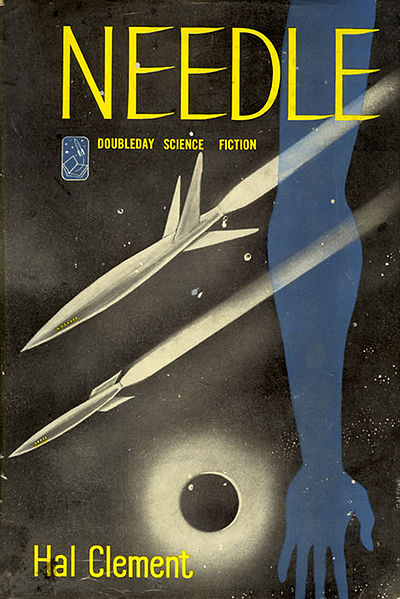
First published in 1950, Hal Clement’s Needle was a unique mixture of hard science fiction and police procedural. The story focused on an alien detective who crash-lands on Earth while chasing an intergalactic criminal. With his ship destroyed and his symbiant companion dead, The Hunter takes up residence inside a teenager’s body, eventually persuading his host to help him find the fugitive — no mean feat, as the fugitive can also hide, undetected, inside a human host.

The story was notable, in part, for Clement’s meticulous, detailed study of the alien’s physiology. Drawing on mid-century research on microorganisms, Clement imagined a highly intelligent, adaptable creature capable of manipulating its body to squeeze through tiny spaces and make use of its host’s sensory organs to learn more about its surroundings. Needle was also notable for the way in which Clement folded these speculative passages into an old-fashioned detective story; once The Hunter begins communicating directly with Bob, his host, the two retrace the fugitive’s steps, investigating everyone who might have come into contact with it and systematically ruling out suspects through careful observation of their behavior.

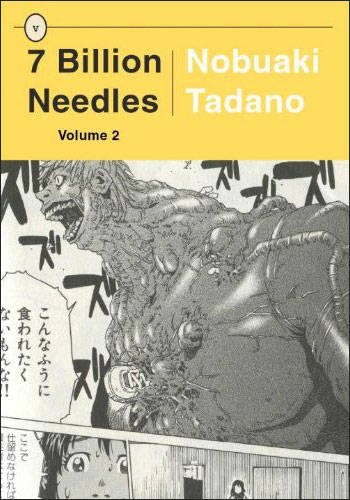
Nobuaki Tadano’s 7 Billion Needles (2008-10) draws inspiration from Clement’s novel, preserving the basic concept while tweaking the storyline to work in a graphic format. Gone are the long passages explaining how Horizon (as the alien detective is called in 7 Billion Needles) insinuates himself into his human host; in their place are more direct, dramatic scenes showing us how Horizon’s host, a sullen teenage girl named Hikaru, wrestles with the emotional and physical burden of helping him pursue Maelstrom, a shape-shifting creature so powerful he’s left a trail of dead planets in his wake.

As a result, 7 Billion Needles reads more like horror than hard science fiction, placing more emphasis on monster-hunting and raw adolescent emotion than the mechanics of Horizon and Hikaru’s symbiotic relationship. Tadano’s choices make good sense from the standpoint of pacing and visual drama; so much of the original novel took place inside Bob, it’s hard to imagine how an artist would have brought those passages to life in comic-book form. (That summary makes Needle sound impossibly dirty, but rest assured, it isn’t.) Tadano’s monster, too, is much better defined than Clement’s; Clement’s fugitive only appears in the final chapters of the book, the nature of his crime never fully explained, whereas Maelstrom, Tadano’s creation, is something out of a good B-movie, causing his host du jour to undergo grotesque transformations before going all-out alien.

The real genius of 7 Billion Needles, however, is the way Tadano uses teen angst as a key plot element. In the very first pages of volume one, we learn that Hikaru is an orphan, living with an aunt and uncle not much older than she is. As the story unfolds, Tadano seeds the conversation with nuggets of information about Hikaru’s past; in volume two, for example, we learn that Hikaru and her father had lived on a small island, where they became social pariahs, enduring threats, taunts, and vandalism from their neighbors. Not surprisingly, Hikaru is withdrawn at the beginning of 7 Billion Needles, openly defying teachers by wearing headphones in class and avoiding even the most basic interaction with her peers. Once she agrees to help Horizon, however, she must begin talking to other people — the only way Horizon can detect Malestrom’s presence is for Hikaru to interact with Maelstrom’s host. Her awkward attempts to connect with other students, and her fumbling efforts at friendship, add a raw emotional energy to 7 Billion Needles that is largely absent from Clement’s original story.

The series’ artwork is its only shortcoming. As Deb Aoki noted in her review of volume one, all the female characters have the same bland, plastic face, making them difficult to distinguish from one another. (Tadano’s rather weak efforts at creating a memorable supporting cast also contribute to the impression of sameness.) Some of the monster designs, too, lack inspiration — a key shortcoming in a genre known for its nightmarish, otherworldly imagery. When we first see Maelstrom in his true form, he looks like a tyrannosaurus rex; not until the second volume are we treated to a more terrifying and unsettling image of Malestrom as a grotesque composite of all the human beings he’s ingested. Perhaps most disappointing is Tadano’s over-reliance on the flash-boom, using big bursts of light and sound effects to indicate Horizon’s powers without really showing us what’s happening.

On the whole, however, 7 Billion Needles is an intelligent update on Needle, substituting the heat of adolescent angst and monster-slaying for the cool detachment of hard science and old-fashioned gumshoeing. Recommended.

Review copies provided by Vertical, Inc. Volume two will be released on November 23, 2010.

7 BILLION NEEDLES, VOLS. 1-2 • BY NOBUAKI TADANO • VERTICAL, INC. • RATING: 16+

Filed Under: Manga Critic Tagged With: Hal Clement, Seinen, vertical

7 Billion Needles, Vols. 1-2

November 21, 2010 by Katherine Dacey

First published in 1950, Hal Clement’s Needle was a unique mixture of hard science fiction and police procedural. The story focused on an alien detective who crash-lands on Earth while chasing an intergalactic criminal. With his ship destroyed and his symbiant companion dead, The Hunter takes up residence inside a teenager’s body, eventually persuading his host to help him find the fugitive — no mean feat, as the fugitive can also hide, undetected, inside a human host.

The story was notable, in part, for Clement’s meticulous, detailed study of the alien’s physiology. Drawing on mid-century research on microorganisms, Clement imagined a highly intelligent, adaptable creature capable of manipulating its body to squeeze through tiny spaces and make use of its host’s sensory organs to learn more about its surroundings. Needle was also notable for the way in which Clement folded these speculative passages into an old-fashioned detective story; once The Hunter begins communicating directly with Bob, his host, the two retrace the fugitive’s steps, investigating everyone who might have come into contact with it and systematically ruling out suspects through careful observation of their behavior.

Nobuaki Tadano’s 7 Billion Needles (2008-10) draws inspiration from Clement’s novel, preserving the basic concept while tweaking the storyline to work in a graphic format. Gone are the long passages explaining how Horizon (as the alien detective is called in 7 Billion Needles) insinuates himself into his human host; in their place are more direct, dramatic scenes showing us how Horizon’s host, a sullen teenage girl named Hikaru, wrestles with the emotional and physical burden of helping him pursue Maelstrom, a shape-shifting creature so powerful he’s left a trail of dead planets in his wake.

As a result, 7 Billion Needles reads more like horror than hard science fiction, placing more emphasis on monster-hunting and raw adolescent emotion than the mechanics of Horizon and Hikaru’s symbiotic relationship. Tadano’s choices make good sense from the standpoint of pacing and visual drama; so much of the original novel took place inside Bob, it’s hard to imagine how an artist would have brought those passages to life in comic-book form. (That summary makes Needle sound impossibly dirty, but rest assured, it isn’t.) Tadano’s monster, too, is much better defined than Clement’s; Clement’s fugitive only appears in the final chapters of the book, the nature of his crime never fully explained, whereas Maelstrom, Tadano’s creation, is something out of a good B-movie, causing his host du jour to undergo grotesque transformations before going all-out alien.

The real genius of 7 Billion Needles, however, is the way Tadano uses teen angst as a key plot element. In the very first pages of volume one, we learn that Hikaru is an orphan, living with an aunt and uncle not much older than she is. As the story unfolds, Tadano seeds the conversation with nuggets of information about Hikaru’s past; in volume two, for example, we learn that Hikaru and her father had lived on a small island, where they became social pariahs, enduring threats, taunts, and vandalism from their neighbors. Not surprisingly, Hikaru is withdrawn at the beginning of 7 Billion Needles, openly defying teachers by wearing headphones in class and avoiding even the most basic interaction with her peers. Once she agrees to help Horizon, however, she must begin talking to other people — the only way Horizon can detect Malestrom’s presence is for Hikaru to interact with Maelstrom’s host. Her awkward attempts to connect with other students, and her fumbling efforts at friendship, add a raw emotional energy to 7 Billion Needles that is largely absent from Clement’s original story.

The series’ artwork is its only shortcoming. As Deb Aoki noted in her review of volume one, all the female characters have the same bland, plastic face, making them difficult to distinguish from one another. (Tadano’s rather weak efforts at creating a memorable supporting cast also contribute to the impression of sameness.) Some of the monster designs, too, lack inspiration — a key shortcoming in a genre known for its nightmarish, otherworldly imagery. When we first see Maelstrom in his true form, he looks like a tyrannosaurus rex; not until the second volume are we treated to a more terrifying and unsettling image of Malestrom as a grotesque composite of all the human beings he’s ingested. Perhaps most disappointing is Tadano’s over-reliance on the flash-boom, using big bursts of light and sound effects to indicate Horizon’s powers without really showing us what’s happening.

On the whole, however, 7 Billion Needles is an intelligent update on Needle, substituting the heat of adolescent angst and monster-slaying for the cool detachment of hard science and old-fashioned gumshoeing. Recommended.

Review copies provided by Vertical, Inc. Volume two will be released on November 23, 2010.

7 BILLION NEEDLES, VOLS. 1-2 • BY NOBUAKI TADANO • VERTICAL, INC. • RATING: 16+

Filed Under: Manga, Manga Critic, REVIEWS Tagged With: Hal Clement, Sci-Fi, Vertical Comics

Superman vs. Muhammad Ali

November 20, 2010 by Katherine Dacey 4 Comments

I was six in 1978, the year DC Comics first published Superman vs. Muhammad Ali, so I can’t claim to have fond memories of reading it or seeing it on the newsstand. But as a product of the 1970s, the idea of putting a superhero and a celeb in an “event” comic makes intuitive sense to me. In 1978, it seemed like every TV show featured a special guest star or assembled a large group of Hollywood luminaries for some kind of friendly competition: remember The New Scooby-Doo Movies, in which Sandy Duncan and Cher helped the gang solve preposterous mysteries? Or Battle of the Network Stars, a forerunner of modern reality TV?

Superman vs. Muhammad Ali combines these two trends into a shamelessly entertaining package in which the world’s most famous superhero teams up with the world’s greatest boxer to defeat an alien race called… The Scrubb. (If you had any doubt that ten-year-old boys were the target audience for the original comic, look no further than the names; The Scrubb’s ruler is named Rat’lar.) Better still, Superman and Muhammad Ali duke it out in front of a distinguished audience of fictional DC characters, Hollywood actors, DC Comics personnel, and the POTUS himself, a veritable who’s-who of 1978. (At least on the cover; in the actual book, the fight takes place in front of a large, boisterous crowd of aliens that does not include Raquel Welch, Joe Namath, Kurt Vonnegut, or The Jackson Five.)

…

Read More

Filed Under: Manga Critic Tagged With: DC Comics, Superheroes, Superman

Superman vs. Muhammad Ali

November 20, 2010 by Katherine Dacey


I was six in 1978, the year DC Comics first published Superman vs. Muhammad Ali, so I can’t claim to have fond memories of reading it or seeing it on the newsstand. But as a product of the 1970s, the idea of putting a superhero and a celeb in an “event” comic makes intuitive sense to me. In 1978, it seemed like every TV show featured a special guest star or assembled a large group of Hollywood luminaries for some kind of friendly competition: remember The New Scooby-Doo Movies, in which Sandy Duncan and Cher helped the gang solve preposterous mysteries? Or Battle of the Network Stars, a forerunner of modern reality TV?

Superman vs. Muhammad Ali combines these two trends into a shamelessly entertaining package in which the world’s most famous superhero teams up with the world’s greatest boxer to defeat an alien race called… The Scrubb. (If you had any doubt that ten-year-old boys were the target audience for the original comic, look no further than the names; The Scrubb’s ruler is named Rat’lar.) Better still, Superman and Muhammad Ali duke it out in front of a distinguished audience of fictional DC characters, Hollywood actors, DC Comics personnel, and the POTUS himself, a veritable who’s-who of 1978. (At least on the cover; in the actual book, the fight takes place in front of a large, boisterous crowd of aliens that does not include Raquel Welch, Joe Namath, Kurt Vonnegut, or The Jackson Five.)

The concept was the brainchild of legendary boxing promoter Don King, who first pitched the idea to DC Comics in 1976 after seeing the media frenzy that accompanied the release of another event comic, Superman vs. The Amazing Spider-Man: The Battle of the Century. Working with editor Julie Schwartz, Dennis O’Neil and Neal Adams developed King’s Superman-versus-Ali concept into a storyline in which Superman and Muhammad Ali are ordered by alien invaders to fight each other to determine who is Earth’s greatest warrior. The winner, in turn, must go mano-a-mano with The Scrubb’s best fighter; if Earth’s representative loses, the planet will be annexed by The Scrubb as a slave labor colony.

On many levels, the Superman vs. Muhammad Ali is cheesier than a plate of Velveeta: who but a ten-year-old boy would dream up a scenario in which the fate of the world rested on the outcome of a boxing match between a fictional superhero and a larger-than-life athlete? Yet the well-crafted script keeps the idea in the realm of the… well, I won’t say plausible, but… logical, at least within the established parameters of the DC universe. Dennis O’Neil anticipates the reader’s many objections to the premise — doesn’t Superman have an unfair advantage over Ali? how could Ali possibly defeat a giant green alien who’s bigger and meaner than George Foreman? — by addressing them head-on: the big fight, for example, takes place under the glare of a red sun, thus draining Superman of his powers, while Ali proves the intergalactic versatility of the rope-a-dope when fighting The Scrubb’s best boxer.

The other secret to Superman vs. Muhammad Ali‘s success is that O’Neil captures Ali’s charisma and swagger without imitating his famous verbal mannerisms — a wise decision, I think, as it would be awfully hard to write Ali-esque dialogue without shading into parody. What O’Neil does instead is pure genius: he inserts a brief speech in which Ali explains the grammar and syntax of boxing to Superman, comparing various punches to declarative and interrogative statements. It’s hokey as hell but it works, showcasing the boxer’s quick wit and flair for metaphor while walking the reader through the basics of the sport. O’Neil’s characterization of Ali is nicely supported by Neal Adams’ artwork; not only does comic-book Ali look a lot like the real man, but he moves with the agility and speed that were hallmarks of Ali’s boxing.

If I had any criticism of Superman, it’s that DC published two different versions of the book: the cheaper, smaller “Deluxe” version includes some nice bonus material — an essay by DC publisher Jenette Kahn, preliminary sketches — but not the glorious, wraparound cover, while the “Facsimile” version reproduces the comic at its original trim size, with the full cover gracing the outside of the book. (The Deluxe version’s slipjacket only reproduces part of the original cover; the full image appears inside the book, to decidedly lesser effect.) At $39.99, the Facsimile version is nearly twice as expensive as the Deluxe version, further limiting its appeal to all but the most dedicated Superman fans.

Still, that’s a minor complaint about an eminently worthwhile project. I’d love to see DC and Marvel re-issue Superman vs. The Amazing Spider-Man in a similar, hardbound format. And if DC would really like to make me happy, they could commission a special 35th anniversary tribute to Superman vs. Muhammad Ali in which Supergirl and Laila Ali picked up where Clark Kent and Cassius Clay left off in 1978. Now that would be awesome.

SUPERMAN VS. MUHAMMAD ALI • BY NEAL ADAMS AND DENNY O’NEIL • DC COMICS • 96 pp. • NO RATING

Filed Under: Comics, Manga Critic, REVIEWS Tagged With: DC Comics, Superheroes, Superman

Short Cuts and Genkaku Picasso

November 18, 2010 by Katherine Dacey

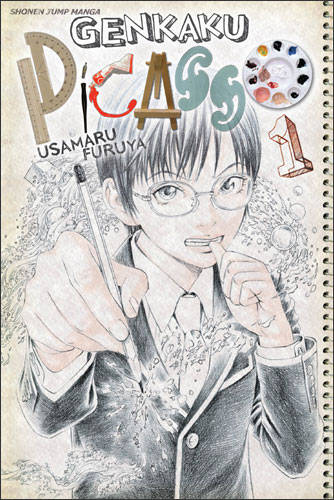
Short Cuts has the unique distinction of being one of the first manga I ever loathed. In fairness to Usamaru Furuya, I read it early in my relationship with manga, when the only titles I knew were Lone Wolf and Cub, Tokyo Babylon, InuYasha, Mermaid Saga, and X/1999. I found Short Cuts bewildering, frankly, as I knew very little about ko-gals — one of Furuya’s favorite subjects — and even less about the other cultural trends and manga tropes that Furuya gleefully mocked. Then, too, Furuya’s fascination with teenage girls, panties, casual prostitution, and incest grew tiresome: how many times can you play the am-I-shocking-you card before the shtick gets old? With the release of Genkaku Picasso, however, I thought it was a good time to revisit Short Cuts and see if I’d unfairly dismissed a great artist or correctly judged him as an unrepentant perv.

What I found was a decidedly mixed bag, a smorgasbord of jokes about girl cliques, lecherous salarymen, Valentine’s Day gift-giving, travel guides for foreigners, and, yes, sex. Some of the best strips tackle obvious targets in unexpected ways. Mr. Pick-on-Me, a recurring character, is one such example: he’s a robot whose sole job is to endure harassment from school kids, providing them a more attractive target for bullying than each other. He proves so effective, however, that the school administrators begin bullying him, too, necessitating the purchase of more robots. Another recurring character, Mitsu Cutie, is an assassin who assembles lethal weapons from bento boxes and Hello Kitty paraphernalia. Though Furuya is hardly the first person to wring laughs from a sweet-faced character’s degenerate behavior, the gag is surprisingly funny, not least for the way in which it carefully filters spy thriller conventions through the lens of shojo manga; it’s as if Takao Saito and Arina Tanemura teamed up to produce a story about a twelve-year-old hit girl.

Furuya is also a first-class mimic, capable of channeling just about any other artist’s style in service of a good joke. In one gag, for example, he twists a TV-addled teen’s face into a perfect imitation of Hitoshi Iwaaki’s parasite aliens, while in another, he shows a woman with ridiculously long eyelashes performing her daily grooming routine, revealing her true identity only in the final panel: she’s Maetel, the heroine of Leiji Matsumoto’s Galaxy Express 999. Even Tezuka take his lumps: in Furuya’s version of Astro Boy, the iconic robot looks like the rotund, bespectacled Dr. Ochanomizu, while his maker resembles Astro, though in Furuya’s telling, the mad scientist likes baggy knee socks, a hallmark of ko-gal fashion.

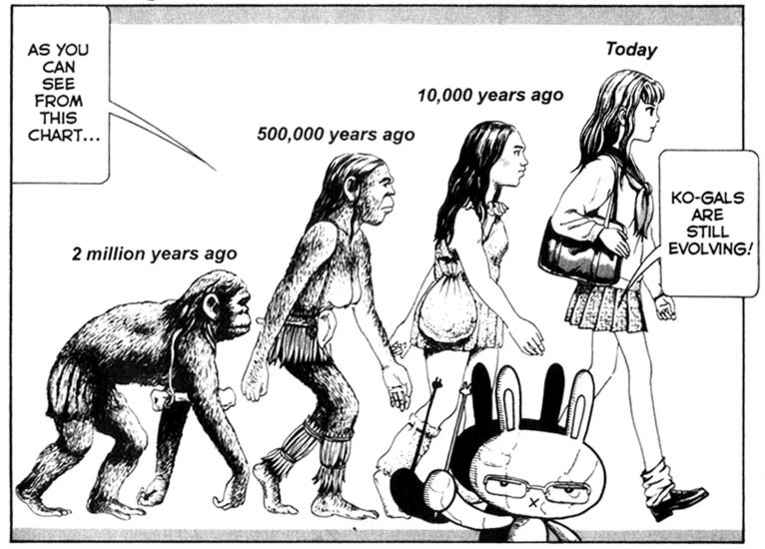
The Astro Boy strip is one of many poking fun at ko-gals, Japan’s own answer to the Valley Girl. Like their Orange County counterparts, kogals are an easy target: their speech and attire are distinctive and easily parodied, as are their devotion to shopping, brand names, and hanging out in the Shibuya district. That’s not to say that Furuya’s jokes are bad; to the contrary, there are some genuinely inspired panels. In one strip, for example, we see a shrine featuring monumental sculptures of ko-gals attended by elderly male priests in short skirts and baggy socks, while in another, a balding, middle-aged man apprentices himself to become a ko-gal, applying himself with the steely resolve of a samurai or geisha-in-training.

A lot of the ko-gal humor is rather mean-spirited, however, portraying girls as hopelessly dim, materialistic, and uninterested in sex unless it comes with a financial reward. Though the male characters are ridiculed for their willingness to pay teenage girls for sexual favors, Furuya allows the reader to have his cake and eat it, too, laughing with recognition at his weakness for panty flashes while being treated to… panty flashes. From very cute girls. Furuya even pokes fun at himself, punishing one of his female characters for her dawning awareness of his “Lolita complex.” (He first attempts to white her out, then resorts to drawing her as a monster.) In the final panel of the “cut,” he’s asserted control over the character again, blackmailing her into silence. The whole sequence is done with a nudge and a wink, as if to make us complicit in Furuya’s predilection for teenage girls; it’s a classic non-apology, the equivalent of saying, “No offense, but sixteen-year-olds are hawt, dude!”

In many ways, Genkaku Picasso seems like one of the two-page “cuts” dragged out to epic lengths. The story focuses on Hikari Hamura, a weird, asexual twit who becomes so involved with his sketch book that he finds a beautiful girl’s attention a nuisance. While sitting on the bank of a river with his classmate Chiaki, a bizarre disaster kills them both. She’s reincarnated as a pocket-sized angel; he’s reborn with a new supernatural gift, the ability to draw other people’s dreams. The central joke of the series is that Hikari is a terrible dream interpreter, reading even darker intent into other students’ nightmares than is implied by the imagery.

The need to show where Hikari’s interpretations go astray proves Genkaku Picasso‘s biggest weakness. Consider “Manba and Kotone,” the third story of volume one, in which one of Hikari’s classmates is plagued by images of a teenage girl being tortured and tied up. As Ng Suat Tong points out in his review of Genkaku, the punchline is squicky: these images aren’t a dark fantasy, but pictures from a magazine shoot in which the girl volunteered to pose for her father, a professional photographer. Handled in two panels, the joke would hit like a nasty rim shot, but as the driving force behind the chapter’s storyline, it becomes… well, seriously creepy, pushing the material into the decidedly unfunny territory of incest and parent-child power dynamics.

I actually liked Genkaku Picasso more than Tong did, partly because I think Furuya is having a ball subverting shonen cliches; it’s the kind of series in which doing your best means staving off body rot, not winning a tournament, and a quiet, philosophical moment between two teens is interrupted by a fiery helicopter crash. I also liked some of the dream sequences, which showcase Furuya’s incredible versatility as an artist. However pedestrian the script may be in explaining the images’ meaning — and yes, there are some borderline Oprah moments in every story — the dreams are nonetheless arresting in their strange specificity.

After reading Short Cuts and Genkaku Picasso, I’m convinced of Usamaru Furuya’s ability draw just about anything, and to tell a truly dirty joke. I’m not yet persuaded that he can work in a longer form, but perhaps if he’s adapting someone else’s story — say, Osamu Daizi’s No Longer Human — he might find the right structure for containing and directing his furious artistic energy.

Review copy of Gengaku Picasso provided by VIZ Media, LLC.

SHORT CUTS, VOLS. 1-2 • BY USAMARU FURUYA • VIZ • NO RATING (MATERIAL BEST SUITED FOR MATURE READERS)

GENKAKU PICASSO, VOL. 1 • BY USAMARU FURUYA • VIZ • 192 pp. • RATING: OLDER TEEN (16+)

Filed Under: Manga Critic Tagged With: Shonen, Shonen Jump, Usamaru Furuya, VIZ

Short Cuts and Genkaku Picasso

November 18, 2010 by Katherine Dacey

Short Cuts has the unique distinction of being one of the first manga I ever loathed. In fairness to Usamaru Furuya, I read it early in my relationship with manga, when the only titles I knew were Lone Wolf and Cub, Tokyo Babylon, InuYasha, Mermaid Saga, and X/1999. I found Short Cuts bewildering, frankly, as I knew very little about ko-gals — one of Furuya’s favorite subjects — and even less about the other cultural trends and manga tropes that Furuya gleefully mocked. Then, too, Furuya’s fascination with teenage girls, panties, casual prostitution, and incest grew tiresome: how many times can you play the am-I-shocking-you card before the shtick gets old? With the release of Genkaku Picasso, however, I thought it was a good time to revisit Short Cuts and see if I’d unfairly dismissed a great artist or correctly judged him as an unrepentant perv.

What I found was a decidedly mixed bag, a smorgasbord of jokes about girl cliques, lecherous salarymen, Valentine’s Day gift-giving, travel guides for foreigners, and, yes, sex. Some of the best strips tackle obvious targets in unexpected ways. Mr. Pick-on-Me, a recurring character, is one such example: he’s a robot whose sole job is to endure harassment from school kids, providing them a more attractive target for bullying than each other. He proves so effective, however, that the school administrators begin bullying him, too, necessitating the purchase of more robots. Another recurring character, Mitsu Cutie, is an assassin who assembles lethal weapons from bento boxes and Hello Kitty paraphernalia. Though Furuya is hardly the first person to wring laughs from a sweet-faced character’s degenerate behavior, the gag is surprisingly funny, not least for the way in which it carefully filters spy thriller conventions through the lens of shojo manga; it’s as if Takao Saito and Arina Tanemura teamed up to produce a story about a twelve-year-old hit girl.

Furuya is also a first-class mimic, capable of channeling just about any other artist’s style in service of a good joke. In one gag, for example, he twists a TV-addled teen’s face into a perfect imitation of Hitoshi Iwaaki’s parasite aliens, while in another, he shows a woman with ridiculously long eyelashes performing her daily grooming routine, revealing her true identity only in the final panel: she’s Maetel, the heroine of Leiji Matsumoto’s Galaxy Express 999. Even Tezuka take his lumps: in Furuya’s version of Astro Boy, the iconic robot looks like the rotund, bespectacled Dr. Ochanomizu, while his maker resembles Astro, though in Furuya’s telling, the mad scientist likes baggy knee socks, a hallmark of ko-gal fashion.

The Astro Boy strip is one of many poking fun at ko-gals, Japan’s own answer to the Valley Girl. Like their Orange County counterparts, kogals are an easy target: their speech and attire are distinctive and easily parodied, as are their devotion to shopping, brand names, and hanging out in the Shibuya district. That’s not to say that Furuya’s jokes are bad; to the contrary, there are some genuinely inspired panels. In one strip, for example, we see a shrine featuring monumental sculptures of ko-gals attended by elderly male priests in short skirts and baggy socks, while in another, a balding, middle-aged man apprentices himself to become a ko-gal, applying himself with the steely resolve of a samurai or geisha-in-training.

A lot of the ko-gal humor is rather mean-spirited, however, portraying girls as hopelessly dim, materialistic, and uninterested in sex unless it comes with a financial reward. Though the male characters are ridiculed for their willingness to pay teenage girls for sexual favors, Furuya allows the reader to have his cake and eat it, too, laughing with recognition at his weakness for panty flashes while being treated to… panty flashes. From very cute girls. Furuya even pokes fun at himself, punishing one of his female characters for her dawning awareness of his “Lolita complex.” (He first attempts to white her out, then resorts to drawing her as a monster.) In the final panel of the “cut,” he’s asserted control over the character again, blackmailing her into silence. The whole sequence is done with a nudge and a wink, as if to make us complicit in Furuya’s predilection for teenage girls; it’s a classic non-apology, the equivalent of saying, “No offense, but sixteen-year-olds are hawt, dude!”

In many ways, Genkaku Picasso seems like one of the two-page “cuts” dragged out to epic lengths. The story focuses on Hikari Hamura, a weird, asexual twit who becomes so involved with his sketch book that he finds a beautiful girl’s attention a nuisance. While sitting on the bank of a river with his classmate Chiaki, a bizarre disaster kills them both. She’s reincarnated as a pocket-sized angel; he’s reborn with a new supernatural gift, the ability to draw other people’s dreams. The central joke of the series is that Hikari is a terrible dream interpreter, reading even darker intent into other students’ nightmares than is implied by the imagery.

The need to show where Hikari’s interpretations go astray proves Genkaku Picasso‘s biggest weakness. Consider “Manba and Kotone,” the third story of volume one, in which one of Hikari’s classmates is plagued by images of a teenage girl being tortured and tied up. As Ng Suat Tong points out in his review of Genkaku, the punchline is squicky: these images aren’t a dark fantasy, but pictures from a magazine shoot in which the girl volunteered to pose for her father, a professional photographer. Handled in two panels, the joke would hit like a nasty rim shot, but as the driving force behind the chapter’s storyline, it becomes… well, seriously creepy, pushing the material into the decidedly unfunny territory of incest and parent-child power dynamics.

I actually liked Genkaku Picasso more than Tong did, partly because I think Furuya is having a ball subverting shonen cliches; it’s the kind of series in which doing your best means staving off body rot, not winning a tournament, and a quiet, philosophical moment between two teens is interrupted by a fiery helicopter crash. I also liked some of the dream sequences, which showcase Furuya’s incredible versatility as an artist. However pedestrian the script may be in explaining the images’ meaning — and yes, there are some borderline Oprah moments in every story — the dreams are nonetheless arresting in their strange specificity.

After reading Short Cuts and Genkaku Picasso, I’m convinced of Usamaru Furuya’s ability draw just about anything, and to tell a truly dirty joke. I’m not yet persuaded that he can work in a longer form, but perhaps if he’s adapting someone else’s story — say, Osamu Daizi’s No Longer Human — he might find the right structure for containing and directing his furious artistic energy.

Review copy of Gengaku Picasso provided by VIZ Media, LLC.

SHORT CUTS, VOLS. 1-2 • BY USAMARU FURUYA • VIZ • NO RATING (MATERIAL BEST SUITED FOR MATURE READERS)

GENKAKU PICASSO, VOL. 1 • BY USAMARU FURUYA • VIZ • 192 pp. • RATING: OLDER TEEN (16+)

Filed Under: Manga, Manga Critic, REVIEWS Tagged With: Shonen, Shonen Jump, Usamaru Furuya, VIZ

The Best Manga You’re Not Reading: Presents

October 29, 2010 by Katherine Dacey 8 Comments

Back in 2007, John Jakala coined the trademark-worthy phrase “comeuppance theater” to describe horror stories in which a mean, violent, or greedy person gets his just desserts: a vain woman becomes visibly grotesque, a murderer dies at the hands of his victim’s ghost. In order for comeuppance theater to be dramatically persuasive, the author needs to do more than just dream up a suitably ironic punishment for the villain; he needs to convince us that the villain is sufficiently deserving of said punishment, that the villain is, in fact, monstrous in his desires or behavior and not simply an average joe exercising bad judgment. We may not be rooting for the villain’s demise — we may even feel a twinge of sympathy for him or self-identification with his plight — but if the author has done his job, the villain’s punishment seems necessary for restoring the social order.

In Presents (CMX), Kananko Inuki puts an interesting spin on the material, using our love of gifts as the jumping-off point for some funny, nasty, and intelligent episodes of comeuppance theater. The series’ host is Kurumi, a strange little girl who doles out presents to bad people and victims alike. Some gifts prove the recipients’ undoing: in “Present of Love,” for example, a manipulative college student goads her suitor into buying expensive jewelry that he can’t afford, even though she loathes him. His last gift to her — a set of earrings that Kurumi promised would “bring them together” — initiates a chain of events that unite the foolish pair in death. Other gifts provide victims a tool for payback: in “The Scary Present,” Kurumi gives a giant, man-eating box to a girl whose big sister gives horrific, mean-spirited gifts, while in “The Return Present,” Kurumi helps a bullied teen find an appropriate present for her tormentor.

Not all the stories follow this exact template; Kurumi becomes less central to the plots in volumes two or three, sometimes functioning as a passive observer, other times not appearing in the story at all. Volume two, for example, opens with a peculiar — and not entirely successful — trio of stories about Christmas gifts’ potential to corrupt little kids. Other stories read more like fairy tales: in “Dream Present,” a young woman endures a series of painful rituals in order to win a prince’s hand in marriage (in homage to Cinderella’s stepsisters, she even dispenses with a few toes), while in “Konotori” (or “stork”), magical cabbages bestow fertility on deserving couples.

The most potent stories shed light on the indignities of childhood, especially playground politics. Many of Presents‘ female characters are preoccupied with their place in the school’s pecking order, selecting uglier or quieter classmates to serve as foils more than friends. Rinko, the mean-girl villain of “The Return Gift,” is a classic example, calmly admitting that her friendship with the shy, slow Suzuko makes her “relax and feel better about herself,” then quietly fuming when Suzuko begins coming into her own socially and academically. The principal characters in “The Keepsake” and “The Most Wanted Present” are similarly opportunistic, demanding extreme fealty from lonely, passive classmates; when these eager-to-please girls die in an effort to honor their promises, their tormentors suffer retribution from beyond the grave.

Frenemies are a staple of young adult literature, of course, but the bald presentation of the issue in Presents conveys the cruelty of the behavior more effectively than a more restrained, realistic depiction could, capturing the intensity of both the bully and the victim’s feelings in an immediate, visceral fashion. Inuki’s imagery in all three stories is cartoonishly grotesque: Rinko, for example, develops monster zits that look more like the handiwork of an alien virus than P. acnes, while Mamiko, the manipulative frenemy in “The Keepsake,” winds up with a grotesque scar on her chest in the shape of her dead friend’s profile. (Mamiko coveted Sakiko’s cameo brooch.) The pimples and the scars make visible Rinko and Mamiko’s true selves; though both are fully aware of what they’re doing (“I was happy to see the look of distress on Sakiko’s face,” Mamiko narrates), it’s not until they see their deformed likenesses that they grasp how hurtful their behavior really is.

The fact that bullies, mean girls, and big sisters factor so prominently into Presents suggests that Inuki was writing for a younger audience, a supposition borne out by her fondness for goosing the story with fleeting but gross images: a box of cockroaches, pus-covered wounds, rotting corpses. It’s a pity, then, that CMX opted for a Mature rating, as I think the series works well for teens, depicting the emotional horrors of childhood in a vivid, gruesomely funny way. The stories are varied enough to sustain an adult’s interest as well; readers with fond memories of Tales from the Crypt or The Twilight Zone will find a lot to like about Inuki’s work, from the efficiently of her storytelling — many of Presents‘ best chapters are less than twenty pages — to the pointedness of her punishments.

PRESENTS, VOLS. 1-3 • BY KANAKO INUKI • CMX • RATING: MATURE (18+)

The Best Manga You’re Not Reading is an occasional feature that highlights titles that aren’t getting the critical attention — or readership — they deserve. Click here for the inaugural column; click here for the series archive.

Filed Under: Manga Critic Tagged With: cmx, Kanako Inuki

  • « Go to Previous Page
  • Page 1
  • Interim pages omitted …
  • Page 23
  • Page 24
  • Page 25
  • Page 26
  • Page 27
  • Interim pages omitted …
  • Page 39
  • Go to Next Page »
 | Log in
Copyright © 2010 Manga Bookshelf | Powered by WordPress & the Genesis Framework