• Skip to primary navigation
  • Skip to main content
  • Skip to primary sidebar
  • Home
  • About Us
    • Privacy Policy
    • Comment Policy
    • Disclosures & Disclaimers
  • Resources
    • Links, Essays & Articles
    • Fandomology!
    • CLAMP Directory
    • BlogRoll
  • Features & Columns
    • 3 Things Thursday
    • Adventures in the Key of Shoujo
    • Bit & Blips (game reviews)
    • BL BOOKRACK
    • Bookshelf Briefs
    • Bringing the Drama
    • Comic Conversion
    • Fanservice Friday
    • Going Digital
    • It Came From the Sinosphere
    • License This!
    • Magazine no Mori
    • My Week in Manga
    • OFF THE SHELF
    • Not By Manga Alone
    • PICK OF THE WEEK
    • Subtitles & Sensibility
    • Weekly Shonen Jump Recaps
  • Manga Moveable Feast
    • MMF Full Archive
    • Yun Kouga
    • CLAMP
    • Shojo Beat
    • Osamu Tezuka
    • Sailor Moon
    • Fruits Basket
    • Takehiko Inoue
    • Wild Adapter
    • One Piece
    • After School Nightmare
    • Karakuri Odette
    • Paradise Kiss
    • The Color Trilogy
    • To Terra…
    • Sexy Voice & Robo
  • Browse by Author
    • Sean Gaffney
    • Anna Neatrour
    • Michelle Smith
    • Katherine Dacey
    • MJ
    • Brigid Alverson
    • Travis Anderson
    • Phillip Anthony
    • Derek Bown
    • Jaci Dahlvang
    • Angela Eastman
    • Erica Friedman
    • Sara K.
    • Megan Purdy
    • Emily Snodgrass
    • Nancy Thistlethwaite
    • Eva Volin
    • David Welsh
  • MB Blogs
    • A Case Suitable For Treatment
    • Experiments in Manga
    • MangaBlog
    • The Manga Critic
    • Manga Report
    • Soliloquy in Blue
    • Manga Curmudgeon (archive)

Manga Bookshelf

Discussion, Resources, Roundtables, & Reviews

Manga Critic

The Red Snake

April 5, 2011 by Katherine Dacey 1 Comment

The Red Snake isn’t the most disturbing manga I’ve read — that honor belongs to Mr. Arashi’s Amazing Freak Show, a book so intent on celebrating taboo behavior that I was certain I’d be arrested for having a copy in my house. But The Red Snake earns a special place on my manga-reading list for being one weirdest horror stories I’ve read, a grim fable about a family obsessed with bugs, boils, chickens, and snakes.

The book opens with the narrator wandering the halls of a sprawling house. “For as long as I can remember, I’ve wanted to get away from this house,” he explains. “Something evil lurks within these walls.” As lugubrious as the corridors and empty rooms may be, the inhabitants are even scarier: the grandfather is a tyrant who lavishes more attention on his poultry than on his family; the grandmother believes she’s a chicken and sits on a gigantic nest, attacking anyone who threatens her “territory”; the sister has an almost erotic fascination with insects; and the mother is a virtual slave, forced each day to massage and drain the pus from an enormous boil on the grandfather’s face. (Perhaps they’re the kind of people Tolstoy had in mind when he famously opined that “every unhappy family is unhappy in its own way”?)

What follows the prologue is hard to classify as a story; it’s more a string of loosely connected vignettes, all increasingly horrific, in which:

  • Snakes violate the sister in almost every way imaginable;
  • The sister kills chickens and drinks their blood — straight from their dripping necks;
  • The grandmother transforms into a chicken with a human head;
  • The mother gives birth to a monstrous creature that looks like a Garbage Pail Kid; and
  • The narrator goes mano-a-mano with a flotilla of zombie infants.

After nearly one hundred pages of blood-soaked insanity, we find ourselves right back where we started: the narrator begins his soliloquy about the house again, using the same words and wandering the same corridors as he did in the book’s opening pages.

Hino’s artwork resembles a scratchboard drawing or a woodblock print, characterized by large patches of black ink pierced by thin, white lines. In the opening pages, for example, there’s no visible light source anywhere in the house or the surrounding woods — no sky, no candles or lamps — creating an atmosphere of almost unbearable claustrophobia; the shadows are palpable, pressing in on the narrator just as surely as the demons he unwittingly frees later in the story.

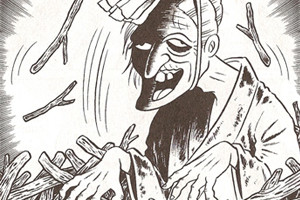
Character-wise, Hino’s designs belong to the same genotype as Kazuo Umezu and Kanako Inuki’s. Hino draws young girls and mothers as beautiful, glassy-eyed dolls and old women, fathers, and boys as grotesques. The narrator, for example, wears his worry like a shirt; he has enormous eyes rimmed in circles and is almost bald, even though his behavior and height peg him as a child of about ten or twelve. The grandparents, by contrast, resemble animals: the grandfather looks like a toad, with a bumpy hide, wide-set eyes, and a broad, leering mouth filled with rotting teeth, while the grandmother increasingly resembles the object of her delusion:

I feel like chicken tonight?

For all Hino’s ability to provoke and amuse, I’m not sure how I feel about The Red Snake. The story unfolds with the feverish logic of a dream, yielding some suitably creepy and bizarre images; I’ve never pictured the Sanzu River as alive with flesh-eating zombie babies, but it’s an arresting idea. The ending, too, is surprisingly effective. It’s not clear if the narrator realizes that he’s trapped in a cycle of unending horror, or is simply puzzled that all of the house’s nameless inhabitants have reverted to their “normal” state; either way, it’s a nasty punchline that subverts our desire — and the narrator’s — for closure.

At the same time, however, Hino has a juvenile fixation with blood, pus, and bugs, relishing every opportunity to draw a close-up of the grandfather’s boil or fill the page with a squirm of insects. Though some of these images merit an appreciative eewww, they’re too broadly cartoonish to really spook us; the grandfather’s ailments reminded me of an old George Carlin routine about the perverse delight humans take in studying their hangnails and pimples, rather than the disturbing metamorphoses found in Junji Ito and David Croenberg’s work. Maybe that’s Hino’s point: that we’re weirdly — almost comically — obsessed with our own bodily existence, but The Red Snake is so packed with ideas and sight gags and detours into the ludicrous that it’s hard to know what, exactly, Hino is trying to do besides mess with our heads.

THE RED SNAKE • BY HIDESHI HINO • DH PUBLISHING • 200 pp. • NO RATING (APPROPRIATE FOR OLDER TEENS AND MATURE AUDIENCES; SEXUAL CONTENT AND DISTURBING IMAGERY)
Filed Under: Manga Critic Tagged With: DH Publishing, Hideshi Hino, Horror/Supernatural

The Red Snake

April 5, 2011 by Katherine Dacey

The Red Snake isn’t the most disturbing manga I’ve read — that honor belongs to Mr. Arashi’s Amazing Freak Show, a book so intent on celebrating taboo behavior that I was certain I’d be arrested for having a copy in my house. But The Red Snake earns a special place on my manga-reading list for being one weirdest horror stories I’ve read, a grim fable about a family obsessed with bugs, boils, chickens, and snakes.

The book opens with the narrator wandering the halls of a sprawling house. “For as long as I can remember, I’ve wanted to get away from this house,” he explains. “Something evil lurks within these walls.” As lugubrious as the corridors and empty rooms may be, the inhabitants are even scarier: the grandfather is a tyrant who lavishes more attention on his poultry than on his family; the grandmother believes she’s a chicken and sits on a gigantic nest, attacking anyone who threatens her “territory”; the sister has an almost erotic fascination with insects; and the mother is a virtual slave, forced each day to massage and drain the pus from an enormous boil on the grandfather’s face. (Perhaps they’re the kind of people Tolstoy had in mind when he famously opined that “every unhappy family is unhappy in its own way”?)

What follows the prologue is hard to classify as a story; it’s more a string of loosely connected vignettes, all increasingly horrific, in which:

  • Snakes violate the sister in almost every way imaginable;
  • The sister kills chickens and drinks their blood — straight from their dripping necks;
  • The grandmother transforms into a chicken with a human head;
  • The mother gives birth to a monstrous creature that looks like a Garbage Pail Kid; and
  • The narrator goes mano-a-mano with a flotilla of zombie infants.

After nearly one hundred pages of blood-soaked insanity, we find ourselves right back where we started: the narrator begins his soliloquy about the house again, using the same words and wandering the same corridors as he did in the book’s opening pages.

Hino’s artwork resembles a scratchboard drawing or a woodblock print, characterized by large patches of black ink pierced by thin, white lines. In the opening pages, for example, there’s no visible light source anywhere in the house or the surrounding woods — no sky, no candles or lamps — creating an atmosphere of almost unbearable claustrophobia; the shadows are palpable, pressing in on the narrator just as surely as the demons he unwittingly frees later in the story.

Character-wise, Hino’s designs belong to the same genotype as Kazuo Umezu and Kanako Inuki’s. Hino draws young girls and mothers as beautiful, glassy-eyed dolls and old women, fathers, and boys as grotesques. The narrator, for example, wears his worry like a shirt; he has enormous eyes rimmed in circles and is almost bald, even though his behavior and height peg him as a child of about ten or twelve. The grandparents, by contrast, resemble animals: the grandfather looks like a toad, with a bumpy hide, wide-set eyes, and a broad, leering mouth filled with rotting teeth, while the grandmother increasingly resembles the object of her delusion:

I feel like chicken tonight?

For all Hino’s ability to provoke and amuse, I’m not sure how I feel about The Red Snake. The story unfolds with the feverish logic of a dream, yielding some suitably creepy and bizarre images; I’ve never pictured the Sanzu River as alive with flesh-eating zombie babies, but it’s an arresting idea. The ending, too, is surprisingly effective. It’s not clear if the narrator realizes that he’s trapped in a cycle of unending horror, or is simply puzzled that all of the house’s nameless inhabitants have reverted to their “normal” state; either way, it’s a nasty punchline that subverts our desire — and the narrator’s — for closure.

At the same time, however, Hino has a juvenile fixation with blood, pus, and bugs, relishing every opportunity to draw a close-up of the grandfather’s boil or fill the page with a squirm of insects. Though some of these images merit an appreciative eewww, they’re too broadly cartoonish to really spook us; the grandfather’s ailments reminded me of an old George Carlin routine about the perverse delight humans take in studying their hangnails and pimples, rather than the disturbing metamorphoses found in Junji Ito and David Croenberg’s work. Maybe that’s Hino’s point: that we’re weirdly — almost comically — obsessed with our own bodily existence, but The Red Snake is so packed with ideas and sight gags and detours into the ludicrous that it’s hard to know what, exactly, Hino is trying to do besides mess with our heads.

THE RED SNAKE • BY HIDESHI HINO • DH PUBLISHING • 200 pp. • NO RATING (APPROPRIATE FOR OLDER TEENS AND MATURE AUDIENCES; SEXUAL CONTENT AND DISTURBING IMAGERY)

Filed Under: Manga, Manga Critic, REVIEWS Tagged With: DH Publishing, Hideshi Hino, Horror/Supernatural

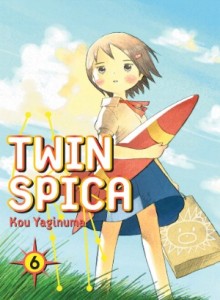
Twin Spica, Vols. 5-6

March 30, 2011 by Katherine Dacey 14 Comments

If you spend any time surfing the mangasphere, you don’t need me to tell you that Twin Spica is about a group of teenagers who are training to become Japan’s first astronauts. You probably know — or have heard from other readers — that it’s poignant. And you may have heard pundits declare it one of the best new series of 2010. (It made my best-of list.) Rather than re-hash plot points or tell you how awesome it is, therefore, I thought I’d share what I like best about Twin Spica: every volume makes me want to look up at the sky.

I’m not talking about the simple act of looking through a telescope or watching clouds drift in the wind — I’m talking about the way the act of looking at the sky makes me feel. Reflecting back on my childhood, that act elicited very specific emotions: the sky represented the future, a large canvas on which I could project my most cherished dreams of traveling to distant places, having adventures, and doing things that, from a six or eight-year-old’s perspective, seemed important. Kou Yaginuma clearly remembers that feeling from his own childhood, because his characters are at their most optimistic and thoughtful when they’re looking up at the sky and thinking about their own experiences.

There’s a lovely moment in volume six, for example, when Fuchuya’s grandfather tells six-year-old Asumi to cherish the memory of gazing up at the sky, as the sky will look different to her as she reaches adulthood. He explains:

You might as well spend your time looking up, at the sky. Me, I’ve spent decades staring up the sky in this town. I only thought the sky was very high when I was your age. When you’re old, it doesn’t seem quite that way. The sky you see as a kid is a lifelong treasure. I mean it. Value what you can see now, and only now.

Reading this passage reminds me of “Feldeinsamkeit” (“In Summerfields”), a beautiful piece of juvenilia from Charles Ives’ 114 Songs. The lyrics, taken from German poet Hermann Allmers, describe the experience of lying in a meadow on a summer’s afternoon and watching the sky. The sight of drifting clouds induces melancholy in his poem’s narrator, who — in typical nineteenth-century fashion — sees the clouds’ gentle, unfettered progress across the sky as a symbol of release from earthly burdens:

I’m resting quietly in tall green grass,
and cast my eyes far upwards;
around me crickets chirp unceasing,
the sky’s blue magically encloses me.

The beautiful white clouds float past
through the deep blue, like lovely silent dreams.
It is as if I had been long dead,
and flew in bliss with them through unending space.

Ives’ setting, by his own standards, is rather tame; there’s a running accompaniment figure that suggests fast-moving clouds, and a fleeting moment of bitonality, but it falls squarely within the nineteenth-century Stimmungslied tradition with its rounded binary form and gentle chromaticism. The song has an undeniably haunting quality, however. Its rapid modulation to harmonically distant key signatures and achingly sad melodic line suggest that the singer isn’t simply describing the act of watching clouds, as the lyrics alone might imply, but remembering what she was thinking and feeling as she did so.

That may sound like a minor distinction, but memory — or, more accurately, the act of remembering — is an important motif in the 114 Songs. “At the River,” for example, initially sounds like a straightforward rendition of “Shall We Gather At the River,” only to deviate from the melody as the singer “forgets” the proper tune, while “Memories” re-enacts a child’s enthusiasm at attending a concert. “In Summerfields” is less self-consciously modernist than either of these songs, but all three rely heavily on the illusion that the performer is reliving one of her own memories.

And that’s exactly the quality I find so compelling about Twin Spica: it’s a manga about living with vivid memories — some haunting, some happy — about reconciling past and present, about recognizing the value in both joy and pain, about negotiating the transition from youthful innocence to adulthood. In that scene with Fuchuya’s grandfather, we’re given a powerful reminder of just how much symbolic importance the sky holds for all of us, even if it doesn’t fill us with the same sense of wonder that it did when we were small.

Review copies provided by Vertical, Inc.

TWIN SPICA, VOLS. 5-6 • BY KOU YAGINUMA • VERTICAL, INC. • RATING: TEEN (13+)

Filed Under: Manga Critic Tagged With: Seinen, vertical

Twin Spica, Vols. 5-6

March 30, 2011 by Katherine Dacey

If you spend any time surfing the mangasphere, you don’t need me to tell you that Twin Spica is about a group of teenagers who are training to become Japan’s first astronauts. You probably know — or have heard from other readers — that it’s poignant. And you may have heard pundits declare it one of the best new series of 2010. (It made my best-of list.) Rather than re-hash plot points or tell you how awesome it is, therefore, I thought I’d share what I like best about Twin Spica: every volume makes me want to look up at the sky.

I’m not talking about the simple act of looking through a telescope or watching clouds drift in the wind — I’m talking about the way the act of looking at the sky makes me feel. Reflecting back on my childhood, that act elicited very specific emotions: the sky represented the future, a large canvas on which I could project my most cherished dreams of traveling to distant places, having adventures, and doing things that, from a six or eight-year-old’s perspective, seemed important. Kou Yaginuma clearly remembers that feeling from his own childhood, because his characters are at their most optimistic and thoughtful when they’re looking up at the sky and thinking about their own experiences.

There’s a lovely moment in volume six, for example, when Fuchuya’s grandfather tells six-year-old Asumi to cherish the memory of gazing up at the sky, as the sky will look different to her as she reaches adulthood. He explains:

You might as well spend your time looking up, at the sky. Me, I’ve spent decades staring up the sky in this town. I only thought the sky was very high when I was your age. When you’re old, it doesn’t seem quite that way. The sky you see as a kid is a lifelong treasure. I mean it. Value what you can see now, and only now.

Reading this passage reminds me of “Feldeinsamkeit” (“In Summerfields”), a beautiful piece of juvenilia from Charles Ives’ 114 Songs. The lyrics, taken from German poet Hermann Allmers, describe the experience of lying in a meadow on a summer’s afternoon and watching the sky. The sight of drifting clouds induces melancholy in his poem’s narrator, who — in typical nineteenth-century fashion — sees the clouds’ gentle, unfettered progress across the sky as a symbol of release from earthly burdens:

I’m resting quietly in tall green grass,
and cast my eyes far upwards;
around me crickets chirp unceasing,
the sky’s blue magically encloses me.

The beautiful white clouds float past
through the deep blue, like lovely silent dreams.
It is as if I had been long dead,
and flew in bliss with them through unending space.

Ives’ setting, by his own standards, is rather tame; there’s a running accompaniment figure that suggests fast-moving clouds, and a fleeting moment of bitonality, but it falls squarely within the nineteenth-century Stimmungslied tradition with its rounded binary form and gentle chromaticism. The song has an undeniably haunting quality, however. Its rapid modulation to harmonically distant key signatures and achingly sad melodic line suggest that the singer isn’t simply describing the act of watching clouds, as the lyrics alone might imply, but remembering what she was thinking and feeling as she did so.

That may sound like a minor distinction, but memory — or, more accurately, the act of remembering — is an important motif in the 114 Songs. “At the River,” for example, initially sounds like a straightforward rendition of “Shall We Gather At the River,” only to deviate from the melody as the singer “forgets” the proper tune, while “Memories” re-enacts a child’s enthusiasm at attending a concert. “In Summerfields” is less self-consciously modernist than either of these songs, but all three rely heavily on the illusion that the performer is reliving one of her own memories.

And that’s exactly the quality I find so compelling about Twin Spica: it’s a manga about living with vivid memories — some haunting, some happy — about reconciling past and present, about recognizing the value in both joy and pain, about negotiating the transition from youthful innocence to adulthood. In that scene with Fuchuya’s grandfather, we’re given a powerful reminder of just how much symbolic importance the sky holds for all of us, even if it doesn’t fill us with the same sense of wonder that it did when we were small.

Review copies provided by Vertical, Inc.

TWIN SPICA, VOLS. 5-6 • BY KOU YAGINUMA • VERTICAL, INC. • RATING: TEEN (13+)

Filed Under: Manga, Manga Critic, REVIEWS Tagged With: Seinen, vertical

Ai Ore!, Vol. 1

March 29, 2011 by Katherine Dacey 22 Comments

Androgyny is as much a part of rock-n-roll as sex, drugs, and three-minute guitar solos, so it seems only natural that a music-obsessed manga-ka would write about a female guitarist who struts like Mick Jagger, or a male singer who can wail like Whitney Houston. Putting two such androgynous rock-n-rollers together in the same manga seems like a stroke of genius — think of what Moto Hagio could do with those characters! — until you realize that Ai Ore! is written by the author of Sensual Phrase, quite possibly the silliest manga ever written about rock musicians.

Ai Ore! begins promisingly enough. Mizuki — a tall, masculine girl — reluctantly allows Akira — a short, feminine boy — to join her band Blaue Rosen. At first, Mizuki seems to be the dominant one; not only is she taller and stronger than Akira, she’s also more charismatic, commanding her friends’ loyalty through the strength of her personality, rather than her sexual allure. (Akira, by contrast, relies on his delicate good looks to get what he wants.) Mizuki claims to hate men, but it doesn’t take long before her cover is blown: she’s besotted with Akira.

So far, so good: Mizuki is a believable character, embracing a masculine persona to camouflage how uncomfortable she feels in her own skin. (As someone who was also tall and broad-shouldered in high school, I can attest to the special misery of being bigger than many of my female peers: I vacillated between striding the halls like General MacArthur and secretly wishing I was four inches shorter.) Even Mizuki’s desire to be softer and prettier for Akira makes sense; she can’t imagine that a boy would be interested in a girl who was unconventionally feminine, despite abundant evidence that both her female and male peers find her attractive.

No, where the story really goes off the rails is in its dogged insistence on including every shojo cliche in the Hana to Yume playbook. A few chapters into the series, for example, we learn that Mizuki’s ambivalence about men stems from a distressing childhood experience in which she became so infatuated with a cute boy that she felt physically ill. (In a line straight out of Guys and Dolls, Mizuki declares, “Men are bad for your health!”) Shinjo doesn’t bother to conceal the mystery prince’s identity from readers, nor does she use that revelation to bring her leads closer together; the whole episode feels completely perfunctory, as if Shinjo were ticking off plot points from a checklist. The same goes for a story line that sends Mizuki, Akira, and a bus full of girls on a retreat. You probably don’t need me to tell you that their destination is a resort with hot springs, or that Akira infiltrates the group by pretending to be girl, or that Mizuki’s virtue is threatened by one of Akira’s classmates who’s tagged along for the express purpose of putting the moves on Mizuki.

It’s too bad that the story settles for such predictable plot twists; there’s a germ of a good idea in here, a chance to challenge the way teenagers define “feminine” and “masculine” by celebrating kids who can’t be neatly pegged as either. Instead, Mizuki and Akira revert to stereotypical female and male roles in the drama, with Mizuki sobbing and trembling and needing rescues, and Akira playing the hero. Now where’s the rock-n-roll in that?

Review copy provided by VIZ Media, LLC. Volume one will be available on May 3, 2011.

AI ORE!, VOL. 1 • BY MAYU SHINJO • VIZ • 300 pp. • RATING: OLDER TEEN (16+)

Filed Under: Manga Critic Tagged With: Mayu Shinjo, shojo, shojo beat, VIZ

Ai Ore!, Vol. 1

March 29, 2011 by Katherine Dacey

Androgyny is as much a part of rock-n-roll as sex, drugs, and three-minute guitar solos, so it seems only natural that a music-obsessed manga-ka would write about a female guitarist who struts like Mick Jagger, or a male singer who can wail like Whitney Houston. Putting two such androgynous rock-n-rollers together in the same manga seems like a stroke of genius — think of what Moto Hagio could do with those characters! — until you realize that Ai Ore! is written by the author of Sensual Phrase, quite possibly the silliest manga ever written about rock musicians.

Ai Ore! begins promisingly enough. Mizuki — a tall, masculine girl — reluctantly allows Akira — a short, feminine boy — to join her band Blaue Rosen. At first, Mizuki seems to be the dominant one; not only is she taller and stronger than Akira, she’s also more charismatic, commanding her friends’ loyalty through the strength of her personality, rather than her sexual allure. (Akira, by contrast, relies on his delicate good looks to get what he wants.) Mizuki claims to hate men, but it doesn’t take long before her cover is blown: she’s besotted with Akira.

So far, so good: Mizuki is a believable character, embracing a masculine persona to camouflage how uncomfortable she feels in her own skin. (As someone who was also tall and broad-shouldered in high school, I can attest to the special misery of being bigger than many of my female peers: I vacillated between striding the halls like General MacArthur and secretly wishing I was four inches shorter.) Even Mizuki’s desire to be softer and prettier for Akira makes sense; she can’t imagine that a boy would be interested in a girl who was unconventionally feminine, despite abundant evidence that both her female and male peers find her attractive.

No, where the story really goes off the rails is in its dogged insistence on including every shojo cliche in the Hana to Yume playbook. A few chapters into the series, for example, we learn that Mizuki’s ambivalence about men stems from a distressing childhood experience in which she became so infatuated with a cute boy that she felt physically ill. (In a line straight out of Guys and Dolls, Mizuki declares, “Men are bad for your health!”) Shinjo doesn’t bother to conceal the mystery prince’s identity from readers, nor does she use that revelation to bring her leads closer together; the whole episode feels completely perfunctory, as if Shinjo were ticking off plot points from a checklist. The same goes for a story line that sends Mizuki, Akira, and a bus full of girls on a retreat. You probably don’t need me to tell you that their destination is a resort with hot springs, or that Akira infiltrates the group by pretending to be girl, or that Mizuki’s virtue is threatened by one of Akira’s classmates who’s tagged along for the express purpose of putting the moves on Mizuki.

It’s too bad that the story settles for such predictable plot twists; there’s a germ of a good idea in here, a chance to challenge the way teenagers define “feminine” and “masculine” by celebrating kids who can’t be neatly pegged as either. Instead, Mizuki and Akira revert to stereotypical female and male roles in the drama, with Mizuki sobbing and trembling and needing rescues, and Akira playing the hero. Now where’s the rock-n-roll in that?

Review copy provided by VIZ Media, LLC. Volume one will be available on May 3, 2011.

AI ORE!, VOL. 1 • BY MAYU SHINJO • VIZ • 300 pp. • RATING: OLDER TEEN (16+)

Filed Under: Manga, Manga Critic, REVIEWS Tagged With: Mayu Shinjo, Musical Manga, shojo beat, VIZ

How to Pen & Ink: The Manga Start-Up Guide

March 25, 2011 by Katherine Dacey 2 Comments

Type the words “how to draw manga” into the Amazon.com search engine, and you’ll net over 575 results. These books run the gamut from Manga-for-Dummies manuals, designed to teach beginners the basics of figure drawing and paneling, to highly specialized texts focusing on a specific skill — say, applying screentone or drawing buxom warriors.

One of the biggest drawbacks to these manuals is the lack of examples culled from actual manga; for licensing reasons, many of these how-to books feature original art that may not be drawn by a professional working in the Japanese publishing industry. And while many of these books possess genuine educational value for the beginning artist, teaching from a copy — however good it might be — isn’t the same thing as learning from the original. That’s where DMP’s How to Pen & Ink: The Manga Start-Up Guide comes in: the book is liberally illustrated with sketches, pin-up art, and finished pages from the work of Oh!Great (Tenjo Tenge, Air Gear), Yasuhiro Nightow (Trigun), and Satoshi Shiki (Kami-Kaze), as well as a half-dozen other established artists.

The book is divided into two sections. In the first, billed as a “close-up of how a manga is born,” each of the three featured manga-ka takes readers step-by-step through the creation of a pen-and-ink drawing, offering insights into their own work process. In the second, readers practice drawing their own manga. This section, which comprises most of the book, contains a list of tools used by professional manga artists, a lengthy Q&A section aimed at novice creators, and a variety of exercises, the most useful of which focus on working with pens. Over a four-week period, readers learn how to draw lines of varying weight, length, and straightness; how to draw effective speedlines; and how to use crosshatching to define space and volume.

What distinguishes Pen & Ink from other how-to manuals is its approach: manga isn’t treated as a style but as a storytelling medium. Almost of the advice focuses on how to draw effective stories, whether readers are learning where to place word balloons or how to use speedlines and panel frames to direct the eye to a key element in the layout. Though some of the tips are too vague to be helpful, the book is chock-full of examples culled from the pages of Air Gear, Kami-Kaze, and Trigun, as well as Hikou x Shonen, Oudo no Kishi Moro, Sgt. Frog, Trigun, and Vampire Princess Yui — a diversity that nicely underscores the manga-as-medium message.

Anyone who’s taken a few life drawing courses should be able to complete most of the exercises, though they may wish to supplement Pen & Ink with a manual on character design. (Tips for drawing eyes, hands, and bodies are too scarce to be very helpful to novice cartoonists.) For readers just learning the basics — anatomy, perspective drawing — most of the information in the book is too advanced to be immediately beneficial; the ideal audience is someone who already owns a few pens and drawing tools but needs guidance on how to work more effectively with them.

Review copy provided by Digital Manga Publishing, Inc.

HOW TO PEN & INK: THE MANGA START-UP GUIDE • VARIOUS AUTHORS • DMP • 114 pp. • NO RATING (BEST SUITED FOR TEENS, AS THE SECTION ON OH!GREAT INCLUDES SOME NUDITY)

Filed Under: Manga Critic Tagged With: DMP, How-To, Oh!Great, Satoshi Shiki, Yasuhiro Nightow

How to Pen & Ink: The Manga Start-Up Guide

March 25, 2011 by Katherine Dacey

Type the words “how to draw manga” into the Amazon.com search engine, and you’ll net over 575 results. These books run the gamut from Manga-for-Dummies manuals, designed to teach beginners the basics of figure drawing and paneling, to highly specialized texts focusing on a specific skill — say, applying screentone or drawing buxom warriors.

One of the biggest drawbacks to these manuals is the lack of examples culled from actual manga; for licensing reasons, many of these how-to books feature original art that may not be drawn by a professional working in the Japanese publishing industry. And while many of these books possess genuine educational value for the beginning artist, teaching from a copy — however good it might be — isn’t the same thing as learning from the original. That’s where DMP’s How to Pen & Ink: The Manga Start-Up Guide comes in: the book is liberally illustrated with sketches, pin-up art, and finished pages from the work of Oh!Great (Tenjo Tenge, Air Gear), Yasuhiro Nightow (Trigun), and Satoshi Shiki (Kami-Kaze), as well as a half-dozen other established artists.

The book is divided into two sections. In the first, billed as a “close-up of how a manga is born,” each of the three featured manga-ka takes readers step-by-step through the creation of a pen-and-ink drawing, offering insights into their own work process. In the second, readers practice drawing their own manga. This section, which comprises most of the book, contains a list of tools used by professional manga artists, a lengthy Q&A section aimed at novice creators, and a variety of exercises, the most useful of which focus on working with pens. Over a four-week period, readers learn how to draw lines of varying weight, length, and straightness; how to draw effective speedlines; and how to use crosshatching to define space and volume.

What distinguishes Pen & Ink from other how-to manuals is its approach: manga isn’t treated as a style but as a storytelling medium. Almost of the advice focuses on how to draw effective stories, whether readers are learning where to place word balloons or how to use speedlines and panel frames to direct the eye to a key element in the layout. Though some of the tips are too vague to be helpful, the book is chock-full of examples culled from the pages of Air Gear, Kami-Kaze, and Trigun, as well as Hikou x Shonen, Oudo no Kishi Moro, Sgt. Frog, Trigun, and Vampire Princess Yui — a diversity that nicely underscores the manga-as-medium message.

Anyone who’s taken a few life drawing courses should be able to complete most of the exercises, though they may wish to supplement Pen & Ink with a manual on character design. (Tips for drawing eyes, hands, and bodies are too scarce to be very helpful to novice cartoonists.) For readers just learning the basics — anatomy, perspective drawing — most of the information in the book is too advanced to be immediately beneficial; the ideal audience is someone who already owns a few pens and drawing tools but needs guidance on how to work more effectively with them.

Review copy provided by Digital Manga Publishing, Inc.

HOW TO PEN & INK: THE MANGA START-UP GUIDE • VARIOUS AUTHORS • DMP • 114 pp. • NO RATING (BEST SUITED FOR TEENS, AS THE SECTION ON OH!GREAT INCLUDES SOME NUDITY)

Filed Under: Books, Classic Manga Critic, Manga Critic, REVIEWS Tagged With: DMP, How-To, Oh!Great, Satoshi Shiki, Yasuhiro Nightow

Manga Artifacts: Memories

March 18, 2011 by Katherine Dacey 20 Comments

Given the speed with which DC Comics shuttered CMX Manga last year, it’s easy to forget that both DC and Marvel actually wanted to publish manga back in the day. Marvel’s manga output paled in comparison with DC’s, but is notable nonetheless, as Marvel helped introduce American readers to one the most influential manga-ka of the last thirty years: Katsuhiro Otomo.

Like Dark Horse, Eclipse Comics, and other companies who dabbled in manga publishing in the 1980s and 1990s, Marvel licensed work that it believed would appeal to the direct market. Marvel’s first acquisition was Katsuhiro Otomo’s dystopian epic AKIRA. Between 1988 and 1995, Marvel published the story in thirty-eight issues, each colorized and flipped in a calculated bid to woo American sci-fi fans. Though Marvel never finished collecting the original issues into bound editions, AKIRA proved important nonetheless, offering many American readers their first exposure to Japanese comics.

Marvel licensed work from other countries as well — including Airtight Garage and Blueberry, both by French artist Moebius — but never developed a substantial manga catalog; aside from AKIRA, the only manga it published were two short, stand-alone stories from early in Otomo’s career: “Memories” and “Farewell to Weapons.” “Memories” was issued in two forms: the first, in 1992, was a standard, thirty-two-page pamphlet with flipped, colorized artwork. The second, in 1995, was only released in the UK; Mandarin Books re-printed “Memories” and “Farewell to Weapons” as part of a longer anthology of Otomo’s short stories. (That anthology is called Memories and is out-of print; the ISBN is 0749396873.)

Plot-wise, “Memories” is simple but effective: a three-man salvage crew accepts a job clearing the “Sargasso Sea,” a debris field in deep space. They begin receiving a mysterious transmission from a large, rose-shaped ship inside the field, and decide to investigate. Once aboard, the crew makes an astonishing discovery: the interior resembles an English manor house with a formal dining room, an immense library, and a mysterious hallway guarded by robot sentries. As the men begin searching the ship for clues to the owner’s identity, a constellation of forces — including a fierce magnetic storm — threaten to compromise their mission.

It’s a tried-and-true sci-fi plot that’s enlivened by the efficiency of the set-up and the specificity of the art. Otomo wastes few pages establishing the crew members’ personalities and reasons for accepting the assignment. Though he teases the reader with hints about what awaits the men aboard the ghost ship, Otomo doesn’t belabor the introduction, swiftly transferring the action from the salvage vessel to the “magnetic rose.” The contrast between the ships is arresting; the Disposer is cramped, with plain steel walls and banks of computers, while the ghost ship is opulent and cavernous, festooned in elk heads, gilt-framed oil paintings, mirrors, and the kind of expensive bric-a-brac one might expect to find at Thornfield or Chesney Wold.

Normally, I’m a purist about black-and-white imagery, but Steve Oliff’s expert coloring brings clarity and emotion to the work that might otherwise be absent. Many of Otomo’s finer details — the pattern in an elaborate rug, for example, or the grain in a wood panel — pop with the judicious use of color, giving the ghost ship’s interior a more palpable feel. The use of rich reds, purples, and golds colors further reinforces strangeness of the environment; we, too, want to know why this lavish ship is adrift inside a cloud of metal, glass, and machine parts. Most importantly, however, Oliff uses color to underscore the characters’ emotional state, using an intense, disturbing green backdrop in the final pages of the story to suggest their growing state of panic as they discover the ship’s true purpose.

Readers curious about “Memories” won’t have any difficulty scaring up inexpensive copies on eBay; I paid less than a dollar for a bagged and boarded one in great condition. Anime fans may prefer to seek out the big-screen adaptation, which is longer and more detailed than the source material. (More information about the anime can be found here.) In either format, this short story is surprisingly eerie and graceful, proof that even the most familiar plot lines can acquire new power in the hands of an expert storyteller.

Manga Artifacts is a monthly feature exploring older, out-of-print manga published in the 1980s and 1990s. For a fuller description of the series’ purpose, see the inaugural column.

MEMORIES • BY KATSUHIRO OTOMO • EPIC COMICS (MARVEL) • 32 pp. • NO RATING

Filed Under: Manga Critic Tagged With: Classic, Katsuhiro Otomo, Marvel Comics

Manga Artifacts: Memories

March 18, 2011 by Katherine Dacey

Given the speed with which DC Comics shuttered CMX Manga last year, it’s easy to forget that both DC and Marvel actually wanted to publish manga back in the day. Marvel’s manga output paled in comparison with DC’s, but is notable nonetheless, as Marvel helped introduce American readers to one the most influential manga-ka of the last thirty years: Katsuhiro Otomo. Like Dark Horse, Eclipse Comics, and other companies who dabbled in manga publishing in the 1980s and 1990s, Marvel licensed work that it believed would appeal to the direct market. Marvel’s first acquisition was Katsuhiro Otomo’s dystopian epic AKIRA. Between 1988 and 1995, Marvel published the story in thirty-eight issues, each colorized and flipped in a calculated bid to woo American sci-fi fans. Though Marvel never finished collecting the original issues into bound editions, AKIRA proved important nonetheless, offering many American readers their first exposure to Japanese comics.

Marvel licensed work from other countries as well — including Airtight Garage and Blueberry, both by French artist Moebius — but never developed a substantial manga catalog; aside from AKIRA, the only manga it published were two short, stand-alone stories from early in Otomo’s career: “Memories” and “Farewell to Weapons.” “Memories” was issued in two forms: the first, in 1992, was a standard, thirty-two-page pamphlet with flipped, colorized artwork. The second, in 1995, was only released in the UK; Mandarin Books re-printed “Memories” and “Farewell to Weapons” as part of a longer anthology of Otomo’s short stories. (That anthology is called Memories and is out-of print; the ISBN is 0749396873.)

Plot-wise, “Memories” is simple but effective: a three-man salvage crew accepts a job clearing the “Sargasso Sea,” a debris field in deep space. They begin receiving a mysterious transmission from a large, rose-shaped ship inside the field, and decide to investigate. Once aboard, the crew makes an astonishing discovery: the interior resembles an English manor house with a formal dining room, an immense library, and a mysterious hallway guarded by robot sentries. As the men begin searching the ship for clues to the owner’s identity, a constellation of forces — including a fierce magnetic storm — threaten to compromise their mission.

It’s a tried-and-true sci-fi plot that’s enlivened by the efficiency of the set-up and the specificity of the art. Otomo wastes few pages establishing the crew members’ personalities and reasons for accepting the assignment. Though he teases the reader with hints about what awaits the men aboard the ghost ship, Otomo doesn’t belabor the introduction, swiftly transferring the action from the salvage vessel to the “magnetic rose.” The contrast between the ships is arresting; the Disposer is cramped, with plain steel walls and banks of computers, while the ghost ship is opulent and cavernous, festooned in elk heads, gilt-framed oil paintings, mirrors, and the kind of expensive bric-a-brac one might expect to find at Thornfield or Chesney Wold.

Normally, I’m a purist about black-and-white imagery, but Steve Oliff’s expert coloring brings clarity and emotion to the work that might otherwise be absent. Many of Otomo’s finer details — the pattern in an elaborate rug, for example, or the grain in a wood panel — pop with the judicious use of color, giving the ghost ship’s interior a more palpable feel. The use of rich reds, purples, and golds colors further reinforces strangeness of the environment; we, too, want to know why this lavish ship is adrift inside a cloud of metal, glass, and machine parts. Most importantly, however, Oliff uses color to underscore the characters’ emotional state, using an intense, disturbing green backdrop in the final pages of the story to suggest their growing state of panic as they discover the ship’s true purpose.

Readers curious about “Memories” won’t have any difficulty scaring up inexpensive copies on eBay; I paid less than a dollar for a bagged and boarded one in great condition. Anime fans may prefer to seek out the big-screen adaptation, which is longer and more detailed than the source material. (More information about the anime can be found here.) In either format, this short story is surprisingly eerie and graceful, proof that even the most familiar plot lines can acquire new power in the hands of an expert storyteller.

Manga Artifacts is a monthly feature exploring older, out-of-print manga published in the 1980s and 1990s. For a fuller description of the series’ purpose, see the inaugural column.

MEMORIES • BY KATSUHIRO OTOMO • EPIC COMICS (MARVEL) • 32 pp. • NO RATING

Filed Under: Manga, Manga Critic, Recommended Reading, REVIEWS Tagged With: Classic, Katsuhiro Otomo, Marvel Comics

The Manga Hall of Shame: Wounded Man

March 8, 2011 by Katherine Dacey 41 Comments

Nicholas Cage, I have a swell idea for your next project: option the rights to Wounded Man. This mid-eighties schlockfest is tailor made for you. It has a hero with extravagantly bad hair, bad guys so charismatic they beg for Christopher Walken or Sharon Stone to play them, and copious amounts of acrobatic sex and violence. And while it lacks the evil Nazis and mad scientists of Offered, another Kazuo Koike gem set in South America, Wounded Man does Offered one better: the series’ main villain is a pornographer. But not the sleazy, sad-sack type who might be the prime suspect on a Law & Order: SVU episode — no, the chief villain in Wounded Man runs a studio called God’s Pornographic X-Rated Films, a.k.a. GPX. She also wears a caftan and carries a parasol.

You know she’s evil.

Wounded Man begins in Brazil, where Yuko Kusaka, an ambitious young NHK reporter, is pursuing a story about a modern-day gold rush in the Amazon basin. Yuko is intent on finding “Rio Baraki,” a prospector who’s rumored to be Japanese. Baraki finds her first, however, savagely attacking her in a city park. “You’d better thank me because this could be much worse!” he tells Yuko. “Go back to Japan if you don’t want anymore trouble!” (He also talks to her at great length about the unsavory eating habits of Amazonian fish, dialogue that’s so unsafe for work I’ll do the honorable thing and not reprint it here.)

What Baraki doesn’t count on is that Yuko falls madly in love with him, following him deep into the jungle in spite of his dire warnings. She and her camera crew are ambushed by bandits, tied up, and sexually tortured; Baraki rescues them. She then jettisons her crew and tags along with Baraki. Once again, she’s ambushed, tied up, and sexually tortured; once again, Baraki rescues her. Baraki and Yuko then fight; they have sex; and Baraki tells Yuko his sad story, a story even more screwed up than all crazy, non-con antics that preceded it.

Baraki, it turns out, was once Keisuke Ibaraki, star quarterback at USC. After a big game, a group of thugs kidnapped him and his high school sweetheart, threatening them with death if Baraki refused to make an X-rated film with a famous female tennis player. Baraki turned GPX down; his heart belonged to Natsuko, and no amount of money would compromise his resolve. Not even the prospect of starvation undermined his commitment to Natsuko — naked and locked in a dungeon, the two survived by drinking each other’s urine before Natsuko finally died. Baraki lived, and has been plotting his revenge ever since he escaped GPX’s clutches.

I’m not making this up.

You’d be forgiven for thinking that a couple of porn-addled teenagers were responsible for the script, however; the whole story feels like something concocted by Dirk Diggler in one of his pitiful bids for movie-actor legitimacy. Though the ostensible genre is action/adventure, the story’s epic sex scenes take up more than half the first volume alone, with only the occasional fist-fight or manly swim through piranha-infested waters to relieve the tedium. The most reprehensible aspect of all the fornicating, however, is how little of it is genuinely consensual. Yuko is molested by Baraki, by random smugglers and poachers, even by members of her own television crew in a scene unpleasantly reminiscent of Deliverance, yet Koike and artist Ryochi Ikegami play these episodes for maximum titillation, trotting out one of the hoariest, most offensive cliches from the rape culture playbook: the victim who falls for her attacker because the sex is so amazing.

I wish I were making this up.

Koike and Ryoichi Ikegami find other ways to offend as well. The Brazilian characters are drawn as crude caricatures, with hulking physiques, gap-toothed smiles, and leering eyes; their primary role in the story is menacing Yuko. The few female characters are equally ridiculous, shunning clothing the way six-year-olds shun brussell sprouts; I’ve never seen so much laughably gratuitous nudity in a manga before. (The naked tennis player is kind of disconcerting, however, as she looks an awful lot like Martina Navatarola.)

The series’ greatest offense, however, is the way Yuko is portrayed. She may be a judo champ, capable of delivering a high-flying kick, and a rising star at the NHK, scoring high ratings with her investigative journalism, but her behavior is so petulant, so dumb, and so completely contradictory that Koike undermines her identity as a competent, strong woman. “That’s right, I hate you,” she tells Baraki during one of their numerous fights. “But at the same time, I love you so much! I’m so in love with you and I get so weak just being touched by you.” Her frequent hysterical outbursts would be comical if they didn’t serve to infantilize and diminish her, robbing her of any meaningful agency or identity outside of sex object.

Really, I wish I were making this up.

I’d be the first to admit that Wounded Man is luridly fascinating. It’s hard to imagine who thought any of it was a good idea, though it unfolds in such a fast, furious, and utterly unironic fashion that readers may be swept up in the story despite their better judgment. In short, Wounded Man is perfect fodder for a Nick Cage movie. Agents, are you listening?

WOUNDED MAN, VOLS. 1-9 • STORY BY KAZUO KOIKE, ART BY RYOICHI IKEGAMI • COMICSONE • RATING: MATURE (COPIOUS NUDITY AND VIOLENCE, VIOLENCE AGAINST WOMEN, STRONG LANGUAGE, INANE PLOT TWISTS)

Filed Under: Manga Critic Tagged With: Bad Manga, ComicsOne, Kazuo Koike, Seinen

The Manga Hall of Shame: Wounded Man

March 8, 2011 by Katherine Dacey

Nicholas Cage, I have a swell idea for your next project: option the rights to Wounded Man. This mid-eighties schlockfest is tailor made for you. It has a hero with extravagantly bad hair, bad guys so charismatic they beg for Christopher Walken or Sharon Stone to play them, and copious amounts of acrobatic sex and violence. And while it lacks the evil Nazis and mad scientists of Offered, another Kazuo Koike gem set in South America, Wounded Man does Offered one better: the series’ main villain is a pornographer. But not the sleazy, sad-sack type who might be the prime suspect on a Law & Order: SVU episode — no, the chief villain in Wounded Man runs a studio called God’s Pornographic X-Rated Films, a.k.a. GPX. She also wears a caftan and carries a parasol.

You know she’s evil.

Wounded Man begins in Brazil, where Yuko Kusaka, an ambitious young NHK reporter, is pursuing a story about a modern-day gold rush in the Amazon basin. Yuko is intent on finding “Rio Baraki,” a prospector who’s rumored to be Japanese. Baraki finds her first, however, savagely attacking her in a city park. “You’d better thank me because this could be much worse!” he tells Yuko. “Go back to Japan if you don’t want anymore trouble!” (He also talks to her at great length about the unsavory eating habits of Amazonian fish, dialogue that’s so unsafe for work I’ll do the honorable thing and not reprint it here.)

What Baraki doesn’t count on is that Yuko falls madly in love with him, following him deep into the jungle in spite of his dire warnings. She and her camera crew are ambushed by bandits, tied up, and sexually tortured; Baraki rescues them. She then jettisons her crew and tags along with Baraki. Once again, she’s ambushed, tied up, and sexually tortured; once again, Baraki rescues her. Baraki and Yuko then fight; they have sex; and Baraki tells Yuko his sad story, a story even more screwed up than all crazy, non-con antics that preceded it.

Baraki, it turns out, was once Keisuke Ibaraki, star quarterback at USC. After a big game, a group of thugs kidnapped him and his high school sweetheart, threatening them with death if Baraki refused to make an X-rated film with a famous female tennis player. Baraki turned GPX down; his heart belonged to Natsuko, and no amount of money would compromise his resolve. Not even the prospect of starvation undermined his commitment to Natsuko — naked and locked in a dungeon, the two survived by drinking each other’s urine before Natsuko finally died. Baraki lived, and has been plotting his revenge ever since he escaped GPX’s clutches.

I’m not making this up.

You’d be forgiven for thinking that a couple of porn-addled teenagers were responsible for the script, however; the whole story feels like something concocted by Dirk Diggler in one of his pitiful bids for movie-actor legitimacy. Though the ostensible genre is action/adventure, the story’s epic sex scenes take up more than half the first volume alone, with only the occasional fist-fight or manly swim through piranha-infested waters to relieve the tedium. The most reprehensible aspect of all the fornicating, however, is how little of it is genuinely consensual. Yuko is molested by Baraki, by random smugglers and poachers, even by members of her own television crew in a scene unpleasantly reminiscent of Deliverance, yet Koike and artist Ryochi Ikegami play these episodes for maximum titillation, trotting out one of the hoariest, most offensive cliches from the rape culture playbook: the victim who falls for her attacker because the sex is so amazing.

I wish I were making this up.

Koike and Ryoichi Ikegami find other ways to offend as well. The Brazilian characters are drawn as crude caricatures, with hulking physiques, gap-toothed smiles, and leering eyes; their primary role in the story is menacing Yuko. The few female characters are equally ridiculous, shunning clothing the way six-year-olds shun brussell sprouts; I’ve never seen so much laughably gratuitous nudity in a manga before. (The naked tennis player is kind of disconcerting, however, as she looks an awful lot like Martina Navratilova.)

The series’ greatest offense, however, is the way Yuko is portrayed. She may be a judo champ, capable of delivering a high-flying kick, and a rising star at the NHK, scoring high ratings with her investigative journalism, but her behavior is so petulant, so dumb, and so completely contradictory that Koike undermines her identity as a competent, strong woman. “That’s right, I hate you,” she tells Baraki during one of their numerous fights. “But at the same time, I love you so much! I’m so in love with you and I get so weak just being touched by you.” Her frequent hysterical outbursts would be comical if they didn’t serve to infantilize and diminish her, robbing her of any meaningful agency or identity outside of sex object.

Really, I wish I were making this up.

I’d be the first to admit that Wounded Man is luridly fascinating. It’s hard to imagine who thought any of it was a good idea, though it unfolds in such a fast, furious, and utterly unironic fashion that readers may be swept up in the story despite their better judgment. In short, Wounded Man is perfect fodder for a Nick Cage movie. Agents, are you listening?

WOUNDED MAN, VOLS. 1-9 • STORY BY KAZUO KOIKE, ART BY RYOICHI IKEGAMI • COMICSONE • RATING: MATURE (COPIOUS NUDITY AND VIOLENCE, VIOLENCE AGAINST WOMEN, STRONG LANGUAGE, INANE PLOT TWISTS)

Filed Under: Manga, Manga Critic, REVIEWS Tagged With: Bad Manga, ComicsOne, Kazuo Koike

The Best Manga You’re Not Reading: Qwan

March 3, 2011 by Katherine Dacey 33 Comments

I have a bad habit of falling in love with commercially doomed series. Satsuma Gishiden, for one: Dark Horse published the first three volumes of this manly-man samurai manga, only to put the series on ice in 2007. Duck Prince, for another: Ai Morinaga’s awesomely weird comedy also bit the dust three volumes into its run, a victim of CPM’s perpetual cash flow problems.

I’m dedicating today’s column to another lost cause: Qwan, a fantasy-adventure that draws heavily on Chinese history and folklore for its inspiration. Between 2005 and 2007, Tokyopop released four volumes of what would eventually be a seven-volume series in Japan. After the English-language edition caught up with the Japanese, Qwan went on hiatus. The series never resumed production, however, leaving its few ardent fans stranded in the middle of a crucial story arc.

Normally, I shy away from recommending incomplete series; there’s nothing quite as frustrating as beginning a manga with the knowledge that you will never, ever know how the story ends. I’m going to recommend Qwan anyway, because the four volumes that were published are awesome — Scout’s honor.

The story focuses on Qwan, a child-like figure whose naivete and enthusiasm belie super-human strength and speed. Though Qwan realizes he isn’t human, he’s never questioned his origins or abilities — that is, until he meets Shaga, a courtesan who urges him to seek the Essential Arts of Peace, a sutra that will reveal where Qwan came from and why he was sent to live among humans. He’s not the only one who wants the sutra, however; various political factions vie for the scrolls, hoping to unlock the scrolls’ power and hasten the Han Dynasty’s demise.

Questing boys and magical scrolls are de rigeur in fantasy-adventure stories, but Qwan distinguishes itself in two crucial areas. The first: well-rounded characters. Qwan isn’t a classic Shonen Jump hero, kind-hearted and dedicated to self-improvement, but a more ambiguous figure; he’s guileless and self-centered in the manner of a nine- or ten-year-old, unable to feel genuine sympathy for others. Early in volume one, for example, Qwan encounters a mysterious girl traveling in the company of a demon. Daki proves more a formidable opponent than Qwan anticipates, successfully countering his attack with powerful insect magic. Though it’s clear to the reader that Daki, like Qwan, is a supernatural being, caught between the human and demon worlds, Qwan himself never sees the parallels between their situations, repeatedly attacking Daki until he resigns himself to the futility of his efforts.

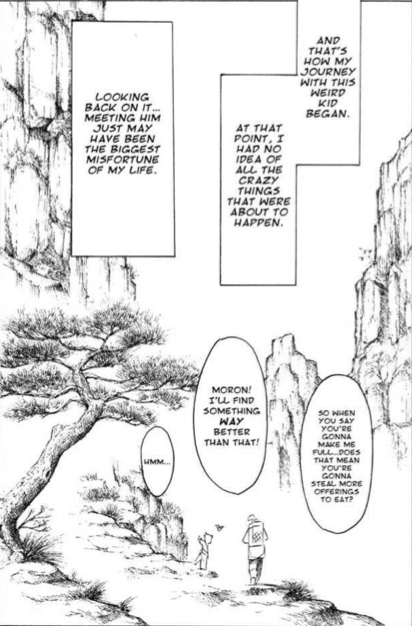
The second distinguishing feature of Qwan is Aki Shimizu’s gorgeous artwork, which draws on anime, guo hua (classical Chinese painting), and wuxia films for its aesthetic. Though Shimizu usually blends these different styles into a seamless whole, she occasionally makes explicit, almost self-conscious quotations of her influences. In this panel, which appears in the very first chapter, she gracefully echoes the undulating lines and shapes of Chinese landscape paintings, even adding a delicately stylized pine tree in the foreground:

Her fight scenes, too, are steeped in Chinese influences. Using dramatic angles, she makes her characters look as weightless as the wire-fu acrobats in Curse of the Golden Flower and House of Flying Daggers; her fight scenes verge on ballet, beautifully choreographed sequences of tumbling bodies and arcing swords. In this sequence, for example, Qwan goes mano-a-mano with a tiger demon, eventually gaining the upper hand by vaulting onto the monster’s back:

Qwan then consumes the demon at the end of their protracted battle, the demon’s body dissolving into an inky swirl:

Oh, and Shimizu draws some pretty nifty monsters, too. This one suggests a Maltese-water buffalo hybrid with prehensile toes:

So why wasn’t Qwan a bigger hit? I think narrative complexity was a factor. Though the story is a rich tapestry of political history and myth, Shimizu refuses to spoon feed information to the reader; we’re just as confused and disoriented as Qwan himself is. That kind of reading experience can be quite rewarding, but the absence of an omniscient narrator demands more of the audience, forcing us to pore over the text and make connections on our own. Shimizu’s artwork and characterizations are up to the task, but impatient readers will easily miss crucial details in their haste to get to the fight scenes.

I also think timing was a factor: Qwan‘s fourth volume appeared in 2007, at the height of the manga boom. If you remember that heady period, publishers were releasing more than 1,200 new volumes of manga per year. Titles that didn’t have an obvious hook — say, a popular anime adaptation or a cast of hot male vampires — faced an uphill battle, with bookstores unwilling to continue stocking series whose first or second volumes sold poorly. With little support from the publisher, and few fans blogging about it, Qwan was all but consigned to the remainder bin.

I’m under no illusion that my paean to Qwan will save it from licensing purgatory; for every Yotsuba&!, there are two Tactics, manga that didn’t gain much traction even after a well-publicized rescue. But Qwan is so good that I can’t help but wish that someone will complete the series — perhaps in a digital-only format, or print-on-demand, or an author-sanctioned scanlation. It’s a manga for readers — for people who love great stories and vivid characters, who care more about the quality of the storytelling than the coolness of the concepts and costumes.

QWAN, VOLS. 1-4 • BY AKI SHIMIZU • TOKYOPOP • RATING: OLDER TEEN (16+)

Filed Under: Manga Critic Tagged With: Aki Shimizu, Shonen Jump, Tokyopop

The Best Manga You’re Not Reading: Qwan

March 3, 2011 by Katherine Dacey

I have a bad habit of falling in love with commercially doomed series. Satsuma Gishiden was my first great disappointment: Dark Horse published three volumes of this manly-man samurai manga, only to put the series on ice in 2007. Duck Prince was another, with Ai Morinaga’s awesomely weird comedy getting the axe midway through its run, a victim of CPM’s perpetual cash flow problems. But the cancellation that really broke my heart was Qwan, a fantasy-adventure that drew heavily on Chinese history and folklore for its inspiration. Between 2005 and 2007, Tokyopop released four volumes before putting the series on hiatus, leaving Qwan‘s few die-hard fans stranded in the middle of a crucial story arc.

While I’d be the first to admit that reading an unfinished story can be an exercise in frustration, I’m going to recommend Qwan anyway because the four volumes that were published are awesome — Scout’s honor.

The story focuses on Qwan, a child-like figure whose naivete and enthusiasm belie super-human strength and speed. Though Qwan realizes he isn’t human, he’s never questioned his origins or abilities — that is, until he meets Shaga, a courtesan who urges him to seek the Essential Arts of Peace, a sutra that will reveal where Qwan came from and why he was sent to live among humans. He’s not the only one who wants the sutra, however; various political factions vie for the scrolls, hoping to unlock the scrolls’ power and hasten the Han Dynasty’s demise.

Questing boys and magical scrolls are de rigeur in fantasy-adventure stories, but Qwan distinguishes itself in two crucial areas. The first is well-rounded characters. Qwan isn’t a classic Shonen Jump hero, kind-hearted and dedicated to self-improvement, but a more ambiguous figure; he’s guileless and self-centered in the manner of a nine- or ten-year-old, unable to feel genuine sympathy for others. Early in volume one, for example, Qwan encounters a mysterious girl traveling in the company of a demon. Daki proves more a formidable opponent than Qwan anticipates, successfully countering his attack with powerful insect magic. Though it’s clear to the reader that Daki, like Qwan, is a supernatural being, caught between the human and demon worlds, Qwan himself never sees the parallels between their situations, repeatedly attacking Daki until he resigns himself to the futility of his efforts.

The second distinguishing feature of Qwan is Aki Shimizu’s gorgeous artwork, which draws on anime, guo hua (classical Chinese painting), and wuxia films for its aesthetic. Though Shimizu usually blends these different styles into a seamless whole, she occasionally makes explicit, almost self-conscious quotations of her influences. In this panel, which appears in the very first chapter, she gracefully echoes the undulating lines and shapes of Chinese landscape paintings, even adding a delicately stylized pine tree in the foreground:

Her fight scenes, too, are steeped in Chinese influences. Using dramatic angles, she makes her characters look as weightless as the wire-fu acrobats in Curse of the Golden Flower and House of Flying Daggers; her fight scenes are balletic, beautifully choreographed sequences of tumbling bodies and arcing swords. In this sequence, for example, Qwan goes mano-a-mano with a tiger demon, eventually gaining the upper hand by vaulting onto the monster’s back:

Qwan then consumes the demon at the end of their protracted battle, the demon’s body dissolving into an inky swirl:

Oh, and Shimizu draws some pretty nifty monsters, too. This one suggests a Maltese-water buffalo hybrid with prehensile toes:

So why wasn’t Qwan a bigger hit? I think narrative complexity was a factor. Though the story is a rich tapestry of political history and myth, Shimizu refuses to spoon feed information to the reader; we’re just as confused and disoriented as Qwan himself is. That kind of reading experience can be quite rewarding, but the absence of an omniscient narrator demands more of the audience, forcing us to pore over the text and make connections on our own. Shimizu’s artwork and characterizations are up to the task, but impatient readers will easily miss crucial details in their haste to get to the fight scenes.

I also think timing was a factor in Qwan’s cancellation, as Qwan‘s fourth volume appeared in 2007 at the height of the manga boom. If you remember that heady period, publishers were releasing more than 1,200 new volumes of manga per year. Titles that didn’t have an obvious hook — say, a popular anime adaptation or a cast of hot male vampires — faced an uphill battle, with bookstores unwilling to stock series whose first or second volumes sold poorly. With little support from the publisher, and few fans blogging about it, Qwan was all but consigned to the remainder bin.

I’m under no illusion that my paean to Qwan will save it from licensing purgatory; for every Yotsuba&!, there are two Tactics, manga that didn’t gain much traction even after a well-publicized rescue. But Qwan is so good that I can’t help but wish that someone will complete the series. It’s a manga for people who love great stories and vivid characters, who care more about the quality of the storytelling than the coolness of the concepts and costumes.

QWAN, VOLS. 1-4 • BY AKI SHIMIZU • TOKYOPOP • RATING: OLDER TEEN (16+)

Filed Under: Manga, Manga Critic, Recommended Reading, REVIEWS Tagged With: Aki Shimizu, Shonen Jump, Tokyopop

Kamisama Kiss, Vols. 1-2

February 27, 2011 by Katherine Dacey 14 Comments

Has Japan experienced a recent surge in pachinko-related child abandonment? I ask because Kamisama Kiss is, by my count, the fourth manga I’ve read in which a parent (a) racks up gambling debt (b) angers his creditors and (c) skips town, leaving his son or daughter to deal with the consequences. Nanami, Kamisama‘s plucky heroine, comes home from school to discover an eviction notice on the kitchen table alongside a hastily scrawled letter: “I’m going on a trip. Sorry. Don’t look for me. Dad.”

With no place to go — apparently, she has no relatives or friends with a couch — Nanami begins camping out in a local park, where she rescues a nervous man from an aggressive dog. As an expression of gratitude for “saving” him, Mikage offers Nanami a place to stay. What Nanami doesn’t know is that Mikage is the deity of a small, decrepit shrine, and is responsible for maintaining it, hearing visitors’ prayers, and warding off evil spirits — responsibilities he passes on to Nanami by planting a kiss on her forehead.

Once ensconced in the shrine, Nanami meets Mikage’s familiar, a haughty fox demon named Tomoe. You don’t need a PhD in Manga to guess what sort of chap Tomoe is: he’s good-looking, perpetually cranky, and quick to insult his new boss. The two bicker constantly about issues great and small, from Tomoe’s snotty tone of voice to Nanami’s inability to defend herself against demons. Over time, however, the two form a reluctant partnership, pledging to protect the shrine together.

If the story feels a little shopworn, the characterizations are vivid and engaging. Julietta Suzuki does a credible job of showing us how Nanami and Tomoe discover that they’re more alike than different; as their antagonistic banter reveals, both are stubborn, loyal, and concerned with other people’s welfare. Making those tart exchanges more entertaining is the fact that Nanami and Tomoe are equally matched; Nanami isn’t as verbally adroit as Tomoe, but she’s perfectly capable of tricking or browbeating him into following her orders.

Where Kamisama Kiss runs aground is in the predictability of its plotting. Every crisis — a threat to the shrine, the introduction of a romantic rival — builds to a crucial moment in which one character realizes that he or she can’t do without the other. Of course, neither is willing to label those feelings as love, forcing the story into an indefinite holding pattern in which the leads teeter on the brink of romance for dozens of chapters. Even the introduction of demonic rivals doesn’t do much to distract from the obvious plot turns, though it does provide Suzuki a swell excuse to draw fancy kimonos, angel wings, and androgynous boys. (I particularly liked the tengu who hid in plain sight by pretending to be a teen idol. Now I’d read a manga about him.)

I liked Kamisama Kiss, but found it totally forgettable — the umpteenth story in which characters from two very different worlds fall in love in spite of their differences. To be sure, there’s a certain pleasure in seeing an author put her romantic leads through their paces, but Suzuki adheres so strictly to the opposites-attract formula that the story practically writes itself.

Review copies provided by VIZ Media, LLC. Volume two will be released on March 2, 2011.

KAMISAMA KISS, VOLS. 1-2 • BY JULIETTA SUZUKI • VIZ • RATING: TEEN (13+)

Filed Under: Manga Critic Tagged With: Julietta Suzuki, shojo, shojo beat, VIZ, Yokai

  • « Go to Previous Page
  • Page 1
  • Interim pages omitted …
  • Page 20
  • Page 21
  • Page 22
  • Page 23
  • Page 24
  • Interim pages omitted …
  • Page 39
  • Go to Next Page »
 | Log in
Copyright © 2010 Manga Bookshelf | Powered by WordPress & the Genesis Framework