• Skip to primary navigation
  • Skip to main content
  • Skip to primary sidebar
  • Home
  • About Us
    • Privacy Policy
    • Comment Policy
    • Disclosures & Disclaimers
  • Resources
    • Links, Essays & Articles
    • Fandomology!
    • CLAMP Directory
    • BlogRoll
  • Features & Columns
    • 3 Things Thursday
    • Adventures in the Key of Shoujo
    • Bit & Blips (game reviews)
    • BL BOOKRACK
    • Bookshelf Briefs
    • Bringing the Drama
    • Comic Conversion
    • Fanservice Friday
    • Going Digital
    • It Came From the Sinosphere
    • License This!
    • Magazine no Mori
    • My Week in Manga
    • OFF THE SHELF
    • Not By Manga Alone
    • PICK OF THE WEEK
    • Subtitles & Sensibility
    • Weekly Shonen Jump Recaps
  • Manga Moveable Feast
    • MMF Full Archive
    • Yun Kouga
    • CLAMP
    • Shojo Beat
    • Osamu Tezuka
    • Sailor Moon
    • Fruits Basket
    • Takehiko Inoue
    • Wild Adapter
    • One Piece
    • After School Nightmare
    • Karakuri Odette
    • Paradise Kiss
    • The Color Trilogy
    • To Terra…
    • Sexy Voice & Robo
  • Browse by Author
    • Sean Gaffney
    • Anna Neatrour
    • Michelle Smith
    • Katherine Dacey
    • MJ
    • Brigid Alverson
    • Travis Anderson
    • Phillip Anthony
    • Derek Bown
    • Jaci Dahlvang
    • Angela Eastman
    • Erica Friedman
    • Sara K.
    • Megan Purdy
    • Emily Snodgrass
    • Nancy Thistlethwaite
    • Eva Volin
    • David Welsh
  • MB Blogs
    • A Case Suitable For Treatment
    • Experiments in Manga
    • MangaBlog
    • The Manga Critic
    • Manga Report
    • Soliloquy in Blue
    • Manga Curmudgeon (archive)

Manga Bookshelf

Discussion, Resources, Roundtables, & Reviews

Manga Critic

Manga Artifacts: The Legend of Mother Sarah

October 9, 2011 by Katherine Dacey 15 Comments

Most American manga fans know Katsuhiro Otomo as the creator of AKIRA, and perhaps of Domu: A Child’s Dream and Hipira. But did you know that Otomo was also the author of The Legend of Mother Sarah, a criminally under-appreciated sci-fi epic that’s equal parts Mad Max and Terminator II?

Set in the not-too-distant future, Mother Sarah begins in space — or, more accurately, space stations, where the survivors of a nuclear holocaust have sought refuge from the Earth’s extreme climate changes. When riots threaten the peace aboard these floating cities, the military evacuates civilians back to the surface, in the process separating thousands of children from their parents. Sarah, the story’s eponymous heroine, is on a quest to find her own family, all of whom disappeared in the chaos aboard the space stations. Traveling with Tsue, a trader, she wanders a desolate landscape of crumbling cities, slave-labor camps, religious compounds, and hardscrabble farms, putting the hurt on anyone who threatens the honest folk she meets along the way.

Given its classic premise and cool, resourceful heroine, it’s curious that Mother Sarah had such a short shelf life. As tempting as it may be to chalk up fan indifference to sexism, or antipathy towards Otomo’s other (read: not AKIRA) projects, I think the real reason lies with the way Mother Sarah was released.

Dark Horse published the series from 1995-98, but only collected the first eight issues into a trade paperback. . When read in thirty-page installments, The Legend of Mother Sarah: Tunnel Town is engaging but frustrating. Otomo and artist Takumi Nagayasu’s sense of pacing, in particular, is too leisurely for a stand-alone booklet: they establish a new setting with a dozen wordless panels, luxuriate in an explosion, or depict a fist-fight over five or six pages, gobbling up pages that might otherwise be advancing the story.

Contrast an issue of Tunnel Town with that of a long-running American series and the incompatibility of format and story becomes more apparent. In each issue of The Walking Dead, for example, one important event is dramatized: the characters make a critical discovery about their zombie foes or confront a troublemaker within their ranks. Though the issue may end on a cliffhanger, there’s a sense of closure that’s missing from an issue of Mother Sarah, even though both stories are clearly intended to extend beyond the confines of a single pamphlet. Put another way, each issue of Walking Dead has a clear beginning, middle, and end, whereas Sarah simply stops; it’s as if the author pressed “pause,” rather than set the table for the next chapter.

When read in trade paperback form, however, Tunnel Town has a more satisfying rhythm. Those establishing shots and slow-mo fight scenes draw the reader deeper into the story; we feel like we’re actually part of the scene, rather than passive witnesses to the action. The continuity between events is easier to appreciate as well. Sarah’s skirmishes with authority no longer seem like a string of isolated incidents, but a steadily escalating pattern of violence that demands resolution. And what a finale! Coming at the end of two hundred pages, the denouement is less a cool stunt than a thrilling affirmation of Sarah’s courage and smarts, an emphatic punctuation mark at the end of a long but well-reasoned paragraph.

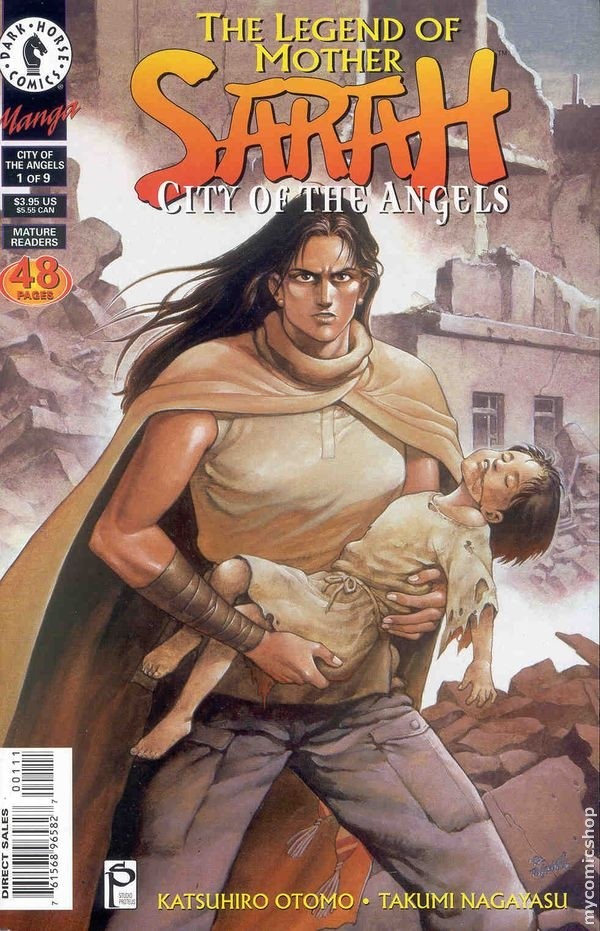
I’m guessing that someone at Dark Horse must have thought Mother Sarah was ill-served by the thirty-page format, as the next two arcs — City of the Children and City of the Angels — were published in forty-eight page installments, a development highlighted on the front covers of each issue:

As a result, the later mini-series are more engaging; we’re treated to a larger, more satisfying chunk of story in each installment, a chunk that I suspect corresponds to the way the manga was serialized in Young Magazine. (I don’t know that for a fact, however, so feel free to politely educate me on this point if I’m off base here.) Alas, neither Children nor Angels were collected in bound form, making it harder for a new generation of manga fans to discover the series for themselves.

For all my grumbling about format and scarcity, however, all three story arcs are worth owning, both for the art and the story. Takumi Nagayasu’s crisp visuals are pleasingly reminiscent of Otomo’s. Nagayasu’s characters are drawn in a naturalistic fashion, with plenty of attention given to hands, facial hair, posture, wrinkles, and muscles; even the most inconsequential soldier or civilian is given a unique face and a thoughtfully constructed costume. Nagayasu also shares Otomo’s love of vehicles and decaying urban landscapes, rendering both in a fine, evocative fashion; one can almost hear the steel structures rusting from neglect.

Otomo’s writing is as strong as Nagayasu’s artwork. Though Sarah is a certifiable bad-ass, capable of kicking and stabbing her way out of a tight situation, she relies on her wits just as frequently as her fists. Her maternal instincts, too, inform much of her decision-making; throughout the series, Sarah is drawn to conflicts involving exploited or abused children, offering her a chance to symbolically “save” the family she lost ten years earlier. In short, Sarah is a woman warrior in the Lt. Ellen Ripley/Sarah Connor mold: fierce, strong, principled, and, above all else, a mama grizzly who sides with the young and the helpless. Oh, and she looks good while dispensing justice, too. Now that’s my kind of escapism, no matter how it’s packaged.
THE LEGEND OF MOTHER SARAH • STORY BY KATSUHIRO OTOMO, ART BY TAKUMI NAGAYASU • DARK HORSE • NO RATING

Filed Under: Manga Critic Tagged With: Dark Horse, Katsuhiro Otomo, Post-Apocalyptic Sci-Fi, Takumi Nagayasu

Manga Artifacts: The Legend of Mother Sarah

October 9, 2011 by Katherine Dacey

Most American manga fans know Katsuhiro Otomo as the creative force behind AKIRA and Domu: A Child’s Dream, but Otomo’s catalog also includes works like The Legend of Mother Sarah, in which Otomo penned the script but relinquished the illustration duties to another manga-ka. And while Mother Sarah isn’t quite as visually dazzling as AKIRA or Domu, this post-apocalyptic adventure is every bit as fun to read, thanks to its vivid characterizations and dynamic action sequences.

Set in the not-too-distant future, Mother Sarah begins in space — or, more accurately, space stations, where the survivors of a nuclear holocaust have sought refuge from the Earth’s extreme climate changes. When riots threaten the peace aboard these floating cities, the military evacuates civilians back to the surface, in the process separating thousands of children from their parents. Sarah, the story’s eponymous heroine, is on a quest to find her own family, all of whom disappeared in the chaos aboard the space stations. Traveling with Tsue, a trader, she wanders a desolate landscape of crumbling cities, slave-labor camps, religious compounds, and hardscrabble farms, karate-chopping anyone who threatens the honest folk she meets along the way.

Given its classic premise and cool, resourceful heroine, it’s curious that Mother Sarah had such a short shelf life here in the United States. As tempting as it may be to chalk up fan indifference to sexism, or antipathy towards Otomo’s other (read: not AKIRA) projects, I think the real reason lies with the way Mother Sarah was released. Dark Horse published the series from 1995-98, but only collected the first eight issues into a trade paperback. When read in thirty-page installments, The Legend of Mother Sarah: Tunnel Town is engaging but frustrating. Otomo and artist Takumi Nagayasu’s sense of pacing, in particular, is too leisurely for a stand-alone booklet: they establish a new setting with a dozen wordless panels, luxuriate in an explosion, or depict a fist-fight over five or six pages, gobbling up real estate that might otherwise be advancing the story. Contrast an issue of Tunnel Town with that of a long-running American series and the incompatibility of format and story becomes more apparent. In each issue of The Walking Dead, for example, one important event is dramatized: the characters make a critical discovery about their zombie foes or confront a troublemaker within their ranks. Though the issue may end on a cliffhanger, there’s a sense of closure that’s missing from an issue of Mother Sarah, even though both stories are clearly intended to extend beyond the confines of a single pamphlet.

When read in trade paperback form, however, Tunnel Town has a more satisfying rhythm. Those establishing shots and slow-mo fight scenes draw the reader deeper into the story; we feel like we’re actually part of the scene, rather than passive witnesses to the action. The continuity between events is easier to appreciate as well. Sarah’s skirmishes with authority no longer seem like a string of isolated incidents, but a steadily escalating pattern of violence that demands resolution. And what a finale! Coming at the end of two hundred pages, the denouement is less a cool stunt than a thrilling affirmation of Sarah’s courage and smarts, an emphatic punctuation mark at the end of a long but well-reasoned paragraph.

I’m guessing that someone at Dark Horse must have thought Mother Sarah was ill-served by the thirty-page format, as the next two arcs — City of the Children and City of the Angels — were published in forty-eight page installments, a development highlighted on the front covers of each issue:

As a result, the later mini-series are more engaging; we’re treated to a larger, more satisfying chunk of story in each installment, a chunk that I suspect corresponds more closely to the way the manga was serialized in Young Magazine. Alas, neither Children nor Angels were collected in bound form, making it harder for a new generation of manga fans to discover the series for themselves.

For all my grumbling about format and scarcity, however, all three story arcs are worth owning, both for the art and the story. Takumi Nagayasu’s crisp visuals are pleasingly reminiscent of Otomo’s. Nagayasu’s characters are drawn in a naturalistic fashion, with plenty of attention given to hands, facial hair, posture, wrinkles, and muscles; even the most inconsequential soldier or civilian is given a unique face and a thoughtfully constructed costume. Nagayasu also shares Otomo’s love of vehicles and decaying urban landscapes, rendering both in a fine, evocative fashion; one can almost hear the steel structures rusting from neglect.

Otomo’s writing is as strong as Nagayasu’s artwork. Though Sarah is a certifiable bad-ass, capable of kicking and stabbing her way out of a tight situation, she relies on her wits just as frequently as her fists. Her maternal instincts, too, inform much of her decision-making; throughout the series, Sarah is drawn to conflicts involving exploited or abused children, offering her a chance to symbolically “save” the family she lost ten years earlier. In short, Sarah is a woman warrior in the Lt. Ellen Ripley/Sarah Connor mold: fierce, strong, principled, and, above all else, a mama grizzly who sides with the young and the helpless. Oh, and she looks good while dispensing justice, too. Now that’s my kind of escapism, no matter how it’s packaged.

THE LEGEND OF MOTHER SARAH • STORY BY KATSUHIRO OTOMO, ART BY TAKUMI NAGAYASU • DARK HORSE • NO RATING

Filed Under: Manga, Manga Critic, REVIEWS Tagged With: Dark Horse, Katsuhiro Otomo, Post-Apocalyptic Sci-Fi, Takumi Nagayasu

Gandhi: A Manga Biography

October 6, 2011 by Katherine Dacey 7 Comments

British historian Phillip Guedalla famously described biography as “a very definite region bounded on the north by history, on the south by fiction, on the east by obituary, and on the west by tedium.” Were I to locate Gandhi: A Manga Biography on Guedalla’s map, its longest borders would be to the south and west: it’s both contrived and dull, a series of historical tableaux that do little to reveal Gandhi’s true humanity.

Most of the book’s problems stem from its scope, as author Kazuki Ebine attempts to cover Gandhi’s entire life in a mere 192 pages. Ebine treats us to brief glimpses of Gandhi’s childhood, when Gandhi was first exposed to the injustices of India’s caste system; his time in England, where he studied law; his time in South Africa, where he challenged the government’s classification of Indians as second-class citizens; and his time in India, where he used strikes, boycotts, and other forms of non-violent resistance to protest English rule.

Though Ebine carefully inserts major historical figures into the narrative, none of them are treated as individuals. Some are straw men, representing unenlightened points of view, while others are apostles, converted to the cause through the power of Gandhi’s words. Even Gandhi’s wife is relegated to a minor supporting role; her primary function within the narrative is to patiently reflect on her husband’s inherent courage and goodness, rather than interact with him as a partner, friend, confidante, or lover. (“Your duty is to lead people in a right direction,” she solemnly informs Gandhi.) Ebine attempts to portray her as the one person who truly knew Gandhi, but the relentless pace of the story prevents him from showing the natural evolution of their relationship….

Read More

Filed Under: Manga Critic Tagged With: Biography, Gandhi, Penguin

Gandhi: A Manga Biography

October 6, 2011 by Katherine Dacey

British historian Phillip Guedalla famously described biography as “a very definite region bounded on the north by history, on the south by fiction, on the east by obituary, and on the west by tedium.” Were I to locate Gandhi: A Manga Biography on Guedalla’s map, its longest borders would be to the south and west: it’s both contrived and dull, a series of historical tableaux that do little to reveal Gandhi’s true humanity.

Most of the book’s problems stem from its scope, as author Kazuki Ebine attempts to cover Gandhi’s entire life in a mere 192 pages. Ebine treats us to brief glimpses of Gandhi’s childhood, when Gandhi was first exposed to the injustices of India’s caste system; his time in England, where he studied law; his time in South Africa, where he challenged the government’s classification of Indians as second-class citizens; and his time in India, where he used strikes, boycotts, and other forms of non-violent resistance to protest English rule.

Though Ebine carefully inserts major historical figures into the narrative, none of them are treated as individuals. Some are straw men, representing unenlightened points of view, while others are apostles, converted to the cause through the power of Gandhi’s words. Even Gandhi’s wife is relegated to a minor supporting role; her primary function within the narrative is to patiently reflect on her husband’s inherent courage and goodness, rather than interact with him as a partner, friend, confidante, or lover. (“Your duty is to lead people in a right direction,” she solemnly informs Gandhi.) Ebine attempts to portray her as the one person who truly knew Gandhi, but the relentless pace of the story prevents him from showing the natural evolution of their relationship.

The script is equally problematic, abounding in typos and grammatical errors. (“Pease enjoy this humble farewell party for you,” one character tells Gandhi.) The problems extend beyond mere editorial sloppiness: the dialogue would have benefited from a vigorous re-write, as it sounds more like a poorly translated Power Point presentation than natural conversation. In one crucial scene, for example, a young South African man confronts Gandhi with what amounts to an eighth grader’s gloss on the crisis in South Africa. “When I first heard your speech, I was so inspired as if you boiled in my blood!” he declares. “No one else has tried to rise up against the whites. As Indians, we have decided to fight together beyond the differences in religions.” Another character tells Gandhi, “By revoking Indians’ right to vote, they try to shut our mouth up regarding sovereignty” — an indignity up with which he will not put.

The biggest disappointment, however, is that Ebine makes such uninspired use of the comics medium. The artwork is plain and lifeless, relying too heavily on computer shortcuts and pre-fab backgrounds to create a genuine sense of place or time. Though Ebine depicts numerous violent confrontations, most of the layouts are an unvaried parade of talking heads addressing assemblies and conducting back-room negotiations. To judge from the characters’ facial expressions, these scenes are meant to be as dramatic as the brawls and massacres, but the monotony of the presentation robs these scenes of specificity and urgency.

The bottom line: readers who want an overview of Gandhi’s life and work may find this slim volume helpful, but readers hoping to move beyond what Mark Twain called the “clothes and the buttons of the man” will be sorely disappointed.

Review copy provided by Penguin Books.

GANDHI: A MANGA BIOGRAPHY • BY KAZUKI EBINE • PENGUIN BOOKS • 192 pp. • NO RATING

Filed Under: Manga, Manga Critic, REVIEWS Tagged With: Biography, Gandhi, Penguin

Show Us Your Stuff: Burning Lizard’s Collection

October 4, 2011 by Katherine Dacey 5 Comments

Welcome to the third installment of Show Us Your Stuff, now back at The Manga Critic! If you missed Daniella Orihuela-Griber’s contribution, click here. I’ve also created an archive for this feature here at The Manga Critic, which you can access from the “Features” menu or by clicking here. Today’s contributor is Derek Bown, a writer, student, and shonen manga enthusiast who runs the review site Burning Lizard Studios. Without further ado, here’s Derek in his own words.

Hey, I’m Derek, sometimes known as Burning Lizard. I run an anime, manga, and anything-that-catches-my-fancy review blog. I’m an avid reader and collector of manga, and in the past few years my manga collection has doubled several times. (Especially since the Borders liquidation.) I figured that since I’m like every collector out there: I’m just not satisfied unless I show my collection off to someone. So here you go internet, here is my manga collection.

What was your first manga?
Either One Piece or Ranma 1/2. Both were series that I originally experienced as anime. After my local TV stations started airing only reruns, I turned to the manga to get the rest of the story — which turned out to be crucial for One Piece, since there was an actual story to continue. Ranma 1/2 just managed to both entertain and piss me off towards the later volumes….

Read More

Filed Under: Manga Critic Tagged With: Awesome Manga Collections, One Piece, Shonen

Bloody Monday, Vol. 1

August 30, 2011 by Katherine Dacey 10 Comments

To judge from all the shonen manga I’ve read, the fate of the world rests in teenage boys’ hands: not only do they have the power to kill demons and thwart alien invasions, they’re also blessed with the kind of superior intelligence that makes them natural partners with law enforcement.

Bloody Monday is a textbook example of the teen-genius genre: high school student Fujimaru Takagi dabbles in crime-solving, hacking into secure networks and decoding encrypted files on behalf of the Public Security Intelligence Agency. (Naturally, he works for the PSIA’s super-secret “Third-I” division, which is “comprised solely of elites.”) Fujimaru’s deductive skills are put to the ultimate test when his father is falsely implicated in a murder. To find the real killer, Fujimaru must uncover the connection between his father and the “Christmas Massacre,” a terrorist attack that left thousands of Russian civilians dead, their bodies covered in boils.

In the right hands, Bloody Monday might have been good, silly fun, 24 for the under-twenty-four crowd. The script, however, is pointed and obvious, explaining hacker culture and internet technology to an audience that has grown up on the world-wide web: are there any fifteen-year-olds who don’t grasp the basics of computer viruses? The characters, too, seem impossibly dim, thinking out loud, missing obvious connections, and reminding each other how they’re related, whether they’re fellow reporters for the school newspaper or siblings. Small wonder they don’t realize that their school has been infiltrated by an enemy agent.

The art is more skillful than the script, with polished character designs and detailed backgrounds. The adults actually look like adults, not teenagers with unfortunate laugh lines, while the scenes aboard the Transsiberian Railroad convey the harshness of the Russian landscape. Though artist Kouji Megumi nevers misses an opportunity to show us an attractive woman in her underwear — and really, what well-trained assassin doesn’t snuff a target or two while wearing only a matching bra-and-panty set? — the fanservice never overwhelms the plot. The action sequences, too, are well-staged, using swift cross-cuts and imaginative camera angles to heighten the suspense.

In the end, however, the slick visuals aren’t enough to compensate for the flat-footed storytelling. A plot as potentially interesting and complex as Bloody Monday‘s should challenge the reader to arrive the solution independently, not spoon-feed it; too often, the story seems to have been written in boldface, depriving the reader of an opportunity to guess the outcome of the story for herself.

BLOODY MONDAY, VOL. 1 • STORY BY RYOU RYUMON, ART BY KOUJI MEGUMI • KODANSHA COMICS USA • 200 pp. • RATING: TEEN (13+)

Filed Under: Manga Critic Tagged With: Bloody Monday, kodansha, Shonen

Bloody Monday, Vol. 1

August 30, 2011 by Katherine Dacey

To judge from all the shonen manga I’ve read, the fate of the world rests in teenage boys’ hands: not only do they have the power to kill demons and thwart alien invasions, they’re also blessed with the kind of superior intelligence that makes them natural partners with law enforcement. Bloody Monday is a textbook example of the teen-genius genre: high school student Fujimaru Takagi dabbles in crime-solving, hacking into secure networks and decoding encrypted files on behalf of the Public Security Intelligence Agency. (Naturally, he works for the PSIA’s super-secret “Third-I” division, which is “comprised solely of elites.”) Fujimaru’s deductive skills are put to the ultimate test when his father is falsely implicated in a murder. To find the real killer, Fujimaru must uncover the connection between his father and the “Christmas Massacre,” a terrorist attack that left thousands of Russian civilians dead, their bodies covered in boils.

In the right hands, Bloody Monday might have been good, silly fun, 24 for the under-twenty-four crowd. The script, however, is pointed and obvious, explaining hacker culture and internet technology to an audience that has grown up on the world-wide web: are there any fifteen-year-olds who don’t grasp the basics of computer viruses? The characters, too, seem impossibly dim, thinking out loud, missing obvious connections, and reminding each other how they’re related, whether they’re fellow reporters for the school newspaper or siblings. Small wonder they don’t realize that their school has been infiltrated by an enemy agent.

The art is more skillful than the script, with polished character designs and detailed backgrounds. The adults actually look like adults, not teenagers with unfortunate laugh lines, while the scenes aboard the Transsiberian Railroad convey the harshness of the Russian landscape. Though artist Kouji Megumi nevers misses an opportunity to show us an attractive woman in her underwear — and really, what well-trained assassin doesn’t snuff a target or two while wearing only a matching bra-and-panty set? — the fanservice never overwhelms the plot. The action sequences, too, are well-staged, using swift cross-cuts and imaginative camera angles to heighten the suspense.

In the end, however, the slick visuals aren’t enough to compensate for the flat-footed storytelling. A plot as potentially interesting and complex as Bloody Monday‘s should challenge the reader to arrive the solution independently, not spoon-feed it; too often, the story seems to have been written in boldface, depriving the reader of an opportunity to guess the outcome of the story for herself.

BLOODY MONDAY, VOL. 1 • STORY BY RYOU RYUMON, ART BY KOUJI MEGUMI • KODANSHA COMICS USA • 200 pp. • RATING: TEEN (13+)

Filed Under: Manga, Manga Critic, REVIEWS Tagged With: Action/Adventure, Bloody Monday, yen press

Cage of Eden, Vol. 1

August 25, 2011 by Katherine Dacey 10 Comments

Stop me if you’ve heard this one before: a trans-Pacific flight encounters turbulence, and before any of the passengers can shout “J.J. Abrams!” — or “William Golding!” for that matter — the plane crash-lands an uninhabited tropical island, far from civilization’s reach. In some variations of the story, the island itself poses the greatest danger to survivors, harboring monsters or malevolent spirits. In other versions, the survivors’ own fear and narcissism proves more deadly than any jungle-dwelling creatures, as the rude wilderness strips away the survivors’ veneer of humanity.

In Cage of Eden, Yoshinobu Yamada combines these two survival narratives to tell the story of a high school holiday gone horribly wrong. Cage’s teen heroes crash-land in a prehistoric forest populated by long-extinct animals: saber-toothed tigers, horse-sized birds. These big, hungry predators aren’t the only threat to the students’ safety, however. Yarai, the class delinquent, seizes the opportunity to act on his darkest impulses, terrorizing his peers and the doomed flight’s captain. Only Akira, a small, self-described loser, and Mariya, a bespectacled, anti-social genius, have the skills and the smarts to outwit both enemies.

Though the story unfurls at a good clip, the execution is a little creaky. The opening chapter is a choppy information dump, as Yamada introduces the principal characters, delineates their relationships, and reveals the purpose of their plane trip. Once on the island, Mariya’s computer proves shockingly durable — it boots up without protest, despite plunging 35,000 feet — and helpfully equipped with a searchable database of extinct animals. (“Even without internet, I can still access program files,” Mariya solemnly informs an incredulous Akira.) The characters speak fluent exposition, frequently explaining things to one another that are readily obvious from Yamada’s crisply executed drawings. Worse still, the intelligent dialogue is reserved for the male characters; the few female characters’ primary role is to be menaced, rescued, and ogled, though not necessarily in that order.

However obvious the script or ubiquitous the cheesecake — and yes, the fanservice is executed with all the subtlety of a tap-dancing hippopotamus — Cage of Eden has a cheerful, B-movie vibe that’s hard to resist. The monsters are rendered in loving detail, down to their sinews and feathers and claws; as they tear across the page, it’s not hard to imagine how terrified the characters must be, or how fast they need to run in order to escape. The setting, too, is a boon, offering Yamada numerous places to conceal a dangerous animal or booby trap. Even the characters are effective. Though drawn in broad strokes, Akira is a sympathetic lead; he’s prone to self-doubt after years of being a bench warmer, an academic failure, a mama’s boy, and a second banana to the most popular student in his class. That the island provides him a chance to prove his worth isn’t surprising — that’s de rigeur for the genre — but Akira’s mixture of humility and bravery is refreshing, helping distract the reader from the absurdity of his action-movie heroics.

I won’t make any grand claims for Cage of Eden: on many levels, it’s dumber than a peroxide blonde, with characters doing and saying things that defy common sense. Yet Yoshinobu Yamada demonstrates a genuine flair for writing popcorn-movie manga, populating the island with scary-looking monsters and staging thrilling action sequences that temporarily erase the memory of the clumsy dialogue and panty shots. Cage of Eden is the perfect beach read for the final days of August: it’s fun and fast-paced, placing few demands on the sun-addled reader.

CAGE OF EDEN, VOL. 1 • BY YOSHINOBU YAMADA • KODANSHA COMICS USA • 200 pp. • RATING: OLDER TEEN (16+)

Filed Under: Manga Critic Tagged With: Cage of Eden, kodansha, Shonen

Cage of Eden, Vol. 1

August 25, 2011 by Katherine Dacey

Stop me if you’ve heard this one before: a trans-Pacific flight encounters turbulence, and before any of the passengers can shout “J.J. Abrams!” — or “William Golding!” for that matter — the plane crash-lands an uninhabited tropical island, far from civilization’s reach. In some variations of the story, the island itself poses the greatest danger to survivors, harboring monsters or malevolent spirits. In other versions, the survivors’ own fear and narcissism proves more deadly than any jungle-dwelling creatures, as the rude wilderness strips away the survivors’ veneer of humanity.

In Cage of Eden, Yoshinobu Yamada combines these two survival narratives to tell the story of a high school holiday gone horribly wrong. Cage’s teen heroes crash-land in a prehistoric forest populated by long-extinct animals: saber-toothed tigers, horse-sized birds. These big, hungry predators aren’t the only threat to the students’ safety, however. Yarai, the class delinquent, seizes the opportunity to act on his darkest impulses, terrorizing his peers and the doomed flight’s captain. Only Akira, a small, self-described loser, and Mariya, a bespectacled, anti-social genius, have the skills and the smarts to outwit both enemies.

Though the story unfurls at a good clip, the execution is a little creaky. The opening chapter is a choppy information dump, as Yamada introduces the principal characters, delineates their relationships, and reveals the purpose of their plane trip. Once on the island, Mariya’s computer proves shockingly durable — it boots up without protest, despite plunging 35,000 feet — and helpfully equipped with a searchable database of extinct animals. (“Even without internet, I can still access program files,” Mariya solemnly informs an incredulous Akira.) The characters speak fluent exposition, frequently explaining things to one another that are readily obvious from Yamada’s crisply executed drawings. Worse still, the intelligent dialogue is reserved for the male characters; the few female characters’ primary role is to be menaced, rescued, and ogled, though not necessarily in that order.

However obvious the script or ubiquitous the cheesecake — and yes, the fanservice is executed with all the subtlety of a tap-dancing hippopotamus — Cage of Eden has a cheerful, B-movie vibe that’s hard to resist. The monsters are rendered in loving detail, down to their sinews and feathers and claws; as they tear across the page, it’s not hard to imagine how terrified the characters must be, or how fast they need to run in order to escape. The setting, too, is a boon, offering Yamada numerous places to conceal a dangerous animal or booby trap. Even the characters are effective. Though drawn in broad strokes, Akira is a sympathetic lead; he’s prone to self-doubt after years of being a bench warmer, an academic failure, a mama’s boy, and a second banana to the most popular student in his class. That the island provides him a chance to prove his worth isn’t surprising — that’s de rigeur for the genre — but Akira’s mixture of humility and bravery is refreshing, helping distract the reader from the absurdity of his action-movie heroics.

I won’t make any grand claims for Cage of Eden: on many levels, it’s dumber than a peroxide blonde, with characters doing and saying things that defy common sense. Yet Yoshinobu Yamada demonstrates a genuine flair for writing popcorn-movie manga, populating the island with scary-looking monsters and staging thrilling action sequences that temporarily erase the memory of the clumsy dialogue and panty shots. Cage of Eden is the perfect beach read for the final days of August: it’s fun and fast-paced, placing few demands on the sun-addled reader.

CAGE OF EDEN, VOL. 1 • BY YOSHINOBU YAMADA • KODANSHA COMICS USA • 200 pp. • RATING: OLDER TEEN (16+)

Filed Under: Manga, Manga Critic, REVIEWS Tagged With: Cage of Eden, Horror/Supernatural, Sci-Fi, yen press

Velveteen & Mandala

August 15, 2011 by Katherine Dacey 14 Comments

Let’s just call this spade a spade: Jiro Matsumoto’s Velveteen & Mandala is a phantasmagoria of zombie-slaying, nudity, and poop. Though Velveteen seems calibrated to shock readers into nervous laughter, it’s never clear if Matsumoto has a greater point to make, as the manga lacks any overarching sense of narrative direction or social commentary.

The volume consists of fourteen loosely connected vignettes starring Velveteen, a ditzy blonde, and Mandala, her frenemy. Both are living on the outskirts of Tokyo, though the time is left to the reader’s imagination; all we know is that a war has ravaged the city, reducing it to a weedy sprawl of corpses, tanks, and abandoned buildings. In some of the stories, the two wield pistols and patrol their territory, shooting anything in sight; in others, they forage for food; and in others, their girlish horseplay shades in sadism or sexual violence.

The first three chapters are innocuous, documenting the minutiae of the girls’ day-to-day existence. Velveteen lives in an amnesiac fog, snapping to consciousness only when she devises a new technique for torturing Mandala. Mandala, too, delights in annoying her friend, adopting verbal mannerisms that drive Velveteen to violent distraction. Neither seems particularly bright; their dialogue and destructive behavior make them seem like a pair of mean-spirited ko-gals.

The series takes a turn for the ugly in “The Super,” a brief story introducing a nameless, pantsless man to whom Velveteen administers a sharp crack on the head. From there on, Matsumoto begins playing up the scatological angle. In subsequent chapters, we’re treated to numerous scenes of Velveteen defecating and vomiting, as well as images of her exposing herself.

The nadir is a gang rape scene in which Velveteen narrowly escapes her captors thanks to an explosive bout of indigestion. I’m guessing — perhaps wrongly — that Matsumoto intended this episode as a particularly nasty joke, designed to an elicit an appreciative “Dude! That’s so gross!” from readers. But as a feminist, it’s impossible not to find this passage yet another tiresome example of a male artist using sexual violence to titillate and shock the reader.

Making things worse is that Matsumoto doesn’t just suggest that Velveteen is dirty, he literally covers her and her would-be assailants in her own filth. Nothing about the character or the story suggests that Matsumoto is trying to make a greater point about sexual violence, level the playing field between victim and attacker, or make the reader uncomfortably aware of his arousal at the scene. If anything, the cruelly unflattering way in which Matsumoto portrays Velveteen suggests a deep contempt for teenage girls.

Perhaps the most frustrating thing about Velveteen & Mandala is that Matsumoto is a genuinely good artist. His linework is superb, reminiscent of Taiyo Matsumoto and Daisuke Igurashi; it’s scratchy and energetic, well-suited to depicting the urban wasteland in which the story unfolds. His characters’ faces are superbly animated, too; few artists can draw malicious glee or surprise with such precision, even if that skill is put in service of drawing a thoroughly repellent cast.

Yet for all the obvious artistry behind Velveteen & Mandala, it’s a stretch to call this book a Hobbesian meditation on survival. Matsumoto’s dialogue is too stylized to register as genuine communication, while his fixation on the most bodily aspects of existence comes off as coprophilia, not meaningful commentary on the human condition. A more thoughtful artist might have found a way to put an intelligent or funny spin on the schoolgirls-slay-zombies premise, but in Matsumoto’s hands, the underlying message seems to be that teenage girls are just as nasty and despicable as the rest of us, as evidenced by the fact that they poop and puke, too.

Review copy provided by Vertical, Inc. Velveteen & Mandala will be released on August 30, 2011.

VELVETEEN & MANDALA • BY JIRO MATSUMOTO • VERTICAL, INC. • 344 pp. • RATING: MATURE (18+)

Filed Under: Manga Critic Tagged With: Jiro Matsumoto, vertical

Velveteen & Mandala

August 15, 2011 by Katherine Dacey

Jiro Matsumoto’s Velveteen & Mandala, a phantasmagoria of zombie-slaying, nudity, and poop, seems calibrated to shock readers into nervous laughter, though it’s never entirely clear if Matsumoto has a greater point to make. Like many of the shorts in the AX anthology, Velveteen & Mandala lacks any overarching sense of narrative direction or social commentary. The volume consists of fourteen loosely connected vignettes starring Velveteen, a ditzy blonde, and Mandala, her frenemy. Both are living on the outskirts of Tokyo, though the time is left to the reader’s imagination; all we know is that a war has ravaged the city, reducing it to a weedy sprawl of corpses, tanks, and abandoned buildings. In some of the stories, the two wield pistols and patrol their territory, shooting anything in sight; in others, they forage for food; and in others, their girlish horseplay shades in sadism or sexual violence.

The first three chapters are relatively innocuous, documenting the minutiae of the girls’ day-to-day existence. Velveteen lives in an amnesiac fog, snapping to consciousness only when she devises a new technique for torturing Mandala. Mandala, too, delights in annoying her friend, adopting verbal mannerisms that drive Velveteen to violent distraction. Neither seems particularly bright; their dialogue and destructive behavior make them seem like a pair of mean-spirited ko-gals.

The series takes a turn for the ugly in “The Super,” a brief story introducing a nameless, pantsless man to whom Velveteen administers a sharp crack on the head. (She wants to keys to his secret stash of weapons. And taxidermy animals. Yes, we’re in Underground Comix territory, folks.) From there on, Matsumoto begins playing up the scatological angle; we’re treated to numerous scenes of Velveteen defecating and vomiting, as well as images of her exposing herself.

The nadir is a gang rape scene in which Velveteen narrowly escapes her captors thanks to an explosive bout of indigestion. I’m guessing — perhaps wrongly — that Matsumoto intended this episode as a particularly nasty joke, designed to an elicit an appreciative “Dude! That’s so gross!” from readers. But as a feminist, it’s impossible not to find this passage yet another tiresome example of a male artist using sexual violence to titillate and shock the reader. (The loving way in which he draws a semi-naked Velveteen only confirms the pornographic impression.) Making things worse is that Matsumoto doesn’t just suggest that Velveteen is dirty, he literally covers her and her would-be assailants in her own filth. Nothing about the character or the story suggests that Matsumoto is trying to make a greater point about sexual violence, or level the playing between victim and attacker, or make the reader uncomfortably aware of his arousal at the scene; if anything, the cruelly unflattering way in which Matsumoto portrays Velveteen suggests a deep contempt for teenage girls.

Perhaps the most frustrating thing about Velveteen & Mandala is that Matsumoto is a genuinely good artist. His linework is superb, reminiscent of Taiyo Matsumoto and Daisuke Igurashi; it’s scratchy and energetic, well-suited to depicting the urban wasteland in which the story unfolds. His characters’ faces are superbly animated, too; few artists can draw malicious glee or surprise with such precision, even if that skill is put in service of drawing a thoroughly repellent cast.

Yet for all the obvious artistry behind Velveteen & Mandala, it’s a stretch to call this book a Hobbesian meditation on survival. Matsumoto’s dialogue is too stylized to register as genuine communication, while his fixation on the most bodily aspects of existence comes off as coprophilia, not meaningful commentary on the human condition. A more thoughtful artist might have found a way to put an intelligent or funny spin on the schoolgirls-slay-zombies premise, but in Matsumoto’s hands, the underlying message seems to be that teenage girls are just as nasty and despicable as the rest of us, as evidenced by the fact that they poop and puke, too.

Review copy provided by Vertical, Inc. Velveteen & Mandala will be released on August 30, 2011.

VELVETEEN & MANDALA • BY JIRO MATSUMOTO • VERTICAL, INC. • 344 pp. • RATING: MATURE (18+)

Filed Under: Manga, Manga Critic, REVIEWS Tagged With: Jiro Matsumoto, vertical

Show Us Your Stuff: CJ’s Awesomely Organized Manga Shrine

August 10, 2011 by Katherine Dacey 70 Comments

I have a confession to make: I’m a compulsive organizer. I’ve carefully arranged my CDs by genre, composer, and opus number; I’ve divided my library into fiction and non-fiction, separating the musicology books from the historical tomes; I’ve even alphabetized my spice rack. (No, I’m not taking any medication. Why do you ask?) So when long-time reader CJ began describing her manga collection to me, I knew I’d found a kindred spirit, someone who viewed her role not as a consumer, but as a librarian or curator. CJ has generously agreed to share pictures of her collection with us, as well as to tell us a little more about herself and her manga-reading habits. Take it away, CJ!

* * *

What's Butters?!

Hello, I’m CJ! I recently graduated from college with a Bachelor’s in Biology. Other nerdy things I’m in to include anime, RPGs, South Park and Doctor Who. I’m currently living with my roommate/sweetest cat ever Butters while job hunting! Please enjoy pictures of my manga collection, I take quite a bit of pride in it!

My first manga: Tokyo Mew Mew, which I no longer have because I no longer like it. I don’t tend to keep things I no longer like or have no plans of re-reading; I try to sell them to get money for more manga. As for the oldest series I have on my shelf (in terms of when I started collecting it and is still on my shelf), probably Maison Ikkoku.

My favorite manga-ka: Osamu Tezuka and Fumi Yoshinaga — they’re the only two mangaka whose work I actively collect everything of, and they both have mini-shrines dedicated to them. I think I have every Yoshinaga work published in English so far, but doing the same for Tezuka is proving to be much more of a challenge. However, they’re both the only two manga-ka whose work I will buy without even reading the back of the book. I already know I want it.

Ode to CJ's Tezuka Collection, Vol. 1.

Ode to CJ's Tezuka Collection, Vol. 2.

How long I’ve been collecting manga: 9 years or so.

My favorite series: Banana Fish, easily, though there are many worthy contenders in my top 5, which are Maison Ikkoku, Hikaru no Go, Firefighter Daigo, and Please Save My Earth.

More of CJ's awesome collection.

Behold: the full run of Monster and volumes of MBQ!

Clearly, this woman has good taste.

The size of my collection: If I counted correctly, about 670 manga, though this is not counting the few non-manga I have and some omnibuses are counted as three, some are counted as one, so it’s a bit fuzzy.

The rarest items in my collection: Some of those volumes for Tezuka’s Phoenix are extremely rare; volume 4 of Fumi Yoshinaga’s Flower of Life quickly became rare right after I got mine; the earlier volumes of What’s Michael? are a pain to find; and just random volumes of some of my favorite series have rare volumes, like Banana Fish, Maison Ikkoku, Firefighter Daigo, and Please Save My Earth. I’ve been extremely lucky in keeping all of my organs while getting some of these. Since I got Monster and Maison Ikkoku as they came out, I never ran into that problem with those two series. The most I’ve ever paid for a single volume of manga though? $60 for volume 20 of Firefighter Daigo.

Rarities from CJ's collection. Style points for owning Club 9!

The weirdest item in my collection: Joan is a full-color manga. I don’t think it’s particular good as a manga; it feels like a sequel to a more interesting prequel that never was, but it is gorgeous as a full-color manga. I was also fortunate to meet a friend online who was living in Japan for a while and she got me the two Please Save My Earth and the Banana Fish artbooks for dirt cheap. I can’t read Japanese in the least, but you don’t have to read artbooks! The only artbooks I want were never released over here, sadly. I’ve also been having trouble finding volume 1 of Tezuka’s Adolf in English at a good price so I bought it in German. I might have to do the same for volume 5. I’m not fluent in German, but I can still get the gist of the story.

More rarities from CJ's collection.

Series that I’m actively collecting right now: Kekkaishi, Maoh: Juvenile Remix, Blue Exorcist, Arisa, Twin Spica, Venus Versus Virus, Cirque du Freak, Fullmetal Alchemist, Bokurano: Ours, Saturn Apartments, House of Five Leaves, Bride’s Story, Wandering Son, and whatever Tezuka manga Vertical pushes out next is expected on my shelves very soon. I’m up to date on some series and a good bit behind on others.

CJ's Shelves of Sorrow.

The Shelves of Sorrow Continued...

Filed Under: Manga Critic Tagged With: Awesome Manga Collections, fumi yoshinaga, Osamu Tezuka

Manga on the Big Screen: Love*Com, NANA, and Ping Pong

August 5, 2011 by Katherine Dacey 1 Comment

As anyone who’s seen Green Lantern or Captain America can attest, adapting a comic for the silver screen is an art, not a science. Done poorly, comic book movies alienate fans with the omission of favorite characters and glossing of seminal plotlines, or confuse newcomers with in-jokes and choppy storytelling. Done well, however, comic book movies can appeal to just about anyone who’s receptive to the genre and the characters. VIZ Pictures may not have released as many comic-book movies as DC or Marvel, but its catalog includes adaptations of several popular manga, including Aya Nakahara’s Love*Com, Ai Yazawa’s NANA, and Taiyo Matsumoto’s Ping Pong. These three films make an instructive case study, as they illustrate the pitfalls and potentials of bridging the gap between page and screen.

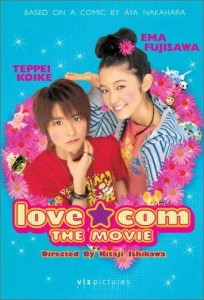
LOVE*COM: THE MOVIE

VIZ PICTURES • 100 MINUTES • NO RATING

Risa, the tallest girl in the seventh grade, develops a crush on Otani, the shortest boy in her class. Though superficial opposites, the two are really kindred spirits, sharing an enthusiasm for Umibozu (a Japanese rap artist that their classmates detest), swapping good-natured insults, and bonding over memories of rejection for being too tall and too short, respectively.

Whether you’ve read Aya Nakahara’s charming manga or not, you won’t have too much difficulty guessing how the story will end. The problem, however, is that Risa and Otani’s journey from bickering classmates to boyfriend and girlfriend seems utterly contrived. The scriptwriter borrows two romantic rivals from different volumes in the series’ run, but only succeeds in making Mr. “Mighty” Maitake, Risa’s handsome homeroom teacher, an integral part of the story. Even then, Mighty’s arrival is a bolt from the blue, and is never satisfactorily explained; he’s simply inserted into the final act of the story so that he and Otani can compete for Risa’s affections. (And when I say “compete,” I mean it: the two play a pick-up basketball game in front of the entire school.)

The other major drawback to Love*Com is its superficial treatment of the principal characters. Though Aya Nakahara’s manga charts the ups and downs of Risa and Otani’s friendship in minute detail, the movie’s frantic pace never allows us to get to know the characters or understand why they’re drawn to each other; we simply see them walk through a variety of stock scenes — cultural festivals, school trips — without actually seeing the evolution of their feelings dramatized.

It’s a pity that the Love*Com script feels so hastily assembled, as the film has the potential to appeal to both long-time fans and newcomers. The button-cute leads have some chemistry, even if the script doesn’t give them much to do. And the script shows flashes of inspiration; a “director” surrogate periodically interrupts the proceedings to explain certain peculiar-to-manga conventions (most notably the nosebleed-as-sign-of-arousal), intoning this information over strains of Beethoven’s Moonlight Sonata. These digressions occur just a few times, but add some much-needed humor to a film that lacks the wit and honesty of the source material.

The verdict: Skip it. This flat, uninspired retelling of Risa and Otani’s courtship will bore all but the most devoted Love*Com fans.

This review originally appeared at PopCultureShock on 3/24/08.

NANA

VIZ PICTURES • 114 MINUTES • NO RATING

I admire Kentaro Otani’s chutzpah in bringing NANA to the big screen, as it’s the kind of story that inspires intense devotion to the characters; make a poor casting decision or cut a beloved character and you run the risk of angering the manga’s most devoted fans. Otani steers clear of those hazards, however, assembling an appealing cast that look and sound like their cartoon doppelgangers.

The movie offers a somewhat streamlined account of the manga’s first five volumes, beginning with the two Nanas’ fateful encounter on a Tokyo-bound train and ending with Trapnest’s first visit to the girls’ apartment. Most of the dramatic juice is supplied by Hachi’s relationship with the feckless art student Shoji, and by Nana O.’s relationship with Trapnest bassist Ren.

As much as I enjoy the manga, I’ve always found Hachi’s relentless enthusiasm and boy-crazy antics irritating and couldn’t imagine why the fierce, scornful Nana O. didn’t feel the same way about her. As portrayed by Aoi Miyazaki, however, the character makes more sense. Miyazaki does a superb job of convincing us that Nana O. would befriend someone who seems too ditzy, too dependent, and too femme to hang with an up-and-coming punk act by showing us what the girls have in common. Mika Nakashima, as Nana O., also turns in a solid performance, playing her character as a believable mixture of belligerence, determination, and vulnerability.

The other great advantage of the movie is its soundtrack. All of the rock-n-roll shoptalk and song lyrics seemed a little preposterous on the page; I had a hard time imaging why Trapnest or Black Stones commanded loyal followings, as they seemed like pallid imitations of Siouxsie and the Banshees. Seeing and hearing these acts in the film, however, transported me back to my college years, reminding me how passionately I felt about certain musicians, and how much their songs felt like an expression of my own identity. The film’s two lengthy concert scenes are highpoints of the film, offering us a window into both girls’ complicated emotional lives — their dreams, their disappointments, their improbably close relationship.

I had a few small bones to pick with the scriptwriters — what happened to Junko and Kyosuke? — but on the whole, I found NANA immensely entertaining. The true measure of the film’s appeal, however, is that my sister, who isn’t a manga maven, loved it too, and wanted to know if there was a sequel. Thank goodness the answer is yes.

The verdict: Rent it. Some die-hard fans may take issue with the casting and script, as the film isn’t as faithful to the manga as the anime adaptation is.

This review originally appeared at PopCultureShock on 3/24/08.

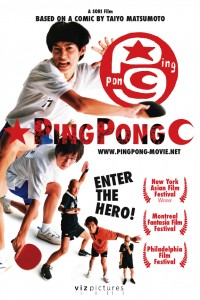
PING PONG

VIZ PICTURES • 114 MINUTES • NO RATING

Based on Taiyo Matsumoto’s manga of the same name, Ping Pong focuses on a pair of friends: Peco (Yosuke Kubozuka), a flamboyant table tennis star who’s obsessed with the game, and Smile (Arata), a reticent young man whose primary motive for playing is to spend time with Peco, whom he quietly regards as a hero. Peco’s swaggering style — complete with acrobatic leaps, trash talk, and frequent dives — makes for good theater, but he’s trounced in a tournament by long-time rival Demon (Koji Ohkura). Despondent over the loss, Peco quits the team and burns his paddle. The coach, himself a former champion known as “Butterfly Joe” (Naoto Takenaka), then turns to Smile to lead his peers to victory in the next major competition, a responsibility Smile is reluctant to accept.

Like Hoosiers, Rocky, Rudy, or A League of Their Own, Ping Pong sticks close to the sports movie playbook, delivering epiphanies with clockwork precision. Smile discovers his inner competitor. Peco discovers that he can’t live without ping pong. “Butterfly Joe” imparts wisdom to Smile. And so on.

Yet for all its sports-movie posturing, Ping Pong is weirdly thrilling, thanks, in large part, to the colorful cast of supporting characters: there’s Peco’s chain-smoking grandmother (Mari Natsuki), a fierce devotee of the sport who runs a table tennis dojo; China (Sam Lee), a washed-up Chinese champion seeking a fresh start in Japan; and Dragon (Shidou Nakamura), a competitor who shaves his eyebrows in an effort to look more intimidating. The other key to Ping Pong‘s success is its fidelity to Taiyo Matsumoto’s original vision. Director Fumihiko Sori’s painstaking efforts to recreate the look and feel of the manga are evident throughout the film, from the casting decisions to the extreme camera angles, jump shots, and fleeting fantasy sequences; Sori manages to capture Ping Pong‘s heightened reality without becoming too arch or mannered.

Fans wanting a behind-the-scenes look at the table tennis action or a few pointers for their own game will want to view the omake on this two-disc set, which includes a 54 minute “making of” documentary, a short “how to” feature reviewing ping pong techniques, and the usual assortment of trailers, tv spots, and cast profiles. All in all, Ping Pong makes a great addition to your library, especially if you still have dog-eared copies of No. 5 kicking around the attic.

The verdict: Rent or buy it. The film captures the arch, surreal quality of Taiyo Matsumoto’s writing even better than the animated version of Tekkonkinkreet.

This review originally appeared at PopCultureShock on 8/28/07.

Filed Under: Manga Critic Tagged With: Ai Yazawa, love*com, Movie Reviews, nana, Ping Pong, Taiyo Matsumoto, VIZ Pictures

Manga on the Big Screen: Love*Com, NANA, and Ping Pong

August 5, 2011 by Katherine Dacey

As anyone who’s seen Green Lantern or Captain America can attest, adapting a comic for the silver screen is an art, not a science. Done poorly, comic book movies alienate fans with the omission of favorite characters and glossing of seminal plotlines, or confuse newcomers with in-jokes and choppy storytelling. Done well, however, comic book movies can appeal to just about anyone who’s receptive to the genre and the characters. VIZ Pictures may not have released as many comic-book movies as DC or Marvel, but its catalog includes adaptations of several popular manga, including Aya Nakahara’s Love*Com, Ai Yazawa’s NANA, and Taiyo Matsumoto’s Ping Pong. These three films make an instructive case study, as they illustrate the pitfalls and potentials of bridging the gap between page and screen.

Love*Com: The Movie
VIZ Pictures • 100 minutes • No Rating
Risa, the tallest girl in the seventh grade, develops a crush on Otani, the shortest boy in her class. Though superficial opposites, the two are really kindred spirits, sharing an enthusiasm for Umibozu (a Japanese rap artist that their classmates detest), swapping good-natured insults, and bonding over memories of rejection for being too tall and too short, respectively.

Whether you’ve read Aya Nakahara’s charming manga or not, you won’t have too much difficulty guessing how the story will end. The problem, however, is that Risa and Otani’s journey from bickering classmates to boyfriend and girlfriend seems utterly contrived. The scriptwriter borrows two romantic rivals from different volumes in the series’ run, but only succeeds in making Mr. “Mighty” Maitake, Risa’s handsome homeroom teacher, an integral part of the story. Even then, Mighty’s arrival is a bolt from the blue, and is never satisfactorily explained; he’s simply inserted into the final act of the story so that he and Otani can compete for Risa’s affections. (And when I say “compete,” I mean it: the two play a pick-up basketball game in front of the entire school.)

The other major drawback to Love*Com is its superficial treatment of the principal characters. Though Aya Nakahara’s manga charts the ups and downs of Risa and Otani’s friendship in minute detail, the movie’s frantic pace never allows us to get to know the characters or understand why they’re drawn to each other; we simply see them walk through a variety of stock scenes — cultural festivals, school trips — without actually seeing the evolution of their feelings dramatized.

It’s a pity that the Love*Com script feels so hastily assembled, as the film has the potential to appeal to both long-time fans and newcomers. The button-cute leads have some chemistry, even if the script doesn’t give them much to do. And the script shows flashes of inspiration; a “director” surrogate periodically interrupts the proceedings to explain certain peculiar-to-manga conventions (most notably the nosebleed-as-sign-of-arousal), intoning this information over strains of Beethoven’s Moonlight Sonata. These digressions occur just a few times, but add some much-needed humor to a film that lacks the wit and honesty of the source material.

The verdict: Skip it. This flat, uninspired retelling of Risa and Otani’s courtship will bore all but the most devoted Love*Com fans.

This review originally appeared at PopCultureShock on 3/24/08.

Nana
VIZ Pictures • 114 minutes • No Rating
I admire Kentaro Otani’s chutzpah in bringing NANA to the big screen, as it’s the kind of story that inspires intense devotion to the characters; make a poor casting decision or cut a beloved character and you run the risk of angering the manga’s most devoted fans. Otani steers clear of those hazards, however, assembling an appealing cast that look and sound like their cartoon doppelgangers. The movie offers a somewhat streamlined account of the manga’s first five volumes, beginning with the two Nanas’ fateful encounter on a Tokyo-bound train and ending with Trapnest’s first visit to the girls’ apartment. Most of the dramatic juice is supplied by Hachi’s relationship with the feckless art student Shoji, and by Nana O.’s relationship with Trapnest bassist Ren.

As much as I enjoy the manga, I’ve always found Hachi’s relentless enthusiasm and boy-crazy antics irritating and couldn’t imagine why the fierce, scornful Nana O. didn’t feel the same way about her. As portrayed by Aoi Miyazaki, however, the character makes more sense. Miyazaki does a superb job of convincing us that Nana O. would befriend someone who seems too ditzy, too dependent, and too femme to hang with an up-and-coming punk act. Mika Nakashima, as Nana O., also turns in a solid performance, playing her character as a believable mixture of belligerence, determination, and vulnerability.

The other great advantage of the movie is its soundtrack. All of the rock-n-roll shoptalk and song lyrics seemed a little preposterous on the page; I had a hard time imaging why Trapnest or Black Stones commanded loyal followings, as they seemed like pallid imitations of Siouxsie and the Banshees. Seeing and hearing these acts in the film, however, transported me back to my college years, reminding me how passionately I felt about certain musicians, and how much their songs felt like an expression of my own identity. The film’s two lengthy concert scenes are highpoints of the film, offering us a window into both girls’ complicated emotional lives — their dreams, their disappointments, their improbably close relationship.

I had a few small bones to pick with the scriptwriters — what happened to Junko and Kyosuke? — but on the whole, I found NANA immensely entertaining. The true measure of the film’s appeal, however, is that my sister, who isn’t a manga maven, loved it too, and wanted to know if there was a sequel. Thank goodness the answer is yes.

The verdict: Rent it. Some die-hard fans may take issue with the casting and script, as the film isn’t as faithful to the manga as the anime adaptation is.

This review originally appeared at PopCultureShock on 3/24/08.

Ping Pong
VIZ Pictures • 114 minutes • No Rating
Based on Taiyo Matsumoto’s manga of the same name, Ping Pong focuses on a pair of friends: Peco (Yosuke Kubozuka), a flamboyant table tennis star who’s obsessed with the game, and Smile (Arata), a reticent young man whose primary motive for playing is to spend time with Peco, whom he quietly regards as a hero. Peco’s swaggering style — complete with acrobatic leaps, trash talk, and frequent dives — makes for good theater, but he’s trounced in a tournament by long-time rival Demon (Koji Ohkura). Despondent over the loss, Peco quits the team and burns his paddle. The coach, himself a former champion known as “Butterfly Joe” (Naoto Takenaka), then turns to Smile to lead his peers to victory in the next major competition, a responsibility Smile is reluctant to accept.

Like Hoosiers, Rocky, Rudy, or A League of Their Own, Ping Pong sticks close to the sports movie playbook, delivering epiphanies with clockwork precision. Smile discovers his inner competitor. Peco discovers that he can’t live without ping pong. “Butterfly Joe” imparts wisdom to Smile. And so on.

Yet for all its sports-movie posturing, Ping Pong is weirdly thrilling, thanks, in large part, to the colorful cast of supporting characters: there’s Peco’s chain-smoking grandmother (Mari Natsuki), a fierce devotee of the sport who runs a table tennis dojo; China (Sam Lee), a washed-up Chinese champion seeking a fresh start in Japan; and Dragon (Shidou Nakamura), a competitor who shaves his eyebrows in an effort to look more intimidating. The other key to Ping Pong‘s success is its fidelity to Taiyo Matsumoto’s original vision. Director Fumihiko Sori’s painstaking efforts to recreate the look and feel of the manga are evident throughout the film, from the casting decisions to the extreme camera angles, jump shots, and fleeting fantasy sequences; Sori manages to capture Ping Pong‘s heightened reality without becoming too arch or mannered.

Fans wanting a behind-the-scenes look at the table tennis action or a few pointers for their own game will want to view the omake on this two-disc set, which includes a 54 minute “making of” documentary, a short “how to” feature reviewing ping pong techniques, and the usual assortment of trailers, tv spots, and cast profiles. All in all, Ping Pong makes a great addition to your library, especially if you still have dog-eared copies of No. 5 kicking around the attic.

The verdict: Rent or buy it. The film captures the arch, surreal quality of Taiyo Matsumoto’s writing even better than the animated version of Tekkonkinkreet.

This review originally appeared at PopCultureShock on 8/28/07.

Filed Under: Manga Critic, Movies & TV, REVIEWS Tagged With: Ai Yazawa, love*com, nana, Ping Pong, Taiyo Matsumoto, VIZ Pictures

Now You’re One of Us

August 3, 2011 by Katherine Dacey Leave a Comment

Noriko, the young heroine of Asa Nonami’s Now You’re One of Us, initially thinks she’s hit the marriage jackpot. Not only are her in-laws wealthy and well regarded by their neighbors, they’re also quick to embrace her as a member of the family. Her husband Kazuhito is handsome and utterly devoted; her mother-in-law Kimie, generous and uncritical; and her sister-in-law Ayano, solicitous to everyone in the household, including Kazuhito’s oddly child-like brother Takehami. Even the Shito matriarch, ninety-eight-year-old Ei, welcomes Noriko to the clan by declaring her the family’s “treasure” and “future.”

Shortly after Noriko arrives at the Shitos’ Tokyo home, a strange, slightly disheveled neighbor approaches her while she works in the garden. Though Kimie is quick to dismiss him as a troubled tenant who’s fallen on hard times, Noriko can’t shake the feeling that the neighbor was about to divulge something damning — a feeling intensified by his mysterious death in a fire several days later. The Shitos’ oddly muted, impersonal response to his death further arouses Noriko’s suspicion, as do the family’s clandestine midnight meetings. Though the Shitos offer reasonable, measured responses to Noriko’s inquiries, she begins wondering if the Shitos run an illicit business… or worse.

Thanks to a fluid translation by Michael and Mitsuko Valek, Asa Nonami’s simple, unfussy prose draws the reader into Noriko’s insular world, showing us how a simple girl from a working class family is lured into the Shitos’ web. In this passage, for example, Nonami reveals Kazuhito to be a deft manipulator, appealing to Noriko’s vanity by suggesting that Ei’s endorsement carries special significance:

“Great Granny’s been watching people for ninety-eight years — she can see through them at a glance, so lots of people in the neighborhood come to ask her for advice.” He explained how delighted he was that Great Granny had taken a liking to her; it showed that he hadn’t been blinded by attraction. He felt like the luckiest man in the world for having found someone of whom his family approved.

Unfortunately, Nonami is never content to let a passage like this one stand alone; she feels compelled to explain how Kazuhito’s words swayed Noriko by telling us exactly what Noriko is thinking at the moment he gives this speech. The obviousness of Noriko’s interior monologues is especially frustrating; Nonami does a competent job of revealing her characters’ motivations and feelings through their actions without resorting to such editorial interventions.

The other drawback to Nonami’s storytelling is that she begins telegraphing the ending just a few chapters into the book. Savvier readers will quickly figure out what the Shitos’ secret is — and it’s a doozy — though they probably won’t mind wading through another hundred pages to have their ickiest suspicions confirmed, especially since Nonami manages a few surprises in the final pages.

The bottom line: Now You’re One of Us is an entertaining, atmospheric potboiler that’s probably best read in the privacy of one’s own home.

This review originally appeared at PopCultureShock on 2/8/08.

NOW YOU’RE ONE OF US • BY ASA NONAMI, TRANSLATED BY MICHAEL AND MITSUKO VALEK • VERTICAL, INC. • 240 pp.

Filed Under: Manga Critic Tagged With: Mystery/Suspense, Novel, vertical

  • « Go to Previous Page
  • Page 1
  • Interim pages omitted …
  • Page 16
  • Page 17
  • Page 18
  • Page 19
  • Page 20
  • Interim pages omitted …
  • Page 39
  • Go to Next Page »
 | Log in
Copyright © 2010 Manga Bookshelf | Powered by WordPress & the Genesis Framework