• Skip to primary navigation
  • Skip to main content
  • Skip to primary sidebar
  • Home
  • About Us
    • Privacy Policy
    • Comment Policy
    • Disclosures & Disclaimers
  • Resources
    • Links, Essays & Articles
    • Fandomology!
    • CLAMP Directory
    • BlogRoll
  • Features & Columns
    • 3 Things Thursday
    • Adventures in the Key of Shoujo
    • Bit & Blips (game reviews)
    • BL BOOKRACK
    • Bookshelf Briefs
    • Bringing the Drama
    • Comic Conversion
    • Fanservice Friday
    • Going Digital
    • It Came From the Sinosphere
    • License This!
    • Magazine no Mori
    • My Week in Manga
    • OFF THE SHELF
    • Not By Manga Alone
    • PICK OF THE WEEK
    • Subtitles & Sensibility
    • Weekly Shonen Jump Recaps
  • Manga Moveable Feast
    • MMF Full Archive
    • Yun Kouga
    • CLAMP
    • Shojo Beat
    • Osamu Tezuka
    • Sailor Moon
    • Fruits Basket
    • Takehiko Inoue
    • Wild Adapter
    • One Piece
    • After School Nightmare
    • Karakuri Odette
    • Paradise Kiss
    • The Color Trilogy
    • To Terra…
    • Sexy Voice & Robo
  • Browse by Author
    • Sean Gaffney
    • Anna Neatrour
    • Michelle Smith
    • Katherine Dacey
    • MJ
    • Brigid Alverson
    • Travis Anderson
    • Phillip Anthony
    • Derek Bown
    • Jaci Dahlvang
    • Angela Eastman
    • Erica Friedman
    • Sara K.
    • Megan Purdy
    • Emily Snodgrass
    • Nancy Thistlethwaite
    • Eva Volin
    • David Welsh
  • MB Blogs
    • A Case Suitable For Treatment
    • Experiments in Manga
    • MangaBlog
    • The Manga Critic
    • Manga Report
    • Soliloquy in Blue
    • Manga Curmudgeon (archive)

Manga Bookshelf

Discussion, Resources, Roundtables, & Reviews

Reviews

Holmes of Kyoto, Vol. 7

December 28, 2021 by Sean Gaffney

By Mai Mochizuki and Shizu Yamauchi. Released in Japan by Futabasha. Released in North America by J-Novel Club. Translated by Minna Lin.

This volume was already starting off in a big hole as I read the synopsis before getting the book. I have to be honest, “I’m breaking up with you to keep you safe” is something that I really, really hate. It didn’t help that we get another of the plot devices I hate, which is the threat of rape framed as “I will despoil her”, because Virginity Is Important, Franklin. So yeah, this was already starting from a deep hole, and it’s a credit to the author that I will still likely be reading the next book. That said, they really need to accept that they are better at writing mysteries, antiquing and travelogues than they are romance, and also that the books work better in short story collections. It helps that the first half of the book does NOT involve this plot, even though it too has a trope that I’m not fond of, the “I’ve misunderstood a secondhand conversation and think my boyfriend is in love with someone else”. Honestly, this whole book is land mines.

Holmes and Aoi are dating, and are both calm and intelligent, but that doesn’t mean they aren’t free from stress. When Aoi hears that Holmes and Yoshie, the owner’s girlfriend, had an intimate conversation while in America, she knows it’s gonna be a misunderstanding but goes there anyway. After this Holmes is asked to judge a tea ceremony between two brothers to help figure out who’s going to take over the family. Unfortunately, after this, everyone’s least favorite Moriarty shows up to ruin the book. Ensho is back, trying to get Holmes to appraise an incense container and also to be creepy and threatening. After being startled that it’s actually genuine, he vanishes… only to show up at Aoi’s high school to threaten her. This is enough for Holmes, who decides to break up with her in order to keep her away from Ensho, who clearly has a vendetta.

It is suggested at the end of this book that we’ve seen the last of Ensho as a recurring villain, and thank God. It’s reminiscent of Jon Pertwee’s second season of Doctor Who, where you know who the villain is because The Master is in every story that season. He’s worn out his welcome. As for Aoi, honestly, given everything that happens to her here I’m rather stunned that she managed to sail through her college entrance exams. The “theme” of the book, such as it is, is that words can hurt and affect people even if they are aware that the words are complete bullshit. We see that with Holmes’s grandfather, father, and him, and it’s all the more startling because it’s people we know are calm and intelligent. That said, this series continues to be at its best when discussing antiques or touring landmarks of Kyoto, and those were once more the better parts of the book.

That said, the writer may be running out of Kyoto, as the next volume sees Homes and Aoi headed to Yawata City! Which, yes, is also in Kyoto Prefecture, but it’s the thought that counts. In the meantime, if you do read this for the potboiler soap opera, this will be filled with that sort of thing. For the rest of us, let’s hope it’s done.

Filed Under: holmes of kyoto, REVIEWS

Der Werwolf: The Annals of Veight, Vol. 13

December 26, 2021 by Sean Gaffney

By Hyougetsu and Nari Teshima. Released in Japan by Earth Star Novels. Released in North America by J-Novel Club. Translated by Ningen.

We continue the trend of the series gradually shifting from Veight’s adventures to Friede’s, though as long as the subtitle of the series remains the same I would not worry too much about losing everyone’s favorite vice-commander. (the best joke in this volume, by the way, is how everyone now wants to be a vice-commander because that’s what Veight was and they associate it with being all-powerful.) The narration here is closer to a balance between Friede and Veight, as is the action, though it’s weighted more towards Friede in the front. She’s something of a breath of fresh air in that, while she is undeniably strong and clever, she’s also a kid and thus cannot simply brute force her way through everything the way that Veight does. Indeed, late in the book Veight gets yelled at for solving a problem by blowing it up, even though, to be fair, that was likely the only way the problem could be solved. Friede is not super OP, so we are more interested in how she fixes things.

We pick up where we left off last time, with Friede, Shirin and Yuhette being sent to Rolmund as part of an ambassadorial visit, with the hopes that if it goes well it could lead to actual negotiations by adults in the future. What follows is essentially a continuation of the Rolmund arc from previous books, as it turns out that, unlike Meraldia, things are still very much in flux there politically. Eleora mostly has everything handled, but insurrections keep happening, and she cannot be everywhere. This is problematic when her niece, the heir (you know she’s not gonna get married, she’s one of the women who lost to Airia in the Veight sweepstakes) ends up kidnapped by one of the rival factions. Who’s going to be the one to find her? Will it be those whose job it is to do it? Or will it be our little girl protagonist? Take a guess.

I was amused at the niece/heir, Micha, who at first appears to be one of THOSE rich kids (you even see her pointing, always a sign in Japanese media that someone is rude) but quickly bonds with Friede, to the point where by the time the visit ends they’re best friends. Admittedly Friede also saves her life, which does help cement close friendships, or so I hear. As for Veight, he gets to do more on the back end of the book. Facing off against a sandworm is a scene for those who prefer the old, Veight is badass sort of story, but for me the highlight was the politics, including Veight opening up to his daughter about being a reincarnation. I too would miss easy to access potato chips if I were a werewolf in a fantasy kingdom. Not to mention paper curr3ency, which rears its ugly head as this book ends and will likely come up in Book 14.

Which we may or may not see soon. Square Enix has purchased the rights to Der Werwolf in Japan, so Vol. 14 and forward need to have J-Novel Club negotiate with a new publisher. Till then, fans of the series can enjoy this book which continues to very, very slowly pass the baton to its new heroine.

Filed Under: der werwolf, REVIEWS

Culinary Chronicles of the Court Flower, Vol. 4

December 25, 2021 by Sean Gaffney

By Miri Mikawa and Kasumi Nagi. Released in Japan as “Ikka Kōkyū Ryōrichō” by Kadokawa Beans Bunko. Released in North America digitally by J-Novel Club. Translated by afm.

I will admit that after the cliffhanger of the previous volume, I was not expecting the plot for most of this one to be “ghost story”. And yet it also manages to help to drive forward the love triangle as well, as it’s hard to maintain a cool, relaxed, professional demeanor when the person you love is sneaking into your room every night. Especially when they’re really a ghost who is there to slowly sap your life essence. This isn’t QUITE Rimi’s fault this time, but she’s the only one that can fix it, and honestly if she fails execution is likely what awaits. Again. If this were the previous three volumes, then the problem would be solved by food, but here food is only part of the answer. Rimi needs to actually look inside the ghost’s heart and see why they’re doing this. Which will, unfortunately for everyone involved, mean looking inside her own heart and doing what’s best for everyone.

The book starts off with the fallout from the previous one. Both Rimi and Shusei both trying to repress their love, and succeeding only in the eyes of each other (we get monologues from each about how the other one is much calmer about this). And the Emperor is, of course, waiting patiently for Rimi’s answer to his proposal. All this emotion flying around means that Tama, the Quinary Dragon, is feeling ill and lethargic. After researching things, they decide to decamp to a different palace, one with more spiritual energy, in order to heal Tama. Unfortunately, this palace comes with its own version of the Seven Mysteries of the High School, and Rimi finds herself dragged to a cursed well by impetuous consort and repressed lesbian Yo, who decides that investigating cursed objects that scream “do not open this cursed object” is awesome. Unfortunately, it triggers a curse. And now everyone’s going into everyone else’s room – supposedly – like it’s a British farce.

The food may take a back seat this time, but the romance and political intrigue does not. Despite Shusei trying to run away from it at every opportunity, he’s finally told the secret of his birth – and understands the implications for how he can use it to make Rimi his. Unfortunately, Rimi identifies strongly with the ghost here, who had to give up on her true love in order to become the Empress because it would be better for the kingdom. It comes down to waffling about things because of your love or making a clean break without regrets, and Rimi, who has matured more with each volume, makes the difficult choice. Which is very good news for the Emperor, but very bad news for the cast in general, as after reading the last forty or so pages of this book I’m fairly sure that this series is going to be ending with most of the cast dead.

But that’s future Sean’s problem. For now, this was probably the best volume in this series to date, one where true loves goes up against political expediency and comes out the loser.

Filed Under: culinary chronicles of the court flower, REVIEWS

Do You Love Your Mom and Her Two-Hit Multi-Target Attacks?, Vol. 11

December 24, 2021 by Sean Gaffney

By Dachima Inaka and Iida Pochi. Released in Japan as “Tsujo Kogeki ga Zentai Kogeki de Ni-kai Kogeki no Okasan wa Suki desu ka?” by Fujimi Fantasia Bunko. Released in North America by Yen On. Translated by Andrew Cunningham.

Sometimes you need to be careful not to read too much into “this character is overpowered an perfect”, even in a light novel. We’ve spent ten volumes so far watching Mamako and Masato, and honestly it has felt like most of the growth has been on his end. He’s a teenager, after all. That said, the game that we’ve been watching has not been entirely for children to mature and learn to get along better with their mothers, it’s also been showing us some pretty awful mothers. From Wise’s selfish mom to Mehdi’s education mom to Porta’s workaholic mom, each of these mothers has shown us that equal work needs to be done on both ends to repair the relationship. As such, it should not be too much of a surprise that we get to the final volume, which is supposedly about Masato facing off against his father the Demon Lord, only to realize that Mamako has been the real final boss all along.

The reason for the appearance of Masato’s dad (who works for the government) is that the beta is over, and it’s time to stop playing the game and go back to the real world. But first, there are a few hurdles to be overcome. The game ‘resets’ itself somewhat, first by having to get everyone to re-register their roles (fortunately for Masato, no one else really wants to be the Hero); then by erasing the memories of most of the supporting cast, in order to make Masato’s task harder. But he’s matured, something he shows off quite well in the first half of this book. A little too well – not only are Wise and Mehdi disturbed that a Masato who’s not pathetic might actually be… attractive to them, but Mamako is realizing that she’ll soon be unable to be a mom for him 24-7… and she hates that, however much she might pretend otherwise.

So yes, Mamako *is* one of the mom stereotypes we mentioned before. She’s the smothering mom. We’ve seen this throughout the series – the gag is that the game revolves around her and that he’s unable to do anything himself. But slowly, as the books have gone on, he’s managed to take more of a role in deciding what to do and how to solve things. He’s growing up. High school and college are around the corner. And then he’ll move out, marry Wise/Mehdi/whoever (Porta, thankfully, is left in the little sister role), and Mamako won’t have her baby boy around. The finale makes sense in a conceptual way – given the entire game has revolved around Mamako to date, she ends up literally becoming the game writ large… very large. But finally they are able to get through to her, and we end up with an epilogue that has everyone in reality dealing with the Mom game going into wide release.

Ignoring the joke ending that is basically “and the adventure continues…”, this was far more solid than it had any right to be. The series should have ended several volumes ago, but at least it mostly stuck the landing.

Filed Under: do you love your mom?, REVIEWS

In the Land of Leadale, Vol. 4

December 23, 2021 by Sean Gaffney

By Ceez and Tenmaso. Released in Japan as “Leadale no Daichi nite” by Famitsu Bunko. Released in North America by Yen On. Translated by Jessica Lange.

Last time I called In the Land of Leadale “a slow life series with a potentially dark, chewy center”, and that definitely applies to this book, though keep in mind the darkness at the center may in fact keep you up at night. For the most part this continues to advance the series’ vague plotline. Cayna is getting better at social interaction (having a child to care for helps), and while she still does ludicrous things, they’ve become more of a spice than the entire book itself. There’s also lots of cuteness and slow life stuff. Unfortunately, there’s also a group of goons who are hired to kidnap the children Cayna is caring for, and they fill the “evil light novel guy” gamut from cheerful sociopath to literal pedophile. Seeing them get their asses handed to them by our favorite catgirl maid is a big highlight of the book. We then get to see their actual fate, which, not gonna lie, was straight up terrifying. I was not expecting pure horror in this series.

Cayna, settling in in the village with her adopted daughter and her butler/maid familiars, realizes that she has not interacted with Mai-Mai as much as her other two children, and also wants to introduce Luca to her. So it’s back to Felskeilo we go, with not only Luca and Roxine but also Lytt, just to make sure Luca has an appropriate companion. Once there, it’s time for the annual festival!… which may not happen, as there’s a mysterious unidentified swimming object in the massive river that goes through the city. Those familiar with previous volumes of Leadale will not be too surprised at what it actually is, but that does not make dealing with it any easier. Add to this that Cayna’s… unusual horseless carriage has drawn the wrong kind of attention, and it’s a wonder that Cayna has any time left over to be ludicrously powerful! But that’s OK. She makes time.

So yeah, I will not get too much into the fate of the horrible mooks, as I’d like to leave it for the reader. It’s scary, though, even if they deserve it. The most interesting part of the book might come near the end, where Cayna starts theorizing about why all of a sudden they’re seeing the reactivation of so many quests. It’s actually quite a clever idea, and manages to hit on another of the things I like about this book – we’re not sure if this is a “trapped in a game” world or not, and the narrative itself is deliberately obfuscating things. The other fun thing about this book is its sweet moments. Cayna’s casual overpoweredness can also lead to relaxed, fun situations, such as the giant fishing party at the end, and the bond she’s developed with not only Luca but also Roxine is great. (Also loved Roxine’s dere moments in this.)

This is the last volume to come out before the anime, and given the state of recent LN adaptations, that’s cause for worry. Still, if you still enjoy slow life OP women and don’t mind a literal demon coming along and turning evil men into things, this is a great series to read.

Filed Under: in the land of leadale, REVIEWS

Rosen Blood, Vol 1

December 22, 2021 by Anna N

Rosen Blood Volume 1 by Kachiru Ishizue

The phrase “gothic reverse harem vampire shoujo manga,” is jam-packed with many plot tropes and Rosen Blood certainly manages to be all of those things. I might wish for slightly more character development, but I found myself sufficiently diverted by all the vibes this manga serves up. The manga opens with heroine Stella Violetta waking up in a luxurious bed with a handsome man with slightly outsized canines introduces himself as her host, Levi-Ruin. Stella was on the way to take up a position as a maid after her sister died and she’s completely destitute. She begs Levi-Ruin to let her work in his mansion and he promptly takes her on a tour.

Levi-Ruin’s house is inhabited by a number of men with outsized canines. There’s Friederich, who is flirty and a bit handsy, the exceptionally pretty Yoel, and the nearly psychotic Gilbert. Levi-Ruin warns Stella that she can’t go outside because the estate is surrounded by a forest of thorns, and she’s not supposed to go into the basement. It takes Stella quite a bit of time to figure out what might be happening, even with Gilbert exclaiming over her “elegant, pulsing veins…” But I suppose most gothic heroines wouldn’t automatically assume the worst when they head into a life of servitude in a creepy yet luxurious mansion. The art in this series is delicate and well-executed to produce plenty of surreal and emotionally overwrought scenes as Levi-Ruin and his companions struggle with having a human in their midst. If you enjoy spooky romances, Rosen Blood packs plenty of atmosphere into one volume. I’d like to see a bit more complexity in Stella’s personality, but I enjoyed the first volume and I’m curious to see where the story goes.

Filed Under: Manga Reviews, REVIEWS Tagged With: rosen blood, shojo beat, shoujo, viz media

Dragon Daddy Diaries: A Girl Grows to Greatness, Vol. 2

December 22, 2021 by Sean Gaffney

By Ameko Kaeruda and Sencha. Released in Japan as “Totsuzen Papa ni Natta Saikyou Dragon no Kosodate Nikki: Kawaii Musume, Honobono to Ningenkai Saikyou ni Sodatsu ” by GC Novels. Released in North America by J-Novel Club. Translated by Giuseppe di Martino.

If the first volume of Dragon Daddy Diaries primarily revolved around the castle that is our heroes’ home base, then this volume is definitely set in the school. Indeed, we have to figure out excuses to get the rest of the cast to the school, and so our dragon daddy ends up being a security officer for the grounds, while Maredia and Clowria… well, sort of mooch around, but I suppose we can call them security as well. Basically what all this means is that the plot beats this volume all come from the school, and we don’t want to divide up the cast. It’s because we have a new main cast member, and she’s a welcome addition, even if she does, as Maredia notes, share a few character points with the Dark Queen herself. Luca is a new first year student, and she has a complicated backstory, a chip on her shoulder, and a desperate need for validation.

As for Olivia, she has managed to become a second year student, despite a huge amount of property damage to the school caused by her trying to learn beginner level spell and firing off advanced-level bursts. This means she’s now a sempai, and she tries to befriend her new roommate Luca, something that does not go very well for most of the book. Luca was supposed to be the King’s Student, a spot that Olivia has now taken, and thus Luca spends most of her school days challenging Olivia to various duels… and losing, because Olivia has been trained by a dragon and it shows. (That also comes out in this book, by the way, so everyone at last knows that he’s a dragon.) The other plotline going on is that they are searching for the Seven Supreme Hallows, powerful magical artifacts lost in the mists of time. In order to find them… a beach episode may be necessary.

As with the first volume, this series runs on tropes and sugar, and if you don’t like too much of either of them you may want to give this a miss. What character development there is comes mostly from Luca, though it is worth seeing Maredia manage to slowly emerge from her shut-in persona and begin to once again embrace her chuuni persona. Luca’s growth mostly stems from… parental neglect is the wrong term, but it’s a good lesson in why being too strict can sometimes have negative effects. When you’re never praised no matter how well you do, that bar can seem farther and father away. That said, I was a bit disappointed that the dragon having a chat with Luca’s mother was a speech done offscreen. Possibly as it would have interfered with the syrupy sweet mood. Even when battling an undersea turtle monster, the series doesn’t go much further than “he has a thorn in his paw”. Or in this case an ancient relic in his forehead.

This won’t make you count the days until the next volume comes out, but it’s a great read for a sunny day at the beach.

Filed Under: dragon daddy diaries, REVIEWS

Fushi no Kami: Rebuilding Civilization Starts with a Village, Vol. 5

December 20, 2021 by Sean Gaffney

By Mizuumi Amakawa and Mai Okuma. Released in Japan as “Fushi no Kami: Henkyou kara Hajimeru Bunmei Saiseiki” by Overlap. Released in North America by J-Novel Club. Translated by Maurice Alesch.

By and large fushi no Kami has been a worldbuilding novel. We’re here to see Ash and company drag the kingdom into the modern era, and we do get a bit of that here, particularly with the development of anesthetic. That said, there has also been an undercurrent of romance to the whole series. Ash has several girls in love with him, and up until this point has pretty much deliberately ignored it. Good news for fans who were hoping for resolution of this plotline, we definitely get it here, as Maika, with the help of almost everyone else in the cast, makes her move. Of course, Ash is unlikely to simply say “sure”, so stronger measures might be needed. And what of Arthur, who is the romantic runner-up in this scenario? Well, she remains a romantic runner-up, I’m afraid. Fushi no Kami does not seem all that interested in polyamory. Fortunately, Maika is awesome enough for five wives.

There is a certain amount of predictability in this volume, to be fair. Once we learn the story of how Maika’s parents got married, the rest of the book writes itself. That said, there is one big surprise, which is Ash casually admitting his feelings for Maika. Ash is a great protagonist, but he also has a tendency to default to ‘blank slate’, both when he talks to others and in his own narrative voice. As such, hearing him casually state that he loves Maika out loud is startling. That said, if you look at most of his actions in the past it makes sense, and his biggest reason to avoid it (they were both kids) is no longer an issue, as both are of marrying age in this fantasy world. That said, his response of “but I’ll never get married because I’d always put my dream over any spouse” is also very Ash. He wants his beloved to be happy.

As for Maika, we know enough about her to know she is not going to mope around after Ash rejects her. Especially not when she learns how her parents got married, and figures she can simply repeat history. Especially if it involves being a cool sword fighter! We’ve seen Maika’s training in the blade throughout the series, and no one has ever really been able to even come close to defeating her. Unfortunately, that applies here as well – despite a couple of attempts to insert drama into the story, with one opponent stating that he’ll be using lethal blows – there is a general lack of tension in her fights the entire way through. That said, it leads up to the best part of the book, where, after Ash says he can’t marry her because his dreams come first, she explains she’ll simply insert herself in between them, as long as it takes. Plus it’s not as if his dreams aren’t hers as well, she just doesn’t have the pat life to draw upon.

There is a decided lack of romantic fallout with Arthur, though that could simply be because she and Maika are best friends. Or it could carry over into Book 6. Which is not out in Japan, so for now we are left with a very nice love confession.

Filed Under: fushi no kami, REVIEWS

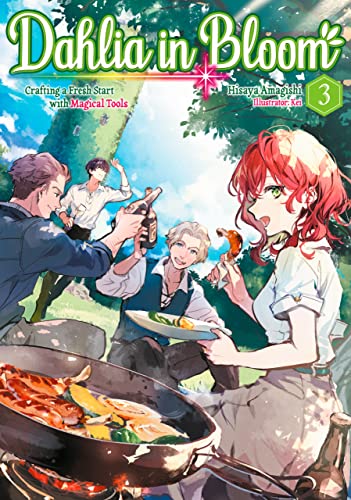
Dahlia in Bloom: Crafting a Fresh Start with Magical Tools, Vol. 2

December 19, 2021 by Sean Gaffney

By Hisaya Amagishi and Kei. Released in Japan as “Madougushi Dahliya wa Utsumukanai” by MF Books. Released in North America by J-Novel Heart. Translated by Nikolas Stirling.

Last time I said readers should not be surprised if this romance series turned into romance in the next book. It turns out that it may take a bit longer than that. Both of our protagonists are suffering from the death of a beloved parent who was their whole world. Moreover, due to different circumstances, both of them are avoiding love at the moment. As a result, while to the eyes of the reader it might look like they’re basically dating at this point, it really is merely a series of dinners, with the occasional experimental magical sword crafting as a side dish. That said, by the end of the book I think Volf is starting to realize how he actually feels about this captivating young woman/drinking partner. As for Dahlia… well, it’s going to be a bit. Heck, we can’t even credit her break up as being responsible for her avoiding love, as it’s made clear in a side story here that Tobias was also not even on her radar. She’s just dense to love. As are they all.

Fortunately for the reader, Tobias and his new bride are entirely absent from this book, which instead focuses on one major flaw that Dahlia has: she does not realize that her new inventions are stunningly revolutionary, rather than just off-the-cuff things that she can casually give out over drinks and dinner. This includes toe socks and insoles, something she suggests when hearing about Volf and his fellow knights having to battle in a swamp and constantly having issues with wet boots. As it turns out, Athlete’s Foot is a huge problem among the men in this world, and Dahlia’s creation – as well as advice she gives them based on experience from her past life – it enough to set up meetings with royalty. And let’s not even get into the magic bracelet she gives Volf that essentially allows him to leap tall buildings in a single bound. She really does not know her own strength as a craftswoman. Fortunately, everyone else does.

I joked on Twitter that the series was called “Dahliacoholic”, and it’s certainly true that pages and pages of this already very long book are devoted to her and Volf sitting around and having dinner and drinks and more drinks. Fortunately, she pretty much only does this around Volf, and he’s as bad as she is but also a gentleman. He also has a woman who he has an agreement with that they pretend to be lovers – for Volf it’s because he wants to avoid the adulation he tends to get walking around town, and for Altea because she appears to have been interested in his mother more than any man in her life. They both make good cover for each other. Which is good, as otherwise rumors about Volf and Dahlia would be rampant. She doesn’t quite have the social standing to be involved with a noble at the moment… but that may change if she keeps inventing at this speed.

I do think these books could stand to be shorter – like their main couple, they enjoy lingering over dinner and drinks and are in no rush to go home. That said, the mood of this book is excellent, and it manages to be a “slow life” that is actually slow, unlike a lot of those sorts of books.

Filed Under: dahlia in bloom, REVIEWS

The Scum Villain’s Self-Saving System, Vol. 1

December 18, 2021 by Sean Gaffney

By Mo Xiang Tong Xiu and Xiao Tong Kong (Velinxi). Released in China as “Ren Zha Fanpai Zijiu Xitong” on the JJWXC website. Released in North America by Seven Seas. Translated by Faelicy & Lily.

It’s rare I read a book that features so many genres that I normally don’t really deal with. I haven’t really read any Chinese “light novels” before. I don’t really do BL all that much. And I am almost totally unfamiliar with Xianxia, the supernatural fantasy “cultivation” genre that this novel is both part of and also parodying. But there were three very famous books coming out from this author that were getting MASSIVE buzz, and I wanted to read at least one of them. I picked this one partly as it was the shortest volume, and partly as it seems to be the least popular of the three (I like my problem children), but mostly because it’s also squarely in a genre I do read obsessively: Reincarnated Villainess. Or, in this case, villain. Shen Qingqiu and Luo Binghe may not quite match up exactly with Katarina and Maria, but at times it feels like it’s not for want of trying. As for the book itself? I’m glad I read it.

Shen Yuan has been reading a Chinese webnovel obsessively, despite raging in the comments about how the author is a hack. When the book ends, he gets so upset he actually dies… and finds himself in the body of Shen Qingqiu. No, not the hero. The hero’s evil master, who mercilessly abused and bullied the actual hero of the novel to the point where his eventual brutal torture and murder is one of the most disturbing in the book. Needless to say, this does not fill Shen Qingqiu with joy at ALL. Nor does the fact that there’s an omniscient System Voice telling him what he can and cannot do… which means he can’t simply change his evil ways right away. Can he manage to somehow avoid his bloody fate? Can he actually get Luo Binghe to look at him in a better light?… and wait, does he really want him to look at him in THAT kind of light?

Knowing nothing of the books and their genre, I was expecting this to be more serious than it was. It’s a hoot a lot of the time, particularly our hero’s screaming at the incredibly bad plot devices and scenarios that he is now forced to live through. That said, he gets wrapped up in both the people of this world and his charge, Luo Binghe, very quickly. The ‘danmei’ in this first book is pretty light, mostly consisting of Luo Binghe falling for his master in a very obvious way and Shenj Qingqiu boggling about the fact that he’s suddenly become the heroine rather than any of the hundreds of women that Luo Binghe was supposed to be bedding in the original (we even get the equivalent of “that’s the line she says to the guy in the game!” from Bakarina). There are also a few genuinely great plot twists along the way, and the characters are obvious cliches (that’s the point) while remaining fun to read.

So yes, I’m definitely happy I picked this up, and will definitely be reading the second book in the series. I’m not sure whether I’ll venture into the other two series, though – how funny are they?

Filed Under: REVIEWS, scum villain's self-saving system

If I Stay, Books 1-2 by Gayle Forman

December 17, 2021 by Michelle Smith

If I Stay
Mia has a perfect family (hip parents, adorable younger brother) and a perfect boyfriend (Adam, a sensitive punk rocker) and is a perfect cellist (surpasses multiple teachers!) whose perfect audition landed her a spot at Juilliard after graduation. Her perfect life (well, okay, there’s a modicum of tension with Adam about her moving away to New York in the fall) is destroyed when a car accident on a snowy day claims the lives of her parents and brother and leaves Mia in a state of astral projection, able to see what’s happening to her body while she struggles to decide whether to stay and live out her life after such a devastating loss or die and potentially join her family.

I’m not sure what I expected from If I Stay, exactly. Perhaps something spookier? Instead, it mostly alternates between Mia reflecting on memories with various loved ones and observing the goings-on at the hospital, including an episode in which Adam, instead of simply asking Mia’s grandparents to help him get in to see her, stages an elaborate distraction involving a rock star singing in the corridor outside the ICU. It’s as cringey as it sounds. I also wasn’t fond of the suggestion that it’s inherently virtuous to like classical music.

Despite my complaints, though, I didn’t hate it. Mia’s “this can’t be real” terror is conveyed well and I did get unexpectedly verklempt a couple of times. The book also gets much better once Mia’s best friend, Kim, is introduced. It’s through stories about Kim that we finally start to see Mia as someone less than perfect, which is decidedly welcome. I do find, though, that I wish the whole book had been about Kim in the first place! I find her much more interesting than Mia.

In any case, I did like this enough to check out the sequel.

Where She Went
Where She Went is quite a lot better than its predecessor. Told from Adam’s perspective, it’s set three years in the future as he—now a world-famous, Grammy-winning rock star and yet totally miserable—runs into Mia in New York City. It turns out Mia dumped Adam only a few weeks after she went off to Juilliard and never told him why, which completely destroyed him for a while until he channeled his pain into a batch of songs that would catapult Shooting Star’s major-label debut into multi-platinum status. They each have one night before they’re due to head out on tour and Mia suggests they spend it checking out some of her favorite spots around the city.

I thought Adam’s mental state was conveyed well. He’s hurt, he’s angry, he’s closed off, he’s sick of being tabloid fodder, and he no longer feels any love for music. Although he once vowed to let Mia go if she would just stay, it’s clear that he hasn’t been able to do that. Throughout the course of their conversation, however, he’s finally able to see that the person who’s really been harming him all this time is him, not Mia. The payoff here felt well-earned. Also, Mia does not come off as perfect here as she did in the first installment, which I appreciated.

In a series with some supernatural touches around the edges, it’s notable that the thing that really stretched my credulity is that everyone is so ridiculously successful at such a young age. Adam is a huge celebrity. Mia was extra special even at Juilliard and their meeting occurred at a concert she was giving at Carnegie Hall. Not only that, she’s somehow famous enough that a journalist from the rock scene knows about her and wants the scoop on her and Adam’s relationship. Even Kim has become a war photographer who sells her photos to The New York Times.

Still, this was quite good and made me a bit sniffly, which I perversely enjoy.

Filed Under: Books, REVIEWS, Supernatural, YA Tagged With: Gayle Forman

Magical Explorer: Reborn as a Side Character in a Fantasy Dating Sim, Vol. 1

December 16, 2021 by Sean Gaffney

By Iris and Noboru Kannatuki. Released in Japan as “Magical Explorer – Eroge no Yuujin Kyara ni Tensei Shita Kedo, Game Chishiki Tsukatte Jiyuu ni Ikiru” by Kadokawa Sneaker Bunko. Released in North America by Yen On. Translated by David Musto.

I will admit that I am not nearly as familiar with the ‘eroge’ genre as our protagonist is in this book. Certainly I’d thought that they all tended to be the same as most visual novels: you pick a route, you make choices, you get a girl, coitus ensues. Magical Explorer tells me that this genre is far broader than I expected. The game that our protagonist suddenly finds himself in (it’s never explained how, and he seems to have no desire to return to Japan) is a fantasy dungeon crawling game, with party balancing, learning new spells and skills, and the like. AND a lot of hot girls that the hero gets it on with. Honestly, given that at one point we’re told that in order to get all the route extras you have to buy five copies of the same game from different stores, I feel happy to be ignorant. That said, what about this book in particular?

Our nameless protagonist suddenly finds himself in the body of Kousuke Takioto, who is… NOT the hero of the dating sim world he finds himself in. He’s the “best friend” side character who is loud, flashy and crass to contrast with the hero’s dull, “insert reader here” qualities. As the hero amasses more and more girls, most players don’t bother to keep Kousuke in their party – why would they? This is an eroge! So he’s in the body of someone doomed to be left behind and ignored? Or… more importantly… he’s in a world where he can use magic powers! Yes, friends, let’s not pretend guys are only interested in sex. Cool powers are also high on the list. After moving in with the headmaster of his new school due to a tragic backstory (which he was entirely unaware of, being it never came up in the game), he decides to get his magic more powerful, explore dungeons, and leave the game plot behind. But will it leave him behind?

Given that our hero’s first thought on being in a porn game is “I wonder how I can level up my magic”, I assume he must have seen the School Days anime and knows the dangers of trying the more obvious “I will bed all the girls” choice. And there is a certain amount of cool magical and fighting content here… that I suspect no one is really reading the book for. No, they’re reading the book for scenes that you’d normally get special CG art for, and we get quite a few of those. Our hero accidentally falls and grabs tits and asses. He walks in on girls getting out of the shower. He manages to level up his magic to the point where he can see through steam and blindfolds to ogle women. And the final scene in the book runs on porn logic, and so is so stupid I hesitate to even bring it up. It’s all here.

This wasn’t bad, per se. It’s very good at giving its readers exactly what they want. If you decided to buy this, you’ll likely enjoy it. If you thought “ew, no”, you’re probably not even reading this review anyway. I think I’m done here, though.

Filed Under: magical explorer, REVIEWS

Goodbye Otherworld, See You Tomorrow: The Traveling Paintbrush and the Hefty Backpack

December 14, 2021 by Sean Gaffney

By Kazamidori and Nimoshi. Released in Japan as “Sayonara Isekai, Mata Kite Ashita” by Fujimi Fantasia Bunko. Released in North America digitally by J-Novel Club. Translated by MPT.

We tend to see, with isekai novels, a hero summoned to a world that’s in peril, usually by the royal family. Sometimes the summons goes wrong, or they summon some other person they didn’t want. We’ve even seen a few where the hero was summoned AFTER the big bad has been defeated, leaving them with nothing to do. We’ve seen heroes fail, and usually they go back in time to try to get it right this time or they’re reincarnated long into the future. But this one in particular is a bit much – by the time our hero, who is living in the woods after running away from his family, stumbles across another world, the world has lost almost everyone in it, turned to crystals by a sudden explosion of mana. All our hero can do, really, is drive around, try to get supplies and possibly find the dark man who gave him advice when he first arrived, and find a reason to go on. The last proves the hardest.

Keisuke does not have much, just his watch and phone (which don’t get more reception from Japan here) and a big truck that he doesn’t really know how to drive that well. Then the truck breaks down when he gets to an abandoned train station. Fortunately, he runs into a half-elf named Nito, who is a painter by trade and reluctantly starts to open up to him seeing as her means of transport is also busted. Together they get their respective vehicles repaired thanks to the last mechanic in the world who responds to distress flares, and set out on a journey – him to find the dark man I mentioned earlier, and her to see if her mother was telling her the truth when she talked about the Golden Sea in a book of paintings that are Nito’s most treasured possession.

So, spoiling something important right here and now: no one commits suicide in this book. This is important to note because we have no less than four different suicidal people at some point i this book, either genuinely trying and failing to take their life or having given up all hope on living. The fact that they do live, and that the See You Tomorrow in the title is meant to be uplifting and affirming, is probably the best thing about the book. The other big plus is the evocative prose – there’s a sense of Kino’s Journey to this series, but it doesn’t have an anti-war agenda like that does, and the disaster that wiped out nearly everyone remains a mystery by the end of the book. Instead we get a series of scenes where we see people who want to end their life finding reason to go on by communicating with others. I love that. It’s a series of passing meetings, but each one has impact.

I’d heard this was the most anticipated of the four J-Novel Club licenses that came out at the same time, and I can see why. It’s just a treat to read, though again I warn there are suicidal thoughts and suicide attempts in this. If you want a different sort of isekai, this is the one for you.

Filed Under: goodbye otherworld see you tomorrow, REVIEWS

Reset! The Imprisoned Princess Dreams of Another Chance!, Vol. 2

December 13, 2021 by Sean Gaffney

By Kei Misawa and poporucha. Released in Japan as “Torawareta Ōjo wa Nido, Shiawasena Yume o Miru” on the Shōsetsuka ni Narō website. Released in North America by Cross Infinite World. Translated by Evie Lund.

This author is very good at making the reader feel tension because something has not happened. For the most part, through about three-quarters of this book, Reset feels like the 2nd book in a two-part series. Annabel is invited to the country where Prince Daniel, her husband from her past life, is from. But… he seems fine? If a little wary. There’s also Princess Karina, the woman who destroyed Annabel’s life and had her thrown in prison. But… she’s sweet and nice? Something screwy’s going on here, and it likely has to do with the sullen, taciturn mage that Karina drags around with her. But it’s OK, because everything gets resolved in the end… well, sort of. The resolution feels rather off. And wait, there’s still how many pages of book left? And then we reach the final chapter, and you realize no, this is going to be a three-parter, and everything goes to hell in a handbasket.

The intriguing plot does help to cover up the author’s weakness, with is character. As I said in my review of the first book, Annabel is an interesting character to read because, if you’ll pardon the expression, she’s not like those other reincarnated villainess girls. Annabel is not a villainess, of course. She’s not trying every hour of every day to avoid her fate – months go by between chapters with not much happening. She isn’t even oblivious to the affection of everyone around her – this is very much a one-couple romance. We the reader figure out what’s actually happening before she does, which works, as it’s fun to watch her slowly realize that the Princess Karina that she knows is no longer herself. That said… she’s a bit generic? As is her boyfriend Ed, who also feels fairly standard.

Then we get the interesting bits, which are interesting because they grate against the reader’s sensibilities. The actual villain of the piece gets a backstory that talks about how she was taken from her people and forced to be a mage, and that her people later completely vanished. The response from the royalty of the kingdom seems to be “Hrm, well, not entirely accurate but yes, somewhat accurate, we’ll try to do something about it”, and we learn that she has essentially been abused her entire life. This makes her fate rather tragic… except the way it happens is so open-ended that the reader just goes, “And? AND?!?!” It’s like waiting for the other shoe to drop, only it takes sixty years. There’s a happily ever after! Annabel and Ed marry and have kids! Annabel dies at a ripe old age! And then we find out what the villain ACTUALLY did, and man, I want to read Book 3 now.

Alas, I will have to wait a few months. Still, Reset is a very good combination of typical characters and not so typical plot, and I hope Annabel can muddle her way through into finding happiness. Again.

Filed Under: reset, REVIEWS

Private Tutor to the Duke’s Daughter: Starting Magic Lessons with a Few Modest Tricks

December 11, 2021 by Sean Gaffney

By Riku Nanano and cura. Released in Japan as “Koujo Denka no Kateikyoushi” by Fujimi Fantasia Bunko. Released in North America digitally by J-Novel Club. Translated by William Varteresian.

Yes, I know, I’m surprised too. Given that I have occasionally muttered that I need to cut down on my light novel intake, it’s a bit of a shock that I picked up a series whose title and cover make it sound like it was introduced by Gilbert Gottfried on USA Up All Night. That said, the book itself is… well, exactly what you’d expect with a title and cover like that. A lot of focus on 13-year-old girls trying to seduce their 17-year-old instructor. Said instructor turns out to be ludicrously good at magic and also has at least three girls in love with him by the end of the book, with the promise of more. There’s a lot of “you are hugging my daughter and are therefore a creeper who must be murdered” schtick. Oh, and there’s a red-headed angry tsundere who flits around the plot, finally showing up at the end. Despite that, I finished it, and I want to read the next in the series. It works despite everything about it.

Our hero is Allen, who has just failed his exams when we meet him, for reasons that we never actually hear until the very end of this volume. This despite being one of the school’s two prodigies (the other being Lydia, the aforementioned redhead). He doesn’t even have the money to return home, so takes a job in a northern dukedom to train the daughter of the family in magic. Tina is smart as a whip and great at everything… except magic. She clearly has a ton of mana, but can’t cast any spells. Allen’s job is to either train her and her best friend/maid/rival Ellie so that they can pass the Royal Academy exams… or else convince Tina, who’s being stubborn about it, that it’s hopeless. That said, Allen has dealt with this sort of thing four years ago, so has a few ideas in mind. Hopefully ones that will not destroy the dukedom…

I always find something to latch on to in these sorts of books, and in this case it’s Allen. He spends the entire book trying to play himself off as a dull, boring, unskilled potato of a protagonist, which might trick the reader at first, but goes out the window whenever he meets anyone and they say “So I see you’re just as big a freak as the rumors say.” I actually wonder if he’s something of a parody, and I’m certain that his constant head-patting, hugging and general close contact with his two charges is tolerable only because he has all the sexual drive of a nerf ball. His world is loaded with little sister figures, with the exception of Lydia, who essentially refuses to let him peg her like that, so he calls her an ‘albatross’ – as in around his neck – instead. Honestly, the book’s big flaw is that we don’t get the story of him and Lydia from four years ago, which honestly sounds better than this one.

If you are the sort to complain about a light novel hero, don’t even start this one. Walk away and never look back. It will melt your eyes. If you don’t take it too seriously, it’s actually pretty fun, and I will read more to see what happens next and if there are any girls in it not in love with Allen.

Filed Under: private tutor to the duke's daughter, REVIEWS

  • « Go to Previous Page
  • Page 1
  • Interim pages omitted …
  • Page 91
  • Page 92
  • Page 93
  • Page 94
  • Page 95
  • Interim pages omitted …
  • Page 349
  • Go to Next Page »
 | Log in
Copyright © 2010 Manga Bookshelf | Powered by WordPress & the Genesis Framework