• Skip to primary navigation
  • Skip to main content
  • Skip to primary sidebar
  • Home
  • About Us
    • Privacy Policy
    • Comment Policy
    • Disclosures & Disclaimers
  • Resources
    • Links, Essays & Articles
    • Fandomology!
    • CLAMP Directory
    • BlogRoll
  • Features & Columns
    • 3 Things Thursday
    • Adventures in the Key of Shoujo
    • Bit & Blips (game reviews)
    • BL BOOKRACK
    • Bookshelf Briefs
    • Bringing the Drama
    • Comic Conversion
    • Fanservice Friday
    • Going Digital
    • It Came From the Sinosphere
    • License This!
    • Magazine no Mori
    • My Week in Manga
    • OFF THE SHELF
    • Not By Manga Alone
    • PICK OF THE WEEK
    • Subtitles & Sensibility
    • Weekly Shonen Jump Recaps
  • Manga Moveable Feast
    • MMF Full Archive
    • Yun Kouga
    • CLAMP
    • Shojo Beat
    • Osamu Tezuka
    • Sailor Moon
    • Fruits Basket
    • Takehiko Inoue
    • Wild Adapter
    • One Piece
    • After School Nightmare
    • Karakuri Odette
    • Paradise Kiss
    • The Color Trilogy
    • To Terra…
    • Sexy Voice & Robo
  • Browse by Author
    • Sean Gaffney
    • Anna Neatrour
    • Michelle Smith
    • Katherine Dacey
    • MJ
    • Brigid Alverson
    • Travis Anderson
    • Phillip Anthony
    • Derek Bown
    • Jaci Dahlvang
    • Angela Eastman
    • Erica Friedman
    • Sara K.
    • Megan Purdy
    • Emily Snodgrass
    • Nancy Thistlethwaite
    • Eva Volin
    • David Welsh
  • MB Blogs
    • A Case Suitable For Treatment
    • Experiments in Manga
    • MangaBlog
    • The Manga Critic
    • Manga Report
    • Soliloquy in Blue
    • Manga Curmudgeon (archive)

Manga Bookshelf

Discussion, Resources, Roundtables, & Reviews

Reviews

Let’s Get to Villainessin’: Stratagems of a Former Commoner, Vol. 1

August 14, 2024 by Sean Gaffney

By Hiironoame and Misumi. Released in Japan as “Sa, Akuyaku Reijou no Oshigoto wo Hajimemashou: Moto Shomin no Watashi ga Idomu Zunousen” by PASH! Bunko. Released in North America by Cross Infinite World. Translated by Dawson Chen.

I’m not sure if we’ve reached the point in 2024 where more villainess titles are licensed than isekai titles. Possibly it just feels that way to me as I read a majority of the villainess titles, while most isekai titles are ignored by me unless there’s a good reason. But this is definitely a book that is intimately familiar with the genre – the author has written several, unlicensed villainess series already, as well as the licensed Seriously Seeking Sister! book. The protagonist says she’s a fan of light novels, and has read villainess books in the past. She’s also backed by serious money here, so you’d think that things would go swimmingly. But as ever, it’s easier to avoid your doom than cause your doom as a villainess, and I appreciate that Mio is trying really hard to be a terrible person but just comes across as a big ol’ tsundere. It turns out being a bad person isn’t easy with a conscience.

Mio is a teenage girl who is working an extra job in order to pay for her sister’s hospital care, as she is dying of a mystery disease. Then, after stopping a purse snatcher, she is introduced to the owner of the purse, who has a deal for her. Shizuki, the rich girl Mio meets, says this is the world of an otome game! (It’s similar to Modern Villainess, in that it’s in a modern Japan but one that still has zaibatsu families.) Shizuki wants Mio to play the villainess role, bullying the heroine, making sure the heroine gets with the correct capture target, and fall to ruin. This will, for reasons not revealed in this book, save the country’s economy. In return, Shizuki will help get Mio’s sister advance treatment that might save her life. Mio thus goes all in on villainessin’.

So, I know this is a “translated into English” problem more than a problem with the original work. And I think the author did it deliberately in some ways to show off the “otome game” cliches of this world. But this book has important characters named Ruki, Riku, Ruri and Rikka. (I suspect the translator added the extra ‘k’ so that I would not lose my mind.) Oh yes, and Mio’s sister is Shizuku and her new sister by adoption is Shizuki. Fortunately, once I got past the names, this was a very good read. It’s a “we have to match the game’s plot but we keep changing it” sort of book, but this time everyone’s being serious, with nary a dumbass in the cast aside from the token “those two girls” who serve as the minibosses of Book One. A lot is being kept from Mio by Shizuki, and I for one am very concerned with her true motivations. But seeing Mio desperately try to be bad and accidentally helping the heroine out… look, I love a good Maria Campbell plot, OK? It helps that the heroine isn’t evil this time, possibly as this isn’t our original villainess either.

Assuming that we’re not introduced to Kiki, Kiko and Kiku next volume, I’m definitely looking forward to it, if only to get some answers, and see if Mio really will fall in love with the guy she’s trying not to fall in love with.

Filed Under: let's get to villainessin', REVIEWS

Sasaki and Peeps: Fake Family Formed! ~The Youngest Daughter Dreams of a Warm Family in This Hodgepodge Household~

August 13, 2024 by Sean Gaffney

By Buncololi and Kantoku. Released in Japan as “Sasaki to Pi-chan” by Media Factory. Released in North America by Yen On. Translated by Alice Prowse.

I do feel that this series might have a conclusion in mind, but it really is meandering towards that conclusion, to the point where I was actually a little bored somewhere in the middle of this volume. Which is surprising given it’s an isekai-lite book, and I usually tend to prefer those. For the most part, the bulk of this book is spent integrating Type Twelve into the main cast, which has Futarishizuka and Sasaki making decisions that make sense in a “we’re trying to save the world” sort of way, but narratively in a book makes them sort of terrible. It doesn’t help that the idea that all of this is secret is really being blown apart, with Neighbor Girl’s classmates all discussing whether aliens are real or not after spotting the huge obvious flying saucer. Each book tends to set up the next book, and I suppose that’s true here. And to be fair, the end of the volume definitely was excellent. But I’d like to know the author has a final volume envisioned.

Type Twelve wants to learn more about humanity from Hoshizaki, and has decided the best way to do this is to pretend to be a family. Hoshizaki is the mother, Sasaki is the father, Kurosu and Abaddon are her older siblings, Elsa (returned from isekai land) is the next door neighbor who’s always dropping in, Sasaki is the family pet, and Futarishizuka is the crotchety grandmother, a role she takes to with gusto, to be honest. They go shopping, they buy a house – well, OK, Type Twelve steals a house – and they go to the amusement park, which Futarishizuka, with the reluctant help of Sasaki, tries to depress the robot so that she’ll give up and return home. Everything changes, though, when Kurosu says there’s a new death game coming to a mysterious island, and she wants their help in going after the big prizes that come with said game. Alas, when they get there they find that things will not go that well…

As noted, the death game is the best part (the worst part may be when Kurosu, running away from interaction with her classmates, comes across her teacher screwing her bullied classmate, and she just sort of stomps away in a fit of pique that she’s not able to get that with Sasaki). They arrive assuming that everything will be much the same as the previous games, but not only is everyone on the angel AND demon teams now trying to kill her and Abaddon specifically, but there are also a lot more random elements. A psychic is killing people because he can, the magical girl rips a hole in reality to go kill psychics, and Type Twelve has to literally blow herself up 9she gets better) to save the main cast. And, oh yes, the entire death game has been co-opted by rich assholes. Because of course.

I greatly enjoy this series when it’s being ridiculous, but when it’s down to earth it can sometimes lose me. The next volume… has everyone going to Kurosu’s school. Oh well, we shall see.

Filed Under: REVIEWS, sasaki and peeps

Observation Records of My Fiancée: The Misadventures of a Self-Proclaimed Villainess, Vol. 1

August 12, 2024 by Sean Gaffney

By Shiki and Wan Hachipisu. Released in Japan as “Jishō Akuyaku Reijō na Konyakusha no Kansatsu Kiroku” by Regina Books. Released in North America by Hanashi Media. Translated by Ethan Holms.

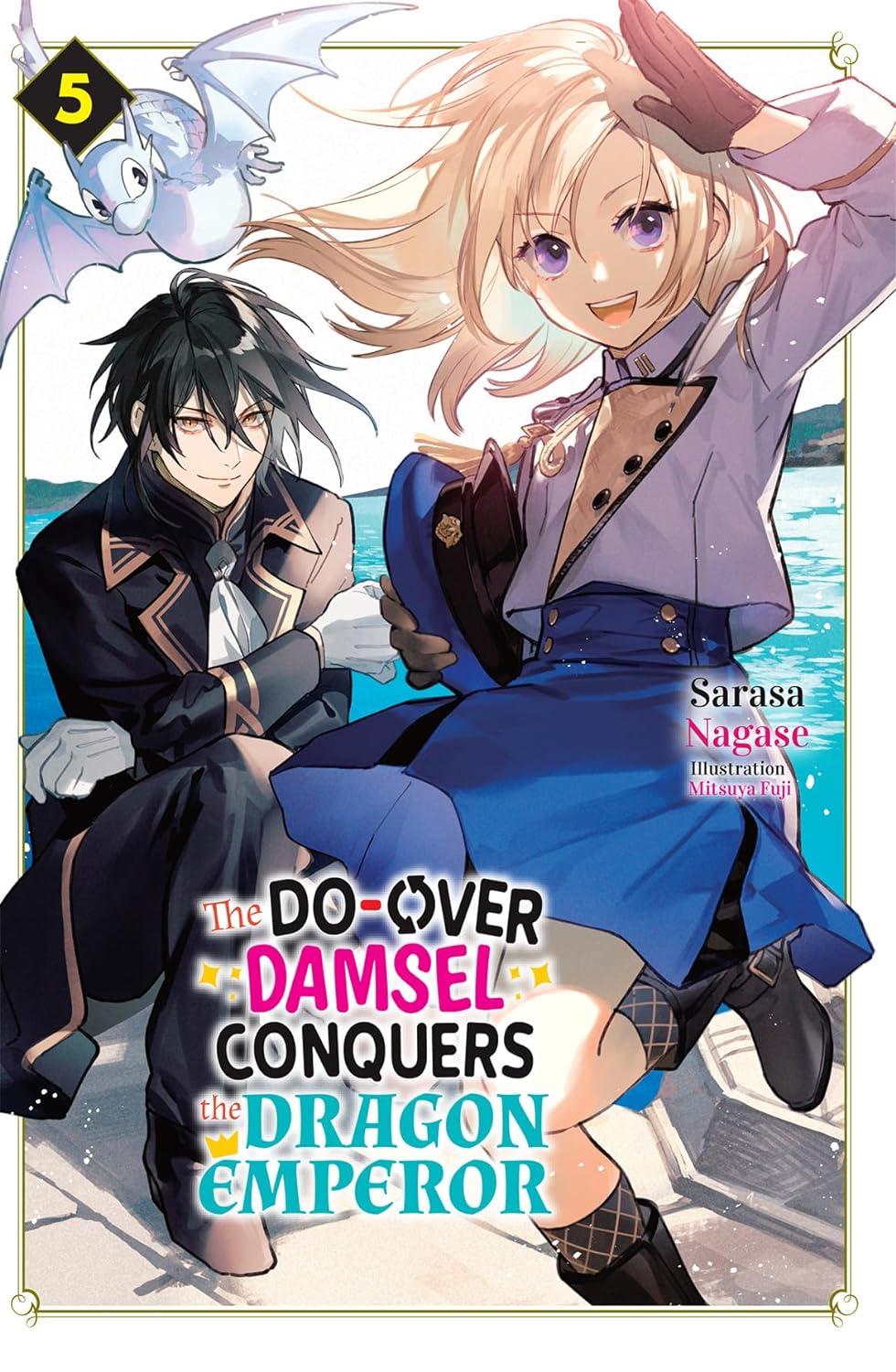
I am, frankly, a little sick of every new villainess book forcing me to say how much it reminds me of My Next Life As a Villainess. And given that this book stars a dumbass who everyone loves, that’s a trap that I want to avoid. So let’s try something else. You know the works of Sarasa Nagase? The kind where the clever heroine has to think on her feet and not let her guard down for a minute or else fate will slot everything back into place and she’ll be killed? And this is helped along by an evil but equally clever heroine? This series is the mirror opposite of that. Both the villainess and the heroine are desperately trying to NOT fight fate, for reasons that we don’t really find out in this volume, but the problem is that they are both not particularly clever, so fate is constantly changed so that things are better. Congratulations on falling face first into success.

While visiting his fiancee on her eighth birthday, the Crown Prince Cecil is rather surprised to hear her say that she’s actually a villainess, and she will do her best to grow up to be a fantastic one so that he can dump her and her family will fall into ruin. And she can go ‘GAH!”. (The “GAH!” is very important!) Cecil is baffled by all this talk of “otome games” and “routes”, but he finds Bertia amusing and interesting, which frankly almost nothing does as he’s the most jaded ten-year-old in the world. Each chapter in the book is “one year later”, and we see that Bertia’s schemes and plans do things like tell everyone where those trying to overthrow the country really are, or making sure that people get together with their true loves, or telling Cecil enough information that they can stop a deadly plague. Isn’t she actually sweet as pie? Why does she want to be a villainess? And what’s with the new girl named (sigh) Hironia?

I read the first volume of the manga when AlphaPolis put it out here, and reviewed it in a Bookshelf Brief where I mentioned Cecil was who interested me most. That goes double for this first book, though Bertia is also interesting for reasons that I don’t think we’ll get explained till the next book. Cecil regards Bertia as a fun toy when he’s a kid, but as he grows older and grows to appreciate her as a person… he’s still not quite there. It’s mentioned many times that Cecil is fundamentally broken, and that gets more clear as we get closer to the climax, when we realize that Cecil has never expressed any affection for Bertia besides “you are my fiancee”, and that he doesn’t really get that he’s fallen in love with her at ALL. We never get Bertia’s POV, for reasons that, again, I think will make more sense in Book 2, but I think she has realized her feelings, but is desperate to avoid them for the sake of the greater good.

This is a series that will end next time, though I think there’s a sequel that Hanashi Media has also licensed with their marriage. Till then, this is a fun Villainess book that starts off very wacky and gets increasingly less so as the book goes on.

Filed Under: observation records of my fiancee, REVIEWS

The Oblivious Saint Can’t Contain Her Power: Forget My Sister! Turns Out I Was the Real Saint All Along!, Vol. 3

August 11, 2024 by Sean Gaffney

By Almond and Yoshiro Ambe. Released in Japan as “Mujikaku Seijo wa Kyō mo Muishiki ni Chikara o Tare Nagasu: Imadai no Seijo wa Anede wa Naku, Imōto no Watashi Datta Mitai Desu” by Earth Star Luna. Released in North America by J-Novel Heart. Translated by Dawson Chen.

It’s never a good sign when I’m checking Amazon Japan to see how long a series has left to go. Fortunately, this series looks like it ends with the 4th volume, so I guess I’ll finish it. It’s not doing anything wrong per se, and doesn’t have random slavery or the usual light novel turnoffs, but it’s a damp wet towel of a book. Our heroes hear of a setback, think of a plan, and the plan, for the most part, goes swimmingly. The bad guys are really bad, the good guys are really good, with the exception of Teodore being a standard “glasses sadist” for laughs. There are one or two exceptions, which I’ll get to later, but if I’m being honest, the most interesting and exciting part of the book was when this volume’s antagonist snaps and decides to start choking Carolina to death in front of royalty and hundreds of people. Dumb, but exciting.

Carolina’s father arrives with bad news: Archbishop Mills is on his way to the kingdom and wants an audience with Carolina, likely to try to get her to come back to Celestia. Unfortunately, they’re not quite ready to reveal how powerful she is to the world yet. So they try several stopgap measures. She puts off her decision while she “thinks about it”, they investigate the bishop for his horrible crimes (can’t have a light novel without a Church of Evil, though in this case it’s just one Bishop of Evil), and create a Saint for their own Empire. Unfortunately, while they get enough support to do this, they can’t just make it Carolina, especially since her power is a secret. There’s going to be a magic competition. And her main opponent is Monica, the noble girl who despises her.

So there are a couple of bits that weren’t too bad, most of which revolve around accepting that sometimes people change, and sometimes kids can’t change situations because they’re kids. Marisa and Owen both had terrible childhoods that left them with many regrets, and indeed we saw Marisa’s younger sister of terrible in the last book. But they need people to vote for their new Saint idea, and that means she has to talk to her OLDER sister, who also treated her like crap. Then she finds… her sister happily married, and love has softened her, and she deeply regrets what she did and apologizes. Marisa really doesn’t know how to take this. As for Owen, it turns out that his brother’s disinterest was not that in the slightest, but just a massive miscommunication, and now the two of them are getting along again. Now, both of them credit Carolina for basically making them nice enough to reach out and make amends, but I’m used to perfectly pure heroines.

I didn’t mention Flora at all, but the final volume has basically one question: will she be saved or will she die? We’ll find out. Bet the answer is the obvious one.

Filed Under: oblivious saint can't contain her power, REVIEWS

The Otome Heroine’s Fight for Survival, Vol. 2

August 10, 2024 by Sean Gaffney

By Harunori Biyori and Hitaki Yuu. Released in Japan as “Otome Game no Heroine de Saikyō Survival” by TO Books. Released in North America by J-Novel Club. Translated by Camilla L.

Fans of this series may be surprised that I’m reading the second volume of this book, but they’ll be even more surprised that I’m looking forward to the third. It’s rare I get a series I enjoy so much which is filled with things that normally annoy me. First of all, Villainess fans must be going nuts reading this, as there’s really very, very little of the actual otome game plot here, though we do meet another villainess (more on her later). There are stats. So many stats. I raised my endurance stat +2 just reading this volume. And of course this is an incredibly dark book in which we meet a cast of about twenty new minor characters and by the end of the book almost all of them are dead by the hands of our heroine, who perhaps does not quite deserve that moniker anymore. They even get little backstory flashes right after they’re killed to make it more tragic. So why do I like it? It’s compelling.

Having survived, barely, her life and death battle at the end of the first novel, Alia is now apprenticed to a dark elf named Cere’zhula, who was also the master of the woman who tried to kill Alicia and take her “heroine” place back at the start of the series. Alia ends up actually confessing almost off of this to her new mentor, and ends up being a much better apprentice, if somewhat… eccentric. Unfortunately, only a few months in, a nasty guy shows up and tries to blackmail Cere’zhula into doign an assassination job for him. Rather than get used as blackmail fodder, Alia offers to do the job herself… and then discovers that the Assassin’s Guild don’t trust her a lick. So, I mean, she goes through with the initial “kill these mooks’ test, and then does the actual dangerous assassination job, but she has a far greater goal in mind: killing the entire guild, who are now her enemies.

There is one big reason to read this new book. Just as, in the first book, the main enjoyment was the relationship between the heroine and the first “villainess”, Elena, here it’s between Alia and another villainess, Karla. And while Elena stands a chance of actually surviving the books, Karla may actually end up being the final boss. To be fair, her backstory is essentially “Sakura Matou with less rape but more torture”, but she is absolutely a hoot, absolutely a psychopath, and bonds IMMEDIATELY with Alia, who she not only sees as a kindred spirit (she’s right there, Alia is not remotely an empathic person) but also as someone who will be able to kill her – and not kill her so she dies pathetically, like her family could have done, but kill her so that her death has MEANING. She’s absolutely horrible, and I can’t take my eyes off her.

By the end of the second book, Alia seems done with Assassining, at least for now. Where she’ll end up, who knows, but the 8th in the series just came out in Japan, so it will be a bit. This is dark as pitch, but I’m sticking with it.

Filed Under: otome heroine's fight for survival, REVIEWS

From Two-Bit Baddie to Total Heartthrob: This Villainess Will Cross-Dress to Impress!, Vol. 1

August 9, 2024 by Sean Gaffney

By Masamune Okazaki and Hayase Jyun. Released in Japan as “Mob Dōzen no Akuyaku Reijō wa Dansō Shite Kōryaku Taishō no Za wo Nerau” by TO Books. Released in North America by J-Novel Heart. Translated by Caroline W.

If I had a nickel for every villainess book that I read and thought that it was clearly influenced by My Next Life as a Villainess… well, I’d have about 50 cents or so. Which is still a lot! Fortunately, most authors know that they can’t simply straight up photocopy Katarina Claes onto the villainess of the hour, even as the whole “reverse harem starring a clueless protagonist who does not realize what she’s doing to the rest of the cast” plot is present and correct. Katarina is the cheerful, empathic oblivious type. Someone like Yumiella is the stoic, overpowered oblivious type. And now we have Elizabeth Burton (a name as subtle as you’d expect from someone with the pen name Masamune Okazaki), who is also strong, and also cheerful, but goes in a totally different direction. That’s her on the cover. In the center, between the two pretty guys. Does that means this is trans? Or yuri? Well… not really? Not yet?

So yes, as is standard for this genre, Elizabeth Burton eats a horrible bell pepper one day, which triggers memories of her past life in Japan, where she was a fan of the otome game “Royal LOVERS”… where Elizabeth Burton, the fiancee of the second prince, was a minor villain who was doomed, in the second prince’s route, to be rejected and likely live her life alone and unloved. Well, that just won’t do. Unfortunately, all the love interests in this game are bishonen, so she can’t exactly compete once the heroine inevitably arrives in ten years’ time. So Elizabeth, showing a startling, terrifying lack of common sense, decides to cut off her hair, dress in a boy’s outfit, get really buff and strong, become the perfect handsome playboy, and seduce the heroine. Oddly, her family and the kingdom put up only token resistance. That said, she has a problem: the love interests don’t care if she looks and acts like a man. They’re smitten.

Is this yuri? Not really. The heroine only shows up at the very end to be the cliffhanger. What’s more, Elizabeth has put ZERO thought into this beyond “seduce the heroine”, has no plan for what happens after that, and denies at first that she’s gay… then backs off and says she’s not sure. Is it trans? Not really that either. Elizabeth, aka Lizzie, dresses and acts like a boy but uses her real name, never denies she’s a woman, and gets annoyed when other people try to call her a man. Is this a weird little genderqueer thing? Boy howdy yes. She doesn’t fall for anyone here, thought Edward (the first prince, who is the ‘beautiful but sickly’ sort) comes close to breaking her facade, but the three male love interests (I’m ignoring her adopted younger brother) certainly fall hard for her… to the point that they all dress in women’s dresses at the big dance in the hopes of attracting her. Again, while this gets some shocked stares, there are no repercussions and no real opposition to it. It’s mentioned that men will get married but have male lovers (women with female lovers is NOT mentioned, I note). Basically, this world seems very casual about a lot of things.

I spoiled myself a bit by looking at the (still ongoing) webnovel, and the second book in the series should bring us a bit more yuri as not-Maria Campbell hits the scene. Till then, temper your expectations if you want this to be anything other than “reverse harem with clueless heroine”, but the heroine herself makes it worth the read.

Filed Under: from two-bit baddie to total heartthrob, REVIEWS

Young Lady Albert Is Courting Disaster, Vol. 7

August 7, 2024 by Sean Gaffney

By Saki and Haduki Futaba. Released in Japan as “Albert-ke no Reijō wa Botsuraku o Goshomō Desu” by Kadokawa Beans Bunko. Released in North America by J-Novel Heart. Translated by Ray Krycki.

Sometimes tropes are so omnipresent that I automatically assume they’ll be there, and I get tripped up when they don’t actually happen. This volume kicks off its plot when a young girl shows up, with red hair the color of Adi’s, and says that he’s her father. Naturally, my first thought was: girl from the future. This is despite the fact that she clearly doesn’t recognize Mary, Alicia, o the rest of the cast. But no, there is no time travel here. Instead we are once again dealing with a more common light novel subtrope, which is the idea that if you’re going to be a noble, you’d damn well better be a GOOD noble who cares about others. The actual backstory for this girl is more down to earth – she’s from a country that doesn’t give a crap about its poor, and it broke her family apart. This infuriates Mary and Alicia, who by their nature are shiny, honest people and can’t stand the idea of abusing power. Even if it’s justified in their head.

The other major plotline in this volume is that Mary Albert is pregnant. This is a happy surprise for her and Adi, but it’s also something they want to keep under wraps for the time being, as there are certain people who will make far too big a deal out of it. Like, new national holiday big. Fortunately, this strange little girl arrives and proceeds to distract everyone as they try to figure out whose child she is (I appreciate the fact that everyone knows Adi is so in love with mary that there’s no way it’s his secret child). Unfortunately, when they find out her exact circumstances, a field trip is in order. Which also consists of her brothers. And Patrick and Alicia. And Parfette and Gainas. And they all converge on one unfortunate lord who believes wholeheartedly that breeding is everything and poor people deserve to be abused. The odd thing is that he believes it to an extreme degree, rather than just being plain old evil about everything.

One thing I really appreciate about Mary Albert is that, despite being reincarnated in an otome game, etcetc., and being generally a very nice person, she is allowed to *behave* like an arrogant villainess, snikping and grumbling at people and acting like she’s going to let out with an OHOHOHOHOHO any moment – though she never does so. In a world with ditzy villainesses, acting villainesses, villainesses with PTSD, it’s nice to see one who doesn’t have a complete personality change even as she plots her doom. Actually, the plotting her doom thing seems to have gone well and truly tits up in this book, as her brothers renounce their claim to the head of the family, leaving it for her. This is unsurprising, but I think she’ll do a good job. I do appreciate how, even now that we’re close to the end, she still cares a lot about what happens to her fantasy fried chicken restaurants, and worries now that she’s given it to twisted friend 31 and twisted friend #2. (I worry as well.)

The next book is the last. I’ll miss this series, one of the first villainess books to come out in Japan. It was overshadowed by Bakarina, but Mary Albert accomplished a lot more. I wish her and her husband and her second and third wives well. What, they’re not her wives? I feel evidence suggests otherwise.

Filed Under: REVIEWS, young lady albert is courting disaster!

The Evil Queen’s Beautiful Principles, Vol. 2

August 6, 2024 by Sean Gaffney

By Reia and Haduki Futaba. Released in Japan as “Akutoku Joo no Kokoroe” by Kadokawa Books. Released in North America by Airship. Translated by Faye Cozy. Adapted by Abigail Clark.

I will admit, the direction of this second volume surprised me. I was expecting there to be a lot more struggle against the evil families who were behind her parents’ death. I was expecting at least one betrayal from a close ally I got none of that. If anything, her revenge was nearly pitch-perfect. But what I’d forgotten is that this second volume is also the final volume, which means that the revenge can’t be the point. The point is Luxeria’s own character growth, and also whether this book turns out to be a tragedy or not. It’s touch and go for a while, and you can argue that the resolution is a bit out of nowhere. But I think it’s thematically appropriate. A queen who has been unable to trust anyone, whose only friend was damaged because of her, whose true love she had to (supposedly) kill. The big question is here not will she get her revenge, the big question is whether she’ll survive it.

After the shocking coronation events, Luxeria is determined to continue investigating the other marquess houses to find out what skeletons they have in their closet, and also to prove what she already knows – that they killed her parents. That said, there are also more dangerous things going on. Children are getting kidnapped all over the land, and it might have something to do with the mysterious circus that’s always in town when it happens. Some of the marquesses are garden-variety assholes, one of whom is so banally evil that his own wife, on finding he’s been arrested, gives all the evidence they need to execute him, then drinks poison so she can end her terrible life. Worst of all,. there’s still the fact that Luxeria’s magic is slowly killing her, and all the allies that she has around her can’t save her because she’s mind controlling them into forgetting she has symptoms at all.

The title is not just for show here. The queen absolutely goes to town on everyone who was plotting against the royal family, be it actual assassination, or merely garden-variety apathy. The heads of family, and all their relatives, are executed. One or two folks turn evidence against their families, so she lets them live, but they have their identities magically changed, and they can’t even reveal their new self to their best friends. And this all weights heavily on her. Even as she is surrounded by people who are helping her, who share her hopes and dreams, who love her, she cannot help but see herself as walking a path to damnation. There are odd moments in this book where she just starts laughing maniacally out of nowhere, like a stereotypical “villainess”. But that’s what she thinks she is. She wants to feel exultation that she’s managed to avenge her parents, but she just feels empty. It’s all performative. Fortunately, thanks to the two people closest to her (and oh my GOD I wish we had an OT3 here, but alas), the worst case is avoided, but this book gets pretty dark.

It ends happily, though. Probably a little TOO happily. But hey, I’ll forgive it, since it’s the last book. Short and not-so-sweet.

Filed Under: evil queen's beautiful principles, REVIEWS

Saving 80,000 Gold in Another World for My Retirement, Vol. 5

August 5, 2024 by Sean Gaffney

By FUNA and Keisuke Motoe. Released in Japan as “Rōgo ni Sonaete Isekai de 8-Man-Mai no Kinka o Tamemasu” by K Lanove Books. Released in North America by Kodansha Books. Translated by Luke Hutton.

(A reminder that the English Vol. 5 is the equivalent of the Japanese Vol. 6.)

I feel at this point that I need to apologize to Mile and Kaoru. I’ve talked before about how all three FUNA heroines are basically agents of chaos who have large body counts to their names, which is true on the face of it. However, Mile (very much so) and Kaoru (somewhat) have people who are around them most of the time, who are there to hear the worst of their atrocities and talk them down. Mitsuha, on the other hand, spends a great deal of these books by herself, wandering all over the land with her teleport powers and with no one to stop her but a tween girl who usually would rather be joining her in the chaos instead. Mitsuha may whine about looking perpetually twelve, but she’s by far the least mature of the FUNA three, and will happily throw intruders on her property onto a remote island for the rest of their lives just because. She’s fricking terrifying.

There’s a new artist, though one that may be familiar – it’s the manga artist, now pulling double duty. As for the “plot”, as usual with this author it’s essentially whatever they feel like doing. Mitsuha manages to get herself a ship to repair/study by posing as a goddess and rescuing sailors from a wrecked ship… which she then has “ascend to heaven”. She gets another teenager to run another company selling luxury goods for her, though at least this one is not an orphan. And she continues to avoid the king and prince on this new nation, who are by now desperate to meet her, and continue to use their secret identities to try to corner her. This goes about as well as you’d expect. People that try to force Mitsuha to do what they want end up longing for a quick and painless death.

There’s minimal gunplay in this book, despite the cover art. But that’s fine, as Mitsuha has shown that she can completely upend all of society without needing to bother with guns. There are so many scenes in this book that come down to “roaring rampage of revenge”, and while with Mile, and especially Kaoru, such displays only really get out of hand when they’re upset or emotionally compromised, Mitsuha doesn’t really have that. Mitsuha spends most of the book happy, making jokes and puns, and laying economic waste to everything around her. She cares about some of the people around her, mostly Colette, but she’s also very casual about “if things go south I’ll just abandon them” when she makes new alliances. I don’t think this is intentional, but I think that the death of Mitsuha’s family has arrested her development and also her moral sense (her brother’s teachings didn’t help). If this was a different series, I’d say it’s a setup for a massive amount of hubris and karma bringing Mitsuha down. But this is not that kind of series. She’s just like that.

This is light, frothy fun provided you don’t take it remotely seriously. As always.

Filed Under: REVIEWS, saving 80000 gold in another world

Agents of the Four Seasons, Vol. 3

August 4, 2024 by Sean Gaffney

By Kana Akatsuki and Suoh. Released in Japan as “Shunka Shūtō Daikōsha” by Dengeki Bunko. Released in North America by Yen On. Translated by Sergio Avila.

Boy, the world that this takes place in really sucks, doesn’t it? This is an alternate Japan where the world relies on people with special powers chosen by the Gods (supposedly) to bring about the seasons, and in this book we also find out that there are archers whose arrows bring about day and night every day. When the Agents can’t or don’t do their duty, the area suffers. If the archers miss a day or miss a shot, the area really suffers. Those responsible are chosen right after the previous one dies, get no choice in the matter, and are, as we see in this volume, blamed for almost everything wrong with the entire country. Oh, and because this book loves to pile on, almost all of them have some sort of tragedy and/or abuse in their life, or are currently having it. The premise of this series is being able to overcome that and live happily, but man, it does occasionally make for depressing reading.

After the events of the last two books, everything is… not back to normal. For one thing, there are now TWO agents of summer, something that makes the conservatives in charge of the town of summer furious. There are, in fact, rumors going around that every single bad thing that has happened recently has been because God is angry at the current agents, and they should all be replaced for the greater good. Unfortunately, “replaced” means “murdered”. What’s worse, Ruri and Ayame both have their engagements broken, which completely traumatizes Ayame, who was secretly in love with her fiance (who loved her back, but both are so repressed neither one noticed). Meanwhile, in case you thought we wouldn’t be seeing Hinagiku in this book, no worries. Unfortunately, she too is dealing with the rumors, which state that the two years she spent recovering from trauma are why all this happened at all. Scapegoats for all!

This is another two-parter, and focuses far more heavily on the twin sisters Ayame and Ruri. We get flashbacks to their childhoods, and see exactly how being chosen as an Agent can be completely traumatizing, and can also damage a family – the twins’ parents are on their side, but there’s still a lot of friction, mostly as Ruri is acting like a 10-year-old who is being torn away from her twin and being forced to be an agent of God. Ruri does not at all fit the bill for the ideal agent… but neither does Ayame, who is so stressed and guilty over all of this that at one point she attempts to run away from home. In the present, the scene with the Town of Summer yelling at Ayame for causing all this by not letting Ruri die, and telling Ruri “the dead don’t get to speak here”, is jaw-droppingly horrifying, especially as it hits on Ruri’s own trauma specifically (she uses asterisks for the word “died” at the start of the volume, a common Japanese trope for a person avoiding thinking of trauma). By the end of the volume they’re being manipulated by unseen forces, but frankly, if it makes them more proactive, I’m OK with it.

All this and I didn’t even mention their actual fiances (another abuse survivor, and a man who we know little about but seems to be “likeable sociopath”). The next volume will be highly anticipated. Though also dreaded a little, perhaps.

Filed Under: agents of the four seasons, REVIEWS

Suppose a Kid from the Last Dungeon Boonies Moved to a Starter Town, Vol. 15

August 3, 2024 by Sean Gaffney

By Toshio Satou and Nao Watanuki. Released in Japan as “Tatoeba Last Dungeon Mae no Mura no Shonen ga Joban no Machi de Kurasu Youna Monogatari” by GA Bunko. Released in North America by Yen On. Translated by Andrew Cunningham.

There is not a single thing that happens in this book that the reader could not have predicted. If you finished Vol. 14 and someone asked “so how will it end”, you would probably say “well, Eve will try to break everything and go home, Lloyd will stop her by being Lloyd, and we’ll get a flashforward showing that everyone is older but otherwise resolving next to nothing”, you’d be absolutely correct. That said… is that really a bad thing? This is a wacky, goofy comedy with a bit of heart. If you were asked what you WANTED from the ending of this series, unless you’re a rabid shipper (and I assume any of those dropped this a while back), you’d probably say exactly what I just did above. It’s a chaotic action-packed fight against Eva, followed by Lloyd showing off how much he’s grown and also showing off that no one has gotten (or will ever get) in his pants.

Things aren’t looking good. Eve has a new body, and what’s more, she has access to the powers and attacks of ALL the demon lords. Everyone who tries to stop her is either distracted by her releasing a horde of monsters, beaten into a coma, or mind-controlled into obeying her will (yeah, sorry, Anzu, you’re mostly a comedy patsy this volume. It happens in this series). Rinko has an idea that might be able to take her down, but Eve has about 87 clever plans, and she does not seem in danger of running out anytime soon. Worst of all, Eve has a special spray bottle and, when hit with the contents, the residents of Kunlun become weak and unable to fight back. With all these advantages, even Lloyd won’t be able to stop her!…. right? Right?

So yeah, the “action climax” of this book happens a little over halfway through, and even Eve’s fate is not all that surprising given the type of series this is. The last chapter takes place a few years later, and is from the POV of Asako, who finally gets to be an actual character in this series now that she’s no longer being possessed by Eve. Fortunately she’s no longer dying, and she has cool teleportation powers. Unfortunately, she’s in love with Lloyd, which merely adds her to the pile. It turns out that the entire series has been written by her to tell Lloyd’s true story, a conceit I quite like. As for the others, well, they’ve all got jobs now, but everyone is reasonably happy, except for Marie, who is miserable and who no one can stand. I can’t believe Marie became the most annoying character in a series where Selen exists, but there it is.

This was never going to be a top-rated light novel series, but for something trying for the vibe of Urusei Yatsura (complete with one of those “chaos ensues” endings Takahashi loved to do), it was good. It always made me laugh, which is more than I can say for a lot of light novel authors.

Filed Under: REVIEWS, suppose a kid from the last dungeon boonies moved to a starter town

The Magical Revolution of the Reincarnated Princess and the Genius Young Lady, Vol. 7

August 1, 2024 by Sean Gaffney

By Piero Karasu and Yuri Kisaragi. Released in Japan as “Tensei Oujo to Tensai Reijou no Mahou Kakumei” by Fujimi Fantasia Bunko. Released in North America by Yen On. Translated by Haydn Trowell.

In the previous volume of MagiRevo, we saw Anis reject the “perfect world” offered to her, as it would render everything that she’s struggled to achieve meaningless. Now it’s one year later (the biggest time jump we’ve seen in this series so far), and she’s finally getting the chance to achieve her dreams… and is still feeling a bit guilty about it. Is it all right for her to do this? To go off and be a weirdo magical researcher coming up with gonzo ideas that will revolutionize the world? Shouldn’t she grow up and be mature, like Euphie is? Leaving aside Euphie’s maturity, which turns out to not be quite as strong as imagined, this makes sense. Anis spent years being the eccentric princess who rebelled, because if she stopped to face reality it would crush her. Now she’s given the opportunity to do the same thing without the same risk. Just one catch: Anis going it alone is a thing of the past.

Anis starts this book, having finally recovered from the events of Book 6, with a startling proposal. Since her magical research and inventions tend to, shall we say, annoy the aristocracy in the capital… why not just build a whole new city and make it a magical Alexandria? As noted above, Anis has to be talked into this, but eventually throws herself wholeheartedly into things, especially since she shocks people with the idea of building the city with both magical and… non-magical means! Me not use magic? That’s unpossible! Moreover, in the massive research that is the back half of this book (it’s OK, it’s interesting for once), we learn that not only might everyone have been learning magic incorrectly, but that there may be more than one KIND of magic. All this means that Anis has a LOT more to do, and is unfortunately going to have to learn to delegate and lead from behind… well, mostly.

Anis is not the only one undergoing crises in this book. Gark is struggling with the fact that everyone around him is a genius of some sort, and he’s just a guy who’s dependent on magic weapons to get anywhere. Tilty is a bit disturbed by Anis going in on making these magic weapons, and serves as her conscience reminding her of the dangers of putting weapons that anyone can use into a world where commoners have massive grudges against the nobility. And we get a new maid in this book, Priscilla, who is also the victim of a noble being terrible – her father – and wonders why Anis, with all the power that she has at her discretion, especially now that she’s a dragon hybrid, not take revenge on everyone who wronged her? The answer Anis has is not what Priscilla really wants, but it works. Anis grew up loved. And she has a wonderful partner. I like Anis sort of acknowledging her privilege here which allows her to be able to take the high road. It’s not as easy for others.

All this plus Anis and Euphie having such a wonderful night (offscreen, of course) that Anis has a hoarse throat the next day. This is the second book in a row with not quite as much Euphie, so the author promises Book 8 will focus more on her. Till then, this was one of the stronger books in the series, setting up the new arc and allowing Anis to feel confident once more in being the little freak we know and love.

Filed Under: magical revolution of reincarnated princess and genius young lady, REVIEWS

The Genius Prince’s Guide to Raising a Nation Out of Debt (Hey, How About Treason?), Vol. 12

July 31, 2024 by Sean Gaffney

By Toru Taba and Falmaro. Released in Japan as “Tensai Ouji no Akaji Kokka Saisei Jutsu ~Sou da, Baikoku Shiyou~” by GA Bunko. Released in North America by Yen On. Translated by Jessica Lange.

So yeah, let’s start with the elephant in the room, which is that this volume came out in Japan in September 2022, and there have been crickets since then. I don’t think we can blame the anime, which did a speedrun of the LNs but wasn’t terrible like some other recent LN adaptations I could mention. And no, I don’t think it’s “cancelled” or whatever it is fans say when there hasn’t been a new volume in over 8 months. I think it’s the author. That said, at the moment this is the final volume of the series. And man, if it was, what a nasty dark and tragic ending it would be. I’m not exactly spoiling. We’ve been waiting almost since the first book for everything in Natra to boil over, and it does now, thanks mostly to Caldmellia, who from the moment she first appeared has been ready to take on the mantle of the series’ main antagonist, and does so here. Everything is terrible.

Having helped Lowellmina become Empress, and leaving her to an Empire with far too many problems to deal with, Wein and Ninym return to Natra, where all is peaceful and happy. Unfortunately, the flahm are still gung ho about independence and getting their own country, mostly as they’re being fed information by a snake in their midst. Information like Ninym’s supposed heritage. Worse, Falanya has been growing by leaps and bounds, to the point where she realizes that Wein is perfectly happy to have peace and prosperity NOW, because he doesn’t care what happens to Natra after he dies. Since she loves her country, she vows to oppose him. And then Caldmellia shows up, asking Wein to ally with the West. She’ll even make him a Holy Elite… for real this time. Needless to say, she has another goal. Ninym is basically tortured this entire book, and it ends with the worst possible outcome.

Interspersed with all that tragic drama is the story of how Wein and Ninym first met, why she grew so attached to him (and he to her), and what led her to be his aide. It’s not happy and sweet, but it’s a much needed balm anyway, mostly as it’s not oppressively tragic. Young Ninym is dealing with everyone worshiping her, which is a tough burden for a little kid. Wein is so depressed and jaded that he’s willing to be assassinated because it’s what the majority of the people seem to want. The two of them need each other desperately, and you can see why he calls her his “heart” – and why he brutally murders people who directly threaten her. Alas, Caldmellia is more cunning. I don’t for one moment believe what we’re told in the cliffhanger, but I do think it will force Wein and Ninym to make a decision, and it’s not one that will be good for Natra.

This is definitely coming to an end soon, whenever it comes. Reading this was not what I’d call “fun”, but it was a great volume, which took all the bad things I didn’t want to have happen and has them all happen at once.

Filed Under: genius prince's guide to raising a nation out of debt, REVIEWS

Re: ZERO ~Starting Life in Another World~, Vol. 25

July 30, 2024 by Sean Gaffney

By Tappei Nagatsuki and Shinichirou Otsuka. Released in Japan as “Re: Zero Kara Hajimeru Isekai Seikatsu” by MF Bunko J. Released in North America by Yen On. Translated by Dale DeLucia.

And so another arc bites the dust, as the 6th Arc of Re: Zero ends with this volume. There are more returns by deaths, there are lots of surprises, there are absolute PILES of cool fights, and there’s even a bit of tragedy. That said, there’s still a whole lot of stuff we don’t really know. Some folks who had their identity eaten by Gluttony are restored, some are not. Gluttony, who of course is three siblings, gets sealed away/killed/we have no clue. As for Subaru, well, he didn’t get a 100% victory, but he did his best. And he did it by knowing his strengths, which is cheering people on, taking their own pain as his own, and knowing that everyone else in his party is ludicrously stronger than him. Emilia gets amazing things to do, Ram is awesome, Julius is fantastic. It’s a pump the air sort of book… at least till that cliffhanger. Whoops, new arc.

Subaru may have decided that now is the time for his counterattack, but about 15 more deaths show that he himself cannot actually affect anything. As such, the one thing that helps him out is spotting his OWN book of the dead in the library… or rather the multiple, multiple volumes of books of each of his deaths. The outcome of reading all these books I won’t spoil, but by the end of it Louis is taken care of and Subaru has all his memories back. Now he’s ready to figure out what should be done to win: give Julius the cheerleader he’s dedicated himself to (who it turns out has not so much been in danger of dying as curling up and sulking), give Emilia a huge morale boost that allows her to pretty much be damn near invincible, let Rem fight with her sister in a very real way to take out Lye, and then go with Beatrice to help Meili to try to hold off Shaula till all this can be done. Oh yes, and can anyone pass the test?

This is a long book, with a lot going on. Emilia fans will eat VERY well in this book, though I get the feeling that the next arc may flip the heroines again. By the end of the book, they have won a bittersweet victory, one that is perhaps more bitter for them than it is for me: I can appreciate the tragedy of Shaula’s existence waiting for her master, but her death doesn’t quite land as tragically as I think the author wants it to. The other really good bit in the book was the climax, where they have Roy captured but not dead, and when Subaru suggests killing him to try to get everyone’s memories back, Anastasia is quick to point out that is a very UN-Subaru thing to say. As for Rem, having had a moment of triumph from within a book of the dead last time, she’s still comatose here, though that does not stop her from unconsciously helping Ram to get more power to defeat Lye. the cliffhanger suggests her fate will change very soon, though, so Rem fans, your long wait is almost over.

The next arc is not only the longest in the series, eight books, but it’s also far less popular than the last two. Get ready for almost an entirely new supporting cast. And go back and read Re: Zero EX 4 and 5, you’ll need them. Till then, this was a mostly very satisfying finale to this round of Re: Zero…. oh wait, we’re finally getting the Short Story volumes! See you next month, back in the Arc 2 days of yore.

Filed Under: re: zero, REVIEWS

The Executioner and Her Way of Life: Fall Down

July 28, 2024 by Sean Gaffney

By Mato Sato and nilitsu. Released in Japan as “Shokei Shoujo no Virgin Road” by GA Bunko. Released in North America by Yen On. Translated by Jenny McKeon.

First of all, big props to the author for actually keeping my attention through the first half of this volume. I’ve talked before about how the first half of these recent books have all been dire, so this is a definite step up. More seriously, I also noticed while reading this volume how compact the cast list is. This is basically a variation of shonen battle manga, in a sci-fi sort of vein, and each volume needs to escalate the danger because our heroes need a bigger threat. But the threats we’re seeing have been around since the start, they’re just coming back because everyone in this series is damn near impossible to permanently kill. Hell, even one of the cast from a thousand years ago is a supporting character in this book due to (handwaves) reasons. The “new” antagonist who threatens our heroines with bigger and bigger guns turns out to have been accidentally stifled by Sahara four books ago, and she doesn’t even remember it. So sad.

Menou, Abbie, Sahara and Maya have arrives in the wilds of the north, where they come across the stunning city of ruins, which is not only still intact after so long but is also technically TWO cities… there’s a second one upside down above the first. Unfortunately, they can’t simply sit around and watch terrible movies about sharks in space – not only is one of the biggest mobster bad guys around trying to kill the woman who killed off Flare, for tragic backstory reasons, but also Pandaemonium is here somewhere as well, and Maya, for obvious reasons, wants to try to stop her. Fortunately, the four of them have some help in the form of an ally thought long dead. UN-fortunately, Momo is there as well, and she’s got her own agenda, one that Menou really isn’t going to like.

As usual, I loved Sahara here, who continues to be forced to care and be heroic against her will. The final scene where she takes out one of the big bads because, among many other reasons, she never got breakfast OR lunch today is hilarious but also dead on. Sometimes you’ve got to let compassion fall by the wayside because you’re too cranky. More impressively, I really enjoyed reading Menou in this book. I’ve made no secret about the fact that Menou is my least favorite of the many “good guys” in this series, but here she’s given subtext that makes you pay attention to her – she’s losing more and more of her self. She’s already forgotten everything about Momo, which does not bode well for when the two inevitably meet up again, but seeing her casually take a scripture because she can’t remember why she wouldn’t be using one is chilling because she REMINDS us why earlier in the book. She’s falling to bits. Still not optimistic this will end with any of the main cast alive.

The yuri may be thin on the ground these days, but it IS driving most of the character motivation deep down, so that’s fine. This was good. I look forward to the 9th book. Which only came out in Japan 6 months ago, so we may have to wait more.

Filed Under: executioner and her way of life, REVIEWS

  • « Go to Previous Page
  • Page 1
  • Interim pages omitted …
  • Page 30
  • Page 31
  • Page 32
  • Page 33
  • Page 34
  • Interim pages omitted …
  • Page 342
  • Go to Next Page »
 | Log in
Copyright © 2010 Manga Bookshelf | Powered by WordPress & the Genesis Framework