• Skip to primary navigation
  • Skip to main content
  • Skip to primary sidebar
  • Home
  • About Us
    • Privacy Policy
    • Comment Policy
    • Disclosures & Disclaimers
  • Resources
    • Links, Essays & Articles
    • Fandomology!
    • CLAMP Directory
    • BlogRoll
  • Features & Columns
    • 3 Things Thursday
    • Adventures in the Key of Shoujo
    • Bit & Blips (game reviews)
    • BL BOOKRACK
    • Bookshelf Briefs
    • Bringing the Drama
    • Comic Conversion
    • Fanservice Friday
    • Going Digital
    • It Came From the Sinosphere
    • License This!
    • Magazine no Mori
    • My Week in Manga
    • OFF THE SHELF
    • Not By Manga Alone
    • PICK OF THE WEEK
    • Subtitles & Sensibility
    • Weekly Shonen Jump Recaps
  • Manga Moveable Feast
    • MMF Full Archive
    • Yun Kouga
    • CLAMP
    • Shojo Beat
    • Osamu Tezuka
    • Sailor Moon
    • Fruits Basket
    • Takehiko Inoue
    • Wild Adapter
    • One Piece
    • After School Nightmare
    • Karakuri Odette
    • Paradise Kiss
    • The Color Trilogy
    • To Terra…
    • Sexy Voice & Robo
  • Browse by Author
    • Sean Gaffney
    • Anna Neatrour
    • Michelle Smith
    • Katherine Dacey
    • MJ
    • Brigid Alverson
    • Travis Anderson
    • Phillip Anthony
    • Derek Bown
    • Jaci Dahlvang
    • Angela Eastman
    • Erica Friedman
    • Sara K.
    • Megan Purdy
    • Emily Snodgrass
    • Nancy Thistlethwaite
    • Eva Volin
    • David Welsh
  • MB Blogs
    • A Case Suitable For Treatment
    • Experiments in Manga
    • MangaBlog
    • The Manga Critic
    • Manga Report
    • Soliloquy in Blue
    • Manga Curmudgeon (archive)

Manga Bookshelf

Discussion, Resources, Roundtables, & Reviews

Reviews

JoJo’s Bizarre Adventure: Part 1 Phantom Blood Vol 1

February 4, 2015 by Anna N

JoJo’s Bizarre Adventure: Part 1 Phantom Blood, Volume 1 by Hirohiko Araki

I read this volume without much background in this series other than knowing that it was a huge and long-running series in Japan, has a bit of a cult following in Japan, and the books that Viz had been releasing under the shonen jump line started midway through the series. This volume goes back to the earliest story arc in the series, kicking things off with the English nobility, bloodthirsty Aztec masks, and people beating the crap out of each other.

The story kicks off in old school shonen fashion, where a scantily clad woman is sacrificed to the wearer of a mysterious stone mask who proclaims that his accessory drinks the blood of the living. Bones from the mask pierce his skull, but he’s still alive and taking on even more blood sacrifices, not worried about staining his stylish leopard skin pelt cape because he has found the secret to eternal life!

The story then skips over to England, where an evil red-haired young man offers his dying father some medicine. Dio’s father tells him a story about how he accidentally saved the life of a nobleman named Joestar when he came across the wreckage of carriage he was intending to scavenge. Brando tells Dio to go to the Joestars when he becomes orphaned, and Dio does, thus starting the torture of poor young Jonathan Joestar. Dio is immediately adopted as a second son by the Joestar family, but since he is basically the spawn of Satan and Jonathan Joestar is like a friendly naive puppy, things do not go well with the new brothers.

Dio is basically a human form of a cancer, undermining the heir to the Joestar family whenever he gets a chance. It has been a long time since I’ve read a shonen manga this manly! There are speed lines and yelling on almost every page. Jonathan and Dio engage in fistfights and boxing matches, where one blow will end up knocking a half dozen teeth into the air. Towards the end of the book the legacy of the blood drinking Aztec mask is further explored, and Jonathan finally begins to get proof of Dio’s nefarious deeds. The art is really dynamic although the proportions are often a bit off. Often one of the muscular bodies of the main characters will look like it is supporting a shrunken head. If Rob Liebefeld and Tetsuo Hara of Fist of the North Star mashed up their styles you might end up with something like JoJo’s Bizarre Adventure, except Araki can actually draw feet. I’m sure the art gets much better in subsequent volumes, and even though it wasn’t always to my taste I couldn’t deny the effectiveness of the energy of the many battle scenes in the manga.

As a main character, Jonathan Joestar lets himself be taken advantage of for far too long, but he does manage to battle back as shonen heroes always do. The hardcover edition is really nicely designed, with color pages shifting to further tonal pages where the black and white art is enlivened by shades of orange. This volume ends on a cliffhanger, and I do want to know what happens next, as I assume it will involve more stone mask blood drinking and face punching. I can certainly see why this is such a long-running and popular series in Japan. Recommended for those who want a major dose of testosterone in their manly manga.

Filed Under: REVIEWS Tagged With: JoJo's Bizarre Adventure, Shonen, viz media

Umineko: When They Cry, Vol. 9

February 3, 2015 by Sean Gaffney

Story by Ryukishi07; Art by Soichiro. Released in Japan in two separate volumes as “Umineko no Naku Koro ni: Alliance of the Golden Witch” by Square Enix, serialized in the magazine Gangan Online. Released in North America by Yen Press.

With this volume we are halfway through Umineko proper, at least in terms of arcs. Most of the major issues involved have become fairly clear to the reader. Battler’s incompetence as a detective is not because he’s stupid per se, but because he can’t see past the who and how to figure out the why. I think he finally manages to grasp this by the end of the book, but by then it’s a bit too late for Beatrice, who is a character whose ‘who’ and ‘why’ define her, to the extent that her dying wish to Battler is to uncover who she is. As for Ange, she figures out what’s going on, and learns how magic works, but her lack of empathy for Beatrice means that she fails here as well, and gets a highly grotesque death. The only real winners in this arc are Bern and Lambda.

umineko9

There’s also the small matter of what’s happening on the “game board”, of course, in which the rest of the cast bar Battler are quickly polished off in an almost perfunctory way. You know things are ridiculous where Krauss fights a goat butler and wins. Actually, I’d argue that the manga didn’t go far enough here – the VN framed this as a long scene, showing off the goat butler’s ‘motivation’ and framing it as a video game with cliches piling up one on top of another. It was highly amusing, yes, but more to the point it shows off how overegged this pudding is. When first Jessica and then Kyrie take pains to tell Battler “you must believe in the witch god we were so wrong being all logical and stuff”, you’re meant to raise an eyebrow. Of course, with all the special effects death, magic is hard to deny. Assuming you can trust what you see.

The most important scene in the volume, which I also think the manga gives some short shrift to, is game-Beatrice asking game-Battler to remember his sin, and her complete devastation when he doesn’t. For Battler, 6 years ago is when he walked out on Rudolf, and all his theorizing about why that was wrong has to do with his place in the Ushiromiya family. Beatrice is clearly looking for something very different and more personal, and the fact that it meant so little to Battler that he’s forgotten it is what breaks Beatrice, both in the game and in meta. It’s telling that, since the whole Ushiromiya family thing is what he remembered, she takes that away from him by removing that identity. (This is where Battler truly is stupid – he knows his dad is a philandering ass, he should never have been taken in by her word games.)

So where are we now, with half the series gone? Beatrice is seemingly killed off. Battler can’t really escape the game. Everyone on the island is still dead. And even Ange is stated to have “died in 1998”, which is quite interesting given that the last we saw of her she was having the Seven Stakes of Purgatory brutally slaughter Kasumi and her yakuza goons. (Speaking of Ange, she starts to understand Eva a little better, though I worry she goes a bit too far. It’s a very hard line to walk between explaining and excusing child abuse, and I think Umineko sometimes walks across that line a bit too much.) And to no one’s surprise, Lambda and Bern turn out to be working together, or at least having mutually useful goals.

So Battler is an awful detective. Ange tried her best, but was too caught up in revenge and suicidal tendencies. Is there not a Great Detective who could possibly tell us what happened in Rokkenjima? Is there someone for whom this level of reasoning is possible? And can they actually be unbiased? Well, now I may be asking too much. In any case, May will bring us ‘End of the Golden Witch’, in which Beatrice’s tragedy reaches its inevitable conclusion. (No, it’s not the last arc.)

Filed Under: REVIEWS

Black Rose Alice Vol 3

February 2, 2015 by Anna N

Black Rose Alice Volume 3 by Setona Mizushiro

I’m glad that Viz is bringing out this series now, because I never collected beyond the first couple volumes of After School Nightmare, which I really regret now. So I’m happy to be able to read another Setona Mizushiro series, and so far my expectations for a manga that is both captivating and weird have easily been met.

In the third volume of the series Alice and her vampire suitors have established a daily life revolving around tasty desserts, with occasional vampire feedings and some light jealous bickering here and there. The stakes for who will procreate with Alice are much higher though, as Leo’s afterlife is about to run out. Leo and Alice always have had a bit more of a natural friendship compared to the other vampires in the house, and now Leo’s courtship of Alice is kicked into high gear by the knowledge of his impending death. Alice likes Leo very much, but she isn’t sure if he’s the one vampire she wants to choose.

In the meantime, Leo strikes up an acquaintance with a novelist who has a terminal disease, and offers her some vampire aid in order to help her finish her last novel. There are obvious parallels between their situations, as the novelist wants to finish one last work, and Leo has to procreate with Alice or he’ll disappear forever. Maximilian and the twins are concerned about Leo, but he forbids them to tell Alice of his impending death, because he doesn’t want to influence her decision.

Maximilian is devastated when Leo calmly faces his own death, but Leo says that he wouldn’t do anything differently and forbids Maximilian from telling Alice the truth. The tonal shifts of this series are really interesting. Each volume seems to be expressing a different main emotion, and the third is a shift away from the kooky slice of life vampire reverse harem scenario that was unfolding in the second volume. There’s sadness and regret in this volume, along with an increasing urgency on the part of the vampires to proceed with their campaign to get Alice to choose them. All along, Mizushiro’s clear and delicate artwork mixes with the elements of body horror that unfold in the manga to create a general feeling of unease and surreality as the story continues. This has got to be one of the oddest shoujo series currently coming out, and it is rapidly becoming my favorite!

Filed Under: REVIEWS Tagged With: Black Rose Alice, shojo beat

Spell of Desire Vol 3

January 31, 2015 by Anna N

Spell of Desire Volume 3 by Tomu Ohmi

Well, there have been plenty of suggestive scenes in the first couple volumes of Spell of Desire, but finally in the third volume accidental witch Kaoruko and her mother’s favored protector Kaname get it on, due to witchy aphrodisiacs, necessary spell casting, and their growing yet not fully acknowledged feelings for each other! What more would a reader want in a josei paranormal romance?

Kaoruko has been delivered to the coven, and they decide it is necessary for her to fully become a black witch in order for her to gain some control over her powers. Black witches can’t be virgins, so they’ve decided to set Kaoruko up with an incubus in order for her to start down the path towards black magic. Kaoruko is drugged into compliance, but she’s still not cool with the idea of being with anyone but Kaname, and fortunately her knight protector decides to intervene in the ritual deflowering, breaking several rules in the process.

Kaname and Kaoruko end up seeking refuge in a house in the woods owned by an impressive looking white wolf (this is a crossover appearance with a character from a series that hasn’t been translated into English yet), and Kaoruko learns a bit more about Kaname’s background and why he’s so devoted to her mother. As always in this series, Kaname’s commitment to the Witch Queen causes Kaoruko to have doubts about their future. When the couple return to the coven, Kaoruko meets more of her mother’s knights, and Kaname is punished horribly. Kaoruko is determined to learn more about witchcraft so she can protect him.

A bunch of new characters get introduced in this volume, and the plot grows more complex as Kaoruko starts to learn more about the differences between white and black magic. It’ll be interesting to see what she can accomplish once she’s fully in command of her powers. I continue to enjoy Ohmi’s art, and I enjoy the way Kaoruko’s power still manifests as vine-like tendrils that curve around the panels of the manga. This series is only 5 volumes long, and this volume served as an effective middle volume, showing Kaoruko about to start gathering more knowledge and power. I recommend this series for any fans of paranormal romance manga!

Filed Under: REVIEWS Tagged With: Josei, shojo beat, spell of desire

The Ring of Saturn

January 31, 2015 by MJ 1 Comment

IMG_0947The Ring of Saturn | by Kaiju | Chromatic Press – “Sometimes it is not about forcing something to work… it is about simply learning to absorb what is beautiful.” These words come from the mouth of English composer Gustav Holst—not the actual historical man, perhaps, but a compelling portrait indeed as envisioned by cartoonist Kate Rhodes and animator Jennifer Xu, credited here collectively as “Kaiju.”

Set during Holst’s tenure as director of music at West London’s St. Paul’s Girls’ School during the First World War, Kaiju’s short comic “The Ring of Saturn” tells the story of Miriam Frayne, a promising young pianist studying with Holst at St. Paul’s. After performing a solo piano arrangement of Holst’s “Saturn: The Bringer of Old Age” (part of his famous orchestral suite, The Planets, which Holst is in the process of orchestrating over the course of the comic), Miriam is approached by a young astronomer, Rasim Rahal, who expresses his appreciation of her performance. Visibly distraught, Miriam forces a polite response and flees as quickly as possible.

Unhappy with her own playing, and doubtful of her ability to do justice to “Saturn,” Miriam begs Holst to be allowed to play something more “appropriate,” and it soon becomes clear what that means to her. Young and filled with the verve of nationalist pride, Miriam is vastly more comfortable with the decidedly uplifting character of Holst’s “Jupiter” (“The Bringer of Jollity”) than she is with the haunting ambiguity of “Saturn.” It is only when wartime tragedy hits close to home that Miriam finds herself beginning to understand what is beautiful and even necessary about “Saturn’s” relentless uncertainty.

It is admittedly difficult to discuss a short comic like The Ring of Saturn without giving away its entire plot, but rest assured that any developments revealed here are not remotely the point. Yes, you may assume that Miriam’s wartime tragedy involves the death of someone close to her (and you’ll know who that is likely to be within the comic’s first twenty pages), but these specifics are important only on the surface. Even Rahal, who seems perfectly poised to be Miriam’s love interest, is ultimately significant only for the ways in which his greater life experience helps to shatter Miriam’s patriotic innocence.

Kaiju’s visual storytelling is stunning—expressive and visceral, particularly towards the end of the comic, where the crux of Miriam’s emotional journey plays out over the course of eleven dialogue-free pages. This sequence, enhanced only by a few crucial sound-effects, is as beautifully envisioned as the best classic shoujo manga, and similarly well-executed. If these were the only eleven pages in the entire comic, they could stand alone as an eloquent expression of one young musician’s moment of truth. That’s how powerful they are.

Enamoring artwork aside, it would be remiss to minimize this comic’s most brilliant element, which is its grounding in the real-life history of Gustav Holst and his music. Though some historical details may be altered for the sake of the story (Holst’s original arrangements were for two pianos, not one, for instance), Holst’s essence remains intact. That he valued himself more as a teacher than as a composer is felt keenly here, and to my mind, deepens the reading of his musical output as much as it does the story at hand. Like many children of musical households in the 20th century, I was brought up on The Planets, and though I rather thoughtlessly abandoned them in later years in favor of the more overtly complex works of composers like Prokofiev and Stravinsky, my appreciation of them in context of Holst’s commitment to teaching and the beginning of World War I has been decidedly enhanced by this comic. Holst notably approached each planet not from an astronomical viewpoint, but an astrological one—specifically in terms of its emotional and psychological associations rather than its mythological namesake—an approach that works exceptionally well as the premise for a character-driven comic.

But perhaps most significantly, what Kaiju has proven here is that it really is possible to craft a wholly satisfying, emotionally resonant comic in under 100 pages—and to do it without resorting to wordy exposition, over-crowded panels, or excessive dialogue. The Ring of Saturn is an elegantly crafted comic that should draw attention not only to its talented, artistically mature creative team, but also to Sparkler Monthly and Chromatic Press’ output as a whole. This is exactly the kind of comic we need more of.

Filed Under: REVIEWS Tagged With: Chromatic Press, gustav holst, kaiju, sparkler monthly, the ring of saturn

The Sound of the Mountain

January 31, 2015 by Ash Brown

The Sound of the MountainAuthor: Yasunari Kawabata
Translator: Edward G. Seidensticker
U.S. publisher: Alfred A. Knopf
ISBN: 9780679762645
Released: May 1996
Original release: 1954
Awards: National Book Award

Prior to reading The Sound of the Mountain I had only read one other novel by the distinguished Japanese author Yasunari Kawabata–Thousand Cranes, one of the three works to have been cited when Kawabata became the first Japanese recipient of the Nobel Prize for Literature. I enjoyed Thousand Cranes and have been meaning to read more of Kawabata’s work for quite some time now. Although it probably isn’t his best known work to have been translated, The Sound of the Mountain does have the distinction of being one of Kawabata’s longest novels. The volume was completed in Japan in 1954 after having been serialized for five years. Also in 1954, the novel was adapted as a live-action film directed by Mikio Naruse. The Sound of the Mountain was first translated into English by Edward G. Seidensticker in 1970 for which he won the National Book Award for Translation.

Shingo Ogata is an aging businessman in postwar Japan. His memory has started to fail him, his hair turns whiter as each day passes, many of his friends and acquaintances have already died, and he begins to be plagued by peculiar dreams. There is nothing he can do to halt the steady decline of his mind and health, but what concerns him most is the decline of his family and the unraveling of his children’s marriages. The philandering ways of Shingo’s son Shuichi are an open secret but his son’s wife Kikuko remains devoted to him, although perhaps even more so to Shingo. Shingo’s daughter, too, is having marital problems. The situation may or may not be temporary, but she has left her husband and is currently living in her parent’s home along with her young children. The house is full, the family’s relationships are strained, and Shingo is conflicted over what he should be doing about it all and over his developing feelings for Kikuko.

The Sound of the Mountain is a relatively quiet novel. Shingo has his personal struggles and internal strife, and there is plenty of family drama, but the work largely consists of snippets of the everyday lives of the Ogata household. None of the characters in The Sound of the Mountain are particularly exceptional in any sort of way. Their lives and their troubles, while certainly having a great impact on those around them, are mundane. Kawabata’s characterization of the individual family members is often very subtle and nuanced, as is his portrayal of the intricacies of their interpersonal relationships. As much as The Sound of the Mountain is about Shingo growing older, it’s just as much about the transformation of his family. All things must inevitably come to an end. Shingo knows this, and knows that his life, too, will eventually end, but he still feels guilty about and responsible for the direction his family and his children are heading.

It’s been a few years since I’ve read it, but overall I think I probably prefer Thousand Cranes over The Sound of the Mountain. However, the two novels do share some similarities: a focus on people and how they interact, a sparse writing style laden with symbolism, and so on. In the case of Thousand Cranes it was the Japanese tea ceremony that provided an underlying framework for the narrative while in The Sound of the Mountain it’s Shingo’s dreams and the change of the seasons–the steady progression of time. The Sound of the Mountain has a resigned, melancholic air to it. The novel isn’t particularly uplifting, but in some ways it can be comforting to see a realistic depiction of a family trying to come to terms with the changes both in their lives as individuals and in their relationships to one another. The Sound of the Mountain captures those fleeting moments of joy and of unrest, revealing that in any stage of life people are at least partially defined by those closest to them.

Filed Under: REVIEWS Tagged With: National Book Award, Novels, Yasunari Kawabata

Utsubora: The Story of a Novelist

January 30, 2015 by Ash Brown

Utsubora: The Story of a NovelistCreator: Asumiko Nakamura
U.S. publisher: Vertical
ISBN: 9781935654766
Released: June 2013
Original release: 2010-2012

Although several of Asumiko Nakamura’s manga have been licensed for digital release, Utsubora: The Story of a Novelist is currently her only work that has been translated into English and made available in print. I truly hope it isn’t the last to be seen from her; although I was already familiar with Nakamura’s distinctive art style, Utsubora was my introduction to her manga and I loved it, and with each rereading love it even more. With the arrival of the Female Goth Mangaka Carnival, I was inspired to take another, deeper look at the manga. In Japan, Utsubora was a short, two-volume series published between 2010 and 2012. The English-language edition of the manga was released in 2014 by Vertical and collects the entire series in a single volume. Due to its mature themes and its erotic content, Utsubora is one of Vertical’s relatively few manga specifically intended for an audience of adults who are at least eighteen years of age.

Although Shun Mizorogi is still considered to be a successful and respected author, it has been quite some time since he has written anything of note. As a result, he has become withdrawn and is tormented by his lack of ability. Finally, his most recent work Utsubora shows great promise. A return to his roots as an author, Mizorogi has given his fans and critics what they have been waiting for. But when a young woman plummets from the top of a building to her death, the apparent suicide somehow connect to Mizorogi, the authorship of Utsubora begins to be called into question. Both Mizorogi’s close friend and fellow author Yatabe and his newly appointed editor Tsuji suspect something. Even Mizorogi’s niece Koyomi, who lives with and adores him, is able to recognize that her uncle has been behaving out of the ordinary. Utsubora and a young woman named Sakura Miki are the only remaining connections Mizorogi has to the death of Aki Fujino, and they are consuming him.

Utsubora is a dark and twisting tale. Nakamura’s distinctive artwork is exceptionally effective in adding to the manga’s moody, erotically charged, and slightly disconcerting atmosphere. The lines of her illustrations are very thin, creating at the same time a sense of sharpness and focus as well as a feeling of softness as they cut and curve across the page. Nakamura’s art in Utsubora is undeniably sensual and arresting. The eyes of her characters are particularly expressive and draw attention to themselves. The artwork of Utsubora, much like the manga’s story, can simultaneously be vaguely ominous and oddly beautiful. It’s really quite stunning and Nakamura is incredibly skilled. Through her artwork and through the body language of her characters, she is able to convey their uncertainties and their desires, their inner turmoil as well as their outward actions. Overall, Utsubora is an intense and even compelling work.

The plot of Utsubora is complex, the relationships and connections between the characters forming a tangled knot that is drawn tighter and tighter. The manga can be confusing and there is quite a bit of ambiguity that is never completely resolved. The only person who really understands everything that is going on is Sakura, and she is deliberately manipulating the situation, mixing together both truths and lies in order to influence those around her. She can’t control everything, though, and some matters in Utsubora are only tangentially related to what she is trying to accomplish. Although sometimes obscured by layers formed by the other characters’ personal struggles and pasts, the core of Utsubora is the despair surrounding Aki, Sakura, and Mizorogi. Granted, most of the characters are reaching their breaking points and are in danger of losing themselves completely; Aki’s death was simply the catalyst that triggered a dramatic sequence of events from which very few will emerge unscathed.

Filed Under: REVIEWS Tagged With: Asumiko Nakamura, manga, vertical

Hayate the Combat Butler, Vol. 25

January 29, 2015 by Sean Gaffney

By Kenjiro Hata. Released in Japan as “Hayate no Gotoku!” by Shogakukan, serialization ongoing in the magazine Shonen Sunday. Released in North America by Viz.

I had said last time that after the emotional catharsis and darkness of the Athena arc that we’d fall back towards comedy here, and that’s somewhat true, but the fallout from that arc still lingers. Athena describes to Hayate how she was rescued from the castle at the end of the world, and it turns out to have been none other than Hayate’s brother who achieved it. We’d seen him in silhouette before, but here we finally get to see his face, mostly so that he can have a distinguishing scar that lets Hayate reassure Athena he’s not dead or trapped. (Even though we haven’t seen him in years… he’d better have a damn good reason for leavin g Hayate to the mercies of his parents).

hayate25

Athena’s parting is also bittersweet, though there’s a tease that implies that she isn’t giving up entirely. But she sees Hayate talking about how much of his life he owes to Nagi, and realizes that she can’t take that away from him now. So she confesses to him, again, but in the past tense, implying that she’s moved on. I try to remain unbiased in my reviews, but I fully admit to being an Athena fan, so this saddened me. Don’t get me wrong, I love Nagi and Hayate’s relationship, but if they’re going to end up together I do think that a) she needs to mature a bit, and b) he needs to show at least a smidgen of attraction to her. We’re slowly seeing the first but not the second, and with Athena is was very nice to see two people who really did desire each other.

After this, it would be hard for the rest of the volume not to feel like an anticlimax, and it does struggle to keep the same level. Hina being cursed with donkey ears is amusing but goes nowhere, and Hayate trying to figure out what’s haunting an old mansion (turns out to be cats) is a bit pointless. Possibly the most interesting part of the volume is a flashforward showing Nagi rushing to the top of a tall building to scream in pain and frustration about someone named Ruka, followed by a title page featuring a new character (spoiler: it is Ruka). We wonder if we’ve done some sort of time skip, but no, it’s just a tease, and we’re soon back to the aftermath of Greece, with Nagi having to leave the mansion.

Nagi’s idea to be a landlord and rent out a building is actually quite clever, and of course will lead to many comedic situations – don’t be surprised to see the building fill with many of our cast. But it’s also a symptom of her biggest flaw, which is her dedication to inactivity – this is a way to make money by sitting around and doing nothing. Nagi can’t apply herself to any hard work that doesn’t pay off instantly, and it will come back to burn her in future volumes. For now, though, Athena is gone, and Hayate the Combat Butler prepares to enter a newer, less dramatic story arc. That said, don’t expect the drama to simply disappear. It just won’t be 24/7 like it was in the last two volumes.

Filed Under: REVIEWS

Akame Ga Kill!, Vol. 1

January 25, 2015 by Sean Gaffney

By Takahiro and Tetsuya Tashiro. Released in Japan by Square Enix, serialization ongoing in the magazine Gangan Joker. Released in North America by Yen Press.

I frequently say to people that I don’t read depressing manga, or horror manga, or anything where the basic plot is “let’s try to find a dim light of hope in between the chapters of lovingly detailed murder and torture.” And to a certain extent this is ridiculous, given how much I love Higurashi, Umineko, Kurosagi Corpse Delivery Service, etc. So I tend to give these series a try, to see if they’re my thing, or to see if they would appeal to their intended audience. So, regarding Akame Ga Kill!, I will admit straight up that it is not my thing. That said, if you like dark fantasy along the lines of Berserk, but with a few more strong women kicking ass, and don’t mind the constant brutal violence, this is absolutely a good title to start picking up, as it does those things very well.

akame1

I think most manga readers by now have learned never to read the solicitation or back cover copy for any given volume, as it has a tendency to spoil, especially for first volumes. That said, I think most readers would be savvy enough to know that when our hero, already depressed at how the big city is nothing but a pack of lies, and having all his money stolen by a buxom thief, is taken in by a very beautiful and nice young princess and her also beautiful and nice young family, that SOMETHING HORRIBLE IS COMING. Particularly when said girl is not the stoic swordswoman on the cover. And sure enough the sweet young thing has not only tortured to death many young people in the name of… well, being insane, but her older sister has a taste for the research scientist from hell. And worst of all, his two best friends are the last two victims, one surviving just long enough to tell him he he has to be strong and go on.

Enter our heroes, who the main lead will end up joining. They’re a wacky band of misfits, and include the cover girl, the buxom thief (who I notice never does give his money back, and seems to essentially be Mitsune from Love Hina), and the tsundere with twintails who totally isn’t falling for him (and also drags out a ‘wheel of morality’ with all of Gangan Joker’s main series on it, including many other Yen licenses, though they haven’t picked up Corpse Party just yet). Gradually our hero shows what he’s made of and begins to impress the others despite himself, and they open up to him, telling their backstories so that we don’t need flashbacks at all.

This may seem a bit cliched and yes, it is. But it’s laid out nicely, the art is good, and you begin to like this ragtag band of assassin misfits even as you realize that this is the soft of series where you shouldn’t get too attached to anyone. That last point is likely why I won’t stay aboard, but if you like dark fantasy with a bit of an otaku bent, Akame Ga Kill! should be right up your alley. Also, fear not, Akame does in fact kill in this volume, thus proving the untranslated title correct.

Filed Under: REVIEWS

Sword Art Online: Progressive Manga, Vol. 1

January 22, 2015 by Sean Gaffney

By Reki Kawahara, abec, and Kiseki Himura. Released in Japan by ASCII Mediaworks, serialized in the magazine Dengeki G’s. Released in North America by Yen Press.

These days fandom is used to seeing multiple tie-ins and spinoffs of popular franchises, and SAO is no exception. That said, usually they’re more along the lines of a cute 4-koma thing, or a side story following other characters (such as Girls’ Ops, which we’ll see in May.) This is an odd duck, though: it’s the author rewriting the series after he realizes he wanted to stay in his world a bit longer. SAO was originally a series of online web novels, and the main light novel adaptation is essentially a straight reworking of those. Here, though, Kawahara goes back into Aincrad proper and gives us a closer look at its early days… while also sort of retconning our lead couple into having been meant from each other from the day they met.

saoprog1

Fans of the anime may be very familiar with some of the material seen in this first manga volume, as it was made around the same time and many things were taken from it to use in the adaptations, such as the presence of Argo the informant, and much of Asuna’s somewhat suicidal attitude at the start. The main reason to read this, though, is that it’s mostly from Asuna’s point of view, with Kirito as the mysterious stranger who may have ulterior motives. We see a nightmare where she flashes back to her life in the real world before the game, and also her poor relationship with her mother, things that never really came out in the main series till the seventh book. And the reaction when Asuna speaks up at a strategy meeting from all the guys in the game reminds readers what women in Aincrad have to deal with all the time – and why Asuna is cloaked most of this volume. (The manga, of course, also features a long, lingering nude bath scene for Asuna – this is still a product made for its known market.)

While this is a reboot of sorts, I’d argue that it only works really well if you’re familiar with the source material. Asuna is a LOT more tsundere in this volume, as the creators lampshade, and while we see her obvious skills, she lacks the confidence and poise of the Asuna we know. Likewise, we know what Kirito is likely thinking in these early meetings, with all its discussion of “let’s find the beta testers and get our revenge’, as we saw his thought processes in the original SAO – without that, he would be something of a flat character. This is meant to complement, not replace, the original. It’s not perfect – the leader of the group planning to take out the boss of the first floor is a very flat character, and his death is signposted from the moment we meet him. And some of Kirito and Asuna’s interaction at the start falls into the standard comedy romance tropes – oh no, I just walked in on you in the bath! – which just made me sigh.

I suspect, like the main series, that I’ll be enjoying it even more once I read the light novel in March – note I had to add ‘manga’ to the header to differentiate in advance. For manga readers who enjoy SAO and would like to see a book from Asuna’s POV, this is a deent start, and I look forward to more.

Filed Under: REVIEWS

Good Luck, Yukikaze

January 21, 2015 by Ash Brown

Good Luck, YukikazeAuthor: Chōhei Kambayashi
Translator: Neil Nadelman
U.S. publisher: Viz Media
ISBN: 9781421539010
Released: July 2011
Original release: 1999
Awards: Seiun Award

Good Luck, Yukikaze is Chōhei Kambayashi’s second Yukikaze novel as well as his second novel to be released in English. A sequel to Yukikaze–which was originally written in 1984 before later being revised–Good Luck, Yukikaze was published in Japan in 1999 after being serialized between 1992 and 1999. Like Yukikaze, Good Luck, Yukikaze was translated into English by Neil Nadelman and released by Haikasoru, Viz Media’s speculative fiction imprint. The English edition of the novel was published in 2011 and also includes a concluding essay with commentary by Maki Ohno. The Yukikaze novels are some of Kambayashi’s most well-known and respected works. Yukikaze wold earn Kambayashi a Seiun Award when it was first written and Good Luck, Yukikaze would receive the same honor after its publication as well. I found the first Yukikaze novel to be thought-provoking and so looked forward to reading its sequel. A third volume in the series also exists, Unbroken Arrow, however it has yet to be translated into English.

Despite humanity’s best efforts the war against the JAM, a mysterious alien force, has continued for more than three decades. Although the end of the fighting is nowhere in sight, some progress has been made, especially in regards to the technology, computers, and weapons that humans employ. But those advances could possibly lead to humanity’s obsolescence and are a threat to its existence. Rei Fukai was one of the best pilots in the Special Air Force, but he was left in a coma after his highly advanced fighter plane Yukikaze took the initiative and ejected him during battle against his will. Eventually he awakens, bu he continues to suffer from the immense psychological blow–Yukikaze was the only thing beyond himself that he trusted and he was betrayed and discarded; he struggles to come to terms with all that has happened to him. Meanwhile the war goes on, as does Rei’s personal battle against the JAM. Like it or not, he and Yukikaze have caught the invaders’ attention.

When I read Yukikaze it took a few chapters before the novel was able to completely engage me, and so I wasn’t initially concerned when Good Luck, Yukikaze failed to immediately grab my attention. I kept waiting and waiting for the moment when it would finally all come together for me, but that moment never seemed to arrive. In fact, I found myself growing more and more frustrated with Good Luck, Yukikaze as a novel the more that I read. If I hadn’t already had some investment in the story and characters from reading the previous novel, I’m not sure Good Luck, Yukikaze would have been something that I would have been interested in–at least as fiction. The problem was that, despite a few intense action scenes, very little actually happens in Good Luck, Yukikaze. The characters seem to spend most of their time talking in circles, over and over again, interrupting the flow of the narrative. I approached Good Luck, Yukikaze expecting a novel, not a philosophical treatise.

Even though Good Luck, Yukikaze can be a bit of a slog at times, and even though I didn’t particularly enjoy it as a fictional narrative, the tremendous ideas, concepts, psychologies, and philosophies that Kambayashi explores through the novel are undeniably fascinating and thought-provoking. Good Luck Yukikaze challenges the characters’ and readers’ understanding of the nature of reality and what it means to exist. In the novel, Kambayashi examines the often tumultuous relationship humanity has with the technology and it has created, and speculates on the direction that relationship is taking as humans struggle to maintain control and autonomy. Computers have become so incredibly advanced that the line between true consciousness and artificial intelligence is blurring. One of the central questions posed by Good Luck, Yukikaze is if it even matters if there is or isn’t a difference between the two, or if functionally it’s simply the next logical evolutionary step.

Filed Under: REVIEWS Tagged With: Chōhei Kambayashi, Haikasoru, Novels, Seiun Award, viz media, Yukikaze

Whispered Words, Vol. 3

January 20, 2015 by Sean Gaffney

By Takashi Ikeda. Released in Japan in three separate volumes as “Sasameki Koto” by Media Factory, serialized in the magazine Comic Alive. Released in North America by One Peace Books.

In this final omnibus of Whispered Words, both Sumika and Ushio have come to terms with their feelings for the other, but Sumika realizes that there’s also other aspects to life besides love, and that staying together forever is not necessarily something easy to achieve. The rest of the cast watches the two of them struggle as they march towards graduation. And their own struggles and successes are also seen throughout, as we watch Mayu’s burgeoning crush and social ineptness come together in a horrible way, Akemiya being clueless about his love life but finding that he enjoys his newfound career, and Kyori being blissfully ignorant of everything.

ww3

As the cover might suggest, everything really does work out in the end. There’s a certain amount of angst on Sumika’s part, though, as she has to content with realizing that Ushio really does love her back, her family’s expectations for her “taking over the dojo” (meaning siring an heir), what she plans to do for a career (sports medicine? she’s not sure), and the fact that they aren’t in school anymore so she may not be seeing Ushio on a regular basis. Last volume we had a major Ushio breakdown, this time it’s Suminka who does the crying, as she realizes that she may have realized everything too late to do something about it. Ushio, meanwhile, has matured after her experiences in the last volume, and really comes into her own here, especially after being voted Student Council President. Admittedly, she and her brother are still playing “I can sacrifice my happiness for my sibling better than you”, but luckily neither of them succeeds.

A lot of this volume is told in a non-straightforward manner, which seems oddly fitting. There are flashbacks and present-day panels mixed together so that you really have to pay attention to the black borders to realize where you are. There’s lots of wordless dialogue, including whole pages where we see the characters dealing with fallout (usually caused by Mayu), but don’t hear them. We get the story of Ushio’s brother and his ex-girlfriend, who still have feelings for each other, mostly in the one-page ‘extras’ after each chapter. Oh yes, and Cooking Papa shows up towards the end, for reasons I can’t quite figure out.

In the end, the happiness outweighs the angst, and we get an unabashedly happy ending. Sumika and Ushio are openly together, and while some of the school mutters about it most seem to accept it. Akemiya becomes a famous model, and seems to be friends with Lotte, who has gained about 3 feet in height and 3 cup sizes as she hits puberty like a truck. Kyori finally finds out what’s been going on, and after some brief worry that she was in the way (which she totally was), she gets over it. Food helps. Mayu and Koi finally finish their ‘we are Sumika and Ushio two grades lower’ dance around each other. And our main couple is happily holding hands, as their brother, at his wedding, suggests they can’t get married now but maybe someday?

That someday is now, actually, and I’d like to think Sumika and Ushio are taking a trip to Tokyo Disneyland in their future. In the meantime, this was a great end to an excellent yuri story, and I think it worked very well in the omnibus format. A fantastic release from One Peace Books.

Filed Under: REVIEWS

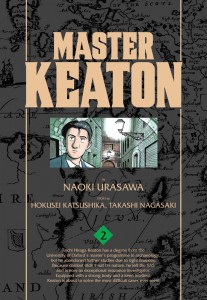
Master Keaton Vol 1

January 19, 2015 by Anna N

Master Keaton Volume 1 by Naoki Urasawa, Takashi Nagasaki, and Hokusei Katsushika

I don’t have the best track record of finishing Naoki Urasawa series. I own all of 20th Century Boys and mean to read it all the way through again. I’ve checked out a couple volumes of Pluto and the first few volumes of Monster. One of these days I will finish an Urasawa series! This failing on my part didn’t stop me from trying out Master Keaton, and I enjoyed the first volume, even though there were a few aspects of the manga that didn’t quite come together for me.

Taichi Hiraga Keaton is a half Japanese half British archaeologist, apathetic professor, and insurance investigator with a unique set of survival skills due to his background in the SAS. He bounces between giving lectures and handling cases for Lloyd’s of London. Many reviewers have referred to Keaton as a mash-up between Indiana Jones and Macgyver, and that’s a good way to sum up the series. Keaton seems to have a bit more inner turmoil than a action hero though, and that’s what makes this series entertaining. We’re introduced to Keaton when a man named Leon Pappas with a substantial life insurance policy dies in Greece. Keaton is dispatched to investigate the murder, but he only has a certain number of days he can allocate to the task, since he has to get back into the classroom the following week.

Keaton’s sensitivity towards antiquities and his excellence in creating weapons out of random kitchen implements are showcased in this story, as he uncovers more facts about the subject of his investigation when he meets Pappa’s girlfriend and manages to fend off some unscrupulous and armed business associates. The rest of the volume is a bit meandering, as different chapters have Keaton explore new mysteries, deal with his teenage daughter, and confront a significant figure from his own past. Aspects of the story here and there are a bit didactic, as the reader is informed about illegal weapons trade, aspects of art forgery, desert survival tactics, and the opium trade. I enjoyed the way the manga skipped around from topic to topic, but I generally enjoy manga with infodumps more when there is some genuine enthusiasm behind conveying all the information. I would happily read chapters upon chapters of a Fumi Yoshinaga where the characters discuss nuances of vegetable chopping, but in Master Keaton I have to admit I found my attention wandering at times.

Keaton’s personality is so reserved and unaffected for the most part. He tends to create a random gadget that saves the day very casually, which is amusing, but it is difficult to see how his adventures are having any impact on him personally. I was glad when his daughter showed up and drew him into an adventure protecting an archeological site, and Keaton’s odd reflexive anxiety about his ex-wife getting married again hints at some deeper emotions. While Urasawa’s art isn’t as polished as his later works, the character designs are all unique and enjoyable and the action scenes are all capably handled. Early Urasawa art is way above the quality of what most artists could aspire to. The over ized deluxe signature edition is really nice, with color pages and a sound effects glossary in the back. I’m curious to see what the next volume of this series is like. In some ways, I liked the shift in focus from unraveling a mystery to family, back to a thriller type story dealing with the drug trade, but at the same time I’m wondering how well that will pan out if the plot continues to skip around like that too much in subsequent volumes.

I’m giving away a copy of this volume, so you can check it out yourself!

Filed Under: REVIEWS Tagged With: Master Keaton, viz media

Ranma 1/2, Vols. 11 & 12

January 18, 2015 by Sean Gaffney

By Rumiko Takahashi. Released in Japan by Shogakukan, serialized in the magazine Shonen Sunday. Released in North America by Viz.

My resolve to do full reviews of the whole Ranma series as it comes out can sometimes give me pause, as this is not only a series that fights against a deeper analysis but which actively becomes worse when you treat it too seriously. Treating Ranma as shallow entertainment is something people have to do to get enjoyment out of it, due to the vast cast of unlikeable people in it. And it’s also a lot less serialized than even I remembered it being, with plots and people coming and going as Takahashi saw fit. For example, remember I was talking about Ukyou being such an important major character last time? She’s not even in this. Also, I knew Nabiki didn’t appear much in these early days, but I’d forgotten HOW little.

ranma11-12

Ryouga is still a major player here, of course. We get a few plots involving him in this omnibus. The first, where he finally manages to go to his house and invites Akane there (with a jealous Ranma following behind) shows off all of what makes Ryouga who he is: his basic sweetness and shy nature around Akane, his stubborn pigheadedness and anger (which can verge on stupidity), his poor sense of direction (which we discover is a family trait in this story, allowing Ranma to pretend to be his “sister” and get away with it), and his plain old bad luck. In the second story, a soap that Shampoo bought as a Jusenkyo cure is used by Ryouga instead, and his attempts to take advantage of not being cursed anymore show a frightening turn, as he almost becomes a berserk stalker. Best line, after we find the “cure” is temporary like all the other ones, and Akane is reflecting on Ryouga’s unthinking brute strength: “Whoever ends up being Ryouga’s girlfriend will have to be made of sterner stuff than me.” Well, does raising sumo pigs count?

Ranma and Akane appear throughout, of course, and the volume shows off why fans of the couple love them and those who hate them (and by them I mean Akane) can’t stand it. Akane jumps to conclusions all the time (albeit in situations that simply would not happen to normal people), punches Ranma into next week when she’s angry or jealous, and refuses to admit any affection. Ranma, meanwhile, jumps to slightly more reasonable conclusions but makes up for it by having his jealousy be more obvious. And of course he refuses to admit affection even more, even when he thinks Akane is being particularly cute (The end of the “whiskers ramen” story is the first of several that show off Ranma’s handsome face smiling at Akane with genuine affection.) And of course together they make a very effective team. They’re held back by their hot bloodedness and insecurities, but if this weren’t Nerima they’d be dating by now.

There is a new character introduced in this volume, thought he turns out to be related to two old friends. I’d forgotten how long the Principal Returns storyline ran before it was finally revealed that he was Kuno’s father, but it makes sense, given he seems to be just as divorced from reality as his children are. He went to Hawaii to study discipline techniques, and much of his behavior is stereotypical Hawaiian, but the teachers point out that he was always over the top even before this. And on his return, he’s obsessed with giving everyone old-fashioned school haircuts – shaved heads for boys, “pudding bowl” for girls. This leads to a giant melee battle, a frequent appearance in this series, as everyone searches for the coconut that can free them from this fate. (Nice lampshading when a man-eating tiger is set upon the students: “What part of this is Hawaiian?”

Of course, no one should be thinking about whether Kuno and Kodachi’s mental trauma is a result of their father’s upbringing, any more than they should worry about Genma being a horrible father, Akane punching Ranma so hard he flies several blocks, etc. Don’t analyze the series, just laugh along with it. It’s a lot of shallow, shallow fun. That said, join us next time for a plotline that is at least a little more serious, and takes over half the omnibus to resolve.

Filed Under: REVIEWS

Mushishi, Vol. 1

January 16, 2015 by Ash Brown

Mushishi, Volume 1Creator: Yuki Urushibara
U.S. publisher: Del Rey
ISBN: 9780345496218
Released: January 2007
Original release: 2000
Awards: Japan Media Arts Award, Kodansha Manga Award

I no longer remember what first led me to pick up Yuki Urushibara’s debut manga Mushishi. It was probably mostly coincidence: the series started being released in English around the same time I started to really get into manga and was trying all sorts of things. I’m grateful for whatever reason it was that convinced me to read Mushishi because it became one of my favorite manga series. I love its quiet creepiness and beautiful storytelling. Mushishi was well-received both in Japan and abroad by both fans and critics. Among other recognitions and honors, Mushishi has earned a Japan Media Arts Award as well as a Kodansha Manga Award. Mushishi, Volume 1 was originally published in Japan in 2000. The English-language edition was initially released by Del Rey Manga in 2007 and, sadly, has since gone out of print. Happily, in 2014, Kodansha Comics released a digital edition of Mushishi in English.

Mushi–a category of primordial beings fundamental to the living world which may take on many forms. Truly understood by very few people, they are studied by mushishi, or mushi masters. Ginko is one such mushishi, making his living by traveling across the Japanese countryside, learning all that he can about mushi, and attempting to help those unfortunate enough to have come under the creatures’ influence. Mushi are often to blame for unusual natural phenomena and strange, otherwise unexplainable illnesses. Ginko is an expert, but even he is faced with circumstances beyond his knowledge and control; where mushi are involved, nothing is ever entirely certain. Sometimes the harm caused by the mushi has already been done and is irreversible, leaving humans to deal with the aftermath. They must learn to coexist or else risk their lives or sanity.

Although there is some continuity between the stories, Mushishi is largely episodic and each chapter in the first volume of the series stands well on its own. “The Green Gathering” introduces the concept of mushi while Ginko investigates a young man with the power to grant life to the things he draws. In “The Soft Horns” Ginko aids the residents of a snowbound village suffering from a peculiar kind of hearing loss. Mushi have invaded the dreams of a man in “The Pillow Path” with devastating and dire consequences. Urushibara’s award-winning “The Light in the Eyelids” was actually the very first Mushishi manga. The story follows a young girl whose eyes have become so painfully sensitive to light that she has been blindfolded and shut away by her family in a dark storehouse. The final story in Mushishi, Volume 1 is “The Traveling Bog” in which a swamp disappears and then reappears again and again, drawing ever closer to the sea each time.

Urushibara was influenced tremendously by older Japanese folk stories, but in developing Mushishi she draws on that inspiration to create a world and mythology of her own. Although the tales in Mushishi, Volume 1 are new, they still have a very familiar, traditional feeling to them that I find immensely appealing. I also enjoy the subtle horror present in many of the stories in Mushishi. While occasionally the manga and its imagery is disconcerting or even disturbing, Mushishi isn’t overly graphic or violent. Instead its creepiness derives from the fear of the unknown or the unknowable and the close intertwining of life and death. Mushi do not always bring misfortune, they can also be a benevolent force, but they are something beyond the understanding  and power of most humans, and that can be frightening. In Mushishi, Volume 1 Ginko is shown trying to bridge the gap that exists between mushi and humans, but he often struggles to find the perfect balance between sharing his knowledge and protecting life.

Filed Under: REVIEWS Tagged With: del rey, Japan Media Arts Award, Kodansha Manga Award, manga, mushishi, Yuki Urushibara

  • « Go to Previous Page
  • Page 1
  • Interim pages omitted …
  • Page 238
  • Page 239
  • Page 240
  • Page 241
  • Page 242
  • Interim pages omitted …
  • Page 342
  • Go to Next Page »
 | Log in
Copyright © 2010 Manga Bookshelf | Powered by WordPress & the Genesis Framework