• Skip to primary navigation
  • Skip to main content
  • Skip to primary sidebar
  • Home
  • About Us
    • Privacy Policy
    • Comment Policy
    • Disclosures & Disclaimers
  • Resources
    • Links, Essays & Articles
    • Fandomology!
    • CLAMP Directory
    • BlogRoll
  • Features & Columns
    • 3 Things Thursday
    • Adventures in the Key of Shoujo
    • Bit & Blips (game reviews)
    • BL BOOKRACK
    • Bookshelf Briefs
    • Bringing the Drama
    • Comic Conversion
    • Fanservice Friday
    • Going Digital
    • It Came From the Sinosphere
    • License This!
    • Magazine no Mori
    • My Week in Manga
    • OFF THE SHELF
    • Not By Manga Alone
    • PICK OF THE WEEK
    • Subtitles & Sensibility
    • Weekly Shonen Jump Recaps
  • Manga Moveable Feast
    • MMF Full Archive
    • Yun Kouga
    • CLAMP
    • Shojo Beat
    • Osamu Tezuka
    • Sailor Moon
    • Fruits Basket
    • Takehiko Inoue
    • Wild Adapter
    • One Piece
    • After School Nightmare
    • Karakuri Odette
    • Paradise Kiss
    • The Color Trilogy
    • To Terra…
    • Sexy Voice & Robo
  • Browse by Author
    • Sean Gaffney
    • Anna Neatrour
    • Michelle Smith
    • Katherine Dacey
    • MJ
    • Brigid Alverson
    • Travis Anderson
    • Phillip Anthony
    • Derek Bown
    • Jaci Dahlvang
    • Angela Eastman
    • Erica Friedman
    • Sara K.
    • Megan Purdy
    • Emily Snodgrass
    • Nancy Thistlethwaite
    • Eva Volin
    • David Welsh
  • MB Blogs
    • A Case Suitable For Treatment
    • Experiments in Manga
    • MangaBlog
    • The Manga Critic
    • Manga Report
    • Soliloquy in Blue
    • Manga Curmudgeon (archive)

Manga Bookshelf

Discussion, Resources, Roundtables, & Reviews

Reviews

I Married My Best Friend to Shut My Parents Up

June 2, 2019 by Sean Gaffney

By Kodama Naoko. Released in Japan as “Oya ga Urusai Node Kohai to Gisou Kekkon Shitemita” by Ichijinsha, serialized in the magazine Comic Yuri Hime. Released in North America by Seven Seas. Translated by Amber Tamosaitis. Adapted by Lora Gray.

I admit, when this was first announced, I said NOPE really hard. But that was mostly due to the author of the series, whose previous series I had sort of hated. But a few people reassured me that this was not along the lines of Netsuzou Trap, and indeed in the afterword the author jokes about their ‘light’ and ‘dark’ modes, and this is definitely on the light side. Indeed, very light – it’s complete in one volume, and also has an unrelated one-shot short story at the end. The main story is also pretty much described in the title, though I think the relationship between the two leads is more like the original Japanese – Agaya is a friend, but she’s definitely framed more as a kohai, with Morimoto as the sempai. They’re out of school now, but end up together as, well, read the title. What follows is cute, and both leads had more depth than I was expecting.

Morimoto is dealing with problems on several fronts. Her parents want her to get married. Her workplace is fairly sexist, resisting giving her any big projects as it’s assumed that women are there until they find husbands and that’s it. And she’s also a somewhat repressed, introverted sort to begin with. Agaya, on the other hand, is bright, bubbly, extroverted, and can be a bit much at times. She’s also gay, and in fact asked Morimoto out when they were in school, though she was rejected. So when she points out that gay marriage is legal in their prefecture, and that it would be a great way to stop her parents nagging her, Morimoto goes along with it. Then Agaya moves in, as she’s saving to get a new apartment and this helps. As the volume goes on, Morimoto gains confidence and realizes just how much she’s enjoying the married life. But can she hold on to Agaya, who is pretty convinced that her senpai is “super-straight”?

This is not the most complicated story in the world, but there were little touches I liked a lot. One early scene shows Morimoto flashing back to her childhood, an endless string of being nagged to excel in everything or else she’s a failure. The interesting part was seeing it start with her father accusing her mother of being a “bad mother” for a poor grade that Morimoto got – which of course is bound to show off why she does NOT want to get married. Agaya is also mostly well handled. She’s very “out”, personality-wise, and is not above sneaking in to bathe together with her new “wife”, or leering her her boobs. But she does not, for the most part, make any advances on Morimoto that she’s not comfortable with, and at the end she’s the one who has to be convinced that they could actually make this into something real. She also has her own career as well – this is not a “breadwinner and housewife” sort of relationship.

The short story afterwards, about a girl in an athletic school who got injured, so has to get great grades to maintain her scholarship, and her rude track girl friend, is a bit too slight to really go anywhere. The meat of the title is in the main story, and at three chapters it’s just about the right length. Worth a look for yuri fans.

Filed Under: i married my best friend to shut my parents up, REVIEWS

I Shall Survive Using Potions!, Vol. 2

June 1, 2019 by Sean Gaffney

By FUNA and Sukima. Released in Japan by Kodansha. Released in North America by J-Novel Club. Translated by Garrison Denim.

There are currently three different series by FUNA coming out here, and having read some of each of them, I’m inclined to categorize them as Beginning, Intermediate and Advanced. Beginning is Saving 80,000 Gold in Another World, which even has an easy mode for its protagonist, who can still interact with the past world. She’s having fun, but there isn’t really all THAT much monstrous ridiculousness (though I admit this is the series I’ve read the least of). Intermediate would be Make My Abilities Average!, where Mile is absolutely stupidly overpowered and shows it, and helps her friend to get that way as well, but those seriously hurt of killed by her and her friends tend to be evil bandits, kidnappers and the like. The tone is very much happy, jolly adventures. Finally, there is I Shall Survive Using Potions!, the Advanced Course. You really, really need to not care about overpowered heroes at ALL, or you will hate this. What’s more, Kaoru is A LOT, and sometimes her emotions get the best of her in ways that veer beyond ridiculous and into horrifying.

Roughly the first half of this book takes place right after the previous one. Kaoru’s hitting this world like a tac nuke has had repercussions, and the kingdom she’s currently staying in is now under attack by two different nations. Fortunately, she has the knight that she was able to de-age in the last book at her side, the brother of the king, and her cadre of Baker Street Irregulars at her side, as well as her usual item boxes/potions/literally anything. Unfortunately, this is a war, which means things turn serious fast, and Kaoru quickly finds she really hates it when people are injured or killed in front of her. It’s pretty horrifying being reminded that when she loses it emotionally, she could decimate anyone around her. The second half of the book takes place after a time skip, and shows Kaoru and her hangers on heading to a new kingdom so that she can try to find herself a man to marry and have kids with. This is as much of a flaming disaster as you can imagine, because of Kaoru’s basic personality, but is far more amusing.

Moral ambiguities aside, and I’m not entirely certain how much of this is intentional, this is still a lot of fun. There are in-jokes that are based on the publisher (a cameo from a certain goddess whose adventures also ran in a Kodansha magazine), and some where you wonder if it was the original or the J-Novel Club adaptation (the use of a certain popular anime meme). Kaoru’s personality is so straightforward that it tends towards snark, and she IS ridiculously overpowered, but there are a number of moments here where she’s allowed to slip up – indeed, the gag right at the end of the main story may be the best in the book. She’s still doing whatever the hell she wants, even if that means adopting a daughter (she’s an orphan), creating vibroblades for her knight (see, it’s really a potion that happens to look AND act like a vibroblade), etc. Disbelief is hung by the neck until it’s dead here. What’s more, Kaoru’s two friends from her original world have lived their full lives and died, and now they’re in this world as well… and also apparently have ridiculous powers.

Like most of FUNA’s series, I want to read more of this. Unlike the other two, though, I do wonder if Kaoru will actually turn down a darker path one day. I mean, she’s already pretty morally grey. Definitely worth picking up, though. Also, don’t insult the goddess or you’ll get a wooden washtub to the head.

Filed Under: i shall survive using potions!, REVIEWS

An Archdemon’s Dilemma: How to Love Your Elf Bride, Vol. 5

May 30, 2019 by Sean Gaffney

By Fuminori Teshima and COMTA. Released in Japan by Hobby Japan. Released in North America digitally by J-Novel Club. Translated by Hikoki.

Given that An Archdemon’s Dilemma rarely has threats to its titular Archdemon that actually go anywhere (once again he’s the strongest one in the entire area, and is only greviously wounded once by his own choice), it makes sense that the series runs on putting loved ones in peril. Though it can take a lot to make Zagan actually admit to caring about people, he absolutely does, and therefore when Nephteros is once again sought after by the series’ major villain, he’s there to help her. Thankfully, he’s not really there to save her, as he generally rescues people based on power level. Innocents, such as the young fox girl who is possessed by black sludge, he is perfectly content to save entirely. Nephteros, who can get out of her own troubles once she gets over her identity issues, just needs a helping hand. And Chastille, who Zagan very much frames as “not a love interest”, has to fend for herself. Luckily, the author seems to finally let her do this.

I’ve talked before about how Chastille seemed like she was going to be the tsundere secondary love interest but then the author realized how much he loved seeing her flailing around and crying. Last time we saw that her ‘work’ and ‘rest’ phases are almost two different people. And here the two seem to combine, as she seems to have finally accepted in her heart that she loves Zagan but he doesn’t love her back… and moreover, she doesn’t want him to, as this would ruin things with Nephy. This actually allows her a stronger bond with Nephteros, who also is drawn to Zagan and Nephy but can’t really be with them. Zagan may say that she’s a sister to Nephy, but for once we get someone deciding NOT to live at Zagan’s castle of increasing population. Nephteros needs to cultivate her own story, as does Chastille.

Speaking of love stories, the biggest new character introduced this time around is Kuroka, a blind priestess with a grudge against a) sorcerers and b) Chastille. With her we get to examine the ‘driven by revenge’ trope, though I admit it was a bit too on the nose to have Zagan literally spell it out for the reader. Fortunately, aside from the revenge she’s a perfectly nice person. Also fortunately, the revenge she was seeking turns out to be unnecessary to begin with. There are hints of the ongoing plot here, as there seems to be a thirteenth sacred sword, and the corruption in the Church is still a larger problem even without assassination attempts on Chastille every book or so. As for the titular couple, well, they’re still awkward – by the end of the novel, Zagan has finally asked Nephy on a date, but that’s as far as we get. Unless you count the muffler scene, which was adorable.

I’m not sure I can point to one thing and say “this is why I enjoy the series so much”, but enjoy it I do. I was particularly pleased with Chastille this volume, who did not have one extended nervous breakdown. And it’s always nice to remind myself sometimes that Zagan is NOT an isekai protagonist, but just a poverty-stricken fantasy lad who got really, really powerful. Fun stuff.

Filed Under: archdemon's dilemma, REVIEWS

Emanon, Vol. 1: Memories of Emanon

May 29, 2019 by Sean Gaffney

By Shinji Kajio and Kenji Tsuruta. Released in Japan as “Omoide Emanon” by Tokuma Shoten, serialized in the magazine Comic Ryu. Released in North America by Dark Horse Comics. Translated by Dana Lewis.

I must admit, I wasn’t even aware this was a famous Japanese SF story till after I’d finished this volume and was reading the afterwords. Japan’s market for such titles tends to wax and wane (as the afterword itself notes), and I had never read a translation of this story. That said, I’m definitely interested in seeking it out now, as I found this to be an excellent adaptation. A great combination of thoughtful dialogue and striking art, it’s also exactly the right length, though I say that knowing that there are more volumes coming in the future that apparently expand on the original story. This particular volume, though, works very well as a stand-alone, and also gets into some of the big questions of how memory works, what makes a human, and where are we headed in the future. All that plus a bittersweet not-quite romance.

Our protagonist is a young college-aged man who’s getting over a broken heart from a one-sided love, so takes the ferry back to his hometown. While on the ferry he meets a young woman, and though they initially don’t get on, they are drawn together in a mutual desire to avoid drunken creeps hitting on her. Eventually she gives a name to him – Emanon, aka “no name” backwards – and, since he’s a science fiction reader and thus has an open mind, tells him a bit about herself and her life, which seems to go back about three million years, Despite her being born in 1950. (The story is set in 1967.) She’s very guarded, at one point passing off her entire confession as a story, but the guy’s open curiosity and acceptance helps her open up more, and they grow closer. That said, this is not really a romance.

The manga seems to alternate between pages of quite, introspective panels and pages that are filled with dialogue as the two leads discuss Emanon’s situation, what it means for her, and what it means for humanity. The story’s origins as science fiction really come to the fore here, but it’s a tribute to the story itself that I was never bored. This volume has a postscript years later, where the (now married) protagonist sees the girl he met on the ferry again, only she doesn’t know who he is. That said, this does not mean Emanon has forgotten him. It’s a good, wistful yet hopeful end for this story, and I’m actually rather curious to see how the manga develops in future volumes, which appear to follow Emanon’s journey. The art is also fantastic, to the point where the end of the book is several pages, both color and black and white, of Emanon just wandering around Japan wordlessly.

I wasn’t sure what to expect with this book, and ended up pleasantly surprised. If you’re looking for something introspective and thought-provoking, this is a very good title to pick up.

Filed Under: emanon, REVIEWS

Invaders of the Rokujouma!?, Vol. 21

May 28, 2019 by Sean Gaffney

By Takehaya and Poco. Released in Japan as “Rokujouma no Shinryakusha!?” by Hobby Japan. Released in North America digitally by J-Novel Club. Translated by Warnis.

We’re back to plot-heavy in this volume of Rokujouma, which sees the enemy making its move. No, not the actual Big Bads of the series, though they do sort of sit at the side, watch, and offer occasional “help”. Instead, the military wing of Forthorthe has been sabotaging things behind the scenes, and they decide to finally make their move to either capture or kill Elfaria once and for all. Naturally her daughter is not going to take that lying down, so everyone gets on their spaceship and rides. (I will assume for the sake of the plot that it’s still summer break or something, as missing school is not brought up at all.) Of course, just getting there is not going to be easy, as they’re trying to remain undetected, and are dealing with both actual bad guys and soldiers who’ve been fed ‘the Empress is a traitor’ fake news for a while. Fortunately for the Empress, she has the Blue Knight and company on her side.

The book starts off with Theia looking romantically at magazines showing happy wives and mothers, and also getting a big revelation from the more scientific princesses in the group: Forthortians and Earthlings have near-as-dammit the exact same genetic makeup, so having kids won’t be an issue. Leaving aside the sheer unlikeliness of this (which is mentioned in text), one thing I’ve noticed about Rokujouma is how pure it is, especially given that it’s about a guy and his nine-girl harem. Theia is seen to be dreaming of having kids, but there’s no real mention of how those kids will be made, and the girls never really think beyond “kisses on the cheek”. Part of this is due to Koutarou’s ongoing intimacy issues, but part of it, I think, is that it’s just that sort of series, and that trying to make things sexier would almost be like removing a magic spell or something. Besides, at heart this isn’t about the girls “getting” Koutarou, it’s about family.

This is Theia’s book, really, and she gets to show off a lot of sides here, even (towards the end) her self-sacrificing side, as she’s determined not to let an innocent fighter pilot die even if it costs her own life. Of course, that doesn’t happen, thank to both Koutarou and a screaming but competent Magical Girl Yurika. (Yurika is pretty whiny this book, but given the circumstances, and that she’s out of her element, it’s mostly fine.) I suspect we’re going to get an awful lot of “you guys go on, I will stay here and hold them off (and die”) going forward. Naturally, this will always be counteracted by everyone else in the cast, but I’m pretty sure that things are only going to get harder from here on out. Especially as the actual bad guys still haven’t stepped in yet.

We’re starting to get towards the endgame here (the books “end” with the 29th volume, though they are still ongoing with ‘after stories’). I expect the next volume will have more political machinations and big ol’ battles. Which is fine by me, as the author does those pretty well. Just as long as the emphasis is on the bond between these sweet, pure kids.

Filed Under: invaders of the rokujouma!?, REVIEWS

Re: ZERO -Starting Life in Another World – Ex, Vol. 3

May 27, 2019 by Sean Gaffney

By Tappei Nagatsuki and Shinichirou Otsuka. Released in Japan by Media Factory. Released in North America by Yen On. Translated by Kevin Steinbach.

When this arrived, I didn’t read it for a while as I was expecting it to be the “second half” of Wilhelm’s tragic backstory. But no, as this volume ends we’re still in lovey dovey land, though there are echoes of bad things on the horizon. Instead this volume picks up where the last one left off, with Wilhelm having defeated Theresia in battle and thus proving that he can replace her as the main defense of the realm… or so he thinks, but given that he starts the book in a prison cell, it’s likely that he has a lot more convincing to do. What this actually is are three short stories mushed together telling the story of Theresia and Wilhelm getting married and going on their honeymoon, and all of the things that get in the way of their happiness, which at this stage are mostly played for comedy. That said, the main villain towards the end has some familiar equipment, and I’m wondering exactly how Big Bad he’s meat to be.

I get the sense that the author wrote these stories while taking a break from their usual “Subaru has the worst day ever” fare. I was not expecting this to be as light-hearted as it was, and in many ways it doesn’t even feel like a Re: ZERO novel. Having determined to become Wilhelm’s bride and not a sword master (Wilhelm at least adds “unless she wants to” to this, but the narrative still pushes hard on “cute girls should not fight” mode), Theresia now goes into full-blown tsundere mode, with lots of embarrassment, mild jealousy, and no doubt pouting while pushing out one cheek in the grand anime faces tradition. Wilhelm has become more human since the last book, but that does make him a bit less interesting, as he’s now the standard snarky male light novel lead – something Subaru takes pains not to be. Theresia’s overprotective dad doesn’t help either, as he is made of cliches.

The final short story is the most interesting. (Well, there’s a short fourth short story about Carol and Grimm’s romance, but it’s clearly an afterword sort of thing.) Our couple are on their honeymoon, accompanied by Carol (who loves Theresia a bit too much) and tailed by Theresia’s father (ditto). Things turn serious, unfortunately, when they run into Lord Stride, who is the classic “arrogant noble” of many a light novel, and his bodyguard/champion, a big guy with eight arms. Naturally, he and Wilhelm have to fight, and it’s the best fight in the book, though unlike the last book this one really isn’t about the fights. Stride reminds me far too much of Petelgeuse only witho0ut the insanity, and I have a sneaking suspicion he or a relative may be in the main story sooner or later.

This is a great change of pace for those who’ve been reading Re: ZERO waiting for bad things to happen to good people. On the downside, that does mean it’s a little boring. There’s no deconstruction here, just the author writing a fun little light novel where the sword cutie marries the sword snarker. No doubt this will be continued in the 4th EX, but that’s not out in Japan yet.

Filed Under: re: zero, REVIEWS

Sword Art Online, Vol. 16: Alicization Exploding

May 26, 2019 by Sean Gaffney

By Reki Kawahara and abec. Released in Japan by ASCII Mediaworks. Released in North America by Yen On. Translated by Stephen Paul.

Thankfully, this is a much stronger volume than the previous one. It helps that this time around we have very little POV of Gabriel Miller, though the little we get shows he’s as awful as ever, and has a new reason to be after Alice. There’s also no Kirito POV, as he spends the entire book still comatose. This allows a number of characters to get POV scenes, which Kawahara admits in the afterword he’s not really used to, but it plays out pretty well, as we’re introduced to a number of Integrity Knights, as well as some villains, and get a little more into what makes them human. Which is good, given that the entire premise of this arc is that the cast of the Underworld are meant to be just as important and sentient as our heroes, even if Alice is framed as the most special of all. And, coming down as a gift from heaven – literally – Asuna joins the fray, with God-tier powers and an immediate rivalry with Alice, because the author never met a cliche he didn’t like.

Unfortunately, sometimes that means cliches that shouldn’t really be used. I sighed when we got to the Integrity Knight with a massive crush on Fanatio, who was forced to become a knight because she fell in love with another woman, falls in love with Fanatio while a knight, and is promptly killed off protecting her. I should be grateful she wasn’t framed as evil or predatory, I suppose. The ‘bad guy’ cast also ranting about the “white iums’ (aka the good guys) also rankles, though I know that it comes from a fantasy base where white = good and black = bad, and was no doubt written into the Underworld by the developers. Better handled was the cowardly Knight who decides to hide from the final battle, and unfortunately for him ends up in the same tent as Ronie, Tiese and their unresponsive charge, and he is forced to learn the true meaning of Christmas. Or at least that some things are worth fighting for.

Most of this book is a fight sequence, and there are some good ones, particularly a battle between a stoic and (mostly) silent Integrity Knight and a Pugilist (who are basically a bunch of Hercules guys) on the opposite side who find that each has an equal bloodlust for a good fight. That said, we can’t avoid the plot entirely. Asuna is in the game now, but she won’t be enough, as the villains have hacked it to allow a bunch of Americans to log on – not telling them these are anything other than NPCs – and let them kill everyone. Fortunately, Yui – who laments the fact that she’s not as good an AI as Alice and company while at the same time surpassing her own limits, a scene that’s very deftly handled – is bringing in a few more ringers. Yes, at last, we’re getting the rest of the band back together, as the other “main” cast members prepare to enter the Underworld as well.

We have two more books to go in this arc, and I will be very surprised if the next one does not end with Kirito ascendant. But there’s no denying that things are tough right now. Fortunately, with the power of More Deban on its way, we can likely find a way past it. That said, SAO is every five months now, so be prepared for a slightly longer wait.

Filed Under: REVIEWS, sword art online

One Piece, Vol. 90

May 25, 2019 by Sean Gaffney

By Eiichiro Oda. Released in Japan by Shueisha, serialization ongoing in the magazine Weekly Shonen Jump. Released in North America by Viz. Translated by Stephen Paul.

One Piece is ninety volumes long over here, in case you missed the title of the review. And it’s been running in Japan for twenty-two years, meaning many parents who started reading it in East Blue are having their kids pick it up with Cake Island. And while Oda tries his best to make everything accessible to casual readers, he really has his work cut out for him with this book, which sees the country’s leaders from all over the land get together for a meeting. The Celestial Dragons will be there… wait, who were they again? And Wapol’s back! … wait, who was he again? Even Oda knows that we can’t really recall everyone in every single volume. As result, not only does each chapter have ‘recap’ panels reminding us who these people are, there’s also an inserted 7-page ‘guidebook’ style entry going into even greater detail. You can’t tell the players without a scorecard. Especially since Oda seems to be reintroducing EVERYONE.

Of course, some characters don’t really need reintroduction, either because they’re still relatively new (Rebecca), hard to miss (Princess Shirahoshi), or iconic (Vivi). There’s an amusing scene where they all talk about how much Luffy did for all of them, and more people fall over themselves to talk about what a debt they owe the Straw Hats. Of course, not everyone reintroduced is a good guy. I mentioned Wapol before, though honestly he doesn’t seem that bad anymore, and I think is merely there to face off against Dalton and Kureha. No, I’m talking about the Celestial Dragons, particularly Stelly, the bratty kid who ruined Sabo’s childhood, who is now an even brattier adult. And of course there are the five elderly guys who run everything, who we rarely see but whenever we do it isn’t good. Worst of all, though, is the Dragon who appears riding Bartholomew Kuma like a mount. Sabo won’t take that lying down, and neither will Bonney, who’s infiltrated the party.

That said, it may be a while till we get back to this meeting, as we also have the Straw Hats, who have finally escaped from Big Mom, at least for the moment. Sadly, they’re without Jimbei, who has to stay behind to hold off the enemy, but he does resolve to join them soon, and I think we can safely say he’s a new crew member. And then we go off to the country of Wano, which allows Oda to bring out every single Meiji period cliche that he can. It also allows us to catch up with the cast who’ve been missing for a long, long time. Some are doing what they’ve always done (Franky is a carpenter, Usppp is lying), some are taking on tough new roles (Robin is a geisha), and some are… being executed? Well, at least they try to convince Zoro to commit suicide for the “crimes” he’s committed. It goes about as well as you’d expect.

So we’re kicking off a new arc, and Luffy seems to be once more separated from everyone else after the ship runs aground on the shore of an uncharted desert isle… wait, no, runs aground in Wano Country. What happens next? And when will we get back to Vivi and company?

Filed Under: one piece, REVIEWS

Torture Princess: Fremd Torturchen, Vol. 1

May 24, 2019 by Sean Gaffney

By Keishi Ayasato and Saki Ukai. Released in Japan as “Isekai Goumon Hime” by Media Factory. Released in North America Yen Press. Translated by Nathaniel Hiroshi Thrasher.

I do try not to be glib in my reviews too often, but I will admit it was tempting to have my entire review of this volume be “Loved the princess, hated the torture”. Honestly, it was a surprise to many people that I started this at all, given my wariness of overly dark and bloody titles. But I was on one of my “read the first volume of everything” kicks, so I worked my way through it. It was difficult at times, I will admit. The torture is no lie, and this isn’t even the pointless “torture them to get information” that you see in other, more annoying works. This is torture for the sake of gore, torture porn. Fortunately, the book also has three very distinct, likeable leads with expressive character voices and interesting through processes. I liked the way they went, and I want to see more of them. That said, it’s hard not to read this and think “the author wanted to write pages of torture description, so wrote a book around it”.

Kaito is a young man who has suffered at the hands of his abusive father his entire life, and finally is killed by said father. However, he ends up being transported to the land of the Torture Princess, Elisabeth Le Fanu. She brought him there to be her servant, and help (or at least watch) as she defeats thirteen demons and the people who have sold their souls to said demons. The demons enjoy torture and despair, and (seemingly) so does Elisabeth, so there’s an awful lot of it going on, and for a while the somewhat stoic Kaito is simply going with the flow. After a while, they also gain a robot maid, Hina (OK, a ball-jointed doll who is sentient maid, but for all intends and purposes she functions as a robot maid) with a devotion to Kaito that borders on the obsessive… well, OK, has moved into the obsessive and set up a knickknack shop there. Can they stop those contracted with demons from torturing innocents? Well, no. But they can at least punish them after the fact.

I will admit, I found Elisabeth, Kaito and Hina a lot of fun. Despite her name, Elisabeth is not a vampire, but she shares some of the same character traits, and the relationship between her and Kaito reminded me at times of Shinobu and Araragi from the Monogatari series. Kaito is snarky but not too much so, and most of this first book is seeing him regain a desire to actually find happiness and a purpose in life. And cliched as Hina is, she’s also hilarious and fun… and also provides the heart of the book, right near the end. It’s a good solid basis for a series. That said, dear sweet merciful Christ, after a while you will start flipping pages as you read about people lying in various bits, or having limbs chopped off, or being staked by demon crows, or… it almost went beyond exhausting to boring. It fits the florid Elisabeth’s Grand Guignol style, but that does mean that this is a book I can recommend only to the strong of stomach.

Filed Under: REVIEWS, torture princess

Urusei Yatsura, Omnibus 2

May 23, 2019 by Sean Gaffney

By Rumiko Takahashi. Released in Japan in two separate volumes by Shogakukan, serialized in the magazine Shonen Sunday. Released in North America by Viz Media. Translated by Camellia Nieh.

UY gets a bit of a reboot about a quarter of a way into this omnibus. The cast is streamlined, with a lot of the alien girls after Ataru vanishing (some will be back – Benten, Oyuki – and some won’t – Kurama), and Megane and his three friends also vanishing from the manga (the anime will keep them around, for good and ill). In their place we get Shutaro Mendo, and he immediately shows us that he is going to be a main cast member fot the long haul. Indeed, after Ataru, Lum and Shinobu he’s the biggest member of the cast, and much of this volume is dedicated to showing off his best features (his money, his looks) and his worst features (everything else about him). Takahashi makes a point of showing early on that without his wealth and good looks, he’d be just like Ataru – but of course, he DOES have wealth and good looks, so the girls all fall for him anyway.

This includes Shinobu, who the endnotes at the end of the volume call out for having bad taste in men, and it’s hard to deny, as Mendo will forever be willing to abandon her at a moment’s notice if he can get Lum instead. (Shinobu will get a happy ending, but you may have to wait till Omnibus 16 or so to start seeing it.) There are a few chapters that show off Mendo trying to woo Lum, but he’s at a huge disadvantage, as Lum’s love for Ataru never really wavers at all – even when she’s dating others, it’s in an effort to make him jealous. Here we see her even disguising herself to save Ataru from his own foolishness, or alternatively so he can pretend she’s a real Japanese girl when they go out. As for Ataru, at the start we see he has the same attitude about Lum as he did before – he wants her gone – but this also changed as the story moves forward.

Ataru is, for the most part, a womanizing creep, and this won’t change, though it’s worth noting that even with these traits he’s still one of the better catches in the class. The ‘fake girl for Ataru’ chapter, which the anime put at Christmas and expanded greatly, is the first time that he actually realizes that Lum is gorgeous, and that plus the fact that she clearly went out of her way to help him leads him to soften his stance on her. He still declares that they aren’t going out or married, but she’s become an ally to him now. Two chapters in a row show this off best. In one, he befriends a caterpillar that wants to eat everything – and we do mean everything – and he and Lum try to protect it from the rest of the class, who find it creepy. This works out better than anyone could expect. In the other, possibly the most famous chapter of the series (its anime adaptation was voted the #1 episode by Japan), Lum vanishes, leaving behind only a cute little doll that looks like her, and Ataru worries that he genuinely drove her off.

Heartwarming moments like these are far more common in the anime than in the manga, but they do happen, and for a good purpose – now Ataru is fighting against his affection for Lum, rather than just seeing her as an invader. Now that the core cast of four has been solidified, we can also start to expand the world once more, and we’ll see that in the next volume. Also, Takahashi’s art settles down here – there are some gorgeous pieces of art on display in these pages.

Filed Under: REVIEWS, urusei yatsura

Ascendance of a Bookworm: I’ll Do Anything to Become a Librarian!, Part 1: Daughter of a Soldier, Vol. 1

May 22, 2019 by Sean Gaffney

By Miya Kazuki and You Shiina. Released in Japan as “Honzuki no Gekokujou: Shisho ni Naru Tame ni wa Shudan wo Erandeiraremasen” by TO Books. Released in North America digitally by J-Novel Club. Translated by quof.

There are people who read books about characters who are transported/reincarnated to another world in order to see fantasy battles, game-style powerups, harem antics, and a lot of plot packed into the first volume of the series. And I am here to tell you that those people should run screaming from Ascendance of a Bookworm, which I loved but is the very definition of “slow buildup”. In a way it’s sort of like Mushoku Tensei, in that a “loser-ish” protagonist is killed and reincarnated as a small child. But Rudy is born with lots of skills and gets training to use them fairly quickly. Myne, meanwhile, not only wakes up as a six-year-old in a fantasy medieval town that has few to no books, but she’s also constantly feverish and weak – even walking a short distance exhausts her. But, and I’m sure she’d be yelling at me for glossing over this, the important point is that there are NO BOOKS for her to read.

In Japan, Urano loved books so much that she was reading them in her family’s book-filled room when an earthquake struck, burying her under the books and killing her. Now she’s woken up as Myne, the youngest in a family that loves but doesn’t quite know what to do with her, as she’s almost always bedridden. Even now that she has Urano’s memories, she’s still weary after only a little activity, and it takes the entire book to get to the point where she can walk around town normally. Worst of all: no books, no paper, ink is super expensive, and the literacy rate for “commoners” is low. Sure, nobles have books, but Myne isn’t one of those. What can she do? Buy a book? Her family is poor, and there are no booksellers. Make paper? Much harder than it sounds. Clay tablets? Foiled by her sketchy knowledge from her prior life. Sure, she can read and do math faster than most kids, but with only one erasable slate to her name, what’s a book girl to do?

As you might guess from the unwieldy title, this is a long-runner. Part 1 is three volumes long. This first volume is fairly lengthy, and it’s also the shortest in the series – others will be longer. It does, however, reward a patient reader. There’s some terrific worldbuilding here, with Myne finding out about things at a reasonable pace. Myne can be very frustrating – her selfishness and anger is a problem throughout the book – but it makes sense given her health and situation. She really is that weak and feeble till about halfway through this, and seemingly has none of the “when you reincarnate, you get this cool sword/goddess/smartphone” cheats we’ve seen in other series. Thankfully, Urano read constantly, so has book knowledge… but the series does a good job of showing how that’s frequently not enough. (Helpfully, her mother was also a super handicraft woman, so Myne can break out a few skills beyond reading.) The book rewards patience, but it can be very frustrating seeing Myne bash her head against a wall over and over. While complaining.

There’s a revelation right before the end of the book that I won’t spoil, but it sounds like it will lead the way towards future arcs in the series. In the meantime, if you’re looking for a different kind of isekai, or are weary of “OP” heroes, this may be right up your alley.

Filed Under: ascendance of a bookworm, REVIEWS

Shoulder-a-Coffin Kuro, Vol. 7

May 21, 2019 by Sean Gaffney

By Satoko Kiyuduki. Released in Japan as “Hitsugi Katsugi no Kuro – Kaichu Tabi no Wa” by Houbunsha, serialized in the magazine Manga Time Kirara. Released in North America by Yen Press. Translated by Sheldon Drzka.

It is always lovely, especially in this age of experiencing media whose endings turn out to be trainwrecks, to see a series get it absolutely right. Everyone who has been reading the Kuro books should be absolutely satisfied by this ending, which wraps up everything we’d like to see and is probably the closest to a happy ending that this series was ever going to get. Indeed, this is lampshaded by a dream sequence showing us the Golden Ending of sorts, with Kuro cured and back to working for Sen, and you realize that no, you can’t just have that. It would ruin the story. And Kuro has been all about people’s stories, both in the reader collecting then as she and the kids make their journey, and also her own self-discovery, which also comes to a head here as she confronts Hifumi for the last time. But in the end, it’s Nijuku and Sanju who take the biggest steps, moving forward in a way that’s impossible for everyone else.

This is a volume that looks back as well as looking forward, especially in a chapter where Emily, a reporter trying to track down Kuro, comes across everyone else that Kuro’s come across on her journey, and what starts off with her terrifying ideas of the gender-ambiguous, vampiric Kuro and her beast-like children ends up being a series of interviews about how much Kuro, Nijuku and Sanju changed everyone they came into contact with. Including Emily, who never does get to meet Kuro but now desperately wants to, having seen just how much she’s affected everyone. That said, the first half of the book also presages the confrontation midway through, as Kuro’s creeping blackness, which we saw affecting Sanju last volume, is getting worse and worse. And then there’s Hifumi, who is having an identity crisis but also knows what she wants – those two kids.

The final half of the volume ends in a string of attempts at self-sacrifice, as Kuro and Hifumi confront each other, Hifumi in an effort to get to the two girls and Kuro in an effort to stop her, which pretty much involves trying to absorb her. This goes about as well as you’d expect, and between the two of them we get tragedy and realization… as well as a bit of closure, which is bittersweet but still has some sweetness in it. Kuro and Hifumi have always had that connection between them, and this merely reinforces it. In the end, though, neither one of them can be the ones to give Nijuku and Sanju a future – they have to make their own choice. Which they do, and it’s innocent and also sort of impossible and incredibly odd and ambiguous. Which is this entire manga in miniature, really.

This manga has been going for over ten years, with many stops and starts along the way, and another entire series by the same author (GA Art Design Class) in between. It’s a journey that will sound familiar to anyone who’s followed the title character, whose meandering was much the same. The author says there may be an eighth volume of short stories coming soon, but I wouldn’t hold your breath. Till then, though, enjoy what may be a perfect ending to this excellent series.

Filed Under: REVIEWS, shoulder-a-coffin kuro

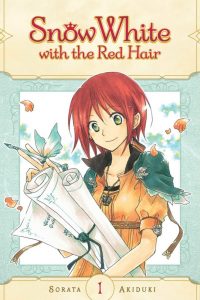
Snow White with the Red Hair, Vol. 1

May 20, 2019 by Anna N

Snow White with the Red Hair, Volume 1 by Sorata Akiduki

The “two volume” rule for judging manga series is something I tend to stick by because sometimes it takes six or seven chapters for a series to come together. In the case of Snow White with the Red Hair, the first volume is charming, but I was left a little confused about what the storyline would be to carry this series for 20 volumes. I’m assuming that this minor quibble will be cleared up with the second volume, or if not, it will continue to be a great slice of life series about herbalism with occasional low stakes kidnappings.

Snow White with the Red Hair

The woman with the red hair is actually not a princess at all, so the “Snow White” of the title is a bit of a red herring? What is it with red-haired heroines in shoujo manga anyway, is it a call back to Anne of Green Gables maybe? Shirayuki is an herbalist with striking red hair that unfortunately makes her a target for petty royals. In the first chapter, Shirayuki flees an overzealous prince who is determined to make her his new concubine, only to run into yet another prince – Zen, the second son of royalty for a neighboring kingdom. They immediately strike up a friendship, but in a subversion of the Snow White fairy tale, Zen eats a bit of a poisonous apple sent by Shirayuki’s would-be paramour and she has to rescue him.

One of the amusing aspects of Snow White with the Red Hair is the fairy-tale like setting combined with characters who are determined to make their own destiny. Shirayuki is devoted to the study of herbalism, and she decides that she’s going to make her own way in Zen’s country through her studies until she can become a court herbalist. Zen has a somewhat laid-back attitude to his royal position which is refreshing. I am not sure if I’ve seen a super chill prince in shoujo manga before. Shirayuki continues to be targeted, both because of her red hair and due to her new friendship with Zen. Seeing their initially quasi-platonic friendship slowly develop throughout the course of this volume made me look forward to what might happen next. On the whole, Snow White with the Red Hair reminded me a lot of the whimsical fantasy series that CMX used to publish, and then when I realized that it ran in LaLa, source of many CMX series, that all made sense to me. I’m glad that shoujo fantasy seems to be doing so well for the Shojo Beat imprint, because it is one of my favorite genres, and this series looks like it will be a worthy addition.

Filed Under: Manga Reviews, REVIEWS

Kokoro Connect: Clip Time

May 20, 2019 by Sean Gaffney

By Sadanatsu Anda and Shiromizakana. Released in Japan by Enterbrain. Released in North America by J-Novel Club. Translated by Molly Lee.

Well, I did ask for more wacky school antics in this volume of short stories, so you can’t say I didn’t bring it on myself. This is definitely a volume that gets better as it goes along. The first story, where Inaba decides to help out two teachers in a secret sort-of relationship by publicizing it over the entire school, is the sort of plot that made me think “and then the club was disbanded and Inaba was expelled”, which didn’t happen. The chapter where Yui gets confessed to by a girl and dates her alternates between trying its best to handle the subject properly and making stupid “OMG, gay!” jokes, which, to be fair, they are teenagers, but it’s still pretty excruciating, especially Aoba and Iori. The third story features Inaba, between the second and third books, working herself into an emotional frenzy regarding the love triangle. It’s fun if you enjoy Inaba flipping out. That said, the REASON to get this book is the final story, which takes up half the volume.

Those two characters on the cover next to Taichi may be unfamiliar to the reader, as they’re new first-years who the Cultural Research folks are trying to recruit to the club… sort of. It’s one of those situations where, were this a normal club, there would be no issues beyond “I like the bond the five of us have and don’t want to risk upsetting it”. But of course, this isn’t a normal club, and our main cast are unconsciously pushing the new recruits away because they are worried about bringing Heartseed into someone else’s life. This is not an easy problem to solve, but they decide eventually that they do want these kids in the club, and that they will tell them about its more supernatural aspects… provided Heartseed doesn’t get there first.

As for the new kids, well, Chihiro is deliberately written to annoy the reader, I suspect. He’s standoffish and arrogant, annoyed at the school’s “you have to be in a club” policy, and not particularly enamored of anyone in the group apart from the “gorgeous” Iori. That said, it’s pretty clear from the narration we get from hi8m that a lot of this is defensive and a front. The cliffhanger implies the next book will delve further into him. As for Enjouji, she’s a very entertaining combination of fluffhead and blunt, and I admire her dedication and her desire to be with those that she admires the most. That said, her obsession with Taichi’s voice is both strange and hilarious. They both look like good additions to the club. It’s also highly unusual to see a major plot point happening in a short story collection, and I once again emphasize that if you’re following the novels you do need to read this one as well.

I’d honestly skip the first two stories in this book (though the Yui story was popular enough to get adapted into the manga AND a PSP game). The final half, though, is very strong, and makes me eager to read the next book in the series.

Filed Under: kokoro connect, REVIEWS

In Another World with My Smartphone, Vol. 14

May 19, 2019 by Sean Gaffney

By Patora Fuyuhara and Eiji Usatsuka. Released in Japan as “Isekai wa Smartphone to Tomo ni” by Hobby Japan. Released in North America digitally by J-Novel Club. Translated by Andrew Hodgson.

Well, you can’t blame the author for nothing happening in this particular volume of Smartphone. it’s very plot-heavy, with the Phrase coming up front and center and Touya also finding out that he’s going to be getting a lot more responsibility pretty soon. What’s more, the Reverse World gets another look-in, and that and Touya’s world may soon be much closer to each other than is really comfortable. Indeed, some of the Mutant Phrase (the ones influenced by the God) are now invading that world as well, and it doesn’t have its own Touya to come in and save the day… yet. And Touya still finds time to help out a kingdom that is at war with another. For once the entire ruling class aren’t poorly written sneering villains. But we do get a few of them. Whoever said “fat and ugly”, you sure know your Smartphone. Hated it before, still hate it. Light novel authors have to write better villains.

The main non-Phrase plot that happens here is that Touya is now the main “god” for this world, meaning that he needs to fix what’s going wrong with it (the Phrase invasion), or else the God of Destruction is going to destroy the world and everyone in it (bar Touya’s fiancees, who will be spared I suspect as they worry about his sociopathic tendencies already). This includes the Reverse World, which eventually is going to merge into the same world with Touya’s own. (Both worlds are flat, which helps.) This also means he has to get the Spirits on his side, who have mostly been absent from the series to date but as long as we’re adding to a cast that already numbers in the hundreds, why not? Getting them on his side involves the female spirits loving him and the male spirits hating him as a “harem bastard”, basically. But he can beat them up, so we’re all good. Oh yes, Touya also has his usual “ew, gay” reaction too.

I’ll gently glide over Touya’s helping two kingdoms in their war, except to note that the enemy kingdom’s chief knight turned out to be Ende, who’s become a little bit Brainwashed And Crazy. As Touya and company gets more powerful, so are the Phrase, and Ende ran afoul of another set of stock characters in these sorts of stories – Evil Twins. Fortunately for Touya, he has also now located the Phrase Princess, who is imprisoned for her own safety, but this does allow her and Ende to have some cuddle time. Speaking of which, the location of the Phrase Princess’ core, as well as getting it removed, was probably one of the more well-written parts of the book. And I also liked Yumina reassuring Touya about his godhood – Yumina is still “first among equals” among the fiancees.

Smartphone is, at heart, a very conservative series, despite the polygamy. Given I am not conservative, it’s not surprising that I frequently find myself infuriated with it. And no, everyone lampshading with a smile when Touya is ‘evil’ doesn’t help, really. That said, I can’t bring myself to drop it either. I’m hoping for less stock villains next time and more things like Touya building cars.

Filed Under: in another world with my smartphone, REVIEWS

  • « Go to Previous Page
  • Page 1
  • Interim pages omitted …
  • Page 142
  • Page 143
  • Page 144
  • Page 145
  • Page 146
  • Interim pages omitted …
  • Page 342
  • Go to Next Page »
 | Log in
Copyright © 2010 Manga Bookshelf | Powered by WordPress & the Genesis Framework