• Skip to primary navigation
  • Skip to main content
  • Skip to primary sidebar
  • Home
  • About Us
    • Privacy Policy
    • Comment Policy
    • Disclosures & Disclaimers
  • Resources
    • Links, Essays & Articles
    • Fandomology!
    • CLAMP Directory
    • BlogRoll
  • Features & Columns
    • 3 Things Thursday
    • Adventures in the Key of Shoujo
    • Bit & Blips (game reviews)
    • BL BOOKRACK
    • Bookshelf Briefs
    • Bringing the Drama
    • Comic Conversion
    • Fanservice Friday
    • Going Digital
    • It Came From the Sinosphere
    • License This!
    • Magazine no Mori
    • My Week in Manga
    • OFF THE SHELF
    • Not By Manga Alone
    • PICK OF THE WEEK
    • Subtitles & Sensibility
    • Weekly Shonen Jump Recaps
  • Manga Moveable Feast
    • MMF Full Archive
    • Yun Kouga
    • CLAMP
    • Shojo Beat
    • Osamu Tezuka
    • Sailor Moon
    • Fruits Basket
    • Takehiko Inoue
    • Wild Adapter
    • One Piece
    • After School Nightmare
    • Karakuri Odette
    • Paradise Kiss
    • The Color Trilogy
    • To Terra…
    • Sexy Voice & Robo
  • Browse by Author
    • Sean Gaffney
    • Anna Neatrour
    • Michelle Smith
    • Katherine Dacey
    • MJ
    • Brigid Alverson
    • Travis Anderson
    • Phillip Anthony
    • Derek Bown
    • Jaci Dahlvang
    • Angela Eastman
    • Erica Friedman
    • Sara K.
    • Megan Purdy
    • Emily Snodgrass
    • Nancy Thistlethwaite
    • Eva Volin
    • David Welsh
  • MB Blogs
    • A Case Suitable For Treatment
    • Experiments in Manga
    • MangaBlog
    • The Manga Critic
    • Manga Report
    • Soliloquy in Blue
    • Manga Curmudgeon (archive)

Manga Bookshelf

Discussion, Resources, Roundtables, & Reviews

Reviews

Toradora!, Vol. 8

December 30, 2019 by Sean Gaffney

By Yuyuko Takemiya and Yasu. Released in Japan by Dengeki Bunko. Released in North America by Seven Seas. Translated by Jan Cash & Vincent Castaneda. Adapted by Will Holcomb.

Last time everything was terrible, and I asked is some of that could be fixed by the end of this book. The answer is mostly no, though we do get one major revelation that I expect will eventually lead to the endgame. Till then, though… this was a good volume, with lots of relatable teenage angst, but I have to admit that it feels very much like an author being told to stretch out a series to a nice round ten books and therefore just having everything continue to disintegrate. Minori in particular is still making all the wrong choices, trying to pretend that everything between her and Ryuuji is still exactly the same. Sadly, she’s much better at pretending than he is, so he assumes that his almost-confession meant nothing to her. Ami calls her out on her bullshit, which leads to a major fight between them. And then there’s the ending of the book, which I’ll get into later but leaves Minori sobbing alone in a corner. This is not a wacky fun Toradora! volume.

The tone of the book is set up right off the bat, as the much-awaited trip to Okinawa is cancelled when the hotel they were supposed to stay in burns down. As such, the class trip is a much shorter skiing trip, which pleases absolutely no one. As for Ryuuji, he’s still devastated by events of the previous book, and only JUST manages to get back to himself by halfway through the book. This thankfully allows for the brief bit of comedy we get – the tracksuit outfits picked out for the class are deliberately tacky and awful, and there’s various “Ryuuji and Taiga can’t ski” jokes that are a lot of fun – at least till the end. The main plotline remains the love septangle going on. Taiga is trying to distance herself from Ryuuji, and has also gone so far as to give Minori the hairclip Ryuuji was going to give her. She’s really pushing Ryuuji/Minorin hard. As for her crush on Kitamura, well…

As with the previous book, events in the last twenty pages of the volume almost consume everything else. After another fight, Taiga ends up disappearing off a cliff, and Ryuuji is the one to go down and rescue her. Unfortunately, Taiga, who is groggy from concussion and blood loss from the fall, sees Ryuuji’s goggles and thinks it’s Kitamura. We’ve heard that Taiga and Kitamura had a talk at New Year’s (which Ryuuji, in the hospital with flu, missed) and now we get the pretty obvious answer of what it was about – Taiga is incredibly devastated that despite her best efforts, she still loves Ryuuji. Naturally, she’s unaware she’s telling this TO Ryuuji. It’s so sweet and sad and heartwarming and terrible all at once, and I do feel that Ryuuji made the right choice for the moment of pretending that he was not her rescuer, but this isn’t going to go away.

If you like Toradora! and its teen comedy-drama, this one is almost all drama, but should definitely appeal. Next time, one hopes, Minori will finally open up, but I suspect nothing will really be resolved until the final volume.

Filed Under: REVIEWS, toradora!

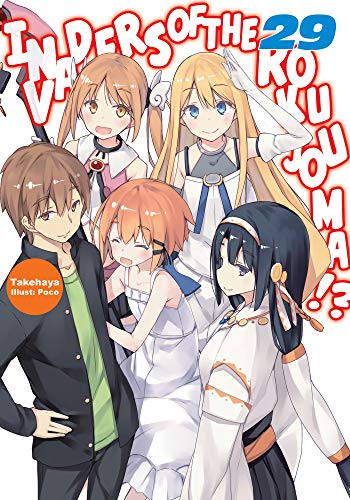
Invaders of the Rokujouma!?, Vol. 27

December 29, 2019 by Sean Gaffney

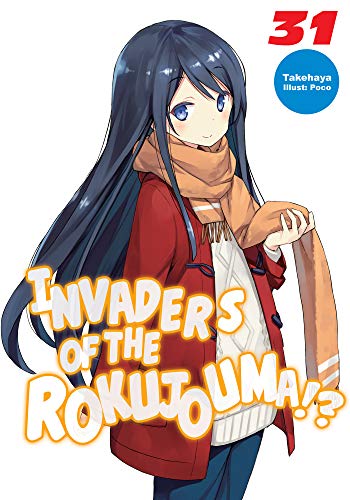
By Takehaya and Poco. Released in Japan as “Rokujouma no Shinryakusha!?” by HJ Bunko. Released in North America digitally by J-Novel Club. Translated by Warnis.

Another “short-story” volume of Rokujouma, although honestly it’s more three short stories and a half-novel, as the story written especially for the book is a continuation of the previous book and not really skippable. The three short stories are all essentially character pieces. The first focuses on Nana, who has been slowly drawn into the secondary orbit of the main cast, although she’s not in the Koutarou sweepstakes. It involves making changes to her mostly cyborg body to have her look more of her actual age… as well as various other members of the cast envying how Koutarou interacts with each of them. The slightest of the three stories has Shizuka and her “dragon” uncle going to a hot springs. The third involves an eating contest that all the cast enters, but it’s mostly about Sanae and Theia, along with making Yurika the butt monkey again, because, well, we’re back on Earth. All three stories are the same as we’ve seen in previous volumes – nice character pieces, but slight.

The final story is more significant, and starts with an obvious problem: Koutarou being on Forthorthe is ruining the economy, as anywhere he goes is automatically where everyone else wants to go, and everything he buys, everyone else does… meaning all the competitors are being ruined. This is a tad ridiculous, but serves to give him an excuse to quietly go back home with everyone except the main Forthorthe cast. That said, they’ve been away from Earth a LONG time. Various people on the magical girl side have been pretending to be them in class, but that’s not helping their actual studies, so they have to take a test to prove that they’re up to date… and failure means repeating a year. You can imagine who panics most about this, but Sanae and Koutarou are also not great students.

Now, I will partly hand it to Yurika, despite whining and moaning the entire time, she really did seem to earnestly study. That said, I do like how this book shows that all the studying effort in the world can’t help you when you start from so far behind. I also liked how Maki kept Yurika motivated – yes, Koutarou would still let her stay there if she had to repeat a year, but he’s be so disappointed… as you can imagine, the thought horrifies Yurika. The other main plot here involves the cast being followed around by various guys in suits and sunglasses who look straight out of Urusei Yatsura. This was amusing, but feels more like a setup for next book, where I expect Forthorthe is going to have to go public. In fact, the author said there’s a lot of setup for the next book in this story.

So overall not bad, and sets us up nicely for the next two books, which are the final ones in the “main” storyline, though the series continues after that. Rokujouma fans should be happy.

Filed Under: invaders of the rokujouma!?, REVIEWS

Baccano!: 2002 [Side A]: Bullet Garden

December 29, 2019 by Sean Gaffney

By Ryohgo Narita and Katsumi Enami. Released in Japan by Dengeki Bunko. Released in North America by Yen On. Translated by Taylor Engel.

The first volume of this two-parter reminds me very much of the fist volume of the last two-parter we had, The Slash. It’s very short, almost all setup, and seems to be saving all its tricks for the back half. It also features a new character I don’t care for, and once again brings up Firo’s paralyzing fear of sexuality, which is not a plotline I like either. Adding this all together makes it one of the more “average” volumes in the series, and it feels sort of like the first volume in a DRRR!! arc as well – you’re reading along waiting for fun, only to be told the fun is four months from now. Fortunately, there is a BIT of fun to be had here – Claudia and Charon *are* new characters I like, being genderswapped carbon copies of their great-grandparents, Czes gets a lot to do an an ominous foreboding about what’s going to happen, and Illness is a treat, though her terrifying backstory reminds me of Huey and Elmer – deliberately, of course.

Firo and Ennis, we are told, married somewhere around 1980, fifty years after they first met, but have never had a honeymoon – or indeed consummated their relationship. On finding out about this, the Camorra bosses pay for him and Ennis to travel on an ocean liner’s maiden voyage – and, Firo still being extremely wary of what comes with a honeymoon, he invites Czes to come as well, much to Czes’s frustration. The cruise also features Claudia and Charon, great-grandkids to Claire and Chane (who, while not immortal, are both still alive and active in their nineties), who are in the film industry; Angelo, a sniper who is out for revenge on the terrorists who wiped out his South American gang; said terrorists, the Mask Makers, whose name seems awfully familiar to Firo and who have a love of modern cinema; and Bobby Splot and his gang, who stow away on the boat to get revenge on people because… well, because Bobby is terrible. He’s a disgrace to his great-grandfather Jacuzzi.

I am aware that Bobby will likely improve in the next book, but, like Maria in the first Slash volume, I have to rate him based on this book alone, and boy, he grates. To be fair, this is deliberate, as the book wants to have him NOT be his great-grandfather, in contrast to Claudia, but still. The plotline going on here seems complex, and you get the sense that we’ve barely seen the start of it. Someone seems to want to recreate the 1931 train incident, only without Isaac and Miria (who briefly appear, but are not on the boat). The Mask Makers are clearly a reference to the same group we saw in the 1705 novel, which makes you wonder what they’re doing here almost 300 years later. And, to make things even more interesting, the terrorists’ plan involves meeting up with the SISTER ship of this huge luxury liner, which is going in the other direction and scheduled to pass them.

We briefly hear what’s happening on the other liner, and honestly it sounds a lot more interesting than events here. As such, I suspect that the 2nd and final book in this 2002 arc will be far more exciting and interesting. Till then, enjoy Claudia, Charon and Illness, who are a lot of fun.

Filed Under: baccano!, REVIEWS

The Genius Prince’s Guide to Raising a Nation Out of Debt (Hey, How About Treason?), Vol. 2

December 28, 2019 by Sean Gaffney

By Toru Taba and Falmaro. Released in Japan as “Tensai Ouji no Akaji Kokka Saisei Jutsu ~Sou da, Baikoku Shiyou~” by GA Bunko. Released in North America by Yen On. Translated by Jessica Lange.

I had a lot of fun with the first volume of this series, and am pleased to report that I liked the second volume even better. For one, it’s a relief to be living in a world of political intrigue and mind games, one where our protagonists actually are people born in that world and have not been transported from modern day Japan. There is no adventurer’s guild… or indeed adventurers at all, nor do we appear to have any magic. It’s just a series with a clever young prince and his clever aide doing battle (at least in this novel) with an equally clever princess from the strife-torn Empire, still dealing with the death of its Emperor that we heard about in the last book. It feels a little bit like an episode of Blackadder if everyone were as clever as he was. There’s even a minimum of light novel cliches – the readers get a scene of the main female cast in a hot springs, but Wein is absent doing paperwork – no accidental peeping here. These are adults.

As noted, the main thrust of this volume is that Wein’s kingdom is visited by the 2nd Princess of the Empire, Lowellmina, who rumor has it is looking for a political marriage. As it turns out, she’s someone both Wein and Ninym have met before, though they were unaware that she was a princess. Wein correctly guesses she has another plan behind the public one, but has trouble figuring out the REAL plan she has behind the second one. She, meanwhile, is also trying to see what he does and how he reacts, relying on his being exceptionally clever to keep the ball rolling along. In among this we have the usual political crises. The Empire is trying to figure out which of the three sons of the Emperor should be in charge. Two territories in Wein’s kingdom who have always been at each other’s throats are coming to a boiling point. And a lovestruck, foolish son of an aristocrat from a neighboring nation may cause everything to fall apart for both Wein AND Lowellmina.

I mentioned in my last review that the best part of the book was the relationship between Wein and Ninym, and that remains the case. At the moment, it’s impossible for anything to happen between them, mostly as Wein is a noble Prince and Ninym is a non-noble from a race that many countries are severely prejudiced against. I suspect that will change before the series ends, because let’s face it, Wein and Ninym have been “married” for years now, in terms of closeness and knowing each other’s hearts. Lowellmina is also a great character, not as overdramatic as Wein can be when things go wrong (there’s some amusing faces in the illustrations) but still cut from the same cloth. There’s also some fun scenes showing Wein and Ninym at the Empire’s military academy from two years prior (which is where they met the in-disguise princess), and I’d love to see more from that period as well.

Certainly I’d recommend this for fans of series like Realist Hero and other kingdom-building books, but also for those who enjoy a light novel series without having to make excuses for half of the events that take place in them. Glorious fun.

Filed Under: genius prince's guide to raising a nation out of debt, REVIEWS

A Witch’s Printing Office, Vol. 1

December 27, 2019 by Sean Gaffney

By Mochinchi and Yasuhiro Miyama. Released in Japan as “Mahoutsukai no Insatsujo” by Kadokawa Shoten, serialization ongoing in the magazine Dengeki G’s. Released in North America by Yen Press. Translated by Amber Tamosaitis.

It’s become something of a running gag that “isekai” is the way to sell your title to a publisher, no matter what the series is. “I’ve got this idea about two philosophy students meeting in a coffee shop to discuss Kokugaku and Rangaku.” “…why would that ever sell?” “You see, the coffee shop is… IN ANOTHER WORLD!” That said, sometimes the isekai prototype does help to make a series more interesting because it’s baked into the plot, especially when the series can avoid the usual pitfalls of having the same thing happen – no guilds, adventurers, etc. Without its isekai plotline, this would just be one of seventy different kinds of “we’re working in an office and also connected with Comiket” titles that come and go with no one remembering them. But, let’s face it: Recreating Comiket in a fantasy world, using magic tomes as the draw… that’s a very clever idea. And from this idea we get the story of Mika, whose desire to get back home led to all this.

The actual circumstances of Mika ending up in another world are mostly glossed over in this first volume – when we come across her, she’s been in this fantasy world for some time. She has one magical skill, Copy, which is what it sounds – she’s a human copier machine. Trying to find a spell that can transport her back home, she’s created her own printing office to help out people who desperately need things copied, such as the magic spell that can drive away monsters, which with Mika’s help can be given to every villager. That said, magic books and spells don’t just walk up to you, even if you are a printing company. And so Mika has decided to help organize Magiket, a massive convention where people buy and sell magical spells. Can she keep the convention from going off the rails? And can she find a spell that will get her back home?

I will admit, “magical Comiket” is just the sort of high-concept idea I like, so I was already on this manga’s side to begin with. Mika might remind many people of Yomiko from Read or Die, at least in appearance, but she’s also a very can do sort of woman who sometimes exhausts herself trying to achieve something and help others. There’s various subplots at the Magiket itself: some people aren’t selling well, at least not until a spell is urgently needed; some folks are trying to sell illegal or illicit spells; and of course there’s the usual problems with lines and keeping everyone moving. I’m not spoiling anything to say that by the end of this book Mika has not found a way to return home, but she has managed to carve out a niche for herself, starting a company with enthusiastic employees and organizing a massive publishing event. Honestly, she’s achieved more in one book than a lot of isekai slackers have in ten.

I don’t expect too many serious or ongoing plots in this series, which when you boil it down is another workplace slice-of-life. But adding the isekai made all the difference for once, and I look forward to seeing what the next Magiket brings us.

Filed Under: a witch's printing office, REVIEWS

Banner of the Stars: The Ties That Bind

December 26, 2019 by Sean Gaffney

By Hiroyuki Morioka and Toshihiro Ono. Released in Japan by Hayakawa Bunko. Released in North America by J-Novel Club. Translated by Giuseppe di Martino.

These are novels rather than light novels, so you don’t get cute interstitial artwork. This may be why we get this cover, with Lafier trying to look cool and captainlike while a cat is climbing on top of her. The cat is Jint’s (it’s Jint now. Don’t ask. Or rather, ask Hayakawa Publishing.), and spends much of the book wandering around places where it shouldn’t be and basically being a cat. That said, after the massive firefight that dominates the second half of the book, it’s probably for the best that the cat ends up being given a permanent home on planet. The cat also provides a different source of humor from the usual in this book, which is banter. Everyone in Banter… erm, Banner of the Stars is in a two-person team of back and forth dialogue as if they’re Nick and Nora Charles – indeed, Jint and Lafier are not nearly as caustic about it as many of the others, perhaps showing the feelings they have for each other. It’s almost Moonlighting in space.

This book takes place three years after the events of Crest of the Stars, with Jint now reunited with Lafier as her Clerk and right-hand man on her brand new ship. She’s just one of many ships that are setting out to fight the enemy, though, and we get a large amount of time devoted to space combat, things blowing up, and last-minute escapes. We meet Lafier’s crew, with Number Two Sobash, stoic Ecryua (stoic may be the wrong term given her love on Jint’s cat) and lovable drunk Samson. There’s also her Assault Unit Commander, who happens to be the sister of the guy that Lafier killed in Crest of the Stars. Sporr is still hanging around and being fabulous. And we also see Neleth and Nefeh, two twin brothers (unusual among the Abh) with a propensity towards being exceptionally weird. Everyone talks back and forth at each other like it’s His Girl Friday. Oh yes, and there’s the planet they’re fighting to conquer, which irritatingly hasn’t surrendered yet.

As I said, Jint and Lafier are also part of this, and we do get some choice banter (the thing about Lafier thinking her mother was a cat is brought up by Jint multiple times, to her displeasure). At the same time, there is a certain fatalistic quality to Jint that the reader, and Lafier, may find disturbing. Atosryua invites Lafier and Jint to a dinner to commemorate the life of her brother… the one Lafier killed… but it’s all very polite and no hard feelings. Afterwards, Jint remarks how he doesn’t have anyone who would miss him after he died anyway, and the look that Lafier gives him burns through the page and onto your fingers. She makes it more explicit later that she would miss him, dammit, but it’s fairly clear that if there is any romance going on between the two, she will need to break through a bit of his self-debasement first.

The author notes that each book in this series will be self-contained, which is probably a good thing given the first came out in 1996 and the 6th in 2018. As with Crest of the Stars, it will bury you in vocabulary, and some of the eccentricities of the characters feel like the author is being cute rather than letting it develop naturally. Still, this is a good solid start to the “second season” of Jint and Lafier.

Filed Under: banner of the stars, crest of the stars, REVIEWS

Konosuba: An Explosion on This Wonderful World!: Megumin’s Turn

December 25, 2019 by Sean Gaffney

By Natsume Akatsuki and Kurone Mishima. Released in Japan as “Kono Subarashii Sekai ni Bakuen wo!” by Kadokawa Sneaker Bunko. Released in North America by Yen On. Translated by Kevin Steinbach.

If you were going to suggest an obvious choice for a side-story spinoff in the Konosuba universe, Megumin immediately comes to mind. She’s the most popular of the cast, and her backstory could use some fleshing out beyond what we got in the 5th novel. Indeed, in Japan, this volume came out before the 5th novel, and the first thing I wanted to do after it was released was to reread that book to see if more of it made sense. It also allows us to get a sense of Megumin’s headspace – through most of this, she’s the narrative voice, and we can see her eccentricities filtered through a coating of relatively sedate and logical thought. Well, logical for the Crimson Magic Clan, of course, whose one truly eccentric member is Yunyun, she who gets embarrassed by the whole thing. If you wanted a book filled with Megumin and Yunyun being funny, good news, this volume delivers, while also fleshing out the overall story.

The book takes place two years before the main series starts, and shows us Megumin and Yunyun in magic school, learning the finer points of saying cool lines and practicing your awesome poses. Both have almost earned enough points to learn Advanced Magic – indeed, Megumin secretly already has the points to do it, but is saving up even more to get enough to learn Explosion, the spell that she’s been obsessed with since she was a little girl. Everyday life for Megumin consists of conning Yunyun out of her lunch every day, looking after her younger sister Komekko, and generally getting into trouble, particularly after picking up an odd cat, nicknamed “Ink” by Yunyun, who Komekko wants to eat but most everyone else wants to snuggle. Unfortunately, more and more monsters are coming to their village, and seem to be after Komekko! Will Megumin be forced to abandon her dream of Explosion to save her sister?

The main reason to get this solid first volume is the relationship between Megumin and Yunyun. Megumin tends to worry about Yunyun as the sort who would get suckered by the first person who called her friend, and she’s not wrong, as we later see two other classmates seemingly conning Yunyun out of money so they can help a sick younger brother, something Megumin regards with more than a little scorn. Despite Megumin’s constant bullying, it’s clear that the two are close – indeed, at least one girl thinks they’re lovers, and when Yunyun is dragged off by her other friends, accuses Megumin of being cuckolded. Despite that, there’s no yuri subtext here, but it is heartwarming to see Megumin look after Yunyun even while she makes her life miserable. The weakest part of the book involved the irritating NEET Bukkororii and his stalker crush on the girl he likes. Megumin and Yunyun think he’s a massive creep, yes, but so does the reader.

Aside from humorous foreshadowing, the other main cast is absent from this book, which is fine. It’s Megumin’s Turn, as the subtitle suggests. The next volume is supposedly Yunyun’s Turn, but I’m not all that optimistic about her achieving much – she’s funnier when suffering. In the meantime, Konosuba fans will definitely enjoy this.

Filed Under: konosuba, REVIEWS

A Certain Magical Index, Vol. 21

December 24, 2019 by Sean Gaffney

By Kazumi Kamachi and Kiyotaka Haimura. Released in Japan as “To Aru Majutsu no Index” by Dengeki Bunko. Released in North America by Yen On. Translated by Andrew Prowse.

As with the previous volume, and likely the next one, this is a giant action movie brought to the page. As such, there’s not quite as much development of Index’s main themes, though once again if you are religious you should drop this work like a hot potato if you haven’t already done so. That said, the ex-Pope showing up here and being the baddest ass who ever badassed just by kindly talking to everyone shows that it’s not just a binary “everyone with the Church is evil” thing. This also applies, oddly enough, to Accelerator, who seems to finally be getting over his “I am a horrible villain who must be punished” mentality now that he’s had his battle with Misaka Worst. In fact, he and Worst team up here, because a) he needs help in saving Last Order, and b) she finds the idea of his asking her for help hilarious. She too is an example of a bad guy who changes sides. And then there’s Touma, our theoretical hero, who just wants to punch Fiamma. A whole lot.

Kamachi said in the afterword that this was meant to be (along with 22) one book, which is likely why Mugino is menacing Hamazura on he cover despite the fact that she literally only shows up to be the cliffhanger. Also, given this is the second to last book in the first “series” of Index, there’s no major new character introduced here, though we do get a reappearance from a few older characters I wasn’t expecting – indeed, you could argue that without Kazakiri showing up, Accelerator and Touma would both be very dead right now. The plot is divided basically as follows: 1) Touma trying to catch up to Fiamma, starting with Lesser, then losing her but gaining Sasha, who fills a similar function; 2) Hamazura looking out for the forgotten and ignored, as always, while (finally) succeeding in helping Takitsubo; 3) Accelerator trying to help Last Order (this is less easy than helping Takitsubo); 4) Misaka arriving in Russia but mostly standing around, thus summing up her position in the novels since Book 3; and 5) Stiyl trying not to get killed by a still-possessed Index.

The action scenes are nice and solid here, and while I still find a lot of the magic discussion a bit boring, it at least doesn’t last as long this time. Everyone knows their function. Fiamma’s is to be smug, and he succeeds admirably, and you really do want Touma to punch him in the face, even though Touma does not achieve this (or really anything) in this book. Arguably that also applies to Accelerator, who is nudging closer to knowing how to save Last Order (magic) but can’t get to the next step. Again, only Hamazura succeeds while looking at the small picture… which also allows him to succeed when he ends up in the larger picture as well, pointing out to a dying Acqua of the Back that the REAL heroes are those who get up and return home to loved ones rather than those who accept death. It’s a really good scene, and you can easily see why he’s been added as a third protagonist, especially give that you get the sense Kamachi doesn’t know what to do with Touma at this point.

The next volume is important, as it will not only wrap up World War III, but may be the final volume of Index in North America. It’s unclear if New Testament is considered a new license or a continuing one, but in any case Yen On has not made it clear if they’re doing it. (That said, the back cover copy for 22 does not say ‘Final Volume’, so that’s a good sign.) Till then, enjoy an action-packed volume, and sorry, Mugino fans, I’m sure she’ll be in 22 more.

Filed Under: a certain magical index, REVIEWS

The Devil Is a Part-Timer!, Vol. 15

December 23, 2019 by Sean Gaffney

By Satoshi Wagahara and 029. Released in Japan by Dengeki Bunko. Released in North America by Yen Press. Translated by Kevin Gifford.

We’re back to the main storyline, but the devil is almost entirely absent from this book, not showing up till the end. Instead we get some of the other characters getting a section of plot, including Chiho (who is still dealing with “Maou hasn’t answered my confession and I know the moment Emilia realizes she loves him I lose”, while Emeralda is trying to drag out her time in Japan as long as possible, both because she likes it there more and also to make sure that Emilia is really doing OK. And, of course, there’s the choice that Emi and Maou have to make – help Laila and save Enta Isla, or stay in Japan and keep seeking their own future? Perhaps most importantly, it’s Christmastime, which ties in with Chiho’s woes – Maou’s working the entire holiday. All of these subplots end up coming together when we center on what to get Alas Ramus for a Christmas Present… a decision that ends up shaking up everyone and everything.

It’s fairly rare to have a Christmas-themed light novel come out in North America close to Christmas – owing to when a book is licensed here, we get far more “Christmas in July” series. It handles the Christmas plot well, and the concept of what Alas Ramus really wants for Christmas is a strong story beat. I also really like everyone thinking about their future going forward in Japan – Maou is absent from most of the book as he’s doing training to become a full-time McRonald’s employee (given the title of the series, I suspect this won’t go well), and both Emi and Chiho are studying to get into university. We see most of this from the POV of Emeralda, who is quite happy to see it as she’s been against Emilia sacrificing her life for some time now, and would be delighted if she actually did things for herself, be this a new career or romance.

That said, there are a few big flaws with this book. This series has never shied away from long expodumps, and I’ve criticized it before. Well, I’m going to do it again, as so much of this volume was characters sitting around listening to Angels and Demons explaining the backstory. I get the sense that the author wanted to put this into a side-story or a spinoff, but was told no, so instead we get to see it secondhand from other people. Sadly, that just makes things boring. The other issue I had was a “one fakeout too many” problem. The book begins with Chiho and Rika arriving at a deserted apartment complex, with Chiho telling Rika everyone connected to Enta Isla has now left. Then we get the book proper. When we return, we get the setup for what feels like another “sorry, humans, you have to stay behind” bit… only for Chiho to pitch an absolute fit, use a magical portal device, grab Rika, and leap into Enta Isla. I loved this. The problem I had was later, when Chiho’s rage, which I loved so much, was handwaved away as being Rika misreading the situation and Chiho being tired. I get they don’t want her to confront Maou yet, but I’d rather she’d have been angry.

Still, provided you don’t mind having the plot spoonfed to you, this is a reasonable solid volume of the series, and I liked one big revelation at the end, which made me think of the Doctor Who story State of Decay. Expect things to stay on the Enta Isla side for the next book.

Filed Under: devil is a part-timer!, REVIEWS

Accel World: The Rivalry of White and Black

December 22, 2019 by Sean Gaffney

By Reki Kawahara and Hima. Released in Japan by Dengeki Bunko. Released in North America by Yen On. Translated by Jocelyne Allen.

Last time I said that this volume would likely finally get to the fight with the White Legion, and that is technically true, but it takes almost 4/5 of the book for us to get to that point. If Sword Art Online’s biggest fault is that it doesn’t flesh out its world or characters enough, and that the pace is too breakneck, Accel World has the opposite problem: the worldbuilding is excellent, but at the expense of the pace, which leads to readers wanting to skin through things to finally get to the fights. There is a minor battle here between Silver Crow and a bottle of Isodine – sorry, Povidone-iodine, but even that feels rather shallow as Iodine Sterilizer feels like an expy of Ash Roller. It is, frankly, a relief that a big villain finally appears to take on our heroes towards the end – and indeed, he’s the biggest villain we’ve seen, towering over the landscape, and might be a little more terrifying if he wasn’t depicted in the illustrations as looking like a giant Snow Bunny.

(The fanservice covers we’ve seen lately are also starting to irritate me – the illustrator’s always had that issue, I know, but this one in particular promises an attention to little girls that the text thankfully does not have.)

The first chunk of the book deals with Nega Nebulus and Prominence uniting to form a single legion, as promised. There is a bit of grumbling on the red side, both from folks who are a bit annoyed given that Black Lotus is the one who killed their former leader and also by the aforementioned iodine bottle, who just really wants to fight Silver Crow. On the Nega Nebulus side we have Cyan Pile and Magenta Scissor, both of whom are feeling guilt over the part they’ve played in past events and are looking for a chance to repent. After this, we get a relatively fluffy chapter which has the twins we met a while back from the Blue legion discovering what they think is a spy… only for it to turn out to be Trilead Trioxide, who is meeting secretly with Crow and Lotus. Some good character work here, and also more “TRILEAD IS THE IMPERIAL PRINCE OF JAPAN!” without actually saying this out loud.

The best part of the book is the final section, which once again gives the chocolate trio some heavy lifting to do as they find themselves first on the scene of battle, and therefore being forced to face off against a foe much bigger than they can really handle – but they try their best. I also liked that by now everyone knows that Haruyuki’s big flaw is that he frets too much, and that he does so much better when he forgets how difficult this is supposed to be and just plunges right in. And I admit I laughed out loud at Magenta Scissor asking if Bel and Pile were going out, which is followed by Bell asking “huh, are we?”. What was one of the bigger plot points in early books has fallen so much by the wayside that half the main couple doesn’t even seem to care anymore, and it almost feels like Kawahara mocking himself (while, of course, keeping Chiyuri free to be part of the potential harem pile).

So things have inched forward to the point where we’re actually fighting, and there is yet another cliffhanger promising things will get worse for our heroes. Still, I admit that after reading most of Accel World 20 my overall feel was “GET ON WITH IT!”.

Filed Under: accel world, REVIEWS

Bloom Into You: Regarding Saeki Sayaka, Vol. 1

December 21, 2019 by Sean Gaffney

By Hitomi Iruma and Nakatani Nio. Released in Japan as “Yagate Kimi ni Naru: Saeki Sayaka ni Tsuite” by Dengeki Bunko. Released in North America by Seven Seas. Translated by Jan Cash and Vincent Castaneda. Adapted by Jenny McKeon.

Bloom Into You is one of the bigger runaway yuri hits of the past few years, so the fact that it’s getting a series of light novel side-stories, particularly given it’s by the prolific Hitomi Iruma, author of Adachi and Shimamura (also coming soon from Seven Seas) should not really surprise me. But I admit I am surprised. Every time there’s a shift in the marketplace I always seem to be blown away. All the old chestnuts: “yuri won’t sell”, “light novels won’t sell”, “tie-in novels never get licensed” – all these are long since dead. Seriously, appreciate the market we live in now. You should especially appreciate it because it gives us this, the first in a projected three-volume series of novels about Sayaka, Touko’s best friend and winner of the “I absolutely want to read more about her” poll that I’m sure was taken internally at ASCII Mediaworks. This book serves as a prequel to the manga, showing us Sayaka’s early life – and, more importantly, her inner monologue.

The book is divided into two sections. The first introduces us to Sayaka at 11 years old, busily taking part in endless activities and trying to give off the impression of being a mature, serious person – even to herself. Her swimming lessons are part of this, but are broken up every time by an unnamed girl (I called her Uruka after a while, after the BokuBen girl with similar looks and personality) who wants to be Sayaka’s friend and find out more about her… and also about the heat that she feels within her body whenever she’s around Sayaka. This story was bittersweet and painful, ending with Sayaka literally fleeing the scene but also learning more about herself. The second, longer story takes place when Sayaka is 14 or so, and is about her relationship – touched in the manga – with her sempai (who does have a name, but Sayaka chooses to stick with sempai even when they are dating.) Sayaka does not initiate this affair, but certainly is the most deeply affected by it, something she slowly goes to realize as time passes.

The best reason to get this is Sayaka, who is captured perfectly here, showing off a serious, mature for her age girl who nevertheless still has a great deal of growing up and discovery to do about herself. We see this captured in the stories, as the reader is usually well ahead of her in terms of what’s actually happening in the other character’s heads – Sayaka has trouble figuring out what the other girl is thinking, but we do not. Frequently this an be, as I noted, very painful – seeing swimming girl’s nascent excitement and frustration around Sayaka is very identifiable, and I was upset as it became clear that, as this book is from Sayaka’s POV, we’d never find out what happened to her after the story. As for Yuzuki, Sayaka’s senpai, it’s clear to the reader almost immediate that she’s in love with the idea of a love affair more than anything about Sayaka herself. Still, she’s not a pure villain in this book, and her awkward “oh crap what have I done” moments are also squirm-inducing.

The book closes with Sayaka determined to move on and never fall in love again, a determination that doesn’t even last five minutes into high school as she meets Touko and is shot through the heart. The second book promises to show us Sayaka’s POV of events during the manga proper. Till then, this is essential for Bloom Into You fans, as well as anyone who likes well-told coming of age stories.

Filed Under: bloom into you, REVIEWS

Yona of the Dawn, Vol. 21

December 20, 2019 by Anna N

Yona of the Dawn Volume 21 by Mizuho Kusanagi

This is the last volume of the Sei story arc, and it has plenty of action interspersed with great quiet moments where bonds between the characters are affirmed. Everyone joins together to rescue Riri, leading to some surprising alliances. One of the highlights for me was seeing Hak’s reunion with the Wind Tribe, especially his adoptive grandfather Mundok. As Zeno and Jaeha search for Yona and find her cornered in the woods by enemy soldiers, Zeno comes to the rescue by literally dropping out of the sky to defend her. Su-Won is also inspecting the area and getting a full picture of the atrocities being committed. Riri shows her strength of character by being defiant even as the evil Lord Kushibi orders her execution. The attack begins as Su-Won’s group and Yona’s companions both stage parallel rescue missions, and the old bond between Su-Won and Hak is reactivated as they are able to wordlessly communicate across the battlefield in support of a single objective.

Kusanagi’s skills with drawing action are particularly showcased in this volume, as the dynamic paneling for the action scenes ramps up the tension of the battle, with pauses that highlight the emotional stakes for everything that Yona and her friends are fighting for. I also appreciated all the battlefield banter between enemies as Hak and Guen-Tae get snarky with each other. As Kushibi realizes the full extent of his hubris, a shadow is cast over his face that mirrors the dark tones used in portraying the body count of the fight. As everyone recovers from the battle, Zeno has a hilariously off-kilter encounter with Su-Won, and Yona and Hak have a random encounter in the middle of the night that is equal parts hilarious and touching. As always, this was an extremely satisfying volume of Yona of the Dawn. It sets such a high standard, it almost seems impossible for it to keep getting better with each volume, but it does.

Filed Under: Manga Reviews, REVIEWS Tagged With: shojo beat, shoujo, viz media, yona of the dawn

Konosuba: God’s Blessing on This Wonderful World!: Gamble Scramble

December 19, 2019 by Sean Gaffney

By Natsume Akatsuki and Kurone Mishima. Released in Japan as “Kono Subarashii Sekai ni Shukufuku o!” by Kadokawa Sneaker Bunko. Released in North America by Yen On. Translated by Kevin Steinbach.

As expected, the relationship upgrade between Kazuma and Megumin we saw in the last book takes a step back here, with one or two exceptions – indeed, it’s a very ensemble cast-led work this time around. Continuing where the last book left off, Kazuma and company are asked to escort Princess Iris to another country, where she is supposed to meet her fiance, and also ask why they’re cutting off the money that they given them to help exterminate the demon lord. The country they go to is a gambling casino-style country, which is good news for everyone but Aqua, but they’re also cutting off funding because… they’ve made a deal with the demon lord? Can Kazuma help his “little sister” get the money her country needs and also avoid getting arrested? And what about the engagement?

There’s an excellent conceit behind the main plot, as it’s pointed out that Kazuma and company have already defeated so many of the Demon Lord’s generals that the rest of his forces are starting to panic. While it has its individual moments of failure and humiliation, KonoSuba has always made sure that our heroes win out in the end, and we’re seeing the fruits of that. That said, it also makes the enemy more desperate, as we see here with the nation of Elroad seemingly deciding to throw in with the Demon Lord to avoid getting wipes out in the war that is no doubt imminent. The other major plus in this book is seeing Princess Iris in action. While her personality is seemingly that of the typical “oniichan-worshipping younger sister”, Kazuma being the oniichan in question, she’s also from a long line of heroes, and has “borrowed” a legendary sword. As such, expect the action scenes in this book to be minimal – Iris is just THAT good.

As for the regulars, Aqua is back to her normal self after her high point of the previous book. Darkness gets a lot to do, and has a few good “masochism” moments, but continues to be hamstrung by the Dustiness side of her character requiring her to be the “straight woman” of the group. Megumin is, like Kazuma, taking their recent understanding in stride, with it only coming up when it needs to, but otherwise continues to show the growth and maturity (yes, really) that we’ve seen recently. Again I like the fact that, with one or two brief exceptions, Kazuma is really only into two women in the cast – Megumin (compatibility-wise) and Darkness (physically). We again get a few scenes showing he’s just not attracted to Aqua, despite her somewhat frustrated denial of this, and he really does seem to see Iris as a younger sister figure, to the point where he does not really get the fact that giving her a cheap plastic ring he bought in the country might be seen by her as something more than just a “a toy for my little sister”.

This is another solid volume in the series, with a few good laughs and fun times all round. It also helps advertise the side novels again – apparently Iris becoming Megumin’s “minion” and taking instruction from her comes from one of the Explosion books. Still, that series begins here soon as well, so hopefully we’ll see it one day.

Filed Under: konosuba, REVIEWS

Legend of the Galactic Heroes: Sunset

December 17, 2019 by Sean Gaffney

By Yoshiki Tanaka. Released in Japan as “Ginga Eiyū Densetsu” by Tokuma Shoten. Released in North America by Haikasoru. Translated by Matt Treyvaud.

And so the Legend of the Galactic Heroes comes to a close. (There are five volumes of short story collections also out in Japan, but they don’t seem essential to the narrative.) The story ends because the two sides finally come together and try to negotiate a compromise between Empire and Federation – Parliamentary Democracy, which is presented as the best of both worlds, mostly. But you could also argue that the series is ending as the author is running out of characters to kill off. This is a doom-laden book, with a bunch of the main cast given their final moments. Some go out fighting, like von Schönkopf and Merkatz, nobly in battle. Some die like villains, taking out swathes of others as they succumb to a brain tumor (Rubinsky). Some appear to die almost because the author forgot to kill them off and they were running out of pages, like von Oberstein. Hell, even von Oberstein’s DOG, the one thing that made him vaguely human, is dying. And then there is Reinhard.

I’m not really spoiling anything by talking about these deaths, as the book is still written like a history textbook from the future, so frequently talks about “this was the last time he would visit this planet”, etc. That said, you’d have to be reading the series with very narrow vision not to realize that Reinhard wasn’t going to make it to the end of it. Honestly, he hasn’t been the same since the death of Yang Wen-Li, and he knows it. What’s more, it may be his fatal flaw that finally kills him off. No, not the disease that he’s had for ages that finally gets a name but might as well be “Love Story disease”. Instead it’s his leaping off to battle against Julian’s forces one last time, despite knowing that he’s running a fever and choosing to hide it from everyone. The end of the war means peace, which means no more battles, which means that Reinhard is pretty much going to be out of his depth – something he admits at his deathbed, as he notes Hilda will be a much better leader as she’s the politician.

There are several cool space battles, including one where Julian and company essentially storm Reinhard’s ship as if it were a boat to try to get to him and negotiate, and another where we see Annerose, Reinhard’s sister, protect Hilda from terrorists (don’t worry, she doesn’t die). But for the most part the best moments are the speeches and dialogues, as with most of this series. A lot of the book discusses von Oberstein, whose methods continue to sacrifice the few to save the many, but in the worst, least honorable way possible, to the point where other Admirals try to punch him. He’s an unpleasant person but a great character, and I wish his death had more impact – perhaps the anime improves on this. Oh yes, and Julian and Katerose hook up, though her lack of presence in the final big scenes reminds me that LOGH tries to give us some good female representation but struggles at it.

I’m very happy that we were able to get the entire series out here in North America. It’s a classic, though admittedly more known here for the epic 80s anime, and worth reading to see how authors who aren’t Leiji Matsumoto handle a Wagnerian space opera sort of story, albeit one with a dry historical filter. A noble finale.

Filed Under: legend of the galactic heroes, REVIEWS

Our Dreams at Dusk: Shimanami Tasogare, Vol. 4

December 16, 2019 by Sean Gaffney

By Yuhki Kamatani. Released in Japan by Shogakukan, serialized in the magazine Hibana. Released in North America by Seven Seas. Translated by Jocelyne Allen. Adapted by Ysabet MacFarlane.

After three volumes that are brilliantly written but also somewhat fraught and filled with frustration, it was wonderful to see how this final volume of Our Dreams at Dusk has so much acceptance in it. It’s in Tchaiko’s present, when he finds that the distance he’s been deliberately keeping between himself and his dying partner’s family doesn’t have to be that way. It’s in the past, where we get Someone-san’s feelings of wanting to be alone and “unlabeled”. And of course it’s in Daichi and Saki’s wedding, as Saki is accidentally outed to her parents and they both have to deal with the fallout… which is not as bad as initially feared. In the end even Misora is able to make peace with Tasuku after getting an apology, and then an apology for apologizing (which I really liked), and shows up at the wedding dressed to the nines. And, of course, there’s still the amazing artwork as well. It’s a conclusion that should satisfy almost everyone.

Tchaiko gets the majority of the focus in this volume. We learn about his partner, who’s dying an in a hospital, and see some of their life together, which looks wonderfully happy. Despite that, Tchaiko goes to visit him only when his family isn’t there, as he doesn’t want to insert himself into their lives – Seichiro has a son from a previous marriage (he had broken up with Tchaiko at that time) and they’re finally talking to each other again, so Tchaiko doesn’t want to get in the middle of that. But that’s not what Seichiro wants, and (as it turns out) not what his son wants either. Through Tchaiko, we also get a better handle on Someone-san, who (appropriately, as it turns out) has been around the periphery of this manga but never seemed to be a main cast member. In a flashback, she admits to Tchaiko and Seichiro that she’s asexual, but doesn’t want to be explaining that every minute of every day, which leads Seichiro to suggest she “wants to be no one, someone from who-knows-where”. It’s a great moment.

Speaking of Someone-san, I would be remiss if I didn’t talk about how far Tsubaki has come over the course of this manga. From being the remote object of Tasuku’s attraction to a somewhat uncomfortable participant in Cat Clutter’s world, he’s also the one able to point out crucial insights, such as when Someone-san makes cafe au lait for the group, and they’re all startled to see her getting involved. Tsubaki points out that she’s still a human being, a label that is both correct and as broad as possible. This leads to Tasuku inviting her to Daichi and Saki’s wedding despite knowing she won’t be there, and saying that her being someone is enough for him – and so is the distance, which doesn’t have to be less OR more. As for Tsubaki, at the end of the book he feels far more comfortable being Tasuku’s friend, and Tasuku’s acceptance by others and acceptance of himself has led him to grow enormously as well.

The book ends with a death and a wedding (and I didn’t even get into the reaction of Saki’s dad, which once again plays into “I know intellectually what my reaction should be, but it’s much harder when it’s my daughter we’re talking about”, but is really heartwarming), and it feels an appropriate place for the story to stop. It was an incredible journey, and this may be my choice for the manga title of 2019. Everyone who loves manga should be reading it.

Filed Under: our dreams at dusk, REVIEWS

  • « Go to Previous Page
  • Page 1
  • Interim pages omitted …
  • Page 127
  • Page 128
  • Page 129
  • Page 130
  • Page 131
  • Interim pages omitted …
  • Page 342
  • Go to Next Page »
 | Log in
Copyright © 2010 Manga Bookshelf | Powered by WordPress & the Genesis Framework