• Skip to primary navigation
  • Skip to main content
  • Skip to primary sidebar
  • Home
  • About Us
    • Privacy Policy
    • Comment Policy
    • Disclosures & Disclaimers
  • Resources
    • Links, Essays & Articles
    • Fandomology!
    • CLAMP Directory
    • BlogRoll
  • Features & Columns
    • 3 Things Thursday
    • Adventures in the Key of Shoujo
    • Bit & Blips (game reviews)
    • BL BOOKRACK
    • Bookshelf Briefs
    • Bringing the Drama
    • Comic Conversion
    • Fanservice Friday
    • Going Digital
    • It Came From the Sinosphere
    • License This!
    • Magazine no Mori
    • My Week in Manga
    • OFF THE SHELF
    • Not By Manga Alone
    • PICK OF THE WEEK
    • Subtitles & Sensibility
    • Weekly Shonen Jump Recaps
  • Manga Moveable Feast
    • MMF Full Archive
    • Yun Kouga
    • CLAMP
    • Shojo Beat
    • Osamu Tezuka
    • Sailor Moon
    • Fruits Basket
    • Takehiko Inoue
    • Wild Adapter
    • One Piece
    • After School Nightmare
    • Karakuri Odette
    • Paradise Kiss
    • The Color Trilogy
    • To Terra…
    • Sexy Voice & Robo
  • Browse by Author
    • Sean Gaffney
    • Anna Neatrour
    • Michelle Smith
    • Katherine Dacey
    • MJ
    • Brigid Alverson
    • Travis Anderson
    • Phillip Anthony
    • Derek Bown
    • Jaci Dahlvang
    • Angela Eastman
    • Erica Friedman
    • Sara K.
    • Megan Purdy
    • Emily Snodgrass
    • Nancy Thistlethwaite
    • Eva Volin
    • David Welsh
  • MB Blogs
    • A Case Suitable For Treatment
    • Experiments in Manga
    • MangaBlog
    • The Manga Critic
    • Manga Report
    • Soliloquy in Blue
    • Manga Curmudgeon (archive)

Manga Bookshelf

Discussion, Resources, Roundtables, & Reviews

Features & Reviews

Bookshelf Briefs 12/31/18

December 31, 2018 by Ash Brown, Sean Gaffney and Michelle Smith Leave a Comment

After Hours, Vol. 3 | By Yuhta Nishio | VIZ Media – Well, After Hours is over already. Ultimately, it just doesn’t feel like three volumes was enough. I suppose if you look at this more as the story of Emi finding something to be passionate about, then it was the right length, but in terms of really understanding the two leads and their relationship, I don’t feel I ever really got there. I should’ve felt something when Kei mysteriously disappeared, suddenly deciding to be a dutiful daughter and help her parents recover from a business loss, but I didn’t. Possibly because it seemed like one page she was ready to call it off with Emi, and by a couple of pages later, the crisis was averted and they were trembling thinking about their future together. It was an enjoyable series, but sadly not a favorite. – Michelle Smith

Ao-chan Can’t Study!, Vol. 3 | By Ren Kawahara | Kodansha Comics (digital only) – The series continues to toe the line but not actually cross it, which is good as crossing it would make this an entirely different sort of series. So even though our hero is inadvertently slipped an aphrodisiac, and really want to bang our heroine, he is a good boy and tells her to get away from him for the time being. Ao, meanwhile, is still very unclear as to what she wants—and it is genuinely affecting her studies. This means the climax of the book is Kijima thinking that it’s for he best if he stays away from her, even though he’s clearly fallen for her. How is Ao going to balance having a good education with her boiling hormones? We’ll see next book, and I think an anime is coming as well. – Sean Gaffney

CITY, Vol. 4 | By Keiichi Arawi | Vertical Comics – A stronger volume of Nichijou than the previous one. The “main” plot, such as it is, involves Nagumo being locked in a tower and forced to have a massive award ceremony telling her she’s amazing. Since this is clearly not to be trusted, she resolves to escape. Sadly, escape turns out to be… ridiculously easy, so much so that there’s a lot of desperate tsukkomi going on. Meanwhile, Niikura races all over the city trying to retrieve a pendant with an embarrassing photo that has gotten tangled with a cat. Even the stories that aren’t about the trio are pretty good this time around, with my favorite being the school playing a “mock detective” game. CITY is built on weird humor, and this volume gives you that in spades. – Sean Gaffney

Dragon Half, Omnibus 3 | By Ryusuke Mita | Seven Seas – Much to my surprise, the plot does gain more importance as we reach the end of Dragon Half, though it will never quite be as important as sheer dumb humor. And I do mean the dumbest humor—some of these jokes are so amazingly lowbrow you laugh from sheer shock that the author bothered. This is, of course, the point—who wants Dragon Half with subtle intelligent humor? That said, Mink clears her name, defeats the demon lord, does not transform into a hideous monster, and marries her beloved Dick Saucer, whose backstory actually manages to be tragic. There’s even an epilogue showing off the next generation. Dragon Half was a terrific series for fans of old-school manga, and I’m very happy it was licensed. – Sean Gaffney

Giant Killing, Vol. 15 | By Masaya Tsunamoto and Tsujitomo | Kodansha Comics (digital only) – The flashback to ten years ago continues! Tatsumi has emerged as the ace of ETU and his performance in the derby against Tokyo Victory draws a lot of attention. For his part, Tatsumi is (even then) seeing chances others can’t and coordinating his teammates to take advantage of them and never once plays like he’s the star. Once he’s injured and ETU falters, it hurts him to hear angry fans lambasting his teammates. Meanwhile, the president of the club wants to show as many people as possible Tatsumi’s entrancing soccer, which seems like a good thing, but we end the volume with this guy ordering the coach to put a not-fully-recovered Tatsumi in the next game so as not to disappoint the fans. I have a feeling the next volume is going to be hellaciously frustrating. What a great series, though. – Michelle Smith

Missions of Love, Vol. 16 | By Ema Toyama | Kodansha Comics – Kodansha may not cancel series for low sales, but series that aren’t performing do tend to come out veeeeeeery far apart. That seems to be the fate of Missions of Love, which now seems to be down to twice a year. Fortunately, it’s almost done. Everyone has confessed, but that’s hardly the be-all and end-all, even in shoujo manga. Yukina has to meet the parents. Hisame is back to behaving like an absolute ass. And Yukina’s literary career… and her use of her own life as a template for it… is finally coming out into the open. Is this something that can be forgiven? Oh, probably, but I imagine there will be even more drama next time around. Which is good, as overblown drama is why this series exists. – Sean Gaffney

Outdoors | By Yuichi Yokoyama | Breakdown Press – The three nature-themed stories collected in Outdoors were originally published online in 2009, the first and so far only time that Yokoyama created manga for a website. Interestingly, according to the short interview by Ryan Holmberg also included in the volume, Yokoyama doesn’t own a computer and strictly works using traditional media—he’s never even seen the site on which his manga was released. In general Yokoyama’s work tends to be something that I appreciate more than enjoy. While the short manga in Outdoors are visually striking—especially important as they contain no dialogue and almost no story—they also have a sense of cold detachment. In the interview Yokoyama notes that he has no interest in portraying human emotions or drama, so I think the effect is a deliberate one. I can recognize Yokoyama as an accomplished artist, but when experiencing his work I personally miss having that emotional core. – Ash Brown

Sleepy Princess in the Demon Castle, Vol. 4 | By Kagiji Kumanomata | Viz Media – If this series were even one small molecule less silly than it is, Syalis would be a hateful monster. The things she does to the demons in this book absolutely boggle the mind. Fortunately, this is absolutely a silly, silly manga and therefore Syalis’ sociopathic attempts for the perfect sleep are absolutely hilarious. She tries to hibernate, carves up even more ghosts, and gets kidnapped by Hades, which as you can imagine does not go very well for him, because Syalis is a law unto herself. Even when she shows a smidgen of humanity, such as when trying to get chocolates on Valentine’s Day, it’s still funny. I want to see this get even more over the top and sadistic. Fun, fun manga. – Sean Gaffney

Yowamushi Pedal, Vol. 10 | By Wataru Watanabe | Yen Press – If there’s anyone that can make Midosouji somewhat more redeemable, it’s Onoda, and he manages to achieve it here. Day Three may be a little more difficult, though. Not only do we meet a new rival who’s an absolute creep, hitting on Kanzaki and reminding us briefly that women do exist in this manga. (And then she goes away again.) But even more importantly, the third day is not about teamwork and working together, it’s ‘the fastest one wins.’ So Onoda finds himself overwhelmed by a whole new experience. Fortunately, he’s reminded how much he loves this and recovers. Still, this final day looks to be the most mentally exhausting. Will it end in the next omnibus? I doubt it somehow. Great sports manga. – Sean Gaffney

Filed Under: Bookshelf Briefs

Didn’t I Say to Make My Abilities Average in the Next Life?!, Vol. 5

December 31, 2018 by Sean Gaffney

By FUNA and Itsuki Akata. Released in Japan as “Watashi, Nouryoku wa Heikinchi de tte Itta yo ne!” by Earth Star Entertainment. Released in North America by Seven Seas. Translated by Diana Taylor. Adapted by Maggie Cooper.

There is something going on with this series that I absolutely love, that’s gotten stronger with each volume. We see Mile and the rest of the Crimson Vow, who have awesome strength and abilities and are a fantastic party. And throughout the book, we see everyone trying to find ways to use that to further their own agenda. And every time – Every Single Time – they are frustrated and anguished as our heroines shut everyone down and continue doing what they want to do. It’s fantastic, especially since so many of these folks eyeing the Crimson Vow are young guys thinking “ehehehe, cute young girls of marriageable age”. We even get it contrasted with a plotline about an inn being run by three young (very young – more on that later) girls who end up with husbands (mostly). The Crimson Vow, minus Mile, are all able to understand the romantic subtext, but just are not looking for that in their life right now. Mile, meanwhile, is Mile.

The start of the book features a moment we’ve been waiting for, as Mile’s main friends go back to her old kingdom and meet her emergency backup friends, which is to say Marcela and company. The main chapters give a fun and emotional reunion. An extra side story turns everything very ridiculous, as Reina and company have to battle against Marcela and company to see who gets custody of Mile. Once Mile realizes that’s what this is about she gets really angry, but till then it’s really quite funny, showing off the old cast vs. the new cast in very amusing ways. There’s two other big stories that take up the rest of the book. The first has the group hired to try to find spices for a gourmet restaurant, and Mile deciding to simply make her own capsaicin. PURE capsaicin. The other involves two warring inns…. well, one inn in trouble and another that wants to help but can’t because of stubbornness.

It is mentioned several times that the age of “I am an adult” is far younger here, i.e. it’s ten years old. Which makes sense in a fantasy sort of way, but I do mention it as we are seeing a lot of 15-16 year old girls discussing marriage, and some here who are about eight talking about getting engaged. In fact, time does seem to be passing and things actually happening here. In addition to trying to track down those excavating the past (which provides us with the cliffhanger), Mile finds out that her old kingdom has executed or exiled those responsible for her original fate, and they are in fact actually trying to find her… again, so that she can be elevated to a title and married off. Responsibilities for young women are never far away from everyone’s thoughts. But Mile, Reina, Mavis and Pauline want to carve out their own path before settling down, and that path does not involve marrying a lord and stopping. This is a series that moves.

I didn’t mention the humor this time, but there are tons of funny moments, mostly involving Pauline, who gets humiliated a lot but also seems to be a few steps away from becoming a supervillain, so it balances out. Anyone who likes seeing young women kick ass and gales of laughter should be seeking this series out.

Filed Under: Didn't I Say to Make My Abilities Average in the Next Life?!, REVIEWS

I’ve Been Killing Slimes for 300 Years and Maxed Out My Level, Vol. 3

December 29, 2018 by Sean Gaffney

By Kisetsu Morita and Benio. Released in Japan as “Slime Taoshite 300 Nen, Shiranai Uchi ni Level MAX ni Nattemashita” by Softbank Creative. Released in North America by Yen On. Translated by Taylor Engel

For all that the premise of this book is about a girl who likes to take things easy and relax, they sure do a hell of a lot. But that’s where the humor comes into play, of course. The only thing relaxed about Azusa’s life is her general attitude and desire to simply live in her cottage. What actually happens? Well, OK, the cookie baking battle seems to fit in nicely. But then one of her daughters is stuck as a slime, leading to a big adventure to try to fix things, which includes a martial arts tournament. Then a fake witch is abusing the name of the Witch of the Highlands, forcing Azusa to track her down and find out why it’s happening. Even a barbeque party, which you’d think would be as peaceful as the cookie baking, involves killing off masses of dangerous boar animals – and teaching dragon girls that nudity is not OK. There’s a lot going on here.

There is more of what I enjoy about the series in this volume (some great humor, “found family” affection) and less of what I don’t like (Halkara’s clumsiness and jokes about her chest – well, OK, there’s some of those). There’s also still a large amount of yuri subtext, though it’s not going anywhere as Azusa really isn’t interested. It’s heavily implied most everyone who lives in the house – and even some who don’t – love her romantically, but she seems to be a) straight, and b) mostly indifferent anyway. Actually, that may be by design – when we meet another long-lived witch, and discuss the loneliness that happens when you outlive everyone around you, Azusa strongly implies that she’s deliberately suppressing all her emotions in order to not be affected by this. It helps that she’s made several long-lived girls part of her family (or ghosts, as the case may be), but I do wonder if it will come up again in the future.

Frankly, though, I’m happy with Azusa being relatively subdued and snarky – except in her head, when the tsukkomi comes across much louder. We get a lot more memories of her previous life on Earth, both from her wageslave days and her school life (she brags about her ping ping club skill… which proves to be a mistake against two dragons she describes as being “classic high school jocks”. There’s a bit more development of the others, particularly the dragons and Beelzebub the Demon Lord, who isn’t living with Azusa but might as well be for how often she pops up. There’s also some examination of modern Japanese foibles, as we get a fantasy undead who’s also a NEET, and the “fake witch” trying to get people to praise her by a method so oblique that it feels a little ridiculous.

If “my pace” heroines drive you nuts, steer clear. But however much Azusa may not want it to, things are happening in this series. Just… very slowly and leisurely.

Filed Under: i've been killing slimes for 300 years, REVIEWS

Yona of the Dawn, Vol. 15

December 28, 2018 by Anna N

Yona of the Dawn, Volume 15 by Mizuho Kusanagi

This story arc of Yona of the Dawn examines issues of geopolitics and addiction, along with Yona’s growth into someone who inspires others to do their their best. Yona gets injured defending her new friend Riri. Sinha appears just in time to rescue her, and as she recuperates Hak is constantly by her side. Yona being Yona, as soon as she is slightly mobile she decides to continue her mission to track down the source of the drug trade that is decimating the Water Tribe. Seeing Yona’s determination, Riri challenges herself to do what she can as well, stealing her father’s seal of authority and traveling to the coastal city of Sensui. Riri’s overtures of friendship to Yona as they part ways are adorably awkward, as she shoves a box of sweets at Yona and attempts to help her with her sash.

Yona of the Dawn 15

One of the reasons why I like Yona of the Dawn so much is the way Kusanagi builds in short character development moments into a larger, more complex story. Seeing Riri on her own standing up for what she believes in shows the depth of Yona’s influence. Jaeha has a few quiet moments with Yona that show how much of his breezy womanizing persona is actually an act. The larger conflict between Yona and Su-Won appears again, as their paths continue to intersect as Yona’s actions on behalf of the people intersect with his travels through his kingdom. Kusanagi is building up to a dramatic confrontation, and while I have no doubt that Yona and her companions will eventually leave the country of the Water Tribe in better shape than it was when they arrived, seeing the pathway to fixing the problems of the people is what makes this series so consistently interesting.

Filed Under: Manga Reviews, REVIEWS Tagged With: shojo beat, shoujo, viz media, yona of the dawn

Manga the Week of 1/2/19

December 28, 2018 by Sean Gaffney, Ash Brown, Michelle Smith and Anna N Leave a Comment

SEAN: It’s the new year! 2019 manga! Fortunately, January is always the lightest month of the year, so there’s not TOO much of it. Yet.

ASH: I’m ready! (If you ignore the giant “to be read” pile of 2018 manga and novels still waiting for me…)

ANNA: I’m not ready!

SEAN: Apologies to Bookwalker, as I always forget when they release a new volume of The Ryuo’s Work Is Never Done. The 6th novel is already out.

Dark Horse has a 2nd Gantz omnibus.

J-Novel Club has a 3rd Sorcerous Stabber Orphen.

Kodansha debuts in print a title that’s come out digitally already, and is also getting an anime soon. The Quintessential Quintuplets sounds like classic Shonen Magazine romantic comedy.

In print, Kodansha also has a 10th Aho-Girl, the 10th (and final) Descending Stories, and a 4th Tokyo Tarareba Girls.

ASH: I’ll admit, I’m not following many of Kodansha’s print series right now, but I’m definitely picking up Descending Stories and Tokyo Tarareba Girls.

MICHELLE: I read a little Descending Stories and really liked it. I need to go back and have a marathon now that the final volume is coming out!

SEAN: Digitally, there doesn’t SEEM to be a debut, but I already know they sometimes add those at the last minute. There are definitely new digital volumes for Can You Just Die My Darling? (7), Can I Kiss You Every Day? (3), Chihayafuru (14), and The Prince Romance Gambit 6.

MICHELLE: It seems like the Chihayafuru releases are coming a bit faster now, so huzzah.

ANNA: More for me to get caught up on with Chihayafuru. I’m hoping to make some headway over winter break.

SEAN: Seven Seas doesn’t realize it’s 2019 already, so is releasing these manga while it’s still 2018! Due to the nature of this list it still counts, though. There’s A Certain Scientific Accelerator 8, Devilman Grimoire 5 (a final volume), High-Rise Invasion 5-6, Hungry for You: Endo Yasuko Stalks the Night 2 (also a final volume), and Magika Swordsman and Summoner 10.

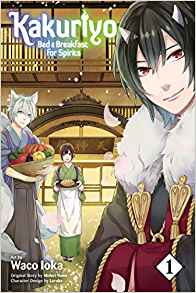
And there is Viz, rounding things out with a heaping helping of shonen and shoujo. The debut is Kakuriyo: Bed & Breakfast for Spirits (Kakuriyo no Yadomeshi: Ayakashi Oyado ni Yomeiri Shimasu), and is an Enterbrain title, from Comic B’s Log. It’s about a young girl who, not wanting to marry a demon to clear her debt, ends up employed at an inn… for the afterlife. Sounds like a good title for Kamisama Kiss fans.

ASH: I’m looking forward to giving this one a try!

MICHELLE: Hm. Could be good!

ANNA: Sounds promising!

SEAN: There’s also Anonymous Noise 12, Blue Exorcist 21, The Demon Prince of Momochi House 13, Demon Slayer: Kimetsu no Yaiba 4, Dr. STONE 3, Dragon Ball Super 4, Haikyu!! 30, Kaguya-sama: Love Is War 6, My Hero Academia: Vigilantes 3, One-Punch Man 15, the final Rurouni Kenshin 4-in-1, Skip Beat! 3-in-1 13, Twin Star Exorcists 14, and The Water Dragon’s Bride 8.

ASH: Quite a few in this list that I’m reading, too!

MICHELLE: Forsooth. I just wish that Skip Beat! volume was new material!

ANNA: Me too. Always glad for another volume of Water Dragon’s Bride.

SEAN: So, y’know, there’s a lot. Just not as much as the past few weeks. What interests you?

Filed Under: FEATURES, manga the week of

Konosuba: God’s Blessing on This Wonderful World!: 110-Million Bride

December 27, 2018 by Sean Gaffney

By Natsume Akatsuki and Kurone Mishima. Released in Japan as “Kono Subarashii Sekai ni Shukufuku o!” by Kadokawa Sneaker Bunko. Released in North America by Yen On. Translated by Kevin Steinbach.

For all that KonoSuba is occasionally called a harem manga, it’s more clearly a love triangle. And having given Megumin her due again in the 5th book, we’re back to focusing on Darkness, who is dealing with the realities of being the daughter of a noble. As the title may imply (it’s a parody of the “My Bride Is a Mermaid” series), she’s getting married off in order to clear a family debt, one that hearkens back to events of the previous books. This is actually very well handled, as it looks more closely at the “we saved the world but there was massive property damage” trope from various fantasy titles. Knowing Darkness’ sense of duty, it’s no surprise that her first thought is to sacrifice herself for the sake of everyone else. Of course there’s no way that Kazuma is going to let her get away with… oh, he’s sulking. OK, he may actually let her get away with it. Fortunately, Megumin and Aqua are on the case. (Fortunately?)

Before the wedding, Darkness is trying other avenues to earn cash, including taking out a hideously dangerous (and thus high bounty) monster, which naturally likes to attack and eat people, leading to Kazuma dying – again. This helps to emphasize something that we saw in the previous book – Kazuma and his partners work better in a large group than they do as a quartet. Unfortunately, this also means the reward is divided among various adventurers, so she has to go through with the wedding. Which is, naturally, to the evil Lord we’ve seen before, who is pretty much the bad guy behind nearly everything in the series. To Kazuma’s credit, he does try to rescue her from this plight, at first, but he simply cannot resist running his mouth off, which leads to a fight, which… well, you know. Kazuma.

This is one of those books that’s all about the climax, though. It’s also very much about Darkness’ specific masochism fetish, which is on display throughout the book. It can be very difficult for both her and Kazuma to draw a line between “you are being mean and embarrassing me and I find it really arousing” and “you are being mean and embarrassing and I am pretty furious”, and after the events of this book, I don’t think either one has really gotten closer to figuring out where that line is. In terms of the reader and KonoSuba’s sense of humor, though, nothing can quite top Kazuma’s declaration that she’s his property now and he plans to use her body to the fullest. This is in the middle of the wedding, and is essentially followed up by Darkness having an orgasm. It’s strangely heartwarming too, in that KonoSuba way. Also heartwarming is the way that everyone in the town arrives to help Darkness.

This series has been very consistent lately, which I’m quite happy with. And the cliffhanger shows that Kazuma has finally figured out who Chris is, which is nice. The next volume seems to feature both Eris and Aqua, so I’m expecting less romantic comedy and more just plain comedy. KonoSuba will make any reader who likes funny stuff happy.

Filed Under: konosuba, REVIEWS

Bookshelf Briefs 12/26/18

December 26, 2018 by Ash Brown, Sean Gaffney and Michelle Smith Leave a Comment

Abara | By Tsutomu Nihei | Viz Media – Although it’s up for debate how directly or tangentially related Abara actually is to Knights of Sidonia, in my mind the manga is unquestionably a precursor to Nihei’s later work. Even if they take different forms, the two series at the very least share elements of the same dystopic vision, a grim future in which humanity’s survival is not guaranteed in the face of the existence of creatures known as Gauna. Collected in a single, deluxe hardcover volume (along with another of Nihei’s earlier stories, “Digimortal”), Abara feels like the beginning of something grand even while being a complete work unto itself. Rather than prioritizing a narrative telling a coherent story, more than anything else the plot serves as a vehicle to showcase Nihei’s artwork and the astonishing, nightmarish atmosphere it creates. And that is just fine—the illustrations in Abara are stunning, managing to be simultaneously  beautiful and grotesque. – Ash Brown

Again!!, Vol. 6 | By Mitsurou Kubo | Kodansha Comics – In the original timeline, the fate of the ouendan was sealed when Usami was responsible for a disaster at a baseball practice game. This time, Imamura is working very hard to make sure that doesn’t happen. True, he still blames himself for the team’s eventual loss, since he wounded the pitcher’s fragile ego, but some things have clearly changed as a result of his actions. Namely, Usami is able to get the crowd on their side, rallying their spirits with her cheers when all seemed lost, and earning some praise from the school principal for her leadership. Sometimes this series is frustrating in that characters have to work harder for the kind of sports manga successes that make me sniff, but man, there are a few brief, glorious moments in this volume that are all the sweeter for having been hard-won. – Michelle Smith

Giant Spider & Me, Vol. 3 | By Kikori Morino | Seven Seas – There’s a bit of seriousness at the start of the third Giant Spider manga, as we find out why our kidnapper is so upset about the spider—his daughter was clawed by a cute baby bear, and died from an infection from the wounds. The rest of the volume, though, is relatively sedate, and even the big finale, in which Asa appears to be either ill or grumpy but is merely molting is pretty low-key. And yes, it’s a big finale as this is the final volume, even though the author says they know Nagi and Asa have lots more adventures. This is the sort of series that doesn’t really need a dramatic climax, but Nagi has changed thanks to her giant spider friend—she’s now surrounded by other friends as well. This was sweet. – Sean Gaffney

Girls’ Last Tour, Vol. 5 | By Tsukumizu| Ywn Press – Each volume of this gets darker than the last, while still maintaining its mood of “two girls wander around a city in their tank.” Chito almost dies a couple of times, and sprains her ankle at one point, leading to Yuu attempting to do leader-like things, which does lead to some laughs. And there’s a fascinating sequence when they look at modern art in a deserted museum. They’re still going up, though, and are helped in this (after breaking into a building using more high explosives) by an AI unit that begs for them to turn it off. We also get a flashback to how their journey began, showing that they were kids staying with adults at one point, and that things are terrible all over. One more volume to go. Will it end in death? – Sean Gaffney

Haganai: I Don’t Have Many Friends, Vol. 16 | By Yomi Hirasaka and Itachi | Seven Seas – The big surprise in this volume is that the student council president happens to be Yozora’s older sister. We’ve seen for a while that family issues are a large part of what makes Yozora the way she is, and it’s no surprise that she’s in a relatively foul mood this volume, where the Neighbors Club and the Student Council go on a vacation together. Before that, though, we do get Yozora returning to the Neighbors Club, and a virtual reality game that I will just gloss over as I found it the weakest part of the book. And for fans of Kodaka and Sena, there’s the final scene, even though it’s just a dream that… Rika has? Why is Rika dreaming of things like that? A good, fun volume, though even more perverse than usual. – Sean Gaffney

Hakumei & Mikochi: Tiny Little Life in the Woods, Vol. 3 | By Takuto Kashiki | Yen Press – Adorable and relaxing take a back seat to ADVENTURE in this volume, as Conju is kidnapped while in a “rough section” of town, requiring a rescue that involves a lost liquor, hang-gliding, and lots of faux badasses who really aren’t all that. It’s a heck of a lot of fun, and really shows off our heroes at their best. They also do well taking Hakumei’s boss out for a day on the town, showing him that life is not just work 24/7. And there’s a chapter involving sweets and some badgers that is quite funny. I’m really enjoying this series, though it has to be said—Hakumei and Mikochi are a married couple, they’re just not aware of it yet. (Nor do I expect that to change.) – Sean Gaffney

Hatsu*Haru, Vol. 4 | By Shizuki Fujisawa | Yen Press – How much you enjoy this volume may depend on how much you can take “I am oblivious to even a direct confession” on the part of Riko, which makes Kai once again spend half the book holed up in his room wondering where everything went wrong. Even when he returns to school and tries to take up his playboy ways once more, things go wrong—right now Riko needs a good friend more than a boyfriend, and if Kai’s not there, well, maybe Takaya will do. (Honestly, Takaya seems to be like he has his own issues, which I suspect may get revealed in a future volume.) Will Riko ever get Kai’s feelings? Does she like him back? Is she even ready to move on? And what of Ayumi, the intrepid newshound? Hatsu*Haru is a well-written soap. – Sean Gaffney

Horimiya, Vol. 12 | By Hero and Daisuke Hagiwara | Yen Press – I imagine there may be some people who have dropped Horimiya by now, and I get it—Hori is sort of a terrible person, groping her friends and joking about getting “technical” consent, and still being upset that Miyamura isn’t hitting her like she really wants him to. She’s a bit of a teenage mess, really. Fortunately, the cast around her have their shit together, so I don’t think things will get that bad. Honestly, seeing Hori groping Sakura reminded me that Sakura is one of the group now—in fact, one chapter has other students surmise that she may have a harem of hot guys. I still love reading Horimiya, even as it’s gone from “romance I’d happily recommend” to “problematic fave.” – Sean Gaffney

Slumbering Beauty, Vol. 2 | By Yumi Unita | Seven Seas – For the most part this was an OK, not great final volume of this series. The majority of it deals with Nerimu’s master trying to recruit Yoneko for the job permanently, and Nerimu trying to point out that this would involve essentially dying. That said, there was a fantastic moment near the end, as Yoneko is shown that her neglectful parents started off with good intentions and are not merely terrible people. And Yoneko says that this is true, and acknowledges it… but also reminds readers (and Nerimu) that the majority of her time growing up has been spent unhappy, and seeing that her parents have good sides as well is not going to change that. Still, at least she decides to live on for now. Like other Unita series, this was weird but worth reading. – Sean Gaffney

Yowamushi Pedal, Vol. 10 | By Wataru Watanabe | Yen Press – The third and final day of the Inter-High begins and since Midousuji got a somewhat sympathetic backstory that might be the start of a redemption arc of sorts it’s time to introduce another odious foe, this time in the form of Eikichi Machimiya, a schemer from Hiroshima who’s got a huge grudge against Hakone due to how things played out the previous year. This is a pretty fun volume, since Machimiya organizes a huge peloton that gobbles up stray riders, Jaws-like, and Sohoku must contend with leaving Onoda—who worked so hard on previous days for the team—behind to be devoured. Tadokoro even cries. Of course, plucky Onoda can’t be counted out yet, but neither can Hiroshima! Looking forward to the next installment, as always. – Michelle Smith

Filed Under: Bookshelf Briefs

Ojojojo, Vols. 1-2

December 26, 2018 by Sean Gaffney

By coolkyousinnjya. Released in Japan by Takeshobo, serialized in the magazine Manga Life. Released in North America by Seven Seas. Translated by Ben Robert Trethewey. Adapted by Clint Bickham.

Well, this was a pleasant surprise. We’ve seen a lot of this author’s works over here recently, including Miss Kobayashi’s Dragon Maid, which I dropped after a few volumes as I found it overrated, and Mononoke Sharing, which I didn’t like at all. Here, though, in a 4-koma series that lacks either monster girls or fanservice, I’ve found a series I can get behind. It helps that this handles the ‘4-koma slice of life’ genre very well. There’s always a danger in these sorts of titles that it will end up being plotless and lacking in forward motion, moving through the school year, festivals, etc. and ending up at graduation. Ojojojo, though, seems to actually care about character development, and things do, in fact, happen. Indeed, our leads end up dating by the end of the first book, which surprised me a great deal. That said, it’s not a surprise, as they complement each other perfectly.

…OK, perhaps they don’t complement each other perfectly immediately. As you can see by the cover, where they stand as far apart as they can and still exist, there’s a bit of awkwardness. This is because Haru Jikogumeguri (you can tell she’s rich because the name is *six* syllables) is socially inept and therefore acts like an arrogant rich princess, and Tsurezure Kawayanagi (who seems to be of modest status, despite also having a “rich” last name) is sopcially inept and therefore doesn’t really interact at all, preferring to stare at nature. When she transfers into his class, they bond almost despite themselves, and the joy of this book is watching the two of them grow close and learn how to communicate honestly. They’re helped by Akane Tendou, Haru’s first female friend in class and the relatively “normal” one of the group, Haru’s acid-tongued butler, and Chris, an English transfer student who has a similarly arrogant introduction as Haru did, but gets away with it more (probably as he’s a guy.)

Haru is the sort of arrogant rich girl you can’t help but love, especially once you get her semi-tragic backstory and see her earnest yet awful attempts to change her ways. The first volume is fairly normal 4-koma stuff, as we learn about our heroes via various quick gags and the occasional sweet moment. (The author says he planned to end it with the first book.) In the second half, he starts to deepen things, particularly the relationship between Haru and Akane, which turns out to involve a lot of misplaced guilt on Akane’s end. (The last name is a bit unfortunate – be assured she is not crossing over from Ranma 1/2.) By the end of the 2nd volume our leads have progressed to holding hands (which, given their personalities, is a big jump), and Chris is beginning to get over his own arrogance. There is one more omnibus to go, though, and since we know next to nothing about Tsurezure (who is unrelated to the Children of the same name, speaking of which) I suspect the next book will go into his past in an effort to move things along further.

Add to this next to no fanservice (Akane is jealous of Haru’s large chest at one point, but it’s a normal large chest, not the massive bosoms we see in Dragon Maid and Mononoke Sharing) and you have a title that’s a perfect introduction to casual fans who want to read a nice romantic comedy and don’t mind the “gag comic” format. A nice pleasant surprise.

Filed Under: ojojojo, REVIEWS

Baccano!: 1934 Alice in Jails: Streets

December 25, 2018 by Sean Gaffney

By Ryohgo Narita and Katsumi Enami. Released in Japan by ASCII Mediaworks. Released in North America by Yen On. Translated by Taylor Engel.

At the end of this volume Narita announces that they’re making an anime (which we have all already seen, of course), and also that after a Prison volume consisting mostly of old favorites, the Streets book mostly features either new cast members or relatively new ones, such as Christopher. That said, while they may have been new to the reader, I’m sure that the anime watcher is finally relieved to see Gustav St. Germain, his assistant/student Carol, and Graham Specter, who were cameo’d in the last book but show up in a major way here. Narita wrote Gustav and Carol into the anime as bookends commenting on the story in a metatextual way, which fits with what they do, and Graham showed up in one of the OAVs, whose events are described here but not shown. Well, at least I assume that folks are enjoying Gustav and Carol. Graham has a few people who just don’t like him, and I get it – like many, many other Narita characters, he won’t shut up.

Miria is in the foreground of the cover, but doesn’t show up till the end of the book. Same with Huey, whose ominous face takes up the background on the left side. Instead we see Renee, who is introduced to us as almost a parody of the “dojikko” type – busty and gorgeous, but always tripping and bumping into people, and constantly apologizing. Of course, just as we were introduced to Elmer C. Albatross as a smiling, likeable guy and then realized that this was not really correct, it turns out that Renee, like Huey, who she seems to have a connection to, is a bit of a horrible monster. Graham, Gustav and Carol are on the cover as well, in addition to Christopher Shaldred, last seen getting the crap kicked out of him on the side of a building in The Slash. Turns out that had a big effect on him, so in the meantime he’s playing bodyguard to the heir to the Russo family, Ricardo, who turns out to also have some big secrets. Not pictured is Lua Klein, Ladd’s girlfriend, who the Russos have locked up, presumably as leverage. Given Lua’s ultra-passive personality, you’d think they could just tell her to leave, but she does make an effort to escape when it presents itself.

That said, though, I think the most important part of the cast (also not pictured) is Rail, also one of the Lamia/Larva group we’ve come to know, and (as all of them are) one of Huey’s homunculus experiments. Huey’s view of everyone as an experiment tends to dehumanize them, and Renee clearly feels the same way. Add this to their not being “born” the way normal humans are, and the horrific tortures they’ve been forced to undergo, and it’s no surprise that most of Lamia are a bit eccentric. Rail is not sure about such basic things as humanity, and the events in this book really don’t help. That said, the majority of this book, as with a lot of Narita’s works, is a big series of fights and battles, combined with explosions (Rail loves to use bombs, although they are apparently not as good as another bomber we’ve seen in this series).

At the end of the book Miria and Jacuzzi’s gang are back in Chicago, trying to meet up with Isaac, who can only afford rail fare to there. So no doubt Peter Pan in Chains will bring the old and new cast together for a big finale. In the meantime, despite being filled with new characters you’re still learning about, this is a typically fun volume of Baccano!.

Filed Under: baccano!, REVIEWS

My Youth Romantic Comedy Is Wrong As I Expected, Vol. 6

December 24, 2018 by Sean Gaffney

By Wataru Watari and Ponkan 8. Released in Japan as “Yahari Ore no Seishun Rabukome wa Machigatte Iru” by Shogakukan. Released in North America by Yen On. Translated by Jennifer Ward.

This volume was pushed back a month or two, and when it finally did come out I didn’t have the time to read it except in short chunks. This is probably one of the reasons that I feel so exhausted after reading it, but the other is the subject matter. For a book that’s supposed to be a “romantic comedy”, which does have a generous helping of humor, it can be extremely depressing. It doesn’t help that this is exactly what the author is going for – after yet another problem is solved by Hachiman getting everyone to unite in hating him (and thus supporting the girl with the problem), his teacher reminds him that while Hachiman may not care about everyone’s bad feelings, there are others that worry about him. This includes her, as well as Yukino and Yui, but learning this lesson is, I think, going to take a few more volumes. Meaning that I may still be glum about this humorous series.

The subject of the book is the school’s Cultural Festival. Hachiman’s class is putting on a production of The Little Prince, which is not BL despite the best efforts of its adapter. Hachiman himself is on the festival committee, despite his best efforts, in the “Records and Miscellaneous” department, which rapidly becomes “defer everything we don’t want to do to here”. The supposed Festival Chairman is Sagami, a young woman with confidence issues who tries to get herself back in the “cool kids” group by taking this on, but in reality everything is being done by the vice-chairman, Yukino, almost to her physical and mental detriment, because since the chairman is flaking on things, everyone else decides to flake as well. And there’s also Yukino’s older sister lurking around the festival, making things worse in the way that only family can. Is this festival really going to be OK?

Well, yes, it pretty much is. There are no major festival disasters on this watch, mostly as Yukino is very good at organization (delegation, not so much). We are gradually seeing her warm up to a few people, particularly Yui, who remains the bright ball of sunshine in this series despite not having all that much to do in this book. The trouble, of course, is Hachiman, who once again narrates the book in a jaded, cynical and otaku-ish tone that serves to belie the fact that he really does care about these people and, when push comes to shove, wants to help them. But because of his self-image, he feels that it’s fine to solve a problem by throwing himself under the bus. Which is ironic, given how our three leads’ lives interacted at the start of the series. Despite being reminded that there are people who value him, the book ends with Yui taking a reluctant Yukino to the after party, while Hachiman resolutely doesn’t go.

I realize that once Hachiman learns from his past mistakes, we’re reaching the end of the series. And this is still very well written with interesting characters I want to see succeed. But man, it’s a slog, and right now I don’t really want either Yukino *or* Yui to end up with Hachiman. (There is a yuri fandom for it, right?) Definitely recommended for fans of the series, however.

Filed Under: my youth romantic comedy is wrong as i expected, REVIEWS

Dr Stone, Vol. 2

December 23, 2018 by Anna N

Dr. Stone Volume 2 by Riichiro Inagaki and Boichi

The second volume of Dr. Stone featured fewer scenes of crazy science action, but it did spend a more time on world building and setting up the conflict between the friends Senku and Taiju and newly revived but reactionary classmate Tsukasa. Senku is determined to push technology forward by manufacturing gunpowder, in order to give his group an advantage. The gunpowder sets off a plume of smoke which is answered by another smoke signal, indicating that the teenagers might not be alone in their post-apocalyptic world where everyone has been turned into stone.

Dr Stone 2

There was a flashback chapter showing Senku, Taiju, and Yuzuriha when they were young and pursuing Senku’s childhood dreams of rocketry. It was nice to see a glimpse of this mini friend group as little kids, and it played in well to how they work together to survive a hostile environment. Taiju and Yuzuriha have to figure out how to rescue their mad scientist friend, and we also get a glimpse of what Senku went through on his own, when he was the only human to wake up. There’s still plenty of dynamic science action in Boichi’s art, and while the second volume was a little less entertaining for me than the first simply because I was no longer as diverted by the initial premise of the manga, I’m curious to see how the conflict between Senku and Tsukasa is going to play out over the long term.

Female characters who exist mainly to be decorative and supportive is one of my shonen pet peeves, and at the end of this volume Dr. Stone seems to be heading in that direction. I’m not sure if all the genuinely enjoyable yelling about paleolithic science will be enough to offset those sort of plot developments, but I’ve liked the series so far.

Filed Under: Manga Reviews, REVIEWS Tagged With: Dr. Stone, Shonen, Shonen Jump, viz media

Sword Art Online, Vol. 15: Alicization Invading

December 23, 2018 by Sean Gaffney

By Reki Kawahara and abec. Released in Japan by ASCII Mediaworks. Released in North America by Yen On. Translated by Stephen Paul.

I was expecting that this volume would be a bit of a letdown after the highs of the previous work. Sadly, it’s even worse than I had anticipated: I actively don’t like this volume. Well, parts of this volume. We can divide the books events in half. Half of it involves Alice, having run away from the Integrity Knights at the end of the last book, living in the woods with Kirito, who is unresponsive and seemingly braindead. She’s struggling to find a purpose to fight, and various circumstances seem to give her that. This is not great writing, but it’s at least decent, and helps to set up the next couple of books. Alas, we then have the other half of the book. Even a Monkey Can Draw Manga discusses Shonen Power Creep, but there’s another aspect that Kawahara really suffers from, Shonen Villain Creep. Each villain has to be worse and more monstrous than the last one, doing even more evil things. So, ladies and gentlemen, meet Gabriel Miller.

Gabriel is introduced to us as a young corporate executive type, and we then flash back to his childhood, where he lived a comfortable life, met a nice sweet young girl to be his childhood friend, and then… well, Gabriel is a sociopath, like so many other of Kawahara’s villains, so you can probably guess. He’s part of a terrorist squad invading the ocean turtle, where Asuna and Kirito’s body are currently, in order to get the results of their experiments – Alice. He seems to regard humans and bugs exactly the same way, and is a thoroughly unpleasant individual. (He is assisted by another evil guy named Vassago, and I suspect that we may be familiar with him from previous volumes, though I will hold off till it’s confirmed.) Gabriel and Vassago are locked away from the Underworld, but they can still become “characters” in it. Which they proceed to do, as Gabriel is now the Demon Lord invading the human world.

The main problem with this book, and it’s teeth-grinding, is that half of it is from Gabriel’s POV. Given I already hate the way Kawahara writes villains, having to experience their thoughts for so long is unbearable. There’s also a couple of horribly violent deaths in the book, both women of course, there to make the reader feel sad and also make me wonder if the author had recently watched Se7en. (Speaking of which, Kawahara is rewriting his webnovel and editing it, and he changed events in Book 11 so that Ronie and Tiese are not, in fact, raped – however, dialogue towards the end of this book shows that he isn’t very good at cleaning up the mentions of it after the fact.) This may come as a surprise to the casual SAO fan, but I really miss Kirito’s POV here. Alice’s uncertainty and Gabriel’s loathsome villainy just make this book very hard to read. Oh yes, and Gabriel has also been in Gun Gale Online, and wants to do nasty things to Sinon as well. So that’s just great.

This was originally written when Kawahara was a much younger man, and it shows – it reads like the sort of thing an emo guy would write in order to be grim and gritty. The author, I think, realizes this – after the anime adaptation of Vol. 11, he publicly apologized for the rape scene, and said he wouldn’t write that sort of thing anymore. Unfortunately, it does mean we still have to plow through this book, which is filled with setup for cooler events to come, as well as appalling sadism. I won’t say to skip it, but you won’t enjoy it.

Filed Under: REVIEWS, sword art online

Dead Mount Death Play, Vol. 1

December 22, 2018 by Sean Gaffney

By Ryohgo Narita and Shinta Fujimoto. Released in Japan by Square Enix, serialization ongoing in the magazine Young Gangan. Released in North America by Yen Press. Translated by Christine Dashiell.

Sometimes you get so used to a specific author’s tropes and themes that you can tell from a cursory read that a work happens to be by that author. That said, it took a while for me to feel like this was written by Narita, the creator of Baccano! and Durarara!!. Starting in a fantasy world with a battle between a paladin and a skeleton lord is not really his deal, at least not in what we’ve seen over here. But once we move back to the modern world, and the “hero” starts describing people as toys? Once you see a sociopath who commits the most horrible crimes with a smile on her face? A ganster-like organization with a “family” feel and cops who are not afraid to use suspicious methods to get justice? Yeah, that’s Narita all right. Here he’s doing a “reverse isekai”, as the death lord from the prologue ends up inside the body of a young man in our world.

Polka is that boy, and his actual self seems to have been moved out of his own body so that the corpse lord can take it over. (It’s OK he ends up inside a plushie shark.) You worry Polka will start up his old ways, but it turns out he was a misunderstood corpse lord with friends who were killed because they associated with him, so it’s all good. Unfortunately, the real Polka has an assassin’s contract out for him, and the assassin, Misaki, is a smiling high school girl who is rather annoyed that the kid she stabbed through the throat sn’t dead. That said, she gets over it rather fast, especially once he kills and then revives her as a corpse – which, honestly, she’s much happier being. Along with a young man who doesn’t seem to leave his control room and communicates through drones, he’s here to figure out this magicless world, though he can still use plenty of magic.

Polka, in his “possessed” form, reminds me not a little of Huey Laforet, who also considers people his toys. That said, he’s not QUITE as morally nihilistic as Huey, and can tell right from wrong. Which is more than Misaki, who seems like what you’d get if you fused Anri from DRRR!! and Elmer from Baccano!, horrifying as that thought is. The rest of the cast are still unfolding, though the two police officers seem like they stepped off the pages of Gangsta. For the most part, this is a fun little action manga with a few mysteries, mostly content to coast along on mood. Be advised it’s a rated M title, though you get the sense that this is more the editors telling the creators “insert lesbian sex here” than any real plot relevance. It’s very Murcielago-ish in its lesbian sex scenes.

If you like DRRR!! and Baccano!, you’ll want to pick this up. Fans of reverse isekai and mindless sex and violence might also enjoy it.

Filed Under: dead mount death play, REVIEWS

Kagerou Daze VIII: Summer Time Reload

December 21, 2018 by Sean Gaffney

By Jin (Shinzen no Teki-P) and Sidu. Released in Japan by Enterbrain. Released in North America by Yen On. Translated by Kevin Gifford.

(This review gets even more spoilery than I normally do, FYI.)

I will admit, those who are only familiar with Kagerou Daze via the light novels themselves, rather than the franchise in general, may be a little dissatisfied with the ending. It’s not really that the villains win or even that most of the cast die, it’s that it all ends with a big old reset button. We tried a cool plan, it didn’t work, and so we’re going back to try something else – which, it turns out, they’ve been doing for a long, long time. Kagerou Daze is not a visual novel, but like Higurashi and Little Busters, it revolves around repeating a sequence of time to try and fix things. In the case of the light novel, things don’t get fixed. Oh, there are some survivors – the “side story” in this book deals with Seto and Marie after everything else has already happened, and Hibiya is still around as well – but no one really wins. Not even the villains.

That said, the novels are not all there is to Kagerou Daze. The books are based on a series of songs, and the final song in the “main” series, Summer Time Reload, is also the title of this book. It implies the majority of the cast survive, though they may forget about all this. There’s also the manga, which is just about to wrap up in Japan, and clearly tells a different version of events from the books and the songs. And there’s also the anime, Mekakucity Actors, which may annoy fans for various reasons, but also arguably provides the most closure. All the spinoffs are different kinds of flavoring to the main plot. Here, with prose, we get a lot of monologues showing off the emotional state of the cast – in fact, I would argue that Jin is better at this than he is at actual plotting.

There’s also an awful lot of shipping in this last volume, which surprised me. Kagerou Daze has a large shipping fandom – it’s got about 2.5K fics on Fanfiction.net – both het and otherwise. You don’t see much of the otherwise here, but other shippers should be pleased. Haruka clearly ships Shintaro and Ayano, and is visibly upset when their reunion in the Daze is less about “Sorry I forgot to say I love you before you killed yourself” and more “how do we stop the villains”. Hiyori, who I suspect the majority of readers may have forgotten about, pops in at the end too, and she’s just as tsundere as ever, though she does manage to spit out words very few tsunderes ever have. And the entire book is about Seto and Marry’s relationship, and how they’re family but also clearly want to have more, at least on his side. Sadly, his desire to protect is sort of destroying anything else they might have.

Jin’s afterword is very self-deprecatory, and I get that. These aren’t the best written books, especially in translation – there were several times when I could have used a “this character is now our narrator” slug at the top of the section. And Seto really did get the least focus of any character, coming off as a bit wet in the process. That said, in terms of emotion and character, Kagerou Daze was a fast favorite for me. The books make me want to listen to the songs, read the manga, and watch the anime all in a marathon. Which is all you can ask from a franchise spinoff.

Filed Under: kagerou daze, REVIEWS

Manga the Week of 12/26/18

December 20, 2018 by Sean Gaffney, Michelle Smith, Ash Brown and MJ 1 Comment

SEAN: Christmas is over! At least for Manga the Week of. We’re looking beyond that to Boxing Day. Is there manga? There is!

ASH: Hooray!

SEAN: And there are also light novels. J-Novel Club has a 5th volume of Infinite Stratos and the 3rd Kokoro Connect.

Kodansha has, for print, a 13th Fire Force and a 16th Missions of Love (still not over, but coming out so rarely that it seems like it is.)

ASH: It does seem like it has been a while.

SEAN: Digitally there’s a lot more, as we see Ace of the Diamond 18, Ao-chan Can’t Study! 3, Defying Kurosaki-kun 6, Forest of Piano 9, Liar x Liar 9, and Mikami-sensei’s Way of Love 2.

MICHELLE: Most of that is shoujo that doesn’t appeal to me, but at least there’s Ace of the Diamond and Forest of Piano!

SEAN: The rest of the list is Seven Seas. The new title is Ojojojo, the latest in the “Miss Kobayashi’s Dragon Maid was such a huge hit that we’ll license everything else by the same author” series. It’s coming out in an omnibus of the first two books, and does look pretty cute. It’s about two different types of outcasts who bond at school.

There’s also the 2nd manga volume of Didn’t I Say to Make My Abilities Average?!, the 3rd and final Dragon Half omnibus, a 3rd Giant Spider & Me (also a final volume), the 6th (and, yes, final) volume of NTR – Netsuzou Trap, and the 2nd volume of Slumbering Beauty, which is – try to contain your surprise – the final volume.

MICHELLE: One of these days I really will read Giant Spider & Me.

ASH: I’ve been delighted by it! Dragon Half is fun, too, and I liked the first volume of Slumbering Beauty as well.

SEAN: Has all the manga ended? Or was this merely Seven Seas’ CLEVER PLAN? Also, what are you buying?

ASH: Looks like it will be a Seven Seas sort of week for me!

MJ: Okay, so I’m probably not into any of this, but I just wanted to keep you all company. Hi.

Filed Under: FEATURES, manga the week of

  • « Go to Previous Page
  • Page 1
  • Interim pages omitted …
  • Page 195
  • Page 196
  • Page 197
  • Page 198
  • Page 199
  • Interim pages omitted …
  • Page 538
  • Go to Next Page »
 | Log in
Copyright © 2010 Manga Bookshelf | Powered by WordPress & the Genesis Framework