• Skip to primary navigation
  • Skip to main content
  • Skip to primary sidebar
  • Home
  • About Us
    • Privacy Policy
    • Comment Policy
    • Disclosures & Disclaimers
  • Resources
    • Links, Essays & Articles
    • Fandomology!
    • CLAMP Directory
    • BlogRoll
  • Features & Columns
    • 3 Things Thursday
    • Adventures in the Key of Shoujo
    • Bit & Blips (game reviews)
    • BL BOOKRACK
    • Bookshelf Briefs
    • Bringing the Drama
    • Comic Conversion
    • Fanservice Friday
    • Going Digital
    • It Came From the Sinosphere
    • License This!
    • Magazine no Mori
    • My Week in Manga
    • OFF THE SHELF
    • Not By Manga Alone
    • PICK OF THE WEEK
    • Subtitles & Sensibility
    • Weekly Shonen Jump Recaps
  • Manga Moveable Feast
    • MMF Full Archive
    • Yun Kouga
    • CLAMP
    • Shojo Beat
    • Osamu Tezuka
    • Sailor Moon
    • Fruits Basket
    • Takehiko Inoue
    • Wild Adapter
    • One Piece
    • After School Nightmare
    • Karakuri Odette
    • Paradise Kiss
    • The Color Trilogy
    • To Terra…
    • Sexy Voice & Robo
  • Browse by Author
    • Sean Gaffney
    • Anna Neatrour
    • Michelle Smith
    • Katherine Dacey
    • MJ
    • Brigid Alverson
    • Travis Anderson
    • Phillip Anthony
    • Derek Bown
    • Jaci Dahlvang
    • Angela Eastman
    • Erica Friedman
    • Sara K.
    • Megan Purdy
    • Emily Snodgrass
    • Nancy Thistlethwaite
    • Eva Volin
    • David Welsh
  • MB Blogs
    • A Case Suitable For Treatment
    • Experiments in Manga
    • MangaBlog
    • The Manga Critic
    • Manga Report
    • Soliloquy in Blue
    • Manga Curmudgeon (archive)

Manga Bookshelf

Discussion, Resources, Roundtables, & Reviews

Features & Reviews

Sword Art Online Alternative: Gun Gale Online: Second Squad Jam: Finish

February 27, 2019 by Sean Gaffney

By Keiichi Sigsawa and Kouhaku Kuroboshi, based on the series created by Reki Kawahara. Released in Japan by ASCII Mediaworks. Released in North America by Yen On. Translated by Stephen Paul.

This volume picks up where the last one left off, showing us the bulk of the 2nd Squad Jam, featuring most of the teams we saw in the last one plus a few new ones. The bulk of the book is, of course, the audience waiting for the big fight between Llenn and Pitohui. I say “audience” rather than reader as a large part of this book takes place in a bar in the virtual GGO world, where non-participants and the newly killed can gather to watch what’s going on and cheer people on. It’s a fun conceit, and helps to break up long pages of descriptions of action/descriptions of guns. Moreover, while our heroes are still the stars, the other teams also get a lot of great things to do (provided you like action – I mean, this is never going to be anything but “OMG, GUN FIGHTS!”) and show off their cool sides. And we meet a couple of characters I expect will pop up again in the future.

I don’t think I’ve ever seen an author quite so gleeful about playing around in someone else’s sandbox as Keiichi Sigsawa is here. (He even writes himself in to have a pathetic “I get killed off” cameo – again.) Theoretically there should be an impending feeling of doom around the events in this game – after all, Pitohui is gaming it so that it may have real-life consequences – but honestly, you rarely get that sense because you’re too busy watching everyone have all the fun in the world. Miyu/Fukaziroh greatly helps here, and I love her addition to the cast so much – aside from being a classic “just cannot shut up” type, she’s a great foil for Llenn. Her crowning moment may be emulating the Black Knight in Monty Python when she gets her hands and feet shot off and still crawls along to try to do some damage.

The battle between Llenn and Pitohui is the climax of the book, with everything else as a mere epilogue (including the actual results of the game, which I found hilarious). Llenn’s desperation to think of something, anything in order to kill off Pitohui herself is admirable and also a bit laughable, especially when she gets stuck in a thinking mantra. She’s at her best when running on instinct, though, and when her gun finally breaks (again, and yes, it still speaks to her), she has her knife, and then a makeshift knife, and then… well, I was impressed, let’s leave it at that. After that sort of battle, the epilogue was a bit of a letdown, especially with the lamest attempt at a fakeout ever – and to be fair, Karen does not fall for it even one iota. Now that Llenn and Pitohui have resolved things, though, what’s next? A third jam? Can we combine the four leads and have the best team ever?

This is still the light novel equivalent of a sugar rush, and I recommend skipping the gun nerd prose unless you really care a lot more than I do. But otherwise the GGO spinoff offers the finest quality action you’ll see in some time. Certainly better than the main series, and I think Kawahara would likely agree.

Filed Under: REVIEWS, sword art online

Bookshelf Briefs 2/26/19

February 26, 2019 by Ash Brown, Sean Gaffney and Michelle Smith Leave a Comment

Beauty and the Beast Girl | By Neji | Seven Seas – This seems to be complete in one volume, and despite a lot of backstory angst edges on the side of sweet. A monster girl living in the woods meets a blind girl (literally, her last name is Blind, but she is also blind) and starts to tell her stories in an effort to hide why she’s living alone in the forest. Naturally, their backstories merge together. Also naturally, they fall for each other hard and must therefore deal with the other humans who are horrified that Lily would be with a monster. It all works out in the end, though, as true love can defeat all. This is one of a number of “cute but slight” yuri titles we’ve seen here recently, and while it’s not the most subtle manga in the world, I’d say it’s worth a read. – Sean Gaffney

Black Clover, Vol. 14 | By Yuki Tabata | Viz Media – More tournament arc. Asta’s fight is fairly typical, involving a large dose of “I want to fight TOGETHER with you” to get the loner to actually do something. The more interesting fight, though, is between Finral and Langris, as you might guess by the cover art. There’s a lot of bad blood between these two, and all sorts of fears and jealousies come rolling out during the fight, which rapidly starts to turn a lot more deadly than expected. (Without any actual death—at least not yet.) There’s also another character who believes in beautiful things getting completely wrecked, which may be a Jump thing, as we also saw it happen in Toriko. All this plus tragic backstory to show off that true magical knights care about people! – Sean Gaffney

DAYS, Vol. 12 | By Tsuyoshi Yasuda | Kodansha Comics (digital only) – Seiseki’s game against Toin continues and Tsukamoto is playing his heart out. It’s gratifying to see the coach of the opposite team notice a change in Seiseki since the previous year, and also gratifying to see Ubukata recognized for her strategic analysis that resulted in Kazama scoring the goal that ties the game at 1-1. There are a lot of missed shots and squandered opportunities and moments where you think that finally Tsukamoto will triumph but instead Toin gets a penalty kick, etc. We also finally learn the significance of the series title—Tsukamoto’s dad died when he was little, and he’s learned never to take the present for granted. “Because someday, this will all be over. But if I try, maybe I can make these days last just a second longer.” I’m a sucker for sentiment in my sports manga. Recommended. – Michelle Smith

Girls’ Last Tour, Vol. 6 | By Tsukumizu| Ywn Press – This is the final volume of the series. Last time I asked if it would end in death. Technically we don’t see the girls die, but the end of their journey certainly seems to be The End of Their Journey, if you know what I mean. That’s the trouble with post-apocalyptic After the End series; unless you pull a fast one to find civilization has simply moved elsewhere (for a moment I wondered if they were going to get on a rocket and go to space in this volume, but that’s probably also a bad idea) you’re left with the fact that humanity has died. There’s some good bits here. I loved Chiro finding the massive library, as well as Yuuri’s calming presence. It was a sad journey in the end, but I’m glad I took it with them. – Sean Gaffney

Laid-Back Camp, Vol. 5 | By Afro | Yen Press – I was very pleased to see that, after last volume’s “camping with friends is fun!,” which Rin agreed with, that nevertheless almost all the camping this time around is by Rin by herself, because she loves camping by herself. This despite the fact that you can get trapped somewhere due to impassable winter roads. Fortunately for Rin, this is the modern age where cell service is everywhere, so even when camping by herself, she’s in constant contact with the others. Nadeshiko also meets up with Rin and introduces her to the wonders of expensive eel, as well as showing off a childhood friend and the fact that she’s lost a ton of weight recently. (She seems very cute either way.) This is such a peaceful series. – Sean Gaffney

Magi: The Labyrinth of Magic, Vol. 34 | By Shinobu Ohtaka | VIZ Media – Sean warned me that this volume had some creepy scenes, but I was not prepared. Sinbad has succeeded in becoming the god of the world and has rewritten the rukh so that everyone agrees with his methods for securing a peaceful future. This includes reverting the world to rukh, thereby killing everyone. Watching the populace cheer, and tearful kids looking excited to die, is seriously disturbing (in a good way). Alibaba and Aladdin are immune, and debate whether they have a right to try to change a fate everyone else seems to want, until a conversation with a brainwashed Morgiana convinces Alibaba that the present is worth fighting for. And so our heroes, accompanied by Judar and Hakuryu, must conquer, like, seven facets of Sinbad or something. It’s vague, but fine. I’m glad things are seemingly wrapping up. Three volumes left! – Michelle Smith

Sleepy Princess in the Demon Castle, Vol. 5 | By Kagiji Kumanomata | Viz Media – I was not expecting the hands-down funniest chapter of this volume to be our princess trying to find a toilet so that she could pee, but there we are. The chapter ends up being hysterical, particularly the facial expressions. Elsewhere, we see the princess has a poor memory for names… and faces. We also see (as if we hadn’t guessed) that she’s an incredibly poor communicator. Even when things AREN’T her fault it’s pretty easy to blame her—a chapter where she tries to be nice and do good things leads merely to fear and paranoia from the demons. There’s no real ongoing plot here, but as long as Princess Syalis remains who she is, there’s certainly ongoing laughs. – Sean Gaffney

A Strange & Mystifying Story, Vol. 6 | By Tsuta Suzuki | SuBLime – Man, A Strange & Mystifying Story has evolved sooooo much since its early volumes. Now it’s a gripping supernatural drama and it’s easy to forget it started out as something smutty with consent issues until Setsu shows up and gives Tsumugi terrible advice on how to make Kurayori his. Kurayori has been holed up in his shrine and just when he finally emerges to talk with Tsumugi, Magawa and Kai arrive to cause problems. I’m surprised Suzuki-sensei has made me like and sympathize with Kai so much so quickly, but she has. He may be a monster, but his desperate desire to be useful to mentally unstable Magawa so that he won’t disappear is genuine. Plus, we got a bonus chapter with my favorite couple! The next volume is the last and I’m really looking forward to seeing how everything plays out. – Michelle Smith

Sword Art Online: Hollow Realization, Vol. 2 | By Tomo Hirakawa, based on the story by Reki Kawahara | Yen Press – There is still a modicum of danger here—the threat to NPCs is still real, and Kirito by his very existence will attract trouble. That said, the fact that everyone is alive in this version of SAO (well, OK, not Sachi, but the cliffhanger included an appearance from someone I definitely was not expecting to see) and that we get chapters devoted to things like teaching Yuuki how to do school homework properly (which leads to helping dead school ghosts to pass on, much to Asuna’s horror) makes it feel sort of like the Today’s Menu for the Emiya Family of SAO. Instead of food, though, we get cool battles and cute interactions. Fun, though again confusing for non-gamers. – Sean Gaffney

Urusei Yatsura, Vol. 1 | By Rumiko Takahashi | Viz Media – While Urusei Yatsura became one of Rumiko Takahashi’s first major successes in Japan, the small portion of the series that was initially translated into English has been out-of-print for the better part of two decades. Happily, Viz is once again hastening “The Return of Lum” by releasing Takahashi’s highly influential manga in a new omnibus edition. For the most part the series is episodic in nature. Although there are recurring characters and jokes, overarching plotlines are virtually nonexistent. The basic premise remains consistent from chapter to chapter, though—Ataru Moroboshi, a lustful high schooler, is a magnet for the absurd and supernatural. Early on he manages to accidentally engage himself to Lum, an alien princess. Honestly, I wish Lum held more of the series’ focus than Ataru, but I still get a kick out of the manga. In particular I appreciate Urusei Yatsura‘s numerous references to Japanese mythology and literature. – Ash Brown

Filed Under: Bookshelf Briefs

A Certain Magical Index, Vol. 18

February 25, 2019 by Sean Gaffney

By Kazumi Kamachi and Kiyotaka Haimura. Released in Japan as “To Aru Majutsu no Index” by ASCII Mediaworks. Released in North America by Yen On. Translated by Andrew Prowse.

As with most two-volume arcs in Index, the second half of this is filled with a lot of action, though there is also some time taken for characterization, particularly of the Royal Family. But yes, fights, fights and more fights. Former allies fight each other, as the Knight Leader and Acqua of the Back face off. Many disparate groups team up, as Touma and Index ally with the English Puritans, Agnes Sanctis’ group, the Amakusa group, the third princess, and even the staff of Buckingham Palace to take down the Second Princess. In the end, she’s defeated by literally weaponizing all of England to fight her, as well as her mother pointing out that all of them are, essentially, trying to do what’s best for Britain, it’s just that Carissa is going about it the wrong way. And, unfortunately, we also get the “there’s always someone better than you” fight, as Fiamma of the Right manages to disable Index in some way, and also seems to have a third arm that is very reminiscent of Touma’s.

Introduced in this volume: Well, we do see Sasha’s other Russian Orthodox ally, Vasilisa, as well as her seeming hunter, Skogssnua. Sasha is no longer possessed by an Angel, and seems to have been picked up by Vento. We’ve seen Fiamma before, though this is the volume where he truly comes forward and shows he’s going to be the next Big Bad. Fans of the Index books will recognize that we see a few cameos of future characters in this book, so technically this is the first we see of Leivinia Birdway, Patricia Birdway, and Mark Space. Chronologically, of course, this takes place right after the events of Book 17. Book 19 takes place back in Academy City, and is taking place at the same time as 17-18. We’re very nearly at the big climax for Index (whether we’ll see New Testament, the sequel, is of course up to the readers buying the series and Yen Press), and everything is clearly heading towards a massive World War – but we aren’t quite there yet.

Possibly my favorite scene in the book is right in the middle (and it gets a big two-page color spread), as all the various factions allied against Carissa all unite in a field for a huge banquet before the final battle. As I said before, we see more cooperation in this book than ever before, and this scene is pure gold for seeing previous enemies just hanging out and eating. They’re being made fun of (Lucia and Angelina), they’re being given a pep talk of sorts (Sherry and Orsola), they’re making stupid maid outfit jokes that Kamachi just can’t let go (the Amakusas), or they’re just eating as much as possible (Index and Agnes). It’s a sweet scene that I suspect we won’t see much of coming up – the action seems to be shifting to Russia. There’s also more Brexit references… or they would be if this hadn’t been written nine years ago. And, since I just picked on Kamachi’s stupid humor, there is one terrific joke that involves Agnes hitting a knight in the groin and the definition of chivalry.

This is the longest Index book to date, and it’s almost all battles. But it’s worth it. Next time we return to Accelerator and Hamazura, who have their own problems.

Filed Under: a certain magical index, REVIEWS

Urusei Yatsura, Omnibus 1

February 24, 2019 by Sean Gaffney

By Rumiko Takahashi. Released in Japan in two separate volumes by Shogakukan, serialized in the magazine Shonen Sunday. Released in North America by Viz Media. Translated by Camellia Nieh.

I had reviewed the first five volumes of UY back in the days before my blog was part of Manga Bookshelf. At the time, it seemed like a pipe dream that we’d ever see more of it over here. It was started by Viz then cancelled, then put into Animerica Magazine and then cancelled there, then it was back to 32-page floppies, and finally it ground to a halt after 9 volumes (which covered up to about Book 11 in Japan owing to them skipping a bunch of chapters). It was the classic “how many times do you want us to beat our heads against this wall?” series. But now the manga market is stronger, Takahashi’s reputation is super high, and so not only do we get the return of UY, uncut and in omnibus format, we also get it released digitally, the first time this has happened for her series over a multi-platform format. It is truly a love song for Lum. Of course, new readers may be wondering: what’s the big deal?

The manga was originally supposed to be about an unlucky boy (whose very name loosely means “born under a bad sign”), his long-suffering and hot-tempered girlfriend, and the amusing situations that happen in their hometown of Tomobiki. Ataru Moroboshi attracts trouble. In the first chapter, that trouble is aliens, as he has to run a tag race against alien ogres so the Earth is not taken over. His opponent is Lum, who is a hot babe but also has a volatile temper. And can fly. After defeating and accidentally proposing to her, the next chapter is Lumless, and you might be deceived (if it were 1978, which it isn’t) into thinking that Lum would be a minor one-shot character… sort of like many of the other girls introduced in these two volumes. That said, the series is translated as “Those Obnoxious Aliens”, and it’s clear in the third chapter that Lum is back to stay. And also insanely popular.

As with a lot of long-running series, the characterization at the start is a bit off. Ataru is almost sympathetic at times, and occasionally makes the effort to be faithful to Shinobu and not be what he is famous for being, a giant horndog. By the end of this omnibus, that’s mostly worn off. Lum too is far nastier than we’re used to seeing, clearly an antagonist. As for Shinobu… well, no, she’s pretty much the same, though she too is unsympathetic much of the time. In fact, if you’re looking for anyone to root for, “look elsewhere” might be the best answer. This series runs on pure comedy, and Takahashi’s brand of comedy means watching people be terrible for fun. It works. These are terrible people. It’s fun. Ataru’s parents constantly wish he’d never been born. The town despises him (because he brings massive property damage). Cherry is possibly the most irritating character in the entire 34-volume series, which says a LOT. But the humor is there. This is a romp. You’ll find yourself laughing, but also slapping your forehead.

We do meet a large number of the main cast in this book, but they won’t last long… for now. Benten and Oyuki are oddly there to be Lum’s rivals for Ataru’s affection – that will change soon. Ataru’s friends aren’t even named (one is definable by his glasses… and not, thank god, his love of Nazi memorabilia), but they too won’t last long. Much as Viz attempted to reboot the series a couple of times here in North America, Takahashi will also reboot her own series starting in the next volume, with the introduction of the fourth and final “main” character. As for whether you should buy it again… yes. The quality of the reproduction is MUCH better than the original Viz volumes, especially the digital version. The translation is also less intrusive than the original, retaining puns when they’re obvious, but not feeling the need to make more jokes than Takahashi already is. It reads very smoothly.

Again, if you find yourself wishing “I wish everyone was a smidge less awful”, the second omnibus may help a bit. Only a bit, mind. These are characters to laugh AT, not with. I can’t wait for more.

Filed Under: REVIEWS, urusei yatsura

Is It Wrong To Try To Pick Up Girls In A Dungeon? On The Side: Sword Oratoria, Vol. 8

February 23, 2019 by Sean Gaffney

By Fujino Omori and Kiyotaka Haimura. Released in Japan as “Dungeon ni Deai o Motomeru no wa Machigatte Iru Darou ka? Gaiden – Sword Oratoria” by Softbank Creative. Released in North America by Yen On. Translated by Liv Sommerlot.

This volume of Sword Oratoria has a lot of the author’s strengths and weaknesses, minus Lefiya’s crush on Aiz, which gets a pass here. Instead, we get a mostly very serious book devoted to the backstory and current troubles of Bete, everyone’s least favorite grumpy asshole in Loki Familia. Picking up right where we left off in Book 7, i.e. with a lot of dead family members, we see Bete’s usual coping tactics at work – insulting and belittling his dead family members for being weak. Needless to say, this gets everyone so angry with him that he’s ordered to take a few days off away from the Family till things cool down. Right away, though, he runs into an Amazon who had a small appearance in the sixth book, and who Bete pounded in the abdomen back then. This has, in a typical Amazon way, led her to want to have his children. I’d say hijinx ensue, but this isn’t that kind of book. Instead, we get Valletta coming back and trying to cause Loki Familia even more pain.

Let’s get my major beef with this book out of the way: Bete’s backstory catches up with his current story at the end of Vol. 7, as it turns out that the one dead family member we actually knew anything about (Finn’s support mage) had a crush on Bete. If we combine this with a) his little sister (dead); b) his childhood friend (dead); and c) his first love (dead), we wind up with Stuffed Into The Fridge about five times over, as this is all to support Bete’s own emotional pain and his journey and explain why he’s so terrible. We’re also told that if you combine the looks of the three girls in Bete’s backstory you come close to Aiz, something that creeps me out more than a bit. Aiz, of course, can take care of herself, which is why Bete’s seemingly so fond of her. Oh yes, and the amazon girl, Lena, is also cut down in front of him halfway through the book. It’s hard not to groan at this point.

Other than that, I’ve said before that Omori specializes in writing fight scenes, and it’s still true, as they’re excellent as always, and keep the book moving briskly. Unfortunately, the author is less good when having to lay out exposition – learning why Bete is the way he is is laid out in several long interlocking scenes where Loki, Finn, Gareth and Riveria all tediously explain what we’ve long guessed to the rest of the family so they’re not mad at him any more. (That said, it does lead to the one great joke in an otherwise humorless book, as Loki convinces Aiz to cheer Bete up, which Aiz does as only a monotone deadpan character can.) This was probably a necessary book, as we needed Bete to get some backstory. I just don’t care for how it was handled. (And thank GOD for that editor, or else it would have been even worse.)

Filed Under: is it wrong to try to pick up girls in a dungeon?, REVIEWS

Kino’s Journey: The Beautiful World, Vol. 1

February 22, 2019 by Sean Gaffney

By Iruka Shiomiya, Keiichi Sigsawa and Kouhaku Kuroboshi. Released in Japan as “Kino no Tabi – the Beautiful World” by Kodansha, serialized in Shonen Magazine Edge. Released in North America by Vertical Comics. Translated by Jenny McKeon.

(This review is based on a copy provided by the publisher.)

In olden times, when the internet was just a young man, the first Kino’s Journey novel was published in North America by Tokyopop. It was also the last Kino’s Journey novel published in North America. Rumors swirled around why it died so fast. The usual low sales for novels? (This was pre-boom.) Or was it, as the most popular rumor went, that the author/publisher was enraged that Tokyopop changed the order of the chapters in the first book and pulled permission? A popular theory, but I have to say, when I saw the first volume of this manga adaptation of Kino’s Journey began, as Tokyopop’s novel does, with the backstory of the lead character, I had to laugh. Clearly someone else also thought it was a good idea to start here. That said, while the backstory is important (and chilling), at heart Kino’s Journey is an anthology series where you get a different place every week.

I would say the series is about the journey that Kino and Hermes (a sentient motorcycle) are taking, but that’s not quite accurate either. The series is about human nature, and how often that nature can turn sad, or frustrating, or tragic. This is not a depressing series, but the smiles you’ll have while reading it are going to be winsome. We start off with a traveler named Kino arriving at a town looking to repair a “motorrad” and befriending a young girl who’s just about to become an adult. That said, we quickly discover that becoming an adult here is a lot more disturbing than you’d expect, and the whole thing takes a Shirley Jackson-style turn – it’s quite disturbing. Kino and Hermes get away from the town and begin to travel, and along the way they meet various people, and places.

The rest of this first volume consists of two stories. The first, and longest, is about Kino’s arrival at a city that’s seemingly deserted, with robots running most amenities. There are people around, but they tend to vanish just as quickly. Once Kino finally meets one of the residents, we discover that it’s a classic “do not bring up what you cannot put down” situation, where what seemed like a good idea at the time quickly turns unbearable. The second story is a simpler one showing how a lack of communication can make tasks completely pointless – or, alternately, a sad but heartwarming story about men who sacrifice everything to work hard for their families back home. Throughout these stories, Kino remains an observer, not staying long and not really offering up advice. We, the reader, do the same.

I’ll definitely be continuing this series. It’s a good adaptation (done over fifteen years after the original novels and the anime series – another Kodansha property, Bakemonogatari, had a similar situation recently). If you like pensive, melancholy series that tell good stories but don’t linger, absolutely give this a try.

Filed Under: kino's journey, REVIEWS

Manga the Week of 2/27/19

February 21, 2019 by Sean Gaffney, Michelle Smith, Ash Brown, Anna N and MJ 1 Comment

SEAN: The last week of February has far, far more titles than I expected. A ridiculous amount, given Yen was mostly the week before.

Cross Infinite World debuts a new light novel with Beast † Blood (which seems to be part of a series called The Beast’s Mate). It’s got a Japanese author and title, but the premise seems pure Western YA. Biotech Researcher meets Mutant Beast Hunter. Sparks fly!

Dark Horse has piled all their manga into next week. We get the debut of their “Deluxe Edition” of Berserk, as well as Fate/Zero 8, and I Am a Hero 9.

ASH: From the previews I’ve seen, the deluxe edition of Berserk looks gorgeous. It also has a price tag to match.

SEAN: Denpa Books has two debuts. The first is Maiden Railways, a one-volume collection of short stories that involve romance on the train. It’s from Hakusensha’s Rakuen Le Paradis, which means it’s a must buy for me.

MICHELLE: Ooooooh.

ASH: I’m very happy to have more of Asumiko Nakamura’s work available in English!

ANNA: I pre-ordered Maiden Railways, I am excited!

MJ: This sounds so interesting! Sign me up!

SEAN: They also have the first volume of Today’s Menu for the Emiya Family, which just had an anime run this past year. If you love Fate/Stay Night but wish there was less blood and death and more delicious food (it has recipes!) and heartwarming moments, this is the title for you. It runs in Kadokawa’s Young Ace Up. Guaranteed not to have people die when they are killed.

ASH: I do like a good food manga, but I know almost nothing about Fate/Stay Night.

SEAN: J-Novel Club gives us four new volumes, as we see Der Werwolf 3, How NOT to Summon a Demon Lord 7, Infinite Stratos 6, and Kokoro Connect 4.

Kodansha, on the print side, has Clockwork Planet 10 and In/Spectre 9.

Digitally the big debut is The Tale of Genji: Dreams at Dawn. This classic shoujo series started its run (in Kodansha’a Mimi magazine, which no longer exists) in 1979, and is apparently a terrific adaptation of the classic story. The author, Waki Yamato, is not as revolutionary as the Year 24 group, but certainly made popular shoujo titles. Can’t wait to read this – the first three volumes are all out next week.

MICHELLE: I am super excited for this. Stay tuned for an Off the Shelf feature!

ASH: I’ve wanted to read this for such a long time! I really hope this truly is one of Kodansha’s “digital first” series and that we eventually get it in print, too.

ANNA: I am also excited but would be more excited for a print release!

MJ: I could not be more excited about this. I have a couple of volumes in Kodansha’s old bilingual edition (gifted to me by Kate, I think!) and they are lovely. But to have a real full-length English edition is a dream come true. You all know how much I love shoujo manga from this era, so my excitement can’t possibly be news. But I intend to shout about it all the same!

SEAN: In non-Genji news, we see Ace of the Diamond 20, All-Rounder Meguru 9, Defying Kurosaki-kun 7, Kira-kun Today 4, Kounodori: Dr. Stork 10, Mikami-sensei’s Way of Love 3, and My Boyfriend in Orange 6.

MICHELLE: Insert obligatory sports manga wooting.

SEAN: I was hoping for a more Space Battleshippy sort of debut this week, but it’s been bumped to April. Instead, Seven Seas debuts Miss Kobayashi’s Dragon Maid: Elma’s Office Lady Diary.

There’s also Alice & Zoroku 5, The Ancient Magus’ Bride 10, The 3rd Captain Harlock Classic Collection, Made in Abyss 5, Masamune-kun’s Revenge 9, and Pandora in the Crimson Shell: Ghost Urn 11.

MICHELLE: I’m so looking forward to the new volume of The Ancient Magus’ Bride, as we left off with Chise preparing to get some learnin’.

ASH: The Ancient Magus’ Bride is where my attention’s at, too.

SEAN: Tokyopop may give me mixed feelings overall, but there’s no way I’m passing up another attempt (please let it be completed this time) at Aria, the gorgeous manga about gondoliers on Mars. The Masterpiece Collection’s first volume will contain the two-volume prequel Aqua.

MICHELLE: Hm. Dubious face. I still have my old volumes of Aqua. It would’ve been nice if they’d started with Aria volume seven, but I guess that doesn’t make a ton of sense in terms of bringing in new customers even though it’d be a step toward making amends to the old customers.

ANNA: I had a couple volumes of old Aria and it was beautiful but I think didn’t have a ton of narrative substance? I don’t remember, I didn’t stick with it long.

MJ: I am skeptical but always full of hope.

SEAN: Vertical Inc. has a one-volume novel, 5 Centimeters per Second: one more side. This tells the story from the point of view of the heroine.

MJ: I am interested in this!

Vertical Comics, meanwhile, has the 3rd volume of the compelling and also unnerving series My Boy.

Yen has a couple of digital-only releases next week, as we get Corpse Princess 21 and IM: Great Priest Imhotep 11.

Yen manga, meanwhile, gives us ACCA 6, Durarara!! re;Dollars 4, Hakumei & Mikochi 4.

MICHELLE: I believe this is the final volume of ACCA, as well.

ASH: Oh, I think you’re right! I’ve been thoroughly enjoy the series.

ANNA: I still need to read it because I am terrible.

SEAN: And last, but not least, we see a digital-only manga hit print with a giant done-in one omnibus. Shut-in Shoutarou Kominami Takes on the World is a Big Gangan series about a hikkikomori who’s trying to fix himself and the gag manga writer who hopes he doesn’t. It’s apparently quite funny.

ASH: I’ll admit I’m curious.

SEAN: See? It’s a lot? What are you getting?

Filed Under: FEATURES, manga the week of

Woof Woof Story: I Told You to Turn Me Into a Pampered Pooch, Not Fenrir!, Vol. 1

February 21, 2019 by Sean Gaffney

By Inumajin and Kochimo. Released in Japan as “Wanwan Monogatari ~Kanemochi no Inu n shite to wa Itta ga, Fenrir ni shiro to wa Itte nee!~” by Kadokawa Sneaker Bunko. Released in North America by Yen On. Translated by Jennifer O’Donnell.

Well, that had all the strengths and weaknesses of the current light novel glut. Everyone want to write an isekai, usually with reincarnation, as that’s what sells. But there’s already too many of the normal adventurer sort, so you try to find a gimmick. We were a bit spoiled by having the Vending Machine isekai come out earlier, which already stretched disbelief to the snapping point. Woof Woof Story does not quite go that far, and instead sticks with our hero Routa as a “dog”. Unfortunately, the goddess who reincarnated him in this world is just as flakey as the goddesses in KonoSuba, and so he ends up being Fenrir, the strongest animal in the world. To his horror. Now he has to pretend he’s just a happy-go-lucky puppy so that he can keep his wonderful relaxed life with his adorable teenage master Mary, who has no idea he’s a monstrous wolf. He’s just a big doggie.

Let’s get one thing out of the way, as I suspect it will irritate some readers. Routa is a dog, and as such speaks in dog sounds. However, the book needs to have him actually converse with other animals, witches, and yes, occasionally his master, who seems to understand what he’s saying in a “dog” way. So we get Routa’s dog sounds, followed by what he’s actually saying in parentheses and italics. This can take some getting used to. The plot itself mostly involves Routa discovering his true identity and trying to hide it while also trying to protect his master, who tends to do things like go swimming by the dangerous lake with monsters around it, or come down with horrible fevers that need a special medicine only found in a faraway cave. But she’s cute and scritches him. And he gets lots of yummy food. In fact, sometimes he eats the larder and is forced to go hunt new food. Oh yes, and the resident knight wants to kill him as she’s the only one who gets that he’s a legendary wolf monster.

If you leave out the ‘I’m a dog’ part of the story, this has a lot of standard isekai/reincarnation tropes. The knight, Zenobia, is a garden variety tsundere, as is lampshaded by Routa himself. Sadly, I expect her role in this story is to be useless. Routa also has a number of other wolves who call him their king, one of whom is female, but, as he insists constantly, he’s not a furry. Routa may be reincarnated as a wolf, but he still has human memories. As such, “I’m not a furry” is the equivalent of “but I’m not into little girls” that we see in so many other isekai to take the curse off the hero being surrounded by young girls. That said, the book is pretty fun, and anyone looking for a lighthearted romp should enjoy it. But honestly, even the vending machine novels had more depth than this.

Filed Under: REVIEWS, woof woof story

My Solo Exchange Diary, Vol. 2

February 20, 2019 by Sean Gaffney

By Nagata Kabi. Released in Japan as “Hitori Koukan Nikki” by Shogakukan, serialized in Big Comic Special. Released in North America by Seven Seas. Translated by Jocelyne Allen. Adapted by Lianne Sentar.

By the end of this volume, the author has decided that she’s ending this diary, at least for public consumption. While this volume was also very good, I do think that may be for the best, as we are once again reminded that the life of a real person can cause more emotional pain that the life of, say, a 16-year-old girl in a girls’ private school. Apparently the last volume (the first Solo Exchange Diary) was not as popular with folks in Japan, particularly the last chapter, and that hit Kabi-san pretty hard. This final volume is much like the other two – some really good realizations and a few tentative steps forward, but also quite a few steps backward. The cover shows us two sides of Kabi-san talking with each other, the first being the one that’s resorted to alcohol, the other being the one who cuts herself. This remains a gripping but uneasy read.

At the start of the book she finds herself returning to live with her parents for a bit, and coming to terms with the fact that her mother is not her, and doesn’t deal with things the same way that she does. Her grandparents also get to see that she’s published two books, and carefully praise her for the publication while avoiding the content, which is very true to life. There are shots of the day-to-day life that the two had which I quite enjoyed. Unfortunately, in this volume Kabi-san also starts drinking beer. A lot. To the point where she’s wetting her bed by accident in the mornings. So much of the second half of the book takes place in the hospital, where she checks herself in so that she can deal with this. There are communication problems with the doctors and nurses, and at one point she’s cutting herself again. I find the fact that she’s putting this all out there on the page amazing.

At the end of the book, she’s out of the hospital, creating original manga, and realizing that the business of being “Nagata Kabi” is too much, which is likely the main reason why the Diary is ending. The best part, though, is that we get to see the original manga she created (it ran in Hibana magazine), and it’s really good. The story of two young people who are “rebelling against society” in a very literal way, it’s cute, clever and emotionally bruising all at the same time. The story is complete as is, but it does make me want to read more of Kabi’s original creations. As for her own life, I thank and applaud her for showing it to us, for good and ill, and I hope that the diary can continue in private even if it doesn’t in public. I felt it was an excellent read, and would also recommend it to anyone else who is dealing witd depression or other inner turmoil.

Filed Under: my lesbian experience with loneliness, my solo exchange diary, REVIEWS

Bookshelf Briefs 2/19/19

February 19, 2019 by Ash Brown, Sean Gaffney and Michelle Smith Leave a Comment

Crocodile Baron, Vol. 2 | By Takuya Okada | Kodansha Comics (digital only) – Crocodile Baron was initially part food manga, part whimsical story about a gentlemanly crocodile novelist named Alfardo J. Donson (a stellar name). In its second volume, the food is still there—I mean, technically, Alfardo and his pal Rabbit Boy travel around and eat various foods—but there’s even less focus on it than before, and it wasn’t much to start with. Now, it’s more about the quirky characters they meet, from a chameleon who wants to get the scoop on Alfardo’s wild side to a lonely jackal to a spoiled rich bunny girl to a competitive beaver. It’s good for a few chuckles, but there’s not much about it’s that’s exciting or compelling. The third volume is its last, and that’s the right length for this offbeat series. – Michelle Smith

Kase-san and Cherry Blossoms | By Hiromi Takashima | Seven Seas – This seems to be a transitional volume of Kase-san, telling a few stories from around the high school years but also putting things in place to get our girls into college, which they do. There’s a certain intentional disconnect between Yamada the emotional girl who cries at everything, which we certainly see at several points here, and Yamada the mature young woman, which she is slowly coming with the help of Kase. This may also be why we get another love scene towards the end, which shows us that “cherry blossoms” is also a metaphor. And they agree to use first names, which I suspect is not going to lead to a series name change. Still adorable and sweet. – Sean Gaffney

My Hero Academia, Vol. 17 | By Kohei Horikoshi | Viz Media – Superpowers/quirks can be awesome and empowering, but they can also be terrifying. Usually they’re both. That’s especially the case with Eri, whose quirk literally erased her father from existence. Fortunately, she has folks like Mirio and Izuku trying to save her. Unfortunately, Mirio’s quirk is erased, and I get the feeling (the cover doesn’t help) that it’s going to be permanent. In amongst all the chaos (which features Toga impersonating Deku, something you’d think she’d have saved for a less pointless moment), the goal seems to be to get Eri to believe in them and reach out her hand to be saved. Which she eventually does, and just in time, as Izuku almost kills himself. Again. Fantastic. – Sean Gaffney

Oresama Teacher, Vol. 25 | By Izumi Tsubaki | Viz Media – The most interesting part of this volume to me is how it handled Mafuyu’s memory loss of large parts of her childhood. For a while it was almost a joke—”lol, head trauma from falling off a jungle gym”—but now it appears that mental trauma may be a cause. What’s more, it appears to have had an effect on Takaomi, who was not always the smiling sadist Mafuyu is used to. It all seems to come down to the new teacher, who turns out (like everyone else in this series) to be connected to the delinquent battles of West and East High. Oh, and there’s also Hanabusa’s little sister, who I’d almost forgotten about. Lots of funny jokes, here, don’t get me wrong, but this is a very plot-heavy Oresama Teacher. – Sean Gaffney

Please Tell Me! Galko-chan, Vol. 5 | By Kenya Suzuki | Seven Seas – There’s more of what everyone wants from a Galko volume here. Lots of random discussions, a few sex-related but some not. There’s the “we watch foreign movies and discuss them” mini-chapters, which I guess are a thing now. There’s the author’s artstyle, which still makes this a series I really wouldn’t recommend to kids —there’s no actual nudity, but there’s lots of extremely large breasts and butts. To my surprise, there’s even a serious storyline near the end, as Galko’s older sister goes on a date with Otako’s older brother, planning to take his virginity, but it turns out his purity actually makes her feel bad about it (and it doesn’t happen in any case.) Still interested. – Sean Gaffney

Shortcake Cake, Vol. 3 | By Suu Morishita | Viz Media – It turns out that I never reviewed the first two volumes of this series. I certainly enjoy it enough, but my guess is that this is going to be one of those shoujo series where I don’t have much to say. There’s a love triangle. The heroes are 1) quiet intellectual and 2) seeming playboy. The heroine has a few issues as well (and a nice set of nightmares, which may have been my favorite part of the book). The cast is likable. That said, if I currently have titles like Yona of the Dawn and The Water Dragon’s Bride at the top of my Shojo Beat list, this one sits comfortable at the end of the middle tier. It’s quite enjoyable, you won’t regret purchasing it, and you will totally forget about it till the next book comes along. – Sean Gaffney

Takane & Hana, Vol. 7 | By Yuki Shiwasu | VIZ Media – Takane’s coping better with being poor, helped by Hana providing regular meals and Kirigasaki requesting a transfer to help maximize Takane’s efficiency at work. He’s slowly regaining ground and it’s clear he appreciates what Hana has done for him. When he gives her a key to his new apartment, it’s not just that he trusts her but that he also finally understands that all the extravagant gifts really were meaningless to her but this will be a significant one. For her part, Hana’s still determined to keep the fact that she’s in love with Takane a secret from him—ostensibly because he’d be insufferable but partly because she’s afraid how their relationship would change if it came to light. I do look forward to some fun gloating when that day arrives, but the best moments are always the sweet ones. I continue to enjoy this series a lot. – Michelle Smith

The Voynich Hotel, Vol. 3 | By Douman Seiman | Seven Seas – By the third and final volume of The Voynich Hotel, all the seemingly disparate storylines and characters converge in a rather dramatic and admittedly violent fashion, which honestly is not all that unusual for the series. Even the gags that initially appeared to be one-off throwaways are ultimately revealed to be of great significance to the plot. Astonishingly, Seiman manages to combine ancient goddesses, witches, demons, undead, yakuza, hitmen, serial killers, drug dealers, tourists, amusement parks, maids, wrestlers, pop culture references and so much more in ways that somehow make weird and darkly amusing sense. The manga’s humor ranges from the completely random to the decidedly risqué. Along with quirky characters, peculiar settings, and bizarre happenings, The Voynich Hotel makes for an exceptionally strange but engaging and sometimes even surprisingly endearing series. I greatly enjoyed it and wouldn’t mind seeing more of Seiman’s work translated in the future. – Ash Brown

We Never Learn, Vol. 2 | By Taishi Tsutsui | Viz Media – Much to my relief, the core “three girls” seems to stay the same by the end of this volume. Not that we don’t meet more characters—Sawako is a self-proclaimed rival to Rizu who, like most self-proclaimed rivals in anime and manga, turns out to be a really good friend who just expresses it through rivalry. More intriguing is a teacher in the school, Kirisu, who seems determined to show the girls that they’re not playing to their strengths this way, and that Nariyuki’s study help will hurt them in the long run. She has a very valid point, but it’s not a point that you should be making within the confines of Shonen Jump, so they’re allowed to continue, despite the constant threat of mild fanservice. – Sean Gaffney

Filed Under: Bookshelf Briefs

I Saved Too Many Girls and Caused the Apocalypse, Vol. 12

February 19, 2019 by Sean Gaffney

By Namekojirushi and Nao Watanuki. Released in Japan as “Ore ga Heroine o Tasukesugite Sekai ga Little Mokushiroku!?” by Hobby Japan. Released in North America digitally by J-Novel Club. Translated by Mana Z.

What struck me most about this volume of Little Apocalypse was what a well oiled machine Rekka’s heroine saving has become. We get three heroines arriving one right after the other, and Rekka and company know what’s going to be happening – he’s got to save them all. He picks out his crack team of Rekka’s Angels based on who he feels would fit best with what’s planned, and for the most part he’s absolutely right about it. The girls occasionally fight over him, but it’s “offscreen” so we don’t actually need to see it, and when times get tough they’re all business. They’re also the main “muscle” of the story – Rekka admits point blank that he’s the sort of person to rely on the powers of others, and they certainly have a lot of power. That said, there are certainly some spanners in the works in this volume, both on the heroine end and the plot end.

Our heroines this time include Haruka Tenou… erm, I mean a phantom thief who has unfortunately put a cursed tiara on her head; Setsuna Sakurazaki… erm, I mean a noble samurai girl from 500 years in the past trying to save her princess; and another princess, this time from Atlantis, 1000 years in the past. As you can imagine, there’s going to be some time travel here, but by now everyone mostly shrugs it off. The phantom thief is the easy part of Rekka’s mission (and honestly the dullest – she’s too perfect). The samurai is more of an issue, as Rekka, due to events, chooses to prioritize the other two girls first, which pisses her off, especially as she hasn’t yet seem Rekka in action and doesn’t trust him. Why would you trust a guy with a harem of girls who says he can fix everything? Moreover, the Atlantean princess, who as a tragic ghost was noble and sweet, as a living being is… well, a spoiled princess.

The other spanner here is the plot twist near the end, which I thought was rather clever. You know that things are going badly when R can actually talk to Rekka about his actions – usually she can’t influence him. It also allows Rekka to save the day at the end with a very clever device that relies on his “greed” – not for money or power, but his desire to save all the heroines (who are listed in order, which is helpful as I’ve forgotten some of them). I was also amused, if somewhat ruefully, at the twist at the end. Rekka thinks that, due to the fact that two of his three heroines this book live in the past, that he’s not going to have them joining the cast herd. Nope – here they are, and the explanation actually works. This is what you have to face up to when you’re a man whose inability to get it romantically led to the end of the world.

So a strong volume in the series, and we’ve only four more to go. How many more heroines can we stack on? And will Rekka manage to graduate?

Filed Under: i saved too many girls and caused the apocalypse, REVIEWS

How a Realist Hero Rebuilt the Kingdom, Vol. 8

February 17, 2019 by Sean Gaffney

By Dojyomaru and Fuyuyuki. Released in Japan by Overlap, Inc. Released in North America digitally by J-Novel Club. Translated by Sean McCann.

After a book that was mostly politics last time, we spend much of this book with warfare, as the tiny kingdom of Lastania is under attack by a horde of monsters from the demon territories. This is relevant to Souma and company because Roroa’s brother Julius, who has been wandering around ever since he got his ass handed to him in the early books, has settled down in this kingdom due to falling for the kingdom’s insufferably cute and plucky princess, Tia, who is on the cover despite not getting nearly as much focus in the book as I expected. Julius is a bit desperate here, as the Kingdom is falling to the monsters, so asks Souma for aid even though it may mean his own death. That said, readers of this series know that Souma is (usually) not one to carry grudges, especially not against members of his fiancee’s family. He also has the ability to show up and lead a charge to wipe everything out, which he does.

Given the nature of this series, there’s not really much of an actual threat here. We do see a few of the regulars get to show off their skills, including Hal, Kaede and Ruby, now pretty much working as a well-oiled OT3; Kuu and Leporina, who remain the perfect overenthusiastic royal and harried bodyguard; and Komain and Jirukoma, who are reunited here as Jirukoma is part of Julius’ forces. Honestly, despite all the battles, you get the feeling that the author is more interested in the romance. Leporina clearly has feelings for Kuu, but is waiting for him to mature enough to see them. Poncha, Serina and Komain appear to be forming an OT3 of their own, but Komain may be the only one who actually realizes this. Jirukoma hooks up with one of the Captain’s of Lastania’s forces, Lauren, in a classic “I am too dim to recognize obvious signals” sort of way. Oh yes, and on Souma’s end, Maria is still hinting she would not mind hooking up with him, Excel is hitting on him to the displeasure of ALL the fiancees, and we also hear about a beautiful young warrior from not-China as a tease for the next book. (Hopefully Realist Hero’s not-China holds up better than Smartphone’s not-China.)

There are a few drawbacks to this volume. I’ve talked before about the “Native American” stereotype for the refugees, and we get more art showing it off here. Still don’t like it. Given we’re focusing on how Julius has been reformed, partly due to the power of love, I wish we’d had a bit more time spent with him and Tia, who pretty much exists as a thing to protect. That said, I approve of villains who can reform, and Julius’ guarded conversations with Souma were excellent. I also liked an exhausted Souma confessing his fears of becoming too jaded and uncaring when he becomes king, and Roroa and Naden’s reassurances. I would like to see Liscia again – we do get a scene with her, revealing she’s pregnant with twins, but the nature of the universe, and the “realist” part of it, means she’s still being treated like fine china.

So a mostly solid Realist Hero here, and we’re edging closer to the actual coronation and wedding(s). That said, it appears we have another detour coming up next. Does Souma need an artist?

Filed Under: how a realist hero rebuilt the kingdom, REVIEWS

One Piece, Vol. 89

February 16, 2019 by Sean Gaffney

By Eiichiro Oda. Released in Japan by Shueisha, serialization ongoing in the magazine Weekly Shonen Jump. Released in North America by Viz. Translated by Stephen Paul.

So, as I have said before, and will again, I have difficulty doing full reviews of these volumes of One Piece that are just a bunch of giant melee battles. And yet, One Piece is also one of the series where I am dedicated to giving full reviews to each volume – no Bookshelf Briefs as that would be cheating. So let’s see what we have here. First of all, I pretty much enjoyed this volume as much as I have the last few, which if anything else puts this arc above Dressrosa, where I was desperate for an ending by the second to last volume. As this manga moves towards the inevitable Volume 100, it’s nice to see that Oda really is mastering his craft, and still learning from his mistakes. The last few arcs have had him “write out” members of the Straw Hats because he doesn’t want everything to be too cluttered – in this arc that means no Zoro, Robin, Franky, or Usopp. This also allows him to introduce a truly ridiculous number of minor villains and allies.

Big Mom’s pirates are the villains here, but even among them there are varying degrees of Good and Evil. We’ve already seen Big Mom’s empathetic but also horrifying backstory, and have gotten hints that Katakuri, Luffy’s opponent throughout the volume, is a “noble villain” sort. We get that confirmed here with the peanut gallery help from Flampe, one of the many family daughters, and a brat with a brother complex that, like most brother complexes, doesn’t take much to get destroyed. Her attempts at ‘helping’ her brother in his fight by shooting needles at Luffy completely miss the point, especially if you view the fight as a “many battle between men”, which, this being Shonen Jump, it absolutely is. Naturally, when Luffy Haki’s up and gets serious, Flampe is one of the first to foam at the mouth and fall unconscious. There are rules of cool in One Piece, and only certain characters can flout them and get away with it.

Meanwhile, the replacement cake has finally been delivered, and there really is an awful lot of discussion about it being poisoned, and Big Mom possibly being affected by the poison. I’m gonna be honest, I simply cannot see Sanji poisoning a cake, at all, for any reason, so I think they’re waiting in vain here. I think it’s pretty much just pure delicious – which is at least enough to slow Big Mom down, as she has to eat it if nothing else. It even makes her nostalgic for her childhood party that went terribly wrong. That said, this also means it’s time for Sanji and Pudding to break up, at least for now. There’s no real romance in One Piece, and we were never going to get a big damn kiss, but we come as close as Oda is ever going to show us, and it was pretty cool. Again, when he’s not being a comedy lech, I really like Sanji.

There’s a cliffhanger ending to this volume, of the sort that’s “did all our heroes get killed just now?” Probably not. Still, it definitely looks like next volume we’re moving on to a new arc, and gathering up the rest of the Straw Hats. Which pleases me, but this arc has been, on the whole, very sweet.

Filed Under: one piece, REVIEWS

Yona of the Dawn, Vol. 16

February 15, 2019 by Anna N

Yona of the Dawn Volume 16 by Mizuho Kusanagi

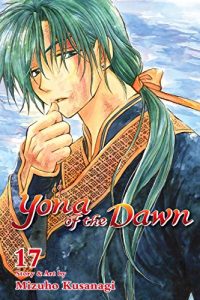
I often put down a new volume of Yona of the Dawn thinking “this was my favorite volume”, which is a testament to Kuanagi’s storytelling abilities. I’m willing to go on the record now and forever (or at least until volume 17) that 16 is my favorite volume of Yona of the Dawn. I had high hopes when I saw that the cover featured an extremely angry looking Hak.

This is the concluding volume of the Water Tribe story arc, and things have been headed towards a major confrontation, what with all the terrible drugrunning, Riri’s seizing her father’s power of hereditary rule, Su-Won and his minions appearing and hanging out near Riri, Yona getting herself injured, and people in general being repressed. As the story opens, Yona and her companions are determined to attack the fleet of the enemy and crush the drug traffickers. Jaeha has managed to secure a mini-army of attractive female divers due to his habitual flirtatious charm to aid in the attack.

yona 16

Even though it is painfully obvious from the beginning of the series that Hak and Yona are in love, there’s so much going against their romance that Hak is an incredibly sympathetic character and somewhat in the position of the underdog. He’s not acting very much on his feelings for Yona since he’s in the position of being her protector and he’s not nobility. While Hak has some great martial arts abilities, he’s not supernaturally gifted like the Dragon Warriors, and he doesn’t share the emotional/psychic bond that binds Yona and the Dragons together. All along Kusanagi shows Hak and Yona sharing a quiet moment here or there set against the backdrop of the great adventure that they’re on, but the reader hasn’t seen multiple panels showing what Hak is actually feeling before.

Most of the action external to Hak’s journey is handled fairly quickly. Riri has found her strength thanks to Yona’s friendship, and it feels like this series has to feature a pirate ship battle every seven volumes or so. As Yona, Riri, Su-Won, and their companions are standing in town and about to be pinned down by archers sniping at them, Su-Won stands in front of Yona to protect her and cautions her not to reinjure her back by firing arrows at her would-be assassins. Yona doesn’t back down from a fight though, and she has a brief reunion with Ju-Do that causes him to reflect on his own choices in staying to support Su-Won. As the local drug kingpen tries to do away with Yona once and for all, Hak comes out of nowhere to protect her from a dagger strike. He then turns incandescent with rage when he sees Su-Won.

What follows are several nearly wordless panels that dramatically portray Hak’s rage and desire for vengeance. Hak’s pupils contract, and Kusanagi switches over to using dramatic black tone and cross-hatching as Hak goes after Su-won. Hak has to go through Ju-Do first, and Jaeha tries to stop him from continuing to fight. As expected, Hak only stops when Yona steps in front of him. The rest of the volume deals with the fall-out of the incident, as Yona’s companions heal their wounds and Su-Won returns to his palace. Kusanagi has paced the story of Yona of the Dawn so well, every few volumes an event will happen that will dial up the emotional intensity and affect the relationships between the main characters even more. Seeing the rage that Hak has masked inside for so long makes the reader contemplate how controlled he’s been up to this point. Yona of the Dawn is embarking on a new story arc as Yona and her companions say farewell to the Water Tribe and I’m eager to see what happens next.

Filed Under: Manga Reviews, REVIEWS Tagged With: shojo beat, shoujo, viz media, yona of the dawn

I Shall Survive Using Potions!, Vol. 1

February 15, 2019 by Sean Gaffney

By FUNA and Sukima. Released in Japan by Kodansha. Released in North America by J-Novel Club. Translated by Garrison Denim.

This was honestly not at all what I expected. I expected this series to be a very ‘slow life’ sort. The heroine would be reincarnated in another world, start a potion shop, get a couple of assistants, etc. Kind of like Killing Slimes for 300 Years, that sort of thing. This is 100% not that sort of series. Kaoru is not interested in a quiet life, just a life with freedom. Like Katarina from My Next Life as a Villainess, she has “evil eyes”, i.e. the sort that slant up, and wherever she goes she changes the lives of people around her. But Katarina is a sweetie pie, whereas Kaoru is more of a tactical nuclear missile. As the book moves from place to place, and Kaoru and her potions affect more and more people, the reader’s jaw begins to drop as to what will happen next. And woe betide the evil baron or sketchy gate guard who gets in the way of a really good plan. Kaoru is here for one reason alone: Kaoru.

A brief summary: Kaoru is a 20-something OL who’s on her way home on the train when she literally EXPLODES and dies. This is the fault of higher beings who were trying to do something else and she got caught up in it. They offer to reincarnate her in a medieval-style world, and she proceeds to ask/blackmail them into giving her a LOT of things. Language skills, a box of infinite holding, etc. And the ability to create any potion she can think of, along with containers for same. The kicker here is that she thinks she’s going to be in a standard light novel fantasy world. But no, there’s no magic here beyond dragons, and it’s more ‘hunting’ than ‘adventuring’. As such, when Kaoru uses her potions to heal a gravely wounded hunter, the general reaction is “WHAAAAAAAAAT?”. Now Kaoru finds herself moving from kingdom to kingdom, getting involved, healing people with potions, and trying to live a free life.

There are so many light novels out there that are male power fantasies, where the hero gets a harem of slave girls, awesome adventurer powers, etc. that it’s weird to read a female power fantasy like this. Most of the other series we’ve seen over here with female protagonists (including Make My Abilities Average!, by the same author as this) tend to have them as nice girls who are “plucky”. Kaoru is not that sort of heroine, and is almost anti-plucky. Occasionally she is in mild danger, such as when she’s captured by the evil nobles who want to get her potion abilities, but she’s got a plan, which involves knocking out the maid, dressing up as her, stealing the entire room, and walking out. (The poor maid eventually gets her dress back, and we’re reassured is not beaten or anything.) That said, most of the people whose lives Kaoru makes miserable are men, and sometimes you get the feeling she’s going out of her way to be awful to them. That said, she really does help a number of people suffering from grievous injuries, rich or poor. As well as, um, de-aging a female knight who’s too old to get married so she can try again.

By the end of this book I was enjoying it quite a bit. I will warn that it may make some readers uncomfortable. Kaoru is a lot to take, and can tease men or destroy their lives at a whim. But then, that’s what it means to live the free life, rather than the slow life.

Filed Under: i shall survive using potions!, REVIEWS

  • « Go to Previous Page
  • Page 1
  • Interim pages omitted …
  • Page 190
  • Page 191
  • Page 192
  • Page 193
  • Page 194
  • Interim pages omitted …
  • Page 538
  • Go to Next Page »
 | Log in
Copyright © 2010 Manga Bookshelf | Powered by WordPress & the Genesis Framework