• Skip to primary navigation
  • Skip to main content
  • Skip to primary sidebar
  • Home
  • About Us
    • Privacy Policy
    • Comment Policy
    • Disclosures & Disclaimers
  • Resources
    • Links, Essays & Articles
    • Fandomology!
    • CLAMP Directory
    • BlogRoll
  • Features & Columns
    • 3 Things Thursday
    • Adventures in the Key of Shoujo
    • Bit & Blips (game reviews)
    • BL BOOKRACK
    • Bookshelf Briefs
    • Bringing the Drama
    • Comic Conversion
    • Fanservice Friday
    • Going Digital
    • It Came From the Sinosphere
    • License This!
    • Magazine no Mori
    • My Week in Manga
    • OFF THE SHELF
    • Not By Manga Alone
    • PICK OF THE WEEK
    • Subtitles & Sensibility
    • Weekly Shonen Jump Recaps
  • Manga Moveable Feast
    • MMF Full Archive
    • Yun Kouga
    • CLAMP
    • Shojo Beat
    • Osamu Tezuka
    • Sailor Moon
    • Fruits Basket
    • Takehiko Inoue
    • Wild Adapter
    • One Piece
    • After School Nightmare
    • Karakuri Odette
    • Paradise Kiss
    • The Color Trilogy
    • To Terra…
    • Sexy Voice & Robo
  • Browse by Author
    • Sean Gaffney
    • Anna Neatrour
    • Michelle Smith
    • Katherine Dacey
    • MJ
    • Brigid Alverson
    • Travis Anderson
    • Phillip Anthony
    • Derek Bown
    • Jaci Dahlvang
    • Angela Eastman
    • Erica Friedman
    • Sara K.
    • Megan Purdy
    • Emily Snodgrass
    • Nancy Thistlethwaite
    • Eva Volin
    • David Welsh
  • MB Blogs
    • A Case Suitable For Treatment
    • Experiments in Manga
    • MangaBlog
    • The Manga Critic
    • Manga Report
    • Soliloquy in Blue
    • Manga Curmudgeon (archive)

Manga Bookshelf

Discussion, Resources, Roundtables, & Reviews

Features & Reviews

Dr. Stone, vols 3 and 4

May 5, 2019 by Anna N

Dr. Stone Volumes 3 and 4 by Riicharo Inagaki and Boichi

Dr. Stone’s premise of a post apocalyptic world where the heroes have to invent their way back to human civilization while battling factions of Luddites is much more of a higher concept than one tends to get in shone series, and so far I’ve been enjoying seeing how Senku attempts to invent his way out of sticky situations. In volume 3, the cast of characters for Dr. Stone expands as Senku stumbles across a small village of people who are to him, the missing manpower ingredient need to power even more ambitious science experiments.
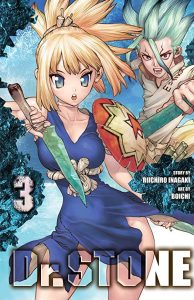
He meets Kohaku, the daughter of the village chief who promptly becomes an ally when she realizes that the power of science might save her sister and tribe shamaness Ruri from a terminal illness. Chrome is another villager who is a self-styled sorcerer due to knowledge gained from his own scientific experiments and rudimentary mineral and chemical gathering. With allies in place, Senku decides to build a new “Kingdom of Science” and power his inventions even further out of the stone age, in an attempt to get in a better place to deal with threat posed by the anti-science Tsukasa. The villagers are naturally extremely suspicious of the newcomer, but Senku has a unique solution in the form of food science. He decides to reinvent ramen in order to woo people to his side.

The village brings with it extra drama, as Senku races through inventing electricity, iron, and glass in order to have a functional chemistry lab to produce medicine, Kokaku has to worry about the battle for Riri’s hand in marriage that will determine the next village chief. Her friends prepare to fight to save Riri from the thuggish Magma. Even Senku’s ability to synthesize energy drinks might not be much of a help in a bracket-style fighting tournament that will decide Riri’s future. These two volumes were plenty diverting with the struggles of recreating inventions full of dynamic adventures, but I can’t help but wonder what on earth Taiju is up to! Hopefully in the next few volumes Senku’s expanded science team will come together again.
Filed Under: Manga Reviews, REVIEWS Tagged With: Dr. Stone, Shonen, viz media

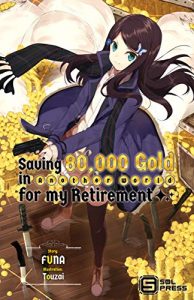
Saving 80,000 Gold in Another World for My Retirement, Vol. 1

May 5, 2019 by Sean Gaffney

By FUNA and Touzai. Released in Japan by Kodansha. Released in North America by Sol Press. Translated by Lukas Ruplys.

This is the third of FUNA’s series to be brought over to the West, but it was apparently the first one serialized (though they do say this and Potions debuted almost at the same time). Having now read all three, there’s no question why Make My Abilities Average! got the attention and the forthcoming anime adaptation: it’s the best of then. Potions gets by on Kaoru being somewhat terrifying rather than cute and plucky, and both it and MMAA have the heroines having to deal with situations where they’re dealing with permanently being in another world, even if they’re loaded up with ridiculous cheats. Mitsuha, though she appears to “die” and be reborn in a fantasy world, in fact has it the best of all of them. As a result, the danger level in this first book is fairly low, and it’s not as interesting as a result. That said, if you enjoy FUNA’s ridiculously OP heroines, there’s a lot to like here.

Mitsuha starts off the book pretty badly, to be honest. She’s not dead like Mile or Kaoru, but her parents and older brother are, leaving her alone and dealing with the fallout. One day at a lookout point, she’s attacked by some young creeps (she’s 18 but looks 12, in the best anime cliche tradition) and they accidentally push her off the edge onto the rocky cliffs below. She wakes up in a forest, and after walking herself to collapse finds herself in a rustic cabin… indeed, in a rustic world. Eventually she discovers that she can transport herself between this world and Japan, and, thanks to some friendly deus ex machinas who explain why she isn’t dead, she also can speak any language and has a healing factor. So what’s a young, recently orphaned young woman to do? Why, earn a pile of gold coins in the fantasy world, convert it over in Japan, and live a life of ease! Except she’s a FUNA heroine, so adventure and ridiculousness is bound to follow.

As with Mile, and especially Kaoru, there is a risk of Mitsuha coming off as uber-smug, especially when she’s doing things like bribing mercenaries to teach her how to use knives and guns, or showing off her general store with amazing inventions such as store-bought shampoo. (There’s also FAR more intrustive fourth-wall breaking in this book.) This being the case, I thought the best scene in the book is when she’s ingratiating herself with the local noble family, all of whom are taken in by her sob story (adapted for the fantasy world), and she gets carried away and calls the patriach “Father”… then starts to unconsciously cry. It’s a reminder that the author really does remember the character backstories, and this is a young woman who recently lost her entire family, who appeared to be pretty loving from what we hear (though the brother was a bit of an otaku). It’s a nice bit of grounding that helps you smile and nod when you see Mitsuha use dry ice and the power of FISH to wow everyone at a debutante ball.

This is my first Sol Press purchase. The translation was good, but the digital formatting was merely eh. They need to figure out how to make the interstitial pictures be one page on their own, rather than having text on the same page. That said, if you’re looking for silly heroines, and have run out of Make My Abilities Average!, this is a pretty good purchase.

Filed Under: REVIEWS, saving 80000 gold in another world

Our Dreams at Dusk: Shimanami Tasogare, Vol. 1

May 4, 2019 by Sean Gaffney

By Yuhki Kamatani. Released in Japan by Shogakukan, serialization ongoing in the magazine Hibana. Released in North America by Seven Seas. Translated by Jocelyne Allen. Adapted by Ysabet MacFarlane.

I had heard a great deal of buzz about this title when it was licensed and before, but hadn’t really experienced it beyond people on Tumblr posting pictures of some of the stunning artistic concepts that form part of its story. Having now read the first volume, I remain deeply impressed with the art, but also drawn in by the story and characters. Our Dreams at Dusk gives us a look at LGBT people in Japan and their attempts to deal with these feelings that society – and their own family and peers – tell them is shameful. At its heard is a community founded by the very mysterious “Someone-san”, whose name we don’t know but who has brought together people who need to be able to confess their feelings to, well, someone. It can’t keep being bottled up and repressed. As we see in this first volume, some are more successful than others. And just because you “come out” doesn’t mean your problems are over.

Tasuku is our protagonist, who is high school kid who we fist meet when he’s debating whether he should leap to his death from a high wall. Flashbacks show that someone at high school grabbed his phone and found his browser history, and now are asking if he’s into “gay porn”. He denies it, using a slur he detests, but the truth is that he is gay, though he hasn’t – and feels he cannot – tell anyone or his life will be over. Just the thought of having to return to school the next day drives him to the brink. Before he can do anything, though, he sees a person leap out of a window much higher than where he is. Rushing to the building they were in, he doesn’t find the jumper, but his blurting out that “someone fell” leads him to Someone-san and the group there. Over the course of the book, he opens up to some of them, clashes with others, and continues to go to school, where his crush is on the volleyball team.

Of course, the ensemble cast is important as well. We meet an older man who seems to love Tchaikovsky, a tween-ish child who seems to dislike Tasuku on sight, the friendly and hard-working Utsumi, and Haruko and Saki, a lesbian couple who are still having some issues – Haruko has come out to her family and friends, and dealt with the fallout, while Saki still hasn’t said anything to her family. We also see that the group is not a perfect, all-loving conclave – Saki trying to drag Tasuku into her argument with Haruko shatters the mood a bit. And there is, as I noted, the art, which for the most part is elegant and expressive, but every once in a while shows us a two-page spread of artistic abandon trying to show the torment and desires in the main characters’ hearts. It’d be worth reading the series just for that – but we’re fortunate yo have much more to it.

There’s certainly more to this story, which recently ended in Japan at its fourth volume. I suspect the second one will deal with the kid who clearly does not like Tasuku at all. In the meantime, believe the hype – this is definitely worth your time and money.

Filed Under: our dreams at dusk, REVIEWS

The Devil Is a Part-Timer!, Vol. 13

May 3, 2019 by Sean Gaffney

By Satoshi Wagahara and 029. Released in Japan by ASCII Mediaworks. Released in North America by Yen Press. Translated by Kevin Gifford.

I’ve said for a while now that this series does a good job of having romantic interests in it but sort of keeping it on the back burner rather than being a full-blown romantic comedy. Well, that changes with this volume, which devotes a large chunk to our heroines and how they feel – in this case, Chiho, who has now confessed to Maou TWICE but still hasn’t gotten much of anything from him, and Rika, who is in love with Ashiya and decides to do something about it when he invites her out for dinner and cellphone buying. Things arguably don’t go well for either of them, but in Chiho’s case there’s a larger issue, which is that she worries that soon she’s going to have to do other human stuff – study for exams, go to college, etc. – and will not see her supernatural friends anymore. Especially given Laila is still trying to get them on board with her big project, which could take a month to complete… or a hundred years.

There are a lot of confrontations in this book, and it’s interesting that some of them we only hear about secondhand. We see a teary Chiho run into Suzuno, but their conversation is heard second-hand later on, and Maou being “punished” for upsetting Chiho is also off screen (well, the setup, anyway). I’m not sure if this is just because the author is trying to keep the books to a certain length, but it is somewhat odd. We do get a great conversation between Chiho and Rika, two characters who are both best friends with Emilia but rarely interact. I worried that Rika and Ashiya’s date would also be off screen, but we do see that, and also Ashiya rejecting her… in fact, he tries to do the “I am too scary, please never see me again” thing, but Rika’s too smart to fall for that, though he is pretty damn scary. I did enjoy seeing Rika tell Chiho that she could possibly be the exception to the “demons don’t have human lovers” thing.

As for the main plot, Laila provides most of the humor in this volume in her desperate attempts to explain why she needs Maou and Emilia’s help. We first hear about the issues via a term paper (no, really, that’s how it reads), and it helps us to understand why everyone is so wary of her – she’s been living on Earth, but is she just an angel in disguise, or is she actively trying to fit in and be human like the others? We eventually find out it’s the latter, and why she’s been so wary of taking anyone to her apartment, in a joke that you can see a mile away but is no less satisfying. It does, however, lead to the big reveal, which is that what Laila is asking will take forever, and some of the people involved are normal humans who will grow old and die. But Maou isn’t… and neither, it turns out, is Emilia, whose half-Angel background means she could live a lot longer than anticipated.

In the end, Maou tries to be nicer about it, but still hasn’t responded to Chiho’s resolve. He can’t keep avoiding it forever, and it’s not as if the answer is “I like Emilia instead”, as he doesnt. If anything, he’s in love with his work. Which is appropriate for this series. What happens next? Can’t wait to find out. Sure hope the next volume isn’t a collection of short stories or something.

Filed Under: devil is a part-timer!, REVIEWS

Manga the Week of 5/8/19

May 2, 2019 by Sean Gaffney, MJ, Michelle Smith, Anna N and Ash Brown 3 Comments

SEAN: Sometimes one book sort of takes all the attention, like a black hole. We’ll do our best to mention everything else as well, though.

Dark Horse debuts Emanon, by the artist of Spirit of Wonder (anyone remember that series?) and based on an award-winning novel. It looks quiet and mysterious. It runs in Comic Ryu, so that may not be the case, but…

MJ: Hm. Interested.

ASH: I’ve been enjoying Wandering Island, the creator’s other series in English, so I’ll likely be giving this one a look.

SEAN: They also have a World Guide for the NieR: Automata series.

J-Novel Club debuts Campfire Cooking in Another World with My Absurd Skill, another in a series of light novels whose plot is in its title.

They also give us I Shall Survive Using Potions! 2, Kokoro Connect 5, and Lazy Dungeon Master 5.

Kodansha does not have a debut, though the first week of the month is always dangerous to say that about – apologies if they announce something after I post this. In the meantime, in print we get Hitorijime My Hero 3.

And digitally there is Blissful Land 3, Can You Just Die, My Darling? 8, Momo’s Iron Will 2, and World’s End and Apricot Jam 4.

Seven Seas has, technically, other things out next week. Let’s actually mention those first. There’s the print debut of Classroom of the Elite, The Dungeon of Black Company 3, High-Rise Invasion 7-8, and Mononoke Sharing 4.

But no one cares at all, because they are debuting Our Dreams at Dusk: Shimanami Tasogare. One of the most highly anticipated manga debuts since I don’t know when (well, OK, since Saint Young Men two weeks ago), this manga deals seriously with LGBTA themes, contains superb writing and character work, and is highly recommended by everyone I know. I can’t wait to start it.

MJ: Okay, want, want, WANT. WANT. WANT.

MICHELLE: SAME.

ASH: YUP!

SEAN: Tokyopop has a third Yuri Bear Storm, which… is not quite the same sort of series.

Vertical has a 12th volume of Mobile Suit Gundam Wing.

I feel badly for Viz, as any other week I’d be falling over myself praising them for picking up Snow White with the Red Hair (Akagami no Shirayukihime), which has similar plot and characters as Yona of the Dawn but is its own delightful series. (And honestly, who wouldn’t want to be compared to Yona of the Dawn?). It runs in LaLa.

MJ: I’m in!

MICHELLE: Same again!

ANNA: Me too!!!

ASH: I’m also looking forward to this!

SEAN: Other shoujo? Anonymous Noise 14, Kakuriyo: Bed & Breakfast 3, and Shortcake Cake 4.

MICHELLE: I’ll read all of these eventually!

ANNA: Me too!

SEAN: On the shonen end we debut the new arc for JoJo’s Bizarre Adventure: Diamond is Unbreakable. Unlike other new arcs for JoJo’s, this has the same cast as the previous arc.

ASH: I am incredibly pleased that this is being released, especially since it’s a fancy hardcover edition.

SEAN: There’s Black Clover 15, Black Torch 4, Demon Slayer 6, Dr. STONE 5, Dragon Ball Super 5, Haikyu!! 32, Kaguya-sama: Love Is War 8 (I’m giving in and making it shonen, as that’s how it’s marketed here), One Piece 90 (Christ, ONE PIECE NINETY!!!), One-Punch Man 16, and Twin Star Exorcists 15.

Seriously, buy Shimanami Tasogare. I want to see it sell like hotcakes. What are you getting besides that?

Filed Under: FEATURES, manga the week of

Penguin Highway

May 1, 2019 by Sean Gaffney

By Tomihiko Morimi. Released in Japan by Kadokawa Shoten. Released in North America by Yen On. Translated by Andrew Cunningham.

For once, the book came first here. Yen has started a side business of publishing novelizations based on famous anime movies, but Penguin Highway was a novel turned into a movie. The prose is one of the best reasons to pick it up, as its narrator may be ten years old but he thinks that he’s a precise, logical scientist, and the book has fun with him sounding like this most of the time but sometimes letting the child come through. To Aoyama’s credit, he is pretty damn smart, though his two friends are no slouches either. I don’t remember doing quite as much scientific experimentation when I was their age, but then I was always more arts than sciences. The book helpfully is both, as the basic premise involves things such as eddies in the space-time continuum, but also has the sheer beauty, which must have looked great animated, of a can of Coke transforming into a penguin bit by bit.

As noted, Aoyama is smart and knows it, and tries not to get too egotistical but frequently fails, especially in his narrative headspace. He spends the days hanging out with best friend Uchida and fellow intellectual Hamamoto, avoiding the bullying of Suzuki and his two minions (why is it always one bully and two minions?), and getting his teeth cleaned as much as possible because he has a massive crush on the dental assistant, who is never named but is called “The Lady” throughout. Things are normal till one day, a bunch of penguins suddenly appear in a vacant lot. They don’t seem too bothered by being in Japan rather than Antarctica. Even more disturbing, a clearing in a local forest has The Sea, a giant sphere of water that seems to be influencing local topography. More things to analyze and write down, but also dangerous. And there are blue whales? And creatures that The Lady/Aoyama are calling Jabberwocks. Why is all this happening/ And how does it tie in with The Lady?

The plot is good, but Aoyama’s narrative is the best reason to read it. I started off the book laughing at him, as he sounded very much like a snooty fourth-grader, but as the book went on I really started to be drawn into his world. He is very smart about logical and scientific things, though when it comes to matters of the heart he’s lagging way behind, as even his best friend Uchida is able to see why Hamamoto is mad at him. For much of the book The Lady remains something of an enigma to us, and there are a few red herrings thrown around that are brushed off when the truth comes out (The Lady’s memories of her past, in particular). Also, loved Aoyama and Hamamoto’s dads, who both do their best to fully support their children so long as they don’t run into danger (which they do here, repeatedly).

The story ends on a somewhat bittersweet note, as with the best Japanese novels. It also has an afterword by famous manga author Moto Hagio discussing Aoyama and his tendency to be too clever by half. In the end, I don’t really have much to say about Penguin Highway except it was a really good book, and I’m glad I read it.

Filed Under: penguin highway, REVIEWS

Bookshelf Briefs 4/30/19

April 30, 2019 by Ash Brown, Sean Gaffney and Michelle Smith Leave a Comment

Arpeggio of Blue Steel, Vol. 14 | By Ark Performance | Seven Seas – Last time I wondered if Arpeggio of Blue Steel really was going to become a high school series, and it’s certainly trying its best, with a School Festival arc in the offing. That said, the tone of the series is still very much Tom Clancy, with much of the volume taken up by I-402’s negotiation with retired general Ryokan on behalf of the Fog. Meanwhile, we also get a flashback as to how Gunzou started all this in the first place (Iona basically forced it on him, but it doesn’t take much pushing), and start to see pieces shifting into position for the next big battle. Will that battle take place at the school? It might start there, but my guess is we’ll be back to the Navy before long. Still underrated. – Sean Gaffney

Crocodile Baron, Vol. 3 | By Takuya Okada | Kodansha Comics (digital only) – Crocodile Baron comes to an end without evolving much since volume two. Alfardo and Rabbit Boy run into the former’s bad older brother, who seemingly turns his life around after eating some ramen. Alfardo eats spicy curry with a desperate warthog and possibly saves his marriage. Rabbit Boy hates Christmas because it’s his birthday and buys a cake from a camel. A lovelorn elephant filmmaker finds his muse and eats pond smelts. They have an Okinawan adventure during which Rabbit Boy nearly drowns. Honestly, I cared about no one and found it all boring. If there had been more emphasis on the food, I might’ve felt differently, but this was a big ol’ yawn banquet. – Michelle Smith

High School Prodigies Have It Easy Even in Another World!, Vol. 3 | By Riku Misora and Kotaro Yamada | Yen Press – Again, I beg the authors for a character sheet. There are quite a number of interesting things going on in this volume, but I suspect the reader may have trouble finding them among all the bouncing boobs. The fanservice is laid on with a shovel here, and can be hard to take. That said, there’s a nice scene with Tsukasa and Lyrule where she berates him for feeling guilty over not prioritizing saving her. The bulk of the serious plot goes to Shinobu and Elch, gathering intel at a seemingly friendly village with a very dark secret. Fortunately (assuming that it’s not a double cross), she may also have come across the resistance. Too many boobs spoiling the pie, alas. – Sean Gaffney

How to Treat Magical Beasts, Vol. 3 | By Kaziya | Seven Seas – Lest we try to run on “the sweet and heartwarming adventures of a vet” for too long, this volume introduces a smiling maybe-villain-maybe-not, who helps Ziska with a cat’s injury and then takes her way out into danger to attend to a wounded Greif, because no series with apprentices and magic is quite complete without a test to see if they’ve got the right stuff. I assume Ziska does have the right stuff, but we’re caught up to Japan, so it may be a while till we find out. In more sweet news, that is one adorable gargoyle, and I’m happy it’s found a friend. Seven Seas has carved out a genre niche with these types of series, and I quite enjoy it. – Sean Gaffney

Mob Psycho 100, Vol. 2 | By ONE | Dark Horse – I keep wanting to call this MPD Psycho, but that is something very different. This is the story of an unassuming boy named Shigeo Kageyama who possesses super powers but wants to live without relying on them. This challenges the worldview of another superpowered boy named Teru, who spends two-thirds of the volume flinging his power at Kageyama in order to make him fight back. (Kageyama is resolute that he won’t use his powers against another person.) The anger meter appears again (with a fun gag about how Teru’s exorcism of Mob’s sycophantic spirit companion doesn’t actually change it at all) and only when his life is in true peril does Kageyama reach “???%.” Will he wreak havoc in the next volume? The story’s definitely getting more interesting, but I’m still not in love with the art. – Michelle Smith

My Hero Academia: Vigilantes, Vol. 4 | By Hideyuki Furuhashi and Betten Court | Viz Media – This gets better with each volume. I had not realized that the Vigilantes series takes place a few years before the main series (though the authors cheat (and say so) for the extra side story). I had suspected that Knuckleduster was somehow connected with the villains, but that connection turns out to be much closer than imagined, and leads to possibly the best fight of the series. Meanwhile, Pop Step finds her confidence and does something only she can do to help out. All this and one of the most horrific images in the manga to date (which also made me wonder if the authors had seen a certain meme about bees). This has become essential. – Sean Gaffney

My Pink Is Overflowing, Vol. 1 | By Yuki Monou | Kodansha Comics (digital only) – I bought this hoping it would be hilariously trashy, and for the most part it was. The premise has a girl who’s tired of being screwed over by pick-up artists decide she’s only going to date virgins from now on… then find out that her boss, seemingly an overly serious taskmaster, is one! They enter into a relationship so fast it boggles the mind, especially since their first kiss is interrupted by her having an orgasm as she does it. At its heart, this is a “ditzy girl/serious guy” title with a decent heart, but the girl can get very over the top at times, and the series seems to want to go as far as it can while keeping the hero a virgin. Plus there’s that title. For fans of Cosplay Animal. – Sean Gaffney

Teasing Master Takagi-san, Vol. 4 | By Soichiro Yamamoto | Yen Press – It has to be said, a lot of the teasing that’s going on here is Takagi-san being as obvious and blatant as she possibly can that she loves Nishitaka. You’d have to be a brick—or a male protagonist—not to get it, and indeed sometimes it’s so blatant he almost shows sings of figuring it out. But this is a long-running series, and resolution just isn’t in the cards right now. So we get Takagi-san visiting his room, playing poker, chasing cute cats, and getting each other’s emails so that now she can tease him whenever she wants to (and have cute photos of her on his phone). Everyone else in their class knows they’re going out. Most of what they do qualifies as a date. But… so dense. Love this series. – Sean Gaffney

Witch Hat Atelier, Vol. 1 | By Kamome Shirahama | Kodansha Comics – Even before it was licensed in English, Witch Hat Atelier was a series that had caught my attention, in large part due to Shirahama’s gorgeous, sumptuous artwork, but also because my Japanese-reading friends spoke so highly of it. At times, the exposition is a little heavy-handed in the first volume as the premise of the the world’s history and magic are introduced. (I expect this to become less of an issue as the series progresses.) However, the explanations are regularly incorporated in a way that makes sense—Coco, the story’s heroine, is also new to the basics and she’s learning right alongside the readers. Coco is a young woman who has always been fascinated by magic not realizing that she has a natural talent for it. Unfortunately, the initial budding of her magical skills ends in tragedy as she hasn’t had the training needed to fully understand or control them. – Ash Brown

Yowamushi Pedal, Vol. 11 | By Wataru Watanabe | Yen Press – No, the Inter High still hasn’t come to an end, but this is still a pretty satisfying volume, what with all the inspirational performances and teary appreciation of same! Watanabe does a good job getting readers to root for Hakone, too, and we learn why Arakita is so motivated to propel Fukutomi to the finish line, right before he runs out of speed. Yes, it’s a harsh truth that all six members of Sohoku aren’t able to ride together for long. The first-years prepare themselves to make the sacrifice for their teammates, but that isn’t how it turns out at all. I was fully expecting that Kinjou would be the one to win this, given his experience in the previous year’s competition, and was honestly surprised when he’s sidelined by injury. I suppose the next book will wrap things up but I kinda don’t even remember what this series is like when it’s not the Inter High! – Michelle Smith

Yuri Is My Job!, Vol. 2 | By miman | Kodansha Comics – Now that Hime is aware of who Mitsuki was in her past, everything is terribly awkward, and the number of times “she must really hate me” is said in this volume boggles the mind. If you guessed it’s all based on misunderstanding what the other is thinking, give yourself a gold star. For all that Hime tries to be the perfect little sister, it’s only when she’s honest with herself that things really take off in the cafe. I’m hoping that things will improve soon, but there’s also the problem of Kanoko, Hime’s best friend from school whose phone turns out to be entirely devoted to Hime. I dislike the term “yandere,” but I have a sneaking suspicion we’re going to see the tropes that lead to its overuse in the next book. – Sean Gaffney

Filed Under: Bookshelf Briefs

Silver Spoon, Vol. 8

April 30, 2019 by Sean Gaffney

By Hiromu Arakawa. Released in Japan as “Gin no Saji” by Shogakukan, serialization ongoing in the magazine Weekly Shonen Sunday. Released in North America by Yen Press. Translated by Amanda Haley.

For years before this series got licensed, my joke was always “why is this popular work by the author of hit series Fullmetal Alchemist not licensed?” “IT’S A FARMING MANGA!”. And now that Silver Spoon *is* licensed and doing well (hopefully doing well – you are all buying it, right?), the joke is over but the point remains. Silver Spoon is indeed a coming of age story, and a sweet romance, but it is also, at heart, a farming manga. Arakawa is here to tell everyone exactly what it means to be a farmer in Japan. Sometimes that means taking pages and pages to learn how to make a certain kind of cheese. And sometimes it means taking a long, cold look at how difficult it can be to keep a farm going in modern Japan, as we find out what we suspected all along about Komaba – getting i9nto the Nationals was his last ditch shot, and now he has to drop out as his family’s farm is going bankrupt.

This affects Mikage as well. We’ve seen that she and Komaba have been commiserating about this (and politely telling Hachiken to butt out), and we find out why, as her family are guarantors for the Komaba debt, so this puts them in danger. Hachiken is once again told to butt out… but he refuses to, in one of the best scenes in the book. He can’t given anyone a solution, though he tries hard to find one, going over all the ideas that most of the adults have already thought of and discarded. (Crab!) But he can be moral support, and help Mikage, who is trying to keep up her fake cheer and failing. He can also be there for Komaba, watching as all their beloved cows get taken away to be sold. It’s a depressing scene, and is meant to be. This is something that happens sometimes when people try to keep a farm up0, and it’s never good.

That said, Hachiken’s moral supprt is far more useful in regards to Mikage, who is ready at this point to give up on her own dream just as Komaba has to give up on his. She doesn’t want to run a farm. She wants to work with horses. And, with Hachiken there as moral support, she tells her parents this. This is the other fantastic scene in the book, as it gives us everything we want from these characters. Hachiken’s impetuousness and resolve, Mikage finding it in her to stop repressing her own feelings, her family’s discussion of the big problems with this (her grades, mostly)… and of course there’s room for some humor as well, as the whole thing feels like they’re about to announce they’re engaged, which causes her father to flip out.

The volume ends with Hachiken starting to tutor Mikage, which once again shows off how good he is at teaching/studying, as he realizes that she’s hopeless about memorization unless it involves horses, so frames every Japanese history question in terms of cavalry and the like. It’s both funny AND brilliant, and I hope it pays off. In the meantime, I’d say this is the best volume of Silver Spoon yet, but that does a disservice to the great volumes before this. The whole series is fantastic.

Filed Under: REVIEWS, silver spoon

Baccano!: 1934 Peter Pan in Chains: Finale

April 29, 2019 by Sean Gaffney

By Ryohgo Narita and Katsumi Enami. Released in Japan by ASCII Mediaworks. Released in North America by Yen On. Translated by Taylor Engel.

At last we reach the finale of this arc. This being a Narita book, all of the plot bombs that were set up in the prior two volumes go off here, and the result is very satisfying. You get the sense of people growing and changing over the course of the series. Christopher points this out himself, as he notes that after spending time with Ricardo, he doesn’t want to kill people anymore. Meanwhile, Rail, driven to the point of madness and despair, discovers that new families and friends are just as good as the old ones. And Firo once again reveals his dark side to us… but it doesn’t last long. Firo is still Firo, the Peter Pan of the title, and his philosophy allows him to stand up against the murderous Leeza, and also save her. There are a few threats and nasty things going on, but for the most part this is a very feel-good sort of book. You leave it with a smile on your face.

There are a few intertwined plot beats that I really liked. On his train to Chicago, Isaac gets into conversation with Sham, talking philosophy as Sham tries to deal with the face that he’s betraying Huey. Isaac’s “do good things, worry about consequences later” attitude is puzzling to Sham, but not to the reader, who’s seen that over the course of the series. And, as we see, it’s not just Isaac. When Rail tries to end it all by jumping off the top of the Nebula building, Jacuzzi rushes in to stop it even if it means his own life, because that’s just the sort of person he is. And then Nice grabs him, and Miria steps in… hell, even Lua, the most passive character in all of Baccano!, is ready to leap in there to save Rail’s life. It’s a great moment. And, of course, it’s resolved by Isaac, arriving in the nick of time to do what he said he would earlier and joyously reunite with Miria.

It’s not all heartwarming, of course. Ladd’s violence can be terrifying, particularly if you’re Leeza, and it’s nice to see him and Firo in such opposition. The method of Huey escaping Alcatraz is somewhat revolting, and the sort of thing only Huey would even think of doing. And Nice runs into the mob, and her thoughts of how they might deal with her and send her back to Jacuzzi make you shudder. This is a fun world to read about, but a highly dangerous one to live in. That said, in the end this is about not destroying things. Rail doesn’t blow everything up with bombs in the end; Ladd decides to become “a model prisoner” so he can get out of jail sooner and return to Graham and Lua; Christopher and Graham each realize that killing each other is not really what they want. And Renee… well, OK, her ending isn’t so sweet, but there’s no denying she deserved everything she got. Narita loves his smiling amoral villains.

So what happens next? Well, it’s going to take a long time to find out, as we leave the world of the 1930s for a few books. Next time Baccano! goes back to Italy in the early 1700s, as we meet a young Huey Laforet and his burgeoning, if irritating, friendship with a certain Elmer C. Albatross.

Filed Under: baccano!, REVIEWS

O Maidens in Your Savage Season, Vol. 1

April 28, 2019 by Sean Gaffney

By Mari Okada and Nao Emoto. Released in Japan as “Araburu Kisetsu no Otomedomo yo” by Kodansha, serialization ongoing in the magazine Bessatsu Shonen Magazine. Released in North America by Kodansha Comics. Translated by Sawa Matsueda Savage.

As the years have gone by, it’s gotten harder and harder to pigeonhole titles into the genre that their magazine is purported to publish. Back in the day there was my “whatever Wings is” joke, but GFantasy, like most Square Enix titles, is for boys in theory only, and Kodansha’s Aria also seemed to slip in and out of genre. And now we have this, which would seem to be a shoujo title judging by the premise and cast, but runs in Bessatsu Shonen Magazine, which also hosted the artist’s former work, Forget Me Not (also licensed here by Kodansha). But the writer this time around is Mari Okada, who is famous for her screenplays (notably Anohana) and is now dipping her toe into manga, though I believe this series is also getting an anime later this year. And with all that said, perhaps it was put in Betsushonen because of its subject matter, as despite – or because of – the melodramatic title, this series is about sex entering the lives of its main cast.

The protagonists are the members of the school literature club, who are reading famous and notable books – many of which happen to feature sex scenes, which embarrasses some of them, particularly the prudish and repressed Sonezaki. The star of this first volume, though, is Onodera, a cute girl who happens to suffer from a tragic fate common to many cute girls in high school: her male childhood friend is a hottie. As such, she’s dealing with bullying that is leading her to pull away from him in hopes that it recedes. Things are not helped by the literature club’s steamy titles making her think more and more about her own burgeoning sexuality… and about Izumi’s, as she walks in on him masturbating and, unsurprisingly, can’t stop thinking about it. Is she in love? How does she deal with this? And what about Eseecross, the highly amusing euphemism the club comes up with for sex?

There are a lot of amusing moments in this book, particularly at the start, and mostly driven by the repressed to the point of hysteria Sonezaki. But mostly this runs on melodrama, which Okada is very good at creating, and the runaway emotions of teenagers, which she likewise excels in. Onodera’s dilemma may be something that we’ve read in countless stories before, but you never feel bored with the story, and it’s a compulsive page-turner. There’s also the sense it will be an ensemble piece – another girl, Hongo, is working on being a published author, and another, Sugawara, has been so pretty from a young age that she’s had to deal with creepers since childhood, and has to find ways to get them to back off. And Sonezaki has her own not-so-secret admirer, which leaves her in a complete tizzy.

This isn’t a mature title, but it’s definitely for older teens, with frank discussion of sex and sex euphemisms. That said, the story is very readable, and I definitely recommend it to fans of the authors or just folks who like watching young teens grow up and deal with maturity (and immaturity).

Filed Under: o maidens in your savage season, REVIEWS

I Saved Too Many Girls and Caused the Apocalypse, Vol. 13

April 27, 2019 by Sean Gaffney

By Namekojirushi and Nao Watanuki. Released in Japan as “Ore ga Heroine o Tasukesugite Sekai ga Little Mokushiroku!?” by Hobby Japan. Released in North America digitally by J-Novel Club. Translated by Mana Z.

We’re starting to run out of series, and so it’s no surprise that we get a school festival here. In fact, it’s two school festivals, as Rekka’s school is combining forces with Hibiki’s school. In fact, this volume really seems to revel in having its cliches and lampshading them too: our heroes get trapped in a game, Rekka has to run around trying to find the key to stopping a bomb from going off; Rekka and Hibiki bump heads and (in the classic tradition) end up inside each other’s bodies, and finally Rekka has to deal with the architect of (almost) all of these, a fortune telling girl who is trying to take Makoto Naegi’s role of Ultimate Lucky Student… though the luck isn’t always welcome. Add to that trying to find room to cram in every single heroine, and you have a book that’s pretty packed despite (as always) a small page count.

Given how huge the cast is already, I am grateful that we once again only have two new heroines. Yorun is a standard RPG girl that the others meet when they’re trapped in a game world, and at first seems to be the same as the other NPCs, but there’s more to it than that, especially since they’re investigating this as a “cursed game” to begin with. The interesting thing about her story is also, to be fair, probably the book’s weak point: it’s not really resolved all that well. Yorun is “rescued” by Rekka, but has already lost damn near everything, and by the end of the novel still has no real clue how to go about getting it back. It feels dissatisfying… but at the same time it’s nice to see that Rekka and his team can’t do EVERYTHING.

The meat of the story lies with the second heroine, Touko, a fortune teller who challenges Rekka to various contests as she’s foreseen that he might actually be able to defeat her – something that no one has ever done as she has reality-warping powers that always make things work for her. The trouble with that is that she feels worse every time she uses them, as she knows that she can’t go nuts – she could literally end hunger, but what would that do to the world? Rekka’s solution to her story is not all that dramatic, but it doesn’t have to be: in the end Touko is sort of the Haruhi Suzumiya of this series, and her “being saved” involves showing her that the world is not, ultimately, as predictable or as small as she thought. It’s a rather sweet, low-key ending to this volume.

We’re three away from the end now, so I suspect that we’re going to get (slightly) more serious going forward. Little Apocalypse will never excite anyone, but it does its premise well, now that it’s mostly abandoned subverting the harem genre.

Filed Under: i saved too many girls and caused the apocalypse, REVIEWS

Outbreak Company, Vol. 8

April 26, 2019 by Sean Gaffney

By Ichiro Sakaki and Yuugen. Released in Japan by Kodansha. Released in North America by J-Novel Club. Translated by Kevin Steinbach.

After an up-and-down volume of short stories last time, we’re back to one plot for this volume, which I am very grateful for. The premise is that Petralka needs a body double for security reasons, and our heroes get the brilliant idea (it actually is pretty smart, given how magic works here) to construct a puppet Petralka, much like the puppet dragon we saw in previous volumes, and have the puppet stand in for Her Majesty. This will be controlled by Lauron, a young dwarf woman with an immense talent for controlling such things. There are, however, two problems. First, magic has been occasionally vanishing and coming back in the kingdom, and they’re trying to figure out the reason. Secondly, Lauron may be fantastic at manipulating puppets but she has underlying emotional issues that may lead to everything falling apart. Oh yes, and there’s the fact that Shinichi is being accused of “adding to his harem”, which baffles him but merely makes everyone else sigh.

Honestly, for a book with a premise like this, you’d expect more deconstruction of tropes, but frequently the author just decides to write things as they are. As such, Shinichi really is the dense harem protagonist, with not only no idea that a lot of young women have fallen in love with him but no idea that he even has much worth at all. It takes several people to point out that it’s his influence and words that have led so many others in Eldant to grow and change, and even after having it pointed out he still doesn’t quite get it. This does not stop him from figuring out Lauron, an overly serious dwarf who had an incident in her past that led to her being incredibly precise about following rules to the point where breaking ANY rule leads her to become an emotional mess. This is not the subtlest of plots, but I enjoyed it nonetheless, and will be interested in seeing how Lauron factors into the cast.

As for the magic part of the plot, it’s almost an Outbreak Company version of Sharknado, as a giant twister is sucking up all the magic in Eldant, and it’s centered on the portal between the fantasy kingdom and Eldant. This leads Shinichi and Minori to briefly realize that fixing this could lead to their being stranded here forever, but fortunately it’s dealt with before that happens, by the fantasy equivalent of hurling a nuclear bomb at it – a bomb that Shinichi and Lauron are able to walk into the castle, gab, and take off, thanks to the crisis and also (it has to be said) really inept security. Shinichi being lectured about not stealing any more nukes amused me, but I was more intrigued by the revelation that some magic has leaked out onto the Japan side of the portal. We haven’t actually been back to Japan proper in the series yet, and I wonder if future books may actually see that happen, if only to stop magical girls from becoming real.

This was a surprisingly strong volume of Outbreak Company, and even had a low quotient of Shinichi leering at boobs. Definitely recommended for fans of the series.

Filed Under: outbreak company, REVIEWS

Manga the Week of 5/1/19

April 25, 2019 by Sean Gaffney, Michelle Smith, MJ, Anna N and Ash Brown 1 Comment

SEAN: Please join us for next week’s crush of titles. Yes, another one.

Ghost Ship gives us To-Love-Ru Darkness 10 and Yokai Girls 7.

J-Novel Club has a lot of debuts coming up, but this one is a license rescue. Tokyopop released a few of the Full Metal Panic! novels back in 2007 or so, but only got five books in. Now J-Novel Club has the rights, and is releasing new translations. The first volume is out digitally next week, with print omnibuses coming early next year. Please enjoy the only angry tsundere male anime fans never tore apart, Kaname Chidori.

J-Novel Club also has How NOT to Summon a Demon Lord 8, Infinite Stratos 7, My Next Life as a Villainess 3, and The Unwanted Undead Adventurer 4. Everyone should be reading Bakarina.

Kodansha has quite a bit. There’s Battle Angel Alita: Mars Chronicle 6, Fire Force 15, and Toppu GP 4 on the print side.

ASH: As a whole, I think I’ve been enjoying Mars Chronicle more than I ended up enjoying Last Order. If nothing else, the action sequences are engaging.

SEAN: Digitally we see Kounodori: Dr. Stork 11, Lovesick Ellie 8, The Prince’s Black Poison 9, Princess Resurrection Nightmare 3, and The Quintessential Quintuplets 7.

Seven Seas has a light novel digital debut with Reincarnated as a Sword, which… aw, you can guess. He’s reincarnated. As a sword! There’s also a catgirl, apparently.

ASH: There have been so many of this particular type of ridiculous premise of late!

SEAN: There’s also a spinoff manga debut with the first volume of Mushoku Tensei: Roxy Gets Serious. With a soundtrack by Jon Astley.

Seven Seas also has Generation Witch 4 and Plus-Sized Elf 2.

Vertical has Arakawa Under the Bridge 6, the title that ISN’T Saint Young Men.

ANNA: I’m STILL EXCITED for Saint Young Men!

ASH: Same! Though, I do enjoy Arakawa Under the Bridge, too.

SEAN: They also have Tsukimonogatari: Possession Tale, the latest in Nisioisin’s fan-friendly novel series, this time focusing on deadpan corpse Ononoki.

Viz has a picture book. Why mention it here? It’s a Nausicaa of the Valley of Wind picture book.

ANNA: I am confident it will be gorgeous.

SEAN: Yen time. JY has a 3rd volume of Zo-Zo-Zombie.

Yen On gives us another of the seemingly endless Final Fantasy novels, this one Final Fantasy XIII: Episode Zero: Promise.

The closest thing Yen has to a manga debut this month is the start of the 8th and final arc of Umineko When They Cry. Titled Twilight of the Golden Witch, this omnibus has the first three volumes, and features some of the best and worst of the series.

And then there is… to the tune of some Gilbert and Sullivan song…

Akame Ga KILL! ZERO 9
Angels of Death 6
Aoharu x Machinegun 15
A Certain Magical Index (manga) 17
Death March to the Parallel World Rhapsody (manga) 7
DIVE!! 2
The Elder Sister-Like One 3

(takes breath)

Goblin Slayer (manga) 5.
Hakumei & Mikochi 5
Hatsu*Haru 6
High School Prodigies Have It Easy Even in Another World 3
Is It Wrong to Try To Pick Up Girls in a Dungeon: Sword Oratoria (manga) 7

(I hope you’re taking notes, there will be a quiz next period)

Kagerou Daze (manga) 12
Murcielago 10
Nyankees 2
The Royal Tutor 11
Sacrificial Princess and the King of Beasts 5
The Saga of Tanya the Evil 6 (manga)

(we’re in the home stretch, folks)

Sekirei Omnibus 8
Silver Spoon 8

(pause for MJto scream “SILVER SPOOOOOOOOOON!”)

MJ: SILVER SPOOOOOOOOOOON!

SEAN: Teasing Master Takagi-san 4
Today’s Cerberus 12
Yowamushi Pedal 11

MICHELLE: Yen’s releases are where my attention is this week. Most of that goes to Yowamushi Pedal, of course, but I continue to have the best intentions for reading Silver Spoon and a couple of their shoujo offerings, too. One of these days!

MJ: I’m a little stunned by how little there is for me here in a week with SO many releases. But Sean made it all better with his G&S joke. Honestly, that’s worth the weirdly uninteresting (to me) glut.

ASH: I was likewise greatly amused! Out of the bunch Silver Spoon and Yowamushi Pedal are what interest me the most. I’ve also been enjoying Sacrificial Princess and the King of Beasts. And while I wasn’t as taken with their debuts as I had hoped, I would love to see DIVE!! and Nyankees live up to their promise.

SEAN: And that’s it! See? You can probably buy all of it easily. What will you be getting?

Filed Under: FEATURES, manga the week of

Saint Young Men, Vol. 1

April 25, 2019 by Sean Gaffney

By Hikaru Nakamura. Released in Japan as “Saint Onii-san” by Kodansha, serialization ongoing in the magazine Morning Two. Released in North America digitally by Kodansha Comics. Translated by Alethea and Athena Nibley.

Over the past few years, there have been fewer and fewer series that you can point to and say “It’s fantastic, but will never be licensed”. The manga market right now is such that risk-taking can be rewarded, and we’ve been very happy to get things like Captain Harlock, Silver Spoon, and (theoretically) Rose of Versailles. That said, Saint Young Men is a special case. Immensely popular both in Japan and here since its debut in 2006, its basic premise made it seemingly radioactive for a long time, and it was assumed that either the author or the publisher had indicated that it was not the right time for it. But times have changed, and even if it’s only digitally for now, we can all now enjoy the adventures of Jesus Christ and Gautama Buddha living in a small apartment in modern-day Japan and having the time of their afterlives. Having finished the first volume, it’s as fun as advertised.

There’s no real plot to speak of. Each chapter shows us the two leads experiencing something new, be it going to a local pool/sauna, a festival, or (of course) a Buddhist temple. They can both take turns as the boke and tsukkomi, though over the course of the volume Boke Jesus tends to move to the foreground – he’s the more happy go lucky of the two, and doesn’t worry about actual expenses and rent as much as the tighter-wound Buddha. They’re experiencing modern-day Japan, and how they take to it depends very much on what the gag needs to be – sometimes it’s clear they’re fairly new to everything, but then there are the chapters showing us Jesus’ blog, where he reviews all manner of things. Throughout, of course, their character is also informed by their own pasts – we hear about how they both died, and various religious miracles they’ve performed. And the Virgin Mary gets a mention as well. She apparently loves to buy T-shirts.

As you might imagine, there are a lot of obscure references in this volume. The translation is good, but you will find yourself flipping to the endnotes in the back quite a bit. There’s a lot of them – I don’t think I’ve seen so many notes since the days of Sayonara, Zetsubou-sensei. I do hope that this book does eventually get a print edition, because flipping to the back of the book in a digital version can be a pain – on first read, I just let the references wash over me, and read the notes afterwards. Which is fine when it’s discussing sutras and stigmata, but less so when Jesus starts talking about Leah Dizon. That said, one of the first references, which is that Jesus looks a lot like Johnny Depp, works well in both Japanese and English.

This is probably not a series I’m going to be doing full reviews for every time – it’s a slice-of-life comedy with no plot to speak of. But it’s fun, and funny, and you actually do learn quite a bit about Jesus and Buddha – over half the notes are religion-based. If you’ve been waiting forever to read this officially, now is the time to go get it.

Filed Under: REVIEWS, saint young men

Didn’t I Say to Make My Abilities Average in the Next Life?!, Vol. 6

April 24, 2019 by Sean Gaffney

By FUNA and Itsuki Akata. Released in Japan as “Watashi, Nouryoku wa Heikinchi de tte Itta yo ne!” by Earth Star Entertainment. Released in North America by Seven Seas. Translated by Diana Taylor. Adapted by Maggie Cooper.

By the time this volume came out from Earth Star Entertainment, the author already had two other series coming out at the same time via a larger publisher – I Shall Survive Using Potions! and Saving 80,000 Gold in Another World for My Retirement are both Kodansha books. Despite that, this is obviously the “flagship” series. I mention it because in my review of the first Potions book I mentioned that Kaoru was a lot more selfish and morally ambiguous than our sweet, lovable Mile. Which is still… mostly true? I have to say, at times it feels like Mile has sort of lost any of the few restraints that she may have had in the series previously. It’s hard to tell, mostly because Mile had so few restraints, but the chapter with the fairies especially almost features Mile in villain mode. It’s weird. I like Mile sort of sweet and cartoonishly overpowered.

Having featured Adele on the cover of the first book, and Mile on the 4th, we now get Misato on the 6th. She’s the subject of one of the short extras after the main storyline, where we meet her family and learn what she was like before her death that sent her to the world we know. It’s a very interesting chapter, and pretty much distracted me from the rest of the book. Misato’s parents are such old-school otaku that they have a reinforced house to hold the weight of all their manga/VHS tapes/games. And Misato takes after them 100% in terms of her media consumption. That said, Misato is also socially awkward to the nth degree – if it weren’t for her little sister she’d have trouble functioning. The description of her (perfect in school, perfect in athletics, no one wants to get close to her) reminds me a lot of Ran the Peerless Beauty, a shoujo manga I recently reviewed. The text also mentioned Misato has partial face blindness, which I really liked seeing as you rarely see that come up in any fiction. The story shows us that it’s the “Adele” part of Mile that has the extroverted personality, and the “Misato” part is the one with the otaku leanings and the brains.

Speaking of which, one of the stories in this book features a pun so bad that Mile has to lampshade it immediately lest the reader not realize just how bad it is. (You have to know your old robot shows.) The Crimson Vow run rampant through this book, defeating a party of demons, exploring ancient factories, curing a princess of her terminal illness (which turns out to be “she’s a picky eater” and also involves my 2nd favorite moment, when Mile’s overenthusiastic nanomachines invent multivitamins), and running into another all-female hunter team who are rather annoyed that their marriage prospects have suddenly plummeted now that the better-in-every-way Vow have come along. This series is very episodic, so for every clunker of a chapter (one chapter seems to involve Mile being the only one who realizes incest is wrong) there’s another fun one down the road (the other three Vow members trying to live for a few days without Mile, and realizing just how dependent on her they are).

I hear this is getting an anime soon, and you can see why. Each volume reminds you how much fun this is, and also how ridiculously overpowered Mile is. I hope the series survives cranky anime fans yelling about her. It should.

Filed Under: Didn't I Say to Make My Abilities Average in the Next Life?!, REVIEWS

  • « Go to Previous Page
  • Page 1
  • Interim pages omitted …
  • Page 188
  • Page 189
  • Page 190
  • Page 191
  • Page 192
  • Interim pages omitted …
  • Page 542
  • Go to Next Page »
 | Log in
Copyright © 2010 Manga Bookshelf | Powered by WordPress & the Genesis Framework