By Nakatani Nio. Released in Japan as “Yagate Kimi ni Naru” by ASCII Media Works, serialization ongoing in the magazine Dengeki Daioh. Released in North America by Seven Seas. Translated by Jenny McKeon. Adapted by Jenn Grunigen.
One of the benefits of having been around in any fandom or genre for a while is the delight you find when someone takes what would appear to be another old, cliched take on an old, cliched premise and manages to breathe some life into it. I had already heard a lot of positive buzz about this title, but from what little I’d read about, I wasn’t sure what the fuss was about. The premise sounded like Maria-sama Ga Miteru clone #2,739, and the cover, featuring the cool black-haired sempai staring into the eyes of her no-doubt adoring kouhai. What I thought might be the reason it was catching on was the apparent lack of fanservice and “we need to lure in male readers”, which has been very common with the yuri genre lately. then I read the first volume, and I think I know why it’s so popular: Yuu, the main character.

Basically, while Yuu looks to be the main stereotype of the first-year yuri student, complete with handy uniform ribbon that will no doubt become crooked at some point, her personality is nothing like what you’d expect. She was confessed to by a guy who she’d been friends with in middle school, and takes a while to answer him as she’s trying to figure out the best way to do it. Seeing Nanami (the other main lead) forthrightly rejecting someone confessing to her, and getting further advice, gives her resolve, and she is able to say no. The interesting part comes when Nanami confesses that she’s fallen in love with Yuu… and Yuu spends most of the volume realizing she DOESN’T feel the same way. Her heart isn’t pounding. This is a nice reversal of the usual, where it’s the younger girl’s earnest, persistent efforts that eventually make the older girl fall for her (seemingly, usually the second girl will admit she was in love all along.)
Yuu isn’t exactly emotionless, but she’s very placid and calm much of the time, and it shows in her actions and her reactions. I really liked the scene where, after Nanami forces a kiss on Yuu to show that she’s not talking about the “admiration” kind of love, there’s an awkward silence and Nanami asks “what should I do?” Yuu, who knows her yuri cliches clearly, looks away as she asks “shouldn’t I be the one asking that?” As the book goes on, we learn more about Yuu (who has a very normal family who run a bookstore) and Nanami (who has a classmate and best friend who I’ll lay you two to one is secretly in love with her, though that seems difficult to say given how this title has caught me off guard so far), and deal with the Student Council Elections, which Nanami wins with the help of Yuu, who proves to be an excellent campaign manager. Throughout it all, Yuu continues to calmly and somewhat sadly realize that she ISN’T in love with Nanami, and she seems a bit puzzled by the fact that Nanami is seemingly OK with things being one-sided.
Basically, the story and characters here are excellent, and while it may seem like your typical high-school yuri romance, I was surprised several times throughout. Definitely recommended.


 Until Olivia mentioned it over in the
  I love series like this, where the leads have episodic disturbances that they investigate (via the partnership they strike up as a sort of supernatural cleaning crew and frequently assisting a non-believing cop named Hanzawa) plus an ongoing mystery (involving curses cast by someone named Erika Hiura) and yet the most important and fascinating aspect is the relationship between the leads themselves. There are the fun, suggestive moments where the guys are combining their powers for one reason or another and end up using dialogue like, “Do you want me to touch it?” or “Take me all the way in.” But where Yamashita-sensei really excels is at teasing out threads of darkness.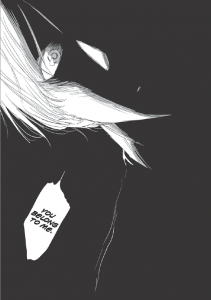
 It’s only at the end of volume three, wherein Hiyakawa nonchalantly suggests that it’d be good if they could work the other side of the business, too, that Mikado realizes he has no idea what kind of person he’s working with. As a reader, I too was lulled into believing that of course the protagonist of a series about fighting the supernatural is a good guy. Turns out, he’s more of an empty-inside opportunist. At this point, even I just want to say, “Run away, Mikado! Run away and don’t look back!” Is there any hope that he can help heal and humanize Hiyakawa, or will he only end up destroyed? How soon until volume four comes out?!