• Skip to primary navigation
  • Skip to main content
  • Skip to primary sidebar
  • Home
  • About Us
    • Privacy Policy
    • Comment Policy
    • Disclosures & Disclaimers
  • Resources
    • Links, Essays & Articles
    • Fandomology!
    • CLAMP Directory
    • BlogRoll
  • Features & Columns
    • 3 Things Thursday
    • Adventures in the Key of Shoujo
    • Bit & Blips (game reviews)
    • BL BOOKRACK
    • Bookshelf Briefs
    • Bringing the Drama
    • Comic Conversion
    • Fanservice Friday
    • Going Digital
    • It Came From the Sinosphere
    • License This!
    • Magazine no Mori
    • My Week in Manga
    • OFF THE SHELF
    • Not By Manga Alone
    • PICK OF THE WEEK
    • Subtitles & Sensibility
    • Weekly Shonen Jump Recaps
  • Manga Moveable Feast
    • MMF Full Archive
    • Yun Kouga
    • CLAMP
    • Shojo Beat
    • Osamu Tezuka
    • Sailor Moon
    • Fruits Basket
    • Takehiko Inoue
    • Wild Adapter
    • One Piece
    • After School Nightmare
    • Karakuri Odette
    • Paradise Kiss
    • The Color Trilogy
    • To Terra…
    • Sexy Voice & Robo
  • Browse by Author
    • Sean Gaffney
    • Anna Neatrour
    • Michelle Smith
    • Katherine Dacey
    • MJ
    • Brigid Alverson
    • Travis Anderson
    • Phillip Anthony
    • Derek Bown
    • Jaci Dahlvang
    • Angela Eastman
    • Erica Friedman
    • Sara K.
    • Megan Purdy
    • Emily Snodgrass
    • Nancy Thistlethwaite
    • Eva Volin
    • David Welsh
  • MB Blogs
    • A Case Suitable For Treatment
    • Experiments in Manga
    • MangaBlog
    • The Manga Critic
    • Manga Report
    • Soliloquy in Blue
    • Manga Curmudgeon (archive)

Manga Bookshelf

Discussion, Resources, Roundtables, & Reviews

Blog

Beast Master, Volume 1

November 12, 2009 by MJ 1 Comment

Beast Master, Vol. 1
By Kyousuke Motomi
Published by Viz Media

beastmaster1
Buy This Book

Yuiko Kubozuka is a seventeen-year-old animal lover whose over-exuberance unfortunately sends the animals she so loves running away from her in fear. When Yuiko’s intrusive attention finally drives her own cat up into a tree, a mysterious young man emerges from the tree’s branches, rescuing the cat and running off into the night. The young man is Leo Aoi, who is soon officially introduced as a new student transferring into Yuiko’s high school class. Leo, who was raised on a remote island and later lived in other areas sparsely populated by humans, is more comfortable with animals than people, a trait that makes him appear frightening to the other students in his class. Eager to thank him for rescuing her cat, Yuiko follows him up to the roof of the school, where she easily befriends Leo, who is grateful to meet someone who isn’t scared of him.

As she gets to know him, Yuiko discovers that Leo actually has a warm, almost childlike personality (as well as a close connection with animals that Yuiko truly envies). Unfortunately, he also has a rather terrifying mental condition that sends him into a violent frenzy whenever he experiences intense fear coupled with the sight of blood. Though this reaction served him well in the wilderness (where he was frequently under attack by wild animals) it makes him a real danger to other humans, and even his legal guardian, Toki, is unable to control him by any means other than shooting him with a strong tranquilizer. It is Yuiko, then, who discovers that she alone has the power to soothe the beast in Leo and bring him out of his frenzy.

Despite its horror-movie title and fairly implausible premise, Beast Master‘s opening volume can best be described as sweet. Both Yuiko and Leo share a kind of open innocence that is undeniably adorable, even when it is responsible for some of their greatest areas of ignorance (such as Yuiko’s consistent failure to understand animals and Leo’s difficulties with humans), and watching the two of them together is pretty charming. This volume includes standard shojo-friendly elements like cute animals, gang leaders with a heart of gold, innocent cuddling, and people doing their best, but regardless of the levels of believability and cliché associated with any of these items (and more) there is an unforced warmth running throughout the story that is pretty difficult to dismiss.

Also, though the premise is pretty simplistic, there is some real depth to be found in the execution for anyone who’s looking. Yuiko’s inability to connect with animals is incredibly painful for her, blinding her to her own strengths. Despite her focus on animals, she possesses an understanding of people that is unusually well-developed, a fact finally pointed out to her by a friend late in the volume, which is undoubtedly responsible for her ability to recognize Leo’s true self while everyone else views him with fear and suspicion. Because of this, she’s able to offer Leo the opportunity to actually live with other humans instead of being caged by them, something she clearly does not recognize the significance of at this point. With Yuiko at his side, Leo is able to safely make a place for himself in the human world, while Leo offers Yuiko the opportunity to learn how to truly love animals rather than simply forcing her will on them, something of which perhaps he truly does not recognize the significance.

With both characters maintaining a level of innocence unusual for their age, the thing that seems most difficult to imagine is romance, though the artwork gracing the volume’s cover (as well as its individual chapters) would indicate that this is where things are headed. This incongruous tone is a bit jarring at this point, and it will be interesting to see how smoothly the author manages to pull that off as the series continues. That said, the fact that the two leads are currently unconcerned with romance is one of the story’s nicest characteristics. Both characters are strong and nicely layered, even early on, and it’s nice to read a school-based shojo manga in which the heroine’s focus is on something other than getting a boyfriend. This is quite nicely reflected in the internal artwork, which is effective (if unremarkable) and nicely restrained, especially in terms of toning.

Though Beast Master is not as immediately addictive as some of its soapier shojo neighbors or as emotionally complex as others, it is both warmer and more thoughtful than its premise would suggest, making it a promising new addition to Viz’s Shojo Beat lineup.

Review copy provided by the publisher.

Filed Under: MANGA REVIEWS Tagged With: beast master, manga

Claymore 15 & a little link-blogging

November 10, 2009 by MJ 6 Comments

claymore15To start things off, I have a review of volume fifteen of Claymore in this week’s Manga Minis column at Manga Recon. Before the eye-rolling begins over the high grades I’ve given recent volumes of Claymore, I’d like to say that I think it has really come into its own as a strong dark fantasy series and that those who dismissed it after the first few volumes are genuinely missing out. It’s true that I’m a patient reader and may enjoy a slow-burning series more than most. I love to watch multiple layers revealed over time, forcing me to continuously re-evaluate what the story is really about, and though it may seem a bit late in the game for the author to begin revealing those layers twelve or thirteen volumes in, in this case I think it’s well worth the wait. There aren’t many series from Viz’s Shonen Jump Advanced line that have endured for me as well as this one. It’s definitely worth a second look….

Read More

Filed Under: NEWS Tagged With: claymore, manga, women in comics

Claymore, Vol. 15

November 9, 2009 by MJ Leave a Comment

By Norihiro Yago
Viz, 200 pp.
Rating: T+ (Older Teen)

Volume fifteen opens with the conclusion to the battle with awakened warrior “Bloody Agetha”—a battle that will soon seem utterly insignificant in comparison to what comes afterward. As the fight ends, the rebel warriors finally reveal their true intentions to Galatea, Clarice, and Miata, after which Miria goes on to divulge what she’s discovered over her many years investigating the Organization, including its origins and true purpose. The truth she’s uncovered is genuinely shocking and as the rebels (along with their new allies) prepare for what may be their final battle, Clare embarks on a side mission of her own to reunite with Raki, the boy she left behind so many years before.

This volume’s new revelations are really quite stunning, pulling the story further into darkness and creating a deeper atmosphere of pathos around both the young women whose futures were sacrificed to make warriors and all the the citizens whose villages have long been plagued by Yoma. It’s difficult to discuss any of it without ruining one of the story’s best plot twists so far, but suffice it to say that the new information is a game-changer all around, giving the series a significant boost of momentum. Adding to this fresh strength is the reemergence of Raki, now a powerful young man, still traveling with Awakened One Priscilla who has become smaller (if not weaker) thanks to several years’ abstinence from eating human flesh.

Those who have followed Claymore to this point have already reaped many of the rewards of Norihiro Yago’s slow and steady approach. Both its plot and characterization have become significantly more complex over the course of the series. Volume fifteen moves all of this yet another great step forward, transforming this series into a real must-read for fans of dark fantasy.

Review copy provided by the publisher. Review originally published at PopCultureShock.

Filed Under: MANGA REVIEWS Tagged With: claymore

Manhwa Monday: The Color of Heaven & Other Stories

November 9, 2009 by MJ 1 Comment

colorofheavenWelcome to the second installment of Manhwa Monday! If you missed it, you can pick up the first here.

Featured today is Chris Mautner’s recent review of The Color of Water/The Color of Heaven by Kim Dong Hwa (published by First Second), which follow up on the series’ first volume, The Color of Earth. As this trilogy ends, the reviewer worries that it may miss finding a real audience, despite its strengths. “But for those willing to walk that line between the two extremes, Hwa’s story remains compelling right up to its happy but slightly bittersweet ending.” I have not read this short series, but Mautner’s review makes me want to. Read the rest of the review here!

In other reviews, Erica Friedman discusses volume four of Click (NETCOMICS) over at Ozaku, Julie checks out volume 2 of Jack Frost (Yen Press) at Manga Maniac Cafe…

Read More

Filed Under: Manhwa Bookshelf Tagged With: manhwa, Manhwa Bookshelf

Goong, Volume 7

November 7, 2009 by MJ Leave a Comment

Goong, Volume 7
By Park SoHee
Published by Yen Press

goong7
Buy This Book

A fire in Daebi-Mama’s quarters sends the palace into an uproar, particularly the Queen who finds Daebi-Mama being relocated to her quarters by order of her husband. Meanwhile, Chae-Kyung overhears something that leads her to believe that Shin may have been responsible for the fire and is surprised by her impulse to protect him regardless of his actions. Still reeling from Shin’s public kiss during a recent press conference, things are made more uncomfortable for Chae-Kyung when the Queen Mother arranges for them to share a room on their class trip. Shin, finding himself intensely attracted to Chae-Kyung since their forced night together in the palace, is no more comfortable than she is, and though a string of misunderstandings and their usual stubborn pride keeps either of them from being completely honest about their growing feelings for each other, they come closer to in in this volume than they ever have before. Most surprisingly, as Shin becomes increasingly aware of both Yul’s ambitions and his own father’s stealthy maneuvering against him, he actually begins to push back, suggesting that he may wish to remain Crown Prince after all.

It’s quite a relief to finally see Shin taking some steps to open up to Chae-Kyung, even bringing himself to thank her when she rescues him from an embarrassing situation on stage in a student play. Whether this is due to a real desire to break down walls between them or just stark fear of losing her to Yul remains to be seen, but either way it’s a pleasure to see. Similarly, his speech to his father in the final chapter of the volume gains him new respect when it’s most needed.

Though it was easier to sympathize with Yul earlier in the series, it is now Shin who seems like the good guy (despite his dismal communication skills) and it will be exciting to see where things go from here, now that he’s really standing up for himself and those he most cares about. Most importantly, he finally reveals to Chae-Kyung the reason behind his early dislike of her and why his feelings have changed. “You looked right into my eyes and asked me so many things,” he says to her, in a flash of rare vulnerability. “You asked me if I ever went to Myungdong or to Dongdaemoon Market or if I’d ever watched a movie in a movie theater. When you talked about your life, I felt like my life was fake.” It is an extremely revealing moment we (and Chae-Kyung) have waited seven volumes to see, and the payoff is definitely worth it.

If last volume’s strife could be mainly chalked up to Shin’s inability to explain his feelings, in this volume the credit goes to Chae-Kyung’s inability to let him. Conditioned now to protect herself against Shin’s coldness as a preemptive measure, she’s having difficulty recognizing what’s changing in him enough to actually let it happen. Fortunately (or unfortunately) it looks like the two of them may soon be in a position where they must stick together just to survive, which will certainly be a trial for each of them as well as for their relationship. Watching the two of them slowly learn to truly care for and depend on each other is one of the best things about this series and though the pace may seem excruciating at times, it’s hard to imagine it playing out any other way.

Though this volume is less emotionally volatile than the last (despite the obvious drama of things such as Shin’s potential as an arsonist) the fact that it actually begins to veer towards romance at long last makes it a real page-turner of the very best kind. Goong continues to be one of the most compelling girls’ comics (Korean or otherwise) I’m currently reading, and definitely a personal favorite.

Review copy provided by the publisher.

Filed Under: REVIEWS Tagged With: goong, manhwa

Demon Ex Machina by Julie Kenner: C

November 7, 2009 by Michelle Smith

demon-ex-machinaFrom the back cover:
With her first husband possessed by a demon and her current husband spending way too much time at home, Demon Hunter Kate Connor is having one hell of a month…

In between demon patrols and teaching self-defense classes for local moms, Kate has to deal with a teenage daughter, who is gung ho about being a demon slayer in training, and a toddler son entering a tantrum phase that rivals anything from the pits of hell.

To make matters worse, ever since her current husband, Stuart, learned about her secret life, he’s been practically smothering her with attention. That wouldn’t be so bad, except now Stuart’s fired up to learn everything he can about demons, and that kind of research can get a former desk jockey killed.

It’s a lot to juggle. And on top of it all, Kate has to find a way to release the demon possessing her first husband, Eric, without destroying the man inside. Because if the demon within Eric gets free, it just might be more than this seriously stressed suburban mom can handle…

Review:
In my review of the previous volume in the Tales of a Demon-Hunting Soccer Mom series, I outlined a formula that Julie Kenner seems to be following in each installment. Let’s see how Demon Ex Machina fares.

1. A demon attacks Kate in her backyard.
Check! This time the demon does not demand information about an artifact required for a ritual, but it does provide a clue by naming the demon (Odayne) dwelling and growing within Kate’s late-but-alive-again husband, Eric.

2. Scattered investigation ensues, taking a backseat to domestic plans. These will include a dinner party.
Check! Most of the “investigation” (and the book) consists of Kate sitting around whining that the only way she knows of to vanquish Odayne is to stab him with some special dagger, but doing so will take Eric along with it. A dinner party is mentioned, but not seen on camera. This time, a house-flipping project is the main domestic subplot.

3. The word “kiddo” will be used a distracting number of times.
Semi-check! It’s used a lot less than in previous volumes, but pops up occasionally.

4. Kate will angst about keeping secrets from her husband.
Check! Stuart knows most everything now, though not about the occasional smoochies Kate enjoys with Eric. Her big secret is not telling her daughter, Allie, about Eric playing host to Odayne.

5. Someone Kate cares about will be kidnapped by the demons.
Check! I almost thought it wasn’t going to happen this time but twenty pages from the end, there it was. So close!

So, yes, more of the predictable, lackluster same. As before, what I find most interesting is Stuart’s reaction to Kate’s doings. Stuart himself isn’t really much of a character, but his pain regarding Kate’s lingering feelings for Eric and his attempts to reconcile himself to her demon-hunting duties supply the most compelling emotional moments this series has to offer. Allie, too, is becoming quite the competent Hunter in her own right and the novel’s conclusion promises further development in her skills as well as a possible departure from the formula I’ve just been criticizing. I am weak against promises such as these, so I’m sure I’ll be back for more when Kenner churns out the next one.

Filed Under: Books Tagged With: Demon-Hunting Soccer Mom Series

Shoujo Art Studio

November 6, 2009 by MJ Leave a Comment

By Yishan Li
Watson-Guptill, 128 pp.

The subtitle of Shoujo Art Studio is “Everything You Need To Create Your Own Shoujo Manga Comics,” an interesting choice considering what is (and isn’t) inside. The fine print on the attached CD points out that users are required to own Adobe’s Photoshop Elements (at the very least) in order to use the files provided—an additional $50 investment casual buyers may not be expecting. On the other hand, one could argue that the CD actually includes so much of “everything,” there isn’t all that much left for the user to create.

What Shoujo Art Studio provides is 67 pages of basic instructions for manipulating the provided images (using Photoshop) in order to create a shojo-style comic, followed by a visual catalogue of the contents of its accompanying CD. The collection of images includes line art for several characters, backgrounds, basic effects, page layouts, word balloons, and accessories (like a bicycle and a cell phone), along with a variety of tones. Characters come complete with an array of possible outfits, hairstyles, poses, and facial features, each in its own layer to be added and removed at will, creating the equivalent of a digital paper doll. Two pages on the topic “Pacing Your Storytelling” are the deepest it goes into anything beyond the most surface elements of manga. The instructions are brief and fairly easy to follow, though Photoshop novices may find that things are not quite as simple as Shoujo Art Studio would have them believe. Though the book is far too basic for even intermediate users, it may move too quickly for some beginners.

<i>Say it isn't so, Kyo-kun!  (Click to enlarge.)</i>

Say it isn't so, Kyo-kun! (Click to enlarge MJ's creation.)

Just as experienced digital artists will find this book of little use, dedicated readers of shojo manga may react negatively as well, particularly to the author’s statements about the nature of the genre which emphasize tired shojo clichés—an attitude that is further reinforced by the choice of artwork included. That said, non-artists will find some enjoyment in being able to “create” something that somewhat resembles a page of manga without having to acquire much in the way of skill. Some elements are more difficult to use than others (this reviewer gave up on toning after one disastrous panel) but the process is surprisingly fun, if undeniably superficial.

Filed Under: MANGA REVIEWS

The Manga Artist’s Workbook by Christopher Hart: A-

November 6, 2009 by Michelle Smith

artistworkbookUsing artwork and text from Hart’s book Manga for the Beginner: Everything You Need to Start Drawing Right Away (Watson-Guptill Publications, ISBN 978-0-307-46270-01), The Manga Artist’s Workbook (subtitled Easy-to-Follow Lessons for Creating Your Own Characters) takes readers step-by-step through the process of creating a character and provides ample opportunities to try out the advice using the tracing and drawing paper included in the book.

The book is divided into sections focusing on different anatomical and sartorial aspects of a character: the head, the eyes, the hands, clothing and costumes, creating natural and action poses, et cetera. The importance of using guidelines to achieve proper proportion and perspective is stressed and the approach is overall a technical one that will require some patience.

That isn’t to say it’s without immediate satisfaction, though. Because of the focus on one element at a time, aspiring artists (or relatively hopeless manga reviewers) can concentrate on adding just one thing to a mostly completed drawing. In the image below, all I did was shade in the eyes and add some hair and it almost looks like I can actually draw!

Unlike some how-to books on drawing manga that I’ve seen, the art in The Manga Artist’s Workbook genuinely looks like manga art. Its lessons are primarily applicable to shojo style, however, which might be an enticement for some and a turn-off for others. Also, as the subtitle suggests, the lessons are all about creating a character; no advice concerning paneling or backgrounds is given. Still, if you’re a shojo artist looking for some hands-on practice, you might want to check this one out.

Review copy provided by the publisher. Review originally published at Manga Recon.

Filed Under: Books

Shoujo Art Studio

November 6, 2009 by MJ 7 Comments

shoujoartstudioJust a quick link this morning to point to today’s Otaku Bookshelf column over at Manga Recon, which includes my review of Shoujo Art Studio, a book that claims to contain “Everything You Need To Create Your Own Shoujo Manga Comics.” You can see what I think about that over in the review and also find the very silly one-page comic I made using the book’s tools and instructions.

Something I didn’t get into too deeply in the review, but which really bothered me while working with this book, is the author’s discussion of the history and nature of shojo manga which claims that “there are really no limits on what can be shown in a shoujo manga,” but then goes on with statements like, “Some heroines are still damsels in distress, but most are independent and successful in their own right. However, supremacy in school or magical combat rarely translates to confidence around boys!” Both the instructions and provided art reinforce the most overdone shojo clichés and it’s difficult to imagine what real fan of the genre could possibly enjoy this or find it of much use. With the background scenery provided–the school, amusement park, girl’s bedroom, etc.–it is a toolkit geared toward creating a parody of shojo manga more than anything else. I can’t even bear to discuss the outfits.

Check out my review for more information on this instructional book. You’ll also find reviews from Michelle Smith and Jennifer Dunbar on two other books of this kind!

Filed Under: Uncategorized Tagged With: manga

Little Fluffy Gigolo Pelu, Vol. 1

November 5, 2009 by Katherine Dacey

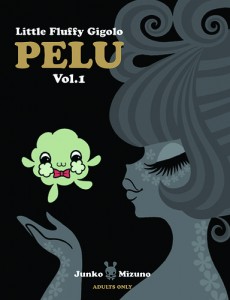
Poignant — now there’s a word I never imagined I’d be using to describe one of Junko Mizuno’s works, given her fondness for disturbing images and acid-trip plotlines. But Little Fluffy Gigolo Pelu is poignant, a perversely sweet and sad meditation on one small, sheep-like alien’s efforts to find his place in the universe.

The story is simple: on the “cute and pink” planet of Princess Kotobuki, Pelu lives with a beautiful race of women and a “calm but carnivorous giant space hippo.” Pelu has always been aware of how different he is from his fellow Kotobukians, but when he learns that he will never be able to have a family of his own, he falls into a terrible funk, begging the hippo to eat him. When the hippo demurs — Pelu is just too woolly to be appetizing — Pelu borrows the hippo’s magic mirror and teleports to Earth in search of others like him. What Pelu discovers, however, is that Earth women view him as an  exotic pet, a companion who’s entertaining but disposable. He careens from one unhappy situation to another, meeting young women who are down on their luck: an aspiring singer with a lousy voice, a homely orphan who’s raising an ungrateful brother, a pearl diver plying her trade in the sewer.

Like Mizuno’s other works, Little Fluffy Gigolo Pelu aims for maximum shock value by depicting cute characters engaged in degenerate behavior: popping pills, doing the nasty in nasty places. Yet Fluffy Gigolo leaves a very different aftertaste than Mizuno’s other manga. Pure Trance, for example, is far less coherent, a set of vivid, Hieronymus Bosch-meets-Hello Kitty set pieces, with doll-like girls binging and purging, brandishing chainsaws, and enduring medical procedures that might give Dr. No pause. One could argue that Pure Trance was intended to point out the absurd lengths to which women go to achieve physical perfection, though one could also argue, as Shaenon Garrity does, that Pure Trance is really a vehicle for Mizuno to draw whatever crazy-ass things popped into her head (i.e. naked, chainsaw-wielding Bratz dolls). Either way, Pure Trance feels like a stunt, its Grand Guignol excesses trumping whatever social commentary might inform the story.

By contrast, Fluffy Gigolo‘s shock tactics serve dramatic and thematic functions, inviting the reader to feel sympathy for Pelu while prompting reflection on pregnancy and motherhood — or perhaps more accurately, the way in which childlessness is dramatized in manga, movies, and soap operas, as if being childless were worse than being afflicted with a terminal disease. “I’m better off dead!” Pelu declares. “I can’t have a baby, and I’ll always be alone for life.” Whether or not Mizuno is striving for deeper social commentary is hard to gauge — after all, her story features copious nudity, drug use, and a teleporting, man-eating space hippo from the Planet of the Dolls — but in Pelu’s odyssey, many readers will recognize the way in which biology, social conditioning, and hormones can prompt us to make compromises in pursuit of motherhood.

LITTLE FLUFFY GIGOLO PELU, VOL. 1 • BY JUNKO MIZUNO • LAST GASP • 168 pp. • RATING: MATURE (NUDITY, SEXUALITY, STRONG LANGUAGE, VIOLENCE, DRUG USE — IN SHORT, THE WORKS)

Filed Under: Manga, Manga Critic, REVIEWS Tagged With: Alt-Manga, Junko Mizuno, Last Gasp

  • « Go to Previous Page
  • Page 1
  • Interim pages omitted …
  • Page 964
  • Page 965
  • Page 966
  • Page 967
  • Page 968
  • Interim pages omitted …
  • Page 1047
  • Go to Next Page »
 | Log in
Copyright © 2010 Manga Bookshelf | Powered by WordPress & the Genesis Framework