Summoner Girl Volume 1
I think with this series, I have contracted a severe case of yokai fatigue. This manga probably won’t interest older readers who are already very familiar with monster hunting storylines from other manga, but I think it would be a fun read for younger readers. Hibiki is a summoner, given the ability to call on spirits that embody the five elements. She’s set on a quest to gather mystical jewels in order to fulfill her destiny to become High Summoner. Hibiki’s sent on quests by her overly enthusiastic grandmother who urges her to ditch school if there’s a spirit nearby that needs hunting. Hibiki is aided by a slightly dim-witted boy named Kenta who possesses some spiritual powers of his own. One aspect of the manga that I thought was interesting was the way Hibiki takes on the personalities of the spirits she summons to help her, for example becoming angry and belligerent when she summons the aspect of fire. Even though Hibiki hunts spirits, her general approach is to try to understand them instead of pounding them into submission with her considerable mystical powers. Hibiki’s spirit aides take the form of cute animals that rest on her shoulders, offering a running commentary on the action
Kubota’s art has a mobile, thin line which blends in cute drawings of Hibiki with elements of the grotesque like a yelling wrinkled grandmother, a house filled with cobwebs, and a snarling fox spirit. The plot was exactly what I’d expect from a yokai manga, without anything extra to draw me in to want to read much more of it. While Summoner Girl didn’t fully capture my attention, I think the combination of Hibiki’s good-willed approach to spirit hunting, demon fighting, and jokey sidekicks would appeal to younger readers. I wouldn’t hesitate to recommend this volume to a young teen wanting a new action series featuring an engaging heroine.
Review copy provided by the publisher

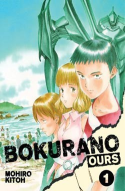 Fifteen kids—most of them, except for one boy’s kid sister, in 7th grade—are taking part in a summer program called “Seaside Friendship and Nature School.” Chafing at the instruction to go out and observe nature, the kids decide to explore a nearby cave, where they inexplicably discover a computer lab and a strange guy who calls himself Kokopelli.
 Bokurano is structured similarly, focusing on each pilot as he or she “gets the call.” There are merits and flaws to this approach: obviously, the current pilot receives a lot of attention, and it’s interesting to see how each approaches the responsibility differently. One boy cares nothing for human casualties while another carefully takes the battle out into the harbor to minimize damage. One girl uses her final hours to sew morale-boosting uniforms for the group. Unfortunately, this also means that at any given time there are about a dozen characters relegated to the background, waiting for their turn to contribute to the story.