• Skip to primary navigation
  • Skip to main content
  • Skip to primary sidebar
  • Home
  • About Us
    • Privacy Policy
    • Comment Policy
    • Disclosures & Disclaimers
  • Resources
    • Links, Essays & Articles
    • Fandomology!
    • CLAMP Directory
    • BlogRoll
  • Features & Columns
    • 3 Things Thursday
    • Adventures in the Key of Shoujo
    • Bit & Blips (game reviews)
    • BL BOOKRACK
    • Bookshelf Briefs
    • Bringing the Drama
    • Comic Conversion
    • Fanservice Friday
    • Going Digital
    • It Came From the Sinosphere
    • License This!
    • Magazine no Mori
    • My Week in Manga
    • OFF THE SHELF
    • Not By Manga Alone
    • PICK OF THE WEEK
    • Subtitles & Sensibility
    • Weekly Shonen Jump Recaps
  • Manga Moveable Feast
    • MMF Full Archive
    • Yun Kouga
    • CLAMP
    • Shojo Beat
    • Osamu Tezuka
    • Sailor Moon
    • Fruits Basket
    • Takehiko Inoue
    • Wild Adapter
    • One Piece
    • After School Nightmare
    • Karakuri Odette
    • Paradise Kiss
    • The Color Trilogy
    • To Terra…
    • Sexy Voice & Robo
  • Browse by Author
    • Sean Gaffney
    • Anna Neatrour
    • Michelle Smith
    • Katherine Dacey
    • MJ
    • Brigid Alverson
    • Travis Anderson
    • Phillip Anthony
    • Derek Bown
    • Jaci Dahlvang
    • Angela Eastman
    • Erica Friedman
    • Sara K.
    • Megan Purdy
    • Emily Snodgrass
    • Nancy Thistlethwaite
    • Eva Volin
    • David Welsh
  • MB Blogs
    • A Case Suitable For Treatment
    • Experiments in Manga
    • MangaBlog
    • The Manga Critic
    • Manga Report
    • Soliloquy in Blue
    • Manga Curmudgeon (archive)

Manga Bookshelf

Discussion, Resources, Roundtables, & Reviews

Blog

Random Musings: Tokyo Demons

April 27, 2013 by Ash Brown

Last week I reviewed Tokyo Demons, Book 1: You’re Never Alone by Lianne Sentar. Long story short, I loved it. In the process of writing the review, I quickly discovered that there was a lot more that I wanted to say about Tokyo Demons in general. Serialized online and written in the tradition of Japanese light novels, Tokyo Demons has expanded to include dramatized audio books, comics, short stories, games, and more. Since reading the first volume, I’ve nearly become obsessed with Tokyo Demons in all of its incarnations. Seriously, I haven’t been this excited about a series in a very long time. So please excuse me while I gush about it for a bit.

The Story
Tokyo Demons will be a trilogy although two sequel series, Tokyo Ghosts and Tokyo Angels, are planned as well. To be honest, Tokyo Demons is a little weak in the beginning; I was even a little worried about some of the potential cliches. But after a few chapters, it really takes off and the scope is huge. The story is packed with action, cussing, humor, supernatural abilities, drama, and awkward teenage romance. Overall, I found it to be exciting, engaging, and entertaining. Tokyo Demons can also be rather dark and tragic at times. Terrible things happen to the characters in both the past and the present. The characters’ relationships to and with one another–romantic, platonic, familial…the list could go on–are also extremely important to the story.

The Characters
And speaking of the characters, they are one of the reasons that Tokyo Demons works so well for me. The entire cast has a lot of personality (which happens to come across fabulously in the audio drama.) The characters have layers and they’re not always particularly likeable at first. But as Tokyo Demons progresses more and more is revealed about them and they grow and change over time. The characterizations are complicated and the morality is often grey–the protagonists and antagonists have both good and bad qualities and it’s not always easy to tell who belongs in which group. The characters don’t fit into neat little boxes or stereotypes.

The Goods
The serialized version of the novels and the audio drama are available for free online at the Tokyo Demons website. Other bonus materials are also available for free: character guides, relationship charts, timelines, comics, illustrations, previews of the short stories, and so on. The Tokyo Demons visual novel Get It Together and the card game Your Number’s Up are currently in production. The finalized editions of the materials (both physical and digital) as well as additional content only available for purchase can be found through the Tokyo Demons store. Also available through the store are art prints, posters, bookmarks, key chains, buttons, and other merchandise.

The Creators
Lianne Sentar is Tokyo Demons writer and head administrator. She works very closely with Rebecca Scoble who serves as the head editor in addition to producing and directing the audio dramas. They are supported by multiple illustrators, designers, and an entire cast of voice actors. It’s obvious from wandering around the Tokyo Demons website and listening to the free talks that the creators have a tremendous amount of love for their work. They are all enjoying themselves and have a great sense of humor. Their enthusiasm is persuasive. In addition, Lianne and Rebecca are particularly accessible to fans on the website and through other social media outlets. My personal interactions have all been wonderful. (It’s nice to know that they’re great people.)

The Fans
I’ll readily admit that I tend to be more of a lurker when it comes to online communities but there are plenty of other fans of Tokyo Demons who regularly comment on the the site, interact with each other, and show their support through fan art and fan fiction (which the creators wholeheartedly encourage.) In 2012, a Tokyo Demons Kickstarter project was launched to fund the second novel and better audio equipment. It reached more than double its initial goal. In fact, there has been so much support for Tokyo Demons that the creators were able to quit their jobs to focus on Tokyo Demons and their manga-industry work full time in addition to helping to launch Chromatic Press.

The Publisher
In part, Tokyo Demons served as a test project for the newly formed Chromatic Press as a way to explore publishing formats and distribution models and to determine what sorts of multimedia opportunities would be possible. The first novel is currently being revised for a new Chromatic Press edition and the series will continue to be released by the publisher–Tokyo Demons is one of the flagships for Chromatic Press. I am very excited to see what Chromatic Press has in store, not just for Tokyo Demons but for all of its titles.

Filed Under: UNSHELVED Tagged With: Chromatic Press, Lianne Sentar, Rebecca Scoble, Rem, Tokyo Demons

The CMX Project: Cipher

April 26, 2013 by Michelle Smith and Karen Peck

cipher1MICHELLE: Hello, and thanks for joining us for the second installment of The CMX Project, in which we turn our attention to Cipher! (Please kindly overlook the fact that this column was promised for February; life has a nasty habit of upending one’s plans.) This month we’ll also have a special guest, but before the big reveal, how about another of your fabulous summaries, Karen? (Since you did so well with
Land of the Blindfolded!
)

KAREN: Goodness, Michelle, all that praise is going to go to my head!

This month we have Cipher, by Minako Narita. Published by Hakusensha, it ran in Lala and Lala DX in the early/mid-’80s. Narita began working in the ’70s, with an eight-volume series (Alien Street) coming before Cipher. She would later go on to do a sequel to Cipher, Alexandrite, and her current work is Hana Yori Mo Hana No Gotoku, coming out very slowly in the bimonthly magazine Melody.

Cipher is the story of Anise, a girl in high school in New York City in the 1980s, and how she pursues a friendship with former child star Siva, breaking through his cool detachment with the force of her personality. Through Siva, she meets his twin brother Cipher, and discovers a mystery surrounding the brothers—that they’ve been changing places with each other for years. Which one is which? And why do they do this? I feel as if I’m not crafting a summary that does the story justice; instead, I hope our conversation will unfold just like the story—there’s a lot of layers to peel back, but I found the effort to do so very worth it.

But before I start going on and on, Michelle, please tell us about our special guest this month!

resized1MICHELLE: Well, I have the good fortune to be Facebook friends with none other than Asako Suzuki, who was director of manga at CMX from 2006 until its untimely death! I shared our Land of the Blindfolded column with her, and when she mentioned that her favorite CMX series was Cipher, I invited her to join us!

Welcome, Asako!

ASAKO: Hi Michelle and Karen! Thank you for having me, and thank you VERY much for this wonderful project remembering CMX! I am honored and excited to be with you today to talk about my favorite manga series, Cipher!

Cipher is a very special manga series to me, and I have lost count of how many times I read it. In fact, I have just read the entire series (of course in Japanese) not long ago.

MICHELLE: Can you tell us how Cipher came to be licensed and published by CMX?

ASAKO: Actually, I inherited Cipher with some other early acquisitions when I joined CMX. That being said, before I joined CMX, I assisted the acquisition team and made some suggestions. Cipher (and [a] few other titles that were eventually published) was one of the titles I recommended, but I didn’t know if DC Comics had acquired it or not until I started my position. When I saw it on our production schedule, I was very happy!

KAREN: Wow, Asako, that must have been a great surprise to come into CMX and see Cipher there!

resized3Now that I’m past the awesome summary-writing part, I can give my opinion—that I loved this title. I went in with preconceived notions—that this was That ’80s Manga. And while yes, it is very much set in the ’80s, it’s not done with artifice. It’s clear that Narita adored American pop culture—she even mentions doing a Thompson Twins doujinshi!—and it’s all done so lovingly. Real teens are a part of the music, movies, and current events, and it’s only in hindsight that the ’80s seem so cheesy. She also doesn’t gloss over some of the gritter aspects of the times—New York was still recovering from a terrible ’70s. Ironically, Cipher and Siva’s apartment is now in a very trendy area!

What surprised me was how the story was very much a coming of age tale—and not just for the heroine, Anise, but for the boys as well. At times, especially in the second half, she’s much more in the background, but her role seemed to be as much as a catalyst to make the bigger, darker story of the twins happen. Anise is still very childish at 16—there’s the very funny part where it’s pointed out that she really, really needs to start wearing a bra—despite her maturity and insight in some areas, she’s having a hard time seeing herself as growing up.

And then we have our former-child-star twins, Siva and Cipher (whose real names are Jake and Roy, respectively). Michelle and Asako, what’s your take on them? And do you still love the ’80s?

MICHELLE: Similar to Land of the Blindfolded, this is another case where focus drifts from the heroine and onto the two boys in her life, who each have past trauma to deal with. Anise isn’t as perpetually sunny as Kanade, but she’s still much less interesting than the twins. Or, rather, I felt like Narita-sensei was less interested in exploring her as a character. It was especially odd to me that we never learn what her focus is at the performing arts school! She narrates in volume one that “lots of people come to this school hoping to become painters, dancers, musicians, or actors.” So, which is Anise? What is her ambition for being there? As someone who actually attended a performing arts school, your “major” was vitally important.

So, that said, I feel a little grumpy that the boys got so much more love, but can’t deny that they’re pretty fascinating. I especially like when the story begins to focus more on Siva and we see events from his perspective that we later see again from Cipher’s perspective. Siva felt that Cipher’s openness made him more easy for his parents to love, while Cipher felt that Jake’s reliability made his own behavior seem childish in comparison. I also really liked how the friends they make while they’re apart affect them.

resized6

ASAKO: I am a huge fan of Anise; she was my hero! The reason why I wanted to come to the United States was because I wanted to be like, and live like her. To me, Anise was more realistic and easy to relate to compared to other manga protagonists, thanks to Narita-sensei’s amazing psychological descriptions throughout the series.

Narita-sensei is an amazing writer; I can easily tell how much she loved her characters, and she treated each differently. The way she shifted focus from one character to another was just incredible. I actually had a deep conversation with one of the manga editors in Japan (can’t say who!) about Cipher and how talented Narita-sensei is!

See, Narita-sensei introduced Cipher and Siva to us through the eyes of Anise and once we got to know the twins better with Anise, we were able to learn more about them individually through the twins’ perspectives. If Anise stayed as the center of the story the whole time, the story would have been shallow. With appearance of Dana, the focus was subtly shifted to Jake, and we got to know the secret of the twins and why Jake was protective yet envious of Roy. Then we learn more about Roy in LA… I really enjoyed the multi-dimensional story telling.

resized7

Speaking of details, have you noticed of the characters’ mix-and-match wardrobes? That’s amazing!

Also, there is something I have always wanted to know and never understood… can I ask you both a question? When you say “manga from the ’80s,” what does that mean? How do you distinguish the manga from the ’80s from the recent ones and why would you get less excited about manga from the era? That always puzzled me…

KAREN: Michelle—I wondered that too! I was really hoping she would have some great talent that drove her to commute all the way in from Queens!

I missed Anise during the second half of the series when the twins separated. She was still there, but the second half was really about the twins apart, and each making friends on their own, without having the other to hide behind. I don’t understand why some places categorize this as a shounen-ai title, the only love is friendship and the twin’s kissy-kissy… is anything but that.

There’s a lot of subtle tonal shifts in the story—the Dana storyline being one of them—a beautiful, talented young girl on the verge of falling in love and being loved is tragically, suddenly killed, and it has a way of breaking apart the entire premise of the story. The twins don’t just grow apart, they fly apart—Roy quite literally to the West Coast, leaving Anise behind. The ruse of one twin playing another will never work again, so they had to be apart, and make friends on their own terms, and the switching between coasts feels like two different stories but… they mirror each other, like Cipher and Siva did. Alexandra and Hal are different people, but they carry their own insecurities and pasts into their friendships—friendships they needed as badly as Jake and Roy did.

resized11

I didn’t notice the wardrobes, except that I loved how detailed they were. Narita-sensei must have been importing magazines! It stuns me about the accuracy of the details—reading this series sent me into a flurry of research (yes, with the extensive use of Google Maps) and it’s amazing that she did this in the pre-internet era—unless she was here herself? Asako, do you know any of that background? She did three series set in the US so it really seems she had a feel for the place.

To answer your question, Asako, and “’80s manga” generally means the style of art that I think is viewed as rather old-fashioned—not as extreme as ’70s manga, but it still looks “dated.” However, Narita-sensei’s art doesn’t suffer as much in comparison, and I think the rep that this title has for being an ’80s manga has is because it’s set in the 1980s, and references to George Michael and Hall and Oates are funny to a modern reader who looks at it all through a lens of nostalgia. I personally adore older manga, and wish there was more of it, but sadly publishers have said it doesn’t sell—that’s one thing I loved about CMX was that they brought out Swan and Cipher.

Speaking of art, I found it very well done, and I really want to hunt down one of those out-of-print artbooks now!

MICHELLE: I think there’s a general sense of affectionate amusement about most things coming out of ’80s culture, really. I love ’80s manga, personally, but yes, I did find it pretty funny when a dancing Cipher is deemed to be as cool as Michael Jackson, or when Narita-sensei professes in the comments, “The source of my strength, just like always, has been The Thompson Twins.”

Asako, you make a great point about Narita’s layered storytelling. I didn’t think of it like that—introducing us to the twins first through Anise’s eyes, then widening the story’s scope with a purposeful sequences of events. I really loved each brother’s relationship with his newfound friend. We learn that Roy felt that he behaved childishly in his past, and so perhaps he had tried to grow up too fast and hadn’t enjoyed some of the simpler pleasures that Hal makes it his mission to introduce him to. Jake felt he always had to be the reliable one—in fact, he wanted to be needed—but then he makes friends with Levine (aka Alex, Alexandra), who is sensitive but also resilient and tough.

resized14

When Jake first meets Levine, he can’t bear to think of Roy and Dana at all, but gradually he allows himself to think about them, and then to talk about them. When one of Dana’s relatives has a baby and names it after her, Jake instantly adores the girl, and ends up breaking down a barrier with his mother for her sake. It all seems to happen very naturally. Too, I love that when everyone meets up again at the end, Hal and Levine are completely baffled that anyone could’ve ever mistaken one twin for the other.

And I, too, appreciated the details that Narita-sensei got right. I was delighted to note that, in one scene, characters are eating an Old El Paso dinner kit of some sort.

resized12

ASAKO: In the first volume of the Tankobon edition, Narita-sensei talks about her trip to NYC, and she shares some pictures that she took during the trip. It sounds like she toured different neighborhoods to choose the neighborhood where twins and Anise should live. I thought it [was] funny but I was impressed at the same time that Narita-sensei even took pictures of TV commercials she watched in her hotel room. (Did you notice Cipher was watching a Betty Crocker’s new cake mix commercial?!) Very detailed artist.

Ah, thank you for explaining about the ’80s manga. To be honest, I have never thought of manga [as] “dated.” Well, in retrospect, I did notice different printing/layout techniques and art style. Maybe I am more comfortable with the ’80s manga because that’s what I grew up reading. Haha.

Back to Cipher, may I ask who is your favorite character(s) and why? I’m curious.

KAREN:That’s great to know some of the background of the creation! I think we’re all so spoiled with just being able to Google everything that people forget how hard it was to do research on such mundane topics—like cake commercials—in those days.

Asako, since you’ve had the advantage of seeing the Japanese versions, I had two questions—what is volume 12 of Cipher about? I’ve seen it listed on information sites and on Amazon.jp—is it side stories or does it add something? Also, have you read the Alexandrite sequel series—how is it in relation to Cipher?

My favorite character in Anise. She’s the entry to the world, and even when she’s in the background, she plays an important role. For all of the ways that she seems a little less mature, she shows such kindness and understanding, and that’s what breaks the shell around the twins. She can tell them apart at the end of the “challenge” but chooses not to—but she’s already opened up their world. I like her spirit, and watching her mature through the course of the series. It may not be as dramatic as what happens to Roy and Jake, but she becomes an important part to helping Jake discover his new life and gives Roy the space he needs until a reconciliation can happen.

I also like Hal—he’s so goofy at first but turns out to be so endearing.

resized13

MICHELLE: I really like Hal, too, but I’d have to say my favorite is Siva. I like his complexity in that he’s the reliable one who is secretly dependent upon being depended upon, and I like how experiencing love (for both Danas, the original and her namesake) frees him to become his own person and to begin to understand the pain of others.

ASAKO: To be honest with you, I don’t remember what was in the twelfth volume. As soon as the bunko edition came out, I gave my tanko edition to my best friend (here in the US). That was long, long time ago. I vaguely remember it was about Levine, but I am not entirely sure. I’m sorry!

Dealing with the difference between tanko edition and bunko edition was a challenge for CMX. We had to make the English edition of the original tanko edition off of the bunko edition—does that make sense?? (:D). The pagination and proportion differences required a lot of effort on our end, and what’s more, cover materials were provided in transparencies (positive films), so they had to be scanned, cleaned and color corrected before we could use on the covers. It happened many times for other CMX books, too, but some of the cover images were not available from the licensor, so we had to scan art books or whatever the resources we could find (and of course, with Licensor permission and extensive approval process) to come up with something.

KAREN: That’s great information, Asako—but I think CMX did a great job, the covers especially were very pretty. Other companies seemed to have problems reformatting the Hakusensha-style “box on the cover” design to something that works in the American market, but this was very well done. Speaking of artbooks, I’m going to have to chase down that out-of-print artbook that came out way back when.

Cipher is thankfully one of those titles that’s easy to collect—it’s all out-of-print, of course, but most volumes go for well below cover, and a couple of others are above cover but nothing crazy—it’s an easy one to collect, so that shouldn’t be a deterrent to hunting down and enjoying this title. Yeah, it’s set in the ’80s, but there’s so much more to it than that.

MICHELLE: We hope we’ve inspired you to check it out, and would also like to extend our very sincere thanks to Asako Suzuki for joining us for this conversation!

ASAKO: Thank you for having me! Looking forward to more CMX reviews in the future!

MICHELLE: You’re in luck, because Oyayubihime Infinity is up next!

Filed Under: FEATURES, The CMX Project Tagged With: cmx, Minako Narita

Square Enix to shut down digital manga sites

April 26, 2013 by Brigid Alverson

Square Enix is shutting down its U.S. and French digital manga sites; they were so loaded down with DRM and bad design that it’s doubtful anyone will miss them. In case you did succeed in buying manga from them, here’s a page describing how to continue reading your purchased books; unfortunately, it’s only for Windows users. The good news is that Yen Press will start distributing Square Enix manga digitally sometime this year, so a better system will soon be in place.

Lissa Pattillo picks the best of this week’s new manga in her On the Shelf column at Otaku USA, and at Manga Bookshelf, the team looks over next week’s new releases.

Reviews: Carlo Santos gives us a quick rundown of recent releases in his Right Turn Only!! column at ANN. Ash Brown looks back on a week’s manga reading at Experiments in Manga.

Connie on vol. 1 of 07-Ghost (Slightly Biased Manga)
Connie on vol. 11 of 13th Boy (Slightly Biased Manga)
Connie on vol. 2 of 21st Century Boys (Slightly Biased Manga)
Erica Friedman on vol. 2 of Angelic Layer (Okazu)
Sean Gaffney on vol. 1 of Angel Sanctuary (A Case Suitable for Treatment)
Matt Cycyk on vol. 7 of Animal Land (Matt Talks About Manga)
Connie on vol. 16 of Bakuman (Slightly Biased Manga)
Leroy Douresseaux on vol. 8 of Bokurano: Ours (The Comic Book Bin)
Anna on vol. 1 of Crimson Empire (Manga Report)
Leroy Douresseaux on vol. 9 of Dorohedoro (The Comic Book Bin)
Sean Gaffney on vol. 9 of Dorohedoro (A Case Suitable for Treatment)
Kate O’Neil on vol. 9 of Dorohedoro (The Fandom Post)
Matthew Warner on The Drops of God: New World (The Fandom Post)
Kate O’Neil on vol. 25 of Excel Saga (The Fandom Post)
Traci on vol. 1 of The Infernal Devices: Clockwork Angel (Experiments in Manga)
Matt Cycyk on vol. 2 of Knights of Sidonia (Matt Talks About Manga)
Daniella Orihuela-Gruber on Love Makes Everything Right (All About Manga)
Lesley Aeschliman on vol. 1 of Mixed Vegetables (Blogcritics)
Matt Cycyk on vol. 1 of Mobile Suit Gundam: The Origin (Matt Talks About Manga)
Matt Cycyk on NonNonBa (Matt Talks About Manga)
Lesley Aeschliman on vol. 9 of Oh My Goddess (Blogcritics)
Lesley Aeschliman on vol. 10 of One Piece (Blogcritics)
Connie on vol. 5 of Pokemon Adventures (Slightly Biased Manga)
Matthew Warner on vol. 11 of Rosario + Vampire: Season II (The Fandom Post)
Connie on vol. 7 of Sailor Moon (Slightly Biased Manga)
Helen on vols. 9 and 10 of Sailor Moon (Narrative Investigations)
Lesley Aeschliman on vol. 10 of Sailor Moon (Blogcritics)
Connie on vol. 9 of Sakura Hime (Slightly Biased Manga)
Derek Bown on this week’s issue of Shonen Jump (Manga Bookshelf)
Victoria K. Martin on vol. 11 of Soul Eater (Kuriousity)
Matthew Warner on vol. 2 of Strobe Edge (The Fandom Post)
Lesley Aeschliman on vol. 3 of Strobe Edge (Blogcritics)
Connie on vol. 11 of Toriko (Slightly Biased Manga)
Drew McCabe on Unico (Comic Attack)
Matthew Warner on vol. 16 of Vampire Knight (The Fandom Post)
Connie on vol. 3 of X (Slightly Biased Manga)

Filed Under: MANGABLOG

Manga the Week of 5/1

April 25, 2013 by Sean Gaffney, Michelle Smith and MJ 2 Comments

Tagame-cover-sketch-1SEAN: Given that most companies regard 5/1 as 4/31, it’s no surprise that there’s not a lot of stuff this week. Trust me, that giant pile of Viz will be waiting for you on 5/8. In the meantime, let’s turn our attention to other offerings.

It has to be said, the most anticipated book for this week is definitely not for the kids. That said, the buzz for The Passion of Gengoroh Tagame: The Master of ‘Bara’ Manga is really high. This is not cute BL with pretty androgynous boys manga. This is MANLY gay manga, with lots of MANLY bondage and discipline. In fact, it’s quite violent and filled with sadism, I hear. But if you want a taste of something different, and don’t mind explicit stories, Picturebox has the collection for you.

MICHELLE: Sometimes one can be glad something exists without really wanting to check it out for themselves. This is one of those times.

MJ: I might check this out, though my threshold for sadism is relatively low.

SEAN: Vertical’s lone print offering this week is Vol. 4 of the Stan Lee penned Heroman, which is a must for manga fans who also love Stan Lee.

twinspica1MICHELLE: I do have to wonder how many such fans exist.

MJ: I wish I could like this, just for Vertical’s sake. I really do. Does that count for anything?

SEAN: The big news from Vertical is digital, though, as three of their series are available on Kindle and Nook as of April 30th. 7 Billion Needles is gripping sci-fi horror, Drops of God is a wine lover’s dream, but the big news for me is the now out-of-print series Twin Spica getting its first two volumes out. Twin Spica is the brilliant and heartwarming epic about a girl who yearns to be in space, and it never did as well here as I’d hoped. Here’s hoping that a digital release will give it new fans!

MICHELLE: That’s a hope I can share!

MJ: Now, this is something to cheer about. It makes the whole week, really!

SEAN: So what’s your kink this week?

Filed Under: FEATURES, manga the week of

Guest Post: The Infernal Devices Vol 1: Clockwork Angel: Manga Review

April 25, 2013 by Ash Brown

Not too long ago I reviewed The Infernal Devices, Volume 1: Clockwork Angel, HyeKyung Baek’s graphic novel adaptation of Cassandra Clare’s novel by the same name. While I am familiar with The Infernal Devices, I haven’t actually read any of the original trilogy. I do, however, know people who have and thought it might be interesting to get another perspective on the work. And so I decided to bribe my good friend Traci with manga in exchange for her thoughts on the adaptation. The video below (a first for Experiments in Manga) is the result. I’m extremely excited that she agreed and am very pleased to welcome Traci to Experiments in Manga!

Hello, all. My name is Traci and I am the mastermind behind the alwynuu channel and Traci Reads vlog on YouTube. I am a photographer by passion and trade and a wanderer, philosopher, and reader by desire and happenstance. I enjoy most things geeky and nerdy, odd literary adaptations, and any genre that includes some form of magic or supernatural business. Don’t be shy. Drop in on occasion and see what I’ve gotten up to and where I’ve wandered.

* * *

Filed Under: UNSHELVED Tagged With: Cassandra Clare, comics, Hyekyung Baek, Infernal Devices, yen press

Crimson Empire, Vol 1: Circumstances to Serve a Noble

April 25, 2013 by Anna N

Crimson Empire, Vol 1: Circumstances to Serve a Noble by QuinRose and Hazuki Futaba

I have a weakness for romance titles with ridiculously long titles in either manga or prose format. There’s something about the inherent ridiculousness of a title like “The Sicilian’s Ruthless Marriage Revenge” that makes me want to read it! If a romance title has five words or more, I’m usually entertained if I’m in the mood for some light reading. My decision to pick up Crimson Empire was largely due to the title, combined with the fact that it is another Quinrose title. I enjoyed the first Alice in the Country of Hearts manga adaptation well enough, so I was curious to see if I’d also like a different manga title from the brand without the literary connection.

Crimson Empire has a potentially amusing protagonist in Sheila the former assassin turned royal bodyguard and head maid, but the story in the first volume isn’t all that compelling as it mostly involves Sheila meeting an endless progression of handsome men. This is only what one could expect in a manga based on an otome game, but there were enough interesting elements that I would probably check out the second volume. This manga opens in a very dark way as one of the turning points of Sheila’s childhood is portrayed when her assassin trainers tell her to kill a random man. She does fulfill her duty, but not without a lot of trepidation. Years later Sheila is ready to accept her first official assignment, and she ends up as a bodyguard to the royal Prince, instead of joining the assassin league that has served as her foster family.

Prince Edvard is blond, charming, and the target of frequent assassination attempts which Sheila foils. He also might be a bit of a sociopath, as his outward personality masks an inner emptiness and pathological self-regard. Edvard’s older brother Justin is the tall, dark, handsome, and tsundere hero of many a female protagonist’s dreams. His outward hostility towards Sheila leads her to wonder if he’s behind all the attacks on his brother, but Justin always seems to be in the right place at the right time if Sheila needs a bit of help. There’s an almost too-large cast of supporting characters that Sheila meets as she goes about her duties. While the art is capably executed, it doesn’t have much of a distinct style. Fortunately the character designs are all very good, which helps the reader distinguish a little bit between the Brainy One, the Mischievous One, the Sorcerers One, the Demonic One, the Well-Dressed One, and the always essential Guy Wearing Glasses.I’m being a bit snarky, but overall I did like reading this manga, and I would follow the series if the next volume shows signs of a more interesting plot. If any more characters are introduced I might give up on the series because I can barely remember everybody! Fans of reverse harem manga would likely enjoy Crimson Empire, Vol 1: Circumstances to Serve a Noble, and at least Sheila’s bodyguarding duties give her a more interesting background than many of the heroines of the genre.

Filed Under: REVIEWS Tagged With: crimson empire, Seven Seas, shoujo

Dorohedoro, Vol. 9

April 25, 2013 by Sean Gaffney

By Q Hayashida. Released in Japan by Shogakukan, serialization ongoing in the magazine Ikki. Released in North America by Viz.

This bright pink volume of Dorohedoro feels very much like the calm before the storm, or the sort of thing that ends with the tag ‘End of Part One’. There’s not as much pulse-pounding action here, and the revelations are still mostly hinted rather than stated outright. But we’ve almost got Caiman’s past, and we’re starting to learn Nikaido’s, and it’s going to turn out SO BADLY for both of them, isn’t it?

dorohedoro9

I especially feel as if I may have seem the last of Caiman, at least as Caiman, and that’s a shame, as he’s such a big, lovable doof. With a lizard head. But he’s always wanted to retrieve his memories, and is now starting to see the downside to all of that. Unfortunately, it’s not really something he can stop doing, either. Hayashida, by the way, does a terrific job of showing just how agonizing Caiman’s ongoing headaches are – including giving us an x-ray of his brain to drive it home!

Meanwhile, Shin and Noi are also hot on the trail of the cross-eyes’ boss, despite him possibly being dead. This leads us to the funniest moment of the series, where we meet the boss’ grandfather, and react to his appearance. Even in the most horrible moments, Dorohedoro still finds a way to be completely ridiculous, and it’s a big reason why I love it as much as I do. If this series didn’t have a high level of comedy and weirdness, it would simply be too bleak to function.

Meanwhile, I can’t really feel bad for Chota – who brought it all on himself, and makes things even worse towards the end. What we do get via his character, however, is the start of Nikaido’s backstory, as she began to keep a diary while at En’s so that she didn’t lose herself. (I’ll be honest, at first I thought the diary would be a giant fakeout, but the flashbacks do seem to make it genuine.) Little Nikaido is absolutely adorable, and you know her backstory is going to be amazingly wretched, so I’m just enjoying the tiny kid messing around with time magic while I can.

And of course I would be remiss if I didn’t discuss the omake chapter at the end. Shin and Noi are my favorite characters in the series, and I also tend to ship them. So far, though, any in-series romance has been just tease. It’s clear that Noi has a crush on Shin, but his feelings for her have been more ambiguous. Now we get a flashback to Shin from ten years ago, forced to attend a masquerade ball by En where he has to dance or get poked by devils with a pitchfork. (This sounds like most of the junior high dances I attended, only everyone usually chose the pitchfork over dancing with girls.) Shin looks adorably cute here, and his dance partner even more so. I love seeing side stories like this.

All in all, another solid volume of Dorohedoro. I see in addition to Scott Pilgrim’s creator giving a blurb, the man behind King City is also praising the series. Viz should be happy. It may not generate Naruto sales, but Dorohedoro has become one of their prestige series, and needs more love. And gyoza. It always needs more gyoza.

Filed Under: REVIEWS

Comic Conversion: The City of Ember

April 24, 2013 by Angela Eastman 3 Comments

The City of Ember | Novel: Jeanne DuPrau / Yearling | Graphic Novel: Dallas Middaugh & Niklas Asker / Random House Children’s Books

The City of Ember CoverOver 200 years ago, the City of Ember was created by the Builders, and now the citizens exist in a perpetual darkness only broken by the electric lights in their homes and lining the streets. But the lights keep going out, and the city’s power source, an ancient generator that no one understands, is constantly failing. Twelve-year-old Doon is determined to find the solution and save the city, but keeps hitting dead ends until his friend Lina finds a strange paper inside a lock box. Thanks to her baby sister, the words—written with the strange, typed script of the Builders—are only half-legible, but she can make out one: Instructions. Certain these are instructions for an exit, Lina and Doon set to deciphering the words so they can follow the directions out of Ember. But with everyone so certain that there is no escape, they find more resistance than they bargained for.

Released in 2003, Jeanne DuPrau’s The City of Ember gave us a teen dystopian novel before The Hunger Games was even a thing. There have since been three sequels and a 2008 movie adaptation, but it wasn’t until September, 2012 that Random House published a graphic novel adaptation. Adapted by Dallas Middaugh and illustrated by Niklas Asker, the comic takes DuPrau’s deeply shadowed world and attempts to bring it to life.

The City of Ember has an immediately interesting premise: two children in a city with perpetually depleting supplies who together find a way to save their people. The characters don’t know why they are there, and they don’t even know why it is always so dark (though readers will probably make their own accurate guess about that). The characters are also much more layered than expected. Doon wants to figure out the answer and save everyone, but it’s partly because he wants the glory of being Ember’s hero so his father, a kind man, can be proud of him. He’s also plagued with a volatile temper that often hinders him. Lina has fewer of these problems—too busy taking care of her sister, a toddler, and her ill grandmother. But she is sometimes overcome with desires—the best job, a pack of colored pencils (rare), a can of pineapple (rarer)—that she momentarily loses sight of important things, like Doon’s concern or her sister. These all add up to make Doon and Lina more sympathetic, as we see pieces of ourselves in them, and even increase our anxiety and investment, as we see how they’ve gotten in their own way before they even realize.

The big problem I had with the novel was the pacing. While the opening gets us right into the story with the choosing of jobs and Doon’s concern over the power and food supply, it’s mostly a slow buildup of information until about a third of the way through the book, when Lina finally finds the Instructions. And after that things move slowly as Lina struggles over each word and tries to get others to help her, like the mayor or her flighty friend Lizzie, who obviously don’t care about her discovery. Things do pick up once Doon gets involved and they start to solve the puzzle. Also, the anxiety does build up at the end as we see how Doon and Lina messed up in their decision to wait on revealing their discovery, and find themselves on the run.

The City of Ember GNAsker did a decent job portraying the darkness of this world in the graphic novel, even filling the gutters with black, and his detailed sketchings of rooms and buildings display the drabness of everything: the cluttered rooms, and clothing and items drained of color from their multiple uses. Asker also understands the importance of silence as he draws out moments like Doon’s exploration of the Pipeworks, and seems to know that narration is entirely unnecessary if his art and panel order are clear, such as when Lina discovers her grandmother has died in the darkness of night.

Dallas Middaugh must have noticed similar issues with the pacing when he adapted the story. Very quickly we see that he cut things out to keep the story from coming too much to a pause, like Lina’s friend Clary (whose important actions are performed by Mrs. Murdo) and even Lina’s failed attempts to show the Instructions to people other than Doon. Trimming the plot helps the pace of the story, but it also alters the emotional effect many of the novel’s scenes had. One big example, which seems very small, is when Lina goes to buy colored pencils from the shop. First, because we missed the prior scene of her aching to just go look at them, we don’t get Lina’s experience of coveting something that others don’t have, which becomes important when Lizzie and then the mayor are discovered to be hoarding rare food. This also diminishes our perception of Lina’s guilt when she loses her sister, Poppy, because she’s too busy debating on whether or not to buy the pencils. So while Asker does an excellent job of showing us a stricken Lina as she watches Poppy sleep later that night, we don’t have as clear of a sense that this is her fear combining with her own extreme guilt.

Jeanne DuPrau’s original novel has a fascinating premise that is riddled with anxiety from the first pages. Its slow trek towards the point keeps it from being as immediately exciting as something like The Hunger Games, but DuPrau starts to make up for this in the faster-paced climax. Middaugh and Asker’s adaptation moves the plot along more quickly and manages to convey enough background information through invented dialogue. But certain things are lost—Lina’s guilt, Doon’s temper, and the panic of other citizens that causes some to run out into the the darkness in hope of finding light—that diminish the characters, flatten them, and turn them into people we’re just not quite that invested in. So while The City of Ember graphic novel effectively gets the story across, it just doesn’t have enough feeling to put it on par with the novel.

Filed Under: Comic Conversion, FEATURES, FEATURES & REVIEWS Tagged With: Dallas Middaugh, Jeanne DuPrau, Niklas Asker, Teen Lit, The City of Ember

Weekly Shonen Jump Recap: April 22, 2013

April 23, 2013 by Derek Bown Leave a Comment

April 22 Cover PageBit of a short issue this week, or at least it feels like that for me since I stopped trying to decipher Yugioh! Zexal. It may be lax of me as a reviewer to ignore that series, but the only way for me to give it a fair shake in any kind of review would be to actually do my research and read the series. But, let’s face it, I could already tell you from chapter one it wouldn’t be interesting—and I haven’t seen anything since then to change my mind.

Dragon Ball Z Ch. 012
Dragon Ball Z (I refuse to call it Dragon Ball since saying “Dragon Ball Ch. 012″ would be inaccurate) really is at its best during chapters that would be nothing but talking heads, were Toriyama not so good at utilizing panel layout and camera angles to make even the talkiest of scenes dynamic. Again, it’s impossible to comment on these chapters without letting my prior knowledge of the series color my perspective, so I’ll limit it to saying that I’m amused by how Gohan actually goes through with his plans to become a scholar, despite everyone saying it’s such a waste. Follow your own dreams, not those others inflict on you. Even if you’re talented at something, it doesn’t mean you are required to pursue it. Sure people that want to do what you’re good at will think it a waste of talent, but that’s not what matters. It’s really a good lesson for all of us.

One Piece Ch. 706
There aren’t many creators who could take a character who was beaten down like a putz and have him come back as a legitimate threat. Not only did Bellamy come across as a threat, but he actually is one of the two characters I predict to win Block B. Oda set up the fights to take advantage of the fact that we all expect Luffy to win, and managed to introduce doubt in the other two blocks by focusing on four characters in the two blocks, either of which could win their respective blocks. So it’s certainly suspenseful when normally it would not be.

Also, Nami is going to be furious if she finds out Bellamy stole the golden pillar that was supposed to be theirs.

One Piece

One-Punch Man Ch. 014
Oh Hammerhead, I’m so glad you didn’t die. He makes a great final punch line because he is the opposite of the usual. Instead of someone dying, it’s someone living when they shouldn’t. Sonic’s expression is also the scariest thing I’ve seen all week. That is all.

One-Punch Man

Bleach Ch. 534
While this chapter was not as engaging as the past few chapters have been, I quite liked it compared to the chapters before this flashback. I think it’s because this is a story I’ve been waiting for a long time, but also because it eschews the baggage Bleach has accumulated in the past years. I think Kubo is capable of telling good stories, but he’s overburdened himself with years of continuity. Sometimes you just need a fresh start, and this story is as close to a fresh start as we’re going to be getting for a while.

Nisekoi Ch. 071
When I found myself rating One Piece as the best chapter this week, I realized that I was doing what I had sworn I would not. I was ranking it number one because I always rank it number one. But this week that honor goes to Nisekoi. The setups for the final punchline were all wonderful, and the punchline itself was just hilarious. Every chapter I think I have a new favorite character, and every time I find myself proven wrong yet again. That’s it—just give this series a harem ending, I won’t mind. I can’t pick which girl to root for anymore.

Nisekoi

Toriko Ch. 230
This chapter of Toriko was the embodiment of “But wait, there’s more!” in manga. There are so many unexpected reveals and awesome cliffhangers that I can’t focus on one. Nor do I want to give anything away. Let’s just say that an unimportant character from early on in the manga comes back in a big way, and another fairly important character who only showed up once changes sides. And then Zebra. Just Zebra. You think he’s peaked in awesomeness, but then you find out you are once again wrong.

Toriko

World Trigger Ch. 011
What could have been a pretty major threat, and has been the main threat for the series’ run, turns out to handled in a montage. Now, I wouldn’t be surprised if it turns out there are more gates opening in strange places, because nobody functioning as a writer in any kind of professional capacity could ever possibly make such a basic writing blunder in such a high stakes game. Could they?

We’ll have to wait to see what happens. But hopes are not high. A shame, truly, considering how much I enjoyed the first chapter.

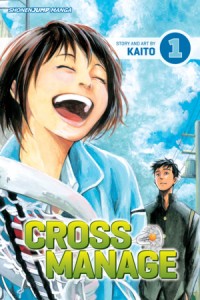
Cross Manage Ch. 030
How does this series keep getting better!? Last week I thought it would be disastrous if Kaito skipped the match. And either he has the most common sense of any writer, or he’s reading my mind. If the latter, please pay attention, Kaito-sensei, I have a few ideas for some omake material. This chapter really showed how good Cross Manage could be as a straight up sports manga. Which just doubles my enjoyment because I already was enjoying it as a character piece. Considering possible upcoming cancellations and series ending their runs I wouldn’t be surprised if Cross Manage lives to fight another day. It better, it’s survived this long and gotten this good that canceling it now would be an abject shame.

Cross Manage


Despite being a short issue, this week’s Weekly Shonen Jump was very strong. Perhaps the lack of Naruto skewed the overall quality. One more week, and then we’re off for Golden Week. I’ll be craving new manga chapters all week, but at least I get to take a break just like the manga authors do that week.

If you want to hear more, check out the Manga^3 Podcast Archives. Or go directly to last week’s episode, Episode 044 – April 15, 2013 – The Naruto Conundrum: Why Do We Hate Sasuke? | Mutant Turtles Gaiden and Super Turtles.

Filed Under: FEATURES & REVIEWS, Weekly Features, WSJA Recaps Tagged With: bleach, Cross Manage, Dragon Ball Z, nisekoi, One Piece, one punch man, toriko, world trigger

It Came from the Sinosphere: Yanyu Mengmeng (TV Drama) Part 2

April 23, 2013 by Sara K. 1 Comment

yymm27

Pouring Sugar on Stakes Thrust through the Heart, or TV Drama vs. Novel

The plot between the novel and this TV adaptation is mostly the same, aside from the addition of new characters (the Li family, Keyun, Du Fei, Ji Yao), and expanded roles for Erhao, Mengping, and Fangyu.

However, the feeling is significantly different. The TV drama does a lot of sugar-coating. For example…

[HUGE SPOILER WARNING + TRIGGER WARNING FOR SEXUAL VIOLENCE / SUICIDE, skip to “End Trigger/Spoiler Warning” if you want to avoid spoilers and/or triggers]

In the novel, Mengping is gang-raped and gets pregnant. When she can’t identify the father, her father stop treating her as his daughter, or even as a human being. After a back-alley abortion gone wrong, Mengping spends most of the novel in the hospital, out of sight. By the time she gets out of the hospital, her mother is in prison, her father and sister are dead, her younger brother is in an orphanage, and she has to live with her older brother, who is penniless.

She is also gang-raped, emotionally discarded by her father, and gets injured in an abortion in the TV Drama. But in the TV drama, her loving sister cares for her after the rape, and her boyfriend agrees to marry her even after he knows what happened. Furthermore, her boyfriend tracks down the rapist and personally punishes them, with some help from Mengping’s father, who starts treating her as his daughter again once a man (her boyfriend) agreed to marry her. Mengping and her boyfriend (later, husband) live happily ever after.

Then there is Ruping.

Mengping and Ruping

Mengping and Ruping

In the TV drama, Ruping commits suicide. After the suicide, all of the characters are heartbroken, blame each other for her suicide, blame themselves, and pour out all of the love they felt for Ruping but didn’t express properly while she was alive.

In the novel, when Ruping commits suicide, the characters either a) hardly notice or b) are upset because her death inconveniences them. None of the characters are depicted being sincerely sad that she is dead (well, maybe He Shuhuan is sincerely sad … to some extent).

In the TV drama, Ruping is mistaken to think that nobody loves and cares about her. In the novel … she is mostly correct.

[END TRIGGER/SPOILER WARNING]

Though the plot is mostly the same, these little differences add up to a very different message. In the novel, the message is “What goes around, comes around.” Since what goes around is pain and abuse, what comes around is not pretty. By contrast, the message in the TV drama is that, deep down, everybody loves each other, they just don’t know it, and that love can get you through everything. That is a VERY different message.

Why Was the Message Changed

So … why does the TV Drama sugar-coat the story?

I have some ideas.

First, the novel was written in the 1960s. Many people in Taiwan, including most of the characters and Chiung Yao herself, had been in China during the Chinese Civil War, and were still recovering from the aftermath. The rest of the population had experienced WWII under Japanese rule and the 2/28 Incident, which was also very traumatic. The novel was also published during the height of the “White Terror,” when Taiwan’s authoritarian government practised strict censorship and imprisoned anybody who was inconvenient to the people in power.

yymm26

By contrast, the 1980s was a much more forgiving era. The economy was booming and standards of living had risen. Taiwan was already moving towards democracy, and in 1987, just a year after this drama aired, martial law was lifted. things didn’t seem so bad.

Then there is Chiung Yao’s own personal circumstances. At the time she wrote the novel, she was a young mother, and had either just ended her first marriage or was about to end it (I couldn’t find a timeline to double-check the order of events), but in any case, ending a marriage while caring for a young child is stressful. She relied on the money she made by writing to make ends meet, so if she had stopped writing, or if her writing hadn’t sold well, she would have been in trouble.

yymm28

By contrast, in the 1980s, she was financially secure and independent, had well-established and extremely successful writing career, and had been happily married to her second husband for years. Chiung Yao herself says that she couldn’t have written the novels she wrote as a young woman at a later age because she had stopped experiencing such sharp, forceful feelings.

It’s entirely possible that a TV drama faithful to the spirit of the novel would not have been allowed to air in the 1980s. I think that Taiwanese TV nowadays wouldn’t produce a TV show with even the 80s drama adaptation’s level of emotional harshness. Audiences would not receive it well.

In fact, based on the reviews I’ve read, the 2000 adaptation of Yanyu Mengmeng is even sappier than the 80s version.

Why I Hate This Story

For starters, I hate most of the characters … Yiping, Ruping, He Shuhuan, Lu Zhenhua, Xueqin, etc. In the novel, just about the only significant characters I didn’t hate were Fu Wenpei (Yiping’s mother) and Fang Yu. I don’t hate any of the new characters (Keyun, Du Fei, etc.) who were added to the story in the TV adaptation.

Yiping has ulterior motives for going out with Erjie.

Yiping has ulterior motives for going out with Erjie.

Okay, I did feel more sympathetic to Yiping in the TV drama, so I suppose I don’t hate TV!Yiping, but that’s mainly because I felt everybody else was treating her unfairly. Everybody was telling her that she should set aside her hatred for the Lu family, that she was their daughter, and that she should learn to love them. I, on the other hand, felt that not only was Yiping entitled to resent the Lu Family, but I was advising her to cut off contact with them as soon as feasible. Her father abused and neglected her for more than ten years, and her siblings either contributed to the abuse/neglect, or refused to offer any help to Yiping … and never ONCE in the entire drama do they apologize to Yiping and admit to her that they were wrong (his father quasi-apologizes to her mother). If any reconciliation is to happen, I think the Lu family (particularly his father) is responsible for the first move, and before there is a clear and sincere apology, nobody should tell Yiping to let go of her bad feelings about the family.

That’s not to say that I approve of Yiping’s actions – on the contrary, I advised her (in my head) to forget revenge so she can get the Lu family as much out of her life as possible. I also advised her to dump He Shuhuan, particularly considering how inclined he is to use physical force to control her in the drama (at least in the novel he’s not physically abusive). Yiping needs a sassy gay-friend, not a self-centered borderline-abusive boyfriend like He Shuhuan (I personally think Yiping was doing Ruping a favor when she ‘stole’ He Shuhuan, but I know Ruping disagrees with me).

When Yiping wants to get away from Shuhuan, he grabs her, carries her as she's kicking and screaming, and pins her to a fence.  What a charming boyfriend.

When Yiping wants to get away from Shuhuan, he grabs her, carries her as she’s kicking and screaming, and pins her to a fence. What a charming boyfriend.

And how could I hate Ruping? Mainly because she seems very passive-aggressive to me. She repeatedly claims that she loves Yiping like a sister but … well, it never translates into her actions. When Yiping needs help, Ruping does nothing (and I don’t buy that Ruping doesn’t have enough courage, because she certainly has enough courage when her other siblings get in trouble). And when Yiping is going through some really terrible things, Ruping is caught up in her own selfish concerns. Yiping, at least, is honest about the fact that she is not looking out for Ruping, and even tells Ruping so.

Ruping needs a cool-old-lady friend.

What’s worse, Yiping, Shuhuan, and Ruping are all bookworms. To Yiping, novels are like water, and reading is one of her main mechanisms for getting through the day. Shuhuan has a large library. Yiping loves 19th century European novels – Tolstoy, Bronte sisters, etc., while Shuhuan enjoys contemporary foreign literature. Ruping is a fan of popular Chinese-language literature, particularly romance and wuxia (I find it intriguing that she is an wuxia fan, considering that she’s a total doormat who wouldn’t hurt a fly). I also identify as a bookworm, and I suspect most people who read the novel are bookworms to some extent, so this makes the characters more like the readers.

In Shuhuan's library.

In Shuhuan’s library.

And that brings me to the crux of why I hate the story – I can see myself in the characters, and it’s an awful part of myself. My family is much more functional than the Lu family – but even I know something about the resentment which builds up between family members, and how it can drive people (myself included) to do terrible things. You could say that I am Yiping’s daughter (my mother as a young woman had some things in common with Yiping). In the TV show, and especially in the novel, I could feel that a) what the characters were doing was wrong and b) understand why they were doing it because, under similar circumstances, I would have the same impulses.

I hate being shown that I can be an awful person.

I seriously considered not watching the TV drama because I hate the novel that much.

My Reaction to the Drama

This is hands down the most addictive TV drama I’ve seen in Chinese, and one of the most addictive things I’ve watched in my life. Even though I already knew the story, I simply had to keep going. As soon as one train-wreck has happened, it’s possible to see the next train coming to pile on the damage.

yymm30

In some ways, the TV drama is much better written than the novel – many supporting characters are much more fully realized, and the suspenseful elements are more deftly crafted.

And the tears. Oh the tears. In my mind, I’ve re-titled the drama “River of Tears” because of the effect it had on me.

But towards the end of the TV drama, I stopped engaging with it because it started to seem a little false to me. The story wants to go to awful places, but somebody puts on the brakes, assuring the audience, ‘no, it’s not really that awful’.

The ending of novel feels profoundly sad because it feels true. The more optimistic ending of the TV drama does not feel true to me.

Availability in English

Currently, this is not available in English, and since it’s a Taiwanese drama from the 1980s, I am not going to hold my breath. Still, if any Taiwanese drama from the 1980s has a chance of being licensed by a streaming service with English subtitles, it’s this one, or another one of the 80s Chiung Yao dramas.

Conclusion

yymm24

Nowadays, before I pick up a Chiung Yao novel, I have to ask myself whether I am ready to tear out my heart and put it through the washing machine for cycle. I’ve read that Yanyu Mengmeng is the rawest of them all, but based on some of the summaries I’ve seen, I suspect some of Chiung Yao’s other novels might wrench me even more. She is a genius of pressing emotional buttons.

For a heart-warming Chiung Yao story, read Princess Pearl. Otherwise, beware!

Next Time: Datang Shuanglong Zhuan (novel)


Why is it that Sara K. only found out that the Takarazuka Revue was coming to Taiwan AFTER the tour was over????? Now she’ll actually have to go to Japan to see them perform live. Oh well, if she ever has the chance to see them in Japan, it will probably be better than seeing them in Taiwan.

Filed Under: Dramas, It Came From the Sinosphere Tagged With: chiung yao, Love in the Rain, taiwan, TV, Yangyu Mengmeng

  • « Go to Previous Page
  • Page 1
  • Interim pages omitted …
  • Page 695
  • Page 696
  • Page 697
  • Page 698
  • Page 699
  • Interim pages omitted …
  • Page 1067
  • Go to Next Page »
 | Log in
Copyright © 2010 Manga Bookshelf | Powered by WordPress & the Genesis Framework