• Skip to primary navigation
  • Skip to main content
  • Skip to primary sidebar
  • Home
  • About Us
    • Privacy Policy
    • Comment Policy
    • Disclosures & Disclaimers
  • Resources
    • Links, Essays & Articles
    • Fandomology!
    • CLAMP Directory
    • BlogRoll
  • Features & Columns
    • 3 Things Thursday
    • Adventures in the Key of Shoujo
    • Bit & Blips (game reviews)
    • BL BOOKRACK
    • Bookshelf Briefs
    • Bringing the Drama
    • Comic Conversion
    • Fanservice Friday
    • Going Digital
    • It Came From the Sinosphere
    • License This!
    • Magazine no Mori
    • My Week in Manga
    • OFF THE SHELF
    • Not By Manga Alone
    • PICK OF THE WEEK
    • Subtitles & Sensibility
    • Weekly Shonen Jump Recaps
  • Manga Moveable Feast
    • MMF Full Archive
    • Yun Kouga
    • CLAMP
    • Shojo Beat
    • Osamu Tezuka
    • Sailor Moon
    • Fruits Basket
    • Takehiko Inoue
    • Wild Adapter
    • One Piece
    • After School Nightmare
    • Karakuri Odette
    • Paradise Kiss
    • The Color Trilogy
    • To Terra…
    • Sexy Voice & Robo
  • Browse by Author
    • Sean Gaffney
    • Anna Neatrour
    • Michelle Smith
    • Katherine Dacey
    • MJ
    • Brigid Alverson
    • Travis Anderson
    • Phillip Anthony
    • Derek Bown
    • Jaci Dahlvang
    • Angela Eastman
    • Erica Friedman
    • Sara K.
    • Megan Purdy
    • Emily Snodgrass
    • Nancy Thistlethwaite
    • Eva Volin
    • David Welsh
  • MB Blogs
    • A Case Suitable For Treatment
    • Experiments in Manga
    • MangaBlog
    • The Manga Critic
    • Manga Report
    • Soliloquy in Blue
    • Manga Curmudgeon (archive)

Manga Bookshelf

Discussion, Resources, Roundtables, & Reviews

Blog

My Week in Manga: November 10-November 16, 2014

November 17, 2014 by Ash Brown

My News and Reviews

Last week I posted two reviews at Experiments in Manga. The first review of was of Ajin: Demi-Human, Volume 1 written by Tsuina Miura and illustrated by Gamon Sakurai. It’s a manga with a rather dark atmosphere that deals with immortals, which is right up my alley. The first volume was a good start to the series; I’m looking forward to seeing how it continues to develop. The second review was of The Legend of Bold Riley, created by Leia Weathington and illustrated by a number of different artists. The review was actually the final review in my Year of Yuri project, so over the weekend I posted a wrap-up for the project as a whole. Later this week, most likely on Friday, a poll will go live so that readers of Experiments in Manga can vote to help me select my next monthly review project.

I came across a few fun and interesting things elsewhere online last week, too. Mangabrog has a translation of a conversation between Katsuhiro Otomo and Takehiko Inoue from 2012. Kate Beaton posted the second part of her collection of comics based on Natsume Sōseki Kokoro (a novel that I’ve reviewed in the past). The Ceiling Gallery posted “Girl Talk”, an article about “the life, friends and music of manga author Okazaki Kyoko” which is well worth reading. Anna Madill, a professor at The University of Leeds, is currently conducting research into boys’ love fandom. If you’re an English-speaking boys’ love fan, please consider assisting her research by completing a brief BL Fandom Survey.

Quick Takes
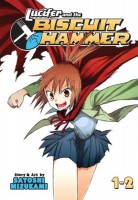
Lucifer and the Biscuit Hammer, Omnibus 1Lucifer and the Biscuit Hammer, Omnibus 1 (equivalent to Volumes 1-2) by Satoshi Mizukami. I really wasn’t sure what to expect from Lucifer and the Biscuit Hammer, but I ended up enjoying the first volume immensely. One morning, college student Amamiya Yuuhi wakes up to discover a talking lizard in his bed, requesting his help to protect a princess destined to save the world from an evil mage bent on destroying Earth by using a giant hammer floating in space. Despite his initial reluctance to get involved in the whole mess, Yuuhi decides to become her knight because of one simple fact: The only reason Samidare (who need little protection) wants to save the world is so that she can destroy it herself. Much like its title, Lucifer and the Biscuit Hammer is kind of strange. Both the characters and story are quirky, a little goofy, and rather bizarre. The manga is also quite a bit darker than it first appears; the characters are all revealed to have twisted pasts and tragedies to work through. It’s particularly interesting to see protagonists who are closer to being supervillians than superheros. I’m still not entirely sure where Lucifer and Biscuit Hammer is heading, but I’m really looking forward to reading more of the series and finding out.
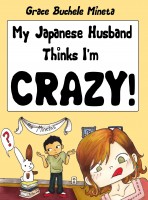
My Japanese Husband Thinks I'm Crazy!My Japanese Husband Thinks I’m Crazy by Grace Buchele Mineta. A companions of sorts to her blog Texan in Tokyo, My Japanese Husband Thinks I’m Crazy! is a collection of autobiographical comics and essays about Mineta’s life in Japan, her work as a freelancer, and her intercultural marriage. I’ll admit, I haven’t actually read much of Texan in Tokyo, but the comics made me laugh, so I decided to pick up the book. Some of the material collected is new to the volume while other material comes directly from the blog. My Japanese Husband Thinks I’m Crazy! is a wonderfully amusing and at times even enlightening collection. The main “characters” are Mineta herself, her salaryman husband Ryosuke, and Marvin–a talking rabbit who’s a figment of her imagination, the result of “stress, coffee, and loneliness from being a freelancer in Tokyo.” The comics are sweet, charming, and short, generally only a single page consisting of a few panels. Many of the comics are personal in nature, but some of Minata’s experiences are certainly shared by other foreign residents and visitors to Japan. My Japanese Husband Thinks I’m Crazy! is a fun way to learn little tidbits about Japan and Japanese culture.

Yakuza in Love, Volume 1Yakuza in Love, Volumes 1-3 by Shiuko Kano. Despite being one of the boys’ love creators with the most manga published in English, which I assume would be an indicator of her popularity, I generally find Kano’s work to be fairly hit-or-miss with me. Sadly, Yakuza in Love largely falls into the miss category. The short series is one of Kano’s earliest works, and it shows. The pacing is all over the place and frequently rushed, the action is difficult to follow, the sex and supposed romance doesn’t always mesh with the story, the plot doesn’t distinguish itself from any other generic yakuza-themed boys’ love manga, and she can’t quite seem to decide if she’s going for comedy or drama. She probably should have stuck with the humor–as a whole, Yakuza in Love simply doesn’t work as well when it takes itself too seriously. It wasn’t all bad, though. Just perhaps a little too ambitious. The best part of Yakuza in Love is actually all of the extras at the end which take up the last half of the third volume. Kano relaxes and just has fun with her characters, actually giving them more depth while parodying her own story. As a result, the extras end up being much more enjoyable.

Monthly Girls' Nozaki-kunMonthly Girls’ Nozaki-kun directed by Mitsue Yamazaki. Based off of an ongoing yonkoma manga series by Izumi Tsubaki, Monthly Girls’ Nozaki-kun is an absolutely delightful twelve-episode anime series. The titular Nozaki is a tall, stoic, and slightly oblivious high school student who, despite what most people would assume from his appearance, also happens to be a published shoujo mangaka. Sakura has a crush on Nozaki, but when she tries to confess her love to him she somehow winds up as one of his assistants instead. Monthly Girls’ Nozaki-kun is a very funny and enjoyable series which freely plays around with shoujo manga tropes and character types. Nozaki finds inspiration for his manga from the other students at school, usually in slightly unexpected ways. He’s also amassed a handful of assistants in addition to Sakura, all with their own quirks and relationship problems which provide plenty of material for Nozaki to work with which eventually ends up in his manga. For the most part the anime tends to be fairly episodic, though there are several recurring characters and running jokes. Overall, the series is a tremendous amount of fun with a large cast of likeable characters.
Filed Under: FEATURES, My Week in Manga Tagged With: anime, comics, Grace Buchele Mineta, Lucifer and the Biscuit Hammer, manga, Monthly Girls' Nozaki-kun, Satoshi Mizukami, Shiuko Kano, Yakuza in Love

Random Musings: Wrapping Up the Year of Yuri Monthly Review Project

November 15, 2014 by Ash Brown

BlueAlthough I’ve continued to review the new volumes of the series as they are released, last year I wrapped up my Blade of the Immortal monthly review project. Because I enjoyed the project, which took me nearly two years to complete, I started to look for a new one to take its place. Ultimately, I decided I wanted readers of Experiments in Manga to have some input in which manga I would tackle next and so put it up for a vote. Out of the five options that I narrowed it down to, by far the most popular choice was what I called “Year of Yuri.”

Over the course of twelve months, I reviewed twelve different comics and manga with yuri and/or lesbian themes. My intention was to feature a wide variety of genres, demographics, and styles. I think I was fairly successful in that. Most of the stories were based in reality, but there was a bit of fantasy, too. Some were erotic while others were very chaste. There were first loves and failed loves, healthy relationships and relationships that did more harm than good, humor and nostalgia, lightheartedness and seriousness, stories about school girls and stories about grown women, and more.

Whereas the Blade of the Immortal project focused on a single series, the Year of Yuri project allowed me to explore a range of titles which was interesting to do. Granted, with only twelve reviews, I could only begin to scratch the surface of the entire realm of possibilities. But hopefully I featured at least one manga or comic that sparked someone’s interest. I enjoyed having a project to work on from month to month and had fun selecting the comics and manga that I would review. Now that my Year of Yuri monthly review project has concluded, I’ll once again be turning to the readers of Experiments of Manga to help choose my next project. Another poll will be opened in the very near future, so stay tuned!

The links to all of my Year of Yuri manga reviews can be found below. I have also conveniently added a Year of Yuri tag to all of the reviews to pull them all together and for even greater ease of access. While I’ll no longer be focusing on yuri and lesbian comics as part of a monthly review project, I will continue to read and review them, so expect to see more quick takes and in-depth reviews in the future. I hope you all enjoyed this project as much as I did!

Year of Yuri reviews:
12 Days by June Kim
Before You Go by Denise Schroeder
Between the Sheets by Erica Sakurazawa
Blue by Kiriko Nananan
Gakuen Polizi, Volume 1 by Milk Morinaga
Kisses, Sighs, and Cherry Blossom Pink by Milk Morinaga
The Legend of Bold Riley created by Leia Weathington
Maka-Maka: Sex, Life, and Communication, Volume 1 by Torajiro Kishi
Revolutionary Girl Utena: The Adolescence of Utena by Chiho Saito
S.S. Astro: Asashio Sogo Teachers’ Room, Volume 1 by Negi Banno
Sweat & Honey by Mari Okazaki
Whispered Words, Omnibus 1 by Takashi Ikeda

Filed Under: UNSHELVED Tagged With: comics, manga, Year of Yuri

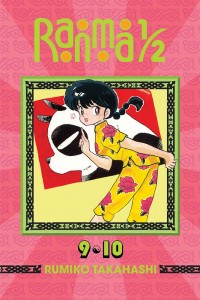
Ranma 1/2, Vols. 9 & 10

November 15, 2014 by Sean Gaffney

By Rumiko Takahashi. Released in Japan by Shogakukan, serialized in the magazine Shonen Sunday. Released in North America by Viz.

This particular omnibus is very illustrative of the perils and pitfalls of being a Ranma fan, both in terms of its ongoing tendency towards “everyone is terrible, comedy trumps everything”, and in terms of the fact that it was written in 1980s Japan, and is, shall we say, a little less than progressive. We’ve already seen Ranma’s treatment of Shampoo fall into the typical Chinese stereotype, complete with broken English. Now in this volume we get two characters introduced as boys who may (or may not) turn out to identify as someone else. I’m not asking a 1980s ‘aquatranssexual’ comedy to be progressive on LGBT issues, but even for that time this is pretty bad. But let’s begin with brighter stuff, and the first of our two gender-confusing newbies.

ranma9-10

Ukyou Kuonji is the last of the major Ranma cast members to join us, even if her role decreases as the series goes on. She’s also the last of the major antagonists in the battle to win Ranma’s heart, one that begins the moment that she realizes he never knew she was a girl, and he actively calls her the “cute fiancee” to Akane’s “uncute fiancee”. She’s a lot like Ranma, which makes them very believable as childhood friends, and clearly her chasing of him has less to do with her family honor and more due to the object of her “revenge fantasy” becoming a crush.

She also provided fandom with what seemed, at the time, to be a more “reasonable” choice than the hyperviolent Akane (note how violent Ukyou is in her introduction and the Tsubasa chapters), and thus became very very popular among fanfiction writers, who were frustrated by Akane and Ranma’s denial, and Akane’s tendency to hit Ranma, which was taken very seriously. Not that Ranma really returns any affection – even if he does enjoy teasing and mocking Akane, he does pick up when she’s seriously hurt and works to correct it. This doesn’t really happen with Ukyou, though he at least offers to let her get revenge for the idiocy his father perpetrated. (Also, asking a 6-year-old to choose between a friend they knew for maybe 3 weeks and food – wtf?)

(As for Ryouga and Ukyou, a very popular fan pairing, I will remain mostly silent, except to note that within minutes of meeting Ryouga, Ukyou is screaming at him in frustration.)

This volume also sees a very funny Kuno and Kodachi runaround, which balances Akane and Ranma’s love/hate relationship just right, as well as a beach episode featuring Happosai and Cologne (who ran into each other in their youth – big surprise), which does not get the balance right. Mousse returns, and has a Jusenkyo curse now to boot – one which he immediately tries to give to Ranma (or Akane – he claims he’s just bluffing about cursing her, but I doubt he’s care much if it happened). I’ve talked before about my dislike of Mousse, but I will note with amusement Shampoo’s rejections of him are immediate and incredibly blunt. Mousse is not a man that will take a vague answer. “Shampoo, do you hate me so much?” “Yep. Hate you.”

And then there’s the introduction of Tsubasa Kurenai. I believe we’ve seen the last of Tsubasa in the manga, though I think he becomes a recurring character in the anime like most of Takahashi’s one-shot antagonists. Tsubasa is from Ukyou’s old school, and is chasing after her out of love and to destroy Ranma, the one she is engaged to. Tsubasa’s gender reveal comes right at the end (which leads to some awkward translations – in Japanese, it’s much easier to hide gender pronouns) and for about a chapter and a half they think he’s a girl – and a lesbian. Then we also have the fact that Tsubasa makes a cuter girl than Ranma in her girl form – something that deeply stings his pride. (It’s also explicitly mentioned here, by the way, that the entire school bar Kuno knows Ranma can change.)

So Ranma decides to “date” Tsubasa. The line that is the worst in the volume comes after Akane tells (male) Ranma she assumed he was taking Tsubasa on a “girl-girl” date. He responds that he’s “trying to set her on the correct path”. There really isn’t much that I can add here except “ugh.” Takahashi frequently uses “uh oh, they may be a lesbian” for comedy, and yes, I realize Takahashi uses absolutely everything in the world for comedy, but this doesn’t mean she shouldn’t be called out on stuff like this, particularly when it makes the cast look homophobic. The whole thing isn’t helped by a wacky reveal ending where we see Tsubasa is just a guy who likes to cross dress, and Ukyou tells the others “I thought everyone knew that already”.

So, for me, this omnibus consisted of one excellent to good first half, and a mediocre to bad second half. The danger of omnibuses. Next time we’ll meet another incredibly annoying antagonist, but at least he’s more fun than Happosai. And surprise, he’s another abusive, horrible father! Find out why the Kunos are not just another insane brother and sister duo, but from a family of insanity!

Filed Under: REVIEWS

Tatsumi on Film; Anno on Instagram

November 14, 2014 by Katherine Dacey

tatsumiGekiga pioneer Yoshihiro Tatsumi’s work is now accessible to viewers on the big screen, thanks to Singaporean director Eric Khoo. Khoo adapted such classic stories as “Hell,” “Goodbye,” and “Beloved Monkey,” interleaving them with vignettes from Tatsumi’s autobiography A Drifting Life. 

This just in: Moyocco Anno‘s new Instagram account is pretty awesome.

Marvel’s C.B. Cebulski shares a few more details about the Avengers/Attack on Titan crossover series. Over at TCJ, Joe McCulloch looks at an earlier Marvel/manga crossover, Kazuo Koike’s Wolverine one-shot.

Lori Henderson dishes the dirt on two new licenses: Aquarion-Evol and Flowers for Chronous, both of which will be published by One Peace Books.

The Manga Bookshelf gang share their picks for this week’s best new arrivals.

What kind of manga appeals to 9-to-12 year old readers? MJ weighs the pros and cons of three series that are frequently recommended for tweens.

News from Japan: The forthcoming Doraemon movie–Doraemon: Nobita no Space Heroes–will be adapted for the pages of Coro Coro; look for the first chapter in January 2015. Also arriving in theaters next year will be a big-screen treatment of Io Sakisaka’s Strobe Edge.

Reviews: Over at Anime News Network, Jason Thompson completes his 56-hour Naruto review marathon, tackling volumes 28-72. Closer to home, MJ sings the praises of an oldie but goodie: Setona Mizushiro’s Afterschool Nightmare.

Matthew Warner on vol. 13 of 07-Ghost (The Fandom Post)
Ash Brown on vol. 1 of Ajin: Demi-Human (Experiments in Manga)
Sean Gaffney on vol. 14 of Attack on Titan (A Case Suitable for Treatment)
Anna Call on vol. 1 of Deadman Wonderland (No Flying No Tights)
Ken H. on vols. 2-3 of Kimagure Orange Road (Sequential Ink)
Megan R. on Le Chevalier D’Eon (Manga Test Drive)
Rebecca Silverman on vols. 1-2 of Lucifer and the Biscuit Hammer (Anime News Network)
L.B. Bryant on vol. 5 of No Matter How I Look at It, It’s You Guys’ Fault I’m Not Popular (ICv2)
Richie Graham on vol. 1 of Ranma 1/2: 2-in-1 Edition (No Flying No Tights)
Sakura Eries on vol. 9 of Spice and Wolf (The Fandom Post)
Kate O’Neil on vol. 22 of Soul Eater (The Fandom Post)
Leroy Douresseaux on vol. 10 of Ultimo (Comic Book Bin)
Jenny Ertel on vols. 1-3 of What Did You Eat Yesterday? (No Flying No Tights)
Matthew Warner on vol. 1 of World Trigger (The Fandom Post)

Filed Under: MANGABLOG Tagged With: attack on titan, Marvel, Moyocco Anno, One Peace Books, Yoshihiro Tatsumi

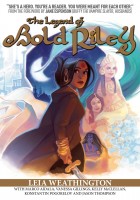
The Legend of Bold Riley

November 14, 2014 by Ash Brown

The Legend of Bold RileyCreator: Leia Weathington
Illustrator: Vanessa Gillings, Jason Thompson, Marco Aidala, Konstantin Pogorelov, and Kelly McClellan; Chloe Dalquist and Liz Conley

Publisher: Northwest Press
ISBN: 9780984594054
Released: June 2012

The Legend of Bold Riley is writer and illustrator Leia Weathington’s first graphic novel. Published by Northwest Press in 2012, the volume is a collection of related stories, each illustrated by a different artist. In addition to Weathington, Vanessa Gillings, Jason Thompson, Marco Aidala, Konstantin Pogorelov, and Kelly McClellan contributed their artistic skills to The Legend of Bold Riley, with Chloe Dalquist and Liz Conley assisting with some of the colors. I first became aware of The Legend of Bold Riley thanks to the involvement of Thompson (to whom I give partial credit for igniting my interest in manga). And it’s thanks to The Legend of Bold Riley that I discovered Northwest Press, a publisher specializing in queer comics, graphic novels, and anthologies. The Legend of Bold Riley is a sword and sorcery adventure featuring a princess as a hero. She also happens to be a lover of women. Happily, The Legend of Bold Riley doesn’t end with this collection. The second volume, Unspun is currently being serialized and Weathington has already started working on a third book.

Rilavashana SanParite, who would come to be known as Bold Riley, is the youngest child of the king and queen of the eastern nation of Prakkalore. She and her two older brothers are heirs to the throne, groomed to be fair and just rulers of the kingdom and knowledgeable in the arts of state in addition to the fine arts, sciences, history, and swordplay. But Riley finds that her heart lies somewhere beyond the walls of the capital city of Ankahla and even beyond the borders of Prakkalore. She wants to travel the world to see the places and meet the people she’s only ever read about in her studies. And so the princess sets out with a sword strapped to her side and a horse to carry her, first to the southern kingdom of Connchenn and then further to the jungles of Ang-Warr, the distant Qeifen, and all the lands in between. Over the course of her journey Riley meets gods and battles demons, the sharpness of her mind and wits just as valuable as the sharpness of her sword. She even falls into the bed of a lovely lady or two.

Although the stories in The Legend of Bold Riley all have continuity with one another, the prologue and the five individual chapters that follow can largely stand on their own once Riley has been introduced. As already mentioned, each chapter is illustrated by a different artist. Riley is always recognizable, but otherwise there is no attempt to have uniform artwork in the volume. Instead, the artists are given free rein, resulting in a marvelous assortment of different art styles and illustration techniques and a range of color palettes. The resulting shift of mood and atmosphere is quite effective in emphasizing the changes in the setting and the type of story being told from one chapter to the next. As Riley travels, visiting different countries and kingdoms, the artwork reflects those differences. The Legend of Bold Riley is diverse, and not just in its illustrations. The volume’s sceneries and stories take inspiration from the fantasy counterparts of India, Central and South America, Southeast Asia, and other areas.

The artwork in The Legend of Bold Riley may change from story to story, but Riley is always Bold Riley. She’s a fantastic and exceptionally appealing character, a dashing and daring young woman with strengths and weaknesses, remarkable talents, and human flaws. Although Riley’s sexuality is never the focus of the comic, it’s always a part of who she is as a person and as a well-rounded character. She falls in love, she makes mistakes, and she struggles and is challenged when faced with a world that’s not always black and white or even kind. The Legend of Bold Riley, while something new and refreshing, somehow also feels very familiar. It’s a collection of heroic tales, some ending in triumph and others ending in heartbreak. Because of its episodic nature there’s not a lot of character development, but Riley is such a great character to begin with that the work is still very satisfying. I thoroughly enjoyed The Legend of Bold Riley and look forward to reading more of Riley’s adventures in the future.

Filed Under: REVIEWS Tagged With: Chloe Dalquist, comics, Jason Thompson, Kelly McClellan, Konstantin Pogorelov, Legend of Bold Riley, Leia Weathington, Liz Conley, Marco Aidala, Northwest Press, Vanessa Gillings, Year of Yuri

Manga the Week of 11/19

November 13, 2014 by Sean Gaffney, Ash Brown, MJ, Michelle Smith and Anna N 1 Comment

SEAN: So. Many. Books.

ASH: Woo!

monster5

SEAN: Kodansha has the 5th volume of shoujo romance My Little Monster, which is still dealing with social ineptness in the best way.

MJ: I feel like I’m really missing out by not reading this. I probably have to fix that.

MICHELLE: I do honestly think that you would like it.

ASH: You should!

ANNA: Now I feel like I should be reading this! But I have far far too much manga to get caught up on.

SEAN: And the 2nd volume of Noragami, which I’m hoping kicks things into gear now that we have a 3rd cast member.

ASH: By the end, I rather enjoyed the first volume. Looking forward to seeing how the series develops.

SEAN: Seven Seas has another Devils and Realist, which I’m hoping keeps the denial in addition to all its handsome devils.

ASH: This series has actually really started to grow on me.

ANNA: I liked the first volume well enough but haven’t picked up the others for whatever reason.

SEAN: Dragonar Academy 4 has dragons and fanservice, possibly not in that order.

Kokoro Connect was surprisingly serious about its body swapping, even if at times the exposition felt a bit stilted. I look forward to seeing where the second volume goes.

Monster Musume 5 has monsters and fanservice, possibly not in that order.

ASH: Since both things are fairly constant, I’m not sure there can be much of an order…

prophecy1

SEAN: Prophecy is our first new title, a seinen title involving a masked man who predicts crimes… which then happen. This looks pretty grim, but is supposed to be a real page-turner.

MJ: Oooo, I like the sound of that.

MICHELLE: Me, too! Something just got added to my shopping list!

ASH: I’ll be checking it out!

ANNA: I’m intrigued but am reserving judgement until you guys check it out.

SEAN: Viz, as always in the 3rd week of the month, has its ‘Signature’ series titles. We have another volume of Gangsta, which I’m starting to like even more than Black Lagoon, its spiritual predecessor.

ASH: I think I do, too, actually.

SEAN: Ooku hasn’t come out in ages, so a 10th volume is very welcome.

MJ: Yay, yay, yay! And more yay!

MICHELLE: What she said.

ASH: And another yay for good measure!

ANNA: Yet another yay for Ooku!

SEAN: And I know the Manga Bookshelf crew will be ecstatic with a 13th volume of Real.

MJ: Truth.

MICHELLE: I am performing the Baby Groot dance as we speak.

ASH: Real is a phenomenal series. If you’re not already reading it, give it a try!

ANNA: It is really great.

SEAN: I’ve never played the games, but one can’t deny the overwhelming popularity of the Resident Evil franchise, and here we have the first volume of a manga adaptation called The Marwha Desire, which ran in Akita Shoten’s Weekly Shonen Champion.

Terra Formars 3 is also coming out.

Yen On has a 2nd volume of the light novel Accel World, whose first volume I enjoyed, and whose protagonist is intriguing, so I will see where it goes from here.

MJ: I’m on board for this, definitely!

index1

SEAN: The big light novel out next week, though, is even more well-known in the anime and manga fandom. A Certain Magical Index has become a giant franchise, whose anime is already out over here, and whose manga spinoff, A Certain Scientific Railgun, has sold quite well indeed. Now see where it all began, with this first volume.

Ani-Imo is a shoujo title from Aria, a magazine known for odd shoujo titles. Do you like bodyswapping? Do you like suggestions of incest? Then you’ll love this title, whose creator has been doing ‘saucy’ shoujo for years.

MJ: I was right there… until “incest.” Just. No.

MICHELLE: That’s an odd shoujo title for sure. Even the cover art looks like it’s meant for some other demographic.

ANNA: Yeah, I don’t think so.

SEAN: Anything I could have said about BTOOOM! I got out with the previous 7 volumes, so… 8.

Durarara!! continues adapting the third novel with the 2nd volume of the Yellow Scarves arc. (That can be confusing. Welcome to light novel adaptations, here’s your accordion.)

Another debut with Gou-dere Sora Nagihara, which ran in Hakusensha’s Young Animal Arashi. It’s pretty ecchi, and involves an otaku’s 2D fantasy girl coming to life and not being quite the shy, demure girl he was expecting.

Speaking of ecchi, another volume of High School DxD is here.

Higurashi: When They Cry ended last year, and Rika finally got her happy ending, provided she doesn’t do anything foolish like bike in front of a truck. (cough) Please enjoy Higurashi’s “epilogue”, the Dice-Killing Arc.

Jack Frost has reached its final, 11th volume! No more head-raising antics!

The Melancholy of Haruhi Suzumiya also has its 20th and final volume, though the spinoffs are still running. Forever doomed to be in the shadow of the novels and anime, it’s probably for the best it ends here as it runs out of novel to adapt.

milkyway1

Milkyway Hitchhiking is a new manwha from the creator of One Fine Day, and is also in full color. It seems to be episodic tales connected by a time-space cat.

MJ: Wahoo! I loved One Fine Day, so I am very enthusiastic about this.

MICHELLE: Oh! I forgot this was coming out. It looks like very much my sort of thing.

ASH: Space-time kitty!

ANNA: This does sound quite appealing.

SEAN: Pandora Hearts 22… MJ?

MJ: You know me so well. I will be eating this up with a spoon.

SEAN: As well as the Pandora Hearts artbook, Odds & Ends… MJ?

MJ: It’s beautiful! Truly. Really, truly. And I offer proof (thanks to Sean).

SEAN: Soul Eater’s covers are still nearly black, which tells me things are still not looking good for our heroes as we head towards the story’s climax.

And there’s also the 4th volume of Soul Eater NOT!, which I believe is also a final volume. Who will Tsugumi choose as her girlfr… um, partner?

Everyone’s least favorite arc of Sword Art Online, Fairy Dance, has its 2nd manga volume ship.

MJ: Heh, I haven’t enjoyed the manga as much as the novels (or the anime), but I’ll take it.

SEAN: Lastly, Triage X marches on, with its 8th volume out next week.

That’s not too much. Surely you can buy all of that in one week, right?

Filed Under: FEATURES, manga the week of

3 Things Thursday: SOS

November 13, 2014 by MJ 8 Comments

As I was casting about for ideas for this week’s column, I found myself consistently drawn back to a manga-related quandary in my own life that I have not quite been able to resolve. As you know, I have recently opened up my personal manga collection as a library for my students (with a few rules in place about age appropriateness). It’s gone about as well as I expected, which is to say that a small number have shown interest. My problem is this: while I have had no trouble at all recommending manga for my teen students, I have been pretty well flummoxed by requests for recommendations from parents of my tweens. These kids are mostly girls, 9-11 (some will turn 12 over the course of this school year), very smart, highly imaginative, fabulously ambitious, heavy readers, into the arts, and not particularly interested in romance or other “teen” concerns. And while I have a few series I’ve recommended for kids in this age range in the past, I don’t consider them ideal for a number of reasons. Let’s take a look:

shugochara1-200x3001. Shugo Chara! | Peach Pit | Kodansha Comics – This is a title I love very much and have recommended for younger readers in the past, for lots of reasons. It’s got a fantastic female protagonist (and lots of other great girl characters as well), wonderful friendships, an emphasis on positivity and cooperation, action, adventure, pretty artwork, and some pretty enticing, tween-fantasy romance, the likes of which my childhood self would have eaten up with a spoon. Thing is, these girls are (for the most part) much, much less interested in boys than I was a their age, which is great, but also makes this a far less compelling choice. Also, the early storytelling and artwork, especially, I think might strike these girls as childish (which, I find, tends to be way less forgivable to actual children than it is to adults). So as much as I love this series, I am having trouble recommending it to these particular girls. Also in this category: Cardcaptor Sakura.

sugar2. Sugar Sugar Rune | Moyoco Anno | Del Rey Manga – While this title is more combative than romantic, its wry take on romance as a competitive sport between girls is commenting on a social structure that, frankly, I’m hoping these particular girls are going to play a part in crushing. In my day, girls their age were already learning how to hate each other and bring each other down in pursuit of popularity with boys, and I see none of that at all in this collection of smart, empowered young girls. In fact, their kindness to each other pretty much blows me away any time I see them interacting as a group. The kind of competitiveness Sugar Sugar Rune so deftly skewers just does not seem to be part of their lives, and I’m hesitant to introduce it to them. Same problem (though less humorously approached): Fushigi Yugi.

fma13. Fullmetal Alchemist | Hiromu Arakawa | Viz Media – I love Fullmetal Alchemist. Everyone knows how much I love Fullmetal Alchemist. This is not a secret. So it should come to no surprise to anyone that it tends to be my number-one go-to manga recommendation for any kid with reading skills developed enough to take it on. It’s got incredible world-building, intricate plotting, compelling characters, heart-wrenching drama, hilarious comedy, action, adventure, fantastic artwork, minimal romance, and (hooray!) awesome female characters. Unfortunately, none of those female characters is the protagonist. There is nothing wrong with this. It’s a shounen manga, and its protagonists are among my favorites of all time. They are smart and funny and totally woman-friendly. They are written by an extremely talented woman. All these are reasons why this is my number-one, most recommended series for kids, including these girls. But man do I wish that I had something this good to recommend to them with girl protagonists, but without the romance themes they do not care about. At all. Similar problem: Hikaru no Go.
So let’s get to the real reason for this column. I do not doubt that there are series floating around that are perfect for my tween girls. I’m certain there are. I just may not own them. For the sake of these students (and for mine as well!), however, I’d be open to picking up a series or two to add to my library. So what do you recommend. With the girls I’ve described in mind, what manga would you recommend I give them?

Filed Under: 3 Things Thursday

Ajin: Demi-Human, Vol. 1

November 12, 2014 by Ash Brown

Ajin: Demi-Human, Volume 1Author: Tsuina Miura
Illustrator: Gamon Sakurai

U.S. publisher: Vertical
ISBN: 9781939130846
Released: October 2014
Original release: 2013

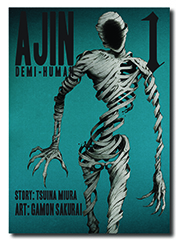
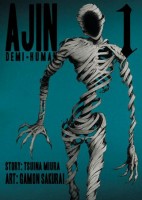
It was the cover art of Ajin: Demi-Human, Volume 1–a creepy image of disconcerting skeletal figure–that first sparked my interest in the series. When I learned that the manga was at least in part about immortals in addition to being fairly dark in tone, I knew that I wanted to read it. The exploration of immortality and its repercussions in fiction fascinates me. Series like Hiroaki Samura’s Blade of the Immortal and novels like Fumi Nakamura’s Enma the Immortal have actually been some of my favorite works of recent years. And so, I was very curious about Ajin. The first volume, written by Tsuina Miura and illustrated by Gamon Sakurai, was originally released n Japan in 2013. (Later volumes of the series are both written and illustrated by Sakurai.) The English-language edition of Ajin, Volume 1 was published by Vertical in 2014. The production values are particularly nice, with high-quality paper that really shows off Sakurai’s ink-heavy artwork.

Seventeen years ago, the first demi-human was discovered. Immortal, and perhaps something a little more, demi-humans are considered to be less than human–feared, despised, reviled, and subjected to horrific experiments in the name of science and for the advancement of humankind. Demi-humans seem to be rare, only forty-six have so far been identified, but that’s only because they appear to be normal humans, at least until they survive their first death. Most assumed Kei Nagai was an average high schooler, preoccupied with studying for his college entrance exams. But Kei’s hopes and dreams of becoming a successful doctor are shattered when he dies in a traffic accident, his body smashed into pieces. And then he comes back to life. Now he’s on the run, pursued by the general population, the police, the Demi-Human Control Commission, and even other demi-humans. His only ally is his friend Kai, who tries to help him escape, but that simply means that the two of them are in danger instead of Kei alone.

As in many other works about immortality, Ajin shows that living forever isn’t always something to be desired and can in fact bring a tremendous amount of pain and suffering. There’s the physical torment of death and injury in a body that revives again and again, but there’s also the mental and psychological damage to take into consideration as well. Kei has suddenly lost all of his rights as a person, he is being hunted as something not worthy of being human, his family and friends are filled with disgust towards him–of course this is going to have an impact on the young man. It would be exceedingly easy for him to lose his humanity or his sanity. Glimmers of those possibilities can be seen in the first volume of Ajin as Kei struggles to realign his worldview with his newfound reality. Granted, Ajin, Volume 1 largely focuses on the action surrounding Kei’s escape and explaining (not too subtly) the unusual abilities of the demi-humans. Not much character development has happened yet, but the potential is certainly there.

Ajin, Volume 1 is a good start to the series, though there is still room for improvement. In general, the artwork tends to be a little stronger than the writing at this point. The premise is interesting, and promising, but Sakurai’s illustrations are what really give Ajin its effectively dark atmosphere. Particularly chilling are the “black ghosts”–malignant extensions of the self capable of extreme violence which are able to be manifested and controlled by certain demi-humans. (That disconcerting figure from the cover? That’s a black ghost.) Humans are quite capable of shocking violence as well. Several examples of the gruesome experiments that have been conducted using demi-humans as test subjects are shown in Ajin, Volume 1. The methods are tortuous and the repeated deaths are cruel. So far, the only real difference between the two groups is that when bodies are mutilated or torn apart–which is not at all an uncommon occurrence in the first volume of Ajin–for better or for worse the demi-humans actually survive.

Filed Under: REVIEWS Tagged With: Ajin, Gamon Sakurai, manga, Tsuina Miura, vertical

Bookmarked! 11/12/14

November 12, 2014 by Brigid Alverson

Welcome to another edition of Bookmarked! This week, Johanna Draper Carlson of Comics Worth Reading joins Kate and I as we talk about what’s on the top of our reading stacks this week. I’ll start:

Legal DrugBrigid: I have been reading CLAMP’s Legal Drug a few pages at a time, which is really not the way to read it. I know this manga was a big deal back in the 2000s, but I have to confess I don’t always get CLAMP, and I’m finding this story somewhat tiresome because the characters all seem like types. The lead character, Kazahaya Kudo, was dying in the snow (for reasons that aren’t at all clear) when he was rescued by Rikuo, a young man who is as sullen as he is handsome. Now they live together and work for a pharmacy, but they spend a lot of time doing side jobs for the overly winsome owner of the business. The tasks they are assigned seem impossible—catch an invisible firefly—and they are given no direction, although they do have special psychic powers to fall back on. The puzzle part of it is interesting, and the art is lovely, but I just can’t warm up to any of these characters. It is nice, though, that Dark Horse has collected it into a single, thick omnibus, and that makes it easy for me to keep on plowing through it.

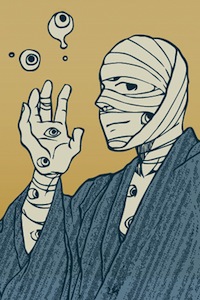
AnomalAnomal, by contrast, is a slim volume filled with lots of interesting characters. It’s a collection of short stories about the interactions between humans and yokai, and although they are all by the same creator, they vary quite a bit in tone. The character on the cover is a hyaku-me, or “hundred-eyes,” and he only figures in the first story, which is a shame as he’s a striking character. Some of the tales touch on deep emotions such as love, loss, and indebtedness, but there are a couple of semi-humorous ones, too. Unfortunately, the longest story is also the most annoying, about a schoolgirl who wants to become a yokai master because she loves to hug yokai. Nukuharu has an interesting way of drawing yokai, but like the stories, the art is uneven. I would love to see a more polished work from this creator, but Anomal is an interesting work and very different from the usual run of yokai tales.

Kate: I read Legal Drug about eight years ago. Though I loved it then, I’m not sure I’d be as enthusiastic about Legal Drug now. I still find CLAMP’s artwork elegant, but I agree with your assessment of the characters: they’re paper-thin collections of tics and mannerisms that grow tiresome quickly.

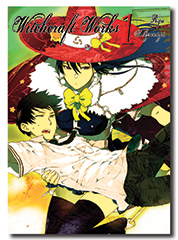
book_witchcraftworks01My nightstand is overflowing with new Vertical Comics. First up for me is volume one of Witchcraft Works, a series that falls squarely under the heading of Manga for Teenage Boys. The story focuses on Honoka Takamiya, a nebbishy high school student who has inexplicably attracted the attention of the class queen, Ayaka Kagari. After Ayaka rescues Honoka from an army of vicious stuffed rabbits — yes, it’s that kind of manga — we learn that Ayaka has been tasked with protecting Honoka from her fellow witches.

I’ll give creator Ryu Mizunagi credit: he wastes no time on exposition, diving into the action in the very first pages. Later chapters are denser in explanation, but generally read like conversations, rather than convenient exchanges of information for the reader’s benefit. I’m a little “meh” on the art, as it’s been calculated to appeal to the male gaze; most of the female characters are comically well endowed. (Several would topple over in real life, given their otherwise slender proportions.) There’s a fair amount of mammary-oriented fanservice and silly outfits, as well as an element of male wish fulfillment that just doesn’t resonate with an older female reader like me.

book_ajin-demihuman01More promising is Ajin: Demi-Human, a supernatural thriller that starts slowly but builds momentum quickly. The first ten or so pages are a chore to read, as author Tsuina Miura provides a detailed explanation of what demi-humans are–they’re immortal–and how many walk the earth. (Hint: not many.) After this clumsy intro, however, the author delivers a nasty jolt: seemingly ordinary teen Kei Nagai learns the hard way that he’s immortal when he survives a hit-and-run accident with a truck. The intense media interest in this discovery forces Kei to go on the lam to avoid bounty hunters, government agents, and evil scientists.

A story likes Ajin lives or dies by its artwork, and manga-ka Gamon Sakurai proves he’s up to the task of bring Miura’s script to life. Kei’s accident, for example, is suitably icky and unsettling, leaving the reader as dumbfounded as the characters who witnessed it. Sakurai’s action scenes are crisply rendered, too–a big plus, considering how many pages of volume one are devoted to high-speed chases and hand-to-hand combat. My only nit-picky criticism is the character designs: although the adults look good, some of the teenagers have serious Manga Hair. That’s a minor complaint, however, considering how much I enjoyed volume one.

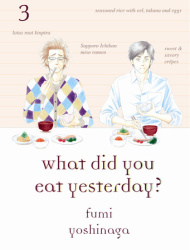
9781939130402Also on my nightstand are volumes three and four of Fumi Yoshinaga’s What Did You Eat Yesterday? I admit that I began this series fully expecting to love it, but have been mildly disappointed thus far. The issue, for me, is the ratio of drama to shop talk. The vignettes exploring the relationship between Shiro, an uptight lawyer, and his partner Kenji, a cheerful hairdresser, are lovely, capturing the normal rhythms of a middle-aged couple’s life. We also get glimpses of each man’s work situation, and how they interact with peers and clients—another winning touch. The food talk, however, is less compelling. Though some of the dishes sound appetizing, I found these passages as tedious as listening to someone give a blow-by-blow account of an expensive meal. Your mileage may vary; if you live to eat, you may find these stove-side rhapsodies more engaging than I have.

Johanna: It’s been a while since I’ve had a chance to read any manga—too much life stuff getting in the way—but the bright side of that is lots of volumes to catch up on over the holidays from series I expect to enjoy. I did manage to dive into a few books recently, plus try a new one-shot.

What Did You Eat Yesterday 5

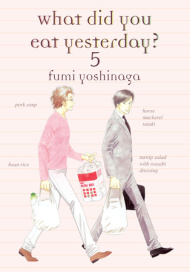
Let’s start with one of my current favorites, What Did You Eat Yesterday? Volume 5 is just out, and every new book for me is a reminder that I’m thrilled that we’re getting this series in English. I adore Fumi Yoshinaga’s art, and her combination of recipe how-tos and small moments of daily life for a gay couple works well. I keep thinking I’m going to try one of the dishes Shiro prepares, but they’re too domestic. They use short-cut bottled sauces and whatever he gets at the local grocery, which is realistic (someone who has to get dinner on the table every day doesn’t spend a lot of time making fancy dishes) and a great insight into his personality, but that makes them difficult to replicate in the U.S. Yet that cultural authenticity adds another level of enjoyment. I need to learn to mimic how he thinks about meals, with easy but balanced side dishes included, instead of getting caught up in the details. I’m not sure I could filet my own whole fish in my kitchen, the way Shiro does, either.

Ha! I originally typoed “meals” as “males” above, which leads into the other piece of the work, the comfortable relationship between the two men. It’s not about what Shiro and Kenji say, specifically, to each other in an evening, it’s that they’re sharing the details of their experiences. Some of them are dramatic, as when Kenji explains how his father abandoned his family. There’s a good deal of humor, too. Early on, a friendly housewife’s husband tries to make Shiro friends with the other gay guy he knows just because they’re both gay. Anyone who’s been matched up on a superficiality can ruefully relate to that. Overall, I never know what a new chapter will bring, which I like a lot.

Genshiken Second Season 5

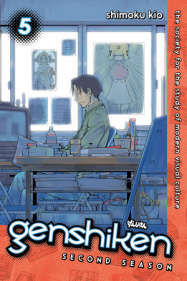
Reaching further back, I also read Volume 5 of Genshiken: Second Season. I don’t always know exactly what’s going on with the characters, since they’re so fannish and detailed about media I’m unfamiliar with, but I can appreciate their dedication to their hobbies, even if this go-round for the series is a lot about cosplay and yaoi.

The one character I remember best from the previous series, the terminally nerdy Madarame, is still hanging around the college club, although he’s graduated. The younger club members have decided to do him a favor by orchestrating him being in the club room with the girl he’s had a crush on for four years. The encounter plays out in a way I found totally unexpected, but quietly charming and good-hearted. That’s why I’m still “hanging around” with these wackos—it’s like being part of your own group of fans, virtually. The details may vary, but the underlying love and dedication, even when taken to extremes, is similar. I also like the way each chapter is followed up by four 4-koma strips that comment on the events we’ve just seen.

In my own burst of fannish trivia, it’s part of the cosplay girl’s (I don’t know any character names beyond “Sue”) character that she’s very large-breasted, in contrast to her sweet, unassuming personality (when she’s not dressing up). In some of the outfits she wears here (and the chapter where she’s topless), I was reminded of what they used to say about Wally Wood drawing Power Girl, that he told his assistants that he was going to keep drawing her bigger and bigger until they made him stop … and they never did.

Judge5

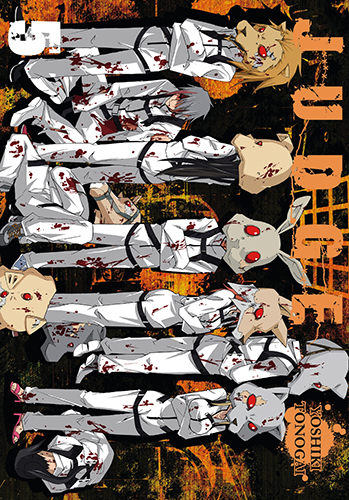
From sex to violence. I also read Judge, volume 5, although I am embarrassed to admit it. I only keep up with it because I’m lucky enough to get review copies. (If not, I’d be getting it out of the library, because I only want to buy series I expect to reread, and once the final villain is revealed, I suspect my interest will disappear entirely.) Next volume is supposedly the last, and I’m glad, the same way I’m glad when they cancel a TV show I should have stopped watching several episodes before but couldn’t quite break the habit on.

It’s one of those “a bunch of random people are told to kill each other one by one” stories—and why did Japan develop that genre?—that’s gone on too long. There are a couple of revelations in this book that I think are supposed to be interesting and provide twists, but I just want it to be over. Especially since it’s turned into a mini-harem, with our nice-ish guy protagonist mostly dealing with three girls. I expected more from it, with the original theme of the seven deadly sins, but I can’t keep up with who had which animal head which was what sin. Really bad pacing, this series has.

Garden of Words

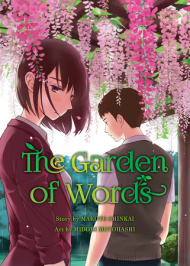
My one new read was The Garden of Words, which I failed. Remember when I said things had been really busy lately? As a result, I’ve been in a super-charged mood of “let’s get more stuff done,” and I want what I’m reading to keep up. This book is the exact opposite. It’s about an older woman and school-age boy who meet at a gazebo when it rains. It requires leisurely reflection and an awareness of connections in life and pondering how someone can affect our lives temporarily but then we move on.

I was in totally the wrong mood for it. I’m going to try reading it again when I can better calm myself and approach it on its terms before I decide whether it’s too much like other things I’ve read or has its own special qualities.

Filed Under: MANGABLOG Tagged With: clamp, Dark Horse, fumi yoshinaga, Vertical Comics

Morning Manga Spotlight: After School Nightmare

November 11, 2014 by MJ 1 Comment

afterschoolnightmare1Setona Mizushiro’s After School Nightmare has loomed in the back of my mind ever since I began this series of manga recommendations for my teen students, and there is really no good reason that it has taken this long to actually come to the fore. I suppose I thought maybe I’d reread it myself first—it has been years now—so that I could talk about it with the particular verve and passion that only accompanies a fresh read. Maybe I thought I’d wait until I had lots of pretty pictures to share, or more articles to point to besides my one lonely review of the first volume.

In the past, I’ve expressed regret at missing out on the Manga Moveable Feast dedicated to this series, and yes, I was really busy at the time, and that was a real factor. But if I’m really being honest with myself and with you, the reason I’ve written less than I’d like about After School Nightmare, is that it nails so many of my personal storytelling kinks and hits upon so many of my own secrets and anxieties, I actually find it difficult to talk about out loud. You know, with other people. Like Please Save My Earth, it weaves dreamworlds in a way that feels written especially for me. Unlike Please Save My Earth, it also scares the bejeezus out of me.

I’ve often said that what I find most powerful about fiction in general is that it lets us explore other people’s inner lives and compare them to our own. I’ve even said that this is, for me (as I suspect it is for many introverts), the most effective way of connecting with other people. And this absolutely applies to me and After School Nightmare (or me and Setona Mizushiro, depending on how you look at it). But there are some stories that feel so close and so private, they are best explored in silence. For my students’ sake, I’ll try to break that silence, just a little.

After School Nightmare is a 10-volume shoujo manga, originally serialized in Princess magazine, home of such legendary manga as Yasuko Aoike’s From Eroica with Love and Moto Hagio’s A, A Prime. The story revolves around Ichijo, a student at an elite high school, whose induction into an unusual after-hours class sends him into a dream world where he must battle other students for a mysterious key necessary for graduation. Furthermore, in the dream world, the students appear as physical manifestations of the things they most fear revealing about themselves. From my review:

Everybody has some kind of secret, though Ichijo Mashiro’s is bigger than most: he was born with a male upper body and a female lower body, something he has successfully kept from his peers for his entire life … In the nightmare, the students are reduced to their “true forms,” revealing their worst fears and deepest wounds to each other. One student, for instance, appears in the dreams with gaping holes in place of her face and chest, while another appears in a full suit of armor. Yet another appears as a pair of endless, disembodied arms. Unlike the others, Ichijo’s true form looks exactly like himself, only dressed in a girl’s school uniform.

As Ichijo soon learns, the battles in the nightmare are only the beginning, for though some students’ daytime identities are pretty well-concealed by their nightmare “true forms,” more (like Ichijo’s) are not, and the dynamics the develop during the after school class soon begin affecting people’s waking relationships as well. Throw in lots of beautiful artwork, some gender confusion, a little romance, and a genuinely surprising plot twist, and you have the recipe for a perfectly MJ-pleasing manga.

The story is well-told and compact (for manga), and though the series has now been out of print for several years, and its North American publisher is no longer), copies can frequently be found used. I originally borrowed the series from a friend, and then picked up my own copies (mostly used) shortly afterwards, so my local students can borrow the series from me in its entirety. The line starts here!

Filed Under: Morning Manga Spotlight

  • « Go to Previous Page
  • Page 1
  • Interim pages omitted …
  • Page 576
  • Page 577
  • Page 578
  • Page 579
  • Page 580
  • Interim pages omitted …
  • Page 1048
  • Go to Next Page »
 | Log in
Copyright © 2010 Manga Bookshelf | Powered by WordPress & the Genesis Framework