• Skip to primary navigation
  • Skip to main content
  • Skip to primary sidebar
  • Home
  • About Us
    • Privacy Policy
    • Comment Policy
    • Disclosures & Disclaimers
  • Resources
    • Links, Essays & Articles
    • Fandomology!
    • CLAMP Directory
    • BlogRoll
  • Features & Columns
    • 3 Things Thursday
    • Adventures in the Key of Shoujo
    • Bit & Blips (game reviews)
    • BL BOOKRACK
    • Bookshelf Briefs
    • Bringing the Drama
    • Comic Conversion
    • Fanservice Friday
    • Going Digital
    • It Came From the Sinosphere
    • License This!
    • Magazine no Mori
    • My Week in Manga
    • OFF THE SHELF
    • Not By Manga Alone
    • PICK OF THE WEEK
    • Subtitles & Sensibility
    • Weekly Shonen Jump Recaps
  • Manga Moveable Feast
    • MMF Full Archive
    • Yun Kouga
    • CLAMP
    • Shojo Beat
    • Osamu Tezuka
    • Sailor Moon
    • Fruits Basket
    • Takehiko Inoue
    • Wild Adapter
    • One Piece
    • After School Nightmare
    • Karakuri Odette
    • Paradise Kiss
    • The Color Trilogy
    • To Terra…
    • Sexy Voice & Robo
  • Browse by Author
    • Sean Gaffney
    • Anna Neatrour
    • Michelle Smith
    • Katherine Dacey
    • MJ
    • Brigid Alverson
    • Travis Anderson
    • Phillip Anthony
    • Derek Bown
    • Jaci Dahlvang
    • Angela Eastman
    • Erica Friedman
    • Sara K.
    • Megan Purdy
    • Emily Snodgrass
    • Nancy Thistlethwaite
    • Eva Volin
    • David Welsh
  • MB Blogs
    • A Case Suitable For Treatment
    • Experiments in Manga
    • MangaBlog
    • The Manga Critic
    • Manga Report
    • Soliloquy in Blue
    • Manga Curmudgeon (archive)

Manga Bookshelf

Discussion, Resources, Roundtables, & Reviews

Blog

Sweet Rein 1-3 Giveaway

December 1, 2014 by Anna N

sr1

I’m getting rid of some of my manga! I have a bunch listed on ebay right now, but I thought I would also do a giveaway as well. So appropriately for the start of the holiday season, I’m going to give away Sweet Rein Volumes 1-3. Just leave a comment on this post and I’ll select a random winner in a week.

Filed Under: UNSHELVED

Bookshelf Briefs 12/1/14

December 1, 2014 by Sean Gaffney, Anna N and Michelle Smith Leave a Comment

This week, Sean, Anna, & Michelle look at recent releases from Kodansha Comics, Viz Media, Yen Press, and Seven Seas.

titanjunior2Attack on Titan Junior High, Vol. 2 | By Saki Nakagawa | Kodansha Comics – A word of warning: as with the first volume, if you think that accurate translation is the most important thing in a North American release, this volume may make you catch fire just by touching it. If, on the other hand, you’re looking for an adaptation bursting with ridiculous humor, you’ve come to the right place. Even when the manga tries briefly to run with a serious plotline, it’s not only filled with multiple gags per page, but it undercuts the serious by talking about how crappy the Naruto manga’s become as it’s ending. There’s Eren being racist, Hange being hyper, Ymir loving (and insulting) Krista, and the introduction of Erwin and Hannes to the series. This is tremendously stupid, in all the best ways. – Sean Gaffney

blackrosealice2Black Rose Alice, Vol. 2 | By Setona Mizushiro | Viz Media – I really was not prepared for Black Rose Alice to get more awesome, but that’s exactly what it does in its second volume. The transplanted soul of 28-year-old teacher Azusa Kikukawa awakes in the 16-year-old body that once belonged to a Viennese aristocrat whom vampire Dimitri once loved and learns exactly what’s expected of her in exchange for Dimitri saving her lover’s life. What is expected is pretty dark, but Mizushiro-sensei sort of half-buries this with cuteness, resulting in a volume with a really interesting and inescapable undercurrent. Honestly, reading this manga feels somewhat like reading a novel, so sure-footed is the storytelling and characterization, but with the added benefit of some terrific non-verbal reaction shots, especially from Dimitri and Kai, one of the vampires vying for the chance to propagate with Azusa (now renamed Alice). This is fascinating stuff. Get on board! – Michelle Smith

bride6A Bride’s Story, Vol. 6 | By Kaoru Mori | Yen Press – I think I’m finally starting to be won over in regards to Amir. I had trouble getting a handle on her in the first few volumes, finding her a bit too detached for my tastes. But we return to her after a few volumes’ absence now, and she has a lot to be emotional about – her family has now come to take her back by force, even though some of her brothers may disagree with this; said family is allying with treacherous Russian gun-runners; and Karluk is growing up, and chafing at still being considered a child. This culminates in a magnificent battle, drawn with verve and attention to detail. It looks like we’ll be following a new bride in the next volume, so I appreciate that we saw Amir and company here again – and I like her a lot more now. – Sean Gaffney

foowars3Food Wars, Vol. 3 | By Yuto Tsukuda and Shun Saeki – This series is slowly winning me over. I enjoyed the third volume of Food Wars much more than previous volumes. The elite cooking academy goes to a resort, not for a relaxing vacation but for grueling tests with the harshest taskmasters possible – successful graduates of their school. Soma finally meets a rival worthy of his attention when the half-Japanese half-Italian Takumi Aldini shows up and promptly challenges him. Takumi has a tendency to make aggressive pronouncements that then turn out to be very anti-climatic, but his approach to food is similar to Soma’s. Seeing the students of cuisine being pitted against the quirky graduates of their program was amusing, and I’m looking forward to the next volume. – Anna N

gangsta4Gangsta, Vol. 4 | By Kohske | Viz Media – Between Gangsta and Dorohedoro, it may be that the most violent titles on the manga market at the moment are both being drawn by women, which is awesome. There’s also more of the complex plot, as we find one of the new villains is an old childhood friend of Worick and Nicholas, and that there’s a group – supported it seems by the general populace – who simply want all Twilights wiped out entirely. There’s also Alex, who not only can’t escape her past – she’s still being told prostitute is her best and possibly only option – but also recalls she is searching for her brother, whose appearance at the end of this volume is one of the least shocking plot twists ever. Complex, but also fun to read. – Sean Gaffney

kokoro2Kokoro Connect, Vol. 2 | By Sadanatsu Anda and CUTEG | Seven Seas – After a first volume establishing the mind-swapping premise, things settle down here into more prosaic matters – a love triangle and teenage angst. In fact, the teenage angst is a particularly good spotlight. as Inaba stresses herself into being sick over worries that, once revealed, turn out to be fairly ordinary. This manga seems to be about secrets that can’t help but be revealed, so it’s nice to see that some of what folks think is a huge secret turns out to be no big deal. (Also, it’s refreshing to see a female character admit they masturbate in a non-porn title.) I suspect Iori’s worries are more complicated and harder to magically fix, and also that Taichi is not the best one to do it. We’ll see what happens. – Sean Gaffney

jeanne5Phantom Thief Jeanne, Vol. 5 | By Arina Tanemura | Viz Media – Phantom Thief Jeanne comes to an end with this volume, wrapping up in a thoroughly shoujotastic yet satisfying fashion. After resolving the cliffhanger from the end of the last volume, things begin moving quickly. Maron ends up meeting God (depicted as a glowing ball of light), who drafts her to participate in one final fight against the Demon Lord. I wondered how this would work, since Jeanne basically has no powers aside from sealing demons located in paintings, but I should’ve known it would play out in the most magical girl way possible. So, maybe the resolution was a little too easy, but I really can’t argue about any aspect of it. I particularly enjoyed seeing the eventual fate of a couple of supporting characters who are finally able to find happiness together. Definitely recommended. – Michelle Smith

Filed Under: Bookshelf Briefs

Pick of the Week: Torn Between Two Manga

December 1, 2014 by Sean Gaffney, Michelle Smith, Ash Brown, Anna N and MJ Leave a Comment

Feeling like a fool.

potwSEAN: There’s a really obvious pick for me this week, as I already mentioned in my Manga the Week of. I’m a sucker for stories where groups of delinquents and misfits are given reasons to fight back and find worth in themselves, and if it’s an alien smiley-face teacher who’s also a bit of a pervert, so much the better. Assassination Classroom is a long awaited addition to the Jump line, and I can’t wait to dig into it.

MICHELLE: I was all set to pick Yukarism here, and I really do look forward to that one, but Sean, you really got me with the description of delinquents/misfits finding worth in themselves. I love stories where kids like that find somewhere they belong, or a passion that they can excel in. It’s a huge reason that I love Slam Dunk so much. And so, I guess I’m picking Assassination Classroom, too!

ASH: Assasination Classroom is one of the manga I’m most curious about this week, too, but since it already has such strong support, I’m going to go ahead and pick the debut of Yukarism. I haven’t read any of the mangaka’s previous works, but the art looks beautiful and I’m intrigued by the story’s premise.

ANNA: I join with Ash in also being intrigued by Assasination Classroom, but as someone who has read all of Chika Shiomi’s other works, I have to pick Yukarism as the manga I am most looking forward to this week.

MJ: Oh dear, oh dear. Well. Though I am feeling the same torment as everyone else here, I will also side with Yukarism in the end. My love for Rasetsu coupled with the rather adorable nature of the title compels me. Yes, indeed it does. Yukarism FTW!

What looks good to you this week?

Filed Under: PICK OF THE WEEK

My Week in Manga: November 24-November 30, 2014

December 1, 2014 by Ash Brown

My News and Reviews

Last week was a busy week for me as I was traveling and such for the Thanksgiving holiday, but Experiments in Manga had quite a few things going on, too. The most recent manga giveaway was posted and there’s still time to enter for a chance to win a Seven Seas Sampler–four first volumes of some of Seven Seas’ manga series. I also posted two reviews last week. First up was Yu Godai’s novel Quantum Devil Saga: Avatar Tuner, Volume 1 which I loved. It’s based on the same story as Digital Devil Saga, a spinoff of the Shin Megami Tensei video game series. I also reviewed Ryosuke Takeuchi and Takeshi Obata’s All You Need Is Kill manga adaptation of Hiroshi Sakurazaka’s original All You Need Is Kill novel. I think the novel is the stronger of the two, but I enjoyed the manga as well. Last week I also joined in with the other Manga Bookshelf bloggers for a roundtable on food manga over at MangaBlog.

I should also probably mention that the votes have been tallied for my next monthly manga review project. After School Nightmare took an early lead, but it ended up being a very close contest between it and Dorohedoro and Mushishi. And in the end, After School Nightmare and Mushishi actually tied with each other! So, I’ve decided to review both manga. There are a few different ways to approach this, but beginning with After School Nightmare, each month I’ll alternate between the two series. If everything goes according to schedule, it should take me a year and a half to complete the review project. Thank you to everyone who participated in the poll! I was very glad to see interest expressed in all of the series to which I had narrowed down the vote. I’ll be sure to keep in mind the other series that were strongly supported and try to feature them as best as I can, too. I wish that I had more time to read and write!

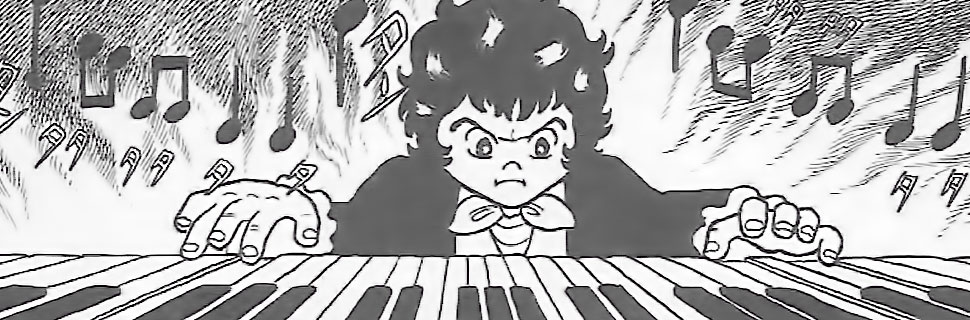
Elsewhere online, Organization Anti-Social Geniuses had a couple of posts that I found particularly interesting last week–an interview with Abigail Blackman, one of Yen Press’ editors and letterers, and a discussion of some of the fears of buying manga from U.S. publishers. Digital Manga has launched yet another Osamu Tezuka manga Kickstarter, though one that seems much more reasonable than the last failed project. This time, Digital Manga is trying to raise funding for the publication of Tezuka’s Ludwig B, an unfinished manga series about Beethoven. (In part because of my background in music, I’m actually really interested in Ludwig B.) I’d also like to bring a little attention to an effort started by Becca Hillburn–a group for Western Shoujo Comic Artists. More about it and the endeavor to create a network of support for manga-influenced artists can be read at Hillburn’s website Nattosoup: Solidarity and the American Shoujo/Josei Comic Scene.

Quick Takes

Alice in the Country of Hearts, Omnibus 1Alice in the Country of Hearts, Omnibus 1 (equivalent to Volumes 1-2) by Soumei Hoshino. Based on an otome game by Quin Rose, Hoshino’s Alice in the Country of Hearts is one of many manga adaptations and spinoffs. Originally the series was partially released in English by Tokyopop, but the license was later rescued by Yen Press. Despite hearing good things about Alice in the Country of Hears, one of the reasons it took me so long to give the manga a try was the sheer number of volumes associated with the franchise. I’m glad that I finally got around to reading the first omnibus, though, because I loved it. At first, Alice in the Country of Hearts seems like a fairly straightforward re-imagining of Lewis Carroll’s Alice’s Adventures in Wonderland. (Granted, many of the characters are now bishōnen of various types.) But it soon becomes clear that something very ominous and disconcerting is brewing under the story’s surface. Alice has been transported to Wonderland and if she ever wants to return home she will have to get to know its residents better. Although they are participating in some sort of game to win her affections, those who live in Wonderland are prone to violence and have a very different sense of what is normal.

Milkyway Hitchhiking, Omnibus 1Milkyway Hitchhiking, Omnibus 1 (equivalent to Volumes 1-2) by Sirial. Although occasionally the same characters make an appearance in multiple stories, Milkyway Hitchhiking is generally an episodic manhwa. The only thing that really ties the volume together is the presence of Milkyway, a beautiful cat who can apparently travel through space and time. She may or may not actually play an active role in the stories being told. Sometimes she’s just an observer and sometimes she’s a participant. Sometimes she’s a focal point of a tale and sometimes she simply happens to be present while events unfold around her. The most striking thing about Milkyway Hitchhiking is its beautiful, full-color artwork. Some of the individual illustrations are simply stunningly gorgeous. A variety of color palettes are used to lovely effect. While I particularly appreciate Milkyway Hitchhiking for Sirial’s art, I also enjoyed the individual episodes, too. The stories range from the fantastical to those grounded in reality. Some feel very much like something out of a fairy tale while others are contemporary slice-of-life or historical in nature. At times heartwarming and at times heartbreaking, I very much enjoyed Milkyway Hitchhiking and look forward to reading more of the series.

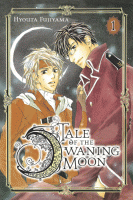
Tale of the Waning Moon, Volume 1Tale of the Waning Moon, Volume 1 by Hyouta Fujiyama. I have a tendency to forget that Yen Press releases boys’ love series. Tale of the Waning Moon is one of those manga. Fujiyama has had quite a few of her works released in English, but I haven’t read any until now. Tale of the Waning Moon is pretty ridiculous. Ryuka is a young man whose girlfriend recently left him for another man. While drowning his sorrows Ryuka accidentally calls upon Ixto, the spirit of the last quarter moon, to grant him true love. The twist is that all of the eligible candidates that Ixto comes up with are men, which doesn’t particularly appeal to Ryuka. The real problem is that when Ryuka rejects those options, he comes under Ixto’s spell and is therefore compelled to leave his village on a quest to reunite with the spirit. From there, Ryuka sets of on his journey, unintentionally amassing an adventuring party of sorts in the process. Tale of the Waning Moon has sex (not all of it consensual) and silliness, magic and mayhem. Inspired and heavily influenced by fantasy RPGs, the manga is definitely more of a comedy than it is a romance. Tale of the Waning Moon is a short series–only four volumes–and the first installment entertained me well enough, so I’ll probably get around to picking up the rest at some point.

Ubel Blatt, Omnibus 0Übel Blatt, Omnibus 0 (equivalent to Volumes 0-1) by Etorouji Shiono. Übel Blatt, which translates as “evil blade,” has a lot going for it that generally appeals to me–a dark fantasy setting, a tale of revenge, epic battles, and so on–but for some reason, the first omnibus (the zeroth omnibus?) didn’t quite grab me as much as I expected it to. I’m not really sure why, since it seems like a series that should interest me. In fact, overall I actually did like the story. I even like many of the characters, especially its lead. But there were a few little (and big) things here and there that just didn’t work for me. For one, the sexual content and rape in the volume seems entirely unnecessary. It comes across as a superfluous attempt to add more edginess as opposed to being important to the story. Most of the female characters don’t fare particularly well, either. Occasionally there’s a little bit of hope that they’ll overcome their scantily clad fantasy tropes, but it never quite seems to happen. At this point, many of the antagonists in Übel Blatt seem fairly one-dimensional, too, though I suspect that this will change as the series progresses. All that being said, Übel Blatt does feature some excellent fight sequences and scenes of destruction. And while I’m not desperate to read the next volume, the series does show potential.

Filed Under: FEATURES, My Week in Manga Tagged With: Alice in the Country of, Etorouji Shiono, Hyouta Fujiyama, manga, manhwa, Milkyway Hitchhiking, Sirial, Soumei Hoshino, tale of the waning moon, Ubel Blatt

All You Need Is Kill

November 30, 2014 by Ash Brown

All You Need Is KillAuthor: Ryosuke Takeuchi
Illustrator: Takeshi Obata
Original story: Hiroshi Sakurazaka

U.S. publisher: Viz Media
ISBN: 9781421576015
Released: November 2014
Original release: 2014

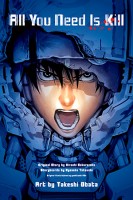
It’s been a few years since I’ve read Hiroshi Sakurazaka’s novel All You Need Is Kill but I distinctly remember enjoying it, perhaps even more than I initially thought that I would. And so, I was very excited to learn that Takeshi Obata would be working on the manga adaptation not only because I like the original All You Need Is Kill but because I also enjoy Obata’s illustrations. (Hikaru no Go, which he worked on, actually happens to be one of my favorite manga series.) I was even more excited when Viz Media licensed the All You Need Is Kill manga for an English-language release. In Japan, the series was published in 2014 in two volumes. Viz’s digital release was also two volumes, but its 2014 print edition was released as a single-volume omnibus under the Shonen Jump Advanced imprint complete with color pages and a larger trim size. While Obata provided the artwork for the manga adaptation of All You Need Is Kill, it was Ryosuke Takeuchi who outlined the script and storyboards.

Humankind has been at war with the Mimics for years, but it seems like it may be a losing battle. The Mimics, alien creatures that continue to evolve with each confrontation, have begun to close in on Japan, the only country remaining that has the ability to produce the high-tech battle jackets used in the war. If Japan is lost, the rest of the world will soon follow. Keiji Kiriya is a young jacket jockey about to face his first battle. He, like so many others, is killed in action, except that he then revives in his bunk, thirty hours before his death. At first Keji thinks he’s dreaming, but then it happens again. And then again. Time after time, Keiji lives and dies fighting against the Mimics. Doing all that he can to survive just a little bit longer each round, Keiji focuses part of his attention on Rita Vrataski, considered to be the best jacket solider in the world. Following her example, Keiji might actually have a chance to escape the time loop alive.

Because I haven’t recently read Sakurazaka’s original All You Need Is Kill it is difficult for me to make a detailed comparison between it and the manga adaptation. Generally though, I feel that the novel is the stronger work of the two, but the manga has quite a bit going for it as well. Most of the resigned humor and social commentary found in the novel and even Keiji’s internal development have been downplayed in the manga in favor of the story’s external spectacle, action, and battles. As manga is a visual medium it makes sense to have this slight change of focus, but as a result All You Need Is Kill does lose some of its emotional impact. As for the artwork itself, Obata does an excellent job conveying the drama of the plot. The jackets and heavy action sequences look great, too. The Mimics’ design does leave something to be desired though–they aren’t as terrifying as they should be–and some readers may find the occasional fanservice more distracting than anything else.

Although it may not have the same substantive weight of the original, All You Need Is Kill makes for an entertaining and exciting, action-packed manga that reads quickly. Though not without flaws, it succeeds well as an adaptation and as its own work. Particularly effective is how Obata emphasizes the time loop by utilizing very similar panels but with slightly different page layouts with each rewind, keeping the manga from becoming too repetitive. The way Obata draws Keiji changes as well. The young soldier becomes stronger and harder with each loop, but also more haunted and battle-weary. An explanation for the time abnormality is eventually given that at least makes sense superficially and sets up a nice plot twist, but it starts to fall apart if given too much critical thought. Still, the All You Need Is Kill is a great read for anyone interested in military science fiction and action. For the most part I was pleased with the adaptation; I’d still recommend that readers give the original novel a try, too, though.

Filed Under: REVIEWS Tagged With: All You Need Is Kill, Hiroshi Sakurazaka, manga, Ryosuke Takeuchi, Shonen Jump, Takeshi Obata, viz media

Neon Genesis Evangelion, Vol. 14

November 30, 2014 by Sean Gaffney

By Yoshiyuki Sadamoto and GAINAX. Released in Japan by Kadokawa Shoten, serialized in the magazine Young Ace. Released in North America by Viz Media.

(This review contains spoilers.)

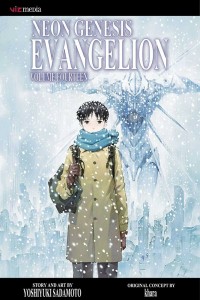
A journey that began in Japan back in 1995, and in North America approximately 2004 I think (it’s been so long), has finally come to an end with this final volume of Neon Genesis Evangelion. It’s only out digitally for the moment, as the volume was only released last week in Japan. Print volumes should be arriving in February, but I can’t wait that long, so let’s swipe at our tablets and find out what happens. I think we all have the same question: we know the manga is following the same beats as the anime did, but is it also going to end with Shinji strangling Asuka on some godforsaken (literally) beach?

evangelion14

Thankfully, the answer turns out to be no. Now don’t get me wrong – everyone still ends up in orange goo here. Makoto gets to see Misato before he dissolves, and Maya gets Ritsuko. Sadly, Aoba isn’t heavily crushing on anyone special, so he just gets dogpiled by a bunch of Rei clones. We see Gendo finally die, and it’s notable that he does NOT dissolve like everyone else – but wait till later. In the end, all is nothingness, and Rei presents this nothingness to Shinji as what Gendo has been shooting for – and what Shinji has wanted as well. To run away, to give in, to be accepted in the same nothingness as everyone else. No war, no hatred, no love, no peace – it’s all one. (There is a fantastic two-page spread showing Shinji seeing dialogue bubbles of the entirety of human experience – acceptance and rejection all in one.)

Shinji in the manga has gone through a lot of stuff, but in the end he rejects this world – and tells Rei why, in no uncertain terms. Rei describes it as a happy world, but Shinji points out that in a world that is nothing, happiness can’t exist. This too is familiar from the anime, but these scenes in the manga end up being pretty heartwarming. He recalls Yui telling him that he has to protect the happiness of everyone in the world – which means the sadness as well. After essentially saying goodbye to Rei (who I think makes it clear that if he rejects Third Impact she is not going to be around), we get one of the more iconic shots of Evangelion, which is Unit 01 emerging from Lilith’s giant eyeball.

The apocalypse gets to take up a good chunk of space, but when it’s over, and Shinji sees both Yui and Gendo in what looks like the afterlife telling him to stand on his own two feet (dammit, why a happy ending for Gendo? Grump), we see that Rei essentially rebooted the world, as things pick up with an older Shinji about to take a train into Tokyo for high school exams. This is, thank GOD, nothing whatsoever like the wacky romantic comedy universe of Episode 26, or even The Shinji Ikari Raising Project. Yes, he meets Asuka in a cute way, but it’s fairly reserved and there is no falling into anyone’s chest. It’s a new beginning, and is combined with his seeing Kensuke to show that this is what Rei and Shinji wanted. Here he can make new connections and form new bonds. Helpfully, there are also no duels in giant robots (we see the remains of the Evas describes as mysterious remnants), so it’s entirely possible that this will come to pass.

And that’s that. (There is a final chapter, which introduces Mari Illustrious Makinami as a high school classmate of Yui’s with a crush, but it’s pretty slight, and feels like an attempt to shoehorn the very popular Mari into the main manga series.) I’ve always read the manga wanting a somewhat less hopeless take on the human race. And that’s what we get here. It’s not Shinji and Asuka as Adam and Eve, it’s a chance to start anew, given by a girl who learned how to reach out and care for others thanks to Shinji’s empathy. Evangelion is a good story, well told, and I am happy that it ends like this. Well done.

Filed Under: REVIEWS

Quantum Devil Saga: Avatar Tuner, Vol. 1

November 28, 2014 by Ash Brown

Quantum Devil Saga: Avatar Tuner, Volume 1Author: Yu Godai
Translator: Kevin Frane
U.S. publisher: Bento Books
ISBN: 9781939326003
Released: July 2014
Original release: 2011

Quantum Devil Saga: Avatar Tuner, Volume 1, a novel written by Yu Godai, was originally published in Japan in 2011. The English-language edition of the volume, translated by Kevin Frane, was released in 2014 by Bento Books. It is the first book in a five-volume series which is further divided into three parts. (The first volume consists of the first half of the first part.) Those familiar with the video game series Digital Devil Saga: Avatar Tuner, a spinoff of the Shin Megami Tensei games, will find Quantum Devil Saga to be familiar as well. The series isn’t a novelization of the video games, but it is based on the same original story created by Godai which became the underlying framework for Digital Devil Saga. Although I was aware of Shin Megami Tensei, which has quite a following, and Digital Devil Saga specifically,  I’ve never actually played any of the games myself. Even so, I was still very interested in reading Quantum Devil Saga, Godai’s first written work to appear in English.

The denizens of the Junkyard exist to die in battle only to be born again in a never-ending struggle to reach the promised paradise of Nirvana. The Junkyard is divided into seven territories, one held by the Church of the Arbiters of Karma while the other six are the domain of rival tribes of skilled fighters. Only when one group is able to obtain complete control of the entire Junkyard will the gates to Nirvana be opened. Serph is the leader of the Embryon, a small tribe that has quickly gained strength, numbers, and territory. During the Embryon’s confrontation with the Vanguards tribe, an unidentifiable device appears on the battlefield which dramatically changes the balance of power in the Junkyard, unleashing the combatants’ darker selves and transforming them into demons. Suddenly, the very laws that governed the world in which they live have changed. Established systems have begun to fracture, the cycle of reincarnation is interrupted, and the quest for Nirvana has become deadlier than ever.

Quantum Devil Saga isn’t a video game novelization, nor does it read like one. However, it is quite easy to see how the story and scenario could be suited for or smoothly adapted as a game. The narrative is fairly linear, generally following Serph’s point of view as he and his comrades strive to understand everything that has happened. The way that the transformations are handled and how skills and knowledge are gained in the novel could sometimes be reminiscent of game play or mechanics. The characters fight in a series of battles with increasingly high stakes and difficulty levels, ultimately ending with what cold be considered a boss battle. It’s clearly not the final boss, though, seeing as the first volume concludes with something of a cliffhanger. But none of these similarities are actually bad things and despite them Quantum Devil Saga doesn’t feel overly game-like. It is entirely its own work and exceptionally engaging one at that. The action is exciting and clear, the characters’ philosophical and psychological development is fascinating, and the translation is great, too. Once I started reading Quantum Devil Saga, I didn’t want to put it down.

What made Quantum Devil Saga particularly interesting and intriguing for me was its setting and atmosphere. The world-building of the series is heavily informed by Hindu and Buddhist cosmology and symbolism. (There is also at least one example of Mayan influence, but I found its inclusion to be rather strange given the context of the rest of the novel.) At first it seems as though these concepts are mostly used as a source of aesthetic inspiration, but they actually run fairly deep. However, readers don’t necessarily need to be acquainted with Hinduism or Buddhism to enjoy the story, although those who are will probably get even more out of an already great novel. The overall tone of Quantum Devil Saga is fairly dark. The demonic transformations that the characters are subject to have horrific and unsettling implications. Some of them wholeheartedly embrace their new powers and forms while others are desperate to hold on to the shreds of their humanity. They are forced to face their true selves and struggle with what they see. I enjoyed the first volume of Quantum Devil Saga immensely and can’t wait for the second volume to be released.

Filed Under: REVIEWS Tagged With: Bento Books, Novels, Quantum Devil Saga, Shin Megami Tensei, Yu Godai

VIZ, DMP, and Crunchyroll Announce New Titles

November 28, 2014 by Katherine Dacey

Ludwig-B

In the aftermath of its failed Kickstarter campaign to raise $380,000, DMP has announced a more modest project: the publication of Ludwig B., Osamu Tezuka’s two-volume biography of Ludwig van Beethoven. DMP seems to have listened to fans’ complaints about previous fundraising efforts, offering more low-cost options for supporting the project and getting paper copies of the books. Johanna Draper Carlson weighs in on the new campaign.

VIZ announced the acquisition of Yoshiaki Sukeno’s Twin Star Exorcists, which will join the Shonen Jump imprint in summer 2015, while Crunchyroll recently added Hoshino Taguchi’s Maga-Tsuki to its growing manga catalog.

Holy guacamole, Batman–Yuusuke Murata’s One-Punch Man has sold more than 4.5 million volumes since its 2012 debut!

Books-a-Million reports that third-quarter manga sales were strong, buoyed by consumer interest in Attack on Titan.

And speaking of Attack on Titan, the latest volume tops this week’s New York Times Manga Bestseller list, followed by new installments of Nisekoi: False Love, Bleach, and Fairy Tail.

Wondering what books arrive at the comic shop next week? The Manga Bookshelf gang sifts the wheat from the chaff.

Japanese tennis pro Kei Nishikori finished a strong year on the court with an awesome off-the-court surprise: a portrait drawn by Prince of Tennis author Takeshi Konomi.

How have your favorite manga characters’ appearances changed through the years? Brian Ashcraft offers side-by-side comparisons of Sgt. Frog, Shin-chan, and other popular characters from the 1980s and 1990s.

White Fox, a Marvel superhero created specifically for the Korean webtoon market, will make her Stateside debut with the Avengers. The character was inspired by the kumiho, a nine-tailed fox demon from Korean folklore.

News from Japan: Taishi Tsutsui will be penning an official Nisekoi spin-off for Shonen Jump+; the first chapter goes live on Monday. Also launching a new series is Kaiji Kawaguchi, author of Zipang, a time-traveling adventure set at the Battle of Midway. His new project, which will appear in Big Comic, will focus on a state-of-the-art Japanese aircraft carrier.

Reviews: Break out the ice pick and crampons–Shaenon Garrity’s latest House of 1000 Manga column examines Jiro Taniguchi’s mountaineering saga The Summit of the Gods. Here at MangaBlog, our colleagues MJ, Sean Gaffnery, Anna N., and Michelle Smith joined me and Brigid for a conversation about our favorite food manga.

Sakura Eries on vol. 6 of Are You Alice? (The Fandom Post)
Nic Wilcox on vols. 3-5 of Are You Alice? (No Flying No Tights)
Ken H. on vol. 4 of Brave 10 (Sequential Ink)
Lesley Aeschliman on vol. 6 of A Bride’s Story (Lesley’s Musings on Anime & Manga)
A Library Girl on vols. 9-10 of Chi’s Sweet Home (A Library Girl’s Familiar Diversions)
Leroy Douresseaux on vol. 4 of Gangsta (Comic Book Bin)
Kory Cerjak on vol. 1 of Honey Blood (The Fandom Post)
Megan R. on Joan (The Manga Test Drive)
Lesley Aeschliman on vol. 16 of Kamisama Kiss (Lesley’s Musings on Anime & Manga)
Megan R. on Ludwig II (The Manga Test Drive)
Lori Henderson on Manga Classics: Pride and Prejudice (Good Comics for Kids)
Guy Thomas on Opus (Panel Patter)

Filed Under: MANGABLOG

Manga the Week of 12/3

November 27, 2014 by Sean Gaffney, Ash Brown, MJ, Anna N and Michelle Smith Leave a Comment

SEAN: December begins, and that can only mean one thing: More piles of manga.

Dark Horse has the 3rd volume of the New Lone Wolf and Cub, with whitewall tires and everything.

Who said DC Comics doesn’t release manga anymore? The Jiro Kuwata Bat-Manga is 350 pages of 60s shonen Bat-goodness, and looks to be amazing.

ASH: This is a really interesting bit of manga history. I was really surprised (and happy) to see DC pick it up!

MJ: Oh, wow, I had no idea this was in the works. Count me in!

ANNA: This sounds great. Really looking forward to it.

SEAN: Sankarea is almost finished, with the penultimate volume shipping next week. Will more main cast members die before this zombie romantic comedy staggers to its conclusion?

We get the 2nd volume of the Nightmare Trilogy from the Alice in the… series.

Is the harem complete in Knights of Sidonia 12? Or are more women waiting in the wings? Oh yes, and science fiction mecha battle horror manga as well.

MICHELLE: I am ashamed to admit that I have failed to catch up on Sidonia. I’m still buying it, though. That counts for something!

ASH: I like saving up a few volumes to read at a time; I’m about ready for another binge.

MJ: More Sidonia is always welcome!

ANNA: My Thanksgiving plans include a bit of a marathon read of Sidonia to get more caught up.

assclass1

SEAN: On the Viz side, we have the manga they said couldn’t be released! No, the Jump editors had literally said this could not be released in North America. But times have changed, there’s an anime on the way, and here we are. Assassination Classroom may have a scary name, but at heart it’s a classic ‘teacher gets class full of misfits and teaches them how to band together’ sort of title. Kind of like GTO, if Onizuka were an alien with a smiley face for a head. I cannot wait for this.

MICHELLE: Huh, interesting! I am intrigued.

ASH: Looking forward to it!

MJ: Same!

ANNA: Really, I would buy the first volume for the title alone. I want to check this out.

SEAN: Dragon Ball gets its 7th 3-in-1 omnibus.

I enjoyed the second volume of Food Wars! and I think have gotten over its appalling first few pages. So let’s have more exciting shonen foodie manga with Vol. 3.

MICHELLE: I really am enjoying this one.

ASH: As am I.

ANNA: I’m a bit more on the fence about this title, but it does have an interesting premise and storyline to balance out the fanservice.

SEAN: Another penultimate volume (look, I just like saying penultimate, OK?), as Happy Marriage?! 9 inches closer to answering the question mark in its title.

ASH: Penultimate is a great word. I… like saying it, too.

ANNA: I feel like this series has fallen off in quality a bit, but I still enjoy reading it.

SEAN: The second Honey Blood is apparently the last of the main series, though there’s a side volume due out in February. Short shoujo supernatural goodness.

MICHELLE: Or not-so-goodness, as the case may be.

MJ: Heh.

ANNA: Aww, that’s too bad. I usually do enjoy shoujo supernatural titles. I think I will check it out though.

SEAN: Kimi ni Todoke… I feel kind of churlish for saying this, but does it feel we’re dragging our feet a little as the series hits Vol. 20? I do still like it, but wish the end was in sight.

MICHELLE: There is always something very satisfying when long, beloved manga series end. I still love Kimi ni Todoke, but I know what you mean, too.

ANNA: Nothing wrong with a consistently good long running shoujo title.

SEAN: Millennium Snow comes to an end with its 4th volume, and will hopefully manage to resolve the whole “impending death” thing once and for all.

ANNA: I want to go back and reread the first two volumes, then read the new releases. I did enjoy it when it first came out.

naruto68

SEAN: Naruto may have finished in chapter format, but the collected volumes live on! Here’s the 68th.

Nura: Rise of the Yokai Clan is still marching towards its ending with the 24th volume.

There is also the 3rd Seraph of the End.

ANNA: I like this series! Not only due to the vampires, but because the light novel origins of the series ensures that there will actually be a decent amount of worldbuilding and backstory for the characters.

SEAN: If Food Wars! seems to mild and sedate for you, Toriko is always ready to take it one level higher, and its 25th volume drops next week.

In case you already miss Vampire Knight, Fleeting Dreams is a short story collection based on the series.

Voice Over! has come to the 8th volume, and is romance finally starting to stroll leisurely towards the reader?

MICHELLE: I find that I would kind of love for that to happen.

MJ: Sometimes the stroll is a bit too leisurely.

ANNA: I liked the first volume of this more than I expected to, but I don’t think I’ll be investing in reading more of the series. I think it might be good for younger teens though, and series like that are always welcome.

SEAN: Three volumes of World Trigger means I’m 3 volumes behind. Need to check this series out.

ANNA: I was lukewarm about the first couple volumes, but I can certainly see how someone else might enjoy the series.

SEAN: And a new shoujo series from Betsuhana, as we get the first volume of Yukarism. If you enjoyed Yurara, this is by the same creator.

MICHELLE: I’m really curious about this one! I haven’t read nearly as much Chika Shiomi as I should’ve. (But I bought all her stuff! That counts for something, right?)

ASH: I’m actually very excited for this one! Gender-bending, time travel, historical romance… this should be good.

MJ: I am so on board for this. I actually never read Yurara, but I loved Rasetsu, which stood better on its own than I ever expected.

ANNA: I REALLY like Chika Shiomi series. The art is great, and often there are some darker themes in her paranormal romance series that are quite intriguing. My favorite of her series so far is Night of the Beasts that was released by Go!Comi back in the day.

SEAN: What appeals to you in this rather large list?

Filed Under: FEATURES, manga the week of

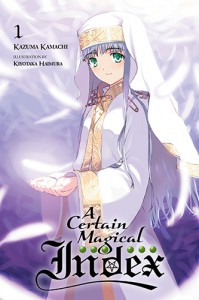
A Certain Magical Index, Vol. 1

November 27, 2014 by Sean Gaffney

By Kazumi Kamachi and Kiyotaka Haimura. Released in Japan as “To Aru Majutsu no Index” by ASCII Mediaworks. Released in North America by Yen Press.

I’ll be honest with you, I’ve read this one in fan translation. Twice. This was before it was licensed, and there was a very good reason for that: I never, ever thought this would be licensed. The main series is 22 volumes + two short story volumes, and the ‘sequel’ is 11 volumes and counting. And while I knew Yen On was starting, I hadn’t suspected this. But here we are, with certainly one of the most demanded light novel series of all, now out in the West to supplement the already popular Railgun series that spun off from it. What’s it like to read, particularly for a fan who’s already possibly seen the anime it’s based on?

index1

First off, I want to try an amusing experiment, based on the fact that this has one of the casts from Hell.

Introduced in this volume: Touma Kamijou, Index Librorum Prohibitorum, Mikoto Misaka, Stiyl Magnus, Kaori Kanzaki, Komoe Tsukiyomi, “blue-haired guy”, “frog-faced doctor” (the latter two have no official names). For Railgun readers, this takes place during the “Level Upper” arc.

There’s no question that this volume is absolutely tailor-fit to be a franchise. This volume wastes no time in stripping Index naked, there’s a typical “everyman” hero who’s actually super amazing but has fairly low self-worth (though compared to Hiroyuki from Accel World, Touma is an egotist). There’s a grumpy tsundere who shouts at the hero, though due to his nature she doesn’t hit him; instead the job of physical abuse goes to Index. Oh, and there’s a 35-year-old teacher who looks 12, chain smokes, and wears bunny footy pajamas. If you can get past the cliches, what you have here is a novel that examines the different “rules” of magic and science, and what would happen if they crossed paths. If your answer was “lots of cool fights and near-death experiences”, step to the top of the class.

It’s worth noting that when I first read the fan translation, I felt the style was overly complex and verbose, but put it down to translation issues. No, as the Yen Press version makes clear, Kamachi’s style is overly complex and verbose. Certain phrases are bolded, which appears to not signify anyone is shouting, but merely to note that something important has just been said or revealed. There’s also some expletives, which surprised me, but fit the emotions of the speaker. As you’d expect for a first novel, some of the characterization is still forming. Index is quite snarky in her first scene, and doesn’t really become the Index we know till she is healed after her injuries (specifically, as they walk to the baths, she seems to spontaneously become Index in front of our eyes). Even for someone who is “pretending to be a villain for her sake”, Stiyl is over the top in his attempts to kill Touma. And given how insanely popular she became, it’s surprising how little Mikoto appears in this first book, serving merely as a plot device to show off Touma’s abilities.

It’s hard for me to judge how well this would read to a new reader, since I’m so familiar with it. I think the translation reads as smoothly as it can given the author, and that fans of anime will certainly enjoy it. That said, it’s a slow start, despite all the battles, and you really need to be prepared for a lot of talking and explaining – yes, even more than the average. If you’re interested in seeing why the series really took off, I’d wait till the third volume, but this is certainly a solid beginning.

Filed Under: REVIEWS

  • « Go to Previous Page
  • Page 1
  • Interim pages omitted …
  • Page 573
  • Page 574
  • Page 575
  • Page 576
  • Page 577
  • Interim pages omitted …
  • Page 1048
  • Go to Next Page »
 | Log in
Copyright © 2010 Manga Bookshelf | Powered by WordPress & the Genesis Framework