• Skip to primary navigation
  • Skip to main content
  • Skip to primary sidebar
  • Home
  • About Us
    • Privacy Policy
    • Comment Policy
    • Disclosures & Disclaimers
  • Resources
    • Links, Essays & Articles
    • Fandomology!
    • CLAMP Directory
    • BlogRoll
  • Features & Columns
    • 3 Things Thursday
    • Adventures in the Key of Shoujo
    • Bit & Blips (game reviews)
    • BL BOOKRACK
    • Bookshelf Briefs
    • Bringing the Drama
    • Comic Conversion
    • Fanservice Friday
    • Going Digital
    • It Came From the Sinosphere
    • License This!
    • Magazine no Mori
    • My Week in Manga
    • OFF THE SHELF
    • Not By Manga Alone
    • PICK OF THE WEEK
    • Subtitles & Sensibility
    • Weekly Shonen Jump Recaps
  • Manga Moveable Feast
    • MMF Full Archive
    • Yun Kouga
    • CLAMP
    • Shojo Beat
    • Osamu Tezuka
    • Sailor Moon
    • Fruits Basket
    • Takehiko Inoue
    • Wild Adapter
    • One Piece
    • After School Nightmare
    • Karakuri Odette
    • Paradise Kiss
    • The Color Trilogy
    • To Terra…
    • Sexy Voice & Robo
  • Browse by Author
    • Sean Gaffney
    • Anna Neatrour
    • Michelle Smith
    • Katherine Dacey
    • MJ
    • Brigid Alverson
    • Travis Anderson
    • Phillip Anthony
    • Derek Bown
    • Jaci Dahlvang
    • Angela Eastman
    • Erica Friedman
    • Sara K.
    • Megan Purdy
    • Emily Snodgrass
    • Nancy Thistlethwaite
    • Eva Volin
    • David Welsh
  • MB Blogs
    • A Case Suitable For Treatment
    • Experiments in Manga
    • MangaBlog
    • The Manga Critic
    • Manga Report
    • Soliloquy in Blue
    • Manga Curmudgeon (archive)

Manga Bookshelf

Discussion, Resources, Roundtables, & Reviews

Blog

The Great King of Manga, Dengeki Daioh

December 19, 2014 by Erica Friedman Leave a Comment

ddaiohWay back when I started reading manga, the very first magazine I ever subscribed to was Dengeki Daioh. It had two, maybe three series running at any given time that I was following, a bunch more I could take or leave and a few that made me want to shower in acid. And so it remains, all these years later, long after I have stopped subscribing. ^_^

Like many magazines of its kind, Dengeki Daioh rides a line between targeting teens and adult men. Stories frequently star young women in various states of undress rather more often than not, who will sometimes throw themselves at the male protagonists, and kisses that are common, but not commonly mutual. The magazine also has a fairly evident lolicon readership, as indicated by many of their most popular series – some of which have made over to western shores, Masayuki Takano’s Blood Alone, Barasui’s Ichigo Mashimaro (Strawberry Marshmallow) and Kiyohito Azuma’s Yotsubato! (Yotsuba&!).

In fact, many of the series that run in the pages of Dengeki Daioh are popular, often as a result of a unique marketing tactic – manga series running in Daioh are very likely to get at least one season of an anime. The anime will end, but the manga series continues, now with a larger readership. It’s pretty rare for a Daioh series to get more than one season, in fact, which makes the exceptions that much more notable. Between  Mediaworks open licensing and Kadokawa’s relentless marketing of  popular series, it is not atypical to page through an issue of Daioh and have heard of more than a third of the series currently running. The addition of Kadokawa as a publisher means that readers are also seeing more manga adaptations of Light Novels in the magazine’s pages.

Originally started by Mediaworks in 1994, now published by ASCII Mediaworks and Kadokawa Publishing in partnership as a monthly, Daioh is the lead title in the Dengeki imprint, with a monthly circulation of 130,000, (the imprint also includes Dengeki’s G’s, Moeoh and Teioh magazines). The website is fully featured with sample chapters, highlights of the most popular series, news of upcoming anime, recruitment campaigns, contests, editor’s blog and upcoming manga releases.  At 800 yen ($6.58 at time of writing) for over 1000 pages, Dengeki Daioh is a pretty cheap way  to buy a lot of cheap entertainment.

Dengeki Daioh, from ASCII Mediaworks and Kadokawa: http://daioh.dengeki.com/
Filed Under: Magazine no Mori

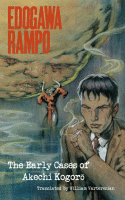
The Early Cases of Akechi Kogorō

December 19, 2014 by Ash Brown

The Early Cases of Akechi KogorōAuthor: Edogawa Rampo
Translator: William Varteresian
U.S. publisher: Kurodahan Press
ISBN: 9784902075625
Released: November 2014
Original release: 1925-1926

Edogawa Rampo, the pen name of Hirai Tarō, was an extraordinarily influential author in Japan, especially when it came to the genre of detective and crime fiction. His influence can still be seen to this day and his work continues to inspire other creators. One of his most famous characters is the detective Akechi Kogorō. Previously, only a handful of stories featuring Akechi had been translated into English: “The Psychological Test,” found in Japanese Tales of Mystery and Imagination; The Black Lizard, which was collected in a single volume along with Beast in the Shadows; “The Stalker in the Attic,” published in The Edogawa Rampo Reader; and The Fiend with Twenty Faces. I have always wished for a volume entirely devoted to Akechi mysteries and so I was very happy when Kurodahan Press announced The Early Cases of Akechi Kogorō. Published in 2014 with translations by William Varteresian, the anthology collects four of the earliest Akechi stories written between 1925 and 1926.

After an excellent and informative introductory essay about Edogawa Rampo and Akechi Kogorō, The Early Cases of Akechi Kogorō opens with Rampo’s very first mystery featuring Akechi, “The Case of the Murder on D. Hill,” a short story about the death of Akechi’s childhood friend, the wife of an owner of a secondhand bookshop he frequents. Rampo hadn’t initially intended for Akechi to become a recurring character in his fiction but readers liked him. The second story in the volume, “The Black Hand Gang,” is narrated by the same protagonist as the first, a relatively new acquaintance of Akechi, and the two of them become involved with an investigation into the disappearance of a young relative. In “The Ghost,” Akechi doesn’t appear until rather late in the story to deal with a peculiar case of a wealthy man suffering from a rival’s deep-seated grudge. The volume concludes with The Dwarf, a short novel well-received by the public but apparently disliked by Rampo himself in which Akechi is faced with an increasingly complicated murder mystery with numerous twist and turns.

All four stories in The Early Cases of Akechi Kogorō were written towards the beginning of Rampo’s career. As is noted in the introduction, Rampo largely wasn’t very happy with them. Although The Dwarf became fairly well-known in part thanks to its film adaptations, the cases collected in the volume are generally not examples of Rampo’s best or strongest work, lacking the polish of later stories. An important component of “The Black Hand Gang” doesn’t even translate very well into English since it relies on a cryptographic method based on the Japanese writing systems. Overall, the included mysteries are still enjoyable but somehow not quite as compelling as many of Rampo’s other tales. He would, however, reuse, rework, and refine many of their elements in subsequent writings. One of the things that makes these four stories particularly notable, and the reason that they have been collected together in the first place, is that they reveal Akechi very early on in his development before has become Rampo’s iconic detective and even before his character has been firmly established.

I’ll admit, I like this early Akechi in all of his eccentricities. In “The Case of the Murder on D. Hill” he begins as a well-read and intelligent young man with a particular interest in and fascination with detective and mystery fiction. The small apartment that he rents is so full of books that there’s barely any room to stand, let alone sit or entertain guests. He’s a flashy dresser and an eloquent speaker with a fondness and flair for the dramatic. By the time of The Dwarf, Akechi has begun to transform into the master detective that he will later be remembered as. He is no longer just an amateur sleuth seeking out strange cases in his spare time as some sort of hobby; Akechi has become a skilled and famous investigator with contacts in the judicial and police forces and a cohort of men working under him. I enjoyed The Early Cases of Akechi Kogorō a great deal specifically because it provides a glimpse of the earliest incarnations of Rampo’s great detective. I do hope to have the opportunity to read even more of Akechi’s stories in translation in the future.

Filed Under: REVIEWS Tagged With: Edogawa Rampo, Kurodahan Press, Novels

Review: Assassination Classroom, Vol. 1

December 18, 2014 by Katherine Dacey

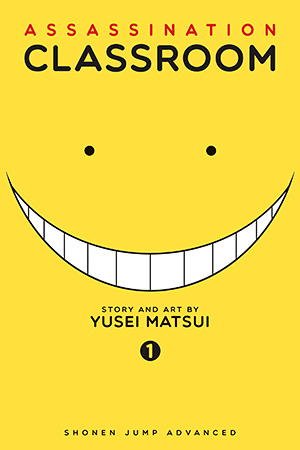
1421576074Assassination Classroom, Vol. 1
By Yusei Matsui
Rated T+, for Older Teens
VIZ Media, $9.99

Americans steadfastly believe that all students need to succeed are a few good teachers—think of how many movies you’ve seen about an unorthodox educator who helps a group of misfits, losers, or underachievers realize their full potential against all odds. Perhaps that’s why American publishers hesitated before licensing Assassination Classroom, a comedy that outwardly conforms to the tenets of the genre while poking fun at its hoariest cliches.

Assassination Classroom‘s star teacher is Koro-sensei, a super-powered alien who can wipe out an army with a swish of a tentacle. His students are class 3-E, the troublemakers and flunkies of Kunugigaoka Junior High School. Instead of studying calculus or Shakespeare, however, Koro-sensei’s charges are learning how to kill him and save Earth in the process—in other words, it’s To Sir With Lethal Force.

If the script isn’t quite as edgy as my summary suggests, Assassination Classroom scores points for the sheer ridiculousness of the premise. Koro-sensei’s relentless enthusiasm and high standards match those of other fictional educators—Michelle Pfeiffer in Dangerous Minds, Robin Williams in Dead Poets Society—but are applied to such activities as shooting and stabbing. He gives the same kind of inspirational speeches that you’d find in those movies, too, reminding his charges that he specifically requested the job because he knows the students’ true potential.

In one scene, for example, timid student Okuda presents Koro-sensei with three deadly potions, imploring him to sample them. “I’m not good at surprise attacks!” she tells him. “But I love chemistry! And I really put my heart and soul into this!” Koro-sensei cheerfully obliges, offering to help Okuda “research a poison that can kill me.” When Okuda proves more skillful at mixing chemicals than persuading her target to drink them, Koro-sensei reminds her that “in order to kill someone, you need to understand how they feel,” skills that she can cultivate through—what else?—reading and writing.

The exchange between Okuda and Koro-sensei is complemented by some of the best visual gags in volume one. One of the poisons, for example, neutralizes Koro-sensei’s Cheshire grin into a flat line, prompting a student to exclaim, “You look like an emoticon!” Although Koro-sensei’s face is the essence of simplicity—a circle with pin-dot eyes and a toothy smile—this subtle tweak of his appearance yields a big pay-off laugh-wise.

At the same time, however, the poison episode illustrates Assassination Classroom‘s biggest flaw: Yusei Matsui wants to have his cake and eat it, too, soft-pedaling the humor with an uplifting, awwww-worthy moment in almost every chapter. Students unironically vow to do their best after Koro-sensei points out the flaws in their technique, saves them from harm, or gives them a pep talk. None of the students harbor a grudge against him—at least not for very long—or question the value of Koro-sensei’s lessons. (Makes you wonder: is Koro-sensei guilty of grade inflation?)

Still, I enjoyed volume one enough to continue with the series, even if Matsui’s efforts to express the Shonen Jump dictum of “friendship, effort, victory” sometimes blunt the edge of his satire.

Filed Under: MANGABLOG, REVIEWS Tagged With: Shonen Jump, viz media

Love at Fourteen, Vol. 1

December 18, 2014 by Sean Gaffney

By Fuka Mizutani. Released in Japan by Hakusensha, serialization ongoing in the magazine Rakuen Le Paradis. Released in North America by Yen Press.

Sliec-of-life can be very difficult sometimes in the West, particularly if it also has romance in it. The genre tends to involve a laid-back quality, with lots of chapters devoted to normal kids doing normal things, and recalling the nostalgia of your teenage years. It’s the antithesis of a title like Naruto or Parasyte. But when done right, slice-of-life can bring a smile to your face, making you want to turn the pages faster so that you can bask in the warm glow of the cast’s feelings. Love at Fourteen is definitely slice-of-life done right; I lost track of the number of times I said “Oh my God, they’re adorable” about halfway through this first volume.

fourteen1

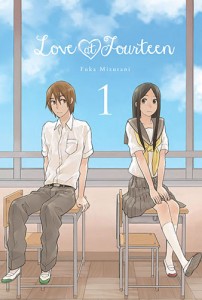
The premise of this volume will not seem unfamiliar to readers of another Hakusensha series, His & Hers Circumstances. Kanata and Kazuki are both the most admired kids in middle school, both having an air of ‘maturity’ about them that sets them above the pack. Of course, that maturity is also what keeps kids from getting too close to them. However, the pair have a secret – they’re childhood friends, and have been “acting” mature as it’s expected of them, when frequently they want to do nothing but relax and let their emotions hang out. The troubles start when the class points out, independently, how gorgeous Kanata’s hair is, and how deep Kazuki’s voice is, things which had never really occurred to two young teens who have hung out for years.

And so they start to realize they’re in love with each other, and are not quite clear how to deal with it. What follows are a series of chapters with lots of heavy blushing, frustrated desires, and sweet reunions. The drama is minimal, mostly as these two don’t make their own drama. “Acting” mature has been the norm for so long that they find they’ve actually *become* mature. What’s more, it’s never stated outright, but I suspect like most Japanese middle schools open relationships are heavily frowned on, so all this has to be kept a secret, which is a pain when you’re having trouble keeping your hands off each other.

I had thought that there was going to be a bit of drama towards the end of the volume, as one of their trysts is observed by Nagai, the class troublemaker. However, before he can start an obvious blackmail attempt he is quickly caught up in problems of his own, stemming from the class music teacher, who’s trying to get him to stop being truant and start singing. I’m a sucker for teachers who can wrap teens around their fingers, and so this was possibly my favorite chapter, and I really hope we see the two of them in the next volume.

In the end, though, this is really Kanata and Kazuki’s series, and there’s an abundance of them to enjoy here. It’s early on, and we haven’t even had a first fight chapter. Things are developing slowly and sweetly, as you’d expect from two kids who’ve known each other so long and now have to redefine each other… and themselves. The book has little definitions interspersed throughout on puberty and developing a sense of self, and you can see our leads develop accordingly. Most importantly, after reading this you will have the biggest goddamn smile on your face you’ve ever seen. Highly recommended.

Filed Under: REVIEWS

After School Nightmare, Vol. 1

December 17, 2014 by Ash Brown

After School Nightmare, Volume 1Creator: Setona Mizushiro
U.S. publisher: Go! Comi
ISBN: 9781933617169
Released: September 2006
Original release: 2004

After School Nightmare is a ten-volume manga series by Setona Mizushiro. I first came across the series while working my way through one of my local library’s manga collection which, at the time, was largely shelved alphabetically by title. So, it didn’t take me too long to encounter After School Nightmare. I borrowed and read the first few volumes and on the strength of those alone decided to track down and purchase the entire series which had sadly gone out of print. The manga’s dark, horror-tinged psychological drama and its themes exploring gender and sexuality immediately appealed to me; the series had the potential to be both disconcerting and compelling. After School Nightmare, Volume 1 was originally published in Japan in 2004. The English-language edition of the volume was released in 2006 by the now defunct Go! Comi. After School Nightmare has generally been critically well-received in English, even earning an Eisner Award nomination for Best U.S. Edition of International Material among other honors.

Mashiro Ichijo is an androgynously attractive and well-liked you man, but he’s hiding a secret from his classmates–his body is neither entirely male nor entirely female. This has brought Mashiro some challenges in his life and as a result of his physical condition he struggles with his personal identity and gender. Just how much he struggles is made abundantly clear when Mashiro is requested to join a special after-school class which must be completed in order for him to graduate. In it the students must literally live out their nightmares where they are forced to face their darkest fears and bear witness to one another’s deepest secrets. What’s more is that they aren’t there to offer comfort or support. Instead, circumstances encourage them to strike out against their fellow classmates. And even though what happens in the nightmares isn’t to carry over into the real world, sharing such an intimate experience can’t help but change the young people and how they see one another.

The circumstances surrounding the after-school classes are peculiar. Only the students invited to attend seem to be aware of it. The stairs leading down to the infirmary where the class is held in a basement that shouldn’t exist disappears and reappears depending on the day. The teacher in charge isn’t known by the school’s other faculty. Students who “graduate” quietly go missing and are forgotten. All of these things and more add to the foreboding atmosphere of After School Nightmare and the feeling that something just isn’t quite right about what is going on. The shared nightmares themselves are also ominously disconcerting. The imagery is frightening–a girl whose face and heart are gaping holes, disembodied hands and arms, a cruel knight in black armor–but in the end the students’ psychological torment and distress may be even more troubling and gut-wrenching. The nightmares simply reveal the darkness and confusion that they already carry within themselves.

In the dreams, the students take on their true forms, representative of the issues, abuse, and trauma that they are dealing with. Many of them appear so distorted in the nightmares that its difficult to know their identities in the waking world. That’s not the case for Mashiro who looks exactly the same except that, to his horror, he sometimes is wearing the girls’ skirted school uniform in the dreams. This makes him easily identifiable and a target in the real world. He catches the attention of Kureha Fujishima, a young woman who is afraid of men but feels comfortable around Mashiro after learning his secret. And then there’s Sou Mizuhashi who has a reputation for being a playboy and womanizer but who also seems to have taken an intense interest in Mashiro. Though somewhat conflicted over these developments in his relationships with his classmates, Mashiro largely welcomes the attention from Kureha and is understandably uncomfortable with Sou’s aggressive advances towards him. As the first volume of After School Nightmare shows, reality can be just as terrifying if not more so than any nightmare.

Filed Under: REVIEWS Tagged With: after school nightmare, Go! Comi, manga, Setona Mizushiro

Takeshi Obata Returns to Shonen Jump

December 15, 2014 by Brigid Alverson

Shonen Jump adds a new series to its lineup, and the artist is Takeshi Obata! The series is Gakkyu Hotei: School Judgment and the writer is Nobuaki Enoki. It’s about a school that has its own court; if that sounds familiar, it’s because the manga ran for a while as a smartphone-only series and just relaunched on December 1.

Kodansha has expanded into China with a local magazine, Jinmanhua, and homegrown manga by Chinese artists; the creative duo who go by Navar have seen their manhua Carrier: Xiedaizhe, go the other way—it is now running in Kodansha’s Bessatsu Shonen Magazine in Japan and has been published as collected editions there as well.

Got some last-minute shopping to do? Erica Friedman posts the Okazu Gift Guide, and she also has a fresh serving of Yuri Network News for us.

Laura reveals her favorite shoujo series at Heart of Manga, and she also looks at the series currently running in the magazine Be Love.

Reviews: The Manga Bookshelf team takes a quick look at recent releases in their newest Bookshelf Briefs post.

Rebecca Silverman on vol. 1 of Ajin (ANN)
Ash Brown on vol. 2 of Attack on Titan: No Regrets (Experiments in Manga)
Lesley Aeschliman on vol. 6 of Attack on Titan (Lesley’s Musings on Manga)
Lori Henderson on vols. 11-13 of Attack on Titan (Manga Xanadu)
Alice Vernon on Bloody Cross (Girls Like Comics)
Lesley Aeschliman on vol. 24 of Fullmetal Alchemist (Lesley’s Musings on Manga)
Kristin on The Garden of Words (Comic Attack)
Sarah on vol. 16 of Kamisama Kiss (nagareboshi reviews0
Lesley Aeschliman on vol. 25 of Naruto (Lesley’s Musings on Manga)
Johanna Draper Carlson on vol. 10 of Ooku: The Inner Chambers (Comics Worth Reading)
A Library Girl on vols. 1-3 of Pandora Hearts (A Library Girl’s Familiar Diversions)
Leroy Douresseaux on vol. 4 of Phantom Thief Jeanne (The Comic Book Bin)
Erica Friedman on Philosophia (Okazu)
Lesley Aeschliman on the December 15 issue of Shonen Jump (Lesley’s Musings on Manga)
Sean Gaffney on vol. 4 of Soul Eater Not! (A Case Suitable for Treatment)
Leroy Douresseaux on vol. 3 of Terra Formars (The Comic Book Bin)
AstroNerdBoy on vol. 2 of UQ Holder (AstroNerdBoy’s Anime and Manga Blog)

Filed Under: MANGABLOG

Bookshelf Briefs 12/15/14

December 15, 2014 by Sean Gaffney and Michelle Smith Leave a Comment

This week, Sean and Michelle look at recent releases from Viz Media and Kodansha Comics.

kimi20Kimi Ni Todoke, Vol. 20 | By Karuho Shiina | Viz Media – This is still Sawako’s story, and her development here is great, but I do love that there’s just as much investment in having the other two heroines grow up as well – Sawako’s career choice is actually the easiest. It’s also great to see the good teacher we know Pin is, as he reminds Chizu that running a ramen joint requires more than just knowing how to cook, and tells Yano straight up that she has the talent to set her goals higher… so why isn’t she? Her mother backs this up, and now Yano is not only wondering about her life goals but about her relationship with Kento. I’d complained earlier that I felt this series might be running a bit long, but this volume showed it still has a lot more going on. – Sean Gaffney

nura24Nura: Rise of the Yokai Clan, Vol. 24 | By Hiroshi Shiibashi | Viz Media – For the most part, this penultimate volume of Nura is a bunch of battles. I believe that the actual end in Weekly Jump is here, approximately halfway through – the rest ended up being in the extra issues like Jump Next, etc. It’s nice seeing the school classmates here, even if it fells like a goodbye – Nura quickly outgrew its “real-world” aspect, and even Kana is an afterthought now, as it’s Tsurara who spends the volume by Rikuo’s side. We see the culmination of what he’s been doing the entire series, as everyone he approached to be allies in the fight now shows up to help out, leaving him safe to fight the final boss. This was never the best shonen series, but I’ll miss it. – Sean Gaffney

rreal13Real, Vol. 13 | By Takehiko Inoue | Viz Media – The latest volume of this wheelchair basketball drama is actually all about pro wrestling, as Takahashi’s rehab companion, Shiratori, makes an inspirational return to the ring, fighting in such a way that the audience is oblivious to his disability. While it was nice to learn more about his backstory, better still is the impact his performance has on Hanasaki and Takahashi. The latter, especially, watches Shiratori fighting with everything he’s got left, pushing himself to the limit for something he loves and finally completely lets go of the aloof, unaffected persona he’d cultivated in high school and embraces his real self, who could love something passionately. To that end, the final page is him showing up to join a wheelchair basketball team. Maybe it sounds simplistic described in words, but in Inoue’s sure hands, the end result is very moving. Now to endure another year before volume fourteen! – Michelle Smith

toriko25Toriko, Vol. 25 | By Mitsutoshi Shimabukuro | Viz Media – I will admit to being a bit disappointed with this volume. I wanted more amazing cooking battles, but sadly Gourmet Corps crashes the event and starts attacking everything, so instead this turns into a melee battle. It’s not without its high points – I liked Coco explaining to Komatsu why chefs such as him are so highly prized in this world, and a battle between Sunny and Tommyrod promises to be rather epic – but for the most part this is a bunch of people showing off their fighting power, then vanishing from the narrative to make way for more people. Combine that with the already high number of new chefs introduced in the last volume, and you have a Toriko that’s less than the sum of its parts. – Sean Gaffney

rei2xxxHOLIC Rei, Vol. 2 | By CLAMP | Kodansha Comics – Yeah, OK, I knew I wasn’t really getting a reboot. Clearly this takes place after the main series, and also clearly there is something terribly wrong, seemingly based on a decision that Watanuki made at some point, something lampshaded by his being interrupted here in this dream/whatever world before he can choose between two gifts. He has knowledge of the supernatural that could only come with experience, and is thus surprising everyone – or is he? In any event, we also still have the usual supernatural, yokai-influenced stories, which are the best part of xxxHOLIC for me. And Himawari’s here, yay! And not married to generic guy we never see and shoved offscreen! Oh xxxHOLIC, why can’t I quit you?-Sean Gaffney

Filed Under: Bookshelf Briefs

Pick of the Week: Keaton vs. Fourteen

December 15, 2014 by MJ, Sean Gaffney, Michelle Smith, Ash Brown and Anna N 4 Comments

fourteenSEAN: There are a bevy of choices this week. I’m tempted by an English edition of Master Keaton at last, or the new yuri title Citrus. But I will go with Love at Fourteen as my pick of the week. It’s the story of two childhood friends, both mature for their age, who are dealing with love and everything that comes from it. The magazine it runs in, Rakuen Le Paradis, is one of Hakusensha’s best new titles, technically being shoujo/josei but really more ‘sui generis’. I cannot wait to read this.

MJ: I am decidedly with Sean this week. Though there are a number of titles on my radar, the one that intrigues me most by far is Love at Fourteen. Everything about this title sounds like exactly what I like best in a manga, and I am a bit ashamed that I didn’t even realize it was on the way until this week. Now I can’t wait to read it!

masterkeaton1MICHELLE: I’m in the opposite camp! I did know Love at Fourteen was coming, so the one I wasn’t aware of until recently was Master Keaton. I really love Naoki Urasawa, so I am super excited to read this one!
ASH: I’m with Michelle this week. While I’m interested in Love at Fourteen, my pick absolutely goes to Master Keaton. Urasawa is one of the reasons I developed such a healthy obsession with manga, so I’m very happy to see more of his work being released in English.

ANNA: I’m also with Ash and Michelle! A newly translated Urasawa series takes precedence over everything in my mind!

What looks good to you this week?

Filed Under: PICK OF THE WEEK

My Week in Manga: December 8-December 14, 2014

December 15, 2014 by Ash Brown

My News and Reviews

Two reviews were posted at Experiments in Manga last week. The first was of Frederik L. Schodt’s classic survey of manga originally written in 1983 but slightly revised in 1986 and with a new introduction added in 1997, Manga! Manga!: The World of Japanese Comics. It may be a few decades old, but it’s still a fantastic work that is well worth reading. Last week I also reviewed Hikaru Suruga’s Attack on Titan: No Regrets, Volume 2, the final volume of Attack on Titan‘s short, shoujo spinoff which focuses on Levi and Erwin’s backstories. I wasn’t quite as fond of the second volume as I was of the first, but I did enjoy the series. It’s definitely a must-read for fans of Erwin and/or Levi and I appreciated how it expanded the setting of Attack on Titan.

Elsewhere online, Kodansha Comics announced the license of Naoshi Arakawa’s Your Lie in April. An Indiegogo campaign was launched to create a stop-motion film adaptation of Moyoco Anno’s The Diary of Ochibi manga. Vertical linked to an older article about Prophecy and how French Manga Fans Inspire the Work of Tsutsui Tetsuya. (The first volume of Prophecy was recently released in English and it’s fantastic.) And last but not least, Muse Hack posted an interview with Mikhail Koulikov of the Anime and Manga Studies Blog. I’ve been following Koulikov’s Anime and Manga Studies ever since I’ve discovered it. The blog is a great resource for anyone interested in the academic pursuit and scholarly study of Japanese pop culture.

Quick Takes

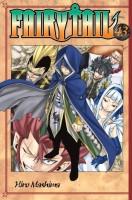
Fairy Tail, Volume 43Fairy Tail, Volume 43 by Hiro Mashima. There was very little Gray in the forty-third volume of Fairly Tail which made me a little sad, especially after the buildup in his character and story over the last few volumes. But with a series like Fairy Tail, which has a fairly large cast of characters who regularly play an important role in its plot, time needs to be spent with those other characters as well. Fairy Tail always seems to have one or two moments of fanservice that, at least for me, detract from the story being told. The clothing and armor choices for the female characters in particular tend towards stereotypical fantasy design–showing more flesh than would be appropriate for battle–but at least the women in Fairy Tail generally have well-developed personalities and are very capable characters in their own right. Often, they’re even stronger than the men. And to be fair, there’s male nudity as well as female nudity in Fairy Tail, though as might be expected from a shounen manga, generally not to the same extent. Fairy Tail is now well into the beginning of the Tartaros arc of the series in which the members of the Fairy Tail guild must face off with a dark guild of demons which is trying to eliminate the entire Magic Council.

Kiss All the Boys, Volume 1Kiss All the Boys, Volumes 1-3 by Shiuko Kano. For the most part I enjoyed Kiss All the Boys more than Kano’s earlier series Yakuza in Love, but ultimately I felt a bit cheated by its conclusion. While in some ways I’m glad that most everything ends happily for the characters, I’m not convinced that that’s really how things would have played out and some of the eventual pairings are troubling. But while Kiss All the Boys may not be the most believable series, at least the convoluted relationships are for the most part interesting even when they are appalling. The series hinges on Tetsuo, a straight thirty-something hentai artist with a fifteen-year-old son born from his youthful indiscretions. At least he’s supposed to be straight. Conveniently for the manga, he soon finds himself entangled in relationships with several other men–his next door neighbor, his best friend and editor, and even the boy his gay son has a crush on. Tetsuo is an asshole, but at least he knows he’s an asshole. He does make some effort to rise above his nature but unfortunately never quite manages to succeed. For the most part Kiss All the Boys is intended to be a comedy and shouldn’t be taken too seriously, but I couldn’t help but worry for the youngsters left with terrible adult role models.

Yukarism, Volume 1Yukarism, Volume 1 by Chika Shiomi. I haven’t previously read any of Shiomi’s manga, but I was looking forward to Yukarism because of its promise of interesting gender dynamics, reincarnation, and historical romance. Although Yukari Kobayakawa is only seventeen, he has already made a name for himself as an author of novels set in the Edo period. He never has to do any research though since he subconsciously draws inspiration from his past life as a courtesan in the era’s pleasure district. Except for that particular twist, at this point Yukari actually isn’t a very interesting character. He’s very reserved, self-absorbed, impassive, and completely unfazed when he begins to slip back and forth between his past life and his current one. Many of the people surrounding Yukari in present-day Japan are reincarnations of people he knew in the pleasure district although they don’t all seem to be aware of that fact. There’s definitely some potential for romance in Yukarism, but after only one volume that doesn’t appear to be the series’ main concern yet. Instead, the mystery surrounding the deaths of Yukari and the others in the past seems to take precedence, although the connections between all of the characters in all of their incarnations is an important element as well. I’ll be curious to see how the series continues to develop.

DevilPartTimerThe Devil Is a Part-Timer! directed by Naoto Hosoda. I’ve been meaning to watch The Devil Is a Part-Timer! for quite some time now, but I was recently reminded of that intention when Yen Press licensed both the light novel series by Satoshi Wagahara on which the anime is based as well as at least one of its manga adaptations. While the anime is entertaining, the ridiculous premise is more hilarious in theory than in execution–The Devil Is a Part-Timer! is actually played fairly straight. But it’s still a fun and consistently amusing series. I particularly got a kick out of Satan diligently working in the fast food industry as a way to take over the world (he takes his job very seriously) and the portrayal of Lucifer as a hikikomori with an online-shopping addiction. For the most part, The Devil Is a Part-Timer! nicely balances its comedy with its drama. Although it has a conclusion, the ending of the series lacks finality and some of the characters introduced were never really put to good use, as though additional seasons were initially planned for but never manifested. (At least I haven’t heard anything about a second season.) Overall, The Devil Is a Part-Timer! is funny series and a nice change of pace from all of the anime centered around high school or middle school students. I might just give the original novels a try when they’re released in English.

Filed Under: FEATURES, My Week in Manga Tagged With: anime, Chika Shiomi, Devil Is a Part-Timer, Fairy Tail, Hiro Mashima, Kiss All the Boys, manga, Shiuko Kano, Yukarism

Soul Eater Not!, Vol. 4

December 14, 2014 by Sean Gaffney

By Atsushi Ohkubo. Released in Japan by Square Enix, serialized in the magazine Shonen Gangan. Released in North America by Yen Press.

I had thought that this was the final volume of the series, but apparently not, as there’s an unscheduled Vol. 5 that is likely waiting for a sufficient distance from the Japanese release. It’s unclear whether the plot of the manga will follow the anime, which had already finished (with Ohkubo’s advice) before this ended. That said, we have here a manga that still has the same problems which the first volume possessed, but is also adding some new ones, such as whether a typical ‘yuri’ fan is supposed to enjoy the series or be really pissed off about it, and how much serious plot you can have in a moe slice-of-life type manga before it really starts to feel out of place.

souleaternot4

Please note that by yuri fans I mean MALE yuri fans, the sort who would be quite happy to see the pairings end in a threesome, and who aren’t put off by the chapter of Meme running around naked that we see here. That said, fanservice isn’t everything, and I think most modern yuri fans are finding that the traditional tease just isn’t enough. Kim and Jackie are another good example – there’s lots of suggestion here that Jackie is in love with Kim, and some hints that Kim might one day return it… but this takes place before Soul Eater, where Kim and Ox become a couple. There’s no there there, it’s done solely to be ‘cutesy’ in a harmless way. Likewise, anyone who thinks that the ‘who will Tsugumi choose?’ plotline might actually involve genuine love and emotion has to be appalled at the aforementioned scene with the girls trying to sleep on a very hot night, which, fanservice aside, seems to show off the ‘immaturity’ of the girls for those who want a safe out.

That said, the other suggested romance in the series, that of Tsugumi and Akane, also seems to have vanished, and the manga is happily settling into focusing solely on our three heroines. There is also, among the jokes and 4-koma, a suggestion of the deeper ongoing plot. Eternal Feather is still recovering from her brainwashing two volumes ago. More importantly Meme’s memory issues, which have been used for comedy to this point, are getting to be a bigger and bigger issue, one that causes genuine concern. The final scene of the book is heartbreaking, as Tsugumi tears into Meme for what she sees as an annoying quirk (Tsugumi dealing with grief over a dead pet right now), but then stops seeing Meme expressing real sadness that she forgot something important again. It’s been vaguely implied she’s a mole for the villain, and I wonder if this is connected to that.

Soul Eater Not! is doing its best to try to appeal to a broader otaku market here, but it feels too pandering, to be honest, and could use more seriousness and heart. It still has some strengths – Anya has developed into the most sensible character of the bunch, and is a far cry from the tsundere princess she started as – but really, Soul Eater fans are better off with Soul Eater, and moe/yuri fans can find material that will give them better jokes and a better payoff than I expect this to have.

Filed Under: REVIEWS

  • « Go to Previous Page
  • Page 1
  • Interim pages omitted …
  • Page 570
  • Page 571
  • Page 572
  • Page 573
  • Page 574
  • Interim pages omitted …
  • Page 1048
  • Go to Next Page »
 | Log in
Copyright © 2010 Manga Bookshelf | Powered by WordPress & the Genesis Framework