• Skip to primary navigation
  • Skip to main content
  • Skip to primary sidebar
  • Home
  • About Us
    • Privacy Policy
    • Comment Policy
    • Disclosures & Disclaimers
  • Resources
    • Links, Essays & Articles
    • Fandomology!
    • CLAMP Directory
    • BlogRoll
  • Features & Columns
    • 3 Things Thursday
    • Adventures in the Key of Shoujo
    • Bit & Blips (game reviews)
    • BL BOOKRACK
    • Bookshelf Briefs
    • Bringing the Drama
    • Comic Conversion
    • Fanservice Friday
    • Going Digital
    • It Came From the Sinosphere
    • License This!
    • Magazine no Mori
    • My Week in Manga
    • OFF THE SHELF
    • Not By Manga Alone
    • PICK OF THE WEEK
    • Subtitles & Sensibility
    • Weekly Shonen Jump Recaps
  • Manga Moveable Feast
    • MMF Full Archive
    • Yun Kouga
    • CLAMP
    • Shojo Beat
    • Osamu Tezuka
    • Sailor Moon
    • Fruits Basket
    • Takehiko Inoue
    • Wild Adapter
    • One Piece
    • After School Nightmare
    • Karakuri Odette
    • Paradise Kiss
    • The Color Trilogy
    • To Terra…
    • Sexy Voice & Robo
  • Browse by Author
    • Sean Gaffney
    • Anna Neatrour
    • Michelle Smith
    • Katherine Dacey
    • MJ
    • Brigid Alverson
    • Travis Anderson
    • Phillip Anthony
    • Derek Bown
    • Jaci Dahlvang
    • Angela Eastman
    • Erica Friedman
    • Sara K.
    • Megan Purdy
    • Emily Snodgrass
    • Nancy Thistlethwaite
    • Eva Volin
    • David Welsh
  • MB Blogs
    • A Case Suitable For Treatment
    • Experiments in Manga
    • MangaBlog
    • The Manga Critic
    • Manga Report
    • Soliloquy in Blue
    • Manga Curmudgeon (archive)

Manga Bookshelf

Discussion, Resources, Roundtables, & Reviews

Blog

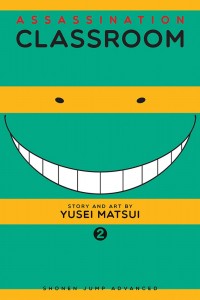
Assassination Classroom, Vol. 2

February 5, 2015 by Sean Gaffney

By Yusei Matsui. Released in Japan by Shueisha, serialization ongoing in the magazine Weekly Shonen Jump. Released in North America by Viz.

In this second volume, there’s a bit less focus on the actual assassination attempts as Matsui starts to try to expand the cast and show us more of the horrible world they live in. We meet the principal of the school, who exudes pure cynicism and hatred from every pore, and it’s quite apparent that he will not allow Class 3-E to succeed. Scapegoats who learn to better themselves have no value to him, and so he changes the rules to ensure that they are hated and despised. What it’s doing to the kids themselves doesn’t seem to matter to him – I think if they all killed themselves the day after graduation he wouldn’t spare it a second thought – but in my mind, it’s the values he’s placing in the A-D classes that’s far more chilling.
ac2

Of course, this is meant to contrast with Koro-sensei, who may be an alien out to kill us all but is also determined to give these kids self-confidence to be the best they can be, and takes it personally when all his hard work goes wasted during the midterms. This is nicely contrasted with all the moments where Koro-sensei is simply an eccentric idiot – the reasn that we don’t get to bored or irritated with him is that he has so many flaws and bad habits in among his invulnerability – flaws that are dutifully being written down by our narrative voice Nagisa (calling him the protagonist of this series seems oddly wrong), and flaws that are abused, seemingly, by the new teacher and assassin introduced here, Irina Jelavich.

A brief aside. For those who hoped that with the forced addition of ‘Koro-sensei’ we’d see honorifics in this series, sorry, Jump editorial practice will only allow it if it leads to an untranslatable pun. Thus ‘Bitch-neesan’ becoming ‘Bitch-sensei’ is not going to happen, and instead we see ‘Ms. Bitch’ becoming ‘Ms. Vitch’, which also neatly allows Viz to soften things up a bit. Bitch or Vitch, though, Irina certainly makes a horrible first impression, on both the cast and the readers. She’s an omniglot and talented assassin, but it’s clear that she only knows how to assassinate through seduction, and when it comes to actually keeping her cover as a teacher she’s useless. That said, she does seem to be easing up a bit, particularly when she sees how Class 3-E are treated by the rest of the school. I could have done without the tentacle rape joke, though given what Koro-sensei looks like I suppose it was inevitable.

We see the students here as well, but so far they seem to be more of a cast herd rather than having deeply drawn personalities. Nagisa is the strongest, being the keen observer (though he’s weak for busty women, like most teens – and indeed like Koro-sensei). Kaede hasn’t really said much at all (though I did love the ‘my brain is up here’ sign she held up, a wonderful translation choice, as I think the original just had her complaining about Irina’s large breasts). And Karma may be the smartest in the class, but he made far less of an impression here. The end of the volume promises that may change soon, though, and I’m hoping that this is the sort f series where everyone gets some attention paid to them. Though ‘a lot of them are only bit players so I try not to make them too unique’ doesn’t bode well.

Overall, this is still an addictive series, even if I feel it has some issues with character. Irina is an amusing addition to the cast, and I hope we will eventually get jokes about her that don’t involve her being a femme fatale who’s really just a ditz. More to the point, the stakes are raised with the introduction of the principal, as now we really see what Koro-sensei and the class are up against. Go get this.

Filed Under: REVIEWS

JoJo’s Bizarre Adventure: Part 1 Phantom Blood Vol 1

February 4, 2015 by Anna N

JoJo’s Bizarre Adventure: Part 1 Phantom Blood, Volume 1 by Hirohiko Araki

I read this volume without much background in this series other than knowing that it was a huge and long-running series in Japan, has a bit of a cult following in Japan, and the books that Viz had been releasing under the shonen jump line started midway through the series. This volume goes back to the earliest story arc in the series, kicking things off with the English nobility, bloodthirsty Aztec masks, and people beating the crap out of each other.

The story kicks off in old school shonen fashion, where a scantily clad woman is sacrificed to the wearer of a mysterious stone mask who proclaims that his accessory drinks the blood of the living. Bones from the mask pierce his skull, but he’s still alive and taking on even more blood sacrifices, not worried about staining his stylish leopard skin pelt cape because he has found the secret to eternal life!

The story then skips over to England, where an evil red-haired young man offers his dying father some medicine. Dio’s father tells him a story about how he accidentally saved the life of a nobleman named Joestar when he came across the wreckage of carriage he was intending to scavenge. Brando tells Dio to go to the Joestars when he becomes orphaned, and Dio does, thus starting the torture of poor young Jonathan Joestar. Dio is immediately adopted as a second son by the Joestar family, but since he is basically the spawn of Satan and Jonathan Joestar is like a friendly naive puppy, things do not go well with the new brothers.

Dio is basically a human form of a cancer, undermining the heir to the Joestar family whenever he gets a chance. It has been a long time since I’ve read a shonen manga this manly! There are speed lines and yelling on almost every page. Jonathan and Dio engage in fistfights and boxing matches, where one blow will end up knocking a half dozen teeth into the air. Towards the end of the book the legacy of the blood drinking Aztec mask is further explored, and Jonathan finally begins to get proof of Dio’s nefarious deeds. The art is really dynamic although the proportions are often a bit off. Often one of the muscular bodies of the main characters will look like it is supporting a shrunken head. If Rob Liebefeld and Tetsuo Hara of Fist of the North Star mashed up their styles you might end up with something like JoJo’s Bizarre Adventure, except Araki can actually draw feet. I’m sure the art gets much better in subsequent volumes, and even though it wasn’t always to my taste I couldn’t deny the effectiveness of the energy of the many battle scenes in the manga.

As a main character, Jonathan Joestar lets himself be taken advantage of for far too long, but he does manage to battle back as shonen heroes always do. The hardcover edition is really nicely designed, with color pages shifting to further tonal pages where the black and white art is enlivened by shades of orange. This volume ends on a cliffhanger, and I do want to know what happens next, as I assume it will involve more stone mask blood drinking and face punching. I can certainly see why this is such a long-running and popular series in Japan. Recommended for those who want a major dose of testosterone in their manly manga.

Filed Under: REVIEWS Tagged With: JoJo's Bizarre Adventure, Shonen, viz media

Manga Giveaway: Cinderalla Giveaway Winner

February 4, 2015 by Ash Brown

CinderallaAnd the winner of the Cinderalla manga giveaway is…Olivia!

As the winner, Olivia will be receiving a copy of Junko Mizuno’s Cinderalla as published by Viz Media. This giveaway was a tie-in to the Female Goth Mangaka Carnival which celebrated the work of Junko Mizuno as well as Kaoru Fujiwara, Maki Kusumoto, Mitsukazu Mihara, and Asumiko Nakamura. I asked entrants to tell me a little about their experiences reading manga by any of the creators of that group. Be sure to check out the giveaway comments for everyone’s detailed responses. The responses were great, so thank you all for sharing! For those of you who are curious about which manga from these creators are (or were) available in English, here’s a handy list:

Kaoru Fujiwara
If You Wanna Destroy the World (through JManga and now unavailable)

Maki Kusumoto
Dolis

Mitsukazu Mihara
Beautiful People
Doll
The Embalmer
Haunted House
IC in a Sunflower
R.I.P.: Requiem in Phonybrian

Junko Mizuno
Cinderella
Hansel & Gretel
“The Life of Momongo” (collected in Secret Comics Japan)
Little Fluffy Gigolo Pelu
Princess Mermaid
Pure Trance

Asumiko Nakamura
Chicken Club
Classmates
Double Mints
Utsubora: The Story of a Novelist

Filed Under: UNSHELVED Tagged With: Junko Mizuno, manga

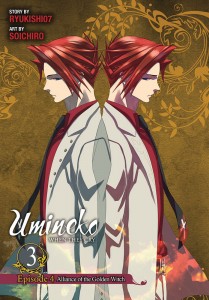
Umineko: When They Cry, Vol. 9

February 3, 2015 by Sean Gaffney

Story by Ryukishi07; Art by Soichiro. Released in Japan in two separate volumes as “Umineko no Naku Koro ni: Alliance of the Golden Witch” by Square Enix, serialized in the magazine Gangan Online. Released in North America by Yen Press.

With this volume we are halfway through Umineko proper, at least in terms of arcs. Most of the major issues involved have become fairly clear to the reader. Battler’s incompetence as a detective is not because he’s stupid per se, but because he can’t see past the who and how to figure out the why. I think he finally manages to grasp this by the end of the book, but by then it’s a bit too late for Beatrice, who is a character whose ‘who’ and ‘why’ define her, to the extent that her dying wish to Battler is to uncover who she is. As for Ange, she figures out what’s going on, and learns how magic works, but her lack of empathy for Beatrice means that she fails here as well, and gets a highly grotesque death. The only real winners in this arc are Bern and Lambda.

umineko9

There’s also the small matter of what’s happening on the “game board”, of course, in which the rest of the cast bar Battler are quickly polished off in an almost perfunctory way. You know things are ridiculous where Krauss fights a goat butler and wins. Actually, I’d argue that the manga didn’t go far enough here – the VN framed this as a long scene, showing off the goat butler’s ‘motivation’ and framing it as a video game with cliches piling up one on top of another. It was highly amusing, yes, but more to the point it shows off how overegged this pudding is. When first Jessica and then Kyrie take pains to tell Battler “you must believe in the witch god we were so wrong being all logical and stuff”, you’re meant to raise an eyebrow. Of course, with all the special effects death, magic is hard to deny. Assuming you can trust what you see.

The most important scene in the volume, which I also think the manga gives some short shrift to, is game-Beatrice asking game-Battler to remember his sin, and her complete devastation when he doesn’t. For Battler, 6 years ago is when he walked out on Rudolf, and all his theorizing about why that was wrong has to do with his place in the Ushiromiya family. Beatrice is clearly looking for something very different and more personal, and the fact that it meant so little to Battler that he’s forgotten it is what breaks Beatrice, both in the game and in meta. It’s telling that, since the whole Ushiromiya family thing is what he remembered, she takes that away from him by removing that identity. (This is where Battler truly is stupid – he knows his dad is a philandering ass, he should never have been taken in by her word games.)

So where are we now, with half the series gone? Beatrice is seemingly killed off. Battler can’t really escape the game. Everyone on the island is still dead. And even Ange is stated to have “died in 1998”, which is quite interesting given that the last we saw of her she was having the Seven Stakes of Purgatory brutally slaughter Kasumi and her yakuza goons. (Speaking of Ange, she starts to understand Eva a little better, though I worry she goes a bit too far. It’s a very hard line to walk between explaining and excusing child abuse, and I think Umineko sometimes walks across that line a bit too much.) And to no one’s surprise, Lambda and Bern turn out to be working together, or at least having mutually useful goals.

So Battler is an awful detective. Ange tried her best, but was too caught up in revenge and suicidal tendencies. Is there not a Great Detective who could possibly tell us what happened in Rokkenjima? Is there someone for whom this level of reasoning is possible? And can they actually be unbiased? Well, now I may be asking too much. In any case, May will bring us ‘End of the Golden Witch’, in which Beatrice’s tragedy reaches its inevitable conclusion. (No, it’s not the last arc.)

Filed Under: REVIEWS

Black Rose Alice Vol 3

February 2, 2015 by Anna N

Black Rose Alice Volume 3 by Setona Mizushiro

I’m glad that Viz is bringing out this series now, because I never collected beyond the first couple volumes of After School Nightmare, which I really regret now. So I’m happy to be able to read another Setona Mizushiro series, and so far my expectations for a manga that is both captivating and weird have easily been met.

In the third volume of the series Alice and her vampire suitors have established a daily life revolving around tasty desserts, with occasional vampire feedings and some light jealous bickering here and there. The stakes for who will procreate with Alice are much higher though, as Leo’s afterlife is about to run out. Leo and Alice always have had a bit more of a natural friendship compared to the other vampires in the house, and now Leo’s courtship of Alice is kicked into high gear by the knowledge of his impending death. Alice likes Leo very much, but she isn’t sure if he’s the one vampire she wants to choose.

In the meantime, Leo strikes up an acquaintance with a novelist who has a terminal disease, and offers her some vampire aid in order to help her finish her last novel. There are obvious parallels between their situations, as the novelist wants to finish one last work, and Leo has to procreate with Alice or he’ll disappear forever. Maximilian and the twins are concerned about Leo, but he forbids them to tell Alice of his impending death, because he doesn’t want to influence her decision.

Maximilian is devastated when Leo calmly faces his own death, but Leo says that he wouldn’t do anything differently and forbids Maximilian from telling Alice the truth. The tonal shifts of this series are really interesting. Each volume seems to be expressing a different main emotion, and the third is a shift away from the kooky slice of life vampire reverse harem scenario that was unfolding in the second volume. There’s sadness and regret in this volume, along with an increasing urgency on the part of the vampires to proceed with their campaign to get Alice to choose them. All along, Mizushiro’s clear and delicate artwork mixes with the elements of body horror that unfold in the manga to create a general feeling of unease and surreality as the story continues. This has got to be one of the oddest shoujo series currently coming out, and it is rapidly becoming my favorite!

Filed Under: REVIEWS Tagged With: Black Rose Alice, shojo beat

Bookshelf Briefs 2/2/15

February 2, 2015 by Sean Gaffney, MJ and Anna N Leave a Comment

This week, Sean, MJ, & Anna look at recent releases from Viz Media, Digital Manga Publishing, and Yen Press.

happymarriage10Happy Marriage?! Vol. 10 | By Maki Enjoji | Viz Media – My favorite moments in this series always occurred when mismatched couple Hokuto and Chiwa had an “us against the world” attitude towards their various trials and tribulations, so I was happy to see that there were some great moments where they supported each other in the final volume of this series. Hokuto deals with the inexplicable violent attacks and family plots by temporarily divorcing Chiwa, saying that he wants to start over with a new marriage once his family situation gets sorted out. Chiwa marches in to confront the Mamiya clan, and Hokuto makes his family confront some unpleasant truths. The volume ends as happily as one would expect from a couple who makes a habit of fighting and making up all the time. I thought some of the later volumes in this series were a bit thin, but everything is now nicely wrapped up. Overall, I enjoyed this series and would be interested in checking out some of Enjoji’s other works. – Anna N.

hentaiprinceThe Hentai Prince and the Stony Cat, Vol. 3 | By Okomeken, Sou Sagara and Kantoku | Digital Manga Publishing – The resolution of the Tsukushi plotline is the weakest part of this volume – the buildup was great, showing Tsukushi trying to push her sister away despite her clearly loving her. We even get the classic ‘hero gets so angry at character he punched them’, only what with Yoto being who he is, that goes very badly indeed. It’s just the denouement that’s the problem, where Tsukushi reveals she wants to go to America so that she can legally marry her sister – seemingly unaware that lesbian incest would still be illegal. It’s played entirely for laughs, and didn’t work for me at all. Oh well, at least the relationship between Yoto and Tsukiko is cute and heartwarming. – Sean Gaffney

inuxboku6Inu x Boku SS, Vol. 6 | By Cocoa Fujiwara | Yen Press – Reincarnation can be a pain in the ass to deal with, whether you remember your past life or not. Watanuki already had issues with being weak and not wanting to be protected before, but now that Carta, his crush, is 5 years older than him, as well as much taller and more mature, he simply can’t deal with it. Meanwhile, Carta thinks that he’s pushing her away as he hates her. Then there’s Ririchiyo, who DOESN’T remember her past yet, and everyone comments on how much pain this is causing Soushi. Honestly, Soushi is so good at hiding who he really is that this is debatable, but that’s partly the point. Ririchiyo can’t figure him out and neither can we. She does get her memory back, so we’ll see how things go next time. – Sean Gaffney

haruhi-chan9The Melancholy of Suzumiya Haruhi-chan, Vol. 9 | By Puyo, Nagaru Tanigawa and Noizi Ito | Yen Press – This being a gag manga, it’s difficult to move the story along as such, because there really isn’t one. But the plot does advance along with the original Haruhi LNs, and so Yasumi is now in the SOS Brigade, even if no attempt is made to show off the real aspect of her identity. It allows for another character to bounce off of, and Yasumi is fun. The more interesting development, though, may be Kyon finally seeing chibi-Asakura, and the two of them being strangely accepting of each other – indeed, only Kyon seems to understand her desire to be a shopkeeper. As that last sentence might suggests, Haruhi-chan’s strength remains its gags. Get it for those. – Sean Gaffney

pandorahearts22Pandora Hearts, Vol. 22 | By Jun Mochizuki | Yen Press – In a series as tense and tumultuous as Pandora Hearts, it can probably be assumed that the series’ penultimate volume would be particularly so. And, in fact, this is the case. Still, I’m not sure I was fully prepared for just how anxiety-inducing this volume would actually be for me, and those who know me well can probably guess that the source of this angst can be boiled down to two simple words: Xerxes Break. The volume opens with the most gloriously Break-y chapter a fan could wish for, and continues largely in this vein to the end (though there’s plenty of Ada, Vincent, and Echo awesomeness to be enjoyed as well). It’s an extra-long volume, which I dearly hope will be the case for the series’ finale, which has not yet been completed. Oh, Pandora Hearts, sweet Pandora Hearts, your promises are many. I desperately hope you’ll keep them. Eagerly awaiting this story’s conclusion. – MJ

spellofdesire3Spell of Desire, Vol. 3 | By Tomu Ohmi | Viz Media – It’s surprising, perhaps, that I’m still following Spell of Desire, after openly admitting how weary I’ve become of its timeworn premise and tropes. And this volume stays true to form. There’s some plot here, regarding heroine Kauruko’s official entry into the coven of black witches and the consequences of such for both her and her standard supernatural love interest, Kaname. But the truth is, this volume is mostly sex. Caught up in a desperate ritual, Kauruko loses her virginity to Kaname early in the volume, followed by much more of the same, accompanied by the familiar pattern of repeated declarations of devotion/ownership alternating with worry/guilt. It’s all in the spirit of trashy josei fun, of course, but there’s not quite enough plot in this volume to be engaging beyond basic smut value. Maybe next time? – MJ

voiceover9Voice Over! Seiyu Academy, Vol. 9 | By Maki Minami | Viz Media – You can tell we’re getting near to the end of this series. The romance is starting to return to the fore, both in Senri’s utter inability to see what Shiro is to him, his discovering Shiro is also a voice actor, and Mizuki stepping up his game to get Hime to see how he feels about her, even if that may mean sabotaging what she has with Senri as “Shiro”. I’ll be honest, we’ve been following Shiro’s adventures for so long that even I was startled to see Hime in her normal hair-down state. I suspect the next volume will be a giant pile of disasters, and though I’m sure it will all end well I do wonder if a scandal may intrude. That said, Minami’s strengths are shown here – her flair for comedy and her overly happy lead. – Sean Gaffney

Filed Under: Bookshelf Briefs

Pick of the Week: Variety

February 2, 2015 by Sean Gaffney, Michelle Smith, Anna N, Ash Brown and MJ Leave a Comment

potwSEAN: It’s a last volume, so what the heck: I’ll make Nura: Rise of the Yokai Clan my pick for this week. When it started, it was all about ‘how can this quarter yokai boy who’s heir to the night parade of demons possibly hide his identity at school?’. That got thrown out after about half a volume, and progressed, as most Jump series to, to bigger and bigger battles. Still, it was surprisingly entertaining, I really loved watching Tsurara try to get her man (and mostly fail). I’ll miss it.
MICHELLE: My pick of the week, the fifth 3-in-1 omnibus of High School Debut is essentially my manga BFF. Cue internal montage of the two of us going on a shopping spree, trying on fancy hats at some snooty boutique, and then later laughing together over our salads. Possibly some frozen yogurt would figure in, as well.

ANNA: There is a ton of good manga coming out this week! I think I’m going to have to go with the second volume of Assassination Classroom. I wonder what murderous jokes about alien tentacles the second volume will serve up!

ASH: Okay, so I know Sean tried to convince us that we weren’t allowed to choose Black Rose Alice two weeks in a row, but I didn’t pick it last week and it really is the manga that I’m most excited for. So far the series has been marvelously creepy and disconcerting; I’m very curious to see where it goes.

MJ: I admit I don’t really have a real pick this week, so I’ll go off list and highlight a digital offering that is currently free to read online. That would be Kaiju’s The Ring of Saturn, which I reviewed here over the weekend. Intertwining the reality of emotional growing pains with the music of Gustav Holst, it’s a quick but satisfying read that leaves readers with a lot to think about. If you’re stuck home in the snow like a bunch of us are today, why not check out this digital goodness?

What looks good to you this week?

Filed Under: PICK OF THE WEEK

My Week in Manga: January 26-February 1, 2015

February 2, 2015 by Ash Brown

My News and Reviews

The Female Goth Mangaka Carnival wrapped up last week. In addition to my recent Spotlight on Mitsukazu Mihara, I also contributed two other related posts. The first was Experiments in Manga’s latest giveaway. There’s still time to enter for a chance to win Junko Mizuno’s Cinderalla. I also posted a review of Asumiko Nakamura’s manga Utsubora: The Story of a Novelist. It’s a dark and twisting tale, and one that I come to love a little more each time I read it. Completely unrelated to the Carnival, last week I also reviewed Yasunari Kawabata’s The Sound of the Mountain, a classic novel about growing older and family relationships.

Elsewhere online, Viz announced that it will be bringing Shotaro Ishinomori’s The Legend of Zelda: A Link to the Past back into print, which I’m looking forward to a great deal. Media scholar Henry Jenkins is posting lengthy, in-depth interview with Patrick W. Galbraith, “In Defense of Moe,” talking about manga, anime, and otaku studies (Part 1|Part 2|Part 3|Part 4|Part 5|Part 6). Digital Manga has launched its next Tezuka Kickstarter to publish Osamu Tezuka’s two-volume Alabaster with a stretch goal to reprint Swallowing the Earth (again). A recent update for Digital Manga’s Finder Kickstarter includes a link to a list of boys’ love titles that are currently in stock. Perhaps most importantly, it indicates which manga are available in limited quantities.

Quick Takes

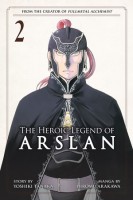
The Heroic Legend of Arslan, Volume 2The Heroic Legend of Arslan, Volume 2 by Hiromu Arakawa. The particular weakness of the second volume of The Heroic Legend of Arslan is that while the battles and sieges are proceeding at a good pace–and Arakawa’s fight and action sequences are excellent–there is a relative lack of character development. Unsurprisingly, considering that the manga takes place during a time of war, there are important, dramatic deaths, but emotionally they aren’t especially effective since readers hadn’t had the opportunity to really get to know those involved before their demise. At this point, many of the antagonists and even a fair number of the series’ protagonists are missing complexity and nuance. Thankfully Arslan himself does show a little growth by the end of the volume, but attention is mostly given to the war being fought and some of the political intrigue behind it all. Granted, those are very important aspects of the series since they are what Arslan must overcome. However, I am hoping that future volumes will spend more time examining the characters as people. Intense, bloody battles are all well and good, but I want to more completely understand the motivation and drive behind them.

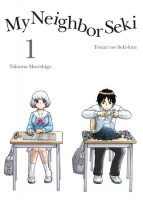
My Neighbor Seki, Volume 1My Neighbor Seki, Volume 1 by Takuma Morishige. I was originally only vaguely curious about My Neighbor Seki, but after watching the absolutely delightful anime adaptation last year, I knew it was a series that I couldn’t miss. The premise is deceptively simple: Yokoi sits in the last row of seats in her classroom right next to Seki, a boy who is always goofing around at his desk. Yokoi finds this incredibly distracting, especially since the ways in which Seki amuses himself can be spectacularly elaborate. Often she’s astounded by Seki’s audacity, but on occasion she can’t help but to join in or interfere with what he’s doing. Of course this means she’s often the one in danger of getting into trouble with the teachers for not paying attention in class. The individual chapters in My Neighbor Seki may be short, but the sheer creativity displayed by Morishige, and in turn by Seki, is quite impressive. The original My Neighbor Seki manga is just as wonderful as the anime was; I’ll definitely be following the manga to its end. (In Japan the series is currently ongoing with six volumes having so far been released.) My Neighbor Seki is funny and charming and a marvelously entertaining read.

Secrecy of the Shivering NightSecrecy of the Shivering Night by Muku Ogura. After reading the first volume of the short boys’ love series Castle Mango, I decided to seek out more of the artist’s work. Currently the only other manga of her’s available in print in English is Secrecy of the Shivering Night. Unlike Castle Mango, Ogura wrote the stories collected in Secrecy of the Shivering Night in addition to illustrating them. The volume includes four short boys’ love manga which, other than tending towards the more sweet or romantic and having slightly peculiar lead characters, are all unrelated. The setup for the titular story is perhaps the most curious and seemingly far-fetched–a young man who is afraid of bright lights and another young man who is afraid of the dark end up as dorm roommates–but the resulting relationship dynamic is surprisingly satisfying. Their opposite phobias, but even more so their opposite personalities, make them an adorable couple. Secrecy of the Shivering Night isn’t an especially outstanding collection, but the stories are generally cute and a little bit quirky, which are characteristics I happen to particularly enjoy, and Ogura’s artwork has a pleasant softness to it.

Terra Formars, Volume 2Terra Formars, Volumes 2-4 written by Yu Sasuga and illustrated by Ken-ichi Tachibana. If the first volume of Terra Formars largely felt like a stand-alone prequel, that’s because it was. The second volume begins twenty years later. An exceptionally fatal disease is becoming more prevalent on Earth which requires a new mission to Mars in order to research a cure. Shokichi Komachi, one of the two survivors from the previous Mars mission, leads a crew of one hundred men and women genetically modified to survive the conditions and lifeforms found on the planet. Terra Formars continues to be extraordinarily violent with an incredibly high body count, though considering the first volume I was actually surprised by how many people are left alive by the end of the fourth. It seems as though there might be an actual plot to Terra Formars, but it’s mostly just an excuse to show epic, over-the-top hand-to-hand combat between opponents with astounding, superhuman abilities. I still dislike the visual design of the humanoid cockroaches immensely, but at least there’s an attempt in these volumes to better explain their appearance. The portrayal of women in the manga has slightly improved, as well.

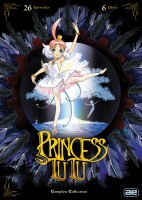
Princess TutuPrincess Tutu directed by Junichi Sato. I picked up Princess Tutu more on a whim than anything else when I saw it on super sale. Although I vaguely remembered hearing good things about the anime, I honestly didn’t know much about the series. I’m very glad that I own it because Princess Tutu is marvelous. I do find it somewhat difficult to describe in a way that does the justice, though. The story follows a girl called Duck who really is a duck. She’s under an enchantment that allows her to not only take human form but to also become the magical Princess Tutu. Through the power of her dance she restores the shattered heart of a prince who had sacrificed himself to save others. That all might sound a little strange, and parts of the anime are admittedly weird, but the series is also very good. Stories are just as real as reality in Princess Tutu, and just as potent if not more so. Bits and pieces of classic ballets, operas, and plays can be found throughout the series all mixed together to form a unique work. I absolutely loved the anime’s use of orchestral works not just as background music but as meaningful additions to the story, emphasizing the significance of the characters and of their actions and, for those who are familiar with the pieces, even revealing some of the plot.

Filed Under: FEATURES, My Week in Manga Tagged With: anime, Heroic Legend of Arslan, Hiromu Arakawa, Ken-ichi Tachibana, manga, Muku Ogura, My Neighbor Seki, princess tutu, Takuma Morishige, Terra Formars, Yu Sasuga

Spell of Desire Vol 3

January 31, 2015 by Anna N

Spell of Desire Volume 3 by Tomu Ohmi

Well, there have been plenty of suggestive scenes in the first couple volumes of Spell of Desire, but finally in the third volume accidental witch Kaoruko and her mother’s favored protector Kaname get it on, due to witchy aphrodisiacs, necessary spell casting, and their growing yet not fully acknowledged feelings for each other! What more would a reader want in a josei paranormal romance?

Kaoruko has been delivered to the coven, and they decide it is necessary for her to fully become a black witch in order for her to gain some control over her powers. Black witches can’t be virgins, so they’ve decided to set Kaoruko up with an incubus in order for her to start down the path towards black magic. Kaoruko is drugged into compliance, but she’s still not cool with the idea of being with anyone but Kaname, and fortunately her knight protector decides to intervene in the ritual deflowering, breaking several rules in the process.

Kaname and Kaoruko end up seeking refuge in a house in the woods owned by an impressive looking white wolf (this is a crossover appearance with a character from a series that hasn’t been translated into English yet), and Kaoruko learns a bit more about Kaname’s background and why he’s so devoted to her mother. As always in this series, Kaname’s commitment to the Witch Queen causes Kaoruko to have doubts about their future. When the couple return to the coven, Kaoruko meets more of her mother’s knights, and Kaname is punished horribly. Kaoruko is determined to learn more about witchcraft so she can protect him.

A bunch of new characters get introduced in this volume, and the plot grows more complex as Kaoruko starts to learn more about the differences between white and black magic. It’ll be interesting to see what she can accomplish once she’s fully in command of her powers. I continue to enjoy Ohmi’s art, and I enjoy the way Kaoruko’s power still manifests as vine-like tendrils that curve around the panels of the manga. This series is only 5 volumes long, and this volume served as an effective middle volume, showing Kaoruko about to start gathering more knowledge and power. I recommend this series for any fans of paranormal romance manga!

Filed Under: REVIEWS Tagged With: Josei, shojo beat, spell of desire

The Ring of Saturn

January 31, 2015 by MJ 1 Comment

IMG_0947The Ring of Saturn | by Kaiju | Chromatic Press – “Sometimes it is not about forcing something to work… it is about simply learning to absorb what is beautiful.” These words come from the mouth of English composer Gustav Holst—not the actual historical man, perhaps, but a compelling portrait indeed as envisioned by cartoonist Kate Rhodes and animator Jennifer Xu, credited here collectively as “Kaiju.”

Set during Holst’s tenure as director of music at West London’s St. Paul’s Girls’ School during the First World War, Kaiju’s short comic “The Ring of Saturn” tells the story of Miriam Frayne, a promising young pianist studying with Holst at St. Paul’s. After performing a solo piano arrangement of Holst’s “Saturn: The Bringer of Old Age” (part of his famous orchestral suite, The Planets, which Holst is in the process of orchestrating over the course of the comic), Miriam is approached by a young astronomer, Rasim Rahal, who expresses his appreciation of her performance. Visibly distraught, Miriam forces a polite response and flees as quickly as possible.

Unhappy with her own playing, and doubtful of her ability to do justice to “Saturn,” Miriam begs Holst to be allowed to play something more “appropriate,” and it soon becomes clear what that means to her. Young and filled with the verve of nationalist pride, Miriam is vastly more comfortable with the decidedly uplifting character of Holst’s “Jupiter” (“The Bringer of Jollity”) than she is with the haunting ambiguity of “Saturn.” It is only when wartime tragedy hits close to home that Miriam finds herself beginning to understand what is beautiful and even necessary about “Saturn’s” relentless uncertainty.

It is admittedly difficult to discuss a short comic like The Ring of Saturn without giving away its entire plot, but rest assured that any developments revealed here are not remotely the point. Yes, you may assume that Miriam’s wartime tragedy involves the death of someone close to her (and you’ll know who that is likely to be within the comic’s first twenty pages), but these specifics are important only on the surface. Even Rahal, who seems perfectly poised to be Miriam’s love interest, is ultimately significant only for the ways in which his greater life experience helps to shatter Miriam’s patriotic innocence.

Kaiju’s visual storytelling is stunning—expressive and visceral, particularly towards the end of the comic, where the crux of Miriam’s emotional journey plays out over the course of eleven dialogue-free pages. This sequence, enhanced only by a few crucial sound-effects, is as beautifully envisioned as the best classic shoujo manga, and similarly well-executed. If these were the only eleven pages in the entire comic, they could stand alone as an eloquent expression of one young musician’s moment of truth. That’s how powerful they are.

Enamoring artwork aside, it would be remiss to minimize this comic’s most brilliant element, which is its grounding in the real-life history of Gustav Holst and his music. Though some historical details may be altered for the sake of the story (Holst’s original arrangements were for two pianos, not one, for instance), Holst’s essence remains intact. That he valued himself more as a teacher than as a composer is felt keenly here, and to my mind, deepens the reading of his musical output as much as it does the story at hand. Like many children of musical households in the 20th century, I was brought up on The Planets, and though I rather thoughtlessly abandoned them in later years in favor of the more overtly complex works of composers like Prokofiev and Stravinsky, my appreciation of them in context of Holst’s commitment to teaching and the beginning of World War I has been decidedly enhanced by this comic. Holst notably approached each planet not from an astronomical viewpoint, but an astrological one—specifically in terms of its emotional and psychological associations rather than its mythological namesake—an approach that works exceptionally well as the premise for a character-driven comic.

But perhaps most significantly, what Kaiju has proven here is that it really is possible to craft a wholly satisfying, emotionally resonant comic in under 100 pages—and to do it without resorting to wordy exposition, over-crowded panels, or excessive dialogue. The Ring of Saturn is an elegantly crafted comic that should draw attention not only to its talented, artistically mature creative team, but also to Sparkler Monthly and Chromatic Press’ output as a whole. This is exactly the kind of comic we need more of.

Filed Under: REVIEWS Tagged With: Chromatic Press, gustav holst, kaiju, sparkler monthly, the ring of saturn

  • « Go to Previous Page
  • Page 1
  • Interim pages omitted …
  • Page 561
  • Page 562
  • Page 563
  • Page 564
  • Page 565
  • Interim pages omitted …
  • Page 1049
  • Go to Next Page »
 | Log in
Copyright © 2010 Manga Bookshelf | Powered by WordPress & the Genesis Framework