• Skip to primary navigation
  • Skip to main content
  • Skip to primary sidebar
  • Home
  • About Us
    • Privacy Policy
    • Comment Policy
    • Disclosures & Disclaimers
  • Resources
    • Links, Essays & Articles
    • Fandomology!
    • CLAMP Directory
    • BlogRoll
  • Features & Columns
    • 3 Things Thursday
    • Adventures in the Key of Shoujo
    • Bit & Blips (game reviews)
    • BL BOOKRACK
    • Bookshelf Briefs
    • Bringing the Drama
    • Comic Conversion
    • Fanservice Friday
    • Going Digital
    • It Came From the Sinosphere
    • License This!
    • Magazine no Mori
    • My Week in Manga
    • OFF THE SHELF
    • Not By Manga Alone
    • PICK OF THE WEEK
    • Subtitles & Sensibility
    • Weekly Shonen Jump Recaps
  • Manga Moveable Feast
    • MMF Full Archive
    • Yun Kouga
    • CLAMP
    • Shojo Beat
    • Osamu Tezuka
    • Sailor Moon
    • Fruits Basket
    • Takehiko Inoue
    • Wild Adapter
    • One Piece
    • After School Nightmare
    • Karakuri Odette
    • Paradise Kiss
    • The Color Trilogy
    • To Terra…
    • Sexy Voice & Robo
  • Browse by Author
    • Sean Gaffney
    • Anna Neatrour
    • Michelle Smith
    • Katherine Dacey
    • MJ
    • Brigid Alverson
    • Travis Anderson
    • Phillip Anthony
    • Derek Bown
    • Jaci Dahlvang
    • Angela Eastman
    • Erica Friedman
    • Sara K.
    • Megan Purdy
    • Emily Snodgrass
    • Nancy Thistlethwaite
    • Eva Volin
    • David Welsh
  • MB Blogs
    • A Case Suitable For Treatment
    • Experiments in Manga
    • MangaBlog
    • The Manga Critic
    • Manga Report
    • Soliloquy in Blue
    • Manga Curmudgeon (archive)

Manga Bookshelf

Discussion, Resources, Roundtables, & Reviews

Blog

Bookshelf Briefs 8/17/15

August 17, 2015 by Sean Gaffney and Michelle Smith Leave a Comment

Sean and Michelle weigh in on some recent releases from Seven Seas and VIZ Media.

black_rose5Black Rose Alice, Vol. 5 | By Setona Mizushiro | VIZ Media – I’m an unabashed shoujo fanatic, but even I must admit that, when it comes to romance, one can usually predict how a story is going to end. Not that Black Rose Alice would exactly fall under the “romance” genre, but it does center around Alice making a choice between suitors and with some surprising arrivals, departures, and developments, the story has taken a fascinating turn and I genuinely have no clue what will happen next! Alice is a mess of guilt, confusion, and indecision and Dimitri continues to be an enigmatic character whose professions of love fail to ring true, but what I liked most was getting to know one of the twins better (Kai) and seeing how his growing connection with Alice spurs jealousy and flashbacks in his brother (Reiji). I’m already sad that volume six will be the last we see for a long while. – Michelle Smith

citrus3Citrus, Vol. 3 | By Saburouta | Seven Seas – The thing that makes Citrus still readable is that Yuzu, despite being the cliched flakey girl, is the only one in the entire series with an ounce of sense and maturity. Her worries about her relationship are sensible and founded on the lack of communication she has with Mei, and the lack of communication makes sense give everything that happens here. Sadly, everything that happens includes Matsuri, a former childhood friend of Yuzu’s who spends the entire volume being so petty and evil that I found myself just wanting to put the book down. Her final conversation with Mei is well done, but was it worth all the aggravation that came before it? It’s nice to see more yuri over here, but Citrus remains highly variable. – Sean Gaffney

evergreen2Evergreen, Vol. 2 | By Yuyiko Takemiya and Akira Caskabe | Seven Seas – Teenagers have chronic misunderstandings. It’s part of being a teenager, and there’s just as much media attention on it in Western media as there is in Japanese animation. There’s also a sense in Evergreen that our two leads have a darker, more dangerous snse of low self-worth than has already been suggested, due to tragic pasts and health concerns. That said, this volume of Evergreen is basically “hope you like miscommunication,” both in its main pairing (if it is one—I’m still not sure about that) and the best friend x playboy side pairing that actually takes up equal time in this volume. I may actually find their relationship more interesting than the main one—not uncommon in many romance manga. – Sean Gaffney

foodwars7Food Wars!: Shokugeki no Soma, Vol. 7 | By Yuto Tsukuda and Shun Saeki| Viz Media – This is a tournament arc in a shonen manga, and even though we’re talking about food rather than fights the basic setup is the same. Lots of last-minute moves, astonished gasps from the gallery, the judges and announcers frantically talking about what they’ve just seen or eaten, and amazing poses of either a) the chef looking cool and awesome or b) annoying fanservice eating shots. The authors made a good choice saving Megumi for last, though—given we’ve been with her story since the beginning, it’s heartwarming to see her newly developed skills catapult her to the next round here, not sacrificing what makes her cooking best. Good stuff, skip the orgasms faces. – Sean Gaffney

onepiece75One Piece, Vol. 75 | By Eiichiro Oda | VIZ Media – I always enjoy reading One Piece, but I found this particular volume to be bloody fantastic. Masterful, even. What could’ve easily been pure chaos—the Straw Hats once again splitting up to help free an island’s local populace from a cruel ruler, with battles raging on multiple fronts—is instead easy to follow and riveting, to boot. Going against Doflamingo is the most significant thing Luffy has done yet, for in addition to being a fearsome opponent with a loyal family of officers on his side, defeating him will bring down the wrath of one of the four emperors upon Luffy and his current ally, Trafalgar Law, and that future faceoff will bring Luffy one step closer to his goal. And if all this weren’t enough, we also get great scenes for other members of the crew and meet the worthy successor to Ace’s flame-flame fruit! Go read it! – Michelle Smith

toriko29Toriko, Vol. 29 | By Mitsutoshi Shimabukuro | Viz Media – As I expected, one of the major mentor characters in this series is brought down here. That, combined with losing his major battle and Komatsu being kidnapped, leads to a mental breakdown for Toriko that takes ages to snap out of (credit to Rin for figuring out what might do it—she’s come a long way from the comedy girl in love with oblivious guy). As for Komatsu, he may be an enemy prisoner, but he’s still able to make the most amazing food he can using only the weak ingredients provided. In a manga filled with superheroes with amazing powers, Komatsu actually ends up seeming like the author’s favorite who can do no wrong. And I’m 100% OK with that. – Sean Gaffney
Filed Under: Bookshelf Briefs

My Week in Manga: August 10-August 16, 2015

August 17, 2015 by Ash Brown

My News and Reviews

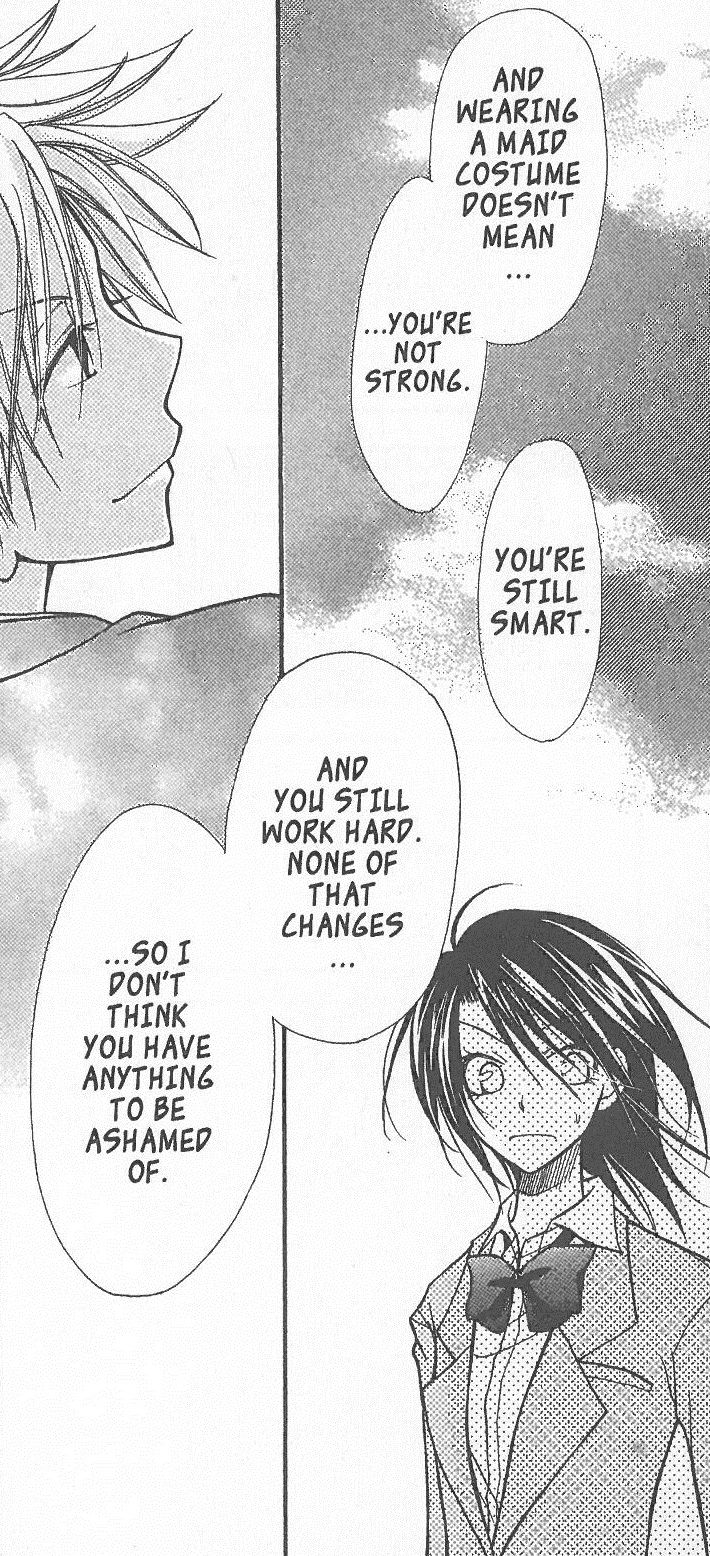
Last week was a two-review week at Experiments in Manga. Both reviews were of manga and, more specifically, both reviews were of shoujo manga. First up was the first omnibus of Hiro Fujiwara’s Maid-sama!. The series was originally licensed by Tokyopop, which released the first eight volumes, but the manga was more recently rescued by Viz Media’s Shojo Beat imprint. Though he has his moments, I’m not particularly fond of the male lead Takumi at this point, but I absolutely adore the female protagonist Misaki. If for no other reason, I’ll be reading more of Maid-sama! for her sake. The second in-depth review from last week was of Setona Mizushiro’s After School Nightmare, Volume 5. I continue to find After School Nightmare to be both compelling and highly distressing. The review is part of my ongoing monthly horror manga review project; September’s review will focus on the fifth volume of Yuki Urushibara’s Mushishi.

As for a few other interesting manga-related posts found online last week, Comic Attack has a nice interview with Stacy King, the editor of Udon Entertainment’s Manga Classics line. (I’ve written a little bit about Udon’s Manga Classics in the past.) Also, Mangabrog has posted a translation of an interview of Kiyohiko Azuma, the creator of Yotsuba&!, from 2014. A few weeks ago I posted some random musings about my manga collection as part of a game of manga tag. One of the people who I specifically tagged to participate was Manga Xanadu’s Lori Henderson. She recently posted her own responses to the manga tag questions and Justin at Organization Anti-Social Geniuses took time to provide some answers, too. I really enjoy reading about other manga enthusiast’s collections. If you’re interested, be sure to check the posts out!

Quick Takes

Clan of the Nakagamis, Volume 1Clan of the Nakagamis, Volumes 1-2 by Homerun Ken. Although only two volumes of Clan of the Nakagamis have been released in English, it’s actually a three-volume boys’ love series. It’s unlikely that the third volume will be officially translated, but the manga tends to be fairly episodic. The final volume may be “missing,” but at least the series’ story doesn’t depend on it. Clan of the Nakagamis was brought to my attention due to the fact that Norikazu Akira, whose manga I’ve enjoyed, is somehow related to Homerun Ken. (She’s either one of the members of the two-person creative team or their older sister; I’m not entirely sure which.) Clan of the Nakagamis is intentionally ridiculous, a mashup of all sorts of unrelated tropes that the mangaka found amusing or were particularly fond of, everything from student-teacher relationships, to family conglomerates, to crossdressers. I actually wasn’t particularly impressed by the first volume of Clan of the Nakagamis, finding it to be too chaotic and lacking in cohesiveness, but I did legitimately enjoy the second. I even laughed out loud. It probably helped that it had a more coherent story and improved artwork.

Ninja Slayer Kills, Volume 1Ninja Slayer Kills!, Volume 1 by Koutarou Sekine. Ninja Slayer started as a series of novels, supposedly written by a couple of Americans, that inspired a recent anime adaptation as well as at least three different manga series (two of which have been licensed for English-language release). Sekine’s Ninja Slayer Kills! is the franchise’s shounen manga offering. It’s intended to be approachable and understandable even for readers who aren’t familiar with Ninja Slayer. I’m not sure it’s successful in accomplishing that, though. Very little of the story, characters, or setting is explained beyond broadly establishing a tale of super-powered revenge in a gritty near future. The first volume is mostly battle after battle and not much more. The fight scenes and their setups are marvelously epic, but unfortunately the action itself is difficult to follow so they lose their impact. That’s a significant flaw since so much of the manga is focused on these martial conflicts. On their own, the character designs of the cybernetic ninja are great, but they tend to blend together in the actual manga, which also makes determining what exactly is going on a challenge.

A Silent Voice, Volume 2A Silent Voice, Volume 2 by Yoshitoki Oima. I was greatly impressed by the first volume of A Silent Voice. It was a hard read due to its subject matter, specifically its realistic portrayal of bullying—how utterly cruel kids can be to each other and how adults, whether intentionally or not, can often encourage such behavior. While there is still some tragedy and darkness in the second volume, overall it’s a much lighter read; where the first is heartbreaking, the second makes it seem as though forgiveness and change is possible. Shoya, feeling that it is impossible to redeem himself for his past cruelty, plans to take his own life after apologizing to Shoko for adding so much misery to hers. But when he meets her again they end up forming an unexpected friendship instead. Even more surprisingly, Shoya eventually becomes friends with her younger sibling as well (though he doesn’t known that’s who the kid is at the time). Shoya recognizes that he can’t undo the harm that he’s already caused to Shoko and her family, but he’s slowly doing what he can to make up for it. I still think that A Silent Voice is one of the very best manga to debut this year.

Filed Under: FEATURES, My Week in Manga Tagged With: Clan of the Nakagamis, Koutarou Sekine, manga, Ninja Slayer, Silent Voice, Yoshitoki Oima

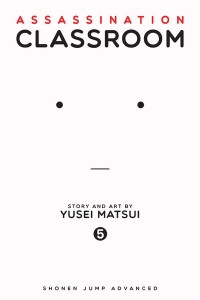
Assassination Classroom, Vol. 5

August 16, 2015 by Sean Gaffney

By Yusei Matsui. Released in Japan by Shueisha, serialization ongoing in the magazine Weekly Shonen Jump. Released in North America by Viz.

One of the things that makes this such an interesting manga is the tension between the standard cliched ‘teacher takes a class filled with losers abandoned by teachers and makes them care about learning and themselves’ cliche and the actual plotline that they are trying to kill their teacher to save the world by learning assassination. Koro-sensei is too straightforward and strange to really swell on this, and Irina is not at a point yet where she really particularly cares (she’s still mostly here for breast jokes and to get humiliated). But Karasuma is normal enough, even if he is a tactical military guy trained in dozens of methods of killing a person, to be aware of what they’re actually doing to these children. And to be disturbed when one of them shows signs of being really really GOOD at killing.

assclass5

Naturally, it’s Nagisa, who is the closest we have to a ‘main character’ amongst the students. We’ve already seen how he has a talent for research and tends to try to think his way to a better assassination. Now we see that he doesn’t even need to use strength and power to be able to achieve this – he can rely on his natural unassuming, slightly feminine personality (there are several jokes here about him looking like a girl) and go right for the kill. And thank goodness for that, because he’s up against the government’s replacement for Karasuma, who gets results by being a complete psycho, and thinks nothing about belting a 14-year-old girl across the chops.

This leads to the other interesting thing about this book, which is the school principal. He’s clearly the main antagonist of the series, and we’ve seen how his method of teaching requires Class E to be at the bottom of the heap for everyone to bully. I was, honestly, surprised at the ending of the baseball story – not necessarily because our heroes won, but more because the principal didn’t punish the main baseball team in retaliation. That said, as an antagonist he’s great, being able to almost hypnotize his students into doing what he wants, and sticking to his principles even if they are twisted. That’s why his appearance at the end of the arc with Takaoka is wonderful, as he strolls up to and casually talks about how dull and boring his class was. Not even worth sticking around like Irina does, he’s terminated right there and then.

Koro-sensei actually doesn’t have much to do in this volume – the main story is all Karasuma, with Koro-sensei merely commenting occasionally, and the revelation that he can’t swim will carry us into the next book, but doesn’t do much good now. Still, the series has now gotten to the point where we don’t need to have killing Koro-sensei being the focus of every chapter. There’s a lot going on here, and as the series hits Vol. 5 you can tell that Matsui has realized he’s not on the verge of cancellation and is drawing out a larger plotline. I look forward to seeing where it goes.

Filed Under: REVIEWS

The Manga Revue: A Brief History of Manga

August 14, 2015 by Katherine Dacey

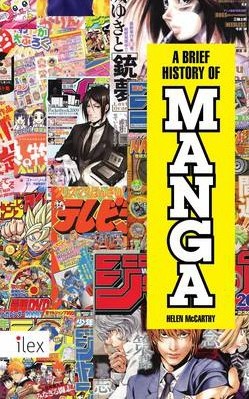
I’m taking a break from shojo romances and shoot ’em ups this week and reviewing Helen McCarthy’s A Brief History of Manga, a slim introduction to the medium’s history, stars, and influential series.

9781781570982A Brief History of Manga
By Helen McCarthy
Ilex Press, $12.95

A Brief History of Manga is an odd duck: it’s too short and impressionistic to be a reference work, but too focused on historically significant titles to appeal to a casual Attack on Titan fan. That’s a pity, because Helen McCarthy’s generously illustrated book provides an accessible introduction to manga, from its prehistory to the present.

A Brief History of Manga begins with Toba Sojo’s famous Choju-jinbutsue-giga, a twelfth century scroll depicting frogs, rabbits, and monkeys engaged in human activities, then jumps ahead to the nineteenth century, when European ex-pats helped popularize new cartooning styles via influential publications such as The Japan Punch (1862). The rest of the book explores the emergence of longer-form storytelling, from the newspaper-style comics of Rakuten Kitazawa (1876-1955) to the cyberpunk manga of Masamune Shirow (b. 1961). Sprinkled throughout the book are callouts highlighting specific artists’ contributions to the medium, as well as summaries of famous series, thumbnail histories of important magazines, and milestones in the globalization of manga.

For a reader familiar with Frederick Schodt’s venerable Manga! Manga! The World of Japanese Comics (1983), many of McCarthy’s insights are old news. Schodt covered the early history of Japanese print culture in considerably more detail, painstakingly connecting the dots between Sojo’s frolicking animals, the birth of the Japanese publishing industry, and the emergence of the post-war manga market, bringing his narrative up to the 1980s. The final section of McCarthy’s book is a useful coda to Manga! Manga!, however, offering insights into more recent trends and titles, some well known–Boys Over Flowers, Death Note, Hetalia: Axis Powers–others less so–51 Ways to Save Her, Field of Cole, XX.

A Brief History of Manga has a more fundamental problem, however: its layout. Although the book’s designer has taken great pains to group images thematically, and link each entry with a timeline, the visual presentation is sometimes misleading. The 1931 entry, for example, pairs images of “manga pup” Norakuro with robot cat Doraemon without acknowledging the forty-year gap that separates the two characters. (Norakuro’s first story appeared in Shonen Club in 1931, while Doraemon debuted in 1969.) A caption informs the reader that Doraemon creator Hiroshi Fujimoto was born in 1933, but the main text never explicitly establishes the influence of Suiho Tagawa’s series on Fujimoto’s; even a simple, declarative sentence stating that Fujimoto had grown up reading Norakuro would have made this entry more valuable by demonstrating the role of pre-war children’s magazines in popularizing certain character types and storylines.

The first mention of gekiga–“1959: Manga’s Punk Movement Takes Root”–is similarly confusing. Although the text introduces gekiga pioneers Takao Saito (b. 1936) and Yoshihiro Tatsumi (1935-2015), the featured images are drawn from Fukushima Masami (b. 1948) and Kai Takizawa’s ultra-violent Prince Shotoku, a fascinating oddity from the late 1970s. While these images are among the most striking in the entire volume, they are not representative of early gekiga; it’s as if someone saw the word “punk” in the manuscript and set out to find the most visually outlandish artwork to emphasize McCarthy’s word choice. Complicating matters further is that the text never mentions Fukushima or Takizawa, or explains how their work built on the legacy of Saito and Tatsumi–no small oversight, given the pronounced differences between Prince Shotuko and Baron Air (1955) and Black Blizzard (1956), Saito and Tatsumi’s debut works.

I’m less bothered by McCarthy’s omissions than earlier reviewers were*; though it’s easy to cavil about missing works, McCarthy has chosen a representative sample of titles and authors across a wide spectrum of genres, demographics, and time periods. A manga newbie would find enough here to pique her interest, and perhaps steer her towards more comprehensive treatments of manga’s history. Knowledgable readers may find the quasi-encyclopedic format and emphasis on familiar material more frustrating, though they may be pleasantly surprised to discover new names and series through a careful scrutiny of the timeline. I did.

The verdict: A Brief History of Manga would make a swell gift for a new reader looking for information about the P.N.E. (that’s the Pre-Naruto Era).

* It’s worth noting that I heartily agree with Prof. Kathryn Hemmann’s concerns about the dearth of female creators in A Brief History of Manga. As Hemmann persuasively argues, this omission effectively silences some of the medium’s most influential and interesting voices. Click here to read Hemmann’s thoughts on the subject.

Reviews: Over at The Comics Journal, weekly columnist Joe McCullock compares the Dragon Ball comic with its most recent big-screen adaptation. Closer to home, Sean Gaffney and Michelle Smith post a new installment of Bookshelf Briefs. Kathryn Hemmann reviews Buchō wa onee, a bara title “about ferocious anthro muscleheads being adorable.”

Matt on vol. 11 of BTOOOM! (AniTay)
Sheena McNeil on vol. 55 of Case Closed (Sequential Tart)
Al Sparrow on vol. 1 of Chaika, The Coffin Princess (ComicSpectrum)
manjiorin on Clay Lord: The Master of Golems (Organization Anti-Social Geniuses)
Johanna Draper Carlson on Cool Japan Guide: Fun in the Land of Manga, Lucky Cats, and Ramen — A Comic Book Writer’s Personal Tour of Japan (Comics Worth Reading)
Ian Wolf on vol. 1 of The Demon Prince of Momochi House (Anime UK News)
Sheena McNeil on vol. 10 of Dogs: Bullets and Carnage (Sequential Tart)
Ken H. on vol. 49 of Fairy Tail (Sequential Ink)
Nick Creamer on Fragments of Horror (Anime News Network)
Austin Ganari on vol. 36 of Gantz (Comic Bastards)
Al Sparrow on vol. 1 of Is It Wrong to Try to Pick Up Girls in a Dungeon? (ComicSpectrum)
Matt on vol. 2 of Is It Wrong to Try to Pick Up Girls in a Dungeon? (AniTAY)
Lesley Aeschliman on vol. 3 of JoJo’s Bizarre Adventure, Part One: Phantom Blood (WatchPlayRead)
Sean Gaffney on vol. 3 of JoJo’s Bizarre Adventure, Part One: Phantom Blood (A Case Suitable for Treatment)
Kate O’Neil on vol. 2 of Let’s Dance a Waltz (The Fandom Post)
Ash Brown on vols. 1-2 of Maid-Sama! (Experiments in Manga)
Rebecca Silverman on vols. 1-2 of Maid-Sama! (Anime News Network)
Ash Brown on vol. 3 of Maria the Virgin Witch (Experiments in Manga)
Sean Gaffney on vol. 1 of My Hero Academia (A Case Suitable for Treatment)
SKJAM on vol. 1 of My Hero Academia (SKJAM! Reviews)
ebooksgirl on vol. 1 of Recorder and Randsell (Geek Lit Etc.)
Wolfen Moondaughter on vol. 18 of Rin-ne (Sequential Tart)
Julie on The Secret Princess (Manga Maniac Cafe)
Matthew Warner on vol. 5 of Seraph of the End (The Fandom Post)
Joceyln Allen on Sorairo no Kani (Book vs. Brain)
Anna N. on vol. 5 of Spell of Desire (The Manga Report)
Austin Lanari on issue 37-38 of Weekly Shonen Jump (Comic Bastards)
Wolfen Moondaughter on The World’s Greatest First Love: The Case of Ritsu Onodera (Sequential Tart)

Filed Under: MANGABLOG, REVIEWS Tagged With: A Brief History of Manga, Helen McCarthy, Ilex Press

After School Nightmare, Vol. 5

August 14, 2015 by Ash Brown

After School Nightmare, Volume 5Creator: Setona Mizushiro
U.S. publisher: Go! Comi
ISBN: 9781933617473
Released: October 2007
Original release: 2006

After School Nightmare by Setona Mizushiro is a manga series that I honestly find disconcerting, so much so that even though I also find it compelling, I could never bring myself to read past the first few volumes until recently. The manga is a dark and intense psychological drama dealing with issues of abuse, gender, and personal identity. Despite being a series that is quite obviously fantasy-horror, some of the themes actually hit fairly close to home for me. Mizushiro has skillfully crafted a chilling setting and ominous atmosphere for After School Nightmare in which to explore both nightmares and reality. The ten-volume series was published in English by the now defunct Go! Comi and so is sadly out-of-print, but it seems to still be fairly easy to find. After School Nightmare, Volume 5 was first published in Japan in 2006 while the English translation was released in 2007. The series reaches its halfway point with this volume, but the intensity of the drama and psychological horror shows no sign of letting up anytime soon.

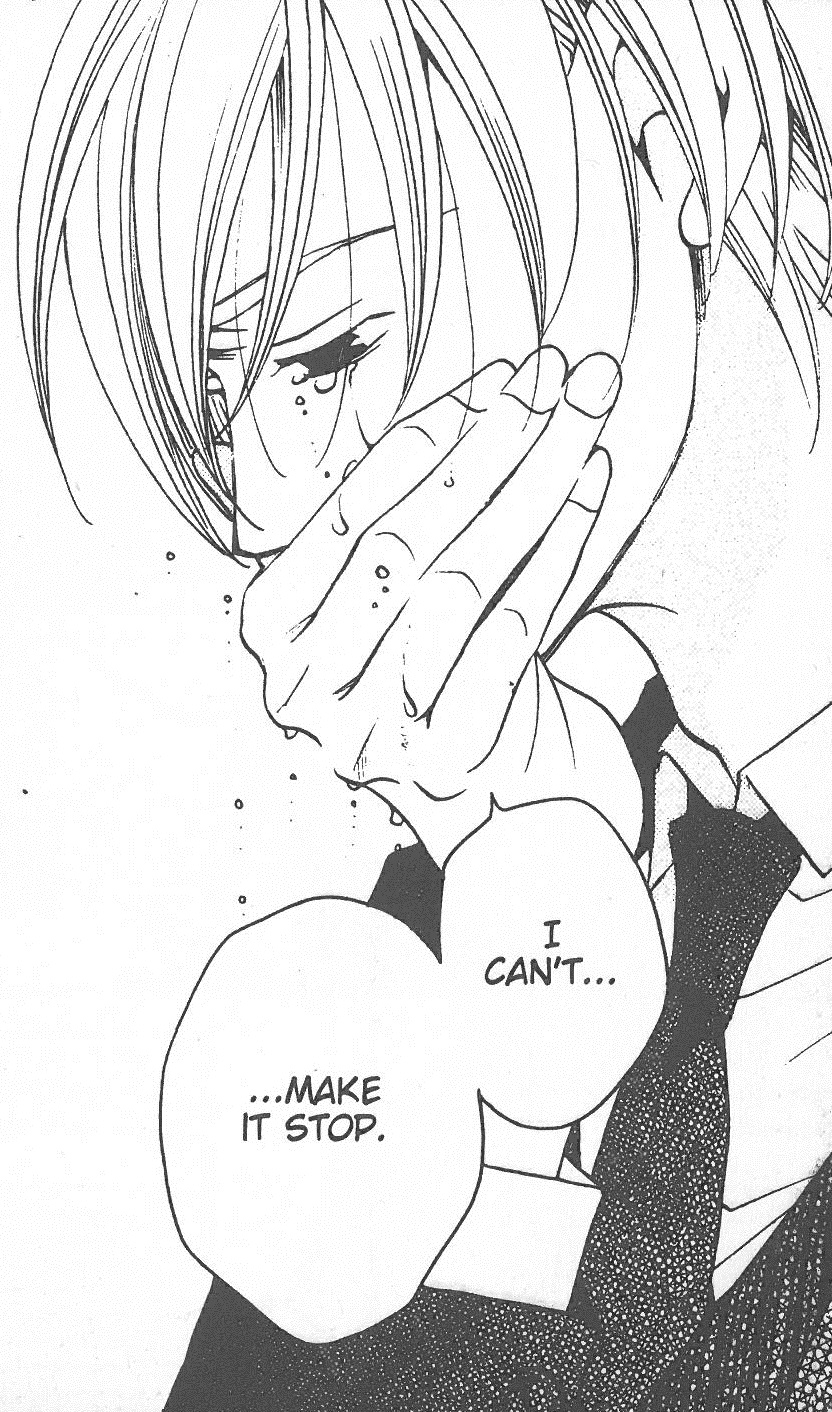
After having let his feelings be pulled one way and then another, Mashiro has made his decision: In order to live as a man he has rejected Sou and his aggressive advances in favor of his girlfriend Kureha. Mashiro tells himself that it’s because Kureha is the one who needs him the most, never considering that Sou might need him, too. Ultimately though, Mashiro’s decision is a selfish one and not nearly as gallant as he would like to believe or portray. Although he has been living as a boy for most of his life, he is still incredibly insecure in his gender identity, mostly due to the fact that his body has both male and female characteristics. By dating Kureha and by becoming her self-proclaimed guardian and protector, Mashiro hopes to unequivocally establish his masculinity for himself and for others, something he doesn’t believe would be possible if he recognized having feelings for another guy. But even though Mashiro has made his decision, he still has lingering doubts.

After School Nightmare, Volume 5, page 52Many of the characters in After School Nightmare are broken, damaged, or incomplete individuals who are attempting to put the pieces of their lives together to form, or reform, some sort of whole. That is part of the purpose of the titular after school nightmare—a special class that, through shared dreams, forces them to confront their greatest fears and in the process reveal them to the other students as they all try to determine who they really are as people. It can actually be quite painful and heart-wrenching to witness the events unfold both within the nightmares and outside of them; truly terrible and horrifying things occur that strongly influence the characters’ physical, mental, and emotional well-being. At this point in the series Mashiro’s personal struggles and torments are the ones about which the most is known, but After School Nightmare, Volume 5 begins to reveal more about Sou’s tragedies which previously had largely only been hinted at.

From the beginning of After School Nightmare, Sou has been shown to be one of the strongest and most assertive characters in the series which is why seeing him in such a vulnerable state in the fifth volume is especially distressing. Sou is an unlikeable person in many ways—among other things showing a shocking lack of respect for Mashiro, the person he supposedly loves—but I can’t help but feel some empathy for him as he is caught up in multiple extremely unhealthy and manipulative relationships. And he’s not always the one doing the manipulating; his relationship with his sister and the control she seem to have over him is particularly troubling. Mashiro’s rejection hits Sou hard, too, certainly much harder than either of them really expected. At first Sou reacts in anger, but ultimately he tries to lives in forced denial of his feelings. Considering how the rest of After School Nightmare has progressed so far, I don’t anticipate that this method of coping will turn out well for any of the people involved.

Filed Under: REVIEWS Tagged With: after school nightmare, Go! Comi, manga, Setona Mizushiro

Manga the Week of 8/19

August 13, 2015 by Sean Gaffney, Ash Brown, Michelle Smith and Anna N 5 Comments

SEAN: (flat stare) OK, I have not seen this much manga coming out in one week in about 7-8 years. This is getting completely ridiculous.

If you somehow have missed bloggers banging the drum for the Kurosagi Corpse Delivery Service over the last several years, there is a good chance to catch up now, as an omnibus of the first 3 volumes is out next week from Dark Horse. Seriously, this series is ridiculously good, y’all. (note: this may not be out everywhere next week, check your Diamond listings)

ASH: I’m glad to see this series getting some more love from Dark Horse again.

SEAN: Kodansha has an 18th volume of Cage of Eden, coming ever closer to the end of the series, where surely it will answer all the questions we have so far! (cough)

And there’s a 6th volume of the increasingly popular series Noragami.

ASH: There was quite a cliffhanger at the end of the fifth volume, so the sixth is on my reading list.

wallflower35

SEAN: Lastly, the penultimate 35th volume of The Wallflower, a series that many thought would never end! Will it romantically resolve anything? Don’t hold your breath. I wouldn’t hold your breath in Vol. 36 either.

MICHELLE: I certainly thought it would never end!

ANNA: I am amazed.

SEAN: One Peace Books has a 3rd volume of Aquarion Evol.

And also a light novel, which I think might have an associated manga later, though I’m unsure. It’s called The Rising of the Shield Hero, and as you can guess, is fantasy-based.

ASH: Yup. One Peace Books is planning to release the manga as well.

SEAN: Seven Seas gives us a 3rd volume of yuri potboiler Citrus.

And a 2nd of Clay Lord: Master of Golems, which I found more interesting than I’d expected.

Vertical has a 6th volume of popular fantasy series Witchcraft Works.

Viz gives us new Dorohedoro, which always makes me happy, and always makes me want to do a giant reread. This is the 16th volume, meaning it easily wins the SigIkki wars for supremacy.

ASH: Dorohedoro! I’m long overdue for another binge read.

SEAN: And if you prefer zombies to… well, I guess Dorohedoro has zombies as well, sort of, but if you prefer more traditional zombies, there’s a second Tokyo Ghoul.

ASH: I haven’t read any of Tokyo Ghoul yet, but the series seems to be doing quite well for Viz.

SEAN: The new manga reboot of Ultraman is so amazing that it actually runs in a magazine called “Monthly Hero’s”. You may expect… Tokusatsu shenanigans, I would expect.

MICHELLE: Ugh, that apostrophe bugs me.

bb1

SEAN: Yen On has a whopping six new titles for us, including the debut of Black Bullet, a future dystopia series. If you enjoyed the ‘young man with loli not-quite-sister’ aspect of No Game No Life but wished it were more depressing, this may be for you.

The fourth volume of A Certain Magical Index reintroduces us to Kaori Kanzaki, the girl with huge sword from the first volume, and also shows us Touma’s parents for the first time… sort of.

The Devil Is A Part-Timer! has Volume 2, as we start to see where we go now that the forces of good and evil are pretty much settled on Earth and dedicated to minor squabbles.

ASH: This series amuses me greatly.

SEAN: Is It Wrong To Try To Pick Up Girls In A Dungeon? has a 3rd volume, and the anime has now passed it, so we get to see what was left out of the adaptation.

Spice & Wolf has ended in Japan, I think, apart from side stories. But it’s still chugging away here in North America with its 15th volume.

And Sword Art Online has a 5th volume. Now that everyone is finally free from the game of death and their lives are back to normal, surely they’ll never play another MMORPG again, right? Hah.

Yen Press has several digital-only releases coming out as well. The 3rd Handa-kun continues to elaborate on the high school years of the Barakamon protagonist.

We get the first two volumes of Kakegurui – Compulsive Gambler, a Gangan Joker series about a school whose student council base everything around, well, gambling. I know next to nothing about it, so am intrigued.

And the first two volumes of The Royal Tutor, a GFantasy series that has, well, royalty and a tutor for same. It seems to be more lighthearted than serious, and may have BL overtones, given the magazine it’s in and the author’s prior works.

ANNA: Hmmmmmm….

SEAN: And Today’s Cerberus has volumes 3 and 4. Despite having dog girls, cat girls, and wolf girls, I found it more enjoyable than you’d expect.

So, that’s Yen On and Yen Digital sorted out, now for Yen Press proper. We’re about halfway through Ani-Imo with the 4th volume. Is it any less creepy?

Despite Handa returning to the city at the end of the last Barakamon, the series continues on with its 6th volume.

It’s been 11 volumes of BTOOOM!. Can you believe it? 11 volumes.

MICHELLE: Siiiiiiiiiiiiiigh.

dpths1

SEAN: The Devil Is A Part-Timer! High School!! is an alternate universe spinoff of the main series which… well, I’m sure you can guess.

Emma has a 2nd omnibus. What will happen to our heroine now that she’s left to go north? And can William ever find her? And can everyone continue to be repressed?

ANNA: Cheers to Emma being back in print, it is such a special series.

ASH: Cheers, indeed!

SEAN: Our long national nightmare is over with the 4th and final volume of Gou-dere Sora Nagihara.

High School DxD shows us we must stay ever vigilant, however, with a 6th volume and no end in sight.

The 2nd Is It Wrong To Try To Pick Up Girls In A Dungeon? manga volume continues to confuse Amazon’s systems and these lists.

Has Madoka Magica been getting you down? Does your favorite girl keep dying? Try Puella Magi Homura Tamura, a wacky 4-koma version of the series that will probably not remind you of Sunshine Sketch too much.

RustBlaster (no space) is a one-volume manga from the creator of Black Butler, featuring vampires. It may therefore take the new crown of ‘most obvious license ever’.

Lastly, a second volume of Trinity Seven, with slightly less “look, breasts!” on the cover than the first.

I… wow. If you’re not getting SOMETHING next week, we may have to check your pulse.

MICHELLE: I think I may not be getting anything! But mostly ‘cos I already own Emma and Kurosagi Corpse Delivery Service.

ANNA: I’m not getting anything either! I need to whittle down all the stacks of unread manga I already have.

ASH: I… most definitely have a pulse. (And soon to be even more overloaded bookshelves.)

Filed Under: FEATURES, manga the week of

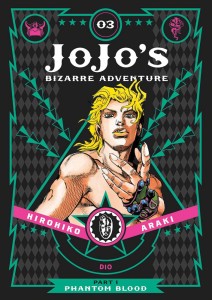
JoJo’s Bizarre Adventure: Phantom Blood, Vol. 3

August 13, 2015 by Sean Gaffney

By Hirohiko Araki. Released in Japan as “Jojo no Kimyou na Bouken” by Shueisha, serialized in the magazine Weekly Shonen Jump. Released in North America by Viz Media.

It’s striking how much of JoJo’s, particularly this first arc, has been embedded in anime fandom in general. I was unfamiliar with the arc till reading Viz’s version, but when Dio, about 3/4 of the way through this volume, begins screaming “WRRRRYYYYYYY!!!”, I laughed, finally knowing where another meme came from. One of the great joys of reading this series is seeing how easily it can get turned into memes – and that’s not a knock on its quality, it’s a sign that people are able to take the musing, exciting and horrifying that is JJBA and make it their own. Not every series is able to do that.

jjba3

That’s Dio on the cover, but for most of the first half he sits out the battle, content to sit on a throne and do evil things like having a mother beg for her child’s life, then zombifying the mother so she kills the child herself. In Volume 1 a token effort was made to give Dio a reason to be evil, but it was just token – Dio is the villain because he really really loves doing evil things, and adding ‘immortal vampire’ to the list only made it easier for him to be MORE evil. Once Bill Bruford and Tarkus – or however they’re spelled – are taken out, Dio finally manages to fight with JoJo and show off how he really is from the dark side – pure attacks don’t even affect him.

This is the last volume of the first arc, and you can tell by how much the violence steps up. This was already a very violent series – I’d mentioned the debt it owed to Fist of the North Star before – but it really amps it up here, with the aforementioned mother and child, with one of Dire Straits (I love the naming in this series, and it reminds me I miss Bastard!!) getting flash frozen and then shattered, with JoJo’s mentor remembering at a convenient time the prophecy that said he had to die, and finally with the apocalyptic ending where Dio, now just a head, finds a way to kill off Jonathan Joestar once and for all.

The ending shows off how much JoJo’s is also immersed in the tropes of tragedy, though I’d argue it’s not really pure tragedy as JoJo doesn’t have a fatal flaw like Hamlet or Lear. He just can’t escape Dio, not even after he gets to marry Erina and go off on a honeymoon. The last 30-40 pages are awash in corpses, and indeed the story ends with (seemingly) Erina the only one still alive. Somehow, though, I doubt Dio is dead. The author clearly planned to move on right after this – there are no breaks between this arc and the next one in the series, so it’s not like many modern manga where a reboot takes place after a break of several months/years. Instead, it shows off how all of this – the histrionics, the shouting, the battles and the tears – was a prelude, working p to something even bigger.

What will that be? Well, we’ll find out in November. Or now, if you like reading digitally.

Filed Under: REVIEWS

Maid-sama!, Omnibus 1

August 12, 2015 by Ash Brown

Maid-sama!, Omnibus 1Creator: Hiro Fujiwara
U.S. publisher: Viz Media
ISBN: 9781421581309
Released: August 2015
Original release: 2006-2007

Maid-sama! is an eighteen-volume manga series created by Hiro Fujiwara. The series was initially licensed for English translation by Tokyopop, which released the first eight volumes of the manga between 2009 and 2011. More recently, Maid-sama! was rescued by Viz Media. The manga is being released under the Shojo Beat imprint in an omnibus edition, each English-language omnibus collecting two volumes of the series’ original Japanese release. The first Maid-sama! omnibus was published in 2015 and includes the first and second volumes of the manga published in 2006 and 2007 respectively. (The first volume also contains Fujiwara’s earlier short manga “A Transparent World.”) Maid-sama! was Fujiwara’s first major success as a mangaka. However, it wasn’t until Viz’s release of Maid-sama! that the series came to my attention when I noted the enthusiastic response of fans surrounding its return. I was therefore very happy to have the chance to read a review copy of the first omnibus in order to see what the excitement was all about.

Seika High School, previously an all-boys’ school, has only been co-ed for a couple of years. The student population is still largely male—the boys outnumbering the girls four to one—and Seika High still has a bad reputation. And so Misaki Ayuzawa has decided to take things into her own hands, becoming Seika’s first female student council president in order to clean up the school’s act, improve it standing, and create a more welcoming environment for young women. Misaki rules over Seika with an iron fist, though not everyone appreciates her strength and intelligence or the changes she’s making. Because of that, she’s particularly careful to keep the fact that she works part-time at a maid cafe a secret; she doesn’t want to ruin her image or risk losing what little authority she has. But then her classmate Takumi Usui discovers how she’s spending her time after school. Misaki has caught his attention and interest, perhaps even romantically, though understandably she’s not very happy about the awkward turn of events.

Maid-sama!, Omnibus 1, page 34I absolutely adore Misaki. She’s a smart, strong, motivated, hard-working, competent, capable, and highly accomplished individual. She’s not perfect though. Her drive to overachieve and handle everything by herself along with her reluctance to rely on the help of others means that she frequently overextends herself, wearing herself down. Misaki could stand to relax a little, but the believable combination of her strengths and weaknesses make her the most well-developed character in the series. While I love Misaki, I am significantly less enamored with Takumi. Sometimes he can be a great guy, but on occasion he can be an utter creep. His skills and talents match and even surpass those of Misaki, often in superbly ridiculous ways which are admittedly amusing, but he seems to frequently be emphasizing that she’s a girl as if that somehow makes her inferior. I want to see the Takumi who supports Misaki for who she is and who doesn’t feel the need to dominate her. Early on in Maid-sama! it seems this would be a possibility, but the more of the omnibus I read the less likely it appeared that the series would be going in that direction.

Although in part Maid-sama! is a romance, ultimately that particular plot line in the manga is the one that interests me the least. (If I actually liked Takumi more than I currently do, I would probably feel differently.) I enjoy the series most when it focuses on Misaki as she grows as a person. I like seeing her become less of a tyrant as the president as she learns to consider other people and their needs instead of completely overruling them without making an effort to hear their concerns. At first she is disliked by almost all of the students, but as time passes more and more of them, male and female alike, come to admire, trust, and appreciate her and where she is leading Seika High. Although there are certain things about Maid-sama! that bother me—most notably the distinct possibility of Takumi being idealized as a romantic lead—overall I did find the beginning of the series to be entertaining and a lot of fun. And since I do like Misaki so incredibly well, at this point I definitely plan on reading more of Maid-sama!.

Thank you to Viz Media for providing a copy of Maid-sama!, Omnibus 1 for review.

Filed Under: REVIEWS Tagged With: Hiro Fujiwara, maid sama!, manga, shojo beat, viz media

Spell of Desire Vol. 5

August 11, 2015 by Anna N

Spell of Desire Volume 5 by Tomu Ohmi

It is the final volume of Spell of Desire! What’s happening in the conclusion of this paranormal romance series?

Throughout Spell of Desire Kaoruko has been heading towards a confrontation with her mother, the mysterious Witch Queen. She finds out that her mother sealed herself away as part of a spell to balance out the positive and negative energy that was building up in the world. The Witch Queen emerges, and Kaname confesses that he’s no longer able to serve as the Witch Queen’s knight due to his love for Kaoruko. The Witch Queen promptly wins an award for worst mother of the year when she announces that she’s going to curse her daughter’s boyfriend by taking all of his senses away, followed by taking his memories of Kaoruko away too. Kaname is blinded, and he slowly becomes more and more debilitated.

This curse presents quite the conundrum, and Kaoruko is determined to harness her power for once and for all in order to save Kaname. She’s been slowly inching towards claiming her power, so it was great to see her finally take charge and do something. She’s aided by an elderly black witch who shows up and indulges in a great deal of exposition as the volume wraps up.

Overall, I thought the pacing of this series was a bit off. I enjoyed the world building and character introductions in the first couple volumes a great deal, but the rest of the series felt like it was just marking time until the big witch battle happened in the final volume. Kaoruko’s rise to self-assurance and command of her power felt a bit rushed, but I still appreciate that by the end of the series she was making her own decisions and acting heroically in order to create her own happy ending. While Spell of Desire wasn’t the best example of paranormal romance, Ohmi’s clear visual storytelling made it easy to read.

I see that this manga hasn’t sold as well as Ohmi’s other series to be translated into English, Midnight Secretary. This is a bit of a shame, because I was hoping that Viz would bring out her earlier series Kindan no Koi de Ikou, since there is such a dearth of werewolf manga romance being translated into English. We have all the vampires we need, what about some werewolves for a change? I’d still recommend Spell of Desire and Midnight Secretary to romance manga fans, and I hope more of Ohmi’s work gets translated here.

Filed Under: REVIEWS Tagged With: shojo beat, spell of desire, viz media

My Hero Academia, Vol. 1

August 11, 2015 by Sean Gaffney

By Kohei Horikoshi. Released in Japan by Shueisha, serialization ongoing in the magazine Weekly Shonen Jump. Released in North America by Viz.

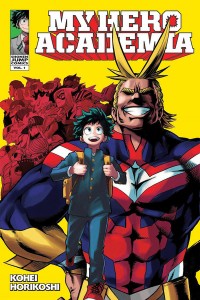
It has to be said, if you’re looking to succeed in Weekly Shonen Jump, ‘write the same thing as everyone else, only your way’ is a pretty good description of how to go about doing it. And to a degree, that’s what the author does with this new series. Even though the front cover parodies Marvel and DC Comics, and the kids are ‘superheroes’ in a Western sense, this is very much in the classic Jump mold – indeed, some of the amusing yet insane superpowers reminded me of the late lamented Medaka Box. Our hero as well is a sweet kid, the Naruto sort who starts off weak and bullied but will improve by leaps and bounds because he tries hard and refuses to back down when his principles tell him it’s wrong.

academia1

Our hero Izuku (abbreviated to ‘Deku’ for reasons that Viz won’t explain because Jump titles don’t have endnotes) is the small guy on the cover, as you no doubt guessed. The world about 25-30 years ago evolved superpowers in about 80 percent of the population. And Izuku really, really loves superheroes – he’s pretty much an otaku. Sadly, he’s in the 20% that doesn’t have powers. This, naturally, leads to bullying on the part of all his school classmates, particularly Katsugi, who plays the role of the selfish ass quite well in this volume, though I suspect he will gain greater depth as the title goes on, particularly give his childhood past with Izuku.

Luckily, Izuku gets a superpower transferred to him from the other guy on the cover. Even more luckily, the power does not just magically make him a superhero – he has to go through an amusing and heartwarming training montage, complete with the usual ‘drag a refrigerator across the beach’ stuff, till he’s no longer a wimpy kid but rather a wimpy kid with a muscular build. And he doesn’t really get a chance to train with his powers, either – which means he’s in trouble when he applies to Superhero School, where the goal is to be awesome immediately.

Nothing here is really original, but also nothing here is really poorly done, either. The author has learned from Barrage, his previous series. Izuku is a bit of a shy coward without being unlikeable, All Might’s secret allows him to be hilarious as well as inspiring, and his new friend Ochako is cute, and not Shiemi from Blue Exorcist despite all appearances saying she is. The fight scenes look smooth and non-confusing, and there is actual tension as you wonder how this will get resolved – it also allows Izuku to be clever, which is the best way to advance when you also have cool superpowers. Add on a reluctant mentor and some random giant woman fanservice, and you can see exactly why this became a bit hit while Barrage was cancelled after 2 volumes.

If you want something you’ve never seen in Jump before… why do you read Jump, exactly? But if you want something light and fun, with potential for more, My Hero Academia may be right up your alley.

Filed Under: REVIEWS

  • « Go to Previous Page
  • Page 1
  • Interim pages omitted …
  • Page 530
  • Page 531
  • Page 532
  • Page 533
  • Page 534
  • Interim pages omitted …
  • Page 1049
  • Go to Next Page »
 | Log in
Copyright © 2010 Manga Bookshelf | Powered by WordPress & the Genesis Framework