• Skip to primary navigation
  • Skip to main content
  • Skip to primary sidebar
  • Home
  • About Us
    • Privacy Policy
    • Comment Policy
    • Disclosures & Disclaimers
  • Resources
    • Links, Essays & Articles
    • Fandomology!
    • CLAMP Directory
    • BlogRoll
  • Features & Columns
    • 3 Things Thursday
    • Adventures in the Key of Shoujo
    • Bit & Blips (game reviews)
    • BL BOOKRACK
    • Bookshelf Briefs
    • Bringing the Drama
    • Comic Conversion
    • Fanservice Friday
    • Going Digital
    • It Came From the Sinosphere
    • License This!
    • Magazine no Mori
    • My Week in Manga
    • OFF THE SHELF
    • Not By Manga Alone
    • PICK OF THE WEEK
    • Subtitles & Sensibility
    • Weekly Shonen Jump Recaps
  • Manga Moveable Feast
    • MMF Full Archive
    • Yun Kouga
    • CLAMP
    • Shojo Beat
    • Osamu Tezuka
    • Sailor Moon
    • Fruits Basket
    • Takehiko Inoue
    • Wild Adapter
    • One Piece
    • After School Nightmare
    • Karakuri Odette
    • Paradise Kiss
    • The Color Trilogy
    • To Terra…
    • Sexy Voice & Robo
  • Browse by Author
    • Sean Gaffney
    • Anna Neatrour
    • Michelle Smith
    • Katherine Dacey
    • MJ
    • Brigid Alverson
    • Travis Anderson
    • Phillip Anthony
    • Derek Bown
    • Jaci Dahlvang
    • Angela Eastman
    • Erica Friedman
    • Sara K.
    • Megan Purdy
    • Emily Snodgrass
    • Nancy Thistlethwaite
    • Eva Volin
    • David Welsh
  • MB Blogs
    • A Case Suitable For Treatment
    • Experiments in Manga
    • MangaBlog
    • The Manga Critic
    • Manga Report
    • Soliloquy in Blue
    • Manga Curmudgeon (archive)

Manga Bookshelf

Discussion, Resources, Roundtables, & Reviews

Blog

Pick of the Week: Sweet and Bizarre Adventures

April 30, 2018 by Katherine Dacey, Sean Gaffney, Michelle Smith, Anna N and Ash Brown Leave a Comment

KATE: There’s plenty of product this week, from long-running shojo favorites like Kimi ni Todoke to new light novel series. My vote, however, goes to Chi’s Sweet Adventure, a spin-off of the Chi’s Sweet Home anime. I’m not expecting anything too ground-breaking here, just some cute kitty antics. What looks good to you?

SEAN: It feels odd to be picking nonfiction as my pick of the week (and prose for the second week running), but the Mari Okada autobiography, From Truant to Anime Screenwriter. I am looking forward to a lot of Viz stuff as well, but Mari Okada is definitely my pick this week.

MICHELLE: I’ll go with the 29th and penultimate volume of Kimi ni Todoke, even though I fully intend to hoard my copy and read it along with the final volume, since we have to wait until December for that one (sniff)!

ANNA: There’s a ton of great manga coming out this week! I’m going to have to go with the latest volume of JoJo’s Bizarre Adventure: Stardust Chronicles. I might be hopelessly far behind in my reading of this series, but I love that it is getting the deluxe hardcover treatment.

ASH: I’ll join Anna this week in declaring JoJo my pick! I’m actually double-dipping for Stardust Crusaders because the deluxe edition is so handsome. There’s plenty of other manga coming out that I plan on giving a read, too, though!

Filed Under: PICK OF THE WEEK

Bookshelf Briefs 4/30/18

April 30, 2018 by Michelle Smith, Sean Gaffney and Ash Brown Leave a Comment

Again!!, Vol. 2 | By Mitsurou Kubo | Kodansha Comics – Imamura sets about convincing the former members of the ouendan to rejoin the club. Although he has success with drummer Tatsuhiko Okuma (who has an extremenly ardent, unrequited crush on Usami), the other second years want nothing to do with it. Thankfully, he finally manages to convince a pair of third years to return by exposing the cheerleaders’ evil plot via a puppet show. (Yes, really.) Things are looking up, Usami is smiling, but… he’s still stuck in the past, and he’s a member of a club he never intended to personally join, and what’s more, he has knowledge that the school’s sports teams aren’t going to win anything. The volume ends with the suggestion that he might try to change that, but it seems like what he really needs to conquer is his own deep-seated belief that he’s a bad-luck charm. This is a fun series. – Michelle Smith

DAYS, Vol. 8 | By Tsuyoshi Yasuda | Kodansha Comics (digital only)- It’s the semi-finals of the Tokyo qualifiers for the All Japan Tournament, the final chance for Seiseki’s third years to play on the national stage. Unfortunately, with Oshiba and Kazama injured, and captain Mizuki forced to sit out because of penalties in previous games, Seiseki is missing its offensive powerhouses. Tsukamoto plays his first official game in some time, and it’s truly gratifying to see him gradually realize that he doesn’t suck anymore. He has a real affinity for regaining possession of stolen balls, and once he begins to have some confidence in his skill, soccer, which previously was just a way of hanging out with friends, starts to become fun in its own right. Seeing him seize the opportunity for a shot without hesitation is quite a big deal, even though he misses. Looking forward to volume nine! – Michelle Smith

Dead Dead Demon’s Dededede Destruction, Vol. 1 | By Inio Asano | Viz Media – While it may not be as immediately dark as some of Asano’s other manga, Dead Dead Demon’s Dededede Destruction still has an ominous and disconcerting atmosphere to it; already there is plenty of heartbreak along with the more lighthearted moments. Kadode Koyama is a young woman in high school who is having a difficult time finding the motivation to devote to her studies when the world itself is coming to an end. Three years ago, aliens appeared from outer space, the attack changing both everything and nothing about human life on Earth. While the story itself is intriguing, Asano’s artwork is a real highlight of the series. With dramatic angles and cinematic framing, Dead Dead Demon’s Dededede Destruction is always visually dynamic even when the manga focuses on the more mundane aspects of the characters’ lives. Well, as surprisingly mundane as things can be when living through an alien invasion. – Ash Brown

The Honor Student at Magic High School, Vol. 8 | By Tsutomu Sato and Yu Mori | Yen Press – For a series that’s supposed to be about Miyuki, the side manga really isn’t concentrating on her POV as much as you’d expect. Of course, given Miyuki’s incestuous love for her brother, perhaps that’s for the best. Instead, this volume is Honoka-and-Shizuru heavy, as we see Honoka’s triumphant win at Battle Board (as well as her triumphantly skintight wetsuit, which shows off her large chest to a ridiculous degree) and also see Shizuku’s battle with Miyuki in Ice Pillars Break, whose conclusion is fairly obvious but still emotional. It’s hard to strive to do your best when you hang around with people so far above you every day, let alone when they’re good friends. Excellent – Sean Gaffney

Imperfect Girl, Vol. 3 | By NISIOISIN and Mitsuru Hattori | Vertical Comics – Good news, the series stayed away from disquieting relationships, though there is a bath scene together. This series has been about a girl who has suffered abuse, and her traumatic mindset after the death of her parents. Said death is shown here, a bit unrealistic but evocative, as is somewhat expected of Nisioisin. Speaking of which, the revelation of the stories that the narrator wants to tell now is a nice fourth-wall break, as they’re all if Nisioisin’s other series, from Zaregoto onward. The conclusion is perhaps a bit too pat, but honestly at this point after all the exhausting tension of the three-book series, pat is good enough for me. Good stuff. – Sean Gaffney

Murcielago, Vol. 6 | By Yoshimurakana | Yen Press – To answer my question from last review, yup, this volume begins with a ridiculously over-the-top sex scene between Kuroko and the mother from last volume. As for the daughter, she’s attending a new school, which is an elevator school that also features Hinako and her friends, as well as a mad bomber, some unfortunate bullies, and a seemingly meek young woman whom Kuroko helps to stroll down the path of a twisted lesbian killer. For all that Kuroko is theoretically helping the police, there’s never any doubt that she’s also killing because she loves it, and gets away with it here. I emphasize again: I enjoy reading Murcielago, but it is a nasty series, and you need to accept that going in. Everyone here is awful. – Sean Gaffney

Pandora in the Crimson Shell: Ghost Urn, Vol. 10 | By Shirow Masamune and Rikudou Koushi | Seven Seas – Just when I thought I was out, they pull me back in. The first half of this is standard Pandora, meaning somewhat dull and also filled with dumb comedy, though I did appreciate that Vlind’s two assistants seemingly look similar to Hyatt and Elgala. The second half, dealing with Mr. Keith Brooklyn, his wife, and their child, is a lot better, getting into the nature of “quality of life” and what it means to be truly happy, and utilizing Nene’s special superpowers for a good, loving reason. I know more than to expect this sort of thing to continue, but it was greatly appreciated as a break from the fanservice and global conspiracy. – Sean Gaffney

Spirit Circle, Vol. 3 | By Satoshi Mizukami | Seven Seas – Fuuta is getting better at reconciling his past lives with his present (and figuring out that his family and friends are also connected to him in the past), but he’s not getting along any better with Kouko, and she’s determined to destroy him for what he apparently did as Fortuna—which we still don’t know, and which Fortuna himself seems to be trying to actively stop him learning. As for the life we see this time around, it’s a tale of old samurai, and he and Kouko literally lose an arm and a leg each to each other. The author is very goo9d at showing the emotional impact of a scene, even if he’s not the best at facial expressions. (That hasn’t changed since Biscuit Hammer, really.) Addicting. – Sean Gaffney

Yowamushi Pedal, Vol. 8 | By Wataru Watanabe | Yen Press – Day two of the Inter-High continues. Although this volume features the triumphant return of Onoda and Tadokoro—which is great, and features Tadokoro crying manly tears of profound gratitude—most of the action has to do with the two teams currently battling it out for the lead: reigning champions Hakone Academy and Kyoto Fushimi, led by deceptive and ever-so-creepy Midousuji. We see how he converted the previously unified members of the Kyoto Fushimi team into his foot soldiers (and there are hints that a rebellion might come soon from within the ranks) and how he exploits the totally justified and sympathetic weakness of Hakone’s ace sprinter, Shinkai. Although readers surely want to see Shohoku take the victory, it’s neat that for this section at least, I find myself rooting for Hakone to smack Midousuji down decisively. Hopefully that will transpire in the next volume! – Michelle Smith

Filed Under: Bookshelf Briefs

Baccano!: 1933 The Slash -Bloody to Fair-

April 30, 2018 by Sean Gaffney

By Ryohgo Narita and Katsumi Enami. Released in Japan by ASCII Mediaworks. Released in North America by Yen On. Translated by Taylor Engel.

“There’s always someone better than you.” A truism that this two-volume arc of Baccano! seems to be taking to heart. Last time we saw Maria devastated when her swordplay lost out to Adele’s spear, and the repercussions of that reverberate though this book. But it doesn’t just end with her. Adele herself gets shattered when Maria’s clever thinking is actually able to deliver a bad wound, and the newly introduced Christopher Shaldred can try all he wants to be a cool, constantly talking killer, but we already have Clare/Felix, so he’s inevitably going to come out second best, especially when you realize that Felix prolonged the fight solely for the reason that he wanted to fight back to back with his fiancee. And then there’s Tim, who finds that not only is he easily manipulated by Huey, but also gets verbally destroyed by Senator Beriam. The theme here is “stay humble”, though to be honest nobody really learns that lesson.

By the time this book had come out, Narita had already started his other popular novel series Durarara!!, and I have to admit that of all the Baccano! novels, this one feels the closest to DRRR!! style shenanigans. That said, DRRR!! never gets quite as bloody as Baccano! does, and the massacre of the employees of the Nebula Building is (at least temporarily) a bit horrifying. Again one is reminded that there really aren’t too many “good guys” in this series – even Jacuzzi and Nice are gang leaders, and honestly I think the only reason they don’t get taken to the cleaners at the end is because Chane is part of their gang. The new villains are also pretty bad, and continue the theme of “someone better than you” – Tim’s Larva group from the prior book is as nothing compared to Huey’s experimental Lamia children, and it’s notable that after the fight at the end of the previous book, Adele is ready to go off the rails at a moment’s notice.

And then there’s Maria. I savaged her pretty badly in the first volume’s review, and to be fair she was incredibly annoying then. That doesn’t completely change (Luck confronting her at the end may be the funniest scene in the book, especially as by then the reader had ALSO forgot what her original mission was), but she manages to overcome her fears and doubts, gets a ridiculously cool two-sword move (honestly, this book would be fantastic animated), and possibly hook up with Tick – she says he gets to decide if they’re friends or lovers, to which I think Tick’s response can best be described as “Buh?”. She’s certainly better off than Firo, who runs around trying to save Ennis only to find Ennis never really needed saving at all. and then has Ennis say that she thinks of Firo… as family. Good thing these two are immortal, they need all that time.

Narita’s afterword says that the publisher wanted to get away from the 1930s again (so The Children of Bottle apparently did pretty well), but he said he had far too many 1930s plots still to tell. As such, be prepared to start a THREE-part arc next time, as we advance one year but otherwise have the same old ruckus. Plus maybe we’ll see who rescued Christopher, last seen bleeding out. As for The Slash, the second part definitely is better than the first. This is a fun ride.

Oh yes, Dallas is in this too. Sorry, totally ignored him.

Filed Under: baccano!, REVIEWS

Monthly Girls’ Nozaki-kun, Vol. 9

April 29, 2018 by Sean Gaffney

By Izumi Tsubaki. Released in Japan as “Gekkan Shoujo Nozaki-kun” by Square Enix, serialization ongoing in the online magazine Gangan Online. Released in North America by Yen Press. Translated by Leighann Harvey.

It’s been a long nine months since we last saw Nozaki-kun here, the curse of having caught up with Japan. I’m relieved to say, though, that the wait is worth it, as this series’ one and only job is stillo being done incredibly well: I laugh a whole lot when reading this. In fact, one joke made me laugh so much I had to put the book down for a few minutes. (It involves the art club and their “perfect guys”.) Characterization remains strong but static: apart from Hori maybe realizing that Kashima is attractive as a woman (though that doesn’t necessarily translate to any love epiphanies), no one here grows or changes, but remains the same lovably exaggerated idiots we want and expect. Chiyo’s Nozaki-love is up to eleven, Seo continues to be the best troll, and Nozaki’s people watching is as entertaingly wrong as ever.

If there’s a straight man left in the series, it’s probably Mikoshiba, whose attempts at getting Mayu and Wakamatsu interested in visual novels is a hilarious disaster, given that they’re not really playing the game for the same goals. Mikoshiba continues to be Chiyo’s BFF (yes, even though he’s a guy), trying in vain to help her and Nozaki get closer. This culminates in the guys and girls having (separate) sleepovers, which predictably involves Mikoshiba an company staying up late and gossiping about the romance game they played, while the three girls (who have no idea how an actual slumber party works) just talk about what male underwear looks sexiest.

I’ve been reviewing this series with full reviews since it began, and I admit it can sometimes be a bit of a challenge given that there’s not much to say here beyond “this is what I thought was the funniest”. But it is funny, and I can admire the craft that Tsubaki brings to the title in developing each gag. This series is not really much at all like Oresama Teacher beyond the love of “tsukkomi” style punchlines. Nozaki-kun has to be punchier, faster, and not wait for the gag to land. It can also be hard to think up material every week – you might see some of that in Nozaki’s watching the drama club improv, where they all talk about how easy it is to end a scene by having everyone drop dead or be murdered.

I’m not sure when Nozaki will end – I suspect when Tsubaki and Square Enix decides it’s run its course. We’ve already had an anime,. and a 2nd season is not on the horizon. That said, I’m not sure I’d expect much resolution in any ending – much as the fans might want the three “main couples” to get together – or even Mikoshiba and Mayu – I’m inclined to agree with the drama club. Ending with a romantic kiss is cheap and easy. Especially for a series like this. Making us laugh, though? That’s guaranteed.

As for tanukis, well, just look at the cover.

Filed Under: monthly girls' nozaki-kun, REVIEWS

Reborn as a Vending Machine, I Now Wander the Dungeon, Vol. 1

April 28, 2018 by Sean Gaffney

By Hirukuma and Ituwa Kato. Released in Japan as “Jidou Hanbaiki ni Umare Kawatta Ore wa Meikyuu wo Samayou” by Kadokawa Shoten. Released in North America by Yen On. Translated by Andrew Prowse.

If you’re going to be selling, as a regular series, a story about a guy reincarnated as a vending machine, you’d better go all in. Some stories work better as parodies (see the upcoming “Do You Like Your Mom?”), but I’m pretty sure this would not be any good if it weren’t 100% serious about its vending machine hero and the world he now lives in. The author says he wrote the book as a sort of push against the typical isekai harem protagonist, and I can see that. Yes, the machine gets a “blessing” that allows him to have a super cool force field, but it uses up HP fast, and its airtightness means it’s hard to keep humans inside. He also can’t move – he’s a vending machine. And his conversation is limited to six programmed phrases – he’s a vending machine. And he’s not getting a harem… well, OK, that remains to be seen.

Our hero is Boxxo (yes, really – thankfully it’s not his own choice of name), a young Japanese man obsessed with vending machines and the things that come out of them, who one day is killed in a brutal vending machine accident. He wakes to find he is now a vending machine, dispensing mineral water and corn soup. Unfortunately, he is sitting at the side of a lake deep in the middle of nowhere, surrounded by frog enemies trying to break him, and if he doesn’t sell things he’ll eventually run out of lifespan. Then he meets Lammis, a super strong, super spunky, super naive girl who has been abandoned by her party and is on the verge of death. He gives her food and drink, and in return she picks him up and carries him to the nearest settlement. (I did mention the super strength, right?) As the book goes on, he finds he can add new items (provided it’s something he previously bought when he was a human), camouflage himself, and other cool adventure powers. As for going on quests… you’d be surprised how important convenient food and drink can be in a battle.

As you can see, the premise can be as silly as you’d like. This is absolutely ridiculous. But the characters are all treated as real people rather than stock isekai types, even the guards at the door, the innkeeper and her daughter, and the town madam. (Oh yes, Boxxo can also sell condoms. I was surprised it went there, but it’s handled quite well. No, Boxxo is not going to be using them, he’s a vending machine.) Boxxo and Lammis get on great from the start, she’s very good at figuring out what he means when he’s using his stock “welcome!’ phrases, and having her around means the story is not totally stationary. I mean… the book has a subplot of Lammis falling in love with Boxxo, and it actually plays out as really sweet and cute rather than weird and creepy. I could have done without the constant breast size discussion, but that’s what you get in this genre, and at least Boxxo’s lack of a human body means he’s rather blase about it all – mostly.

I was going to be cute and say this was the best vending machine isekai I’d ever read, but that’s selling it short – it was a really good read, period. I enjoyed this a lot more than I expected, and definitely want to see what happens next. You will believe that a fantasy world can be transformed by a simple machine that gives you Pringles when you want them.

Filed Under: reborn as a vending machine, REVIEWS

Manga the Week of 5/2/18

April 27, 2018 by Sean Gaffney, Ash Brown, Michelle Smith, Anna N and MJ Leave a Comment

SEAN: There’s a lot of manga out in May, but mercifully slightly less than March or April. What do we have next week?

Cross Infinite World has another Japanese webnovel for us. Mia and the Forbidden Medicine Report stars a girl determined to help the sick, and her adventures in a fantasy-tinged land.

Ghost Ship has a 4th To-Love-Ru Darkness.

J-Novel Club has a couple of debuts, one of which is very interesting indeed. Mari Okada is a prolific anime screenwriter who has won awards, and From Truant to Anime Screenwriter: My Path to “Anohana” and “The Anthem of the Heart” is her autobiography. A truly unique license that sounds fantastic.

ASH: That does sound interesting! Okada worked on the anime adaptation of Wandering Son and The Woman Called Fujiko Mine among many other great series.

ANNA: Huh, that does sound interesting!

SEAN: The other debut is more typical. The Unwanted Undead Adventurer starts off in a fantasy world, so not an isekai. Unfortunately, our plucky young adventurer was eaten, and now exists as a skeleton. Can he conquer dungeons anyway? What do you think?

There’s also a 2nd New Life + and a 12th Invaders of the Rokujouma!?.

Kodansha is mostly taking a break from digital next week, but they are debuting even more new series, so we get the debut of Beware the Kamiki Brothers! (Kamiki Kyoudai Okotowari), a 6-volume Betsufure series. I tend to be very wary of shoujo covers with a pensive female lead and smug male lead. We shall see.

Seven Seas has the 7th Lord Marskman and Vanadis, and a 2nd Nameless Asterism. They’re also putting out a 2nd digital volume of the Strawberry Panic light novel.

ASH: I liked the first volume of Nameless Asterism well enough to see how the Gordian Knot of unrequited love continues to develop in the second.

SEAN: We have a new publisher, though they’ve done work on visual novels in the past. Sol Press debuts two new light novels titles digitally, with print apparently coming out later on. We have Battle Divas: The Incorruptible Battle Blossom Princess, as well as Strongest Gamer: Let’s Play in Another World. Go check them out!

ASH: Oh, a new challenger has entered the arena! I was previously unaware.

MJ: Oh, interesting! I’m not sure I mean these particular books, but always happy to see a new publisher in the game.

SEAN: Vertical has the debut of Chi’s Sweet Adventures, the spinoff of beloved cat manga Chi’s Sweet Home.

And the rest is Viz. There are no debuts this time around. The Jump imprint has new volumes of Black Clover (11), Bleach’s 23rd 3-in-1, Haikyu!! (23), the 7th hardcover re-release of JoJo’s Bizarre Adventure: Stardust Crusaders, Kaguya-sama: Love Is War 2 (technically Seinen Jump), Naruto: Chibi Sasuke’s Sharingan Legend (3), One Piece (86), the penultimate Toriko (42), and Twin Star Exorcists (12).

ASH: Haikyu!! and JoJo for me, please!

ANNA: So behind with JoJo but I love it.

On the Shojo Beat end, we see Anonymous Noise 8, Everyone’s Getting Married 8, Kimi ni Todoke 29 (also a penultimate volume), and Oresama Teacher 24.

ASH: I’ll take some more Oresama Teacher, too.

SEAN: That’s actually quite a bit. Do you see favorites in this list?

MICHELLE: My favorites are all in the VIZ camp today, specifically One Piece, Haikyu!!, and Kimi ni Todoke. Hard to believe the last is finally drawing to a close.

Filed Under: FEATURES, manga the week of

Dead Dead Demon’s Dededede Destruction, Vol. 1

April 27, 2018 by Sean Gaffney

By Inio Asano. Released in Japan by Shogakukan, serialization ongoing in the magazine Big Comic Spirits. Released in North America by Viz. Translated by John Werry.

This was the series that came directly after Goodnight Punpun for Inio Asano, and he’s on record as saying that he wanted to give readers something a bit lighter and easier to read after Punpun’s depresso-fest. Having read the first volume of this series, it’s… sort of correct? There’s definitely an attempt here to do a sort of Asano version of a slice-of-life series a la Strawberry Marshmallow, with Kadode and Ontan as a sort of grown up Chika and Miu, doing weird things in their day to day life. But of course this is an Asano version of slice-of-life, not actual slice-of-life, and so it’s hard not to see the grey clouds piling up bind the series. Kadode’s family life is depicted starkly but without drama (big drama is rarely seen in Asano’s works), and her attempts at relationships are meant to make the reader feel uncomfortable, I suspect, and succeed. Oh yes, and then there’s the other reason this slice-of-life is odd: aliens invaded Japan three years before, and are still hanging around.

The idea of an alien invasion that has gone on so long that it’s become part of everyday life is not unique to Asano, I believe, but usually in other cases the aliens play a major role. Here they hover offscreen in their giant mothership, occasionally sending out smaller ships to get blown up by pissed-off humans. The flashbacks to the initial invasion are played relatively seriously, but most of the story takes place once everyone is thinking “now what?”, as after that first strike not much has happened. And so life has gone back to semi-normal, allowing the kids to keep going to high school, Kadoda to continue to hit in her teacher, and Ontan to be loud, rude, and eccentric, which seems to be her entire character. There are games to play, love affairs to be gossiped about, and college choices to be mulled over. At least till a possible cliffhanger, you get the sense that “now what?” may be the point of the entire story.

There are a few flaws here, in my opinion. As I said before, Ontan does not seem to have as deep a character as Kadoda, and various scenes suggest that the author kind of wants to set the two girls up as a couple but can’t bring himself to do it. The relationship between Kadoda and her teacher is meant to be vaguely offputting and unsettling, and certainly fulfills its function there, but I also get the sense there’s a “will they or won’t they?” question that is speaking to an audience far more comfortable with teacher/student romance in their manga. Also, please try not to make your high schoolers look like they’re eight years old. On the flip side, of course, this volume is filled with what Asano does best, with evocative art (the contrast between the hyperrealistic backgrounds and the cartoony characters is excellent) and a mood that I think I can best describe as “repressed ennui”. I read an Asano book to feel things, and I certainly did with this one, even if some of those things were frustration.

If you’re an Asano fan, you should absolutely get this. If you avoided him for one reason or another, you may want to give this a try. He seems to be trying to compromise with his audience a bit, and the journey should be fascinating. Also, who could resist that cover?

Filed Under: dead dead demon's dededede destruction, REVIEWS

I’ve Been Killing Slimes for 300 Years and Maxed Out My Level, Vol. 1

April 26, 2018 by Sean Gaffney

By Kisetsu Morita and Benio. Released in Japan as “Slime Taoshite 300 Nen, Shiranai Uchi ni Level MAX ni Nattemashita” by Softbank Creative. Released in North America by Yen On. Translated by Taylor Engel

The premise for the start of this book may seem a tad familiar: a young woman dies and is told by an apologetic angel that she can be reincarnated in another world, and is entitled to 1 (one) cool power. Azusa wasn’t actually killed saving a young boy or murdered by a jealous colleague, though – she just worked herself to death as a corporate wage slave. Since dying for her job proved to be very unsatisfying, she asks to be immortal in her next life, and is reincarnated as a perpetually 17-year-old witch in your standard fantasy land. (If this is made into an anime, she’d better be played by Kikuko Inoue or I’ll be sad.) She meets the local villagers, finds a conveniently abandoned house, and spends her days killing off low-level slimes. Then 300 years pass…

If this sounds like I just spent a paragraph explaining the plot of a book whose plot is actually explained in the title, well, welcome to the world of Japanese light novels, where the longer and more pedantic the title, the more popular it seems to be. Yes, after killing slimes every day for 300 years, Azusa is rather shocked to find she’s now a Level 99 powerhouse. This upsets her, as for 300 years she’s also been doing the opposite of what she did in her former life – taking life easy, slow, and not really doing anything at all. Unfortunately, now that word’s gotten out, she suddenly finds adventure coming for her. A dragon wants to challenge her, two slime girls are here for revenge, a busty elf arrives demanding protection from a demon… you get the idea. Will she be dragged into dangerous yet compelling adventures against her will?

Well, no, she won’t, in fact. The conceit of this series, and its most entertaining aspect, is that everyone who tries to fight Azusa ends up pulled into her “my pace” lifestyle. The dragon, once defeated, transforms to human form and lives as her apprentice. The slime girls are really children who need a family more than anything else. And what’s more, Azusa benefits from this as well, as she realizes that while living alone and relaxing for 300 years was all very well, her new found family is even better, and she’s even willing to protect them in a pinch, despite that not being very relaxing. (I haven’t mentioned the elf girl, who is the weak point of the book, being a busty airhead with lesbian tendencies who is in the book because it’s written by a male author for a male audience that wants to see a busty airhead elf with lesbian tendencies. She’s not as funny as everyone would like us to think.) The general theme of this book is “relax and take it easy, do things at your own pace”, and I quite like that.

The book has several volumes out in Japan, and I’m not sure how well it will succeed going forward, but I’m perfectly happy to find out. Another “don’t read if you hate overpowered characters” warning, but if you can get past that, Killing Slimes for 300 Years will put a nice smile on your face. A good beach read.

Filed Under: i've been killing slimes for 300 years, REVIEWS

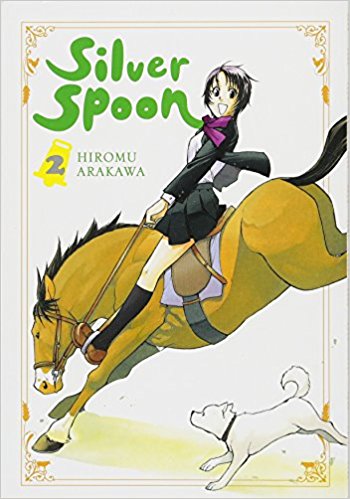
Silver Spoon, Vol. 2

April 25, 2018 by Sean Gaffney

By Hiromu Arakawa. Released in Japan as “Gin no Saji” by Shogakukan, serialization ongoing in the magazine Weekly Shonen Sunday. Released in North America by Yen Press. Translated by Amanda Haley.

It seems a bit startling for our hero and his classmates to be headed into summer break right at the start of the series, but that’s the Japanese education schedule for you, which begins in April. And summer break at an agricultural school means everyone goes back to their farms… except Hachiken, who has no farm but does have an intense desire not to go back home. So he takes up Mikage’s offer to go to her farm for the holiday. You’d think cute romance would ensue, but that’s pretty much still just in Hachiken’s head right now. Instead we get more examples of Hachiken as a fish out of water, and a lot of discussion of the various aspects of farm life, including butchering deer and watching a cow give birth. But before that, there are more important things to do. Things like pizza. Priorities, please.

One of the many things I love about Silver Spoon is the way that Arakawa portrays Hachiken, the male lead. It would be all too easy to turn him into your standard harem drip, a la Keitaro Urashima. But while Hachiken is inexperienced in the ways of farming life, and still having difficulty with the idea of “animals become food”, he’s smart as a whip and quick to understand things. Moreover, he’s a planner who sees ahead, which will become very important as the series goes on. For now it’s important because it allows him to see everything that needs to be done with the pizza oven, which ends up requiring the help of most of the school in order to repair it and procure ingredients to make the pizza. He’s also getting a little more buff, which is inevitable when you’re doing the daily farm routine he has to do. But most importantly, he feels realistic. He feels like an actual person. This is what Arakawa has always excelled at, and it goes doubly for this series.

I also love the attention to detail we see here. There’s discussion of what kinds of pizza cheese work best in Japan (gouda, not mozzarella), and we see three kinds of farms: Komaba’s small one where even the elementary school twins are pitching in constantly, Mikage’s medium-sized one (which she is expected to take over, something she clearly doesn’t want to do but is unwilling to open up about just yet), and Tamako’s huge industrial farm showing off the finest in modern advancements. When we kept joking that Silver Spoon was a farming manga back in the pre-licensed days, we weren’t kidding. This book is here to tell you what farming is really like, and that it requires a lot of labor, time, money, and care. No matter how big or how small your farm is, things need to be done constantly.

Aside from Mikage’s worries about her future and Hachiken avoiding his parents, there’s not really a lot of forward progress on a “plot” here per se. But the plot is a coming of age story, and in that sense we see Hachiken grow and change a lot in this volume. If you like Arakawa’s books, farms, or just good manga, Silver Spoon is essential.

Filed Under: REVIEWS, silver spoon

The Girl from the Other Side: Siúil, a Rún, Vol. 4

April 24, 2018 by Katherine Dacey

The Girl from the Other Side: Siúil, a Rún was one of 2017’s surprise hits, an emotionally wrenching fantasy manga about a demon who rescues an orphan girl from a plague-ridden world. Nagabe’s art — with its graceful linework and unique character designs — was enough to distinguish Girl from the Other Side from virtually any other series licensed by a major American publisher. But it was the characters and the poignancy of their relationship that truly captivated readers, as the bond between Teacher (the demon) and Shiva (the girl) was tested by Shiva’s ties to the human world, particularly her attachment to the aunt who raised her — and then abandoned her in the woods. Four volumes in, Girl from the Other Side is still casting a powerful spell, even as the story takes another grim turn.

As the volume opens, Teacher, Shiva, and Auntie have formed an uneasy family unit, with Shiva desperate to broker the peace between her adoptive parents. Nagabe does a fine job of dramatizing the conflict between Teacher and Auntie without spoiling the quiet mood of the story, using small gestures to convey how desperately each wants to protect Shiva from the human world. Nagabe also includes a handful of scenes that chart the progress of Auntie’s disease, showing us how quickly the curse erases a victim’s memory and personality — a development that raises the interesting question of who Teacher was before he assumed his demonic form.

Perhaps the most striking aspect of volume four is how much of the characters’ interior lives are revealed through the artwork. In the first chapter, for example, Teacher and Auntie slip into the woods for a nighttime conference about Shiva. Each carries a lantern as they walk and talk — two pinpoints of light against a scrim of trees — their conversation ending when Auntie’s lantern flickers out, leaving her and Teacher side by side in darkness. What makes this sequence so effective is the deliberate placement of the characters on the page and the meticulous attention to lighting; Nagabe has found an elegant — and wordless — way to demonstrate the characters’ shared resolve to protect Shiva, even though they remain suspicious of one another. Such carefully observed moments are a potent reminder that The Girl from the Other Side is an all-too-rare example of a manga whose story engages the heart and mind by suggesting, rather than saying, what the characters are feeling. Recommended.

The Girl From the Other Side: Siúil, a Rún, Vol. 4
Art and Story by Nagabe
Translated by Adrienne Beck
Seven Seas, 180 pp.

Filed Under: Manga, Manga Critic, REVIEWS Tagged With: Fantasy, Girl from the Other Side, Nagabe, Seven Seas, Shonen

  • « Go to Previous Page
  • Page 1
  • Interim pages omitted …
  • Page 387
  • Page 388
  • Page 389
  • Page 390
  • Page 391
  • Interim pages omitted …
  • Page 1064
  • Go to Next Page »
 | Log in
Copyright © 2010 Manga Bookshelf | Powered by WordPress & the Genesis Framework