• Skip to primary navigation
  • Skip to main content
  • Skip to primary sidebar
  • Home
  • About Us
    • Privacy Policy
    • Comment Policy
    • Disclosures & Disclaimers
  • Resources
    • Links, Essays & Articles
    • Fandomology!
    • CLAMP Directory
    • BlogRoll
  • Features & Columns
    • 3 Things Thursday
    • Adventures in the Key of Shoujo
    • Bit & Blips (game reviews)
    • BL BOOKRACK
    • Bookshelf Briefs
    • Bringing the Drama
    • Comic Conversion
    • Fanservice Friday
    • Going Digital
    • It Came From the Sinosphere
    • License This!
    • Magazine no Mori
    • My Week in Manga
    • OFF THE SHELF
    • Not By Manga Alone
    • PICK OF THE WEEK
    • Subtitles & Sensibility
    • Weekly Shonen Jump Recaps
  • Manga Moveable Feast
    • MMF Full Archive
    • Yun Kouga
    • CLAMP
    • Shojo Beat
    • Osamu Tezuka
    • Sailor Moon
    • Fruits Basket
    • Takehiko Inoue
    • Wild Adapter
    • One Piece
    • After School Nightmare
    • Karakuri Odette
    • Paradise Kiss
    • The Color Trilogy
    • To Terra…
    • Sexy Voice & Robo
  • Browse by Author
    • Sean Gaffney
    • Anna Neatrour
    • Michelle Smith
    • Katherine Dacey
    • MJ
    • Brigid Alverson
    • Travis Anderson
    • Phillip Anthony
    • Derek Bown
    • Jaci Dahlvang
    • Angela Eastman
    • Erica Friedman
    • Sara K.
    • Megan Purdy
    • Emily Snodgrass
    • Nancy Thistlethwaite
    • Eva Volin
    • David Welsh
  • MB Blogs
    • A Case Suitable For Treatment
    • Experiments in Manga
    • MangaBlog
    • The Manga Critic
    • Manga Report
    • Soliloquy in Blue
    • Manga Curmudgeon (archive)

Manga Bookshelf

Discussion, Resources, Roundtables, & Reviews

Blog

The Ancient Magus’ Bride, Vols. 1-8

April 9, 2018 by Michelle Smith

By Kore Yamazaki | Published by Seven Seas

I’d heard good things about The Ancient Magus’ Bride from my Manga Bookshelf compatriots, but I had also heard about a sad fate befalling some cats, so I steered clear. After reading and really enjoying Kore Yamazaki’s Frau Faust, however, I decided to give AMB a try. I’m glad I did, because it turns out the cat stuff wasn’t a deal breaker (it all happened long ago and present-day kitties emerge unscathed) and the series is excellent.

In the opening chapter, fifteen-year-old Japanese teenager Chise Hatori is on sale at a British auction house. She is apparently “the most wondrous tool an alchemist can hope for—a sleigh beggy,” though she knows not what a sleigh beggy is. She only knows that she’s been attracting weird creatures all her life, that her father left with her younger brother, that her mother committed suicide, that her other relatives wouldn’t take her, and that she just wants a place to call home. She doesn’t care whether she lives or dies, but thought that if she could be useful to someone, that would be okay.

She’s purchased by a mage named Elias Ainsworth, who takes her as his apprentice. Elias is not entirely human and not entirely fae, either. Most of the time he assumes the form of a tall human with a head somewhat like a cow’s skull, but his real form is something far stranger. Despite his scary looks, he’s kind to Chise, insisting that she be neither passive nor servile, and she’s soon comfortable in his home in the countryside west of London. Eventually, he tells her that because of her ability to absorb and generate mass quantities of magic, her lifespan is destined to be brief. Part of the reason he bought her was to try to help overcome this while also learning more about humans. And to be his bride, of course.

Here’s a particularly revealing passage from volume two:

”I bought you because you met my requirements. With nothing of your own, you’d have little reason to leave me. I gave you food and shelter, and said things I expected you wished to hear. I thought that raising you myself might enable me to better understand your kind. I’d planned to tell you these things after I was confident you’d never leave.”

For Chise, someone not wanting her to leave is a novel experience, so she stays. Most of the time, anything romantic happening between them is downplayed. Instead, they take on a variety of tasks like investigating the black dog haunting a churchyard (who ultimately becomes Chise’s very, very lovable familiar), or helping a muse-like fae communicate with the man she’s loved for decades, or helping a girl find the brother her parents have inexplicably forgotten. Meanwhile, Chise learns more about magic (and how it differs from alchemy) and becomes passionate about helping others, often to her detriment. While she’s become more attached to the idea of living, she’s also reckless, culminating in an incident at the end of volume seven where, in an attempt to calm a rampaging dragon, she ends up absorbing so much of its magic that she curses herself. A despairing and desperate Elias attempts something awful to cure her, driving her away in the process (and potentially into an alliance with evil alchemist Josef, though I fail to see how Chise could rationalize doing such a thing).

What I’m getting at here is that this is a series rich in story. The plot is interesting, but the real story is Chise and Elias, what they mean to each other and how they might be incompatible despite all that binds them together. Besides the fact that her life was already going to be brief, now Chise has this dragon’s curse to contend with, and it’s really not looking good for her. Sometimes, too, Chise gets warned about Elias’ interest in her, like when his master Lindel says, “It looks as if he’s trying to tame you… and you are allowing him to do it. But you mustn’t.” Even if she were to return to him after what he did, would that be the healthy choice? I’m not sure this is going to have a happy ending, but it’s certain to have a fascinating one. I can’t wait for volume nine!

The Ancient Magus’ Bride is ongoing in Japan, where the ninth volume has just been released. It’ll come out in English in September.

Filed Under: Manga, REVIEWS, Shounen, Supernatural Tagged With: Kore Yamazaki

Bookshelf Briefs 4/9/18

April 9, 2018 by Michelle Smith and Sean Gaffney Leave a Comment

Ace of the Diamond, Vol. 10 | By Yuji Terajima | Kodansha Comics (digital only) – It’s the fourth round of Koshien and, for the first time, Seido is facing some stiff competition. Akikawa is a college preparatory school that nobody really expected to get this far, except that they now have Shunchen Yang, an exchange student from Taiwan and Japanese baseball enthusiast, for a pitcher. Unlike Seido’s young pitchers, Yang has precise control, which he uses to secure an early lead for his team. Despite the punishing heat, Furuya manages to limit them to those first two runs, and it was neat to see him actually get pissed when Coach eventually decides to bring Sawamura in to relieve him. Too, it was neat to see how Sawamura’s audacity and tenacity revitalizes Seido—the volume ends with the teams tied as they enter the second half. Real-life baseball isn’t half so riveting as this! – Michelle Smith

Assassination Classroom, Vol. 21 | By Yusei Matsui | Viz Media – What remains of the main series here is fantastic, an excellent conclusion showing us the immediate aftermath of Koro-sensei’s death, the class grieving and coping, and a flashforward showing us everyone doing well (though bizarrely Kayano is implied both to be pregnant and not to be seeing Nagisa). Unfortunately, the series was finished with a large chunk of volume to go, and so we get a long 4-chapter side-story with Koro-sensei outside the classroom, and a “pilot” chapter for another series that just shows why it was rejected. But the main series was an amazing ride, and I’m pleased that Viz gave it to us. These were great kids, and a great teacher. – Sean Gaffney

Haikyu!!, Vol. 22 | By Haruichi Furudate | Viz Media – Interestingly, this is an entire volume spent away from our heroes, as it focuses on the games of Nekoma. I’d mentioned last time that Kageyama’s ominous pronouncement wasn’t good news for the team, and the volleyball that ensues is awesome, tense, and shows I was absolutely right. Still, all is not lost. We also get introduced to two young girls who get to fulfill the ‘exposition’ role in the absence of our regular commentators. One is a younger sister with princess curls, the other a somewhat airheaded older sister. A lot of the game’s events are filtered through their perspective, possibly so as to keep the readers interested despite the lack of Karasuno High. Still quite engaging. – Sean Gaffney

Kiss Me at the Stroke of Midnight, Vol. 4 | By Rin Mikimoto | Kodansha Comics – There are some more A+ silly super-deformed faces in this volume, which are not my only reason for reading the series but are right in the top five. My personal favorite is Hinana’s gradual reaction to Kaede’s attempts at playing the piano, which show off a repressed musician trying to get out. (There’s some implied backstory I want to see more of.) Apart from that, I will admit that this is a bit shoujo-by-numbers, particularly in regards to the ex-girlfriend who’s back and wants to get back together. It’s still a pleasant read, though, and hasn’t hit any of the shoujo tropes I really dislike yet. I think it’s worth keeping up with. – Sean Gaffney

My Monster Secret, Vol. 10 | By Eiji Masuda | Seven Seas – Shiragami is back on the cover of this new volume, which should give clever readers the idea that something is afoot. And yes, indeed, we have definitive forward motion here, first brought to us by Aizawa, who confesses in the most ridiculous way possible, and then by Shirigami, who misunderstands in a painful and dispiriting way. Fortunately, Asahi mans up and is able to do what he’s wanted to for so long. There’s lots of amusing humor here as well, along with some “LOL gay” stuff that I could have done without. The reason that folks will remember this volume, though, is the denouement, and to see where we go from here. Fun romantic comedy. Also, extra points for “wild monkey sex.” – Sean Gaffney

Princess Jellyfish, Vol. 8 | By Akiko Higashimura | Kodansha Comics – Well, that didn’t last long. I thought Tsukimi would potentially balk at being rescued by Kuranosuke, but nope. Their getaway is assisted by Fayong, who lets Kuranosuke in on some dirty secrets of the Avidy business before tendering her resignation. Mostly, this volume is about characters coming to realizations. Independently but simultaneously, Tsukimi and Kuranosuke hit upon the brand concept for Jelly Fish as a result of considering what a fashion-inept modern-day woman might desire most from her clothes. Even Jiji hasn’t given up, and it’s good to see her taking some initiative. Also, I didn’t think I would rejoice when Tsukimi turns down Shu’s proposal, because I really do like him, but to see her do so with a clear-eyed sense of purpose was really great. Only one volume left! – Michelle Smith

The Promised Neverland, Vol. 3 | By Kaiu Shirai and Posuka Demizu | VIZ Media – The cliffhanger with Don and Gilda learning that the other kids were lying to them is actually swiftly defused, and I think that lulled me into a false sense of security in the early chapters of this volume. Escape plans proceed, Krone offers an alliance with valuable information and seems willing to conspire against Isabella (it’s very interesting watching the kids try to learn what they can without incriminating themselves), and then…. things go in a direction I did not expect. I really loved the glimpses of Krone’s past and the insight into the power structure of the “higher-ups,” including some hints about William Minerva, who left messages for the kids in donated books. Too, the volume’s conclusion really reinforced the ominous fate awaiting them, especially the character who learns their shipment date is now at hand. I desperately need volume four! – Michelle Smith

To-Love-Ru, Vols. 5-6 | By Saki Hasemi and Kentaro Yabuki | Seven Seas – We’re dealing once again with a very predictable harem comedy, which means that the quality is going to be highly variable. I find, oddly, it works best when taking itself the most seriously (well, relatively)—the scenes with Golden Darkness trying to assassinate Rito, and the response to it, actually works as an action sequence and character-building moment. On the other hand, the scenes where Rito swaps personalities with a dog is so cringeworthy I actively had to skip chunks of it. This is never going to be a good series, or even a good romantic comedy. But as I said last time, it gives teenage boys what they want, and is less shameful about it than most other titles. – Sean Gaffney

The Water Dragon’s Bride, Vol. 5 | By Rei Toma | Viz Media – First of all, let’s be honest, those attendants really should have realized that Asahi did not know what a fertility festival really was about, and while the reaction of “oh, everyone is having “fun” in the forest” is briefly amusing, it rapidly becomes less so. It does underline the fact that Asahi really cannot rely on the protection of a small village, even if she does have the mercurial water god with her. Speaking of which, his character development is a highlight. My favorite scene is when he asks Asahi why he would be angry, and she replies that HE’S the one who needs to figure that out. This remains a reliably solid shoujo title, and I want to see where it goes next. – Sean Gaffney

Filed Under: Bookshelf Briefs

The Promised Neverland, Vol. 3

April 9, 2018 by Sean Gaffney

By Kaiu Shirai and Posuka Demizu. Released in Japan as “Yakusoku no Neverland” by Shueisha, serialization ongoing in the magazine Weekly Shonen Jump. Released in North America by Viz Media. Translated by Satsuki Yamashita.

(As with previous volumes, and likely going forward, these reviews spoil the volume in question. Because that’s exactly what reviews are for.)

I keep waiting for the moment that The Promised Neverland slows down to catch its breath a bit, but it’s become clear by the end of this third volume that that’s never going to happen. Our heroes plot, scheme, learn who to trust and who to betray, get trusted and betrayed, and by the end of the book everything is in ruins. It can honestly be a bit exhausting, and it’s definitely terrifying – there’s some real chilling horror reading this series – but it’s also completely exhilarating, and I want to see these kids succeed. Somehow. Even if what they escape to may end up being even worse. That said, I may not get my wish for a bit, as by the end of this book their plan is up in smoke, Mom knows all, Emma’s got a broken leg, and Norman’s getting shipped out to be delicious. There’s a lot going on.

Despite the presence of most of the orphans on the cover, this is very much a cast of five vs. the world, as Don and Gilda, after a tense discovery and angry confrontation, join forces with our heroes. I enjoyed all of the back and forth with Norman and Ray try to outdo Vizzini in figuring out what Mom and Sister Krone are actually up to, and how they can escape. I also like how they ultimate fail (at least so far) – a lot of clever kids think they’re being super secretive and canny when it turns out Mom has known what they’re thinking all along, and that’s what we get here, and it doesn’t take away from their extreme cleverness. I loved them looking at the books, where they understand some but not all of the code, and Emma’s intuition knowing they’re important but now quite why they’re important.

And then there’s the fall of Sister Krone, as well as her backstory. Despite Norman wondering how much of what she revealed to them was true and how much was false, I’m inclined to believe most of her backstory, especially as we get more flashbacks to it in her final moments. Despite functioning very effectively as a pure force of terror a lot of the time, particularly at the start of this volume, by the end of it all you feel is sad, as well as realizing what horrible monsters we have on “the outside”. Her revelation on how “moms” get chosen is also rather interesting, and makes me wonder if someone from Field House (not Emma, I suspect, but maybe Gilda) was being groomed for a position. That said, Sister Krone was correct – she could try to be scarier and more cunning than Isabella, but in the end there’s only one mom here.

So what’s next? Is this the sort of series that’s prepared to kill off its main cast? What about the rest of the orphans that Emma wants to save? And what *is* going on outside? This is a scary, scary volume, but I desperately want to read more. Highly recommended.

Filed Under: promised neverland, REVIEWS

Re: ZERO -Starting Life in Another World – Ex, Vol. 2

April 8, 2018 by Sean Gaffney

By Tappei Nagatsuki and Shinichirou Otsuka. Released in Japan by Media Factory. Released in North America by Yen On. Translated by Kevin Steinbach.

In Japan, these two volumes came out slightly later than they did here – the first one came out after Book 6, and this second one after Book 7. It didn’t really matter with Crusch’s book, but I get the sense with this second volume that we’re missing the impetus as to why we’re suddenly getting a side story devoted to Wilhelm when he hasn’t really had a large role in these books to date. Of course, as fans will know, the cover of the next volume of Re: Zero out in North America prominently features Wilhelm. In any case, despite feeling as if I came in after the start of the movie, this was a very good volume of Re: Zero’s spinoff, showing us a moody young man who tries to shut himself off from everyone except his sword, and his meeting a lovely and teasing young woman in a construction site with a flower garden. It also manages to have another excellent message that we’ve seen before: war is an awful thing.

The start of the book doesn’t even has Wilhelm as the viewpoint character, though that changes about one-third of the way in. Grimm is his fellow soldier and a far more “normal” person, which is to say he has his doubts, wants to avoid combat and run away when things are bad, etc. Wilhelm seemingly finds him detestable, but the fact that he’s also the only person to repress those feelings and fight valiantly anyway says a lot in his favor. As Wilhelm gradually (very gradually) begins to open up to the reader and to others, Grimm is no longer needed, though I was annoyed that the narrative went so far as to remove his voice from it literally. We also meet what… I guess is meant to be Roswaal’s mother or grandmother? It’s not very clear, and the fact that they talk and act exactly the same makes me wary and suspicious. (If you know, don’t tell me in comments, I’m happy to be unspoiled.) And we also get a whole lot of dead soldiers, both humans and demi-humans, to show that, again, war is an awful thing.

There’s also Theresia, who for most of the book seems to be just an ordinary young girl who likes to hang out in the middle of deserted vacant lots in the poor sectio0n of town for fun, but who turns out to have a much bigger secret. A surprise to you all, I’m sure. Honestly, I wish I could have had more of her – this is a very male-oriented narrative, given that it’s mostly from Wilhelm’s POV, and both he and Carol, Theresia’s friend and retainer, think the same thing: she is made for peace and fluffy things, not as a maiden of war. Which is all very well and good, and I understand that in an anti-war book you want to have that sort of opinion, but a longer section from Theresia’s POV might have helped me not see it as “pretty girls shouldn’t fight!”, which is what it comes off as.

Fortunately, their story is not over yet. This comes as a surprise to me, as after the first Ex volume I came in assuming we’d see another awesome character getting killed off for tragic backstory. But no, the book ends on a triumphant note. And there’s a 3rd volume coming out soon in Japan that looks like it will continue the story. So this is definitely recommended, though readers may want to wait till after Vol. 7 is out before they give it a try.

Filed Under: re: zero, REVIEWS

Yona of the Dawn, Vol. 11

April 7, 2018 by Sean Gaffney

By Mizuho Kusanagi. Released in Japan as “Akatsuki no Yona” by Hakusensha, serialization ongoing in the magazine Hana to Yume. Released in North America by Viz. Translated by JN Productions, Adapted by Ysabet Reinhardt MacFarlane.

This volume of Yona of the Dawn is a return to the beginning in many ways. It opens with an extended flashback showing the trio of Yona, Hak and Su-Won as children, sneaking out against orders to see what the town looks like, which ends up turning into a disaster after Yona is kidnapped almost immediately. It’s a terrific sequence, showing off the strong friendship that the three had, as well as showing that Hak and Su-Won each are jealous of the qualities they see in each other. And of course it’s tragic because of what came later, something that is still affecting both Yona and Hak deeply, as we see later on. He has nightmares about Yona, both in regards to Su-Won’s betrayal and also her becoming a warrior rather than a princess. And Yona is feeling the same thing, only she knows what side she’s going to choose going forward.

Yona and company are moving north, arriving in a village that is much the same as the fire tribe one they left, but is much better off due to developments in their grain. This excites Yun so much that he’s willing to do a festival dance in order to get more information about it – or at least have Yona do it, as Yun can’t dance at all. Hak notes that Yona has danced in the past, but it’s been rather awkward and amusing more than anything else. That changes here when Yona uses the dance to show what she’s become and where she’s headed, in a performance that makes everyone’s jaw drop, including Hak’s. For shippers, there’s a giant pile of Hak being in love with Yona here, but he’s fighting back against too many things, including Yona being mostly oblivious, for it to go anywhere. But man, the burning unsaid passion in this book is amazing.

Rest assured the book is also filled with humor – one two-page section had me laughing out loud just from the use of ‘pondering’ and ‘lounge’ as comedic weapons. A lot of this comes from Jaeha, who has become my favorite non-Yona character (those who recall my I Hate You More Than Anyone reviews may guess why – he’s basically Honjo as a superhero. He also knows that Hak/Yona is the endgame, which grates on him a bit – but not enough to stop him giving Hak some good, if needling, advice. That said, I don’t think anything more is going to be happening anytime soon. I do wonder if we’ll be seeing another female cast member soon – this volume has them go to a village with a lot of young women who remind us that Yona is walking around with a bunch of hunky guys, and some female friendships would, I think, do her good and make her a bit less serious.

To sum up, this remains one of the best Shojo Beat titles being released by now, and an essential purchase. Buy it, you’ll love it.

Filed Under: REVIEWS, yona of the dawn

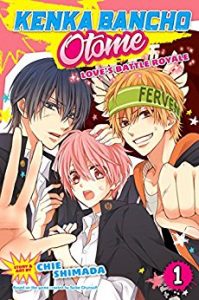
Kenka Bancho Otome: Love’s Battle Royale, Vol. 1

April 6, 2018 by Katherine Dacey

For a manga based on a dating game, Kenka Bancho Otome is far better than it ought to be. It’s a fast-paced, loose-limbed story that’s both cheerfully stupid and mildly subversive, buoyed by its deliciously queer premise: a girl goes undercover in an all-boys’ high school where her androgynous beauty and lethal karate chops inflame her classmates’ hearts.

The plot is set in motion by an accidental encounter between Hinako Nakayama, an orphan, and her long-lost twin Hikaru, whom she rescues from the path of an oncoming car. In the aftermath of the accident, Hikaru cajoles his sister into impersonating him for a day, lending her his school uniform and dropping her at the campus gates. Hinako soon realizes the folly of her brother’s request, however; Shishiku Academy is more like Rock ’n’ Roll High School than prep school, as its entire curriculum—if one could call it that—centers on fighting. Making matters worse is that everyone wants to fight Hinako because they believe she’s the heir apparent to the Onigumo crime family. She isn’t, of course, but Hikaru is, a detail he conveniently omitted when roping her into his charade. 

If you’ve read more than one shojo comedy, you know what happens next: Hinako befriends and beguiles the best-looking delinquents at the school, from Totomaru, an earnest cutie who’s prone to nosebleeds and blushing, to Kira, a tousle-haired bishonen with a sensitive side. Author Chie Shimada has the good graces to keep the hot guys and fist-fights coming — the better to distract from the thinness of the plot —and the imagination to add small but delightful quirks to her main characters’ personalities. Her best running gag is Hikaru, who seems more at home impersonating his sister than inhabiting his own skin; though his temper suggests he’d be a ruthless crime boss, his obvious joy in looking pretty and flirting with Miraku, Shinsiku Academy’s resident idol, add a fresh dimension to the identity-swapping formula. 

As you might expect, the artwork is more serviceable than memorable. Shimada proves capable of drawing a variety of familiar bishonen types — lanky guys with ponytails, serious guys with glasses — though the pro forma nature of the character designs occasionally makes it difficult to parse the fight scenes. (All those artfully coiffed young men have the same lanky, spike-haired silhouette.) Then, too, there are riotously busy pages where Shimada’s screentone is so thick and smudgy it’s almost palpable; the phrase “applied with a trowel” comes to mind.

Still, the Shishiku gang’s bonhomie is hard to resist, carrying the reader past the story’s creakier moments. So, too, is Hinako’s sincerity; her journey towards self-actualization is both touching and amusing, as she discovers that she might, in fact, be a more natural bancho than her twin. That she wins her fellow delinquents’ admiration with a mean right hook and a roundhouse kick is less important than the fact they appreciate her for her pluck, kindness, and thirst for justice — a nuance that elevates Kenka Bancho Otome from otome rehash to actual story. Recommended.

KENKA BANCHO OTOME: LOVE’S BATTLE ROYALE, VOL. 1 • STORY AND ART BY CHIE SHIMADA • ORIGINAL CONCEPT BY SPIKE CHUNSOFT • VIZ MEDIA • 194 pp. • RATED T, FOR TEENS (13+)

Filed Under: Manga, Manga Critic, REVIEWS Tagged With: Comedy, Otome, shojo, shojo beat, VIZ

Again!!, Vol. 1

April 6, 2018 by Michelle Smith

By Mitsurou Kubo | Published by Kodansha Comics

Having greatly enjoyed Yuri!!! on Ice, written by Mitsurou Kubo, I’ve been eagerly anticipating the release of some of Kubo’s manga in English. (In addition to Again!! from Kodansha, Vertical Comics has just published the first omnibus of Moteki, which I shall be reviewing within the next week or so.) Happily, Again!! did not disappoint.

This shounen series begins on March 14, 2014, when long-haired, scary-looking outcast Kinichiro Imamura is about to graduate from high school. He’s friendless, and despite going to a good school, he has no college or employment plans. The graduation ceremony reminds him of his entrance ceremony three years ago, during which the lone remaining member of the ouendan club (a girl, at that) tried to recruit new members. This spurs him to go check out the now-deserted ouendan club room and, when chasing after a female classmate who gets the wrong idea, he ends up falling down the stairs and three years into the past.

Now it’s April 6, 2011 and Kinichiro has a chance to do it all over again. Will he manage to navigate school this time without scaring people? He decides to actually talk to the ouendan girl this time, and learns her name is Yoshiki Usami. In a neat twist, the girl he was chasing also fell down the stairs and ends up back in the past with him. Her name is Akira Fujieda, and while Kinichiro begins to make small improvements on his high school experience—dispelling notions that he’s in a gang or that his blond hair signifies anything other than a hair stylist’s whim—Akira’s knowledge of the future alienates her classmates and would’ve-been future boyfriend.

Mostly, though, the focus is on the ouendan club and Kinichiro’s attempts to help Usami out. She’s stubborn, however, and resists efforts to draw male membership by featuring her image on recruitment posters. This makes more sense later on, when it’s revealed that she originally got a lot of media attention that led to fallout within the group—stoked by an online smear campaign—leading everyone but her to quit. Complicating matters is the captain of the cheerleading club, Tamaki Abe, who is resentful of having to cooperate with the ouendan, and determined to sabotage them. Happily, the girl she picks to seduce Kinichiro has scruples (and Kinichiro is also not an idiot), so this first volume ends with our heroes savvy to her scheme.

Again!! is a lot of fun. If you’re looking for time travel with a reasonable scientific explanation, then you should probably look elsewhere, but if you just accept the premise and go with it, then it’s kind of like a sports manga and a coming-of-age story rolled into one. I do worry what’s going to happen after Kinichiro reaches his graduation year again. Will these changes stick, and will he be able to go forward in life with more ambition and fewer regrets? I’m confident, though, that these questions will be answered eventually.

Again!! is complete in twelve volumes. The second volume is due out in English next week.

Review copy provided by the publisher.

Filed Under: Manga, REVIEWS, Sci-Fi, Shounen Tagged With: Mitsurou Kubo

So I’m a Spider, So What?, Vol. 2

April 6, 2018 by Sean Gaffney

By Okina Baba and Tsukasa Kiryu. Released in Japan as “Kumo Desu ga, Nani ka?” by Fujimi Shobo. Released in North America by Yen On. Translated by Jenny McKeon.

This series continues, very deliberately, to be a book of two halves, albeit unequal halves. The main thrust of the story remains our spider heroine slowly ascending the dungeon and defeating stronger and stronger monsters while keeping up an inner monologue that sounds like she’s high on a dozen pixie stix all the time. The other half of the story is interspersed in between this, and deals with Shun and the rest of the reincarnated students having a far more normal isekai life… well, normal compared to the spider. The difficulty is that forward plot progression is entirely confined to the latter – a couple of the students have clearly gone a bit mad from the new world, Shun finds being a hero actually involves killing things, there’s a giant demon invasion happening as we speak, and oh yes, the demons are seemingly led by another reincarnated classmate. I want to know more about this. I have to be content with Spider Levels Up And Reads Her Stats.

Spider’s progress is the biggest strength of the book. She is hilarious, and it gets even better when she’s able to subdivide her brains so they can think about different things, and they start arguing with each other. She’s arrogant as heck except when she’s being attacked by killer monsters, and there’s an ongoing disturbing thread about her not realizing that she’s lost any moral or ethical sense – every time she reads about her taboo increasing and wonders why that is, you sort of smack your head. At the same time, spider’s progress is the book’s biggest weakness as well. There is endless discussion of her stats and skills, complete with charts (which are what pile up the page count), and she has to overanalyze all of them. Sometimes this is amusing, but a lot of times it can get very tedious, even with her excitable inner voice.

As for Shun and company, as I said, they’re pursuing a much more common isekai narrative. We’re introduced to Hugo, another classmate who seems to have gone completely insane and power mad, as well as Yuri, who has accepted God as her savior in a very over the top way. (Given that God in this work appears to not only exist but be the sysadmin, not too mad an idea, but she’s a pure “religious zealot” type, so will no doubt be an antagonist.) The most interesting thing going on here is Katia, who was a boy in Japan but was reincarnated as a woman here, and seems to be the ONLY one who’s not the same sex. She becomes very accepting of this, and is also clearly starting to have feelings for Shun, which everyone notices except her. It’s not, perhaps, as amusing as the author wants it to be, but it’s definitely interesting, and handled pretty well.

The book ends with a nasty cliffhanger for those on the surface, even as our spider heroine just keeps rolling along. I’m enjoying these books, but I really hope that the two plots converge soon, as I’m drawning in stats a bit too much.

Filed Under: REVIEWS, so i'm a spider so what?

Manga the Week of 4/11/18

April 5, 2018 by Sean Gaffney, MJ, Anna N, Michelle Smith and Ash Brown 1 Comment

SEAN: Yikes. Thanks to Yen shifting half their March releases into April, we have another punishing week.

But first, Kodansha once again did a last-minute release on me. Already out this week is You Got Me, Sempai (Mairimashita, Senpai), a shoujo title from Dessert which I will add to the stack.

MICHELLE: I’ll probably check this one out.

SEAN: As for next week, Dark Horse gives us a 2nd volume of Hatsune Miku: Future Delivery.

J-Novel Club debuts Arifureta Zero, a spinoff prequel to the series showing those who built the dungeons in the first place.

They also have a 4th Faraway Paladin (technically the 5th, as the 3rd was split into two parts).

Back to Kodansha Digital, who have two new releases this week. A.I.C.O. Incarnation is based on the anime from Studio Bones, and is a Shonen Sirius title.

And Boarding School Juliet (Kishuku Gakkou no Juliet) is a Weekly Shonen Magazine title about a modern day manga Romeo and Juliet. Of the digital debuts I’ve mentioned, this is the one that most intrigues me.

There’s also plenty of ongoing digital titles. Grand Blue Dreaming 8, GTO Paradise Lost 7, Lovesick Ellie 5, and Starving Anonymous 2. No sports, though, sorry, Michelle.

MICHELLE: I am placated by having had several sportsy releases last week.

SEAN: On the print front, we have Attack on Titan 24, Cardcaptor Sakura: Clear Card 3, The Heroic Legend of Arslan 8, In/Spectre 7, and Love & Lies 5. In/Spectre is supposed to be starting a new manga-only arc.

MJ: I haven’t even tried out the new CCS series. Bad CLAMP fan, bad. I should get on that.

ANNA: I haven’t either but I feel less enthusiastic about late CLAMP as opposed to early CLAMP.

ASH: I’m liking it so far, although it hasn’t really distinguished itself yet.

SEAN: Seven Seas has three titles out next week. There’s a 3rd Akashic Records of Bastard Magical Instructor, a 14th Magical Girl Apocalypse, and the 10th My Monster Secret, which will finally resolve its main plot hook. Not that this means it’s ending, of course. There’s still a lot of laughs to go.

SuBLime has a 6th Deluxe Edition of Finder.

Vertical debuts My Boy (Watashi no Shounen), or as I like to call it, “Hoo boy.” It’s an award-winning title from Futabasha’s Monthly Action, about the growing friendship between a 30-ish office lady and a 12-year-old boy, and how ambiguous their relationship is. It’s apparently very well-written and very tasteful, and I will be giving it a shot, despite my reaction being, as I said, “Hoo boy.”

MJ: Hm. Maybe?

MICHELLE: Same. I’ll wait to see Sean’s review.

ANNA: I will pass on this.

SEAN: Viz has new volumes of Case Closed (66) and Magi (29). Itsuwaribito finally comes to an end as well with its 23rd volume.

Their debut this week is not manga, but will no doubt heavily appeal to anime fans: Homestuck Book One collects the popular and meme-spawning webcomic-ish thing.

ASH: I’m curious to see how well this translates into print considering the multimedia nature of the original. (It’s also interesting to see Viz continuing to expand beyond strictly Japanese content.)

SEAN: And now for the rest of Yen’s March titles, coming to you in April. Yen On has the 13th Accel World.

There are also a few debuts. The Elder Sister-Like One (Ane Naru Mono) is a Dengeki G’s title from ASCII Mediaworks that asks the question we’ve all wanted to know: What if Cthulhu was your big sis? It is based on a pornographic work, but I believe isn’t actually one in this version. Expect fanservice, though.

Mermaid Boys is a shoujo title from the late lamented Aria magazine, and seems to be a gender-reversed Little Mermaid. Can this be the rare Yen Press title that Anna will be interested in?

MJ: Okay, this sounds possibly kind of awesome.

ANNA: Probably! Gender-reversed Little Mermaid sounds intriguing!

ASH: I’m looking forward to giving it a try!

SEAN: And where you have Mermaid Boys, you must also have Monster Tamer Girls (Kaijuu no Shiiku Iin), though the two series are not connected. This is a Houbunsha title from Manga Time Kirara Forward, and I don’t know much about it.

ASH: I don’t know much about it, either, except that it’s a short series about the care and feeding of kaiju.

SEAN: And there is Though You May Burn to Ash (Tatoe Hai ni Natte mo), a Young Gangan horror/thriller title that is a survival game manga and oh wait, I stopped caring.

MICHELLE: Heh.

SEAN: Ongoing Yen titles? We have plenty. Alice in Murderland 8, Angels of Death 2, The Betrayal Knows My Name 8 (MJalert here), Bungo Stray Dogs 6 (Ash alert here), the 4th Erased omnibus, a 7th Love at Fourteen (they’re 15 now, but hey), a 2nd One Week Friends, a 2nd manga volume for So I’m a Spider, So What?, a 5th Spirits & Cat Ears, a 2nd A Terrified Teacher at Ghoul School, the 2nd three-volume omnibus of Umineko: When they Cry: Requiem of the Golden Witch (Sean alert here), and your name 3.

MJ: Noting the alert here. I also like Erased, so there’s that.

ASH: Same! I’m still getting a kick out of all of the literary references in Bungo Stray Dogs, but the penultimate volume of Erased is what I’m really interested in this week.

SEAN: This is, frankly, far far too much. It’s getting ridiculous. Are you getting anything?

Filed Under: FEATURES, manga the week of

Cutie Honey a Go Go!

April 5, 2018 by Sean Gaffney

By Shimpei Itoh, Go Nagai and Hideaki Anno. Released in Japan by Kadokawa Shoten, serialized in the magazine Tokusatsu A. Released in North America by Seven Seas. Translated by Zack Davisson, Adrienne Beck and Wesley Bridges.

Another day, another reimagining of a classic property that I enjoyed a lot more than I thought I would. Indeed, I enjoyed it a lot more than the Japanese audience apparently did, as not only was this cancelled after ten chapters, but the second volume was never published until this omnibus edition. The afterword is filled with the author’s apologies, but I’m not sure they’re merited, because I thought this was a pretty terrific adaptation. The cynic in me wonders if the series didn’t take off because it’s not filled with high school girls – Natsuko, aka the reason everyone should read this, is an adult police detective in this version, and I can’t help but think that this was Cutie Honey’s StrikerS. But I’m not going to complain too much, as what we do have is silly, over the top fun with lots of fighting, a lot of over the top bloodshed, and some yuri subtext. Everything you’d want from Cutie Honey, in other words.

As noted, Natsuko is a police detective with a penchant for being “a cop on the edge” – she exists in a constant haze of cigarettes and violence, beating the crap out of anyone who pisses her off, which is everyone. She’s having a particular bad day due to Panther Claw, an evil organization which has started destroying the city and its inhabitants due to the city not answering its demands – which no one actually seemed to receive. Fortunately, there is one woman here to save the day and defeat the bad guys (OK, bad girls – Panther Claw is an all-female monster team). Honey Kisaragi is an android built by her “father”, Dr. Kisaragi. She’s a combination of sentai warrior, magical girl and cute young airhead. Unfortunately, her father doesn’t last long in this series, and it’s noted that Panther Claw keeps coming after her. There’s only one thing left to do – go undercover at a Catholic Girls’ school.

If this sounds a bit ridiculous, it’s because it is -despite all the bloodshed, the ‘a Go Go” version of Cutie Honey is very much in the lighthearted vein. It was produced in tandem with the anime “Re: Cutie Honey”, which explains why Anno is listed as one of the creators. Natsuko’s angry reactions have those classic “all teeth” faces you see in a lot of Rumiko Takahashi works. That may be why the manga didn’t do as well – the ending, where the author was clearly told “you’re cancelled, wrap it up”, is noticeably darker than the rest of the series, with people getting their heads cut off and put on display or simply sliced completely in half. The main cast survives to fight another day, though, and readers might want to look towards the anime for a less ambiguous ending. There are other things going on here (a “reporter” who’s meant to be charming and irritating but is mostly the latter), but honestly the best reason to read this is Natsuko vs. everything around her.

Filed Under: cutie honey, REVIEWS

  • « Go to Previous Page
  • Page 1
  • Interim pages omitted …
  • Page 374
  • Page 375
  • Page 376
  • Page 377
  • Page 378
  • Interim pages omitted …
  • Page 1048
  • Go to Next Page »
 | Log in
Copyright © 2010 Manga Bookshelf | Powered by WordPress & the Genesis Framework