• Skip to primary navigation
  • Skip to main content
  • Skip to primary sidebar
  • Home
  • About Us
    • Privacy Policy
    • Comment Policy
    • Disclosures & Disclaimers
  • Resources
    • Links, Essays & Articles
    • Fandomology!
    • CLAMP Directory
    • BlogRoll
  • Features & Columns
    • 3 Things Thursday
    • Adventures in the Key of Shoujo
    • Bit & Blips (game reviews)
    • BL BOOKRACK
    • Bookshelf Briefs
    • Bringing the Drama
    • Comic Conversion
    • Fanservice Friday
    • Going Digital
    • It Came From the Sinosphere
    • License This!
    • Magazine no Mori
    • My Week in Manga
    • OFF THE SHELF
    • Not By Manga Alone
    • PICK OF THE WEEK
    • Subtitles & Sensibility
    • Weekly Shonen Jump Recaps
  • Manga Moveable Feast
    • MMF Full Archive
    • Yun Kouga
    • CLAMP
    • Shojo Beat
    • Osamu Tezuka
    • Sailor Moon
    • Fruits Basket
    • Takehiko Inoue
    • Wild Adapter
    • One Piece
    • After School Nightmare
    • Karakuri Odette
    • Paradise Kiss
    • The Color Trilogy
    • To Terra…
    • Sexy Voice & Robo
  • Browse by Author
    • Sean Gaffney
    • Anna Neatrour
    • Michelle Smith
    • Katherine Dacey
    • MJ
    • Brigid Alverson
    • Travis Anderson
    • Phillip Anthony
    • Derek Bown
    • Jaci Dahlvang
    • Angela Eastman
    • Erica Friedman
    • Sara K.
    • Megan Purdy
    • Emily Snodgrass
    • Nancy Thistlethwaite
    • Eva Volin
    • David Welsh
  • MB Blogs
    • A Case Suitable For Treatment
    • Experiments in Manga
    • MangaBlog
    • The Manga Critic
    • Manga Report
    • Soliloquy in Blue
    • Manga Curmudgeon (archive)

Manga Bookshelf

Discussion, Resources, Roundtables, & Reviews

Blog

Pick of the Week: Sweet and Tart

February 11, 2019 by Michelle Smith, Sean Gaffney, Katherine Dacey, Anna N, Ash Brown and MJ Leave a Comment

MICHELLE: Although it may not have the most original premise, the digital debut of My Sweet Girl appeals to me the most this week. I think that the word “boyish” is largely responsible for my interest.

SEAN: There’s an awful lot of yuri out this week. My Solo Exchange Diary is certainly on my list. But I think I’ll make Kase-san and Cherry Blossoms my pick this week, as it’s just that sweet.

KATE: Hmmmm… this is one of those weeks where I feel torn between recommending something fun and frivolous — here’s looking at you, Sleepy Princess — and recommending something more serious like the second installment of My Solo Exchange Diary. So I’ll split the difference and recommend the latest volume of Tokyo Tarareba Girls, a josei title that vividly captures the anxiety that single, unmarried women can feel in a coupled-up culture. It’s witty, rueful, and often cringe-inducing — I can’t tell you how many times I’ve yelled at the characters — but worth a read.

ANNA: I’m also intrigued by My Sweet Girl, I’m always up for more shoujo and it looks cute.

ASH: Kate has pretty much summed up my own feelings about this week’s releases! (And has phrased it better than I could have, too.) I’ll join her in recommending Tokyo Tarareba Girls as my official pick, but I’m sure that I’ll be reading Sleepy Princess in the Demon Castle and My Solo Exchange Diary pretty soon, too.

MJ: I’m don’t have a really obvious pick this week, so I think I’ll go along with Michelle and cling to the word “boyish” in that description of My Sweet Girl. Count me in for that.

Filed Under: PICK OF THE WEEK

My Next Life As a Villainess! All Routes Lead to Doom!, Vol. 2

February 11, 2019 by Sean Gaffney

By Satoru Yamaguchi and Nami Hidaka. Released in Japan by Ichijinsha. Released in North America by J-Novel Club. Translated by Shirley Yeung.

When I was reviewing the 2nd and final volume of It’s My Fault That My Husband Has the Head of a Beast, I noted that it was a very open ending for a series that wrapped up there, not resolving much of anything. The 2nd volume of Bakarina has the opposite problem – unsuspecting readers who finish this book will definitely think it’s the final volume, which isn’t true. While none of the cast have been able to get their feelings through to the dense Katarina yet, the book takes us through to the end of the “Fortune Lover” game that her prior incarnation had been playing, and she successfully navigates it without getting a horrible Bad End. We even meet Maria Campbell, the actual heroine of the game, and she’s sweet and kind and also falls head over heels for Katarina, because of course she does. Problems are solved, tragic backstories ferreted out, and they all lived happily ever after and ate lots of snacks.

I will issue a word of warning: while there are still tons of hilarious parts to this volume, the second half of the book turns serious, and one of the backstories features sacrificial murder of a loved one. It’s not played for laughs at all, nor should it be. Katarina starts her school life, meets Maria and defuses any problems there by her love of sweet, and all seems to be well… except that the same things happen that occur in the game – Katarina is accused of being a terrible bully to Maria. Fortunately, in this world it’s not true, so this is rapidly defused, but it’s clear that someone is out to get Katarina. Someone with Dark Magic, which can control a person’s mind and also means they’ve killed to get it. The culprit is not exactly a mystery, frankly, but it’s handled quite well, especially as Katarina doesn’t have any foreknowledge of the events – her past self never got to the “hidden route” before she died.

Speaking of past lives, we find here that another of the main characters turns out to be a reincarnation, though she isn’t consciously aware of it. This allows Katarina, at a time of great peril, to get advice from her former friend who HAD played the game, and allows her to try to save the villain – because remember I said tragic backstory? Plus this is Katarina, and much as she may be silly and dense a lot of the time, she’s a kind and loving heroine, to an extreme. This means that she’s allowed to talk the villain down by simply saying that she’ll listen to him and she understands his pain. Bakarina is having fun with its heroine’s personality, but it’s not really subverting or deconstructing anything except perhaps the fact that literally everyone falls in love with her. She is 100% shiny and pure.

So with everyone living happily ever after, where does the series go from here? Well, they’re all still at school (though Nicol graduated, and time definitely seems to be moving faster than these sorts of books usually do), and this world may be based on a game but clearly isn’t actually a game, so I’m sure that something will come up. And maybe Katarina will realize the others’ feelings for her!… yeah, OK, no.

Filed Under: my next life as a villainess, REVIEWS

Young Master’s Revenge, Vol. 4

February 10, 2019 by Anna N

Young Master’s Revenge Volume 4 by Meca Tanaka

Young Master’s Revenge has been a such a fun short series! I just finished reading the last and final volume this week and I found that it had much more of an emotional payoff than I was expecting from a manga with its main plot centering on turtle-inflicted butt scars. There’s never any doubt that Leo and Tenma are going to end up together, but seeing how they finally both grappled with their feelings made the ending of this series rewarding.

young master's revenge 4

Tenma and Leo are living separately, and she’s actually able to take care of herself finally now that she’s endured life as Leo’s maid. She’s moved on from being oblivious about romance to trying to figure out how to deal with her newly realized crush on Leo, which results in a bunch of protestations and slightly emotional outbursts. Leo’s secret scars are almost exposed, and Hana goes to whatever lengths she can in order to protect him. The confusing feelings of teen romance are amped up even further when Tenma reluctantly agrees to go on a date with “Rose King” Barazono, while Leo and Togo pretend to go on their own date in order to act as silent observers. Tenma finds herself unable to control her crying when she sees Leo and Tojo together, and Leo confesses his true feelings but doesn’t let Tenma say anything in return.

Tenma decides to take on the emotional labor of fixing everything herself and while she previously was more self-contained due to her upbringing and unfamiliarity with basic teen socialization, she stands up for herself and her feelings in quite a spectacular fashion. She demonstrates quite a few over the top angry faces along the way. Seeing Tenma and Leo finally get together without the specter of revenge that’s been hovering over the series brings everything to an extremely satisfying conclusion. Young Master’s Revenge might seem a little superficial and silly, but at four volumes it doesn’t feel like the plot was stretched out just for the sake of extra drama. It is a great series to use as a mini-vacation if you’ve been bogged down by reading too many angst-ridden manga.

I was able to talk about Young Master’s Revenge on the Shojo & Tell Manga Podcast recently, I’ll update this post when the episode is available!

Filed Under: Manga Reviews, REVIEWS Tagged With: shojo beat, shoujo, viz media, young master's revenge

The Promised Neverland, Vol. 8

February 10, 2019 by Sean Gaffney

By Kaiu Shirai and Posuka Demizu. Released in Japan as “Yakusoku no Neverland” by Shueisha, serialization ongoing in the magazine Weekly Shonen Jump. Released in North America by Viz Media. Translated by Satsuki Yamashita.

The cast of characters, and the first few volumes in general, try to give equal emphasis to Emma, Norman and Ray as the three protagonists, keeping a healthy balance. But… I think the readers tend to think of Emma as the ‘lead’, and she’s certainly featured more when Jump does a ‘one character from all our series’ picture. Emma fans will be quite happy with this volume, which definitely revolves around her. The first third or so finds her and Ray trying to desperately escape demons that can regenerate, trying to intuit how to kill them. They’re not helped by their guide (still nameless, which begins to get annoying towards the end of the volume), who doesn’t want to kill them but is trying to convince himself that he can easily let them die. He’s no match, however, for Emma’s shining beacon of hope, who talks him down by guessing exactly what happened to him and pointing out that his now dead) friends would never have wanted this. It’s really sweet.

Unfortunately, Emma is then kidnapped and brought to a hunting ground for demons, with kids as the prey. Emma tries her best here as well, and is remarkably clever, deadly, and optimistic. Sometimes, though, optimism can’t save you, and a couple of people that Emma promises the world to end up dead. For all that it’s a series about kids being raised to be eaten for their delicious brains, there hasn’t been much actual death so far except right at the start. (I continue to maintain that Norman is alive because we didn’t see him die.) It gives these deaths added impact, and Emma briefly falls into despair. Luckily, we get to meet a lot of new kids who are basically doing for the hunting ground what she’s done with Grace Field… helped by an adult who seems very familiar. This part of the book is probably the most heartwarming, and Emma, seeing that even in despair there’s still hope, is back to her old self.

There’s lots of little touches in this volume I liked. The author gives a lot of attention to the guide’s past friends, even if they’re all long dead, so that we can imagine what things must have been like for them, and they seem like a great group of kids. I am also very pleased at the series of faces that Ray makes as Emma tries to convince the guide to help them by being her shiniest – this is why Ray is Emma’s best friend, but he still can’t help going “what the hey” every time he sees her in action. (He should know, he’s seen it used on him.) And, in case you’d forgotten the horror part of Promised Neverland, the shot of Theo revealing that Jake and Monica were killed by the hunters then cuts to the demons having a delicious meal – and we can likely guess who it is. The author can still make you shiver.

This is a strong time from Shonen Jump series in general, and The Promised Neverland is one of the strongest. It should never be far from the top of your reading pile when it comes out. Also, Emma is amazing.

Filed Under: promised neverland, REVIEWS

Takane & Hana, Vol. 6

February 9, 2019 by Anna N

Takane & Hana Volume 6 by Yuki Shiwasu

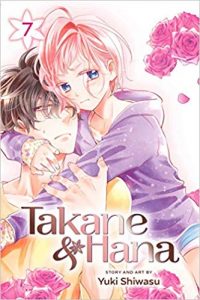
I should have read this volume earlier this winter, because it had a great Christmas story in it! But Takane & Hana can always be counted on for some breezy shoujo antics as it explores the potentially problematic relationship between a high school student and an heir to industry who become friends after Hana subs in for her sister at an arranged marriage meeting with Takane.

The volume opens with Takane standing Hana up for a date due to his workload, so she goes out with friends instead. It turns out that he was actually planning on surprising her with a Christmas date. Takane is incapable of doing anything less than a grand gesture, so he appears before Hana in a custom designed cashmere Santa Suit. Hana realizes that he planned the whole thing after she made a random comment about how normal people celebrate Christmas, and she’s touched by the gesture.

The major storyline in this volume centers on Takane suffering a reversal of fortunes when his grandfather takes away his access to all his bank accounts, his high-powered job, and his apartment, telling him that he has to prove himself by working his way up to the top. Takane’s occasional glimpses through Hana of how common people live do not prepare him at all for being cut off from his credit card. As he slowly starts to adjust to the horror of cheap suits, convenience store lunches, and public transportation, he cuts off contact with Hana, not sure what to do if he can’t appear before her with elaborately expensive presents. Hana is mystified and confused because while he certainly is in the habit of being busy with work, he’s never cut off contact with her for such a long time before. As always, Shiwasu is a master of exaggerated facial expressions, and seeing Takane react to his changed circumstances is both sad and hilarious.

One of the things that has me rooting for this relationship between a forthright high schooler and an emotionally stunted captain of industry is Hana’s habit of confronting Takane and pointing out when he’s being an idiot. Takane rejects her offers of help, but she’s not going to back down. A rich person learning who they are after a reversal of fortune is a very common plot trope, but seeing how these particular characters take on this challenge makes it interesting in Takane & Hana.

Filed Under: Manga Reviews, REVIEWS Tagged With: shojo beat, shoujo, takane & hana, viz media

Classroom of the Elite, Vol. 1

February 9, 2019 by Sean Gaffney

By Syougo Kinugasa and Tomoseshunsaku. Released in Japan by Media Factory. Released in North America by Seven Seas. Translated by Timothy MacKenzie. Adapted by Jessica Cluess.

By the end of the first volume of this new light novel series, I finally had an idea where the author was going with the series. It’s something of a thought experiment, examining a school that functions similar to the Assassination Classroom school. The school has a hierarchy, and once you find yourself in the ‘D’ class, comprised of the seeming failures, its impossible to climb back up and you are belittled and ridiculed by the rest. Naturally, our heroes are in this class. That said, it takes about half the volume to get to the point where the author does anything more than drop ominous hints. Before that, unfortunately, what we get is a painfully normal light novel with the ‘average’ hero who doesn’t stand out, the grumpy beauty who doesn’t like talking to anyone, her contrast in the perky upbeat girl who wants to be friends with everyone, and, sadly, the perverted best friends who only want to talk about sex. You have to crawl through this to get to the point.

Of course, all is not as it seems. Horikita, the grumpy, sullen heroine of this volume, is the closest thing to being exactly what she seems, fortunately – the only hidden side she has is a desperate need to please her brother. Our hero, Ayanokouji, meanwhile, takes pains to not stand out – indeed, by the end of the book it’s becoming clear that he’s going to ridiculous lengths. His scores are average, but they’re the sort of average that requires brilliance to achieve. He’s very muscular, but denies being in any sports clubs. And he seems somewhat desperate to be at the school – I smell a tragic past. Sadly, he’s also almost as stoic and unfriendly as Horikita, which means both the narrator hero and the heroine of this first volume are downers. There’s some brightness with Kushida, the typical perky upbeat girl you see in every shonen school series… only, of course, she has a secret dark side as well. I’m pretty sure they all do.

That said, I’m not entirely averse to the ideas here, provided that they also include later character development. There are hints it may happen. The premise is that the world is fundamentally unequal but we should strive to be as equal as possible anyway, something that the school is seemingly opposed to – though this could all end up being a secret test of character. By the end of the book, Horikita is marginally more social, even if she’s unaware that her very unsociability is why she’s in the class in the first place. So I’ll definitely get the second volume. That said, everyone in this is depressing to read. Even the teacher seems sadistic for no other reason than that she enjoys it. If the series slowly works to make these kids better people and to grow up, I may enjoy it a great deal. If it remains an intellectual thought experiment, though, I’m out.

I understand that the anime, which I haven’t seen, took a number of liberties with the novels, so fans of one should definitely pick up the other. I’d also pick this up if you like Dark!Grey Harry Potter/Naruto fanfics or arguing about rationality on Reddit. As for light novel fans, your mileage may vary.

Filed Under: classroom of the elite, REVIEWS

Manga the Week of 2/13/19

February 8, 2019 by Sean Gaffney, Michelle Smith, Anna N, Ash Brown and MJ 1 Comment

SEAN: Usually it’s just Jump/Beat weeks and Yen Press weeks that are when I whine about it being a lot, but there’s no question: this is a lot.

Bookwalker has an 8th volume of The Combat Baker and Automaton Waitress.

J-Novel Club has a new debut, though the author is familiar. I Shall Survive Using Potions! is from the same author as Make My Abilities Average and Saving 80,000 Gold, and the scenario is similar: teenage overpowered girl. She’s reincarnated by accident, so asks for a lot, and gets it. I’m hoping this is as ridiculous as the author’s other series.

They also have the 8th volume of How a Realist Hero Rebuilt the Kingdom, the 12th I Saved Too Many Girls and Caused the Apocalypse, the 19th Invaders of the Rokujouma!?, and a 4th Lazy Dungeon Master.

Kodansha, in print, has Tokyo Tarareba Girls 5.

ASH: Yes! This series is so good! (Cuts pretty close to the quick sometimes, too.)

SEAN: Kodansha, digitally, has a lot more, including a debut, My Sweet Girl. This Betsufure title is about a small, boyish, awkward girl who finds love with a popular boy. Not to be confused with other shoujo titles that might sound the same.

MICHELLE: Could be cute!

ANNA: I’m interested!

MJ: That does sound cute! I mean, not original, but totally cute!

SEAN: They also have Boarding School Juliet 8, Crocodile Baron 2, I’m Standing on a Million Lives 5, Kamikamikaeshi 8 (a final volume), Tokyo Alice 8, and The Walls Between Us 4.

MICHELLE: Someday I will read a few of these.

SEAN: Seven Seas debuts Beauty and the Beast Girl, which is a single-volume release. It’s a yuri manga about the love between a monster girl and a blind girl.

ASH: Hmmm, that could be interesting!

MJ: This sounds kind of awesome. I have a new appreciation for monsters lately.

SEAN: There’s also Kase-san and Cherry Blossoms (the 5th in this uniquely named series), My Solo Exchange Diary 2, and Please Tell Me, Galko-chan! 5. Interested in pretty much all of this.

ASH: My Solo Exchange Diary is another one of those good but cutting series.

SEAN: SuBLime gives us Punch Up! 5 and A Strange and Mystifying Story 6.

MICHELLE: I’m liking A Strange & Mystifying Story since it has moved on to a new couple.

ASH: Huh, I didn’t realize Punch Up! was still ongoing.

SEAN: Tokyopop has three releases next week! The debut is Yuri Bear Storm, whose anime is already famous… or infamous. I hear, much like Utena, that the manga is a bit less weird. It’s a Comic Birz title, of course.

ASH: Gah! I’m so torn about this. A series I’m legitimately interested in but… Tokyopop…

MJ: What Ash said. Like. Yeah.

SEAN: They’ve also got a 3rd Futaribeya and a 3rd Konohana Kitan.

Vertical has a 12th volume of Devils’ Line.

Lastly, Viz gives us a 4th Fullmetal Edition of Fullmetal Alchemist, a 34th Magi, a 2nd Record of Grancest War, and a 5th Sleepy Princess in the Demon Castle.

ANNA: Sleepy Princess can always be counted on for funny hijinks.

ASH: It’s true!

MJ: Also, everyone should always read Fullmetal Alchemist and that’s basically an order.

SEAN: Seem like a lot? It’s actually only about half of the volume total for the week after next. What are you getting?

Filed Under: FEATURES, manga the week of

Yona of the Dawn, Vol. 16

February 8, 2019 by Sean Gaffney

By Mizuho Kusanagi. Released in Japan as “Akatsuki no Yona” by Hakusensha, serialization ongoing in the magazine Hana to Yume. Released in North America by Viz Media. Translated by JN Productions, Adapted by Ysabet Reinhardt MacFarlane.

The actual resolution of the plot in this arc is treated as an afterthought, with Hyo, the villainous drug merchant, getting blithely killed off so that we may reach the real confrontation of the book. Because, having spent several chapters deliberately having Hak not meet Riri’s new bodyguard, when the moment arrives it takes pride of place above anything else that might be going on. It is truly an amazing setpiece, and shows off how good Kusanagi is at her craft. The rage that pours from Hak, his desire to kill Su-Won dripping off of him, is stunning to see. And you know that, at this point in time, it would be the absolute worst thing in the world for Hak to do that. Thank goodness for Jaeha, and later on Yona herself, for pointing out what’s important here: Yona is fine, she doesn’t need Hak to get revenge for her. Not like this. It’s only one chapter in this volume, but what a chapter.

I also definitely want to talk about the continued growth of Riri. Having stolen her father’s political seal as a means of showing that she has his power, she puts it to good use, getting the soldiers and merchants to unite to defend against Hyo’s fleet. What’s more, when events wrap up, she’s ready to take her punishment for what she did, even if that means being killed. That said, Riri’s political activism seems to have finally sunk in , as her father not only “punishes” her by exiling her to Sensui, where she can continue to do what she was planning to anyway. What’s more, he himself is now no longer content to be passive – which means that the tribes are now united in taking a more active role in the kingdom… even if that means war. All this from a young woman who was inspired by Yona (and is arguably in love with Yona, because their final scenes together really read like Riri wants to say something but chooses to hold back).

Riri is not the only woman in this volume who is awesome. Yona and Tetra are recovering from serious injuries, and are visibly exhausted, but are not letting that stop them from doing what needs to be done. Indeed, Tetra and Ayura have figured out Yona’s secret (such as it is), but are content to let her get on with what she needs to do. Heck, even the Sensui divers, who at first look to be introduced as a joke to show off “Jaeha is a player”, are swimming out towards enemy ships with bombs strapped to their heads. One of the best reasons to read Yona of the Dawn is that the cast is trying to effect change, and we see everyone who wants it step up and make that happen. It’s made explicit here with Riri’s father, but previous volumes also show that everyone Yona comes into contact to takes up her idealism… even if they’re cynics. It’s nothing to do with romance, though her own party does have guys who like her. It’s her sheer presence and drive.

I will end this review as I have many previous Yona reviews. This is possibly the best shoujo manga currently coming out in English. Everyone should be reading it.

Filed Under: REVIEWS, yona of the dawn

Off the Shelf: Still kicking

February 7, 2019 by Michelle Smith and MJ Leave a Comment

MICHELLE: MJ, after we finish this one we will have done as many columns in 2019 as we did for the entirety of 2015-2018! Go us!

MJ: *laughs weakly* Yes… “go us.” Um. Wow. When you put it that way, we sound terribly unimpressive.

MICHELLE: Well, the alternative would’ve been to let it disappear, so I think we deserve a bit of credit for resuscitating it! Anyhow, I expect that you’ve been reading some manga!

MJ: I suppose you’re right! WE ARE BASICALLY GODS.

…

Okay, maybe not. But yes, I have indeed been reading some manga, or at least rereading, which is to say that I took some time this week to look at the new omnibus edition of CLAMP’s four-volume manga, Wish, originally published in Kadokawa Shoten’s Mystery DX, adapted into English in the early 2000s by TOKYOPOP, and resurrected just a few weeks ago by Dark Horse Comics, with their usual omnibus treatment—larger trim size, very nice-looking print, and a somewhat refreshed translation.

For those who missed Wish the first time around, it’s the story of an angel, Kohaku, who has been sent to Earth to find Hisui, one of the four “Master Angels” (why they don’t just say “Archangel” is a mystery to me, but maybe there’s something I don’t get), who disappeared from Heaven after a visit to the bridge between Heaven and Hell. During their mission, Kohaku—who appears human-sized during the day but reverts to tiny cherub form at night—is rescued from an attacking crow by Shuichiro, a local human doctor. Complications ensue when it turns out that Hisui actually defected to Earth in order to be with Kokuyo, the actual son of Satan, with whom they have fallen in love. Meanwhile, Kohaku becomes confused by their own growing feelings for Shuichiro.

There’s a whole lot packed into this short series, including more angels and demons, time travel, reincarnation, messenger rabbits, cats (some of whom are actually demons), and a tree fairy, but generally speaking it’s all just incredibly CLAMP from start to finish, and if you’re into that, you know what I mean. Someone even sacrifices an eye. This thing honestly couldn’t get any CLAMPier. It’s not my favorite of their series—I could live very happily never reading another manga about angels for the rest of my life—but as most CLAMP fans will know, the big deal about this edition is the translation, which is certainly what caught my attention.

In CLAMP’s original vision, there is no gender in Heaven or Hell, but in early 2000s publishing, it was unthinkable to convey that in English, especially when it came to the angels, who, in Japanese, referred to themselves with genderless pronouns. This led to a decision to choose genders for each of the angels, based on heteronormative standards regarding appearance and romantic entanglement, outraging some fans but satisfying style guides. Fast forward to 2019, when publishing has finally recalled that singular “they” is a thing, and our angels are genderless at last.

I’ve already mentioned that Wish is far from my favorite of CLAMP’s work, so I wasn’t especially eager to reread it, but I was surprised to note just how much more enjoyment I got out of it this time around. As someone who identifies as nonbinary, I realize this may be of greater importance to me than most, but whatever CLAMP’s intention really was when they filled their comic with genderless angels, it feels like representation, and for something originally published in the 1990s, that is kind of a big deal. Freeing the angels from gender expectations breathed new life into them for me, made the story richer, and opened up its universe to the notion that love and attraction might be based on something other than a person’s gender expression or whatever reproductive organs they happen to possess. These are not novel ideas for many of us, but with all the hand-wringing over this series back in 2002, it feels revolutionary. Mostly, though, what I’m struck with as I read this edition, is how easy it would have been to publish it exactly as it is now, then. The sentences are not awkward. There is nothing that feels labored or unnatural in this translation. How has it actually taken publishing this long to figure that out?

MICHELLE: It’s been a long time since I read Wish, and it was also not my favorite, but I definitely feel a greater spark of interest when I imagine a translation that represents the angels as genderless! It makes me want to shake TOKYOPOP and demand, “Would that have been so hard?!?!” (They had other similar issues back in the day, too, and not just with genderless protagonists. I distinctly remember a character in GetBackers being assigned feminine pronouns when, in fact, he is very much a dude and if anyone had actually bothered to learn anything about the series they were translating, they would’ve known that. SIGH.) I can totally see how it would make the whole story richer as a result.

MJ: Yeah, nobody could be more surprised than I am to be describing Wish as “rich” in anything other than CLAMP’s beautiful, swirly artwork, but I genuinely enjoyed rereading it, and I’d even recommend it, at least to fans of shoujo manga, and particularly to other enbies. It’s an unusual treasure of representation for the time period. And messenger bunnies! Who doesn’t love messenger bunnies?

There is one jarring panel in the first volume, where one of the demons seems to misgender Kohaku as “she,” but I don’t know if that was an editorial oversight (that’s how it’s translated in TOKYOPOP’s version, too) or if it was actually written that way in Japanese. But in over 800 pages, that one panel wasn’t significant enough to mar my enjoyment overall.

So what did you read this week, Michelle?

MICHELLE: Maybe that demon was intentionally being a jerk.

I checked out the first volume of Hitorijime My Hero by Memeco Arii, one of the first boys’ love manga published in print by Kodansha Comics. (They did release a handful of others digitally in 2018.)

As a kid, Masahiro Setagawa hated tokusatsu shows because he knew that, no matter how miserable his life was, no hero would come to save him. But when he fell in with a group of delinquents in middle school and became their gofer, a hero did come in the form of Kousuke Ohshiba, the so-called “bear killer,” who defeated the thugs and ended up with Setagawa as his new underling. Setagawa befriended Ohshiba’s younger brother, Kensuke, and as the manga begins, some time has passed. He’s dealing with the fact that Kensuke is now in a relationship with another boy named Asaya Hasekura and that Kousuke is a teacher at their high school.

Almost immediately, Kousuke is confronting Setagawa about the feelings he believes Setagawa has for him, saying, “Even if you feel that way I won’t be able to return those feelings.” Setagawa is too dumbstruck to deny it, and then Kousuke (an adult) keeps sending him (a teenager) mixed signals, like suddenly smooching him or calling him “the guy I like.” It turns out that Kousuke is basically trying to make Setagawa realize he is gay. This eventually works. And then they do it. Eyeroll.

Because this series is a spinoff from an earlier series, we’re just kind of thrown into a confusing timeline and a mix of characters without a lot of context. I’ve seen the first couple of episodes of the anime, and they handle all of this material far more clearly. The manga does a little to show why Setagawa likes Kousuke—he’s strong, smart, and capable—but none at all to show why Kousuke likes Setagawa, aside from one page where he talks about how his devotion helped him retain his humanity or something. Really, it’s all pretty disappointing so far. I know it’s a popular series, so I’m hoping it gets better.

MJ: I can’t help but roll my eyes along with you. This basically sounds like a collection of my least favorite BL tropes, though maybe (hopefully??) at least without the younger, smaller guy wincing in pain and horror every time they have sex? Please tell me it at least doesn’t have that. Though maybe it doesn’t matter. I know the student/teacher thing is a common trope too, but I really hate it, especially when it’s the main romantic plot line. I know it’s a popular series, but I honestly can’t imagine reading it by choice.

MICHELLE: To its credit, it absolutely does not have that. It’s fully a fade-to-black scenario with some evidence afterwards that Setagawa enjoyed himself tremendously. As for the student-teacher thing, this is a slightly different variation in which the two people concerned knew each other for years before Setagawa came to the school where Kousuke teaches, so the power imbalance between them is not so much that Kousuke is in an official position of authority but that Setagawa has kind of idolized him.

MJ: Either way, I’m guessing it’s not for me. I’ll wait to hear what you think of future volumes before taking the risk.

MICHELLE: Okay. I can handle at least one more. Speaking of Kodansha’s advances into the realm of print BL, would you care to do the summary honors for our mutual read this time?

MJ: Sure!

This week, we both read the first volume of the much-anticipated series 10 Dance, by Inouesatoh, also from Kodansha Comics, as Michelle mentioned above.

The story involves two ballroom dancers with similar names—Shinya Sugiki, who is an international champion in Standard Ballroom, and Shinya Suzuki, who is the Japanese national champion in Latin Dance. Their relationship with each other is both admiring and rivalrous, and when Sugiki asks Suzuki and his partner to train with with him (and his partner) for the 10-Dance Competition (combining the 5 Standard and 5 Latin dances), Suzuki finds it impossible to refuse.

Over the course of the first volume, the four dancers train together—the men in particular working to be able to lead in each other’s specialty—and that’s literally all that happens in the story, but as we watch the two of them butt heads (and other things) throughout the training, it’s honestly just riveting. This story is all about personality and relationships, and certainly we’re expecting some steamy romance between the two male leads down the line, but even in this preliminary volume, where nothing overtly romantic happens, there’s so much interpersonal entanglement to enjoy.

The two men couldn’t be more different. Suzuki, who grew up in Cuba, has been dancing with his partner since childhood, while Sugiki changes partners constantly, never quite settling in with anyone. Suzuki’s strength is showing passion on the floor, while Sugiki’s is the elegance of his form. And though things are slowly heating up a bit, I honestly believe I would be happy just watching them dance together as I learn new details about Standard and Latin ballroom rules, pretty much forever. It’s that entertaining.

MICHELLE: I enjoyed it tremendously! From the start, the cover art reminded me of est em, and the content within does, too. With est em, I was always struck by the way her characters would talk while engaged in intimate acts, and although Sugiki and Suzuki aren’t having sex, they’re still engaged in physical activity—indeed, they’ve been dancing until dawn together for months—that puts them in close proximity, gettin’ sweaty, maintaining eye contact, et cetera. And they’re talking throughout, gradually becoming closer and revealing details about their personal lives in the process. I love the slow development of their relationship and how this, in turn, makes small moments so pivotal. The one that stands out is when Sugiki has gone to London to defend a championship title. When he succeeds, it’s Suzuki that he calls, and when this reserved man actually smiles when being told “Hurry up and come home,” it has such impact! Of course, they go right back to butting heads after that.

MJ: I agree on est em, though I’d go even further and say it feels like an est em/Fumi Yoshinaga hybrid, with the additional warmth of their observations about each other’s habits and idiosyncrasies and the scene where they dance together at a restaurant, because trying to make points about dance while sitting at the table just isn’t working. It’s got all of est em’s sexiness and suave, along with Yoshinaga’s warm goofiness, and the underlying elegance of both.

MICHELLE: “Warm goofiness” is a great way to describe the scene where Sugiki, frustrated by Suzuki’s attempts to lead the waltz, gets Suzuki to adopt the woman’s role and proceeds to very thoroughly make him feel like a princess. “I feel like I could pop out a dozen babies for you right now!” And you’re absolutely right about elegance, too; these dance scenes are drawn so beautifully.

If you’ll forgive somewhat of a non-sequitur, although I don’t know the kanji used for Sugiki and Suzuki’s given names (and, indeed, it might not even be the same), one definition for “shinya” has a meaning that’s very applicable to the story. Check it out.

MJ: I believe I read somewhere that the kanji for each of their names is slightly different from the other, but I’m tickled by that meaning all the same. It certainly is appropriate!

Bottom line, I can’t wait to read more of this series, and I’m thrilled that Kodansha brought it over for us!

MICHELLE: I enthusiastically concur!


Thanks for joining us for another installment of Off the Shelf! The winner of last column’s giveaway is Joseph Miller! Joseph, send over an email or drop a message to MJ on Twitter to collect!

Filed Under: OFF THE SHELF

Toradora!, Vol. 4

February 7, 2019 by Sean Gaffney

By Yuyuko Takemiya and Yasu. Released in Japan by Dengeki Bunko. Released in North America by Seven Seas. Translated by Jan Cash & Vincent Castaneda. Adapted by Will Holcomb.

This fourth volume of Toradora! does a very good job of playing to the series’ strengths. The core of it is getting the five main characters to become closer and bond as friends, and it achieves that. That said, there is also the romantic comedy/drama part of it, and that’s even better. It was always going to be hard for a series where the winning pairing is literally in the name to try to have “who will they end up with?”, but this volume comes closer than any so far. Ryuuji is still crippled by his awkwardness around Minori, but when he tries to can actually have a really meaningful conversation with her where she opens up (obliquely) about her own insecurities. As for Ami, not only does Ryuuji force her to open up a bit more (a very little bit more) about her own insecurities, but she also flat out states she thinks Minori and him would be a bad match, and that he should hook up with her. As for Taiga? Well, there’s the puppy dream.

The puppy dream is great. Starting off as ridiculous, with both Taiga and Ryuuji completely disgusted by it, the reader is immediately thinking “they’re sharing dreams now!”. By the end of the book, Ryuuji is seeing how the dream could also be taken as really sweet and familial. That said, for the most part the Taiga/Ryuuji antics take a backseat here… or at least the boil settles down to a mild simmer, as there are no shortage of scenes showing them being each other’s perfect halves. Taiga fares far less well in the romance department here, partly as she’s still cripplingly shy and partly as Kitamura is even more Kitamura than usual, complete with accidental flashing. I do sort of wonder how clued in he is to everything going on around him – like Minori, he thinks that Ryuugi and Taiga are meant to be a couple, if not already, but it’s not clear that he’s realized Taiga’s feelings.

That said, this is Minori’s book in the end, as she shows off a fragile vulnerability here, and there’s the first signs that she may feel something for Ryuuji as well. Unfortunately, both are the sort to back off at the last minute – as Ami bluntly points out, they can’t get close to each other. But we also have lots of Minori acting goofy, and of course the giant “let’s try to scare Minori” horror movie plotline, which gives us the opportunity for some great laughs. Toradora! holds up over a lot of other comedy romances in that the comedy does not feel forced or cliched, a la “whoops I just fell into your boobs”. The humor is natural, realistic, and both situational and character-driven. But it’s the drama that readers may take away from this volume. Will things change when they go back to school? Will Ami press her suit/ Will Minori do anything? Will Taiga yell at Ryuuji? At least one of those things is guaranteed to happen!

Filed Under: REVIEWS, toradora!

  • « Go to Previous Page
  • Page 1
  • Interim pages omitted …
  • Page 328
  • Page 329
  • Page 330
  • Page 331
  • Page 332
  • Interim pages omitted …
  • Page 1048
  • Go to Next Page »
 | Log in
Copyright © 2010 Manga Bookshelf | Powered by WordPress & the Genesis Framework