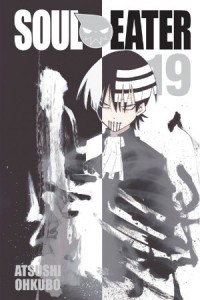
By Atsushi Ohkubo. Released in Japan by Square Enix, serialization ongoing in the magazine Shonen Gangan. Released in North America by Yen Press.
One of the most enjoyable things about Soul Eater is the way that the author balances out the seriousness and humor throughout the story. A lot of shonen fighting series tend to have long serious parts, then chapters that are pure goofy. Ohkubo, though, simply lets the humor come in anytime he feels like it, even if it’s in the middle of a pitched battle for everyone’s life. This is not to say that there aren’t pure comedy bits here (the middle chapter, which features Maka’s dad trying to be sympathetic and failing spectacularly – again) but the fact that you can find a goofy face or a silly moment anywhere actually helps add to the mood of the overall work. Soul Eater has always thrived on being one step off the edge, leaning slightly into madness.
The converse of this, of course, is that any silly moment can turn on a dime to become serious. Thus Black*Star’s self-aggrandizing has a serious point – the reason why he can push back Crona so easily is due to his own self-confidence and ego, while Crona is simply filled with hatred and loathing. Crona’s “I DON’T KNOW WHO MAKA IS!” is a cry of anguish that once again makes you realize that Crona’s entire life (the manga may choose to say he, but I prefer to be awkward – Crona is genderless on purpose) has been mental torture and abuse by Medusa. Speaking of Medusa, she’s back to being a mad scientist, and is perfectly content to justify her actions by noting she is a witch – not that all witches automatically stand against our heroes, but as Kim has shown us, they are generally assumed to be evil until proven otherwise.
As for Kid, once again we get the goofy stuff – his obsessive-compulsive disorder comes to the fore in a very funny way, as you realize that the one who’s really best at torturing Kid is Kid himself – followed by an unnerving scene where Kid meets another one of the Great Old Ones whose presence has made this world what it is – and is seemingly taken over by it, as the cliffhanger shows. Soul Eater does star Maka and Soul, but has been excellent at giving Black*Star and Kid enough character arcs and development that they also feel like co-stars.
And then there’s the gender-bending. Rule 63 has been around the Internet forever, but has appeared in actual canonical works less so. As such, it’s highly amusing to see the cast transformed into their opposite-gendered selves (though I do have a little niggle with the explanation why – it makes it sound like gays and lesbians don’t exist), particularly as Maka and Soul have to deal with the thing that most annoys them about the other – Maka’s male body is tempted by the succubus, and Soul bemoans the fact that it’s “just big boobs” that turn men on. Judging by the previous, this swap won’t take up too much time, but it’s fun to see.
In the end, this is why Soul Eater is one of the best shonen titles coming out here. It’s fun, but with a tinge of madness that never quite goes away. It skitters at the back of your brain.

SEAN: There are a large number of things 


ASH: There are a few interesting things being released 


MJ: Once again, there’s quite a bit on this week’s
Midnight Secretary, Vol. 2 | By Tomu Ohmi | Viz Media – As ever with the josei series we’ve seen Viz license in Shojo Beat, this second volume is dedicated to much angsting and lying to oneself. Unlike most Shojo Bdeat series, all the angsting ends in a fairly hot sex scene, which actually feels earned, mostly as we do get to see both Kaya and Kyohei making the same journey. Kaya “But I’m just a secretary” drives the first half, and Kyohei’s “Vampires should not love humans” drives the second, but they’re essentially the same concerns; each is losing themselves to the other, and it’s scary. I am pleased that we continue to focus on how good the two of them are at their jobs, and I suspect that Kyohei’s family will play a larger role as things go on. In the meantime, enjoy all the fretting and frothing leading to a whole lot of pleasure for all concerned. – Sean Gaffney
Psyren, Vol. 13 | By Toshiaki Iwashiro | Viz Media – I like the fact that so much attention is given in Psyren to showing us how the villains came together as a team. Usually the heroes band together with the power of friendship, etc., so it’s nice seeing it coming from the other side, with folks having agendas other than ’cause we’re evil like that’. Also, given Jump action series almost never really focus on the romance, I also liked seeing Sakurako freaking out at what her alternate self did with Ageha, even if it was played for the broadest comedy. (As was Maria being jealous, which was also very cute). Then it’s back to the Psyren world for more fighting, as things get livened up by the addition of a genuinely unhinged serial killer on the villain’s side – the flashback to his victims being found is chilling. Hopefully the series cam keep the momentum going, next volume looks like all fighting. – Sean Gaffney
Rin-Ne Vol. 13 | By Rumiko Takahashi | Viz Media – Never let it be said that Rumiko Takahashi’s comedy hasn’t been consistent as we travel from UY to Ranma to Rin-Ne. Her characters are funny because they are all gloriously selfish asses who are truly horrible to each other for the most petty reasons. There is the occasional heartwarming bone thrown here, but even then you never know when it will be yanked away from you, as with the chapter with Rinne’s horrible father. Even Sakura gets in on the act, not having issues with Rinne being a thief, but musing he wouldn’t be so bad at it if he were. Even the ghosts everyone is helping are petty, vindictive and shallow. If I hadn’t been reading Takahashi for almost 20 years now, I’d be fairly repulsed at this entire cast. As it is, it feels like putting on your favorite old electric blanket. – Sean Gaffney
Strobe Edge, Vol. 7 | By Io Sakisaka | Viz Media – One of the things that makes Strobe Edge so great it’s that it’s often sweet, but never sappy. Some of the best moments occur when mature-seeming character show their vulnerabilities and insecurities to the select few they care about, which means these scenes area always firmly rooted in character. The primary focus of this volume is the growing closeness between Ren and Ninako and the latter’s unwillingness to let go of their friendship to try for something more, especially since she knows Ren is still sad after breaking up with his girlfriend, unlike the other girls in school, who are eager to nab him without truly knowing him. Then there’s Ninako’s friend, Sayuri, who is worried that her current boyfriend has fallen for another girl just like her last one did. I suppose there’s nothing really new here, but it’s done so well that I just don’t care. – Michelle Smith
Sunny, Vol. 2 | By Taiyo Matsumoto | Viz Media – How does one craft something that’s sad but simultaneously uplifting and charming? Introspective and yet a page-turner? I have no clue, but thankfully Taiyo Matsumoto does and has instilled those qualities in Sunny. I especially love that the kids in this series (who live together in a group foster home) are not idealized. They tell lies, act tough, fail to show gratitude for their caretakers, and hang out with the wrong crowd but Matsumoto shows us the vulnerabilities that make them behave this way. One can’t help but feel for them, with the painful truths they’re confronting at such a young age. My favorite chapter involves relative newcomer Sei taking the latest arrival under his wing, only to say goodbye when the boy’s mother actually keeps her promise to come for him. It’s just beautifully done all around, which is yet another reason why you should be reading Sunny. – Michelle Smith