• Skip to primary navigation
  • Skip to main content
  • Skip to primary sidebar
  • Home
  • About Us
    • Privacy Policy
    • Comment Policy
    • Disclosures & Disclaimers
  • Resources
    • Links, Essays & Articles
    • Fandomology!
    • CLAMP Directory
    • BlogRoll
  • Features & Columns
    • 3 Things Thursday
    • Adventures in the Key of Shoujo
    • Bit & Blips (game reviews)
    • BL BOOKRACK
    • Bookshelf Briefs
    • Bringing the Drama
    • Comic Conversion
    • Fanservice Friday
    • Going Digital
    • It Came From the Sinosphere
    • License This!
    • Magazine no Mori
    • My Week in Manga
    • OFF THE SHELF
    • Not By Manga Alone
    • PICK OF THE WEEK
    • Subtitles & Sensibility
    • Weekly Shonen Jump Recaps
  • Manga Moveable Feast
    • MMF Full Archive
    • Yun Kouga
    • CLAMP
    • Shojo Beat
    • Osamu Tezuka
    • Sailor Moon
    • Fruits Basket
    • Takehiko Inoue
    • Wild Adapter
    • One Piece
    • After School Nightmare
    • Karakuri Odette
    • Paradise Kiss
    • The Color Trilogy
    • To Terra…
    • Sexy Voice & Robo
  • Browse by Author
    • Sean Gaffney
    • Anna Neatrour
    • Michelle Smith
    • Katherine Dacey
    • MJ
    • Brigid Alverson
    • Travis Anderson
    • Phillip Anthony
    • Derek Bown
    • Jaci Dahlvang
    • Angela Eastman
    • Erica Friedman
    • Sara K.
    • Megan Purdy
    • Emily Snodgrass
    • Nancy Thistlethwaite
    • Eva Volin
    • David Welsh
  • MB Blogs
    • A Case Suitable For Treatment
    • Experiments in Manga
    • MangaBlog
    • The Manga Critic
    • Manga Report
    • Soliloquy in Blue
    • Manga Curmudgeon (archive)

Manga Bookshelf

Discussion, Resources, Roundtables, & Reviews

Sean Gaffney

Pick of the Week: Goodbye Kiss

October 2, 2017 by Sean Gaffney, Michelle Smith, Katherine Dacey, Ash Brown and Anna N Leave a Comment

MICHELLE: There’s a healthy dose of sports manga due out this week—Ace of the Diamond, Haikyu!!, and Kuroko’s Basketball—as well as other favorites like Food Wars and Honey So Sweet, but I really have no choice but to avail myself of the final opportunity to pick Kamisama Kiss. This series has been consistently good across 25 volumes, and though a happy ending has been earned, I’ll be sorry to see it so. Sayounara, Kamisama.

SEAN: A lot of old favorites, and the shipper in me wants to pick Assassination Classroom, but I agree, Kamisama Kiss is absolutely the pick this week. I can never resist a wedding pic on the final volume of a shoujo manga!

KATE: At the risk of sounding like Manga Bookshelf’s resident picky eater, this week’s list doesn’t have any stand-out titles for me. There are plenty of decent continuing series — Assassination Classroom, Kurokuro’s Basketball — but nothing that I’m actively following. If I had to choose a title, though, my vote would go to Rave Master, since I missed it the first time around.

ASH: Although there are several manga that I’m looking forward to next week, such as the next installments of Haikyu!! and Yona of the Dawn, the release that I’m most curious about is the first volume of House of Brutes. In particular, I’m interested to see if it’s actually released at all considering the publisher’s current financial troubles. But I’ll be glad to see more of Gengoroh Tagame’s work released in English. (This is definitely different fare than My Brother’s Husband, though!)

ANNA: I’m a little torn, because there’s a ton of great manga coming out this week, with Yona of the Dawn always a highlight. But I’m also going to pick the final volume of Kamisama Kiss. It is such a jewel of a series, and even though all things must come to an end, I’m glad it is getting an appropriate send off with a special limited edition.

Filed Under: PICK OF THE WEEK

Bookshelf Briefs 10/2/17

October 2, 2017 by Michelle Smith and Sean Gaffney Leave a Comment

DAYS, Vol. 5 | By Tsuyoshi Yasuda | Kodansha Comics (digital only) – Coming off the intense emotions of the fourth volume, in which Seiseki loses at the Inter-High Tournament, volume five at first feels like generic, episodic summer filler. The guys cram for finals so they can avoid remedial classes, then there’s a chapter at the beach, and one at a festival, and then it’s training camp time. But in each of these chapters, something important happens character-wise. In the beach chapter, we learn more about Kurusu and his relationship with his grandfather; at the festival we check in with Sayuri, who laments that soccer has stolen Tsukushi away from her; and at the training camp we get to know Haibara, an upperclassman whose rowdy behavior is just an act to cover his lack of self-confidence. And meanwhile, Tsukushi continues to make incremental improvement. Although not as exciting as its predecessor, this is still definitely a solid volume. – Michelle Smith

Dreamin’ Sun, Vol. 3 | By Ichigo Takano | Seven Seas Entertainment – There’s no better way to make me hate a shoujo heroine than to have her melodramatically run out of the house after an outburst (in the rain, naturally), crying over lightning and internally wailing, “Someone! Please come and get me!!” Zen’s critiques used to seem overly harsh, but I was cheering him on this time when he said, “You should be thanking me for coming after your sorry ass.” Things don’t improve much as Shimana takes forever to realize that she has feelings for Taiga the landlord, though I did like Zen’s tearful confession to her. It’s intriguing, too, that princely Asahi, originally the supposed love interest, has faded so far into the background. Some of the subplots are picking up, as well, so despite my irritation at Shimana I’ll probably be back next time. – Michelle Smith

Genshiken: Second Season, Vol. 11 | By Shimoku Kio | Kodansha Comics – Again, the best moments are when this series treats things a bit more seriously. The scenes between Madarame and Hato are excellent, as they both try to figure out what is going on here, how Hato identifies, what attracts Madarame, and can either of them even try to make this work for real? The answer is probably no, but the tension is real here, and I greatly enjoyed it. Sue’s stuff is done well too—it’s very clear that we’re stuck between Hato, Sue, or no one, and you suspect Kio will go for the easy third choice. And then there’s Hato and Yajima, which is mostly trying to get past Yajima’s self-hatred and Hato’s inability to see her a a woman. Better than it should be. – Sean Gaffney

Honey So Sweet, Vol. 8 | By Amu Meguro | Viz Media – I had actually forgotten that this was the final volume of Honey So Sweet, though the cover should have tipped me off. Much of the book is devoted to Nao’s uncle, who has been putting his life on hold until Nao grows up and is ready to take care of herself… which reminds Nao that she’s still not all that great at that sort of thing. I did appreciate that the old flame who arrived stayed mostly old, though there are hints that may eventually change. On a lighter note, I’ve liked Yashiro best in this cast, and seeing her struggle with direct communication is fun. This was a sweet and cute shoujo fluff series, and just about the right length. You’ll enjoy it. – Sean Gaffney

Plum Crazy! Tales of a Tiger-Striped Cat, Vol. 2 | By Natsumi Hoshino | Seven Seas Entertainment – If you liked the first volume of Plum Crazy!, you’ll probably like this one, which is more of the same. I do wonder if readers reacted negatively to the Nakarai family not doing anything to stop new kitten Snowball from repeatedly attacking incumbent resident Plum, because there’s more emphasis on her bad behavior this time around, including a chapter in which Taku’s friend attempts to distract Snowball with other toys, only to make her aggression toward Plum worse. I can only assume we’re supposed to find these kitten antics cute (and I’m sure I’m taking this too seriously), but as a cat owner, they actually kind of stress me out. I very much look forward to Snowball growing out of this phase. Maybe then I’ll be able to relax and just enjoy the kittehs. – Michelle Smith

Skip Beat!, Vol. 39 | By Yoshiki Nakamura | Viz Media – I avoided reading this book for a while. Kyoko’s mother was the one part of her life I was dreading the confrontation with, and I had worried it would be too sympathetic. I should have trusted Nakamura more, as I think she strikes an excellent balance between explaining Saena’s behavior without downplaying the horrible abuse Kyoko suffered growing up. Kyoko can’t hate Saena, but also doesn’t quite forgive her. Instead she throws herself into a possible new role, finally working alongside Moko. That said, I have a feeling the role will prove to be a lot more trouble than it’s worth. These volumes were good, but I’ll be happy to get back to acting. – Sean Gaffney

Species Domain, Vol. 3 | By Shunsuke Noro | Seven Seas – I knew at some point we were going to see Dowa without her beard, so I wasn’t too surprised here. That said, kudos to the author for having her grow it back pretty quickly, showing that the character’s own desires are more important than looking “cute” for the audience. A more important detail here is Ohki’s “science” abilities, and how much of it is explained by genuine scientific principles. In a world like this, where there is literal magic, it’s hard to tell what is really going on—though Ohki seems very upset at the idea. There’s still lighthearted stuff, of course, with the constant fun that is Kazamori, as well as big sisters and little sisters. If you want a non-skeezy monster girls title, Species Domain is a good choice. – Sean Gaffney

Waiting for Spring, Vol. 2 | By Anashin | Kodansha Comics – The childhood friend who was thought to be a boy being a girl is fairly common in manga and anime, but seeing the reverse is a lot less common. The author sensibly keeps the attention on Mitsuki’s reaction to the whole thing, with her realization that this makes a number of childhood conversations very embarrassing. On the bright side, she’s getting closer to Towa, though he seems to be taking things a lot more seriously than she is at this stage. This is very much a ‘warmup’ volume, continuing to develop the characters and introducing a rival without moving things forward too much. It’s not fantastic, but it’s enough to make you want to read more. – Sean Gaffney

The Water Dragon’s Bride, Vol. 3 | By Rei Toma | Viz Media – This continues to be a lot darker than I was really expecting—a couple of villagers are straight up murdered in front of us, not to mention the war that ensues. It’s well done, but there’s no denying that the main reason this holds up well is because of the relationship between Asahi and the two men in her life—especially now that one of them actually IS a man. Getting her voice back is also unsurprising, as now that she’s grown up it will help the storytelling, both in terms of potential romance and in terms of Asahi’s status as a priestess. And of course she still wants to go home, even after so many years. There’s a lot going on in this series, and I’m grateful it’s so well told. – Sean Gaffney

Welcome to the Ballroom, Vol. 7 | By Tomo Takeuchi | Kodansha Comics – Tatara Fujita and his partner Chinatsu are trying to meld together as a pair, but it isn’t going very well, particularly due to Tatara’s uncommanding lead and Chinatsu’s inability to follow. They decide to get help from Hyodo Social Dance Academy, and though Tatara does learn more of the basics there than he had at Sengoku’s studio, he’s still impatient to compete, leading to a humiliating forfeit at the Grand Prix. Summer rolls around and, in true sports manga fashion, it’s time for a training camp in the mountains. This volume’s theme seems to be “strife and striving.” Until recently, this series had been on hiatus in Japan and I was worried we might not get to see the outcome to all of this, but I’m happy to see a new volume has come out since I last looked. A bit on the melodramatic side sometimes, but totally addictive.– Michelle Smith

Filed Under: Bookshelf Briefs

Assassination Classroom, Vol. 18

October 2, 2017 by Sean Gaffney

By Yusei Matsui. Released in Japan by Shueisha, serialized in the magazine Weekly Shonen Jump. Released in North America by Viz. Translated by Tetsuichiro Miyaki. Adapted by Bryant Turnage.

Jump series tend to be highly variable in how they handle romance in the titles (discarding actual romance series such as Nisekoi). Some series are happy to have romance as part of the character’s motivations, such as Naruto or Bleach. Some are proud of the fact that they eschew normal romance in their titles, such as One Piece or Gintama. A lot of series go for the in between, where romance sometimes crops up but it’s never really the focus and you aren’t really gunning for pairings. Toriko, My Hero Academia… and Assassination Classroom, where we’ve previously seen that Kayano is sort of crushing on Nagisa and that Irina has a thing for Karasuma, but that’s about it. Of course, sometimes those series will then take the opportunity to leap into the romance waters head-first… and what better opportunity than Valentine’s Day?

Before that, though, let’s wrap up the “space station” arc, one which if I recall correctly was one suspension of disbelief too many for a lot of readers. The author does try to keep things as ridiculous as the premise (I love Nagisa’s bomb with ‘BOMB’ written on it), but it is a bit anti-climactic that the whole thing is resolved in one chapter, though it’s nice to see Ritsu actually doing something again. That said, this is all a setup for the main thrust of the first half of the book, which is that these are idealistic middle schoolers, assassins or no. They think because Koro-sensei exploding is now a less than 1% chance, that those odds mean they can save him. In the real world, that’s not how things work, and it’s no surprise that the bad guys are working hard on plan B. Even Irina is concerned, thinking that someone killing Koro-sensei in front of them will ruin the kids’ innocence.

But then there’s the Valentine’s chapters. Again, the author blissfully ignores the most popular fan pairing – Nagisa and Karma – but there’s still plenty to draw on here. We see the class playboy screw things up and then try valiantly to fix them, especially as Koro-sensei says his recommendation to a high school depends on it. We see Kayano, who not only has to work up the courage to give Nagisa chocolates, but has to do it without Koro-sensei spying on her and with the “help” of Rio and Karma, who turn into literal devils in some panels as if it weren’t obvious enough. (We also see Rio quietly admitting she likes Nagisa too, but feels Kayano made the better showing here.) If it’s frustrating, that’s because this is one of those ‘middling’ Jump romance series; hence, there won’t be a pairing because Nagisa needs to focus solely on the future. And the adults also get in on this, with Irina’s worries that I mentioned above prompting Karasuma to tell her to stop being an assassin and join the defense agency. Her compassion for the students also prompts him to give in to her affections… though it’s done Karasuma-style, with a subtle, almost non-existent proposal that he refuses to repeat. Irina’s facial reaction is the best reason to buy this book.

In short this novel is a shipper’s paradise, but we’re also told we’re not going to be getting a get Koro-sensei out of jail free card. It’s becoming more and more clear that Koro-sensei being killed is the endgame. As we get to the final volumes, will the kids keep their youthful innocence? I can’t wait to find out.

Filed Under: assassination classroom, REVIEWS

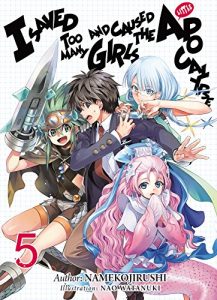
I Saved Too Many Girls And Caused the Apocalypse, Vol. 5

October 1, 2017 by Sean Gaffney

By Namekojirushi and Nao Watanuki. Released in Japan as “Ore ga Heroine o Tasukesugite Sekai ga Little Mokushiroku!?” by Hobby Japan. Released in North America digitally by J-Novel Club. Translated by Adam Lensenmayer.

After a couple of books where I was fairly dissatisfied with the series, this is a much stronger volume of Little Apocalypse. It still has its cliches that it falls into, and has pretty much given up being a parody, but that also means the plot gets much more serious and thrilling. Rekka actually manages to achieve cool things, and his wishy-washyness about the heroines is a bit less frustrating. Also R has a lot more to do, and has become the reader stand-in, admiring the girls and tweaking Rekka. We also get a second book in a row where one of the heroines turns out to be not what they seem, but this one actually comes as a bit of a surprise, one of quite a few genuine surprises I had reading this book. There are still a few major problems with it (more on that below), but rating it against other books in the series, it’s the best since the first.

The plot kicks off when Iris invites Rekka to a water planet for the weekend to do some swimming. By now Iris has gotten used to the fact that she can’t have Rekka all to herself as much as she wants, so she even goes as far as to invite the others as well. (The revolving heroine door revolves again this time – Lea can’t make it, but instead Tetra gets a much larger role, to make up for being absent in the prior book.) Upon arrival, they find the planet, in order to survive, has basically become a resort, with the mermaid palace a glorified hotel. Unfortunately, the palace is soon attacked by pirates, whose motive is murky but who seem prepared to kill. Rekka teams up with his usual crew, along with Rain, the princess of the mermaid planet; Shirley, a scientist who seemingly was simply there on holiday as well; and Fam, one of the pirates who’s noticed that the captain has not been himself lately. Interestingly, only the last two are identified as ‘heroines’ by R; I wasn’t sure why Rain wasn’t, but in the end she ends up being one anyway.

As I said, for the most part I enjoyed this. The first at the end was quite good, and the villain’s broken motivation was treated with sensitivity by Rekka when almost any other hero would have simply taken them out. That said, I had two big problems. The first is Raul, a Lupin wannabe who seems to be there to do all the things that the author realized would be impossible for Rekka to achieve, which is nice except that seeing how Rekka achieves impossible things is the main reason to read the series. He’s a deus ex machina character. The other is the ending, which I knew was coming but still cringed at. If you’re going to have a villain threaten an entire planet with death and be well advanced in actually achieving this, even if the motivations do turn out to be “I have never had friends and am desperately lonely”, I’m pretty sure you still have to serve time. The Get Out Of Jail Free Because I’m A Heroine card works far less well here than it does for Rosalind.

But oh well. Little Apocalypse is never going to be perfect, particularly as it keeps advancing its ridiculous premise. Most of the book works pretty well, some neglected heroines get things to do (and no doubt will be neglected again while others rotate in), Rekka gets to be cool and yet still unaware that people are attracted to him, and R is snarky. We’re almost a third of the way through the series, and I’m starting to be curious as to how the author can keep this up without it collapsing.

Filed Under: i saved too many girls and caused the apocalypse, REVIEWS

Sweet Blue Flowers, Omnibus 1

September 30, 2017 by Sean Gaffney

By Takako Shimura. Released in Japan as “Aoi Hana” by Ohta Shuppan, serialized in the magazine Manga Erotics F. Released in North America by Viz. Translated by John Werry.

The reason for the somewhat awkward ‘omnibus 1’ up there is that I’ve already reviewed the first volume of this series back in April 2014 when DMP did a somewhat aborted digital release of it. But now we have a handsome paperback of the first two volumes, with a new translation and looking excellent. As for the series itself, it’s odd coming at it now after so many of the series that came after it have done the same thing. The average reader interested in yuri may well ask what they can get from this they aren’t getting from Bloom Into You, or Kiss & White Lily for My Dearest Girl, or even Citrus (well, OK, don’t bring Citrus into this). The biggest answer, of course, is that this is written and drawn by Takako Shimura, and thus is simply well-crafted, with characters whose school days and intimate lives are laid out in sometimes crushing precision by an expert.

One thing that sets this series apart from other ‘girls fall for other girls at a school’ series is that we’re dealing with two different schools. Akira (sailor uniform school) is bright, bubbly, a bit overearnest and not particularly interested in romance at all, at least not at first (though the arranged fiancne of one of her friends seems interested in her). She’s just reunited with childhood friend Fumi (apron-like dress uniform school), who was a big crybaby back in the day and, well, still is. She’s also in love with her cousin, and therefore somewhat devastated when said cousin ends up marrying a guy. She’s quick to rebound, though not with Akira – even though she slowly realizes over the course of the book that Akira was her real childhood crush, she’s now head over heels with Yasuko, who is a charmer and a Takarazuka type if ever there was one. Unfortunately, Yasuko also has issues in her life, namely a crush she used to have on a male teacher. So that’s not likely to work out either.

As you can see, this tends more towards the melodramatic side of the scale, at least when you write out what’s actually going on. As with Shimura’s other classic, Wandering Son, though, it doesn’t feel overwrought as you read it – the emotions feel real without attempting to drown the reader, and everyone reacts (mostly) sensibly. You’ll also note that I mentioned men a few times – even though both schools our heroines attend are girls only, this is not a series where men simply never pop up. And sexuality is not precisely binary either – Yasuko’s somewhat exasperating family note the fact that Yasuko dating Fumi means she’s bisexual now, and we see a few examples of the classic ‘I’m in love with a girl while in school but I will ‘grow up’ and marry a guy’ trope which is, well, very indicative of real life in Japan, though that’s starting to change.

So yes, Sweet Blue Flowers is absolutely worth reading and checking out, both if you like yuri and if you like Takako Shimura. It’s also only four omnibuses, so shouldn’t devastate your bookshelf too much.

Filed Under: sweet blue flowers

Manga the Week of 10/4/17

September 28, 2017 by Sean Gaffney, Michelle Smith, Ash Brown and Anna N 1 Comment

SEAN: Next week is October! Are you ready for your pumpkin-spiced manga?

Technically I’ve no idea when in October this will be out, but Bruno Gmuender has listed House of Brutes 1 on Amazon for ‘Oct 2017’, so let’s stick it here. If you like burly gay men getting tied up, you’ll love this.

ASH: The publisher declared bankruptcy earlier this year, so some of the releases are up in the air or have been moved around in the schedule. But should this actually exist, I’ll definitely be picking it up.

SEAN: We’ve seen a lot of male power fantasies this year, but Arifureta: From Commonplace to World’s Strongest may be the most iconic. The 3rd light novel arrives from J-Novel Club next week.

We also get the 3rd Bluesteel Blasphemer novel, from the creator of Outbreak Company, which J-Novel Club just licensed.

And our monthly dose of Invaders of the Rokujouma!?, Vol. 7 this time.

Kodansha Digital celebrates October with a 14th Pumpkin Scissors, and also a 17th Yozakura Quartet.

ASH: There really is pumpkin manga for October!

SEAN: Speaking of license rescues, they also are releasing ALL of Rave Master digitally next week. I assume these are the Tokyopop editions with the serial numbers filed off, but it’s nice to see them available again.

As for newer digital titles, we have a 5th Ace of the Diamond and a 7th Domestic Girlfriend. No print for Kodansha next week!

MICHELLE: Yay for Ace of the Diamond!

SEAN: Seven Seas has a 6th volume of revenge comedy Masamune-kun’s Revenge, although “revenge angst” might be more appropriate at this point.

And a 2nd Tales of Zestiria, which I think I may have mentioned in a prior post – did its date slip?

Vertical, Inc. has the Anime Supremacy! novel, which I know nothing about but looks pretty cool.

ASH: I’ve heard it described as a prose version of the Shirobako anime, which I know has more than a few fans.

SEAN: And also the 9th Devil’s Line from Vertical Comics.

Viz has a pile of titles, as always. The 6th 7th Garden seems numerically off somehow.

Assassination Classroom 18 features that most popular holiday, Valentine’s Day! Will anyone hook up?

The Demon Prince of Momochi House reaches double digits with Vol. 10.

ASH: I’ve fallen a little behind in the series; it’s probably about time I catch up!

ANNA: I enjoy it a lot. It surprises me sometimes!

SEAN: And Food Wars! has gotten to Vol. 20.

Haikyu!! is at sweet sixteen – will it still be popular now that we have a woman’s volleyball title as well? (Hint: yes.)

MICHELLE: There’s definitely room in my heart for both of them.

ANNA: One day I will wrestle the volumes of this series away from my kids and get caught up.

SEAN: We have a lot of final volumes next week, starting with the 8th and final Honey So Sweet!. My guess is it will live up to its name as always.

MICHELLE: It does.

ANNA: Aww, I think Shojo Beat needs another super cute series to fill the void left by Honey So Sweet and My Love Story!!.

SEAN: Kamisama Kiss comes to an end with its 25th and final volume. There’s also a limited edition with extra content – you may want to get that.

MICHELLE: So many shoujo conclusions recently!

ANNA: Glad it is getting a nice sendoff with a special edition.

SEAN: Back to series not ending anytime soon, Kuroko’s Basketball’s 8th 2-in-1 shows the end of the big game – well, the big game of the moment.

MICHELLE: Woot. I still haven’t read the seventh omnibus, so I will have fun tackling four volumes’ worth of sportsy goodness at once.

ANNA: Will Kuroko be invisible AGAIN!?

SEAN: Naruto has a 20th 3-in-1.

More omnibuses! Rurouni Kenshin’s 4th 3-in-1.

Another series ending, with the 15th and final volume of So Cute It Hurts!!!!!!!!!!!!!!!. And my last attempt to make that lame joke as well.

Twin Star Exorcists also joins the double digits club with Vol. 10.

The Water Dragon’s Bride as a 3rd volume.

MICHELLE: This series has grown on me—not surprising since I really liked Dawn of the Arcana—and I find I’m looking forward to volume three quite a bit.

ANNA: I love this series. Everyone should be reading this!

SEAN: And we have a 17th World Trigger, which hopefully will resume in Japan soon.

Lastly, there’s an 8th Yona of the Dawn, always guaranteed to put a smile on the face of the Manga Bookshelf crowd.

MICHELLE: The closest thing to Basara coming out currently, I will always be on board for this.

ASH: Same here!

ANNA: EEEEE!!! for Yona of the Dawn!!!!

SEAN: So what’s your preferred title?

Filed Under: FEATURES, manga the week of

Is It Wrong To Try To Pick Up Girls In A Dungeon?, Vol. 9

September 28, 2017 by Sean Gaffney

By Fujino Omori and Suzuhito Yasuda. Released in Japan as “Dungeon ni Deai o Motomeru no wa Machigatte Iru Darou ka?” by Softbank Creative. Released in North America by Yen On. Translated by Andrew Gaippe.

DanMachi is not a game world per se, but it runs on game mechanics. Adventurer’s levels are literally written on them, and most of the plot involves killing monsters, drinking healing potions, etc. And this means that the villains tend to be mindless, unthinking monsters. Which makes for good fight scenes – in fact, it has to. If you hesitate or lose it for a moment, you’re dead. We’ve seen Bell Cranel and his group come perilously close to this several times. Be swift, be strong, and kill the monsters. That’s how you survive. So when Bell comes across a newborn monster that not only is not trying to kill him, but is crying – and can talk! – his world is upended a bit. And so is the reader’s, as it’s made clear that this is a game-changer.

The girl on the cover is the monster in question, a vouivre, which may require a little googling – it seems to be related to wyverns. In any case, she shows consciousness, awareness, and intelligence, something previously unknown in the dungeons. Bell being Bell, he decides to take her back to the mansion with him, much to the chagrin of everyone else, who would probably protest more if it weren’t for the fact that they’ve all been rescued from bad situations by him in the exact same manner. Naming her Wiene (not sure how this is pronounced – I went with “vine-uh” while reading), she learns incredibly rapidly, and also bonds with most of the family (sorry, Lilly, you’re destined forever to be the grumpy suspicious one) very quickly. The difficulty is with what she is. If monsters have intelligence now and can be nice, will that make adventurers think twice before killing them? That will lead to a lot of dead adventurers. How do you tell a populace born and raised on ‘monsters are evil’ that some aren’t? And if you spend your life devoted to killing monsters, and now some are folks like Wiene, are you a murderer?

DanMachi 9 doesn’t focus on these questions quite as much as I’d like, but it’s also not finished – the author apologizes for this being a two-parter, and says that the next volume will resolve the subplot. It becomes clear that this is an ongoing thing, and that some of the gods are trying to advance it – using Bell’s ever-loving kindness as a catalyst – so that monsters and humans can live together. Easier said than done, though. Speaking of catalysts, Hestia serves once more as an exposition catalyst, though honestly that’s preferable to some of her former jealous antics. She learns what’s going on, and what price her family could now pay… a price that I think the next volume may deal with.

As always, DanMachi is well-written, with excellent fights, nice characterization (less fanservice than usual this time), and smooth prose, so that you don’t tend to notice how much larger these books are compared to some other light novels. Is this new development going to change the course of the series? Or will everything turn tragic in Book 10? Luckily, as Vol. 9 was pushed back a month, we only have a 3-month wait to find out. Ignore the gimmickey title – this is one of Yen On’s best series.

Filed Under: is it wrong to try to pick up girls in a dungeon?, REVIEWS

Shojo Fight!, Vol. 1

September 27, 2017 by Sean Gaffney

By Yoko Nihonbashi. Released in Japan by Kodansha, serialization ongoing in the magazine Evening. Released in North America digitally by Kodansha Comics. Translated by Rose Padgett.

One of the benefits of the wave of digital-only titles we’re seeing in 2017 is the glut of a genre that was almost invisible until a few years ago – sports manga. Kodansha in particular has been pouring out titles devoted to soccer, baseball, soccer, rugby, soccer… and now we have women’s volleyball, with the emotionally gripping Shojo Fight!. You’d expect, given that all the male-oriented soccer manga run in either shonen or seinen magazines, that this might be a shoujo title. The title might also make you think that. But no, this runs in Kodansha’s Evening magazine, a counterpart of the mainstream Weekly Morning and the otaku-oriented Afternoon. So Shojo Fight! is reaching an older male audience. Fortunately, this does not mean that the series is filled with cheesecake. Shojo Fight! is a sports title first and foremost.

The series seems to begin in medias res, but it turns out that the first volume is about the end of middle school, and we’re setting up for high school to be the main event. Our hero is Neri, a strong but short young woman with a natural talent for volleyball and a tragic past, which keeps her mostly benchwarming. Her teammates include Koyuki, who is the school idol but whose volleyball skills don’t measure up as much, and Chiyo, who is absolutely furious at Neri and yells at her all the time in that “I am only angry because I see you have given up” sort of way. Neri is in danger of getting cut from the team, which prioritizes tall girls, and she seems to be OK with that, despite pushback from various others. One accidental injury later, however, and Neri is playing in a real game. Can she keep her emotions under control and not let the driving need to play volleyball take over?

It seems to be a sort of cliche to mention that the art in this looks a bit like OEL, so I will say that as well. More to the point, though, the art fits the subject matter. The volleyball matches that we see are straightforward, lacking the ‘cool’ art that we see from titles such as Haikyu!, but being quite understandable and easy on the eyes. I also really liked Neri’s facial expressions, particularly when she’s traumatized in the second half of the book. That dazed, emotionally hollow look makes your heart ache, and you’re grateful for her future coach (I assume) from coming by to stop her making a choice that would be terrible. I’d mentioned the lack of cheesecake: Neri’s male friend Shigeru is a massage therapist, and when Neri strains her back he massages her – in the girl’s bathroom stall, as student’s aren’t supposed to fraternize. It’s quite innocent, but turns into a nasty rumor that gets people punished, and the art shows both the innocent act while signposting how it’s going to be viewed.

It looks like the cast is going to expand vastly in the second volume, not unusual with sports titles. There are some eccentrics in the high school team, and I have to admit the idea of a barbed-wire volleyball net made me laugh. The series isn’t perfect (some of the exposition about the tragedy was really shoehorned in), but it was highly enjoyable, and I can’t wait for future volumes to see if Neri comes into her own as a player.

Filed Under: REVIEWS, shojo fight!

My Youth Romantic Comedy Is Wrong As I Expected, Vol. 3

September 26, 2017 by Sean Gaffney

By Wataru Watari and Ponkan 8. Released in Japan as “Yahari Ore no Seishun Rabukome wa Machigatte Iru” by Shogakukan. Released in North America by Yen On. Translated by Jennifer Ward.

In many ways this third volume of OreGairu actually moves backwards: having seen Hachiman seemingly blow up his burgeoning friendship with Yui in the second book, much of this third one consists of he and Yukino trying to get Yui to return to the Service Club, if only as the teacher demands a certain number of people in the club. They are impeded by Yui’s hurt awkwardness, Yukino’s inability to really interact with people normally, and above all Hachiman being who he is. The point of this series to a degree is amusing the reader with Hachiman’s narration and analysis of himself and others, and I am frequently amused. But I do hope that eventually we get some sort of deconstruction of this mindset or attempt to take it apart, because it also reminds you how incredibly annoying this kind of guy really is. For someone in their late teens, Hachiman must seem awesome. He frequently exhausts me.

Yukino, on the other hand, does get quite a bit of attention devoted to her as well, and we start to see a few reasons why she is the way she is, first and foremost being the appearance of her older sister. Haruno is bright, vivacious, communicative, and seemingly nothing whatsoever like Yukino… except Hachiman, who is quite clever in ways that don’t involve himself, realizes is a false front. I’m not sure if Haruno is meant to be a villainous character here – she doesn’t actually seem to be secretly needling Yukino as you’d expect if she were, and the delight over Yukino having a boyfriend seems genuine, false front or no. Yukino is also more apparently making an effort to get closer to Hachiman, though because of who he is and who she is, this doesn’t go far at all, even with Hachiman’s sister trying to set them up.

The book ends with a “bonus chapter” that is the novelization of a drama CD included with the volume, but you get the sense that if it hadn’t come with a drama CD the author would have included it anyway, as it’s in no way irrelevant. By the end of the story Hachiman and Yui have made up and gone back to baseline, they’ve all had a cute birthday party at a karaoke place, and Hachiman has had romantic thoughts about his cute male friend Saika about 80,000 times, which has gotten less amusing as the book go on, and I wasn’t all that amused by it to start with. That said, there are also some very funny jokes here as well – I loved Yui completely misreading Hachiman’s present to her, as well as the brief narrative from Shizuka’s POV, showing that the teacher is every bit as bad as the students who she’s trying to rehabilitate.

The main reason to read this is still Hachiman’s first person snark and the jokes. But so far if I wanted to read a series about a quirky cynical narrator and a frosty socially awkward brunette beauty, I have the Monogatari Series. I’m hoping that in the next book we try to do a bit more with these people than just circling each other warily and grudgingly getting along.

Filed Under: my youth romantic comedy is wrong as i expected, REVIEWS

Bookshelf Briefs 9/25/17

September 25, 2017 by Michelle Smith and Sean Gaffney Leave a Comment

Arpeggio of Blue Steel, Vol. 11 | By Ark Performance | Seven Seas – One of the good things about this series is the way that not all of the ‘traitor’ mental models are changing sides due to love on Gunzou—in fact, almost none of them are. We’re gradually seeing that the mental models, as they gain more experience, are becoming more and more like humans. Which means they can screw up—I laughed out loud at Haruna’s “fake name.” But it also means they can bond with other humans, like Iona and her crew, or save other humans when it doesn’t gain them anything, like the two chibis who help Iori to not die in the engine room. As you can see, I may be very bad at names in this series, but that doesn’t mean I don’t enjoy it every time. – Sean Gaffney

Barakamon, Vol. 14 | By Satsuki Yoshino | Yen Press – We’re back on the island for this volume, as Handa goes forward with his decision to start a calligraphy school rather than try to follow in his father’s footsteps. That said, trying to make a real living at a school on an island where no one wants to pay that much money is going to be tough. Meanwhile, Miwa’s family is also having issues with finances, as her father decides to close the liquor store as he’s losing to the larger chain. Miwa’s frustration and indecisiveness is quite realistically shown—she doesn’t just go “I’ll take over for you, Dad” but has to be led there slowly because her future hasn’t really occurred to her. And the best news of all, Kanzaki goes back to Tokyo, and will not hopefully irritate future volumes with his presence. – Sean Gaffney

Dreamin’ Sun, Vol. 3 | By Ichigo Takano | Seven Seas – After Zen infuriating me in the second volume, I’m pleased to state that he’s much more tolerable here, possibly as I’m now sure that he’s not going to be endgame. That said, I do now suspect that endgame is going to be her landlord, which… well, on the bright side, he’s not her teacher. Much of this volume follows a theme of ‘dramatic shoujo,’ with the desire to chase your dreams warring with the reality of needing to actually deal with life crises, which may mean abandoning those dreams. Zen works much better in this plot than he did getting really angry at Shimana because he had no idea how to deal with love. This isn’t my favorite series by this author (I prefer orange), but it’s nice and solid shoujo. – Sean Gaffney

Everyone’s Getting Married, Vol. 6 | By Izumi Miyazono | Viz Media – While I’d appreciate this even more if Kamiya weren’t a creep and stalker, I do like the fact that the author is well aware of it and not really playing it as oh-so-sexy. In fact, sometimes it manages to be funny. A large part of this book involves Asuka and Ryu, still not getting married, deciding to get an apartment together—and naturally guess who their neighbor is. I also really enjoyed Asuka’s family, as her mom explains the reasoning behind why she got married, and her brother manages to be protective but not a brat. More to the point, I just really love Asuka and Ryu as a couple, married or not. The cliffhanger implies fresh disasters, but that’s OK. This series has really leveled up. – Sean Gaffney

Honey So Sweet, Vol. 8 | By Amu Meguro | VIZ Media – It feels like so many shoujo series have ended recently, and here’s one more. It doesn’t quite take the pair-the-spares approach, as one guy in the group remains single, but I do admit the sudden love interest for Sou is out of left field. However, seeing Yashiro and Misaki finally get together was freakin’ adorable, as is Onise’s crying when he realizes how much Sou loves Nao, followed by Sou actually laughing at Onise’s blinding honestly. A brief glimpse at the future six years hence is followed by the original short story that was the basis for the series. It’s cute, it’s frothy, and I’m totally okay with that. – Michelle Smith

Kiss Him, Not Me!, Vol. 12 | By Junko | Kodansha Comics – On the bright side, the couple I wanted to get together actually got together, and the author’s notes implied this was something she actually planned in advance (never a guarantee with this series). On the other hand, I’m always wary in a reverse harem (or indeed a regular harem) when the couple gets together and the series is still ongoing. Is this really going to last? It also doesn’t help that we get a lot of backstory of how they got to know each other in a flashback after the fact. Still, it’s sweet enough, The comedy comes from them behaving like a newlywed couple in class, much to the frustration of nearly everyone. As for the drama, god help us, we have another pissed off third party breaking things up. Variable even when it’s good. – Sean Gaffney

Nisekoi: False Love, Vol. 23 | By Naoshi Komi | Viz Media – Well, it’s finally become clear what the endgame is, as Raku realizes what his feelings really are. That said, we’ve got two more volumes after this, and he isn’t sure if his love for Chitoge is greater than his love for Onodera, even if the audience is. And so all the heroines who are still in Japan get one last lap around the track so show off why they would also be an awesome choice for any guy reading this series. What interested me most was 1) Fu-chan, Haru’s friend, who is as close to a girl in love with her female best friend as you can get in a Jump series, and 2) the ongoing beta pairing, which seems to get closer and closer to reality the more violent Ruri gets. (She’s not a lead girl, so isn’t attacked for violence, I guess.) Good but dragging on. – Sean Gaffney

Of the Red, the Light, and the Ayakashi, Vol. 8 | By nanao and HaccaWorks* | Yen Press – I’ve grown increasingly frustrated with the euphemisms “eating” and “taking a meal” in this series, so it’s nice to see that it’s made more explicit here—no, they don’t say “kill,” but you literally see the endgame happening on a pile of corpses that are the previous “meals.” We also see Tougo getting guilt-tripped into accepting his own sacrifice, showing him flashbacks that give us a lot more context regarding Akane’s disappearance. Combine that with the role his younger sister played now being complete, and what can he do except be eaten? That said, we have two more volumes to go after this, so I’m fairly confident that this isn’t the endgame. How do we avoid the meal, though? – Sean Gaffney

Sweetness & Lightning, Vol. 8 | By Gido Amagakure | Kodansha Comics – Tsumugi has started elementary school, which means tasty school lunches that she and her father replicate at home and a field day for which Tsumugi powers up by eating tonkatsu (lucky!) the night before and during which she runs with such determination that it actually made me cry. Meanwhile, Kotori has managed to convince her parents that she’s serious about taking over the restaurant. It looks like the series might be doing something new going forward—now that Inuzuka has enough skill to tackle new things on his own, he might be doing that while Kotori trains with her mother. That’d be interesting, too! Also, I am seriously considering attempting to make my own tonkatsu! – Michelle Smith

Filed Under: Bookshelf Briefs

Pick of the Week: Girl Fight Tonight!

September 25, 2017 by Sean Gaffney, Katherine Dacey, Michelle Smith, Anna N and Ash Brown Leave a Comment

SEAN: Until a couple of days ago, this was an easy pick, as Frau Faust was greatly enjoyable. But a rival appears, and I’m afraid that it’s won me over… or should, I haven’t read it yet. Yes, my pick of the week is Shojo Fight!, which I’ve wanted licensed here for a while now. It’s digital only, but we can’t have everything. Also, potential Haikyu!! crossover fics?

KATE: I second Sean’s pick: more volleyball manga is a good thing, especially since Crimson Hero is out of print. I’m also curious about All Out!!, another digital-only sports title from Kodansha. I can’t claim to be a rugby fan, but my younger sister played on the Stanford women’s team and has fond memories of — and a few scars from — the experience. So as an act of sisterly loyalty, I’m also casting a vote for All-Out!!.

MICHELLE: Yep, it’s gotta be Shojo Fight! for me, too, though I am definitely looking forward to All-Out!! as well.

ANNA: Shojo Fight! is also my pick. Have we had an all sports manga pick of the week recently? It certainly sounds like an excuse to celebrate!

ASH: Well, were I a digital reader, I’m sure I would be joining you all in picking Shojo Fight!. Alas, I am still devoted to my print volumes. Happily, though this week is relatively light on physical releases, there is one manga in particular that has caught my eye–the debut of Frau Faust.

Filed Under: PICK OF THE WEEK

A Bride’s Story, Vol. 9

September 25, 2017 by Sean Gaffney

By Kaoru Mori. Released in Japan as “Otoyomegatari” by Enterbrain, serialization ongoing in the magazine fellows!. Released in North America by Yen Press. Translated by William Flanagan.

Pariya gets a second cover in a row, which makes perfect sense because this book is still all about her attempts to recover from the fire that devastated her dowry, try to get closer to her possible fiance, and make readers think of her as someone other than “the tsundere somehow trapped in the nineteenth century. That she succeeds admirably is a tribute to Kaoru Mori’s writing, which continues to be excellent. In particular, Mori has a talent for wedding her story and art in a way that few manga artists these days do, something that is especially gratifying given that Pariya’s specialty is that her emotions are showing all over her face. Which makes it even more amusing that everyone seems to be misreading her, particularly Umar, her intended.

The dowry continues to be the big issue. The devastating fire from last volume really sent Pariya back to square one, which is very concerning for her family because, well, Pariya is seen as someone not all that easy to marry off. She’s loud, she’s abrasive, and she seems to spend her days in a state of perpetual rage. The well-seasoned manga reader, of course, knows that the anger is to hide her shyness and embarrassment, but I like the fact that most of the village does NOT get this immediately, not even Umar, and Pariya really has to work hard to make herself clear. There’s no revelatory moment where people work out “this is how she is”, just a series of chapters that show Pariya gritting her teeth and watching others to see if she can work out what this strange Earth concept called conversation is. A good chunk of the volume has her and Umar go on a day journey to get supplies, which ends up getting extended when they stop to help an ill woman, then suffer a broken axle. But it also helps Umar see how awesome Pariya can really be.

The rest of the cast get something to do, though obviously except for Amir and Karluk it’s a very brief something to do. There’s a series of 4-koma at the start that check in on the rest of the cast we’ve seen to date, who are mostly getting on well, aside from Mr. Smith, who’s having bandit trouble, and the girl who he had a brief liaison with, who is still alone. As for Amir, her perfection has a tendency to become her character at times (I had trouble warming up to her), but we see a few flaws here, as she makes a bow so that her husband can learn archery, but makes it for the strength of a full-grown male, not the young boy that he still is. Karluk, of course, is determined to get the arm strength to learn it anyway. These two are cute, and I’m OK with having them be the return point for the series in general.

We apparently kick off a new arc next time, which will no doubt be next year, as A Bride’s Story does not come out all that frequently. When it does, though, the reader is always in for a treat. Curl up in a comfy chair and immerse yourself in this volume.

Filed Under: a bride's story, REVIEWS

Strike the Blood, Vol. 7

September 24, 2017 by Sean Gaffney

By Gakuto Mikumo and Manyako. Released in Japan by ASCII Mediaworks. Released in North America by Yen On. Translated by Jeremiah Bourque.

Let the drums roll out and the trumpets call, strike up the band as well as the blood because I am here to tell you that this is easily the best Strike the Blood to date. It has finally moved above its decent but uninspiring attempts at makework writing and had me say, after finishing this book, “yeah, that was pretty decent”. And it should come as no surprise to find that the main reason for this, in my opinion, is because it doesn’t abide by the formula of the first six books. Oh, yes, the middle section may make an awkward attempt at it, and indeed the section in the classroom was my least favorite in the book. But overall we get backstory revelations, setup for future books, a reasonable amount of character development… it makes me cry that we haven’t bothered to have this before now, but I’ll take it.

Now, don’t get me wrong, I don’t want to overhype this too much: this is rising to the level of ‘pretty good’, but that’s all it’s doing. I would not recommend reading through the previous six books to get to this point. That said, the first third of the book, which is a flashback to when Kojou and his sister meet the Fourth Primogenitor, is well-handled, and exists pretty much to tell us that what little we’d heard to date, including Kojou’s own memories, was pretty trustworthy. We also meet his father, who seems an Indiana Jones sort, and while he’s a pretty cool guy it’s not hard to see why he is divorced from Kojou’s mother. The last quarter or so of the book also does another “finally” and focuses on Yaze, who has occasionally helped out (and gotten beat up a lot) but whose thoughts we rarely get much beyond surface. He gets his own backstory here, and shows us he’s not merely someone who is Kojou’s friend because he has to be.

As I said earlier, I was annoyed at the wacky comedy in the classroom with Vattler’s minions, mostly as it once again felt cookie cutter, Strike the Blood’s worst fault – you have a feeling his editor had a line [INSERT COMEDY HERE] at the first pass. Once Natsuki passes out and the drama starts up again, though, it’s reasonably gripping and entertaining. Despite its lack of risk-taking, the series does fights well, and that’s true here too. The villain (if she is one) is a reasonably clever fake-out, which makes you wonder if the series is going to be turned completely on its ear. It’s not, but it does come with one big benefit – Asagi is present to see both Yukina and Kojou whip out their powers, and does not lose her memory, get knocked out, or otherwise forget afterwards. I’ve wanted her to find out the truth for 7 books now. Her reaction (as Yukina observes) is understated, but she explains why that makes sense. More to the point, setup for the next big arc hints that Asagi’s secrets are about to become big news. Will she learn about her own supernatural abilities?

This isn’t going to pick up any new readers, and old readers will be continuing the series anyway. But as for me, I’m just happy not to have to end a review with “well, yeah, it’s Strike the Blood, whatever”. This was solidly pretty good. 7 out of 10, maybe? Oh yes, and it gets bonus points for Kojou saying “this is my fight” at one point and Yukina not actually responding “No, sempai, this is OUR fight”, even if it feels like it’s only not there as the author forgot.

Filed Under: REVIEWS, strike the blood

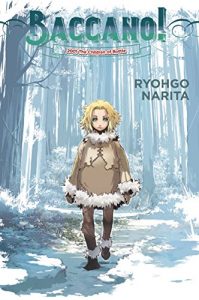
Baccano!: 2001 The Children of Bottle

September 22, 2017 by Sean Gaffney

By Ryohgo Narita and Katsumi Enami. Released in Japan by ASCII Mediaworks. Released in North America by Yen On. Translated by Taylor Engel.

This must have been quite startling to readers at the time, and it’s still pretty startling. The first four books in this series all took place around the same two year period, and there was no reason to expect anything else. Thus suddenly jumping forward to 2001 is jarring, even if you do know intellectually that a large number of the cast are Immortals. Furthermore, Isaac and Miria, bar a cameo at the start (which ended up being used in the anime) and the end, are absent from this book. But that’s OK, because we are introduced in this book to Elmer C. Albatross, a man with so much sheer force of personality that he tends to overwhelm the narrative when he’s in it. Having him interact with Isaac and Miria would be like eating something too sweet. Best to have moderation. That said, this is still an excellent volume of Baccano!.

The girl on the cover is Fil, and she is essentially the heart of this book. (To avoid too many spoilers, I will try not to refer to her as Fil and the Filtones.) The basic premise has Maiza and Czeslaw, who we’re familiar with from previous books, searching the world for the remaining immortals from the 1711 ship journey where they gained said immortality. The goal is to tell said immortals they can stop hiding, as Szilard is now dead. They pick up two more for this journey: Sylvie, a gorgeous women who was hell-bent on nothing but revenge on Szilard and has to figure out what to do now that someone else got there first; and Nile, a large North African man who has spent his immortality fighting in wars and wears a mask because his face no longer shows emotions when doing things like killing people. They are now all arriving at a tiny village in the middle of nowhere in Europe, where Maiza has been told he may find Elmer. He does find Elmer, but also finds what Elmer’s been doing for the last few years: trying to make everyone smile.

Elmer is one of the most awaited introductions for longtime Baccano! fans, and he doesn’t disappoint. As I said earlier, on the surface he might seem a bit like Isaac and Miria, but that’s just the surface. Elmer is a bit broken, and his quest for smiles at any cost, no matter how inappropriate the time, no matter if he’s talking about a killer, no matter if it involves selling everyone’s soul – it’s just disturbing when you dig down into it. He’s doing the right thing here, but it’s not really for the right reason, and yet in the end you can’t help but love Elmer, even as you find him vaguely disquieting – I suspect if I met him in real life he’d be unbearable. (I suspect that about a lot of Baccano! characters.) The rest of the cast also get stuff to do – Czes shows that years and years of physical, mental and emotional abuse can still affect you even almost a hundred years later, Sylvie gets to be sympathetic and sweet (mostly; she’s noticeably different when only around the other immortals), and Nile at first seems to be comic relief till an absolutely stunning speech that rips into a character’s desire to end their life with beautiful precision.

Speaking of Nile, let’s talk translation. Baccano! has a large fan community who translated many of the books before they were officially licensed. That hasn’t been an issue before this, as the first four books had fan translations ranging from adequate to awful. 2001, though, had a really good translation, so I was concerned fans would be wedded to that and object to anything different. That said, having finished the book, I think we’re good. The main concern is Nile’s way of speaking. He has a habit of prefacing his sentences with “Let me just say this:” and variations, which emphasizes his declamatory language and also shows a bit that he’s constantly asking permission to speak, something Maiza calls him out on. The fan translation had “I say this:” which is more literal but not as smooth. I think Taylor Engel does a very good job of making each character’s speech pattern distinct, which is important, as not everyone’s dialogue is as eccentric as Nile’s.

I haven’t talked much about the actual plot of the book, but that’s because it’s one of those books where I don’t want to give away the surprises too much. Suffice it to say I found it very enjoyable, and think you will as well. And if you’re annoyed that we don’t get more of Firo, or Isaac and Miria, or Jacuzzi and Nice, well, we’re back to the 1930s with the next five books.

Oh yes, and ‘Children of Bodom’ is the title reference, a Finnish metal band.

Filed Under: baccano!, REVIEWS

Manga the Week of 9/27/17

September 21, 2017 by Sean Gaffney, Ash Brown, Anna N, MJ and Michelle Smith 3 Comments

SEAN: Another final week of the month with far more than we’d come to expect for a final week of the month. Mainly thanks to our friends at Kodansha (yeah, sorry Ash, it’s all digital again).

ASH: They may be digital, but at least there’s some really great manga being released!

ANNA: It is true, but it also makes me a little wary, having seen plenty of digital manga efforts go under in the past.

SEAN: Starting with their weekly Del Rey rescue, Princess Resurrection 18.

The first digital debut this week is All-Out!, which is a rugby manga. I’ll repeat that: a rugby manga has been licensed for North America. It runs in Kodansha’s experimental seinen magazine Morning Two, and is, I’ll repeat once more, a RUGBY MANGA. Must buy.

MICHELLE: Ooooooh. I have really appreciated the seinen difference in Giant Killing, so I’m obviously all over this one.

ASH: Yup. This one has caught my eye, too.

ANNA: This sounds interesting.

SEAN: Altair: A Record of Battles has a 4th volume digitally.

And there’s a 2nd Black Panther and Sweet 16, for shoujo fans. Also digital.

DAYS 5 reminds you that it’s not just rugby manga out there this week.

MICHELLE: Woot.

SEAN: DEATHTOPIA has a 4th volume as well.

Elegant Yokai Apartment Life has a 2nd volume of, my guess is, yokai living in apartments. Elegantly. (Though not as elegantly as Michiru Kaioh.)

MICHELLE: No one could ever be as elegant.

MJ: I am intrigued by the title alone.

SEAN: Print at last, and the debut of Frau Faust, a josei (ish) title that runs in Itan, from the creator of The Ancient Magus’ Bride. It’s a genderbent take on the classic tale, and I greatly enjoyed the first volume.

MICHELLE: I’m looking forward to this one!

ASH: I’m very excited for this release, too! I’m really enjoying The Ancient Magus’ Bride and, well, Faust is another tale I’m quite familiar with.

MJ: This sounds great!

ANNA: I didn’t totally connect with The Ancient Magus’ Bride but I am intrigued.

SEAN: Genshiken 2nd Season has its 11th volume – we’re almost near the end, but not quite there yet. Expect more Madarame stuff.

ASH: I happen to like Madarame, but I wasn’t expecting the series to end up focusing on him as much as it does.

SEAN: Giant Killing says that it too is a digital sports manga with its 6th volume.

MICHELLE: And this!

SEAN: In/Spectre comes to an end with its 6th volume. I will miss its heroine especially. and hope things end well.

Princess Jellyfish has a 6th omnibus, and it too is apparently nearing its climax. Will the apartments be saved?

MICHELLE: I love this series so much. I love the realism as they come to appreciate the enormity of what they’re attempting, but gosh darnit, I want them to succeed!

ASH: I’m so happy this series is being released! The anime adaptation was delightful, but I’m glad to finally be able to get the entire story.

ANNA: Me too! I need to go on a Jellyfish binge.

SEAN: Real Girl has a 3rd volume, and I keep meaning to catch up with it but haven’t yet.

Shojo Fight is the other big digital debut that I can’t quite believe is out over here. Women’s volleyball! It runs in Evening magazine, and is filled with kickass women. Buy this AND the rugby manga. Splurge.

MICHELLE: I literally have geekbumps right now.

ANNA: Sounds good! Crimson Hero was not enough volleyball manga!

MICHELLE: And those final six volumes will probably never be released here. :(

SEAN: Lastly for Kodansha, we have a 3rd Tsuredure Children, whose anime just wrapped up.

SEAN: One Peace has an 11th volume of Maria Holic, which I still dislike but its fans are happy.

Seven Seas has several titles, starting with a 5th 12 Beast.

Otome Mania!! has its 2nd and final volume, as we see if this game can get released.

Re: Monster has a 3rd volume of male power fantasy.

And Species Domain has a 3rd volume of quirky fantasy slice-of-life school manga.

Lastly, just when you thought the fanservice was gone, it’s back bigger than ever: The Testament of Sister New Devil STORM! debuts.

ASH: Hmmm, usually there’s at least one Seven Seas release I’m reading, but haven’t been following any of these.

SEAN: Udon has a debut as well with Infini-T Force, a Shogakukan title from Hero’s magazine (yes, that’s how they spell it) that’s essentially a giant superhero crossover.

Vertical has a 3rd Flying Witch, which continued to be cute and weird, in that order.

MICHELLE: It’s a low-key charmer.

SEAN: And we have some Yen runoff, starting with their digital titles, new 12th volumes for Aphorism, Crimson Prince and Sekirei.

In print, we have the 7th How to Raise a Boring Girlfriend.

And the 8th Of the Red, the Light, and the Ayakashi, which will no doubt entertain and confuse me, not in that order.

ASH: I need to catch up on this series, but I’ve been liking it!

SEAN: It’s a digital world, folks. Sorry again, Ash. What are you getting this week?

ASH: It’s okay, at least there’s some great print releases, too!

Filed Under: FEATURES, manga the week of

  • « Go to Previous Page
  • Page 1
  • Interim pages omitted …
  • Page 246
  • Page 247
  • Page 248
  • Page 249
  • Page 250
  • Interim pages omitted …
  • Page 382
  • Go to Next Page »
 | Log in
Copyright © 2010 Manga Bookshelf | Powered by WordPress & the Genesis Framework