• Skip to primary navigation
  • Skip to main content
  • Skip to primary sidebar
  • Home
  • About Us
    • Privacy Policy
    • Comment Policy
    • Disclosures & Disclaimers
  • Resources
    • Links, Essays & Articles
    • Fandomology!
    • CLAMP Directory
    • BlogRoll
  • Features & Columns
    • 3 Things Thursday
    • Adventures in the Key of Shoujo
    • Bit & Blips (game reviews)
    • BL BOOKRACK
    • Bookshelf Briefs
    • Bringing the Drama
    • Comic Conversion
    • Fanservice Friday
    • Going Digital
    • It Came From the Sinosphere
    • License This!
    • Magazine no Mori
    • My Week in Manga
    • OFF THE SHELF
    • Not By Manga Alone
    • PICK OF THE WEEK
    • Subtitles & Sensibility
    • Weekly Shonen Jump Recaps
  • Manga Moveable Feast
    • MMF Full Archive
    • Yun Kouga
    • CLAMP
    • Shojo Beat
    • Osamu Tezuka
    • Sailor Moon
    • Fruits Basket
    • Takehiko Inoue
    • Wild Adapter
    • One Piece
    • After School Nightmare
    • Karakuri Odette
    • Paradise Kiss
    • The Color Trilogy
    • To Terra…
    • Sexy Voice & Robo
  • Browse by Author
    • Sean Gaffney
    • Anna Neatrour
    • Michelle Smith
    • Katherine Dacey
    • MJ
    • Brigid Alverson
    • Travis Anderson
    • Phillip Anthony
    • Derek Bown
    • Jaci Dahlvang
    • Angela Eastman
    • Erica Friedman
    • Sara K.
    • Megan Purdy
    • Emily Snodgrass
    • Nancy Thistlethwaite
    • Eva Volin
    • David Welsh
  • MB Blogs
    • A Case Suitable For Treatment
    • Experiments in Manga
    • MangaBlog
    • The Manga Critic
    • Manga Report
    • Soliloquy in Blue
    • Manga Curmudgeon (archive)

Manga Bookshelf

Discussion, Resources, Roundtables, & Reviews

Katherine Dacey

Bookshelf Briefs 10/10/11

October 10, 2011 by Katherine Dacey, David Welsh, MJ, Sean Gaffney and Michelle Smith 11 Comments

This week, Kate, MJ, David, Sean, & Michelle take a look at recent releases from Digital Manga Publishing, Kodansha Comics, and Viz Media.


Blue Exorcist, Vol. 3 | By Kazue Kato | Viz Media – In the third volume of Blue Exorcist, Kazue Kato proves beyond a doubt that she’s in control of the material. She uses these chapters to properly introduce two worthy antagonists for Rin: Mephisto’s younger brother Amaimon (a dead ringer for Green Day’s Billie Joe Armstrong) and Father Fujimoto’s former protege Shura Kirigakure. But Kato also takes the time to flesh out her established cast. Rin has an opportunity to solve a crisis with reason instead of magic, while flashbacks allow us greater insight into Father Fujimoto’s relationship with Rin. Smart-looking character designs, brisk pacing, and crisp dialogue keep the story afloat, even when Kato is going through the standard shonen motions (e.g. busty big-sis types, school field trips involving camping and group chores). A worthy addition to the Shonen Jump catalog. -Katherine Dacey

Entangled Circumstances | By Kikuko Kikuya | Digital Manga Publishing – Everyone’s heard the adage “never judge a book by its cover,” but more often than not, doing so has led me to something interesting, especially where BL is concerned. Not so with Entangled Circumstances, alas. Oh, it’s okay, being the story of a handsome, popular guy (now the project manager for a magazine) and the stubborn, uptight guy (now in the magazine’s sales department) he’s been chasing for six years, but it’s not as quirky as its eye-catching cover—quite different from common BL motifs—would suggest. Pretty much the entire plot is “uptight guy refuses to admit that he loves the other guy until suddenly he does acknowledge his feelings and then they have lots of sex although he worries the popular guy will tire of him now that he’s caught him.” Yawn. Nothing new to see here. – Michelle Smith

Eyeshield 21, Vol. 37 | By Riichiro Inagaki and Yusuke Murata | Viz Media – We are finally at the end of Eyeshield 21, which is second only to Prince of Tennis for longest sports manga out in North America, I believe. And if, as I believe, it should have ended at the Christmas Bowl 3 volumes ago, I can’t really begrudge it this victory lap. We finish up the game against America, and as expected the Japanese team slowly begins to inch its way back. The highlights of the volume are probably a) the revelation of the bandaged player, who isn’t the person everyone thought; and b) seeing Agon finally give in and play like a real teammate. Much as I hate to see anything good happen to him after being a jerk for *so* long, it wouldn’t be very Shonen Jump-ey, and this is nice to see. As the series ends and we see the cast split into various colleges all playing against each other, we get a satisfying sense of closure (unless you were one of the few readers wanting romance – no hope there) and a sense that the future is bright for all of them.-Sean Gaffney

March Story, Vol. 3 | By Kim Hyung-Min and Yang Kyung-Il | Viz Media – From the beginning, March Story has had a compelling protagonist, a dark, intriguing tone, and beautiful, beautiful artwork, while other aspects of the series have waxed and waned. Things even out in volume three, as author Kim Hyung-Min finally hits his stride and then some. Though this volume conforms to the series’ episodic format almost to a fault, this seems to be a good thing, even in the eyes of an epic-loving critic like me. March’s surreally-designed mother figure, Jake, is featured in this volume, which is much more of a treat than I might have imagined. Other highlights include a story about an Ill trying to protect her human son, and an Ill who spends years devoted to a human woman. There isn’t a lot of Ill-hunting going on in these stories, but you won’t hear me complaining. This series is at its best when bittersweet. It’s nice to be able to finally recommend March Story without reservation. Hopefully this is a permanent trend. – MJ

Pretty Guardian Sailor Moon, Vol. 1 | By Naoko Takeuchi | Kodansha Comics –I end up enjoying a lot of teen-demographic manga in spite of the fact that I don’t really care for the protagonist. If the supporting cast is large and interesting enough, I can ignore the lead’s shortcomings. Sailor Moon is shaping up in that direction, as I find our titular heroine to be too much of a drippy dingbat to actively like. While her solar-system sister is having a ball over in Codename: Sailor V, Usagi is behaving in some of the most predictable ways imaginable: lazy, shallow, and easily distracted. Fortunately, she’s surrounded by people with enough verve to drag her along, and Takeuchi has barely begun assembling her array of allies. I’m particularly taken with tough, elegant, slightly spooky Sailor Mars and dreamy, sarcastic Tuxedo mask, in spite of his contractual obligation to express fascination with our heroine. And whose life wouldn’t improve under the mentorship of a talking cat? – David Welsh

Tonight’s Take-Out Night | By Akira Minazuki | Digital Manga Publishing – The title story in this collection depicts a whirlwind romance between the manager of a burger joint and a guy from the corporate office. There’s not much emotional resonance to this tale, but that’s made up for by the next set of stories about an icy inhuman being (Kirin) whose killing streak comes to an end when he meets a kind physician (Shinnosuke). Their story brings all the drama one could ever want, including Kirin becoming human through his love for Shinnosuke (and angsting that he’s just a replacement for Shinnosuke’s late wife) and Shinnosuke eventually having second thoughts about this because Kirin will now eventually die. The last pair of stories are devoted to Makimura and Fujimori, an art student and his younger mentor who feel each other up first for sculpture-making purposes and then just for fun. All in all, it’s a diverse and enjoyable collection. – Michelle Smith

X 3-in-1, Vol. 1 | By CLAMP | Viz Media – Psychic powers! Family secrets! Mysterious destinies that threaten the entire world! Good-looking boys, and girls with yards of hair! X is pretty much dead center in the Venn diagram of “things I expect from a comic by CLAMP,” which is problematic only in that I like their work best when it surprises me. Siblings Kotori and Fuma find their high-school world turned upside-down by the return of their childhood friend, Kamui. He’s changed from the gentle, outgoing boy they knew, but you would too if you were constantly being attacked by nattily dressed, willowy psychics. On one hand, the whole “earth-threatening destiny” thing is as muddy and hard to navigate as a swamp; on the other, there’s an unapologetic level of violence here that compensates for the nonsensical quality of the plot it serves. The characters may be a little drab, and the story is a head-scratcher, but the fact that there’s this much bone-crushing, body-count action in a shôjo series is undeniably awesome. – David Welsh

Filed Under: Bookshelf Briefs

Manga Artifacts: The Legend of Mother Sarah

October 9, 2011 by Katherine Dacey 15 Comments

Most American manga fans know Katsuhiro Otomo as the creator of AKIRA, and perhaps of Domu: A Child’s Dream and Hipira. But did you know that Otomo was also the author of The Legend of Mother Sarah, a criminally under-appreciated sci-fi epic that’s equal parts Mad Max and Terminator II?

Set in the not-too-distant future, Mother Sarah begins in space — or, more accurately, space stations, where the survivors of a nuclear holocaust have sought refuge from the Earth’s extreme climate changes. When riots threaten the peace aboard these floating cities, the military evacuates civilians back to the surface, in the process separating thousands of children from their parents. Sarah, the story’s eponymous heroine, is on a quest to find her own family, all of whom disappeared in the chaos aboard the space stations. Traveling with Tsue, a trader, she wanders a desolate landscape of crumbling cities, slave-labor camps, religious compounds, and hardscrabble farms, putting the hurt on anyone who threatens the honest folk she meets along the way.

Given its classic premise and cool, resourceful heroine, it’s curious that Mother Sarah had such a short shelf life. As tempting as it may be to chalk up fan indifference to sexism, or antipathy towards Otomo’s other (read: not AKIRA) projects, I think the real reason lies with the way Mother Sarah was released.

Dark Horse published the series from 1995-98, but only collected the first eight issues into a trade paperback. . When read in thirty-page installments, The Legend of Mother Sarah: Tunnel Town is engaging but frustrating. Otomo and artist Takumi Nagayasu’s sense of pacing, in particular, is too leisurely for a stand-alone booklet: they establish a new setting with a dozen wordless panels, luxuriate in an explosion, or depict a fist-fight over five or six pages, gobbling up pages that might otherwise be advancing the story.

Contrast an issue of Tunnel Town with that of a long-running American series and the incompatibility of format and story becomes more apparent. In each issue of The Walking Dead, for example, one important event is dramatized: the characters make a critical discovery about their zombie foes or confront a troublemaker within their ranks. Though the issue may end on a cliffhanger, there’s a sense of closure that’s missing from an issue of Mother Sarah, even though both stories are clearly intended to extend beyond the confines of a single pamphlet. Put another way, each issue of Walking Dead has a clear beginning, middle, and end, whereas Sarah simply stops; it’s as if the author pressed “pause,” rather than set the table for the next chapter.

When read in trade paperback form, however, Tunnel Town has a more satisfying rhythm. Those establishing shots and slow-mo fight scenes draw the reader deeper into the story; we feel like we’re actually part of the scene, rather than passive witnesses to the action. The continuity between events is easier to appreciate as well. Sarah’s skirmishes with authority no longer seem like a string of isolated incidents, but a steadily escalating pattern of violence that demands resolution. And what a finale! Coming at the end of two hundred pages, the denouement is less a cool stunt than a thrilling affirmation of Sarah’s courage and smarts, an emphatic punctuation mark at the end of a long but well-reasoned paragraph.

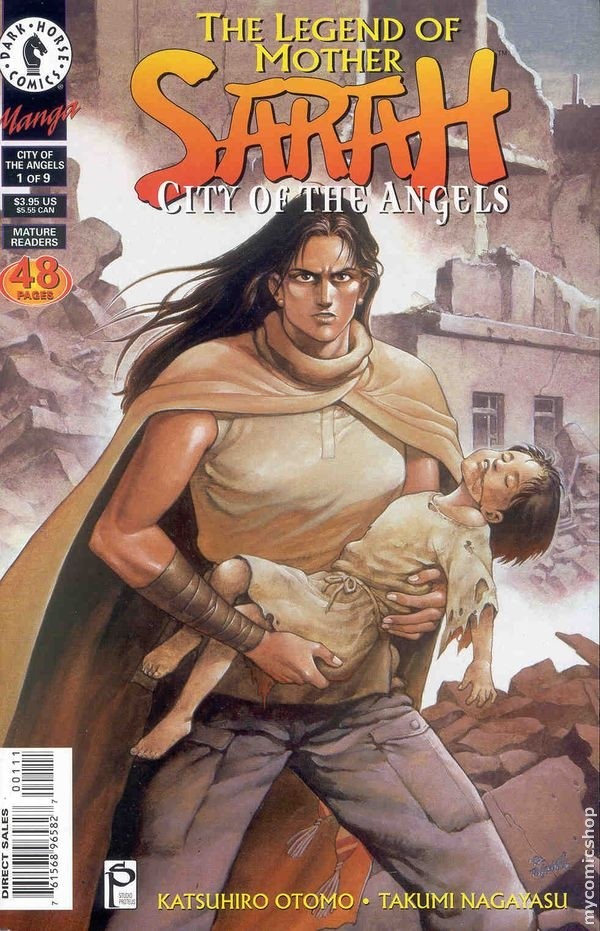
I’m guessing that someone at Dark Horse must have thought Mother Sarah was ill-served by the thirty-page format, as the next two arcs — City of the Children and City of the Angels — were published in forty-eight page installments, a development highlighted on the front covers of each issue:

As a result, the later mini-series are more engaging; we’re treated to a larger, more satisfying chunk of story in each installment, a chunk that I suspect corresponds to the way the manga was serialized in Young Magazine. (I don’t know that for a fact, however, so feel free to politely educate me on this point if I’m off base here.) Alas, neither Children nor Angels were collected in bound form, making it harder for a new generation of manga fans to discover the series for themselves.

For all my grumbling about format and scarcity, however, all three story arcs are worth owning, both for the art and the story. Takumi Nagayasu’s crisp visuals are pleasingly reminiscent of Otomo’s. Nagayasu’s characters are drawn in a naturalistic fashion, with plenty of attention given to hands, facial hair, posture, wrinkles, and muscles; even the most inconsequential soldier or civilian is given a unique face and a thoughtfully constructed costume. Nagayasu also shares Otomo’s love of vehicles and decaying urban landscapes, rendering both in a fine, evocative fashion; one can almost hear the steel structures rusting from neglect.

Otomo’s writing is as strong as Nagayasu’s artwork. Though Sarah is a certifiable bad-ass, capable of kicking and stabbing her way out of a tight situation, she relies on her wits just as frequently as her fists. Her maternal instincts, too, inform much of her decision-making; throughout the series, Sarah is drawn to conflicts involving exploited or abused children, offering her a chance to symbolically “save” the family she lost ten years earlier. In short, Sarah is a woman warrior in the Lt. Ellen Ripley/Sarah Connor mold: fierce, strong, principled, and, above all else, a mama grizzly who sides with the young and the helpless. Oh, and she looks good while dispensing justice, too. Now that’s my kind of escapism, no matter how it’s packaged.

THE LEGEND OF MOTHER SARAH • STORY BY KATSUHIRO OTOMO, ART BY TAKUMI NAGAYASU • DARK HORSE • NO RATING

Filed Under: Manga Critic Tagged With: Dark Horse, Katsuhiro Otomo, Post-Apocalyptic Sci-Fi, Takumi Nagayasu

Manga Artifacts: The Legend of Mother Sarah

October 9, 2011 by Katherine Dacey

Most American manga fans know Katsuhiro Otomo as the creative force behind AKIRA and Domu: A Child’s Dream, but Otomo’s catalog also includes works like The Legend of Mother Sarah, in which Otomo penned the script but relinquished the illustration duties to another manga-ka. And while Mother Sarah isn’t quite as visually dazzling as AKIRA or Domu, this post-apocalyptic adventure is every bit as fun to read, thanks to its vivid characterizations and dynamic action sequences.

Set in the not-too-distant future, Mother Sarah begins in space — or, more accurately, space stations, where the survivors of a nuclear holocaust have sought refuge from the Earth’s extreme climate changes. When riots threaten the peace aboard these floating cities, the military evacuates civilians back to the surface, in the process separating thousands of children from their parents. Sarah, the story’s eponymous heroine, is on a quest to find her own family, all of whom disappeared in the chaos aboard the space stations. Traveling with Tsue, a trader, she wanders a desolate landscape of crumbling cities, slave-labor camps, religious compounds, and hardscrabble farms, karate-chopping anyone who threatens the honest folk she meets along the way.

Given its classic premise and cool, resourceful heroine, it’s curious that Mother Sarah had such a short shelf life here in the United States. As tempting as it may be to chalk up fan indifference to sexism, or antipathy towards Otomo’s other (read: not AKIRA) projects, I think the real reason lies with the way Mother Sarah was released. Dark Horse published the series from 1995-98, but only collected the first eight issues into a trade paperback. When read in thirty-page installments, The Legend of Mother Sarah: Tunnel Town is engaging but frustrating. Otomo and artist Takumi Nagayasu’s sense of pacing, in particular, is too leisurely for a stand-alone booklet: they establish a new setting with a dozen wordless panels, luxuriate in an explosion, or depict a fist-fight over five or six pages, gobbling up real estate that might otherwise be advancing the story. Contrast an issue of Tunnel Town with that of a long-running American series and the incompatibility of format and story becomes more apparent. In each issue of The Walking Dead, for example, one important event is dramatized: the characters make a critical discovery about their zombie foes or confront a troublemaker within their ranks. Though the issue may end on a cliffhanger, there’s a sense of closure that’s missing from an issue of Mother Sarah, even though both stories are clearly intended to extend beyond the confines of a single pamphlet.

When read in trade paperback form, however, Tunnel Town has a more satisfying rhythm. Those establishing shots and slow-mo fight scenes draw the reader deeper into the story; we feel like we’re actually part of the scene, rather than passive witnesses to the action. The continuity between events is easier to appreciate as well. Sarah’s skirmishes with authority no longer seem like a string of isolated incidents, but a steadily escalating pattern of violence that demands resolution. And what a finale! Coming at the end of two hundred pages, the denouement is less a cool stunt than a thrilling affirmation of Sarah’s courage and smarts, an emphatic punctuation mark at the end of a long but well-reasoned paragraph.

I’m guessing that someone at Dark Horse must have thought Mother Sarah was ill-served by the thirty-page format, as the next two arcs — City of the Children and City of the Angels — were published in forty-eight page installments, a development highlighted on the front covers of each issue:

As a result, the later mini-series are more engaging; we’re treated to a larger, more satisfying chunk of story in each installment, a chunk that I suspect corresponds more closely to the way the manga was serialized in Young Magazine. Alas, neither Children nor Angels were collected in bound form, making it harder for a new generation of manga fans to discover the series for themselves.

For all my grumbling about format and scarcity, however, all three story arcs are worth owning, both for the art and the story. Takumi Nagayasu’s crisp visuals are pleasingly reminiscent of Otomo’s. Nagayasu’s characters are drawn in a naturalistic fashion, with plenty of attention given to hands, facial hair, posture, wrinkles, and muscles; even the most inconsequential soldier or civilian is given a unique face and a thoughtfully constructed costume. Nagayasu also shares Otomo’s love of vehicles and decaying urban landscapes, rendering both in a fine, evocative fashion; one can almost hear the steel structures rusting from neglect.

Otomo’s writing is as strong as Nagayasu’s artwork. Though Sarah is a certifiable bad-ass, capable of kicking and stabbing her way out of a tight situation, she relies on her wits just as frequently as her fists. Her maternal instincts, too, inform much of her decision-making; throughout the series, Sarah is drawn to conflicts involving exploited or abused children, offering her a chance to symbolically “save” the family she lost ten years earlier. In short, Sarah is a woman warrior in the Lt. Ellen Ripley/Sarah Connor mold: fierce, strong, principled, and, above all else, a mama grizzly who sides with the young and the helpless. Oh, and she looks good while dispensing justice, too. Now that’s my kind of escapism, no matter how it’s packaged.

THE LEGEND OF MOTHER SARAH • STORY BY KATSUHIRO OTOMO, ART BY TAKUMI NAGAYASU • DARK HORSE • NO RATING

Filed Under: Manga, Manga Critic, REVIEWS Tagged With: Dark Horse, Katsuhiro Otomo, Post-Apocalyptic Sci-Fi, Takumi Nagayasu

Gandhi: A Manga Biography

October 6, 2011 by Katherine Dacey 7 Comments

British historian Phillip Guedalla famously described biography as “a very definite region bounded on the north by history, on the south by fiction, on the east by obituary, and on the west by tedium.” Were I to locate Gandhi: A Manga Biography on Guedalla’s map, its longest borders would be to the south and west: it’s both contrived and dull, a series of historical tableaux that do little to reveal Gandhi’s true humanity.

Most of the book’s problems stem from its scope, as author Kazuki Ebine attempts to cover Gandhi’s entire life in a mere 192 pages. Ebine treats us to brief glimpses of Gandhi’s childhood, when Gandhi was first exposed to the injustices of India’s caste system; his time in England, where he studied law; his time in South Africa, where he challenged the government’s classification of Indians as second-class citizens; and his time in India, where he used strikes, boycotts, and other forms of non-violent resistance to protest English rule.

Though Ebine carefully inserts major historical figures into the narrative, none of them are treated as individuals. Some are straw men, representing unenlightened points of view, while others are apostles, converted to the cause through the power of Gandhi’s words. Even Gandhi’s wife is relegated to a minor supporting role; her primary function within the narrative is to patiently reflect on her husband’s inherent courage and goodness, rather than interact with him as a partner, friend, confidante, or lover. (“Your duty is to lead people in a right direction,” she solemnly informs Gandhi.) Ebine attempts to portray her as the one person who truly knew Gandhi, but the relentless pace of the story prevents him from showing the natural evolution of their relationship….

Read More

Filed Under: Manga Critic Tagged With: Biography, Gandhi, Penguin

Gandhi: A Manga Biography

October 6, 2011 by Katherine Dacey

British historian Phillip Guedalla famously described biography as “a very definite region bounded on the north by history, on the south by fiction, on the east by obituary, and on the west by tedium.” Were I to locate Gandhi: A Manga Biography on Guedalla’s map, its longest borders would be to the south and west: it’s both contrived and dull, a series of historical tableaux that do little to reveal Gandhi’s true humanity.

Most of the book’s problems stem from its scope, as author Kazuki Ebine attempts to cover Gandhi’s entire life in a mere 192 pages. Ebine treats us to brief glimpses of Gandhi’s childhood, when Gandhi was first exposed to the injustices of India’s caste system; his time in England, where he studied law; his time in South Africa, where he challenged the government’s classification of Indians as second-class citizens; and his time in India, where he used strikes, boycotts, and other forms of non-violent resistance to protest English rule.

Though Ebine carefully inserts major historical figures into the narrative, none of them are treated as individuals. Some are straw men, representing unenlightened points of view, while others are apostles, converted to the cause through the power of Gandhi’s words. Even Gandhi’s wife is relegated to a minor supporting role; her primary function within the narrative is to patiently reflect on her husband’s inherent courage and goodness, rather than interact with him as a partner, friend, confidante, or lover. (“Your duty is to lead people in a right direction,” she solemnly informs Gandhi.) Ebine attempts to portray her as the one person who truly knew Gandhi, but the relentless pace of the story prevents him from showing the natural evolution of their relationship.

The script is equally problematic, abounding in typos and grammatical errors. (“Pease enjoy this humble farewell party for you,” one character tells Gandhi.) The problems extend beyond mere editorial sloppiness: the dialogue would have benefited from a vigorous re-write, as it sounds more like a poorly translated Power Point presentation than natural conversation. In one crucial scene, for example, a young South African man confronts Gandhi with what amounts to an eighth grader’s gloss on the crisis in South Africa. “When I first heard your speech, I was so inspired as if you boiled in my blood!” he declares. “No one else has tried to rise up against the whites. As Indians, we have decided to fight together beyond the differences in religions.” Another character tells Gandhi, “By revoking Indians’ right to vote, they try to shut our mouth up regarding sovereignty” — an indignity up with which he will not put.

The biggest disappointment, however, is that Ebine makes such uninspired use of the comics medium. The artwork is plain and lifeless, relying too heavily on computer shortcuts and pre-fab backgrounds to create a genuine sense of place or time. Though Ebine depicts numerous violent confrontations, most of the layouts are an unvaried parade of talking heads addressing assemblies and conducting back-room negotiations. To judge from the characters’ facial expressions, these scenes are meant to be as dramatic as the brawls and massacres, but the monotony of the presentation robs these scenes of specificity and urgency.

The bottom line: readers who want an overview of Gandhi’s life and work may find this slim volume helpful, but readers hoping to move beyond what Mark Twain called the “clothes and the buttons of the man” will be sorely disappointed.

Review copy provided by Penguin Books.

GANDHI: A MANGA BIOGRAPHY • BY KAZUKI EBINE • PENGUIN BOOKS • 192 pp. • NO RATING

Filed Under: Manga, Manga Critic, REVIEWS Tagged With: Biography, Gandhi, Penguin

Show Us Your Stuff: Burning Lizard’s Collection

October 4, 2011 by Katherine Dacey 5 Comments

Welcome to the third installment of Show Us Your Stuff, now back at The Manga Critic! If you missed Daniella Orihuela-Griber’s contribution, click here. I’ve also created an archive for this feature here at The Manga Critic, which you can access from the “Features” menu or by clicking here. Today’s contributor is Derek Bown, a writer, student, and shonen manga enthusiast who runs the review site Burning Lizard Studios. Without further ado, here’s Derek in his own words.

Hey, I’m Derek, sometimes known as Burning Lizard. I run an anime, manga, and anything-that-catches-my-fancy review blog. I’m an avid reader and collector of manga, and in the past few years my manga collection has doubled several times. (Especially since the Borders liquidation.) I figured that since I’m like every collector out there: I’m just not satisfied unless I show my collection off to someone. So here you go internet, here is my manga collection.

What was your first manga?
Either One Piece or Ranma 1/2. Both were series that I originally experienced as anime. After my local TV stations started airing only reruns, I turned to the manga to get the rest of the story — which turned out to be crucial for One Piece, since there was an actual story to continue. Ranma 1/2 just managed to both entertain and piss me off towards the later volumes….

Read More

Filed Under: Manga Critic Tagged With: Awesome Manga Collections, One Piece, Shonen

Pick of the Week: Festival of Viz

October 3, 2011 by David Welsh, Katherine Dacey, Sean Gaffney, Michelle Smith and MJ 9 Comments

There’s a flood of Viz titles coming in to Midtown Comics this week. Check out the Battle Robot’s picks of the bunch below!


DAVID: It’s the first week of the month, so Viz follows its customary practice of flooding the shelves with new volumes of shônen and shôjo series. While they could certainly learn to pace themselves, I won’t complain if it means I can get my hands on the fifth volume of Julietta Suzuki’s Kamisama Kiss. This series is turning into a fine example of Suzuki’s ability to balance antic comedy and nuanced emotion, which is always a good recipe for satisfying shôjo. One of the things I particularly like about Suzuki’s work is that she respects her readers’ intelligence and doesn’t need to underline every romantic beat, choosing instead to highlight unexpected moments rather than dwell on the ones we can all recite by heart. The result is a series that fluxes confidently between sweet, silly, urgent, sad, and suspenseful. I’m always happy to spend more time with these characters.

KATE: My vote goes to the fourth volume of Blue Exorcist. I’d be the first to admit that the series covers well-trod territory: it’s got combatants of the cloth, a magical academy where exorcists learn their trade, and a tortured hero who straddles the demon and human worlds. But Kazuo Kaito’s elegant art and quick wit bring this very tired premise to life, making it easy to forgive the frequent capitulations to shonen cliche: characters declaring they’ll “do their best,” sloppy but talented fighters winning the grudging respect of their more disciplined peers. I’m not convinced I want forty more volumes of Blue Exorcist, but what I’ve read so far is good, solid fun.

MICHELLE: There’s a lot on this week’s list—which includes the final volumes of both Eyeshield 21 and Seiho Boys’ High School—that I personally plan on purchasing, but the one I look forward to with the most glee is volume 25 of Yoshiki Nakamura’s Skip Beat!. Although our heroine Kyoko Mogami is still fueled largely by the desire for revenge, she gets more serious about the craft of acting every day while remaining believably oblivious to the romantic feelings of her biggest mentor, renowned actor Ren Tsuruga. Somehow, Nakamura is able to make all of this feel fresh and new, and in volume 24 revisited the well-trod shoujo territory of Valentine’s Day with truly amusing results. I look forward to seeing what happens next!

SEAN: As always with Viz blitz weeks, there’s any number of titles I could talk about, including the aforementioned final volume of Seiho (I love Eyeshield, but it should have ended 3 volumes before it did). And I really want to pick Hark! A Vagrant as well, but it manages to not be manga. So my pick this week goes to a new Weekly Shonen Jump series, the first from Viz in quite some time. PSYЯEN sounds like a standard battle manga, with the only difference being the tournament arc starts right away as opposed to 9-10 volumes in. But I’ve been pleasantly surprised by many of the more recent Jump efforts (Nura, Blue Exorcist), and the art looks good. I’m hoping for another fun, exciting series that manages to have fights without letting the manga get overwhelmed by them. And Volume 1s are the best place for that!

MJ: Well, it’s been mentioned a few times, but I’ll be the one to come down firmly on the side of volume eight of Seiho Boys’ High School. This is the final volume of the series, which has managed to remain as brash and funny as ever, while also presenting one of the most moving, realistic portrayals of teen romance I’ve seen in a while. I’ll be discussing this more in this week’s off the shelf, but it’s not that often that shoujo manga successfully balances both the all-consuming heart-burst of young love right alongside its inevitable transience, without degenerating into serious melodrama. This fun, light-hearted series has turned out to be much more poignant than I ever expected, and at just eight volumes, it’s a nice, easy-to-collect length, too. Definitely recommended.


Readers, what looks good to you this week?

Filed Under: PICK OF THE WEEK Tagged With: blue exorcist, kamisama kiss, psyren, seiho boys high school, Skip Beat!

Bookshelf Briefs, 10/3/11

October 3, 2011 by Katherine Dacey, David Welsh, MJ, Sean Gaffney and Michelle Smith 10 Comments

This week, Kate, MJ, David, Sean, & Michelle take a look at recent releases from Digital Manga Publishing, Yen Press, Kodansha Comics, Viz Media, and Vertical, Inc.


Acting on Impulse | By Natsue Ogoshi, Original Text by Vicki Lewis | Digital Manga Publishing – Opposites attract in this silly but charming romance about a farm girl from Virtue, KS who falls for a reformed playboy from Manhattan’s Upper West Side. When Trudy takes a job in New York City, her friends Meg and Peter appoint Linc to be her “bodyguard” and romance coach. Trudy wants to become a Sex-in-the-City sophisticate, having wild flings and meeting exotic men, while Linc wants to settle down. Their initial compromise — friends with benefits — proves more difficult than either anticipated, as each begins developing strong feelings for the other. (Didn’t they see When Harry Met Sally?!) I’m not giving away much by revealing that Acting on Impulse ends at the altar, but the story earns points for snappy dialogue and a heroine who’s hell-bent on preserving her independence, even if it means turning down a marriage proposal. -Katherine Dacey

Bakuman, Vol. 7 | By Tsugumi Ohba and Takeshi Obata | Viz Media – Things continue to go wrong for our heroes in this volume as their first series is canceled, and this may be the best thing that’s ever happened to Bakuman. Most of this volume focuses on the team’s power struggle with their editor, whose opinion about what direction the boys should pursue with their next series differs drastically from their own. This is one of the most interesting looks into the editorial process we’ve been shown thus far, ultimately coming to a conclusion I did not anticipate. Less interesting are Takagi’s potential girl issues, as he begins a professional but intense telephone relationship with female writer Aoki, but even this has its moments. The undeniable truth about Bakuman, is that it continues to be fascinating regardless of its shortcomings. Honestly, I can’t put it down. Still recommended.– MJ

Bamboo Blade, Vol. 10 | By Masahiro Totsuka and Aguri Igarashi | Yen Press – In the last volume, we spent most of the time on the awesome kendo battles, showing how much our team of determined girls has grown over the course of the series. Now we have to set up the next plot arc, featuring Tama matching up against her new rival. That is, if the opposing side can get the new rival onto the show. This volume may be low on kendo action (though there are some nice bouts in flashback), but it reminds you how funny this series can be when it’s on a roll. Chapter 82 and 85 are simply amazing, with Osaka-style overreaction to everything and a manga-within-a-manga parody that hits all the cliched genre conventions. We’re now about 3/4 through the series, and it’s good to see it can still make me laugh like this.-Sean Gaffney

Bloody Monday, Vol. 1 | By Ryou Ryumon and Kouji Megumi | Kodansha Comics – As a story, there’s nothing really novel about Bloody Monday, but the execution is so solid that I’m not bothered. A high-school computer hacker, Fujimaru Takagi, divides his time between the newspaper club and helping is secret-agent father decode sensitive computer files. Takagi, the senior, ends up on the wrong side of a conspiracy, leaving Fujimaru to try and clear his dad’s name, protect his sickly sister, and defend Japan against a mysterious disaster involving a virus of the organic kind. Ryumon piles on the plot twists but manages to keep things both orderly and suspenseful. Megumi’s art is very much in the crisp, Takeshi Obata vein, which always suits material of this nature. The visual fan service is certainly in evidence, but it’s pretty benign and hardly surprising considering that this is a story created for high-school boys that stars high-school boys. Overall, Bloody Monday is more than solid enough on all fronts to make me want to know what happens next. – David Welsh

Codename: Sailor V, Vol. 1 | By Naoko Takeuchi | Kodansha Comics –The thing I like best about this precursor to Sailor Moon is the fun its heroine has being a “champion of justice.” Lots of contemporary super-girls tend to mope over the necessity for secrecy and the burdensome nature of heroic duty, but Minako Aino seems to be having a ball. And why shouldn’t she? She gets to be glamorous, powerful, and popular, all while saving the day. Takeuchi also manages to tweak a lot of fan-culture mainstays along the way, from teen idols to spin-off merchandise to hunky juvenile delinquents. On the down side, the stories here tend to get a little repetitive, and it would be nice if Takeuchi relied a little less on the fact that Minako is kind of a dingbat to generate comedy. It’s fun to watch Sailor V kick ass and look fabulous doing it, but it would be more satisfying if she seemed to take more genuine pride in her work. – David Welsh

Kekkaishi, Vols. 7-9 (omnibus edition) | By Yellow Tanabe | Viz Media – There’s more classic shonen situations in these three volumes of Kekkaishi. We see the tragic backstory of Gen, whose life before joining the Shadow Organization is shown to be pretty much awful. A nasty villain is shown treating his fellow villainous colleagues as pawns, and sacrificing them just because he’s in a bad mood. A new teacher arrives to beat some sense into our heroes, and she turns out to be a hot dark-skinned girl (shades of Bleach). But it’s a sign of Yellow Tanabe’s craft that these cliches don’t feel worn, and I’m still enjoying the byplay between everyone as more of the plot is uncovered. Yoshimori gets less to do here, but this is made up for with a great sequence involving Tokine, who shows why she iss ruthless and not to be underestimated. A very good series, which I will now sadly have to get single volumes of.-Sean Gaffney

A Liar in Love | By Kiyo Ueda | Published by Digital Manga Publishing – On the surface, A Liar in Love looks like generic BL, featuring as it does a handsome playboy named Hiroki who makes a game out of seducing his brother’s timid and kind coworker, Yasuyuki. Actually, though, it’s pretty great, as Hiroki quickly finds himself out of his depth in this new relationship. It’s often difficult to sympathize with him, as he tends to treat Yasuyuki shabbily when confronted with his own shortcomings, but his journey from an inveterate player clinging to the notion that it’s all just a game to a person who can actually be genuine about his feelings is believable and compelling. Yasuyuki’s no slouch, either, especially when he’s able to stand his ground against Hiroki when the latter is at his most callous. With true-to-life characters in a realistic and difficult situation and lovely, expressive art, A Liar in Love is a gem. Highly recommended. – Michelle Smith

Psyren, Vol. 1 | By Toshiaki Iwashiro | Viz Media – Psyren is pretty much equal parts Gantz, The Drifting Classroom, and The Hunger Games, though it lacks the specific urgency of any of those entertainments. A dumb-but-decent, fight-happy boy named Ageha winds up sucked into a game-conspiracy where survival means victory and failure equals death in a dessicated, dystopian landscape. Ageha has a slight edge over his fellow competitors in the form of his desire to protect a classmate, Sakurako, who seems to have been suffering under the game’s random rules for some time. Sakurako, with her combination of ferocity and fragility, is the most interesting thing Psyren has to offer, and the prospect of getting to know her better is the most compelling reason to keep up with the series. Other than that, it’s competent enough as mayhem-survival drama goes. With so much really good survival-mayhem drama at your disposal, Psyren ends up feeling kind of inessential. Recommended for readers who like their body counts high and can withstand a lot of déjà vu. – David Welsh

Twin Spica, Vol. 9 | By Kou Yaginuma | Vertical – This volume of Twin Spica is not necessarily filled with warmth and good cheer, and certainly has many sad and wistful moments, but did not seem quite as melancholy as Volume 8 was. Our cast is now in its third year, and things get tougher as you would expect, but the praise is also coming more easily, even from their hardest instructors. Moreover, even as he’s seen less and less, Mr. Lion’s storyline continues to fascinate me. As Asumi grows older and more confident, and the actual reasons behind the fatal crash begin to slowly be revealed, we see him start to wonder if it’s finally time for him to move on. The fact that this is done with minimal dialogue is another tribute to the craft we see exhibited here. There may be trouble on the horizon for Marika, though, which is a shame as we also see her open up a bit more here. A nice peaceful ride, with lots of scenery. -Sean Gaffney

Filed Under: Bookshelf Briefs

PotW: Insects, Dogs, & Other Stories

September 26, 2011 by MJ, David Welsh, Sean Gaffney, Michelle Smith and Katherine Dacey 8 Comments

It’s a quiet week at Midtown Comics, but the battle robot’s choices are clear!


MJ: We’ve hit a slow week again at Midtown Comics, but there’s at least one standout in the mix. This week, we’ll see the release of Osamu Tezuka’s Book of Human Insects, which was announced in Vertical’s panel at last year’s New York Comic Con. There’s no way I’d be willing to miss this, though it’s an interesting pick for me. I have a feeling it’ll be one of those books that blows me away with its artistry while simultaneously killing me with its outlook on humanity. A bleak Tezuka can be hard on us optimistic types, but it’s impossible to reject his genius, and I’d be a fool to try. This is absolutely my must-buy manga for the week.

DAVID: I should try and spread the wealth, but I just have to second MJ’s choice. This is my very favorite kind of Tezuka: crazy plotting and intense social commentary, with some indelible characters. I found Ayako disappointing, but Book of Human Insects is right up my alley.

KATE: Since David and MJhave taken up the cause of Human Insects, I’m going to plug Stargazing Dog. I don’t know if Takahashi Murakami was inspired by Vittorio DeSica’s Umberto D., but like that 1951 film, Stargazing Dog features a down-on-his-luck man whose only companion is his dog. Yes, I know, that sounds horribly mawkish, but Murakami manages to tug on the heartstrings without being sentimental. More impressive still, he pulls off that feat while allowing us to be privy to the dog’s thoughts, something DeSica didn’t have the stones to try. Highly recommended for dog-fanciers, though be warned: have tissues handy, as you will need them.

MICHELLE: Aw man, I was going to pick Stargazing Dog! I guess I will just have to second what Kate says here, and note that despite the fact that I am a bona fide cat lover, I am totally weak against endearing canines in fictional form. One interesting thing to note is that at the same time that Stargazing Dog is coming out in print, courtesy of NBM Publishing (who’ve also released some quality manhwa), it’s also available on JManga.com as Star Protector Dog.

SEAN: If I had to rely on Midtown’s lists for my PotW, I’d never mention Kodansha at all. And I already mentioned Sailor Moon and Sailor V two weeks ago. So I will once again go to the Negima well. Last volume was rather depressing, with all sorts of horrible things happening to our heroes. Naturally, that means that this volume is the one where our heroes step up and start kicking ass. I feel I should note that Volume 31 features my favorite scene in all of Negima to date. A scene so awesome that the entire cast comments later on about how awesome it was. And yes, there will be more fanservicey nudity here too. It’s Negima, that’s how it rolls.


Readers, what looks good to you this week?

Filed Under: PICK OF THE WEEK

Pick of the Week: FMA, Zoo in Winter, Arata

September 19, 2011 by Sean Gaffney, MJ, David Welsh, Katherine Dacey and Michelle Smith 5 Comments

The choices are meaty this week at Midtown Comics, and choosing just one has given most of us a bit of heartache. See what we settled on below!


SEAN: As I noted in my shipping post earlier in the week, Fullmetal Alchemist is up to its penultimate volume. And you know what that means. That means the apocalypse is upon us. I had missed this series for quite some time because of a plot point early on that frankly creeped me out so much that I never wanted to go near the thing again (you can probably guess which one), but I have caught up, and am glad I did. With lots of awesome moments (both for men and women alike – FMA has some of the most badass heroines in manga) and a plot that rarely gets sidetracked, we should be headed up to one hell of a finale. If everyone can survive this book, that is.

MJ: I’m really torn this week, because though I feel it’s urgent that someone choose the fourth volume of Natsume Ono’s House of Five Leaves, if I really could buy only one volume of manga this week, it would have to be Fullmetal Alchemist. One of this series’ biggest draws for me is the fact that Hiromu Arakawa has really never strayed from her heroes’ primary objective, which means that we’re truly reaching the climax of the entire series. And with so much work and planning put toward building this up, you better believe it’s a doozy. I decided a long while ago that I was in this series for the long haul, and I’ve never regretted it. There’s no way I’d give it up now, even for the likes of Ono. Thankfully, in the real world, I don’t actually have to choose.

DAVID: It is hard to pass up on either Fullmetal or Five Leaves, but I can never seem to resist throwing my support to boutique publisher Fanfare/Ponent Mon and its mainstay manga-ka, Jiro Taniguchi. Now, I unexpectedly find myself liking Taniguchi’s manly-man meditations, books like The Quest for the Missing Girl, just a little bit more than his more subdued pieces like A Distant Neighborhood. In my perfect world, we’d be getting a new volume of The Summit of the Gods before the debut of A Zoo in Winter, which is basically a portrait of the artist as a young assistant. That’s just splitting hairs, obviously, as anything by Taniguchi hovers near the top of my must-have list, and I know we’ll be getting more Summit before too long. Fans of Bakuman might appreciate this alternate take on the subject, which will probably be more Sundance Channel than Shonen Jump.

KATE: I second David’s recommendation! I, too, like Taniguchi’s manly-man manga, whether he’s paying tribute to film noir (Benkei in New York, Hotel Harbour View) or writing a man-against-nature saga (Summit of the Gods), but I think Taniguchi is at his best when writing about more prosaic subjects. A Distant Neighborhood, for example, was a lovely meditation on adolescent awkwardness, while A Zoo in Winter, his latest, is about joining the world of adult responsibility. There are a few overdetermined moments, but on the whole, it’s a thoughtful, semi-autobiographical story about a young man who discovers that being a manga-ka is a lot more work than he ever imagined. Taniguchi’s art is crisp and evocative, and the script heartfelt but never saccharine.

MICHELLE: I intend to buy every single book mentioned above, but I’m going to have to award my pick to volume seven of Yuu Watase’s Arata: The Legend. I dove into this series just recently and fell in love with it in a big way. It’s got all your shounen adventure trappings—a modern-day teen in a fantasy world who is chosen by the most awesomest sword-god around and tasked with saving the princess—but with a real shoujo flair, as romances gradually develop, past trauma plays a part in present conflicts, and handsome guys regularly walk around bearing their studly midriffs. While I like certain of Watase’s shoujo works—I steered clear of Absolute Boyfriend but positively adore Fushigi Yûgi—I’m starting to think that shounen is where she really belongs!


Readers, what looks good to you this week?

Filed Under: PICK OF THE WEEK

Bookshelf Briefs 9/19/11

September 19, 2011 by Katherine Dacey, David Welsh, Sean Gaffney and Michelle Smith 4 Comments

This week, Kate, David, Sean, & Michelle take a look at recent releases from Viz Media, Digital Manga Publishing, Kodansha Comics, and Vertical, Inc.


Afterschool Charisma, Vol. 4 | By Kumiko Suekane | Viz Media – Afterschool Charisma has all the right ingredients to be a Kaori Yuki manga: there are impossibly attractive leads wearing fanciful costumes (see Florence Nightingale’s clone), evil bishies (see Rasputin’s clone), wackadoo plot twists (see Hitler and Napoleon’s clones), and excursions into taboo territory (see Joan of Arc’s clones). What sets Afterschool Charisma apart from Fairy Cube or Grand Guignol Orchestra, however, is that Kumiko Suekane uses action sequences to advance the plot and not just interrupt the talking. In so doing, Suekane liberates her characters from the burden of explaining what’s happening — a key shortcoming of Yuki’s storytelling, which often bogs down in long-winded exposition. Suekane isn’t as wildly imaginative as Yuki, but shows a similar talent for creating and sustaining a mood of almost unbearable dread, producing a story that’s both incredibly suspenseful and deliciously silly. Recommended. -Katherine Dacey

Kimi ni Todoke, Vol. 10 | By Karuho Shiina | Viz Media- Sometimes you can get frustrated with a series taking so long to buildup to what seems like an obvious conclusion. You stare at the leads misunderstanding each other over and over, and wish that they’d just get on with it. Of course, when they DO get together, and it’s even sweeter than you possibly imagined, you forget you were ever frustrated in the first place, because it’s all worth it. This is an entire volume of payoff. Right from the cover, which seems to be a mirror of the first volume, through our desire to KILL Joe for being what he is – an author-crafted character designed to get in the way, and through Pin once again being helpful and yet appalling at the same time, it’s all worth it for those wonderful scenes of Sawako and Kazehaya finally achieving enlightenment. I think it can best be summed up by the start of Chapter 42, where Sawako has written notes her herself all over her room telling her it wasn’t a dream. No, but it sure felt like one, huh?– Sean Gaffney

March Story, Vol. 3 | By Kim Hyung-Min and Yang Kyung-Il | Viz Media – After two hit-or-miss volumes, March Story has finally found its sea legs. The five stories that comprise volume three run the gamut from folklore (“Wedding March”) to horror (“Song of the Waves,” “The Sword-Maiden and the Glass Palace”) to comedy (“Extra Version”) while giving each of the principal characters a turn in the spotlight. It’s hard to single out one chapter as the volume’s highpoint, though “Ode to a Doll” comes close: the plot revolves around a toy who develops a deep attachment to its owner, going to extreme lengths to bring a lonely little girl a few moments of joy. As in the previous two installments, the artwork is a pleasing amalgam of stylistic influences from Hayao Miyazaki’s Spirited Away to Jim Henson’s Labyrinth. The character designs, faux-European settings, and objects are rendered in meticulous detail, making March Story one of the best-looking titles in the VIZ Signature line. Recommended. -Katherine Dacey

Mardock Scramble, Vol. 1 | Created by Tow Ubukata, manga by Yoshitoki Oima | Kodansha Comics – I’m probably as guilty as anyone of judging books by their covers, and I can’t say this one’s made a great impression, with its aggressively vulnerable but sexy waif gazing out at me. I was pleasantly surprised by the content behind that cover, though. It’s about a homeless prostitute who’s nearly murdered but ends up rescued and remade with amazing powers by an odd pair of private investigators. Our heroine, Rune Balot, adapts quickly to her new abilities to sense and control all of the electric currents around her, but she’s much less sure of her place in the world and even her willingness to stay in it. There’s a genuine gravitas to Rune and her plight, which elevates the book over its familiar and potentially pandering premise. Here quirky benefactors – a mad scientist named Dr. Easter and a great partner named Oeufcoque – have lots of promise. There is a lot of formula evident here, but there’s also a lot of sincere feeling and some fun surprises. – David Welsh

One Piece, Vol. 58 | By Eiichiro Oda | Published by Viz Media – Much like volume 57 before it—which saw the beginning of a battle at Marineford, where Luffy’s brother Ace is scheduled to be executed—the first half of volume 58 sidelines even Luffy (the only Straw Hat pirate we’ve seen in some time) to focus on the conflict between Whitebeard’s crew and the navy. That’s not to say that the conflict isn’t epic or interesting, but that it does not feel immediate. Not to worry, though, as Oda brings the emotional gut-punches to the second half of the volume, driving Luffy to the point of death to achieve his goal, reminding everyone of various familial or family-esque bonds, and then showing how such costly sacrifice can be squandered when one is unable to put aside their pride. This is tragedy, folks, in the Greek sense of the word. – Michelle Smith

Rabbit Man, Tiger Man, Vol. 1 | By Akira Honma | Digital Manga Publishing – In this yakuza-themed romance, Nonami, a brash mobster, falls in love with Uzuki, the timid doctor who saved him from bleeding to death in an alley. No yaoi cliche goes untouched: Nonami is boorish and heterosexual, but inexplicably and powerfully drawn to Uzuki, while Uzuki discovers that he’s attracted to Nonami, even though he’s sorely afraid of him. (Poor Uzuki sweats like a triathlete whenever Nonami calls him or walks into the same room.) Nothing about the characters or their relationship has a whiff of plausibility about it: is the Japanese economy so abysmal that Tokyo U. grads are really taking gigs as hit men? The artwork is Rabbit Man, Tiger Man‘s sole redeeming feature, as Honma demonstrates a flair for drawing handsome male characters and cute animal caricatures. Strictly for yaoi enthusiasts. -Katherine Dacey

Twin Spica, Vol. 9 | By Kou Yaginuma | Vertical – While this series is ultimately very gentle, I’m consistently impressed by the way Yaginuma makes the most of small character grace notes. In this volume, a relatively brief sequence shows an unexpected but rewarding side of Asumi, Yaginuma’s tiny, determined heroine. A younger student moves into her rooming house, and Asumi is troubled by the lack of respect she receives from the newcomer. One of Asumi’s defining traits is that she looks so much younger than she actually is, but it’s never really shown as bothering her. She compensates by redoubling her efforts. Now, she’s presented with someone who isn’t aware of those efforts, and just reacts to Asumi’s surface. It results in a few extremely telling moments that give Asumi the luxury of being a little egotistical and one of her friends the chance to show how well he understands Asumi. It’s not a seismic event, but it really adds to the overall narrative. – David Welsh

Velveteen & Mandala | By Jiro Matsumoto | Vertical – I wasn’t quite sure what to expect from this book, besides ‘alternative’. I was surprised, therefore, to find that it held my attention for almost the entire volume. Yes, I could have done without the casual body humor, and the fourth-wall breaking, normally something I’m quite fond of, didn’t really work for me in this setting. But much of the volume is spent trying to figure out what’s going on – how much of what Velveteen and the Super say is true; is this is post-apocalypse, the afterlife, or something in between; what’s alive, dead, or a zombie; and the entire problem of whether one of the two leads actually exists. I thought that it fell down a bit right at the end – after Velveteen is hit by the car, things fell apart for me. But just because the ending didn’t quite satisfy dind’t mean the journey wasn’t worth it. And I did love both final images of the heroines, each of which give a strange hope that isn’t anywhere in the actual narrative. Flawed, and not for the easily grossed out, but worthy.– Sean Gaffney

Filed Under: Bookshelf Briefs

Pick of the Week: Magical Girls FTW

September 12, 2011 by Michelle Smith, Sean Gaffney, MJ, David Welsh and Katherine Dacey 5 Comments

Though Midtown Comics expects some real winners this week, much of the gang looks to other distribution sources for one of the most-anticipated releases of the year.


MICHELLE: While this week’s list over at Midtown Comics does include some real contenders—Bunny Drop and Goong especially—I simply must go off list this time and pick what has to be one of the most highly anticipated (if not the most, but we are in a situation where Princess Knight is also on its way!) releases of the year: Pretty Guardian Sailor Moon. It’s a classic and a nostalgic favorite for many, but also has an empowering message for young girls. They’ve got a duty, a mission, they can become strong, and it’s up to them to make the most of themselves and save the world. Don’t miss the prequel/companion series Codename: Sailor V, either!

SEAN: Yes, while I really should be trying to drive up Hayate the Combat Butler’s sales by talking about how enjoyable this current serious arc is, it’s got to be Sailor Moon this week. Or rather, I’ll talk about Code Name: Sailor V, the series whose popularity is what led to Sailor Moon in the first place. Many who are unaware of the series’ origins have noted the similarities between Usagi and Minako, and there’s a good reason for that – Moon is just V with an added sentai team, as requested by the author’s publisher. This does not make V any less awesome – Minako is more proactive (and impulsive) than Usagi, which leads to some fantastic humor. (As TV Tropes noted, trying to contrast the two heroines: “Usagi is a crybaby and Minako is a drama queen.”) So happy to see North America finally getting a chance to read this.

MJ: Though I’m loathe to pass up the chance to talk more about Goong, I simply can’t deny the spectacular nature of this week’s release of Pretty Guardian Sailor Moon and its prequel, Code Name: Sailor V. Though it’s yet unknown whether I will fall for the series as so many have, I am absolutely thrilled to finally have the opportunity to experience what was the initial point of entry for so many American manga fans, and especially for female fans. These are absolutely my must-read manga for the week.

DAVID: For whatever incomprehensible reason, neither of the Sailor debuts will be showing up at my local comic shop, which would have been enough to plant a seed of dark bitterness in my heart, were it not for the fact that I can look forward to the fourth volume of Yumi Unita’s Bunny Drop from Yen Press. (Okay, there was also the intervention of a small squadron of Sailor Scouts who fired sparkly beams at me from their accessories.) I have a weakness for stories that unfold in something close to real time, and when you combine that with a thoughtful, slice-of-life examination of parenting, I’m pretty much undone. I love this book, and I’m looking forward to meeting more of better-than-he-expected adoptive father Daikichi’s extended family. Seeing a competent male parent, single or otherwise, is something that’s so rare in entertainment that Daikichi’s anxious, thoughtful efforts are particularly welcome.

KATE: Since MJ is singing the praises of Sailor Moon, I’ll bang the drum for volume 12 of Goong: The Royal Palace. This gorgeously illustrated manhwa isn’t just for monarchy watchers, though anyone who followed Kate and William’s nuptials will certainly adore this soap opera. It’s for folks who like a good old-fashioned drama, with a big, sprawling cast of characters, a plucky heroine, several handsome suitors, and the kind of meddling parents who make Queen Elizabeth look like the founder of the Free Range Kids movement. And if you’re the kind of person who keeps tabs on what Kate and Pippa wear around London, so much the better: no one in Goong ever, ever leaves their room without dressing to the nines. In short, it’s a stylish, compelling soap opera that makes the most of its royal trappings, and I’m totally addicted to it.


Readers, what looks good to you this week?

Filed Under: PICK OF THE WEEK Tagged With: bunny drop, codename: sailor v, goong, sailor moon

Bookshelf Briefs 9/12/11

September 12, 2011 by Katherine Dacey, David Welsh and Sean Gaffney 7 Comments

This week, Kate, David, & Sean take a look at new releases from Viz Media, Dark Horse, Digital Manga Publishing, and Kodansha Comics.


Dengeki Daisy, Vol. 6 | By Kyousuke Motomi | Viz Media-It was only after reading this volume that I realized that not a heck of a lot plot-relevant stuff happened in it. We’re building up to what will likely be a big climax in the next volume or two, but it’s still a buildup, and despite the removal of one minor villain and the redemption of another, there’s a sense of the author trying to gauge how long she can spin out the Daisy/hacker plotline before she’s forced to fire the guns. Still, at the time I was reading it, I didn’t notice at all, as I was completely drawn in by everything. Teru still tends to be a damsel most of the time, as this is her role in the plot, but she’s not a damsel content to be passive, as her attack on one villain shows. As for Tasuku, it’s clear he can’t move forward with Teru till he gets over his own self-loathing – and we’ve not yet bottomed out there. Addictive.– Sean Gaffney

Eden: It’s an Endless World! Vol. 13 | By Hiroki Endo | Dark Horse –In spite of the fact that the 12th volume of this series came out just under two years ago, I found it surprisingly easy to get back in the groove. For those who are unfamiliar with the book, it’s a sprawling, violent sci-fi epic about a world changed utterly by a pernicious virus, a situation worsened by surviving humanity’s relentless desire to tinker with themselves and their world to gain advantage and power. It would probably be irrelevant to provide any kind of plot summary at this stage of the game, so I’ll just say this: Endo avoids just about every pitfall that can befall this kind of action drama. The technobabble is interesting, the ultraviolence is beautifully and imaginatively rendered, and the characters benefit from thoughtful and often surprising motivations. Even the sex scenes don’t feel quite as gratuitous as they could. It’s good stuff. Painfully slow to arrive, but always welcome. – David Welsh

Grand Guignol Orchestra, Vol. 4 | By Kaori Yuki | Viz Media –There’s a lot to like about this series, which I can’t always say with Yuki’s work. She really sells her blend of gothic violence and simmering emotional dysfunction. Unfortunately, it all seems a bit compressed. The overarching plot of Grand Guignol Orchestra – a troupe of traveling musicians battles an encroaching horde of doll-like zombies and tries to solve the various mysteries behind them – could have stretched out for a good long while, but Yuki seemed to barely begin scratching the surface of that premise before she moved into operatic endgame mode. To be honest, it seems like she’s working for an audience that can carry memory of the specific resonances of her style and fill in the narrative blanks. As a result, the most promisingly turgid moments here aren’t as persuasive as they could be. They’re all right, but they could be better if the series had taken the time to fully realize them. – David Welsh

Itazura Na Kiss, Vol. 6 | By Kaoru Tada | Digital Manga Publishing –Given that both the cover and blurb spoil the first half of the volume, I feel it’s safe to say that Kotoko and Naoki finally get together in this 6th omnibus and are married. Pleasingly, the manga doesn’t end there, but continues on with their married life. Unfortunately, given the story still tends to rely on “Kotoko panics and misses the point” and “Naoki doesn’t say what he’s thinking”, this can get even more frustrating. Naoki especially is hard – I’ve gone on about him before, but he really seems to want a wife who can literally read his mind, and doesn’t get how off-putting he can be. And Kotoko is still a dimwit, but her lovableness varies from moment to moment. Still, the sweet and joyous moments in this manga ARE really good, made all the better by the misunderstandings we waded through to get there.– Sean Gaffney

Kingyo Used Books, Vol. 4 | By Seimu Yoshizaki | Viz Media – Any volume of Kingyo Used Books that features manga by Go Nagai, Rumiko Takahashi, and Moto Hagio can’t be all bad; how could any self-respecting otaku dislike a story whose protagonists bond over their mutual affection for Ranma 1/2, or whose bespectacled hero is a connoisseur of classic shojo? The problem with Kingyo Used Books, however, is that even stories such as the aforementioned “A Common Language” or “Beautiful People” never deviate from the basic pattern established in the very first volume: characters stumble into Kingyo, reveal that they’re struggling with a difficult issue, then discover a manga that helps them feel better. The stories are so pat they often feel more like an Afterschool Special than a thoughtful reflection on the power of reading to transform our lives, and the shallow nature of the characters’ epiphanies — beauty is only skin deep, don’t judge a book by its cover — only emphasizes the series’ missed potential. – Katherine Dacey

One Piece, Vol. 58 | By Eiichiro Oda | Viz Media –With my long and turbulent history as a fan of soap operas, I certainly recognize what Oda is doing here. He’s creating a necessary sequence of events that will pay off later, even if that sequence isn’t necessarily what his audience has come to expect or prefer. The thing is, I only like it marginally better in One Piece than I would have on, say, All My Children. (This is because Oda, unlike a Megan McTavish, isn’t a manipulative hack.) So, while experience has taught me that I will eventually be sobbing and cheering at the edifice Oda builds from this foundation, I’m finding myself increasingly impatient with the absence of Oda’s lovingly crafted ensemble and with the relentless bombast of this seemingly never-ending battle. It’s actually pretty good stuff, but it’s wearing out its welcome, and I’m ready to get back to the regular delivery of great stuff. – David Welsh

Phoenix Wright: Ace Attorney, Vol. 2 | By Kenji Kuroda and Kazuo Maekawa | Kodansha Comics –First off, yes, the cover does look awful, as some of my colleagues mentioned before. It totally screams “tie-in fodder”. Which, to be fair, this is. That said, it’s still succeeding at trying to appeal to its demographic of those who have played the games but want more. The second volume brings Edgeworth into the story, and the manga is better for it – he’s dead on, particularly in how he tries to win his case while at the same time giving Phoenix the little hints he needs to turn everything around. The second half of the manga is a complete story, revolving around the murder of a costumed actor at an amusement park while doing a sentai show. The cases are much less convoluted than the games, by design – there’s just no time to go over everything – but even so, the resolution seems perfectly in keeping with the series. Perhaps we could get Franziska in Vol. 3? Please?– Sean Gaffney

Filed Under: Bookshelf Briefs

Pick of the Week: All Viz, all the time

September 5, 2011 by Katherine Dacey, Michelle Smith, Sean Gaffney, MJ and David Welsh 4 Comments

It’s a Viz-heavy week at Midtown Comics. Check out picks from the Battle Robot below!


KATE: It’s time for the semi-monthly VIZ dump, which means new volumes of such long-running titles as Naruto and One Piece, as well as a random assortment of shojo and shonen series. My pick is the fourth volume of Oresama Teacher, a juvie-gone-straight comedy from the creator of Magic Touch. The fact that the same person is responsible for both series is nothing short of mind-blowing; I found Magic Touch tepid, tedious, and entirely too wholesome for its own good. Oresama, on the other hand, is fun and silly, with a great, feisty lead character and just enough edges that an old curmudgeon like me can enjoy it without needing an insulin injection.

MICHELLE: I actually thought the 58th volume of One Piece was coming out in October, so with Midtown’s list providing evidence to the contrary, how could I do otherwise than name this my pick of the week? It’s pretty special to be this excited about the 58th volume of a series, but mangaka Eiichiro Oda continues to do new and interesting things with the world and characters he’s created. In the current arc, for example, the simmering tensions between pirates and navy have finally come to a head in the form of an epic battle in the midst of which Luffy, and his kickass drag queen allies, strive to rescue his brother, Ace. Yes, I miss the other Straw Hats, but this is definitely going to be a volume I start reading immediately after coming into possession of it.

SEAN: First of all, I enjoyed The Magic Touch quite a bit, so neener neener neener. (Sorry, I had to respond, it’s contractual). For my pick of the week I will pick a final volume, the last of the josei experiment from our friends at Shojo Beat, Butterflies, Flowers. I have been back and forth about this title its entire run, generally depending on how much backbone its heroine is showing at the time. However, unlike some other shoujo series with bad reputations, Choko does show SOME backbone – when she puts her foot down it can be awesome. And the hero is of an over the top type we really haven’t seen over here – Tamaki from Ouran might match him for foolishness but is far too much of a gentleman to ever go as far into the gutter as Masayuki does throughout. Best of all, even if it’s offensive and wrong at times, it at least KNOWS it’s a comedy – which is more than one can say for Ai Ore half the time. I’ll miss it, and hope Viz tries more Josei Beat soon.

MJ: My choice is pretty surprising, or at least it is to me, but after reading the 36th volume of Bleach due out this week, I found myself more interested in the series than I have been for a long time. A long jump back in time might not be the most original storytelling convention ever, but it turns the focus away from battles and back to characterization, which is where I love Tite Kubo best. I don’t know for sure how long this backstory arc will last, but I’m grateful for it while it’s here. It’s nice to feel excited about reading Bleach again.

DAVID: I’m rather surprised to see myself type this, as I’m still on the fence about the series, but I’m going to go with the fourth volume of Kaori Yuki’s Grand Guignol Orchestra. My reaction to each volume so far has been mixed, but Yuki keeps bringing enough eye-popping weirdness and energy to the proceedings to keep me on the hook, even if consistency isn’t her watchword. Our band of zombie-fighting musicians has really put their collective feet in it as this volume begins, forcing Yuki to pay attention to her overarching plot. In my admittedly limited experience, her likelihood of success in this endeavor is about 50%, but I know there will at least be some freaky, “What the hell was that?” diversions.


Readers, what looks good to you this week?

Filed Under: PICK OF THE WEEK

Bookshelf Briefs 9/5/11

September 5, 2011 by MJ, Sean Gaffney, Katherine Dacey, David Welsh and Michelle Smith 6 Comments

This week, Sean, Kate, David, MJ, & Michelle look at recent releases from Yen Press, Kodansha Comics, Viz Media, and Digital Manga Publishing.


Black Bird, Vol. 10 | By Kanoko Sakurakoji | Viz Media – Dear Black Bird: I’ve nearly defeated you. After allowing you to work me into a state of blind fury over the course of nine volumes, I’ve finally become indifferent to your crimes. The constant belittlement of your heroine, her permanently flushed face—even the way your beloved hero always manages to blame her for his most abusive behavior no longer has the power to affect me. Wait, what am I saying? Okay, I admit I lied. You did get to me by the end of the volume, you sneaky devil. Sorry about those pages I ripped up and burned, but you have to admit you were asking for it. After all, I think you said it best. “There are times I want to treat you really well … and times when I want to treat you mean and make you cry … Which way I lean all depends on you. So don’t blame it all on me.” – MJ

Bleach, Vol. 36 | By Tite Kubo | Viz Media – It’s easy to become jaded as a manga reviewer, especially when it comes to long-running shounen manga. Though some series manage to transcend formula, others just seem to settle in, churning out pages of endless battles, increasingly generic foes, or whatever popular staples their genres require. Bleach has long walked the line between the two, just barely balancing compelling drama with mind-numbing repetition. After volume 35‘s strict conformity to this pattern, nothing could be more surprising than volume 36. Completely abandoning (for the moment) the battle set up in the volume before, Bleach 36 dives back into the past, promising new and exciting revelations about characters we already care about, including the enigmatic Kisuke Urahara and the entire lot of Visored. Though future tedium undoubtedly awaits, for the moment, Kubo gives us his very best. Unexpectedly recommended. – MJ

Deltora Quest, Vol. 1 | By Emily Rodda and Makoto Niwano | Yen Press –As a reviewer, sometimes you have to try to avoid the easy way out and grind through why you couldn’t really enjoy a title. It’s tempting, especially with a title as dull as Deltora Quest was, to simply wrote “No.” as a review and be done with it. But it’s my own fault, as I ordered the book even knowing that sword-and-sorcery fantasy is one of my least favorite genres, because it was part of a big pile of Kodansha Vol. 1s. And I have not even read the original novels by Emily Rodda either. Oh, and I’m not a 9-year-old boy. So, honestly, it should come as no surprise that I found this manga a tedious slog, with two-dimensional characters, action scenes where I kept flipping the pages faster and faster, and tortured exposition. Best of all, a time skip at the end shows us that the entire volume was mere prologue for the real story, which begins with the son of our protagonist next time. Also, kings should know better than to have grand viziers by now. It’s just asking for trouble. Skip this.– Sean Gaffney

Mardock Scramble, Vol. 1 | By Tow Ubukata and Yoshitoki Oima | Kodansha Comics – Mardock Scramble walks a fine line between dark and glum. The premise places it squarely in dark and compelling territory: a young woman gets a second chance at life — and a chance to bring her would-be killer to justice — after getting a bionic woman makeover. Rune Balot’s reluctance to embrace her new abilities, however, frequently threatens to drag Mardock into glum terrain; though it’s entirely plausible that someone as damaged as Rune isn’t ready to get all Lady Snowblood on her abuser’s ass, watching her passively resist self-actualization is a depressing and frustrating spectacle. Only the presence of Oefcoque, a cyborg mouse capable of transforming into just about anything, prevents the story from collapsing under the weight of its own grim agenda. – Katherine Dacey

The Melancholy of Haruhi Suzumiya, Vol. 9 | By Nagaru Tanigawa and Gaku Tsugano | Yen Press –This volume takes us through the end of Disappearance. For the most part, once again it’s simply poor when compared to the novel and the anime. I’ve no frame of reference to gauge how I’d feel about it if I hadn’t read/seen either of those, but I suspect I’d still find it wanting. I did note that Asakura is drawn far peppier and less evil/menacing than she appeared in the movie, which makes her final scene even creepier. There’s also a bonus story of the Christmas Party itself (which involves accidentally creating an ancient Egyptian hot pot), and another one set in Edo times (with Edo Haruhi being just as bad as the modern one, and wanting the perfect cup of tea), but neither add anything of note to the canon, nor are they bad enough to be entertaining on their own like the boxing story was last time. Substandard, though Vol. 10 apparently features Love at First Sight, a story as yet unanimated, so maybe it can try again there.– Sean Gaffney

Phoenix Wright: Ace Attorney, Vol. 2 | By Kenji Kuroda and Kazuo Maekawa | Kodansha Comics – I described the first volume of Phoenix Wright: Ace Attorney as “blah,” and I’m pleased to report that second volume is more to my liking. I’m still having issues with suspension of disbelief—ask me to believe in yokai, cyborgs, or reincarnated moon princesses and I’m fine, but ask me to believe that suspects go on trial two days after the crime, and I balk—but I’ve been (mostly) won over by the Case Closed vibe the kooky murder methods conjure. It doesn’t hurt that half of this volume is occupied with investigating the murder of an amusement park employee who was garbed in the furry mascot costume of a character named “Twinklestar” at the time of his death. Phoenix and his assistant Maya take it seriously, of course, but I enjoy the sheer absurdity of it all. – Michelle Smith

The Story of Saiunkoku, Vol. 4 | By Sai Yukino and Kairi Yura | Viz Media –First of all, I cannot emphasize enough how disappointed I am by Ensei shaving. His rough and tumble beard made him look like a man from a completely different world in this manga filled with interchangeable bishies. Now he’s just another one of them. At least he has a scar, but still, it’s the principle of the thing. In addition, we get hung up here with a classic problem adapting a prose novel to visual – someone has been described as inhumanly beautiful. The artist does their level best, but in the end, nope, just another pretty bishie. To be fair, it’s impossible to draw ‘inhumanly beautiful’, so they did their best. As for the manga itself, it’s still good, mainly focusing on court intrigue and Shurei’s learning curve, with only a brief stop at romance (I am highly amused that the emperor is doing the right thing entirely through instinct, rather than overthinking things. An excellent read.– Sean Gaffney

Warning! Whispers of Love | By Puku Okuyama | Digital Manga Publishing – This addition to the reading list was the result of one of my boys’-love polls , monthly quests where I try to find gems among the new BL and yaoi releases. Okuyama’s storytelling has its charms, but I found myself wishing for a little more genuine feeling mixed in with the antics. The title story is about a game of cat and mouse between two high-school students where both realize they enjoy the game. Logic isn’t driving the bus here, but Okuyama manages a pretty good, weird, recurring joke along the way. The middle piece, about a guy who values his solitude taking in a roommate on impulse, brings more emotional authenticity to the table, though the creator clearly has a possibly excessive fondness for flaky gamines. The last story is pretty much all antics, but at least there’s a really cute dog to distract me from the underdeveloped human characters in the story. This was pleasant enough, but I don’t think I’d rush to read more of Okuyama’s work. – David Welsh

Filed Under: Bookshelf Briefs

  • « Go to Previous Page
  • Page 1
  • Interim pages omitted …
  • Page 61
  • Page 62
  • Page 63
  • Page 64
  • Page 65
  • Interim pages omitted …
  • Page 89
  • Go to Next Page »
 | Log in
Copyright © 2010 Manga Bookshelf | Powered by WordPress & the Genesis Framework