• Skip to primary navigation
  • Skip to main content
  • Skip to primary sidebar
  • Home
  • About Us
    • Privacy Policy
    • Comment Policy
    • Disclosures & Disclaimers
  • Resources
    • Links, Essays & Articles
    • Fandomology!
    • CLAMP Directory
    • BlogRoll
  • Features & Columns
    • 3 Things Thursday
    • Adventures in the Key of Shoujo
    • Bit & Blips (game reviews)
    • BL BOOKRACK
    • Bookshelf Briefs
    • Bringing the Drama
    • Comic Conversion
    • Fanservice Friday
    • Going Digital
    • It Came From the Sinosphere
    • License This!
    • Magazine no Mori
    • My Week in Manga
    • OFF THE SHELF
    • Not By Manga Alone
    • PICK OF THE WEEK
    • Subtitles & Sensibility
    • Weekly Shonen Jump Recaps
  • Manga Moveable Feast
    • MMF Full Archive
    • Yun Kouga
    • CLAMP
    • Shojo Beat
    • Osamu Tezuka
    • Sailor Moon
    • Fruits Basket
    • Takehiko Inoue
    • Wild Adapter
    • One Piece
    • After School Nightmare
    • Karakuri Odette
    • Paradise Kiss
    • The Color Trilogy
    • To Terra…
    • Sexy Voice & Robo
  • Browse by Author
    • Sean Gaffney
    • Anna Neatrour
    • Michelle Smith
    • Katherine Dacey
    • MJ
    • Brigid Alverson
    • Travis Anderson
    • Phillip Anthony
    • Derek Bown
    • Jaci Dahlvang
    • Angela Eastman
    • Erica Friedman
    • Sara K.
    • Megan Purdy
    • Emily Snodgrass
    • Nancy Thistlethwaite
    • Eva Volin
    • David Welsh
  • MB Blogs
    • A Case Suitable For Treatment
    • Experiments in Manga
    • MangaBlog
    • The Manga Critic
    • Manga Report
    • Soliloquy in Blue
    • Manga Curmudgeon (archive)

Manga Bookshelf

Discussion, Resources, Roundtables, & Reviews

Katherine Dacey

Junji Ito’s No Longer Human

January 2, 2020 by Katherine Dacey

Of all the famous works of literature to get the Classics Illustrated treatment, Osamu Dazai’s No Longer Human is an odd choice. Its protagonist is Oba Yozo, a tortured soul who never figures out how to be his authentic self in a society that places tremendous emphasis on hierarchy, self-restraint, and civility. Over the course of the novel, he binges, gambles, seduces a string of women, joins a Communist cell, attempts suicide, and succumbs to heroin addiction, all while donning the mask of “the farcical eccentric” to conceal his “melancholy” and “agitation” from the very people whose lives he ruins.

Though the novel is filled with incident, its unreliable narrator and relentless interiority make it difficult to effectively retell in a comic format, as Junji Ito’s adaptation demonstrates. Ito’s No Longer Human is largely faithful to the events of Dazai’s novel, but takes Dazai’s spare, haunting narrative and transforms it into a phantasmagoria of sex, drugs, and death. In his efforts to show us how Yozo feels, Ito leans so hard into nightmarish imagery that the true horror of Yozo’s story is overshadowed by Ito’s artwork—a mistake, I think, as Ito’s drawings are too literal to convey the nuance of what it means to exist, in Peter Selgin’s words, in a state of “complete dissociation… yet still capable of feeling.”

In Ito’s defense, it’s not hard to see what attracted him to Dazai’s text; Yozo’s narration is peppered with the kind of vivid analogies that, at first glance, seem ideally suited for a visual medium like comics. But a closer examination of the text reveals the extent to which these analogies are part of the narrator’s efforts to beguile the reader; Yozo is, in effect, trying to convince the reader that his mind is filled with such monstrous ideas that he cannot be expected to function like a normal person. There’s a tension between how Yozo describes his own reactions to the ordinary unpleasantness of interacting with other people, and how Yozo describes the impact of his behavior on other people—a point that Ito overlooks in choosing to flesh out some key events in the novel.

Nowhere is that more evident than in Yozo’s brief affair with Tsuneko, a destitute waitress. After hitting rock bottom financially and emotionally, Yozo persuades her to join him in a double suicide pact. Dazai’s summary of what happens is shocking in its brevity and matter-of-factness:

As I stood there hesitating, she got up and looked inside my wallet. ‘‘Is that all you have?” Her voice was innocent, but it cut me to the quick. It was painful as only the voice of the first woman I had ever loved could be painful. “Is that all?” No, even that suggested more money than I had — three copper coins don’t count as money at all. This was a humiliation more strange than any I had tasted before, a humiliation I could not live with. I suppose I had still not managed to extricate myself from the part of the rich man’s son. It was then I myself determined, this time as a reality, to kill myself.

We threw ourselves into the sea at Kamakura that night. She untied her sash, saying she had borrowed it from a friend at the cafe, and left it folded neatly on a rock. I removed my coat and put it in the same spot. We entered the water together.

She died. I was saved.

As Ito recounts this event, however, Tsuneko’s death is caused by a poison so painful to ingest that she collapses in a writhing heap, eyes bulging and tongue wagging as if she were in the throes of becoming a monster herself. Yozo’s reaction to the poison, by contrast, is to plunge into a hallucinatory state in which a parade of ghostly women mock and berate him, an artistic choice that suggests Yozo feels shame and guilt for his actions—and a reading of Dazai’s text that makes Yozo seem more deserving of sympathy than he does in Dazai’s novel:

Throughout this vignette, Yozo’s contempt for Tsuneko creeps into the narrative, even as he assures the reader that she was the first woman he truly loved. Yozo’s disdain is palpable, as is evident in the way he off-handedly introduces her to the reader:

I was waiting at a sushi stall back of the Ginza for Tsuneko (that, as I recall, was her name, but the memory is too blurred for me to be sure: I am the sort of person who can forget even the name of the woman with whom he attempted suicide) to get off from work.

Only a few episodes capture the spirit of Dazai’s original novel, as when Yozo’s father gives an inept speech to a gathering of businessmen and community leaders. Ito skillfully cross-cuts between three separate conversations, allowing us to step into Yozo’s shoes as he eavesdrops on the attendees, servants, and family members, all of whom speak disparagingly about each other, and the speech. By pulling back the curtain on these conversations, Ito helps the reader appreciate the class and power differences among these groups, as well as revealing that this episode was a turning point for Yozo: the moment when he first realized that adults maintain certain masks in public that they discard in private. Though such a moment would undoubtedly trouble a more observant child—one need only think of Holden Caulfield’s obsession with adult “phoniness”—this discovery plunges Yozo into a state of despair, as he cannot imagine how anyone reconciles their public and private selves in a truthful way.

Ito also wisely restores material from Dazai’s novel that other adaptors—most notably Usamaru Furuya—trimmed from their versions. In particular, Ito does an excellent job of exploring the dynamic between Yozo and his classmate Takeichi, the first person who sees through Yozo’s carefully orchestrated buffoonery:

Just when I had begun to relax my guard a bit, fairly confident that I had succeeded by now in concealing completely my true identity, I was stabbed in the back, quite unexpectedly. The assailant, like most people who stab in the back, bordered on being a simpleton — the puniest boy in the class, whose scrofulous face and floppy jacket with sleeves too long  for him was complemented by a total lack of proficiency in his studies and by such clumsiness in military drill and physical training that he was perpetually designated as an ‘‘onlooker.” Not surprisingly, I failed to recognize the need to be on my guard against him.

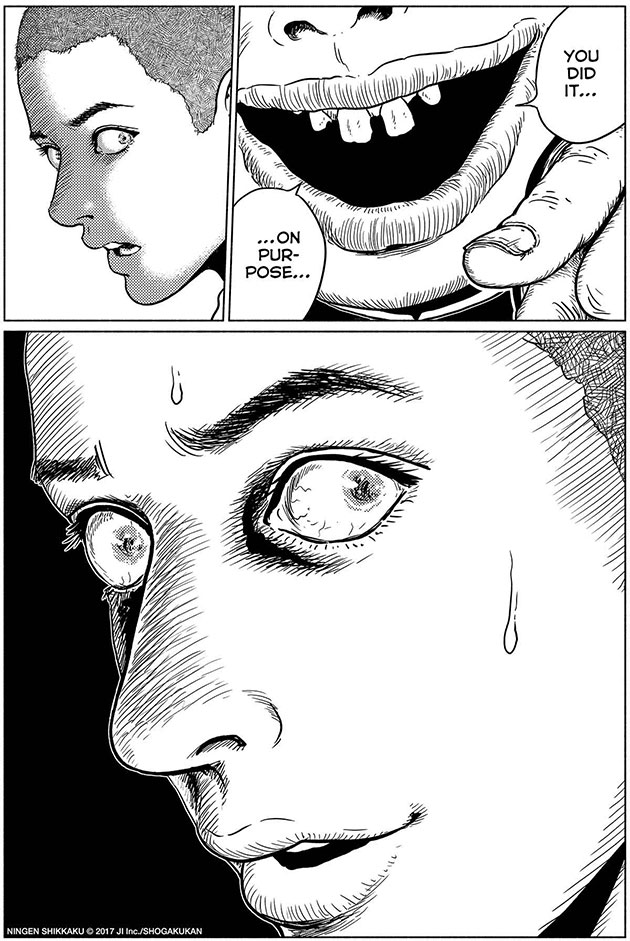
As one might guess from this passage, Yozo’s terror at being discovered is another critical juncture in the novel. “I felt as if I had seen the world before me burst in an instant into the raging flames of hell,” he reports, before embarking on a campaign to win Takeichi’s trust by “cloth[ing his] face in the gentle beguiling smile of the false Christian.” Though Ito can’t resist the temptation to draw an image of Yozo engulfed in hell fire, most of Yozo’s fear is conveyed in subtler ways: a wary glance at Takeichi, an extreme close-up of Yozo’s face, an awkwardly placed arm around Takeichi’s shoulder:

What happens next in Ito’s version of No Longer Human, however, is indicative of another problem with his adaptation: his decision to add new material. In Dazai’s novel, Takeichi simply disappears from the narrative when Yozo moves to Tokyo for college, but in Ito’s version, Yozo cruelly manipulates Takeichi into thinking that Yozo’s cousin Setchan is in love with him—a manipulation that ultimately leads to Takeichi’s humiliation and suicide. That violent death is followed by a gruesome murder, this time prompted by a love triangle involving Yozo, his “auntie,” and Setchan, who becomes pregnant with Yozo’s child. Neither of these episodes deepen our understanding of who Yozo really is; they simply add more examples of how manipulative and callous he can be, thus blunting the impact of the real tragedy that unfolds in the late stages of his story.

Ito’s most problematic addition, however, is Osamu Dazai himself. Ito replaces the novel’s original framing device with the events leading up to Dazai’s 1948 suicide, encouraging us to view No Longer Human as pure autobiography through reinforcing the parallels between Dazai’s life and Yozo’s. And while those parallels are striking, the juxtaposition of the author and his fictional alter ego ultimately distorts the meaning of the novel by suggesting that the story documents Dazai’s own unravelling. That’s certainly one way to interpret No Longer Human, but such an autobiographical reading misses Dazai’s broader themes about the burden of consciousness, the nature of self, and the difficulty of being a full, authentic, feeling person in modern society.

VIZ Media provided a review copy. You can read a brief preview at the VIZ website by clicking here. For additional perspectives on Junji Ito’s adaptation, see Serdar Yegulalp‘s excellent, in-depth review at Ganriki.org, Reuben Barron‘s review at CBR.com, and MinovskyArticle’s review at the VIZ Media website.

JUNJI ITO’S NO LONGER HUMAN • ORIGINAL NOVEL BY OSAMU DAZAI • BASED ON THE ENGLISH TRANSLATION BY DONALD KEENE • TRANSLATED AND ADAPTED BY JOCELYNE ALLEN • VIZ MEDIA • RATED M, FOR MATURE AUDIENCES • 616 pp.

Filed Under: Manga, Manga Critic, REVIEWS Tagged With: Junji Ito, no longer human, Osamu Dazai, VIZ, VIZ Signature

Pick of the Year: It Was a Very Good Year

December 23, 2019 by Sean Gaffney, Michelle Smith, Ash Brown, Katherine Dacey and Anna N 1 Comment

MICHELLE: When declaring a pick of the year, I feel some self-induced pressure to choose something highbrow, but the fact is that the the title that I loved the most, cared about the most, was from Shounen Jump. And that, of course, is My Hero Academia. It’s fun, it’s funny, it’s got a lovable cast. It’s also got trauma, kids struggling with feelings of inadequacy, a great and gradual redemption arc for the protagonist’s childhood bully, and scenes that make one cry. I love it to bits.

SEAN: There’s a lot of titles I really loved this year (including MHA), but the one that caught my eye the most, as I said last week for Pick of the Week, was Our Dreams at Dusk. One of the best LGBTQ titles to hit these shores, it scores in characterization, art, mood, just about everything. It was simply amazing.

ASH: Our Dreams at Dusk really is a phenomenal series, and one of my top picks of the year, too. The other debut that made a big impression on me this year was the beautiful hardcover release of Moto Hagio’s The Poe Clan. It’s a marvelously dark and dramatic shoujo classic; I can definitely understand why it became such an influential work.

KATE: My favorite manga of 2019 was Taiyo Matsumoto’s gorgeous, weird, and trippy Cats of the Louvre, which is both a meditation on purpose of art, and a meditation on what it means to close the door on your childhood and face the uncertainty of being an adult. I’m still thinking about it more two months after I read it—something I can’t say about most of the books I read this year.

ANNA: My pick of the year is Witch Hat Atelier. It combines stunningly detailed art with classic world building, creating a manga that reminds me of fantasy stories I read as a child.

Filed Under: PICK OF THE WEEK

Pick of the Week: Still Dreaming

December 16, 2019 by Sean Gaffney, Michelle Smith, Katherine Dacey, Ash Brown, Anna N and MJ Leave a Comment

SEAN: An embarrassment of amazing stuff this week. I could choose any one of half a dozen books. But I’ll go with the 4th and final Our Dreams at Dusk, which has been such an amazing series. Recommended for everyone.

MICHELLE: I definitely look forward to reading Our Dreams at Dusk, but this week I’ll award my pick to Our Dining Table, which looks absolutely adorable. Seven Seas really is putting out some stellar titles these days!

KATE: I whole-heartedly agree with Sean: Our Dreams at Dusk is a genuinely moving story, told with nuance and grace. If the Manga Bookshelf team’s ringing endorsement isn’t enough to persuade you to read this series, check out Sean’s thoughtful reviews of volumes 1-3 at A Case Suitable for Treatment.

ASH: Wow! This week really is full of amazing releases, which makes it incredibly hard to choose just one as my pick. Our Dreams at Dusk is an incredible series, as is Vinland Saga and To Your Eternity. I’m also really looking forward to Our Dining Table and the debut of the previously unlicensable Saint Young Men. But the first thing that I’ll be reading – and therefore my pick this week – is Junji Ito’s manga adaptation of No Longer Human.

ANNA: I totally plan on reading Our Dreams at Dusk one day, and I’m excited for more Vinland Saga. The manga I’m most excited about reading this week though is Saint Young Men, I’ve been holding out for the print edition for a long time.

MJ: I’ve absolutely got Our Dreams at Dusk on my to-buy list, and I’m also pretty excited about Junji Ito’s No Longer Human, but like Anna, I’ve waited so long for a US print release of Saint Young Men, that just has to be my pick for the week.

Filed Under: PICK OF THE WEEK

Pick of the Week: Pick of the Seven Days

December 9, 2019 by Michelle Smith, Sean Gaffney, Ash Brown, Anna N, MJ and Katherine Dacey Leave a Comment

MICHELLE: Confident that MJwill choose Seven Days, I’ll instead cast my vote for the fifth volume of Farewell, My Dear Cramer. The best part about any sports manga is when the members of the team find the place they belong, and that’s beginning to happen here. Players who were formerly alone, or at least alone in the amount of love they had for soccer, are finally among like-minded individuals. I was a little unsure about this series at first, but now I’m fully hooked.

SEAN: My love for this series has been very variable, and there’s no question it ran too long, but I’ll go with Mission of Love’s final volume as my pick this week. Certainly if you pick one Ema Toyama series, this is the one to get.

ASH: While I’m very happy that Seven Days is getting a well deserved re-release, my pick this week goes to Gambling Apocalypse Kaiji. I really wasn’t expecting this series to be licensed, but I’m really looking forward to reading the original manga after greatly enjoying its anime adaptation. (Zawa zawa zawa…)

ANNA: I’m going to pick The Golden Sheep Volume 2, because I hope it will spur me to finally read the first volume.

MJ: I hate that I’m so predictable, but YES OF COURSE my pick this week is Seven Days: Monday-Sunday. I enjoyed this so much when it was originally released by DMP, and I’m thrilled to see it back again. Hurray!

KATE: I second Ash’s pick; I’ve been curious about Kaiji since Denpa made this licensing announcement in 2018, and am looking forward to finally getting to read it!

Filed Under: PICK OF THE WEEK

Pick of the Week: Old Friends And New

December 2, 2019 by Sean Gaffney, Ash Brown, Michelle Smith, Katherine Dacey, MJ and Anna N Leave a Comment

SEAN: There’s always an embarrassment of riches when it’s Viz week. That said, I can see no reason not to pick one of my favorite manga series of all time yet again. Yona of the Dawn is my pick.

ASH: Yona of the Dawn is a fine choice! (And one of my favorite shoujo series currently being released.) However, the debut I’m most curious about this week is Jujutsu Kaisen, also from Viz, so that’s what’ll get my official pick this week.

MICHELLE: I love Yona of the Dawn but since that’s covered I’ll go with volume 22 of My Hero Academia. Long have I wanted to get more of class 1-B and their various Quirks, as well as more Shinsou, and this arc of the manga delivers on both accounts.

KATE: Holy manga haul, Batman! I could recommend at least eight titles from this week’s new arrival list. If I had to narrow it down to just two, my nominations would be Drifting Dragons, a gorgeously illustrated adventure story about a team of whalers—er, dragon hunters—and the digital edition of Dream Fossil: The Complete Stories of Satoshi Kon, which I reviewed a few years ago.

MJ: There’s a lot of interesting stuff coming out this week, but since the rest of the Battle Robot seems to have it covered, I’ll speak up for Vertical’s 20th Anniversary Edition of Paradise Kiss. I’m not sure I’ll ever get over wanting more Ai Yazawa, but I’m also pretty sure that’s something I’ll have to content myself with wanting forever. Meanwhile, I love the fact that we’re repeatedly celebrating what’s already there.

ANNA: I can’t pick anything else other than Yona of the Dawn, it is such a great series.

Filed Under: PICK OF THE WEEK

Pick of the Week: Of Mice and Manga

November 25, 2019 by Michelle Smith, Sean Gaffney, Anna N, Katherine Dacey, Ash Brown and MJ Leave a Comment

MICHELLE: I have wanted to read The Cornered Mouse Dreams of Cheese for quite a few years, so to me there is really no other choice.

ANNA: Me too, I am excited for The Cornered Mouse Dreams of Cheese!

SEAN: I’m going with Seven Little Sons of the Dragon, which has an amazing cover and I love its author’s other series. Short story collection 4tw.

KATE: I feel like a Vegas gambler stumbling across an all-you-can-eat buffet after being on a losing streak: I just want to fill up my plate with as much delicious manga as possible! Any week that brings a new volume of Blank Canvas, a one-shot manga by Setona Mizuhiro, and a collection of short stories by Ryuko Kui is a good week in my book. If I had to pick just one title, though, it would be Akiko Higurashima’s Blank Canvas, a funny, insightful, and brutally honest look at how she became a manga artist; it’s the perfect antidote for the testosterone-fueled nonsense in Bakuman.

ASH: I’m going to echo everyone here, Blank Canvas, The Cornered Mouse Dreams of Cheese, and Seven Little Sons of the Dragon are all at the top of my list this week! It’s American Thanksgiving in a few days… no one minds if I take a couple extra helpings of manga picks, do they?

MJ: Even if I knew nothing about it, I’d pick The Cornered Mouse Dreams of Cheese based on the title alone. The fact that this is a much-anticipated title is just a bonus.

Filed Under: PICK OF THE WEEK

Pick of the Week: Beasts, Eldritch Horrors, and Cute Girls

November 18, 2019 by Sean Gaffney, Michelle Smith, Ash Brown, Anna N and Katherine Dacey 1 Comment

SEAN: Yes, yes, Beastars. (see other entries below) My pick this week is a double shot of the girl tormenting the boy she likes, as I’ll pick the 6th volume of Teasing Master Takagi-san and the debut of Don’t Toy with Me, Miss Nagotoro. I enjoy this genre.

MICHELLE: Sean’s got me pegged. It’s high time I get on the Beastars train and I shall start by making it my pick of the week.

ASH: Me, too. The first volume was great and the second volume was even better. I’m really looking forward to seeing how Beastars continues to develop!

ANNA: I’ll go for Beastars as well!

KATE: As one of six people in the mangasphere who didn’t like Beastars, I’m going to buck the tide and pick the second volume of Gou Tanabe’s adaptation of At the Mountain of Madness.

Filed Under: PICK OF THE WEEK

Short Takes: No Guns Life and Ryuko

November 12, 2019 by Katherine Dacey

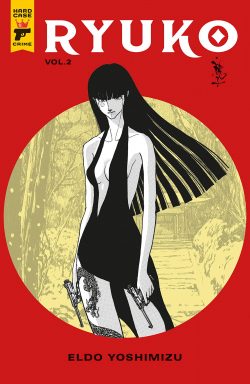
This month’s Short Takes column checks in with two previously-reviewed series: No Guns Life, a sci-fi thriller whose principled hero sounds like Sam Spade and looks like a Remington; and Ryuko, a thriller starring a yakuza assassin who’s hell-bent on avenging her mother’s kidnapping.

No Guns Life, Vol. 2
Story and Art by Tasuku Karasuma
Translation by Joe Yamazaki; Adaptation by Stan!
VIZ Media, 224 pp.
Rated T+ (Older Teens)

After a decent, if predictable, first volume, Tasuku Karasuma finds his groove in volume two of No Guns Life, maintaining a brisk pace while allowing his characters’ personalities to emerge more fully. Though the action occasionally pauses for the characters to expound on important plot developments, these dialogues are less of a drag on the story than they were in volume one; here, they add badly needed layers of  complexity to a familiar noir plot line. Better still, Karasuma introduces several new characters who push the narrative in a more interesting direction, hinting at the power and secrecy of the Berühen Corporation, as well as the general public’s mixed feelings about living alongside cyborgs. If Karasuma engages in a little too much fanservice, or relies too heavily on speedlines and sound effects to enliven his fight scenes, No Guns Life is still entertaining enough to make all but the most discriminating reader root for Juzo to succeed. Recommended.

VIZ Media provided a review copy. Click here to read my review of volume one.

Ryuko, Vol. 2
Story and Art by Eldo Yoshimizu
Translation by Motoko Tamamuro and Jonathan Clements
Titan Comics, 226 pp.
No rating (Best suited for older teen and adult readers)

Paging the exposition police! The second volume of Ryuko has all the swagger of the first, but leans more heavily into Talking Points Conversation to help expedite its resolution. In some respects, these exchanges are a welcome development, as they clearly—one might say baldly—delineate the various factions’ interest in the Golden Seal, an object whose significance was glossed over in volume one. These passages also help the reader untangle the complex web of relationships among the characters, making it easier to grasp why Ryuko forges an alliance with an avowed enemy and why US military forces are trying to manipulate the outcome of her feud with the Sheqing-Ban. These conversations would feel less forced if the pacing were more even, but the two-volume format is too compressed for such an ambitious, labyrinthine plot to unfold at a reader-friendly pace.

Volume two’s chief attraction is the same as volume one’s: the artwork. Eldo Yoshimizu has a flair for staging car chases, fist fights, gun battles, and dramatic escapes, immersing the reader in the action with his creative use of perspective and fastidious attention to detail; Ryuko’s leopard-print catsuit is practically a character in its own right. In less capable hands, this maximalist approach might be overwhelming, but Yoshimizu’s layouts have a strong narrative pull that leads the eye across the page at the speed of the action, creating an almost cinematic experience. The final confrontation between Ryuko and evil American operatives is a show-stopper involving a motorcycle stunt so outrageous that even Jackie Chan would be impressed with its audacity. None of the story makes much sense, but Yoshimizu’s energetic, bold, and—yes—sexy artwork is cool enough to carry the day. Recommended.

Click here to read my review of volume one. 

Filed Under: Manga, Manga Critic, REVIEWS Tagged With: Action/Adventure, Eldo Yoshimizu, No Guns Life, Ryuko, Sci-Fi, Titan Comics, VIZ, Yakuza

Pick of the Week: Mornings and Requiems

November 11, 2019 by Michelle Smith, Sean Gaffney, Anna N, Ash Brown, MJ and Katherine Dacey 1 Comment

MICHELLE: The final volume of Blue Morning comes out this week and, as I’ve enjoyed this more-complicated-than-usual BL series, both in terms of plot and characterization, I’m officially awarding it my pick of the week.

SEAN: Between Our Wonderful Days, A Tropical Fish Yearns for Snow, and the final volume of Kiss & White Lily for My Dearest Girl, I think my pick is for yuri this week.

ANNA: I’ve got to take the chance to celebrate Requiem of the Rose King.

ASH: There are so many releases I’m interested in this week! Requiem of the Rose King, Skull-Faced Bookseller Honda-san, and Delicious in Dungeon are a few of the ones at the top of my list, but since this the last time I can choose Blue Morning, I will join Michelle in making it my official pick.

MJ: I’m going to join Anna this week in once more celebrating Requiem of the Rose King! I’ll admit I’m a couple of volumes behind, but it’s always a pleasure to catch up with this series.

KATE: I only have eyes for one manga this week: Witch Hat Atelier.

Filed Under: PICK OF THE WEEK

A Few Thoughts About Stranger Things

October 31, 2019 by Katherine Dacey

Over the course of three seasons, Stranger Things has devolved from an engaging period piece to a Potemkin village whose neon surfaces, vintage movie posters, garish fashions, and spiral perms have displaced the heart, humor, and horror that made the first two seasons so compelling. The proof lies in the media’s response to the current season, as the New York Times and Vulture have breathlessly cataloged every cereal box and song cue that link Stranger Things to The Goonies and The Neverending Story. In choosing to fetishize the material and pop culture of 1980s, however, the Duffer brothers have neglected the capable team of actors who’ve been selling audiences on the idea that Hawkins is the epicenter of an inter-dimensional catastrophe, lavishing their creative energies instead on recreating that most 80s of artifacts: the mall.

Don’t get me wrong: the idea of a shopping mall concealing a portal to the Upside Down has subversive potential, but the Duffers are too invested in making sure that everything looks right to care whether their story has anything new or meaningful to say about Reagan-era consumer culture. We’re treated to numerous tracking shots of the mall itself, with the camera lovingly documenting the stores, food court, and movie theater as teenagers shop to the sounds of Madonna’s “Material Girl.” Perhaps most tellingly, the characters never really look like they’re at the mall; these scenes look like an 80s sitcom’s idea of what hanging out at the mall was like, right down to the cartoonish portrayal of teenage mating rituals and clique behavior.

Adding insult to injury is the poor writing. Most of the problems lie with the scriptwriters’ decision to lean into the angrier, more compulsive side of Hopper’s personality, with little thought of how his behavior might appear to audiences. Hopper bullies Mike, for example, rather than examining his own feelings about Mike and Eleven dating. These scenes are played for laughs—dads always want to “kill” their daughters’ boyfriends, right?—but the intensity of Hopper’s anger makes these scenes uncomfortable to watch. If anything, his anger is a potent reminder of season two’s biggest flaw: the unexamined way in which Hopper’s desperate, violent attempts to keep Eleven safe crossed a line between loving concern and possessiveness. (Yes, Hopper and Eleven’s relationship was even more egregious than the much-maligned Punk Rockers episode.)

The once poignant dynamic between Joyce and Hopper has also curdled into something sourly antagonistic. Though their first heart-to-heart conversation in Melvald’s is moving, conveying both Hopper’s insecurities and Joyce’s ambivalence towards Hopper as a romantic prospect, the relationship goes downhill from there. Hopper behaves like a boor when Joyce stands him up for a dinner date, even though Hopper had repeatedly stressed that he wasn’t asking her out. That scene might have played better if we were encouraged to see Hopper as entitled or insensitive, but instead Joyce becomes the villain in this scenario, a scatterbrain who’s so obsessed with proving that something awful is happening in Hawkins that she’d rather chat about magnets with a high school science teacher than split a bottle of Chianti with Hopper. The script then puts Hopper and Joyce in a strenuously unfunny holding pattern as they bicker in a manner that’s supposed to show how much they’re secretly attracted to one another. Ryder, whose fierce intensity was an asset in seasons one and two, is particularly unsuited to this kind of banter, overselling every comeback with too much mugging. Worse still, the dialogue is so flat that it barely registers as amusing, let alone flirtatious.

Perhaps the biggest failing of season three, however, are the monsters. Though there’s a genuine ick factor to the Mind Flayer’s new form, it looks too much like raspberry Jello-O to be the stuff of nightmares; only a gruesome scene in which hordes of rats spontaneously explode registers as horrific. Other potentially scary moments–Nancy confronting the Mind Flayer in a hospital ward, Billy being dragged into the Flayer’s den–are too self-consciously derivative of Alien to make much of impression on viewers familiar with the Duffers’ favorite pop-cultural touchstones. As a result, season three lacks a single scene that’s as unnerving as Barb’s disappearance, or as harrowing as Eleven’s visits to the astral plane, two of the defining moments of season one.

There are a few bright spots, thanks to the Duffers’ generous treatment of the supporting characters. Steve and Robin’s friendship, forged through insults and amateur sleuthing, adds some screwball zest to the proceedings, demonstrating Joe Keery and Maya Hawkins’ potential as romantic comedy leads; their scenes crackle with the kind of wit and energy that’s sorely missing from Hopper and Joyce’s ill-fated courtship. Noah Schapp continues to impress as Will, bringing soulful presence to a character who’s often pushed to the margins of his own story. As his friends pair off in season three, Schapp makes us feel Will’s contempt for Mike, Dustin, and Lucas, who’ve traded Dungeons & Dragons for trips to the mall and awkward dates; Schapp’s facial and body language capture his frustration and shame at being relegated to the status of uncool friend.

Alas, little else in season three of Stranger Things feels as honest or scary as Will’s dilemma. Most of season three registers as 80s fanservice with its on-the-nose needle drops and acid-washed fashion, with little sense of what it was actually like to be alive in the Reagan years. Unless the writing team figures out how to bring back the suspense and humor that made seasons one and two so irresistible, Stranger Things will continue to feel more like Goonies cosplay than a horror story that just happens to take place in the 1980s. Not recommended.

Seasons one through three of Stranger Things can be streamed on Netflix.

Filed Under: Manga Critic, Movies & TV, REVIEWS Tagged With: Stranger Things

Cats of the Louvre

October 30, 2019 by Katherine Dacey

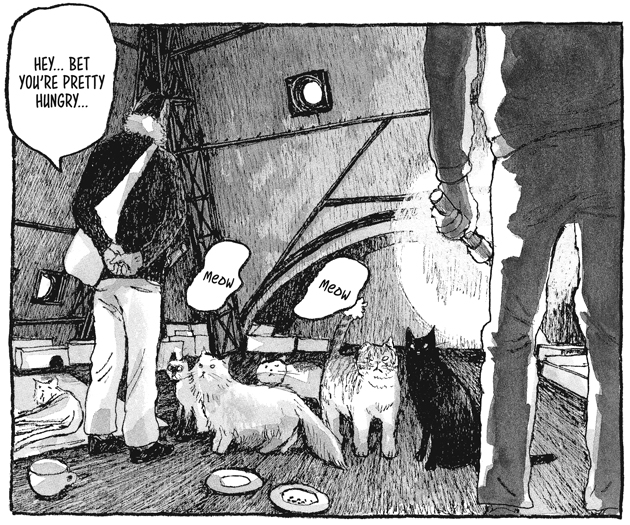
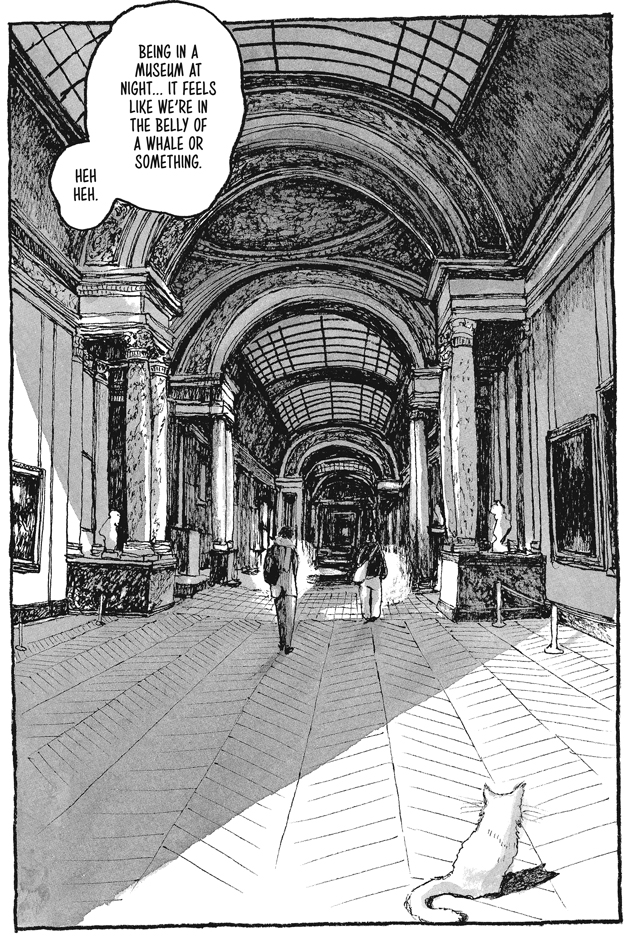
Weird. Uncanny. Melancholy. Beautiful. Those were just a few of the adjectives I jotted down while reading Taiyo Matsumoto’s Cats of the Louvre, the latest volume in the museum’s ongoing graphic novel series. Like Nicholas De Crécy’s Glacial Period and Jiro Taniguchi’s Guardians of the Louvre, Cats of the Louvre is less an illustrated guide to the museum than a story that happens to take place within its walls—in this case, the attic, where a colony of cats have taken up residence. Through a series of eighteen vignettes, Matsumoto gradually reveals that the cats’ primary caretaker—an elderly night watchman—has dedicated his life to searching the museum for his missing sister, who disappeared into one of the paintings when she was a child.

The key to finding Arrieta turns out to be Snowbébé, a kitten who frequently escapes from the attic to roam the galleries, hiding inside canvases to avoid detection. Snowbébé’s gift is both an essential plot point and an opportunity for Matsumoto to luxuriate in the smaller details of his favorite paintings, as is evident in a lovely, strange sequence that unfolds inside Henri Lerambert’s The Funeral Procession of Love (1580). From a modern viewer’s standpoint, Lerambert’s painting seems a little kitschy, with its parade of cherubs, poets, and philosophers strolling under the watchful eye of the goddess Diana:

Once Snowbébé steps into the painting, however, the landscape comes to life in unexpected ways: the flowers grin, the animals speak, and the laws of gravity disappear. In one brief but delightful sequence, for example, Snowbébé and Arrieta cavort across the ceilings and walls of a temple, while in another they board Diana’s chariot for a ride through the Milky Way. Yet for all the joyful (and weird) imagery, there’s a wistful quality to these two chapters, as Snowbébé slowly realizes that he cannot remain inside the Parade forever; his presence has disturbed the painting’s equilibrium, bringing storm clouds and disrupting the flow of time itself, forcing him to choose between staying with his new friend, or returning to the “cold and smelly and noisy” world of the Louvre.

What prevents Snowbébé’s odyssey from seeming twee or precious is Matsumoto’s studied primitivism; his characters’ mask-like faces, oddly proportioned bodies, and grotesque smiles are genuinely unnerving, creating a surreal atmosphere in which the boundaries between reality and imagination are blurred. Nowhere is this tendency more obvious than in the way he draws Snowbébé and his friends: the cats look like animals to their caretakers, but assume a humanoid form when interacting with each other. In Matsumoto’s hands, they look more like people in cat costumes than pussycats, with their essential feline features—ears, whiskers, tails, elongated limbs—rendered in an exaggerated fashion that gives them a faintly alien appearance.

Matsumoto’s depiction of the Louvre is more straightforward, recreating iconic works with fidelity to the originals, whether he’s drawing a lesser-known genre painting or a genuinely famous sculpture. His rendition of the physical environment—the claustrophobic, dusty garret where the cats live, the grand staircases and hallways that lead to the galleries—is similarly precise, helping the reader envision the sheer size and opulence of the museum. As a result, the Louvre transcends its basic function as a setting, taking on the qualities of a living, breathing organism whose vaulted ceilings and majestic columns invite comparisons with dinosaurs or whales:

And while all the comics in the Louvre Collection have done an admirable job of depicting the museum, Cats of the Louvre approaches its subject matter without didacticism or pedantry; though Matsumoto’s human characters express strong feelings about art, those conversations spring organically from the story. Equally important, Cats of the Louvre has its own personality; unlike Hirohiko Araki’s Rohan at the Louvre, which recycled ideas and characters from JoJo’s Bizarre Adventure, Matsumoto’s story stands on its own, capturing his unique response to the museum and its collection. But the best reason to read Cats of the Louvre is its hero Snowbébé, whose quest to find his place in the world invites us to see the Louvre through fresh eyes, as a place of danger and sadness, but also of wonder, magic, and possibility. Recommended.

A review copy was provided by VIZ Media. To read a short preview, click here.

CATS OF THE LOUVRE • STORY AND ART BY TAIYO MATSUMOTO • TRANSLATED BY MICHAEL ARIAS • RATING: TEEN • 432 pp.

Filed Under: Manga, Manga Critic, REVIEWS Tagged With: Cats, Louvre Museum, Taiyo Matsumoto, VIZ, VIZ Signature

Pick of the Week: It’s That Manga Again

October 28, 2019 by Michelle Smith, Sean Gaffney, MJ, Katherine Dacey, Ash Brown and Anna N 1 Comment

MICHELLE: There are some pretty interesting things coming out next week, namely the debut of another digital-only josei series from Kodansha Comics, but my heart belongs to volume six of The Night Beyond the Tricornered Window, which actually came out last week. I love this series so very much and am always excited when a new installment pops up. Because of its creepy atmosphere, the timing is just right, too!

SEAN: There’s quite a few things I like this week, but I’m going to go with good old Silver Spoon, because I love it and it is wonderful.

MJ: I was surprised to note that, in such a full week, the only thing on my Absolute Must Buy list is Silver Spoon. But also, YAY SILVER SPOOOOON! Seriously, I could not love this series more.

KATE: At the risk of sounding like a broken record, I am Team Silver Spoon 100%. It’s one of most consistently funny, honest, and gut-wrenching manga being published in English right now, and it deserves waaaaay more love and support from the mangasphere.

ASH: Silver Spoon really is a tremendous series! And so, for all of the reasons that everyone else has already outlined, it gets my pick. On top of that, I always get a little nostalgic reading the manga… it reminds me a lot of the people and places in my hometown growing up.

ANNA: I am feeling so guilty for not reading Silver Spoon yet, although I think I have a couple volumes stashed around my house. I’m not going to break the streak for pick of the week. I’m going to read the first volume this week for sure!

Filed Under: PICK OF THE WEEK

Pick of the Week: Manga Sweeter Than Wine

October 21, 2019 by Sean Gaffney, Michelle Smith, Katherine Dacey, Ash Brown, Anna N and MJ Leave a Comment

SEAN: A lean week, and my choices are a bit lean as well. As such, I’m fine with picking The Drops of God, which I may have picked before back in the day but now it’s digital and we have the first 11 books (or a planned 44!). Read with a nice glass of wine.

MICHELLE: Same here. It did have its ridiculous moments, but it was also pretty fun (and educational) and I was sad to see its release truncated (after a random time-jump volume). Hooray for its return!

KATE: After all these years, I’m excited to see who wins the contest to identify the “Drops of God” and the “Twelve Apostles.” (None are named John or Peter, FWIW.)

ASH: Ha! The Drops of God is definitely something to be excited about, even if it’s only a digital release. Print-wise, my pick of the week is the most recent volume of the fancy new edition of Berserk, which probably doesn’t surprise many.

ANNA: I’m always glad when good series get rescued, Drops of God for the win!

MJ: I’m going to add to this broken record here, by also declaring my excitement over the continuation of Drops of God!

Filed Under: PICK OF THE WEEK

Pick of the Week: Drifting Demons

October 14, 2019 by Ash Brown, Sean Gaffney, Michelle Smith, Katherine Dacey and Anna N 1 Comment

ASH: Portions of The Drifting Classroom have been out of print for some time, so I am thrilled that a new hardcover edition is being released. For those who appreciate horror manga, this series is a must. It’s an extremely intense work with dark psychological elements. Other great manga are being released this week, too, but this one is my pick.

SEAN: I acknowledge the brilliance of The Drifting Classroom while also wanting to stay the hell away from it. As a result, I’ll pick the new Dead Dead Demon’s Dededede Destruction, which continues to be fun to read even as I fear that it will end with the entire world dead.

MICHELLE: Dreamin’ Sun has reached its conclusion, and thus I feel a bit of a pang for not choosing it, but a new volume of Shojo FIGHT! comes out this week, and that’s simply more enjoyable to me.

KATE: No surprise here–my pick is Kazuo Umezu’s batshit classic The Drifting Classroom. The new VIZ edition is an essential addition to any horror manga fan’s library. On the fence? Here’s what I had to say about volume one.

ANNA: There’s a lot of great manga coming out this week, but I have to say my loyalty lies with Dead Dead Demon’s Dededede Destruction.

Filed Under: PICK OF THE WEEK

The Drifting Classroom Signature Edition, Vol. 1

October 13, 2019 by Katherine Dacey

In a 2009 interview with Tokyo Scum Brigade, Kazuo Umezu acknowledged that his debt to Osamu Tezuka went beyond storyboarding and character designs. Tezuka “didn’t pull any punches for children or dumb down his works,” Umezu explained. “He dealt with complicated themes and let the readers work it out on their own.” The 1972 classic The Drifting Classroom reveals just how profoundly Umezu absorbed this lesson. Though it ran in Weekly Shonen Sunday, a magazine aimed at grade schoolers, Umezu’s work was bleak, subversive, and weirdly thrilling, depicting a nightmarish world where kids resorted to violence and deception to survive.

The Drifting Classroom begins with a freak accident in which a rift in the space-time continuum sends the Yamato Elementary School and its occupants into the distant future. Initially, the students and teachers believe that they are the sole survivors of a devastating nuclear attack, and the area immediately surrounding the school supports their hypothesis: it’s a barren wasteland with no water, plants, or signs of human habitation save a pile or two or non-degradable trash. As the school’s occupants realize the severity of the crisis, panic sets in. Teachers and students engage in a brutal competition for dwindling supplies while attempting to solve the mystery of what happened to them. And when I say “brutal,” I mean it: the body count in volume one is astonishing, with murders, mass suicides, fist fights, knife fights, and rampaging monsters culling the herd at a breathtaking rate.

It’s sorely tempting to compare The Drifting Classroom to The Lord of the Flies, as both stories depict school children creating their own societies in the absence of adult authority. But Kazuo Umezu’s series is more sinister than Golding’s novel, as Classroom‘s youthful survivors have been forced to band together to defend themselves against their former teachers, many of whom have become unhinged at the realization that they may never return to the present. Umezu creates an atmosphere of almost unbearable dread that conveys both the hopelessness of the children’s situation and their terror at being abandoned by the grown-ups, a point underscored by one student’s observation that adults “depend on logic and reason to deal with things.” He continues:

When something happens and they can’t use reason or logic to explain it, they can’t handle it. I don’t think they were able to accept that we’ve traveled to the future. You know how adults are always saying that kids are making things up? It’s because they only know things to be one way. Kids can imagine all kinds of possibilities. That’s why we’ve managed to survive here.

That speech is delivered by The Drifting Classroom‘s plucky protagonist Sho, a sixth grader who becomes the children’s de facto leader. When we first meet Sho, he’s behaving petulantly, pouting over his mother’s decision to throw away his marbles. The intensity of his anger is drawn in broad strokes, but it firmly establishes him as an honest-to-goodness ten year old, caught between his desire to play and his parents’ desire to mold him into a responsible teenager. Once transported to the future, Sho’s strategies for scavenging supplies or subduing a rampaging teacher are astute but not adult; there are flourishes of imagination and kid logic guiding his actions that remind us just how young and vulnerable he is. As a result, Sho’s pain at being separated from his parents, and of losing his comrades, is genuinely agonizing.

Umezu’s artwork further emphasizes the precarity of Sho’s situation. Sho and his classmates have doll-like faces and awkwardly proportioned bodies that harken back to Umezu’s work for shojo magazines such as Sho-Comi and Shoujo Friend, yet their somewhat unnatural appearance serves a vital dramatic function, underscoring how small they are when contrasted with their adult guardians. The adults, on the other hand, initially appear normal, but descend into monstrous or feckless caricatures as their plight becomes more desperate. Only Sho’s mother—who is stuck in the present day—escapes such unflattering treatment, a testament to her devotion, courage, and imagination; while her husband and friends have accepted the official story about the school’s fate, Sho’s mother is open to the possibility that Sho may be reaching across time to communicate with her.

Like his character designs, Umezu’s landscapes are willfully ugly, evoking feelings of disgust, fear, and anxiety that are almost palpable, whether he’s drawing an abandoned building or a garden filled with grotesquely misshapen plants. The area just outside the school gates, for example, resembles the slopes of an active volcano, with sulfurous clouds wafting over a rocky expanse that seems both frozen and molten—an apt metaphor the characters’ state of mind as they first glimpse their new surroundings:

Though The Drifting Classroom‘s imagery still resonates in 2019, its gender politics do not, as an egregious subplot involving a sadistic girl gang demonstrates. When the gang attempts to seize control of the school, a classmate urges Sho to oppose them on the grounds that girls are fundamentally unsuited for leadership roles. (“Women are made to give birth and rear children so they can’t think long term,” Gamo helpfully opines.) Umezu’s goal here, I think, is to suggest that girls are as capable of violence and cruelty as boys, but the dialogue suggests the gang’s behavior is a symptom of innate irrationality instead of a genuine and logical response to a desperate situation. Making matters worse is that the few sympathetic female characters are consigned to stereotypically feminine roles that give them little to do besides scream, run, and comfort the younger children; even Sakiko, the smartest girl in the class, never gets a chance to solve a problem or offer a useful opinion.

Yet for all its obvious shortcomings, The Drifting Classroom is a thoughtful meditation on adult hypocrisy, exposing all the ways that adults manipulate and terrorize children for their own convenience. “Adults are humans, children are animals,” a cafeteria worker tells Sho and his friends. “That’s why adults have the power of life and death over kids.” That Sho and his followers cling to their humanity despite the adults’ selfish behavior reminds us that children are innocent but not naive; Sho and his friends are clear-eyed about their teachers’ failings, yet choose to persevere. Recommended.

This is a greatly expanded–and reconsidered–review of The Drifting Classroom that appeared at PopCultureShock in 2006. VIZ Media provided a review copy. Read a free preview here.

THE DRIFTING CLASSROOM, VOL. 1 • STORY AND ART BY KAZUO UMEZZ • TRANSLATED BY SHELDON DRZKA • ADAPTED BY MOLLY TANZER • RATED T+, FOR OLDER TEENS (VIOLENCE, HORROR, GORE) • 744 pp.

Filed Under: Manga, Manga Critic, REVIEWS Tagged With: Classic Manga, Drifting Classroom, Horror/Supernatural, Kazuo Umezu, VIZ, VIZ Signature

  • « Go to Previous Page
  • Page 1
  • Interim pages omitted …
  • Page 25
  • Page 26
  • Page 27
  • Page 28
  • Page 29
  • Interim pages omitted …
  • Page 89
  • Go to Next Page »
 | Log in
Copyright © 2010 Manga Bookshelf | Powered by WordPress & the Genesis Framework