• Skip to primary navigation
  • Skip to main content
  • Skip to primary sidebar
  • Home
  • About Us
    • Privacy Policy
    • Comment Policy
    • Disclosures & Disclaimers
  • Resources
    • Links, Essays & Articles
    • Fandomology!
    • CLAMP Directory
    • BlogRoll
  • Features & Columns
    • 3 Things Thursday
    • Adventures in the Key of Shoujo
    • Bit & Blips (game reviews)
    • BL BOOKRACK
    • Bookshelf Briefs
    • Bringing the Drama
    • Comic Conversion
    • Fanservice Friday
    • Going Digital
    • It Came From the Sinosphere
    • License This!
    • Magazine no Mori
    • My Week in Manga
    • OFF THE SHELF
    • Not By Manga Alone
    • PICK OF THE WEEK
    • Subtitles & Sensibility
    • Weekly Shonen Jump Recaps
  • Manga Moveable Feast
    • MMF Full Archive
    • Yun Kouga
    • CLAMP
    • Shojo Beat
    • Osamu Tezuka
    • Sailor Moon
    • Fruits Basket
    • Takehiko Inoue
    • Wild Adapter
    • One Piece
    • After School Nightmare
    • Karakuri Odette
    • Paradise Kiss
    • The Color Trilogy
    • To Terra…
    • Sexy Voice & Robo
  • Browse by Author
    • Sean Gaffney
    • Anna Neatrour
    • Michelle Smith
    • Katherine Dacey
    • MJ
    • Brigid Alverson
    • Travis Anderson
    • Phillip Anthony
    • Derek Bown
    • Jaci Dahlvang
    • Angela Eastman
    • Erica Friedman
    • Sara K.
    • Megan Purdy
    • Emily Snodgrass
    • Nancy Thistlethwaite
    • Eva Volin
    • David Welsh
  • MB Blogs
    • A Case Suitable For Treatment
    • Experiments in Manga
    • MangaBlog
    • The Manga Critic
    • Manga Report
    • Soliloquy in Blue
    • Manga Curmudgeon (archive)

Manga Bookshelf

Discussion, Resources, Roundtables, & Reviews

Ash Brown

Pick of the Week: My Love Story!!

June 30, 2014 by Sean Gaffney, Ash Brown, Michelle Smith, Anna N and MJ 1 Comment

mylovestory1SEAN: There’s one obvious title that really leaps out this week: My Love Story!!. Anything from the High School Debut creator is worth a read, the premise sounds terrific, and even the cover is funny. Can’t wait for more silly shoujo.

ASH: My Love Story!! is my obvious pick this week as well. I haven’t read High School Debut, but thanks to an early shipment I’ve already read the first volume of My Love Story!!. It may very well be one of my favorite debuts of the year; I loved it.

MICHELLE: I have proclaimed my love for High School Debut for a long time, so I am beyond excited for My Love Story!!.

ANNA: I’m not going to go against the general trend here. I’m also looking forward to My Love Story!!

MJ: It was Michelle who hooked me on High School Debut several years ago, and it’s been a while since I’ve gleefully anticipated a new shoujo series to this extent, so you can count me on board for My Love Story!! as well!
What looks good to you this week?

Filed Under: PICK OF THE WEEK

Cage on the Sea

June 29, 2014 by Ash Brown

Cage on the SeaAuthor: Kaoru Ohno
Translator: Giles Murray
U.S. publisher: Bento Books
ISBN: 9780983951384
Released: March 2014
Original release: 1998

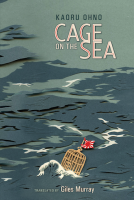
Cage on the Sea is the first book by Kaoru Ohno to be translated and released in English. The novel, originally published in Japan in 1998, was released in English by Bento Books in 2014 with a translation by Giles Murray. It was Bento Books’ involvement that brought Cage on the Sea to my attention. Though he has written novels, Ohno is primarily known as a journalist and as an author of nonfiction works with a particular emphasis on Japanese military history and World War II. Cage on the Sea suits Ohno’s interests perfectly. Based on a true story and meticulously researched, Cage on the Sea is about a group of Japanese holdouts on Anatahan, a remote island in the Marianas, and their eventual repatriation after World War II. Their tale of survival was sensationalized by the mass media in the 1950s and has served as an inspiration for various other films and novels in addition to Ohno’s Cage on the Sea. Though once a well-known story, more than fifty years later relatively few people are as familiar with this particular history of Anatahan.

In 1944 three Japanese ships–the Hyosukemaru, Akebonomaru, and Kaihomaru–were destroyed by American air raids on the Mariana Islands, stranding the surviving crew on the sparsely populated island of Anatahan. They expected reinforcements and rescue to follow soon afterwards, but days, weeks, months, and eventually years passed before they would leave the island. Initially sheltered by employees of the South Sea Development Company supervising copra production on Anatahan, the more than thirty men quickly exhausted the food stores and supplies meant for less than a handful of people. With resupply increasingly unlikely and with the continued bombardment by the Americans, the group fled for the island’s forested interior, doing their best to survive off of the land by foraging and growing what they could and by capturing lizards and bats for food. After the war in 1950, James B. Johnson, a United States naval commander, began attempts to peacefully remove the Japanese holdouts from the island, hoping to prevent additional casualties on both sides. But by that point, due to injury, disease, and infighting, only twenty men and a single woman, Kazuko Higa, were still alive.

Despite the multitude of named characters (all of whom are based on actual people), Cage on the Sea primarily follows the perspectives of three men: Lieutenant Commander Johnson, Sugataro Nakai, a seaman aboard the Hyosukemaru and a balladeer, and Seargent Junzo Itami of the Kaihomaru, the highest ranking member of the Japanese military present on Anatahan. But the person with the most vital role in Cage of the Sea, the focus to the point of obsession for many of the men and the reason for so much of the group’s conflict and strife, is Kazuko Higa. Johnson’s account actually provides the framing story for the novel, looking back on the events surrounding the repatriation of the Anatahan holdouts from the perspective of his retirement. In particular, he wonders what has become of Higa. Nakai and Itami’s narratives deal more specifically with the efforts to survive on a nearly uninhabited island for seven years, capturing the constantly shifting social dynamics and alliances among the group–a mix of civilians, seamen and fishermen, and enlisted men.

Frequently, Cage on the Sea almost feels as though it’s a documentary. Ohno has put a tremendous amount of research into the work, motivated by the question of what it must have been like to have lived and survived from one day to the next on Anatahan Island for all of those years. He read the memoirs of Michiro Maruyama, one of the survivors; he spoke with and interviewed the holdouts and those who knew them; perhaps most importantly, he gained access to Johnson’s personal archives and to the materials recording the efforts to peacefully rescue the Japanese from Anatahan. Prior to the Anatahan mission, holdouts who resisted surrender were met with force. Johnson’s innovative approach unquestionably saved lives. In the end, Cage on the Sea is a novel, so to some extent the events and key players have been fictionalized and dramatized–but Ohno treats the story with realism, sympathy, and respect, avoiding sensationalism and presenting a much more nuanced version of the events and the people involved than had previously been seen.

Filed Under: REVIEWS Tagged With: Bento Books, Kaoru Ohno, Novels

Random Musings: Two from Tagame

June 27, 2014 by Ash Brown

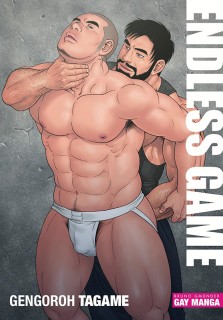
Endless GameGengoroh Tagame is an extraordinarily important creator of gay erotic art and manga. He is extremely influential in Japan, but his talent is also recognized worldwide. Tagame’s work has been published in French, Spanish, and Italian, but it wasn’t until 2012 that any of his manga received an English-language release when “Standing Ovations” was collected in the third issue of the erotic comics zine Thickness.

There was a persistent rumor that Tagame didn’t want his work to be published in English, which may have been one of the reasons it took so long for a major release of Tagame’s manga to emerge. Happily, that rumor was unfounded and not at all true; 2013 saw the publication of The Passion of Gengoroh Tagame: The Master of Gay Erotic Manga, which collected stories from over a decade of Tagame’s output.

In part, The Passion of Gengoroh Tagame and the efforts of its editor Graham Kolbeins and its producer and translator Anne Ishii led to the establishment of Massive, a line of apparel and goods inspired by gay manga (and especially by the work of Tagame and Jiraiya). Massive also imports, produces, and translates gay manga and collaborates directly with creators of gay Japanese art and comics. I’m very much looking forward to Massive and Fantagraphics’ release of Massive: Gay Erotic Manga and the Men Who Make It in late 2014 which will include interviews, photography, essays, illustrations, and manga. Tagame will be one of the nine artists featured in the volume.

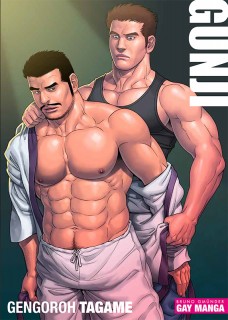
The publication of The Passion of Gengoroh Tagame may have also helped to open the doors for the German publisher Bruno Gmünder to release two more collections of Tagame’s work in English: Endless Game and Gunji. Bruno Gmünder specializes in high quality releases of gay fiction, nonfiction, comics, art, and photography, so Tagame’s manga fits the publishing house perfectly. In addition to the manga themselves, the volumes also include color illustrations by Tagame. Endless Game and Gunji are the first volumes in Bruno Gmünder’s Gay Manga line of comics. 2014 will also see the release and English debuts of works by Takeshi Matsu and Mentaiko Itto, as well as one of Tagame’s most recent manga, Fisherman’s Lodge. Tagame was also included in Bruno Gmünder’s 2014 artbook Raunch.

Interestingly enough, Bruno Gmünder’s release of Endless Game was actually the volume’s world debut. The English-language edition of Endless Game was published in 2013, while the Japanese edition of the manga wasn’t collected until 2014. Endless Game originally began serialization in 2009 and was completed in 2012. I was particularly interested in the volume because prior to its publication I had only had the opportunity to read selections of Tagame’s short manga; all one-hundred-seventy-six pages of Endless Game are devoted to a single story about a young jock named Akira and his descent into prostitution.

GunjiTagame is particularly well-known for the hardcore BDSM themes found in his manga and artwork and he doesn’t shy away from rape scenarios in his work. The sex in Endless Game however, while still being hardcore and exceptionally explicit, is entirely consensual. Granted, Akira might not be aware of the extent to which he is being manipulated. But everything that he does, all of the filthy and degrading acts in which he participates, he does so willingly. Akira has an insatiable sexual appetite and even when he is being taken advantage of, he revels in it. There is still power play and intense sexual scenarios in Endless Game, but the extreme brutality seen in some of the shorter manga collected in The Passion of Gengoroh Tagame is missing, making this volume more approachable as a whole to a wider audience.

Gunji collects two of Tagame’s earlier works: the Gunji tetralogy (“Gunji,” “Scars,” “Flash Rain,” and “Pyre”), which was serialized between 2002 and 2003, as well as a slightly revised version of “The Ballad of Ôeyama” from 2004. Both of those manga had previously been released in Japanese and in French before the English translation was published in 2014. The Gunji series was serialized in the Muscle Man manga magazine. The anthology became a crossover of sorts between boys’ love and gay manga and attracted both female and male readers and creators. Because of this, Tagame deliberately incorporated more boys’ love-esque elements into the story. The men, while still very masculine, have considerably less body hair compared to some of his other works. “Gunji” was initially written as a one-shot story, but proved to be popular enough that Tagame followed it up with a serialized prequel. Whereas sex drove the plot in Endless Game, in the Gunji manga the plot drives the sex. The titular Gunji is a skilled sushi chef who is tormented by the sadistic son of his late master, whom he loved.

“The Ballad of Ôeyama” is a historical period piece set in 10th-century Japan. The short manga was inspired by the military commander Minamoto no Yorimitsu (also known as Raikō) and the legend of the oni Shuten Douji. In the afterword, Tagame notes that “The Ballad of Ôeyama” was also greatly influenced by Osamu Tezuka’s 1969 manga General Onimaru which he enjoyed reading as a child. (Even Tagame is influenced by Tezuka!) Raikō and two of his followers are sent to quell a demon which has been terrorizing the people of Ôeyama but find themselves captured instead. The demon, it turns out, is a shipwrecked foreigner who after being shunned for so long desires human contact and forcibly takes Raikō. Tagame’s reinterpretation of the Shuten Douji myth is spun into a surprisingly romantic tragedy. As with the Gunji tetralogy, while the erotic content is certainly important to “The Ballad of Ôeyama,” the story itself seems to take slightly more precedence in the development of the manga. Granted, Tagame himself would be the first to admit that his work is pornography and he is very candid about that fact. But one of the things that I appreciate the most about Tagame’s manga is that in addition to being gorgeously and viscerally drawn they also have interesting narratives and compelling psychological elements.

Filed Under: FEATURES Tagged With: Bruno Gmünder, Gay Manga, Gengoroh Tagame, manga

Manga the Week of 7/2

June 26, 2014 by Sean Gaffney, Ash Brown, MJ, Michelle Smith and Anna N 3 Comments

SEAN: It’s not QUITE as bad as last month’s pile, but there’s a ton of things out the first week in July. Let’s to’t.

Dark Horse continues to give us omnibuses showcasing Lone Wolf & Cub in larger trim size and far more pages. Here’s the fifth.

ASH: Excellent! I’ve been needing to do a binge read of Lone Wolf & Cub and the omnibuses make that much easier.

MJ: I’m always happy to see more of these!

SEAN: Six volumes is an awfully long time for a Blue Sheep Reverie from DMP. Maybe the sheep should come out of it soon.

MICHELLE: *snerk* I actually kind of liked this one—at least it tried to have a plot—but just sort of drifted away from it. I’m glad it continues to exist.

SEAN: And another ‘we’re not just BL!’ title from DMP, as they put out the first volume of seinen dog-focused manga Kinokoinu – Mushroom Pup, which runs in Comic Ryu (home of A Centaur’s Life), and involves a man who can’t get over the death of his pet dog.

MJ: That sounds… heartbreaking.

Seven Seas has a quartet of titles dropping. Knight’s Knowledge is a Country of Clover title from the Alice franchise. It stars Ace. I’ve found titles where Ace is supporting are much better than titles starring him, but maybe this will be different.

ANNA: It probably says something about me that Ace is my favorite because he is so murderous. I haven’t read any of his solo titles, maybe I will give this a try.

arpeggio1

The new series from SS this month is Arpeggio of Blue Steel, which runs in Young King Ours, home of Excel Saga and Hellsing. I warn you in advance, this is another ‘sentient warfare/battleships shown as cute girls’ series. That said, I’ve heard this one is a slight cut above the usual fare, so we’ll see what it brings to the table.

Haganai is a popular series, both here and in Japan, so it makes sense that we’d see a few of the spinoff manga. Now With 50% More Fail is apparently filled with cute comedic one-shots that don’t impact the plot (such as it is).

Lastly, The Sacred Blacksmith continues to nudge its way forward towards its own main plot, here with Vol. 5.

Flowers of Evil 10 is a good 3 volumes over what I expected it to be, but hey, more creepy arty manga is always welcome, even if I dropped the series ages ago. Others here like it, right?

ASH: I do, indeed! The series seems to get better and better with each arc.

MJ: Indeed!

SEAN: The rest is Viz. They’re still giving readers of D.Gray-Man a chance to see it again, with the 4th 3-in-1 due out.

Demon Love Spell features what I believe is the 6th and final volume, and therefore I suspect will finally have a love scene that takes place in the *real* world, unless Mayu Shinjo has been corralled by the Margaret editorial department.

MICHELLE: Will Miko become more powerful than her dad and break his spell so she can get it on with her boyfriend?!

ANNA: I think this is the series where Shinjo effectively blends the sexy angst that was the trademark of her earlier series like Sensual Phrasewith the comedy stylings of Ai Ore. I’ve really enjoyed this series, and I hope Viz has another Shinjo series waiting in the wings.

MJ: I have fallen behind on this series, and am feeling very regretful!

SEAN: Midnight Secretary is almost over, this being the penultimate volume, so no doubt things will get far more serious and dangerous for our vampire and human couple.

ANNA: EEEEEEEE, Midnight Secretary!!!!!!!!

MJ: Heeeeee.

mylovestory1

SEAN: Viz’s new shoujo series, My Love Story!!, is one I’ve been looking forward to. By the author of High School Debut, it’s about a guy who longs for a shoujo romance (and this is a shoujo title), despite looking like your typical big, burly, not bishonen at all guy. His struggle begins here.

MICHELLE: I am looking forward to this so much!

ANNA: This sounds great. Planning on picking this up!

ASH: My copy arrived early and I’ve already read it and I loved it and Takeo is the best!

MJ: I am so on board with this.

SEAN: Naruto hits Vol. 66. Be careful! That’s the Third Cousin Once Removed of the Beast!

Nisekoi drops the print volume of Vol. 4. Will it continue to juggle the girls it has, or add a new one to the mix? The eternal question of every harem title.

Phantom Thief Jeanne has Vol. 3, and I suspect things will get even more serious soon, given we’re just about halfway through this omnibus-ish rerelease.

MICHELLE: I’m enjoying this quite a lot.

ANNA: This is my favorite Tanemura series. I’m glad it is getting reissued with an updated translation.

SEAN: Speaking of omnibuses, though not ish in this case, Skip Beat! has its 8th omnibus pop up as well.

MICHELLE: Yay, Skip Beat! Now if only the next standalone volume would hurry up and come out!

ANNA: Skip Beat! is the best.

SEAN: Sweet Rein comes to an end with its third volume, ending inappropriately enough in mid-summer. Expect more Santa and reindeer antics.

ANNA: This was sweet and cute, if not very deep.

MJ: I can’t say that I’m sad to see it go. Does that make me a grinch?

SEAN: Lastly, there is a Yu-Gi-Oh Zexal 5, which I can’t even make jokes about. Here it is, Yu-Gi-Oh fans.

What’s tickling your fancy?

Filed Under: FEATURES, manga the week of

Manga Giveaway: Juné Manga Giveaway (Flutter)

June 25, 2014 by Ash Brown

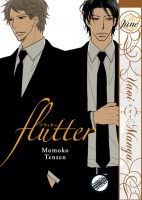
The end of June is almost here, which means it’s time for Experiments in Manga’s monthly manga giveaway. And, because it’s June, I thought that I would hold a Juné manga giveaway. (I can’t help it, the wordplay amuses me.) This month (almost) everyone has an opportunity to enter for a chance to win a copy of Momoko Tenzen’s boys’ love one-shot Flutter! The giveaway is open worldwide, but if boys’ love and yaoi is illegal in your country, please don’t participate. (Sorry!) You must also be at least eighteen years of age for this particular giveaway.

Flutter

Last year I received a request to do a Juné manga giveaway. I actually do take requests, for giveaways as well as for reviews, though it might take some time for me to be able to follow through. Still, a Juné manga giveaway was something that I was pretty sure I could make happen. Juné is one of Digital Manga’s boys’ love imprints, taking its name from Japan’s earliest boys’ love magazine June. It’s also one of Digital Manga’s largest imprints with currently over four hundred manga and novels in its catalog. Juné’s first title, Satoru Kannagi and Hotaru Odagiri’s Only the Ring Finger Knows, was released in August 2004, which means the imprint will be celebrating its tenth anniversary very soon. With so many Juné manga to choose from, and with so many that I’ve immensely enjoyed, I had a difficult time picking just one to give away. After putting some thought into it, I finally settled on one of the imprint’s newer one-shot manga that I’ve read recently: Momoko Tenzen’s Flutter. It’s an enjoyable volume with endearing characters and a slowly, quietly developed, slightly awkward romance between two grown men. Plus, one of them happens to be legitimately, and openly, gay. This isn’t particularly common in many of the boys’ love manga that have been translated, so it always makes me happy to see.

So, you may be wondering, how can you win a copy of Flutter?

1) In the comments below, tell me a little about your favorite Juné manga, if you have one. (And if you don’t, simply mention that.)
2) If you’re on Twitter, you can earn a bonus entry by tweeting about the contest. Make sure to include a link to this post and @PhoenixTerran (that’s me).

It’s as easy as that! For this giveaway, each person can earn up to two entries and has one week to submit comments. Entries may also be submitted via e-mail to phoenixterran(at)gmail(dot)com if you prefer or if you encounter problems trying to leave comments. (I will then post the entry in your name.) The giveaway winner will be randomly selected and announced on July 2, 2014. Good luck, and happy June!

VERY IMPORTANT: Include some way that I can contact you. This can be an e-mail address, a link to your website, Twitter username, or whatever. If I can’t figure out how to get a hold of you and you win, I’ll just draw another name.

Contest winner announced–Manga Giveaway: Juné Manga Giveaway Winner

Filed Under: FEATURES Tagged With: manga, Momoko Tenzen

Pick of the Week: Favorites & Fallbacks

June 24, 2014 by Ash Brown, Sean Gaffney, MJ, Anna N and Michelle Smith 2 Comments

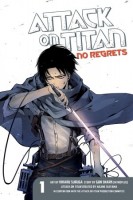
potwASH: Despite the variety of the manga being released this week, there aren’t many that I’m actively following with one exception: the debut volume of Attack on Titan: No Regrets (which I was happy to receive an early copy for review). Currently the only explicitly shoujo version of Attack on Titan, the series is the origin story of two of the most popular (and possibly most frequently shipped) characters, Erwin and Levi. It’s also pretty great; I’m looking forward to reading the next and final volume.

SEAN: No Regrets is excellent, but since it’s been picked, I’ll go with the new Sword Art Online:Fairy Dance manga volume. An adaptation of the novel due out in December, it’s apparently quite divisive, adding a harem element back to the story after being theoretically removed when Kirito and Asuna got together, and placing Asuna out of the action for a good chunk. We will see what it can bring to the table.

MJ: I’m firmly with Sean this week. Though I’m looking forward to the novel with more verve, I’m still interested in the manga adaptation of Sword Art Online: Fairy Dance. The second arc is likely to prickle my inner feminist somewhat, much as its anime adaptation did, but I like these characters and am looking forward to seeing how they are handled by the manga.

ANNA: I have to admit, there isn’t that much that appeals to me that is coming out this week. So I’ll go with one of the manga that’s on the top of my “to-read” pile, Vinland Saga Volume 3! What warm June day isn’t improved by manly Vikings pillaging things?

MICHELLE: I’m in the same boat as Anna this week, so I’ll go back a couple of weeks and pick one I skipped in favor of Tiger & Bunny—the second volume of Say I Love You.. I’ve enjoyed these new shoujo series from Kodansha, and this is what’s presently on top of my to-read pile.

What looks good to you this week?

Filed Under: PICK OF THE WEEK

My Week in Manga: June 16-June 22, 2014

June 23, 2014 by Ash Brown

My News and Reviews

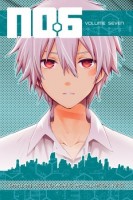
Well, it wasn’t entirely intentional, but both of my in-depth manga reviews from last week featured manga released by Kodansha Comics. I managed to get my hands on an early copy of Hikaru Suruga’s Attack on Titan: No Regrets, Volume 1, the first installment in a short shoujo series focusing on Erwin and Levi and their pasts. It’s a welcome addition to the Attack on Titan canon and I enjoyed it a great deal. The second review was of Hinoki Kino’s No. 6, Volume 7 which may very well be the best volume yet in the series; it’s intense. I’d still love to read the original novels, but I’m glad that the manga adaptation is being released. I also had a bonus post last week–Random Musings: Cherry Bomb, Cinderseed, and Skyglass. Cherry Bomb is the mature imprint of Chromatic Press. Cinderseed was released through Cherry Bomb and is the prologue to the illustrated novel Skyglass which debuted earlier this month. I’m absolutely loving what I’ve seen of Skyglass so far.

And speaking of great stuff from Chromatic Press, I encourage everyone to check out its Kickstarter to release Gauntlent in print. As for other interesting things found online: The fifth part of Revealing and Concealing Identities: Cross-Dressing in Anime and Manga was posted at The Lobster Dance and focuses on Takako Shimura’s Wandering Son. Sean has a roundup of the recent license announcements from Seven Seas at A Case Suitable for Treatment. The UK-based comics publisher Breakdown Press is launching a series of classic and avant garde manga in translation, starting with Seiichi Hayashi’s Flowering Harbour in July. And last but not least, I discovered manga brog a newish site which already has some extremely interesting content, like a translation of a conversation between Taiyo Matsumoto, Inio Asano, and Keigo Shinzo.

Quick Takes

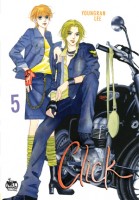
Click, Volume 5Click, Volumes 5-8 by Youngran Lee. The relationship dynamics in Click are exceptionally complicated, made more complicated by the fact that Joonha’s sex and gender are in flux. After spending sixteen years of his life physically and mentally as male, the fact that he now has a female body has presented some problems. Initially he tried to separate himself from those closest to him, but now they’re back in his life. For better and for worse, Joonha still hasn’t fully explained the situation or his peculiar genetic condition. Some people treat him as the boy he once was, others treat him as the girl he seems to be now. Surprisingly enough, Joonha seems to care less and less about gender, more or less ignoring it in order to focus on other aspects of life. (Which really is how it should be.) Click is extremely melodramatic, emotions run high, and the plot can occasionally take some absurd turns. Despite being somewhat of a jerk, most everyone seems to be in love with Joonha and those feelings are returned. As a result, the manhwa forms an extraordinary mess of romantic entanglements.

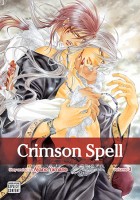
Crimson Spell, Volume 4Crimson Spell, Volumes 3-4 by Ayano Yamane. The first two volumes of Crimson Spell were originally released in English by Media Blasters. I was thrilled when SuBLime rescued the license; Crimson Spell is my favorite Yamane series, and there are relatively few boys’ love manga set in a sword and sorcery fantasy world. On rereading the series, I realized that I had forgotten just how funny it can be, too. Granted, the third volume takes a fairly serious turn when Halvir is captured and Vald must go to his rescue. The plot is getting more involved, more and more characters are introduced, and Vald’s curse and the bond between him and his demon self are growing stronger. Halvir and Vald desperately need to sort out their feelings for one another, a particular thorny issue since Vald has now discovered that Halvir has been taking great pleasure in satisfying the carnal needs of the demon without Vald’s knowledge (or consent). Understandably, Vald isn’t particularly happy to learn this. With all of the drama, magic, and sword fights, and all of the smut to go along with it, I’m still loving Crimson Spell.

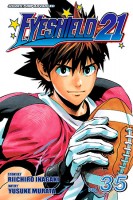
Eyeshield 21, Volume 35Eyeshield 21, Volumes 35-37 written by Riichiro Inagaki and illustrated by Yusuke Murata. These last three volumes of Eyeshield 21 feel like an afterthought to the series more than anything else. The Christmas Bowl is over, but with the Youth World Cup about to begin Japan needs to pull together its all-star team. Basically this final arc amounts to an excuse to bring all of the favorite characters from the various Japanese teams together one last time. Despite it being a world championship, Eyeshield 21 seems to have lost the sense of urgency and emotional investment that was present during the battles in the Christmas Bowl. In part this is probably due to the fact that most of the members of the other national teams are new to the series, so any established rivalries or histories are missing. As expected, the championship game in the Youth World Cup comes down to Japan versus America. It’s a good game, but I found it to be rather anticlimactic in the end. Still, Eyeshield 21 is a lot of fun and as always Murata’s artwork is fantastic. I mean, the image of Ceasar riding a dinosaur? That’s some great stuff there.

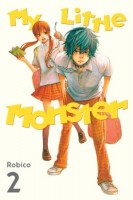
My Little Monster, Volume 2My Little Monster, Volume 2 by Robico. I’m quite enjoying My Little Monster. I particularly appreciate the series’ quirky, offbeat characters–a group of misfits with varying degrees of social awkwardness, ineptitude, and obliviousness. Shizuku is currently struggling to find the balance between her accidental friendships, her feelings towards Haru, and her studying, which had been the only thing in her life that had been constant. As for Haru, he’s starting to become more comfortable at school and around other people. But, though he means well, his more violent tendencies still cause some problems. Haru’s older brother is introduced in this volume and some of Haru’s troubled family life is revealed as well, adding some mystery and ominous undertones to what is generally a fairly lighthearted series. I like Robico’s dry sense of humor in My Little Monster. So far, the series has achieved a nice blend of more serious and more comedic elements. There are certainly some uncomfortable moments, but at this point the series has avoided becoming too heavy. I’m looking forward to reading more of My Little Monster.

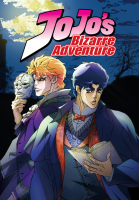
JJBATV1JoJo’s Bizarre Adventure directed by Kenichi Suzuki and Naokatsu Tsuda. The first season of the JoJo’s Bizarre Adventure television anime series covers the first two parts of Hirohiko Araki’s inter-generational action manga epic. Phantom Blood is adapted in a mere nine episodes but still manages to hit most of the major plot points and remains coherent despite its quick pace. The remaining seventeen episodes are devoted to the second story arc, Battle Tendency. While they both obviously belong to the same anime series, the individual parts have their own stylistic quirks in the music and animation that give each its own feel. Phantom Blood has a classically oriented soundtrack and palette while Battle Tendency introduces dubstep and bright, fluorescent colors. Some shortcuts were taken with the animation in order to keep to a budget, some of which are more effective than others. However, the story remains entertaining and engaging, a mix of horror, revenge, and intense battles and action with strong psychological elements. JoJo’s Bizarre Adventure can be, well, bizarre and over-the-top, but I’ll gladly admit that I get a huge kick out of it.

Filed Under: FEATURES, My Week in Manga Tagged With: anime, Ayano Yamane, Click, Crimson Spell, Eyeshield 21, JoJo's Bizarre Adventure, manga, manhwa, My Little Monster, Riichiro Inagaki, Robico, Youngran Lee, Yusuke Murata

Random Musings: Cherry Bomb, Cinderseed, and Skyglass

June 21, 2014 by Ash Brown

Cherry BombBack in April 2014, Chromatic Press announced Cherry Bomb, its new imprint for mature readers. The intent was to provide an outlet for Sparkler Monthly‘s creators to explore a sexier side of their already established characters and stories with a goal to include original, unrelated material in the future as well. Cherry Bomb’s coordinator Lianne Sentar probably sums it up best: “We want our erotica to be emotionally cathartic, with a purpose and meaning behind some smoking content. If it’s all smut and no context, that’s not good enough – we demand both!”

Personally, I was very excited to learn about Cherry Bomb. The imprint launched with five titles: two short stories from Tokyo Demons, which I had previously read and enjoyed (I’ve written a little about my Tokyo Demons obsession in the past); two short comics from Awake; a Gauntlet side story; and Cinderseed, the prologue to the then upcoming illustrated novel Skyglass written by Jenn Grunigen with art by Mookie.

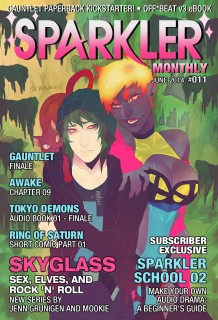
I’m rather ashamed to admit that after the initial Cherry Bomb announcement, I actually completely forgot about Cinderseed. But then came the even more recent announcement for Skyglass, which made its debut in June 2014 in Sparkler Monthly, Issue 11. The prose series was described as “throwing Ai Yazawa’s Nana, a space opera, and a really fresh take on post-apocalyptic Earth into a blender.” With a line like that, I knew that I needed to read Skyglass. It was at that point that I was also gently reminded that Cinderseed existed, and the lovely folk at Chromatic were kind enough to send along a review copy to me.

Sparkler Monthly, Issue 11Cinderseed opens with a girl floating through space, a fire elemental who has been ripped from the sun, her home, and confined within a human body. Understandably, she is somewhat confused and not particularly pleased by this turn of events and violently lashes out at the humans who would try to control her further. Soon after she meets Kri, who hopes that she would kill him, too. But as a Pleasure Intelligence, he doesn’t have much say in the direction his life is taking or even ownership over himself.

The two of them make an interesting contrast, similar to each other in some ways but vastly different in others. Neither are entirely human, but Kri has been designed by humans and his thoughts and behaviors are influenced by that. On the other hand, Phoenix’s actions and ways of thinking are often disconcertingly inhuman. (As they should be.) However, they both feel trapped, experience loneliness, and want to reclaim themselves and take control of their own lives. Phoenix, though, is much more likely to redirect her feelings towards revenge than Kri is.

Technically, while reading the prologue may not be absolutely necessary to follow what is going on in the novel proper, it does provide background information and additional insights into the world and characters of Skyglass, particularly the re/birth of Phoenix. Plus, it’s sexy. And hot, often literally so. (Phoenix is a fire elemental, after all.) Female-friendly, queer-friendly, and kink-friendly, too. The science fiction setting provides the opportunity for some particularly creative, audacious, and delightful, scenarios. And keeping with the intent of Cherry Bomb, the sex serves a purpose beyond titillation in Cinderseed; it’s integral both to who the characters are as people and to the plot itself.

One of the taglines for Skyglass is “Sex, elves, and rock ‘n’ roll.” The prologue covered the sex, but the elves (I promise, it makes perfect sense within the context of the story) and rock music don’t come into play until the first chapter with the introduction of the novel’s other main character Moss Wick—a half-human/half-elvish drummer who has…significant issues. And on top of those, Phoenix has attached herself to him. Unlike the prologue, which was written in the third person, the main narrative (or at least the initial chapter) alternates between Moss and Phoenix’s perspectives and is told in the first person, allowing the readers to get a very good sense of who they are. If Kri and Phoenix were opposites, Moss and Phoenix are even more so; their relationship should be quite interesting to watch unfold.

Even after only having read the prologue and the first chapter, I’m already loving Skyglass. The wait for the release of each new chapter will be torturous, but I’m definitely looking forward to reading more. The novel is shaping up to be smart and sexy and incredibly offbeat science fiction, with interesting and entertaining characters, a fascinating setting, and an engaging writing style. Personally, I think Cinderseed and Skyglass, not to mention the rest of the offerings from Chromatic Press, are well worth checking out.

Save

Filed Under: FEATURES Tagged With: Cherry Bomb, Chromatic Press, Jenn Grunigen, Mookie, Novels, Skyglass

No. 6, Vol. 7

June 20, 2014 by Ash Brown

No. 6, Volume 7Creator: Hinoki Kino
Original story: Atsuko Asano

U.S. publisher: Kodansha
ISBN: 9781612625539
Released: June 2014
Original release: 2013

I have been following Hinoki Kino’s manga adaptation of Atsuko Asano’s science fiction novel series No. 6 since its beginning. The manga got off to a bit of an unsteady start, but it quickly improved its pacing and setting development, each passing volume becoming stronger and building on those that came before it. No. 6, Volume 7 was initially published in Japan in 2013 while Kodansha Comics’ English translation, which includes a bonus story from Japan’s special edition, was released in 2014. I haven’t read Asano’s original novels (sadly, they have yet to be licensed in English) so I can’t directly compare the manga series, but I have seen the anime adaptation. In fact, it was because I liked the characters from the anime so well that I sought out another interpretation of their story. Though both the anime and the manga began around the same time, the anime was completed in 2011 while the ninth and final volume of the manga was released in 2014. The anime and manga share many similarities with each other, but in the end they are their own works.

Rat and Shion’s daring plan to infiltrate the city of No. 6’s Correctional Facility has so far been surprisingly successful and, with a little outside help, they have been able to penetrate the building’s first line of defenses. Gaining access to the Correctional Facility and surmounting the initial challenges preventing the rescue of Shion’s close friend Safu is only the beginning; even with their unexpected luck, things will prove to be much more difficult for Rat and Shion as they continue on their mission and press on farther into the Facility’s interior. Considering that Safu was once counted among No. 6’s elites, Shion is convinced that she must be being held captive in the most secure, upper levels of the Correctional Facility. At best, he and Rat have mere minutes before their intrusion is discovered. After that there is no knowing what they will have to face and they were working with very limited information to begin with. Both Shion and Rat anticipated that the rescue attempt would be extremely dangerous, and at this point there is no turning back.

Since I have seen the anime adaptation of No. 6 and am therefore familiar with many of the important plot points found in the manga, I can’t say that I was particularly surprised by some of the major developments in No. 6, Volume 7. That being said, there are still some incredibly shocking moments which can be attributed to the strength of the underlying story as a whole. Especially potent and devastating is the evolution of Shion’s character over the course of the series. In the last few volumes in particular he has changed so much it seems that Rat’s fears are starting to come true–at times he is no longer even recognizable as Shion anymore. He has become a different person. Gone is the innocent and optimistic young man who was so quick to see the good in people. In his place is a person within whom hatred is growing and whose sense of justice has taken a dramatic and dangerous turn, not only for those around him, but for himself as well.

Taking into account everything that Shion has been through so far, it’s not unexpected that he and his outlook on the world has changed. His own life and the lives of those he holds dearest have been repeatedly threatened. He has personally witnessed the poverty and despair of the residents of West Block as well as the horrors of the Manhunt. Shion has seen senseless violence and death. He has learned about the atrocities committed in the name of No. 6, and yet he still doesn’t know everything. Rat and Shion gained access to the Correctional Facility in order to rescue Safu, but in the process they discover even more of the city’s dark secrets. The truths behind No. 6, its establishment, and its continued existence are not pleasant ones. It’s a so-called perfect society, but the leadership is more than willing to turn on its own citizens in order to maintain that perfection. Shion is trying to come to terms with all of this and to protect the people that he cares about and loves, but in doing so he may very well lose himself entirely.

Filed Under: REVIEWS Tagged With: Atsuko Asano, Hinoki Kino, kodansha, Kodansha Comics, manga, no. 6

Manga the Week of 6/25

June 19, 2014 by Sean Gaffney, Ash Brown and MJ 2 Comments

SEAN: The final week of June, and the end of Manga’s Fiscal Year 13-14. There are a few interesting titles coming out.

It’s right about time for a new Vampire Hunter D novel, so Dark Horse has Vol. 21 all ready for us.

ASH: You know, I’ve read the manga adaptations, but have yet to actually read any of the novels. I should probably get around to that one of these days.

SEAN: There’s also a 31st volume of Air Gear. That is a lot of roller blading.

noregrets

The volume Attack on Titan fans have been waiting for, here is the first volume of No Regrets, giving us some (not all) the backstory on Levi, along with a good look at Erwin too. It’s a shipper’s dream, even though they barely interact here. I reviewed Vol. 1; it’s a good ‘un.

ASH: I actually just posted my own review of the volume. I’m liking the series, too.

SEAN: The last Sankarea ended with our heroine being spirited away by the morally ambiguous teenage scientist. Will she end up dissected, and thus have this volume be the last? (checks) This volume is not the last, so I guess not.

Vertical has the 2nd volume of Cardfight!! Vanguard, which I have not really looked at whatsoever, so… cards? Fighting? Shonen excitement?

And we have June’s slate of Yen Press. There’s the 5th Are You Alice?, indicting that Alice has still not quite discovered the answer to this himself. Yes, him. It’s that sort of title.

MJ: Heh, I need to get back into this title, I think.

SEAN: I was a bit less enthused with the 2nd volume of Bloody Cross, but there’s still enough potential that I look forward to the third. It’s at its best when the two leads snark at each other.

A new volume of Judge, the 4th, means we are 2/3 of the way through this series, and therefore, what, 2/3 of the cast must be dead by now?

Madoka Magica has the 2nd volume of its Different Story, focusing on Mami and Kyouko.

fairydance1

I was fairly gushing about my praise of the first Sword Art Online manga/novel, to the point where I got several people telling me that it went way downhill with its second arc. Naturally, this makes me want to read the 2nd arc and find all the great things about it, because I am a contrary sort. Here’s Vol. 1 of Fairy Dance (no more omnibuses), where we find out what life is like after Aincrad.

MJ: I thought the anime had some issues in the second arc as well, but I still want to read the novel. Count me in!

SEAN: This Fairy Dance is the manga, actually. The novel ships in December, after the 2nd Aincrad novel in August.

Lastly, remember Tales of the Waning Moon? It’s been almost 2 years since the last volume, possibly as it runs in Houbunsha’s Cita Cita magazine, which only comes out quarterly. But rejoice! Here is Vol. 4!

MJ: This. I. Really, I can’t believe there is enough story left to tell for more volumes. I can’t.

SEAN: What titles make you want to spend your hard-earned cash?

Filed Under: FEATURES, manga the week of

Attack on Titan: No Regrets, Vol. 1

June 18, 2014 by Ash Brown

Attack on Titan: No Regrets, Volume 1Creator: Hikaru Suruga
Original story: Gun Snark

U.S. publisher: Kodansha
ISBN: 9781612629414
Released: June 2014
Original release: 2014

I think it’s probably safe at this point to call Hajime Isayama’s manga series Attack on Titan a worldwide phenomenon. It has spawned successful anime adaptations as well as multiple manga spinoffs, a series of novels, and games, among other media. Most of those have been, or soon will be, released in English, too. When it comes to the side manga, I was especially curious about Attack on Titan: No Regrets because so far it has been the only explicitly shoujo offering to be included as part of the franchise. (I was therefore very happy to receive a review copy.) The short manga series in an adaptation by Hikaru Suruga of a Nitroplus visual novel written by Gun Snark and supervised by Isayama himself. The first volume of No Regrets was released in Japan, and then soon after in English by Kodansha Comics, in 2014. Kodansha’s English-language release also collects the story’s prologue chapter, which was included as part of Japan’s special edition of Attack on Titan: No Regrets, Volume 1.

Behind Wall Sheena lies the royal capital and the surrounding city where those who are lucky enough are able to live in luxury. But below it all is the Underground, where outcasts and criminals live in slum-like conditions. It’s there that Levi and his two comrades Isabel and Furlan call home, but they swear to one another that one day they will leave their criminal pasts and the Underground behind and live up above. Their chance comes in the form of Erwin, a young, talented, and devoted Survey Corps squad leader. Levi’s exceptional vertical maneuvering skills have caught Erwin’s attention and after some effort he has caught Levi as well. Erwin offers Levi and his crew a choice: join the Survey Corps themselves, lending their natural strengths to humanity’s fight against the Titans, or submit to the Military Police to answer for their many crimes. The decision isn’t a difficult one to make, but being forced to join the Survey Corps against their will doesn’t sit at all well with Levi; he plans to have his revenge against Erwin.

Arguably, Erwin and Levi are two of Attack on Titan‘s most beloved characters. (Not to mention one of the pairings that I’ve most frequently seen shipped.) There’s a certain intensity to their relationship in the original series–it’s obvious that they share a history and a past with each other–which means exploring their origins and how that bond developed in No Regrets makes a good deal of sense. Personally, I’ve always found Levi and Erwin to be particularly interesting characters, making No Regrets a welcome addition to the Attack on Titan canon. In the first volume of No Regrets their relationship is a volatile and antagonistic one. It’s an extremely important element of the series, but the manga also explores who they are as individuals, which is just as crucial. Each in their own way, both Levi and Erwin are intimidating and formidable men. Erwin may actually be the more terrifying of the two–he’s cool, calm, collected, and incredibly calculating–but Levi’s more obvious aggressiveness and propensity towards violence also leaves an impression.

In addition to focusing on Erwin and Levi, No Regrets features cameos from a few of the other key players from the original Attack on Titan and also introduces new characters, most notably Furlan and Isabel. Granted, seeing as this is still Attack on Titan and that No Regrets already has a considerable death count, there’s certainly no guarantee of their survival. All of the main characters in No Regrets, and to some extent the series’ side and background characters as well, have very distinct personalities which are exhibited through their facial expressions, body language, and individual manners of speech. Suruga’s artwork in No Regrets takes its cues from Isayama’s original series but in general is much cleaner and consistent. Story-wise, the series exhibits an excellent balance between political intrigue and action, including fantastically dynamic vertical maneuvering sequences. For the most part No Regrets stands fairly well on its own, although those familiar with Attack on Titan will get the most out of it. I quite enjoyed the first volume of No Regrets and look forward to reading the rest of the series.

Thank you to Kodansha for providing a copy of Attack on Titan: No Regrets, Volume 1 for review.

Filed Under: REVIEWS Tagged With: attack on titan, Gun Snark, Hikaru Suruga, kodansha, Kodansha Comics, manga

Pick of the Week: Old Favorites & New

June 16, 2014 by MJ, Sean Gaffney, Michelle Smith, Ash Brown and Anna N 1 Comment

potw-6-16MJ: Though I’m interested in a few of this week’s releases, including the latest from the author of Girl Friends, I’m unable to restrain myself from recommending the second omnibus volume of CLAMP’s xxxHolic. These volumes are some of my favorites in the early series, responsible for much laughter, tears, and for my everlasting Watanuki/Doumeki ‘shipping (seriously, if you are not on board by the end of volume six, there’s no help for you). In fact, I think I must reread them in honor of this release. If you never picked up this gorgeous and occasionally maddening series, now is your chance!
SEAN: I’ll chime in here, then, and make Gakuen Polizi my pick for this week. It’s got a lot of things that people like Morinaga Milk for: yuri tease (though a lot less than Girl Friends, obviously), broad comedy between an outgoing young girl and her more introverted friend, and of course high school antics (even though our leads are technically police officers). Sometimes you just want to read something FUN. This should fit the bill nicely.

MICHELLE: I’m going to have to cast my vote for the xxxHOLiC omnibus, too. Especially since this reissue will give me the opportunity to pick up the final few volumes of the series that I originally missed!

ASH: Vertical’s deluxe release of Mobile Suit Gundam: The Origin is always worth mentioning, but my pick of the week actually goes to Battle Royale: Angels’ Border. In addition to a new translation of the original novel and The Battle Royale Slam Book (which was great), the manga makes the third Battle Royale release from Viz this year.

ANNA: Since no one else is picking Mobile Suit Gundam: The Origin, I’ll have to go with that! Civil war! Mecha! Space! Char Aznable being evil! Seriously, what else does a reader need?

What looks good to you this week?

Filed Under: PICK OF THE WEEK

My Week in Manga: June 9-June 15, 2014

June 16, 2014 by Ash Brown

My News and Reviews

I posted two in-depth manga reviews at Experiments in Manga last week. The first was of Baku Yumemakura and Jiro Taniguchi’s The Summit of the Gods, Volume 3. It’s the middle volume of a five-volume, award-winning series and is a critical turning point for the story and characters. The Summit of the Gods is my favorite Taniguchi collaboration as well as one of my favorite manga series in general. And if manly mountain men don’t interest you, perhaps my review of Mari Okazaki’s out-of-print josei collection Sweat & Honey might entice you to track down a copy for yourself. The short manga included in the anthology focus on the close and often complicated relationships between women. The post is a part of my Year of Yuri monthly review project and makes the seventh installment. Only five more reviews to go!

Elsewhere online there were plenty of interesting things to read. Yen Press has a new set of license announcements. Organization Anti-Social Geniuses had two posts last week that I particularly liked: an interview with Cho, the founder of the site English Light Novels (which is an incredibly useful resource that I was previously unaware of), and a look at some of the reasons why people tell publishers they read illegal version of manga. Otaku USA has a nice interview with Helen McCarthy, whose newest book A Brief History of Manga will be released soon. The Lobster Dance has posted Revealing and Concealing Identities: Cross-Dressing in Anime and Manga, Part 4, with at least one more part to come. Lastly, the second manga studies column at Comics Forum is now available, focusing on the history of manga and Kitazawa Rakuten.

Quick Takes

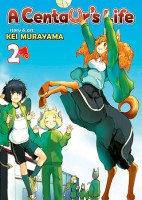
A Centaur's Life, Volume 2A Centaur’s Life, Volumes 2-3 by Kei Murayama. The more I read of A Centaur’s Life, the more I like the series. It can be incredibly sweet and adorable, and Murayama’s world-building is fascinating. Not all of that world-building makes it into the series proper (at least not yet), but the extra material between chapters and at the beginning and end of the volumes. Is interesting, delving into the politics, history, and mythology of A Centaur’s Life. It’s obvious that a lot of thought has been put into the series to make it as realistic as possible; Murayama takes into account even the smallest details of everyday life and how things like cars, furniture, and buildings have to be modified to accommodate races with completely different anatomies. A Centaur’s Life is fairly episodic, but more and more recurring characters are introduced as the series progresses. These two volumes in particular frequently feature the youngest generation of centaurs and other folk. Like any kids, they can be hellions but they can be super cute, too.

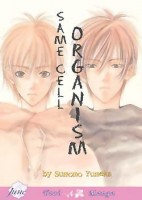
Same Cell OrganismSame Cell Organism by Sumomo Yumeka. Much like Yumeka’s later manga, The Day I Become a Butterfly, Same Cell Organism tends to be fairly quiet and subdued. Yumeka’s artwork is lovely, with a light, airy touch to it, though her character designs from one story to the next are similar enough to cause some brief confusion from time to time. Same Cell Organism is a collection of some of her earliest boys’ love manga. It’s a somewhat uneven volume, mostly do to the fact that one of the stories, “To Make an Angel” was never actually completed. All of the set up is there, but then it suddenly ends with no real conclusion. However, I absolutely adored the titular story “Same Cell Organism” and its subsequent chapters. The story follows two young men in high school who might seem like unlikely friends because their personalities are so different: Yokota is loud, enthusiastic, and outgoing while Nakagawa is much quieter and reserved and has a more difficult time expressing himself. However, their relationship develops naturally and is delightfully loving and sweet.

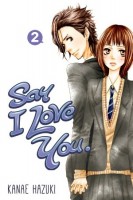
Say I Love You, Volume 2Say I Love You, Volume 2 by Kanae Hazuki. I was a little surprised by how much I enjoyed the first volume of Say I Love You and so was very interested in seeing how the characters’ stories and relationships continued to develop in the second. I particularly like the leads, Mei and Yamato. Mei especially is marvelous; she’s confident enough in herself to avoid bad situations involving other people, which made me very happy to see. Yamato obviously cares for Mei and is very respectful of her. However, many of the other characters aren’t likeable at all, and much of the second volume is devoted to them. Hayakawa is a womanizer and an absolute asshole. His story arc in this volume is a bit uncomfortable–he gets his comeuppance, but he also gets the girl. (I worry about her, so I truly hope that his colors have changed having been redeemed by love.) Aiko, who apparently used to be a lovely young woman, is simply not a nice person at all anymore. She has her reasons, but she’s still not sympathetic. Say I Love You deals very honestly with sex and its emotional repercussions at such a young age. Some of the relationships in the series aren’t at all healthy, making the budding romance between Mei and Yamato refreshing in comparison.

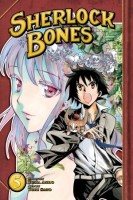
Sherlock Bones, Volume 5Sherlock Bones, Volume 5 written by Yuma Ando and illustrated by Yuki Sato. Sherlock Holmes reincarnated as a puppy is still a rather silly premise, but I’ll admit that I’ve largely been enjoying the series. Occasionally there’s an unnecessary flash of underwear, but generally that’s fairly easy to pass over. The mysteries in the series are interesting with some very clever, though sometimes outlandish, twists. The artwork provides clues for readers to pick up on if they’d like a more interactive story experience, too. One of the things that I actually liked best about this particular volume of Sherlock Bones is that the story moves from Takeru being a high school student to his entry into the workforce. Unsurprisingly, coming from a police family and considering his recent work solving crimes with Sherdog, Takeru becomes a patrol officer. Already it’s proving to supply even more cases for him and Sherdog to investigate, and a few new characters are introduced as well. Sherlock Bones continues to be an entertaining series, and I look forward to reading the remaining two volumes.

Filed Under: FEATURES, My Week in Manga Tagged With: Centaur's Life, Kanae Hazuki, Kei Murayama, manga, Say I Love You, Sherlock Bones, Sumomo Yumeka, Yuki Sato, Yuma Ando

Sweat & Honey

June 13, 2014 by Ash Brown

Sweat & HoneyCreator: Mari Okazaki
U.S. publisher: Tokyopop
ISBN: 9781591827979
Released: February 2005
Original release: 2002

Back in 2005 Tokyopop launched a short-lived line of josei manga called Passion Fruit, describing it as a collection of innovative and edgy works. Only two volumes were ever released before Passion Fruit faded out of existence: Mari Okazaki’s Sweat & Honey and Junko Kawakami’s Galaxy Girl, Panda Boy. I learned about all of this long after the fact and only discovered the Passion Fruit line while searching for more translated manga by Okazaki after rereading her series Suppli (which was sadly left incomplete in English after Tokyopop’s decline.) Currently, Sweat & Honey is her only other work available, which is a shame. Sweat & Honey was originally published in Japan in 2002 before being released in English in 2005. I didn’t realize it when I first picked up a copy–initially I was interested in the fact that it was by Okazaki more than anything else–but Sweat & Honey incorporates sapphic elements and yuri undertones which made me even more curious to read it.

Sweat & Honey collects five short, unrelated manga, most of which focus on the close, personal, and intimate relationships between women, ranging from friendship to love and even more complicated bonds. The volume opens with “After Sex, A Boy’s Sweat Smells Like Honey,” from which the collection draws its name. In it, a young woman is staying with her cousin; her attitudes toward and dislike of men has her cousin reevaluating her own romantic relationships as the two women grow closer. In “About Kusako,” Moeko stumbles upon a girl literally growing out of the ground. It’s a curious story and the most fantastical one included in Sweat & Honey. “Sister” follows Chinami, a highschool girl, and Kayo, her 35-year-old neighbor who leads a much more fulfilling life than most realize. The longest story, “The Land Where Rain Falls,” is told in three parts. It delves into the intense and twisted connections between Kumi, her classmate Kaya, and Kaya’s older brother. The volume closes with “Iced Tea,” in which a young man looks back on one of his first crushes, his seventh-grade teacher.

Sweat & Honey, though occasionally lighthearted, is a manga that deals with very mature themes–death, coming of age, self-discovery, nostalgia–and can frankly be disturbing from time to time. Okazaki’s artwork aids tremendously in creating this atmosphere in the volume. Her illustrations are sensuous and provocative, with a languid heaviness to them. They are beautiful, but also somewhat disconcerting and ominous, too. The page layouts in Sweat & Honey are also interesting, often featuring a large background panel which sets the scene with smaller, overlapping panels that focus a reader’s attention on a particular detail of the people who inhabit it. The elegant line of a neck, hesitant glances or a sly smile, an exposed breast, shifting legs and feet, entwined fingers or tightly clasped hands, all are accentuated. Because of this, the young women in Sweat & Honey seem to exist both in their world and apart from it. Okazaki reveals their personal and private thoughts and feelings while at the same time exposing their physical selves.

Although the short manga collected in Sweat & Honey aren’t related by characters or by plot, they all share an emphasis on the inner and outer lives of women and their relationships with each other. Even “Iced Tea,” which is told from the perspective of a young man, is focused on his female teacher. Although the ties between the women in Sweat & Honey are the most crucial, their associations with men and how those associations impact their other relationships are also very important. The older cousin in “After Sex, A Boy’s Sweat Smell s Like Honey” has a boyfriend, but she isn’t able to connect with him in the same way that she does with her younger relative. Moeko drifts away from Kusako when a boy enters the picture. Kayo’s seeming lack of romantic involvement is one of the things that bothers Chinami the most. And in “The Land Where Rain Falls,” the nearly incestuous relationship instigated by Kaya is one of the key elements of the story. But in the end, while the men have their place in the manga, the true focus of Sweat & Honey is on its young women and their experiences.

Filed Under: REVIEWS Tagged With: manga, Mari Okazaki, Passion Fruit, Tokyopop, Year of Yuri

Manga the Week of 6/18

June 12, 2014 by Sean Gaffney, Michelle Smith, Ash Brown, Anna N and MJ 1 Comment

SEAN: It’s no Week 1, but the 3rd week of the month gives us a chunky pile of manga, which should have something for most everyone.

The Shinji Ikari Raising Project manga from Dark Horse has now reached the same number of volumes as the regular Evangelion manga, and I don’t think it’s finished. Will this lighter take on the Evaverse surpass its predecessor? …mmmm, probably not. But it’s fun.

I swear I’ve had Alice the 101st Vol. 4 coming out from DMP before this week. But in any case, here it is again, and I suspect I will be confused all the way to Vol. 101.

MICHELLE: I forgot this series existed.

hentaiprince2

SEAN: I enjoyed Vol. 1 of Hentai Prince and the Stony Cat, which came out right before DMP’s print hiatus. Now that it’s back, I look forward to seeing what wacky comedy Vol. 2 can give us, especially since the anime has now come and gone.

Fairy Tail has hit its Jack Benny volume, and I am starting to fall behind. I believe this is one of the more serious volumes. Lotsa harsh battle scenes. (Vol. 39, for those of you who are wondering what the hell I’m talking about.)

There’s also the 7th volume of No. 6, which simply ruins the symmetry and makes me bitter. So bitter. Why must manga be numbered anyway? Manga should be free!

ASH: The beautiful symmetry may have been ruined, but this is one of the best volumes in the series yet!

SEAN: The 2nd xxxHOLIC omnibus has some really excellent stories, and a minimal amount of crossover with Tsubasa. Neither of those two will last.

ANNA: I feel sort of bad that I never finished either xxxHOLIC or Tsubasa, and then I remember how long they are and I feel OK with it all.

MICHELLE: I didn’t finish them either, actually. But I intend to one of these days!

ASH: And the omnibus releases make it easier than ever!

MJ: I feel somewhat out of place here admitting that I finished them both, and with great enthusiasm! I’m very happy to see these omnibus releases coming out.

SEAN: In case you thought Seven Seas had put out everything Dance in the Vampire Bund-related, here are some Forgotten Tales. Probably fell behind the desk or something.

Haganai: I Don’t Have Many Friends hits the 7th volume of wacky comedy with Kodaka and the friends he insists he doesn’t have.

gakuen1

I’m a big fan of Morinaga Milk, author of Girl Friends, so am looking forward to the new series from Seven Seas, Gakuen Polizi. Which is not translated as School Police, for reasons why I do not know. I don’t think this one’s yuri, but I bet it’s cute.

ASH: I’ve enjoyed the other manga by Morinaga released in English, so I’m looking forward to this series’ debut.

MJ: Same here!

SEAN: The Sky That Connects Us is the next in the Strike Witches franchise, and will give you lots of cute girls and aerial battles, but less pants than most series.

Vertical’s deluxe release of Mobile Suit Gundam hits its 6th collection, which I believe may be the halfway point? In any case, still essential.

ANNA: So deluxe! I’ve been buying these as they come out but am a couple volumes behind. I see a Gundam reading binge in my future.

MICHELLE: Much mecha.

ASH: I believe this volume will once again feature a fair amount of Char, which pleases me greatly.

SEAN: Lastly, Viz has the Battle Royale: Angels’ Border manga, which ran in Akita Shoten’s Young Champion and focuses on six girls who got short shrift in the main series.

ASH: As a fan of the original novel, I’ve been enjoying the recent Battle Royale releases from Viz, so I’m happy to see this one, too.

SEAN: Is there something here that appeals to you?

Filed Under: FEATURES, manga the week of

  • « Go to Previous Page
  • Page 1
  • Interim pages omitted …
  • Page 119
  • Page 120
  • Page 121
  • Page 122
  • Page 123
  • Interim pages omitted …
  • Page 140
  • Go to Next Page »
 | Log in
Copyright © 2010 Manga Bookshelf | Powered by WordPress & the Genesis Framework