• Skip to primary navigation
  • Skip to main content
  • Skip to primary sidebar
  • Home
  • About Us
    • Privacy Policy
    • Comment Policy
    • Disclosures & Disclaimers
  • Resources
    • Links, Essays & Articles
    • Fandomology!
    • CLAMP Directory
    • BlogRoll
  • Features & Columns
    • 3 Things Thursday
    • Adventures in the Key of Shoujo
    • Bit & Blips (game reviews)
    • BL BOOKRACK
    • Bookshelf Briefs
    • Bringing the Drama
    • Comic Conversion
    • Fanservice Friday
    • Going Digital
    • It Came From the Sinosphere
    • License This!
    • Magazine no Mori
    • My Week in Manga
    • OFF THE SHELF
    • Not By Manga Alone
    • PICK OF THE WEEK
    • Subtitles & Sensibility
    • Weekly Shonen Jump Recaps
  • Manga Moveable Feast
    • MMF Full Archive
    • Yun Kouga
    • CLAMP
    • Shojo Beat
    • Osamu Tezuka
    • Sailor Moon
    • Fruits Basket
    • Takehiko Inoue
    • Wild Adapter
    • One Piece
    • After School Nightmare
    • Karakuri Odette
    • Paradise Kiss
    • The Color Trilogy
    • To Terra…
    • Sexy Voice & Robo
  • Browse by Author
    • Sean Gaffney
    • Anna Neatrour
    • Michelle Smith
    • Katherine Dacey
    • MJ
    • Brigid Alverson
    • Travis Anderson
    • Phillip Anthony
    • Derek Bown
    • Jaci Dahlvang
    • Angela Eastman
    • Erica Friedman
    • Sara K.
    • Megan Purdy
    • Emily Snodgrass
    • Nancy Thistlethwaite
    • Eva Volin
    • David Welsh
  • MB Blogs
    • A Case Suitable For Treatment
    • Experiments in Manga
    • MangaBlog
    • The Manga Critic
    • Manga Report
    • Soliloquy in Blue
    • Manga Curmudgeon (archive)

Manga Bookshelf

Discussion, Resources, Roundtables, & Reviews

Archives for November 2012

It Came from the Sinosphere: Princess Pearl (Pt. 2)

November 16, 2012 by Sara K. 5 Comments

Ziwei and Xiaoyanzi

Yet another screenshot from the TV adaptation.

So, last Tuesday I talked about the super-popular novel Princess Pearl. Now I’m going to keep talking about it.

The Friendship/Sisterhood of Ziwei and Xiaoyanzi

I don’t know whether to call them “friends” or “sisters.” As I mentioned in the previous post, Chinese-speaking cultures tend to value family relationships above romantic relationships, and this also applies to friendships. But what happens is that, especially in stories set in historical periods, whenever two people become close friends, they become sworn sisters/brothers. In a way, in Chinese, a “brother” or “sister” is anybody from the same generation with whom you have a close relationship. This can even apply to romantic couples, which weirded me out until I got my head around the fact that in Chinese-speaking cultures, calling one’s lover “sister” or “brother” does not imply anything incestuous.

Okay, I’m calling them “friends.”

One of the things which makes Xiaoyanzi and Ziwei’s friendship so entertaining is that they are opposites. Ziwei is well-educated, has an excellent understanding of the high arts, is a beautiful singer, an excellent chess player, etc. Xiaoyanzi is illiterate, and can’t follow proper etiquette even when her life depends on it. Ziwei, while healthy, is physically weak … whereas Xiaoyanzi is quite good at hand-to-hand combat, jumping over walls, and other physically-demanding feats. Ziwei can’t lie, but she’s very good at staying quiet. Xiaoyanzi can’t stay quiet, but she’s an excellent liar.

And it’s hilarious that Xiaoyanzi has to pretend that she is a princess, while Ziwei has to pretend that she’s not.

What they have in common is their passionate feelings. I think this is ultimately what brings them—and keeps them—together. Xiaoyanzi is willing to brave any danger to keep Ziwei safe … and Ziwei is willing to sacrifice anything for Xiaoyanzi’s well-being. When someone feels that way about you, it’s hard not to respond, and when it’s mutual, it’s hard to break apart. No wonder Xiaoyanzi and Ziwei care more about each other than the charming young men they fall in love with. Ultimately, they even come to the conclusion that their relationship with each other is more important than their relationship with their father, Emperor Qianlong. This is a classic example of how the more one gives, the more one has.

Princess Pearl and Goong

Cover of volume 20 of the Taiwanese eidtion of Goong

Out of all of the Asian comics I am familiar with, Goong feels the most like Princess Pearl. They are both about a teenaged girl from the commoner class who finds herself inadvertendtly becoming a princess, locked away inside the royal court. Neither Xiaoyanzi nor Chae-Kyung are very good at being refined, well-behaved princesses, and it’s their very roughness and lively spirit which eventually wins over the love of almost everybody in the palace.

Princess Pearl and Goong are entertaining for some of the same reasons. There’s plenty of opportunity for comedy as the commoner way of life and the royal way of life clash with each other, yet underneath all of the amusing escapades a potential tragedy is brewing (notice that I say *potential* … I am not trying to imply that either story actually is a tragedy).

Prince Shin is, in some ways, the opposite of Emperor Qianlong. Prince Shin is a big jerk at first, and only later reveals his tenderness; Emperor Qianlong is all sweetness and tenderness at first, and only bares his fangs once the novelty of having a new daughter wears off.

And of course, some of the major details are really different … Goong really is a romance, and Princess Pearl scores way better on the Bechdel test (come to think of it, it’s very rare for two male characters to talk about something other than a woman in Princess Pearl), not to mention the whole time period/location thing. But I think it would be fair to call both of them soap operas.

I don’t think it’s a coincidence that Princess Pearl and Goong feel so much alike. The 1998 TV adaptation of Princess Pearl was extremely popular in South Korea (where it is called “Emperor’s Daughter”). Goong started serialization just a few years later in 2002. I don’t know whether or not Princess Pearl inspired Park SoHee, but considering what I’ve read about the impact Princess Pearl had on South Korea, I think it must have at least been an influence.

Availability in English (rant)

This novel has never been published in English or in any other European language as far as I know. I can’t even find a TV adaptation with English subtitles (though I suspect that it just might be possible to get Singapore DVDs with English subtitles—I haven’t turned over every stone).

This … irritates me.

I do not buy the argument that non-Asians can’t understand the oh-so-mysterious Chinese culture. I think somebody who had never even heard of China before could love this novel. Understanding what it’s like to be a human being is all that’s required, as far as I’m concerned.

And considering that this story has proven extremely popular in places with such different cultures as Mongolia and Indonesia, I don’t see why this couldn’t have been a worldwide hit … aside from reluctance on the part of the media to even try.

*sigh*

Maybe they should make a comic book adaptation … manhua, manhwa, manga, whatever (the original novel and the 1998 TV adaptation are available in both Korean and Japanese) and then get that licensed overseas.

But this is one of the reasons I bother writing this column. I want to help the works which do get translated into English get more attention, and I want to discuss things which don’t get translated into English so that English-speakers at least have a clue about what they’re missing.

Conclusion

I figured that, since this is one of the most popular Chinese-language novels ever, that it would at least be readable. What I didn’t expect is that it would become one of my personal favorites. It’s really a very simple story, yet the simplicity makes me love it harder. Actually, it’s so simple that I’m even a bit embarrassed that I love it so much.

I think one of the fundamentals of human existence is that we crave love and affection from others. The flipside is that we are all afraid of losing that love. This is true whether we are a street urchin or the emperor of China. To some extent, it doesn’t matter where that love comes from—a parent, a sibling, a child, a lover, a friend, a stranger. That craving, and that fear, can drive us to both wonderful and terrible things.

I think this is the chord that this story has struck in a billion people.


Sara K. …. has completely forgotten what she wants to say. Oh well. When she remembers, she can stick it at the end of a future post.

Filed Under: It Came From the Sinosphere Tagged With: chiung yao, my fair princess, princess pearl

Manga the Week of 11/21

November 15, 2012 by Sean Gaffney, Michelle Smith and MJ 11 Comments

SEAN: After a very, very busy first two weeks of November, you’d think the manga industry would let us off easy before Thanksgiving, but no. There’s an awful lot to bite into this week.

First of all, Midtown seems to have caught up with Diamond Comics. If you’re looking for the 2nd week Viz releases or the Seven Seas titles, we discussed them last week.

That still leaves a lot. Starting, as ever, with Dark Horse, who are bringing out the first of their Trigun Maximum volumes. While I always tended to prefer the anime adaptation of this story, I do still have a soft spot for Vash and company, and if you haven’t tried the title out yet, you might want to. Meryl and Milly are a stitch!

MICHELLE: I never have been able to muster much enthusiasm for Trigun, even though I have vaguely good feelings towards it.

SEAN: Digital Manga Publishing has one BL titles and two non. Starting with the BL, we first have Honey Smile, a title from Nihon Bungeisha’s Karen Magazine. Aside from appealing to women named Karen, the premise sounds quite sweet, and the cover only adds to that impression.

MJ: It’s so rare that I like the cover for a BL manga (even when I end up liking the manga), but for once this actually does look like My Kind of BL, right from the start. I’ll definitely be looking out for this.

MICHELLE: Oh, that *is* pretty adorable-looking!

SEAN: I had thought that Lovephobia, Vol. 2 of which is out next week, fell into the BL category as well, mostly as it runs in the hideously named Comic B’s Log KYUN!. But it’s apparently a regular old shoujo title that features vampires. As you know, Congressional Act Pub-L 111-369 decrees that all vampire manga must be licensed for North American audiences, so here we are. Do they sparkle?

MJ: Hmmm, I’m torn between my love for the words “old shoujo” and my increasing weariness with vampires. Which feeling will win?

MICHELLE: I keep mentally conflating Lovephobia with Toko Kawai’s Loveholic, so I’ve been thinking of it as BL as well.

SEAN: I’m not used to seeing DMP dipping its toes into the waters of Media Factory’s Comic Alive, which is usually the purview of our friends at Seven Seas. Here they are, though, with Vol. 1 of Hentai Prince and the Stony Cat. It apparently features a perverted protagonist *and* a tsundere, but we’ll give it a shot anyway.

MJ: This sounds like it could either be awesome or horrible, and I’ll probably wait for someone else to read it first. I’m looking at you, Sean.

MICHELLE: Ugh. Not for me.

SEAN: 3 titles next week (well, this week, but it’s Kodansha, we know the deal) from Kodansha Comics. Animal Land has hit Vol. 6. For some reasons, I always assume this title is geared towards little kids in Japan, but it runs in Monthly Shonen Magazine, also home to Flowers of Evil and Attack on Titan, so I could be wrong. Are there at least animals? In a land?

MJ: There are, but I couldn’t even make it through the first volume, so that’s about all I can tell you.

MICHELLE: I made it through the first one, but never did continue. It’s got tons of poop jokes, so you’re probably right about its intended audience.

SEAN: Love Hina’s omnibus re-release hits Vol. 4, and introduces two of its most controversial plot points. a) Kanako Urashima, Keitaro’s younger sister, and b) Keitaro’s leave-of-absence from the series, and subsequent return with a personality transplant. Still, it has a new translation, and probably better scans, so Love Hina fans (like me) will get it anyway.

Miles Edgeworth: Ace Attorney Investigations hits Vol. 3, and sadly still lacks most of the cast of the games themselves, being content only with Dick Gumshoe. Still, even though Edgeworth is not as silly as Phoenix, he surrounds himself with silly suspects.

Apologies to BL fans: when porting over Viz’s 2nd week releases last week, I missed the two SubLime BL titles. So here they are. Bond of Dreams, Bond of Love has Vol. 2, with a cute feminine little guy trying to attract the grumpy, chain-smoking big manly guy. (I really need to come up with better ways to describe BL.) As for the cover of Vol. 2 of Starting with a Kiss… do necks even BEND like that? Oh my God!

MJ: I admit I’ve been pretty wishy-washy on SuBLime releases in general. I love what they are doing and how they’re doing it (Viz has proven they really get digital distribution, including how it works best for particular audiences—in this case, BL fans), but for the most part, their licenses are simply not to my taste. I am not the BL fan they are publishing for, and titles like Bond of Dreams, Bond of Love really drive that point home. Given the response I’ve seen from BL fans at Manga Bookshelf (and elsewhere), I’m pretty sure they’re making strong choices for the larger fanbase, but I just really don’t care for these titles.

MICHELLE: I have genuinely liked at least one (The Bed of My Dear King) and was unexpectedly intrigued by another (Punch Up!), but on the whole I must agree. I prefer a kinder, gentler sort of BL. And egads, that Starting with a Kiss cover is creepy!

SEAN: Viz also has a few 3rd week releases. Bokurano: Ours has hit Vol. 7, and is still doing what Bokurano does quite nicely. Its uplifting and life-affirming message requires the reader to sit through piles and piles of trauma, and thus I’ve given it a miss.

MJ: Oooh, I bet Michelle has a response to this!

MICHELLE: There’s no denying Bokurano is grim, grim, grim, and that one doesn’t get to learn much about the cast of kids until it’s their turn to pilot the robot and subsequently die. But it’s the mystery of why this is all happening that keeps me fascinated.

SEAN: REAL is still ongoing in Japan, albeit at a very slow rate, and now North America gets Vol. 11. This volume actually promises to feature Nomiya, the delinquent protagonist who got most of the beginning of the series before the focus moved away from him. Still a good story well-told, as you’d expect from Inoue.

MJ: Hurray! Seriously, that’s the only possible response to a new volume of REAL.

MICHELLE: I disagree. I think “Huzzah!” works equally well!

SEAN: And Saturn Apartments, one of the quieter SigIKKI titles, has hit Vol. 6. I think 7 is the last, so it must be getting close to wrapping things up.

MJ: Wow, I’m behind in this series. I need to remedy that, pronto.

MICHELLE: Me, too. I really like it, but I’ve fallen behind by several volumes now.

SEAN: There’s a new omnibus out for CLAMP’s classic shoujo series X, containing Vols. 10-12, and more preparation for the complete and total apocalypse that we still haven’t actually quite seen yet. Still, the preparation is absolutely gorgeous.

MJ: Despite my lukewarm feelings for this series, these omnibus releases are a must-buy. If there’s one thing I really do love about X, it’s the gorgeous, shoujo-tastic artwork, and these volumes show that off to its best advantage.

MICHELLE: I still have yet to read beyond volume one of this series, despite owning it in its entirety and having the first two omnibus editions. I’ve seen the anime, though.

SEAN: Lastly, I had wondered why Diamond didn’t ship it this week with the rest of Yen’s titles, but no matter: The long awaited Thermae Romae Vol. 1 (a two-volume omnibus) is out next week in glorious hardcover. Far more than just a take of Roman baths, this series is another reason why North Americans keep wanting more and more from Comic Beam (also home to Emma and Wandering Son).

MJ: I can’t wait to read this!

MICHELLE: Me, neither! Coming soon to an Off the Shelf near you!

SEAN: It’s Thanksgiving Week for The U.S.! What titles are you thankful for?

Filed Under: FEATURES, FEATURES & REVIEWS, manga the week of

Digital Manga goes all-digital for six months

November 15, 2012 by Brigid Alverson

Here’s a startling bit of news: Digital Manga, Inc., has put all their print titles on hiatus for six months, from January through June 2013. In a message on the company blog, Digital president Hikaru Sasahara said, “Please be advised that none of our licenses are cancelled, simply postponed. We will be resuming the distribution of our print editions in June, 2013.” The move affects all Digital imprints, including June, 801, and DokiDoki, but not the two Tezuka books ; behind the scenes, the company has been revamping its emanga digital manga site.

The latest addition to the Shonen Jump Alpha lineup is the romantic comedy Nisekoi, by Naoshi Komi, who is best known for his Double Arts manga.

Lissa Pattillo looks at this week’s new manga releases in her latest On the Shelf column at Otaku USA.

Where’s Deb Aoki? She’s in Tokyo, at the International Comics Festa, where a group of Canadians has put together their own doujinshi anthology. She’s taking pictures and chronicling her adventures on Twitter, so if you don’t follow her already, now would be a good time to start.

Reviews

Rebecca Silverman on vols. 9 and 10 of Oresama Teacher (ANN)
Rebecca Silverman on vol. 44 of Case Closed (ANN)
Ken H on vol. 1 of Heroman (Comics Should Be Good)
Leroy Douresseaux on vol. 59 of Naruto (The Comic Book Bin)
Alex Hoffman on vol. 1 of Pupa (Manga Widget)
Leroy Douresseaux on vol. 10 of Rin-ne (The Comic Book Bin)
Lesley Aeschliman on vol. 8 of Sailor Moon (Blogcritics)
Anna on vol. 1 of Strobe Edge (Manga Report)
Johanna Draper Carlson on vol. 1 of Strobe Edge (Comics Worth Reading)
Sean Gaffney on vol. 1 of Strobe Edge (A Case Suitable for Treatment)
Rebecca Silverman on Wolf (ANN)

Filed Under: MANGABLOG

Strobe Edge, Vol. 1

November 14, 2012 by Sean Gaffney

By Io Sakisaka. Released in Japan by Shueisha, serialized in the magazine Bessatsu Margaret (“Betsuma”). Released in North America by Viz.

As many readers of this blog know, give me a choice between a new series that’s daring, bold, experimental and avant-garde and a new series that’s more of the same as all the other series except with different bits, and I will go for the latter every time. I appreciate the value of alt-manga, but am far more happy reading Vol. 97 of Shoujo Girl X. Usually because every time I do, even if it seems like it’s going to be more of the same, there’s always something that ends up drawing me in. These series all have to compete in Japan with 7,000 other high-school romances. There needs to be something that stood out enough to have it be a success there and get licensed here. Which brings me to Strobe Edge.

The cover really says it all – it’s hard to look at and not feel ‘well, it’s a bit overly sweet, isn’t it?’ without even reading the content. And the first half of the book doesn’t seemingly do much to change that opinion. Ninako is naive and a bit flighty, but not overly ditzy. She’s got a group of close female friends (who so far have stayed her friends, yay!) as well as a male childhood friend that everyone assumes she is in love with, mostly as he is clearly in love with her and that’s how these things go. Ninako, however, isn’t sure what she feels for Daiki is love. And she has *no idea* what these feelings she has are when she runs into Ren, the school heartthrob and all-around mysterious guy.

As I said, so far so normal. If I told you Daiki was blond and Ren had black hair, I assume you’d be totally unsurprised. But gradually I started to realize that more thought was being put into the plot than I suspected. Ninako may seem flighty, but she thinks hard about everything, and once she realizes that what she’s feeling for Ren is love, all sorts of extra problems come up. As for Daiki, he is obviously the ‘unlucky childhood friend’ who is there to provide the love triangle, but this does not make his crush on Ninako any less weighty, especially as we see its origins. He’s a nice guy, as Ninako herself says, and we feel for him even as we root for Ninako to get together with Ren, because that’s how these things go.

The second half of this volume really picks things up, and I was quite startled a few times. Ren, for one, is not really the aloof loner type he presents… or at least not around Ninako, which is a good sign. Of course, things aren’t as simple as ‘if I just worked up my courage to confess, we’d be together’. Ren’s own life intertwines with Daiki’s in very unexpected ways, and as Ninako herself notes, when you fall in love with someone the feelings don’t merely vanish just because you get rejected. I suspect the plot of much of Strobe Edge will deal with that, given the large number of unrequited relationships we bring out here.

Strobe Edge begins with its heroine thinking about what it means to be in love, and I suspect that’s what the whole series is going to be about. It’s working with stock shoujo manga types, but what it’s doing with them is interesting. Which, as I said before, is exactly what I look for in ‘normal’ shoujo manga.

Filed Under: REVIEWS

Blogging about the blogger

November 13, 2012 by Brigid Alverson

If you’re curious to know what I really think about comics, manga, comics shops, and other stuff, as well as what it was like to be an Eisner judge (in a word: Awesome!), check out Carrie Shepherd’s interview with me at Girls + Comics.

The Manga Bookshelf bloggers discuss their Pick of the Week.

Noah Berlatsky looks at the role of women in ero and horror manga such as the works of Junji Ito and relates it to their role in society at the time these manga were being created.

Matt Blind looks at the top-selling manga from the past week.

Reviews: The Manga Bookshelf team kick off the week with a new set of Bookshelf Briefs. Ash Brown discusses a week’s worth of manga reading at Experiments in Manga.

Johanna Draper Carlson on vols. 14-16 of Bakuman (Comics Worth Reading)
Lori Henderson on vols. 33 and 34 of Bleach (Manga Xanadu)
Phillip on vol. 2 of A Bride’s Story (Eeeper’s Choice)
Johanna Draper Carlson on vols. 6 and 7 of Bunny Drop (Comics Worth Reading)
Sean Gaffney on vol. 1 of Missions of Love (A Case Suitable for Treatment)
Anna on Not for a Student and Hush A Bye Baby (Manga Report)
Kristin on vol. 1 of Strobe Edge (Comic Attack)
Leroy Douresseaux on vol. 15 of We Were There (The Comic Book Bin)

Filed Under: MANGABLOG

It Came from the Sinosphere: Princess Pearl (Pt. 1)

November 13, 2012 by Sara K. 3 Comments

The book covers of Princess Pearl

So, a while ago, I said I needed to read some Chiung Yao novels and try some of the TV adaptations. Well, I’ve been working on that, and it is with great enthusiasm that I present Princess Pearl (AKA My Fair Princess and Prince Returning-Pearl).

About Chiung Yao

Chiung Yao might be the most popular Taiwanese novelist ever (this is difficult to measure). She is without a doubt the most popular female Chinese-language novelist ever, as well as the most popular Chinese-language romance novelist ever.

Almost all of her novels were originally serialized in a magazine aimed at teenage girls, and with all of the cliffhangers, they read like serializations. The works I’ve read so far have an addictive melodramatic quality that reminds me of 70s shoujo manga.

Princess Pearl is her most popular novel, and was adapted into the most popular Mandarin-language TV drama ever (I am not exaggerating). But I want to talk about the novel, not the TV drama.

Story

This novel is set in 18th century China. Xiaoyanzi is a burglar and a swindler who grew up on the streets of Beijing. She encounters Ziwei, an educated and refined girl from Shandong. At first they rub each other the wrong way, but soon enough they bond and become sworn sisters. Ziwei left Shandong upon the death of her mother, and her mother’s dying wish was that she would go to her father in Beijing. Though Ziwei knows where her father is, getting access to him is a problem because her mother never had a chance to tell him that they have a daugther and … well, he’s the emperor of China. Of course, while Ziwei can’t break into the Forbidden City, Xiaoyanzi, as an expert burglar, can.

Upon breaking into the Forbidden City, carrying the evidence of Ziwei’s paternity with her, Xiaoyanzi is shot by an arrow, and eventually passes out. Emperor Qianlong, seeing the evidence, mistakes Xiaoyanzi for being his own daughter. By the time Xiaoyanzi is clear-headed again, it is explained to her that if he discovers that she is a fake, the emperor will cut off her head. Meanwhile, Ziwei remains outside the Forbidden City.

About Emperor Qianlong

Emperor Qianlong ruled for over 60 years, one of the longest reigns in Chinese history. I don’t know much about the historical Emperor Qianlong, but I remember one exhibit about his personal ceramics collection. In order to show his appreciation for ceramics, he would write poems praising their excellence, and then order people to carve the poems into the pieces. While I didn’t bother to read the poetry myself, apparently a common theme was that it was very important for an emperor to appraise ceramics, and therefore he was not neglecting his imperial duties by obsessing over his collection.

Emperor Qianlong wasn’t just interested in pottery. He also collected paintings, jade, ivory, and other works of art. He didn’t just appreciate Chinese art; he also collected art from Europe and Central Asia. In addition to visual art, he also loved music, poetry, and literature.

He is a very popular character in Chinese-language historical fiction … however most historical fiction focuses not on his love of art, but his romantic and sexual relationships with various women. Even though I’ve never seen (and probably never will see) The Legend of Qianlong, I do like the theme song.

This isn’t even the first time I’ve discussed him; he’s one of the main characters in The Book and the Sword.

In this particular novel, he is basically presented as a loveable spoiled brat who unfortunately (for everyone else) has absolute power over an empire. He loves art and culture, and feels entitled to having access to the best. He loves romance and sex, and feels that any woman he approaches ought to feel happy about it. And he has had so many relationships that it’s easy for even someone he likes a lot to slip from his mind (Ziwei’s mother specifically). He expects his children to continually shower him with affection and to do everything he tells them to do because a) he is their emperor and b) he is their father. And it is really, really easy to hurt his feelings.

I’m making him out to be a nasty character, aren’t I? Well, in his defense, he is also very loving. When he takes a liking to somebody, he is extremely gentle and kind, and he often gets heartbroken because a) somebody he likes got hurt or b) he feels betrayed by somebody he likes. It seems that he has, by nature, a sweet, warm, and sensitive personality, yet he has been warped by having more power than any human being ought to have.

In any case, it’s no wonder that he appears in so much Chinese-language fiction. He is a complex character who can be presented as a hero or as a villain, and he can fit well in anything ranging from a deep work of serious literature to a titillating pornographic film.

The Love Triangle

Zhao Wei as Xiaoyanzi

Okay, so sue me, I am using an image from the TV series

Since Chiung Yao is known as a romance writer, I was expecting this to be a romance. And there is some romance in the novel, but it generally happens in the sidelines. But while this novel is not about romance, it is definitely about love. There is even a (non-romantic) love triangle at the center of the action: Xiaoyanzi, Ziwei, and Emperor Qianlong.

Neither Ziwei nor Xiaoyanzi had any father-figure in her childhood, so they both crave the fatherly affections of the emperor. Neither is interested in political power, so when they compete for the status of princess, this is their motivation. Meanwhile, the emperor wants as much love as possible to come his way, and while he never consciously tries to break up Xiaoyanzi and Ziwei, one of the schemes he comes up with to get more of their love would have incidently separated them.

Daughters and Fathers

I would say that, in the culture of the United States (as well as in Britain, Canada, Australia, etc), romantic relationships are valued more than parent-child relationships. In the Chinese-speaking world, it’s the other way around.

It has been noted that one of the things which makes Taiwanese idol dramas different from K-dramas and J-dramas is that there tends to be a lot more emphasis on the romantic couples’ parents and other relatives. I don’t know enough about K-dramas and J-dramas to confirm this … but compared to shoujo manga, this is certainly the case. This is also reflected in my encounters with Taiwanese people; they are much more likely to ask questions about my parents and family than about my romantic life.

Off the top of my head, I can think of two Taiwanese movies—Cannot Live Without You/No Puedo Vivir Sin Ti and Seven Days in Heaven—that are primarily about the relationship between a daughter and a father (and IIRC neither movie has any romance whatsoever). I cannot think of any English-language movie that is primarily about a relationship between a daughter and a father. In the context of Chinese-speaking culture, the fact that Princess Pearl focuses on parent-child relationships does not make it an outlier.

So what does the novel have to say about children and parents?

On the one hand, even though Xiaoyanzi and Emperor Qianlong are not biological relatives, they come to care for each other very deeply. This implies that the bond between daughter and father is forged by shared experiences and people’s actions, not by biology. On the other hand, Emperor Qianlong also happens to become very attached to Ziwei, even though he does not know that she is his biological daughter. This implies that the genetic bond still counts for something. Then again, when he first meets her, he doesn’t notice her. It is her actions that finally catch his attention.

While I disagree with some of the ideas that Chinese-speaking cultures have about parent-child relationships, I think it is good that they value them so much and include them far more often in their mainstream media, and I think my own culture could stand to learn something from them.

I have plenty more to say, but I think that’s enough for now. So please come back on Friday for Part 2, when I will:

– discuss the friendship/sisterhood between Xiaoyanzi and Ziwei
– compare the novel Princess Pearl to the manhwa Goong
– rant talk about its (un)availability in English

Next time (not Friday): You Are the Apple of My Eye (movie)


When Sara K. was caught reading a Chiung Yao novel, somebody told her that they are for 16-year old girls. She replied that when she was 16 years old, she couldn’t read Chinese. Furthermore, Sara K. has discovered that Chiung Yao novels, particularly the second halves, are NSFW. If she read them, they might make her cry, and then she’d have to explain to everybody what was wrong.

Filed Under: It Came From the Sinosphere

Bookshelf Briefs 11/12/12

November 12, 2012 by MJ, Sean Gaffney and Michelle Smith 2 Comments

This week, MJ, Sean, and Michelle take a look at recent releases from VIZ Media and Yen Press.


Bunny Drop, Vol. 7 | Yumi Unita | Yen Press – After commenting on the last volume that mangaka Yumi Unita seemed “less comfortable writing Rin’s voice than she was writing Daikichi’s,” I’m now prepared to take that back completely. Unita shines in her portrayal of Rin in volume seven, particularly during the last half of the volume when Rin begins to show interest in finding out about her birth mother. Any awkwardness over the series’ time jump has vanished with the previous volume as well, and it almost feels at this point as if those years weren’t missing at all. Older versions of Rin, Daikichi, Kouki, and even absent mom Masako are rich with history, and it seems clear that even if we were not privy to their offscreen years, those years absolutely happened in Unita’s imagination. Ultimately, this series continues to be warm, compelling, and surprisingly poignant. Definitely recommended. – MJ

Durarara!!, Vol. 4 | By Ryohgo Narita, Akiyo Satorigi, and Suzuhito Yasuda | Yen Press – With this fourth volume, which correlates with the end of the first novel, the manga adaptation of Durarara!! comes to a temporary hold (resuming in Durarara!! Saika). And so we get an ending that’s a little bit confusing, with revelations that would mean a lot more if we actually had gotten to know any of these (far too many) characters aside from Celty, who is admittedly pretty fascinating. Unfortunately, Celty and another female character end up declaring their love for unrepentantly murderous fellows, which gets my feminist goat and tarnishes Celty’s moment of empowerment when she realizes she doesn’t need to be ashamed of what she is. Durarara!! has certainly been interesting, and I will definitely check out its continuation, but it will probably never be one of my favorites.– Michelle Smith

Kimi ni Todoke, Vol. 15 | By Karuho Shiina | VIZ Media – Our main couple does get a bit of attention here—particularly Sawako’s worries about her relationship’s progression—but this volume’s big focus is on Chizuru and Ryu. We get a long, sad flashback to their childhoods, showing a turning point in their lives, and also hinting (though Chizuru has forgotten) why being treated like a brother bothers Ryu so much. It gets quite emotional, and the catharsis on the last few pages is welcome. The series continues to show stasis as a bad thing in life—always move forward. As for Kent and Ayane, I must admit I still have my issues with Kent—I’d like to see him be a little more flawed, as he was when he first appeared—but his passive/aggressive patience is, I suppose, one way of trying to court Ayane. Will it work? Dunno, let’s find out next volume. – Sean Gaffney

Oresama Teacher, Vol. 11 | By Izumi Tsubaki | VIZ Media – Tsubaki not being one to let the genre ‘shoujo’ mean much of anything to her, this current arc of Oresama Teacher has read much like a shonen battle arc, or even an RPG. Every volume, Mafuyu needs to take down a new mid-level boss, using both force (which doesn’t work here) and her basic power of being nice and shiny (which does). I admit I didn’t find Ayabe as interesting as I had Wakana in Vol. 10, possibly as he’s not tied to another regular as she is. The actual highlight of the book may be earlier, where Hayasaka gets his long-awaited date with Super-Bun… only for it to be more serious than I expected. That said, there’s still the usual number of hysterical gags here based on the entire cast being idiots. And we get to see Mafuyu lose! For the first time ever, apparently. Still recommended. – Sean Gaffney

Oresama Teacher, Vol. 11 | By Izumi Tsubaki | Viz Media – Because of its episodic (and silly) nature, Oresama Teacher is inconsistent in terms of quality, but this volume happens to be one of the good ones! The high point occurs at the beginning, when Hayasaka ends up on a Christmas Eve date with his hero, Super Bun. It’s a highly adorable chapter and creates a good feeling that lingers over the rest of the volume, which involves another minion of the scheming student council president being dispatched to disband the Public Morals Club. This is actually starting to remind me of Sailor Moon or something, where you’ve got the big bad (like Queen Beryl) running through her resources of devotees (like the Four Generals) to take down our heroes. I don’t really mind, but I’d rather read more about Hayasaka’s quirks and contradictions. I suppose if we continue to get a sprinkling of those, I’ll be satisfied. – Michelle Smith

Soulless, Vol. 2 | By Gail Carriger and Rem | Yen Press – After its debut volume’s satisfying, settled (and sexy!) conclusion, volume two of Soulless begins as the best “next” volumes do—with everything coming apart. This sense of unraveling begins immediately, as heroine Alexia is roused from her sleep by her husband’s noisy departure, followed by unwelcome late-night chaos on her own front lawn. She moves on, disoriented, from this point and things really never regain their balance, leaving her (and the reader) increasingly shaken all the way through the volume’s end. This is a tense installment to be sure, and I mean that in the best way possible, as the only response one can have to the book’s decidedly unsettling conclusion is an intense desire for more. Fast-paced, compelling, and oddly beguiling, Soulless continues to be my favorite of Yen Press’ growing catalogue of adaptations. Highly recommended. – MJ

We Were There, Vol. 15 | By Yuuki Obata | VIZ Media – Some manga is all about the plot, and so it’s easy to summarize what happens. We Were There, however, is all about the characters and while it might seem that not much actually happens or changes outwardly, the fact that things seem to be shifting internally for Yano at last is incredibly significant. The story is driven by conversations between characters, mostly people trying to point out to Yano that he can stop striving for atonement while he insists he’s just acting selfishly. Finally, though, the message gets through and he realizes that what Takahashi has always offered—strength, not neediness—is something he might finally be ready to accept. He finishes out the volume helping Yamamoto avoid going down the same path of regret, and then… what’s next? I am honestly not sure this series will end up with Yano and Takahashi together, but this is the first time I have felt like such an outcome would be healthy for all concerned. Truly an amazing series. – Michelle Smith

Filed Under: Bookshelf Briefs

Manga Bestsellers: 2012, Week Ending 11 November

November 12, 2012 by Matt Blind 1 Comment

Comparative Rankings Based on Consolidated Online Sales

last week’s charts
about the charts

##

Manga Bestsellers

1. ↔0 (1) : Sailor Moon 8 – Kodansha Comics, Nov 2012 [436.4] ::
2. ↑15 (17) : Naruto 59 – Viz Shonen Jump, Nov 2012 [373.9] ::
3. ↑9 (12) : Rosario+Vampire Season II 10 – Viz Shonen Jump Advanced, Nov 2012 [352.9] ::
4. ↓-2 (2) : Negima! 36 – Kodansha Comics, Oct 2012 [345.4] ::
5. ↓-2 (3) : Sailor Moon 1 – Kodansha Comics, Sep 2011 [333.4] ::
6. ↑27 (33) : Vampire Knight 15 – Viz Shojo Beat, Nov 2012 [325.8] ::
7. ↓-3 (4) : Sailor Moon 3 – Kodansha Comics, Jan 2012 [323.4] ::
8. ↓-3 (5) : Sailor Moon 4 – Kodansha Comics, Mar 2012 [317.3] ::
9. ↓-3 (6) : Death Note vols 1-13 box set – Viz Shonen Jump Advanced, Oct 2008 [303.5] ::
10. ↓-3 (7) : Sailor Moon 2 – Kodansha Comics, Nov 2011 [302.1] ::

[more]

Top Imprints
Number of volumes ranking in the Top 500:

Yen Press 103
Viz Shonen Jump 91
Viz Shojo Beat 67
Kodansha Comics 46
Viz Shonen Jump Advanced 46
Dark Horse 21
Seven Seas 21
Tokyopop 12
Viz 12
Vizkids 9

[more]

Series/Property

1. ↔0 (1) : Sailor Moon – Kodansha Comics [1,076.0] ::
2. ↔0 (2) : Naruto – Viz Shonen Jump [810.1] ::
3. ↑5 (8) : Vampire Knight – Viz Shojo Beat [602.9] ::
4. ↑2 (6) : Bleach – Viz Shonen Jump [599.7] ::
5. ↓-1 (4) : Black Butler – Yen Press [593.2] ::
6. ↓-3 (3) : Rosario+Vampire – Viz Shonen Jump Advanced [577.7] ::
7. ↓-2 (5) : Negima! – Del Rey/Kodansha Comics [564.9] ::
8. ↓-1 (7) : Maximum Ride – Yen Press [444.9] ::
9. ↑1 (10) : Soul Eater – Yen Press [421.8] ::
10. ↓-1 (9) : Death Note – Viz Shonen Jump Advanced [418.3] ::

[more]

New Releases
(Titles releasing/released This Month & Last)

1. ↔0 (1) : Sailor Moon 8 – Kodansha Comics, Nov 2012 [436.4] ::
2. ↑15 (17) : Naruto 59 – Viz Shonen Jump, Nov 2012 [373.9] ::
3. ↑9 (12) : Rosario+Vampire Season II 10 – Viz Shonen Jump Advanced, Nov 2012 [352.9] ::
4. ↓-2 (2) : Negima! 36 – Kodansha Comics, Oct 2012 [345.4] ::
6. ↑27 (33) : Vampire Knight 15 – Viz Shojo Beat, Nov 2012 [325.8] ::
14. ↑144 (158) : Blue Exorcist 8 – Viz Shonen Jump Advanced, Nov 2012 [257.0] ::
15. ↑1 (16) : Black Butler 11 – Yen Press, Oct 2012 [256.8] ::
17. ↓-9 (8) : Cardcaptor Sakura Omnibus 4 – Dark Horse, Oct 2012 [253.2] ::
18. ↑55 (73) : Omamori Himari 9 – Yen Press, Nov 2012 [244.3] ::
19. ↑52 (71) : Bleach 50 – Viz Shonen Jump, Nov 2012 [239.1] ::

[more]

Preorders

11. ↔0 (11) : Sailor Moon 9 – Kodansha Comics, Jan 2013 [278.9] ::
20. ↓-5 (15) : Sailor Moon 10 – Kodansha Comics, Mar 2013 [236.0] ::
30. ↑18 (48) : Sailor Moon 11 – Kodansha Comics, May 2013 [199.7] ::
35. ↑1 (36) : Sailor Moon 12 – Kodansha Comics, Jul 2013 [194.5] ::
77. ↑8 (85) : Negima! 37 – Kodansha Comics, Jan 2013 [126.8] ::
104. ↑11 (115) : Battle Angel Alita Last Order 16 – Kodansha Comics, Dec 2012 [95.5] ::
113. ↑6 (119) : Alice in the Country of Joker Circus & Liar’s Game 2 – Seven Seas, May 2013 [89.7] ::
116. ↑15 (131) : Alice in the Country of Joker Circus & Liar’s Game 1 – Seven Seas, Feb 2013 [86.3] ::
117. ↑36 (153) : Naruto 60 – Viz Shonen Jump, Jan 2013 [86.2] ::
118. ↑9 (127) : Negima! 38 – Kodansha Comics, Apr 2013 [86.2] ::

[more]

Manhwa

146. ↑51 (197) : March Story 4 – Viz Signature, Oct 2012 [74.1] ::
314. ↓-11 (303) : Black God 17 – Yen Press, Oct 2012 [32.9] ::
364. ↑285 (649) : Bride of the Water God 12 – Dark Horse, Nov 2012 [28.1] ::
595. ↓-19 (576) : Bride of the Water God 11 – Dark Horse, May 2012 [13.8] ::
910. ↓-307 (603) : Hissing 4 – Yen Press, Jul 2008 [5.4] ::
916. ↓-298 (618) : Legend 3 – Yen Press, Aug 2008 [5.2] ::
#VALUE!
1029. ↓-267 (762) : Chrono Code 2 – Tokyopop, Oct 2005 [3.6] ::
1044. ↑1610 (2654) : Sweety 1 – Infinity Studios, May 2006 [3.5] ::
1070. ↓-436 (634) : Chunchu: Genocide Fiend 2 – Dark Horse, Oct 2007 [3.3] ::

[more]

BL/Yaoi

68. ↑31 (99) : Awkward Silence 2 – SuBLime, Oct 2012 [140.2] ::
101. ↓-8 (93) : Finder Series 6 Passion within the View Finder – DMP Juné, Jul 2012 [98.1] ::
108. ↑30 (138) : Honey*Smile – DMP Juné, Oct 2012 [93.0] ::
112. ↓-29 (83) : Loveless 9 – Viz, Sep 2012 [91.2] ::
172. ↔0 (172) : Awkward Silence 1 – SuBLime, Jul 2012 [64.0] ::
200. ↑69 (269) : Alice the 101st 3 – DMP DokiDoki, Jan 2013 [54.4] ::
284. ↓-72 (212) : The Tyrant Falls in Love 7 – DMP Juné, Sep 2012 [36.2] ::
310. ↓-37 (273) : Only the Ring Finger Knows (novel) 5 – DMP Juné, Sep 2012 [33.5] ::
318. ↓-12 (306) : Loveless 10 – Viz, Jan 2013 [32.7] ::
386. ↓-186 (200) : Punch Up! 2 – SuBLime, Oct 2012 [25.8] ::

[more]

Ebooks

31. ↓-8 (23) : Maximum Ride 1 – Yen Press, Jan 2009 [198.4] ::
39. ↓-5 (34) : Maximum Ride 5 – Yen Press, Dec 2011 [182.7] ::
41. ↓-9 (32) : Naruto 57 – Viz Shonen Jump, Jul 2012 [177.7] ::
60. ↓-30 (30) : Naruto 55 – Viz Shonen Jump, Mar 2012 [146.6] ::
66. ↓-21 (45) : Naruto 56 – Viz Shonen Jump, May 2012 [143.5] ::
74. ↓-4 (70) : Maximum Ride 2 – Yen Press, Oct 2009 [128.6] ::
78. ↑17 (95) : Rosario+Vampire 3 – Viz Shonen Jump Advanced, Oct 2008 [125.6] ::
81. ↓-28 (53) : Maximum Ride 4 – Yen Press, Apr 2011 [123.9] ::
86. ↓-20 (66) : Maximum Ride 3 – Yen Press, Aug 2010 [120.5] ::
107. ↓-17 (90) : Blue Exorcist 1 – Viz Shonen Jump Advanced, Apr 2011 [93.2] ::

[more]

Filed Under: Manga Bestsellers Tagged With: Manga Bestsellers

Announcement: Dramafever’s Worldwide Preview

November 12, 2012 by Sara K. 1 Comment

First of all, Dramafever has finally made episodes of Fated to Love You available. I explain why everybody should watch this in my column (hey, if MJdidn’t want this announcement to be biased by my personal opinions, she shouldn’t have let me write it).

If you want to know why Chen Xinyi put Ji Cunxi in a trash can, or if you want to know what she plans to do next, you’ll have to watch Fated to Love You.

But now it’s not just limited to people in North and South America. For a limited time, Dramafever is available to everybody who is not in China, Japan, or Korea. This is the post from their official blog.

The way the deal works is that, if you are in a country outside of North and South America which is not China, Japan, or Korea, you can sign up and watch the latest two episodes of any series currently airing, and watch the first five episodes of any older series.

Well, that’s how it’s supposed to work. Since this is brand new, there have been technical difficulties. The most common technical difficulty—and the Dramafever team says they are working on this—is that many people can’t get subtitles to work. I’m one of those people, by the way. However, there is enough in their catalogue that has caught my interest (that I don’t need subtitles to enjoy) that this wouldn’t be such a problem for me, specifically, if I weren’t running into other technical difficulties. I still admire Dramafever’s boldness, and I am sure they are doing their best to fix all of the technical problems.

Anyway, this is a limited time offer. But it does not have to be limited. In countries where Dramafever gets sufficient users, they will maintain a permanent presence. So if you want Dramafever in your corner of the world (and you’re not in China/Japan/Korea), now is the time to a) sign up, and b) tell your fellow residents to sign up.

Don’t know what to watch? Aside from Fated to Love You, here are posts from the Manga Bookshelf archives discussing various dramas offered on Dramafever:

It Came from the Sinosphere: Autumn’s Concerto
It Came from the Sinosphere: My Queen
Bringing the Drama: To the Beautiful You
Bringing the Drama: Rooftop Prince
Bringing the Drama: Big
Bringing the Drama: You’re Beautiful
Bringing the Drama: City Hunter
Joseon Female Detective Damo Vol. 2

So, what are your recommendations for us in Asia, Europe, Africa, Oceania and Australia who have access to Dramafever for the first time?


Sara K. started as a guest blogger, then she got a column, and now she’s making announcements. This is all a part of her nefarious plot to take over Manga Bookshelf and rule the blogosphere. She will govern with an iron fist and make everybody listen to her bad jokes.

Filed Under: UNSHELVED Tagged With: dramafever

New Tezuka manga found, JManga finalists announced

November 12, 2012 by Brigid Alverson

I picked the best of the past week’s new releases at MTV Geek, Lissa Pattillo gives her take in her On the Shelf column at Otaku USA, and the Manga Village team did the same back at their place. Meanwhile, the Manga Bookshelf bloggers look forward to this week’s new manga releases in print and at JManga.

The finalists have been chosen for the JManga Translation Battle, and now it’s up to you: Go check it out and vote for your favorites!

Also, if you have been holding off on downloading the Viz manga app on your iThing, Android device, or Kindle Fire, now’s the time to do it: Viz is giving away a free volume 1 to anyone who downloads the app for the first time before November 20.

Jason Thompson writes about one of my favorite manga, the sadly unfinished (in translation) josei series Suppli, in his latest House of 1000 Manga column at ANN.

The Manga Bookshelf team discuss what they are looking forward to among next week’s new manga releases, and MJ and Michelle Smith discuss Aaron’s Absurd Armada, Stepping on Roses, and Crazy for You in their latest Off the Shelf column.

An unpublished manga story drawn by Osamu Tezuka as a teenager has surfaced in Tokyo and has been purchased by Tezuka Productions for possible future release.

MJ believes in miracles: She looks at three sadly unfinished manga series that are coming back to life. Also: MJinvites fans to share their fannish highlights of 2012.

Justin Stroman has an interesting guest feature on 10 things you should know about manga at Manga Bookshelf. And one more guest post at MB: An introduction to Korean webcomics.

At Heart of Manga, Laura is clearing off her shelves and giving away some manga.

News from Japan: I’m way behind, so let’s catch up on the highlights: Otomen manga-ka Aya Kanno has a new series in the works, Makoto no Kuni, starting in the April issue of Bessatsu Hana to Yume. Reborn is coming to an end. The last volume of Nura: Rise of the Yokai Clan will include an anime DVD, and the three-chapter sequel that is currently running in Shonen Jump Next! will eventually be made available in English. Rideback manga-ka Tetsuro Kasahara will draw a new Full Metal Panic 0 manga, and Full Metal Panic! Sigma is coming to an end. Go Nagai has drawn a one-shot manga that crosses over his Dororon Enma-Kun with Osamu Tezuka’s Dororo.

Reviews: Carlo Santos tells us what he thinks of some recent releases in his latest Right Turn Only!! column at ANN. Manga reviews are back at About Heroes, where Melanie takes a look at some recent releases.

Lesley Aeschliman on vol. 1 of Alice in the Country of Hearts (Blogcritics)
Lesley Aeschliman on vol. 4 of Angelic Layer (Blogcritics)
Connie on vol. 14 of Bakuman (Slightly Biased Manga)
Carlo Santos on vol. 15 of Bakuman (ANN)
Lissa Pattillo on vol. 16 of Bakuman (Kuriousity)
Chris Kirby on vol. 14 of Bamboo Blade (The Fandom Post)
Victoria K. Martin on vol. 14 of Bamboo Blade (Kuriousity)
Leroy Douresseaux on vol. 51 of Bleach (The Comic Book Bin)
Connie on vol. 2 of A Bride’s Story (Slightly Biased Manga)
Erica Friedman on the November issue of Comic Yuri Hime (Okazu)
Sean Kleefeld on Death Note (Kleefeld on Comics)
Rebecca Silverman on vols. 3 and 4 of A Devil and Her Love Song (ANN)
Jocelyne Allen on Dokyusei (Brain Vs. Book)
Carlo Santos on vol. 7 of Dorohedoro (ANN)
Kylee Strutt on vols. 1 and 2 of Durarara!!! (Animanga Nation)
Matthew Warner on vol. 2 of The Flowers of Evil (The Fandom Post)
Carlo Santos on vol. 7 of House of Five Leaves (ANN)
Connie on vol. 7 of House of Five Leaves (Slightly Biased Manga)
Connie on vol. 1 of In These Words (Slightly Biased Manga)
Matthew Alexander on vol. 6 of Jack Frost (The Fandom Post)
Leroy Douresseaux on vol. 11 of Kamisama Kiss (The Comic Book Bin)
Rebecca Silverman on vol. 20 of Kaze Hikaru (ANN)
Rebecca Silverman on vol. 1 of The Limit (ANN)
Connie on vol. 5 of Lone Wolf and Cub (Slightly Biased Manga)
Sean Gaffney on vol. 36 of Negima (A Case Suitable for Treatment)
Connie on vol. 13 of Neon Genesis Evangelion (Slightly Biased Manga)
Matthew Warner on vol. 64 of One Piece (The Fandom Post)
Rebecca Silverman on vol. 7 of Ooku: The Inner Chambers (ANN)
Kate O’Neil on vol. 11 of Pandora Hearts (The Fandom Post)
Lesley Aeschliman on vol. 5 of Pokemon: Black and White (Blogcritics)
Erica Friedman on vol. 4 of Poor, Poor Lips (Okazu)
Leroy Douresseaux on vol. 7 of Psyren (The Comic Book Bin)
Connie on vol. 1 of Punch Up! (Slightly Biased Manga)
Erica Friedman on vol. 10 of Rakuen Le Paradis (Okazu)
Sean Gaffney on vol. 8 of Sailor Moon (A Case Suitable for Treatment)
Connie on Same Difference (Slightly Biased Manga)
Lori Henderson on vol. 2 of Sasameke (Manga Village)
Connie on vol. 3 of Sayonara, Zetsubou-Sensei (Slightly Biased Manga)
Rebecca Silverman on vol. 29 of Skip Beat! (ANN)
Rebecca Silverman on vol. 1 of Start with a Happy Ending (ANN)
Kristin on vol. 8 of The Story of Saiunkoku (Comic Attack)
Dave Ferraro on vol. 1 of Strobe Edge (Comics-and-More)
Katherine Hanson on Tears of Thorn (Yuri no Boke)
Leroy Douresseaux on vol. 11 of Tegami Bachi (The Comic Book Bin)
Leroy Douresseaux on vol. 15 of Vampire Knight (The Comic Book Bin)
Lesley Aeschliman on vol. 3 of Wandering Son (Blogcritics)
Ash Brown on Yokai Attack! The Japanese Monster Survival Guide (Experiments in Manga)

Filed Under: MANGABLOG

Pick of the Week: Aron’s Absurd Armada & more

November 12, 2012 by MJ, Sean Gaffney and Michelle Smith 2 Comments

MJ: While there’s a lot to get excited about at Midtown Comics this week (and on Sean’s alternate list as well), including the latest (awesome) volume of Bunny Drop and one of my particular favorites, Nabari no Ou, I’m going to use my Pick this week to shine the spotlight on a lesser-known property—MiSun Kim’s Korean webtoon Aron’s Absurd Armada. I read this series’ first chapter back when I used to subscribe to Yen Plus, and after checking out its first full volume for this week’s Off the Shelf, I kinda wish I’d kept that subscription. Though there are certainly more profound comics on this week’s shipping list, and many more thoughtful, better-plotted, and carefully-crafted, too, there could hardly be any more fun. This week, I’m in the mood for a little fun.

SEAN: While the pick is obvious to those who know, me, one thing I find interesting is how far Excel Saga has moved beyond what everyone associated it with back in 2003 when it first debuted in North America. It was never as loud and manic as the anime it inspired—there was always a certain sardonic cynicism to the manga and its vision of a Japan broken by the economic bubble collapse—but when the manga revealed itself to have an actual backstory, as well as genuine characterization and depth for many of the characters, fans who were thinking ‘puns and violence’ were still taken by surprise. Now with Vol. 24 we’re getting to the climax of the story. Will Excel get her body back, or care enough to try? Is Iwata doomed? Will Misaki finally have that nervous breakdown that’s sort of been threatening for a while now? And just how low can Dr. Kabapu sink? There is a real reason I pimp this manga so often, you know. :)

MICHELLE: Man, there is a lot of good stuff on that list, including the debut volumes of a few different series. I’ll be checking out Strobe Edge and Umineko: When They Cry for sure, but, seriously, how could I resist this premise?
If you had 7 days to do whatever you wanted before your spirit is sent to heaven, what would you do? How about becoming a cat for 7 days..? Start With a Happy Ending is a heartfelt story about cats and the preciousness of life.

It’ll be Start with a Happy Ending for me!


Readers, what looks good to you this week?

Filed Under: PICK OF THE WEEK

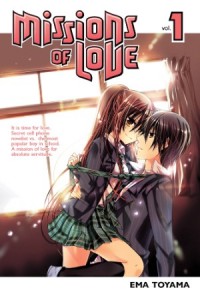
Missions of Love, Vol. 1

November 12, 2012 by Sean Gaffney

By Ema Toyama. Released in Japan as “Watashi ni xx Shinasai!” by Kodansha, serialized in the magazine Nakayoshi. Released in North America by Kodansha Comics.

There has been a certain growing trend in shoujo manga that gets licensed over here lately, pulling away from the overly perky/helpless female lead in favor of someone a lot more sarcastic, cold, and awkward. And I for one could not be happier. Yes, it can be argued that this type of shoujo doesn’t sell quite as well as Black Bird and the like, but its heroines are usually a breath of fresh air, especially given how they deal with the heroes, many of whom remain the same heartthrob of the school types.

Yukina, the heroine of Missions of Love, is not quite as sharp as the two other heroines she calls to mind, Kanoko from ‘The Secret Notes Of Lady Kanoko’ and Maria from ‘Devil and Her Love Song’. But then this did run in Nakayoshi, which caters to a much younger demographic than the other two titles. The author’s comments even notes that she was told this isn’t really the sort of thing Nakayoshi does. So I suspect that the goal here may be to see how long Yukina’s natural-born snark can win out against the narrative trying to get her to say ‘what is this strange feeling in my heart?’ This is not helped by this being her own goal as well.

Yukina is a secret popular cell-phone novelist, a genre that has not really taken off in North America yet… I think the best description would be drabbles strung together into a narrative. Her talent and intelligence have made her quite a draw, but her social ineptness means that her works lack a certain… heat. So she wants to find out how love feels, but is not callous enough to ask some normal guy to show her what this Earth thing called kissing is. That’s when she spots Shigure, the popular male in the class, getting hit on by someone else. And rejecting her politely. And then… ticking off her name in a book?

Yes, finding out about love is all right as long as there’s no actual emotion involved. So now that she knows Shigure is a jerk, she can feel free to emotionally blackmail him. This is the meat of the book, and also the best part, for several reasons. Shigure has gotten through life by observing people’s likes and faults and playing up to them – he even has a notebook full of traits to note – but Yukina is not only better than him at it but doesn’t need to write it down. He tries to blackmail her right back a few times, unsuccessfully. She’s probably just what he needs. Yukina, meanwhile, is not without fault – she hasn’t mentioned her books at all (she is, after all, a secret author), so her come-ons to Shigure sound even weirder than we know them to be. It’s hard to learn about love when you have no concept of real social interaction.

I didn’t even mention her cousin, who seems poised to be the romantic rival if the cliffhanger to Vol. 1 is anything to go by. But I suspect he won’t be too much of an issue. The reason to read this is the same reason we enjoy watching the best screwball comedies – to see the guy and girl exchange barbs and grow closer even as they both try to manipulate each other. Good stuff. (And, despite the Japanese title, decidedly G-rated.)

Filed Under: REVIEWS

The Immortal: Demon in the Blood

November 11, 2012 by Ash Brown

Author: Ian Edginton
Illustrator: Vicenç Villagrasa and José Luis Río
Original story: Fumi Nakamura

Publisher: Dark Horse
ISBN: 9781616550240
Released: October 2012
Original run: 2011-2012

I picked up the trade collection of The Immortal: Demon in the Blood for one reason–the comic series is an adaptation of Fumi Nakamura’s award-winning novel Ura-Enma, published by Vertical under the title Enma the Immortal. I have read, and absolutely loved, Enma the Immortal. I was interested in seeing how another team of creators would handle the story. Ian Edginton wrote the series script, working with the artists Vicenç Villagrasa, responsible for pencils, and José Luis Río, responsible for inks and colors. I know of Edginton’s work, but before reading The Immortal I was unfamiliar with either of the two artists. The Immortal was first published by Dark Horse Comics in four monthly issues beginning in December 2011. Later it was collected and released as a single, complete volume in 2012. I missed the series when it was first issued, and so looked forward to reading the trade collection.

Amane Ichinose is a traitor and a spy. After being confronted by his fellow Shinsengumi members, he barely escapes with his life. Bleeding and dying, he stumbles onto the doorstep of Baikou Houshou, a talented tattooist. The old man rescues Ichinose, saving his life, but at the same time curses him with immortality. Houshou has given Ichinose an oni-gome, a tattoo which binds a demon to him, keeping him alive. Ichinose isn’t the only one with an oni-gome granting immortality. Yasha, Houshou’s erstwhile apprentice, tattooed his own oni-gome, becoming a cannibalistic monster in the process as the demon bound to him devours his soul. Ichinose comes to realize that Yasha may have been responsible for the death of his sister and is determined to find him no matter how long it takes. After all, time is the one thing Ichinose now has more than enough of.

The Immortal doesn’t actually adapt the entirety of Enma the Immortal, which makes sense for such a short comic series. Instead, the comic focuses its attention on the first two thirds of the novel, taking the story up through the Yokohama Ripper arc. It was a good decision. However, steampunk elements were added to the story of The Immortal. Except for some interesting and attractive illustrations, they don’t seem to serve much of a purpose for either the plot or the setting. I actually found them to be somewhat distracting and even at odds with the supernatural elements of the story. Edginton is particularly known for some of his other steampunk series and steampunk is a popular genre right now, but its inclusion in The Immortal was largely unnecessary.

Ultimately, I can’t say that I was overly impressed with The Immortal. But it’s not because of my loyalty to or love of source material. The comic gets off to a weak start, rushing through the necessary introductory material. The ending, too, isn’t very satisfying; the rules governing how the oni-gome work seem to suddenly change during the story’s climax. But everything in between the beginning and end is pretty great. Ichinose is easily the most well developed character in the series. I enjoyed seeing how he changes as a person over the years even while physically he remains the same. I think The Immortal could have used one or two more issues to more fully develop and flesh out the other characters and address some of the problems with pacing in the series. As it is, the comic is somewhat frustrating overall, especially considering there were parts of it that I highly enjoyed.

Filed Under: REVIEWS Tagged With: comics, Dark Horse, Enma the Immortal, Fumi Nakamura, Ian Edginton, José Luis Río, Vicenç Villagrasa

Saturday Spotlight: Webtoons

November 10, 2012 by MJ Leave a Comment

Today’s Off the Shelf column featuring the Korean webcomic, or “webtoon,” Aron’s Absurd Armada has put webtoons in general on my mind. With only a handful licensed for North American release (mainly from online publisher NETCOMICS and iOS publisher iSeeToon), Korean webtoons represent a huge untapped source of East Asian comics.

So, this week’s Saturday Spotlight shines on Hana Lee’s An introduction to Korean webcomics, written for Manhwa Bookshelf in the summer of 2010.

Read and dream of what we could be reading!

Filed Under: Saturday Spotlight, UNSHELVED Tagged With: webtoons

Off the Shelf: Armada, Roses, Crazy for You

November 10, 2012 by MJ and Michelle Smith 4 Comments

MICHELLE: Hey, MJ! What did Geronimo say when he jumped out of an airplane?

MJ: Hm, I don’t know, what did he say?

MICHELLE: “Me!!!!”

MJ: I guess I should have seen that coming.

MICHELLE: Yeah, probably. So! What’ve you been reading this week?

MJ: My solo read this week was the debut volume of MiSun Kim’s Aron’s Absurd Armada, a Korean webtoon published in English by Yen Press. This series has been running since August of 2010 in the online incarnation of Yen Plus, and I checked out the first chapter for this column back when it debuted. Since it’s been quite a while, I’ll take a moment to refresh the premise.

Aron is a young nobleman and heir to a prominent dukedom with dreams of becoming a pirate. Thanks in part to his mother’s delusions regarding his intelligence and cunning (she believes he aspires to piracy in order to keep a rival family’s military influence in check), he is allowed to do so, accompanied by his pretty-boy bodyguard, Robin, whose reluctant participation hinges entirely upon his unapologetic greed. Though Aron is a fairly ridiculous pirate, random luck and Robin’s skills as a swordsman actually manage to win them a small crew, and the two embark on their journey to conquer the seven seas. Members of Aron’s ragtag crew include Ronnie, a young woman rescued from a shipwreck who is consistently mistaken for a man; Mercedes, a swanky transvestite who claims to be a hairdresser but is actually a deadly assassin; hulky Vincent, the world’s worst chef; and underlings Anton and Gilbert, whose primary function seems to be complaining and making jokes about other people’s sexuality.

True to its name, Aron’s Absurd Armada is devoted to humor rather than plot, and in this it largely succeeds. Though translating foreign comedy tends to err on the “miss” side of “hit-or-miss,” Kim’s sense of humor easily bridges cultural barriers—most of the time, at least. Only two or three jokes rely too heavily on Korean pop culture references to translate effectively in this first volume, which is a fairly good track record when compared to much of the Japanese 4-koma that’s been licensed for English-language release. In fact, the biggest cultural disconnect is the unfortunate volume of gay jokes that crop up, a large number of which originate in the series’ deliberate BL overtones. As a general rule, however, the series is genuinely funny, light, and satisfyingly whimsical.

Having originated as a webcomic, Absurd Armada is in full color, and Yen has thankfully preserved this in its print volumes as well. While, as a manga fan, I often find that full color comics result in sensory overload, in this case, color pages just enhance the series’ cartoonish feel, which is really quite effective. On top of that, both Kim’s comedic sense and her clear, expressive art style remind me of nothing more than Hiromu Arakawa’s omake strips for Fullmetal Alchemist, which, coming from me, is definitely a compliment.

MICHELLE: Since I generally don’t like consuming stories on a chapter-by-chapter basis, I’ve been waiting to read any of Aron’s Absurd Armada until it was finally collected, so I was very excited to see that a tangible copy is finally available. I’m kind of dubious about comedies a lot of the time, but this one sounds like it could be right up my alley.

MJ: I think it could be! Actually, I’d theorize that the best way to consume this series would be as a daily webcomic, one strip at a time, but it’s enjoyable in collected form as well.

So, what have you been reading this week?

MICHELLE: I’ve spent the last week catching up on Rinko Ueda’s Stepping on Roses in order to talk about its eighth volume, which came out early last month.

I knew going in that Stepping on Roses wasn’t going to be a masterpiece, but ye gods, is it ever dumb! The basic premise is that pauper Sumi Kitamura agrees to marry rich Soichiro Ashida in order to provide for the orphans her ne’er-do-well brother, Eisuke, keeps bringing home. Soichiro needs to be married in order to inherit his grandfather’s fortune, but schemes to have his friend Nozomu fall in love with Sumi with hopes of causing a scandal that’ll allow Soichiro to triumph in business somehow. He succeeds wildly, causing Nozomu to essentially go insane with his love for Sumi and become the series’ main antagonist. Meanwhile, Soichiro and Sumi fall in love for real. In volume eight, they’re living together in the slums until Soichiro gets ill and Sumi decides to yield to Nozomu’s aggressive courtship as a means to provide for her husband’s treatment. Misunderstandings, manual labor, and jumping from cliffs ensue. (Really.)

Being dumb doesn’t preclude Stepping on Roses from occasionally being entertaining. In particular, I’m fond of Soichiro’s manservant, Komai, and the best moment in the series so far is the super-short flashback side story in which he introduces his young charge to commoner cuisine in the form of riceballs. The series is also an extremely fast and easy read, with large, uncluttered panels and uncomplicated dialogue. Unfortunately, “uncomplicated” is pretty much the theme of the day. Despite the dramatic goings-on, the story lacks oomph and I find it hard to care about the characters. Sumi is mostly a passive heroine, and whenever she musters some gumption to do something about her plight, it’s usually something dangerous that requires one of the men in her life to rescue her. Soichiro is the classic misunderstood rich boy who’s never known love, and all of the villains are so obvious that they might as well be twirling mustaches. Speaking of obvious, the plot twist that will presumably be unveiled in the ninth and final volume was telegraphed so strongly in volume seven that it’s now just a matter of waiting for the pieces to fall into place.

That said, I undoubtedly will read the last volume to see how it all wraps up.

MJ: You are a lot more patient with this series than I have been. I gave up on it many volumes ago, for most of the reasons you mention here. Somehow it managed to eclipse my tolerance for brainless shoujo. I hadn’t realized that was possible, really, until Stepping on Roses. Though I have enjoyed Sean’s repeated wish that it would turn into a shogi manga. Sumi’s unexpected skill at shogi is pretty much all the series has going for it, in my view. Heh.

MICHELLE: I would much prefer it as a shogi manga!

Anyways, I think it’s your turn this time to introduce our tandem read!

MJ: Indeed it is! Our mutual read this week was the first two volumes of Crazy for You, a recent addition to the JManga catalogue from Karuho Shiina, best known in North America as the creator of Kimi ni Todoke.

Okay. So, Sachi is a shoujo everygirl—physically and intellectually unremarkable—whose best friend, Akemi, sets her up on a group date with a bunch of her boyfriend’s classmates. Though the boyfriend, Yuuhei, has been charged by Akemi with not letting any questionable guys latch on to inexperienced Sachi, he somehow lets known womanizer Yuki chat her up for the entire evening. Sachi predictably falls for Yuki and, despite Akemi’s alarmed disapproval, continues to pursue him even though she knows that most of what he says are lies. Thanks to Sachi’s sweet, guileless nature, she actually manages to befriend Yuki for real (to the dismay of both Akemi and Yuki’s more straightforward friend, Akahoshi), but their friendship’s unbalanced nature only spells doom for Sachi’s romantic heart. Just when Sachi begins to believe that her feelings might be returned, it becomes clear that Yuki harbors feelings for Akemi (and vice-versa), shattering relationships on all sides.

Though the typical love-triangle (or double-triangle?) setup and Sachi’s downright eagerness to be jerked around by Yuki becomes quickly wearying in the series’ early chapters, Shiina’s talent for exploring teen emotion eventually shines through. Early on, I’ll admit that my assessment of the series was pretty much, “not as good as We Were There,” to which it bears a number of similarities in terms of romantic setup, but Shiina adds some appealing touches later on.

First, I’m quite taken with the friendship between Sachi and Akemi, which (for once) is portrayed as being at least as important as their romantic aspirations—something Shiina perfected later in Kimi ni Todoke. Also, while Akahoshi could easily be set up as the ill-fated, stalwart “nice guy,” there’s actually quite a bit of doubt about just how “nice” he actually is, which makes his attachment to Sachi more interesting than tragic. Emotional complication is the real key to good romance, and there’s just enough here to make Crazy for You an engaging read.

MICHELLE: Nicely put! I was thinking that this really is the opposite of Stepping on Roses in terms of complicated versus uncomplicated!

Although I’m usually the first one to get riled up at female leads who don’t assert themselves, somehow I felt fairly tolerant of Sachi’s eagerness. Not the way she agrees to be duped, but how, even after Yuki and Akemi’s illicit smoochies shatter the group of friends, she still considers meeting Yuki—and experiencing a whole new world of love and heartbreak—the luckiest thing that’s happened to her. It’s almost as if she appears weak, but is actually strong, determined not to deny the love she feels, no matter what else is happening with other people. She’s glad that detached Yuki is able to feel love after all, and simply being capable of such an emotion herself is sustaining. If that makes sense.

And man, yes, the similarities with We Were There are pretty striking. Not so much the plot, but Yuki and Yano are so much alike they’re practically interchangeable. And the discoveries our heroine makes about their romantic pasts are rather similar, as well. I wonder if that’s part of why VIZ hasn’t licensed it.

MJ: Oh, you may have a point! One thing I’m glad of is that at least Akahoshi is not as straightforwardly awesome as Takeuchi, which I’m hoping means that I won’t have to be heartbroken over his inevitable rejection by Sachi. Heh.

MICHELLE: Yeah, he’s a really interesting character! Just another example of Shiina’s flair for developing her supporting characters in unexpected ways. Who could tell from the first couple of chapters that he would wind up being so important to the story? It’s hard to tell whether he genuinely wants Sachi to “save” him in a way, bestow upon him the faith she had for Yuki, or if this is another deliberate attempt to seduce a girl on his part. Is she a challenge? Does he genuinely like her?

MJ: In any case, I’m dying to find out! Which I guess means that I’m hooked.

MICHELLE: Me, too! Thanks again, JManga (and Shueisha)! I seriously was not getting far with my German editions and Google Translate! I hope we get more volumes of this (and Pride) in the near future.

Filed Under: OFF THE SHELF Tagged With: aron's absurd armada, crazy for you, stepping on roses

  • « Go to Previous Page
  • Page 1
  • Page 2
  • Page 3
  • Page 4
  • Page 5
  • Page 6
  • Go to Next Page »
 | Log in
Copyright © 2010 Manga Bookshelf | Powered by WordPress & the Genesis Framework