• Skip to primary navigation
  • Skip to main content
  • Skip to primary sidebar
  • Home
  • About Us
    • Privacy Policy
    • Comment Policy
    • Disclosures & Disclaimers
  • Resources
    • Links, Essays & Articles
    • Fandomology!
    • CLAMP Directory
    • BlogRoll
  • Features & Columns
    • 3 Things Thursday
    • Adventures in the Key of Shoujo
    • Bit & Blips (game reviews)
    • BL BOOKRACK
    • Bookshelf Briefs
    • Bringing the Drama
    • Comic Conversion
    • Fanservice Friday
    • Going Digital
    • It Came From the Sinosphere
    • License This!
    • Magazine no Mori
    • My Week in Manga
    • OFF THE SHELF
    • Not By Manga Alone
    • PICK OF THE WEEK
    • Subtitles & Sensibility
    • Weekly Shonen Jump Recaps
  • Manga Moveable Feast
    • MMF Full Archive
    • Yun Kouga
    • CLAMP
    • Shojo Beat
    • Osamu Tezuka
    • Sailor Moon
    • Fruits Basket
    • Takehiko Inoue
    • Wild Adapter
    • One Piece
    • After School Nightmare
    • Karakuri Odette
    • Paradise Kiss
    • The Color Trilogy
    • To Terra…
    • Sexy Voice & Robo
  • Browse by Author
    • Sean Gaffney
    • Anna Neatrour
    • Michelle Smith
    • Katherine Dacey
    • MJ
    • Brigid Alverson
    • Travis Anderson
    • Phillip Anthony
    • Derek Bown
    • Jaci Dahlvang
    • Angela Eastman
    • Erica Friedman
    • Sara K.
    • Megan Purdy
    • Emily Snodgrass
    • Nancy Thistlethwaite
    • Eva Volin
    • David Welsh
  • MB Blogs
    • A Case Suitable For Treatment
    • Experiments in Manga
    • MangaBlog
    • The Manga Critic
    • Manga Report
    • Soliloquy in Blue
    • Manga Curmudgeon (archive)

Manga Bookshelf

Discussion, Resources, Roundtables, & Reviews

Archives for September 2009

What Belongs in the Manga Canon?

September 11, 2009 by Katherine Dacey

Back in 2006, I stumbled across this entry at Otaku Champloo, reflecting on the need for a manga “canon.” The author noted that books in the Western literary canon (e.g. Aeschylus, Dante, Shakespeare) were not the “most popular” titles, but titles that “reflect[ed] the progress of humanity” from classical antiquity to the machine age. She then posed several intriguing questions:

[W]hat really struck my head was the idea of a canon for manga. Could we come up a list of mangas that would best represent humanity and the manga genre? Another interesting question would be… what good would a manga canon bring? Does the world of manga need one?

When I first responded to her essay back in 2006, I hadn’t read very much manga — just enough to be dangerously opinionated and scornful of shojo* — and my knowledge of “classic” titles was limited to a few works by Osamu Tezuka and Kazuo Koike. I thought it would be an interesting challenge to revisit and revise that initial response to reflect where I am now, three years and hundreds of series later.

…

Read More

Filed Under: Manga Critic

Underfoot in Show Business by Helene Hanff: A

September 9, 2009 by Michelle Smith

underfootFrom the front flap:
“Each year, hundreds of stagestruck kids arrive in New York determined to crash the theatre… One in a thousand turns out to be Noel Coward. This book is about life among the other 999. By one of them.”
– Helene Hanff

In her spirited, witty and vastly entertaining memoir, Helene Hanff recalls her ingenuous attempts to crash Broadway in the early forties as one of “the other 999.”

From the joys of summer theatre and furnished rooms to being Seen at Sardi’s and weathering one more Theatre Guild flop, Miss Hanff recalls the rigors of crashing Broadway with warmth and generous humor. Her exuberant account of a misspent youth will hearten theatre hopefuls and entertain the large, devoted readership she has acquired through her subsequent works.

Review:
Helene Hanff’s memoir of her attempts to break into the threatre spans decades from the early ’40s to the early ’60s. Conforming to Flanagan’s Law, a theory advanced by a friend of hers that states, “If you can predict it, it doesn’t happen. In the theatre, no matter what happens to you, it’s unexpected,” Hanff’s career does not go as planned. It starts off well, with Hanff taking top prize in a contest, but soon sputters. Though she wants to be a playwright, and can create excellent characters and settings, she’s never been a fiction fan so her plots are always weak and her plays never sell. To make ends meet she takes a variety of part-time jobs, and eventually ends up writing for television. Just as she accepts that it’s time to give up on plays and focus on TV, all of the writing jobs for that medium move off to the West Coast and she’s left unemployed once again.

Hanff tells the story of her career trajectory with warmth and wit and, though I just used this adjective the other day and am hesitant to do so again, the result is nothing short of delightful. Interspersed with tales of her various odd jobs—including a memorable episode where she and an assistant have to alter 10,000 mimeographed press releases for Oklahoma! by hand when its creators decide it needs an exclamation point—are stories about the places she used to live (garrets with a communal kitchen and colorful neighbors), the free entertainment she and a friend used to enjoy (courtesy of a nifty trick of mingling in with the crowd at intermission), and snippets of wisdom gleaned from so many years in the business.

Toward the end, the narrative overlaps a little with 84, Charing Cross Road, probably the best known of Hanff’s works. At least one story shared with her English penpals is recounted in this book, too—about a dramatization of the life of Aesop and Rhodope—but it’s not tiresome by any means. It’s more like your friend telling you an amusing story and not quite remembering they’ve told you already, but it’s fun and you like them, so you play along and don’t interrupt.

And speaking of not interrupting, this book is so captivating that I very nearly read it in one sitting and would have if not for the pesky necessity of going to bed at a reasonable hour. A special thanks to MJfor the recommendation!

Filed Under: Books Tagged With: Helene Hanff

Sand Chronicles, Volume 5

September 9, 2009 by MJ 5 Comments

Sand Chronicles, Vol. 5
By Hinako Ashihara
Published by Viz Media

sandchronicles5
Buy This Book

After promising to call once he’s sorted out his feelings, Daigo has gone three months without contacting Ann and each passing day makes it more difficult for him to pick up the phone. Ann tries to be patient but is dying inside, saved finally by her friend Asa who places a call to Daigo on her behalf. Determined to be the one to put in the work this time, Ann rushes to the airport and flies back to see him. Meanwhile, Shika has been going all out to try to attract Daigo for herself, though she meets repeated rejection. Finally faced with Ann’s presence (and her own betrayal), Shika’s desperation leads to desperate action and though ultimately some things do end up going her way, the outcome is far from what she might have hoped.

As rare as it is for first love to last forever, particularly in ones so young, it’s still painful to watch such an intense relationship wane, especially when both characters are so likable and so obviously still in love. Though Ann’s considerable emotional baggage and Daigo’s hero complex make their relationship potentially damaging for them both, their mutual devotion is hard to beat and very difficult to give up easily as a reader. “No, no!” I found myself crying throughout much of this volume, despite the fact that both characters have equally appealing admirers waiting patiently (or not) in the wings.

One of the most powerful characteristics of this series, of course, is its nuanced treatment of love and friendship, and this volume provides an perfect example of that trait, if not in quite the way one might expect. Though the mangaka’s handling of Ann’s relationships with both Daigo and rival Fuji are as poignant and wonderfully layered as always, the most interesting interaction in this volume is between Ann and Shika. Alternately defiant and conflicted over her decision to steal her best friend’s boyfriend, Shika never loses either the love or jealousy she feels for Ann, and as a result, ties them both up in knots. The fact that this volume nowhere contains (or even remotely approaches) any kind of stereotypical cat fight or other confrontation between the two of them keeps the story’s melancholy feel perfectly intact, while also demonstrating the power of the characters’ long mutual history. Even while hurting each other, these characters are connected too deeply to relish the results or even to just be okay with them. This kind of thoughtful writing is perhaps what I treasure most in shojo manga and is certainly what draws me to this series.

Also in this volume, both Ann and Daigo face decisions about their careers–a common theme in high school manga–presented here with the same delicate anxiety that permeates the series overall. Both of their personal struggles here are highly engaging, as Daigo fights off snickers from friends and family when he sheepishly announces his intention to get into a well-respected public university and Ann fights her own complacency when she realizes she’s never developed any ambition at all beyond her desire to go back home and marry Daigo. This plot line only enhances the sense that the two of them may be growing irrevocably apart, as new love interests are the ones best poised to help each of them move forward.

Though this series’ art lacks the extraordinary poignance of something like We Were There–a series with a similarly melancholy feel–it is visually well-paced and nicely expressive with occasional moments of stillness and beauty that can be truly breathtaking. Body language, in particular, is one of the artist’s real strengths, which is a great asset to her already-rich characterization.

For those of us who prefer our shojo manga heavily weighted in sweet, sweet angst, choosing Sand Chronicles is no-brainer and its fifth volume could not possibly embody this aesthetic more. Bring some tissues and dig right in!

Review copy provided by the publisher.

Filed Under: MANGA REVIEWS Tagged With: manga, sand chronicles

Celebrating Dorrie

September 6, 2009 by MJ 16 Comments

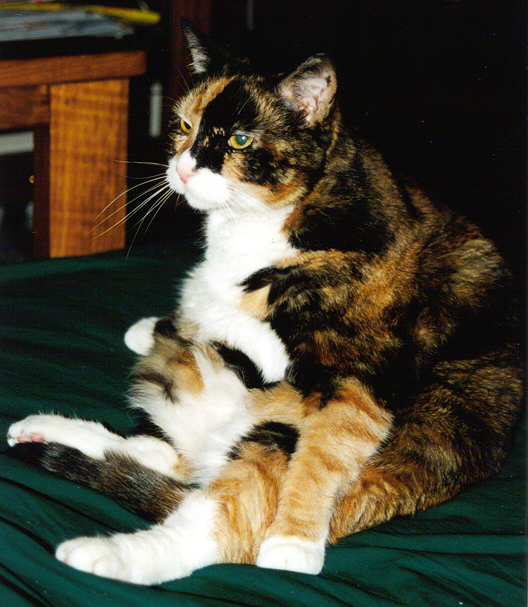
Please excuse this off-topic post but I must take a moment to talk about Dorrie, my beloved friend and companion for the past eighteen years. Today we lost her and though my heart is truly broken, I’d like to share with you all some of what made her so special.

I first met Dorrie when I was working as a waitress at a Mexican restaurant in New York’s financial district. Another waitress was looking for a home for a six month old kitten belonging to her little sister. The girl had stopped caring for the kitten and her mom was sick of dealing with it herself, so she planned to have the kitten put to sleep. Though I already had four cats and was not looking for another, I immediately said, “Bring me the cat!” The next day, she brought me a half-grown kitten named “Princess” in a cardboard box. I re-named her “Dorrie” (though she was occasionally referred to as “The Cat Formerly Known As Princess”), hopped on the subway, and brought her back to my apartment. Dorrie was named for a character in one of my favorite books, B.J. Chute’s Greenwillow. Greenwillow‘s Dorrie was a foundling, taken in and loved by two sisters who raised her as their own. I considered my Dorrie to be much the same.

Though Dorrie had clearly been abused in her former life and it took a lot of love and patience to get her through the trauma that had instilled in her, over the years she developed into the most friendly, loving, unique cat I have ever known. There has never been another like her.

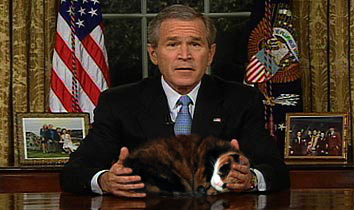
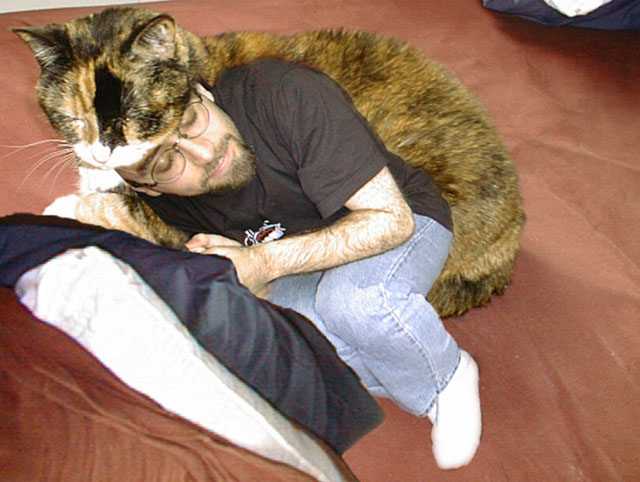
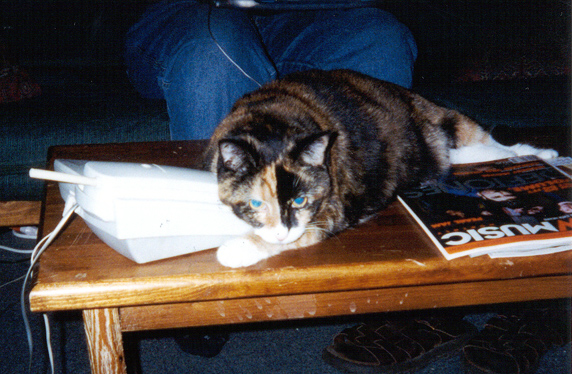
According to legend (and by “legend” I mean “my husband”), Dorrie has been many things over the years, including (but not limited to) a film star, a pitcher for the Red Sox, leader of a nation, a licensed driver, reliable transportation (later upgraded), a presidential candidate, an express delivery service (man, I wish the Dorrie Express website was still up), a donkey, a hardened criminal, burger ingredients, meat pie, a superhero, an artist’s model (that’s actually real–thanks Ellen!), valid currency, an avid writer, omniscient, possibly evil, occasionally flabby, and… okay, I don’t actually remember what this was about, capable of mind-reading, speaking English, teleportation, writing fanfiction, and pretty much anything else you can imagine. She also kept my husband warm. She definitely loved the telephone and the Kitty Kat Komb, was creative about her seating choices, and occasionally felt hurt.

Most of all, though, she was our most dear, beloved cat. I will miss her more than I can possibly express, though I feel very lucky that she allowed me to share my life with her for eighteen wonderful years.

R.I.P. Dorrie 1991-2009

Picture 2

Filed Under: NEWS Tagged With: Bloggish, dorrie

Have His Carcase by Dorothy L. Sayers: B

September 6, 2009 by Michelle Smith

havehiscarcaseFrom the back cover:
The mystery writer Harriet Vane, recovering from an unhappy love affair and its aftermath, seeks solace on a barren beach—deserted but for the body of a bearded young man with his throat cut. From the moment she photographs the corpse, which soon disappears with the tide, she is puzzled by a mystery that might have been suicide, murder, or a political plot. With the appearance of her dear friend Lord Peter Wimsey, she finds a reason for detective pursuit—as only the two of them can pursue it.

Review:
On the one hand, Have His Carcase is nothing short of delightful. Upon learning that his beloved Harriet Vane has discovered a body upon a stretch of coastline, Lord Peter dashes to the scene with a stated claim of interest in the case, though he is really there to defend Harriet, lately the defendant in a notorious murder trial and likely to be suspected on that account. When the local police force seems content with a verdict of suicide, Peter and Harriet proceed to work together to prove the victim was murdered. He still loves her and often cavalierly asks her to marry him, but she steadfastly refuses. While the banter between them is brisk, witty, and wonderful, the most emotional moments are really the best, like when Peter confesses that he camouflages his proposals in flippancy because he can’t bear to see the repulsed reaction a genuine query would engender.

Sayers sets the scene for these two right at the start in a highly amusing way that I must quote out of admiration for its economical humor:

The best remedy for a bruised heart is not, as so many people seem to think, repose upon a manly bosom. Much more efficacious are honest work, physical activity, and the sudden acquisition of wealth… Harriet Vane found all three specifics abundantly at her disposal; and although Lord Peter Wimsey, with a touching faith in tradition, persisted day in and day out in presenting the bosom for her approval, she showed no inclination to recline upon it.

Significantly less delightful, alas, is the investigation itself. This aspect of the book definitely has attributes to recommend it—I had no idea who’d really done the deed and had even begun to think perhaps Sayers would conclude by saying, “What do you know, it really was suicide!”—but bogs down a lot in lengthy passages spent decoding ciphers or tracking down innumerable townsfolk possessed with an uncanny ability to remember the precise time they saw a certain gentleman get into a Bentley. Cracking the case hinges on the time of death, so a lot of emphasis is placed on alibis and many theories are advanced that attempt to make all of the random clues work together. It’s kind of interesting, but does get rather tiresome after a while.

Still, it’s a solid mystery and I am satisfied that some progress was made in tempting Harriet to reconsider the merits of the Wimsey bosom.

Filed Under: Books Tagged With: Dorothy L. Sayers

Kare Kano 11-12 by Masami Tsuda: B-

September 6, 2009 by Michelle Smith

karekano11One thing that Kare Kano does differently from a lot of shoujo manga is that it puts its side stories about the main couple’s friends in the middle of the series rather than the end. That might be a disruptive and frustrating choice if one is consuming the story rapidly—the “Dark Arima” arc has been left hanging since the end of volume nine—but for someone like me, who hasn’t read a volume of this series in a year, the two-volume tale of the romance between childlike Tsubasa and her step-brother, Kazuma, works as a nice, self-contained reintroduction to Kare Kano‘s characters and plot.

When Tsubasa’s doting father married Kazuma’s mother, each lonely only child acquired a new step-sibling. Tsubasa was very upset at first, but grew to like her step-brother a lot and open up to him in a way she had with no one else. Kazuma fights his more mature attraction for her, drawn to the sad and lonely side of her that only he gets to see, especially as he feels an increasingly strong desire to devote himself more fully to his musical career with the indie band, Yin and Yang. Feelings of doubt and insecurity about his musical worth plague him, however, and he spends a lot of time trying to figure out what he wants and should do. He eventually realizes that his love for Tsubasa is a strength rather than a weakness, as allowing himself to experience it positively impacts his songwriting abilities and makes him feel like a more legitimate part of the band.

Tsubasa has always been my least favorite character in the series. Since her introduction, she’s been portrayed as immature and violent, and often pretty dumb. These two volumes make the case that she’s actually refusing to grow up on purpose, putting up walls to deflect things she’s not ready to deal with yet. She’s certainly far more tolerable here than she ever has been before, and by the end of the story seems to have grown up a great deal. Originally viewing Kazuma as a “safe” guy by whom she can feel adored without entering into anything more complicated, her front row center presence at a Yin and Yang concert signals that she accepts both Kazuma’s dedication to music as well as his feelings for her.

karekano12While there are certainly moments between Kazuma and Tsubasa that are important, not just between them but for the story at large (I very much hope Tsubasa retains her newfound maturity), I still can’t get very excited about their relationship. Part of the problem is that they’re not actually together a lot in these two volumes: it seems like Kazuma spends much more time with his (meant to be amusing but not actually amusing at all) bandmates than he does with her. Granted, this is actually indicative of their circumstances, and Kazuma’s absence from Tsubasa’s world and her hatred of the music that keeps him from her is a big part of the story, but it seems they’re only able to connect for a few pages at a time which hampers my ability to really understand how they’d function together as a couple.

I’m also rather confused about the passage of time. From the time Kazuma’s new song prompts Yin and Yang to give a stellar performance to the concert Tsubasa attends, eight months pass. Have these eight months also passed uneventfully for Yukino and Arima, who appear throughout these volumes sporadically, functioning solely as Yin and Yang fans? Perhaps it was a convenient way for Tsuda to leave her leads in a holding pattern while whisking them that much nearer to graduation. Time will tell, I suppose.

Ultimately, these two volumes are decent, but disappointing, too. At least the focus returns to Yukino and Arima with the next volume.

Filed Under: REVIEWS Tagged With: Masami Tsuda, Tokyopop

A Little Morning Link-Blogging

September 2, 2009 by MJ 10 Comments

Various life complications have kept me from posting as much content as I’d like here lately, but there have been some posts out in the rest of the world that have gotten my mind going. First off, Kate Dacey talks about fabulous Boston comic shop Comicopia in her blog this week. Despite living only a couple of hours away, I have only visited Comicopia once, though it honestly blew my mind with its huge manga selection. What’s most heartbreaking about this, is that my single visit was quite early on in my association with manga, so I am sure I failed to appreciate the store fully, even then. Hopefully my life will calm down enough soon to let me take more trips into Boston!

Secondly, fantasy author Sarah Rees Brennan made a post in her livejournal recently regarding readers’ views of women in fiction that really struck a chord with me. A quote from her post:

Let us think of the Question of Harry Potter. I do not mean to bag on the character of Harry Potter: I am very fond of him.

But I think people would be less fond of him if he was Harriet Potter. If he was a girl, and she’d had a sad childhood but risen above it, and she’d found fast friends, and been naturally talented at her school’s only important sport, and saved the day at least seven times. If she’d had most of the boys in the series fancy her, and mention made of boys following her around admiring her. If the only talent she didn’t have was dismissed by her guy friend who did have it. If she was often told by people of her numerous awesome qualities, and was in fact Chosen by Fate to be awesome.

Well, then she’d be just like Harry Potter, but a girl. But I don’t think people would like her as much.

Having read numerous posts on the evils of Ginny Weasley (Chosen by The Author to be both awesome and loved by the awesome hero), I would be honestly shocked if anyone could present a believable argument against Sarah’s point here. I would also be surprised if anyone could believably argue against the fact that the great bulk of those who dislike female characters in fiction are women themselves! Sure, there are women (I like to think I’m one of them) who love awesome female characters in fiction. Maybe there are even a lot of us. But I am constantly disturbed by the evidence suggesting just how many of us actually despise female characters, both the fabulous, kick-ass ones and the ones who are deeply flawed, which is not, by the way, mutually exclusive (see both of the main characters in NANA, for instance). Misogyny among women is probably my single greatest ISSUE with certain subsets of fandom. It makes me cry. And you can go on and on about how poorly women are written in fiction but there are plenty of fantastic female characters receiving hate from female readers at any given moment, so that argument really doesn’t fly with me.

Anything I could say on this subject, however, is better said by Sarah. Witness her conclusion:

My point is, people will enjoy books and movies and shows more if ladies are in them being awesome. (I know I will.) And people will enjoy them more if they maybe take a step back, examine their prejudices, and relax into accepting that they’re awesome. Even if some girl characters are missteps, even if some of them you just will never personally like because tastes are subjective, it’s worth doing to have them, and it’s worth trying to love them.

Amen. Read her full post here. Please. Especially the section in which she talks about readers’ reactions to the characters in her own books.

There were more links in the works, but I’m out of time! Later, friends!

Filed Under: NEWS Tagged With: fiction, links, manga

Where to Buy Manga: Comicopia (Boston, MA)

September 1, 2009 by Katherine Dacey

IMG_0080Highbrow, lowbrow… and everything in between. That’s the slogan of Comicopia, a Mecca (mecha?) for Beantown manga lovers. For twenty years, this modest Kenmore Square storefront has been catering to discerning comic fans of all persuasions, stocking everything from Introducing Derrida to Mr. Arashi’s Amazing Freak Show, as well as crowd-pleasers like Peanuts, Bone, Y: The Last Man, Justice Society of America, and, of course, Bleach, Naruto and Fruits Basket. Comicopia’s low-key, friendly vibe is more bookstore than comic store, making it a great place for former Barnes & Noble junkies to ween themselves off the chain store habit.

Owner Matt Lehman claims to have “New England’s largest selection of manga,” a claim substantiated by both the quantity and variety of titles on Comicopia’s shelves. On my most recent visit, for example, I found all nineteen volumes of Full Metal Alchemist alongside full runs of Dragon Head, Eden: It’s An Endless World, and Swan, as well as a generous assortment of older and more obscure titles: Junko Mizuno’s Cinderalla, Shirow Masamune’s Black Magic, Junjo Ito’s Museum of Terror, numerous volumes of Basara, and the first volume of The Monkey King. “We’re committed to carrying every manga in print,” Lehman explains. “We make an effort to stock the first two or three volumes of each new series as it comes out, and continue carrying what sells.”

…

Read More

Filed Under: Manga Critic Tagged With: Boston, Comicopia, Where to Buy Manga

  • « Go to Previous Page
  • Page 1
  • Page 2
  • Page 3
 | Log in
Copyright © 2010 Manga Bookshelf | Powered by WordPress & the Genesis Framework