• Skip to primary navigation
  • Skip to main content
  • Skip to primary sidebar
  • Home
  • About Us
    • Privacy Policy
    • Comment Policy
    • Disclosures & Disclaimers
  • Resources
    • Links, Essays & Articles
    • Fandomology!
    • CLAMP Directory
    • BlogRoll
  • Features & Columns
    • 3 Things Thursday
    • Adventures in the Key of Shoujo
    • Bit & Blips (game reviews)
    • BL BOOKRACK
    • Bookshelf Briefs
    • Bringing the Drama
    • Comic Conversion
    • Fanservice Friday
    • Going Digital
    • It Came From the Sinosphere
    • License This!
    • Magazine no Mori
    • My Week in Manga
    • OFF THE SHELF
    • Not By Manga Alone
    • PICK OF THE WEEK
    • Subtitles & Sensibility
    • Weekly Shonen Jump Recaps
  • Manga Moveable Feast
    • MMF Full Archive
    • Yun Kouga
    • CLAMP
    • Shojo Beat
    • Osamu Tezuka
    • Sailor Moon
    • Fruits Basket
    • Takehiko Inoue
    • Wild Adapter
    • One Piece
    • After School Nightmare
    • Karakuri Odette
    • Paradise Kiss
    • The Color Trilogy
    • To Terra…
    • Sexy Voice & Robo
  • Browse by Author
    • Sean Gaffney
    • Anna Neatrour
    • Michelle Smith
    • Katherine Dacey
    • MJ
    • Brigid Alverson
    • Travis Anderson
    • Phillip Anthony
    • Derek Bown
    • Jaci Dahlvang
    • Angela Eastman
    • Erica Friedman
    • Sara K.
    • Megan Purdy
    • Emily Snodgrass
    • Nancy Thistlethwaite
    • Eva Volin
    • David Welsh
  • MB Blogs
    • A Case Suitable For Treatment
    • Experiments in Manga
    • MangaBlog
    • The Manga Critic
    • Manga Report
    • Soliloquy in Blue
    • Manga Curmudgeon (archive)

Manga Bookshelf

Discussion, Resources, Roundtables, & Reviews

yen press

The Betrayal Knows My Name, Vol. 1

June 29, 2011 by Katherine Dacey 27 Comments

For years, Tokyopop specialized in a particular genre — call it “forbidden bromance,” for want of a better term — in which two handsome, impeccably groomed young men teetered on the brink of a relationship. That relationship usually faced a serious obstacle: one might be a demon and the other a human, for example, or one may have killed the other in a previous life. Most of the story was devoted to uncovering the reason that fate united them, providing the heroes ample time for impassioned conversations and meaningful looks.

At their best, titles like Tokyo Bablyon, Silver Diamond, and X-Kai were silly but engrossing, with plot twists as gloriously melodramatic as an episode of Passions; at their worst, they read like bad slash fic, with purple dialogue and an abundance of poorly explained plot details. Yen Press’ latest offering, The Betrayal Knows My Name, has all the requisite elements to be a gas — pretty-boy leads, past-life tragedy, perfectly moussed locks — but never quite rises to the level of a great guilty pleasure.

Not that volume one wants for activity; every chapter is packed with action sequences, murderous demons, dramatic confrontations, and shocking revelations. What Betrayal lacks is the kind of tightly constructed narrative that made the best bromances such a treat to read. The characters barely rise above type, while script flirts with incoherence at every turn, introducing new characters and subplots at such a furious pace that the central love story is often in danger of being overshadowed. Even the dialogue sags; when the characters aren’t explaining things to one another, they’re so wrapped up in their own thoughts that their monologues become tedious. (Sample: “We can’t survive on principles alone. And everyone would like to live without getting tainted at all. But that’s not how things are.”)

That’s a pity, because The Betrayal Knows My Name looks a lot like my favorite bromances. The character designs owe an obvious debt to CLAMP’s high Baroque period, when characters wore trench coats and dog collars and always had windswept hair. And Hotaru Odagiri certainly knows how to draw brooding men; her heroes, Yuki and Zess, spend a great deal of time staring into space while wearing soulful expressions. (They also know how to pop a pose for readers, allowing us to savor the sheer ridiculousness of their outfits, and the artful way in which they leave their shirts unbuttoned to the waist.)

Yet the prettiness of the character designs can’t camouflage the fact that Betrayal is straining too hard for effect; what should be a great, emo-porn pleasure is something of a chore to read, thanks to its relentless pace, clumsy dialogue, and chemistry-free leads. Readers who can’t get enough of the forbidden bromance genre may find Betrayal an adequate fix; others are encouraged to hold out for Tokyo Babylon‘s return this fall.

Review copy provided by Yen Press.

THE BETRAYAL KNOWS MY NAME, VOL. 1 • BY HOTARO ODAGIRI • YEN PRESS • 368 pp. • RATING: OLDER TEEN (16+)

Filed Under: Manga Critic Tagged With: Betrayal Knows My Name, yen press

The Betrayal Knows My Name, Vol. 1

June 29, 2011 by Katherine Dacey

For years, Tokyopop specialized in a particular genre — call it “forbidden bromance,” for want of a better term — in which two handsome, impeccably groomed young men teetered on the brink of a relationship. That relationship usually faced a serious obstacle: one might be a demon and the other a human, for example, or one may have killed the other in a previous life. Most of the story was devoted to uncovering the reason that fate united them, providing the heroes ample time for impassioned conversations and meaningful looks.

At their best, titles like Tokyo Bablyon, Silver Diamond, and X-Kai were silly but engrossing, with plot twists as gloriously melodramatic as an episode of Passions; at their worst, they read like bad slash fic, with purple dialogue and an abundance of poorly explained plot details. Yen Press’ latest offering, The Betrayal Knows My Name, has all the requisite elements to be a gas — pretty-boy leads, past-life tragedy, perfectly moussed locks — but never quite rises to the level of a great guilty pleasure.

Not that volume one wants for activity; every chapter is packed with action sequences, murderous demons, dramatic confrontations, and shocking revelations. What Betrayal lacks is the kind of tightly constructed narrative that made the best bromances such a treat to read. The characters barely rise above type, while script flirts with incoherence at every turn, introducing new characters and subplots at such a furious pace that the central love story is often in danger of being overshadowed. Even the dialogue sags; when the characters aren’t explaining things to one another, they’re so wrapped up in their own thoughts that their monologues become tedious. (Sample: “We can’t survive on principles alone. And everyone would like to live without getting tainted at all. But that’s not how things are.”)

That’s a pity, because The Betrayal Knows My Name looks a lot like my favorite bromances. The character designs owe an obvious debt to CLAMP’s high Baroque period, when characters wore trench coats and dog collars and always had windswept hair. And Hotaru Odagiri certainly knows how to draw brooding men; her heroes, Yuki and Zess, spend a great deal of time staring into space while wearing soulful expressions. (They also know how to pop a pose for readers, allowing us to savor the sheer ridiculousness of their outfits, and the artful way in which they leave their shirts unbuttoned to the waist.)

Yet the prettiness of the character designs can’t camouflage the fact that Betrayal is straining too hard for effect; what should be a great, emo-porn pleasure is something of a chore to read, thanks to its relentless pace, clumsy dialogue, and chemistry-free leads. Readers who can’t get enough of the forbidden bromance genre may find Betrayal an adequate fix; others are encouraged to hold out for Tokyo Babylon‘s return this fall.

Review copy provided by Yen Press.

THE BETRAYAL KNOWS MY NAME, VOL. 1 • BY HOTARO ODAGIRI • YEN PRESS • 368 pp. • RATING: OLDER TEEN (16+)

Filed Under: Classic Manga Critic, Manga, Manga Critic, REVIEWS Tagged With: Betrayal Knows My Name, yen press

13th Boy 3-6 by SangEun Lee

June 1, 2011 by Michelle Smith

After I read the first two volumes of SangEun Lee’s 13th Boy, in which a pertinacious girl named Hee-So Eun does everything in her power to win the love of the handsome Won-Jun Kang, I had high hopes for the quirky series but apparently not high enough because, starting with volume three, the story veers into unexpectedly (and awesomely) dark territory. That’s not to say that the sense of whimsy—best represented by Beatrice, a talking cactus—has disappeared. Indeed, volume six has several silly moments. But both the reader and Hee-So discover that things are more serious than expected, with the result being that she reveals some admirable qualities that she had not previously displayed.

The bulk of the drama revolves around three childhood friends: Won-Jun, Whie-Young, and Sae-Bom. The three of them have been stuck in a love triangle for years, with Won-Jun pining away for Sae-Bom, and Sae-Bom pining for Whie-Young. But so much time has passed, they begin to question what it is they actually feel for each other. Won-Jun, for example, is staying near Sae-Bom partly out of guilt born of an awful secret that in turn led to a serious accident. Sae-Bom is stunted because of these incidents, behaving like her seven-year-old self (though she is now fifteen) in an attempt to return things to how they used to be. And Whie-Young doesn’t want much to do with either of them.

Into their group comes Hee-So, and though she first appears obnoxious (I didn’t like her much in the first two volumes) her bright outlook and unfiltered expression of what she’s feeling make a big difference in their lives. At first, she merely turns the triangle into a square, with Whie-Young drawn to her while she chases after Won-Jun, but soon begins to make an impact on the others as well. Although Hee-So initially befriends Sae-Bom because it hurts to see Won-Jun caring for his damaged friend so solicitously and she figures he’ll have to do less of that if she helps out, she throws herself into the friendship with true commitment and eventually helps Sae-Bom relinquish her tight hold (literal and mental) on Toe-Toe, a stuffed rabbit who at one point had been given life by Whie-Young, who has magical powers.

You might not think that convincing a teenage girl to give up her stuffed animal would be riveting drama, but it really is. There’s a lot of emotional baggage concerning Toe-Toe, like who was responsible for his death and what that has subsequently meant for Sae-Bom’s emotional state. Simultaneously, Hee-So’s ability to rebound after being snubbed by Won-Jun makes him relax, because even if he should hurt her accidentally, it doesn’t affect how she feels about him. In time, he grows to feel a profound peace in her company and once Sae-Bom actually starts to look at him instead of Whie-Young, it may already be too late for her, because Hee-So has gotten her wish at last.

Starting in volume three, each volume is full of major progress in the story, to the point where I began to think “And there are twelve volumes of this series?! We’re not supposed to find this stuff out until the very end!” But SangEun Lee continues to come up with unforeseen avenues for the story to travel, with the most recent development being that Beatrice, the talking cactus, has realized that he is in love with Hee-So. Although this results in some amusingly absurd dialogue, like “Please don’t say that. It’s an unworthy thought. I am a cactus. I don’t have the right to love her…” it’s still treated fairly seriously, and Beatrice’s wish to become human (something he already manages each month on the full moon) has the potential to complicate the story still further.

And yet, while the romantic feelings of each character are definitely important and inform their motivations, this is not a story that can simply be settled by Hee-So and Won-Jun getting together and living happily ever after. There are too many secrets and too many deep bonds for matters to wrap up so neatly. Will Sae-Bom succeed in redirecting Won-Jun’s attention onto herself? Will Won-Jun, now that he has conquered the symbolic hurdle of “crossing the bridge” into Hee-So’s neighborhood, regress back into childhood obligations or continue on his own path, which ultimately might not include Hee-So? Will Whie-Young, who purports to be tough but yet frequently grants magical favors at the cost of his own health, really fail to live to the age of twenty? In many series, I would doubt that the death of a major character would be allowed to occur, but not 13th Boy.

If you read only the beginning of the series and dismissed it as a romantic comedy, I urge you to reconsider, because 13th Boy is surprising, complex, and well worth reading.

Review copies for volumes three, five, and six provided by the publisher.

Filed Under: REVIEWS Tagged With: yen press

A Bride’s Story, Vol. 1

May 24, 2011 by Katherine Dacey 29 Comments

For nearly 3,000 years, the Silk Road connected Asia with Africa and the Middle East, providing a conduit for the ancient world’s most precious commodities: silk, spices, glassware, medicine, perfume, livestock. By the nineteenth century, when A Bride’s Story takes place, the overland trade routes had been eclipsed in importance by maritime ones that linked China directly with India, Somalia, and the Mediterranean. Yet the Silk Road continued to play a vital role in bridging smaller geographical divides, as the main plot in A Bride’s Story demonstrates.

Set in Central Asia, A Bride’s Story focuses on two clans: the Halgal, a nomadic tribe whose livelihood depends on a mixture of hunting and herding, and the Eihon, farmers with a permanent homestead near the Caspian Sea. The families arrange a marriage between twenty-year-old Amir, the oldest Halgal daughter, and twelve-year-old Karluk, the future Eihon patriarch. As that age gap implies, Amir and Karluk’s union is one of political and economic expedience, designed to help the Eihon clan preserve its territory. Each family has reservations about the match: the Eihon believe that Amir is too old to bear Karluk a good-sized family, while the Halgal want to dissolve the union and betroth Amir to the leader of a neighboring tribe.

Amir and Karluk, however, seem more content with the arrangement than their elders. Given their age gap, Amir is more mother than wife to Karluk. There’s a note of urgency and purpose in Amir’s ministrations — she’s keen to prove her worth to the Eihons, especially when Karluk falls ill — but there’s also a genuine warmth and kindness in her gestures. Karluk, for his part, seems very much like a young teenager, intrigued by Amir’s beauty and charisma, but still too uncomfortable in his own skin to be physically demonstrative with her; Amir seems much keener to consummate their marriage, lest she lose her standing with the Eihon clan.

One of the great pleasures of A Bride’s Story is its strong cast of female characters. Balkirsh, the Eihon matriarch, proves Amir’s staunchest ally, fiercely rebuffing the Halgal’s efforts to reclaim Amir with a well-placed arrow. Though Balkirsh never explicitly states why she identifies with her daughter-in-law, the bow-and-arrow scene is telling, hinting at a shared cultural heritage that binds the two women. Amir, too, is a memorable character; she’s a terrific physical specimen, agile and fearless on horseback, but her true strength is her keen emotional intelligence. She accepts her new marriage without complaint, rapidly insinuating herself into the Eihon clan while preserving her own sense of self by introducing Karluk to her family’s customs.

The artwork, too, is another compelling reason to read A Bride’s Story. As she did in Emma and Shirley, Kaoru Mori pours her energy into period detail: clothing, furnishings, architecture. By far her most striking designs are the tribal costumes worn by the Eihon and the Halgal. Mori painstakingly draws embroidery, ornaments, and layers of fabric; watching Amir mount her horse, one can almost hear the swish of her skirts and the jingle of her earrings. Mori is similarly meticulous when rendering the surfaces of common household objects; she etches an intricate floral design into a silver tea set and weaves elegant, delicate patterns into the rugs that grace the walls and floors of the Eihon compound, luxuriating in the artistry with which these items were made.

At the same time, however, the Central Asian setting grants Mori greater license to make her characters move — something she rarely did in the overstuffed parlors  and crowded London streets in Emma and Shirley. To be sure, Mori’s flair for staging dynamic scenes was evident in Emma, when Hakim Atawari made a show-stopping entrance astride an elephant. In A Bride’s Story, however, Mori’s active sequences are less flashy and more fluid; they feel less like dramatic stunts than an organic part of the story, helping the reader understand how physically taxing Amir and Karluk’s labors are while helping us appreciate the scale and severity of the landscape.

Perhaps the most striking aspect of volume one is just how uneventful it is. Kaoru Mori is content to let her narrative follow the rhythms of everyday life, pausing to show us a master carver in his wood shop, or a group of women cooking a meal, or a young boy tending chickens. Yet A Bride’s Story is never dull, thanks to Mori’s smart, engaging dialogue; as she demonstrated in Emma and Shirley, Mori can make even the simplest moments revealing, whether her characters are preparing a manor house for the master’s return or discussing the merits of rabbit stew. By allowing her story to unfold in such a naturalistic fashion, A Bride’s Story manages to be both intimate and expansive, giving us a taste of what it might have been like to live along the Silk Road in the nineteenth century. Highly recommended.

A BRIDE’S STORY, VOL. 1 • BY KAORU MORI • YEN PRESS • 192 pp. • RATING: OLDER TEEN (16+)

Filed Under: Manga Critic Tagged With: A Bride's Story Review, Kaoru Mori, Silk Road, yen press

A Bride’s Story, Vol. 1

May 24, 2011 by Katherine Dacey

For nearly 3,000 years, the Silk Road connected Asia with Africa and the Middle East, providing a conduit for the ancient world’s most precious commodities: silk, spices, glassware, medicine, perfume, livestock. By the nineteenth century, when A Bride’s Story takes place, the overland trade routes had been eclipsed in importance by maritime ones that linked China directly with India, Somalia, and the Mediterranean. Yet the Silk Road continued to play a vital role in bridging smaller geographical divides, as the main plot in A Bride’s Story demonstrates.

Set in Central Asia, A Bride’s Story focuses on two clans: the Halgal, a nomadic tribe whose livelihood depends on a mixture of hunting and herding, and the Eihon, farmers with a permanent homestead near the Caspian Sea. The families arrange a marriage between twenty-year-old Amir, the oldest Halgal daughter, and twelve-year-old Karluk, the future Eihon patriarch. As that age gap implies, Amir and Karluk’s union is one of political and economic expedience, designed to help the Eihon clan preserve its territory. Each family has reservations about the match: the Eihon believe that Amir is too old to bear Karluk a good-sized family, while the Halgal want to dissolve the union and betroth Amir to the leader of a neighboring tribe.

Amir and Karluk, however, seem more content with the arrangement than their elders. Given their age gap, Amir is more mother than wife to Karluk. There’s a note of urgency and purpose in Amir’s ministrations — she’s keen to prove her worth to the Eihons, especially when Karluk falls ill — but there’s also a genuine warmth and kindness in her gestures. Karluk, for his part, seems very much like a young teenager, intrigued by Amir’s beauty and charisma, but still too uncomfortable in his own skin to be physically demonstrative with her; Amir seems much keener to consummate their marriage, lest she lose her standing with the Eihon clan.

One of the great pleasures of A Bride’s Story is its strong cast of female characters. Balkirsh, the Eihon matriarch, proves Amir’s staunchest ally, fiercely rebuffing the Halgal’s efforts to reclaim Amir with a well-placed arrow. Though Balkirsh never explicitly states why she identifies with her daughter-in-law, the bow-and-arrow scene is telling, hinting at a shared cultural heritage that binds the two women. Amir, too, is a memorable character; she’s a terrific physical specimen, agile and fearless on horseback, but her true strength is her keen emotional intelligence. She accepts her new marriage without complaint, rapidly insinuating herself into the Eihon clan while preserving her own sense of self by introducing Karluk to her family’s customs.

The artwork, too, is another compelling reason to read A Bride’s Story. As she did in Emma and Shirley, Kaoru Mori pours her energy into period detail: clothing, furnishings, architecture. By far her most striking designs are the tribal costumes worn by the Eihon and the Halgal. Mori painstakingly draws embroidery, ornaments, and layers of fabric; watching Amir mount her horse, one can almost hear the swish of her skirts and the jingle of her earrings. Mori is similarly meticulous when rendering the surfaces of common household objects; she etches an intricate floral design into a silver tea set and weaves elegant, delicate patterns into the rugs that grace the walls and floors of the Eihon compound, luxuriating in the artistry with which these items were made.

At the same time, however, the Central Asian setting grants Mori greater license to make her characters move — something she rarely did in the overstuffed parlors  and crowded London streets in Emma and Shirley. To be sure, Mori’s flair for staging dynamic scenes was evident in Emma, when Hakim Atawari made a show-stopping entrance astride an elephant. In A Bride’s Story, however, Mori’s active sequences are less flashy and more fluid; they feel less like dramatic stunts than an organic part of the story, helping the reader understand how physically taxing Amir and Karluk’s labors are while helping us appreciate the scale and severity of the landscape.

Perhaps the most striking aspect of volume one is just how uneventful it is. Kaoru Mori is content to let her narrative follow the rhythms of everyday life, pausing to show us a master carver in his wood shop, or a group of women cooking a meal, or a young boy tending chickens. Yet A Bride’s Story is never dull, thanks to Mori’s smart, engaging dialogue; as she demonstrated in Emma and Shirley, Mori can make even the simplest moments revealing, whether her characters are preparing a manor house for the master’s return or discussing the merits of rabbit stew. By allowing her story to unfold in such a naturalistic fashion, A Bride’s Story manages to be both intimate and expansive, giving us a taste of what it might have been like to live along the Silk Road in the nineteenth century. Highly recommended.

A BRIDE’S STORY, VOL. 1 • BY KAORU MORI • YEN PRESS • 192 pp. • RATING: OLDER TEEN (16+)

Filed Under: Manga, Manga Critic, REVIEWS Tagged With: A Bride's Story Review, Kaoru Mori, Silk Road, yen press

Spice and Wolf, Vol. 4

May 4, 2011 by Katherine Dacey 22 Comments

At some point in your childhood, a well-meaning adult — a parent, a teacher, Mr. Rodgers — exhorted you “not to judge a book by its cover.” I’m not as diligent about following that advice as I should be, though I have enough experience as a consumer to correctly guess a book’s contents and intended audience from the packaging. Every now and then, however, I completely misjudge a title, as I did with volume four of Spice and Wolf. The cover suggested a fantasy-adventure in a medieval setting — perhaps something along the lines of Claymore — but the story read more like an economics textbook with sexy illustrations.

Ostensibly, Spice and Wolf focuses on the relationship between Holo, a six-hundred-year-old wolf god, and Lawrence, a twenty-five-year-old human. The two meet cute when Holo stows away in Lawrence’s wagon, looking for a ride to her homeland of Yoitsu. Though they’re temperamental opposites — Holo is crafty and impulsive, Lawrence is deliberate and careful — the two discover that they make good business partners; Holo’s ability to manipulate trading partners complements Lawrence’s financial acumen and risk assessment skills.

That’s not a bad premise for a manga; in the right hands, Holo and Lawrence’s travels could be the basis for a smart social satire or an engaging comedy. Unfortunately, the script frequently requires Lawrence to explain the finer points of loans, currency, and inventory control to Holo, expositions that are about as much fun to read as a chapter from Modern Management: Concepts and Skills. Holo’s responses are equally stultifying; in one scene, she cheerfully tells Lawrence, “It’s my intention to pay you back with interest. That means the more I borrow, the more you profit.” Ace student, that Holo.

These tedious exchanges about interest rates and guild politics are occasionally interrupted by comic interludes, usually prompted by Holo’s discovery of a stash of booze or Holo’s decision to groom her tail, an elaborate procedure that requires her to assume a number of fetching poses as she preens. If there was any chemistry between Holo and Lawrence, these scenes might not feel so completely perfunctory, but they serve little purpose beyond catering to the male reader’s gaze. Worse still, the story lacks any sense of urgency or purpose; the dramatic climax of volume four involves Lawrence discovering that he bought a wagon’s worth of worthless armor. There’s more at stake in a typical episode of The Apprentice, and they’re hawking salad dressing and mattresses.

Yet for all my criticisms of Spice and Wolf, I can see why the series has a devoted following. The artwork is immaculate, with clean lines, appealing character designs, and meticulously rendered landscapes, buildings, and urban markets; Keito Koume’s crowd scenes bustle with activity, as characters negotiate deals and flirt with each other, bringing the walled medieval towns to vivid life. The supporting cast, too, boasts some memorable characters. In volume four, for example, Lawrence and Holo cross paths with Norah, a shepherdess whose pleasant demeanor masks a complicated personal history. The volume closes with a bonus story showing us Norah’s visit to a local town, followed by a difficult night when she and her dog Ennek hide from Church authorities. It’s a simple mood piece, but it’s tense and effectively staged, hinting at the broad — even overreaching — power invested in religious authorities.

That the Church’s power and history remain mysterious four volumes into the manga points to the series’ biggest problem: most of the interesting conflicts in Spice and Wolf are so deeply buried beneath the commercial shop-talk that they barely register at all. As a result, Spice and Wolf reads more like Project X: Cup Medieval Noodle than a proper drama; what it desperately needs is a high-speed wagon chase, sword fight, or — dare I say it? — a love scene to goose the proceedings.

Review copy provided by Yen Press. Volume four of Spice & Wolf arrives in stores on May 31, 2011.

SPICE AND WOLF, VOL. 4 • STORY BY ISUNA HASEKURA, ART BY KEITO KOUME • YEN PRESS • 192 pp. • RATING: MATURE

Filed Under: Manga Critic Tagged With: Seinen, Spice and Wolf, yen press

Spice and Wolf, Vol. 4

May 4, 2011 by Katherine Dacey

At some point in your childhood, a well-meaning adult — a parent, a teacher, Mr. Rodgers — exhorted you “not to judge a book by its cover.” I’m not as diligent about following that advice as I should be, though I have enough experience as a consumer to correctly guess a book’s contents and intended audience from the packaging. Every now and then, however, I completely misjudge a title, as I did with volume four of Spice and Wolf. The cover suggested a fantasy-adventure in a medieval setting — perhaps something along the lines of Claymore — but the story read more like an economics textbook with sexy illustrations.

Ostensibly, Spice and Wolf focuses on the relationship between Holo, a six-hundred-year-old wolf god, and Lawrence, a twenty-five-year-old human. The two meet cute when Holo stows away in Lawrence’s wagon, looking for a ride to her homeland of Yoitsu. Though they’re temperamental opposites — Holo is crafty and impulsive, Lawrence is deliberate and careful — the two discover that they make good business partners; Holo’s ability to manipulate trading partners complements Lawrence’s financial acumen and risk assessment skills.

That’s not a bad premise for a manga; in the right hands, Holo and Lawrence’s travels could be the basis for a smart social satire or an engaging comedy. Unfortunately, the script frequently requires Lawrence to explain the finer points of loans, currency, and inventory control to Holo, expositions that are about as much fun to read as a chapter from Modern Management: Concepts and Skills. Holo’s responses are equally stultifying; in one scene, she cheerfully tells Lawrence, “It’s my intention to pay you back with interest. That means the more I borrow, the more you profit.” Ace student, that Holo.

These tedious exchanges about interest rates and guild politics are occasionally interrupted by comic interludes, usually prompted by Holo’s discovery of a stash of booze or Holo’s decision to groom her tail, an elaborate procedure that requires her to assume a number of fetching poses as she preens. If there was any chemistry between Holo and Lawrence, these scenes might not feel so completely perfunctory, but they serve little purpose beyond catering to the male reader’s gaze. Worse still, the story lacks any sense of urgency or purpose; the dramatic climax of volume four involves Lawrence discovering that he bought a wagon’s worth of worthless armor. There’s more at stake in a typical episode of The Apprentice, and they’re hawking salad dressing and mattresses.

Yet for all my criticisms of Spice and Wolf, I can see why the series has a devoted following. The artwork is immaculate, with clean lines, appealing character designs, and meticulously rendered landscapes, buildings, and urban markets; Keito Koume’s crowd scenes bustle with activity, as characters negotiate deals and flirt with each other, bringing the walled medieval towns to vivid life. The supporting cast, too, boasts some memorable characters. In volume four, for example, Lawrence and Holo cross paths with Norah, a shepherdess whose pleasant demeanor masks a complicated personal history. The volume closes with a bonus story showing us Norah’s visit to a local town, followed by a difficult night when she and her dog Ennek hide from Church authorities. It’s a simple mood piece, but it’s tense and effectively staged, hinting at the broad — even overreaching — power invested in religious authorities.

That the Church’s power and history remain mysterious four volumes into the manga points to the series’ biggest problem: most of the interesting conflicts in Spice and Wolf are so deeply buried beneath the commercial shop-talk that they barely register at all. As a result, Spice and Wolf reads more like Project X: Cup Medieval Noodle than a proper drama; what it desperately needs is a high-speed wagon chase, sword fight, or — dare I say it? — a love scene to goose the proceedings.

Review copy provided by Yen Press. Volume four of Spice & Wolf arrives in stores on May 31, 2011.

SPICE AND WOLF, VOL. 4 • STORY BY ISUNA HASEKURA, ART BY KEITO KOUME • YEN PRESS • 192 pp. • RATING: MATURE

Filed Under: Manga, Manga Critic, REVIEWS Tagged With: Seinen, Spice and Wolf, yen press

The Best Manga You’re Not Reading: Shoulder-a-Coffin, Kuro

January 27, 2011 by Katherine Dacey 16 Comments

Don’t be fooled by the kawaii covers: Shoulder-a-Coffin, Kuro is a melancholy little manga. The story focuses on an androgynous young woman on a pilgrimage. Kuro’s goal: to find the witch who inflicted a mysterious curse on her. Everywhere she goes, Kuro cuts a dramatic figure, wearing heavy black clothing, a Pilgrim hat, and a custom-sized coffin, which she straps to her back. Though she begins her journey with only a talking bat for a companion, she soon adds two members to her traveling “family”: Nijuku and Sanju, a pair of genetically engineered nekomimi whose creator was brutally murdered.

Kuro’s story is told primarily through four-panel, black-and-white strips, with full-color pages marking the beginning of each chapter. The format imposes a certain rhythm on the material that occasionally makes Shoulder-a-Coffin, Kuro a little too talky; I found myself wishing that Satoko Kiyuduki had allowed her spiky, expressive artwork to play a more prominent role in the storytelling. But the format also frees her from the constraints of a linear narrative, allowing the story to unfold in a less schematic, more relaxed fashion. The predominant mood is wistful bordering on elegiac; Kuro is always mindful that Nijuku and Sanju are too naive to understand what befell their creator, and worries what will happen to them at the end of their journey. Kuro, too, faces an uncertain future, as her body is slowly consumed by a deadly illness.

The jacket copy promises “all the whimsy of the most memorable fairy tales,” but I think that misses the point — if anything, Shoulder-a-Coffin, Kuro eschews whimsy in favor of dark complexity; anger and fear inform the behavior of many people Kuro meets in her travels, the threat of violence lurking just below the surface of their interactions. To be sure, the somber mood is lightened by plenty of broad comedy as various characters mistake Kuro for a vampire, a demon, a gravedigger, or — quelle horreur! — a boy. But even these comic moments are tinged with sadness: Kuro often finds herself cast out of towns, branded a witch, a weirdo, or worse, even though the residents are happy to profit from her skills.

Ultimately, it’s this mixture of melancholy and humor that makes Shoulder-a-Coffin, Kuro such a compelling read. The story never succumbs to mawkishness or easy sentiment, yet at the same time, it dares to tug a little at the heartstrings. Not everyone will find the series’ odd tone to their liking, especially those in search of a breezy riff on Western fairy tales. But for those looking something more thought-provoking — the kind of story that lingers in your mind after you’ve finished reading it — I highly recommend Kuro.

This is a revised version of a review that originally appeared at PopCultureShock on 4/29/08.

SHOULDER-A-COFFIN, KURO, VOLS. 1-2 • BY SATOKO KIYUDUKI • YEN PRESS • RATING: TEEN (13+)

Filed Under: Manga Critic Tagged With: 4-koma, yen press

The Best Manga You’re Not Reading: Shoulder-a-Coffin, Kuro

January 27, 2011 by Katherine Dacey

Don’t be fooled by the kawaii covers: Shoulder-a-Coffin, Kuro is a melancholy little manga. The story focuses on an androgynous young woman on a pilgrimage. Kuro’s goal: to find the witch who inflicted a mysterious curse on her. Everywhere she goes, Kuro cuts a dramatic figure, wearing heavy black clothing, a Pilgrim hat, and a custom-sized coffin, which she straps to her back. Though she begins her journey with only a talking bat for a companion, she soon adds two members to her traveling “family”: Nijuku and Sanju, a pair of genetically engineered nekomimi whose creator was brutally murdered.

Kuro’s story is told primarily through four-panel, black-and-white strips, with full-color pages marking the beginning of each chapter. The format imposes a certain rhythm on the material that occasionally makes Shoulder-a-Coffin, Kuro a little too talky; I found myself wishing that Satoko Kiyuduki had allowed her spiky, expressive artwork to play a more prominent role in the storytelling. But the format also frees her from the constraints of a linear narrative, allowing the story to unfold in a less schematic, more relaxed fashion. The predominant mood is wistful bordering on elegiac; Kuro is always mindful that Nijuku and Sanju are too naive to understand what befell their creator, and worries what will happen to them at the end of their journey. Kuro, too, faces an uncertain future, as her body is slowly consumed by a deadly illness.

The jacket copy promises “all the whimsy of the most memorable fairy tales,” but I think that misses the point — if anything, Shoulder-a-Coffin, Kuro eschews whimsy in favor of dark complexity; anger and fear inform the behavior of many people Kuro meets in her travels, the threat of violence lurking just below the surface of their interactions. To be sure, the somber mood is lightened by plenty of broad comedy as various characters mistake Kuro for a vampire, a demon, a gravedigger, or — quelle horreur! — a boy. But even these comic moments are tinged with sadness: Kuro often finds herself cast out of towns, branded a witch, a weirdo, or worse, even though the residents are happy to profit from her skills.

Ultimately, it’s this mixture of melancholy and humor that makes Shoulder-a-Coffin, Kuro such a compelling read. The story never succumbs to mawkishness or easy sentiment, yet at the same time, it dares to tug a little at the heartstrings. Not everyone will find the series’ odd tone to their liking, especially those in search of a breezy riff on Western fairy tales. But for those looking something more thought-provoking — the kind of story that lingers in your mind after you’ve finished reading it — I highly recommend Kuro.

This is a revised version of a review that originally appeared at PopCultureShock on 4/29/08.

SHOULDER-A-COFFIN, KURO, VOLS. 1-2 • BY SATOKO KIYUDUKI • YEN PRESS • RATING: TEEN (13+)

Filed Under: Manga, Manga Critic, Recommended Reading, REVIEWS Tagged With: 4-koma, yen press

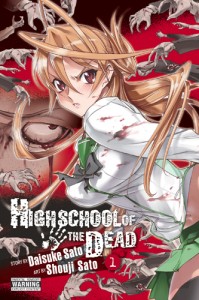
Highschool of the Dead, Vol. 1

December 27, 2010 by Katherine Dacey

A poor man’s Dawn of the Dead — that’s how I’d describe Highschool of the Dead, a slick, violent zombie story that borrows shamelessly from the George Romero canon. Whether that’s a good thing depends a lot on your relationship with Romero. If you thought Dawn of the Dead was a sly poke at American society — its consumerism, class divisions, and latent racism — Daisuke Sato and Shouji Sato’s manga will seem awfully thin, as the authors are more concerned with dishing out panty shots than revealing how threadbare the social fabric really is. If you found Romero’s film unnecessarily burdened with subtext, however, you might just cotton to the Satos’ ultra-violent update.

As the title implies, the story begins at an ordinary high school in Tokyo. When the staff contract a mysterious disease that transforms them into zombies, they wreak havoc, infecting hundreds of other people as they chomp, rend, and tear their way through campus. A small band of students take refuge on the roof, hoping for a helicopter rescue. What they discover, however, is that the entire city has descended into chaos, leaving them little choice than to find a safer place to wait out the crisis.

From a narrative point of view, Highschool of the Dead follows the zombie playbook to the letter. The zombies are slow and shambling; the the story takes place in a closed environment where the zombies’ sheer numbers give them a decided advantage; and the characters can barely stand each other, setting aside their mutual contempt only for the zombie-fighting cause. But while Romero made the most of his film’s shopping mall setting, the Satos treat their high school’s corridors and classrooms as just another indoor space filled with convenient weapons. (Call me crazy, but I don’t remember nail guns lying around the Newton North science labs.) The fight scenes are choppy and poorly staged, giving little indication of how the characters are moving through the space or where, exactly, they are in relation to the school’s main entrance. Even the violence-porn flourishes lack imagination: zombies die by baseball bat, power drill, broom handle, sword, and fire hose, but none of the characters improvises an interesting weapon out of something unique to the school.

The script is as predictable and clumsy as the fight scenes; the characters speak in exposition-heavy soundbites that bear little resemble to real conversation. (Sample: “Rumor has it that your childhood girlfriend ended up in your class when she stayed back and is going out with Igou now, right?”) Daisuke Sato assigns each character a few defining personality traits, raising the possibility that the characters’ economic and social disparities might inform the way they interact. The characterizations are so meager and inconsistent, however, that it’s tough to remember who’s who; I learned more from reading the Wikipedia article on Highschool of the Dead than from the manga itself, never a good sign when the characters, in fact, do have important backstories that shape their opinions of one another.

The biggest problem with Highschool of the Dead is its relentless commitment to cheesecake. The Satos work fanservice into as many scenes as possible, taking full advantage of every stairwell, fight, fall, and female death to flash derrieres and panties; only an episode of Strike Witches has more up-skirt imagery. Adding insult to injury is Shouji Sato’s willful disregard for basic female anatomy. Several of the female characters’ bust lines are so monstrously distended that it would be impossible for the characters to actually stand up and walk in real life, let alone fight zombies. (Hint to aspiring manga artists: large breasts do not look like grossly misshapen lemons or balloon animals.) I realize that costume failures and nubile girls are a staple of horror movies, but when the cheesecake is so poorly done, it’s hard to imagine who would find it arousing; the Satos could take a few tips from Robert Rodriguez on how to incorporate plausible, sexy women into a monster flick.

And when the scariest thing about a zombie story is the way the female characters’ breasts are drawn, well… I’d say the creators have fallen down on the job. The bottom line: unless you’re a die-hard zombie fan or panty-shot connoisseur, you’re better off seeking undead thrills elsewhere.

Review copy provided by Yen Press. Volume one of Highschool of the Dead will go on sale January 25, 2011.

HIGHSCHOOL OF THE DEAD, VOL. 1 • STORY BY DAISUKE SATO, ART BY SHOUJI SATO • YEN PRESS • 160 pp. • RATING: MATURE (18+)

Filed Under: Manga Critic Tagged With: yen press, Zombies

Highschool of the Dead, Vol. 1

December 27, 2010 by Katherine Dacey

A poor man’s Dawn of the Dead — that’s how I’d describe Highschool of the Dead, a slick, violent zombie story that borrows shamelessly from the George Romero canon. Whether that’s a good thing depends a lot on your relationship with Romero. If you thought Dawn of the Dead was a sly poke at American society — its consumerism, class divisions, and latent racism — Daisuke Sato and Shouji Sato’s manga will seem awfully thin, as the authors are more concerned with dishing out panty shots than revealing how threadbare the social fabric really is. If you found Romero’s film unnecessarily burdened with subtext, however, you might just cotton to the Satos’ ultra-violent update.

As the title implies, the story begins at an ordinary high school in Tokyo. When the staff contract a mysterious disease that transforms them into zombies, they wreak havoc, infecting hundreds of other people as they chomp, rend, and tear their way through campus. A small band of students take refuge on the roof, hoping for a helicopter rescue. What they discover, however, is that the entire city has descended into chaos, leaving them little choice than to find a safer place to wait out the crisis.

From a narrative point of view, Highschool of the Dead follows the zombie playbook to the letter. The zombies are slow and shambling; the the story takes place in a closed environment where the zombies’ sheer numbers give them a decided advantage; and the characters can barely stand each other, setting aside their mutual contempt only for the zombie-fighting cause. But while Romero made the most of his film’s shopping mall setting, the Satos treat their high school’s corridors and classrooms as just another indoor space filled with convenient weapons. (Call me crazy, but I don’t remember nail guns lying around the Newton North science labs.) The fight scenes are choppy and poorly staged, giving little indication of how the characters are moving through the space or where, exactly, they are in relation to the school’s main entrance. Even the violence-porn flourishes lack imagination: zombies die by baseball bat, power drill, broom handle, sword, and fire hose, but none of the characters improvises an interesting weapon out of something unique to the school.

The script is as predictable and clumsy as the fight scenes; the characters speak in exposition-heavy soundbites that bear little resemble to real conversation. (Sample: “Rumor has it that your childhood girlfriend ended up in your class when she stayed back and is going out with Igou now, right?”) Daisuke Sato assigns each character a few defining personality traits, raising the possibility that the characters’ economic and social disparities might inform the way they interact. The characterizations are so meager and inconsistent, however, that it’s tough to remember who’s who; I learned more from reading the Wikipedia article on Highschool of the Dead than from the manga itself, never a good sign when the characters, in fact, do have important backstories that shape their opinions of one another.

The biggest problem with Highschool of the Dead is its relentless commitment to cheesecake. The Satos work fanservice into as many scenes as possible, taking full advantage of every stairwell, fight, fall, and female death to flash derrieres and panties; only an episode of Strike Witches has more up-skirt imagery. Adding insult to injury is Shouji Sato’s willful disregard for basic female anatomy. Several of the female characters’ bust lines are so monstrously distended that it would be impossible for the characters to actually stand up and walk in real life, let alone fight zombies. (Hint to aspiring manga artists: large breasts do not look like grossly misshapen lemons or balloon animals.) I realize that costume failures and nubile girls are a staple of horror movies, but when the cheesecake is so poorly done, it’s hard to imagine who would find it arousing; the Satos could take a few tips from Robert Rodriguez on how to incorporate plausible, sexy women into a monster flick.

And when the scariest thing about a zombie story is the way the female characters’ breasts are drawn, well… I’d say the creators have fallen down on the job. The bottom line: unless you’re a die-hard zombie fan or panty-shot connoisseur, you’re better off seeking undead thrills elsewhere.

Review copy provided by Yen Press. Volume one of Highschool of the Dead will go on sale January 25, 2011.

HIGHSCHOOL OF THE DEAD, VOL. 1 • STORY BY DAISUKE SATO, ART BY SHOUJI SATO • YEN PRESS • 160 pp. • RATING: MATURE (18+)

Filed Under: Manga, Manga Critic, REVIEWS Tagged With: Horror/Supernatural, yen press, Zombies

Let’s Get Visual: Duds

December 18, 2010 by Michelle Smith

MICHELLE: After a few months of this column, I feel like I’m better able to think critically about the artistic aspect of manga. I expected to be able to better appreciate good art when I see it, but hadn’t anticipated that I’d also more readily notice flaws. This month, MJ (of Manga Bookshelf) and I turn our attention to problematic pages or, as I like to call them, “duds.” (Click on images to enlarge.)

Fairy Tail, Volume 10, Page 84 (Del Rey)

MJ: Wow. I’m… a little bit stymied by that image.

MICHELLE: It is a doozy, isn’t it? Actually, that page was the inspiration for this whole column. There I was, innocently reading volume ten of Fairy Tail, then I turned the page and was brutally accosted by that monstrosity!

So, as is probably pretty obvious, the speaker is unhinged. Mangaka Hiro Mashima has opted to depict this by freezing the guy in the act of making a weird face and forcing readers to read two huge bubbles full of ranting speech before we can proceed to the final (and uninteresting) panel on the bottom of the page. Now, maybe this is a tactic to make us feel as trapped as the girl does, having to sit there and listen to this lunatic ramble on, but it doesn’t do a good job at conveying his insanity. The page feels flat and lifeless; a better choice would have been to inject more movement into the scene, break up the speech, and maybe allow the guy the opportunity to change expressions throughout his tirade.

MJ: I honestly feel accosted by the page. Its primary image is loud, but not particularly expressive in any other way than that, and the text feels overwhelming to the point where I can’t really even bring myself to try to read it all. Not only that, the page is so top-heavy, I find it difficult to even look at. That bottom image is completely wasted there, not that it’s much of a waste.

MICHELLE: Yeah, it’s weird how an amount of text that would be perfectly reasonable to read in a prose novel suddenly looks so daunting in a speech bubble, but it really does. And you’re absolutely right that it’s loud without being expressive. Everything about this page is just so glaringly bad that I knew we had to build a column around lousy art so that I’d have an excuse to talk about it with someone!

MJ: Well, feel free to talk as much as you like, because I’ve rarely seen something so pointlessly hideous. And though I hate to think that I’m reacting purely out of aesthetics, I can’t deny that it offends me greatly on that level.

MICHELLE: I think that’s pretty much the only basis on which you can be expected to react, since you haven’t read the manga in question. For me, it completely yanked me out of the story, which I find inexcusable.

And though I appreciate the offer to further vent my spleen, perhaps we should proceed on to your dud of choice.

Baseball Heaven, pages 133-134 (approx.) (BLU Manga)

MJ: Okay, then. My “dud” comes from Ellie Mamahara’s Baseball Heaven, a BL manga I expressed no great love for in our BL Bookrack column a couple of months ago. I assume I don’t need to describe what’s happening in the scene, and chances are I don’t need to tell anyone what’s wrong with it, either, but of course that’s why we’re here.

I look at this scene, and there’s simply no passion in it. None at all. Here we have a guy, supposedly in an altered state of mind, making the moves on his teammate who has rebuffed him in the past, and not only do we not get any real sense of how either of them are feeling (we wouldn’t even know the one was drunk if it wasn’t for indications in the word balloons and flushed cheeks), but there’s absolutely no sexual tension between them conveyed through the artwork. And while I can appreciate that perhaps we’re meant to believe that athletes might be stiff and awkward with each other, surely the drunk guy, at least, would have a little heat in his body language here.

The artist goes through the motions, placing them physically near each other and indicating that the one is, perhaps, touching the other’s behind, but there is just no real feeling between them at all. Even when their faces are so close together, Mamahara is unable to provide any magnetic reaction between them. I should feel that they *want* to touch each other. It should feel painful for them not to. Instead, it leaves me completely cold.

MICHELLE: I definitely see what you mean! Personally, I keep staring at that first panel on the second page. They look so stiff and awkward. It’s not that I expect the position of a character’s legs to help drive the emotional content of a scene, but when they’re as oddly placed as the blond guy’s are, it feels unnatural and, by extension, makes everything else going on in the scene feel the same way.

MJ: I think I’d go so far as to say that in a scene like *this* one, I kind of *do* expect the position of a character’s legs to help drive the emotional content of the scene. It’s just as I was saying before, there should be a sense that the characters want desperately to touch each other (this includes legs) even if they might be scared to do so. I should see that in the legs and every other part of the body, at least in the drunk guy who is initiating the contact in the first place. It’s a seduction scene with no actual seduction going on.

Also, I feel like the panels are getting in the way of us viewing the scene, which is a weird and uncomfortable feeling. And unlike in last month’s selection where this was done to elicit response from the reader, here it just feels like clumsiness on the part of the artist. She provides these little glimpses of their faces and legs in the smaller panels, but since there is no tension in those panels, they don’t add anything to the scene. They just steal space from the main action, such as it is.

Wow, I’m really ranting now, aren’t I? Please stop me.

MICHELLE: You’re quite right, but I shall stop you as requested by introducing my second dud!

Moon Boy, Volume 9, Page 3 (Yen Press)

MICHELLE: Initially, it was the affronted rooster in the lower left that caught my eye and made me pause to really take in the complete and utter randomness of this page.

You’ve got a young person of indeterminate gender, swaddled in coat and boots, flushed and exhaling a gust of wintry air, possibly due to the exertion of just having decapitated a nearby snowman. This person is surrounded by such seasonal items as a piece of pie, a cookie, a beehive (with fake bees), an inverted dog bowl, and a pair of barnyard pals.

This was enough to have me snickering, but closer inspection reveals several problems in proportion and perspective. For one, take a look at that snowman’s nose. I’m pretty sure that is supposed to be the traditional carrot, but the artist was unable to draw it from a head-on perspective so instead it looks like a giant almond. Secondly, check out the boots. The right foot is clearly much larger than the left, and I don’t think it’s just an issue of angle—the detail on the top of each foot is different! Finally, actually wearing the mitten dangling by the person’s right hand on said hand would cause the heart pattern to appear on the palm side rather the back of the hand, where such designs typically go.

This is just sloppy and, above all, weird. What do these items have to do with each other? I also found it odd that one of the designs in the border is actually a musical symbol called a mordent. The mordent belongs to a class of musical embellishments called “ornaments,” which could carry a Christmassy connotation, except that I don’t credit this artist with that much cleverness.

MJ: I’ll admit I’m not too picky about things like perspective and such, but I am somehow disturbed by the way his fingers are digging into the poor snowman’s head. What did that poor (decapitated) snowman ever do to anyone? It’s as though he’s digging right into its scalp. Which looks oddly fleshy. And now I’m feeling shuddery.

MICHELLE: I don’t think I would have noticed the perspective problems if not for the chicken, to be honest, but spotting it here did spur me to notice other problems in the rest of the volume, notably a few deformed thumbs and some confusing action scenes that I wrote about in my review of the volume. I wasn’t sure what to make of the hands, honestly. If it’s that cold, why aren’t you wearing your mittens, kid?

MJ: If he put on his mittens, he wouldn’t be able to grab that piece of pie when it comes down. ;)

MICHELLE: Well, pie is important…

And that’s it for us this month. Do you have some duds of your own you’d like to share? We’d love to hear about them!

Filed Under: FEATURES Tagged With: BLU Manga, del rey, Hiro Mashima, yen press

Not Love But Delicious Foods Make Me So Happy!

December 12, 2010 by Katherine Dacey

My Dinner With Fumi: that’s what I would have called the English-language edition of Not Love But Delicious Foods Make Me So Happy! The fifteen stories contained within this slim volume celebrate good food and good conversation, documenting Yoshinaga’s interactions with friends, assistants, and fellow artists at real restaurants around Tokyo. No culinary stone goes unturned, as Yoshinaga — or, as her fictional alter ego is called, Y-naga — visits a Korean restaurant, a French bistro, an Italian trattoria, a sushi joint, an all-you-can-eat dim sum buffet, and a bakery famous for its bagels. (Bagels in Tokyo? Call me a recovering New Yorker, but that sounds horribly wrong, especially since Y-naga views the absence of a hole in a the middle as a sign of quality.)

I can think of few mediums less suited to showcasing food than manga, but Yoshinaga’s drawings of steaming dumplings, seafood stews, and sashimi are convincing, despite the absence of color. She renders the food’s textures and shapes in meticulous detail, in the process suggesting the care with which each item was prepared. Her characters’ obvious enjoyment of the meals also helps sell the conceit; watching them rhapsodize over rare ingredients or extol the virtues of dessert makes the reader feel like another member of the party.

Much as I enjoyed the foodie shop-talk, what really sold me on Not Love But Delicious Foods was Yoshinaga’s willingness to poke fun at herself. Y-naga is a sartorial disaster, wearing a frumpy headband, thick glasses, and a scowl as she toils over her comics; only the prospect of a restaurant meal can persuade her to trade her sweatpants for a dress and to comb her hair. Once transformed, however, Y-naga is just as uncouth as her work attire would suggest, spilling copious amounts of food and wine on herself, talking with her mouth full, and flirting aggressively with a handsome dinner companion after drinking too much wine. Yet Y-naga’s dinner conversations reveal that she isn’t a buffoon; she’s surprisingly self-aware, rejecting one potential boyfriend because he’s indifferent to food (he doesn’t like to talk about it the way she does), farming out an incompetent assistant to other artists so that he can improve his skills, and apologizing profusely to a gay friend for “paying my rent by drawing manga with gay themes,” even though her books contain “no real gay themes.”

And that, I think, is the real strength of Not Love But Delicious Foods: the people remain central to the story, even though the Tokyo restaurant scene is the ostensible subject of the manga. As the characters chatter enthusiastically about what they’re eating, we realize that Yoshinaga’s real objective is showing us the important role that food plays in bringing people together, drawing them out, and cementing friendships. It’s a sentiment that’s expressed throughout the manga, as characters find common ground in their mutual enthusiasm for creme brulee and osso bucco. One contentious conversation even prompts the omniscient narrator to praise good food for its diplomatic value; in Yoshinaga’s world, detente is just a dish away. “But through the power of skirt steak, their hearts resumed beating as one,” the narrator observes. Couldn’t have said it better myself.

Review copy provided by Yen Press. Not Love But Delicious Foods Make Me So Happy! will be released on December 21, 2010.

NOT LOVE BUT DELICIOUS FOODS MAKE ME SO HAPPY! • BY FUMI YOSHINAGA • YEN PRESS • 160 pp. • RATING: OLDER TEEN (16+)

Filed Under: Manga Critic Tagged With: fumi yoshinaga, yen press

Not Love But Delicious Foods Make Me So Happy!

December 12, 2010 by Katherine Dacey

My Dinner With Fumi: that’s what I would have called the English-language edition of Not Love But Delicious Foods Make Me So Happy! The fifteen stories contained within this slim volume celebrate good food and good conversation, documenting Yoshinaga’s interactions with friends, assistants, and fellow artists at real restaurants around Tokyo. No culinary stone goes unturned, as Yoshinaga — or, as her fictional alter ego is called, Y-naga — visits a Korean restaurant, a French bistro, an Italian trattoria, a sushi joint, an all-you-can-eat dim sum buffet, and a bakery famous for its bagels. (Bagels in Tokyo? Call me a recovering New Yorker, but that sounds horribly wrong, especially since Y-naga views the absence of a hole in a the middle as a sign of quality.)

I can think of few mediums less suited to showcasing food than manga, but Yoshinaga’s drawings of steaming dumplings, seafood stews, and sashimi are convincing, despite the absence of color. She renders the food’s textures and shapes in meticulous detail, in the process suggesting the care with which each item was prepared. Her characters’ obvious enjoyment of the meals also helps sell the conceit; watching them rhapsodize over rare ingredients or extol the virtues of dessert makes the reader feel like another member of the party.

Much as I enjoyed the foodie shop-talk, what really sold me on Not Love But Delicious Foods was Yoshinaga’s willingness to poke fun at herself. Y-naga is a sartorial disaster, wearing a frumpy headband, thick glasses, and a scowl as she toils over her comics; only the prospect of a restaurant meal can persuade her to trade her sweatpants for a dress and to comb her hair. Once transformed, however, Y-naga is just as uncouth as her work attire would suggest, spilling copious amounts of food and wine on herself, talking with her mouth full, and flirting aggressively with a handsome dinner companion after drinking too much wine. Yet Y-naga’s dinner conversations reveal that she isn’t a buffoon; she’s surprisingly self-aware, rejecting one potential boyfriend because he’s indifferent to food (he doesn’t like to talk about it the way she does), farming out an incompetent assistant to other artists so that he can improve his skills, and apologizing profusely to a gay friend for “paying my rent by drawing manga with gay themes,” even though her books contain “no real gay themes.”

And that, I think, is the real strength of Not Love But Delicious Foods: the people remain central to the story, even though the Tokyo restaurant scene is the ostensible subject of the manga. As the characters chatter enthusiastically about what they’re eating, we realize that Yoshinaga’s real objective is showing us the important role that food plays in bringing people together, drawing them out, and cementing friendships. It’s a sentiment that’s expressed throughout the manga, as characters find common ground in their mutual enthusiasm for creme brulee and osso bucco. One contentious conversation even prompts the omniscient narrator to praise good food for its diplomatic value; in Yoshinaga’s world, detente is just a dish away. “But through the power of skirt steak, their hearts resumed beating as one,” the narrator observes. Couldn’t have said it better myself.

Review copy provided by Yen Press. Not Love But Delicious Foods Make Me So Happy! will be released on December 21, 2010.

NOT LOVE BUT DELICIOUS FOODS MAKE ME SO HAPPY! • BY FUMI YOSHINAGA • YEN PRESS • 160 pp. • RATING: OLDER TEEN (16+)

Filed Under: Manga, Manga Critic Tagged With: Cooking and Food, fumi yoshinaga, yen press

Bunny Drop, Vols. 1-2

December 8, 2010 by Katherine Dacey

Fictional bachelor dads come in two flavors. The first is easily flummoxed by diapers, sippy cups, tantrums, and stomach aches, reacting in abject horror to bodily functions and extreme emotions (see Three Men and a Baby), while the second behaves more like a stand-up comedian than an engaged parent, commenting wryly on his charges’ behavior without doing much to guide or correct them (see Yotsuba&!). Daikichi, the singleton hero of Bunny Drop, is a pleasant corrective to these familiar stereotypes: he’s a sensitive, well-meaning thirty-year-old who steps up to the plate when his grandfather dies, leaving behind an illegitimate six-year-old daughter.

What begins as an impulsive decision — Daikichi is offended by his family’s reluctance to accept responsibility for gramps’ kid — quickly evolves into a serious commitment. Daikichi is humble enough to realize his limitations as a father, enlisting help from co-workers, friends, and family members in his efforts to find day care for Rin and impose some structure on her life, even though he isn’t entirely certain what kind of boundaries and routines are appropriate for a six-year-old. Yumi Unita wrings some humor out of Daikichi’s attempt to understand Rin’s unique point of view, but steers clear of easy laughs and easy victories. The early moments of rapport between Daikichi and Rin feel earned, not contrived, while Rin’s quirks reflect the bizarre circumstances of her early upbringing, as well as her deep fear of being abandoned.

Though Unita’s character designs are highly stylized and her panels free of busy detail, the spare, unfussy quality of her artwork is deceptive; her seemingly simple faces and bodies actually speak volumes about each character’s personality and history. The few lines on Daikichi’s face, for example, not only establish his age and his homeliness, they also give readers a window into his relationship with Rin. We see his growing attachment to the girl through the softening of his brow and jawline, and note the tension in his face when trying to negotiate new office hours for himself. (His co-workers are puzzled and angered by Daikichi’s decision to take care of Rin. “Just because it’s a relative’s child,” one underling complains, “why must you be the sacrifice, Kawachi-San?”)

With Rin, Unita focuses as much on the character’s body language as on her facial expressions. In the first volume, Rin appears closed off from everyone: rounded shoulders, downcast eyes, pursed lips, and folded arms. As Rin begins to trust Daikichi, however, her face and posture change: her limbs unfurl and her eyes brighten, and her repertory of faces soon includes pouty defiance and bravado. That same attention to detail extends to supporting cast members as well. Rin’s mother, whom Daikichi meets in volume two, comes across as impossibly young, swimming in an outfit too big for her slight frame, and fidgeting throughout her conversation with Daikichi, twisting her hair and avoiding eye contact in the manner of a sullen teenager.

The introduction of Rin’s mother suggests that future installments of Bunny Drop will continue to focus complex issues — what constitutes a family? who has the right to call himself a parent? what’s in the best interest of a damaged child? — in lieu of sitcom ones. (See sippy cups, bad dreams, and the stomach flu, above.) That Unita can take such potentially overwrought material and fashion a thoughtful, funny, and honest look at child-rearing is testament to her skill as a storyteller and — one suspects — as a parent. Easily one of 2010’s best new titles.

BUNNY DROP, VOLS. 1-2 • BY YUMI UNITA • YEN PRESS • RATING: TEEN (13+)

Filed Under: Manga Critic Tagged With: Josei, yen press

  • « Go to Previous Page
  • Page 1
  • Interim pages omitted …
  • Page 4
  • Page 5
  • Page 6
  • Page 7
  • Page 8
  • Interim pages omitted …
  • Page 10
  • Go to Next Page »
 | Log in
Copyright © 2010 Manga Bookshelf | Powered by WordPress & the Genesis Framework