• Skip to primary navigation
  • Skip to main content
  • Skip to primary sidebar
  • Home
  • About Us
    • Privacy Policy
    • Comment Policy
    • Disclosures & Disclaimers
  • Resources
    • Links, Essays & Articles
    • Fandomology!
    • CLAMP Directory
    • BlogRoll
  • Features & Columns
    • 3 Things Thursday
    • Adventures in the Key of Shoujo
    • Bit & Blips (game reviews)
    • BL BOOKRACK
    • Bookshelf Briefs
    • Bringing the Drama
    • Comic Conversion
    • Fanservice Friday
    • Going Digital
    • It Came From the Sinosphere
    • License This!
    • Magazine no Mori
    • My Week in Manga
    • OFF THE SHELF
    • Not By Manga Alone
    • PICK OF THE WEEK
    • Subtitles & Sensibility
    • Weekly Shonen Jump Recaps
  • Manga Moveable Feast
    • MMF Full Archive
    • Yun Kouga
    • CLAMP
    • Shojo Beat
    • Osamu Tezuka
    • Sailor Moon
    • Fruits Basket
    • Takehiko Inoue
    • Wild Adapter
    • One Piece
    • After School Nightmare
    • Karakuri Odette
    • Paradise Kiss
    • The Color Trilogy
    • To Terra…
    • Sexy Voice & Robo
  • Browse by Author
    • Sean Gaffney
    • Anna Neatrour
    • Michelle Smith
    • Katherine Dacey
    • MJ
    • Brigid Alverson
    • Travis Anderson
    • Phillip Anthony
    • Derek Bown
    • Jaci Dahlvang
    • Angela Eastman
    • Erica Friedman
    • Sara K.
    • Megan Purdy
    • Emily Snodgrass
    • Nancy Thistlethwaite
    • Eva Volin
    • David Welsh
  • MB Blogs
    • A Case Suitable For Treatment
    • Experiments in Manga
    • MangaBlog
    • The Manga Critic
    • Manga Report
    • Soliloquy in Blue
    • Manga Curmudgeon (archive)

Manga Bookshelf

Discussion, Resources, Roundtables, & Reviews

viz media

World Trigger, Vols 1 and 2

October 7, 2014 by Anna N

World Trigger Volumes 1 and 2 by Daisuke Ashihara

World Trigger starts out with a very Attack on Titanesque set-up, expressed simply in one page. Monsters from another dimension are invading the earth. A paramilitary force shows up to fight the monsters. Daily life for the rest of humanity is often interrupted by these “Neighbors” who look a bit like giant eels and the humans who fight back against the invasion.

Osamu is a bit of an unassuming student, but he finds his life complicated when a mysterious new transfer student named Yuma shows up. Yuma seems to not know very much about basic human behavior. When a Neighbor attacks outside of the usual boundaries, Osamu reveals that he’s actually a trainee for the Border Defense Agency, with a small amount of power that he’s determined to use to protect everyone in his city. Yuma turns out to have some extraordinary powers himself. He claims to also be a Neighbor, from the dimension where the monsters come from. He also has the ability to use a trigger, the weapon/body exchange protocol that allows users to fight off the monsters.

In the ensuing battle, Yuma fends off a powerful monster after Osamu proves not to have the level that he needs in order to destroy his enemy. Osamu turns to helping out however he can, by evacuating residents and helping everyone stay safe. Members of the Border Protection Agency turn up, suspicious of the recent events and determined to follow correct bureaucratic procedure. The cast of the book gradually expands beyond Osamu and Yuma to include many of the typical foils for a shonen protagonist. There’s a cool older male mentor, a type A overachiever warrior girl, and a host of bureaucrats in the Border Protection Agency that will surely make life difficult for Osamu.

The Border Protection Agency seems more chaotic than a force for either good or evil, as a squad starts to hunt down Yuma. Osamu tries to intercede, but Yuma’s level of power is such that he’s able to evade attack from multiple agents at once with only some slight injuries. One interesting aspect of the story is that Osamu keeps getting promoted within the Border Protection Agency simply because he is often in the right place at the right time and occasionally forced to take credit for some of Yuma’s actions in order to maintain his new friend’s cover. Osamu’s leveling up though being an unassuming nice guy who is incredibly lucky is a bit unexpected for a reader expecting a more typical brash shonen hero, and this was one aspect of the book that I found intriguing.

There’s a fair amount of world building as the characters go into details about the alien tech infused battle system, but I didn’t find this very interesting. The art is workmanlike and easy to follow, but it doesn’t have that extra bit of style or distinct quality that would make me want to pick up the manga just to see some fabulously paneled battle scenes. The story is solid, but there isn’t much that’s surprising about it so far. The anime for this series is starting to air, so I imagine that will fuel interest for this title. I didn’t find myself inspired to keep reading the series, simply because there are other titles out there that are much more entertaining. I can read One Punch Man if I want something funny, Attack on Titan if I want to read about a dystopian future where humanity is fighting off giant invaders, or Seraph of the End for more attractive art and interesting world building. Overall, this is a solid if not super compelling shonen title, and I imagine that someone less picky about shonen manga than me will enjoy it.
Filed Under: REVIEWS Tagged With: Shonen, Shonen Jump, viz media, world trigger

My Love Story! Vol 2

September 25, 2014 by Anna N

My Love Story! Volume 2 by Kazune Kawahara and Aruko

I thought the first volume of this series managed to be both hilarious and refreshing with its unconventional for shoujo manga premise of focusing on the foibles of a unconventional male hero. The second volume took first place on my to-read pile as soon as I got it, and it was just as delightful as the first volume. There are a few episodic chapters here that all manage to focus on something a bit different, while still providing some continuity in exploring the developing romance between the giant Takeo and his cute girlfriend Yamato, with conventionally attractive Sunakawa acting as a willing and supportive third wheel.

The first chapter shows Takeo tasked with the job of rounding up some boys to go along on a group date with Yamato and her friends from school. BYamato has told all her friends how awesome her new boyfriend is, and when they are confronted with the somewhat ungainly Takeo and his band of misfits, they don’t react well. Takeo does excel at feats of strength, and when a fire breaks out he manages to rescue everyone from the burning building, winning the admiration of every new acquaintance. Yamato and Takeo’s relationship is tested further when he agrees to do the judo team the favor of temporarily joining them before a big match, which causes him to have to spend too much time training. Sunakawa acts as a somewhat enigmatic but still caring sounding board to the couple. As Takeo starts preparing the best birthday ever for Yamato, he notices that the usually reticent Sunakawa seems to be even more preoccupied, causing him to have to choose between his girlfriend and his best friend.

The type of comedy in My Love Story! is tricky to pull off. Even though Takeo is drawn to be exaggeratedly not the shoujo manga ideal and he gets into plenty of ridiculous situations, the steadfast affection of Yamato and Sunakawa ensures that he’s never an object of ridicule. The world might be against him, but he has the support of people who think he’s great the way he is. It’s a nice central message that’s absent from more cynical series. Aruko does a great job with drawing physical comedy of the series, with plenty of exaggerated expressions and action elements, but there are also plenty of more subtle moments as Sunakawa shields his emotions and Yamato reacts with joy to practically everything Takeo does. This is all a balancing act of plot and art, and My Love Story! pulls it off well.

Filed Under: REVIEWS Tagged With: My Love Story, shojo beat, viz media

Food Wars, Vol 1

August 6, 2014 by Anna N

Food Wars Volume 1 by Yuto Tsukudo and Shun Saeki

This is a potentially engaging battle style foodie manga that I found myself having a difficult time getting into due to the copious amounts of fan service. I do realize that in shonen manga, one has to expect some boobs and miniskirts, just as one might expect scenes of shirtless vampires chained to the wall in supernatural shoujo manga, but I thought the sexual elements in Food Wars didn’t really enhance what might otherwise be a fun food battle manga.

Soma has grown up cooking for his father’s neighborhood restaurant. He’s trying to battle his father for supremacy but still falling short of the mark. The third page of the manga contains a reference to tentacle rape, as Soma pops a bite of a squid food experiment into a girls mouth, only for her to feel horrifically molested by the terrible combination of flavors. The first chapter in the book is a prolog, as representatives of a hostile corporation try to move in on the restaurant, Soma’s father decides to take off and cook in America, and Soma is promptly sent to try out for an elite cooking school called the Totsuki Saryo Culinary Institute.

The female antagonist of Food Wars is Erina Nakiri, a student with an incredibly refined palette, and a gift for metaphor, as she likens an unsatisfactory dish to the sensation of visiting a hot springs only to find out that there is a gorilla staring at her. Full visuals for this scene are of course provided, and it is actually much more funny than some of the other fanservicey scenes that just seem to involve food blowing away peoples’ clothes. Erina judges Soma’s dish and finds it extraordinary despite the fact that he’s making everyday Japanese food instead of something more fancy. She fails him, but he’s let into the school after all when a school administrator tears up the test results after tasting the dish.

I do enjoy food manga, and ordinarily I’d be totally up for reading a few volumes of food battling set in an elite high school. I also liked the theme of contrasting Soma’s expertise in making everyday food with the snobby pretensions of his fellow students. The fan service elements were just a bit too much for me, and there are certainly other examples of food manga that manage to show the transformative experience of eating an excellent dish without resorting to upskirt shots. So for funny food manga, I’d probably recommend that someone with similar tastes as me go with Yakitate Japan or the ridiculous Toriko.

Filed Under: REVIEWS Tagged With: food wars, Shonen, viz media

Spell of Desire, Vol. 1

July 16, 2014 by Anna N

Spell of Desire Volume 1 by Tomu Ohmi

I am unapologetically enthusiastic about Shojo Beat’s new habit of releasing slightly smutty josei manga under the Shojo Beat imprint. More josei is a good thing! I was happy to see that after a few volumes of Tohmu Ohmi’s Midnight Secretary, another series of hers was licensed by Viz. Spell of Desire is that series, and I might even like it more than I like Midnight Secretary, as impossible as that might seem.

As you might guess from the title, with Spell of Desire, Ohmi has turned her attention to witches! Kaoruko Mochizuki is a herbalist in a small village, but one day a mysterious man named Kaname Hibiki shows up at her store and announces that she’s a witch, descended from a long line of women with mystical power. It turns out that Kaoruko’s long lost mother is a Witch Queen, and she’s sealed her power within Kaoruko. As the power begins to activate, Kaoruko will need help controlling it, and Kaname just happens to be the Knight dedicated to her protection.

I loved the contrast between Kaoruko and Kaname. She’s drawn as an earthy, hippie type, with flowing layers of clothing with botanical prints that reflect her connection to her profession. Kaoruko is a bit naive, but committed to the customers at her shop and the simple way of life that she enjoys. Kaname’s severe, with an all-black wardrobe and glasses that make him look stern. He also has a bit of a snarky and cynical personality. Kaname comes with two animal companions named Dragon and Unicorn, that appear to be a fluffy white cat and dog, but actually possess mystical powers themselves. When Kaoruko accidentally activates her mystical powers, they manifest as black vine tendrils winding across the panels in the manga, becoming more tangled as her powers become more out of control. Of course, there is a fail-safe mechanism to calm Kaoruko down – kisses from Kaname.

The first volume deals with the conflict between Kaoruko and Kaname as he insinuates himself into her life in order to protect her from her runaway witch powers. It is terrible, but Kaname and Kaoruko have to kiss very often because her powers are starting to really get out of control. While at first Kaoruko is resistant to the idea that she’s a witch, she decides to accept her situation calmly and deal with it even if there are things that she doesn’t understand. Kaname comments in response, “You’re such a decent person it’s almost ludicrous.” Kaoruko is left wondering about Kaname’s real relationship with her mother the Witch Queen, and I can see how there will be plenty to explore in future volumes as Kaoruko has to deal with her new reality as a witch and Kaname’s place in her life. Fans of Midnight Secretary or paranormal romance manga in general should snap this up!

Filed Under: REVIEWS Tagged With: shojo beat, spell of desire, viz media

My Love Story! Vol. 1

July 13, 2014 by Anna N

My Love Story! Vol 1 by Kazune Kawahara and Aruko

It is fairly rare for a shoujo manga to manage being both hilarious and heartwarming, but My Love Story! delivers. I was looking forward to this title because I absolutely adore Kazune Kawahara’s previously translated series High School Debut, and this new manga more than lived up to my expectations.

My Love Story! is extremely refreshing because in a dramatic shift from most shoujo series, it focuses on a boy as the main character. And the boy that it focuses on is Takeo, a hulking giant who is drawn exactly like the manga stereotype of a local gang leader, with a hulking body, thick eyebrows, and overabundant sideburns. Takeo is looked up to by everyone who plays sports with him, but his true friend is Suna, conventionally attractive in exactly the way a shoujo reader would expect, with windswept hair and a habit of rejecting all the girls who have crushes on him. Takeo has a habit of falling for girls who are crushing on Shun, who are then promptly turned down when they confess their feelings. On a fateful day Takeo saves a girl from being groped on a train, and she shows up the next day at his house with a cake to thank him. Rinko is an incredibly sweet and cute girl who enjoys baking and shyly blushing whenever she comes up with an excuse to be around Takeo. Unfortunately Takeo is so used to being passed over for Shun, he tries to set up Shun and Rinko, while being utterly unaware the the cute girl that he loves actually loves him back.

There’s plenty of caricature and humorous reactions as Takeo goes through extreme emotions. While it would be easy for Takeo to be the target of jokes, Shun genuinely cares for his best friend. While much is made of Takeo being an unlikely shoujo hero, he’s actually surrounded by supporters. It turns out that Shun is rejecting any girl who speaks badly about Takeo, because he has no interest in dating anyone who shows themselves as a mean person. Shun manages to get Rinko and Takeo together, and it is nice to see a manga series centered around people who just simply care about each other. My Love Story doesn’t suffer from second volume syndrome at all, by the end of the first two chapters I was utterly won over by the combination of characters, humor, and random feats of strength exhibited by Takeo as he goes about his day. The art maybe relies a bit too much on the contrast between Takeo being a blundering thug in a sparkly shoujo world, but there’s plenty of plot driven and situational humor to balance out this aspect of the manga.

As Rinko and Takeo start going out, Shun learns that his older sister has also been nursing a crush on Takeo that she has never expressed, because she was waiting to tell him her feelings when she was older. She immediately concludes that Rinko must be no good, and heads off to intervene, but Rinko and Ai quickly bond over their shared feelings. The end of the first volume of My Love Story! is too funny to spoil, but I’ll be looking forward to the second volume for this winning combination of laugh out loud moments and quirky romance.

Filed Under: REVIEWS Tagged With: My Love Story, shojo beat, shoujo, viz media

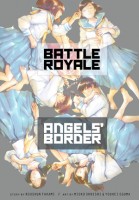
Battle Royale: Angels’ Border

July 6, 2014 by Ash Brown

Battle Royale: Angels' BorderAuthor: Koushun Takami and N-Cake
Illustrator: Mioko Ohnishi and Youhei Oguma

U.S. publisher: Viz Media
ISBN: 9781421571683
Released: June 2014
Original release: 2012

In 1999 Koushun Takami’s controversial cult classic Battle Royale was released upon the world, the novel soon after spawning a fifteen-volume manga adaptation illustrated by Masayuki Taguchi and inspiring two live-action films. I became a fan of the original novel after reading the 2009 English translation, and so was very interested to learn that Takami (with the assistance of N-Cake) had returned to Battle Royale with the manga Angels’ Border. Released in Japan in 2012, the collected volume includes two related episodes about the young women whose efforts to survive a brutal government sponsored death match by grouping together end in tragedy. The first story is illustrated by Mioko Ohnishi while the second is illustrated by Youhei Oguma. I was happy that Viz Media licensed Battle Royale: Angels’ Border, releasing the manga under its Signature imprint in 2014. Angels’ Border makes a nice addition to Viz’s other recent Battle Royale releases: The Battle Royale Slam Book, and a new English translation of Takumi’s original novel.

Every year a class of ninth grade students from the Republic of Greater East Asia is selected to participate in the Program. The students are given a small survival pack, a random weapon, and forced into a situation where they must either kill or be killed. In the end, only one person will survive. This year’s Program pits the forty-two students of Shiroiwa Junior High’s ninth grade, Class B against each other. Under the leadership of Yukie Utsumi, six of the girls band together, taking shelter in the lighthouse on the island serving as the Program’s arena. There they hope to avoid and wait out most of the violence. The group includes her best friend Haruka Tanizawa, who has recently come to the realization that she is in love with Yukie, though she hasn’t been able to confess those feelings. Another girl at the lighthouse, Chisato Matsui, has her own secret–she shares a special connection with Shinji Mimura, a star basketball player with smarts, good looks, and dangerous anti-government tendencies. But because she has joined up with the other young women for safety, it is unlikely that she will ever see him again.

People who have read the original Battle Royale, or who have experienced its adaptations, know very well how the incident at the lighthouse plays out; those who haven’t can probably very easily guess. Most (but not all) of the violence occurs off-page in Angels’ Border, but the characters still have to deal with its aftermath. The atmosphere at the lighthouse is strained but relatively quiet; the tension, fear, and despair is present even as the young women are resigning themselves to their fates. They witness the deaths of their fellow students and try to come up with excuses for the classmates who have resorted to killing one another, partly because they are in denial about what is happening and partly because the entire situation is incomprehensible to them. For a time they are safe, but every decision that they make for their own survival has an impact on the survival of everyone else forced to participate in the Program. The alliance formed by the six young women and their trust in one another are extraordinarily fragile things. None of them want to kill, but none of them want to die either, even though they know it will be impossible for all of them so survive. The result is a highly stressful and volatile scenario.

Generally, Angels’ Border can be read on its own, but it will probably appeal most to those who are at least familiar with Battle Royale. I hadn’t anticipated it when I began reading Angels’ Border, but both of the manga’s episodes are actually love stories. Granted, because they occur within the context of Battle Royale, they are both dramatic romantic tragedies. The first story is told by Haruka as she deals with what she sees as the futility of her feelings for Yukie as well as with the futility of the situation in which they find themselves. She reflects briefly on their past friendship, but generally the episode’s focus is on their unfortunate present and bleak future. The second story is seen from Chisato’s perspective. Much of it is devoted to a single encounter between her and Shinji six months before the start of the Program. Both episodes are more about the characters’ interpersonal relationships than they are about death and violence, although those are certainly a constant concern and bring those relationships into sharper focus. Both stories also talk about “forever,” which is heart-wrenching; “forever” for these young people will be a tragically short period of time.

Filed Under: REVIEWS Tagged With: Battle Royale, Koushun Takami, manga, Mioko Ohnishi, N-Cake, viz media, VIZ Signature, Youhei Oguma

Shojo Beat Quick Takes – Midnight Secretary Vol 6 and Dengeki Daisy Vol 14

May 30, 2014 by Anna N

Midnight Secretary Vol 6 by Tomu Ohmi

This volume of Midnight Secretary shows the relationship between Kaya and her vampire boss Kyohei on firmer footing, but the manipulations of the vampire clan start to interfere with the couple. Kyohei takes Kaya to a party as his date, and there’s a bit of unexpected fallout from the action. Kyohei’s vampire mother shows up to warn Kaya off of becoming involved in a human/vampire relationship. Kaya has a bit of a pregnancy scare, and she’s worried about what would happen if she had a vampire baby, because the vampire clan would swoop in and claim any vampire child as one of their own. It turns out that Kaya’s not pregnant and Kyohei tells her that he has no intention of marrying her or having children with her, simply because of the way their relationship would be stressed with outside interference as soon as it takes on the appearance of being serious. While he doesn’t want Kaya to be manipulated by the vampire clan, she’s soon deluged with marriage offers as the clan takes steps to separate her from Kyohei. Vampire politics soon becomes even more of a focus of the volume, as the head of the clan shows up, looking less evil than one would suppose! Throughout the trials and tribulations in this volume Kaya and Kyohei’s relationship remains strong, but we’ll have to see in future volumes if they can withstand the forces that are seeking to drive them apart. This series continues to be very entertaining. I’m always amused by the combination of heartfelt romance, the paranormal elements, and boardroom politics.


Dengeki Daisy Vol 14 by Kyousuke Motomi

Dengeki Daisy is still going strong in its 14th volume. I have to say, I don’t really care about the latest hacker drama that is occupying all the characters, it is really the way that they interact with each other when dealing with the high stakes world of computer viruses and conspiracy theories. In their search for “M’s Last Testament”, the group has finally found out more information about the mysterious hacker Akira, and learned how exactly he became so twisted. One of the reasons why I like this series so much is that the reactions of the characters seem so much more authentic and less reliant on what I’d expect to see in a shoujo romance. When Teru learns the truth about Akira she can see why her other friends feel an obligation to help him, but her own suffering at his hands has left her wondering if he’s a person without any hope of redemption. In a more typical series, the disclosure of a character’s tragic past would prompt people to immediately move towards forgiveness, but Teru isn’t able to get over the past and she’s very forthright about her feelings. This drives a bit of a wedge between her and Kurosaki, as he moves on with the rest of the team even though he understands Teru’s reasons for not wanting to participate. In true Dengeki Daisy fashion, this first crisis of their relationship is solved with text messaging, in a nice bit of circular plotting that echoes back to the beginning of the series. Motomi could really just call each new hacker MacGuffin 1 or MacGuffin 2 and I’d still love reading this series just because it is so well executed and the characters are very memorable.

Filed Under: REVIEWS Tagged With: Dengeki Daisy, midnight secretary, shojo beat, shoujo, viz media

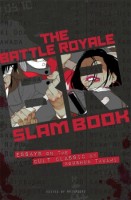
The Battle Royale Slam Book: Essays on the Cult Classic by Koushun Takami

May 11, 2014 by Ash Brown

The Battle Royale Slam BookEditor: Nick Mamatas and Masumi Washington
Publisher: Viz Media
ISBN: 9781421565996
Released: April 2014

Battle Royale has recently seen something of a revival in North America in recent years. Koushun Takami’s controversial novel was originally published in Japan in 1999. Both the novel and its manga adaptation illustrated by Masayuki Taguchi first appeared in English in 2003. The novel was released again with a slightly revised translation and additional supplementary material in 2009 by Viz Media’s speculative fiction imprint Haikasoru. (This tenth anniversary release was my introduction to Battle Royale.) However, it wasn’t until 2012 that the film version of Battle Royale and its sequel Battle Royale II: Requiem received an official release in the United States. And now, in 2014, we’re seeing the releases of a new English translation of Takami’s novel by Haikasoru, the recent Battle Royale: Angels’ Border manga illustrated by Mioko Ohnishi and Youhei Oguma, and The Battle Royale Slam Book: Essays on the Cult Classic by Koushun Takami, which is also notable for being Haikasoru’s first foray into nonfiction. Takami’s original novel left a huge impression on me, so I was very excited to read all of these new Battle Royale releases.

The Battle Royale Slam Book, edited by Nick Mamatas and Masumi Washington, collects sixteen essays (seventeen including the introduction by Mamatas) which examine various aspects of the entire Battle Royale franchise. The core of that franchise is of course Takami’s original novel, but The Battle Royale Slam Book also explores many of its manga and film adaptations as well. The contributors to the volume include award-winning writers, academics, fans, and many others from around the world–the United States, Canada, United Kingdom, and even Japan itself are particularly well-represented. I was specifically excited to see an essay by Toh EnJoe included in the volume, but the rest of the lineup is great, too: Nadia Bulkin, Carrie Cuinn, Raechel Dumas, Isamu Fukui, Sam Hamm, Masao Higashi, Brian Keen, Gregory Lamberson, Kathleen Miller, Konstantine Paradias, Jason S. Ridler, Adam Roberts, John Skipp, Steven R. Stewart, and Douglas F. Warrick. All of their essays were written specifically for inclusion in The Battle Royale Slam Book.

The Battle Royale Slam Book includes several types of essays ranging from academic ruminations to literary and film criticisms to the authors’ more personal experiences with Battle Royale in all of its iterations. The topics of the individual contributions are also varied, though some recurring themes do emerge. Many of the essays focus on some of Battle Royale‘s most controversial aspects, such as extreme violence and the deaths of school-aged youth, gender portrayals and sexism, and so on. Other essays position Battle Royale within a greater context, exploring its place within and relationship to not only Japanese popular culture but Western popular culture as well. School literature, professional wrestling, teen films, and other similar subjects are all addressed. The volume also examines the historical context of Battle Royale and its themes. The Battle Royale Slam Book shows how the Battle Royale phenomena has been influenced by, uses, and challenges literary and genre conventions in addition to showing its impact and continuing influence on individual people.

Several assumptions are made with The Battle Royale Slam Book, primarily that the readers are adults already familiar with Battle Royale, have a basic understanding of the novel’s premise, or have been exposed to at least one of its adaptations. It’s also helpful but not absolutely necessary to have some grounding in literature and film, and especially with speculative fiction and horror. The Battle Royale Slam Book will probably appeal most to those who are already interested in or who have already experienced Battle Royale in some form. Though the contributors don’t hesitate to point out the flaws and challenges presented by the Battle Royale novel, manga, and films, it is very clear that they are all either fans or are fascinated by the material and the responses to it. There is criticism to be found, but in general the volume tends to take a positive approach. The Battle Royale Slam Book was written for people like me who want to learn more about Battle Royale, its influences, and impacts. I found The Battle Royale Slam Book to be utterly fascinating and would highly recommend the volume to similarly minded individuals.

Filed Under: REVIEWS Tagged With: Battle Royale, Haikasoru, Koushun Takami, Masumi Washington, Nick Mamatas, Nonfiction, viz media

Gangsta Vols 1 and 2

May 4, 2014 by Anna N

Gangsta Volumes 1 and 2 by Kohske

I was pretty intrigued by Gangsta when I first heard that Viz was going to be translating this title. I always am interested in series that get the deluxe treatment of the Viz Signature line. The art looked very stylish, and I generally enjoy the few examples of seinen written by women authors that we get translated over here, so I was already intrigued for a few months before finally getting my hands on a couple volumes.

First of all, to totally judge a manga by its cover, I was immediately captivated by the cover designs! The front and back covers of both volumes show the same scene from different perspectives, showcasing the personalities of the main characters Nic and Worick. The first volume shows Nic glaring out at the reader, with Worick turned away. On the back Worick has his finger raised over his lips to prevent someone from telling a secret. Worick and Nic are handymen, mercenaries, couriers, and assassins taking on jobs no one else will. Their day opens in a way that conveys the gritty and corrupt nature of the city of Ergastulum, as a hooker gets beat up and the police chief asks the handymen to deal with recent gang activity, promising them “all their goods” as payment.

As the day unfolds, more gets revealed about Nic and Worick. Nic is a “Tag” or “Twilight,” who appears to be an ex-soldier who was the subject of some sort of enhancement experiments that have turned him into a deadly warrior. Nic is deaf, and Kohske has come up with some clever ways of portraying this, by representing his sign language with a different style of word balloons and carefully drawing them as emanating from his hands as he gestures. Nic is incredibly deadly, but he is viewed as subhuman by almost everybody but Worick. The duo quickly becomes a platonic (so far) threesome, as the handymen decide to liberate Ally, the hooker who was being beat up by her john before. When the police chief objects, Nic yells that the handymen will take whatever they want.

What follows is a mix between slice of life communal living issues, drug deals, and over the top action scenes as Ally putters around the handymen’s apartment, reading sign language dictionaries and answering their phone. She gradually learns a little more about Worick and Nic, including the fact that Worick occasionally hires himself out as a gigalo and that his past might be very far from the circles where he runs in now.

There are a few elements of Gangsta that reminded me of other series, but not in a bad way. The intense friendship of Nic and Worick set against a gritty background with mysterious drugs enhancing human abilities gave me some slight Wild Adapter flashbacks, although Gangsta isn’t very shonen-ai (yet). I’m sure there’s some Gangsta doujinshi out there that is though! Worick’s mysterious and privileged past made me remember Antique Bakery a bit. And the 3 rules for Twilight behavior are basically Asimov’s 3 Laws of Robotics. But Kohske hints at so many different plots to be explored in future volumes, I’m wanting to see the shared past of the handymen explored, wondering if Ally is better off with them than without them, and curious to see how Nic manages to deal with the latest in a procession of super human enemies.

Kohske’s art is gritty and stylish, showcasing the dynamic nature of the fights the handymen find themselves embroiled in as well as the run down area of the city where they live. The illustrations in this book are for sure not style over substance, as there are nuanced and varying character designs for all the members of the expanding cast. Nic’s growling antagonism and Worick’s intelligently constructed careless facade are both nimbly portrayed, as are the wordless exchanges and day to day moments that say volumes about the friendship they share. After enjoying the first two volumes, I’m certainly going to see about reading the rest of this series.

Filed Under: REVIEWS Tagged With: Gangsta, viz media

Manga Publishers on Fan Interest in Manga Online

April 18, 2014 by Justin Stroman 5 Comments

Welp, thanks Google! Credit to AnimeKon for that.

Um, I guess this is the best image I could find? Credit to AnimeKon.

It started this week, when Ash had posted a link to Kodansha’s Tumblr that weighed in on piracy. Interested in reading what they said, I checked it out, and after sitting on this idea for a day, I decided to get in contact with all the manga publishers in the US and basically asked them for a response to that query. So a shout-out to he or she who decided to ask the question, and to Ash for linking to it.

I should already preface this by saying that, after reading the responses by the publishers, feel free to discuss your overall position on the situation, because discussion is good, and especially for those who live on the side where you do read manga that has no chance of being published in English for a multitude of reasons, it may be something you want to know. Or maybe not know about!

Note: as a heads up, this post may be updated with publisher thoughts as the day goes on. It’s their choice whether to respond or not.

Anyways, here they are (let’s start with the one who started this chain off):

Kodansha’s Editor Ben Applegate:

Today, here’s how our process works. We read series as they begin serialization in Kodansha’s magazines, and we keep an eye on the promising ones. If it’s by an author or from a franchise we’ve had success with, that’s a major bonus. Kodansha Japan will come to us to with the series they want to push in the future. We also consider which series may get an anime presence. All of these factors are more important than fan requests online. Though there was a time when most publishers referred to scanlations during licensing, and maybe some still do, we don’t. The other manga publishers I’m familiar with don’t either.

This is not because we don’t pay attention to our fans. It’s because we’ve learned from experience that highly-requested series usually produce sales that come in under expectations. The biggest reason is that, unfortunately, heavy social media users are just not representative of a majority of English-language manga fans. But it can’t help that most of the target audience has already read the series online, and thus isn’t very motivated to buy.

When series, usually seinen series, that are frequently requested on social media as a result of scans do get licensed, sales might be okay for Vol. 1 and sometimes 2, but they drop far below expectations on Vol. 3+. My personal hypothesis here is that people who’ve read the scanlations maybe remember to buy Vol. 1 or 2 because they want to support the artist, but by Vol. 3 and later they either forget or feel they’ve done their part. But the publisher is still on the hook for five, ten, fifteen more potentially money-losing volumes.

So, given the choice (and we usually aren’t), I would rather start from zero with a series I strongly believed in and try to build an audience for the legal release than be forced to compete with illegal scanlations that people have already been reading for months or years.

It doesn’t mean we’ve given up on “fan favorite” series. Vinland Saga was highly-requested and highly-scanlated for years. We took lots of extraordinary measures to try to break the “seinen curse,” producing premium hardcover editions with a bonus story, exclusive author Q&A, and other extra content. We also made them 2-in-1 editions to reduce the number of volumes we’d have to release. Whether that has worked or not is still an open question. Though Vol. 1 is doing well, it is discouraging to see basically no change in the popularity of the scanlations since we licensed the series.

Finally, consider: We’ve received some asks about whether having a manga available in English on a legal manga site makes a print version less likely because people have already read it. Well, illegal scanlations have an impact that’s many times bigger than any legal manga site. Something to think about.

So, what can you do? Well, you can stop reading scanlations, and encourage friends to do the same. I have never read more than a single chapter of a series in scanlation, and I have read a lot of manga (not all of it in Japanese). There is enough excellent manga out legally in English to fill all of your leisure time. ALL of it. And it’s increasingly available digitally at an affordable price.

If you still need a little piracy in your life, the least you can do is stop reading series that have been licensed. If you want to see what happens next, wait for the official release to catch up. You’ll survive the wait, I promise. And please spread the word about licensed releases! It can be hard for publishers to get scan readers informed about the legal version.

Viz’s Vice President of Publishing, Leyla Acker:

— On whether it’s a bad thing to read manga that won’t be published in English online when they’ve been fan translated?

I don’t think it’s a “bad thing,” mainly because I don’t think that value judgments like “good” and “bad” are useful to the conversation. The assumption implicit in this question is that the legitimacy of scanlations should be measured primarily by their potential impact on sales. While that’s no small issue, it’s not the main one, which is this: with a few notable exceptions, every mangaka and doujinshika I have ever spoken to about their work being scanlated hates it. From the creator’s perspective, the point is not whether the work is officially released in English or any other language, but that their work has been appropriated by people they don’t know and then used in ways they never consented to, even if it’s being done with good intentions.

— If fan interest online ever compelled them to go back and take a second look at a title?

You can basically copy and paste Kodansha’s Tumblr post on scanlations here. In other words, no. As fans ourselves, we’re definitely aware of what people are talking about online, but in our market there’s not necessarily a direct correlation between what’s popular online and what people actually buy. In fact, sometimes there’s an inverse correlation, not only with seinen and josei, as the Kodansha post indicated, but also markedly with shoujo. Also, if a midlist or potentially more modest-selling title has been heavily scanlated that can act as a disincentive for us to publish it since we know we’ll be faced with diminished sales out the gate.

Digital Manga Publishing’s Sales Manager Yoko Tanigaki:

— On whether it’s a bad thing to read manga that won’t be published in English online when they’ve been fan translated?

When was it ever a good thing? This is not a good or bad thing. This is an issue of right or wrong. It is wrong to take un-consented or unlicensed materials, scan them, translate them and distribute them. This is stealing- YES, stealing. This is never OK. This is WRONG. Knowing this and you still want a “scanlation-like” action in your life? Come work for me at Digital Manga Guild, and we’ll pay you a portion of the sale. I could always use more translators and letterers.

— On whether it’s a bad thing to read manga that won’t be published in English online when they’ve been fan translated?

Not really. There is no magical publishing formula that says “this book will sell well because it has a huge fan interest on line.”


Justin is the Editor-in-Chief of Organization Anti-Social Geniuses, an anime and manga blog. Currently is on an anime backlog adventure. You can follow him on Twitter @Kami_nomi.

Filed Under: FEATURES Tagged With: digital manga publishing, fan interest online, Kodansha Comics, kodansha usa, Manga Publishers, viz media

Yukikaze

April 9, 2014 by Ash Brown

YukikazeAuthor: Chōhei Kambayashi
Translator: Neil Nadelman
U.S. publisher: Viz Media
ISBN: 9781421532554
Released: January 2010
Original release: 1984
Awards: Seiun Award

Chōhei Kambayashi is an award-winning, well-respected, and popular author of science fiction in Japan. His novel Yukikaze is one of his best known works and has even been adapted into a short anime series. It is also his first book to be translated and released in English. Originally published in Japan in 1984, Yukikaze would go on to win a Seiun Award in 1985. Kambayashi revisited and slightly revised the novel in 2002 in preparation for the volume’s sequel Good Luck, Yukikaze. Neil Nadelman’s translation of Yukikaze, published by Viz Media’s speculative fiction imprint Haikasoru in 2010, is based on this 2002 edition. Haikasoru’s release of Yukikaze also includes two very interesting essays about the novel by Ran Ishidou and Ray Fuyuki. Haikasoru also released an English translation of Good Luck, Yukikaze. Kambayashi has written a third volume in the series, Unbroken Arrow, which has yet to be translated.

Rei Fukai is one of the best pilots that the Faery Air Force has, surviving numerous encounters with the JAM, an alien force threatening humanity’s very existence. It has been more than three decades since the JAM first appeared on Earth. They were quickly pushed back to the planet from where their invasion was launched, however the prolonged war against the JAM continues with no obvious way to secure a complete victory. Survival is Fukai’s primary order and goal. A member of an elite squadron associated with the Special Air Force, his mission is to collect and record massive amounts of data about the JAM and their tactical capabilities. He is to return with that information no matter what, even if that means leaving his comrades behind to die. Because of this, he and the others in his squadron have earned the reputation of being cold-hearted bastards. Outside of himself, the only thing that Fukai believes in, cares about, or trusts is the Yukikaze, the highly advanced fighter plane that he pilots.

Kambayashi addresses several themes in depth in Yukikaze: what humanity’s purpose is within the context of war, what it means to be human or inhuman, and perhaps most strikingly what the impact of the convergence of human intelligence and the technology it develops could be. Yukikaze is an engaging war story, with kinetic and hazardous air battles that have terrifying implications, but like all great science fiction the novel is also incredibly thought-provoking. The members of the Faery Air Force, and especially those in the Special Air Force, are primarily made up of criminals, those with anti-social tendencies, and other people who are unwanted or have no place back on Earth. They are treated more like expendable resources than they are like human beings. The war and the fighting is so far removed from those living on Earth that they are mostly oblivious to what is occurring on Faery. Protecting Earth is a thankless task for those engaged in the war, people who have very few ties to the planet left but who have no better options other than to fight.

Considering all of this, it isn’t that surprising that Fukai and some of the other pilots would prefer their planes to people. I’ll admit, as unsociable as Fukai can be, I did like the guy. It did take me a couple of chapters to really settle into Yukikaze, but by the end of the novel I was completely engaged. A large reason behind that was because of Fukai and his development as the novel progressed as well as the evolution of the Yukikaze. In the chaos of war, Fukai’s relationship to his fighter is one of the only stable things remaining in his life, but even that begins to change. The members of the Faery Air Force are often called inhuman and compared to machines. At the same time those machines are becoming more and more advanced, raising the question of whether humans are even necessary anymore. The war against the JAM that humanity is waging may not be the only battle of survival that it should be concerned about fighting. After an interesting but somewhat clunky beginning, I was actually quite impressed with the depth of Kambayashi’s ideas in Yukikaze. I look forward to reading its sequel.

Filed Under: REVIEWS Tagged With: Chōhei Kambayashi, Haikasoru, Novels, Seiun Award, viz media, Yukikaze

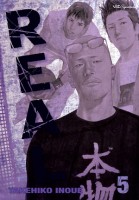
Real, Vol. 5

March 29, 2014 by Ash Brown

Real, Volume 5Creator: Takehiko Inoue
U.S. publisher: Viz Media
ISBN: 9781421519937
Released: July 2009
Original release: 2005
Awards: Japan Media Arts Award

When I first started reading Takehiko Inoue’s prize-winning manga series Real, I didn’t expect to appreciate it as much as I do. Real has actually become one of my favorite series. I wasn’t particularly interested in wheelchair basketball, one of the main subjects of Real, although that has since changed. Instead, I was initially drawn to the manga because it was created by Inoue, whose artwork I greatly admire. I also am very impressed by his storytelling skills, especially in Real, but also in his other manga available in English, Slam Dunk and Vagabond. As much as I enjoy those two series, in the end it’s Real that I find to be the most compelling. It is a very powerful work. I’ve said it many times before, but it is still true–I honestly believe Real to be one of the best comics that is currently being released in English. The fifth volume of Real was originally collected in Japan in 2005 while the English-language edition, released under Viz Media’s Signature imprint, was published in 2009.

Ever since his motorcycle accident, Nomiya’s life has been falling apart. Although he has tried to earn his drivers’ license, it has taken him quite some time since he is terrified to be on the road. Nomiya is even more terrified of facing Natsumi, the young woman who was in the accident with him. While Nomiya was barely injured, Natsumi has lost the ability to walk and must now use a wheelchair. Nomiya blames himself for the accident and Natsumi’s current condition. The guilt has nearly brought his life to a standstill. He wants to do all that he can to move forward, but this means confronting his fears and confronting Natsumi. Unsurprisingly, she’s not particularly interested in seeing Nomiya, either–she blames him for the accident, too. Her rehabilitation is going well, but Natsumi’s life has been changed forever. Takahashi’s rehabilitation has actually taken a turn for the better, too, after a visit from Nomiya that ends rather badly. It’s been about six months since Takahashi’s own accident which cost him the use of his legs, but he has recently shown enough improvement that he will soon be able to leave the hospital.

Whereas the previous volumes of Real thoroughly introduced the lead characters–Nomiya, Togawa, and Takahashi– and explored their personal, internal struggles, the fifth volume addresses some of the more practical problems and challenges experienced by those who are disabled in an world and environment designed for the able-bodied. This can particularly be seen when Takahashi is considering returning to Nishi High to finish school. Not only is he not yet in a position where he can take of himself, the school itself isn’t at all accessible to someone in a wheelchair and the needed accommodations are prohibitively expensive. These external issues and concerns are inexorably tied to how Takahashi and the others view themselves and and see themselves as people of worth. Takahashi in particular is obsessed with ranking people and assigning them value. He used to consider himself one of the elite, but now his self-worth has been severely compromised. It’s understandable that this is something that he continues to struggle with, especially as he no longer feels that there is a place for him.

Takahashi isn’t the only one suffering from a crisis of self-worth in the series. A major theme in Real deals with what it means to be a good person and a decent human being. Takahashi’s attitude and efforts to be the best in whatever he does comes across as extremely arrogant, but people are beginning to see through his facade of perfection. Nomiya has made, and continues to make, plenty of mistakes in his life, but his honest desire to improve himself and the care and acceptance that he offers others show that he is a much better person than he recognizes. This search for self-worth isn’t limited only to the series’ leads, either. All of their friends and family members are struggling with it as well. In a particularly heart-wrenching development, Togawa’s close friend Yama, who has always been vibrant and maintained an admirably positive outlook, is frightened of who is becoming now that his disease is overtaking his body and mind. Inoue’s characterizations in Real are fantastic. The series is compelling because it is so easy for anyone to identify with the personal struggles being portrayed in the manga even if the characters’ particular situations are unique.

Filed Under: REVIEWS Tagged With: Japan Media Arts Award, manga, real, Takehiko Inoue, viz media, VIZ Signature

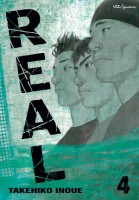
Real, Vol. 4

March 23, 2014 by Ash Brown

Real, Volume 4Creator: Takehiko Inoue
U.S. publisher: Viz Media
ISBN: 9781421519920
Released: April 2009
Original release: 2004
Awards: Japan Media Arts Award

I am a huge fan of Takehiko Inoue’s illustrations and manga. Everything that I have read by him has impressed me; his artistic skills and storytelling, as well as his complex characterizations, are fantastic. When I first began reading Inoue’s manga I fully expected to enjoy his series Vagabond the most. Vagabond is marvelous and I love it, but it was Inoue’s wheelchair basketball series Real that became my favorite. Real also happens to be the first manga by Inoue that I read. Since I don’t follow sports of any sort very closely, I was somewhat taken by surprise by how much I enjoyed Real. But the series is about so much more than basketball. Inoue adeptly portrays hard-hitting challenges and life-changing events in Real; basketball is just one part of the whole. The fourth volume of Real was published in Japan in 2004 while the English-language edition was released under Viz Media’s Signature imprint in 2009. Inoue received a Japan Media Arts Award Excellence Prize for Real in 2001, the same year the manga began serialisation.

After a violent falling-out with the captain of his wheelchair basketball team, Togawa has only recently returned to the game. There is still a fair amount of tension between the members of the Tigers, but with the Sunflower tournament coming up the team has started to pull together in a way that it hasn’t been able to in a long time. Togawa’s hard work and enthusiasm for basketball have served as an inspiration for some of his teammates. Unfortunately, some of the other players aren’t as appreciative of his attitude and the grueling practices that he leads. It is very likely that the Tigers forward momentum is only temporary and that the team will soon fall apart again. For Togawa, playing basketball and playing for the Tigers means everything to him. Having his right leg amputated as a middle school student because of bone cancer brought his dream of becoming a sprinter to an abrupt end. Togawa struggled immensely with this loss and it wasn’t until he discovered wheelchair basketball that he was able to find himself and his passion as an athlete again.

Just as the third volume of Real largely focused on the beginning of Takahashi’s rehabilitation, the fourth volume in the series delves more deeply into Togawa’s past, looking closely at the state of his life immediately following the amputation of his leg. It shows how the young track star, after having his ambitions crushed, came to play wheelchair basketball. The loss of his leg was devastating for Togawa. He became withdrawn, cutting himself off from his classmates and his friends, and his father unintentionally reinforced this isolation. Along with his leg, Togawa lost his sense of purpose, drive, and direction in his life. Even greater is the tremendous loneliness that he experiences. Togawa doesn’t want pity from others, he wants understanding. At the same time he is shunning contact and pushing people away, he is desperate to ease the loneliness that he feels. Togawa is extremely fortunate to meet a man by the name of Tora who helps drag Togawa back out of the shell he created for himself, serving as a much-needed role model–something that Takahashi has yet to find.

Despite all of the sweat and tears in Real, Volume 4, it tends to be slightly more ruminative and quiet than the volumes that precede it. One of the major themes that Inoue explores in the series–the meaning and purpose of a person’s life–becomes particularly prominent in the fourth volume. Both Togawa and Takahashi are faced with enormous challenges and changes in their lives which require them to completely reevaluate who they are as people. They are both struggling to rediscover and redefine their identities. Having lost something incredibly important to them, they anguish over the reasons why and what could have been done to prevent it. Ultimately, these are questions that don’t have an easy answer or solution. Over the course of the series, Takahashi frequently lashes out at those around him. In contrast, as seen in Real, Volume 4, Togawa tends to internalize his anger and despair. The similarities and differences in their situations and personalities are striking and an extraordinary effective part of the series. Real is a powerful and emotionally engaging work.

Filed Under: REVIEWS Tagged With: Japan Media Arts Award, manga, real, Takehiko Inoue, viz media, VIZ Signature

One Punch Man, Vol 1

March 21, 2014 by Anna N

I make no secret of my affection for shoujo manga, but occasionally even I want to read shonen manga featuring kicking or punching, preferably both. One Punch Man, as one might suspect, is centered on punching. This is available on the Viz Digital site for your various devices! One Punch Man provides an amusing twist on the typical shonen manga plot about a young protagonist who has to work hard to develop his extraordinary abilities. In this case the hero of the manga, formerly unemployed salaryman turned hero Saitama has already train to develop his powers with such intensity that all his hair has fallen out. He is called “One Punch Man” because he is so strong he can easily defeat any opponent with just one punch, and as a result is incredibly bored.

In One Punch Man, Saitama’s town seems to be an unfortunate focus of giant villains or monsters with satirical origin stories. One Punch Man punches Vaccine Man, who exists due to pollution, a crustacean made angry by graffiti, and a group of subterraneans. Throughout the manga, One Punch Man is vainly hoping for a non-boring battle, only to be disappointed every time. As drawn by Yusuke Murata, One Punch Man often resembles a slightly perturbed superhero with an egg-like head, which only serves to highlight the ridiculousness of his opponents. Towards the end of middle of the volume One Punch Man even takes on a sidekick Genos, “a lone cyborg fighting for justice.”

I found One Punch Man‘s send up of superhero conventions amusing, the art was well executed, and it perfectly fit in my desire to read goofy fighting shonen manga. The send-ups of villains and heroic origin stories mixed in with some spectacular punches made this manga fun to read, and I hope it does well for Viz as a digital first release. I’d buy the next volume, for sure.

Filed Under: REVIEWS Tagged With: one punch man, Shonen, viz media

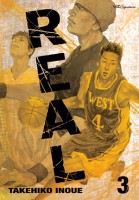
Real, Vol. 3

March 15, 2014 by Ash Brown

Real, Volume 3Creator: Takehiko Inoue
U.S. publisher: Viz Media
ISBN: 9781421519913
Released: January 2009
Original release: 2003
Awards: Japan Media Arts Award

Takehiko Inoue is probably best known for his basketball manga series Slam Dunk. Now, I enjoy Slam Dunk quite a bit. However, it’s another basketball manga by Inoue that is my personal favorite–Real, which specifically features wheelchair basketball. Although Real and Slam Dunk both share some similar themes, Inoue’s approach in Real tends to be much more serious and realistic, which make sense as the series is intended for a more mature audience. Real began serialization in the manga magazine Weekly Young Jump in 2001. Later that year, Inoue would win a Japan Media Arts Award Excellence Prize for the manga. The third volume of Real was released in Japan in 2003. Viz Media published Real under its Signature imprint, releasing the English-language edition of Real, Volume 3 in 2009. Real is a fantastic series that starts strongly and only continues to get stronger with each volume.

Things always came easily for Takahashi and he naturally excelled at both school and sports. But now he is faced with one of the most daunting challenges of his life. The question is whether or not he will be able to meet that challenge. After being hit by a truck, Takahashi has lost all feeling in his legs along with his ability to walk. He is in complete denial about his condition and is convinced that with only a little effort he’ll be back to playing basketball in no time. Takahashi is in for quite a shock when he begins his physical rehabilitation and he doesnt’ take it well. Recovery, both mental and physical, will be a long and excruciating process and in the end Takahashi will never have the mobility he once enjoyed. Coming to terms with that fact and facing reality are the first steps that Takahashi needs to take in order to move on with his life, but they may be some of the most difficult ones to accomplish.

Although Takahashi is largely the focus of the third volume of Real, he is not the only one who is facing a significant crossroads in his life. Moving forward after a traumatic experience is one of the themes addressed in Real, Volume 3. Nomiya still feels incredibly guilty over the accident that he was in which caused Natsumi to lose the use of her legs. She, like Takahashi, has begun her rehabilitation. It’s a painful and exhausting process for the body, the mind, and the spirit. Seeing this, Nomiya desperately wants to change the direction his life is heading and to become a better person. This, too, is not an easy process. At this point in the series, Togawa serves as proof that these sorts of challenges can be overcome. Things certainly aren’t perfect for him and he still harbors intense anger and frustration, but even with a missing leg he leads a full life. However, it took hard work and effort to get to where he is now. Whether or not Takahashi will be able to do the same remains to be seen.

One of the things that impresses me about Real and Inoue’s work in general is his ability to create incredibly flawed characters who are still sympathetic. Takahashi in particular can be extremely harsh and unlikeable, but I still care about him and his situation. His tormented feelings over no longer being able to walk and how he believes that makes him a lesser person are counterproductive. But he is not the only person who shares them; others struggle with those types of feelings as well. Tamura, the captain of Togawa’s basketball team, has repeatedly expressed similar sentiments which either deflates the other players or pisses them off. (Togawa is particularly sensitive to this issue and has hauled off and punched Tamura at least once because of it.) Inoue’s adept handling of these concerns, while specific to the context of Real and its characters, is also more universally applicable. Almost everyone, no matter who they are, has experienced feelings of inadequacy and disappointment at some point in their lives. Real simply shows what can happen when that reality is faced head on.

Filed Under: REVIEWS Tagged With: Japan Media Arts Award, manga, real, Takehiko Inoue, viz media, VIZ Signature

  • « Go to Previous Page
  • Page 1
  • Interim pages omitted …
  • Page 15
  • Page 16
  • Page 17
  • Page 18
  • Page 19
  • Page 20
  • Go to Next Page »
 | Log in
Copyright © 2010 Manga Bookshelf | Powered by WordPress & the Genesis Framework