• Skip to primary navigation
  • Skip to main content
  • Skip to primary sidebar
  • Home
  • About Us
    • Privacy Policy
    • Comment Policy
    • Disclosures & Disclaimers
  • Resources
    • Links, Essays & Articles
    • Fandomology!
    • CLAMP Directory
    • BlogRoll
  • Features & Columns
    • 3 Things Thursday
    • Adventures in the Key of Shoujo
    • Bit & Blips (game reviews)
    • BL BOOKRACK
    • Bookshelf Briefs
    • Bringing the Drama
    • Comic Conversion
    • Fanservice Friday
    • Going Digital
    • It Came From the Sinosphere
    • License This!
    • Magazine no Mori
    • My Week in Manga
    • OFF THE SHELF
    • Not By Manga Alone
    • PICK OF THE WEEK
    • Subtitles & Sensibility
    • Weekly Shonen Jump Recaps
  • Manga Moveable Feast
    • MMF Full Archive
    • Yun Kouga
    • CLAMP
    • Shojo Beat
    • Osamu Tezuka
    • Sailor Moon
    • Fruits Basket
    • Takehiko Inoue
    • Wild Adapter
    • One Piece
    • After School Nightmare
    • Karakuri Odette
    • Paradise Kiss
    • The Color Trilogy
    • To Terra…
    • Sexy Voice & Robo
  • Browse by Author
    • Sean Gaffney
    • Anna Neatrour
    • Michelle Smith
    • Katherine Dacey
    • MJ
    • Brigid Alverson
    • Travis Anderson
    • Phillip Anthony
    • Derek Bown
    • Jaci Dahlvang
    • Angela Eastman
    • Erica Friedman
    • Sara K.
    • Megan Purdy
    • Emily Snodgrass
    • Nancy Thistlethwaite
    • Eva Volin
    • David Welsh
  • MB Blogs
    • A Case Suitable For Treatment
    • Experiments in Manga
    • MangaBlog
    • The Manga Critic
    • Manga Report
    • Soliloquy in Blue
    • Manga Curmudgeon (archive)

Manga Bookshelf

Discussion, Resources, Roundtables, & Reviews

viz media

Anonymous Noise Vol. 2

March 26, 2017 by Anna N

I feel like Anonymous Noise is hobbled by its covers, because they are so consistently great the manga inside has a hard time living up to them. That being said, I found the contrived plot elements a little less annoying in the second volume, probably because the cliched character introductions are now out of the way.

The volume opens with Nino being challenged about her vocal ability. Miou, Yuzu’s former singer points out that while Nino’s voice has a compelling quality, her technique is a mess. Nino and Miou sing together and Miou is able to sustain her note much longer than Nino. Nino is determined to get better, and she starts reading tons of books on vocal technique. Nino spots Momo’s name on a flyer advertising music autions for a famous writer/producer, and she decides to try out in order to find out if the mysterious producer is her long-lost Momo. Of course the auditions are on the same day as the next TV appearance of In No Hurry to Shout, and Nino has to somehow pull off being at both at the same time.

The aspect of this manga that I found most interesting in the first volume was Nino as a destructive muse. She’s so single-minded, she is still utterly unaware that she’s hurting Yuzu’s feelings with her never-ending Momo obsession. Yuzu is inspired to compose by the idea of Nino as his Alice, but Momo is determined to avoid her because he’s turned away from his original childhood inspiration to compose pop hits. Yuzu even damaged his voice to sing with Nino when they were children, with the result that he’s no longer able to sing himself and Nino is now serving as his proxy. All this obsession in the service of creativity might not be a good thing, yet the joyful scenes of people lost in song carry the manga along.

I wish some of the plot elements were a little less contrived, because the coincidences piling on top of each other take me out of enjoying the story a little bit. I am still enjoying the stylish art, particularly a great panel where Yuzu hands Nino the wig of the lead singer for his band. I think this series might be one where I become a little better at engaging my suspension of disbelief with each volume. Anonymous Noise certainly delivers dramatic angst, so I’m still finding it interesting to read.
Filed Under: Manga Reviews, REVIEWS Tagged With: anonomous noise, shojo beat, shoujo, viz media

The Legend of Zelda: Twilight Princess, Vol. 1

March 23, 2017 by Ash Brown

The Legend of Zelda: Twilight Princess, Volume 1Creator: Akira Himekawa
Translator: John Werry
U.S. publisher: Viz Media
ISBN: 9781421593470
Released: March 2017
Original run: 2016

Akira Himekawa is the joint pen name of A. Honda and S. Nagano, two women who have been collaborators for over thirty years. The two-person creative team is probably best known for their work on the manga adaptations of The Legend of Zelda series of video games, although some North American readers may associate Himekawa with the Avatar: The Last Airbender comics as well. Despite being a fan of both franchises, I actually hadn’t made a point to read any of Himekawa’s work until after meeting the two women briefly at the Toronto Comic Arts Festival in 2014. Twilight Princess is the most recent entry in Himekawa’s series of The Legend of Zelda adaptations. Initially Twilight Princess was intended to be a children’s series, but when the original 2006 video game it was to be based on became the first in the franchise to be rated for teens, plans for that manga were cancelled. It wasn’t until 2016 that Himekawa would begin serializing Twilight Princess digitally, the first volume subsequently being released in Japan in print later that year. Viz Media’s English-language edition of Twilight Princess debuted in print in 2017.

Link is a young man trying to outrun his past. A year and a half ago he wandered into the border village of Ordon, hiding his personal history in hopes of establishing a new life for himself. Ordon is idyllic, seemingly a perfect place for Link to retreat. The land is said to have been blessed by the spirits and the village is well-known for its bountiful harvests. Although Link arrived as a stranger, he was warmly welcomed by the villagers and has since become an integral part of the community. Link loves Ordon and its people, but there’s always a small part of him that feels like he doesn’t quite belong. He is still plagued by guilt over the tragedies of his past, dealing with a weighty feeling of responsibility which is impossible to ignore. Having experienced disaster before, Link may be one of the few who can prevent it from happening again. Most of the other people in the sacred kingdom of Hyrule are unaware of the looming threat that the long-forgotten Twilight Realm poses. It’s a danger that grows even greater when the ambitions of one man to rule both the light and the dark begin to come to fruition. As the shadows of darkness gather around Ordon, Link will have to face his past and his fears, confronting the possibility that he will once again lose everything that he holds most dear.

The Legend of Zelda: Twilight Princess, Volume 1, page 122Although I’ve played some of the original Twilight Princess, familiarity with the video game is not at all necessary to enjoy Himekawa’s adaptation. At least so far, the series can stand on its own as a work–the manga largely comes across as a freely-developed fantasy rather than a strict reimagining of a video game. Himekawa’s narrative in Twilight Princess is streamlined and quickly paced, incorporating elements of the original game in clever ways. Some of the wonder of having a world to leisurely explore and discover is lost as Twilight Princess is adapted into a different medium, but in exchange the manga emphasizes depth of characterization. As the protagonist, Link is generally the most fully-realized character. I really like Himkeawa’s multi-faceted interpretation of Link in Twilight Princess. While at heart Link is a troubled and brooding hero, he also exhibits happiness and joy and there are moments in the manga when his good-natured goofiness shines through. The Twilight Princess manga, much like the video game itself, is intended for a more mature audience than many of the previous incarnations of The Legend of Zelda. The story tends to be fairly dark and can be strikingly violent at times.

One of the things that I appreciate the most about Himekawa’s work on The Legend of Zelda manga is the creators’ ability to adjust their tone and style to fit the requirements of a given series. Himekawa’s skill and flexibility as artists can be seen as they move from one adaptation to the next, but can also be exhibited within a single manga. In Twilight Princess specifically there is a wonderful contrast between the serene, pastoral setting of Ordon and the ominous darkness and shadowy creatures encroaching upon it. The artwork in Twilight Princess is beautifully executed, ranging from the gorgeous to the grotesque as demanded by the story. In comparison, the storytelling itself isn’t nearly as strong. The first chapter of Twilight Princess in particular suffers from some awkward exposition and Link has a tendency to ask questions that he should already know the answers to having lived in Ordon for so long. Still, I do like the story, characters, and settings of Twilight Princess. In the past, Himekawa’s The Legend of Zelda manga have only been one or two volumes long. I would be surprised if Twilight Princess could end satisfactorily in such a short span, so I hope that the series will be longer to allow the story to unfold more naturally; I enjoyed the first volume of Twilight Princess a great deal and look forward to reading more.

Thank you to Viz Media for providing a copy of The Legend of Zelda: Twilight Princess, Volume 1 for review.

Filed Under: REVIEWS Tagged With: Akira Himekawa, Legend of Zelda, manga, viz media

Anonymous Noise Vol. 1

March 8, 2017 by Anna N

Anonymous Noise Volume 1 by Ryoko Fukuyama

I read Anonymous Noise a few days ago, and I’ve had a hard time writing about it, I think because I ended up feeling very conflicted about whether or not I actually enjoyed reading it. It was stylish looking, which I appreciated. The author deployed a great deal of typical shoujo manga plot elements, which I was less than enthusiastic about. Finally, there was a level of angst involved in the relationships between the characters that I actually found intriguing, and will likely keep me hanging on to reading this series in the hopes that it gets a bit better in the second volume.

Childhood friends who are separated and meet again only to fall in love is such a shoujo staple plot element, that I get weary of it if it isn’t executed well. Nino Arisugawa has a habit of developing close childhood friendships with boys only for them to utterly disappear, which will make it very handy for her to have a love triangle as a teenager. Her first friend is Momo, a next door neighbor boy with a habit of making terrible puns. They’re in the habit of singing together. Momo abruptly moves away with his family and while Nino is visiting the sea to scream her agony into it, she stumbles across Yuzu, a kid composer who likes to write musical compositions in the sand. Yuzu is also a very familiar character type seen in manga, the short kid who drinks a ton of milk in hopes of triggering a growth spurt. Nino finds a bit of peace when singing Yuzu’s compositions, but she still longs for her lost friend Momo.

Switching gears to the future, Nino starts attending a school where Yuzu is a student. He’s very busy, because he also has the time to be in a rock band called In No Hurry, which performs wearing face masks and eyepatches. Nino and Yuzu reconnect, but it is clear that she’s still nurturing her feelings for Momo. The part of this manga that I found most interesting, and I’m not sure if it was intentional on the part of the author, is that Yuzu’s obsession with Nino as a muse is so clearly unhealthy. He has a girl singer in his band called Alice who is designed with his memories of Nino in mind, and he likens his feelings for Nino as being trapped under the spell of a canary. Yuzu ends up being the most compelling character in this manga, just because he wears his emotional agony on his sleeve. No surprise, Momo is attending the same high school, and shows up around Yuzu to make a few bad puns and then disappear in an enigmatic fashion.

The art is stylish, if a bit generic. I enjoyed the edgy costumes for Yuzu’s band. A couple moments in the manga that stood out to be as being particularly well-executed were a scene of Nino and Yuzu reconnecting through music in a practice room, and an encounter with Yuzu’s band mates that hints at a whole different story of unrequited love. I often feel like some manga series need at least two volumes before passing judgement on them, and I’m hoping that the second volume of Anonymous Noise has less shoujo cliches and more teen angst because the potential is there for an entertaining music infused teen soap opera, but I’m not quite seeing that yet.

Filed Under: Manga Reviews, REVIEWS Tagged With: Anonymous Noise, shojo beat, shoujo, viz media

The Water Dragon’s Bride, Vol. 1

February 28, 2017 by Anna N

The Water Dragon’s Bride Volume 1 by Rei Toma

I remember being delighted when I heard that another Rei Toma title was going to be released by Viz. Then many months passed between the announcement and actually getting the volume in my hand, I totally forgot about it and then was delighted all over again! I do enjoy fantasy manga and this volume was an excellent start to the series.

Asahi is a modern girl who has the misfortune of standing too close to a pond, where she is promptly whisked away to a village with no technology whose inhabitants don’t quite know what to make of her. A young boy named Subaru stumbles across Asahi and takes her home despite his sister’s protests. Unfortunately the village has a habit of offering up human sacrifices to the Water Dragon, and when Subaru brings home his new friend his mother decides that the odd girl will be a great way to ensure the prosperity of her family. Asahi is a bit stunned by being catapulted into another world and she doesn’t realize that she’s going to be a sacrifice until it is too late. Subaru tries to prevent the ritual but is unable to do anything to save his new friend.

Asahi finds herself in the Water Dragon’s realm. He’s a cold, stoic sort of god who says that he’ll wait to make Asahi his bride until she grows up. She asks him if he’s wearing cosplay and accuses him of being a pervert. The Water Dragon seems to find Asahi mildly entertaining, but he takes away her voice and then sits calmly while she starts to starve. Asahi finally realizes that the world she’s lost in is horrible. Other gods intervene to see some drama when Subaru and Asahi are reunited, but the humans in Subaru’s village prove to be even more terrible than the gods.

I think that Toma’s art, which was always good, has improved since Dawn of the Arcana. Her clear and simple style does a great job highlighting all the variants in facial expressions and reactions as the characters deal with the extraordinary. Subaru’s mother shows hints of evil in her smirk, and then devolves into full-out evil as she takes on the role of putting Asahi to trial for being rejected by the gods. Asahi’s personality is inherently bubbly and open, and it takes her a while to realize the truth of the world that she’s found herself in. Her body language completely changes after meeting the Water Dragon and the villagers. There aren’t a lot of detailed backgrounds in this manga, but the absence of setting is used to great effect when Asahi is in the Water Dragon’s world because the lack of detail in Asahi’s surroundings just makes everything seem even more surreal.

The inhumanity of the humans and the possibility that a god might change due to having to take care of a small girl are interesting themes for this manga to explore. This is a solid shoujo fantasy title and I strongly recommended it for fans of the genre.

Filed Under: Manga Reviews, REVIEWS Tagged With: shojo beat, shoujo, viz media, water dragon's bride

Shojo Beat Quick Takes – Honey So Sweet Vol. 5 and My Love Story!! Vol. 11

February 13, 2017 by Anna N

Kicking off the week of Valentine’s Day by reading some shoujo manga seemed like a good idea! Honey So Sweet and My Love Story!! are some of the most adorable and cute manga currently being published. Both couples in this series are in more established relationships, so it is interesting to see how the series continue to develop these romances.

Honey So Sweet Volume 5 by Amu Meguro

Christmas dates are a staple plot element in shoujo manga. In this case Nao and Taiga plan on getting together, but their solo date plans are quickly derailed when their entire group of friends decides that a Christmas party is happening. While everyone does have fun, it turns out that Futami decides to employ some social pressure to make sure that Nao and Taiga get some alone time. Hence, a scene of fierce blushing as the young couple is painfully aware that they are at last alone with each other. Other than blushes and some hand holding, nothing happens because Taiga’s mom suddenly returns home and embarks on a fierce examination of her son’s new girlfriend.

The artwork shifts from the general wispy and feminine style Meguro usually employs into some panels with dark screentone and bold fierce lettering as Taiga’s mom demands that the couple break up. Aggressive mothers are no match for Nao’s earnestness, as she proclaims that she loves Taiga and is determined to stay in the relationship. They then bond over Taiga’s embarrassing childhood photo albums. Nao also has to repair her relationship with her uncle and guardian Sou after accidentally staying out all night. While Sou denies being angry while acting passive aggressive and Nao decides that she’ll avoid the situation as much as she can, it takes a moment of insight and extraordinary emotional intelligence from Taiga for things to get back to normal.

A shoujo series that only focuses on the main couple gets boring fast, which is why this volume emphasizing relationships with parents or parent-like figures along with the regular romance ensures that the series as a whole continues to be entertaining.

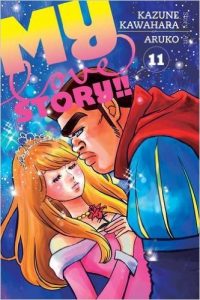
My Love Story!! Volume 11 by Kazune Kawahara and Aruko

First of all, the skewed Sleeping Beauty illustration on this volume is hilarious. This is one of my favorite shoujo manga currently being translated just because it raises the bar so much for any series attempting to be both sweet and hilarious at the same time. At this point, Takeo and Rinko haven’t seen each other very much, but they are about to be thrown in close proximity due to some coinciding class trips.

Takeo is freaking out about his ability to control his romantic urges, while Rinko keeps not so innocently popping up in his personal space. As always in My Love Story!! there’s plenty of comedic tension but the couple ends up talking things through to smooth over any awkwardness. The next story in this volume focuses on a scenario where Takeo and Rinko try to learn more about each other’s hobbies. Takeo attempts to make pancakes with results that end up carbonized while Rinko starts running around to boxing gyms because she wants to learn how to do feats of strength. Takeo ends up training her in tumbling techniques, and the scenes showing his intensity with constant frowning and fire burning in the background and her determined attempts to be a good student are fun to read. I always put this manga down feeling like I’m in a better mood, and what more could someone want out of some leisure reading?

Filed Under: Manga Reviews, REVIEWS Tagged With: honey so sweet, My Love Story, shojo beat, shoujo, viz media

Yona of the Dawn, Vol. 4

February 6, 2017 by Anna N

Yona of the Dawn Volume 4 by Mizuho Kusanagi

Yona of the Dawn is firmly in the “get the team together” quest story line that is so common in fantasy manga, but even though the plot is predictable, I’m enjoying it greatly just due ot the character interactions along the way and the interesting world building. It wouldn’t be a team without plenty of bickering, and the first chapter of this volume shows Gija and Hak constantly going at it as they both want the role of Yona’s main protector. Gija’s sheltered upbringing in his remote village doesn’t exactly prepare him for life on the open road, as it turns out he is terrified by bugs. The bickering continues and provides some much needed humor before the rest of the volume settles in with a much more serious story line.

It turns out that not every dragon guardian was raised with as much privelege and love as Gija, and as the Yona and her band go to find the Blue Dragon, they find a mysterious village with masked tribes people, and the Blue Dragon has been treated as a pariah, not celebrated due to his unique powers like Gija. The feeling in the village is unsettling, and provides Yona a real challenge to work through as she attempts to discover the identity of the Blue Dragon. One of the reasons why I like this series so much is that while Yona is obviously blessed by being a princes and having some fabled mystical guardians, she isn’t going to stop trying to improve herself. She still spends hours practicing her archery alone because she wants to be able to help the people who are fighting for her. Getting through to the Blue Dragon is a product of her insight into human nature and her genuine interest in other people as opposed to relying on her title or position in the world.

Kusanagi’s art continues to be clear and easy to read, and she’s great at conveying different moods and emotions like Gija’s over exaggerated reactions to the horrors of nature, Yona’s determination, and the unsettling masks of the Blue Dragon’s tribe.

Filed Under: Manga Reviews, REVIEWS Tagged With: shojo, shoujo, viz media, yona of the dawn

Sakura Hime Volumes 1-4

January 8, 2017 by Anna N

Sakura Hime Volumes 1-4 by Arina Tanemura

One of my reading goals over winter vacation was to make some headway into some of the series that I’ve been hoarding but not finishing. The main ones I’ve had around the house are 07-Ghost, Magi, and Sakura Hime. Since Sakura Hime is the shortest, I decided to start with that. Also, for someone that genuinely loves Arina Tanemura manga as much as I do, it is just plain weird that I haven’t finished the series before now. I didn’t reach my goal of reading the entire series during winter vacation but I hope to whittle away at it over the next couple months.

Sakura is a 14 year old princess from the moon who is engaged to Prince Oura, the son of the emperor. She is extrmely unhappy about her upcoming marriage. Hanging out in a tree in protest, she falls into the arms of Aoba, a handsome and obnoxious emissary who has come to escort her to her new husband. They immediately start bickering in that “I hate you because I’m secretly attracted to you!” way that so often happens in shoujo romance. And in a not very great surprise, Aoba is actually Oura.

Sakura and Aoba are fighting from the start, as he thinks that she has the potential to turn into an evil demon due to her moon heritage, while Sakura is determined to protect humans. Demons called youko attack Sakura if she looks directly at the moon, and she is able to manifest magical girl powers when she calls on the somewhat cranky sword Chizakura. One interesting aspect of this manga is that each character has a unique soul symbol that defines their lives. Sakura’s is “Destroy” which highlights the tension between her otherworldly nature and her desire to protect humanity. It also feeds into Aoba’s worries that Sakura is dangerous.

A large supporting cast is introduced at a quick pace in the first few volumes, including the tiny mononoke Asagiri, who is a companion to Sakura. Sakura is also joined by a spunky ninja protector named Kohaku, who has a companion frog named Hayate who is actually a handsome ninja boy with an unfortunate curse. The Priestess Byakura serves in the role of mystical advisor. Lord Fujimurasaki shows up to hint at love triangle possibilities, and just be generally fabulous with a tendency to compose random poems as commentary on whatever is happening around him.

One thing I was surprised about as the story unfolded is that the relationship between Aoba and Sakura ends up evolving greatly in the first few volumes, as based on patterns in other Tanemura series, I expected the “I hate you, no I love you” dynamic to continue for at least 6-7 volumes. Sakura grows in capabilities and confidence as she continues to reclaim her heritage as a princess from the moon. It wouldn’t be a Tanemura series if the heroine wasn’t spending a great deal of time stressing out over a man so since the situation with Aoba is quickly resolved, Sakura’s long-lost brother Enju appears and takes her away.

Tanemura does a good job juggling the character relationships with such a large cast, and in the first few volumes she has moments of levity balanced with some serious mystical creepiness. The moon is a creepy, creepy place. Sakura’s good human companions are balanced out by Enju’s followers, and I’m looking forward to the coming conflict in the rest of the series. I had to laugh when I was reading one of the authors’ notes, as Tanemura commented that she was using less screentone, and I have to say I can’t see it. The combination of historical setting, magical girl hijinks, and moon people ensures that all the flowing ribbons and fluttering flower petals that Tanemura fans would expect are present in this series. After reading the first few volumes, I’m enjoying it very much.

Filed Under: REVIEWS Tagged With: sakura hime, shojo beat, shoujo, viz media

Heiress and the Chauffeur 2 and Shuriken and Pleats Vol 2

December 26, 2016 by Anna N

Short manga series can be a bit troublesome at times. Sometimes they are short because they obviously weren’t all that popular, or because it seems like the premise for the series isn’t enough to stand up to multiple volumes. Sometimes two volume manga series really deliver on a a good short story, and here we have examples of one good and one not so great two volume series.

Shuriken and Pleats Volume 2 by Matsuri Hino

Matsuri Hino’s art is always gorgeous, and I enjoyed the first volume of this series mostly because I liked the concept of an overly serious ninja girl being forced to be a regular highschooler. The second volume of this series fell apart, although there were a few hints of humor along the way that I appreciated. First, I was totally confused because I remember putting down the first volume thinking that the heroine, Mikage, was an orphan. Imagine my surprise when Mikage’s mother shows up to visit her daughter, stands in the doorway and has a brief conversation with her and then promptly leaves. And it turns out that her mother has no idea that she’s a ninja, while Mikage’s father is actually running the ninja organization that Mikage used to work for.

The confusion continued as random scenes of high school life were interspersed with the conspiracy about seeds that was explored in the first volume, but the main thing that remained constant was Mikage being attracted to much older men with her feelings unreciprocated, while other much older men continue to find her adorable. The only part I found somewhat amusing about this volume was Mikage’s tendency to reach for ninja weapons and when called on her actions, proclaim that she was just holding a pen. The pretty art wasn’t enough to compensate for an incoherent storyline, and it is perplexing because Hino is capable of so much better.

The Heiress and the Chauffeur Volume 2 by Keiko Ishihara

Two volumes is probably just the right amount of length for this story about a Taisho Era heiress who is in love with her childhood companion and chauffeur. Sakaya is unusually forthright and straightforward about facing her problems, and she exhibits a great deal of resilience considering some difficult life circumstances that she’s dealing with. She has a lame foot which sometimes causes her pain, and her father is off overseas working. Her protector is Shinobu, a chauffeur who she persists in seeing as an older brother even though he is clearly in love with her.

A suitor for Sakaya shows up in this volume, and continues to meet with her even while telling her that he has business that is 10 times more important than socializing with her. Sakaya’s father is pushing for the match, so this ends up being a test for Sakaya in standing up to family pressure. This causes Sakaya and Shinobu to become a bit more honest with themselves about their feelings for each other, even going as far as stealing away with each other briefly. Like many short series that get pressured to wrap up quickly, the pacing of the story was a little bit rushed, and the authors’ notes contain some hints at stories she would have incorporated if she had more time. Still, this was a satisfying conclusion to this short series, and I enjoyed both the clarity of the art and the historical setting. I’d definitely be on the lookout for a longer series from Ishihara if Viz finds another one to put out under the Shojo Beat imprint.

Filed Under: REVIEWS Tagged With: shojo beat, shoujo, viz media

Haikyu!! Vol 5 and Kuroko’s Basketball 3 and 4

December 13, 2016 by Anna N

Haikyu!! Volume 5 by Haruichi Furudate

I still feel like pinching myself a little bit to remind myself that it is actually real that so much great sports manga is coming out now! I’m trying to get caught up with my manga reading after a very hectic few months at work, and there’s something very relaxing about retreating to a world where everyone’s biggest concern is sports tournaments.

One of the reasons why I like Haikyu!! so much is that the focus shifts around with every volume, so while the odd rookie couple Hinata and Kageyama are certainly progressing with each volume, the emotional core of the story changes to focus on different team members. As Karasuno heads towards a tournament with the weight of their past reputation still following them around, it becomes an opportunity for redemption. Karasuno can be recognized as a legitimate opponent again. One important theme stressed in tournament play is the need to focus on one game at a time. While the bracket facing the team is challenging, they take on their first opponent with a serious sense of purpose. The experience of the boys’ team is contrasted with the girls volleyball team, who falls to their first opponent. Furudate takes a beat to acknowledge how athletes feel when they are knocked out of a season unexpectedly early, without the opportunity to play their sport anymore.

Karasuno faces the “Iron Wall” of Date Technical High school, and here we see how Hinata’s jumping abilities and athleticism have turned him into a great decoy on the court. With the opposing team distracted by his unexpected athletic brilliance, it slowly builds into an opening for Asahi. Some of the more striking panels in the manga show Hinata in the spotlight with Asahi in the background growing more and more intense, until he’s able to prove his abilities as an ace again. Karasuno has shown all the pieces of their team though, and they won’t be able to take advantage of the element of surprise again. Haikyu!! continues to be incredibly gripping and fun.

Kuroko’s Basketball Volumes 3 and 4 by Tadatoshi Fujimaki

In contrast, while Kuroko’s Basketball sometimes feels more like a traditional shonen battle manga transported to the basketball court, with a little less focus on the emotional story associated with sports and a bit more emphasis on defeating opponents who have honed their skills at basketball in order to develop sports superpowers.

Kuroko’s invisibility continues to be an asset to Seiren High, and no surprise they are in a tournament too! They have the tough draw of having to fight two opponents in the same day. First up is Seiho, who have an intimidating center, and a brash player who starts running off his mouth about Kagami being the only good player on the Seiren team. Seiho’s team is difficult to read and defend against, because all their movements are informed by martial arts practices instead of ordinary basketball. Gradually Seiren comes up with unexpected plays that wear the other team down.

The next team contains the best shooter of Kuroko’s old team, “the Miracle Generation”. Midorima’s superstitions are funny, but his insane ability to never miss with a basketball makes him seem more like an overpowered fighting manga villain than a high school basketball player. The shots he makes are so improbable, I was worried about Seiren’s ability to come up with a strategy to defeat him. Along the way Kuroko and Kagami have some interpersonal conflict yet again as Kagami decides that he has to win the game all by himself, which is in direct opposition to Kuroko’s team-driven approach. While there’s a little bit of character development, most of these two volumes was devoted to non-stop dynamic basketball action. I appreciate the omnibus release for this manga, since the story isn’t quite as gripping as Haikyu!! for me, I’d rather read it in larger chunks. This is still an enjoyable manga, even though I don’t think it will reach the iconic status of Slam Dunk.

Filed Under: REVIEWS Tagged With: Haikyu!!, Kuroko's Basketball, Shonen, viz media

Platinum End Vol. 1

November 20, 2016 by Anna N

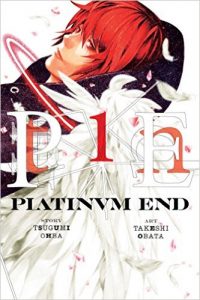
Platinum End Volume 1 by Tsugumi Ohba and Takeshi Obata

I approached reading Platinum End with mixed feelings, I was interested because this series is another work from the team that brought the world Death Note, and I greatly enjoyed Death Note. On the other hand, I wasn’t looking forward Death Note 2: Electric Boogaloo. I ended up putting down the first volume feeling like I was cautiously interested in seeing where Platinum End was going.

The volume opens with Mirai Kagehashi, a high school student who has decided to kill himself. He’s foiled in his attempt by the sudden appearance of an angel who rescues him. Mirai is stuck in despair because he was orphaned when he was young, and taken in by relatives who abused him. His new angel announces that she’s going to make him happy and gives him some new abilities – he can choose between having wings to fly anywhere or mystical red arrows that will cause anyone to fall in love with him. Mirai responds that he’ll ponder what he wants if he’s given both gifts and the angel agrees.

Mirai’s angel Nasse functions more like the devil on his shoulder than a good conscience, as she encourages him to use his powers for the most selfish of reasons. Mirai gets a sense of how deadly the ability to make anyone fall in love with him can be, when he returns to his aunt and uncle and learns the truth behind the death of his parents. In true shonen fashion it turns out that Mirai is caught up in a cosmic game, where God has decided that he’s going to elevate a human to become the next God. 13 angels have been assigned to 13 chosen humans, and the last one left gets to be in charge of the universe.

Mirai says that he would be just content with normal happiness, but Nasse keeps pushing him to use his angel-given superpowers to manipulate and murder his way to having money and happiness. In a way, Platinum End seems more like a horror title than anything else, as Mirai wakes up from nightmares with horrific visions. The other contestants for godhood aren’t using their powers for good either, as one of them decides to disguise himself as a superhero and pick off his opponents one by one, killing a comedian who decides to use the love arrows to assault a group of women.

Platinum End is rated mature and aside from that, one could develop a drinking game centered on the number of panels where Nasse’s disembodied butt is hanging in the air randomly in many panels. The art from Obata is good as always. Overall, this was an interesting manga to read, but not very pleasant. It seems like Platinum End is going to be even darker in tone than Death Note, and that series was pretty dark. At the same time, seeing if Mirai’s inherent sense of morality is going to hold up to the temptation of godlike power is an interesting story to explore, even though it is thematically a bit too close to Death Note. I put this volume down feeling a bit cautious about this series. I’ll be curious to see if in the next couple volumes Platinum End develops into a manga that I’m looking forward to reading. If not, there’s always Death Note!

pe1

Filed Under: REVIEWS Tagged With: Platinum End, Shonen, viz media

Everyone’s Getting Married Vol. 3

November 15, 2016 by Anna N

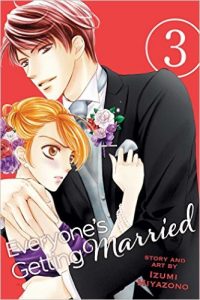
Everyone’s Getting Married, Volume 3 by Izumi Miyazono

Is everyone getting married? I see no evidence of it yet in this series where aspiring housewife Asuka and committed bachelor Ryu continue to fall in love with each other despite their utterly incompatible life goals. This manga manages to balance the twists and turns of a soap opera with some very touching moments as Ryu and Asuka continue to struggle with their feelings for each other, balance their demanding work schedules, and navigate their possibly doomed relationship.

One of the things I like about this series is how little it relies on conflict due to people not talking to each other. Sure it happens sometimes, but not talking about a problem isn’t stretched over multiple volumes as sometimes happens in romance manga. Even when some standard plot elements pop up in the form of Ryu’s Complicated Ex-Girlfriend and Asuka’s Flirty Co-Worker, this continues to lead the couple to reflect on their relationship.

Two events happen in fairly short succession that cause some strain. Yuko, a married actress who Ryu had a long-term affair with years ago is back in town. She’s touched by scandal due to her philandering husband, and Ryu is maneuvered by combative questions from the press into joking on tv that he’d dump his girlfriend for a chance to date her. In addition, Asuka gets news of a upcoming work transfer and is spending time with Kamiya, a colleague. They’re walking down the street together and they agree to do a “couple interview” as a joke, only Asuka is shocked when she sees that Ryu is interviewing her.

These additional people popping up near Asuka and Ryu cause them to confront some of the issues in their relationship. Asuka wonders if Yuko is the reason why Ryu is so set against marriage. Ryu is jealous of Kamiya, even though his relationship with Asuka is professional. But while the only person Asuka wants to marry is Ryu, she wonders what might happen if she takes Kamiya’s overtures seriously since it seems he does really want to get married.

As always the art is attractive and easy to follow, easily handling cute scenes of Ryu and Asuka supporting each other in addition to some tumultuous relationship drama. I wish Shojo Beat could bring out more series like this all at the same time, but I’ll be happy with what I can get.

egm3

Filed Under: REVIEWS Tagged With: everyone's getting married, Josei, shojo beat, viz media

Komomo Confiserie, Vols 4 and 5

October 17, 2016 by Anna N

Komomo Confiserie, Vols 4 and 5 by Maki Minami

This series was five volumes long, and it feels like exactly the right length to wrap everything up and not leave the readers hanging. It was pleasant enough, but I don’t see myself rereading it anytime soon. Still, this is the first Minami series that I’ve stuck with all the way to the end, so there’s something about cranky pasty chefs that I must find appealing! The last two volumes of the series work through a few barriers to Komomo and Natsu getting together.

This volume shows how Komomo deals with a psychotic girl who has decided to stalk Natsu in a dramatic fashion. Natsu starts ignoring Komomo for her own protection, because he doesn’t want Komomo to become a focus for Noelle’s wrath. Komomo doesn’t deal well with being ignored though, and since Natsu doesn’t openly discuss this problem with her at all (which is standard practice for shoujo heroes) the situation drags on far too long. While Komomo manages to fly under the radar for a little bit, Noelle becomes suspicious of Komomo and Natsu’s relationship and decides to take out her revenge on the Meli-Melo pastry shop. Here, Komomo’s sheer force of will and commanding nature comes out when she decides that she will not stand for Natsu’s livelihood being threatened, and she takes charge in a spectacular fashion, exhibiting some emotional maturity that she wouldn’t have been capable of at the start of the series.

Mitsuru, an old friend of Natsu starts to move in on the story. He’s fascinated with Komomo and figures out that Natsu must be in love with her. However, he has his own secret motivation for becoming involved with the odd pastry-obsessed couple, which is explored more fully in the next volume.

While Komomo starts to realize her feelings for Natsu when she begins to feel jealous of Noelle in the previous volume, the dynamic in the final volume is reversed as Natsu is forced to confront just how precious Komomo is to him once Mitsuru comes charging on the scene. Komomo has a choice to go back to her old life or stay devoted to Meli-Melo, and while her feelings aren’t in question, it takes a bit of time for Natsu to actually acknowledge what the reader has known has been going on since the very first volume.

Komomo Confiserie isn’t the most innovative shoujo manga, but I enjoyed the pastry-themed setting and Komomo’s imperious manner, expressive eyebrows, and occasional fits of rage. I While I don’t see myself rereading this manga anytime soon, it was the first Maki Minami series that I actually read from start to finish. Even though I had a very clear idea where the story would conclude after reading the first volume, I still enjoyed reading the whole series.

km5

Filed Under: REVIEWS Tagged With: komomo confiserie, shojo beat, shoujo, viz media

Yona of the Dawn, Vol. 2

October 7, 2016 by Anna N

Yona of the Dawn Volume 2 by Mizuho Kusanagi

I’m enjoying the way this story seems to is moving along at a fairly fast clip, but still seems to have plenty of time for character development and world building. In the last volume Princess Yona’s world was utterly shattered and she has to go on the run with her trusty protector Hak. He takes her to the home village of the wind tribe in order to seek refuge for a short time. I was happy to see that in this volume, Yona’s resolute spirit is highlighted, since she was mostly silly, sassy, and incredibly depressed in the first volume.

As they reach the Wind Tribe, there’s a little bit of comic relief as Hak meets up with some fellow warriors. Yona is exhausted, but living among the Wind Tribe helps her gain back some resiliency as she’s surrounded by a warm family. Hak continues to tease Yona somewhat relentlessly in such a way that I’m assuming that he’s just trying to cover up for his feelings for her. Yona has an opportunity to stay and live a quiet live with the Wind Tribe, but when it becomes clear that Su-Won isn’t going to stop trying to track her down. Yona is still a valuable political pawn.

What I most enjoyed about this volume is that I was able to see some flashes of the heroine I’m sure Yona is going to become. When Hak tries to leave her behind, she cuts through his joking demeanor and demands his fealty, and they strike out on their own again. Su Won’s soldiers are determined to capture Yona, and she stands up to the enemy, demonstrating that she isn’t the broken princess they were assuming they would find.

yona2

Filed Under: Uncategorized Tagged With: shojo beat, shoujo, viz media, yona of the dawn

Idol Dreams, Vol. 3

September 26, 2016 by Anna N

Idol Dreams Volume 3 by Arina Tanemura

Well, I spent the first two volumes really hoping that Tanemura would be able to pull off the inherently problematic premise of a 30 year old heroine with arrested development suddenly being given the chance to relive her teen years through magic teen idol pills, but as the various love triangles start to develop with Chikage’s two personas I found myself wishing that the series would wrap up quickly before it starts to head into some uncomfortable territory.

One part of this volume that I liked very much is more time spent with Chikage as an adult. She runs into her long-lost crush Haru and they start to reconnect. Tokita keeps interfering in any situation where Haru and Chikage might become more intimate, even though he doesn’t really have a logical excuse for his actions. Haru has been a bit too mysterious so far, so it was good to get some of his backstory filled in, and see how it is clear that he really did care for Chikage when they were teenagers and he still has feelings for her. It was fun to see the teenage bonds of friendship resurface between Chikage and the two men as they hang out as a trio for the first time in years. Haru is very observant, and seeing how Tokita keeps reacting to Chikage, he decides to step back, but this is only temporary. What is more problematic is that Chikage really can’t relate to anyone intimately as an adult, and she reacts like a flustered teenager to Haru’s overtures. At this point, I’m convinced that she needs therapy more than magic teen idol pills.

Chikage’s adventures as Akari in this volume were a bit more dynamic as she has to manage babysitting duties and breaking into a school in disguise. However, what I was hoping wouldn’t happen in this series happened, as Akari decides to date a 16 year old. I find this more creepy than anything, and I hope this is really short-lived. I’ve enjoyed Arina Tanemura series so much in the past, but now I’m wondering if I should just fill in some of the gaps in my Sakura Hime manga collection and going back and reading that instead. I’m still firmly team Tokita, as he’s clearly the only man that Chikage can actually relax around and be herself with. I hope that the romance swings more that way in future volumes.

idoldreams3

Filed Under: REVIEWS Tagged With: idol dreams, shojo beat, shoujo, viz media

Skip Beat!, Vol 37

September 18, 2016 by Anna N

Skip Beat! Volume 37, by Yoshiki Nakamura

I always do a mental happy dance whenever a new volume of Skip Beat! comes out, because it is just so consistently good. This volume brings the pain, as Kyoko has to deal with her mother. Kyoko’s family has always been consistently absent from this series, and now the reader knows why. There was a bit of a reference to family difficulties when Kyoko had to get her mother’s permission to sign with a talent agency, but she hasn’t appeared in person in the manga before. Kyoko’s mom appears to be a cold-hearted lawyer who doesn’t want to be inconvenienced by her own daughter.

Coming off of the Heel Siblings arc, Kyoko is back in Japan, working as a Love Me section member again while the first few episodes of her new drama are airing. She runs into her mother by an elevator, but she only displays a few hostile micro-expressions before walking by her daughter, utterly ignoring her. Later, it turns out that Saena Mogami is filling in for another lawyer on a variety show and when responding to questions about her cold demeanor, she replies that she’s never had children. Both Ren and Sho witness this moment, and they think about Kyoko’s feelings, rushing to be by her side.

Sho arrives first, right after Kyoko sees her mother deny her existence. Kyoko’s response to this event is to utterly shut down her emotions. Nakamura does such a great job with Kyoko’s facial expressions in this scene. Kyoko is usually so animated, swinging from one emotional extreme to another that to see her be both beyond sad and blank at the same time is shocking. Kyoko’s eyes are shadowed in grey, and the aftermath of her mother’s interview settles on Kyoko like a physical weight. Sho being Sho, his response is to try to provoke some sort of emotion out of her, and he fails miserably.

Skip Beat! has that rare combination of gripping plots and lovely art, even though the characters might have the leg proportions of giraffes. There are always several pages in each volume where I stop to appreciate the art, like the panels that show Kyoko’s devastation, a photo shoot with Ren that shows the charisma he has that has made him a star, and the moment where Kyoko finally finds some comfort.

Kyoko goes on the run and finds Ren, but she thinks he’s Corn! Oh the tangled web we weave, etc! Still, no mater what side of himself Ren may be portraying, he’s the refuge that Kyoko needs at the time. I can see this storyline spinning out over several volumes, and as usual when Skip Beat! embarks on new direction I can’t wait to see what happens next.

skipbeat37

Filed Under: REVIEWS Tagged With: shojo, shoujo, Skip Beat!, viz media

  • « Go to Previous Page
  • Page 1
  • Interim pages omitted …
  • Page 8
  • Page 9
  • Page 10
  • Page 11
  • Page 12
  • Interim pages omitted …
  • Page 20
  • Go to Next Page »
 | Log in
Copyright © 2010 Manga Bookshelf | Powered by WordPress & the Genesis Framework