• Skip to primary navigation
  • Skip to main content
  • Skip to primary sidebar
  • Home
  • About Us
    • Privacy Policy
    • Comment Policy
    • Disclosures & Disclaimers
  • Resources
    • Links, Essays & Articles
    • Fandomology!
    • CLAMP Directory
    • BlogRoll
  • Features & Columns
    • 3 Things Thursday
    • Adventures in the Key of Shoujo
    • Bit & Blips (game reviews)
    • BL BOOKRACK
    • Bookshelf Briefs
    • Bringing the Drama
    • Comic Conversion
    • Fanservice Friday
    • Going Digital
    • It Came From the Sinosphere
    • License This!
    • Magazine no Mori
    • My Week in Manga
    • OFF THE SHELF
    • Not By Manga Alone
    • PICK OF THE WEEK
    • Subtitles & Sensibility
    • Weekly Shonen Jump Recaps
  • Manga Moveable Feast
    • MMF Full Archive
    • Yun Kouga
    • CLAMP
    • Shojo Beat
    • Osamu Tezuka
    • Sailor Moon
    • Fruits Basket
    • Takehiko Inoue
    • Wild Adapter
    • One Piece
    • After School Nightmare
    • Karakuri Odette
    • Paradise Kiss
    • The Color Trilogy
    • To Terra…
    • Sexy Voice & Robo
  • Browse by Author
    • Sean Gaffney
    • Anna Neatrour
    • Michelle Smith
    • Katherine Dacey
    • MJ
    • Brigid Alverson
    • Travis Anderson
    • Phillip Anthony
    • Derek Bown
    • Jaci Dahlvang
    • Angela Eastman
    • Erica Friedman
    • Sara K.
    • Megan Purdy
    • Emily Snodgrass
    • Nancy Thistlethwaite
    • Eva Volin
    • David Welsh
  • MB Blogs
    • A Case Suitable For Treatment
    • Experiments in Manga
    • MangaBlog
    • The Manga Critic
    • Manga Report
    • Soliloquy in Blue
    • Manga Curmudgeon (archive)

Manga Bookshelf

Discussion, Resources, Roundtables, & Reviews

Vertical Comics

Ode to Kirihito, Vols. 1-2

April 7, 2010 by Katherine Dacey

“When he heard his cry for help, it wasn’t human” — so went the tagline for Ken Russell’s Altered States (1980), a bizarre fever-dream of Nietzchean philosophy, horror, and mystical hoo-ha in which a scientist’s experiments result in his spontaneous devolution. That same tagline would work equally well for Osamu Tezuka’s Ode to Kirihito (1970-71), a globe-trotting medical mystery about a doctor who takes a similar step down the evolutionary ladder from man to beast. In less capable hands, Kirihito would be pure, B-movie camp with delusions of grandeur — as Altered States is — but Tezuka synthesizes these disparate elements into a gripping story that explores meaty themes: the porous boundaries between man and animal, sanity and insanity, godliness and godlessness; the arrogance of scientists; and the corruption of the Japanese medical establishment.

At its most basic level, Ode to Kirihito is a beat-the-clock thriller in which a charismatic young doctor named Kirihito Osanai tries to discover the cause of Monmow, a mysterious condition that reduces its victims to hairy, misshapen creatures with dog-like snouts. Kirihito’s superior, the ambitious Dr. Tatsugaura, dispatches Kirihito to Doggodale, a remote mountain village where hundreds of residents have developed suggestive symptoms. Once in Doggodale, Kirihito contracts Monmow himself, thus beginning a hellish odyssey to escape the village, arrest the disease’s progress, and share his findings with the medical community.
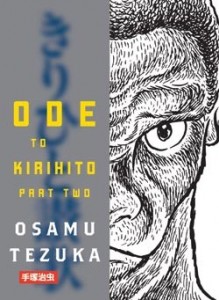
kirihito2At a deeper level, however, Ode to Kirihito is an extended meditation on what distinguishes man from animal. Kirihito’s physical transformation forces him to the very margins of society; he terrifies and fascinates the people he encounters, as they alternately shun him and exploit him for his dog-like appearance. (In one of the manga’s most engrossing subplots, an eccentric millionaire kidnaps Kirihito for display in a private freak show.) The discrimination that Kirihito faces — coupled with Monmow’s dramatic symptoms, such as irrational aggression and raw meat cravings — lead him to question whether he is, in fact, still human. Throughout the story, he wrestles with a strong desire to abandon reason and morality for instinct; only his medical training — and the ethics thus inculcated — prevent him from embracing the beast within.

Tezuka explores the boundaries between the rational and the instinctual in other ways as well. Running in tandem with Kirihito’s metamorphosis is another devolution of sorts: Kirihito’s colleague Dr. Urabe, who descends into madness after uncovering a sinister plot within the administration of M University Hospital. When we first meet Urabe, he’s a self-interested cad who lusts after Kirihito’s fiancee Izumi, views Kirihito as more rival than friend, and lacks the will to challenge Tatsugaura, even when data suggests Tatsugaura’s hypothesis about Monmow is flat-out wrong. The slow dawning of Urabe’s conscience, however, precipitates a dramatic change; his psyche splits in two, with one half striving after truth and the other succumbing to base impulse. Even as Urabe begins to redeem himself, collaborating with Izumi to reveal Tatsugaura’s dishonesty, he frequently lapses into savage, sexual aggression.

Other characters’ reactions to these transformations — especially characters in positions of authority or power — provide Tezuka with ample opportunity to engage in one of his favorite activities: exposing institutional hypocrisy. The scandal surrounding Tatsugaura’s Monmow hypothesis, for example, lays bare the corruption within the barely fictional Japanese Medical Association. In his relentless quest to become head of the organization, Tatsugaura seeks to establish an international reputation as an infectious disease expert, even going so far as to suppress evidence that contradicts his thesis. Yet the revelation of Tatsugaura’s deceit does little to jeopardize his position among his peers; only the young doctors find his behavior objectionable, yet they cannot dislodge him from his powerful position.

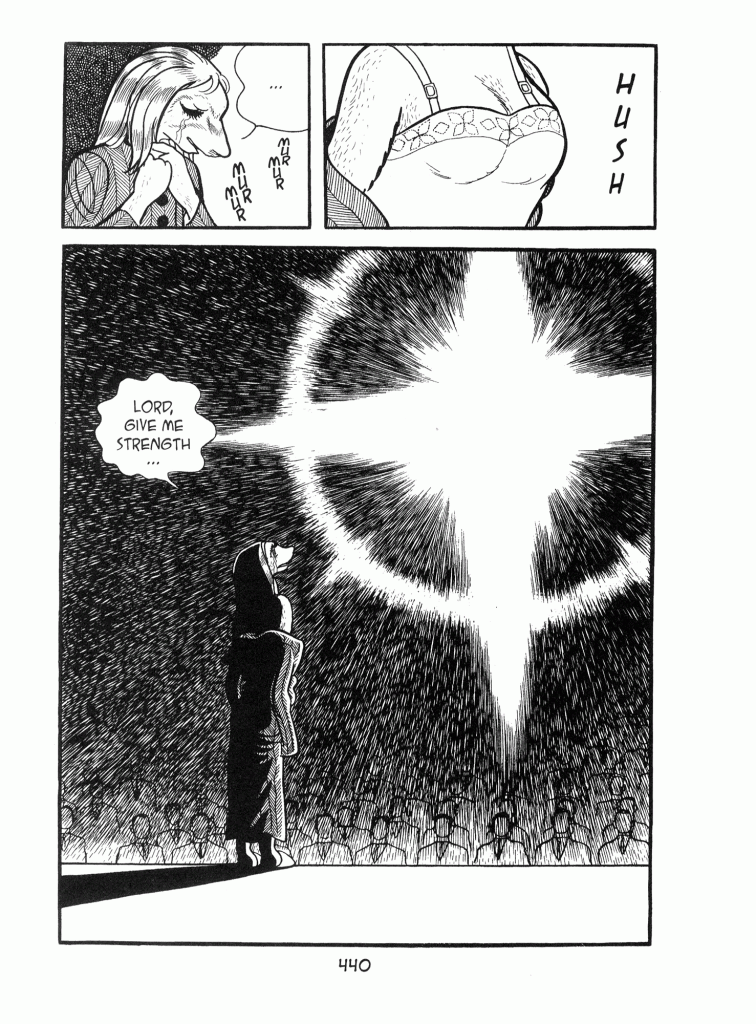
One of the key figures in revealing Tatsugaura’s treachery, Sister Helen, also provides Tezuka a chance to tear away the veil of hypocrisy from another institution — in this case, the Catholic Church. Midway through the first volume, a priest attempts to murder Sister Helen after she contracts Monmow disease. When confronted with his act, he acknowledges his intent but denies his purpose was evil; he insists on protecting the Church’s reputation at all costs, fearing that news of Helen’s condition would bring a scandal, as the received wisdom about Monmow disease held that Caucasians were immune to it.
sisterhelen

At the same time, however, Tezuka uses his characters’ metamorphoses to reveal the human capacity for selflessness and spirituality. Sister Helen provides the most obvious example; after entertaining thoughts of suicide, she has an epiphany — literally, as the cross imagery above suggests — and begins emulating Christ’s example, eventually finding her place ministering to the residents of an impoverished industrial town. Other characters demonstrate a similar capacity for selfless behavior: Urabe, for example, devotes himself to finding Kirihito, while Reika, a circus performer, helps Kirihito escape from captivity and reassert his humanity by practicing medicine.

One could certainly view Ode to Kirihito as heavy-handed allegory; there’s nothing subtle about its Christian imagery or Elephant Man storyline. Yet Tezuka’s fondness for Baroque subplots, over-the-top action sequences, and larger-than-life villains demands an equally bold approach for exploring the story’s greater themes. After all, Kirihito features dog men, sideshow freaks, an evil millionaire who hosts his own private circus, a German geneticist sporting a monocle, and an acrobat who risks life and limb to become human tempura; had Tezuka played things straight, or tried to state his man-vs-inner-beast conflict in less obvious terms, the story would seem preposterous and arty, a surreal experiment devoid of genuine human feeling.

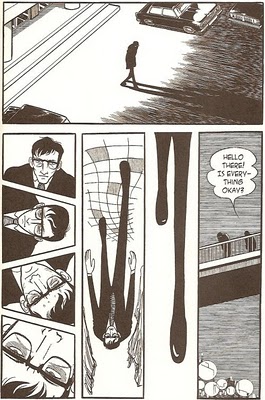
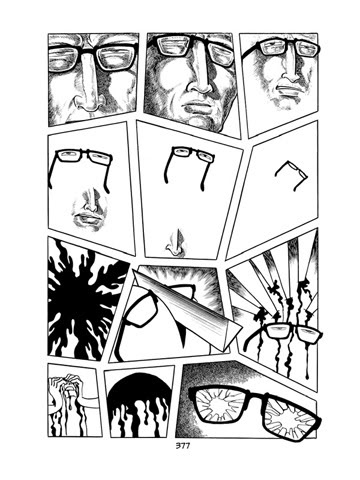
As he would do in MW (1976-78), Tezuka pushes the boundaries of the comics medium in Ode to Kirihito, aiming for a cinematic style capable of immersing us not only in the action but in the characters’ own thought processes. Though Kirihito has its share of artfully staged chases, fights, and dramatic confrontations, the most visually arresting sequences depict Urabe’s fragile mental state:
urabe_breakdown2urabe_breakdown

The panel shapes alone are a brilliant stroke; not only do they suggest his fractured and chaotic thought process, they also have a hint of the insect about them, as if we’re viewing Urabe’s consciousness through a fly’s eye. The knife and blood imagery are cliche, to be sure, but the shattered glasses are a novel and unsettling gesture open to multiple interpretations. Even the more conventional sequence on the left, in which Urabe leaves a hospital in a murderous rage, employs its share of neat visual tricks: Tezuka dramatizes Urabe’s personality shift by rotating the character’s image until he appears to be walking through an upside-down hall of mirrors. Amplifying the effect is the ambiguous way in which Tezuka draws Urabe’s legs in the bottom panel; as Matthew Brady observed in his review of Ode to Kirihito, the image simultaneously evokes dripping blood and moving limbs.

Perhaps the best compliment I can pay Ode to Kirihito is to say that Tezuka achieves on paper what John Frankenheimer achieved on film with The Train, Seven Days in May, and The Manchurian Candidate, transforming the humble thriller into a vehicle for telling thought-provoking, challenging stories that enlighten as they entertain. Kirihito may not surpass the narrative sophistication or visual poetry of Phoenix, but it comes awfully close. A must-read for serious manga lovers.

Review copies provided by Vertical, Inc.

ODE TO KIRIHITO, VOLS. 1-2 • BY OSAMU TEZUKA • VERTICAL, INC. • RATING: OLDER TEEN (16+)

Filed Under: Manga, Manga Critic, REVIEWS Tagged With: Action/Adventure, Classic, Horror/Supernatural, Osamu Tezuka, Vertical Comics

Osamu Tezuka’s MW

March 1, 2010 by Katherine Dacey

Invoke Tezuka’s name, and most readers immediately think of Astro Boy, Buddha, and Princess Knight. But there’s a darker side to Tezuka’s oeuvre that dates back to 1953, the year in which he brought Dostoevsky’s tormented Raskolnikov to life in a manga-fied version of Crime and Punishment. It’s this side of Tezuka — the side that acknowledges the human capacity for violence, greed, and deception — that’s on display in MW, a twisty thriller about a sociopath and the priest who loves him.

The central event of MW is a military cover-up. “Nation X,” which maintains a base on Okinawa Mafune, has been stockpiling a top-secret chemical weapon known as MW.1 An explosion releases a poisonous cloud, killing everyone on the island except for two visitors, Iwao Garai and Michio Yuki. Though Garai and Yuki are equally traumatized by this holocaust, their lives diverge wildly over the next fifteen years. Garai embraces the light, becoming a Roman Catholic priest, while Yuki embraces the darkness, embarking on a spree of kidnappings, murders, and extortion schemes meant to punish the politicians, businessmen, and military officials who profited from the subsequent cover-up.

Superficially, Yuki’s plans might be understood as an eye for an eye, but Yuki is no righteous avenger. He’s a serial killer who relishes torturing his victims, who exploits the secrecy of the confessional to torment Garai with details of his crimes, who uses his androgynous sex appeal to seduce both men and women, and who impersonates his female victims with the skill of a kabuki actor. (And just in case we haven’t yet grasped the true extent of Yuki’s depravity, Tezuka suggests that Yuki has a rather intimate bond with his dog Tomoe.) Even Yuki’s motivation for exposing the MW scandal is purely selfish: Yuki is dying from its lingering effects, and wishes to take millions of people with him to the grave. Though Father Garai hopes to redeem Yuki, he lacks Yuki’s certitude, instead violating his priestly vows — especially that pesky oath of celibacy — as he tries to prevent Yuki from harming anyone else.

MW can certainly be enjoyed as a potboiler. Tezuka spins an entertaining, slightly preposterous yarn, serving up more plot twists, car chases, and gender-bending costume changes than Dressed to Kill and The Manchurian Candidate combined. But it’s also very talky. Characters frequently describe their plans at length instead of just carrying them out; voice-overs interrupt the action to educate us on the history of chemical warfare; and thought balloons reveal little about the interior lives of the characters that couldn’t be inferred from their actions.

MW can be more profitably understood as a meditation on US-Japanese relations during the Vietnam War. The gas attack takes place around 1960, the year the Japanese Diet ratified the Treaty of Mutual Cooperation and Security2, while most of the action takes place in the 1970s, as left-wing student groups were taking to the streets to protest American military presence in Japan. Though MW does include a few demonstrations, Tezuka doesn’t try to dramatize the left wing’s activities so much as the spirit of the movement: “Debunk false democracy!” The politicians in MW are greedy, foolish, and entirely too cozy with “Nation X” military brass. Yet the student radicals don’t fare so well, either; Tezuka renders them as an ineffectual lot whose agenda is riddled with inconsistencies. Only in the ambivalent Father Garai, who desperately wishes to enlighten the public about MW, does Tezuka present a decent, sympathetic figure, someone struggling mightily against hypocrisy and deceit, even as he succumbs to his own sexual demons.

Of course, there’s another level on which MW can be appreciated as well: the artwork. MW is Tezuka at his most restrained; there are no doe-eyed critters, no slapstick, no characters breaking the fourth wall to crack wise about cartooning conventions. (To be sure, there are moments of playfulness: in one memorable sequence, reminiscent of the grand parade in Cleopatra, Yuki impersonates the great gorgons of Aubrey Beardsley’s work, from Salome to the Lady in the Peacock Skirt.) Most of the pages have a surprisingly direct, clean presentation, a neat and orderly progression of squares and rectangles that run in counterpoint to the orgies, bank robberies, high-speed boat chases, and fist-fights they contain. From time to time, however, Tezuka thinks outside the grid, with dramatic results. When Gari and Yuki find themselves on Okinawa Mafune, for example, Tezuka doesn’t depict the actual gas attack. Instead, Tezuka shows us only what Garai and Yuki see after the cloud has dissipated: a mosaic of faces, each contorted into a grotesque death-mask. It’s a potent, haunting moment that suggests both the survivors’ horror upon discovering the bodies and the victims’ excruciatingly painful deaths.

As with all of Tezuka’s works, MW is sprinkled with characters and scenes that may make contemporary readers uncomfortable. The women of MW, for example, are either passive victims — one is rendered an emotional and physical invalid after Yuki rapes her — or venal shrews, with only a brief appearance by a sane lesbian newspaper editor to balance the parade of unflattering female stereotypes. Tezuka’s depiction of homosexuality is similarly frustrating. On the one hand, the newspaper editor refuses to embarrass Garai by outing him in the press, telling him that “gay love is accepted outside Japan”; on the other hand, Garai’s relationship with Yuki has a strong whiff of pedophilia — at least in the opening pages — as Garai is an adult and Yuki a boy at the time of their first encounter. Similar issues dog Apollo’s Song and Swallowing the Earth, yet in MW, Tezuka’s decision to focus exclusively on the problems of Japanese society prevents the story from spinning out of control or sinking under the weight of a few ill-informed portrayals.

Fans of Apollo’s Song, Buddha, and Ode to Kirihito won’t be surprised to learn that Vertical has done a fine job of showcasing Tezuka’s work with a crisp translation, quality binding, and signature Chip Kidd dustjacket. MW won’t be everyone’s cup of tea, but if the thought of Tezuka channeling Brian DePalma and John Frankenheimer sounds appealing, you’ll want to add it to your library.

1 MW is pronounced “moo.”
2 The treaty reaffirmed the US military’s commitment to defending Japan against hostile forces, pledged to return captured territories, and extended the US occupation of Okinawa for an additional ten years.

This is a revised version of a review that appeared at PopCultureShock on October 29, 2007. Click here for the original text.

MW • BY OSAMU TEZUKA • VERTICAL, INC. • 582 pp. • RATING: OLDER TEEN (16+)

Filed Under: Manga, Manga Critic, REVIEWS Tagged With: Classic, Osamu Tezuka, Thriller, Vertical Comics

The Cat in the Coffin

June 22, 2009 by Katherine Dacey

The year is 1955. Twenty-year-old Masayo, an aspiring painter from Hakodate, apprentices herself to Goro Kawabuko, a handsome widower who teaches at a Tokyo art college. In exchange for a weekly lesson, Masayo agrees to keep house for Goro and tutor his daughter Momoko, a strange, withdrawn child whose only companion is a regal white cat named Lala.

Masayo, who comes from a humble background, finds the Kawabuko household enchanting. Or, more accurately, she finds Goro enchanting. Goro epitomizes urban chic, hosting lavish parties, listening to jazz, and wearing the latest Western fashions. Realizing that Goro is beyond her reach, Masayo instead focuses on Momoko; if she can gain the girl’s confidance, perhaps she’ll have a claim on Goro’s heart as well. Masayo must first demonstrate her affinity for Lala, however, as the cat exerts an almost maternal power over Momoko, responding to her mistress’ quicksilver moods with an emotional intelligence that borders on human.

Masayo’s tenure is threatened by the arrival of Chinatsu, a beautiful sophisticate who seems intent on marrying Goro. Chinatsu competes with Masayo for Momoko’s affections, touching off a battle royal between the two women. Watching their struggle unfold, we begin to see through Masayo’s guileless pose: she’s as masterful a manipulator as Chinatsu, using her relationship with Momoko to drive a wedge between Goro and his fiancee:

For a wicked moment, I savored the momentary discomfiture that flickered across the faces of Goro and Chinatsu. Momoko had shown precious little interest in Chintasu; indeed, she had all but ignored her. And then she came running to me. It occurred to me then that aside from Goro, nobody was closer to Momoko than I was. That thought made me feel even more elated.

Like Henry James’s “The Turn of the Screw,” The Cat in the Coffin draws its power from “the strange and sinister embroidered on the very type of the normal and easy,” presenting itself as a domestic drama about a naive young woman who falls for her worldly employer. Yet the book has an oppressive, eerie quality that lends itself to several tantalizing readings: that Lala may be possessed by Momoko’s dead mother, that Momoko herself is a bad seed. By the novel’s end, the reader may believe Masayo’s account of events — and even feel great compassion for her — while questioning her involvement in them.

It’s this level of narrative complexity that elevates The Cat in the Coffin from romantic pot boiler to literature: we’re seduced by Masayo’s modest, self-effacing comments before we recognize that she’s an unreliable witness. One can certainly read The Cat in the Coffin as an atmospheric mystery, but it works on many other levels as well: as a meditation on jealousy, as a young woman’s sexual awakening, as a portrait of life in occupied Japan, as a parody of the Victorian governess novel. I’d love to see Vertical translate more work by Mariko Koike, as she brings an uncommon level of wisdom and literary sophistication to a pulpy genre.

Review copy provided by Vertical, Inc.

THE CAT IN THE COFFIN • BY MARIKO KOIKE, TRANSLATED BY DEBORAH BOLIVER BOEHM • VERTICAL, INC. • 190 pp.

Filed Under: Books, Manga Critic, REVIEWS Tagged With: Animals, Mystery/Suspense, Novel, Vertical Comics

  • « Go to Previous Page
  • Page 1
  • Page 2
  • Page 3
 | Log in
Copyright © 2010 Manga Bookshelf | Powered by WordPress & the Genesis Framework