• Skip to primary navigation
  • Skip to main content
  • Skip to primary sidebar
  • Home
  • About Us
    • Privacy Policy
    • Comment Policy
    • Disclosures & Disclaimers
  • Resources
    • Links, Essays & Articles
    • Fandomology!
    • CLAMP Directory
    • BlogRoll
  • Features & Columns
    • 3 Things Thursday
    • Adventures in the Key of Shoujo
    • Bit & Blips (game reviews)
    • BL BOOKRACK
    • Bookshelf Briefs
    • Bringing the Drama
    • Comic Conversion
    • Fanservice Friday
    • Going Digital
    • It Came From the Sinosphere
    • License This!
    • Magazine no Mori
    • My Week in Manga
    • OFF THE SHELF
    • Not By Manga Alone
    • PICK OF THE WEEK
    • Subtitles & Sensibility
    • Weekly Shonen Jump Recaps
  • Manga Moveable Feast
    • MMF Full Archive
    • Yun Kouga
    • CLAMP
    • Shojo Beat
    • Osamu Tezuka
    • Sailor Moon
    • Fruits Basket
    • Takehiko Inoue
    • Wild Adapter
    • One Piece
    • After School Nightmare
    • Karakuri Odette
    • Paradise Kiss
    • The Color Trilogy
    • To Terra…
    • Sexy Voice & Robo
  • Browse by Author
    • Sean Gaffney
    • Anna Neatrour
    • Michelle Smith
    • Katherine Dacey
    • MJ
    • Brigid Alverson
    • Travis Anderson
    • Phillip Anthony
    • Derek Bown
    • Jaci Dahlvang
    • Angela Eastman
    • Erica Friedman
    • Sara K.
    • Megan Purdy
    • Emily Snodgrass
    • Nancy Thistlethwaite
    • Eva Volin
    • David Welsh
  • MB Blogs
    • A Case Suitable For Treatment
    • Experiments in Manga
    • MangaBlog
    • The Manga Critic
    • Manga Report
    • Soliloquy in Blue
    • Manga Curmudgeon (archive)

Manga Bookshelf

Discussion, Resources, Roundtables, & Reviews

shojo beat

A Devil and Her Love Song, Vol. 4

September 19, 2012 by Katherine Dacey 7 Comments

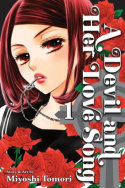
A Devil and Her Love Song has been one of 2012’s best surprises. Though the series uneven — and sometimes a little silly — its heroine is one of the most memorable in the Shojo Beat canon. Maria Kawai looks like a mean girl on the surface: she’s pretty and unsparingly blunt, pointing out her classmates’ insecurities with all the delicacy of Dr. Phil. Yet Maria’s bull-in-a-china-shop demeanor reflects her own uncertainty about how to be the kind of person who’s liked for who she is, not the kind of person who’s admired for telling unpleasant truths. And that makes her interesting.

Early in volume four, for example, Maria confronts queen bee Ayu in the bathroom, where she finds Ayu primping for the television cameras. When Maria questions Ayu’s behavior — “But you look the same,” she tells Ayu — Ayu is furious. Maria, however, persists — not because she wants the embarrass a rival, but because she wants to share a hard-won piece of advice. “If someone likes you, or wants to get to know you, it’s not because of how you look,” she tells Ayu. “It’s because you show them how you feel.”

Ayu’s subsequent behavior, however, points to one of the series’ weaknesses: characters have epiphanies with whiplash-inducing frequency. (Saul would never have made it to Damascus if he fell off his donkey as many times as Maria’s classmates do.) Though some of these epiphanies feel genuine, many are contrived: would an alpha girl suddenly confess her feelings to a cute boy in front of all her friends, risking public rejection? Or the class darling admit that she’s actually a nasty manipulator, risking her popularity? Those are nice fantasies, but not very plausible ones; Tomori is working too hard to convince us that Maria’s classmates secretly wish they could be more like her, and not giving group-think and fear enough due.

The series also relies heavily on shopworn gimmicks to advance the plot. The arrival of a television crew in volume three, for example, serves no useful purpose; they disappear for long stretches at a home, only to materialize when the plot demands that someone bear witness to the class’ antics. Maria’s long-running feud with her teacher, too, feels more like an editor’s suggestion than an original idea. To be sure, a student as outspoken as Maria might infuriate a certain kind of adult, but her teacher’s cartoonish behavior renders him ineffective; his actions seem too obvious, too ripe for exposure, for him to pose a real threat to Maria.

Where A Devil and Her Love Song shines is in Maria’s one-on-one interactions with other students. These scenes remind us that everyone is wearing a mask in high school — even Maria, whose sharp comments are as much a pose as Hana’s forced cheerfulness. Though Tomori nails the mean-girl dynamic in all its exquisite awfulness, the best of these exchanges belong to Maria and Shin. Their will-they-won’t-they tension is certainly an effective narrative hook, but what makes these scenes compelling is their honesty. Tomori captures her characters’ body language and fitful conversations, which unfold in fragments, silences, and sudden bursts of feeling, rather than eloquent declarations.

I don’t know about you, but that’s how I remember high school, as a time when I had flashes of insight and bravery, but a lot more moments of cringe-inducing stupidity, cowardice, or tongue-tied helplessness. That Tomori captures adolescence in all its discomfort while still writing a romance that’s fun, readable, and sometimes endearingly silly, is proof of her skill. Now if she could just ditch the television crew and the evil teacher…

Review copy provided by VIZ Media.

A DEVIL AND HER LONG SONG • BY MIYOSHI TOMORI • VIZ MEDIA • 200 pp. • RATING: TEEN (13+)

Filed Under: Manga Critic Tagged With: Miyoshi Tomori, shojo, shojo beat, VIZ

A Devil and Her Love Song, Vol. 4

September 19, 2012 by Katherine Dacey

A Devil and Her Love Song has been one of 2012’s best surprises. Though the series uneven — and sometimes a little silly — its heroine is one of the most memorable in the Shojo Beat canon. Maria Kawai looks like a mean girl on the surface: she’s pretty and unsparingly blunt, pointing out her classmates’ insecurities with all the delicacy of Dr. Phil. Yet Maria’s bull-in-a-china-shop demeanor reflects her own uncertainty about how to be the kind of person who’s liked for who she is, not the kind of person who’s admired for telling unpleasant truths. And that makes her interesting.

Early in volume four, for example, Maria confronts queen bee Ayu in the bathroom, where she finds Ayu primping for the television cameras. When Maria questions Ayu’s behavior — “But you look the same,” she tells Ayu — Ayu is furious. Maria, however, persists — not because she wants the embarrass a rival, but because she wants to share a hard-won piece of advice. “If someone likes you, or wants to get to know you, it’s not because of how you look,” she tells Ayu. “It’s because you show them how you feel.”

Ayu’s subsequent behavior, however, points to one of the series’ weaknesses: characters have epiphanies with whiplash-inducing frequency. (Saul would never have made it to Damascus if he fell off his donkey as many times as Maria’s classmates do.) Though some of these epiphanies feel genuine, many are contrived: would an alpha girl suddenly confess her feelings to a cute boy in front of all her friends, risking public rejection? Or the class darling admit that she’s actually a nasty manipulator, risking her popularity? Those are nice fantasies, but not very plausible ones; Tomori is working too hard to convince us that Maria’s classmates secretly wish they could be more like her, and not giving group-think and fear enough due.

The series also relies heavily on shopworn gimmicks to advance the plot. The arrival of a television crew in volume three, for example, serves no useful purpose; they disappear for long stretches at a home, only to materialize when the plot demands that someone bear witness to the class’ antics. Maria’s long-running feud with her teacher, too, feels more like an editor’s suggestion than an original idea. To be sure, a student as outspoken as Maria might infuriate a certain kind of adult, but her teacher’s cartoonish behavior renders him ineffective; his actions seem too obvious, too ripe for exposure, for him to pose a real threat to Maria.

Where A Devil and Her Love Song shines is in Maria’s one-on-one interactions with other students. These scenes remind us that everyone is wearing a mask in high school — even Maria, whose sharp comments are as much a pose as Hana’s forced cheerfulness. Though Tomori nails the mean-girl dynamic in all its exquisite awfulness, the best of these exchanges belong to Maria and Shin. Their will-they-won’t-they tension is certainly an effective narrative hook, but what makes these scenes compelling is their honesty. Tomori captures her characters’ body language and fitful conversations, which unfold in fragments, silences, and sudden bursts of feeling, rather than eloquent declarations.

I don’t know about you, but that’s how I remember high school, as a time when I had flashes of insight and bravery, but a lot more moments of cringe-inducing stupidity, cowardice, or tongue-tied helplessness. That Tomori captures adolescence in all its discomfort while still writing a romance that’s fun, readable, and sometimes endearingly silly, is proof of her skill. Now if she could just ditch the television crew and the evil teacher…

Review copy provided by VIZ Media.

A DEVIL AND HER LONG SONG • BY MIYOSHI TOMORI • VIZ MEDIA • 200 pp. • RATING: TEEN (13+)

Filed Under: Manga, Manga Critic, REVIEWS Tagged With: Miyoshi Tomori, shojo, shojo beat, VIZ

Dawn of the Arcana, Vols. 3-5

August 1, 2012 by Katherine Dacey 4 Comments

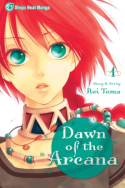
On the surface, Dawn of the Arcana looks like a Harlequin romance. Its flame-haired heroine is feisty and impetuous, torn between her feelings for the man who raised her and the man she was forced to marry. Both men are keen to “own” her — their word, not mine — and are willing to go to ridiculous extremes to prove their devotion, even setting aside their differences to honor her requests. And true to Harlequin form, the heroine frequently struggles to reconcile the circumstances of her marriage and her growing feelings for her jailer-husband.

Peer beneath its romance-novel trappings, however, and it quickly becomes clear that manga-ka Rei Toma is actually writing a pretty nifty fantasy-adventure as well, one with interesting moral dilemmas, parallels with contemporary geopolitics, and multi-layered characters whose behavior frequently deviates from the Harlequin playbook.

In volume three, for example, Nakaba’s mother-in-law attempts to dye her hair black, lest visiting dignitaries realize that the new Belquat princess hails from Senan. Toma might have used this scene to provide Caesar an opportunity to publicly declare his feelings for Nakaba, or demonstrate Nakaba’s ability to endure hazing with noble forbearance. Instead, Toma transforms this act of fairy-tale cruelty into a moment of self-actualization: Nakaba seizes a sword and defiantly gives herself a fabulous pixie cut — er, short, boyish locks — denying the queen the satisfaction of humiliating her in front of the royal family.

That act resonates throughout the next three volumes, as Nakaba sheds her girlish braid and girlish indignation in favor of a stronger, more active role in defeating Belquat’s royal family. Though Nakaba’s new ‘do leads to some predictable exchanges about “looking like a boy,” both Loki and Caesar admire her determination: red hair symbolizes more than just her country of origin, but also the struggles that helped define her as a person.

As appealing as such scenes may be, they highlight the series’ main drawback: the artwork is too plain and spare for a story with such vivid characters. Though the principal characters’ costumes are rendered in considerable detail, the supporting cast resemble Renfair extras, with faintly old-timey clothing and long tresses. Worse still are the backgrounds: with their perfect right angles and unvaried lines, they look like stills from an ancient Nintendo game, rather than a representation of a specific time and place. That sterility isn’t a deal-breaker, but it does reinforce the impression that Toma hasn’t quite developed the artistic chops to fully realize her vision.

Despite its artistic shortcomings, Dawn of the Arcana remains an appealing mixture of fantasy and romance, offering just enough sword fights, scenes of female empowerment, and emotional entanglements to appeal to fans of both genres.

Review copies provided by VIZ Media, LLC.

DAWN OF THE ARCANA, VOLS. 3-5 | BY REI TOMA | VIZ MEDIA | RATING: TEEN (13+)

Filed Under: Manga Critic Tagged With: Rei Toma, shojo, shojo beat, VIZ

Dawn of the Arcana, Vols. 3-5

August 1, 2012 by Katherine Dacey

On the surface, Dawn of the Arcana looks like a Harlequin romance. Its flame-haired heroine is feisty and impetuous, torn between her feelings for the man who raised her and the man she was forced to marry. Both men are keen to “own” her — their word, not mine — and are willing to go to ridiculous extremes to prove their devotion, even setting aside their differences to honor her requests. And true to Harlequin form, the heroine frequently struggles to reconcile the circumstances of her marriage and her growing feelings for her jailer-husband.

Peer beneath its romance-novel trappings, however, and it quickly becomes clear that manga-ka Rei Toma is actually writing a pretty nifty fantasy-adventure as well, one with interesting moral dilemmas, parallels with contemporary geopolitics, and multi-layered characters whose behavior frequently deviates from the Harlequin playbook.

In volume three, for example, Nakaba’s mother-in-law attempts to dye her hair black, lest visiting dignitaries realize that the new Belquat princess hails from Senan. Toma might have used this scene to provide Caesar an opportunity to publicly declare his feelings for Nakaba, or demonstrate Nakaba’s ability to endure hazing with noble forbearance. Instead, Toma transforms this act of fairy-tale cruelty into a moment of self-actualization: Nakaba seizes a sword and defiantly gives herself a fabulous pixie cut — er, short, boyish locks — denying the queen the satisfaction of humiliating her in front of the royal family.

That act resonates throughout the next three volumes, as Nakaba sheds her girlish braid and girlish indignation in favor of a stronger, more active role in defeating Belquat’s royal family. Though Nakaba’s new ‘do leads to some predictable exchanges about “looking like a boy,” both Loki and Caesar admire her determination: red hair symbolizes more than just her country of origin, but also the struggles that helped define her as a person.

As appealing as such scenes may be, they highlight the series’ main drawback: the artwork is too plain and spare for a story with such vivid characters. Though the principal characters’ costumes are rendered in considerable detail, the supporting cast resemble Renfair extras, with faintly old-timey clothing and long tresses. Worse still are the backgrounds: with their perfect right angles and unvaried lines, they look like stills from an ancient Nintendo game, rather than a representation of a specific time and place. That sterility isn’t a deal-breaker, but it does reinforce the impression that Toma hasn’t quite developed the artistic chops to fully realize her vision.

Despite its artistic shortcomings, Dawn of the Arcana remains an appealing mixture of fantasy and romance, offering just enough sword fights, scenes of female empowerment, and emotional entanglements to appeal to fans of both genres.

Review copies provided by VIZ Media, LLC.

DAWN OF THE ARCANA, VOLS. 3-5 | BY REI TOMA | VIZ MEDIA | RATING: TEEN (13+)

Filed Under: Manga, Manga Critic, REVIEWS Tagged With: Rei Toma, shojo, shojo beat, VIZ

Jiu Jiu, Vol. 1

July 4, 2012 by Katherine Dacey 11 Comments

My childhood bookshelves were filled with stories about wolves and the girls who loved them, so Jiu Jiu sounded like pure Kate Bait. Not only did Jiu Jiu feature wolves — two, to be exact — it also featured the kind of angry, conflicted heroine familiar to me from years of reading books like Sasha, My Friend. As an added bonus, Takamichi, the heroine, wasn’t just a frustrated teen adjusting to a new school and new classmates; she was a demon hunter who dispatched ghouls with the chilly efficiency of a robot, aided by Snow and Night.

But oh, the execution! Jiu Jiu is a riotously busy manga, with layouts that look more like a junior high school student’s scrapbook than a conscious ordering of panels. Author Touya Tobina draws cute wolf pups, but her command of human anatomy is poor; her characters’ rubbery limbs barely seem anchored to their torsos, resulting in odd pretzel configurations whenever they embrace or fight. Her use of screentone and pattern is similarly problematic: though the dark palette helps dramatize Takamichi’s inner turmoil, it also obscures many nicely observed moments, seldom allowing those images to stand alone, unadorned, for the reader to contemplate.

The other problem is the ever-present threat of romance. Snow and Night aren’t ordinary wolves; they’re shape-shifters who transform into handsome teenage boys. As much as they view Takamichi as their mother and mistress, there’s a strong whiff of eroticism in their interactions with her. Takamichi, of course, doesn’t yet perceive her pups’ romantic designs on her, though it doesn’t take a great leap of imagination to see that living with two attractive wolf-men might  invite emotional and physical entanglements beyond the occasional game of fetch. By placing so much emphasis on Snow and Night’s hotness, however, author Tobina seems to be laying the foundation for a much less interesting story, one in which the heroine must chose between two cute guys, rather than forge her own destiny.

Where Jiu Jiu redeems itself is in the individual characterizations. Takamichi, for example, reminded me a lot of how I was at sixteen: moody, isolated, and eager to mask my insecurities with belligerence and swagger. Her hot-and-cold relationship with Snow and Night also rings with truth, as she vacillates between nurturing them and sternly rejecting them, re-enacting her fraught relationship with her father in the process. Snow and Night, too, are a marked improvement on the standard-issue shojo prince. Yes, one is blonde and outgoing while the other is bespectacled and introspective, but both characters’ personalities betray their canine DNA; who but a dog would think a frisbee was the ideal birthday present for a human?

For all the skill with which these characters are realized, however, Jiu Jiu still frustrates more than it entertains. The author’s visually frenzied layouts and frequent recourse to emotional manipulation make volume one a bumpy ride, with too many unwarranted shifts between comedy and heart-tugging drama. (Does anything say “emotional manipulation” quite like the sight of a whimpering puppy?) I’m still clinging to the hope that Jiu Jiu will improve in future chapters, if for no other reason that I haven’t outgrown my love of stories about tough girls who run with wolves.

Review copy provided by VIZ Media LLC.

JIU JIU, VOL. 1 • BY TOUYA TOBINA • VIZ MEDIA • 200 pp. • RATING: OLDER TEEN (16+)

Filed Under: Manga Critic Tagged With: shojo, shojo beat, Touya Tobina, VIZ

Tidbits: Now We Are Six

April 22, 2012 by Michelle Smith

Originally, this post was supposed to go up several months ago, when the sixth volumes of these series were newly released, but time conspired against me. And so, belatedly, I present reviews of volumes five and six of Kamisama Kiss and Oresama Teacher. Also included is perennial favorite Skip Beat!, which is on a similar trajectory, just twenty volumes ahead.

Kamisama Kiss, Vols. 5-6
It’s hard to believe now that I ever had my doubts about Kamisama Kiss, because I’m enjoying it more and more with each volume.

Volume five finds Nanami determined to correct public opinion that her shrine is a creepy, dangerous ruin, especially since her shinshi, Tomoe, works so hard to maintain it. And so, she decides to hold a festival, spending two weeks preparing for a special performance while soliciting amusingly misguided advice from her supernatural acquaintances. It’s a success in the end. In volume six, Nanami is called upon to compete against another human girl for a spot at a prestigious kami conference.

In these two volumes, mangaka Julietta Suzuki nicely balances the expansion of the supernatural world (including the introduction of several new characters) and Nanami’s abilities with further development in her relationship with Tomoe. It seems to me that Tomoe is finding himself somewhat in awe of his kami these days—particularly when purification powers on par with his first master’s manifest themselves—and also more prone to emotions like fondness and jealousy. One of the best things about their relationship is how he is able to encourage and reassure her before the festival without being condescending about it. “I acknowledged you as my master,” he says. “Don’t be afraid. Prove yourself to everyone… like you did to me.”

I think the main appeal for me is that Kamisama Kiss is shaping up to be the story of Nanami’s growth. She may be in love with Tomoe, but winning his affections is not her sole ambition, or even her focus. Instead, she wants to develop as a kami and become someone that her parishioners can depend upon and respect. Because progress has come slowly, watching her actually achieve some truly remarkable things in these volumes actually leaves me a little verklempt. This has become less a story about a human girl thrust into the wacky world of yokai and more about someone embracing their destiny and striving to reach their full potential. I eagerly look forward to the next volume.

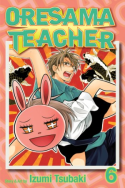
Oresama Teacher, Vols. 5-6
I was worried there for a minute. It seemed to me that volume five was showing signs of Tsubaki-sensei running out of ideas, what with a chapter about Takaomi and Mafuyu helping a wealthy girl find love with her self-denying servant, a chapter about the school’s bancho being stalked by a flower fairy, and a chapter about the Student Council’s resident ninja gathering intel on the Public Morals Club.

Although it’s not the neatest bow—I still don’t fully grasp why the Student Council is so opposed to Takaomi’s plans to attract more non-delinquent students to Midorigaoka, but at least I have an inkling now—Tsubaki does manage to tie things together by the end of volume six. Okay, not the flower fairy bit, but the significance of Takaomi going out of his way to help Marika (the rich girl) ties in with the backstory of why he’s become a teacher and why he’s made a bet with the school’s director. It brings new depth to his character and even relates to some things he said back in volume one.

I also really enjoyed the chapter in which the members of the Public Morals Club—now including Shinobu the ninja, who has decided to obtain information on his enemies from within their midst—explore the school, finding oodles of empty classrooms and realizing that it was once a thriving place with high-caliber students. Also significant is that, when Mafuyu is frustrated by Takaomi refusal to reveal his true motivations, she complains that all she’d wanted was to be a regular high school girl, but then got forcibly recruited to his agenda. Hayasaka overhears and, thinking he has kept Mafuyu from the life she’d wished for, avoids her. Mafuyu attempts to hang out with some girls, but in the end realizes she prefers being with Hayasaka. It’s really sweet.

This description might make it sound as if the series has suddenly gone in a plot-heavy direction, but that’s not really the case. There’s definitely something happening, but there are still plenty of amusing moments. My favorite is when Hayasaka and Super Bun are reunited and we get a panel of her carrying him in her arms while he thinks, “You’re so dreamy!”

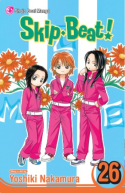
Skip Beat!, Vols. 25-26
It’s a rare series that still genuinely delights me this far into its run, but Skip Beat! consistently manages to do so. I think the key here is that Nakamura has developed a cast of characters whose personality quirks enable her to take the plot in unexpected directions.

For example, volume 25 is all about the aftermath of Valentine’s Day. Sho has learned that Kyoko gave chocolates to Reino, and so shows up on the set of Dark Moon with an ostentatious bouquet in hand. He’s not out to win Kyoko’s love—so her explanation of the true nature of the chocolates (hatred) makes no difference—he just wants all her thoughts to be focused on him once more, and he temporarily ensures this by stealing her first kiss. Kyoko freaks out, according to plan, and is briefly talked down by Ren, but when she gives Ren his own special valentine, he can’t resist driving thoughts of Sho out of her head by administering a smooch of his own. This one’s on the cheek and he plays it off as a foreigner’s expression of gratitude, but it definitely leaves a trace in her heart.

Backing away from all of this progress, Nakamura eases us into the next arc by having Kyoko and Kanae return to the Love-Me Section, where they are joined by new member Chiori Amamiya, a former child actress whom Kyoko recently inspired to regain her love for acting. Each girl receives a personalized assignment from Lory, and Kyoko’s involves picking up Cain Heel, a dangerous-looking guy who is the president’s guest. Turns out, this is Ren going undercover and Kyoko’s new assignment is to stay by his side as his doting and scantily clad goth sister, Setsuka. And they have to live together in a hotel room. Ordinarily, a twist like this would be completely out of left field, but because this is Lory and because this is Skip Beat! I can just roll with it and eagerly anticipate the complications that will ensue.

If you’ve never read Skip Beat! before, now is a great time to start, as an omnibus edition of the first three volumes has recently been released!

Review copies provided by the publisher.

Filed Under: REVIEWS Tagged With: shojo beat, VIZ

The Earl & The Fairy, Vol. 1

April 6, 2012 by Katherine Dacey 1 Comment

Meet Lydia Carlton: she’s a so-called “fairy doctor,” a healer who acts as an intermediary between the spirit and human worlds. The rapid advance of technology in Victorian England has made Lydia’s job obsolete; most people no longer seek magical remedies for their ailments, and view Lydia as a relic of a less enlightened time, someone who steadfastly clings to the belief that she can see and talk to these mischievous folk. Lydia knows better: not only are fairies real, but they continue to wreak havoc with humans, even in an age of railroads, telegraphs, and steam-powered ships.

Lydia’s predicament would make a swell basis for a manga, but her abilities are more a plot contrivance than a central element of the drama — at least in volume one of The Earl & The Fairy. The initial chapters focus on Lydia’s fraught relationship with Edgar Ashenbert, a dashing young man who claims to be descended from the Blue Knight, a legendary warrior. Edgar enlists kidnaps Lydia because he needs someone to help him find the Blue Knight’s sword, the location of which is inscribed on a coin that can only be read by a fairy doctor.

If you’ve read more than five or six shojo manga — or, for that matter, five or six Harlequin romances — you can guess what sort of chap Edgar is: he’s handsome, possessive, and smug, with a tender side that the heroine’s beauty and decency helps reveal. Lydia is a similarly predictable character: she’s feisty and conflicted, simultaneously drawn to and repelled by her captor. Lydia also happens to be one of the duller knives in the Shojo Beat drawer, placing her trust in anyone who approaches her; she’s kidnapped not once but twice in the very first chapter of the story.

For a grumpy old lady like me, stale, silly lead characters would usually be a deal-breaker. The lively supporting cast and lovely artwork, however, drew me into the story, even when Edgar and Lydia’s conversations inspired eyeball rolling and hair pulling. (In later chapters, Edgar narrates his tortured personal history in comic detail — it’s courtship by information dump.)

The best character in The Earl & The Fairy — so far, at least — is Nico, a magical being who assumes the form of a fussy talking cat. On one level, Nico is a standard animal sidekick, providing much-needed comic relief: in one running joke, for example, he bristles with indignation every time he’s served a bowl of milk. (He prefers wine.) On another level, however, Nico is a reader stand-in, giving voice to our frustration with Lydia’s naivete; in essence, it’s like watching a horror movie in which one of the characters says, “Don’t open that door, dude, the killer’s in there.” You don’t say.

Ermine and Raven, a sister-brother duo in Edgar’s employ, also add depth to the cast. Their backstory is pure manga: both were enslaved by a wicked “prince” working out of the sewers of an unnamed American city. After Edgar rescued them, Ermine and Raven became his most devoted servants, waiting on him hand and foot, defending him against enemies, and wooing Lydia on his behalf. To be sure, henchmen/servants are a standard manga type, but Ermine and Raven have enough idiosyncrasies to make them interesting; Ermine, in particular, is an unusual figure, a melancholy cross-dresser who seems caught between the male and female worlds.

The Earl & The Fairy‘s other saving grace is the artwork. The character designs are crisply executed; though none of the characters are especially distinguished looking, artist Ayuko draws elegant, well-proportioned figures that are pleasing to the eye. The settings are rendered with even greater care, capturing the technology and landscapes of mid-nineteenth century England in convincing detail. (Well, minus the ships: when viewed from a distance, they appear to be eighteenth-century sailing vessels, while their interiors suggest a Cunard ocean liner.) Ayuko pays similar attention to lighting; in several nocturnal scenes, she does a fine job of suggesting the meager, irregular quality of candlelight, using delicate crosshatching to mark the boundary between light and shadow.

If the parts of Earl are greater than the whole, it’s still an entertaining series. I don’t know if moody landscapes and talking cats are enough to justify my investment in all four volumes, but I’m certainly willing to read another before declaring this nice-looking romance a dud.

THE EARL & THE FAIRY, VOL. 1 • STORY AND ART BY AYUKO, ORIGINAL CONCEPT BY MIZUE TANI • VIZ MEDIA • 186 pp. • RATING: TEEN (13+)

Filed Under: Manga Critic Tagged With: Romance/Romantic Comedy, shojo, shojo beat, VIZ

The Earl & The Fairy, Vol. 1

April 6, 2012 by Katherine Dacey

Meet Lydia Carlton: she’s a so-called “fairy doctor,” a healer who acts as an intermediary between the spirit and human worlds. The rapid advance of technology in Victorian England has made Lydia’s job obsolete; most people no longer seek magical remedies for their ailments, and view Lydia as a relic of a less enlightened time, someone who steadfastly clings to the belief that she can see and talk to these mischievous folk. Lydia knows better: not only are fairies real, but they continue to wreak havoc with humans, even in an age of railroads, telegraphs, and steam-powered ships.

Lydia’s predicament would make a swell basis for a manga, but her abilities are more a plot contrivance than a central element of the drama — at least in volume one of The Earl & The Fairy. The initial chapters focus on Lydia’s fraught relationship with Edgar Ashenbert, a dashing young man who claims to be descended from the Blue Knight, a legendary warrior. Edgar enlists kidnaps Lydia because he needs someone to help him find the Blue Knight’s sword, the location of which is inscribed on a coin that can only be read by a fairy doctor.

If you’ve read more than five or six shojo manga — or, for that matter, five or six Harlequin romances — you can guess what sort of chap Edgar is: he’s handsome, possessive, and smug, with a tender side that the heroine’s beauty and decency helps reveal. Lydia is a similarly predictable character: she’s feisty and conflicted, simultaneously drawn to and repelled by her captor. Lydia also happens to be one of the duller knives in the Shojo Beat drawer, placing her trust in anyone who approaches her; she’s kidnapped not once but twice in the very first chapter of the story.

For a grumpy old lady like me, stale, silly lead characters would usually be a deal-breaker. The lively supporting cast and lovely artwork, however, drew me into the story, even when Edgar and Lydia’s conversations inspired eyeball rolling and hair pulling. (In later chapters, Edgar narrates his tortured personal history in comic detail — it’s courtship by information dump.)

The best character in The Earl & The Fairy — so far, at least — is Nico, a magical being who assumes the form of a fussy talking cat. On one level, Nico is a standard animal sidekick, providing much-needed comic relief: in one running joke, for example, he bristles with indignation every time he’s served a bowl of milk. (He prefers wine.) On another level, however, Nico is a reader stand-in, giving voice to our frustration with Lydia’s naivete; in essence, it’s like watching a horror movie in which one of the characters says, “Don’t open that door, dude, the killer’s in there.” You don’t say.

Ermine and Raven, a sister-brother duo in Edgar’s employ, also add depth to the cast. Their backstory is pure manga: both were enslaved by a wicked “prince” working out of the sewers of an unnamed American city. After Edgar rescued them, Ermine and Raven became his most devoted servants, waiting on him hand and foot, defending him against enemies, and wooing Lydia on his behalf. To be sure, henchmen/servants are a standard manga type, but Ermine and Raven have enough idiosyncrasies to make them interesting; Ermine, in particular, is an unusual figure, a melancholy cross-dresser who seems caught between the male and female worlds.

The Earl & The Fairy‘s other saving grace is the artwork. The character designs are crisply executed; though none of the characters are especially distinguished looking, artist Ayuko draws elegant, well-proportioned figures that are pleasing to the eye. The settings are rendered with even greater care, capturing the technology and landscapes of mid-nineteenth century England in convincing detail. (Well, minus the ships: when viewed from a distance, they appear to be eighteenth-century sailing vessels, while their interiors suggest a Cunard ocean liner.) Ayuko pays similar attention to lighting; in several nocturnal scenes, she does a fine job of suggesting the meager, irregular quality of candlelight, using delicate crosshatching to mark the boundary between light and shadow.

If the parts of Earl are greater than the whole, it’s still an entertaining series. I don’t know if moody landscapes and talking cats are enough to justify my investment in all four volumes, but I’m certainly willing to read another before declaring this nice-looking romance a dud.

THE EARL & THE FAIRY, VOL. 1 • STORY AND ART BY AYUKO, ORIGINAL CONCEPT BY MIZUE TANI • VIZ MEDIA • 186 pp. • RATING: TEEN (13+)

Filed Under: Manga, Manga Critic, REVIEWS Tagged With: Romance/Romantic Comedy, shojo, shojo beat, VIZ

Dawn of the Arcana, Vols. 1-2

January 29, 2012 by Michelle Smith

By Rei Toma | Published by VIZ Media

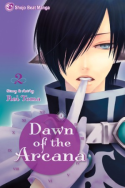
In premise, Dawn of Arcana sounds like fairly generic shoujo fantasy. Princess Nakaba of Senan is married to Prince Caesar of Belquat in an arrangement ostensibly meant to ensure peace between their warring kingdoms, but which nobody expects to do so for long. Nakaba is resigned to her fate, but not without backbone, while Caesar is arrogant and entitled and makes remarks like, “Make no mistake. You are my property.” It’s pretty obvious they will fall for each other soon.

Accompanying Nakaba is her demi-human attendant, Loki, who belongs to an enslaved race possessed of heightened strength and senses. He’s been by Nakaba’s side ever since the village in which she lived was attacked by Belquat soldiers—evidently, her mother (also a princess) eloped with a member of a race possessed of precognitive powers, which Belquat was attempting to wipe out and of which Nakaba is now the only survivor—and so she feels much love and gratitude for him.

The first volume mainly focuses on Nakaba’s attempts to fit in around the enemy castle. In Senan and Belquat, only royalty have black hair, so the fact that hers is red has always prompted sneers, curiosity, and contempt, so the reaction would be the same no matter where she resided. Gradually, she gets to know Caesar a little better, and we see that his main problems are youth and actually buying into the “it’s your right” lectures that his mother has been subjecting him to since childhood. Here’s a great sample exchange between them:

Caesar: (After planting a smooch on Nakaba.) I’m a prince, and this is my kingdom. If I want something, I take it.

Nakaba: You may be a prince, but there are some things you’ll never have. Allow me to be the first.

Nakaba actually trusts him to keep his word when he promises to help Loki get out of trouble at one point, and expresses faith in his abilities to succeed in the very endeavors which his mother discouraged him from even trying. In return, he somewhat awkwardly tries to make her happy by bestowing lavish gifts upon her, and learns that a simple thing like caring for a wounded bird does the job better than fancy dresses. It’s certainly nothing new for a surly hero to be thus tamed by a spunky heroine, but I like the development all the same.

And speaking of development, volume two is a lot more interesting than the first. While someone plots to poison Caesar—and attempts to frame Nakaba for the deed—tension is brewing between Nakaba’s husband and her attendant. Loki intervenes to save Caesar from the would-be assassin, but admits that this is only to earn his trust. “I do want him dead… Have you forgotten? They are the enemy.” For too long, Loki’s people have been kept down, and he is now plotting rebellion. “You must not let him into your heart,” he warns, knowing that Caesar must eventually be his target, but though Nakaba attempts to comply, out of loyalty to Loki, she’s ultimately unable to do so.

Despite the fact that Nakaba falling for Caesar is predictable, I still like them together—how she improves him, and how he manages to make her feel safe yet simultaneously guilty—and I really like that she’s torn between these two guys, but not exactly in a romantic sense. Even while her feelings for Caesar are growing, she’s aware of the possibility that she’ll end up betraying him for Loki’s sake. Personally, I’m betting on Caesar becoming aware of the atrocities committed by his father and joining Loki’s cause—there have been some hints in this direction already—but the angst will be fun in the meantime.

Ultimately, this is a solidly good series. It’s not great yet, but it’s also far from bad.

Dawn of the Arcana is published in English by VIZ Media. Volume one is out now and volume two will officially be released on February 7, 2012. The series is ongoing in Japan, where the ninth volume has just come out.

Review copies provided by the publisher.

Filed Under: REVIEWS Tagged With: shojo beat, VIZ

A Devil and Her Love Song, Vol. 1

January 24, 2012 by Michelle Smith

By Miyoshi Tomori | Published by VIZ Media

The back cover blurb of A Devil and Her Love Song contains the following lines: “Meet Maria Kawai—she’s gorgeous and whip-smart, a girl who seems to have it all. But when she unleashes her sharp tongue, it’s no wonder some consider her to be the very devil!”

And in my mind, this built up the expectation for a comedy, but that’s not what A Devil and Her Love Song is at all. It’s much more serious and sad than I had anticipated, but if I had done my research beforehand and realized that it originally ran in Margaret, I shouldn’t have been surprised.

Beautiful Maria Kawai has been expelled from her prestigious Catholic school, St. Katria’s, and must now enroll in a new school. She carries a lot of mental baggage from her experiences at St. Katria’s, most notably the fact that someone she regarded as her best friend told her “You taint everyone around you.” And, as if to lend credence to these words, Maria stirs up hostilities amongst her classmates almost immediately. The problem is that she’s so perceptive, and so blunt in her delivery, that she points out personality attributes that her classmates would rather not acknowledge, like the fact that they’ve been gossiping about her prior to her arrival, or that one boy is pushing himself to be liked by all even though he is not naturally a people person. Over the first week of school, matters escalate to the point where Maria is shoved down a flight of stairs and a truly odious teacher is telling her she’s “rotten to the core.”

And yet, there are certain lessons from her St. Katria’s days that serve Maria well in tough moments, like “those who believe will be saved,” which provides her encouragement to get through bullying encounters with a group of Mean Girls in her class. But she’s not taking solace from a religious implication of these words; instead, she seems to feel that if she believes in people’s good intentions, has faith that one day they will accept her, that this will actually come to pass. And so, even though she knows the girls have it in for her, she puts herself in the path of their harassment in the hopes that one day, she’ll win them over. As I said, it’s really rather sad and makes her far more sympathetic than I ever expected a sharp-tongued heroine to be.

I regret to admit I made another snap judgment of the series based on the chapter one title page, which depicts Maria and a couple of boys, one a cheerful blond and the other a surly-looking brunette. I assumed these would be her stereotypical shoujo love interests, but though both boys are definitely interested in her, they are far more complicated individuals than I had assumed they would be. The brunette, Shin, is grumpy, rebellious, and not really friendly with the rest of the class, but has a kind heart. It unsettles him that Maria can so clearly see through him, and he’s terrified of what would happen if she could discern what he’s feeling about her, but he still comes through with her when no one else will. There’s one especially nice scene where she’s so happy and scared by his kindness that she can’t even find the words to explain, so she sings instead.

On the other hand, you have Yusuke, who is trying so hard to be everyone’s friend that he’s actually no one’s real friend at all. His philosophy is the “lovely spin,” which is a survival mechanism he tries to impart upon Maria with little success. Turn everything into something palatable and nice, even if you’re being untrue to yourself, is the basic gist. It’s probably good for her to master this subterfuge, to avoid further confrontations and to effect the personal change she seeks, but why is he doing it? Just as he helps her master the art of diplomacy, one wonders whether she will help him drop the charade.

I mean no slight to shoujo comedies when I say that A Devil and Her Love Song is much better, richer and more deep, than I anticipated. To say that I am looking forward to reading the rest of this story would be a gross understatement.

A Devil and Her Love Song is published in English by VIZ Media. The first volume will officially be released on February 7, 2012. The series is complete in Japan with thirteen volumes.

Review copy provided by the publisher.

Filed Under: REVIEWS Tagged With: shojo beat, VIZ

A Devil and Her Love Song, Vol. 1

January 15, 2012 by Katherine Dacey 12 Comments

Maria Kawai, heroine of A Devil and Her Love Song, is a cool customer. Not only is she beautiful, talented, and smart, she’s also tough — so tough, in fact, that she was expelled from a hoity-toity Catholic school for beating up a teacher. Her blunt demeanor further cements her bad-girl impression; within minutes of enrolling at a new high school, she antagonizes all the girls in her class with a few sharp observations about their behavior. Only two boys — Yusuke, a cheerful, popular student who avoids conflict at all costs, and Shin, a moody outsider — try defending Maria from her peers’ nasty comments and pranks.

So far, so good: Maria is spiky and complicated, a truth-teller who lacks the ability to censor herself, even though she’s aware of the potential consequences of speaking her mind. Throughout volume one, there are some wonderful comic moments as Maria struggles to put a “lovely spin” — Yusuke’s term — on her acid comments. Alas, Maria’s sideways head-tilt and doe-eyed gaze look more sinister than cute; not since Kazuo Umezu’s Scary Book has a manga-ka made a doll-like character look so thoroughly menacing, even when superimposed atop a backdrop of flowers and sparkles.

Having created such a vivid character, however, Miyoshi Tomori isn’t sure where to go with the story. In several scenes, Maria does things that contradict what we know about her: would someone as perceptive as Maria willingly attend a party hosted by the class mean girls, especially after they’d harassed her on a daily basis? And why would someone as outspoken as Maria refrain from pointing out her teacher’s judgmental behavior — especially when it’s plainly obvious to both the characters in the story and the reader? These kind of abrupt reversals might make sense if we knew more about Maria’s past, but at this stage in the story, they feel more like authorial floundering than a conscious revelation of character.

From time to time, however, Tomori convincingly hints at Maria’s softer side. Midway through volume one, for example, Maria makes tentative overtures towards Tomoya “Nippachi” Kohsaka, a fellow bullying victim. (“Nippachi” means “twenty-eight,” and is a mean-spirited reference to Tomoya’s poor academic performance.) That scene is both sad and real; anyone who’s ever seen two ostracized kids turn their classmates’ scorn on one another will immediately appreciate the dynamic between Maria and Nippachi. Maria’s exchanges with Shin, too, reveal a different side of her personality; though the pair frequently engage in the kind of rapid, antagonistic banter that’s de rigeur for romantic comedies, their quieter conversations suggest a grudging mutual respect.

Maria’s interactions with Nippachi and Shin fill me with hope that A Devil and Her Love Song will find its footing in later chapters. If Tomori can find a way to reveal Maria’s fundamental decency without compromising her heroine’s tart, outspoken personality, A Devil and Her Love Song will be a welcome addition to the Shojo Beat catalog, an all-too-rare example of a story in which the heroine isn’t the least bit concerned with being nice or popular. If Tomori can’t, Devil runs the risk of devolving into a YA Taming of the Shrew, with Shin (or, perhaps, Yosuke) playing Petruchio to Maria’s Katherina.

Review copy provided by VIZ Media, LLC. Volume one will be released February 7, 2011.

A DEVIL AND HER LOVE SONG, VOL. 1 • BY MIYOSHI TOMORI • VIZ MEDIA • 200 pp. • RATING: TEEN (13+)

Filed Under: Manga Critic Tagged With: shojo, shojo beat, VIZ

A Devil and Her Love Song, Vol. 1

January 15, 2012 by Katherine Dacey

Maria Kawai, heroine of A Devil and Her Love Song, is a cool customer. Not only is she beautiful, talented, and smart, she’s also tough — so tough, in fact, that she was expelled from a hoity-toity Catholic school for beating up a teacher. Her blunt demeanor further cements her bad-girl impression; within minutes of enrolling at a new high school, she antagonizes all the girls in her class with a few sharp observations about their behavior. Only two boys — Yusuke, a cheerful, popular student who avoids conflict at all costs, and Shin, a moody outsider — try defending Maria from her peers’ nasty comments and pranks.

So far, so good: Maria is spiky and complicated, a truth-teller who lacks the ability to censor herself, even though she’s aware of the potential consequences of speaking her mind. Throughout volume one, there are some wonderful comic moments as Maria struggles to put a “lovely spin” — Yusuke’s term — on her acid comments. Alas, Maria’s sideways head-tilt and doe-eyed gaze look more sinister than cute; not since Kazuo Umezu’s Scary Book has a manga-ka made a doll-like character look so thoroughly menacing, even when superimposed atop a backdrop of flowers and sparkles.

Having created such a vivid character, however, Miyoshi Tomori isn’t sure where to go with the story. In several scenes, Maria does things that contradict what we know about her: would someone as perceptive as Maria willingly attend a party hosted by the class mean girls, especially after they’d harassed her on a daily basis? And why would someone as outspoken as Maria refrain from pointing out her teacher’s judgmental behavior — especially when it’s plainly obvious to both the characters in the story and the reader? These kind of abrupt reversals might make sense if we knew more about Maria’s past, but at this stage in the story, they feel more like authorial floundering than a conscious revelation of character.

From time to time, however, Tomori convincingly hints at Maria’s softer side. Midway through volume one, for example, Maria makes tentative overtures towards Tomoya “Nippachi” Kohsaka, a fellow bullying victim. (“Nippachi” means “twenty-eight,” and is a mean-spirited reference to Tomoya’s poor academic performance.) That scene is both sad and real; anyone who’s ever seen two ostracized kids turn their classmates’ scorn on one another will immediately appreciate the dynamic between Maria and Nippachi. Maria’s exchanges with Shin, too, reveal a different side of her personality; though the pair frequently engage in the kind of rapid, antagonistic banter that’s de rigeur for romantic comedies, their quieter conversations suggest a grudging mutual respect.

Maria’s interactions with Nippachi and Shin fill me with hope that A Devil and Her Love Song will find its footing in later chapters. If Tomori can find a way to reveal Maria’s fundamental decency without compromising her heroine’s tart, outspoken personality, A Devil and Her Love Song will be a welcome addition to the Shojo Beat catalog, an all-too-rare example of a story in which the heroine isn’t the least bit concerned with being nice or popular. If Tomori can’t, Devil runs the risk of devolving into a YA Taming of the Shrew, with Shin (or, perhaps, Yosuke) playing Petruchio to Maria’s Katherina.

Review copy provided by VIZ Media, LLC. Volume one will be released February 7, 2011.

A DEVIL AND HER LOVE SONG, VOL. 1 • BY MIYOSHI TOMORI • VIZ MEDIA • 200 pp. • RATING: TEEN (13+)
Filed Under: Manga, Manga Critic, REVIEWS Tagged With: shojo, shojo beat, VIZ

Dawn of the Arcana, Vol. 1

November 19, 2011 by Katherine Dacey 15 Comments

“Today, I belong to the enemy” — so begins Dawn of the Arcana, a medieval fantasy in which a feisty princess marries into a neighboring country’s royal family. Nakaba characterizes herself as “a lamb,” sacrificed by her people to help two warring kingdoms maintain a fragile peace. Her husband, the handsome but insolent Prince Caesar, initially snubs his new wife; not only does she have red hair — a commoner’s color — but she also flouts palace conventions, wearing the traditional dress of her homeland, employing a male Ajin (humanoid) as her valet, and excoriating Caesar in front of his servants.

Adding fuel to this combustible situation are Caesar’s mother, a Lady Macbeth figure who urges her son to seek the throne; King Guran, her husband; Cain, Caesar’s half-brother; and Louise, Cain’s flirty fiancee. Nakaba is keenly aware of their contempt for her, and struggles to maintain her composure as they openly mock her and threaten her faithful servant Loki. Though Loki is devoted to his mistress, he, too, poses a danger to Nakaba, as he quickly antagonizes Caesar and Guran with his impulsive behavior….

Read More

Filed Under: Manga Critic Tagged With: Rei Toma, shojo, shojo beat, VIZ

Dawn of the Arcana, Vol. 1

November 19, 2011 by Katherine Dacey

“Today, I belong to the enemy” — so begins Dawn of the Arcana, a medieval fantasy in which a feisty princess marries into a neighboring country’s royal family. Nakaba characterizes herself as “a lamb,” sacrificed by her people to help two warring kingdoms maintain a fragile peace. Her husband, the handsome but insolent Prince Caesar, initially snubs his new wife; not only does she have red hair — a commoner’s color — but she also flouts palace conventions, wearing the traditional dress of her homeland, employing a male Ajin (humanoid) as her valet, and excoriating Caesar in front of his servants.

Adding fuel to this combustible situation are Caesar’s mother, a Lady Macbeth figure who urges her son to seek the throne; King Guran, her husband; Cain, Caesar’s half-brother; and Louise, Cain’s flirty fiancee. Nakaba is keenly aware of their contempt for her, and struggles to maintain her composure as they openly mock her and threaten her faithful servant Loki. Though Loki is devoted to his mistress, he, too, poses a danger to Nakaba, as he quickly antagonizes Caesar and Guran with his impulsive behavior.

As predictable as the plot may be — would you be surprised to learn that Caesar soon becomes smitten with his ginger-haired bride? — Dawn of the Arcana proves engaging nonetheless, a heady mixture of palace intrigue and romance. Nakaba, in particular, is a winning heroine: she’s tough and principled, but savvy enough to appease Caesar and his family when it suits her own agenda. (Early in volume one, for example, Nakaba slaps Loki after a tense stand-off between the prince and the valet, telling Loki, “Disciplining my husband is my duty!”) Nakaba’s enemies are two-dimensional at best, but each displays a Joan Collinesque flair for making Nakaba’s life miserable, spitting out their lines with gusto. (“You look wretched!” the queen exclaims upon seeing Nakaba in her people’s native costume. “Typical red-hair!”)

What gives Dawn of the Arcana its real dramatic juice, however, is the way in which Rei Toma draws parallels between Nakaba’s situation and everyday teenage experience. Anyone who’s ever transferred to a new school, run the gauntlet of a junior high school cafeteria, or been hassled for wearing the “wrong” clothes will immediately recognize herself in Nakaba’s shoes. Sitting at a royal banquet, for example, Nakaba squirms under the withering stares of her new subjects. “I can feel it,” she thinks. “The hatred. The curiosity. The sneers.” In an added note of realism, Toma depicts Caesar as two-faced, the sort of fair-weather friend who openly mocks Nakaba in public — where nasty comments score points with his family —while privately acknowledging her sincerity and courage.

If I had any criticism of Arcana, it’s that the artwork is unimaginative. The character designs are attractive, with careful attention to costumes and hairstyles, but lack personality; I’d have difficulty distinguishing Rei Toma’s work from other popular shojo manga artists’. The minimalist backgrounds are likewise disappointing, doing little to situate the story in a particular time or place. Perhaps that’s a deliberate decision on Toma’s part, an attempt to make Nakaba’s story seem more universal. Given the sloppiness with which the establishing shots are rendered, however, it seems more likely that architectural details and landscapes aren’t her forte.

Still, that’s a minor criticism of an engaging story — one that benefits from a terrific premise, an intelligent heroine, and a supporting cast that wouldn’t be out of place in a juicy historical soap opera like Rome or The Tudors. Recommended.

Review copy provided by VIZ Media, LLC.

DAWN OF THE ARCANA, VOL. 1 • BY REI TOMA • VIZ • 192 pp. • RATED: TEEN (13+)

Filed Under: Manga, Manga Critic, REVIEWS Tagged With: Rei Toma, shojo, shojo beat, VIZ

Yurara, Vols. 1-5

November 3, 2011 by Michelle Smith

By Chika Shiomi | Published by VIZ Media

Yurara Tsukinowa can see spirits and sense their painful emotions, but she can’t actually do anything to help them. Or so she thinks. When a new school year finds her in the same class as Mei Tendo and Yako Hoshino, two hunky boys who use their spiritual powers to ward off vengeful spirits, she ends up helping them out, but not entirely alone. You see, Yurara has a guardian spirit—also named Yurara—and it’s this spirit who manifests when spiritual nasties are afoot, causing regular Yurara to adopt the spirit’s good looks and feisty personality until the threat is dealt with. “That was awesome!” Mei proclaims after spirit!Yurara’s first appearance. “She’s beautiful and strong!”

At first, the series is pretty episodic. Before Yurara came along it seems the boys simply drove off the spirits—Mei possesses offensive powers of fire while Yako’s water-based abilities lean toward the defensive end—but now that she’s around to actually communicate with the ghosts the encounters typically end with the spirit being able to pass on peacefully. The exception is the case of Mei’s mother, a ghost who claims to be hanging around so that her husband and sons can’t bring chicks over, but who is really worried about protecting her son from an evil spirit.

As time goes on, Yurara begins to learn more about the boys and is especially intrigued by cheerful, glompy Mei, whose skirt-chasing demeanor is really a way to hide his sorrow over the spirit-induced death of his first love. When Yako asks whether there’s someone Mei loves, Mei replies, “You should know. There is… but she’s not here.” I didn’t realize it at the time, but looking back on it now, the plight of loving someone who is gone and will never return actually comes full circle, alighting upon Yako by the end of the series. Because the more he’s around Yurara, the more Mei falls in love with her. She returns his feelings in her normal guise, but when under the influence of spirit!Yurara, she’s drawn to Yako instead. This makes for much confusion, as you might imagine.

The latter half of the series is primarily focused on this romantic triangle/square, and I ate up all of the attendant angst with a spoon. I sighed a bit when a contingent of mean girls harrasses Yurara for hogging the boys’ attention, but was pleased when she actually ended up befriending one of them. Really, this shoujotastic twist on a supernatural tale was exactly what I was craving when I began Yurara, and so I found it very satisfying. My one quibble is that early on, Yako seems to acknowledge the fact that he’s in love with “a phantom of a person no longer of this world,” but later seems surprised to realize that it’s the guardian spirit who loves him and not Yurara herself. Perhaps that’s not so much a flaw, though, as it is something to ponder over.

I shan’t spoil the ending except to say that I liked it and that it paves the way for Rasetsu (now released in its nine-volume entirety by VIZ), in which a slightly older Yako meets a girl who reminds him very much of spirit!Yurara.

Ultimately, Yurara is not a masterpiece, but it was exactly what I wanted it to be and I enjoyed it very much. Now on to Rasetsu!

Yurara was published in English by VIZ. All five volumes were released.

Filed Under: REVIEWS Tagged With: Chika Shiomi, shojo beat, VIZ

  • « Go to Previous Page
  • Page 1
  • Interim pages omitted …
  • Page 12
  • Page 13
  • Page 14
  • Page 15
  • Page 16
  • Interim pages omitted …
  • Page 22
  • Go to Next Page »
 | Log in
Copyright © 2010 Manga Bookshelf | Powered by WordPress & the Genesis Framework