 Invoke Tezuka’s name, and most readers immediately think of Astro Boy, Buddha, and Princess Knight. But there’s a darker side to Tezuka’s oeuvre that dates back to 1953, the year in which he brought Dostoevsky’s tormented Raskolnikov to life in a manga-fied version of Crime and Punishment. It’s this side of Tezuka — the side that acknowledges the human capacity for violence, greed, and deception — that’s on display in MW, a twisty thriller about a sociopath and the priest who loves him.
The central event of MW is a military cover-up. “Nation X,” which maintains a base on Okinawa Mafune, has been stockpiling a top-secret chemical weapon known as MW.1 An explosion releases a poisonous cloud, killing everyone on the island except for two visitors, Iwao Garai and Michio Yuki. Though Garai and Yuki are equally traumatized by this holocaust, their lives diverge wildly over the next fifteen years. Garai embraces the light, becoming a Roman Catholic priest, while Yuki embraces the darkness, embarking on a spree of kidnappings, murders, and extortion schemes meant to punish the politicians, businessmen, and military officials who profited from the subsequent cover-up.
…
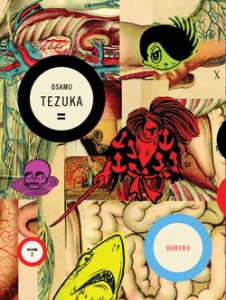 Though much of the devastation that Hyakkimaru and Dororo witness is man-made (Dororo takes placed during the Sengoku, or Warring States, Period), demons exploit the conflict for their own benefit, holding small communities in their thrall, luring desperate travelers to their doom, and feasting on the never-ending supply of human corpses. Some of these demons have obvious antecedents in Japanese folklore — a nine-tailed kitsune — while others seem to have sprung full-blown from Tezuka’s imagination — a shark who paralyzes his victims with sake breath, a demonic toad, a patch of mold possessed by an evil spirit. (As someone who’s lived in prewar buildings, I can vouch for the existence of demonic mold. Lysol is generally more effective than swordplay in eliminating it, however.) Hyakkimaru has a vested interest in killing these demons, as he spontaneously regenerates a lost body part with each monster he slays. But he also feels a strong sense of kinship with many victims — a feeling not shared by those he helps, who cast him out of their village as soon as the local demon has been vanquished.
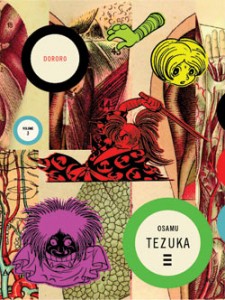 For folks who find the cartoonish aspects of Tezuka’s style difficult to reconcile with the serious themes addressed in Buddha, Phoenix, and Ode to Kirihito, Dororo may prove a more satisfying read. The cuteness of Tezuka’s heroes actually works to his advantage; they seem terribly vulnerable when contrasted with the grotesque demons, ruthless samurai, and scheming bandits they encounter. Tezuka’s jokes — which can be intrusive in other stories — also prove essential to Dororo‘s success. He shatters the fourth wall, inserts characters from his stable of “stars,” borrows characters from other manga-kas’ work, and punctuates moments of high drama with low comedy, underscoring the sheer absurdity of his conceits… like sake-breathing shark demons. Put another way, Dororo wears its allegory lightly, focusing primarily on swordfights, monster lairs, and damsels in distress while using its historical setting to make a few modest points about the corrosive influence of greed, power, and fear.
 If Phoenix is Tezuka’s Ring Cycle, Wagnerian in scope, form, and seriousness, then Dororo is Tezuka’s Don Giovanni, a playful marriage of supernatural intrigue and lowbrow comedy whose deeper message is cloaked in shout-outs to fellow artists (in this case,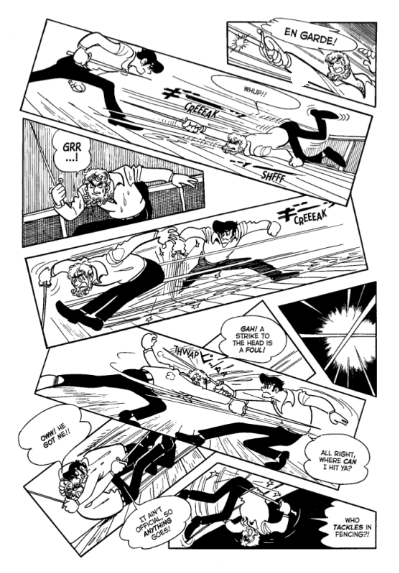
 Nineteen sixty-eight was a critical year in Osamu Tezuka’s artistic development. Best known as the creator of Astro Boy, Jungle Emperor Leo, and Princess Knight, the public viewed Tezuka primarily as a children’s author. That assessment of Tezuka wasn’t entirely warranted; he had, in fact, made several forays into serious literature with adaptations of Manon Lescaut (1947), Faust (1950), and Crime and Punishment (1953). None of these works had made a lasting impression, however, so in 1968, as gekiga was gaining more traction with adult readers, Tezuka adopted a different tact, writing a dark, erotic story for Big Comic magazine: Swallowing the Earth.