• Skip to primary navigation
  • Skip to main content
  • Skip to primary sidebar
  • Home
  • About Us
    • Privacy Policy
    • Comment Policy
    • Disclosures & Disclaimers
  • Resources
    • Links, Essays & Articles
    • Fandomology!
    • CLAMP Directory
    • BlogRoll
  • Features & Columns
    • 3 Things Thursday
    • Adventures in the Key of Shoujo
    • Bit & Blips (game reviews)
    • BL BOOKRACK
    • Bookshelf Briefs
    • Bringing the Drama
    • Comic Conversion
    • Fanservice Friday
    • Going Digital
    • It Came From the Sinosphere
    • License This!
    • Magazine no Mori
    • My Week in Manga
    • OFF THE SHELF
    • Not By Manga Alone
    • PICK OF THE WEEK
    • Subtitles & Sensibility
    • Weekly Shonen Jump Recaps
  • Manga Moveable Feast
    • MMF Full Archive
    • Yun Kouga
    • CLAMP
    • Shojo Beat
    • Osamu Tezuka
    • Sailor Moon
    • Fruits Basket
    • Takehiko Inoue
    • Wild Adapter
    • One Piece
    • After School Nightmare
    • Karakuri Odette
    • Paradise Kiss
    • The Color Trilogy
    • To Terra…
    • Sexy Voice & Robo
  • Browse by Author
    • Sean Gaffney
    • Anna Neatrour
    • Michelle Smith
    • Katherine Dacey
    • MJ
    • Brigid Alverson
    • Travis Anderson
    • Phillip Anthony
    • Derek Bown
    • Jaci Dahlvang
    • Angela Eastman
    • Erica Friedman
    • Sara K.
    • Megan Purdy
    • Emily Snodgrass
    • Nancy Thistlethwaite
    • Eva Volin
    • David Welsh
  • MB Blogs
    • A Case Suitable For Treatment
    • Experiments in Manga
    • MangaBlog
    • The Manga Critic
    • Manga Report
    • Soliloquy in Blue
    • Manga Curmudgeon (archive)

Manga Bookshelf

Discussion, Resources, Roundtables, & Reviews

Light Novels

Blade of the Immortal: Legend of the Sword Demon

November 13, 2013 by Ash Brown

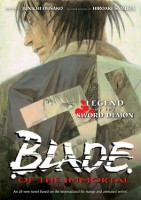
Blade of the Immortal: Legend of the Sword DemonAuthor: Junichi Ohsako
Illustrator: Hiroaki Samura

U.S. publisher: Dark Horse
ISBN: 9781595823380
Released: January 2010
Original release: 2008

Hiroaki Samura’s Blade of the Immortal was one of the first manga series that I began reading and it remains one of my personal favorites. When I learned that a novel based on the manga had been written I immediately picked it up. However, it did take me quite some time to actually get around to reading it. Blade of the Immortal: Legend of the Sword Demon, written by Junichi Ohsako with illustrations by Samura, was originally published in Japan in July 2008–the same month the anime adaptation of Blade of the Immortal began airing. I don’t know much about the author (Legend of the Sword Demon is the only novel by Ohsako to have been released in English), but I do know that Ohsako is a fellow fan of Blade of the Immortal. The English-language edition of Legend of the Sword Demon was translated by Camellia Nieh and released in 2010 by Dark Horse. Unsurprisingly, Dark Horse is also the publisher responsible for releasing the Blade of the Immortal manga and artbook in English.

Rin was the only daughter of Asano Takayoshi, the head of the respected Mutenichi-ryū sword school. A few years past he was brutally murdered before her very eyes, her mother was raped and abducted, and Rin was abandoned and left alone to fend for herself. Her family was destroyed at the hands of a group of renegade swordsmen known as the Ittō-ryū and their leader Anotsu Kagehisa. Now Rin is seeking her revenge, hiring an outlaw known only as Manji as her bodyguard. Rumored to be immortal, Manji has vowed to kill one thousand evil men to atone for hist past misdeeds. But is the Ittō-ryū truly evil? Whether it is or isn’t, Manji and Rin aren’t the only ones seeking the group’s demise. This complicates matters a great deal and it becomes difficult for Rin and Manji to determine who are friends and who are foes. Any alliances made in the fight against the Ittō-ryū can only be assumed to be temporary.

Legend of the Sword Demon is a very quick read. The story is a re-imagining of the early part of the Blade of the Immortal manga series. While the novel has some unique content of its own, including a dangerous enemy not found anywhere else, many of the scenes will be familiar to those who have read the original. All of the most popular characters make an appearance in the novel as well. (This was actually one of the conditions set by the publisher when the novel was initially commissioned.) Legend of the Sword Demon mostly focuses on the action of the story. Very little descriptive detail is given and the characters aren’t particularly fleshed out, either. It is interesting to see a slightly different take on Blade of the Immortal, but Legend of the Sword Demon almost requires that readers have a fairly firm grounding in the original series to really appreciate what Ohsako is doing with the story and characters. There might be enough in the novel to entice new readers to pick up the manga, but I am not at all confident of that.

In the end, I was actually rather disappointed with Legend of the Sword Demon. I can’t really recommend the novel to anyone but those who are Blade of the Immortal completists (a group of people to which I admittedly belong). Ultimately, Legend of the Sword Demon is a very insubstantial work and somewhat shallow, lacking the depth present in the manga series. It feels as though the novel is nothing more than tie-in promotional material. Ohsako may be a devoted fan of Blade of the Immortal but Legend of the Sword Demon isn’t long enough nor complex enough to really establish itself as noteworthy. It’s fun in places, but Legend of the Sword Demon is largely forgettable. The real highlight of the volume is Samura’s cover art and the handful of full-page illustrations that he created specifically for the novel. Otherwise, Legend of the Sword Demon is something that most people probably won’t regret passing over.
Filed Under: REVIEWS Tagged With: Blade of the Immortal, Dark Horse, Hiroaki Samura, Junichi Ohsako, Light Novels, Novels

Spice & Wolf, Volume 8: Town of Strife I

August 11, 2013 by Ash Brown

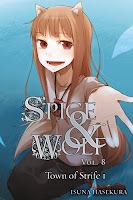
Author: Isuna Hasekura
Illustrator: Jyuu Ayakura

Translator: Paul Starr
U.S. publisher: Yen Press
ISBN: 9780316245463
Released: April 2013
Original release: 2008

Town of Strife I is the eighth volume in Isuna Hasekura’s light novel series Spice & Wolf, illustrated by Jyuu Ayakura. The previous volume, Side Colors, was actually a collection of three side stories; Town of Strife I picks up the story immediately following Spice & Wolf, Volume 6. As indicated by its title, Town of Strife I is the first part of a two-volume story, a first for Spice & Wolf. Town of Strife I was originally published in Japan in 2008. Paul Starr’s English translation of the novel was released by Yen Press in 2013. Spice & Wolf is a series that I have been enjoying much more than I thought I would. Although I wasn’t particularly taken with most of Side Colors, I was interested in getting back to the main story again with Town of Strife I.

Having had quite the adventure on the Roam River, Kraft Lawrence, a traveling merchant, and Holo the Wisewolf, a centuries-old spirit in the form of a young woman, have finally made their way to the port town of Kerube with a new companion in in tow–Col, a young student they encountered along the river. Together the three of them are following a curious rumor: a search is on for the bones of a northern town’s guardian deity. Many people think the story is some far fetched fairytale, but Lawrence, Holo, and Col know very well that there could be some truth behind the rumors. Upon their arrival at Kerube Lawrence seeks the aid of Eve, a former noblewoman and a skilled merchant in her own right. He’s been burned once before in his dealings with her, but Eve’s impressive network of connections may be their best chance of finding the bones.

One of the things that I have always enjoyed about Spice & Wolf is the relationship and developing romance between Lawrence and Holo. By this point in the series, Lawrence has lost some of his awkwardness when it comes to Holo. While I suppose this means he’s grown as a character, I do miss the more easily embarrassed Lawrence. With the addition of Col to the mix, the dynamics of Holo and Lawrence’s relationship has also changed. Their battles of wits and their good-natured bickering and teasing which once seemed so natural now feel forced as if the two of them are putting on some sort of performance for the boy. More often than not, Holo and Lawrence are verbally sparring for show in Town of Strife I and it’s not nearly as entertaining. Ultimately I do like Col (everyone in Spice & Wolf likes Col), but his presence in the story is somewhat distracting.

Not much happens in Town of Strife I; it mostly seems to be setting up for the second volume in the story arc. Hasekura promises that Lawrence will get to be “really cool” in the next volume and Town of Strife I does end on a great cliffhanger, but I’m not sure that I’m actually interested in finding out what happens. Unfortunately, the series has finally lost its charm for me. The characters know one another so well and their conversations are so cryptic that the story is difficult to follow. The narrative lacks sufficient detail and explanations leaving readers to puzzle out the characters’ motivations and actions. This has always been the case with Spice & Wolf but what makes it particularly frustrating in Town of Strife I is that the volume doesn’t even have a satisfying ending and doesn’t stand well on its own. Hasekura claims that he needed two volumes to tell this particular story, but considering how tedious much of Town of Strife I is, I’m not convinced.

Filed Under: REVIEWS Tagged With: Isuna Hasekura, Jyuu Ayakura, Light Novels, Novels, Spice and Wolf, yen press

Book Girl and the Famished Spirit

August 10, 2011 by Ash Brown

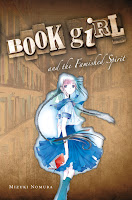
Author: Mizuki Nomura
Illustrator: Miho Takeoka

Translator: Karen McGillicuddy
U.S. publisher: Yen Press
ISBN: 9780316076920
Released: January 2011
Original release: 2006

Book Girl and the Famished Spirit is the second book in Mizuki Nomura’s sixteen-volume light novel series Book Girl, illustrated by Miho Takeoka. Originally published in Japan in 2006, the book was released in English in 2011 by Yen Press. Once again, Karen McGillicuddy serves as the translator for the series. I read the first volume, Book Girl and the Suicidal Mime not too long ago and absolutely loved it. The book more or less made me an instant fan and so there was no question that I would be picking up Book Girl and the Famished Spirit. I am still quite fond of the premise of a “book girl,” a yōkai that devours the written word instead of food. Even though this story element is often relegated to the background, it is still important and I find it to be utterly delightful. Because I enjoyed Book Girl and the Suicidal Mime so much, I was really looking forward to reading Book Girl and the Famished Spirit.

Despite insisting she doesn’t believe in them, Tohko, the self-proclaimed “book girl,” is afraid of ghosts. Normally this wouldn’t be such a problem, but someone has been leaving encoded messages in the literature club’s mailbox. Messages that seem to be similar to the ones rumored to be left all over the school by a wandering ghost. But whether a prank pulled by a classmate or a legitimate spirit (book girls exist after all, so why not ghosts?), one thing is clear—the notes are asking for help. Tohko intends to investigate the incidents, assuming that Konoha, her underclassman and the only other member of the literature club, will be willing to assist her. But he’s reluctant, especially as the notes become more threatening. He hopes that she will just leave the whole matter alone.

While Book Girl and the Suicidal Mime was heavily influenced by Osamu Dazai’s No Longer Human, Book Girl and the Famished Spirit takes its inspiration from Emily Brontë’s Wuthering Heights. In some ways the story is actually more cruel than the original. If you’ve never read Wuthering Heights, don’t worry. If there’s one thing that Tohko likes to do besides eating literature, it’s talking about it and she provides a very nice summarization of the novel. Throughout the series she frequently launches into tirades about books, even at seemingly inappropriate moments. This is part of her charm although it can come across as tangential. Nomura is constantly dropping references to various works and authors, some more well known than others. But my favorite thing about Book Girl and the Famished Spirit was the introduction of Ryuto. I almost hope that he also turns out to be some sort of yōkai, but I’d still be happy even if it turns out he’s just simply a masochist.

For the most part, Book Girl and the Famished Spirit can stand fairly well on its own and it’s not absolutely necessary to have read Book Girl and the Suicidal Mime. The main mystery is almost completely separate with only a few minor references to the previous one. However, more information is given about Konoha and Tohko. To be honest, it is their backgrounds that intrigue me the most at this point. Konoha’s past in particular is slowly being introduced, piece by piece, within the context of the incidents he and Tohko get caught up in. It’s an interesting but effective technique. Although I enjoyed Book Girl and the Famished Spirit, I didn’t like it nearly as well as I did the first book. I’m not really sure why; maybe it’s just that I happen to prefer No Longer Human over Wuthering Heights. Regardless, I still intend to continue the series with the next volume, Book Girl and the Captive Fool.

Filed Under: REVIEWS Tagged With: book girl, Light Novels, Miho Takeoka, Mizuki Nomura, Novels, yen press

All You Need Is Kill

August 9, 2010 by Ash Brown

Author: Hiroshi Sakurazaka
Translator: Alexander O. Smith
U.S. publisher: Viz Media
ISBN: 9781421527611
Released: July 2009
Original release: 2004

I really don’t remember exactly when and where I first heard about Hiroshi Sakurazaka’s All You Need Is Kill but after I did it seemed to keep popping up everywhere I looked. It was even picked up by Warner Brothers to make into a live-action film. All You Need Is Kill was originally published in Japan as a light novel in 2004. The English edition, translated by Alexander O. Smith, was one of the very first books to be released by Viz Media’s Haikasoru imprint in 2009. I haven’ read much military science fiction but All You Need Is Kill certainly is that, complete with alien intelligence and battle suits. What particularly caught my interest in the novel was that the main character, Keiji Kiriya, dies during his first battle only to wake up in his bunk thirty hours before over and over again.

The battle on Kotoiushi Island would be pivotal in humanity’s war with the Mimics. If lost, the rest of Japan would follow, along with the technology that made it possible to fight against the constantly evolving invading force. Keiji is a Jacket jockey in the United Defense Force’s 301st Armored Infantry Division which was sent to reinforce the island. He doesn’t even make it through his first battle. Or his second. Or his third. Somehow stuck in a time-loop he is forced to live and die in the same battle again and again. The only thing he can do is learn to fight a little better and hope to survive a little longer each time. Rita Vrataski, member of the U.S. Army Special Forces, has killed more Mimics than any other person in the world. Known as the Full Metal Bitch, not that anyone would call her that to her face, she is formidable, efficient, and scary as hell on the battlefield. She is also one of the last hopes remaining to end the war and may be the only person who can help Keiji escape his fate.

Although All You Need Is Kill is primarily entertainment and not overly serious, Sakurazaka still works in some environmental, technological, and social commentary. At least for me, the story also had a convincing emotional impact. Repeatedly living through the horrors of war, your own death, and the death of your friends and those around you changes a person and Sakurazaka captures this quite well. I like Keiji a lot and was most interested in his story, told in the first person. The third quarter of the book, written in the third person, focuses on Rita and the background of the war with the Mimics. While interesting and certainly important, especially in understanding Rita and her history, I still looked forward to getting back to Keiji. Which is not to say that I didn’t like Rita, because I did. I liked most of the secondary characters as well; Keiji’s bunk-mate and veteran Yonabaru in particular amused me as much as he tended to annoy others in his platoon. I also appreciated the fact that not everyone was assumed to be straight (although pretty much all of them were.)

The translation Smith has done for All You Need Is Kill is great–it’s straightforward with a good flow that hits hard and fast. There is also a nice use of repeated phrases to emphasize the time-loop that Keiji’s stuck in. The original light novel was illustrated by Yoshitoshi ABe and it’s a pity that none of his art was included in the Haikasoru edition beyond the cover–I really would have liked to have seen more of his work. I enjoyed All You Need Is Kill even more than I was expecting to and was impressed by how much action and story Sakurazaka was able to fit into such a relatively short work (it comes in at just under 200 pages.) I’m really looking forward to picking up his only other work currently available in English, also released through Haikasoru, Slum Online.

Filed Under: REVIEWS Tagged With: All You Need Is Kill, Haikasoru, Hiroshi Sakurazaka, Light Novels, Novels, viz media

  • « Go to Previous Page
  • Page 1
  • Page 2
 | Log in
Copyright © 2010 Manga Bookshelf | Powered by WordPress & the Genesis Framework