• Skip to primary navigation
  • Skip to main content
  • Skip to primary sidebar
  • Home
  • About Us
    • Privacy Policy
    • Comment Policy
    • Disclosures & Disclaimers
  • Resources
    • Links, Essays & Articles
    • Fandomology!
    • CLAMP Directory
    • BlogRoll
  • Features & Columns
    • 3 Things Thursday
    • Adventures in the Key of Shoujo
    • Bit & Blips (game reviews)
    • BL BOOKRACK
    • Bookshelf Briefs
    • Bringing the Drama
    • Comic Conversion
    • Fanservice Friday
    • Going Digital
    • It Came From the Sinosphere
    • License This!
    • Magazine no Mori
    • My Week in Manga
    • OFF THE SHELF
    • Not By Manga Alone
    • PICK OF THE WEEK
    • Subtitles & Sensibility
    • Weekly Shonen Jump Recaps
  • Manga Moveable Feast
    • MMF Full Archive
    • Yun Kouga
    • CLAMP
    • Shojo Beat
    • Osamu Tezuka
    • Sailor Moon
    • Fruits Basket
    • Takehiko Inoue
    • Wild Adapter
    • One Piece
    • After School Nightmare
    • Karakuri Odette
    • Paradise Kiss
    • The Color Trilogy
    • To Terra…
    • Sexy Voice & Robo
  • Browse by Author
    • Sean Gaffney
    • Anna Neatrour
    • Michelle Smith
    • Katherine Dacey
    • MJ
    • Brigid Alverson
    • Travis Anderson
    • Phillip Anthony
    • Derek Bown
    • Jaci Dahlvang
    • Angela Eastman
    • Erica Friedman
    • Sara K.
    • Megan Purdy
    • Emily Snodgrass
    • Nancy Thistlethwaite
    • Eva Volin
    • David Welsh
  • MB Blogs
    • A Case Suitable For Treatment
    • Experiments in Manga
    • MangaBlog
    • The Manga Critic
    • Manga Report
    • Soliloquy in Blue
    • Manga Curmudgeon (archive)

Manga Bookshelf

Discussion, Resources, Roundtables, & Reviews

Cats

The Best and Worst Manga of 2023

January 9, 2024 by Katherine Dacey

This weekend’s Nor’easter provided me a swell opportunity to finish my long-gestating Best and Worst Manga list for 2023. One of the things that tripped me up was the sheer volume of new work published last year; when I first started reviewing manga in 2006, it was hard to imagine a market that offered a title for every conceivable reader, from the Chainsaw Man enthusiast to the the romantic, the oenophile, the foodie, the soccer fan, the gore hound, the isekai buff, and even the middle-aged manga critic. Though I made a concerted effort to be as thorough as possible, I freely admit that my picks barely capture the sheer quantity and diversity of last year’s new releases. Instead, I focused on the titles that stayed with me weeks and months after I first read them, from the exuberant One Hundred Tales to the unnerving The Summer Hikaru Died. For additional perspective on 2023’s best and worst manga, I encourage you to check out the well curated lists at Anime News Network, Anime UK News, Asian Movie Pulse, The Beat, The Comics Journal, From Cover to Cover, Okazu, and The School Library Journal.
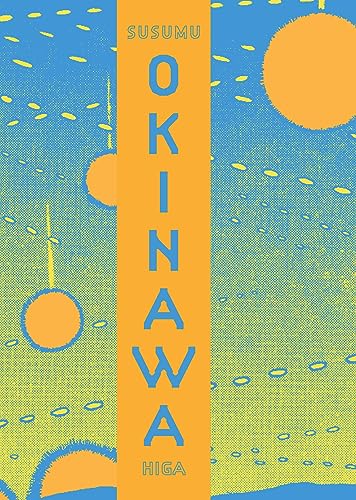
Best New Manga: Okinawa
Story and Art by Susumu Higa • Translated by Jocelyne Allen • Lettering by Patrick Crotty and Kayla E. • Fantagraphics
There are books that critics like, and books that readers like. I’d put Okinawa squarely in the first category, as it has all the hallmarks of a Serious Manga™: slightly naïve artwork, historically important events seen through the eyes of ordinary people, and detailed footnotes explaining the story’s cultural and linguistic nuances. If I sound a little cynical, I was; I put off reading Okinawa for months after its release because so many reviewers rehearsed the same talking points about how “harrowing,” “heartbreaking,” “complex,” and “haunting” it was. After reading Okinawa, however, I have to admit the critics were right: Okinawa is a deeply moving exploration of the island’s fraught relationship with Japan and the United States. It’s also a tribute to Susumu Higa’s parents, whose memories of World War II pervade many of Okinawa’s most affecting stories; a celebration of Okinawan resilience and spirituality; and the best manga I read in 2023.

Best New Drama: River’s Edge“Story and Art by Kyoko Okazaki • Translated by Alexa Frank • Vertical Comics
River’s Edge offers a gritty portrait of adolescence before chat rooms, cell phones, and social media, focusing on the slackers and misfits at a Tokyo high school. Haruna Wakakusa, the protagonist, is caught between her fierce sense of justice and her ambivalent feelings towards her on-again, off-again boyfriend Kannonzaki, a horny, hot-headed loser who bullies weaker classmates. Over the course of the story, Haruna forges an unlikely friendship with one of Kannonzaki’s targets, an aloof young man whose popularity with the girls belies his true sexual orientation. Okazaki’s spare, stylish linework is ideally suited to the material, as the character’s exaggerated facial features and ungainly proportions remind the reader of how confusing, weird, and uncomfortable it is to be on the physical cusp of adulthood. Okazaki also nails the casual cruelty and cluelessness of adolescence: her characters’ impulsiveness, selfishness, and inexperience often compel them to betray each other in small (and big) ways that feel true to life even when the plot teeters on the brink of melodrama.

Best Classic Title: One Hundred Tales
Story and Art by Osamu Tezuka • Translated by Iyasu Adair Nagata • Lettering by Aidan Clarke • ABLAZE
Over the course of his long career, Osamu Tezuka published three series based on the legend of Doctor Faustus, among them One Hundred Tales (1971), which ran in Weekly Shonen Jump. Tezuka takes a few liberties with the original story: his hero is not a brilliant scholar in search of knowledge but a lowly samurai who’s been sentenced to death for his employer’s misdeeds. In a fit of desperation, he sells his soul to a witch and is reborn as Fuwa Usuto, a dashing young man who wants two things: love and power. What follows is a rowdy picaresque, as Fuwo ventures into the lair of an alluring demon, saves his daughter from an arranged marriage, and insinuates himself into the house of a foolish daimyo in his quest to become more worldly and powerful. These episodes provide Tezuka ample opportunity to insert pop-cultural sight gags—Christopher Lee and Astro Boy both make fleeting appearances—but they also showcase Tezuka’s flair for character design and panel structure; the artwork is fluid and playful, equally suited to moments of exquisite silliness and heartbreaking sadness as Fuwo stumbles towards transcendence.

Best New Horror Series: The Summer Hikaru Died
Story and Art by Mokumokuren • Translated by Ajani Oloye • Lettering by Abigail Blackman • Yen Press
The Summer Hikaru Died begins with a familiar scene: two high school buddies are clowning around outside a convenience store, trading good-natured barbs. But something’s off, and midway through a seemingly ordinary conversation Yoshiki realizes that he’s talking to an impostor who’s the spitting image of his friend Hikaru. Though the mystery of what happened to the real Hikaru is resolved quickly, many questions remain: is it possible for Yoshiki to befriend “Hikaru” even though he has no real memories of their relationship? And what, exactly, is “Hikaru”? Mokumokuren resists the temptation to provide simple answers, relying instead on suggestion to create a tense, atmospheric story that skillfully blends elements of body horror, BL, and fantasy in a fresh, unsettling way.

Best New Cat Manga: Nights With a Cat
Story and Art by Kyuryu Z • Translated by Stephen Paul • Lettering by Lys Blakesly • Yen Press
Though there are dozens of great pet manga now available in English, Nights with a Cat has something genuinely new to offer: simple, observational storytelling that doesn’t shamelessly tug on the heartstrings or anthropomorphize our furry companions. The series explores the relationship between Fuuta and Kyuruga, his roommate’s cat. As someone who’s never lived with a cat before, Fuuta is fascinated by Kyuruga, marveling at Kyuruga’s anatomy—his pupils, his sandpaper tongue, his retractable claws—as well as Kyuruga’s ability to silently materialize in surprising places. Kyuryu Z doesn’t play these moments for laughs, choosing instead to emphasize how strange and amazing cats really are with illustrations that capture the fluidity of Kyuruga’s movements and the changeability of his moods. Recommended for new and long-time cat owners alike. (Reviewed at Manga Bookshelf on 5/21/23)

Best Ongoing Series: Go With the Clouds, North by Northwest
Story and Art by Irie Aki • Translated by David Musto • Vertical Comics
After a two-year wait, a new installment of Go With the Clouds, North by Northwest arrived in stores this fall, demonstrating once again why this odd, delightful, and occasionally thrilling story deserves a bigger audience. Strictly speaking, Go With the Clouds is a murder mystery, but Aki Irie refuses to observe the basic tenets of the genre, frequently interrupting her story for interesting diversions: a fitful romance between supporting characters, a brief lesson on Icelandic geography, a casual conversation between Kei, the main protagonist, and his trusty jeep. What prevents the story from being twee or mannered is its matter-of-fact tone. In the first chapter of volume six, for example, Kei uses ESP to track a kidnapping victim through the streets of Reykjavik by chatting up parked cars around the city, a goofy gambit that works thanks to Irie’s superb pacing and commitment to character development; Kei’s methodical approach suggests that his ESP is something he uses on an everyday basis, not something that manifests per the plot’s demands. Swoon-worthy art and twisty plotting add to the series’ considerable appeal. (Volumes one and two reviewed at The Manga Critic on 8/30/19).

Most Disappointing New Series: #DRCL: Midnight Children
Story and Art by Shin’ichi Sakamoto • Based on Bram’s Stoker’s Dracula • Translation Caleb Cook • Touch-Up & Lettering by Brandon Hull • VIZ Media
Let’s face it: Bram Stoker’s Dracula sucks, marred by turgid prose and a convoluted form. In the hands of other creators, however, Stoker’s ideas have thrilled, titillated, and shocked six generations of horror buffs. The introduction to #DRCL: Midnight Children suggests that Shin’ichi Sakamoto might be one of those creators, as he offers the reader a claustrophobic, suspenseful riff on Dracula‘s most famous chapter, “The Voyage of the Demeter.” The rest of volume one, by contrast, is a fever dream of short, incoherent scenes that bump up against each other like commuters on a rush-hour train. Anyone familiar with Stoker’s original novel will recognize the characters’ names but wonder why Sakamoto re-imagined Renfield as a nun who’s chained up in a dormitory room or Mina Murray as a short, scrappy redhead who’s an expert wrestler. (Also: a dead ringer for Anne of Green Gables.) It’s a pity that the story is so fragmented and overripe, as Sakamoto has a fertile imagination; the first volume is filled with hauntingly beautiful renditions of Dracula himself that instill a sense of awe and fear that’s missing from the rest of the story.
Filed Under: Manga, Manga Critic, Recommended Reading, REVIEWS Tagged With: ABLAZE, Aki Irie, Bad Manga, BEST MANGA, Cats, fantagraphics, Kyoko Okazaki, Mokumokuren, Osamu Tezuka, Shin'ichi Sakamoto, Susumu Higa, Vertical Comics, VIZ, yen press

A Man & His Cat, Vol. 1

February 13, 2020 by Katherine Dacey

As someone who’s suffered a lifetime of embarrassment over my tendency to cry at movies and books about animals—even ones with happy outcomes—I realize that that my reaction to A Man and His Cat may not, in fact, be warranted by the quality of the storytelling or artwork. I should also disclose that I’m almost 50, so I’m hungry for stories about people old enough to have a few grey hairs and wrinkles. And I should probably mention that I live with two cats, one of whom is contentedly snoozing by my feet as I type.

Reader, I loved it.

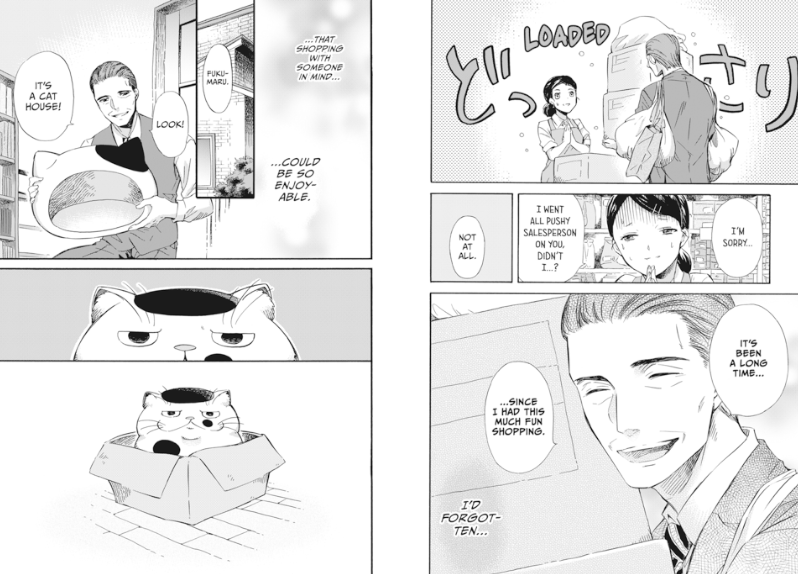
There’s no real plot to speak of; the most dramatic event unfolds in the opening pages, when Fukumaru, a grumpy-faced cat, is adopted from the pet store where he’s spent a lonely year waiting for an owner. His knight in shining armor is Mr. Kanda, a middle-aged music teacher and empty nester who exudes an aura of sadness, despite his outward composure. Though Fukumaru frets that Kanda might suffer buyer’s remorse, Kanda is thoroughly smitten with Fukumaru, throwing himself into cat ownership with abandon, buying toys and collars, and taking selfies with Fukumaru. These scenes are engineered to elicit a strong, uncomplicated emotional response from the reader; Umi Sakurai doesn’t pluck or tug at the heartstrings so much as tear and rend them, giving Fukumaru a running interior monologue about his fears and hopes. And if seeing a cat worry about being returned to the pet store isn’t enough to make your lip tremble even a little, Fukumaru’s speech is peppered with feline-specific pronouns that underscore his plight in a shamelessly sentimental fashion: who but the most jaded reader could laugh at a chubby cat who worries that he might “go meowy whole life without a name?”

Fukumaru’s vulnerability is further amplified by Sakurai’s depiction of him as round and awkwardly proportioned, with an enormous face and stumpy legs. (One character helpfully describes him as “ugly-cute.”) Though Fukumaru’s penchant for tearing up is chalked up to his breed—the pet shop labels him a “short-haired exotic”—almost every kind gesture, separation, reunion, and potential setback makes Fukumaru’s eyes glisten with great, beady tears. Kanda, on the other hand, is drawn in a somewhat stiff, bland fashion with a few perfunctory laugh lines to suggest his age. The contrast between Fukumaru—who looks like the kind of off-brand stuffed animal you might win at a carnival—and his slim, be-suited owner is an interesting artistic choice, as it makes it easier for the reader to understand why Fukumaru initially feels such trepidation about Kanda. (It’s also a pretty amusing visual gag, too.)

By now, reader, you’re probably wondering, but would I like it? That’s a question I can’t really answer, since this manga’s wholesome sentimentality appealed to me against my better judgment. But if there’s a cat in your lap as you read this review, or you share your house with a pet you rescued from a shelter, I think you might appreciate the warm dynamic between Kanda and Fukumaru, as watching these two wounded souls revel in each other’s company is a genuinely heartwarming experience. Recommended.

Square Enix provided a review copy.

A MAN & HIS CAT, VOL. 1 • BY UMI SAKURAI • TRANSLATED BY TAYLOR ENGEL • SQUARE ENIX MANGA & BOOKS • 146 pp.

Filed Under: Manga, Manga Critic, REVIEWS Tagged With: Cats, square enix

Cats of the Louvre

October 30, 2019 by Katherine Dacey

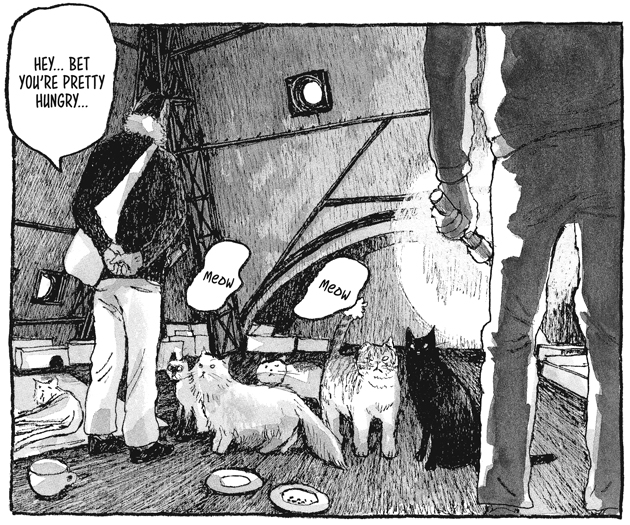
Weird. Uncanny. Melancholy. Beautiful. Those were just a few of the adjectives I jotted down while reading Taiyo Matsumoto’s Cats of the Louvre, the latest volume in the museum’s ongoing graphic novel series. Like Nicholas De Crécy’s Glacial Period and Jiro Taniguchi’s Guardians of the Louvre, Cats of the Louvre is less an illustrated guide to the museum than a story that happens to take place within its walls—in this case, the attic, where a colony of cats have taken up residence. Through a series of eighteen vignettes, Matsumoto gradually reveals that the cats’ primary caretaker—an elderly night watchman—has dedicated his life to searching the museum for his missing sister, who disappeared into one of the paintings when she was a child.

The key to finding Arrieta turns out to be Snowbébé, a kitten who frequently escapes from the attic to roam the galleries, hiding inside canvases to avoid detection. Snowbébé’s gift is both an essential plot point and an opportunity for Matsumoto to luxuriate in the smaller details of his favorite paintings, as is evident in a lovely, strange sequence that unfolds inside Henri Lerambert’s The Funeral Procession of Love (1580). From a modern viewer’s standpoint, Lerambert’s painting seems a little kitschy, with its parade of cherubs, poets, and philosophers strolling under the watchful eye of the goddess Diana:

Once Snowbébé steps into the painting, however, the landscape comes to life in unexpected ways: the flowers grin, the animals speak, and the laws of gravity disappear. In one brief but delightful sequence, for example, Snowbébé and Arrieta cavort across the ceilings and walls of a temple, while in another they board Diana’s chariot for a ride through the Milky Way. Yet for all the joyful (and weird) imagery, there’s a wistful quality to these two chapters, as Snowbébé slowly realizes that he cannot remain inside the Parade forever; his presence has disturbed the painting’s equilibrium, bringing storm clouds and disrupting the flow of time itself, forcing him to choose between staying with his new friend, or returning to the “cold and smelly and noisy” world of the Louvre.

What prevents Snowbébé’s odyssey from seeming twee or precious is Matsumoto’s studied primitivism; his characters’ mask-like faces, oddly proportioned bodies, and grotesque smiles are genuinely unnerving, creating a surreal atmosphere in which the boundaries between reality and imagination are blurred. Nowhere is this tendency more obvious than in the way he draws Snowbébé and his friends: the cats look like animals to their caretakers, but assume a humanoid form when interacting with each other. In Matsumoto’s hands, they look more like people in cat costumes than pussycats, with their essential feline features—ears, whiskers, tails, elongated limbs—rendered in an exaggerated fashion that gives them a faintly alien appearance.

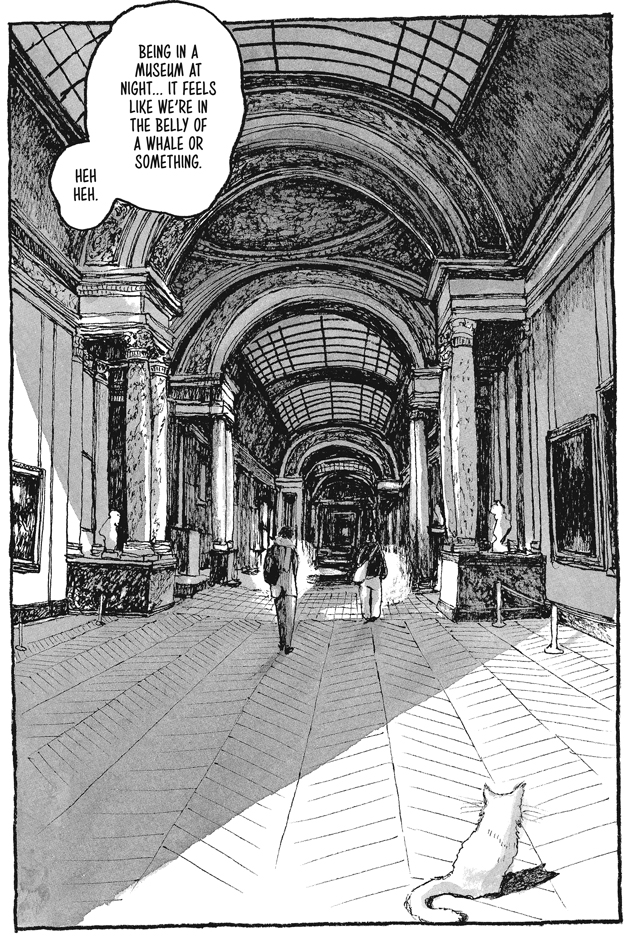
Matsumoto’s depiction of the Louvre is more straightforward, recreating iconic works with fidelity to the originals, whether he’s drawing a lesser-known genre painting or a genuinely famous sculpture. His rendition of the physical environment—the claustrophobic, dusty garret where the cats live, the grand staircases and hallways that lead to the galleries—is similarly precise, helping the reader envision the sheer size and opulence of the museum. As a result, the Louvre transcends its basic function as a setting, taking on the qualities of a living, breathing organism whose vaulted ceilings and majestic columns invite comparisons with dinosaurs or whales:

And while all the comics in the Louvre Collection have done an admirable job of depicting the museum, Cats of the Louvre approaches its subject matter without didacticism or pedantry; though Matsumoto’s human characters express strong feelings about art, those conversations spring organically from the story. Equally important, Cats of the Louvre has its own personality; unlike Hirohiko Araki’s Rohan at the Louvre, which recycled ideas and characters from JoJo’s Bizarre Adventure, Matsumoto’s story stands on its own, capturing his unique response to the museum and its collection. But the best reason to read Cats of the Louvre is its hero Snowbébé, whose quest to find his place in the world invites us to see the Louvre through fresh eyes, as a place of danger and sadness, but also of wonder, magic, and possibility. Recommended.

A review copy was provided by VIZ Media. To read a short preview, click here.

CATS OF THE LOUVRE • STORY AND ART BY TAIYO MATSUMOTO • TRANSLATED BY MICHAEL ARIAS • RATING: TEEN • 432 pp.

Filed Under: Manga, Manga Critic, REVIEWS Tagged With: Cats, Louvre Museum, Taiyo Matsumoto, VIZ, VIZ Signature

Junji Ito’s Cat Diary: Yon & Mu

January 6, 2017 by Katherine Dacey

On the surface, Junji Ito’s Cat Diary is a gag manga. J-Kun–a lightly fictionalized version of the author–reluctantly agrees to let his fiancee bring two cats into their home: Yon, a black-and-white cat with sinister markings on his back, and Mu, a Norwegian forest cat with a cute face and a wicked bite. Each story depicts Yon and Mu doing normal cat things, from coughing up hairballs to resisting unsolicited human affection.

Readers familiar with Ito’s previous manga will get a chuckle at J-Kun’s over-the-top reactions to cat poop, scratched floors, and feather wands, as his grotesque facial expressions have been swiped from the pages of Gyo and Uzumaki. Surprisingly, these grimaces work just as well in the context of a domestic comedy, capturing the mixture of revulsion and love that cat behavior elicits. The uninitiated reader may also find these scenes amusing, if a bit excessive; surely a grown man realizes that cats can be jerks?

On a deeper level, however, Cat Diary is a meditation on human relationships. Though the ostensible plot focuses on J-Kun’s struggle to overcome his dislike of cats, the real story is Yon and Mu’s role in bringing J-Kun closer to his fiancee. J-Kun comes to love the cats–spoiler alert!–but the way in which he expresses those feelings demonstrates his journey from “me” to “we,” as his selfish concerns about the house give way to a shared sense of responsibility for the cats’ welfare. This human dimension of Cat Diary infuses it with a warmth that’s frequently missing from Ito’s work, and prevents the stories from reading like a collection of cat GIFs. (I can haz laffs now!)

On a totally shallow note, reading Cat Diary made me want to get my own Norwegian forest cat. I’m not sure if that’s an endorsement of Ito’s comedy chops, but it’s proof that he can draw the hell out of cute, furry things.

The verdict: You don’t need to be a cat person–crazy or otherwise–to enjoy this idiosyncratic manga, though a healthy respect for cats definitely helps.

Junji Ito’s Cat Diary: Yon & Mu
By Junji Ito
Rated T, for readers 13+
Kodansha Comics, $10.99

This review originally appeared at MangaBlog on December 12, 2015.

Filed Under: Manga, Manga Critic, REVIEWS Tagged With: Cats, Comedy, Junji Ito, yen press

Chi’s Sweet Home, Vol. 1

June 24, 2010 by Katherine Dacey

Come for the cat, stay for the cartooning — that’s how I’d summarize the appeal of Chi’s Sweet Home, a deceptively simple story about a family that adopts a wayward kitten. Chi certainly works as an all-ages comic, as the clean, simple layouts do a good job of telling the story, even without the addition of dialogue or voice-overs. But Chi is more than just cute kitty antics; it’s a thoughtful reflection on the joys and difficulties of pet ownership, one that invites readers of all ages to see the world through their cat or dog’s eyes and imagine how an animal adapts to life among humans.

Though Kanata Konami accomplishes some of this by revealing Chi’s thoughts in the form of a simple monologue, delivered — or should that be “dewivered”? — in a child-like voice, it’s the artwork that really drives home the point that Chi is bewildered and intrigued by her new environment. Early in the volume, for example, the newly-rescued Chi awakes in a panicked state: she doesn’t know where she is, and she’s desperate to find her mother. Konami first gives us an overhead view of the living room, tracing Chi’s frantic attempt to find the door, then cuts to a panel of Chi trapped against a wall, two pieces of furniture looming over her. Konami employs a similar tactic when Mr. Yamada takes Chi to the veterinarian for her first check-up, again using an overhead shot of the waiting room to establish the human scale of the space before offering a cat’s eye perspective; as Chi sees things, the vet’s office is filled with enormous, Godzilla-sized dogs who seemed poised to eat her. In both sequences, the quick shift in perspective gives the reader a clear sense of Chi’s disorientation by reminding us how small she is, and how alien the environment seems to her.

The other secret to Konami’s success are her character designs. Though Chi is clearly a cat, Konami draws her face as a round, moon-like shape with two enormous eyes — if anything, Chi resembles the heroine of Kiyohiko Azuma’s Yotsuba&! more than, say, Neko Ramen‘s cat cook or Cat Paradise‘s feline warriors. Like Azuma, Konami demonstrates that it’s possible to contort and bend these simple, circular shapes into an enormous range of expressions, from wide-eyed wonder to fear, sadness, and, for want of a better term, hunterly attentiveness. (Chi considers all of her cat toys a form of prey.) Even the very youngest reader will immediately understand how Chi is feeling, even if he isn’t able to parse the accompanying text or make sense of other imagery. (To wit: there’s a marvelous, trippy dream sequence in which Chi is pursued by what could best be described as a canine matryoshka, a chain of barking dogs, each a smaller imitation of the one before it. I don’t know what a four-year-old would make of it, but Chi’s reaction is priceless.)

Given the strength of Konami’s artwork, I would have liked Chi’s Sweet Home even better without the voice-overs. Most of Chi’s comments seem obvious — cats usually fear dogs and vets — or deliberately calculated to tug at the heartstrings. Interior monologues of this kind are generally more effective when they ascribe uniquely human sentiments to an animal: think of Snoopy’s Walter Mitty-esque fascination with the Red Baron, or Garfield’s contempt for Jon Arbuckle, which stems less from a general disdain of humans and more from Garfield’s embarrassment that his owner is a loser. Chi’s voice-overs aren’t a deal-breaker by any means; at times, they prove quite effective, especially in illustrating Chi’s gradual transference of affection from her feline mother to her human family. Moreover, Konami wisely avoids putting words into Chi’s mouth that suggest an unnatural awareness of human behavior or language, allowing Chi to remain completely oblivious to the Yamadas’ numerous attempts to find her a new home. (Their apartment complex doesn’t allow pets.)

If you’re the kind of person who unironically refers to children and housepets as “social parasites,” Chi’s Sweet Home is not the manga for you. But if you’re ever lived with a cat or a dog or any other animal whose companionship you enjoyed, then you’ll find a lot to like about Chi, from its frank treatment of housebreaking and separation anxiety to the numerous scenes of Chi exploring her surroundings, transforming ordinary household items into “prey.” You don’t need to be a manga lover, either, to find Chi’s Sweet Home accessible; the simple artwork and flipped layout (Chi reads left to right, like an English-language book) make this a great place for newbies to begin their exploration of the medium. Highly recommended for readers of all ages.

Volume one will be released on June 29, 2010. Review copy provided by Vertical, Inc.

CHI’S SWEET HOME, VOL. 1 • BY KONAMI KANATA • VERTICAL, INC. • 162 pp. • NO RATING

Filed Under: Manga, Manga Critic, REVIEWS Tagged With: All-Ages Manga, Animals, Cats, Kanata Konami, Vertical Comics

Neko Ramen, Vol. 1: Hey! Order Up!

June 2, 2010 by Katherine Dacey

If you’ve ever lived with a cat or dog, you know that no meal is complete without a pet hair garnish. Now imagine that your beloved companion actually prepared your meals instead of watching you eat them: what sort of unimaginable horrors might you encounter beyond the stray hair? That’s the starting point for Neko Ramen, a 4-koma manga about a cat whose big dream is to run a noodle shop, but author Kenji Sonishi quickly moves past hair balls and litter box jokes to mine a richer vein of humor, poking fun at his cat cook’s delusions of entrepreneurial grandeur.

Taisho is forever dreaming up ways to expand his business, ideas that seem sound in the abstract, but prove disastrous in the execution: a dessert ramen consisting of noodles and milk, a delivery service that’s thwarted by feline territoriality, a playing card promotion featuring unappetizing pictures of soup. In fact, Taisho is so completely misguided that he doesn’t grasp what’s novel about Neko Ramen; when a competitor in a cat costume opens a shop, hoping to capitalize on Taisho’s appearance on “The World’s Most Amazing Animals,” Taisho thinks he, too, needs an animal costume in order to drum up business. His sole customer, the long-suffering Tanaka-san, tries hard to offer sensible advice, but Tanaka’s counsel falls on deaf ears. (Why Tanaka sticks around for ramen that he freely admits is “awful” is one the series’ great mysteries.)

Sonishi’s artwork is crude and sketchy; each character is rendered with just enough lines to give a general impression of who or what he’s supposed to be. The primitive quality of the art actually works in the series’ favor, conveying the low-rent nature of Taisho’s business. More effective still is Sonishi’s strategy for differentiating Taisho from the other cats who regularly appear in the series: Taisho resembles a maneki neko (beckoning cat statue) in an apron, while other felines are depicted as simple, rounded shapes with ears and tails.

None of this would work if the translation were stiff or colorless, but TOKYOPOP wisely employed the husband-and-wife team of Emily Gordon and Kumail Nanjiani to adapt the script for English-speaking audiences. Both are experienced writers and performers (she wrote for Bust and Jane, he does stand-up comedy), and their ear for language is evident throughout volume one; the dialogue is idiomatic and the punchlines are snappy. The other secret to the script’s success is the care with which the adaptors distinguish Taisho’s voice from Tanaka’s, infusing the characters’ owner-customer banter the feeling of a good manzai routine, with Taisho as the boke and Tanaka as the tsukkomi.

The biggest surprise about Neko Ramen is that Sonishi manages to wring so many laughs out of what could be a one-joke premise. Sonishi’s gags remain fresh throughout the first volume, thanks, in part, to several interludes in which he abandons the 4-koma format to relate stories of Taisho’s past: his ill-fated stint as a cat model, his rivalry with a noodle shop staffed by a dog, a monkey, and a bird. These interludes nicely set the table for volume two, providing Sonishi more avenues for his absurd humor without straying too far from the series’ basic idea. Highly recommended, whether or not you fancy cats.

NEKO RAMEN, VOL. 1: HEY! ORDER UP! • BY KENJI SONISHI • TOKYOPOP • 156 pp. • RATING: TEEN (13+)

Filed Under: Manga, Manga Critic, REVIEWS Tagged With: 4-koma, Cats, Comedy, Cooking and Food, Tokyopop

Cat Paradise, Vol. 1

July 16, 2009 by Katherine Dacey

When I was applying to college, my guidance counselor encouraged me to make a list of amenities that my dream school would have — say, a first-class orchestra or a bucolic New England setting. It never occurred to me to add “pet-friendly dormitories” to that list, but reading Yuji Iwahara’s Cat Paradise makes me wish I’d been a little more imaginative in my thinking. The students at Matabi Academy, you see, are allowed to have cats in the dorms, a nice perk that has a rather sinister rationale: cats play a vital role in defending the school against Kaen, a powerful demon who’s been sealed beneath its library for a century.

Yumi Hayakawa, the series’ plucky heroine, is blissfully unaware of Kaen’s existence when she and her beloved pet Kansuke enroll at Matabi Academy. Within hours of their arrival, however, they find themselves face-to-face with a blood-thirsty demon who describes himself as “the right knee” of Kaen. (N.B. He’s a lot more badass than “right knee” might suggest, and has a coat of human skulls to prove it.) The ensuing battle reveals that the school’s six-member student council is, in fact, comprised of magically-enhanced warriors who fight in concert with their pets. Each Guardian has a different ability; some possess super-strength, while others transform their cats into powerful weapons. Though prophecy foretold only six “fighting pairs,” Yumi and Kansuke quickly discover that they, too, have similar powers that obligate them to fight alongside the Guardians. Iwahara hasn’t explained why the prophecy proved wrong — a cloudy crystal ball, perhaps? — but it’s a safe bet that Yumi and Kansuke will have a special role to play in the impending showdown with Kaen, who has yet to materialize.

Though the plot sounds like an amalgam of manga cliches, Cat Paradise proves fun and fresh, thanks to Iwahara’s rich imagination and wicked sense of humor. The Guardians’ powers are handled in a particularly droll fashion: each student’s ability is based on his best talent, whether that be great physical speed or the ability to make a mean dumpling. The scenes in which Yumi and the other Guardians unleash their powers are both hilarious and horrifying, as Iwahara pokes fun at fighting-pair manga (e.g. Loveless) while punctuating the action with scary, visceral images (e.g. the demon’s coat). Iwahara also milks the talking animal concept for all its humorous potential, giving each Guardian’s cat a distinctive voice. The jokes are predictable but amusing; Kansuke speaks for many cats when he voices disdain for sweaters.

At first glance, Iwahara’s artwork looks a lot like other manga-ka’s. His cast is filled with familiar types, from the bishonen who’s so pretty people mistake him for a girl to the steely female fighter who looks older and more worldly than her peers. Yet a closer inspection of Iwahara’s drawing reveals a much higher level of craftsmanship that his generic character designs might suggest; he’s a consummate draftsman, favoring intricate linework over screentone to create volume and depth. (Even his character designs are more distinctive than they initially appear, as each human’s face contains a subtle echo of his cat’s.) The story’s good-vs-evil theme is neatly underscored by Iwahara’s use of white spaces and bold, black patches to create strong visual contrast and menacing shadows.

I’d be the first to admit that Cat Paradise defies easy classification. Is it a parody? A horror story? A plea for greater human-cat understanding? Or just a goof on Iwahara’s part, as his afterword suggests? No matter. Iwahara demonstrates that he can make almost any story work, no matter how ridiculous the premise may be. The proof is in the pudding: you don’t need to have a special fondness for cats, manga about cats, or manga about teen demon fighters to enjoy Cat Paradise, just a good sense of humor and a good imagination.

CAT PARADISE, VOL. 1 • BY YUJI IWAHARA • YEN PRESS • 192 pp. • RATING: OLDER TEEN

Filed Under: Manga, Manga Critic, REVIEWS Tagged With: Animals, Cats, Horror/Supernatural, yen press

 | Log in
Copyright © 2010 Manga Bookshelf | Powered by WordPress & the Genesis Framework