In which I cover several new(er) series and a digital one-shot!
 Daytime Shooting Star, Vol. 1 by Mika Yamamori
Fifteen-year-old Suzume Yosano has been going to school with the same kids in her country town for as long as she can remember, but when her dad gets transferred to Bangladesh for work, Suzume ends up transferring to school in Tokyo and living with her uncle. When she faints on the way to his house, one of his customers (he runs a café) helps her find her way. The next day, she learns that her savior is her homeroom teacher, Mr. Shishio.
I don’t generally like student-teacher romances, but Daytime Shooting Star runs in Margaret, a magazine that many of my favorites have come from, so I was willing to give it a chance. And, indeed, I do like it! Suzume is a fun lead character. She’s much more forthright than one normally sees in a shoujo heroine, particularly with how she deals with a mean girl (Yuyuka Nekota), and yet kind of humble at the same time. She’ll state clearly her position and unabashedly apologize when she’s wrong. I like her a lot.
Shishio is fairly likeable, too. Twenty-four years old and handsome, he’s popular with the girls, but rather than coming across as skeevy, so far he seems genuinely interested in helping out kids who might be struggling. It might be a little dodgy that he’s willing to come privately tutor Suzume after she spectacularly fails a quiz, but it’s apparently something he does for all of his students who need extra help.
What makes Daytime Shooting Star acceptable is that, so far, Shishio does not seem to have any romantic interest in Suzume whatsoever. Some promising retrospective narration adds, “At that time, even if I had known he was out of reach like that star, I was still drawn to him.” If this is the story of a girl’s unrequited first love, I am totally here for that. If Shishio starts to reciprocate, it’ll be time to reevaluate.
Daytime Shooting Star is complete in twelve volumes. VIZ will release the second volume in September.
 Komi Can’t Communicate, Vol. 1 by Tomohito Oda
Serialized in Shounen Sunday (and possessed of that unique charm that many series from that magazine possess), Komi Can’t Communicate is the story of Shoko Komi, a girl so lovely she’s seen as an unapproachable beauty possessed of cool reserve when actually she has a communication disorder and, though she would love to make friends, can’t manage to talk to anyone. One day, her timid classmate Hitohito Tadano happens to hear her talking to herself and ends up befriending her—over the course of a sprawling chalkboard conversation—and vowing to help her achieve her goal of making 100 friends.
The pacing of the series is very much like a 4-koma manga, but the panel layout is more like standard manga, so even though each page kind of has a punchline, it also feels like a through-composed story. Throughout the course of this first volume Tadano helps Komi make friends with Najimi Osana, his junior high friend of ambiguous gender, and Himiko Agari, a super-nervous girl for whom Komi feels particular affinity. Various hijinks ensue, including Najimi seeming to use Komi as an errand girl by sending her off to fetch a complicated coffee order—though perhaps this really was intended as useful practice for her?—and Tadano and Komi attempting to join in on some classroom games and faring terribly, with Tadano ultimately sacrificing his own reputation in order to spare Komi’s. I only laughed out loud once, but overall, it was pretty cute.
The elite prep school they attend has a reputation for admitting many quirky individuals, so presumably Oda-sensei won’t want for material any time soon. I shouldn’t expect anything deep from this series, or any sort of social renaissance for Tadano, so if I keep that in mind, I foresee this being an enjoyable, easy read for a long time to come.
Komi Can’t Communicate is ongoing in Japan, where the thirteen volume comes out this month. VIZ will release volume two in August.
 Snow White with the Red Hair, Vol. 1 by Sorata Akiduki
Shirayuki is renowned in the country of Tanbarun for her apple-red hair. When the infamously foolish Prince Raj decides that she’s going to be his next concubine, Shirayuki cuts her hair and flees. She winds up making the acquaintance of a boy named Zen, who turns out to be the younger prince of the neighboring Clarines kingdom. After they defeat Prince Raj’s henchman, they decide to stick together. Zen returns home to the Clarines capital city where Shirayuki starts studying to become a court herbalist.
I really liked the characters in this one. Shirayuki is smart and has a definite goal that she wants to earn for her own merits and not through Zen’s benevolence. She is never once spazzy. Although her unique beauty (and a developing reputation as a “treasure even a prince failed to nab”) makes her a target, which sometimes requires Zen to come to her rescue, she is suitably defiant and resourceful enough on her own that this does not play out like a typical shoujo trope. For his part, Zen is wonderfully supportive of her goals and, furthermore, demonstrates that he understands her when he dismisses someone’s suggestion that he should just appoint her to be court herbalist.
This is kind of a low-key series so far, but it’s exceedingly charming and I very much look forward to continuing with it.
Snow White with the Red Hair is ongoing in Japan, where 20 volumes have been released so far. Volume two comes out in English tomorrow.
 That Blue Sky Feeling, Vols. 1-2 by Okura and Coma Hashii
When friendly and outgoing Dai Noshiro transfers to a new school, he can’t help but notice that one student is always alone. Kou Sanada insists that Noshiro doesn’t have to go out of his way to talk to him, but Noshiro is convinced that Sanada is lonely and keeps trying to befriend the boy, even after hearing rumors that Sanada is gay. He chastises others for treating Sanada differently, but must confront his own reaction when, after Sanada backtracks after admitting the rumor is true and instead claims to have been joking, relief is his primary emotion. To his credit, he realizes the impact of his words and swiftly apologizes.
The bulk of these two volumes concerns these very different boys getting to know each other. Noshiro is big and loud but profoundly innocent in the realm of romance. He had notions of protecting Sanada, but soon realizes, “He’s way more grown-up than me!” (Sanada has had at least one boyfriend, Hide, who is 26. Seeing as how Sanada is in high school, this is a little creepy, but Hide actually proves to be a decent guy who gives Noshiro a lot of helpful advice.) Sanada is reserved and prefers to keep out of the spotlight, which is difficult when someone as boisterous as Noshiro is around.
Sanada is also pretty anxious, and I loved that every time he worried that Noshiro wouldn’t accept him or that he should continue to keep parts of his life separate, Noshiro would surprise him. One good example is when Sanada meets up with a guy he met online and Noshiro spots them walking around town together. Sanada expects the worst. “The more he gets to know me the more Noshiro will be weirded out by me. I just know it.” But the truth is… Noshiro is just upset that other people can make Sanada smile more easily than he can, and this bugs him for some reason.
By the end of volume two, it’s clear that Sanada is starting to have feelings for Noshiro, and that he’s jealous when another boy starts crushing on him, too. It’s unclear whether Noshiro is feeling the same—he’s so clueless romantically that he actually thought Sanada might start dating a female classmate simply because she is his friend—though he does at least realize that what he feels for Sanada is special. I do hope they get together in the end, but a more bittersweet ending would be satisfying, too.
That Blue Sky Feeling is complete in three volumes. The final volume will be released in English in October.
 Will I Be Single Forever? by Mari Okazaki
As a big fan of Okazaki’s Suppli, I was delighted when VIZ decided to offer one of her titles in a digital-only format. Based on an essay by Mami Amamiya, Will I Be Single Forever? features the interconnected stories of three unmarried and proudly self-reliant women in their thirties.
Mami is 36 and a successful writer, though her mother pities her for her singlehood. “I’m finally capable,” Mami laments, “but she feels sorry for me.” Reuniting with family for a funeral reminds Mami how others have assumed their places as wives and mothers, but it’s her free-spirited single uncle who really seems to be enjoying life. She wants to be like him.
Yukino has broken up with a guy who she didn’t really like that much, but is upset nevertheless. After a brief attempt at rekindling with an old flame—and realizing with horror that she was so scared of being alone that her memories of why they broke up temporarily vanished—she decides to go on the trip she and her ex had planned to take by herself and has a blast.
Shimizu has a lover she forgets about for weeks at a time and turns down a rendez-vous with him in favor of work, which she finds more fulfilling. She ponders if fixating on random projects is just protecting herself from something, but in the end concludes the work is honestly rewarding. “I want to keep going down this path.” (My one complaint here is that the exact nature of these projects is kept vague, something that also bugged me in Suppli.)
In the final chapter, the women convene after Mami almost gets married. Her fiancé was a jerk from a family of jerks, and she emerges from the experience literally and figuratively battered and bruised. The final scene is marvelous, as the trio creates their own definition of happiness: “Eating good food. Reading your favorite books. Telling yourself “Good job!” at work. Eating a whole bag of potato chips in the middle of the night. And getting those things for yourself with your own strength.”
In the interview at the end of the book, the creators assure readers they bear no ill will towards married ladies and stress that it’s the independence, the having of one’s own life that is most important. I think I would’ve preferred a much longer series fleshing out these characters, but it was a good, affirming read nonetheless!
Will I Be Single Forever? is complete in one volume.
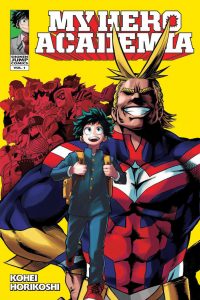 Reviewing nineteen volumes of a manga at once is a pretty daunting task, but here goes!
 Meanwhile, just as Izuku is the protégé of All Might, All for One had taken a boy under his wing, as well. Tomura Shigaraki is a nihilistic villain with a particular grudge against All Might. He forms the League of Villains and so far has attempted to assassinate All Might at the school, attacked a training camp and kidnapped Bakugo, and ambushed a police caravan in order to steal Quirk-erasing drugs that had been seized from a former ally. While All Might exhausted the remainder of his powers to vanquish All for One, Shigaraki remains an active threat. Because of the power vacuum left by All Might’s retirement, the U.A. first years are able to take their provisional license exams earlier than normal and also go out into the field in work-study capacity.
 • Shoto Todoroki – He became Izuku’s friend after the Sports Festival, in which Izuku encouraged him to finally embrace the half of his powers that came from his odious dad, #2 hero Endeavor. He’s still got a complex about his dad, but he’s working through it. And, for his part, Endeavor is trying to become a better hero, too, though he’s got a long way to go.
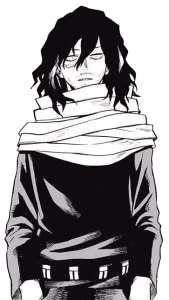 • Shota Aizawa – I saved the best for last. Aizawa is the homeroom teacher for class 1-A and I love him so, so much. He is a great teacher and puts a lot of thought into how best to encourage development in his students. One of my favorite Aizawa moments occurs at a press conference when he expresses absolute faith that Bakugo will not be tempted to join the League of Villains. “More than anyone, he pursues the title of top hero with all he has.” Later, during a home visit with Bakugo’s parents to discuss the new on-campus dormitories, Bakugo’s mom reveals how much she appreciated this proof that her son has been understood by his educators. “Most everything comes easy to him. His whole life, people’ve made a fuss about him… praising him for every little thing he does.” Aizawa sees Bakugo’s potential but also doesn’t let any of his shortcomings slide. I love, too, how he helps take care of Eri and buys her outfits with kitties on them.
 I’d heard good things about The Ancient Magus’ Bride from my Manga Bookshelf compatriots, but I had also heard about a sad fate befalling some cats, so I steered clear. After reading and really enjoying Kore Yamazaki’s
  She’s purchased by a mage named Elias Ainsworth, who takes her as his apprentice. Elias is not entirely human and not entirely fae, either. Most of the time he assumes the form of a tall human with a head somewhat like a cow’s skull, but his real form is something far stranger. Despite his scary looks, he’s kind to Chise, insisting that she be neither passive nor servile, and she’s soon comfortable in his home in the countryside west of London. Eventually, he tells her that because of her ability to absorb and generate mass quantities of magic, her lifespan is destined to be brief. Part of the reason he bought her was to try to help overcome this while also learning more about humans. And to be his bride, of course.
  What I’m getting at here is that this is a series rich in story. The plot is interesting, but the real story is Chise and Elias, what they mean to each other and how they might be incompatible despite all that binds them together. Besides the fact that her life was already going to be brief, now Chise has this dragon’s curse to contend with, and it’s really not looking good for her. Sometimes, too, Chise gets warned about Elias’ interest in her, like when his master Lindel says, “It looks as if he’s trying to tame you… and you are allowing him to do it. But you mustn’t.” Even if she were to return to him after what he did, would that be the healthy choice? I’m not sure this is going to have a happy ending, but it’s certain to have a fascinating one. I can’t wait for volume nine!
 Having greatly enjoyed Yuri!!! on Ice, written by Mitsurou Kubo, I’ve been eagerly anticipating the release of some of Kubo’s manga in English. (In addition to Again!! from Kodansha, Vertical Comics has just published the first omnibus of Moteki, which I shall be reviewing within the next week or so.) Happily, Again!! did not disappoint.
 First off: The Promised Neverland is amazing and you should go buy it. I’d heard good things about it, but hadn’t expected this degree of exhilarating awesomeness. Secondly: I will do my best to avoid major spoilers, but a few are unavoidably required to describe (and compliment) the plot. Take heed!
 Makoto Kowata is a novice witch who, in the tradition of witches, has left home at the age of fifteen to become independent. Her parents are concerned about her safety, though, so she’s staying with relatives in Aomori, located in the Tohoko region where it’s easier to perform magic thanks to abundant wilderness and natural resources. Accompanying her is her familiar, a black cat named Chito who is indisputably my favorite character.
 Fifteen-year-old Tsukushi Tsukamoto doesn’t have any friends. He’s always rushed home after school to be there for his disabled mother, who is raising him on her own after his father passed away. After an eccentric fellow named Jin Kazama saves Tsukushi from bullies, Tsukushi is more than willing to grant Kazama the favor of playing a game of futsal with him. In fact, he runs six miles through the rain in order to fulfill his promise, and though he’s spectacularly awful at the game, he’s also a gutsy idiot and something about his enthusiasm rubs off on his teammates.
 Little by little, Tsukushi manages to not completely suck, albeit only for brief moments at a time. Because of his ability to rekindle the joy of soccer in others, he is surprisingly chosen for the Interhigh team. Though he makes an error that costs them a penalty kick, he also makes a valiant save that rallies everyone’s spirits. I’m a sucker for those moments when the underdog first hears the crowd cheering for them so, predictably, this moment made me verklempt.
 In elementary school, Shoya Ishida often engaged in foolhardy stunts to stave off boredom. When hearing impaired transfer student Shoko Nishimiya joins his class and causes disruption within the class, she becomes Shoya’s target. Initially, the other kids laugh at Shoya’s antics but when he goes too far and destroys several hearing aids to the tune of $14,000, they swiftly condemn him. Now he’s the one who’s ostracized and this status continues into high school, long after Shoko transferred out again. Full of self-loathing, he’s preparing to commit suicide, but a chance reunion with Shoko inspires him to try to change.
 Back and forth things go, with this group continuing to try to establish themselves as friends without seeming to genuinely like each other much. Eventually, they decide to film a movie together. For one scene, they need to acquire permission to film at their old elementary school. Shoya is the unwilling emissary, and an encounter with his odious former teacher leaves him feeling so awful about himself that he ends up lashing out at all his friends, seemingly trying to drive them away as he feels he deserves. This has the unintended side effect of causing Shoko to feel like she’s the cause of his unhappiness, prompting a desperate act.
 Less clear is what Oima was aiming for with their group of friends. Even though Naoka was far more outwardly nasty to Shoko, at least she was open about it and expressed a great deal of self-loathing because of her behavior. With the help of another friend, Miyoko, she is encouraged to have a bit more optimism, and will probably end up doing okay. Even though she could’ve been fleshed out further, I do like Naoka as a character. But man oh man, do I hate Miki. She makes everything about herself—at one point revising the bullying narrative so that she and Shoko were co-victims—and doesn’t seem to grow at all. Everything she does seems fake, because most of it is, and I was baffled when the boy she fancies declared her to be “kind” after some weepy episode. Miki should get hit by a bus.
 Bloom Into You, Vol. 1 by Nakatani Nio
 The Girl from the Other Side: Siúil, a Rún, Vol. 1 by Nagabe
 Kase-san and Morning Glories by Hiromi Takashima
 Kindred Spirits on the Roof: The Complete Collection by Hachi Ito, Aya Fumio, Toitentsu, and Liar-Soft
 Eijun Sawamura really wanted to make some good baseball memories with his middle-school friends, but even though they practiced hard, they couldn’t win a single game. Although he shows talent as a pitcher, his unsportsmanlike behavior after a bitter defeat means most of the good baseball schools are no longer interested in him. And, because he is a hot-headed yet enthusiastic idiot, he totally forgot about the entrance exams required for other schools.
 and the second volume ends with the cliffhanger… will he and another first year succeed in scoring against overwhelming opponents?