• Skip to primary navigation
  • Skip to main content
  • Skip to primary sidebar
  • Home
  • About Us
    • Privacy Policy
    • Comment Policy
    • Disclosures & Disclaimers
  • Resources
    • Links, Essays & Articles
    • Fandomology!
    • CLAMP Directory
    • BlogRoll
  • Features & Columns
    • 3 Things Thursday
    • Adventures in the Key of Shoujo
    • Bit & Blips (game reviews)
    • BL BOOKRACK
    • Bookshelf Briefs
    • Bringing the Drama
    • Comic Conversion
    • Fanservice Friday
    • Going Digital
    • It Came From the Sinosphere
    • License This!
    • Magazine no Mori
    • My Week in Manga
    • OFF THE SHELF
    • Not By Manga Alone
    • PICK OF THE WEEK
    • Subtitles & Sensibility
    • Weekly Shonen Jump Recaps
  • Manga Moveable Feast
    • MMF Full Archive
    • Yun Kouga
    • CLAMP
    • Shojo Beat
    • Osamu Tezuka
    • Sailor Moon
    • Fruits Basket
    • Takehiko Inoue
    • Wild Adapter
    • One Piece
    • After School Nightmare
    • Karakuri Odette
    • Paradise Kiss
    • The Color Trilogy
    • To Terra…
    • Sexy Voice & Robo
  • Browse by Author
    • Sean Gaffney
    • Anna Neatrour
    • Michelle Smith
    • Katherine Dacey
    • MJ
    • Brigid Alverson
    • Travis Anderson
    • Phillip Anthony
    • Derek Bown
    • Jaci Dahlvang
    • Angela Eastman
    • Erica Friedman
    • Sara K.
    • Megan Purdy
    • Emily Snodgrass
    • Nancy Thistlethwaite
    • Eva Volin
    • David Welsh
  • MB Blogs
    • A Case Suitable For Treatment
    • Experiments in Manga
    • MangaBlog
    • The Manga Critic
    • Manga Report
    • Soliloquy in Blue
    • Manga Curmudgeon (archive)

Manga Bookshelf

Discussion, Resources, Roundtables, & Reviews

Reviews

Sabikui Bisco, Vol. 1

January 23, 2022 by Sean Gaffney

By Shinji Cobkubo and K Akagishi. Released in Japan by Dengeki Bunko. Released in North America by Yen On. Translated by Jake Humphrey.

I admit that I was a little wary of this title. It got a HUGE amount of buzz when it first came out and when it was first licensed, which is all very well and good, but the last two times that happened it was The Detective Is Already Dead (which I bounced off of hard) and Osamake (which people stopped demanding the license of once they actually knew the plot). Not to mention that, let’s face it, this does not feel like a Dengeki Bunko light novel, it feels like a shonen manga. Even after I finished the book, I wanted to see what Jump or Magazine title it was novelizing. But no, it’s a real live light novel. It’s just loud, and boisterous, and action-packed, and stars two guys who feel like they could definitely be popular Shonen Jump characters. And, of course, there is one other reason why it reminded me of some of the more popular titles like, say, Reborn or Haikyu!: the two male leads are about as gay as you can possibly be without actually saying it.

Sometime in the future, and try not to be too shocked by this, a huge disaster has leveled Tokyo and left the other prefectures around it in an arid, desert state. What’s worse, people can get infected with rust, which spreads and eventually kills. Rumor has it this is all caused by the Mushroom Keepers, who have control over mushrooms and have gone underground after being accused of destroying the world. Our hero, Bisco, insists that in fact the mushrooms are what can save people! Now he must team up with a naive yet determined panda… erm, doctor named Milo (there’s a big cookie naming theme going on here, in case you didn’t get it) and try to get a cure for the rust before it kills off Bisco’s old mentor and Milo’s sister. This is not being helped by the many people trying to kill Bisco… including Milo’s sister.

This is definitely one of those “gets better as it goes along” books. It starts slow, and I tweeted after about a third of it that I thought it was trying too hard. But around about the time when the pink-haired mercenary who’s also been following them around spouts off every single cliched line in the world in one paragraph, I began to feel its vibe, and the last half flies along. It’s helped by its two leads. Milo bonds with Bisco immediately, and though Bisco takes longer to get used to Milo’s concentrated niceness, by about halfway in they’re both sacrificing their lives for the other. Milo even literally confesses “I love you” to Bisco. I suspect it may have made the editors uncomfortable, as Milo will occasionally try to tell Bisco how hot his sister is and how big her breasts are. It would be sad if it weren’t so funny – the tacked-on feel of it makes it hilarious.

There is one other big problem with this book – it’s a perfect one-shot. Which is an issue, as there’s currently 8 volumes and counting. Contest winner, I expect. In any case, that’s for future Sean to worry about – this volume, for once, actually deserves its hype.

Filed Under: REVIEWS, sabikui bisco

My Friend’s Little Sister Has It In for Me!, Vol. 5

January 22, 2022 by Sean Gaffney

By mikawaghost and tomari. Released in Japan as “Tomodachi no Imouto ga Ore ni dake Uzai” by GA Bunko. Released in North America by J-Novel Club. Translated by Alexandra Owen-Burns.

This series has a tendency to be very metatextual, and we certainly get a lot of that in this book. Everyone may not think that they’re in a light novel series, but they certainly know the way said series tend to go, and they’re noticing that all the things happening around Akiteru pretty much line up with those sort of plots. That’s not good news for him, as he’s supposed to be fake dating Mashiro, who has already not-fake confessed to him. His uncle is clearly very aware of the things going on in his life, especially the presence of Iroha, but for now seems to be content to give him enough rope to hang himself as long as he keeps making Mashiro happy. (Even if he is jealous of the little bastard.) As for Iroha herself, she should be reassured, given that in light novels her type tends to win rather than Mashiro’s type, but she is not. Are the others, a year older than she is, really going to abandon her?

So yes, Mashiro’s father, and Akiteru’s potential benefactor, has noticed that the fake dating part of the books has been left by the wayside almost since it began, mostly as Akiteru can’t quite bring himself to do it knowing she loves him for real. They’re going to have to try, though, and the upcoming festival seems like a good chance. Before that, though, Akiteru needs to continue his quest to find Iroha a friend who can take his place in her life (not realizing that this would be devastating to her). He may have found one in Sasara, Iroha’s classmate who is a classic “always comes in second to her” rival character who is also socially awkward. He may be on to something here. But that’s for later. For now, he has to pay attention to Mashiro on their fake date and not be a “piece of shit”.

First of all, the best possible news about this book: Sumire’s barely in it at all. Which means we get precisely zero shotacon jokes. Hooray! More seriously, Mashiro gets the focus for the first time since the second book, and she has all the hallmarks of the sweet, low-confidence girl that always comes in second in these harem genres. She’s trying her hardest here, determined to get stronger than she was as a kid (when she went to the same festival with Akiteru) and to outshine Iroha. But she may be running a bit late on that, because now that he’s suddenly realized that Iroha *can* be cute, Akiteru is leaning towards her almost unconsciously. Honestly, if it weren’t for the presence of Iroha’s mother, who will no doubt be the final boss, I’d say this series was ready to end by the next book. But that’s not happening.

So yes, fans of Mashiro will enjoy her here, and fans of Iroha… well, Iroha is the other protagonist, so you’re always happy. In any case, this remains a fun romcom, with Akiteru trying his best to logic love to death and failing.

Filed Under: my friend's little sister has it in for me!, REVIEWS

Suppose a Kid from the Last Dungeon Boonies Moved to a Starter Town, Vol. 8

January 21, 2022 by Sean Gaffney

By Toshio Satou and Nao Watanuki. Released in Japan as “Tatoeba Last Dungeon Mae no Mura no Shonen ga Joban no Machi de Kurasu Youna Monogatari” by GA Bunko. Released in North America by Yen On. Translated by Andrew Cunningham.

Because this series is such a broad comedy, I sometimes forget that it is actually trying to have a plot too. There’s more plot in this book than in any of the previous others, as we get a lot more information… well, OK, a little more information… about the Japanese research group that apparently kickstarted whatever this world is, and where they are now. Unsurprisingly, there’s mostly a bunch of loud awkward guys, even if here they’re powerful demon lords. On a more disturbing note, Alka continues to be the gift that keeps on giving even when we don’t want her to. The revelation of her past with the hero was fine. Even hearing that Lloyd is essentially a replacement for the man she once loved, I mean, at least that explains the obsession. But in a series filled with thirsty women, Alka remains the thirstiest, with a line here that made my jaw drop. It’s not welcome.

Despite the cliffhanger from the last book, this volume has the least amount of Lloyd to date, as until the very end he’s reduced to simply standing around and reacting to others. The volume essentially consists of two things: 1) Allan muddling his way through life despite everyone misunderstanding him, and 2) the actual competition to see which clan gets to be the leader. The first part is amusing inasmuch as Allan is a schlub – if you like schlubs trying to blurt something out but failing, you’ll enjoy it. He does gain a demon lord. And a wife. Meanwhile, the competition is where most of the volume’s broad comedy comes out, as we manage to work in swimsuits, cavalry battles, loincloths and farming. The final battle is Allan vs. Lloyd, which Allan is pretty sure he will not survive, but it’s OK, as it’s interrupted by – I’m not making this up – a GIANT CRAB BATTLE where you must hit its weak point for massive damage.

Most of the forward movement in this book happens away from our main cast, who pretty much all act as you would expect them to. The supporting cast, though, are more interesting. Half of them are still recovering their memories, or simply getting used to being impossibly powerful. Alka and Eug are still on opposite sides, though it’s now being made clear that there’s someone trying to play both sides against each other. And we also meet a new player in the game at the very end, who (as with damn near everyone in the cast) is accidentally awoken by Lloyd, who just wants to use the bathroom. Despite all this, there’s a lot going on but the book feels fairly light. The setup comes out in odd bits and bobs, and the main plot is so “wacky” that a lot of it bounced off me.

Oh well, at least this arc is over, though given Allan is married now I suspect we’ll be seeing the newly introduced cast stick around for the next arc. In the meantime, this works best if you don’t think about it.

Filed Under: REVIEWS, suppose a kid from the last dungeon boonies moved to a starter town

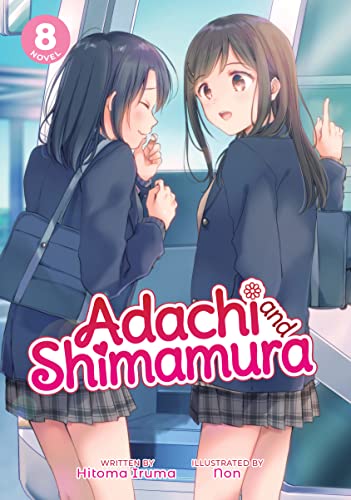
Adachi and Shimamura, Vol. 8

January 20, 2022 by Sean Gaffney

By Hitoma Iruma and Non. Released in Japan by Dengeki Bunko. Released in North America by Seven Seas. Translated by Molly Lee.

There was a three-year gap between the previous volume and this one, and you can sort of tell. There’s a bit of a priority shift in the way the story is being told. For one thing, while Adachi still gets the occasional POV scene, the book has finally admitted that it should be called “Shimamura and Adachi”. Shimamura gets 90% of the first-person narrative, and the entire book is about forcing her to confront how she feels about Adachi, what she wants to do in a relationship with Adachi, and what they mean to each other. The answer will not surprise you, because the book begins with a flash-forward to ten years later, when we see the two of them living together and planning a trip to San Francisco. Given the ‘alternate universes’ of the previous volume, I was expecting ‘it was all a dream’ or something similar, but no. That said, there is one sad part. Sorry, toy shippers, Yashiro and Shimamura’s little sister is not gonna happen. She’s perpetually ten.

The non-flash-forward part of the book is also about a trip – the school trip, which is going to Kitakyushu. Naturally, Adachi is a combination of nervous wreck and jealous child, but for once we don’t really dwell on her. Instead we focus almost entirely on Shimamura, who is dealing with several problems. She’s in a group with Adachi and the three girls she briefly made friends with at the start of the school year, and things are… awkward, mostly as her new relationship is not nearly as secret as she’d like. Yashiro has stowed away in her backpack like a Doraemon invention. And an evening at a hot spring means that she is suddenly very aware that Adachi not only loves her in a romantic way but loves her in a sexual way. Being Shimamura, she’s not sure what to do about any of this, but she does come away with one thing – she wants to be with Adachi for the foreseeable future.

As noted, this book came out after a three-year gap, and it shows in the writing (and not just because Yashiro throws in a Demon Slayer reference). For one thing, Shimamura is asked point blank if she’s a lesbian, something I don’t think would have happened in this series even a few years earlier. (As you might guess, she doesn’t give a straight answer, but it leans more towards “Adachisexual”.) In the same conversation (it’s the best part of the book, and it did not escape my attention that that may be because Adachi’s not in it) Shimamura is also called a “hot mess”, and I laughed because it’s true. But she’s actually trying to fix that in real ways, being more tactile with Adachi, suggesting things like holding hands or snuggling, and trying to tease her without having Adachi take it the wrong way. As for Yashiro… well, if you don’t like her, this is not the book for you. She’s in this more than any other book, and she even has some good philosophical advice for Shimamura. She’s part of the writer’s world.

The flash-forward does show that Adachi is no longer a ball of vibrating gay whenever she’s around her girlfriend, which is good, though I hope I don’t have to wait ten years for that to kick in. In the meantime, Shimamura has gone from a creature who tries to emulate human emotions but can’t work up the energy to a real live human being. I can’t make fun of her anymore.

Filed Under: adachi and shimamura, REVIEWS

My Happy Marriage, Vol. 1

January 19, 2022 by Sean Gaffney

By Akumi Agitogi and Tsukiho Tsukioka. Released in Japan as “Watashi no Shiawase na Kekkon” by Fujimi L Bunko. Released in North America Yen On. Translated by Kiki Piatkowska.

Brief content warning: this book features an abusive family, and unlike other light novels we’ve seen to date in this genre, they do not vanish after the first 20 pages. The marriage, though, is not abusive.

It’s rare that a book affects me so much that I think to myself that I may have to drop another, similar series for being thoroughly inadequate, but that’s sort of how I feel. After reading the first volume of My Happy Marriage, I suspect any time I try to get back into I’ll Never Set Foot in That House Again!, a book with a very similar premise, I will come away thinking it shallow and boorish. Because My Happy Marriage is wonderfully written but also amazingly painful, the story of a woman who has spent most of her life being thoroughly abused by her family suddenly finding herself in a marriage that turns out to be the best thing that ever happened to her… and feeling that she doesn’t deserve any of it. Miyo’s pain and suffering suffuses this first volume.

Seemingly set in a Meiji-period Japan where some families have superpowers, this is the story of Miyo Saimori. Hers is a Cinderella story, but that also means it starts out the way Cinderella’s does as well – after her mother dies and her father remarries, she’s despised by her stepmother, and her younger sister is raised to hate her as well, particularly as she seemingly has no powers of her own. She has a maid on her side… till the maid is fired. She has a childhood friend who has a crush on her… but he’s too cowardly to do anything. She’s reduced to worse than a servant. So when she’s suddenly told she’ll be engaged to the powerful Kiyoka Kudou, she doesn’t know what to think. He’s been looking for a bride for some time, and has rejected all of them. Will Miyo be what he really needs? And can he possibly help her out of the deep pit of self-loathing and despair that is her life?

This book is very compelling but also very hard to read, as you are drenched in Miyo’s POV, and she is an abused woman. Despite being taken to Kiyoko’s house near the start of the book, we continue to focus on her family, who are losing power and influence and desperate to get it back. Fortunately, once she gets to Kiyoko’s house, she does start to have some allies. Kiyoko is, as his reputation says, cold and dismissive at first, but that’s mostly because he’s had a succession of women after his position and power. In fact, once he opens up to Miyo he becomes quite the loving fiancee. His elderly maid is also wonderful, and the first person that Miyo really opens up to. As for her supposed lack of power… it’s heavily implied in this book that she does indeed have strong powers, and that they just awaken late (something her mother was trying to get across to her father before she died). I suspect future books will go into this.

I also hope that future books will better try to match the title of the series. I want to read more of My Happy Marriage, but that’s mostly as I really want to see the happy part. This was good setup, and very much needed to get a good look into Miyo’s psyche, but it’s not what I would call a “light” novel. (Actually, given there are no internal illustrations, it probably should be classified as a light novel at all.)

Filed Under: my happy marriage, REVIEWS

Frieren: Beyond Journey’s End Vol 1

January 18, 2022 by Anna N

Frieren: Beyond Journey’s End Volume 1 by Kanehito Yamada and Tsukasa Abe

I’m always curious about new Shonen Sunday titles since some of the series that I’ve enjoyed from the magazine just end up having more emotional and narrative depth than the more formulaic series in Shonen Jump. Frieren: Beyond Journey’s End is a deliberately paced fantasy story that examines the question of what happens next after a group of heroes succeeds in their ultimate mission. The party of friends on the verge of retirement includes character types that would not be out of place in any DnD campaign: Frieren, an elven mage, Himmel the Hero, Heiter the priest, and Eisen, a dwarf warrior.

The manga opens as the companions have completed their ten year quest to defeat the Demon King. The group splits up, with Frieren not quite understanding how time is going to pass much more quickly for her companions. She promises to check back with everyone in 50 years with the air of someone who’s going to drop by again next month, and leaves to continue her journey doing magical research. When she does return she finds Himmel transformed into a bald old man with an impressive white beard. When Himmel dies shortly after their reunion, Frieren finds herself more interested in reexamining her memories and trying to think the way humans do. She begins to retrace her party’s previous path and finds some low key magical adventures along the way as she starts to engage more with the idea of time passing for humans. Heiter tricks Frieren into taking on a human apprentice mage named Fern, so Frieren has a new companion along as she begins to come to terms with her past.

There’s a slow and gentle quality to the pacing of Frieren: Beyond Journey’s End. I think it would appeal to anyone who also enjoys Snow White with the Red Hair. There’s also plenty of humor as Frieren attempts to get better at understanding emotions and the human pace of the world. The art is attractive, capably portraying the medieval fantasy settings and capturing the emotional dynamic between the characters. I found reading this first volume both diverting and relaxing.

Filed Under: Manga Reviews, REVIEWS Tagged With: shonen sunday, viz media

I’d Rather Have a Cat Than a Harem! Reincarnated into the World of an Otome Game as a Cat Loving Villainess, Vol. 1

January 18, 2022 by Sean Gaffney

By Kosuzu Kobato and Hinano Chano. Released in Japan as “Sonna Koto yori, Neko ga Kaitai ~ Otome Game no Sekai ni Tensei Shimashita ~” on the Shousetsuka ni Narou website. Released in North America by Cross Infinite World. Translated by Jenny Murphy.

As always, the first question you should be asking yourself is “what makes this different from every other villainess book?”. In this case, there are multiple answers. The first is that it is not just our nameless Japanese heroine who dies and reincarnates as the villainess, her entire family also died and has reincarnated as her villainess family! They all gained their memories when they were ten years old, so Amy has a built-in loving support structure. Secondly, she and her mother both agree that they want her to avoid the fate of the otome game, and decide to do this by… fattening her up, so that she’s too pudgy to be a bride. Before you ask, yes, this is handled quite positively, and ends up having huge benefits to her healing magic powers. Third, and most importantly, she loves animals, and they love her. Especially big, big cats. I mean, it is the title of the book.

One more difference from other villainess books: Amy is rather shy and retiring, and the idea of getting engaged at the age of ten would likely fill her with horror even if she was not trying to avoid a Bad End. Unfortunately for her, the fact that she’s not trying to gain favor with the third prince and instead wants to gush about animals is what makes her attractive to him. It also helps that she manages to save his wounded pet owl with her magic. As the book goes on, we start to see that, while Amy may be content to hang around her family and play with her cat all day, the world has bigger plans for her. She’s discovered four of the six ‘capture targets’, and they’ve insinuated themselves into her life. And there’s a girl walking around who looks exactly like Maria Campbell, and we know what THAT means. Can Amy still avoid her doom?

As I said earlier, I was a bit wary when I heard part of the plot is “let’s make you chubby so no one will want to marry you”, but in context it’s treated really well. Amy is super healthy and active, climbing trees and roaming the land with her giant cat, so even keeping the weight on her at all is a challenge. What’s more, and the reader realizes this even if no one else does, gaining weight is clearly what leads to her having much stronger magical power than anyone else her age… or even above her age. Amy feeling bad that she can only heal a 2-inch cut on someone’s face, and everyone else reacting “You healed a wound from a monster and didn’t even leave a scar?!?!” is fun. There’s also a character introduced towards the end, Letizia, who is a delightful cliche of a tsundere, in all the best ways. I definitely hope we see more of her.

Honestly, this feels more like a slow life book than a villainess book, especially as we’ve only seen glimpses of the heroine. But it was a lot of fun, and had enough interesting variations to make me recommend you add it to your 70-foot-high pile of villainess books.

Filed Under: i'd rather have a cat than a harem!, REVIEWS

Torture Princess: Fremd Torturchen, Vol. 7.5

January 17, 2022 by Sean Gaffney

By Keishi Ayasato and Saki Ukai. Released in Japan as “Isekai Goumon Hime” by MF Bunko J. Released in North America Yen On. Translated by Nathaniel Hiroshi Thrasher.

I suspect a lot of people looked at the decimal point in the next volume of Torture Princess and went “Really? NOW is when you decide to release a short story volume?”. After all, we JUST began not only a new story arc, but a story arc that is missing three of the four main cast members, and was promising even more horrible things happening to both deserving and undeserving people, and also possibly snarks and boojums. But also, honestly, this volume is a bit of a relief. The last book was excellent but emotionally exhausting, and I wasn’t quite sure whether I was ready to dive right into more torture games. This is not to say that all the stories in this book are fluffy fun. Come on. It’s Torture Princess. The content warnings are baked in. But compared to the rest of the series? Yeah, this is fluffy fun. Ah, yes, and one more thing: don’t read this out of order – the other stories may all come at the beginning of the series, but the last one is a prelude to Vol. 8.

The volume has four “main” short stories, interspersed with two smaller ones split up. We see Kaito, still struggling to be Elizabeth’s manservant, being haunted by a half-flayed ghost; Elizabeth being invited to a grotesque banquet by a bunch of folks who love her for all the wrong reasons; Kaito and Elizabeth realizing that Hina is missing, and searching the entire castle to try to find her; and the last story, which I will get to in a bit. Each one of those has a “front” and “back” side, showing first one POV and then the same events from another POV – while this can be annoying when you’re reading the same dialogue twice at times, that is kept mostly to a minimum. We also get several first-person monologues from the Saint, and a series of short interludes showing us Alice and her “father” are still deeply screwed up. But hey, bunny!

The final story shows us a celebration dinner for Elizabeth’s third anniversary as Captain of the Peace Brigade. Kaito and Hina are back at the castle whipping up a grand feast, inviting all their friends, and flirting shamelessly. The reader is, of course, aware that this is a giant pile of bullshit, as is Elizabeth, but she goes along with it as long as possible, and we get a few scenes that we are likely never going to get near ever again. What makes this so interesting is that some of the narrative critiques the fact that events are still proceeding as they are – in other words, it’s yelling at the author, in-universe, for not stopping Torture Princess with Book 6. I mean, I did that too! But in a review, not in a Torture Princess story. It’s fascinating and layered, and in the end I think the author does actually justify going forward. Which is good, because in reality Kaito and Hina are still locked in their Cage of Stasis, and Elizabeth has to fight a war.

This is not really a skippable short story collection – the end literally leads straight into Book 8 – but that’s OK, as it’s worth reading even if you do normally skip them. A strong stomach is needed as always, but it’s another winner from this author who writes horribly gratuitous gore much better than the author of Roll Over and Die.

Filed Under: REVIEWS, torture princess

The Magician Who Rose from Failure: Tales of War and Magic, Vol. 4

January 16, 2022 by Sean Gaffney

By Hitsuji Gamei and Fushimi Saika. Released in Japan as “Shikkaku Kara Hajimeru Nariagari Madō Shidō! ~ Jumon Kaihatsu Tokidoki Senki ~” by GC Novels. Released in North America by J-Novel Club. Translated by Alexandra Owen-Burns.

For those who were hoping to see more of Sue trying to get Arcus to take interest in her, or Lecia continuing to think she’s getting further behind Arcus even as she’s also quite powerful, or Charlotte… well, no, no one was really expecting Charlotte. But none of them are in this book at all, because it’s entirely devoted to the battlefield. Last time the author promised the “war” part of the title, and we sure get it here. We also meet the nation’s prince, who is constantly veiled, super powerful, Arcus’ age, and implied to possibly be a princess in disguise, though honestly only the afterword really makes the implication. If you like cool battles, this is an excellent book. Fortunately, it does have a bit more to dig into in terms of characterization, but honestly, you will remember the awesome magic battles. And also the huge burly guy who almost kills everyone then doesn’t because he’s just gotten lost. He’s tremendous fun.

After impressing so many people at the end of the third book, Arcus is invited to meet the Crown Prince, who will also be leading the forces to battle the traitor Count. Of course, Arcus is still quite young, so there are no shortage of offended nobles who show themselves to have no knowledge of how isekai novels work by complaining about this child being present at their planning. Also not smart to say this in front of the prince who is also a child. As for the battle, well, first one side does really well, then the other side does well, but for the most part our heroes have got this in the bag. So much so that they decide it’s OK for the prince, having inspired the troops, to head on back. Which, sadly, is what the enemy was waiting for all along.

There’s a fair bit of time dedicated to the “bad guys” here, and it shows off how in a war no one thinks of themselves as being on the wrong side, even if the person you’re helping is a dead ringer for the classic Japanese fantasy villain, aka “looks squat and froglike, acts like that too”. We see one man who has decided to fight despite the fact that his sister begs him to return home as he is now the head of their family, and you appreciate his thought process while also wincing because man, that’s a death flag if ever I saw one. We also set up a few things for future volumes, as the other side’s mages now know about Arcus and the fact that he has an imagination that can see things that this world cannot. Oh yes, and there’s Arcus’ dinner with Andre… I mean God, who gives him a quest that should keep the series going if it ever gets another volume.

Yeah, fans of The Magic in This Other World Is Too Far Behind!! know where this is going. We’ve caught up with Japan, and the author has started a shiny new light novel series that looks to be following the current cliched trends far more than his other two series. What does that mean? It means I hope we see more of this at some point before I die. Till then, this is a good military fantasy book.

Filed Under: magician who rose from failure, REVIEWS

I’m in Love with the Villainess, Vol. 4

January 15, 2022 by Sean Gaffney

By Inori and Hanagata. Released in Japan as “Watashi no Oshi wa Akuyaku Reijou” by GL Bunko. Released in North America by Seven Seas. Translated by Kevin Ishizaka. Adapted by Nibedita Sen.

Last time I mentioned that it felt awkward to start a new volume of the series when it could easily have ended in Book 2 with “and they lived happily ever after”. Oddly, towards the end of this book Claire’s father thinks much the same thing, trying to send Rae, Claire and their family back home because “they’ve done enough”. Not in a negative way, though Claire initially takes it that way, but n the sense that the country of Nur is quickly about to become super-dangerous. That said, as events unfold in this book one gets the sense that this world is not about to let either of them go live a quiet, happy life very easily… though it has no such qualms about quietly shuffling most of the new cast we met in the third volume off to the side, to the point where I wondered if this were a Christie novel set on a faraway island. As for why? Well… revolution. Again. Come on, it’s in the game title.

The general thrust of this volume should be familiar to readers of the series. We start off with a lot of cute, fluffy things, like a fantasy cross between Iron Chef and the Great British Bake-Off, and we then start the balls rolling down the hill until you reach a climax that can be summed up by “great googly-moogly, it’s all gone to shit”. Part of the problem is that while Dorothea is amusing as a strong as heck, emotionally blunt empress, she is also a somewhat terrifying dictator, and does not particularly care if that means that the country is hated by everyone around it. As for her daughter, after being the comedy girl with a crush at the start, Philine’s development is actually one of the strongest parts of the book (though I’d argue it does come a bit too fast). Which is better, speaking softly or carrying the big stick?

As with previous books in the series, there are occasional digressions in order to discuss modern gender politics. Rae gives a good explanation of gender identity, and one of the subplots later in the book also resolves around this sort of thing. On the down side… there really is an awful lot of “brainwashed to be evil” in this book, and indeed in this series, though some of it is less “I am here to kill you” and more “I am here to threaten you on behalf of the Church”. Fortunately, the main reason to read the books is Rae and Claire, and they’re both excellent. There’s a recurring theme of Claire being beloved by all (including her daughters) and Rae getting either slightly less attention (her daughters) or outright dislike (one of her classmates). It’s amusing but also makes sense, as Rae’s personality is the sort that is difficult to trust… the exact opposite of her partner.

The book ends on another cliffhanger, and seems to indicate the 5th will be the last. Till then, this remains for the most part a well-plotted and compelling series with excellent LGBTQ content.

Oh yes, and mamas, don’t let your babies grow up to be tsunderes.

Filed Under: i'm in love with the villainess, REVIEWS

Bottom-Tier Character Tomozaki, Vol. 7

January 13, 2022 by Sean Gaffney

By Yuki Yaku and Fly. Released in Japan as “Jaku Chara Tomozaki-kun” by Gagaga Bunko. Released in North America by Yen On. Translated by Winifred Bird.

If you don’t want to know who Tomozaki ends up with at the end of this book, be warned I talk about that, but not till the third paragraph.

There’s a lot of metatext in the Tomozaki series. To a degree, it’s deconstructing these sorts of high school romcom series, especially the way that the lead tends to be this asocial schlub who nevertheless has the plot revolve around him. As we’ve seen, it’s only when Tomozaki makes an effort that he gets noticed and gets romantic attention. That said, the series has not forgotten that it’s also a real story and that realistic things need to happen, and as such we get a resolution here to the love triangle between Tomozaki, Mimimi and Kikuchi. But there is a little niggling thought at the back of the reader’s head, because at its core this series is about two people: Tomozaki and Hinami. It’s not a matter of “first girl” or anything, it’s a matter of who gets the most narrative attention. And therefore the most interesting part of the book is when Kikuchi, who sees things from an author’s perspective, tries to abandon her own ship and pair Tomozaki with his *real* girlfriend.

Gumi is on the cover but is just a minor part of this book, which revolves around the culture festival. Tomozaki is dividing his energies between Mimimi and her comedy routine and Kikuchi and her play. What’s more, Hinami is setting him goals that require him to enter one of the girls’ “routes” by the end of the festival, without waffling or putting it off. The trouble is, Tomozaki is still trying to figure out how love and romance work. This can be quite funny, especially when he asks Nakamura for advice, but it’s also really making him miss the forest for the trees. In addition to this, Kikuchi is having trouble with the character Hinami is performing in her play, so she and Tomozaki interview people from Hinami’s past… with some very confusing results. Then we get the festival itself… and Tomozaki realizes he may have been rejected by a “Dear John” play.

I have to feel absolutely horrible for Mimimi. She’s a great kid, and a wonderful character, and her reaction to Tomozaki choosing someone else is very well-handled (possibly as it’s not Hinami he chose). But come on, when someone has to choose between two girls and you come in third, that’s just mean. Kikuchi gets it, though. Mimimi isn’t even on her radar, she knows where the narrative of this story is going, and it’s Hinami. That said, thanks especially to Mimimi kicking his ass, Tomozaki won’t let this lie, and reminds Kikuchi that “this is a story” can only take you so far. I also really liked the idea that it’s possible to be an idealist *and* be selfish, and that it’s not wrong to want to have it all. As a result, by the end of the book, he and Kikuchi are a couple.

Will they be a couple by the end of the series? Mmmmmmm… questioning. After all, there sure was a lot of Hinami baggage dropped in the middle of the book and then just left there. She is the other protagonist in this book. (Also, notably, Tomozaki never said “but I’m not romantically interested in Hinami” or tried to contradict Kikuchi’s play, which surprised me.) For the moment, though, Kikuchi is best girl, and they do make a great couple. As for Mimimi fans… at least she gets the manga spinoff?

Filed Under: bottom-tier character tomozaki, REVIEWS

Reincarnated as the Piggy Duke: This Time I’m Gonna Tell Her How I Feel!, Vol. 4

January 11, 2022 by Sean Gaffney

By Rhythm Aida and nauribon. Released in Japan as “Buta Koushaku ni Tensei shita kara, Kondo wa Kimi ni Suki to Iitai” by Fujimi Fantasia Bunko. Released in North America by J-Novel Club. Translated by Zihan Gao.

As each of these books have happened, the title has been less and less accurate, because Slowe has slowly but surely been losing a lot of that weight. It’s possible the author realizes this, as in this book Slowe spends the majority of the time disguised as an orc – which means he has pig-like features. That said, everyone seems to think he’s turned the corner in terms of popular opinion – everybody but Slowe, who is not really ready to take up the mantle of the heir after blowing it off in the past. For one thing, he still needs to stop the anime plot from happening, and for another, he has a much better idea than his old friends as to just how much he torched his reputation, and how much more it will take to get that back. Especially if he blows off the Queen because another disaster is about to take place… yet, the books aren’t self-contained anymore. Cliffhanger time!

Slow is disguised as an orc, and Charlotte as a pixie, in order to infiltrate Charlotte’s old kingdom, which is now overrun with monsters. Slowe is there to try to head off the next big event of the anime, where one of the antagonists murders a pixie ambassador and helps to jumpstart a war. To do so, he makes contact with an Orc King and his village, as well as the ambassador, Elyas, passing himself off as an Orc Mage – something that is theoretically impossible, given orcs are barely above goblins on the fantasy monster hierarchy. Elyas is trying to have all the monsters unite to defeat the human who’s destroying them. Unfortunately, not only is the human stupid powerful, but Shuya and Alicia (well, just Shuya really) decide to take a shortcut through the monster-infested country and end up in the mix as well!

I’ve said before that I think this series is solid, not great, and that trend continues, though it’s still very readable. Having a “monsters are people too” volume after the previous three is an interesting way to go, and you get the sense that we’ve reached the “the series is successful, you can plan for the long future” part that most Japanese media face. That said, Shuya and Alicia are still very generic, as fits the anime that they belong to, and Slowe and Charlotte’s fight is filled with teenage angst that is more interesting to have read than to be reading. That said, the ending fight is really very well done, and the book promises more of that sort of thing in the next volume. There’s some good humor too, as Slowe is both drawn to and exasperated by his “orc brothers”, who are cliched as heck but in a good way. I hope we see them again.

If you like fantasies with this sort of cliched plot, you could do a lot worse than this.

Filed Under: reincarnated as the piggy duke, REVIEWS

The Apothecary Diaries, Vol. 4

January 10, 2022 by Sean Gaffney

By Natsu Hyuuga and Touko Shino. Released in Japan as “Kusuriya no Hitorigoto” by Hero Bunko. Released in North America by J-Novel Club. Translated by Kevin Steinbach.

Ah, nothing like another review where I can’t talk about half of what I want to because it would spoil. I know that half the time my reviews spoil the entire book anyway, but there are very good plot twists here, and I don’t really want to give them away. As such, I will simply say that I am looking back on some comments I made in my review of the third volume and laughing hollowly. Other than that, well, this particular volume is taking care to wrap up all the plotlines that have been dangling since it began. Jinshi’s identity and why he’s hiding it, Maomao’s friendship with Xiaolan and Shisui, and the long-standing question of who will be Empress are all dealt with here, and we even get a few action scenes towards the end and some chilling torture… well, it would be chilling were it not Maomao, who does have the ability to be terrified, but not when the danger is this pathetic.

After the events of the last book Maomao has been studiously avoiding Jinshi and trying not to think about what she found when she accidentally groped him. She’s back with Gyokuyou, who is quite pregnant. That said, the pregnancy may be an issue, as all signs are that the baby wants to come out the wrong way around. This means they need an expert, which brings Maomao’s adopted father to the rear palace. Elsewhere, Maomao may have found her new calling in body hair removal, and Maomao the kitten is busy getting up to no good. However, things take a far more serious turn in the second half of the book when Maomao attempts to sleuth on her own about various lingering mysteries from the previous books… and ends up kidnapped! Can she manage to get back to the rear palace, and if she does will she get punished anyway? And what’s with our favorite bug-loving maid?

As of this review, there are 11 volumes of The Apothecary Diaries out in Japan, so the series isn’t ending. But this certainly feels like a good stopping place. By the end of the book most of the subplots have been resolved, Jinshi has been forced to stop hiding, and, as Maomao herself puts it, with Gyokuyou now being Empress Maomao is out of a job. The romance is not really resolved, but then it’s hard to imagine how it COULD resolve – leaving aside status issues, which can easily be taken care of if Maomao acknowledges who her birth father is, there’s the fact that Maomao is seemingly apathetic about it. I think she has repressed desire for Jinshi, no question, but I think the idea of being a consort, bride, wife, whatever you call it galls her. No doubt it galls the reader too, who would much rather watch Mao wander around playing Murder, She Wrote.

So the question now is, what needs to happen to get Maomao back to the rear palace, because I’m pretty sure the rest of the series is not going to involve her sitting in her apothecary shop in the pleasure district. Can’t wait to find out, because this is one of the best written light novels coming out right now.

Filed Under: apothecary diaries, REVIEWS

I’ll Never Set Foot in That House Again!, Vol. 3

January 9, 2022 by Sean Gaffney

By Milli-gram and Yuki Kana. Released in Japan as “Nidoto ie ni wa Kaerimasen!” by Overlap Novels f. Released in North America digitally by J-Novel Club. Translated by Emily Hemphill.

There is one, brief shining moment in the third volume of this very sweet and also very dull series where I was engaged and interested, and (as with the second volume) it’s where we are reminded of the past that Chelsea has had. About halfway through this third volume a group of kidnappers enter the mansion of her friend and hold them hostage. After the situation is resolved (there’s really no suspense at all), Glen talks to Chelsea about why she wasn’t scared, and she reveals that she was fine once she knew there would be no pain, because it was the physical abuse that was the worst part of her old life. Chelsea casually talking about getting whipped on a near daily basis is jaw-dropping, mostly as she now possesses a defensive barrier and can literally create massive Venus Flytrap monsters to eat her enemies within seconds. She’s come a long way, and while I’m happy for her as a person, it damages the book.

Glen has proposed to Chelsea, and she’s now actually looking her age (though whether she acts it is in question), but we still have a few hoops to jump through before they can marry, and not just “wait till she gets older”. First she needs to make her debut in society, and that means gowns! It also means meeting the Queen, who thinks Chelsea is adorable and cute and also treats her like a Barbie doll whose clothes get changed 6 times a day. And she gets a new friend… almost by force… in Noel, a young noble who is enthusiastic about gardening and plants and therefore is very eager to talk with someone who knows her stuff. Unfortunately, as I noted above, there’s the break-in and hostage situation. And it turns out that the people trying to kill Chelsea, who we met in the previous book, are still trying to kill Chelsea. Can she survive to her engagement ceremony?

I mean, yes. She can create anything in the entire world from seeds as long as she can visualize it. She has a personal defensive barrier. She has an army of soldiers ready to defend her. And now she’s creating monsters to eat her enemies. She has maids who love her, a cook who not only loves to feed her (and she can finally actually eat meals now that she’s no longer being starved to death) but can also interrogate enemies with her own special magic, her research team, her cool older brother, and of course Glen, who adores and wants to protect her. There’s an after story where she and Glen go to his home and discover that the enemy is a giant crab, but once Chelsea is there she creates a trap (with a seed, natch) and the problem is solved.

You know what this series needs? Fagin. No, not the anti-semitism, but Chelsea is like Oliver Twist if he was rescued from the orphanage by Mr. Brownlow and the rest of the series was just meals and clothes. Chelsea desperately needs to be lured into evil or spirited away. Not because of her as a character – she’s a sweet girl, I don’t want bad things to happen to her. But for me, as a reader? Yes, I want bad things to happen to her.

Filed Under: i'll never set foot in that house again!, REVIEWS

The Reincarnated Princess Spends Another Day Skipping Story Routes, Vol. 2

January 8, 2022 by Sean Gaffney

By Bisu and Yukiko. Released in Japan as “Tensei Oujo wa Kyou mo Hata o Tatakioru” by Arian Rose. Released in North America by J-Novel Club. Translated by Tom Harris.

Generally speaking, most reincarnated folks who end up in the body of a little kid do NOT act like they’re an adult. This even applies to Rosemary, the protagonist of this series. Sure, she’s talking and making decisions that are far beyond what a child her age should be doing, but her emotional maturity remains at about the right level. There are many times this comes up in the books – her inability to get that other kids are in love with her is baked into the genre, but certainly her tearful confession to her crush and the scene that follows shows her as having the easily broken heart of a 10-year-old girl. This most applies, though, when she’s dealing with her father. Who, to be fair, is the King. But the reader recognizes the type that he is, and what he’s actually doing to help her – or at least test her – and I don’t think she sees this as the tough love it’s meant to be. It makes Randolf the most interesting character in this new volume.

Rosemary is still doing her best to try and avoid the dreadful fate her country is going to be in in a year or two, but it’s not easy, especially since she’s changed things so much that she can’t rely on her memories of the game shoe once played. She needs to research the Demon Lord, who possessed the body of a young priest… who she then runs across, pre-possession. She also discovers that most Demon Lord books are kept in the King’s personal library, which means she has to ask to read them and put up with his cold, calculating attitude. And, of course, she’s still in love with the Captain of the guards, Leonhart, who is quite a number of years older than she is – and also she’s ten, yes, a fact that definitely influences her thoughts on her crush. Worst of all, if she doesn’t figure out how to be incredibly useful to the King in the next two years, he’s going to do the obvious thing – marry her off to another country’s royal.

Rosemary remains the best reason to read this, especially when we see her (relatively low) opinion of herself versus everyone else’s (very high) opinion. This comes out best in a scene with Randolf, who castigates his daughter for thinking herself stupid for being unable to catch every possibility in advance. She’s not a God, even though she does have the knowledge of the game from her past life. Fortunately, she does reveal this (in a way, she treats it as a prophetic dream) to Leonhart, so at least has one ally she can turn to. Unfortunately, she’s falling more deeply in love with him by the day. And is, as I said, ten years old. So nothing’s gonna happen, but the emotional turmoil is still there.

The ending of this book implies the next one will likely be Rosemary’s tour of various lands, as she tries to discover more about what’s around her so that she can be a better person and of use to her father. I look forward to reading it, this is in the upper end of the Reincarnated Villainess charts, despite Rosemary not technically being a villainess.

Filed Under: reincarnated princess skips story routes, REVIEWS

  • « Go to Previous Page
  • Page 1
  • Interim pages omitted …
  • Page 86
  • Page 87
  • Page 88
  • Page 89
  • Page 90
  • Interim pages omitted …
  • Page 346
  • Go to Next Page »
 | Log in
Copyright © 2010 Manga Bookshelf | Powered by WordPress & the Genesis Framework