• Skip to primary navigation
  • Skip to main content
  • Skip to primary sidebar
  • Home
  • About Us
    • Privacy Policy
    • Comment Policy
    • Disclosures & Disclaimers
  • Resources
    • Links, Essays & Articles
    • Fandomology!
    • CLAMP Directory
    • BlogRoll
  • Features & Columns
    • 3 Things Thursday
    • Adventures in the Key of Shoujo
    • Bit & Blips (game reviews)
    • BL BOOKRACK
    • Bookshelf Briefs
    • Bringing the Drama
    • Comic Conversion
    • Fanservice Friday
    • Going Digital
    • It Came From the Sinosphere
    • License This!
    • Magazine no Mori
    • My Week in Manga
    • OFF THE SHELF
    • Not By Manga Alone
    • PICK OF THE WEEK
    • Subtitles & Sensibility
    • Weekly Shonen Jump Recaps
  • Manga Moveable Feast
    • MMF Full Archive
    • Yun Kouga
    • CLAMP
    • Shojo Beat
    • Osamu Tezuka
    • Sailor Moon
    • Fruits Basket
    • Takehiko Inoue
    • Wild Adapter
    • One Piece
    • After School Nightmare
    • Karakuri Odette
    • Paradise Kiss
    • The Color Trilogy
    • To Terra…
    • Sexy Voice & Robo
  • Browse by Author
    • Sean Gaffney
    • Anna Neatrour
    • Michelle Smith
    • Katherine Dacey
    • MJ
    • Brigid Alverson
    • Travis Anderson
    • Phillip Anthony
    • Derek Bown
    • Jaci Dahlvang
    • Angela Eastman
    • Erica Friedman
    • Sara K.
    • Megan Purdy
    • Emily Snodgrass
    • Nancy Thistlethwaite
    • Eva Volin
    • David Welsh
  • MB Blogs
    • A Case Suitable For Treatment
    • Experiments in Manga
    • MangaBlog
    • The Manga Critic
    • Manga Report
    • Soliloquy in Blue
    • Manga Curmudgeon (archive)

Manga Bookshelf

Discussion, Resources, Roundtables, & Reviews

Reviews

Jiu Jiu, Vol. 1

August 1, 2012 by Sean Gaffney

By Touya Tobina. Released in Japan by Hakusensha, serialized in the magazines Hana to Yume and The Hana to Yume. Released in North America by Viz.

Those who follow my reviews know that I tend to be very fond of shoujo manga published by Hakusensha, despite the fact that most of my favorites were put out by companies which them folded. Astute readers may also recall my #1 complaint with said Hakusensha manga, which is that the artists need more editing than they are really given, and that much of their work, especially in early volumes, tends to be messy, unfocused, and uneven. Unfortunately, Jiu Jiu is a classic example of this sort of manga.

The author, Touya Tobina, has been seen here briefly before – her story Clean Freak: Fully Equipped had one of its two volumes put out by Tokyopop before they shuttered down. That story was more grounded in the real world. Jiu Jiu is a full blown fantasy, featuring a girl who aspires to be a demon hunter and her two wolf pets/bodyguards/whatevers, who can assume human form when they want to. It ran for two volumes in Hana to Yume, then for reasons unknown moved to the quarterly publication The Hana To Yume, where it recently ended last month with Volume 5. The premise involves a young woman who’s trying to block herself off from emotions in order to deal with her tragic past, and the two wolf boys, who want to be helpful and discover these new feelings of love within them, but are foiled by their playful natures.

I think I make that sound better than it actually it, unfortunately. Takamichi ends up being more of an emotional wreck than a stoic hunter. While this makes sense given she’s a teen who’s undergone a traumatic experience (which we still don’t get all the details about in this volume), it is a bit of a disappointment seeing her fall into the traits that I’ve associated with the basic ‘tsundere’ type. As for the two wolves/wolf boys, this falls more into the sort of shoujo romance tropes that were cliched 15 years ago. She constantly wakes up with them naked in her bed, they continue to act like wolves (well, OK, dogs really) even when in human form, etc.

The biggest problem, I think, is that this ends up being far more comedic than I’d assumed given its premise, and the comedy just isn’t all that funny. When it turns to serious matters, its quality improves significantly. Snow and Night, the two wolf boys, have a tough job, given their mistress is trying to shut out anyone close to her but they need to protect her (and make her understand why they want to). My favorite scene in the volume is where the three have to track down a werewolf (an evil one, let’s make that clear) who has been killing people during full moons. After reaffirming their devotion to their mistress, who seems to want them to remain innocent puppies, we cut back to the now defeated and transformed werewolf, who is a salaryman type. He begs for mercy, but Takamichi coldly informs him that her family are killers, and orders the man executed. It’s chilling stuff.

Unfortunately, there was more ‘wacky high school comedy with hot guys behaving like dogs’ and less ‘family of demon slayers’ here. Now, given that I am a big proponent of ‘never judge a series by its Volume 1’, I am hoping that things improve down the road. For the moment, Jiu Jiu is an excellent example of average Hakusensha shoujo – good plot, interesting ideas, but desperately needs an editor to take a firm hand.

Filed Under: REVIEWS

Dawn of the Arcana, Vols. 3-5

August 1, 2012 by Katherine Dacey

On the surface, Dawn of the Arcana looks like a Harlequin romance. Its flame-haired heroine is feisty and impetuous, torn between her feelings for the man who raised her and the man she was forced to marry. Both men are keen to “own” her — their word, not mine — and are willing to go to ridiculous extremes to prove their devotion, even setting aside their differences to honor her requests. And true to Harlequin form, the heroine frequently struggles to reconcile the circumstances of her marriage and her growing feelings for her jailer-husband.

Peer beneath its romance-novel trappings, however, and it quickly becomes clear that manga-ka Rei Toma is actually writing a pretty nifty fantasy-adventure as well, one with interesting moral dilemmas, parallels with contemporary geopolitics, and multi-layered characters whose behavior frequently deviates from the Harlequin playbook.

In volume three, for example, Nakaba’s mother-in-law attempts to dye her hair black, lest visiting dignitaries realize that the new Belquat princess hails from Senan. Toma might have used this scene to provide Caesar an opportunity to publicly declare his feelings for Nakaba, or demonstrate Nakaba’s ability to endure hazing with noble forbearance. Instead, Toma transforms this act of fairy-tale cruelty into a moment of self-actualization: Nakaba seizes a sword and defiantly gives herself a fabulous pixie cut — er, short, boyish locks — denying the queen the satisfaction of humiliating her in front of the royal family.

That act resonates throughout the next three volumes, as Nakaba sheds her girlish braid and girlish indignation in favor of a stronger, more active role in defeating Belquat’s royal family. Though Nakaba’s new ‘do leads to some predictable exchanges about “looking like a boy,” both Loki and Caesar admire her determination: red hair symbolizes more than just her country of origin, but also the struggles that helped define her as a person.

As appealing as such scenes may be, they highlight the series’ main drawback: the artwork is too plain and spare for a story with such vivid characters. Though the principal characters’ costumes are rendered in considerable detail, the supporting cast resemble Renfair extras, with faintly old-timey clothing and long tresses. Worse still are the backgrounds: with their perfect right angles and unvaried lines, they look like stills from an ancient Nintendo game, rather than a representation of a specific time and place. That sterility isn’t a deal-breaker, but it does reinforce the impression that Toma hasn’t quite developed the artistic chops to fully realize her vision.

Despite its artistic shortcomings, Dawn of the Arcana remains an appealing mixture of fantasy and romance, offering just enough sword fights, scenes of female empowerment, and emotional entanglements to appeal to fans of both genres.

Review copies provided by VIZ Media, LLC.

DAWN OF THE ARCANA, VOLS. 3-5 | BY REI TOMA | VIZ MEDIA | RATING: TEEN (13+)

Filed Under: Manga, Manga Critic, REVIEWS Tagged With: Rei Toma, shojo, shojo beat, VIZ

Soul Eater Not!, Vol. 1

July 30, 2012 by Sean Gaffney

By Atsushi Ohkubo. Released in Japan by Square Enix, serialization ongoing in the magazine Shonen Gangan. Released in North America by Yen Press.

It didn’t really dawn on me until I’d finished the first volume how accurate the title would prove to be. It sounds odd, given it’s a Soul Eater spinoff with many of the same characters, including cameos from the two heroes, and that it takes place at the same Academy. But this is an altogether different type of reading experience, and I felt that the author was smiling at me as I finished it and saying, like a little kid, “Enjoy Soul Eater – NOT!”

This is not to say that the manga is bad. The author has skills, and I was entertained throughout. The basic premise is that we follow the life of a new Japanese student, Tsugumi, who’s found out that she’s a weapon, and therefore transfers to the Academy (which is in Nevada, something I’d forgotten – you keep thinking Soul Eater is on a different planet with that sun and moon) in order to meet her partner and find her place (and not be thought of as a danger to others). There she meets two new friends, the bubbleheaded yet strong Meme and the tsundere princess Anya. They have cute classes, run into occasional cute danger, and in the end Tsumugi is even confessed to! … well, not quite, but a guy asks to be her partner.

This seems to begin shortly before the actual Soul Eater manga does. Sid, their teacher, isn’t dead here, and Medusa is still the school nurse (although apparently her younger sister will be the main antagonist). The first volume consists entirely of what I’ve come to think of as typical shoujo situations – the three girls have to deal with some classroom jerks; the three girls get part-time jobs as waitresses; etc. All of the heroines are drawn with very broad strokes – Tsumugi is polite yet worried and with low self-esteem; Anya is such a cliched tsundere that I wouldn’t be surprised if she were artificial. Even Meme’s ‘big-breasted airhead with secret skills’ has been seen before.

There’s also what I tend to call ‘fake yuri’, i.e. close female friendships with lots of hugging and lovey-dovey feelings without the actual relationship behind it. Meisters and weapons tend to be thought of as couples, and both Anya and Meme want to pair up with her. (This is in addition to Akane, the serious-looking young man who asks her to partner with him at the end. So yes, Tsumugi is also the star of a harem manga as well, something else that Soul Eater proper most decidedly isn’t.)

This is the big problem with the series to date. There’s nothing new or challenging here. And for those who enjoyed Soul Eater for its weird design or its occasional graphic horror, so far there’s none of that either. It reads as if Square Enix asked the creator to rewrite the series, only make it more like K-On!. There’s nothing bad about this – it’s a fun story well-told. But compared to its parent series, so far it feels like there’s nothing there.

Filed Under: REVIEWS

Clover

July 27, 2012 by Ash Brown

Creator: CLAMP
U.S. publisher: Dark Horse
ISBN: 9781595821966
Released: May 2009
Original release: 1997-1999

Technically, Clover is one of CLAMP’s incomplete works. Originally planned to be at least six volumes, the series prematurely ended at four when the magazine it was being serialized in, Amie, ceased publication. Clover was initially released in Japan between 1997 and 1999. Tokyopop first published the series in English in four volumes between 2001 and 2002 before Dark Horse released a deluxe omnibus edition of Clover, using the same translation but including additional color artwork, in 2009. CLAMP is an all-female creative group that had its beginnings as a dōjinshi circle in the 1980s before emerging as a highly successful professional group. It’s four main members, who are also the members who worked on Clover, include Satsuki Igarashi, Mokona, Tsubaki Nekoi, and Nanase Ohkawa. (Ohkawa was primarily responsible for Clover‘s story while Mokona was primarily responsible for its artwork.) Clover happens to be one of my personal favorites of CLAMP’s works. Although there are things about the series that annoy me, I enjoy its futuristic and vaguely dystopic setting and its experimental artwork. I thought the CLAMP Manga Moveable Feast was a great opportunity for me to give the manga a closer look.

After being court-martialed six times, ex-special operative Kazuhiko Fay Ryu is trying to lead a normal civilian life when the government calls him back to duty for one last mission–one that only he can complete. Charged with transporting a strange girl to an undisclosed location, there’s plenty about the mission that Kazuhiko doesn’t know. And what he doesn’t know may very well end up getting him killed. He isn’t even aware of the special connection that she shares with him. Sue, the girl, is a Clover–a child with extraordinary abilities far surpassing those of a normal psychic. Considered both extremely valuable and extremely dangerous, she has been kept alone in captivity by the government for most of her life. All she really wants is a moment of true happiness, no matter how fleeting. But now that the closely guarded secret of her existence is out, both Sue and Kazuhiko are being pursued by well-armed renegade forces who want her power for their own.

The most striking thing about Clover is its artwork. The style itself is similar to those used in other works by CLAMP, but what makes it stand out from other manga (and not just other CLAMP manga) is the group’s use of innovative and unusual panel layouts and page designs. The individual panels tend to focus closely in on a particular element; these fragments are then gathered together as a whole on the page in interesting and varied ways. CLAMP isn’t afraid of overlap or white space and relatively few panels are used on a page, giving the overall presentation of Clover a minimalist feel. CLAMP’s artwork revels in the small details, moments, and movements without becoming overly complicated. Less successful in Clover is CLAMP’s constant use of song lyrics. I can see this being used to good effect in another medium such as film, but it becomes tedious and repetitive in the manga. Eventually, I stopped reading them entirely. I suspect that the overused lyrics worked better in serialization than they do now that the manga has been collected.

The primary story is contained by the first two volumes of Clover. The third and fourth volumes serve as prequels, each going back a little further in time, which delve into the characters’ histories. Although there is still plenty of room for development, and I would love to see what CLAMP had in mind for the rest of Clover, the volumes that currently exist are more or less complete in and of themselves. In tone, Clover tends to be very melancholic bordering on and even crossing over into angst. However the future shown in Clover came to pass, it is not a particularly happy one. Very little is actually known about the world of Clover; many of the details of the setting and of the characters backstories and relationships are only hinted at or implied rather than being explicitly stated. CLAMP provides just enough information for readers to run with and to ignite their imaginations as they speculate on the series’ possibilities. Clover might not be the best of CLAMP’s works, but I think it is one of the most interesting. Even considering its faults, with an engaging setting and fantastic artwork, Clover remains a personal favorite of mine.

Filed Under: REVIEWS Tagged With: clamp, Clover, Dark Horse, manga, Manga Moveable Feast

The Best Manga You’re Not Reading: Suki

July 26, 2012 by Katherine Dacey

The brilliant sociopath, the hooker with the heart of gold, and the naïf are my three least favorite character types, the first two for their tiresome ubiquity in popular culture, and the third for being tiresome: when was the last time you read a story about a sweet, innocent person that didn’t make you feel horribly manipulated or horribly jaded? Imagine my surprise, then, at discovering CLAMP’s delightfully odd series Suki: A Like Story, which revolves around a brilliant but impossibly naive teenager who trusts everyone, reads picture books, and talks to teddy bears. I thought I’d be tearing my breast in agony by the end of the first chapter; instead, I quickly succumbed to Suki‘s charms and even suppressed a sniffle or two in the final pages.

Suki succeeds, in large part, because the supporting cast has the same reaction to sixteen-year-old Hinata Asashi as the reader. Hina’s boundless enthusiasm endears her to best friends, Touko and Emi, though both roll their eyes at her inability to read social cues or grasp ulterior motives. Touko, in particular, is keen to protect her pal; as we learn in the second volume of the series, Hina has been kidnapped nine — count ’em — times over the course of her short life. (Hina’s dad is rich and willing to pay ransom for the safe return of his daughter.) Though an ordinary person might be deeply scarred by such experiences — or least more suspicious of strangers — Hina remains cheerful and oblivious to signs that a tenth abduction might be in the works.

Those signs include a string of odd coincidences: the long-vacant house next to Hina’s is suddenly occupied by a handsome young man who just happens to be Hina’s new homeroom teacher, Shiro Asou. Shiro just happens to be around whenever Hina is in need of an escort, or rescuing. And Shiro just happens to conduct clandestine meetings when the class goes on field trips. The ever-vigilant Touko quickly suspects the worst, but Hina interprets Shiro’s gruff yet solicitous behavior as concern, and develops a chaste crush on her sensei.

Watching Hina come to terms with her feelings is a painful but believable process. At first, she revels in any opportunity to spend time with Shiro, whether they’re raking leaves or walking home from school. Later, she begins to see parallels between their relationship and the relationship between two characters in a favorite picture-book series. (More on the series-within-a-series gambit in a minute.) In the final chapters of the book, Hina develops a more realistic idea of who Shiro is, eventually telling him how her feelings have evolved from youthful naivete to adult maturity. “At first, I fell in love with you because you did so many things I loved,” she confesses. “But from now on, Asou-san… whatever you do for yourself… I’ll love you for that.”

That Hina’s epiphany is facilitated, in part, by reading a children’s book may strike some readers as hopelessly twee. Suki — the name of the story-within-a-story — isn’t subtle; using bears as surrogates for Hina and Shiro, Suki charts the budding friendship between a small, chatty bear and her large, bespectacled neighbor. The parallels between the main plot and the story-within-the-story are obvious, but they serve an important purpose, reminding us that Hina is struggling to reconcile new, adult feelings with her decidedly child-like worldview.

Art-wise, Suki: A Like Story is one of CLAMP’s simplest — one might even say plainest — series. Tsubaki Nekoi’s style is much less Baroque than her cohorts’; she favors ordinary street clothes over epaulets and garter belts, and more realistic physiques over exaggerated shoulders and sharp chins. By shedding the fanciful trappings, Nekoi focuses the reader’s attention on faces, allowing us to fully register how each character is feeling. Nowhere is that more evident in the way Nekoi draws Touko. Touko is by far the most mature girl at Hina’s school, and the one most attuned to signs of adult malfeasance. Though Touko voices her concerns, the sadness in her face reveals a level of understanding that might be rooted in her own experiences, not just Hina’s:

Though Hina has a much more innocent personality than Touko, Nekoi resists the temptation to draw Hina as a child; Hina is clearly meant to be a teenager, given her size and athleticism. Hina’s transparent facial expressions, wide-eyed enthusiasm, and sudden, darting movements, however, hint at the discrepancy between her chronological and emotional ages; she bounces and skips and claps her way through the story, reacting with intense glee at even the briefest exchange with Shiro:

The art isn’t perfect by any means. Shiro’s proportions, for example, often look wrong: he has a tiny head and an enormous frame, and is so much taller than the other characters that he’d be NBA draft material in real life. Suki, the book-within-a-book, is also problematic. It’s quite possibly the dullest picture book I’ve read, a series of simple drawings accompanied by large, undifferentiated blocks of text. I certainly wasn’t expecting Sylvester and the Magic Pebble (or A Kiss for Little Bear), but the flat, unimaginative illustrations make it harder for the reader to imagine why someone Hina’s age would find the story so compelling:

Perhaps the most interesting thing about Suki is that Hina’s realistic coming-of-age story is embedded within a thriller. The suspenseful elements of Suki are handled with skill and restraint, even if they are a wee bit ridiculous. (OK, a lot ridiculous: who allows their frequently kidnapped sixteen-year-old daughter to live alone with her teddy bears?!) The few action scenes are brief but crisply executed, adding some much-needed variety in tone and pacing to the story. If the ending is a little too tidy, CLAMP avoids the trap of pandering to the reader’s expectations of what should happen; there’s a note of melancholy in that final scene, joyous though Hina may be.

Readers curious about Suki: A Like Story won’t have too much difficulty tracking down used copies on eBay or Amazon; the complete series will set you back about $20-30.

SUKI: A LIKE STORY, VOLS. 1-3 • BY CLAMP • TOKYOPOP • RATING: TEEN (13+)

Filed Under: Manga, Manga Critic, Recommended Reading, REVIEWS Tagged With: clamp, Suki, Tokyopop

Angel Para Bellum, Vol. 1

July 25, 2012 by Sean Gaffney

By Kent Minami and Nozomu Tamaki. Released in Japan by Flex Comics, serialization ongoing in the online magazine Flex Comics Next. Released in North America by Seven Seas.

It has to be said, despite my ongoing joke that it succeeds because it has the word ‘vampire’ in the title, Seven Seas’ license of Dance in the Vampire Bund has proven to be one of their big successes. And as you’d expect when there is a big success, they likely decided to look around and see what else the artist had done that might pick up a similar audience in North America. After filtering out titles the author did that are too pornographic to really be licensed hre… you’re left with very little. Tamaki-san seems to specialize in various kinds of ‘adult’ work, a lot of it running in the borderline H magazines such as Takeshobo’s Vitamin. However, he also recently teamed up with an author to do an online serialization for Flex Comics, which seems to be more about action and religion that showing off the female body.

As readers who follow my site likely know, if I spend almost 200 words talking about the background to a manga rather than the manga itself, it means I’m already reaching for things I can say. But let’s get down to brass tacks. This series introduces us to Mitsuru, a young, pretty, and very emotional young man who is apparently also the key that will bring about the final apocalyptic war between heaven and hell. Protecting him are a team of angels, including Archangel Gabriel, aka Kyrie, his ‘older sister’ figure who recently disappeared, and Revy from Black Lagoon… um, sorry, I mean the Archangel Azrael. They are battling against a group of nasty demons, who want Mitsuru dead so they can bring about the war on their own terms.

The religious terms come thick and fast in this series, and may grow to be more relevant later, but honestly the war in heaven is really just a plot hook on which hangs a bunch of action and things blowing up. Gabriel/Kyrie can call down heavenly fire, the various demons can turn into slavering Cthulhu-like horrors, and of course everyone can fire guns. There’s even a few sequences of roof hopping. As for the other, non-action type of fan service, Gabriel and Azrael are seen nude often (especially Azrael, who walks around topless most of the time) and we are told they are androgynous and also have male members. It’s all just for show, of course – Mitsuru is far too innocent to bother thinking of taking advantage of anything, and spends most of this volume in a constant state of trauma in any case.

There were one or two moments in this manga I felt worked pretty well – the description of how humans let angels or demons possess them, and seeing it work on a sweet young thing at a coffee shop was well-handled and rather chilling. For the most part, though, I don’t think the first volume of this series really cohered all that well. There was a lot of theoretical plot tossed around – and we meet Uriel, a third Archangel who is (of course) in the body of a little girl – but for the most part it can be summed up as ‘Mitsuru gets menaced, then rescued, then lots of things blow up, get shot, or catch fire’. Hopefully it will gain more depth later on.

Filed Under: REVIEWS

The Disappearance of Nagato Yuki-chan, Vol. 1

July 24, 2012 by Sean Gaffney

By Nagaru Tanigawa and Puyo. Released in Japan as “Nagato Yuki-chan no Shoushitsu” by Kadokawa Shoten, serialization ongoing in the magazine Young Ace. Released in North America by Yen Press.

It is noted in the ads at the back of this volume shamelessly plugging the rest of the Haruhi franchise that in order to get maximum enjoyment from this work, you need to have read the original books, particularly the 4th novel, Disappearance (which was made into the Haruhi movie). I think this is quite accurate. Without the context of Haruhi, this seems a lot fluffier and pointless than it really is. Not that it isn’t already light as air – this is not a manga for those who seek the sci-fi adventures the original sometimes gives us. But knowing the original series as we do helps us to see what the artist is trying to achieve here by, in effect, changing Kyon’s decision in the 4th book. What if he’d stayed, and his memories were also rewritten? How would that universe have kept going?

As you might guess by the cover, the focus here is on Yuki, who is back to being the meek and shy but far more human Yuki we saw in that novel. Luckily, she’s not a complete wallflower. One sensible thing this manga does is start ‘in media res’, as it were, showing us several chapters of Yuki, Kyon and the other interacting before going back at the end and giving us a flashback as to how they met. This allows us to see a Yuki more comfortable with Kyon (although she’s still awkward around him) and even lets her have the occasional snarky line, although that’s mostly directed at Ryouko, who fires right back.

Ah yes, Ryouko. Fans have a tendency to influence other people’s creations, as many writers will tell you. Especially when this is a spinoff once-removed sort of series. The artist, Puyo, is also writing the Haruhi-chan gag mangas for Shonen Ace, which feature his own conceit of Ryouko coming back as an adorable plushie-like creature and basically losing every trace of evil in her. Likewise, fandom in Japan read the first Haruhi books (and Disappearance) and theorized that Yuki and Ryouko would be eating meals together and such before Haruhi showed up and Ryouko went insane. Combining the two, here we see Ryouko as a pure onee-san figure. She has a quick temper, and gets easily frustrated, especially by Yuki’s indecision, but this is a Ryouko who is not going to be stabbing Kyon anytime soon – a genuinely good-hearted character who really is Yuki’s best friend. It’s quite sweet.

There are a few flaws here, of course. As with Haruhi-chan, Puyo’s art can be highly variable, especially when he draws faces. Unlike Haruhi-chan, he isn’t allowed the luxury of going super-deformed all the time. So sometimes we see some very awkward poses and art. In addition, our hero Kyon, deprived of Haruhi’s antics giving him a cynical and sarcastic inner monologue, comes off as being a bit dull, the standard romantic lead for the shy girl who wins her heart by… well, by actually interacting with her. His sharpest moments are actually with Ryouko, who is trying to nudge the two leads together, much to Kyon’s clueless bafflement.

Even with the universe having been rewritten, and Kyon and Haruhi not meeting each other, she’s still not very far away. This time around, an older Haruhi gets Yuki to draw figures on the ground – this time sending out a message for Santa. It’s another example of what this series is trying to do. It’s taking the characters of the Haruhi franchise (including Haruhi, who will get more to do in the next volume) and putting them in situations that make you go ‘Awwwww’ and smile. If you enjoy the sharp, caustic comedy of the original franchise, it would be best to stick to that. As an AU alternative, though, this is simply cute as a button.

Filed Under: REVIEWS

Pretty Guardian Sailor Moon, Vol. 6

July 23, 2012 by Sean Gaffney

By Naoko Takeuchi. Released in Japan as “Bishoujo Senshi Sailor Moon” by Kodansha, serialized in the magazine Nakayoshi. Released in North America by Kodansha Comics.

Having defeated Death Phantom and the Black Moon Clan, and briefly saying hi to their 20th century selves, Usagi and friends have returned to the present, ready to prepare for their final year of middle school, with all the test-taking that involves for typical Japanese students. But this is Sailor Moon. More importantly, it’s the Sailor Moon manga, where filler is hard to find. There’s barely any time to breathe before a new enemy has made its presence known. But… who *is* the new enemy, anyway?

It has to be said, the senshi are getting better at finding and stopping threats. There is no flailing around the way we sometimes saw in previous volumes. The trouble is that while they can find beings of power, they aren’t quite sure if they’re bad guys or not. Sometimes it gets obvious right away. Possessed schoolgirl has huge lumpy monster leap off her back? That’s a bad guy. (Well, the lump anyway, try not to kill the girl.) But there’s also a couple at the newly formed Private School For The Awesome, Mugen Academy. He’s a cocky smart-aleck who seems taken with Usagi, but also gives off a different kind of aura. She’s a cool and self-possessed gorgeous teen who seems to like Mamoru. And together… well, they have their own agenda.

Of course, I am talking about Haruka and Michiru, who (along with Hotaru) make their debut here. It’s interesting in hindsight to see how much time Takeuchi-san devoted to making the main cast doubt the two new cast members, mostly as, of course, from our perspective, we know they’re good guys, if ones with ambiguous ethics. They’re helped out by a deliberate stylistic art choice. Haruka, when she’s being her normal Academy student self, is not only drawn in the male uniform but is drawn as a male. The judo practice in particular shows this. Whereas when she’s Sailor Uranus, there are far more curves. As I said, though, this is mostly stylistic (Naoko admitted as much in an interview), and Haruka does not appear to be a sex-changer like Ranma or anything. The anime didn’t even bother to deal with this at all, and just made Haruka obviously female for all but her very first episode.

There’s a lot of gender identity stuff here. When Makoto gets hurled to the ground in the judo match, the other senshi yell at Haruka, but she replies that gender shouldn’t matter if you have something you want to protect. Likewise, later on Usagi asks Haruka (who she suspects of being Sailor Uranus) point blank if she’s a woman or a man, and Haruka asks “Does it matter?”. Being a woman and the strength that it provides are a core theme of the series, of course, but Haruka’s dual identity adds a dual thrill to the whole thing. As for the agenda of Sailors Uranus and Neptune, it seems to be partly ‘this is our fight, not yours’ and partly ‘we are better at this and know better’. Though thankfully not quite as obnoxious about it as they would be in the anime.

And there’s also Hotaru, one of my favorite characters, who at this point seems to be shaping up to be a tool of the big bad more than anything else. As opposed to the other senshi (including Uranus and Neptune), Hotaru’s true identity actually *does* remain a surprise in the manga proper, though this is slightly spoiled by the start of the volume having a giant color picture of all ten senshi. Hotaru here mostly gets ill and bonds with Chibi-Usa (who is quite cute here, and also very much like her mother). There is an interesting scene where she is clearly unhappy with Kaolinite, her father’s new assistant, accusing her of breaking up their family. Unfortunately, I think she is going to be disappointed on that front. Despite her initial standoffishness, though (much like the other Outers), there is a core of empathy to Hotaru that makes us sympathize with her.

I do still have a few issues with the manga proper. The anime, particularly this arc, spoiled me for real villains. Yes, the Witches 5 are present and accounted for, but they’re one-offs who do their schtick and get killed off. We don’t even get Eudial driving her car! Likewise, I’m afraid that the main villain behind the scenes, Pharaoh 90, is another nebulous black miasma of evil. Not to be confused with the previous two nebulous black miasmas of evil. (I think Takeuchi eventually realized what she was doing and ‘fixed’ this, if I recall the Stars plotline correctly.)

Still, overall a fantastic volume of Sailor Moon. And hey, who’s that we see at the cliffhanger? Gosh, she looks very familiar…

Filed Under: REVIEWS

Wonder!, Vol. 2

July 21, 2012 by Sean Gaffney

By Akira Kawa. Released in Japan by Futabasha, serialized in the magazine Women’s Comic Jour. Released in the United States by Futabasha on the JManga website.

The second volume of Wonder! (which has just ended in Japan, by the way, and is 17 volumes total) continues the types of stories we saw in the first. It’s a story about what it means to be a family, in all the myriad ways: husbands and wives, parents and children, and the multi-generational aspect of everything. It also touches on childcare quite a deal, and might actually strike some as being a bit heavy-handed at times. I think the writing and characterization is so strong, though, that it overcomes any issues it might have.

The protagonist role continues to switch back and forth between forthright and emotional Kaori and her reserved and quiet adopted son, Kota. Having jumped forward about 9 years in the first volume, this one settles down into his final years of high school, as the manga seems to have been picked up as a series fully by now. Kota’s future is not so certain, though. He doesn’t really want to go to college, and is content to simply start working full time at the snack bar he’s been with. Everyone seems to wonder if this is really the right choice for him, though… especially as he seems to brim with unfulfilled potential. As the volume goes on, a new possibility makes itself known: Kota is really fantastic with kids, and it’s brought up that he may want to look into being a caregiver of some sort. Whether he takes this up or not is another matter. Kota is not quite as hard to read as his father, Taiyo, but it’s clear he’s at that age where he doesn’t want to burden his family but also doesn’t ant to leave.

As for Kaori, if she seems angrier than usual here, it’s mostly because her mother has moved in with them temporarily, after getting divorced from what appears to be her fifth husband. It’s lampshaded right away that Kaori and her mother are far too similar for their own good, though Kaori certainly comes off better when we compare; her mother is written as deliberately antagonistic most of the time, and picks fights constantly. Just as much as this series is about family, it also seems to be about communication, and how hard it is to really get anything across even when you *do* mean well. Kaori has always been upset with her mother for ruining her second marriage (the first, which led to Kaori, ended with her father’s death from illness). And after a long series of arguments, her mother finally reveals the real reason that marriage fell apart. Kaori is stunned, and rightly so, but… you also feel sympathy for her mother, as really, how do you begin to bring that up with a child?

It can be argued that Kori and Taiyo’s family is a bit too perfect, especially compared to the other family we get to know in this volume, which involves both spousal and parental abuse. There’s an interesting discussion of disciplining a child – Kaori is adamant about hot hitting her child, partly due to the real reasons that it’s not a good thing to do, but also because of her own memories of being hit as a kid. When the abused young child of a different family comes to live with them for a short period, Kaori is frustrated that he’s acting up and lashing out – the child even attacks Wonder, the titular dog! Kaori is stunned to realize that at one point she wanted to strike the boy, and her mother cynically notes, “Did you think that you were perfect?” Well, she may have – her own child, Miya, is adorable, well-mannered and behaves, she and her husband have resolved the whole ‘open marriage’ thing from last volume and seem to have bonded. It’s easy to be judgmental towards someone whose problems you’ve never dealt with.

As with Volume 1, this volume ends with a one-shot story about an unrelated couple. This one has a bit of a fantasy aspect – a young wife who’s feeling stressed out and uncertain about her marriage, especially as her husband is ten years older than she is, finds that an older couple have moved in next door to him – and not only are they eerily similar, but there even seem to be future echoes of the fights that she and her husband have. The revelation here was more obvious than I’d have liked – anyone who’s read speculative fiction will get it right away – but I still enjoyed it, especially as it examinees the fact that choosing to live with someone the rest of your life can be a scary and terrifying thing to do… but is ultimately really sweet.

In case you’re wondering, Wonder does appear throughout, and still appears to have that ’empathy’ superpower and ability to always find a person in trouble that he had previously. In fact, Kota may share the same ability – the parallels between Kota and Wonder are numerous. As for Volume 3, I’m definitely awaiting more, despite a cliffhanger ending (was it a cliffhanger?) to Chapter 9 that made my jaw drop – let’s just say that the most serious part of the manga was dragged uncomfortably back and given a light, almost offhand touch. I’m not certain how morally dissonant it was meant to be, honestly, and to say more would be to spoil. But for anyone wanting a josei manga about family and raising children, Wonder! is a fantastic choice.

Filed Under: REVIEWS

Negima! Magister Negi Magi, Vol. 35

July 20, 2012 by Sean Gaffney

By Ken Akamatsu. Released in Japan as “Mahou Sensei Negima!” by Kodansha, serialized in the magazine Weekly Shonen Magazine. Released in North America by Kodansha Comics.

Sometimes when you’re reviewing Volume 35 of a series, it can be a bit difficult to know what to say. Especially when so much of the volume is people punching other people, sometimes with lightning. But as we head breathlessly towards the climax, we are reminded that Akamatsu always manages to make things interesting, even when we don’t expect it.

Note that Negi is not on the cover for the 2nd volume in a row. Instead we get Ayaka in costume, surrounded by the five girls who probably ended up getting the least attention in the series. I mean, even Zazie gets to be an actual demon. The twins and the cheerleader girls, though, ended up suffering from Akamatsu trying his best to write a plot that would feature 31 different girls and not quite making it. We get another brief reminder of Sakurako’s insane luck skills, but other than that, their main function is to be the ‘reassuringly normal ones’ when Haruna returns to Mahora Academy (even if, as Madoka intuits, that’s an insult by now).

As for the fighting, it’s rather interesting that even after all this time, Negi still wants to try to resolve things through discussion. It tends to separate out Negima from other shonen fighting titles – yes, there’s a love of physical combat, but every time we confront a villain and prepare for battle, there’s an offer to try to mediate. This doesn’t just extend to Negi, as even his followers do the same – Nodoka’s overture of friendship to Fate may get her socked in the jaw, but that doesn’t make it less sincere. (I would like to take the time to note, since I suspect I won’t get the opportunity again, how much I love Nodoka’s character arc in this entire series. She’s come a long way from ‘that one who’s like Shinobu from Love Hina.) But of course, for all the attempts at peacemaking, in the end it comes down to a lot of fights – which, luckily, Negi is also very good at.

One of the surprises in this volume is the fact that the connections between Magical World and the ‘real’ world of Mahora Academy have become so broken down that the fight is now literally coming to the school. This, of course, allows a lot of the cast who were left behind to appear again, as I noted above. It also allows Evangeline to finally give up and embrace her not-villain status. For a supposed morally bankrupt vampire, she’s really been one of the more noble characters in the series, and Negi’s influence has done her a world of good. As Zazie notes. Speaking of which, Zazie’s sudden penchant for conversation, and lampshading of Eva’s sudden affection for her classmates, is easily the funniest part of the book.

And yes, there’s people being stripped, and discussion on which of the girls Negi likes best, because this is still Akamatsu, after all. In the end, though, we’re left with another killer cliffhanger, as we find out what’s actually beneath that world tree. Oh yes, and Kodansha remembered to keep the extras this time!

Filed Under: REVIEWS

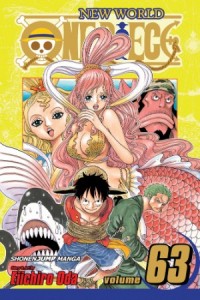
One Piece, Vol. 63

July 18, 2012 by Sean Gaffney

By Eiichiro Oda. Released in Japan by Shueisha, serialization ongoing in the magazine Weekly Shonen Jump. Released in North America by Viz.

There’s always a risk that Oda runs because he puts everything into his manga. This is not a title like Bleach, where a 5-minute fight can take three months of real time. There’s always at least ten different things going on. The difficulty is in trying to keep all that happening and not confuse or alienate the audience with too much information all at once. And in this volume, I’m afraid a lot of the time Oda doesn’t quite manage it. He’s simply trying to do too much too fast here, using too many characters that we haven’t grown to care about yet.

This is basically a volume in two halves. The first continues the melee battle on Fishman Island, as the Straw Hats get in between a civil war/coup started by Hody Jones and his brand of outlaw scum. Of course, they’re powerful outlaw scum, so King Neptune and his good guys are getting pounded. Meanwhile, Luffy has succeeded in getting Princess Shiratori outside, but this quickly leads to even more chaos. And then there’s Jimbei, who is down by the grave of the princess’ mother, feeling guilt and sadness. There are some nifty fights (Zoro is, as usual, badass) and the odd goofy comedic moment (Sanji seems to finally get better here, after briefly turning to stone (which I’m sure isn’t meant to be metaphorical at ALL.) But mostly the chaos is what’s driving everything, and this does make things incoherent at times.

Some things to note: Nami’s subplot is actually quite interesting. She’s recognized, sort of, as being an ex-member of Arlong’s crew, and certainly Jimbei’s guilt is directed quite a bit in her direction. But we don’t really see her reacting much beyond faraway looks and the occasional sweatdrop. I like to think that it’s Oda showing that Nami is finally starting to move on from her past (we get a nice page-long flashback from Nami for those readers who may have forgotten it), but also we see that she can also see things from the other side now, and is more aware of the prejudice and persecution that fish-people have suffered. Not that she’s forgiving Arlong anytime soon.

Which leads us into the big flashback. This is an unusual flashback in that it doesn’t seemingly stem from a crewmember’s past and end with them joining Luffy – unless that’s meant to be Jimbei. Instead, we meet Fisher Tiger and Queen Otohime, two characters whose dreams and ideals for their people are contrasted against each other. Fisher Tiger knows what’s right and tries to follow that, but the constant abuse of humanity against his people has ground him down. As for Queen Otohime, her naivete is contrasted with her nobility and pure stubbornness, and we learn that even if fishmen and humanity can try to move closer together, it only seems to take one person with different ideas to screw everything up. As you might guess, prejudice is not an easy fix, especially when it involves slavery.

The aftermath of the queen’s death will have to wait for the next volume, as she dies on the last page (Oda even notes there’s no room for extras this time). But it’s not going to be pretty. Oda is showing us that the world is a complex, contrasting, and sometimes horrible place. Even if he’s trying to jam it into a narrative already overstuffed with political battles and revolutions. Next volume should have a lot of fights, which will actually come as a relief after all this buildup, I think.

(Also, Oda’s response to the reader asking who the father of Makino’s child is is classic Odatroll. He clearly knows all about the Shanks/Makino shippers, and is baiting them mercilessly.)

Filed Under: REVIEWS

Alice in the Country of Clover: Cheshire Cat Waltz, Vol. 1

July 16, 2012 by Sean Gaffney

By Quin Rose and Mamenosuke Fujimaru, based on the game by Quin Rose. Released in Japan as “Clover no Kuni no Alice – Cheshire Neko to Waltz” by Ichijinsha. Released in North America by Seven Seas.

I was less than impressed with the first spinoff from the Alice books, Bloody Twins. This second one promises a much longer and more involved plotline – it’s 7+ volumes in Japan – and like the heart volumes has Alice bonding with a lot of people while clearly being romantically paired off with only one of them. Here it’s Boris, the Cheshire Cat of Alice’s dream world.

The premise, supposedly, of the ‘Clover’ world is that the player, playing Alice, did not actually pick anyone while playing the ‘Hearts’ game – which involved a love based on passion. So the world changes to the ‘Clover’ country, where Alice once again interacts with most of the cast she knows (Julius is gone, and I missed him), along with a few new characters, and tries to see if she can find a love based on ‘companionship’. The manga thus fairly unapologetically plots out one of the ‘routes’ you can take as Alice in the game.

What this means in terms of an actual manga plotline is that Alice is uprooted from her comfortable life at the amusement park (as I said, different world from the Hearts manga) and dumped into a lonely forest. Much of this first volume involves her fear and uncertainty at having her life turned upside down right after she decided to stay there and not return home to her sister. Luckily, she eventually finds Boris, and through a series of wacky situations, ends up staying at the Hatter’s place and getting a new job.

Like Bloody Twins, this manga is focused far more on the romance than the Hearts manga. Alice’s sister is mentioned once or twice, but the implication we get at the end of Hearts is never brought up. Instead, we get the Hatter, and the Twins, and above all Boris, all trying to get into Alice’s pants. I’d mentioned in Bloody Twins that there was a far more sexually suggestive air to the book, and that continues here – at one point the Hatter says ‘So maybe you’ll *stay* if I make you *come*’ and his implication is clear. Of course, this manga series – and the original games – were written for female fans, not male ones. As a result, the tendency to try to keep all the harem characters virgins so as not to offend male otaku is absent. Nothing actually happens here, but I would not be terribly surprised if Alice and Boris come together – so to speak – in the future.

This volume does tend to get a little aimless at times, and risks being as light and frothy as Bloody Twins was. The good thing, though, is that it’s not afraid to show how emotionally damaged all its cast is. Alice and Boris are both filled with doubts and unfulfilled needs, and can’t communicate well at all – part of Alice’s worries are that Boris doesn’t love her as much because he’s a cat deep down. Meanwhile, thankfully Peter White and Ace are both in this universe as well, and they’re as insane as ever – Peter is the worst stalker ever, and Ace always seems to be one step away from a mass murder spree. If the title can balance its romantic comedy elements with the discomfort at its heart, it should prove just as fun as the original.

Filed Under: REVIEWS

Sakuran

July 13, 2012 by Katherine Dacey

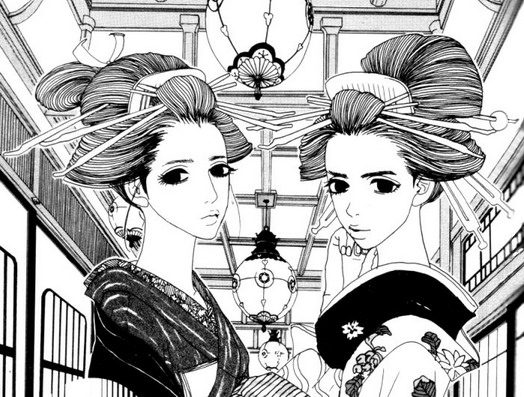
The oiran, or Japanese courtesan, is a product of seventeenth century Japan. Like the geisha who eclipsed them in popularity, the oiran were not simply prostitutes; they were companions and performers, trained in a variety of arts — calligraphy, music, flower arranging — and prized for their ability to converse with powerful men. Though confined to the official pleasure districts of Edo, Kyoto, and Osaka, they were highly visible, formally parading through the streets in elaborate costumes, attended by a retinue of maids. As a potent symbol of the new, hedonistic culture of urban Japan, the oiran were frequent subjects of ukiyo-e, or “floating world” prints. Artists such as Suzuki Harunobou emphasized the oiran’s refinement, the rarefied world in which they operated, and, in their more explicit shunga prints, the bodily pleasures they offered.

Moyocco Anno’s Sakuran presents a less romanticized image of the oiran, documenting one girl’s rise from maid to tayuu, or head courtesan. We first meet Kiyoha as an eight-year-old child: orphaned and undisciplined, she chafes against the strict rules inside Edo’s Tamagiku House, making several unsuccessful attempts to escape. Shohi, Kiyoha’s mistress, is one of the few people to recognize Kiyoha’s potential: not only is Kiyoha quick-witted, she also boasts a porcelain complexion and delicate facial features, both highly prized assets in a courtesan. Shohi’s method for grooming Kiyoha for her new role is less tutoring than hazing, however, a mixture of slaps, insults, and mind games designed to teach Kiyoha to behave in a more dignified fashion.

Anno’s artwork is uniquely suited to the subject matter: it’s both starkly ugly and exquisitely beautiful, capable of conveying the anger and suffering beneath Kiyoha’s carefully manicured appearance. When we first meet Kiyoha, for example, Anno draws her as a “dirty little turnip” with a snot-stained face, unkempt hair, and an ill-fitting yukata. Though Kiyoha undergoes a remarkable transformation over the course of the manga, we are frequently reminded of what she looked like when she first arrived at Tamagiku. Kiyoha’s face contorts into a grotesque, child-like mask whenever she feels wronged or vulnerable, and she frequently reverts to a feral posture when eating, as if her bowl might be snatched from her hands.

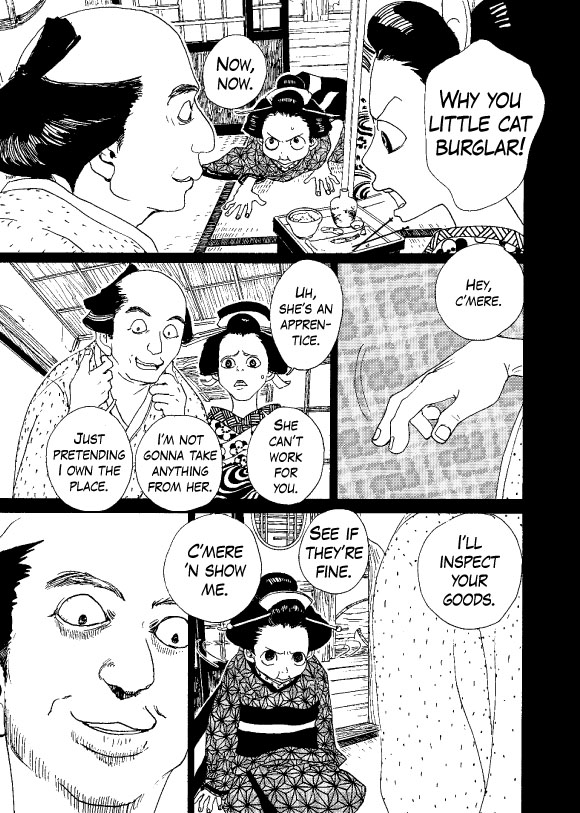
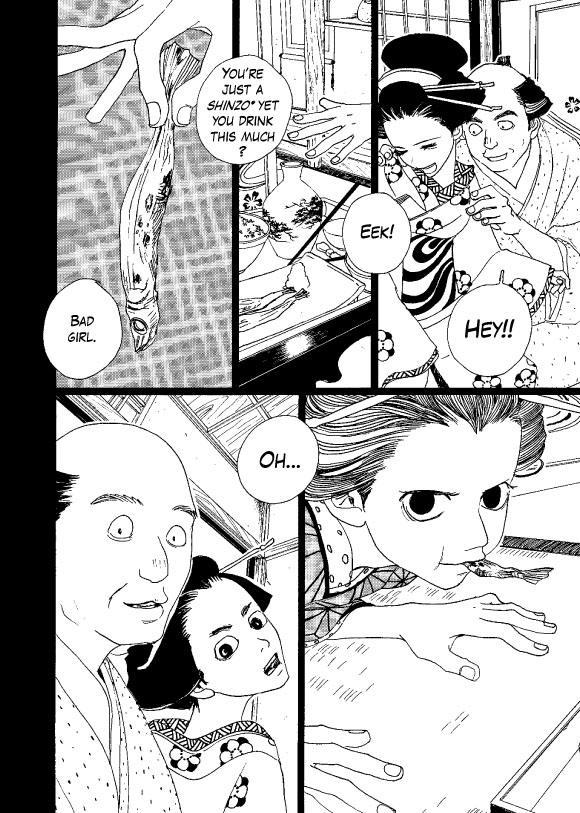
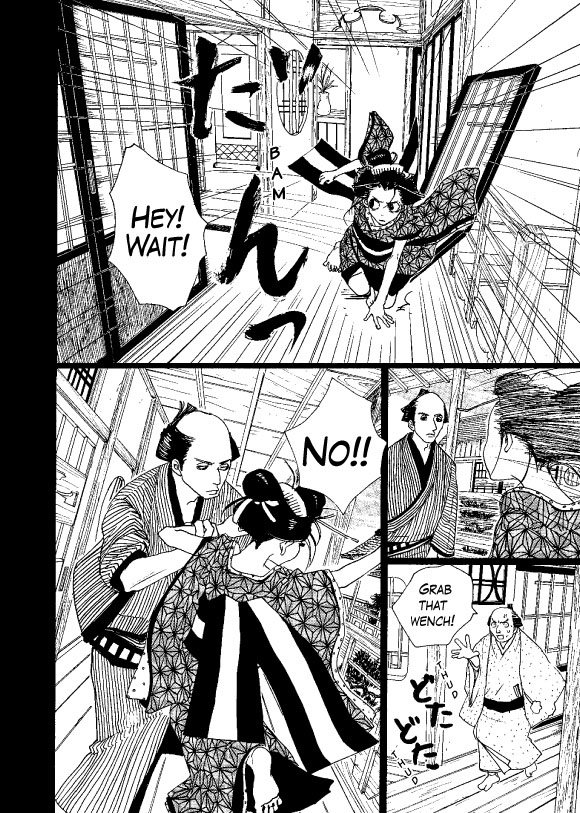
In this sequence, for example, twelve-year-old Kiyoha interrupts a transaction between a shinzu (the lowest ranking courtesan of the house) and a lecherous customer. Kiyoha’s motives for intervening are unclear, since her relationship with the shinzu in question is never carefully delineated. As she tussles with the customer, however, we see Kiyoha’s childhood survival instinct emerge in full force, overriding Shohi’s etiquette lessons:

One of the things this sequence also emphasizes is the discrepancy in power between the low-ranking courtesans and the house clientele; any violation of established protocol could result in severe reprisal. Anno infuses this scene with special urgency by using blunt, contemporary speech in lieu of the archaic language that verisimilitude might demand. It’s a welcome departure from the tortured, Fakespearian dialogue that plagues the otherwise brilliant Ooku: The Inner Chambers, focusing the reader’s attention on visual signifiers of class and gender — eye contact, body language, clothing — rather than honorifics and awkward syntax.

Perhaps Anno’s greatest achievement is her ability to capture her characters’ physical beauty and sensuality without reducing them to objects. Even the most erotic images are carefully framed as business transactions: the dialogue reminds us that the oiran are performing for their customers, creating an illusion of sexual and emotional intimacy for the sake of money, while their customers’ grim expressions and sweaty bodies remind us of their determination to get the most bang for the buck (so to speak).

If Sakuran sounds like a hectoring treatise on prostitution, rest assured it’s not. Anno creates a vibrant, fascinating world, teeming with people from every walk of life. Though her female characters have limited agency, they nonetheless find opportunities to exert influence over their customers, improve their social standing, and choose their own lovers.

Kiyoha embodies all the contradictions and complexities of her environment: she’s impetuous, competitive, and unmoved by her peers’ hardships, yet she has a great capacity for feeling — and transcending — pain. That Kiyoha is, at times, a repellant figure, does not diminish her appeal as a character; we appreciate the mental toughness that her job demands, and admire her efforts to push back against its limits. It seems only fitting that the story ends not with the outcome that a modern reader might choose for this fierce woman, but with one that reflects the heroine’s own clear-eyed understanding of what she is. Highly recommended.

Review copy provided by Vertical, Inc.

SAKURAN • BY MOYOCCO ANNO • VERTICAL, INC. • 308 pp. • RATING: MATURE (VIOLENCE, LANGUAGE, AND SEXUAL NUDITY)

Filed Under: Manga, Manga Critic, REVIEWS Tagged With: Moyocco Anno, Oiran, Sakuran, vertical

Olympos

July 12, 2012 by Sean Gaffney

By Aki. Released in Japan by Ichijinsha, serialized in the magazine Comic Zero-Sum. Released in North America by Yen Press.

Yen Press has occasionally taken a flyer on short series that they can release as omnibuses, things that are somewhat off the beaten path. Sometimes this works out well (Dragon Girl), sometimes not so well (Sasameke). Olympos, a josei series about a petulant god and his captive human, seems to fall somewhat between those two camps, though I am ultimately pleased to have read it.

After a very well-handled fakeout of an opening, where we get teased about who the actual protagonist is supposed to be, things settle down. Ganymede, who people may recall from mythology, has been taken from his life and brought to a beautiful yet empty ruin, where he lives in stasis and occasionally has cross words with the god who has orchestrated all this, Apollo. The rest of the omnibus features Ganymede’s interaction with these gods, and Apollo’s attempts to amuse himself, which ultimately end up telling us more about the latter than the former.

The art style used here is very pretty and shoujo-esque. Deliberately meant to evoke androgyny, I found myself throughout the series forgetting that I wasn’t dealing with two women here. Even Poseidon, who is supposed to be big, burly and the masculine ideal, has a face that is very female. Of course, gender doesn’t really matter here – there’s no actual romance, except for the false start with Heinz and his doomed love. Still, the feminine faces are another way of showing that we’re dealing mostly with gods rather than man.

Easily my favorite part of the story was one that did not involve Ganymede at all. Instead, we flashback to a time when Apollo saw a temple being built in his honor, and began to interact with the sacrifice that had been offered to him. He refused to accept her, so she essentially hung around until he did. Iris, the sacrifice, is portrayed as a bit of a bubblehead, but her sweet and earnest devotion is rather cute, and you enjoy seeing Apollo open up to her, even if this leads to an inevitable conclusion.

By contrast, the weak point in the volume is Ganymede, who at the time we meet him has mostly grown rather resigned and bitter about his fate. There’s nothing particularly wrong with his conversations with Apollo, which tend towards the philosophical in regarding the nature of man and gods, but he does not stand out the way that the other gods (and Iris) do. Ganymede may be the focus of the book, but the show is clearly Apollo’s to steal.

I always enjoy seeing Japan dealing with Western mythology, and this is pretty well done. There’s a lot to think about here, involving Apollo’s relationship with Artemis, Poseidon’s desperate attempts at social climbing, and Zeus hovering above all, as unknowable to the other gods as they are to mankind. I do wish that the author had found a better way to go about conveying these ideas besides having everyone sit around and blithely discuss it. Don’t get me wrong, the discussions can be fascinating, but the utter lack of forward movement – even in the end, the manga simply stops rather than reaching a climax – makes the whole thing rather dry and dull, a bit like a textbook of Ancient Greece.

Filed Under: REVIEWS

The Flowers of Evil, Vol. 2

July 10, 2012 by Katherine Dacey

Do you remember the first time you tried to impress someone on a date? I do: I was fifteen, and thrilled that an older boy had invited me to dinner. (He drove a Mazda two-seater and quoted lines from Wim Wenders’ Wings of Desire, which, in 1988, made him a god.) My strategy for wooing him was to describe, in excruciating detail, the nuances of Igor Stravinsky’s Petrushka, from the opening tableau to the final notes. I was convinced that if he could see my passion for something as dark and powerful as that ballet, he’d understand who I really was, and fall in love with that person. (Needless to say, we didn’t go on a second date.)

Kasuga, the earnest hero of The Flowers of Evil, finds himself in a similar situation at the beginning of volume two: Saeki, the classmate whom he’s loved from afar, has finally consented to go on a date with him. As they wander the aisles of his favorite bookstore, Kasuga confesses to Saeki that Baudelaire’s Fleurs du Mal “changed how I see the world. I felt as though I’d been an ignorant fool my whole life.”  It’s a cringe-inducing moment — not because Saeki mocks Kasuga, or recoils from him, but because Kasuga has exposed himself in such a clumsy, sincere, and godawful manner.

That sincerity is nearly his undoing. Throughout the volume, Nakamura goads Kasuga about Saeki, reacting with fury when Kasuga asks Saeki to enter into a “pure, platonic relationship” with him: how dare he pretend to be normal? Nakamura then redoubles her efforts to reveal Kasuga’s “perversion,” currying favor with Saeki while pouring poison in Kasuga’s ear. But to what end? The final scene of the manga offers some interesting, and surprising, hints at Nakamura’s true agenda while suggesting that Kasuga might, in fact, have more in common with her than he’d care to admit. I won’t reveal what happens, but will venture to say that “orgiastic” is an apt description of those last glorious, frenzied pages.

Review copy provided by Vertical, Inc.

THE FLOWERS OF EVIL, VOL. 2 | BY SHUZO OSHIMI | VERTICAL, INC. | 168 pp.

Filed Under: Manga, Manga Critic, REVIEWS Tagged With: Flowers of Evil, Shonen, Shuzo Oshimi, vertical

  • « Go to Previous Page
  • Page 1
  • Interim pages omitted …
  • Page 280
  • Page 281
  • Page 282
  • Page 283
  • Page 284
  • Interim pages omitted …
  • Page 346
  • Go to Next Page »
 | Log in
Copyright © 2010 Manga Bookshelf | Powered by WordPress & the Genesis Framework